
C.K.Schneid.
Description
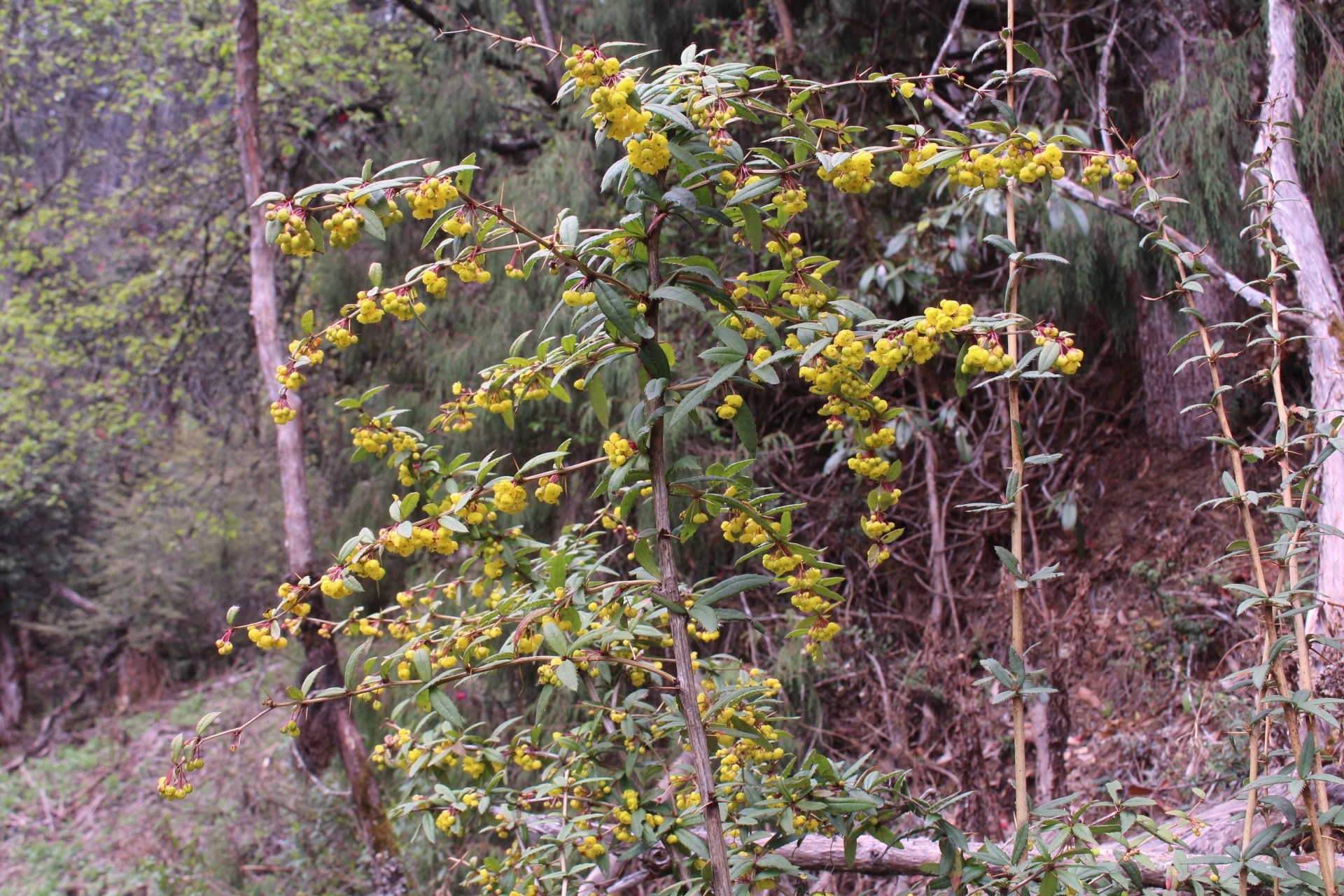
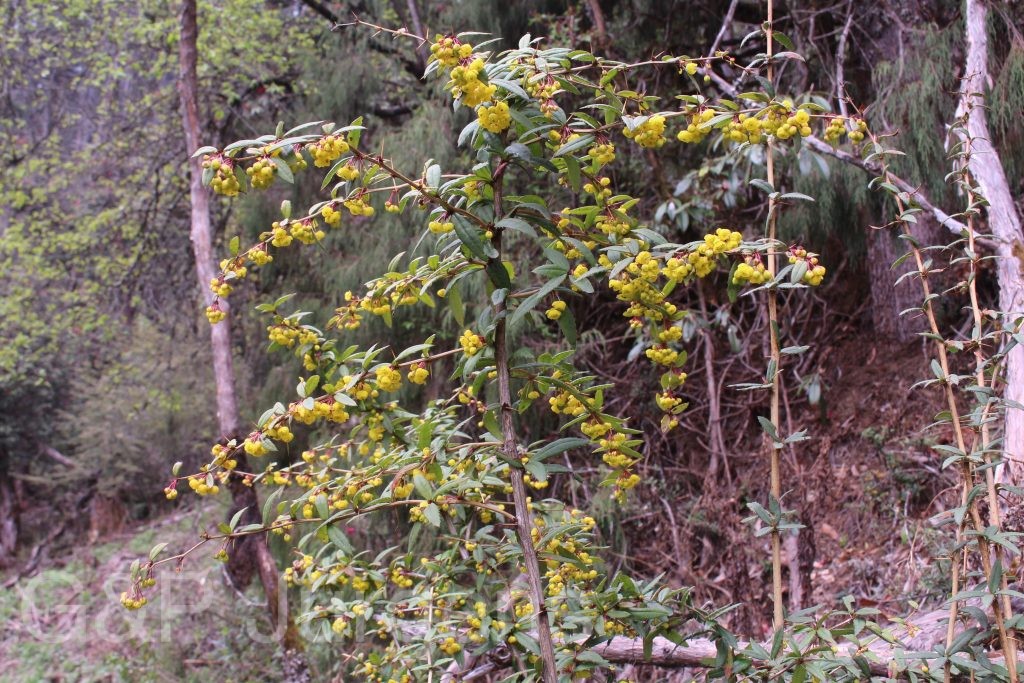
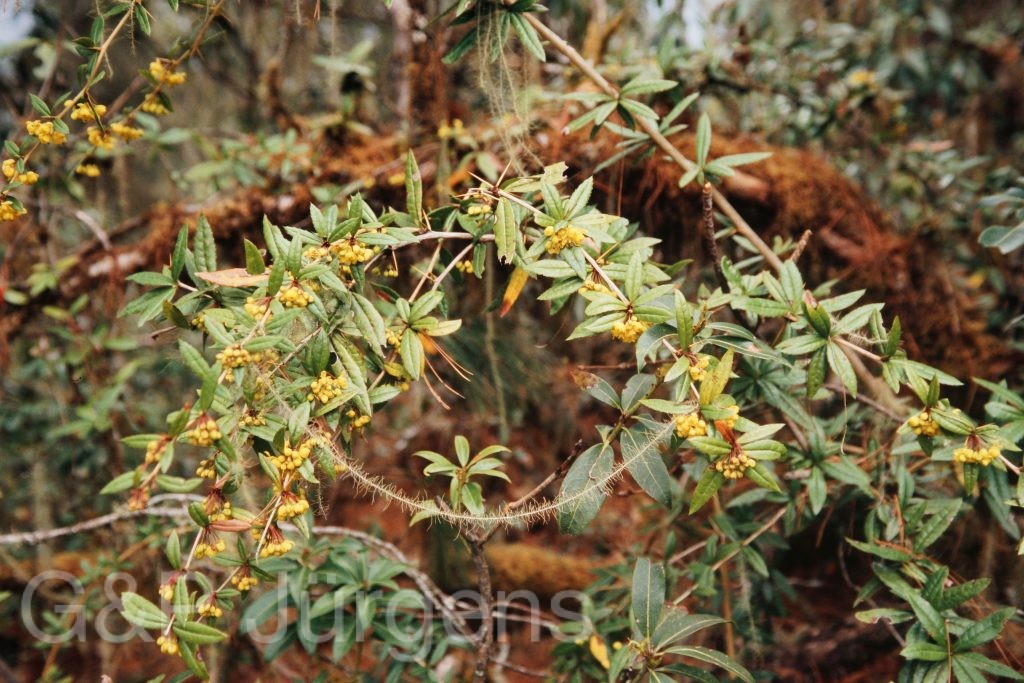
Berberis praecipua is an eastern Himalayan barberry centred on Bhutan and adjacent India, Nepal and southern China, with about 39 occurrences (the additional records from Canada and Britain representing cultivated or herbarium material). It grows in temperate forest margins, open hillsides, scrub and clearings, typically between roughly 2300 and 3300 m. The photographed plants from Gogona at 3000 m (May) and Paro at 2300 m (April) in Bhutan illustrate its spring flowering across this montane belt, where it occupies sunny, well-drained slopes within and around mixed conifer and broad-leaved forest.
It is a deciduous, much-branched spiny shrub with terete, often reddish-brown young shoots armed with three-fid spines derived from modified leaves. The foliage leaves are clustered on short shoots in the axils of the spines, obovate to oblanceolate, with an entire to spinulose-toothed margin, glaucous beneath. The flowers are yellow, borne in pendulous racemes or fascicles, each with the typical Berberis arrangement of six sepals in two whorls, six petals each bearing two basal nectariferous glands, and six stamens with sensitive filaments and valvate anther dehiscence. The ovary is superior and unilocular, ripening into an ellipsoid to oblong berry that is red to purplish-black and often pruinose, containing few seeds.
Berberis is a large, taxonomically intricate genus in which the Himalayan deciduous species form a difficult complex separated on fruit, leaf and inflorescence characters; B. praecipua C.K.Schneid. is the accepted name. The bright flowers are insect-pollinated, with the touch-sensitive stamens promoting pollen transfer, while the fleshy berries are dispersed by birds (ornithochory). As a relatively localised eastern Himalayan endemic it has not been formally assessed but appears locally frequent within its range.
Author: C.K.Schneid. · Sources: POWO (Kew), GBIF, Flora of China Vol. 19, Flora of Bhutan Vol. 1, Flora of Nepal, Ahrendt Berberis and Mahonia: A Taxonomic Revision