Tag:

Summer

Gagea flavonutans

by GP Jürgens

(H.Hara) Zarrei & Wilkin
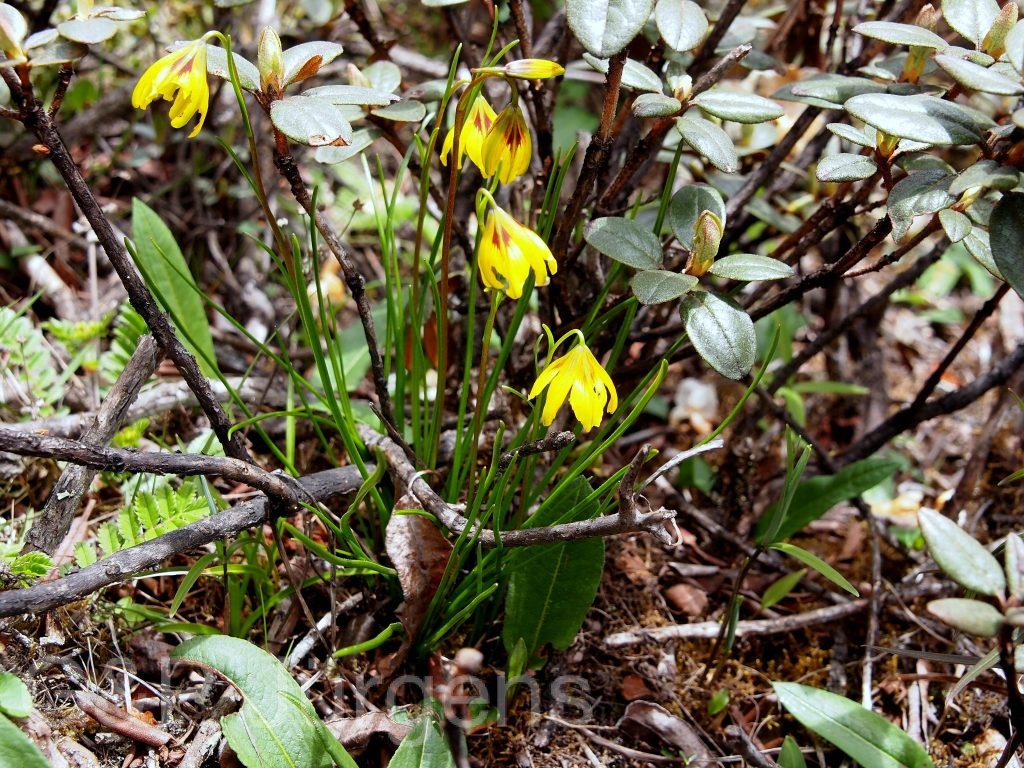
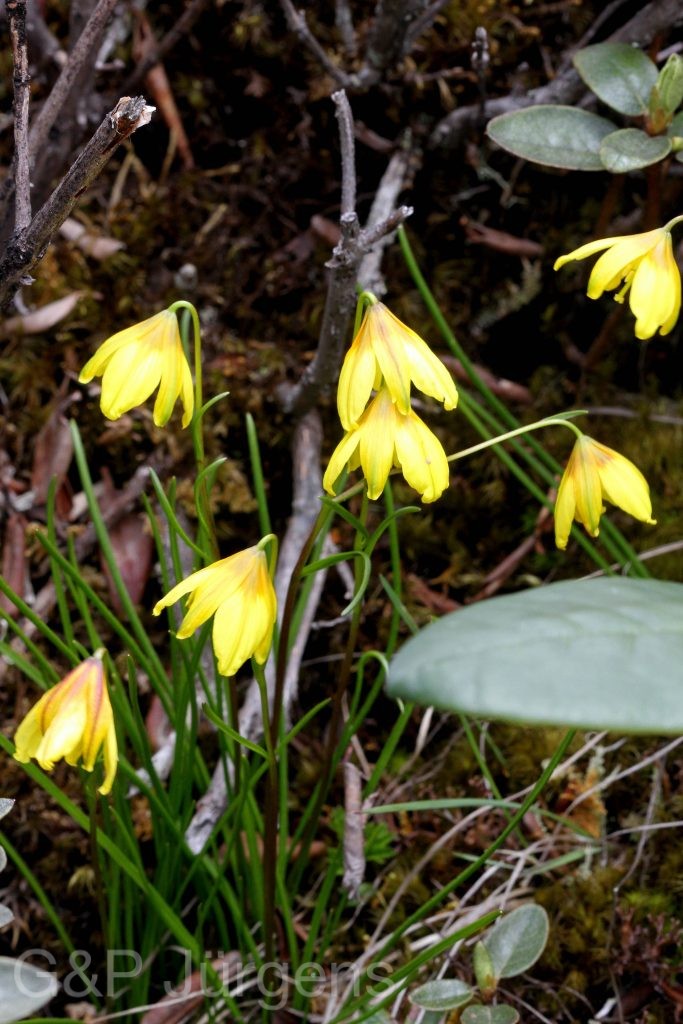
Sikkim2011 100
Sikkim Chopta-valley 4200m, June
Sikkim2011 120
Sikkim Chopta-valley 4200m, June

Description

Gagea flavonutans is a small alpine bulbous geophyte of the eastern Himalaya, recorded from Nepal, India, China, Bhutan and Myanmar, with about 104 georeferenced occurrences clustered along the high inner ranges. It grows in open alpine turf, on grassy and stony slopes, screes and moist ground at the edge of melting snow, chiefly between roughly 3800 and 4500 m. The plant was photographed in the Sikkim Chopta Valley at 4200 m in June, an elevation and season characteristic of the genus, whose members flush and flower rapidly in the brief interval following snowmelt before the soil dries.

It is a slender, hairless perennial arising from one or few ovoid tunicate bulbs. There are typically two narrowly linear basal leaves, channelled and grass-like, considerably exceeding the short scape. The inflorescence is few-flowered, the flowers nodding as the epithet flavonutans implies. The perianth comprises six free, narrowly elliptic to oblong tepals, yellow within and often greenish or purplish-tinged on the outer surface; the six stamens have slender filaments and small anthers, and the superior tricarpellate ovary bears a single style. The fruit is a small loculicidal capsule containing numerous seeds.

Gagea (Liliaceae) is a large, taxonomically difficult Old World genus in which species are delimited by bulb structure, leaf number and section, and floral orientation; G. flavonutans, originally described by Hara, was transferred to Gagea in the molecular reassessment by Zarrei and Wilkin that absorbed the segregate Lloydia into a broadened Gagea. Its nodding yellow flowers and high-Himalayan range distinguish it within this complex. As a short-statured snowbed geophyte it is sensitive to changes in snow cover and grazing, though it remains locally frequent and is not currently regarded as threatened.

Author: (H.Hara) Zarrei & Wilkin · Sources: POWO (Kew), GBIF, Flora of China, Annotated Checklist of the Flowering Plants of Nepal, Zarrei & Wilkin phylogenetic revision of Gagea
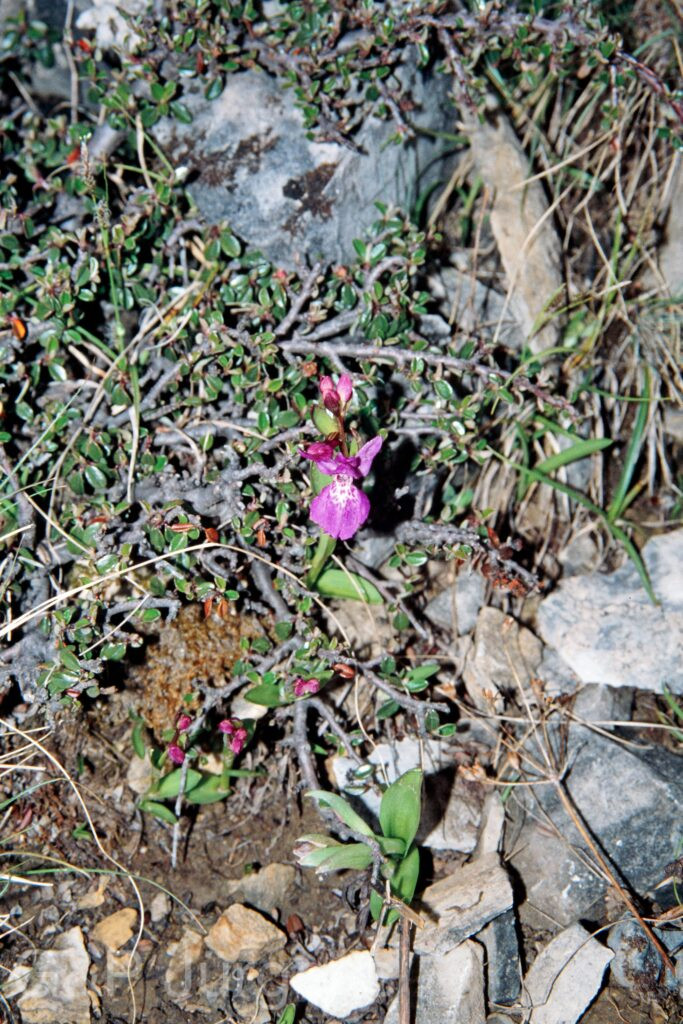
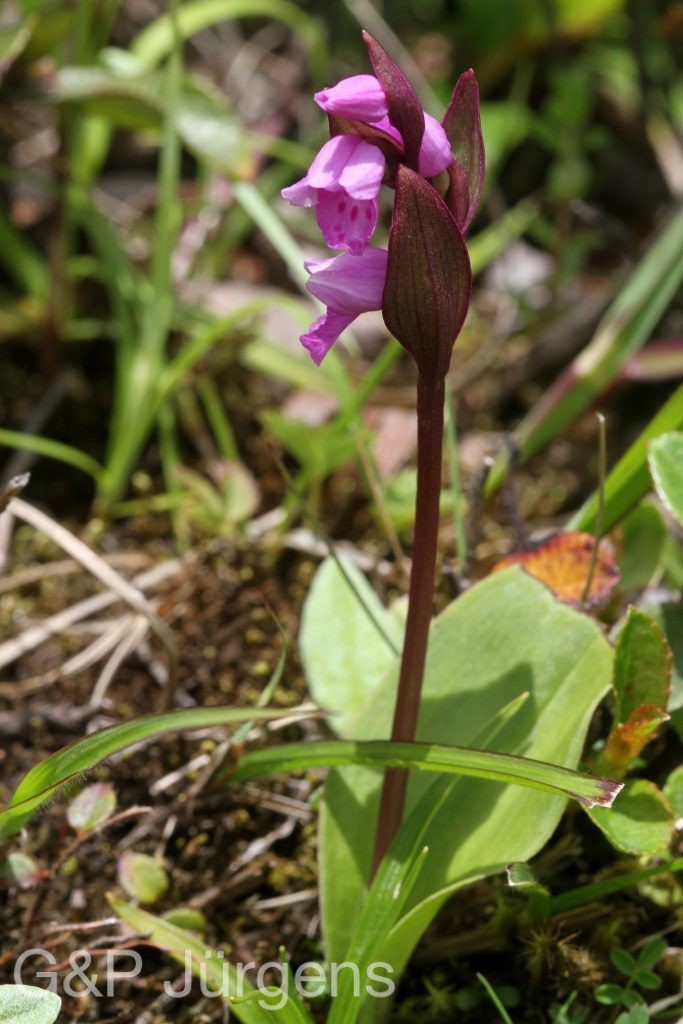
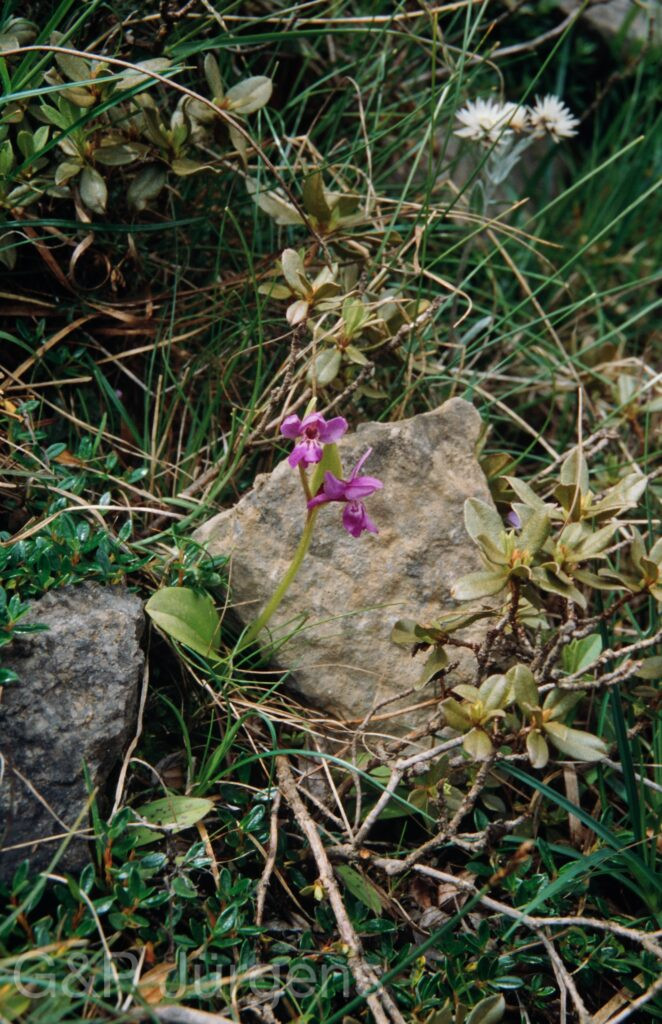
(Maxim.) S.C.Chen, P.J.Cribb & S.W.Gale

Nepal 99 34 ergebnis
West-Nepal Chere 3000m June

Description

Galearis roborovskii is a terrestrial orchid distributed across the high mountains of Central and East Asia, with georeferenced records documented from China, Nepal, Bhutan, India, Myanmar, Japan and Russia, comprising about 154 occurrences in GBIF. It is a plant of cool, moist alpine and subalpine habitats, favouring open meadows, grassy slopes, streambanks and forest margins where snowmelt maintains soil moisture through the growing season. The species generally occurs between roughly 2500 and 4000 m, and the population photographed at Chere in West Nepal at about 3000 m in June, at the onset of the monsoon flowering season, falls within this montane belt.

It is a small, glabrous, tuberous geophyte arising from ovoid to oblong fleshy tuberoids. The slender, erect stem bears one or two basal leaves that are oblong-elliptic to lanceolate, sheathing at the base and often fleshy. The inflorescence is a short, few-flowered terminal raceme subtended by leaf-like bracts. The flowers are purple to rose-pink, with the dorsal sepal and petals converging to form a loose hood (galea) over the column; the lateral sepals spread or are reflexed, and the trilobed labellum is deflexed and produced basally into a slender, cylindric to clavate spur. The fruit is a small erect dehiscent capsule releasing abundant dust-like seeds.

The genus Galearis was resurrected and recircumscribed on molecular grounds, and this species was transferred from Orchis by S.C.Chen, P.J.Cribb and S.W.Gale; it sits within subtribe Orchidinae. Like most temperate terrestrial orchids it depends on mycorrhizal fungi for germination and establishment, rendering it sensitive to grazing, trampling and habitat disturbance. Though presently widespread and not formally assessed as threatened across its broad Himalayan to Sino-Russian range, localised populations warrant monitoring against alpine land-use pressures.

Author: (Maxim.) S.C.Chen, P.J.Cribb & S.W.Gale · Sources: POWO (Kew), GBIF, Flora of China, Flora of Bhutan, Flora of Nepal, Pearce & Cribb The Orchids of Bhutan

(Lindl.) P.F.Hunt

Sikkim2011 207
Sikkim Lachung 3100m, June
Nepal 99 809 ergebnis
West-Nepal Baga-La-Phedi 4300m, July

Description

Galearis spathulata is a small terrestrial orchid of the high Himalaya and the mountains of western China, recorded from China, India, Nepal, Bhutan and Myanmar, with over 500 occurrences in GBIF. It is a plant of moist alpine and subalpine meadows, open Rhododendron and juniper scrub, grassy slopes and rocky turf, generally between about 3,000 and 4,500 m. The illustrated gatherings span this range, from Lachung in Sikkim at around 3,100 m in June to Baga-La-Phedi in West Nepal at about 4,300 m in July, where the species flowers through the early summer monsoon.

It is a dwarf, glabrous perennial herb arising from slender, fleshy root-tubers and bearing usually one or two basal, spathulate to oblong leaves that taper to a sheathing base. The short, erect stem terminates in a few-flowered raceme of small purplish-pink flowers, each subtended by a bract. The dorsal sepal and petals converge to form a hood over the column, the lateral sepals spreading; the labellum is entire to obscurely lobed, directed forward and produced at the base into a short, cylindrical to saccate spur. The fruit is an erect, ribbed capsule releasing dust-like seeds.

Galearis is a small holarctic-temperate to Sino-Himalayan genus segregated from Orchis, and G. spathulata is distinguished by its spathulate basal leaves and short-spurred, hooded flowers. Pollination is by insects, with seedling establishment dependent on mycorrhizal association, as in all orchids. Widespread and locally common across the alpine Himalaya, the species is not regarded as threatened, although, being an orchid, it falls under the general CITES Appendix II listing for the family.

Author: (Lindl.) P.F.Hunt · Sources: POWO (Kew), GBIF, Flora of China, Flora of Bhutan, Annotated Checklist of the Flowering Plants of Nepal, Pridgeon et al. Genera Orchidacearum

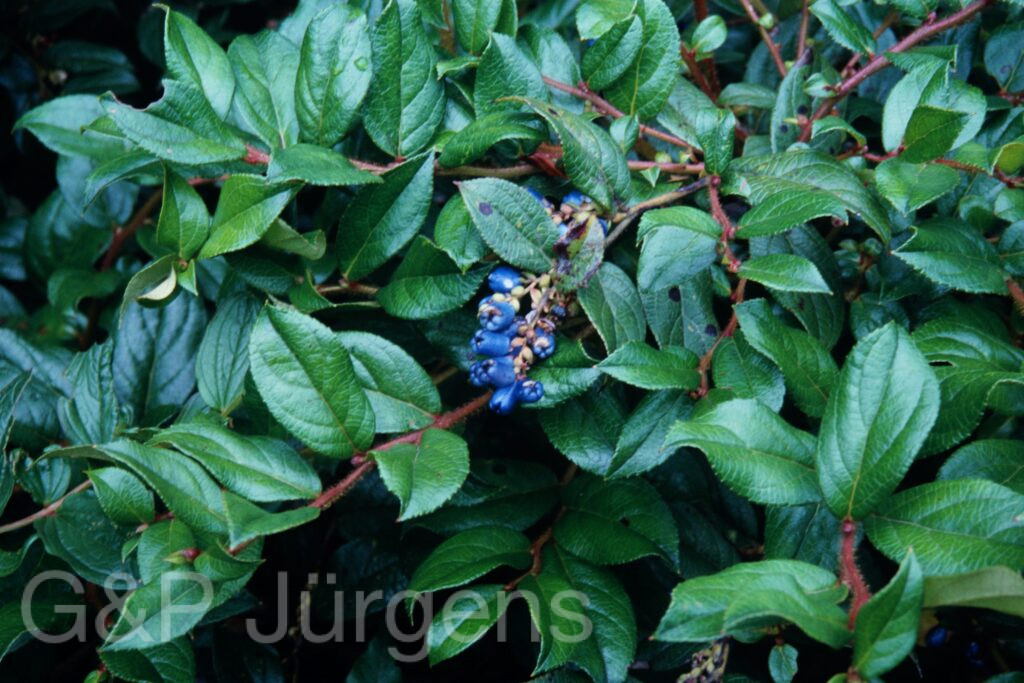
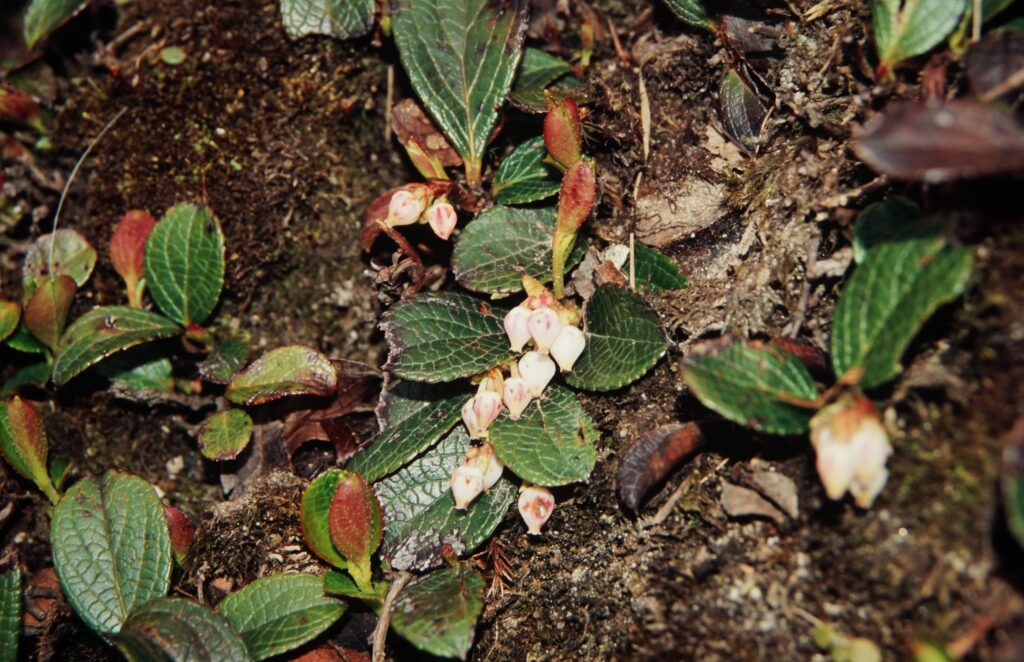
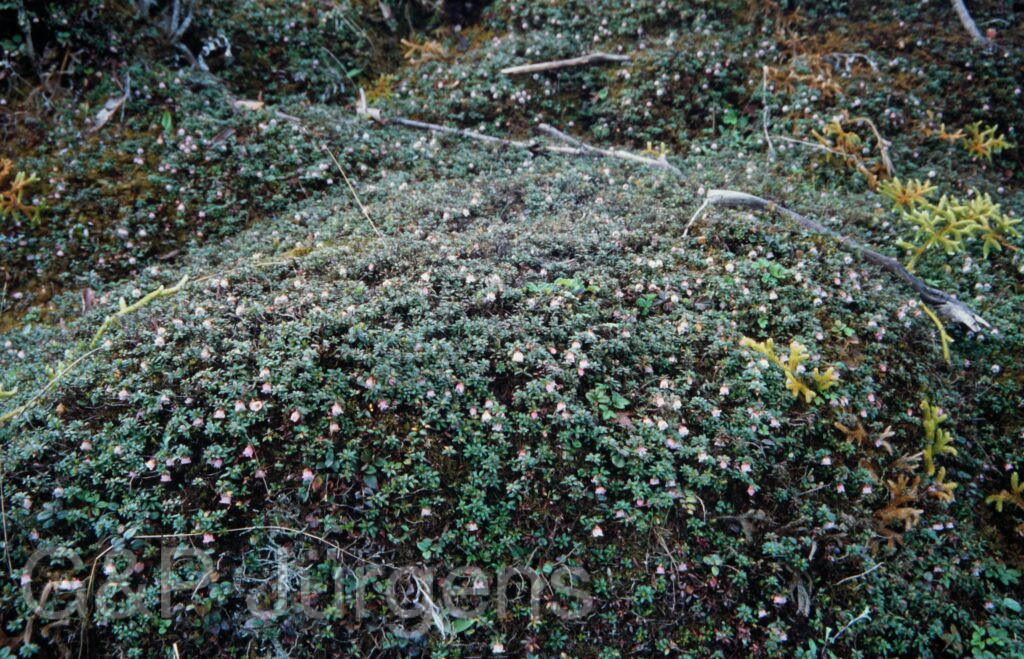
C.B.Clarke

Sikkim2003 409 P569
Sikkim Zemu Valley 3400m August

Description

Gaultheria hookeri is an evergreen shrub native to the eastern Himalayas and extending into southwestern China and northern Myanmar. Its range encompasses Nepal, northeast India (Sikkim, Arunachal Pradesh), Bhutan, Myanmar, and China (Yunnan, Xizang, Sichuan). The species is a characteristic element of upper temperate to subalpine forests, occurring at elevations of 2,500–4,000 m in Rhododendron-Abies forests, bamboo thickets, and along stream margins. It is well documented from the Zemu Valley in Sikkim at 3,400 m, where it can be found growing in the understorey of dense montane forests during August.
Gaultheria hookeri forms a densely branched, spreading to erect shrub 0.3–1.5 m tall. The young branchlets are setose-hispid with rusty brown hairs. The leaves are alternate, coriaceous, ovate to elliptic-ovate, 4–10 cm long, with a serrate to serrulate margin, the veins impressed above and prominent beneath. The flowers are borne in short axillary racemes; each flower has a campanulate to urceolate corolla, white to pinkish, 4–6 mm long. The calyx is five-lobed and becomes fleshy and enlarged in fruit, enclosing the capsule to form a conspicuous, globose, fleshy pseudoberry that is blue to deep purple-black at maturity, 8–12 mm in diameter.
Described by C.B. Clarke and named in honour of Sir Joseph Dalton Hooker, who extensively explored the Sikkim Himalaya, G. hookeri is one of the more robust and widely collected species in the genus across the eastern Himalayan region. With over 750 occurrence records in GBIF, it is comparatively well documented. The species is of ecological importance as a food source for montane birds and mammals that disperse its fleshy fruits. Its aromatic, wintergreen-scented foliage, rich in methyl salicylate, is occasionally used in traditional medicine. The species has also been introduced to cultivation in botanical gardens in Europe and North America.

Author: C.B.Clarke · Sources: POWO (Kew), GBIF, Flora of Bhutan Vol. 2, Flora of China Vol. 14, Hooker: Flora of British India Vol. 3 (1882)

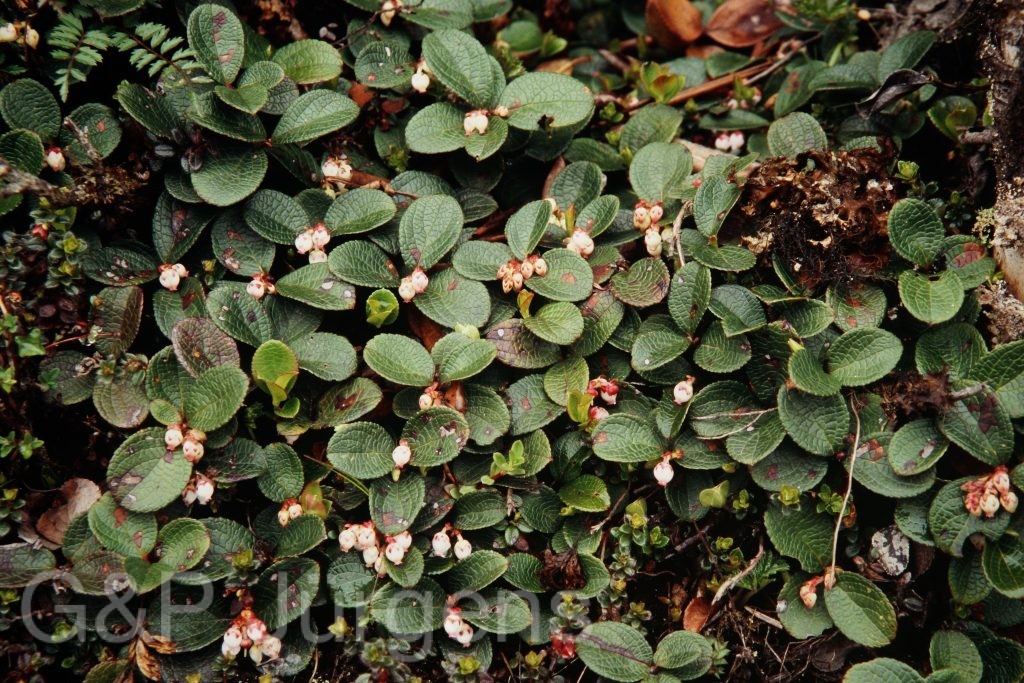
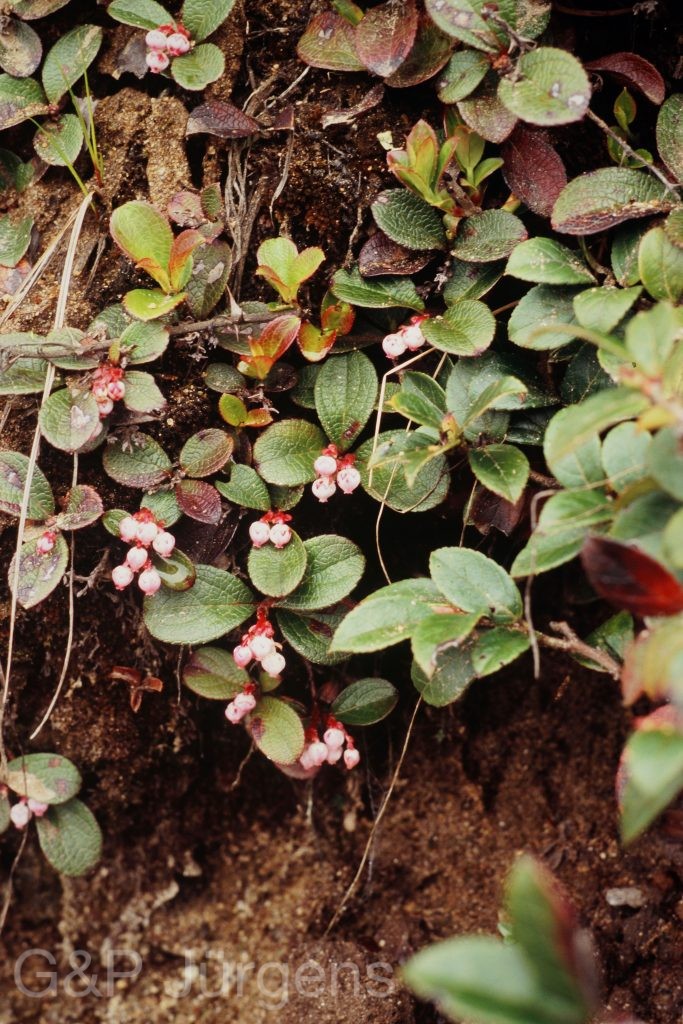
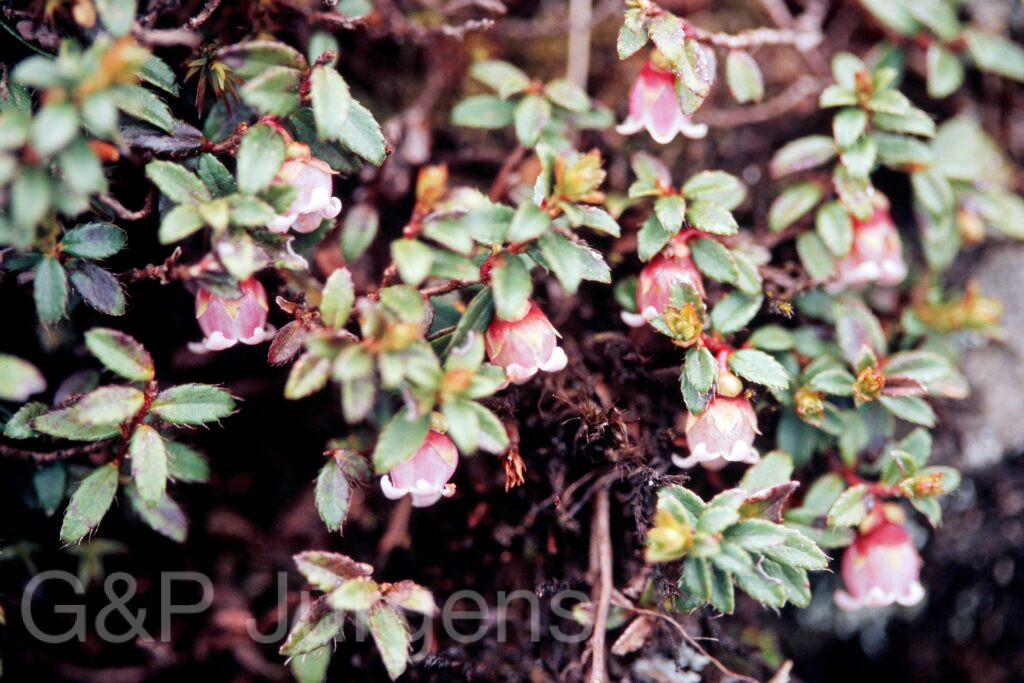
Hook.f. & Thomson ex Miq.

Bh09 327 P536
Bhutan Tumching, 3700m June
Bh09 328 G535
Bhutan Tumching, 3700m June
Sikkim 2006 130 ergebnis
India West-Bengal, Molley 3650m, May

Description

Gaultheria pyroloides is a dwarf evergreen shrublet of the eastern Himalaya and East Asia, with a notably disjunct northern range: its 652 georeferenced records span Japan (JP), China (CN) and the Russian Far East (RU) as well as the core Himalayan countries of Nepal (NP), India (IN) and Bhutan (BT). It is a plant of cool, humid, high-montane to subalpine habitats, growing on mossy banks, in the floor of conifer and rhododendron forest, on humus-rich rocks and at forest margins, generally between about 3000 and 4000 m. The plants documented at Tumching in Bhutan at 3700 m in June and at Molley in West Bengal at 3650 m in May are typical of these shaded, moss-rich montane situations.

It is a low, creeping to ascending undershrub forming mats, with slender, often reddish-bristly stems rooting at the nodes. The leaves are crowded toward the stem tips, more or less rosulate, obovate to broadly elliptic, leathery, glossy, with a finely serrulate, bristle-margined edge and a Pyrola-like aspect that gives the epithet pyroloides. The flowers are usually few, axillary or in short terminal racemes, the corolla urceolate to campanulate, white or pink-flushed, with a five-lobed limb. As in many of its relatives the calyx becomes fleshy and accrescent in fruit, enclosing or partly enclosing the small capsule to form a berry-like, blue to blue-black false fruit attractive to birds.

Gaultheria (Ericaceae, subfamily Vaccinioideae) is exceptionally diverse in the Himalaya, and the prostrate, rosette-leaved species such as G. pyroloides occupy the dwarf, ground-hugging end of the genus's growth-form spectrum. The wide but fragmented distribution into temperate East Asia points to a once more continuous circum-montane forest range. The species is not regarded as threatened, but its reliance on undisturbed, moist forest understorey renders it sensitive to disturbance.

Author: Hook.f. & Thomson ex Miq. · Sources: POWO (Kew), GBIF, Flora of Bhutan, Flora of China, Flora of Japan, Airy Shaw and Fritsch revisions of Gaultheria (Ericaceae)

(C.B.Clarke) Airy Shaw

Bh09 338 P551
Bhutan Jakar 2600m, June

Description

Gaultheria semi-infera is an Eastern Himalayan and Sino-Himalayan shrub centred on the eastern Himalaya and south-central China, with verified records from China (CN) and India (IN); the relatively modest pool of about 87 georeferenced occurrences reflects its restricted montane range, the records attributed to Canada (CA) and Spain (ES) representing cultivated or herbarium-based outliers rather than naturalised populations. It occupies the temperate to subalpine belt, typically between 2000 and 3500 m, growing in open coniferous and broad-leaved forest, on forest margins, among rhododendron scrub and on rocky banks. The plant photographed near Jakar in central Bhutan at about 2600 m in June is characteristic of this habitat, where the species flowers as the early monsoon develops.

It is a low, evergreen, much-branched shrub with wiry, often reddish-bristly young stems. The leaves are alternate, coriaceous, ovate to elliptic, serrulate or bristle-toothed at the margin, glossy dark green above and paler beneath, with the midrib and veins frequently set with stiff appressed bristles. The flowers are borne in short axillary racemes; each has a five-lobed campanular to urceolate corolla, white tinged pink, with the calyx becoming fleshy and accrescent in fruit. The diagnostic feature is the partly inferior ovary, from which the epithet semi-infera derives, so that the swelling fruit is a fleshy berry-like capsule, half-enclosed by the succulent calyx and ripening blue to blue-black.

The genus Gaultheria (Ericaceae, subfamily Vaccinioideae) is taxonomically complex in the Himalaya, where numerous species intergrade and hybridise. The semi-inferior ovary places this species in a distinctive group bridging the capsular and baccate fruit types within the genus. Like its relatives it produces aromatic, methyl-salicylate-bearing foliage and the ripe fruits are eaten by birds, aiding dispersal. Though not formally assessed as threatened, its dependence on intact temperate forest makes it sensitive to logging and grazing pressure across the Himalayan arc.

Author: (C.B.Clarke) Airy Shaw · Sources: POWO (Kew), GBIF, Flora of Bhutan, Flora of China, Airy Shaw revision of Himalayan Gaultheria, Lu & Fritsch monographic studies of Gaultheria (Ericaceae)

Royle

Nepal 2001 411 ergebnis ergebnis
Nepal (Gorkha) Barpak 3050m, May
Garh 07 165 ergebnis
India Garhwal Kinkhola 3550m, June

Description

Gaultheria trichophylla is a low, mat-forming dwarf shrub of the high Himalaya, occurring across Nepal, northern India, Bhutan, Pakistan, Myanmar and southwestern China, with disjunct or introduced records from New Zealand, Canada, Chile and France; GBIF documents some 611 collections. It is a plant of open alpine and subalpine slopes, rhododendron scrub margins and humus-rich turf between about 3000 and 4500 m. The photographed material was gathered in central Nepal at Barpak (Gorkha) near 3050 m in May and in the Garhwal Himalaya at Kinkhola around 3550 m in June, on the moist, well-drained, peaty soils it favours under a cool monsoonal climate.

The plant forms compact, prostrate to ascending mats from slender, wiry, much-branched stems that are finely bristly-hairy and root at the nodes. The leaves are small, alternate, crowded, ovate to elliptic, leathery and shining, with a finely toothed, bristly-ciliate margin. Flowers are solitary in the leaf axils, the corolla urceolate to broadly campanulate, pink to pale rose, five-lobed, with a persistent calyx that becomes fleshy in fruit. The fruit is a depressed-globose capsule enclosed by the swollen, berry-like, bright blue calyx, a diagnostic generic feature aiding bird dispersal.

The genus Gaultheria (Ericaceae) is centred on eastern Asia and the Americas, and G. trichophylla belongs to a group of small-leaved alpine species in which the showy fleshy calyx replaces a true berry. Like its relatives it is calcifuge, demanding acidic substrates and forming ericoid mycorrhizal associations. It is widespread and locally abundant across its core Himalayan range and not regarded as threatened.

Author: Royle · Sources: POWO (Kew), GBIF, Flora of China Vol. 14, Flora of Bhutan Vol. 2, Flora of Nepal, Flora of Pakistan, Airy Shaw and Sleumer monograph of Asiatic Gaultheria

Buch.-Ham. ex D.Don

Garh 07 393 ergebnis
India Garhwal Meggu Kichatti 3200m, June 
Garh 07 420 ergebnis
India Garhwal Khiar Kutti 3900m, June

Description

Gentiana capitata is a Himalayan annual gentian distributed across Nepal, India, Bhutan, China and Pakistan and into Myanmar; GBIF records about 206 occurrences spanning the central and eastern Himalaya. It grows on open alpine and subalpine slopes, grassy meadows, terraced banks and pastures, generally between about 2500 and 4000 m. The photographed plants come from Garhwal, India, at Meggu Kichatti (3200 m) and Khiar Kutti (3900 m), both in June, a setting typical of this small monsoon-season gentian, part of the seasonal herb flora of the western Himalayan high meadows in early summer.

The species is a slender annual with erect, often few-branched, quadrangular stems arising from a fine root system. The leaves are opposite, sessile, ovate to lanceolate, the basal pairs sometimes forming a loose rosette. The flowers are clustered into a dense, head-like or capitate terminal cyme that gives the species its name, sometimes with additional flowers in the upper axils. Each flower has a tubular to funnel-shaped, pale blue to bluish-mauve corolla with five spreading lobes and small plicate folds between them; the calyx is tubular with five teeth. The fruit is a stalked, two-valved capsule releasing numerous minute seeds.

Gentiana capitata Buch.-Ham. ex D.Don belongs to the annual, small-flowered Himalayan section of the genus characterised by capitate inflorescences and plicate corollas. Widespread and locally common across the Himalaya, it tolerates grazed and disturbed ground and is of no conservation concern. As an annual it depends on regular seed production and the brief monsoon season, and it is a familiar component of the high-meadow flora pollinated by insects drawn to its blue flower clusters.

Author: Buch.-Ham. ex D.Don · Sources: POWO (Kew), GBIF, Flora of China, Flora of Nepal, Halda: The Genus Gentiana

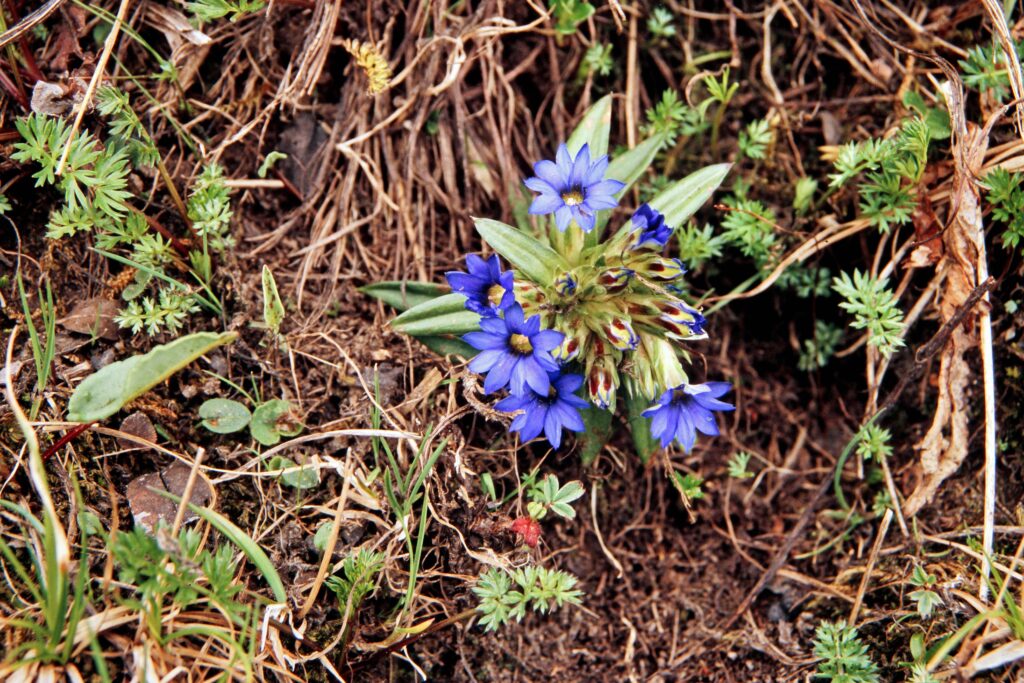
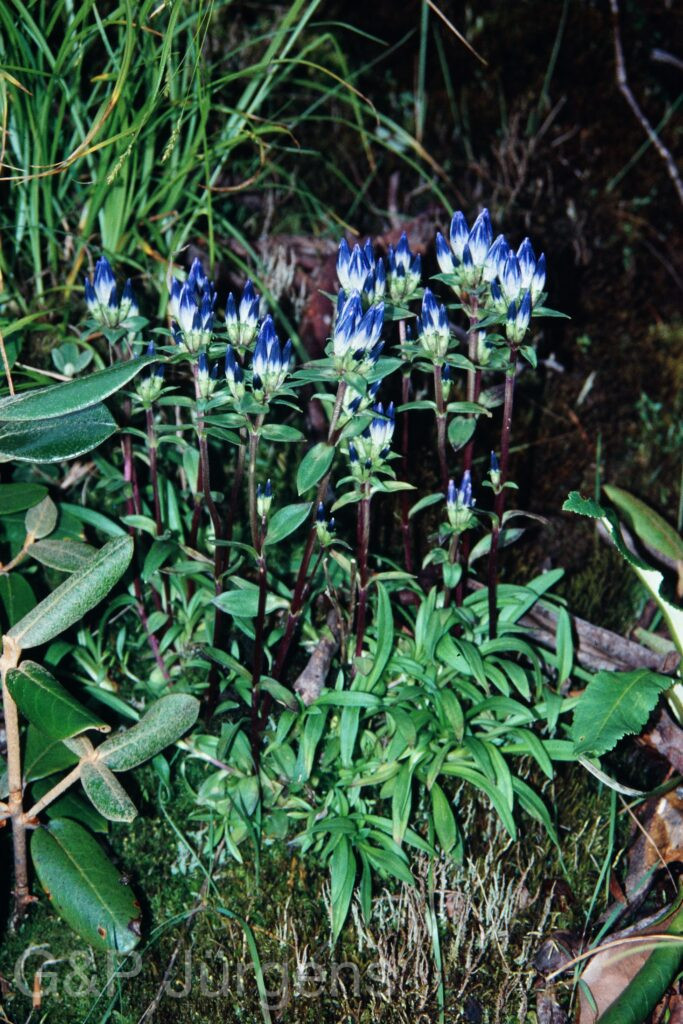
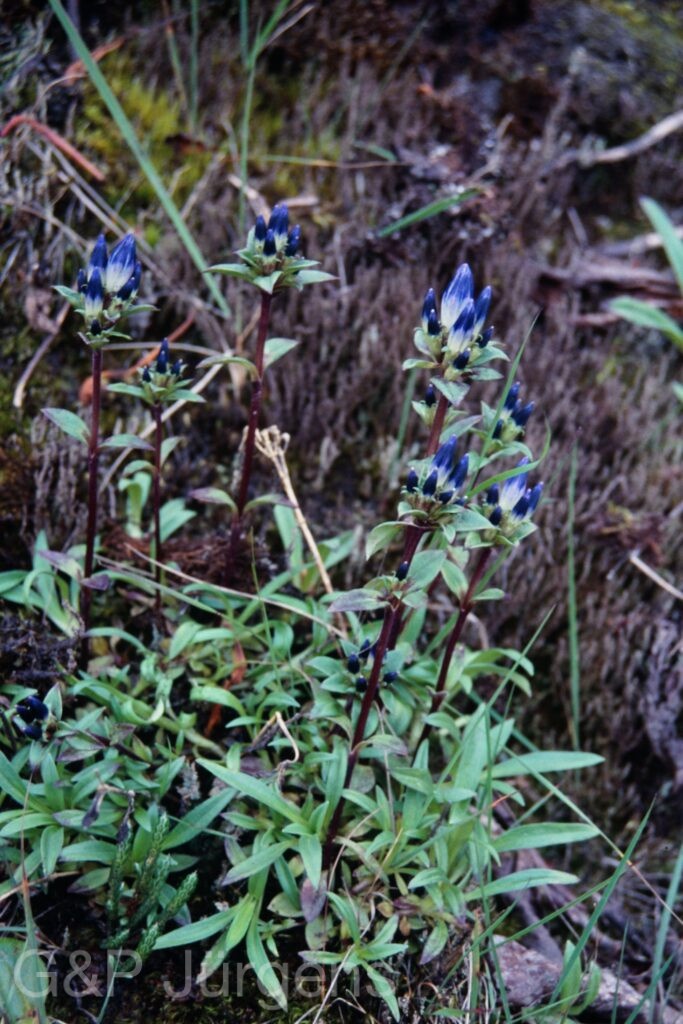
C.B.Clarke

Sikkim2003 164 G219
Sikkim Dzongri 4000m, August
Sikkim2003 165 P220
Sikkim Dzongri 4000m, August

Description

Gentiana elwesii is an eastern Himalayan gentian recorded from Nepal (NP), Bhutan (BT), India (IN) and China (CN), with 100 GBIF occurrences reflecting its restricted high-mountain range. It is a plant of alpine meadows, open turf, grassy slopes and rocky pastures in the upper subalpine and alpine zones, generally between about 3500 and 4500 m. The illustrated material was collected at Dzongri in Sikkim at roughly 4000 m in August, when many Himalayan autumnal gentians come into flower at the close of the monsoon.

It is a small annual or biennial herb with a slender, erect to ascending, often branched stem arising from a basal rosette. The leaves are small, ovate to lanceolate, opposite and sessile, the rosette leaves frequently larger than the cauline ones. The flowers are borne singly or few together at the stem and branch apices; the calyx is tubular with narrow lobes, and the corolla is funnel-shaped to narrowly campanulate, typically blue to purplish-blue, with five spreading lobes alternating with smaller, fringed or toothed plicae in the sinuses, a diagnostic feature of the autumn-flowering gentians. The fruit is a stipitate, two-valved capsule releasing numerous minute seeds.

Gentiana elwesii belongs to the species-rich annual gentians (section Chondrophyllae and allies) that characterise Himalayan alpine grasslands, a group noted for intricate corolla-plait morphology and bee pollination. The Sino-Himalayan region is a global centre of Gentiana diversity, and such narrow-range alpine annuals are valuable indicators of high-elevation grassland habitats sensitive to grazing and climatic change.

Author: C.B.Clarke · Sources: POWO (Kew), GBIF, Flora of China, Flora of Nepal, Flora of Bhutan, Ho & Liu Worldwide Monograph of the genus Gentiana

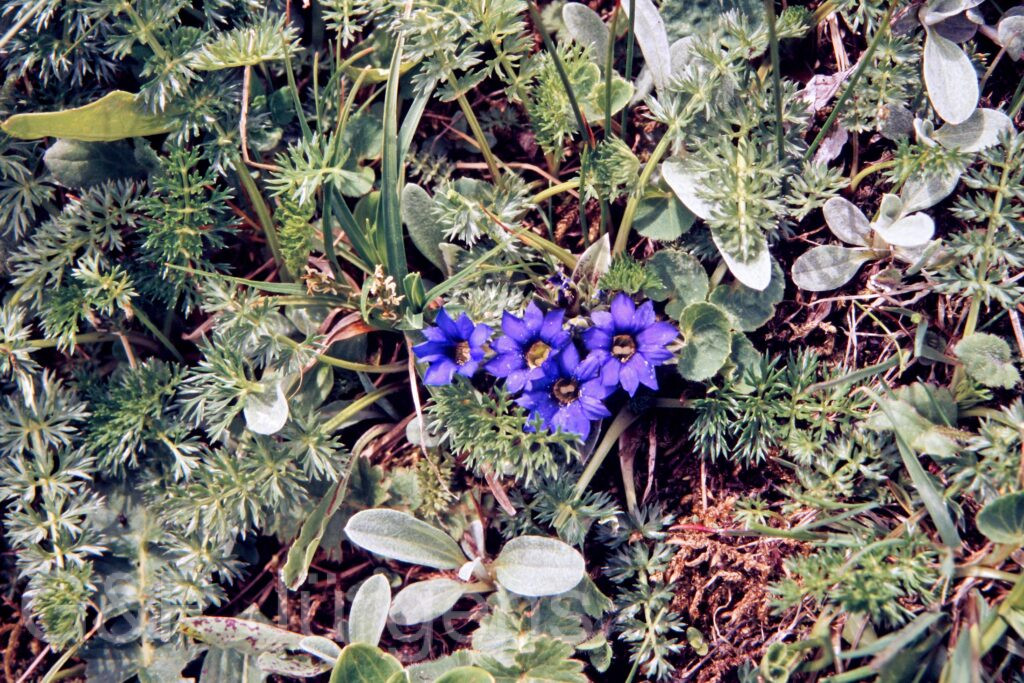
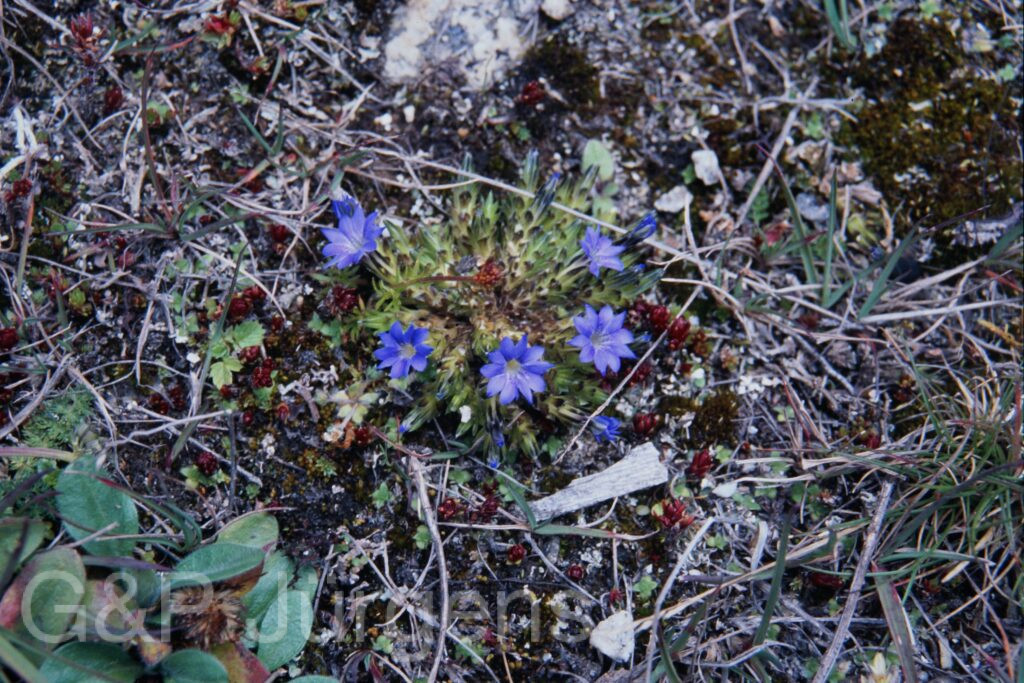
C.B.Clarke

Sikkim2003 526 P734
Sikkim Yume Samdong 4600m August

Description

Gentiana micans is an alpine gentian of the eastern and central Himalaya, with GBIF occurrences spanning southwest China, Bhutan, India and Nepal. It is a characteristic component of moist alpine meadow, seepage slopes and short turf above the treeline, generally between 3,500 and 4,800 m. The illustrated plant was recorded at Yume Samdong in northern Sikkim at about 4,600 m in August, coinciding with the late-monsoon flowering peak when these gentians carpet the high pastures alongside Primula, Pedicularis and Saxifraga.

The species is a small annual or short-lived herb with slender, ascending to erect stems often branching from the base and frequently tinged purple. The leaves are small, sessile, ovate to lanceolate and arranged in opposite pairs. The flowers are solitary and terminal on the branchlets, with a tubular to narrowly campanulate corolla that is brilliant deep blue, the five lobes spreading and separated by small plicate folds; the calyx is tubular with narrow teeth. The fruit is a stalked, two-valved capsule containing numerous minute seeds adapted to wind dispersal.

Gentiana micans belongs to the species-rich Himalayan assemblage of small annual gentians (section Chondrophyllae and allies), a group whose delicate taxonomy rests on corolla, calyx and seed characters. Though individually inconspicuous, these annuals are ecologically important early colonisers of disturbed and grazed alpine ground. The taxon is widespread and not considered threatened, but its meadow habitats are sensitive to overgrazing and to the shifting precipitation regimes of the monsoonal high Himalaya.

Author: C.B.Clarke · Sources: POWO (Kew), GBIF, Flora of China Vol. 16 (Gentianaceae), Grierson & Long: Flora of Bhutan Vol. 2, Ho & Liu: A Worldwide Monograph of Gentiana