Tag:

Summer

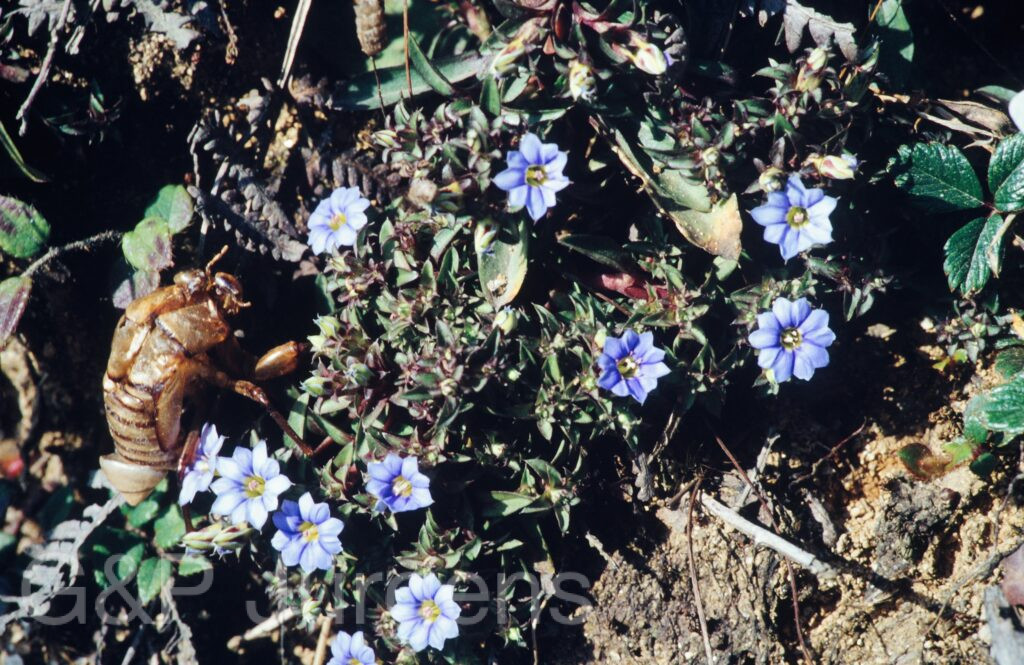
Burkill

Sikkim2011 105
Sikkim Chopta-valley 4200m, June
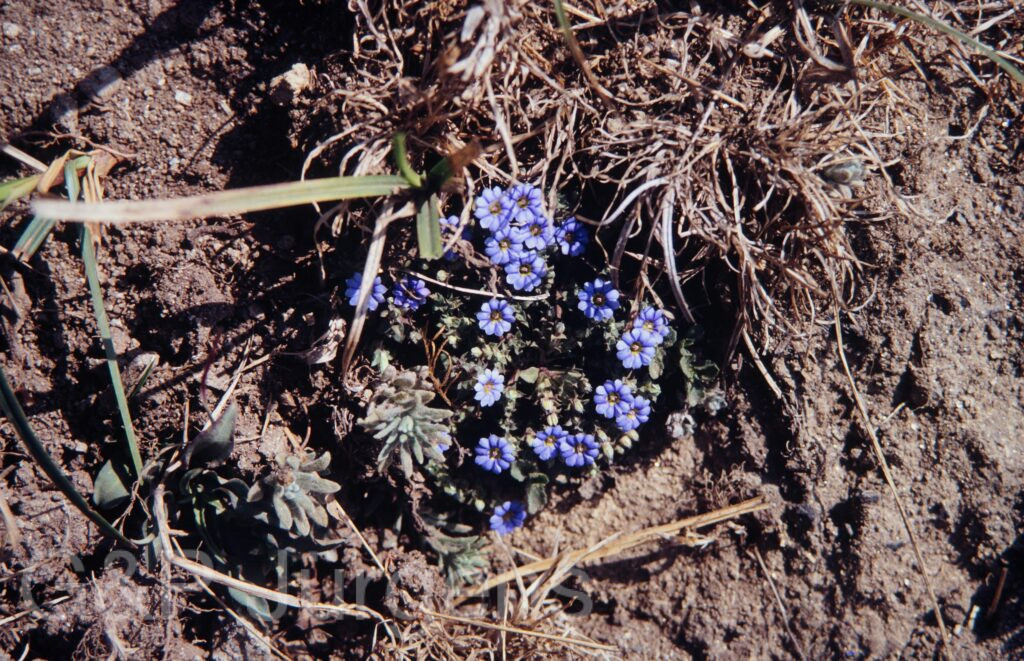
Bhutan2014 908
Bhutan Chele-La 3700m, May

Description

Gentiana micantiformis Burkill is a diminutive alpine gentian of the high Sino-Himalaya, recorded from China, Nepal, Bhutan, India and Japan (gbif_countries: CN, NP, BT, IN, JP) with a modest 59 occurrences in GBIF, reflecting both its small stature and restricted high-elevation range. It inhabits short alpine turf, open stony slopes, moist meadows and the margins of snow-melt flushes, generally between about 3500 and 4500 m. The image data, from the Chopta valley in Sikkim at 4200 m in June and Chele-La in western Bhutan at 3700 m in May, place it firmly in the early-season alpine zone where it flowers as the snow recedes.

It is a small annual or short-lived herb forming low tufts, with slender, often branched stems. The leaves are small, opposite, ovate to oblong and crowded toward the base, frequently with cartilaginous mucronate tips and white membranous margins. The flowers are solitary or few at the stem apices, with a tubular-campanulate, lobed calyx and a tubular-funnelform corolla that is blue to pale blue-violet, the lobes alternating with smaller plicate folds (plicae) characteristic of section Chondrophyllae. The capsule is stipitate and many-seeded, dehiscing to release minute seeds.

Gentiana section Chondrophyllae comprises numerous small annual Asian gentians whose delimitation is notoriously difficult, and the epithet signals close affinity with G. micans. Flowers open in bright sun and close in cold or cloud, a heliotropic adaptation typical of high-alpine gentians and aiding warmth-dependent insect pollination. Although nowhere abundant, the species is widely scattered across the high ranges and is not regarded as threatened.

Author: Burkill · Sources: POWO (Kew), GBIF, Flora of China (Gentianaceae), Flora of Bhutan, Ho & Liu monograph A Worldwide Monograph of Gentiana
Edgew.

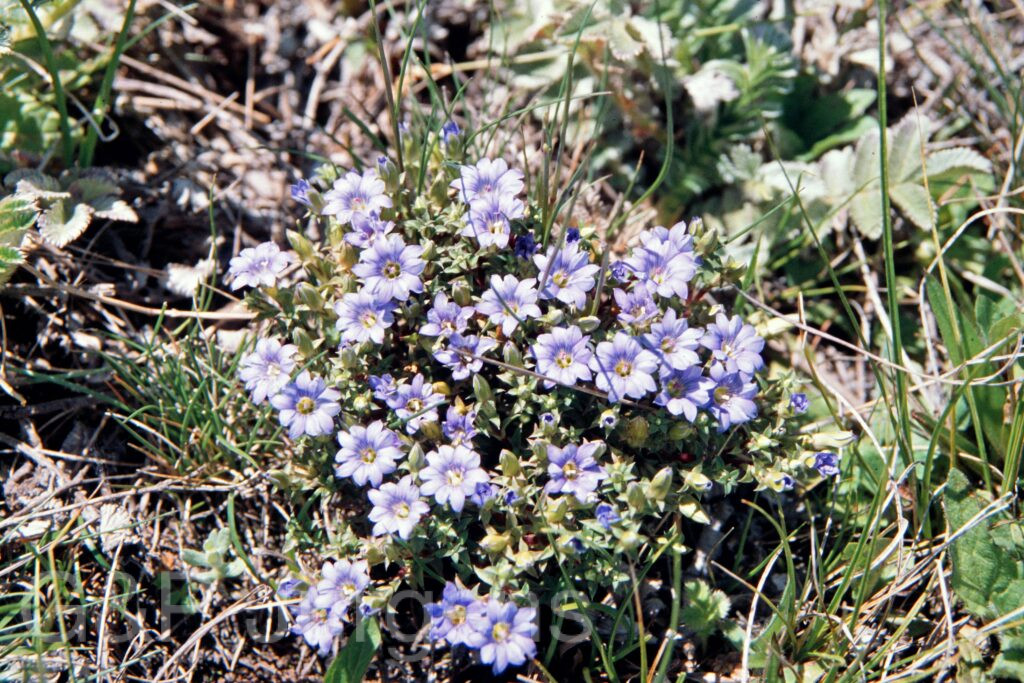
Sikkim2003 515 G715
Sikkim Yume Samdong 4600m August
Sikkim2003 514 P714
Sikkim Yume Samdong 4600m August

Description

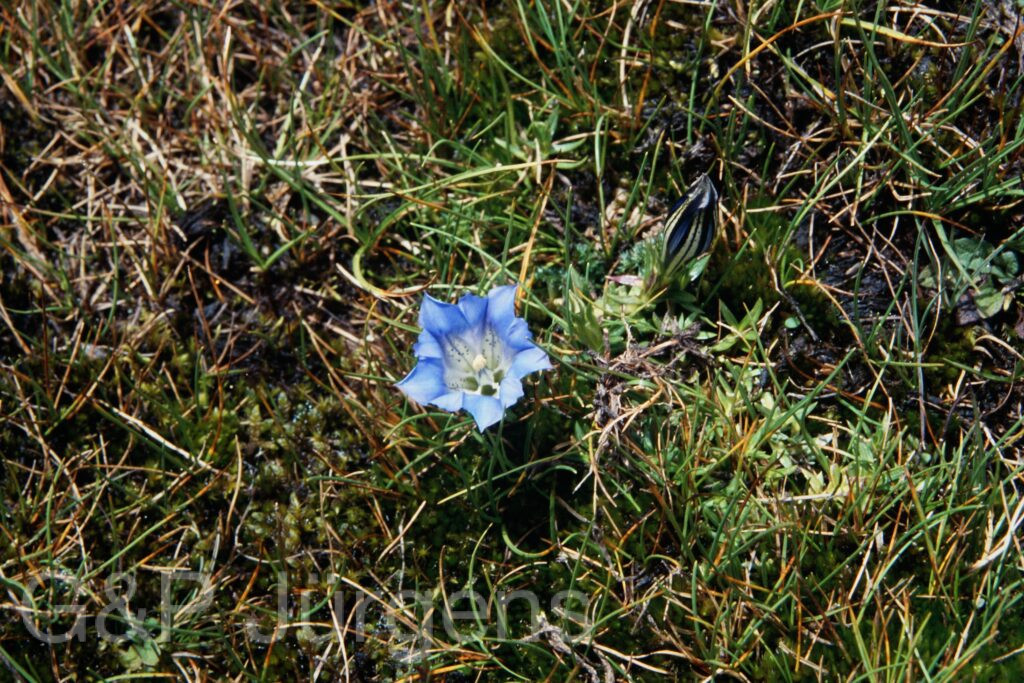
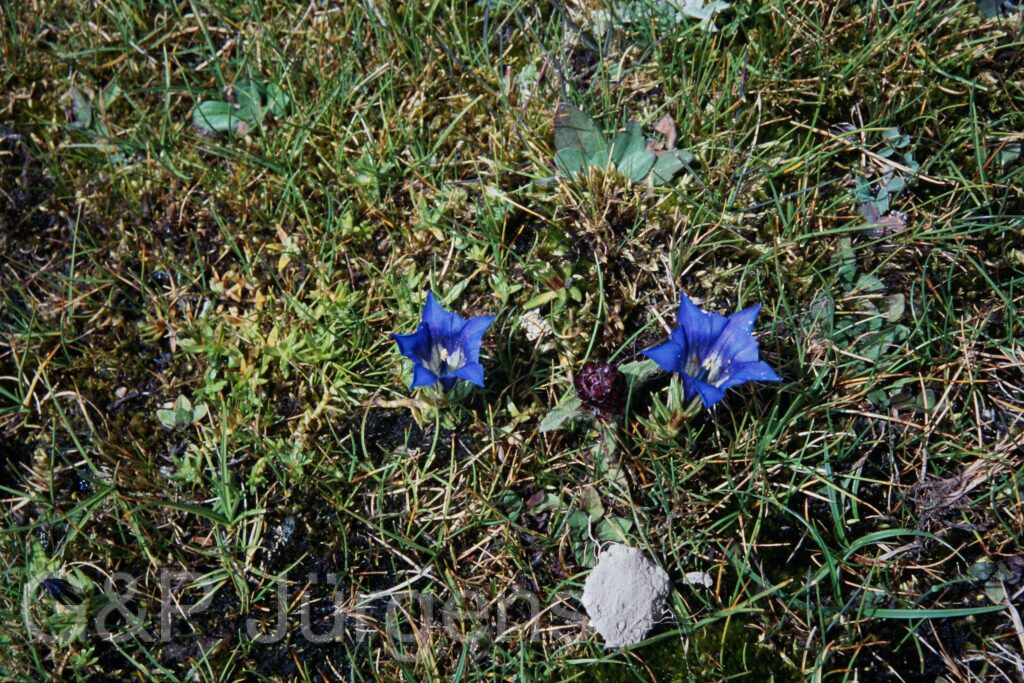
Gentiana nubigena is a high-alpine gentian of the Himalaya and the Tibetan plateau, recorded from China, Nepal, India, Bhutan and Pakistan, with GBIF documenting around 330 occurrences. It inhabits cold alpine meadows, gravelly slopes, screes, moraine and damp turf in the upper alpine and subnival zones, typically from about 4000 to 5000 m. The photographed plant was found in Sikkim at Yume Samdong at 4600 m in August, flowering at the height of the brief alpine summer; the epithet "nubigena," meaning cloud-born, aptly evokes its habitat in the mist-shrouded high pastures.

The plant is a small, tufted perennial herb forming low rosettes from a short rootstock, with several short ascending flowering stems. The basal leaves are crowded, linear-lanceolate to oblong and somewhat fleshy; the stem leaves are smaller and opposite. The flowers are solitary or few at the stem tips, comparatively large; the corolla is funnelform to narrowly campanulate, pale blue to whitish with darker greenish or blue-spotted bands externally, the five lobes separated by shorter plicate folds (plicae) characteristic of the genus. There are five included stamens and a superior ovary that matures into a stipitate, two-valved capsule releasing numerous small seeds.

The species belongs to genus Gentiana (Gentianaceae), within the large complex of Sino-Himalayan autumn-flowering alpine gentians (section Frigida and allies). Adapted to intense cold, high irradiance and a short growing season, it is a characteristic component of the highest vegetated zones. It is not regarded as threatened given its extensive remote range, but as a strict high-alpine specialist it is sensitive to warming-driven upslope compression of subnival habitats.

Author: Edgew. · Sources: POWO (Kew), GBIF, Flora of China, Flora of Nepal, Flowers of the Himalaya (Polunin & Stainton), monograph of Gentiana (Ho & Liu)

(D.Don) Wall.

Nepal 1994 80 ergebnis
Ost-Nepal Jaljale Himal
2900m April
Nepal1992 43 W61 ergebnis
Nepal Nundhaki 1600m March 
Nepal 99 227 ergebnis
West-Nepal Gumghadi 2400m, June

Description

Gentiana pedicellata is a small annual gentian widely distributed across the Himalaya and into south-western China and Sri Lanka, with records also from Myanmar, Laos and Bangladesh and a documented base of some 466 occurrences (European and East Asian points largely cultivated or curated). It occupies open grassy slopes, terraced fields, forest clearings and moist disturbed ground over a broad altitudinal span. The images here span eastern Nepal's Jaljale Himal at 2900 m in April, Nundhaki at 1600 m in March, and Gumghadi in west Nepal at 2400 m in June, reflecting a flowering season tied to spring and early summer at middle elevations.

The plant is a slender, diminutive annual a few centimetres to about 15 cm tall, often branched from the base. The leaves are small, opposite, ovate to elliptic, sessile or shortly petiolate and somewhat fleshy, the lower forming a loose basal rosette. The flowers are solitary and terminal on conspicuously elongate, thread-like pedicels (the source of the epithet), the calyx tubular with five lobes, and the corolla narrowly funnel-shaped, pale blue to bluish-white with intervening plicate folds between the five spreading lobes. The fruit is a stalked, two-valved capsule exserted from the persistent calyx, releasing numerous minute seeds.

Gentiana pedicellata belongs to the Gentianaceae and to the annual gentians (section Chondrophyllae), a group well represented in the temperate Himalaya by many small, ephemeral species. Its long pedicels readily distinguish it from related dwarf annuals. The flowers are insect-pollinated, opening in bright conditions, and the light seeds are dispersed passively. Common, weedy and adaptable across a wide range, the species is of least conservation concern.

Author: (D.Don) Wall. · Sources: POWO (Kew), GBIF, Flora of China, Flora of Bhutan, Annotated Checklist of the Flowering Plants of Nepal, Ho & Liu monograph of Gentiana

(Lam.) Schltr.

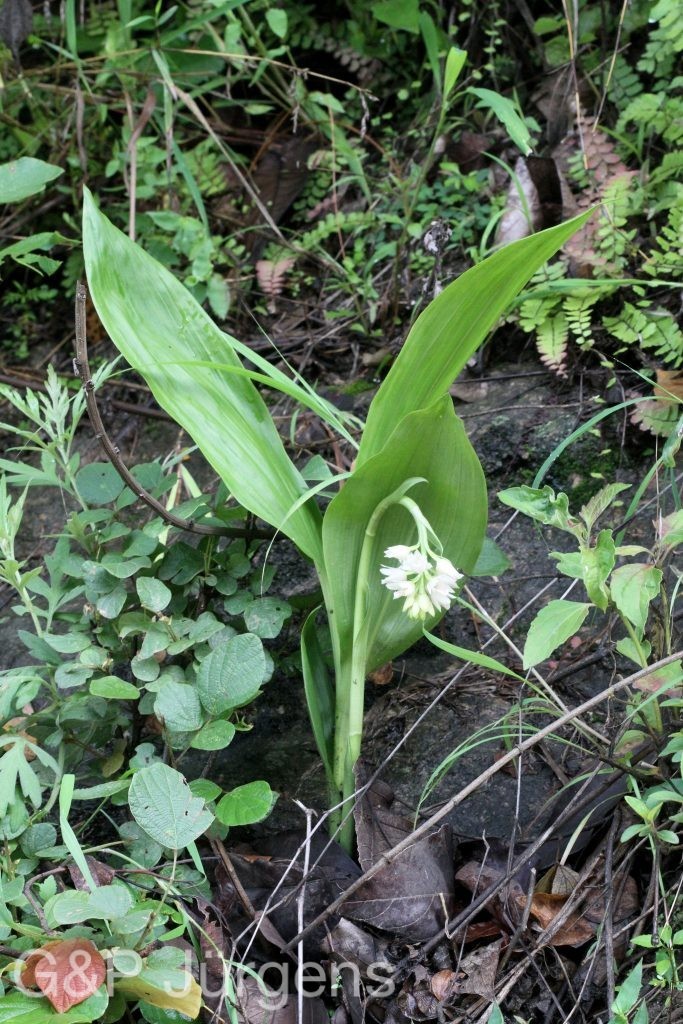
Geodorum densiflorum ergebnis
Bhutan Paro, 2400m June

Description

Geodorum densiflorum is a widespread terrestrial orchid ranging across tropical and subtropical Asia and into the Pacific, recorded from India, Nepal, Bhutan, Sri Lanka, China, Japan, Taiwan, Thailand, Vietnam, Malaysia, Indonesia, the Philippines, New Guinea, Australia and numerous islands, with well over a thousand documented occurrences. It grows in open deciduous and bamboo forest, grassy slopes, scrub and roadside banks, usually in seasonally dry, well-drained ground from the lowlands to mid-elevations. The plant photographed near Paro in Bhutan at 2400 m in June represents the upper part of its altitudinal range, flowering with the onset of the monsoon.

The species arises from underground, corm-like pseudobulbs that store water and reserves through the dry season. The leaves are few, large, broadly elliptic-lanceolate and plicate, with prominent parallel venation, narrowed to a petiole-like base and often appearing with or after the flowers. The inflorescence is unmistakable: a stout scape terminating in a dense, sharply nodding or recurved raceme so that the flowers face downward, the apex curving over before erecting in fruit. The flowers are pink to white with a pouched, whitish labellum marked yellow or purple within. The column is short and the fruit a pendent capsule.

In GBIF the name appears as a synonym, with Geodorum densiflorum treated as the accepted name; the species is the type of the small palaeotropical genus Geodorum within tribe Cymbidieae, distinguished by its characteristic nodding inflorescence. Its wide range, ecological tolerance and frequent occurrence in disturbed habitats make it relatively secure, though, like all orchids, it is listed on CITES Appendix II.

Author: (Lam.) Schltr. · Sources: POWO (Kew), GBIF, Flora of China, The Orchids of Bhutan (Pearce & Cribb), Flora of British India, CITES Appendices

Stephan ex Willd.

Nepal 99 259 ergebnis
West-Nepal Loccu 3400m, June
Nepal 99 342 ergebnis
West-Nepal Kalmura 3800m, June

Description

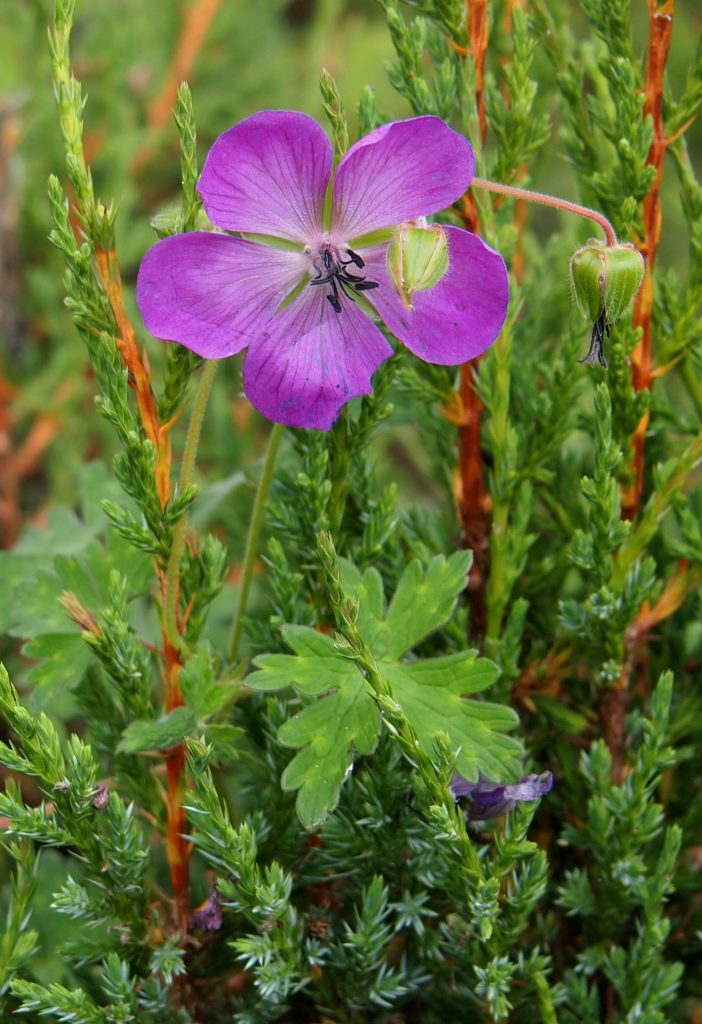
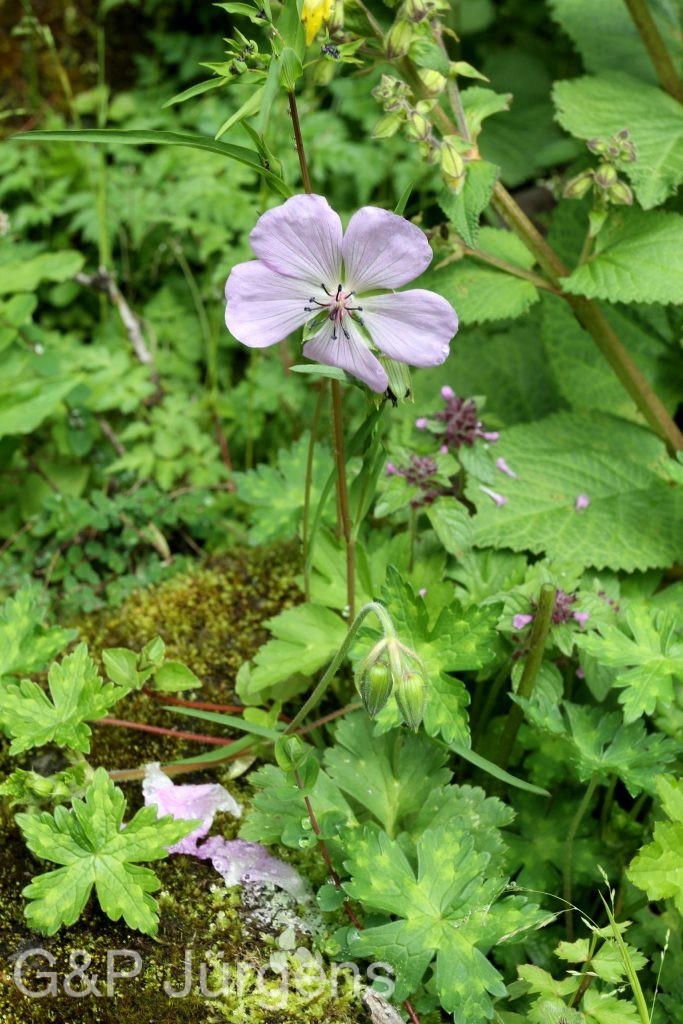
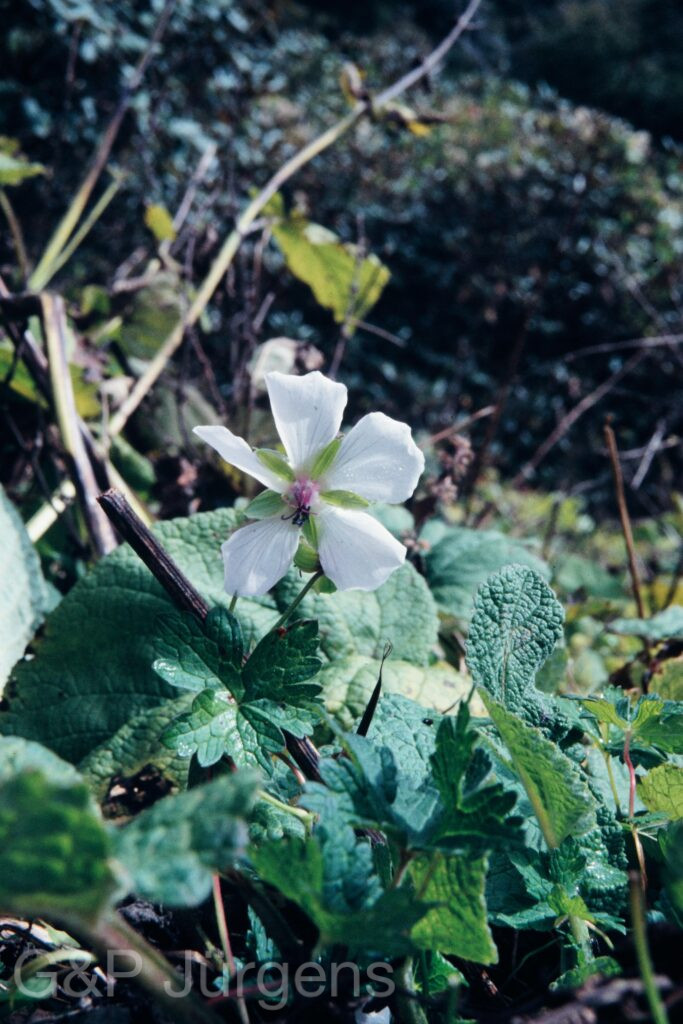
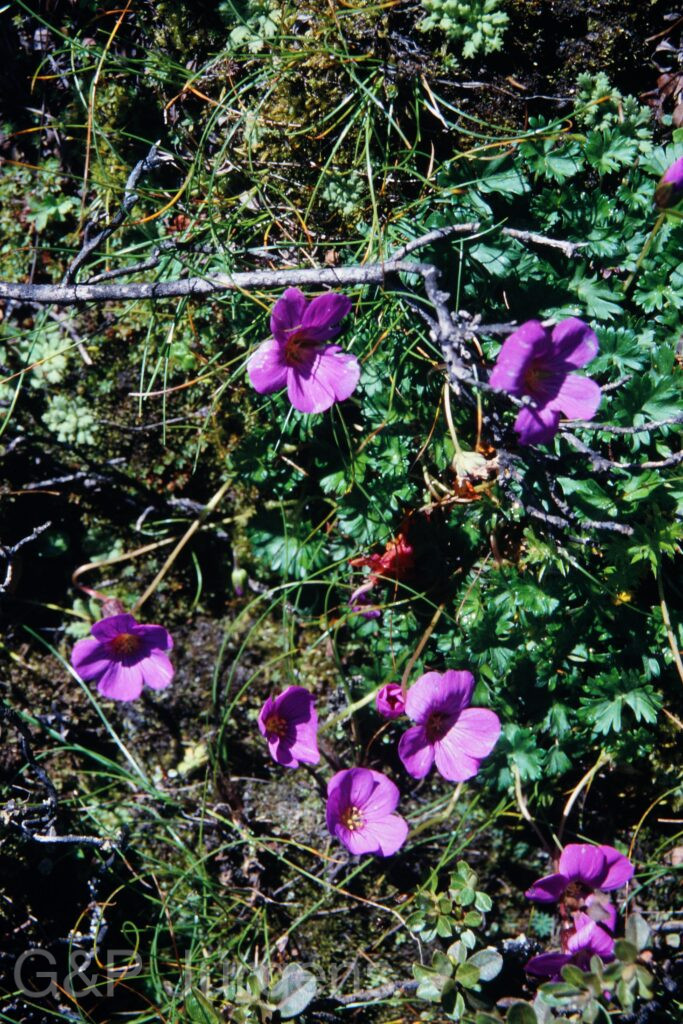
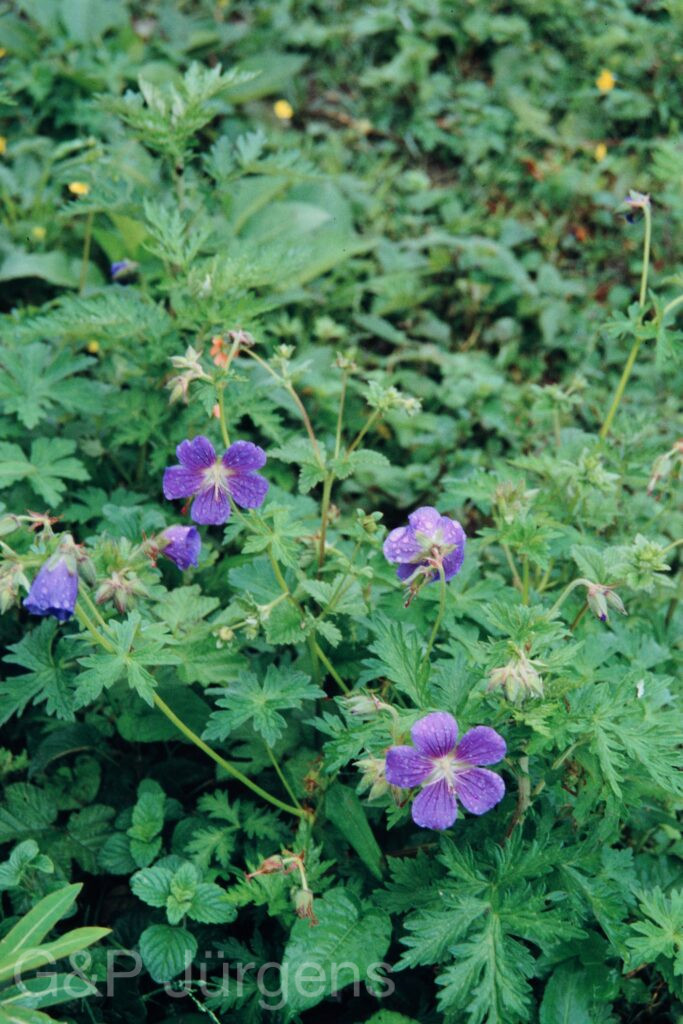
Geranium collinum (Stephan ex Willd.) is a perennial cranesbill of wide continental distribution, ranging from eastern Europe and the Caucasus through Russia, Turkey, Iran and Central Asia (Kazakhstan, Kyrgyzstan, Tajikistan, Uzbekistan) into Afghanistan, Pakistan, the western Himalaya and western China and Mongolia. The roughly 3,200 GBIF records trace a steppe-and-mountain belt across temperate Asia. It is characteristic of moist alpine meadows, damp grassland, streamsides and open subalpine slopes, typically between 2,500 and 4,000 m, as shown by the West Nepal collections from Loccu at 3,400 m and Kalmura at 3,800 m, both in June at the height of the monsoon-flush flowering season.

The plant grows from a stout, woody, branched rootstock and produces ascending to decumbent, much-branched stems clothed in spreading, often retrorse hairs. The leaves are long-petiolate and palmately divided into five to seven deeply incised, oblong-cuneate lobes, the upper cauline leaves becoming shortly stalked and smaller. The flowers are borne in lax, paired cymes; the five petals are pale pink to lilac-purple, obovate and slightly notched, conspicuously veined with darker lines. The fruit is the characteristic geraniaceous schizocarp with a long beak (rostrum), splitting at maturity into five awned mericarps that disperse the seeds by an explosive ballistic mechanism.

Geranium collinum belongs to a taxonomically complex group of pink-flowered perennial cranesbills and is somewhat variable in leaf dissection and indumentum across its vast range, having given rise to numerous infraspecific names. Its presence in alpine pastures makes it a component of high-altitude grazing communities, and the tannin-rich rootstock has been used in folk medicine. The species is widespread and not of conservation concern.

Author: Stephan ex Willd. · Sources: POWO (Kew), Flora of Pakistan, GBIF, Flora of China Vol. 11, Yeo: Hardy Geraniums (2002)

Sweet

BhutanPG2011 106
Bhutan Tsochenchen, 3450m June
Sikkim2003 181 G247
Sikkim Dzongri 4100m 08.2003

Description

Geranium donianum is an alpine cranesbill of the Himalaya and southwestern China, recorded by GBIF from China, Nepal, India, Bhutan and Myanmar across roughly 795 occurrences. It grows in alpine and subalpine meadows, open grassy slopes, scrub margins and stony turf, generally at high elevations where it forms part of the herb-rich alpine sward. The photographed plants were found in Bhutan at Tsochenchen at 3450 m in June and in Sikkim at Dzongri at 4100 m in August, situations typical of its preference for sunny, well-drained montane grassland through the brief alpine summer.

It is a low, tufted perennial arising from a stout, often woody rootstock, with somewhat spreading, hairy stems. The leaves are orbicular to reniform in outline and palmately divided nearly to the base into several wedge-shaped, deeply lobed segments, the lobes again toothed; basal leaves are long-petiolate. The flowers are relatively large and showy, with five free, obovate petals that are typically deep pink to purplish-red and conspicuously darker-veined, sometimes notched at the apex. There are ten stamens and a five-lobed superior ovary; the fruit is the characteristic beaked schizocarp of the genus, whose mericarps separate elastically at maturity to fling out the seeds.

GBIF accepts the name. Within Geranium it belongs among the Himalayan alpine cranesbills allied to G. orientali-tibeticum and related taxa, a group well represented across the high ranges. The vivid dark-veined petals serve as nectar guides for bee and fly pollinators. Widespread and locally common in alpine pastures, G. donianum is assessed as of least conservation concern.

Author: Sweet · Sources: POWO (Kew), GBIF, Flora of Nepal, Flora of China, Yeo monograph of Geranium

Sweet

Bhutan2012 218
Bhutan Shele-La, 3800m September
BhutanPG2011 679 01 01
Bhutan Luksur, 3700m July
Nepal 95 389P688 ergebnis
Nepal Bahanjyang 3700m October

Description

Geranium lambertii is a perennial herb of the high Himalaya, distributed through China, India, Nepal, Bhutan and Pakistan, with about 304 georeferenced records (additional codes from Canada, Japan and Europe reflect its presence in cultivation). It inhabits subalpine and alpine meadows, forest clearings, shrubberies and moist rocky slopes, often among dwarf rhododendron and on the margins of birch forest. The collections cited from Bhutan at Shele-La (3800 m, September) and Luksur (3700 m, July) and from Bahanjyang in Nepal (3700 m, October) place it firmly in the 3500-4000 m belt, flowering through the late monsoon and into autumn.

It forms a clump of trailing to ascending stems from a stout rootstock. The leaves are long-petiolate and palmately divided into five to seven deeply lobed and toothed segments, sparsely hairy. The flowers are among the most distinctive in the genus, nodding and saucer- to bell-shaped, with five broad, satiny white petals usually flushed pink and contrasting with a dark crimson-purple centre; the ten stamens and the style cluster are conspicuous, and the pedicels recurve in fruit. The fruit is the typical geranium schizocarp, with a long beak that splits elastically to fling the seeds.

Geranium lambertii, named by Sweet, is a well-marked species of the Himalayan endemic assemblage and a long-cultivated ornamental prized for its pendent, dark-eyed blooms. Its mid- to late-season flowering supports bumblebees and other high-altitude pollinators, and the spring-loaded mericarps achieve effective ballistic seed dispersal. It is widespread and not considered threatened, though localised meadow populations are sensitive to heavy grazing.

Author: Sweet · Sources: POWO (Kew), GBIF, Flora of Bhutan, Annotated Checklist of the Flowering Plants of Nepal, Yeo Hardy Geraniums

H.Hara

BhutanPG2011 372
Bhutan Dur-Tso, 3800m June
Also included: Pedicularis siphonantha D.Don
Sikkim2003 176 P240
Sikkim Dzongri 4100m, August

Description

Geranium nakaoanum is a Himalayan cranesbill known from Nepal, the Indian Himalaya, Bhutan and adjacent China, with around 61 GBIF occurrences reflecting its montane to alpine distribution. It occupies open alpine meadows, grassy slopes, streamsides and the herbaceous margins of dwarf rhododendron and juniper scrub on moist, humus-rich soils. The locality figured, Dur Tsachu in Bhutan at about 3800 m in June, sits within its typical band of roughly 3300-4500 m; the accompanying note of Pedicularis siphonantha at Dzongri in Sikkim at 4100 m in August underscores the high-elevation meadow community in which it grows, flowering through the monsoon summer.

It is a low, tufted perennial herb with a thickened rootstock, producing slender, often decumbent or ascending stems clothed in spreading or retrorse hairs. The leaves are long-petioled and palmately divided into five to seven deeply incised, lobed segments forming a rounded outline, the laminae sparsely hairy on both surfaces. The flowers are borne in few-flowered cymes on glandular-hairy pedicels; the five free petals are pink to rose-purple, frequently darker-veined and shallowly notched. Ten stamens surround the five-carpellate ovary, which matures into the characteristic beaked schizocarp whose mericarps spring apart elastically to disperse the seeds.

The species commemorates the Japanese botanist Sasuke Nakao, a participant in mid-twentieth-century Himalayan expeditions. It belongs to the large temperate genus Geranium, well represented in the Himalaya by several allied alpine taxa distinguished by indumentum, petal colour and leaf dissection. As a meadow perennial it contributes to the diverse alpine herb flora and is pollinated chiefly by bees and flies; no specific threat is recorded, though alpine grazing pressure can affect such populations.

Author: H.Hara · Sources: POWO (Kew), GBIF, Flora of Bhutan, Flora of Nepal, Aedo monograph of Geranium, Yeo Hardy Geraniums

L.

Nepal 99 89 ergebnis
West-Nepal Bhulbhule 3500m, June

Description

Geranium pratense, the meadow cranesbill, is a widespread perennial of temperate Eurasia. With over 190,000 GBIF occurrences it is abundantly documented across Britain, Germany, France, the Nordic and Baltic states, the Low Countries, central Europe and Russia, extending through Central Asia to the Himalaya. It grows in moist meadows, grassy slopes, streamsides and open woodland margins. In the high Himalaya it ascends to subalpine pastures; the illustrated plant was photographed at Bhulbhule in western Nepal at about 3,500 m, flowering in June, where it is a characteristic component of moist alpine-meadow turf during the early monsoon.

The plant forms a stout, branched rootstock bearing erect, glandular-pubescent stems 30–80 cm tall. The leaves are deeply palmately 5–7-lobed, the lobes themselves pinnatifid and sharply toothed, the basal leaves long-petiolate. The flowers are large and showy, 2.5–4 cm across, borne in pairs on long peduncles; the five petals are violet-blue with fine darker veins. The fruit is the characteristic geraniaceous schizocarp with an elongate beak that springs apart explosively at maturity, ejecting the five mericarps.

Geranium pratense is taxonomically variable across its vast range, with several recognised subspecies and forms; Himalayan populations have at times been segregated but are generally treated within the broad species. It is of least conservation concern, being common and adaptable, and is widely grown ornamentally with numerous cultivars. Its presence links the Himalayan flora biogeographically to the temperate grasslands of the western Palaearctic.

Author: L. · Sources: POWO (Kew), Flora of Nepal, Flora of Pakistan, GBIF, Yeo: Hardy Geraniums (2002)

Edgew. & Hook.

BhutanPG2011 491
Bhutan Ludlow-Sherriff-Trail Managed-Chu, 3550m June

Description

Geranium refractum is a perennial herb of the eastern and central Himalaya and adjacent China, distributed through China, Nepal, India, Bhutan and Myanmar, with about 645 georeferenced records concentrated in the subalpine and alpine zones. It grows in alpine meadows, forest clearings, shrubberies and moist, rocky slopes, often among dwarf rhododendron and on streamside banks. The plant photographed along the Ludlow-Sherriff trail near the Managed-Chu in Bhutan at 3550 m, flowering in June, is typical of its high-elevation habitat, where it appears with the early summer thaw.

It forms ascending to spreading stems from a perennial rootstock, the foliage palmately divided into five to seven deeply incised and toothed lobes. The flowers, as the epithet indicates, are nodding and become strongly reflexed, with five reflexed to spreading white or pale pinkish petals; the ten stamens and the long style column are exserted and conspicuous against the recurved corolla, recalling a small cyclamen or shooting-star in posture. The fruit is the characteristic geranium schizocarp with an elongate beak, the mericarps releasing seeds by elastic ejection.

Geranium refractum, described by Edgeworth and Hooker f., belongs to the same Himalayan group of nodding-flowered species as G. lambertii, from which it differs in its reflexed white flowers and exserted reproductive parts. Its early-summer blooms are visited by bumblebees and other montane insects, and the spring-loaded mericarps disperse seed ballistically. It is reasonably widespread across the eastern Himalaya and is not regarded as threatened, although alpine meadow populations are subject to grazing pressure.

Author: Edgew. & Hook. · Sources: POWO (Kew), GBIF, Flora of China, Flora of Bhutan, Annotated Checklist of the Flowering Plants of Nepal, Yeo Hardy Geraniums