Tag:

Summer

(Royle) Raizada & Saxena
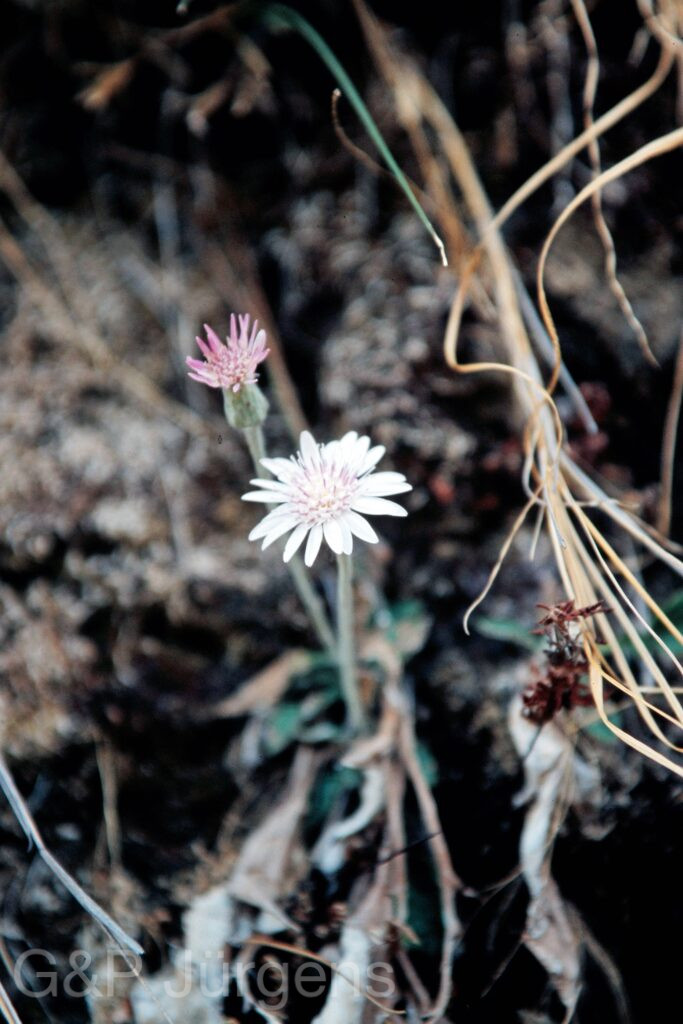
Garh 07 20 ergebnis
India Garhwal Ransi at Mandakini 1800m, June

Description

Gerbera gossypina is a western Himalayan herb recorded by GBIF from India and Pakistan, with only about 10 documented occurrences, reflecting both its restricted range and sparse collection history. It grows on open grassy slopes, sunny banks, forest clearings and rocky hillsides in the temperate zone, generally between about 1500 and 2800 m. The photographed plant was found in Garhwal, India, at Ransi by the Mandakini river at around 1800 m in June, a habitat characteristic of this woolly-leaved species among the herb-rich meadows of the western Himalayan foothills before the monsoon.

The species is a stemless or short-stemmed perennial forming a basal rosette from a thick rootstock. The leaves are oblong to obovate or lyrate, narrowed to a winged petiole, and densely clothed beneath with white to greyish cottony tomentum, the feature that gives the epithet gossypina. The flowering heads are solitary on long, erect, woolly scapes overtopping the rosette. Each radiate capitulum has an outer series of strap-shaped ligulate florets, white to pinkish above and often reddish beneath, surrounding numerous tubular disc florets within an involucre of imbricate bracts. The fruit is a ribbed, hairy cypsela bearing a pappus of fine bristles.

Gerbera gossypina (Royle) Raizada & Saxena is one of few representatives of this largely African and Asian genus in the Himalaya and a western-Himalayan element of phytogeographic interest. The very small number of records suggests it is genuinely localised, and its limited known range and scant documentation indicate its conservation status merits assessment, with field survey needed across Garhwal, Himachal and adjoining Pakistan.

Author: (Royle) Raizada & Saxena · Sources: POWO (Kew), GBIF, Flora of British India, Polunin & Stainton: Flowers of the Himalaya, taxonomic revisions of Gerbera (Asteraceae)
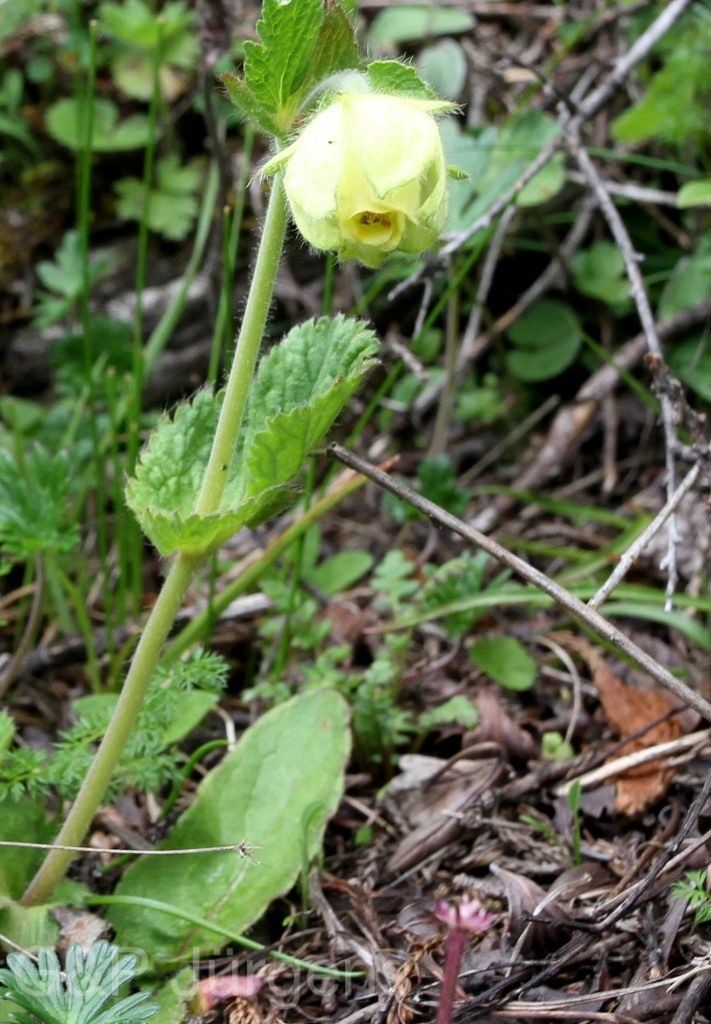
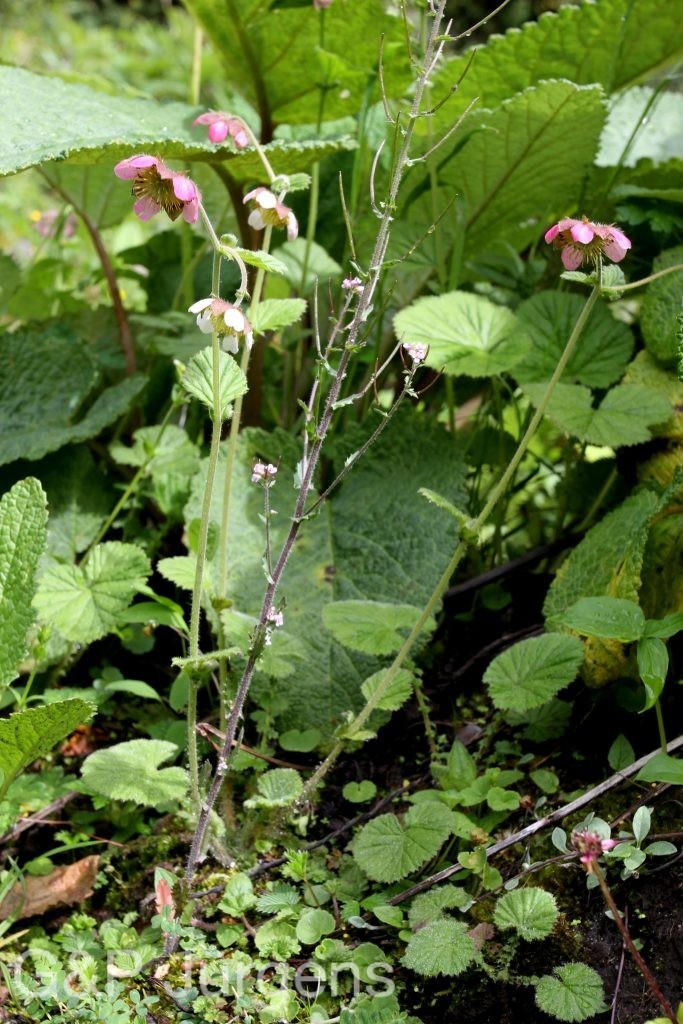
Geum elatum

by G & P Jürgens

Wall ex. G.Don.

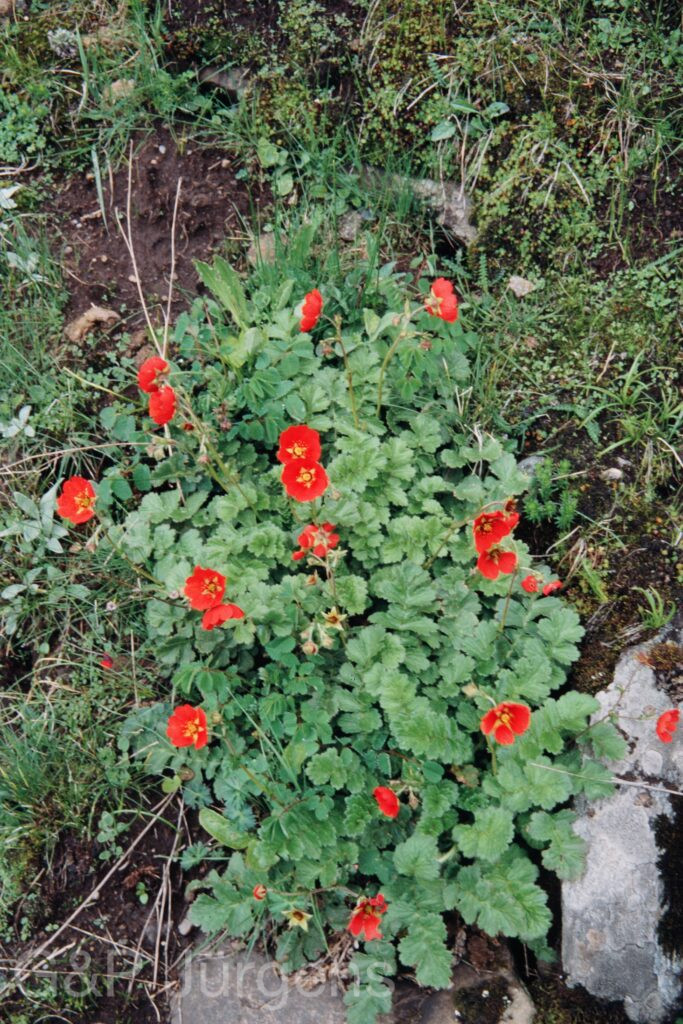
Nepal 99 532 ergebnis
West-Nepal Churta-Khola 3600-3800m, June
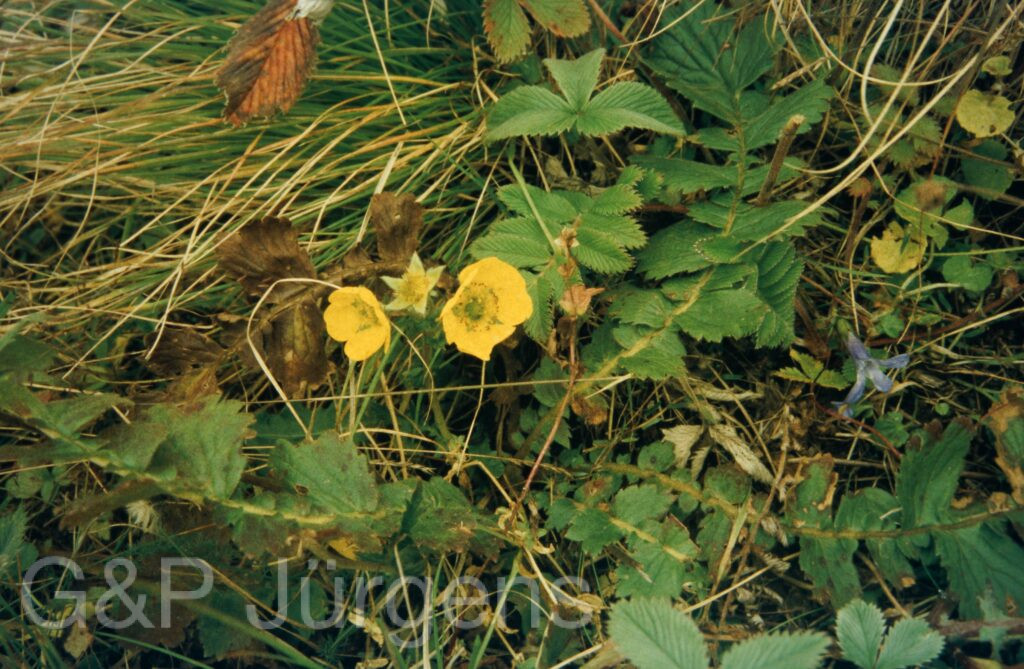
Garw 2005 351 ergebnis
India Garhwal Patanathi 3800m, September

Description

Geum elatum is a perennial herb of the high Himalaya, distributed along the alpine and subalpine belt from Pakistan and Afghanistan eastward through India, Nepal, Bhutan and south-western China. GBIF aggregates some 366 occurrences, densest in Nepal and the Indian Himalaya. It grows in open alpine meadows, moist grassy slopes, rocky ledges and snow-melt flushes, typically between about 3000 and 4500 m. The populations imaged in West-Nepal at Churta-Khola (3600-3800 m, June) and in Indian Garhwal at Patanathi (3800 m, September) typify its preference for cool, humid turf near the upper limit of vegetation.

The plant arises from a stout, scaly rhizome bearing a basal rosette of pinnate to lyrate-pinnatifid leaves, the terminal leaflet conspicuously enlarged, reniform to orbicular and crenate-lobed. Flowering stems are erect to ascending, simple or sparingly branched, bearing one to several comparatively large, nodding to suberect golden-yellow flowers. These have five spreading obovate petals, five reflexed sepals alternating with small epicalyx segments, numerous stamens, and many free carpels on a hairy receptacle. In fruit the styles elongate into persistent, often plumose or hooked awns, forming a globose head of achenes adapted to epizoochorous dispersal.

Geum elatum belongs to a Himalayan complex sometimes segregated under Acomastylis or Sieversia, and varieties (notably var. leiocarpum) have been recognised on indumentum and style characters. Its nodding, large-flowered habit and montane ecology distinguish it from lowland Geum species. As a widespread, locally common alpine perennial it is of no immediate conservation concern, though potentially sensitive to grazing and climate-driven upward shifts of the alpine zone.

Author: Wall ex. G.Don. · Sources: POWO (Kew), GBIF, Flora of China, Flora of Pakistan, Flora of Bhutan, Annotated Checklist of the Flowering Plants of Nepal, monograph of the genus Geum (Gajewski)

Geum macrosepalum

by GP Jürgens

Ludlow

BhutanPG2011 231
Bhutan Tsochenchen 3800m, July

Description

Geum macrosepalum Ludlow is a high-alpine rosaceous herb of the Eastern Himalaya and adjacent China, recorded from China, India and Bhutan (gbif_countries: CN, IN, BT) with only 20 occurrences in GBIF, marking it as a narrowly distributed mountain endemic. It grows in open alpine meadows, moist turf, rocky slopes and seepage ground, typically above about 3500 m. The illustrated plant from Tsochenchen in Bhutan at 3800 m, in July, captures it flowering at the height of the summer growing season in the cool, humid alpine belt of the eastern ranges.

It is a perennial herb arising from a stout rhizome, forming a basal rosette of pinnately compound, lyrate leaves with a large terminal leaflet and smaller lateral pairs, the margins toothed and the surfaces softly hairy. The flowering stems bear few reduced cauline leaves. The flowers, often solitary or few, are notable for their enlarged sepals, recorded in the epithet macrosepalum, which subtend yellow petals; an epicalyx is present outside the calyx. Numerous stamens and carpels occupy the receptacle, and the achenes mature with persistent styles that may be hooked or plumose, aiding dispersal, a feature linking the species to the segregate Acomastylis under which it has been treated.

The taxon has been placed in Acomastylis (Geum macrosepalum being the basis of Acomastylis macrosepala), reflecting the disputed generic limits within the Geum–Sieversia–Acomastylis complex; molecular work supports a broadly circumscribed Geum. Given its limited range across the eastern alpine zone, the species is of biogeographic interest as a regional endemic, and its small number of records suggests it warrants conservation attention.

Author: Ludlow · Sources: POWO (Kew), GBIF, Flora of China (Rosaceae), Flora of Bhutan, Smedmark & Eriksson phylogenetic study of Geum and allies

Geum sikkimense

by GP Jürgens

Prain

BhutanPG2011 676 01
Bhutan Luksur, 4700m July

Description

Geum sikkimense is a high-alpine avens of the eastern Himalaya, recorded in GBIF (a modest 47 occurrences) from Nepal, Bhutan and India. It is a plant of cold, open, high-elevation habitats, growing on alpine meadows, moist turf, screes and rocky slopes generally between about 4000 and 4800 m, flowering during the short summer monsoon window. The photographed plant from Luksur in Bhutan at 4700 m in July exemplifies its occurrence near the upper limit of vascular plant growth, where it persists in stony, snowmelt-watered ground.

It is a low, tufted perennial herb arising from a stout, woody rhizome clothed in old leaf bases. The leaves are mostly basal and lyrate-pinnate, with a large rounded, crenate-toothed terminal lobe and progressively smaller lateral leaflets, the surfaces hairy and the petiole long. The flowering stems are erect and bear one to few flowers; each flower has five green sepals (often with alternating epicalyx segments) and five spreading, obovate, yellow petals surrounding numerous stamens and carpels. The fruit is a head of dry achenes, each tipped with a persistent style that elongates into a hooked or feathery awn aiding epizoochorous dispersal.

Geum belongs to tribe Colurieae of the Rosaceae, allied to Sieversia and Acomastylis, genera with which several Himalayan high-alpine species have at times been associated. G. sikkimense is a narrow-range eastern Himalayan endemic adapted to the harsh, short growing season of the upper alpine zone. Given its limited known distribution and small number of records, it is poorly assessed, but its restriction to fragile high-altitude habitats makes it potentially vulnerable to climate-driven habitat contraction.

Author: Prain · Sources: POWO (Kew), GBIF, Flora of Bhutan, Annotated Checklist of the Flowering Plants of Nepal, Gajurel et al. studies on Himalayan Rosaceae, Smedmark revision of Colurieae

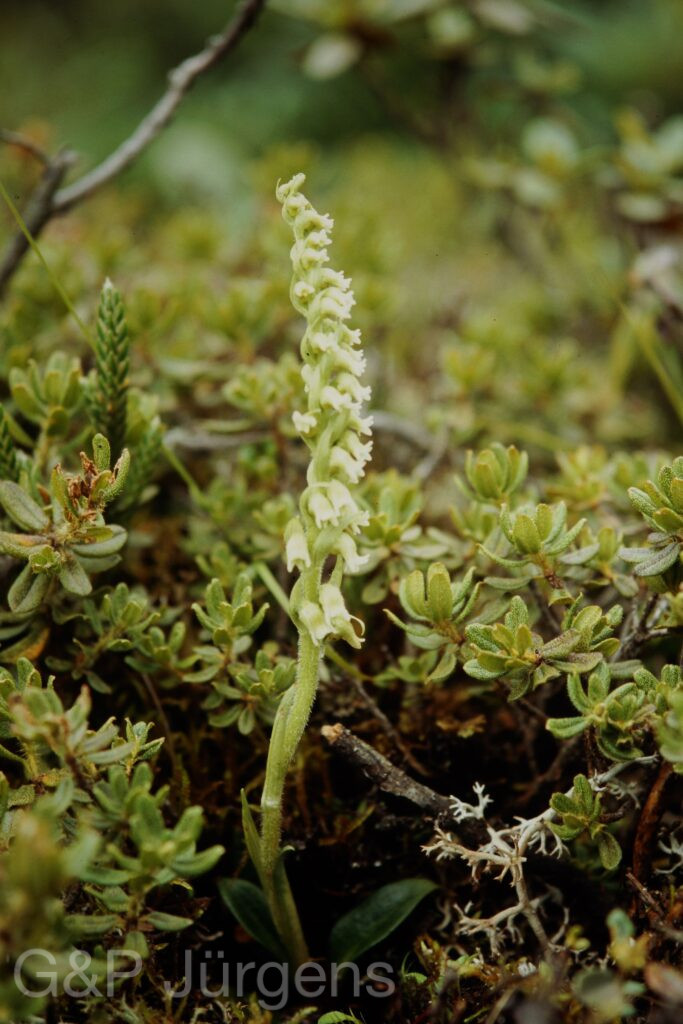
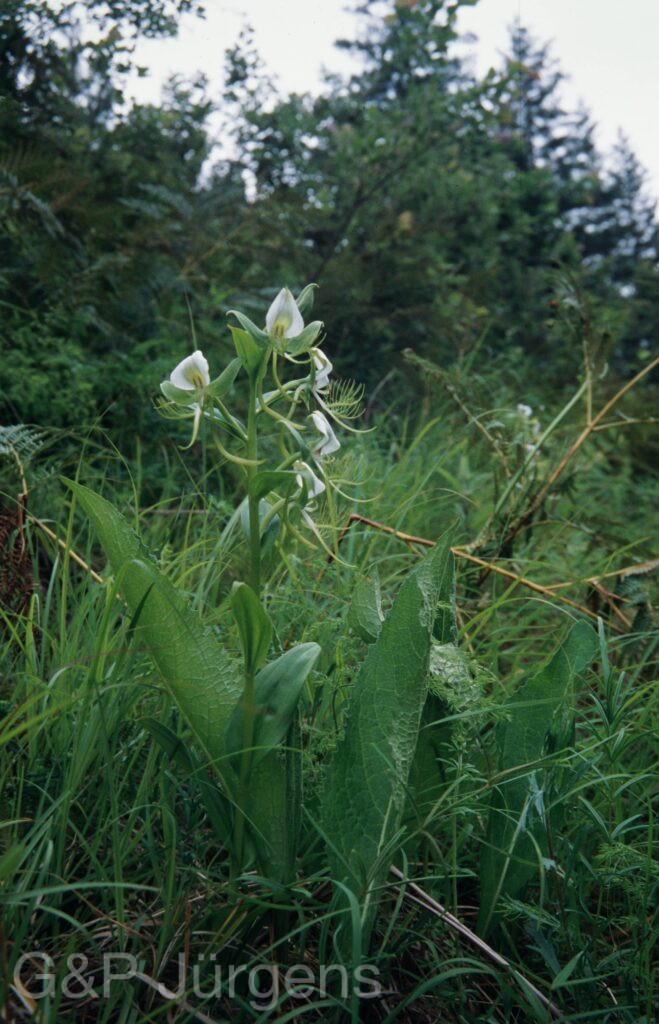
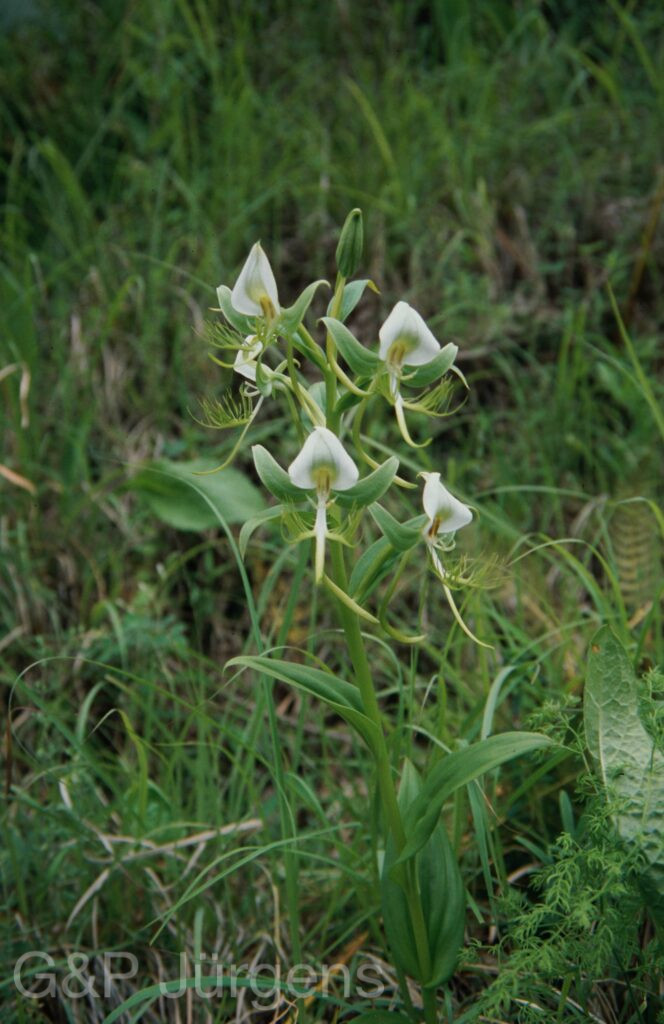
Hook.f.

Sikkim2003 457 K631.2
Sikkim Chopta Valley 3900m August

Description

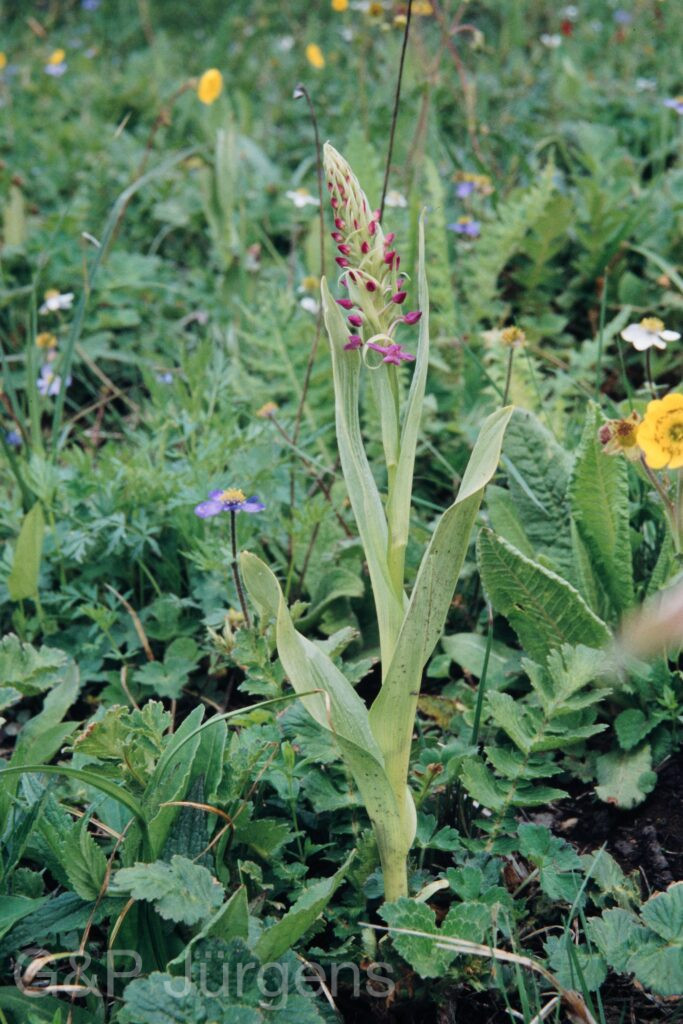
Goodyera fusca is a terrestrial orchid of the higher Himalaya, ranging through Nepal, China, Bhutan, India and Myanmar (NP, CN, BT, IN, MM), with about 101 recorded occurrences. It grows in cool, shaded humus among mossy rocks, in subalpine Rhododendron and conifer thickets and at the upper forest margin, generally in the upper temperate to subalpine zone. The plant illustrated was found in the Chopta Valley of Sikkim at 3900 m in August, an elevation and late-summer flowering period typical of the species, where it occupies damp, sheltered pockets of leaf litter and bryophyte cover beneath open scrub near the treeline.

It is a small, erect herb arising from a creeping, fleshy, few-noded rhizome rooting at the nodes. The leaves are few and clustered toward the stem base, ovate to elliptic, somewhat fleshy, and in many populations marked with the reticulate veining characteristic of the 'jewel orchids'. The inflorescence is an erect, glandular-pubescent spike bearing a secund to spiralled series of small, dull brownish to greenish flowers, each subtended by a lanceolate bract. The dorsal sepal and petals are connivent to form a hood over the column, the lateral sepals spreading, and the saccate, concave lip lacks a free spur. The fruit is a small, erect, ribbed capsule releasing dust-fine seeds.

Goodyera (subtribe Goodyerinae, tribe Cranichideae of the Orchidaceae) is a chiefly Asian genus of forest-floor orchids whose germination and establishment depend on association with mycorrhizal fungi. The small, drab, nectar-bearing flowers are pollinated by small bees and other insects, and the minute seeds are wind-dispersed. As an obligately mycotrophic forest understorey orchid, G. fusca is vulnerable to disturbance of its humus-rich habitat, though across its wide Himalayan-Chinese range it is not currently regarded as threatened.

Author: Hook.f. · Sources: POWO (Kew), GBIF, Flora of Bhutan, Flora of China, Genera Orchidacearum (Goodyerinae)

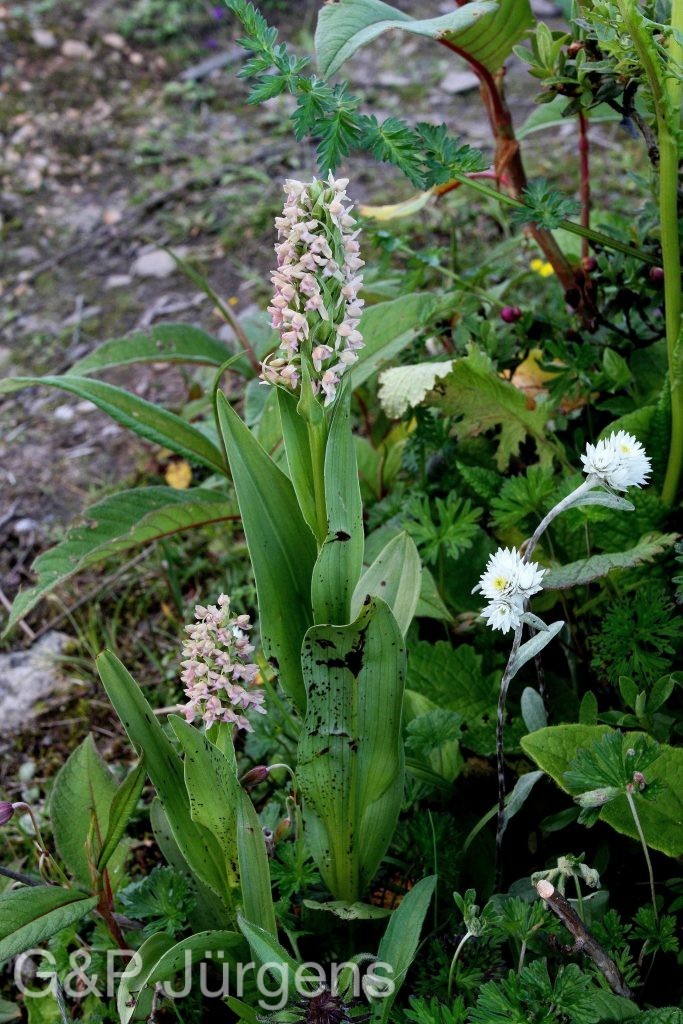
Lindl.

BhutanPG2011 801 01 01
Bhutan Chele-La, 3800m July
also included: Anaphalis busua (D.Don) DC. and Anemone demissa Hook.f. & Thomson
Nepal 99 371 ergebnis
West-Nepal Linji-Khola 3400m, June
Nepal 99 474 ergebnis
West-Nepal Churta-Khola 3200m, June

Description

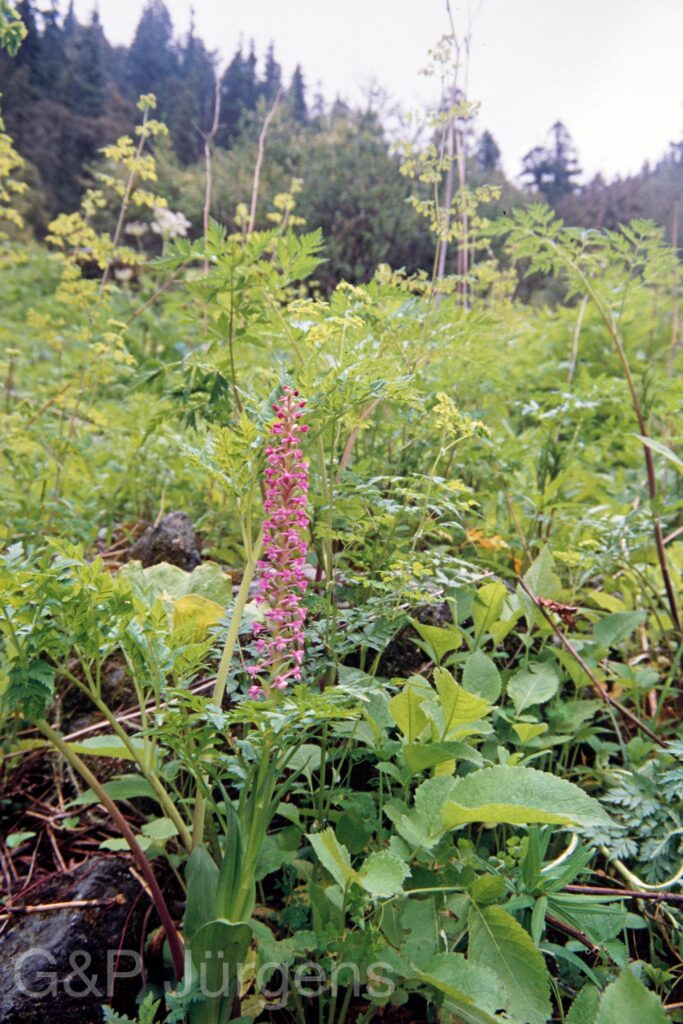
Gymnadenia orchidis is a terrestrial orchid of the Himalaya and adjacent China, distributed through China, Nepal, India, Bhutan, Myanmar and Pakistan, with GBIF documenting some 795 occurrences. It is a plant of open alpine and subalpine meadows, grassy slopes, forest clearings and damp turf, growing in full sun to light shade on humus-rich soils. The species occupies the upper montane to alpine zone; the photographed material from the Chele-La pass in Bhutan at about 3800 m in July, sharing its habitat with Anaphalis busua and Anemone demissa, and from the Linji-Khola and Churta-Khola valleys of West Nepal at 3200-3400 m in June, illustrates its summer flowering across this high-elevation belt.

The plant arises from palmately lobed, fleshy root-tubers and bears an erect, leafy stem. The leaves are several, oblong to lanceolate, sheathing at the base and reduced upward to bracts. The inflorescence is a dense, cylindrical terminal spike of many small flowers, ranging in colour from purple and pink-magenta to occasionally white. Each flower has spreading lateral sepals, a hooded arrangement of the dorsal sepal and petals, and a trilobed labellum bearing a slender, decurved spur about equalling or shorter than the ovary, containing nectar. The pollinaria have naked, exposed viscidia characteristic of the genus. The fruit is a small, erect capsule.

The species belongs to Gymnadenia, a genus of nectar-spurred terrestrial orchids closely allied to Dactylorhiza and Platanthera; it has at times been segregated into Habenaria or treated under broader generic concepts, reflecting ongoing debate over the limits of the orchidine genera. Pollinated by long-tongued insects attracted to its spur nectar, it remains widespread and locally common in Himalayan alpine grasslands, although meadow degradation and grazing may affect individual populations.

Author: Lindl. · Sources: POWO (Kew), GBIF, Flora of China, Flora of Bhutan, The Orchids of Sikkim and Bhutan (Pearce & Cribb)

D.Don

BhutanPG2011 233
Bhutan Tsochenchen, 3650m June
Bhutan2014 512
Bhutan Tsochenchen, 3600m June

Description

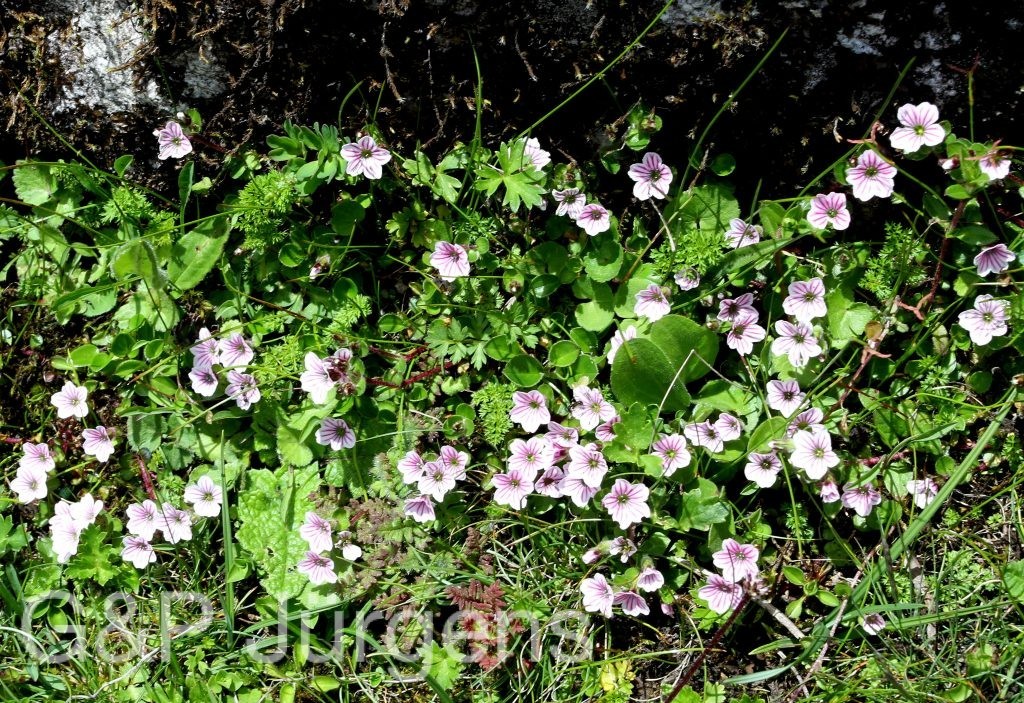
Gypsophila cerastoides is a mat-forming Himalayan pink ranging across India, Nepal and Bhutan, with the remaining GBIF country codes (USA, Austria) representing cultivated and herbarium records; the dataset holds about 65 occurrences. It is an alpine and upper subalpine plant of open stony slopes, gravelly flats, short turf and rock crevices, typically between about 3000 and 4500 m. The cushions photographed at Tsochenchen in Bhutan at roughly 3600 to 3650 m in June occupy exactly this kind of well-drained, sunlit high-mountain ground where the species flowers early in the season.

It forms low, spreading mats or loose cushions from a branched woody rootstock. The numerous small leaves are oblong to spathulate, sessile, somewhat hairy and crowded, recalling those of a Cerastium, hence the epithet. The flowers are borne singly or in few-flowered cymes on short stalks; each has five white to pale lilac petals conspicuously veined with violet or purple lines and often notched at the apex, set against a campanulate, five-toothed calyx. There are ten stamens and two styles, and the fruit is a small capsule opening by teeth to release minute seeds.

Unusual among Gypsophila for its broad, prettily veined petals and prostrate alpine habit, G. cerastoides is widely grown as a rock-garden and trough plant in temperate horticulture, which accounts for its appearance in European and North American records. Its cushion growth form is a typical adaptation to high-altitude wind, frost and drought. The species is locally common over a wide Himalayan arc and is not regarded as threatened, although alpine grazing and warming-driven vegetation shifts could affect particular populations at the margins of its range.

Author: D.Don · Sources: POWO (Kew), GBIF, Flora of Bhutan, Flora of China, Annotated Checklist of the Flowering Plants of Nepal, Barkoudah Revision of the Genus Gypsophila

D.Don

Nepal 99 902 ergebnis
West-Nepal Sepka 2680m, July
Nepal 99 903 ergebnis
West-Nepal Sepka 2680m, July

Description

Habenaria pectinata is a terrestrial orchid of the Himalaya and adjacent China, distributed from India and Nepal through Bhutan into south-western China, with records also from Japan. GBIF holds around 222 occurrences, concentrated in the central and eastern Himalaya and the Sino-Himalayan borderlands. It is a plant of temperate forest and forest margins, grassy slopes, clearings and humus-rich banks, typically between about 1500 and 3000 m, flowering during the summer monsoon. The population photographed in West-Nepal at Sepka (2680 m, July) is characteristic of its occurrence in cool, moist mid-elevation woodland and adjoining meadows, flowering as the rains advance.

The plant is a tuberous terrestrial herb arising from ovoid to oblong root-tubers, producing a single erect, leafy stem. The leaves are several, cauline, ovate-lanceolate to oblong, sheathing at the base and grading into bracts above. The inflorescence is a lax to fairly dense terminal raceme of green to greenish-white flowers. Each flower shows the characteristic Habenaria structure: a galeate dorsal sepal with spreading lateral sepals, narrow petals, and a deeply tripartite lip whose lateral lobes are conspicuously divided into slender comb-like (pectinate) segments, giving the epithet, with a long slender spur behind. The column bears widely separated viscidia and elongate caudicles adapted to moth pollination; the fruit is a ribbed dehiscent capsule releasing dust-like seeds.

The family name as supplied (Orchideaceae) is an orthographic variant of the correct Orchidaceae. Habenaria is a large pantropical genus, and H. pectinata, described by David Don, belongs to a Himalayan group with fringed or pectinate lip lobes whose delimitation from allied species requires care. As a fairly widespread terrestrial orchid it is not globally assessed as threatened, but like many ground orchids it is sensitive to forest disturbance, habitat loss and collection.

Author: D.Don · Sources: POWO (Kew), GBIF, Flora of China, Flora of Bhutan, Annotated Checklist of the Flowering Plants of Nepal, Orchids of Nepal, monograph of the genus Habenaria (Kraenzlin)

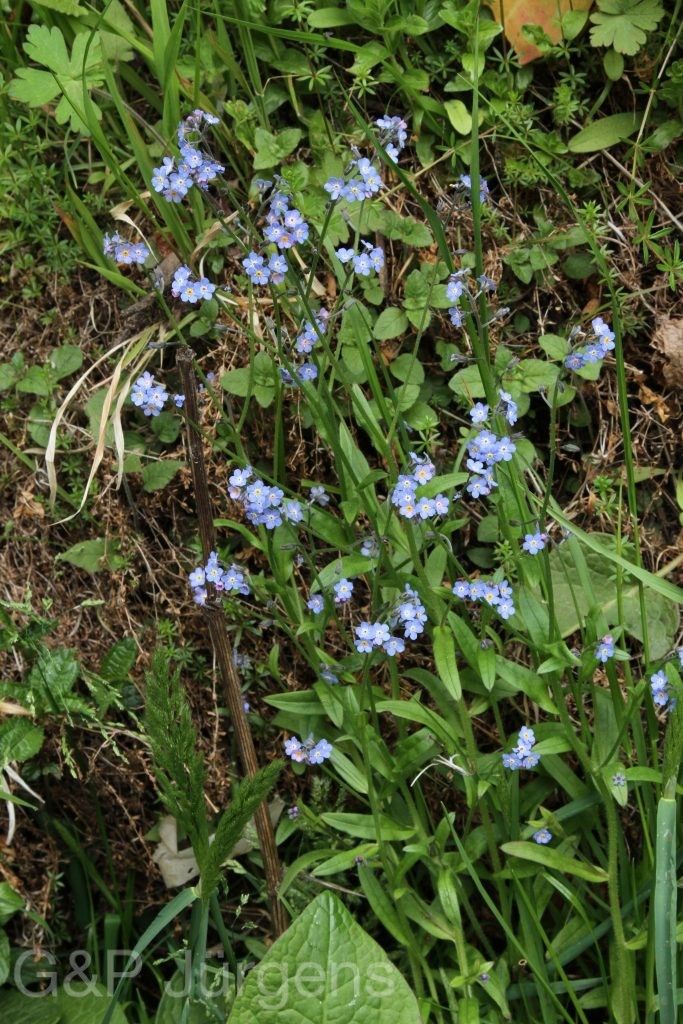
R.R.Mill

Bhutan2014 1055
Bhutan Takthsang 2900m, May
BhutanPG2011 766
Bhutan Chele-La, 3800m July

Description

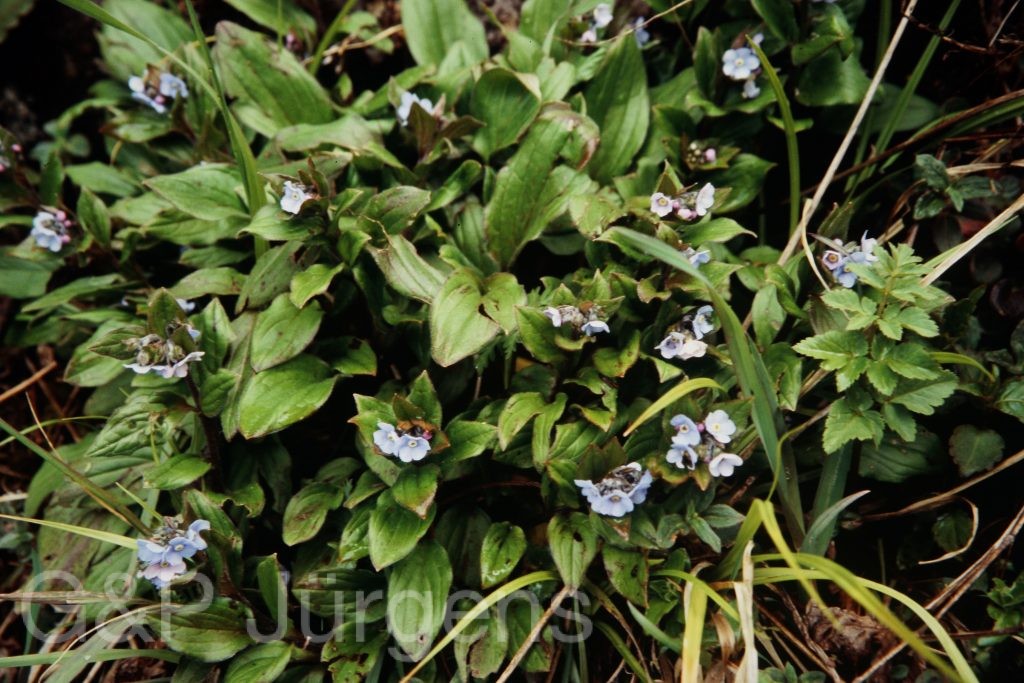
Hackelia bhutanica is a forget-me-not relative of the eastern Himalaya, described from Bhutan and also recorded from India and Nepal, with a comparatively small number of occurrences (31 georeferenced records) consistent with a localised eastern Himalayan range. It grows on shaded banks, forest margins, open slopes and among rocks in the temperate to subalpine zones. The illustrated plants from Bhutan — at Takthsang around 2900 m in May and at Chele-La near 3800 m in July — span a broad altitudinal range and show the species flowering from late spring at lower elevations into mid-summer at higher ones, tracking the seasonal advance of conditions up the mountain.

The plant is an erect biennial or perennial herb, more or less roughly hairy throughout, with a leafy stem arising from a basal cluster of leaves. The leaves are alternate, narrowly lanceolate to oblong, entire and hispid. The flowers are borne in elongating, scorpioid (coiled) cymes typical of the Boraginaceae; each has a five-lobed calyx and a small, salver-shaped, blue corolla with a short tube and five spreading lobes closed at the throat by raised scales (fornices). The fruit characteristic of Hackelia consists of four nutlets whose margins bear glochidiate (barbed, hooked) prickles, an adaptation for dispersal by attachment to passing animals.

Hackelia is segregated from the closely allied Lappula and the broader stickseed group within Boraginaceae, distinguished largely by nutlet ornamentation; the species was described by R. R. Mill, a specialist in the Bhutanese and Himalayan flora. As a restricted eastern Himalayan endemic known from relatively few localities, H. bhutanica warrants attention from a conservation standpoint, its persistence depending on the maintenance of the temperate forest and open subalpine habitats it occupies.

Author: R.R.Mill · Sources: POWO (Kew), GBIF, Flora of Bhutan, Flora of China (Boraginaceae), Mill: revisionary studies of Himalayan Boraginaceae

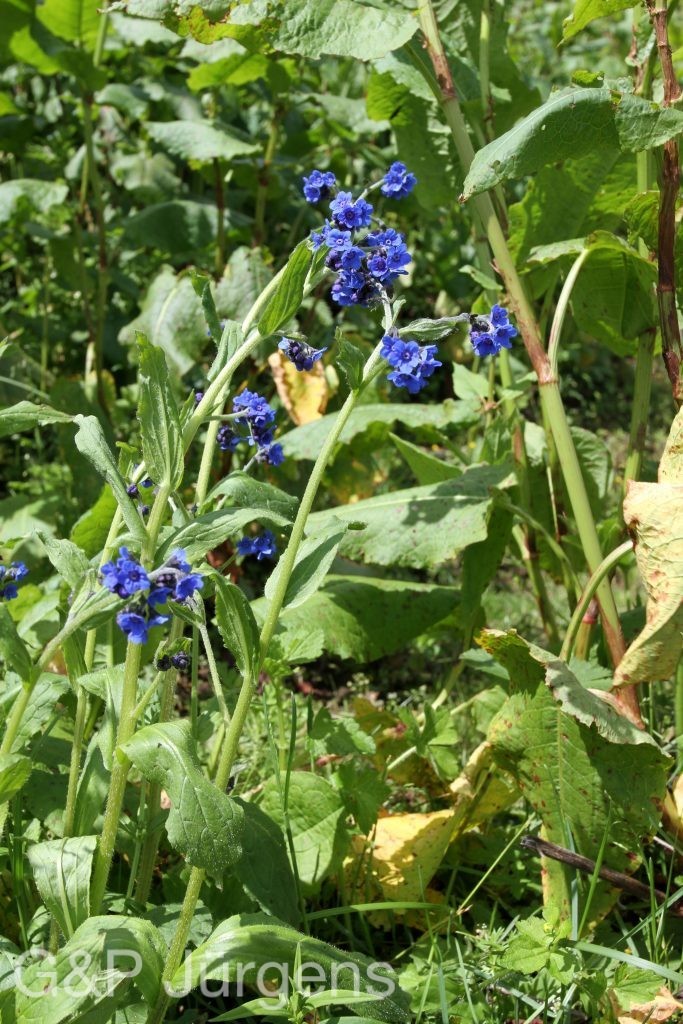
R.R.Mill

Bh09 180 P312
Bhutan Phajoding, 3600m June

Description

Hackelia obtusifolia is a Himalayan stickseed of restricted distribution, recorded from northern India, Bhutan and Nepal. GBIF documents only 14 occurrences across these three countries, indicating a localised and seldom-gathered species of the inner ranges. It grows on subalpine and alpine slopes, in open forest clearings, on rocky banks and among shrubberies on moist, humus-rich soils, broadly between about 3000 and 4000 m. The plant illustrated here was found in Bhutan at Phajoding at 3600 m in June, a high meadow and rhododendron-shrubland setting characteristic of its early-summer flowering in the eastern Himalaya.

The plant is an erect perennial herb with one or more branching, hispid stems arising from a woody rootstock. The leaves are alternate, the basal ones petiolate and the cauline ones sessile, oblong to obovate with an obtuse apex—the feature underlying the epithet—and clothed in stiff, appressed hairs. The inflorescence consists of lax, scorpioid cymes that elongate in fruit; the small flowers have a five-lobed calyx and a blue, rotate to shortly funnelform corolla with five conspicuous papillate scales (fornices) closing the throat. The fruit separates into four nutlets, each armed around the margin with glochidiate (barbed) prickles that effect epizoochorous dispersal.

Hackelia is distinguished within the tribe Cynoglosseae by its bordering of marginal glochids on the nutlets, contrasting with the wholly bristly nutlets of Cynoglossum. The barbed fruits cling readily to fur and clothing, an effective dispersal strategy in alpine grazing habitats. As a narrow Himalayan endemic known from very few collections, H. obtusifolia is poorly understood ecologically; its limited records suggest it warrants further survey, though its remote montane habitat affords some natural protection.

Author: R.R.Mill · Sources: POWO (Kew), GBIF, Flora of Bhutan, Flora of China, An Annotated Checklist of the Flowering Plants of Nepal, A Revision of the Asiatic Species of Hackelia (Boraginaceae)