Author

GP Jürgens

Wall. ex DC.

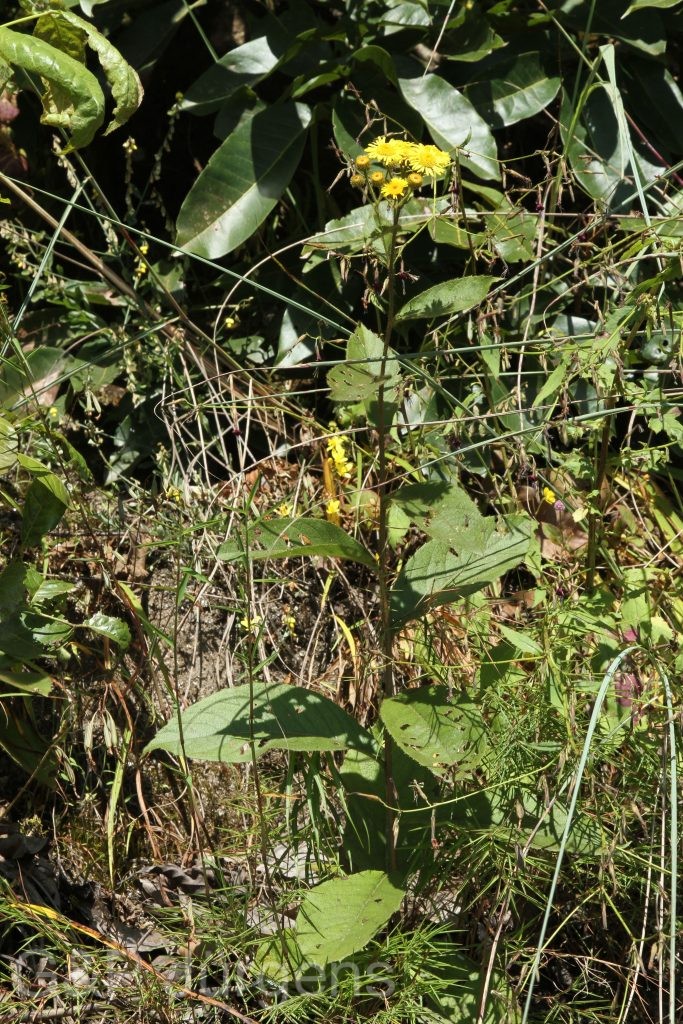
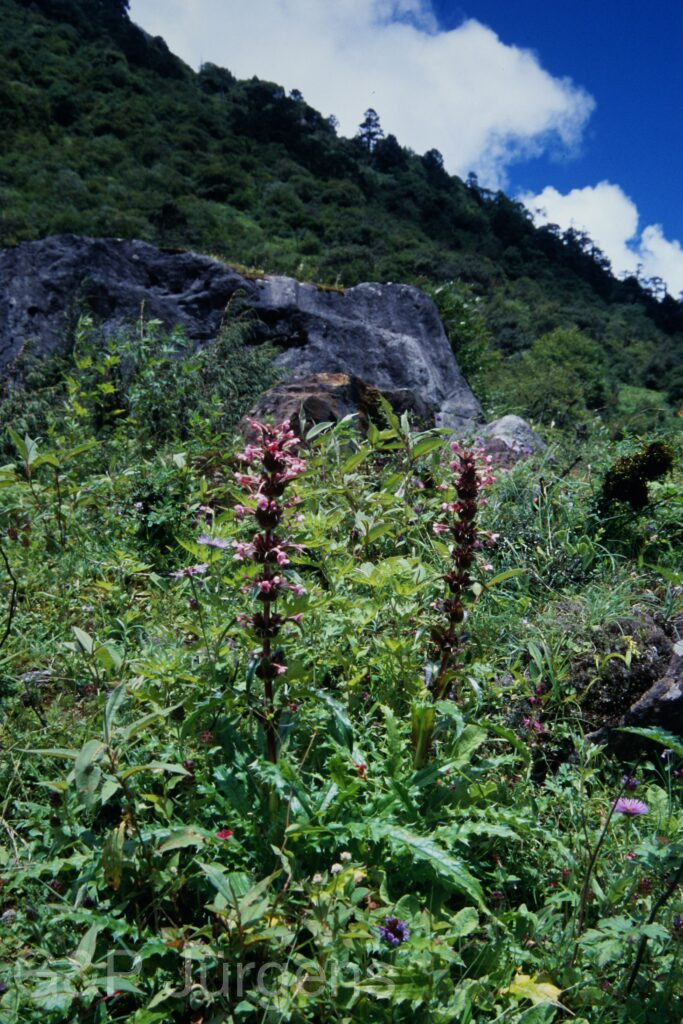
Sikkim2003 372 G521
Sikkim Tista valley 3500m August
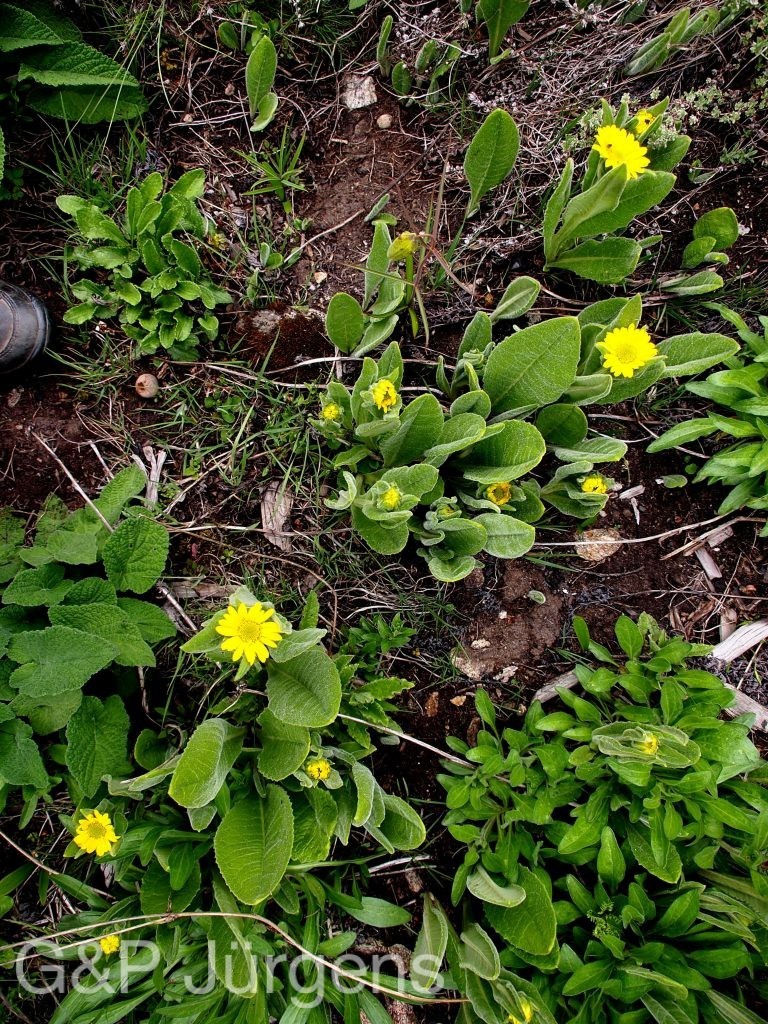
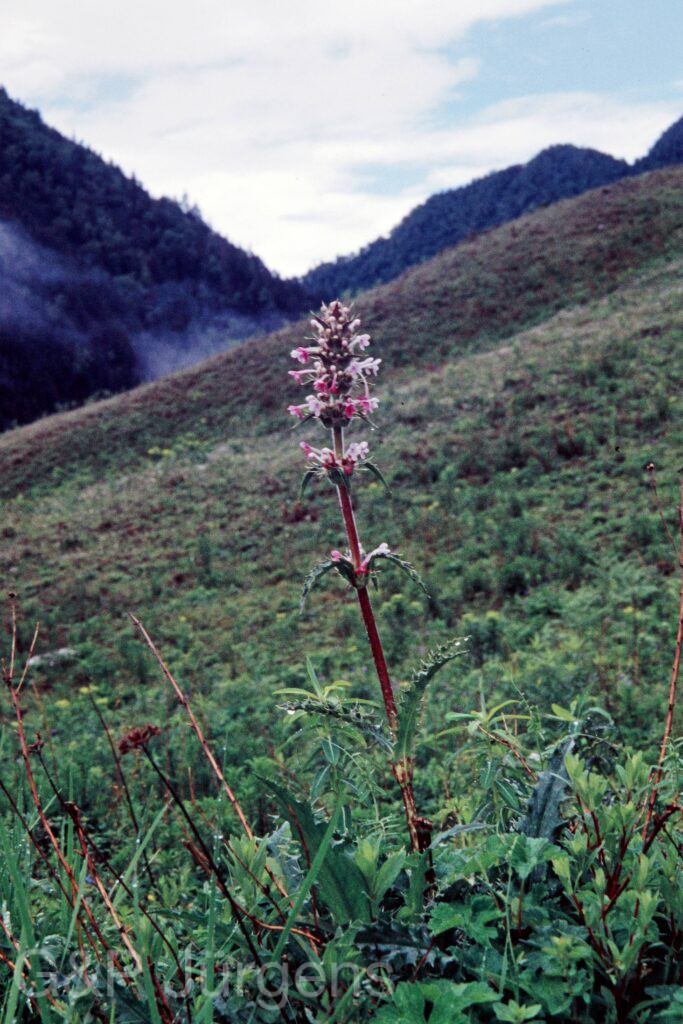
Nepal 99 84 ergebnis
West-Nepal Bhulbhule 3200m, June
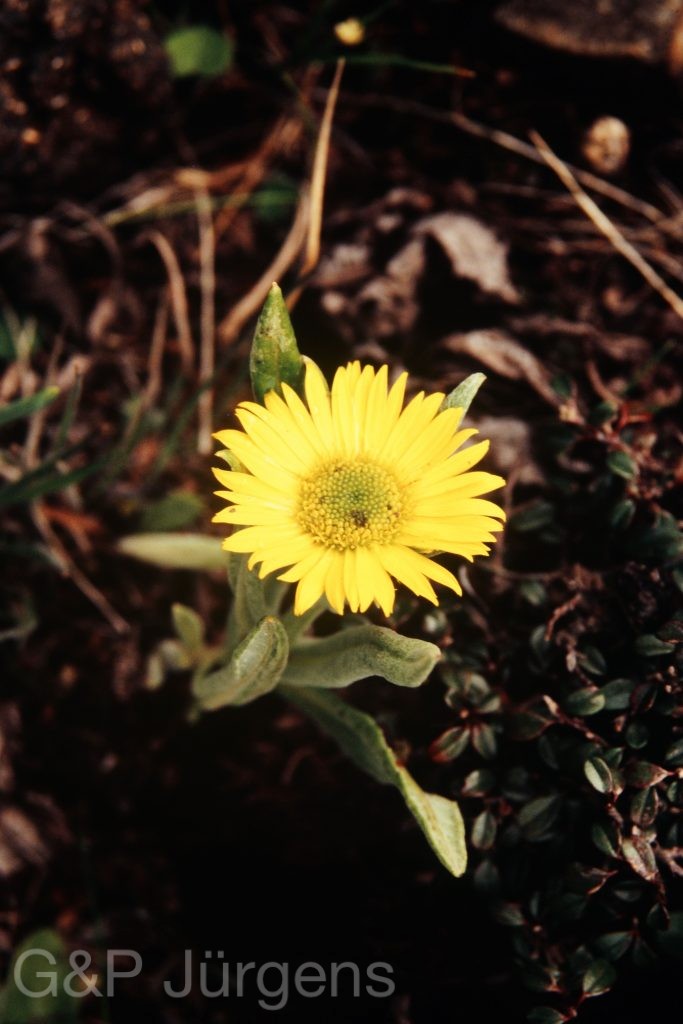
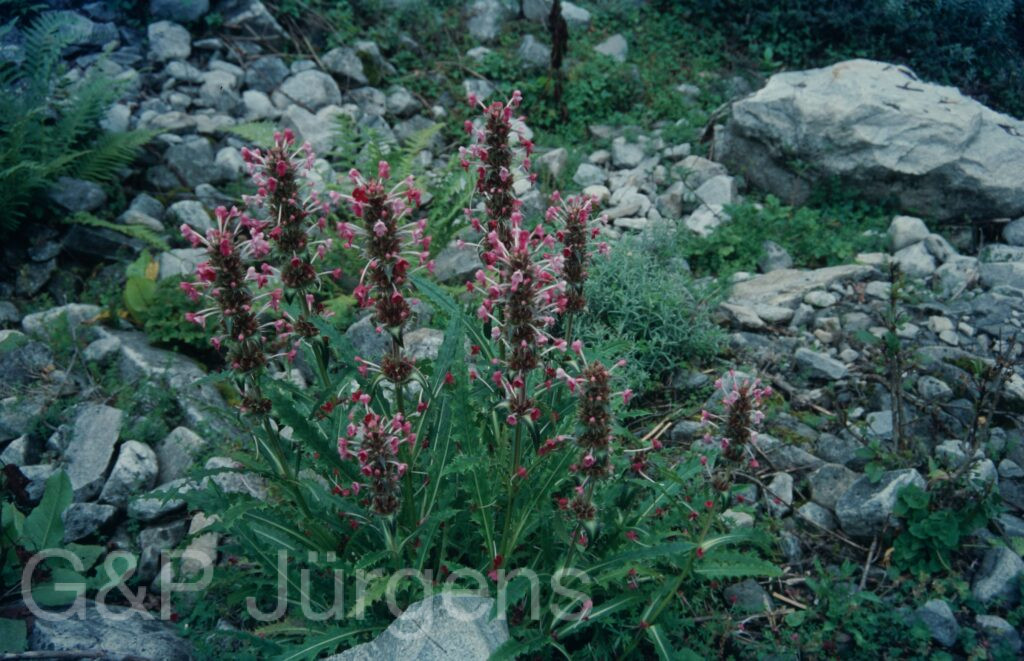
Garw 2005 36 ergebnis ergebnis
India Garhwal Valley of flowers 3100m, September

Description

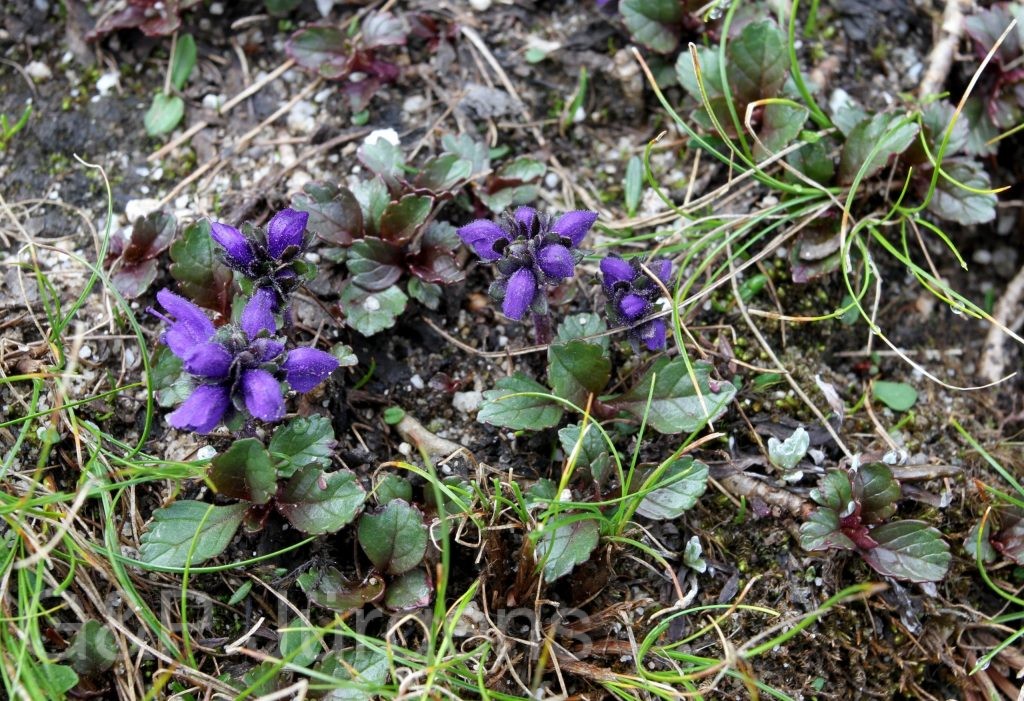
Morina longifolia, the Himalayan whorlflower, is native to the Himalaya across Pakistan, India, Nepal and Bhutan, with naturalised and cultivated records in Europe and North America (Norway, Germany, Denmark, Sweden, the United States) reflected among its roughly 125 GBIF occurrences. It grows on open alpine and subalpine slopes, in stony meadows, grassy clearings and among low scrub on well-drained soils above the forest. The cited localities, the Tista valley in Sikkim at 3500 m in August, Bhulbhule in western Nepal at 3200 m in June, and the Valley of Flowers in Garhwal at 3100 m in September, span its range of roughly 3000-4000 m, where it flowers through the summer monsoon.

It is a robust, erect perennial herb forming a basal rosette of long, narrow, linear-lanceolate leaves whose margins are conspicuously spiny-toothed, giving a thistle-like appearance, the whole plant aromatic when crushed. The flowering stem rises stoutly and bears the flowers in well-separated, spiny-bracted whorls (verticillasters) up the upper axis. Each flower has a tubular, curved, two-lipped corolla that opens white and ages through pink to deep crimson, so flowers of several colours appear together in one whorl. Two stamens are fertile, the slender style is exserted, and the inferior ovary develops into a small one-seeded achene enclosed within the persistent involucel.

The genus Morina, with its spiny leaves and whorled bicoloured flowers, has been placed variously in its own family Morinaceae or within Dipsacaceae, and is treated by current systems within an enlarged Caprifoliaceae; molecular work confirms its position near the teasels and valerians in the Dipsacales. The long-tubed flowers are pollinated by long-tongued insects, and the species is widely grown as an ornamental, accounting for its scattered occurrences far beyond its native range.

Author: Wall. ex DC. · Sources: POWO (Kew), GBIF, Flora of Pakistan, Flora of Bhutan, Cannon revision of Morina, Bell Dipsacales phylogeny

Morus indica

by GP Jürgens

L.

Nepal 97 362 P710
Nepal Arun-Valley 1700m May

Description

Morus indica L. is a deciduous tree or shrub of the mulberry family, widely distributed across temperate and subtropical Asia and extensively cultivated. GBIF documents over 14,000 records from China, India, Taiwan, Korea, Japan, Myanmar, the Philippines and Thailand, together with introductions in Europe and the Americas, reflecting its long history of cultivation for sericulture and fruit. In the Himalaya it occurs in subtropical and lower temperate forest, along valley sides, field margins and roadsides; the photographed plant is from Nepal, the Arun Valley, at 1,700 m in May, a typical mid-elevation montane setting.

The plant is a small to medium tree with grey, fissured bark and milky latex. The leaves are alternate, ovate, often unequally cordate at the base, with a serrate or dentate margin and an acuminate apex; juvenile and coppice leaves are frequently variously lobed, a common feature of the genus. The plant is dioecious or monoecious, the inconspicuous unisexual flowers borne in short, dense, pendent axillary catkins (spikes); staminate flowers have four tepals and four stamens, pistillate flowers a superior ovary with a bifid stigma. The fruit is a fleshy sorosis (multiple fruit) formed from the accrescent perianths, ripening from greenish through red to dark purple-black and edible.

The taxonomy of Asian Morus is unsettled, with M. indica often treated as part of the variable M. alba complex and subject to differing circumscriptions. The species is of major economic importance as the principal food plant of the silkworm and as a fruit and fodder tree, and is consequently both wild and widely naturalised; it is not of conservation concern.

Author: L. · Sources: POWO (Kew), GBIF, Flora of China Vol. 5, Flora of Nepal, Flora of Bhutan Vol. 1, Berg: Moraceae (Flora Malesiana)

(Buch.-Ham. ex Roxb.) Maxim.

Bhutan2015 32
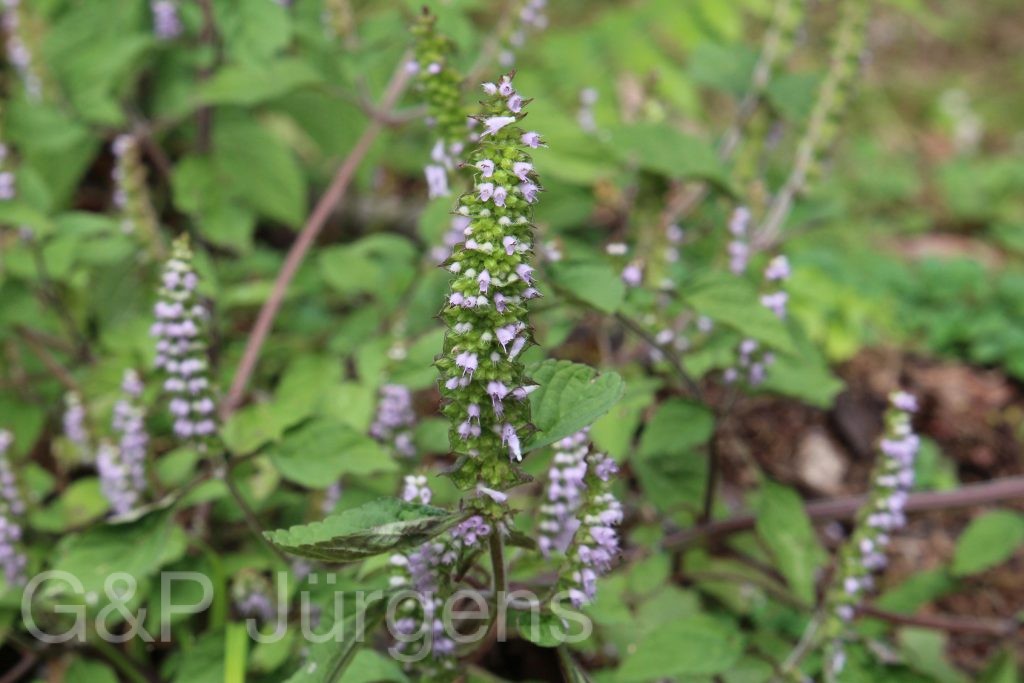
Bhutan Dochu-La 2800m, October
Bhutan2015 33
Bhutan Dochu-La 2800m, October

Description

Mosla dianthera is a widespread annual mint of monsoonal Asia, ranging from the Himalaya (Nepal, Bhutan, India, Pakistan, Bangladesh, Myanmar) across China, Korea, Japan, Taiwan and the Russian Far East south into mainland and insular Southeast Asia; with over 7000 GBIF occurrences it is among the most frequently recorded species of its genus. It grows in disturbed and seasonally moist ground, including roadsides, field margins, fallow land, streambanks and open grassy slopes from the lowlands into the temperate hills, as recorded at Dochu-La in Bhutan at 2800 m. As an autumn-flowering annual it completes its cycle on the late monsoon moisture, flowering and fruiting in October.

It is a slender, erect, aromatic annual herb with the quadrangular stems typical of the Lamiaceae, often much branched and sparsely hairy. The leaves are opposite, petiolate, ovate-lanceolate to lanceolate, serrate along the margin and gland-dotted, releasing a pungent scent when crushed. The flowers are borne in lax, terminal and axillary racemes; each two-lipped corolla is small, pale pink to purplish, with a notched upper lip and a three-lobed lower lip. Diagnostic for Mosla are the two fertile stamens (the epithet "dianthera" referring to the two anthers) and the reticulately pitted nutlets. The fruit comprises four small, dry, one-seeded nutlets enclosed in the persistent, gland-dotted calyx.

Mosla is a small Asian genus segregated from Orthodon and allied to Perilla and Elsholtzia within the subfamily Nepetoideae, characterised by the reduction to two stamens and by aromatic terpene-rich foliage. The essential oils of M. dianthera are used in traditional medicine, and the plant is a minor nectar source for bees and other insects. Being a ruderal, broadly tolerant annual of vast geographic range, it is of least conservation concern and is sometimes weedy. (The associated WordPress link erroneously references Pogostemon benghalensis; the taxon treated here is Mosla dianthera.)

Author: (Buch.-Ham. ex Roxb.) Maxim. · Sources: POWO (Kew), GBIF, Flora of China, Flora of Bhutan, Li & Hedge's treatment of the Lamiaceae

Mucuna macrocarpa

by GP Jürgens

Wall.

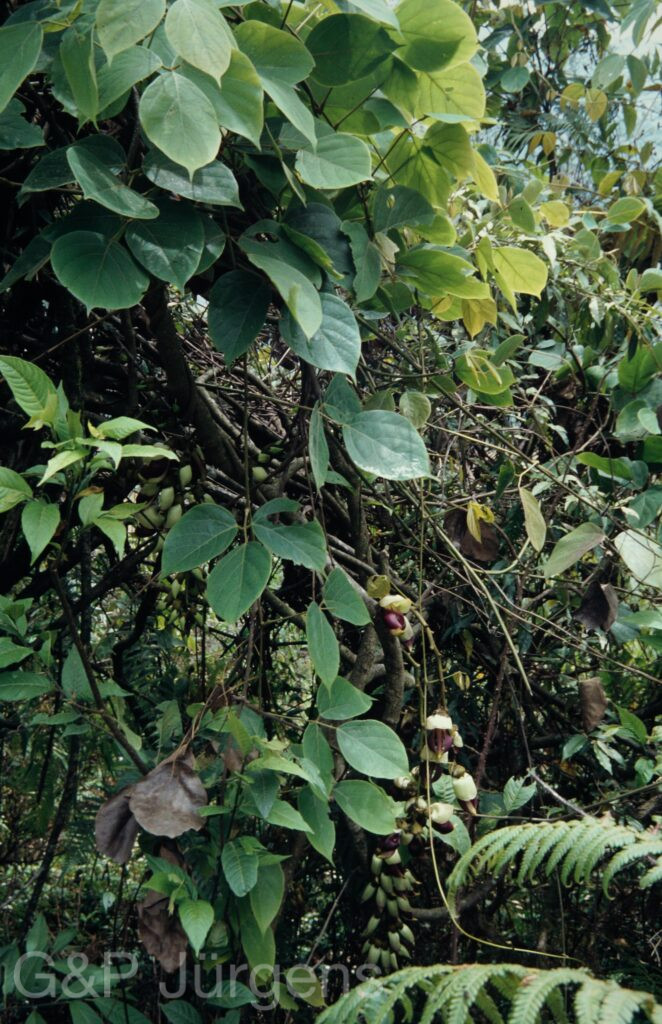
Nepal 1994 57 ergebnis
Ost-Nepal Bhalukhob 
1800m April
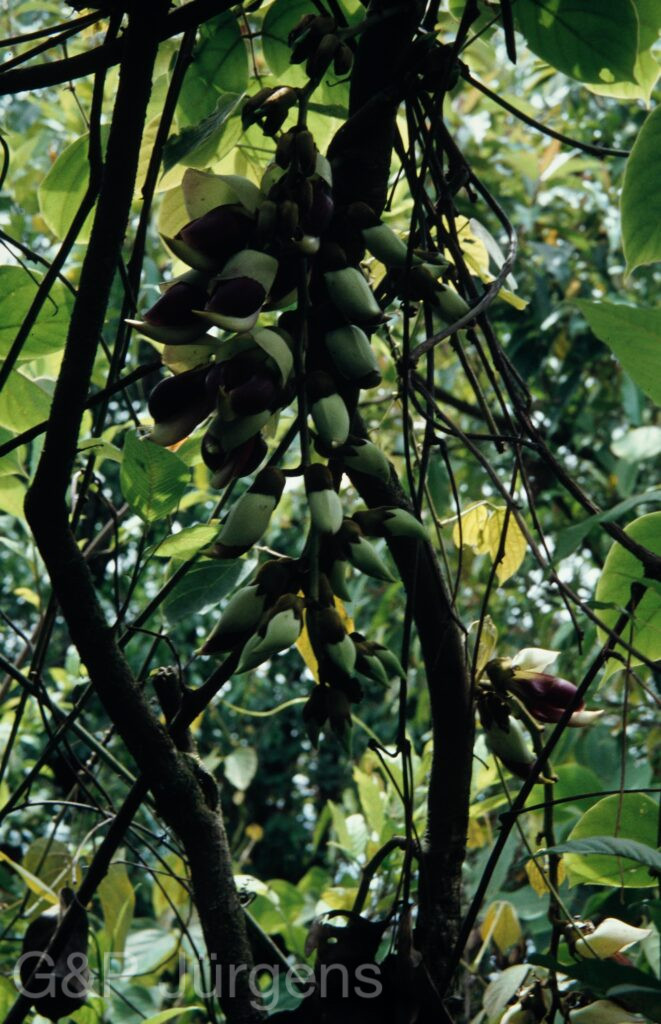
Nepal 1994 55 ergebnis
Ost-Nepal Bhalukhob 
1800m April

Description

Mucuna macrocarpa is a large woody climber of subtropical and tropical Asia, ranging from Taiwan, Japan and China through Thailand, Laos, Myanmar, India, Vietnam, Nepal, Malaysia and Bhutan; GBIF records some 2100 occurrences, making it by far the best-documented species in this set. It scrambles through warm broadleaved and evergreen forest, along forest edges and ravine slopes at lower montane elevations. The photographed plant grows at Bhalukhob in East Nepal at about 1800 m, flowering in April, in humid subtropical hill forest.

It is a robust, perennial liana with stout woody stems and trifoliolate leaves bearing large, broadly ovate to elliptic leaflets. The pendent, cauliflorous to ramiflorous inflorescences carry showy papilionaceous flowers with a dark, often deep purple to maroon or greenish keel and standard, the keel curved and enclosing the stamens and style. The fruit is a large, woody, oblong pod, broad and often flattened, conspicuously ribbed or winged and clothed in irritant hairs, enclosing several hard, disc-shaped seeds.

The species is accepted. Mucuna is noted for explosive, mechanically triggered flowers adapted to vertebrate pollination: in this and related species the keel snaps open under the manipulation of nectar-feeding bats and, locally, other mammals or large birds, a celebrated case of chiropterophily. The stinging pod hairs deter herbivores, while the buoyant seeds are reported to disperse by water. Its wide range and frequency indicate a secure conservation status across monsoon Asia.

Author: Wall. · Sources: POWO (Kew), GBIF, Flora of China, Flora of Bhutan, Wilmot-Dear's revisions of Asian Mucuna (Leguminosae)

(Stokes) Faden

Description

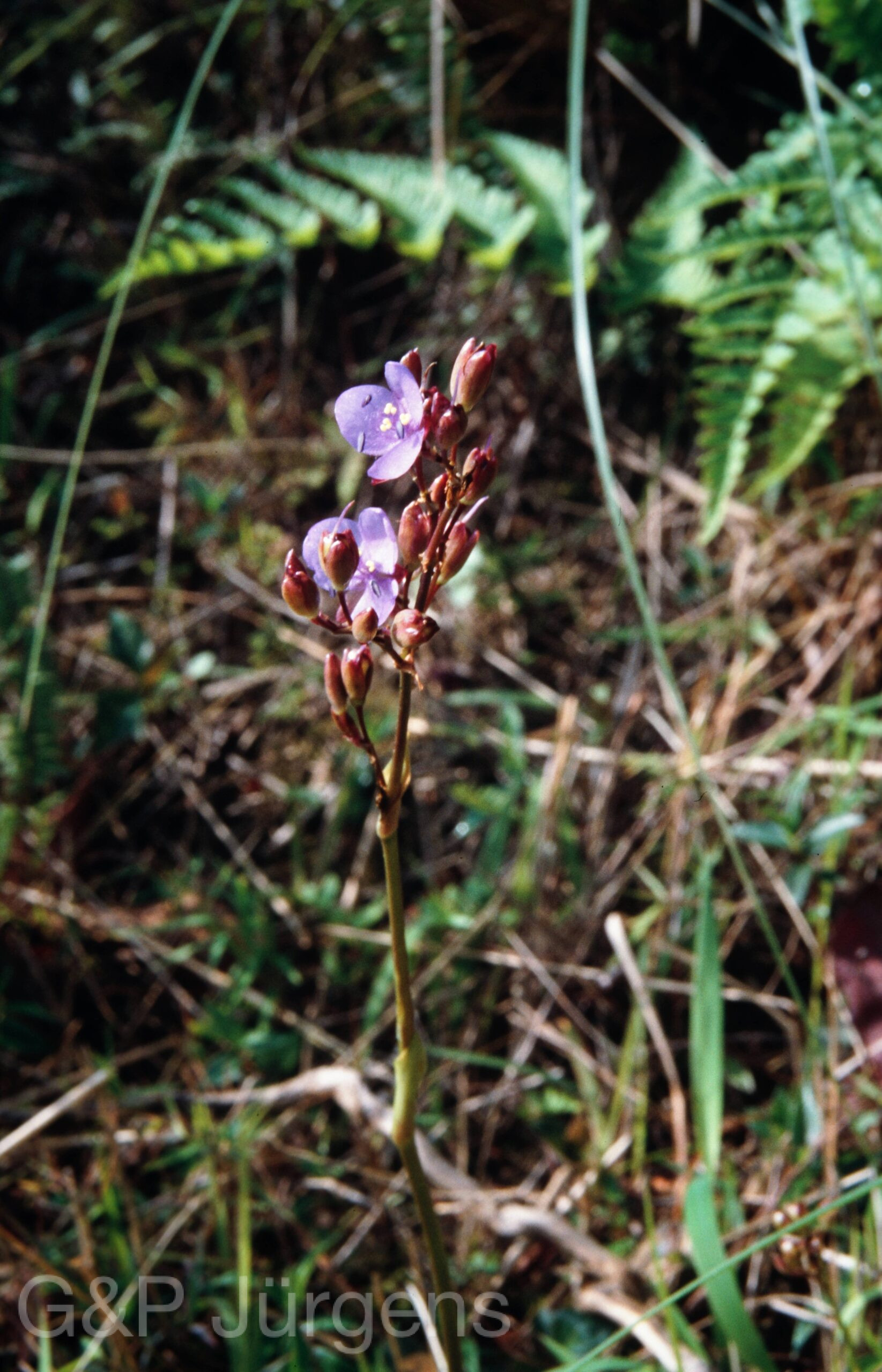
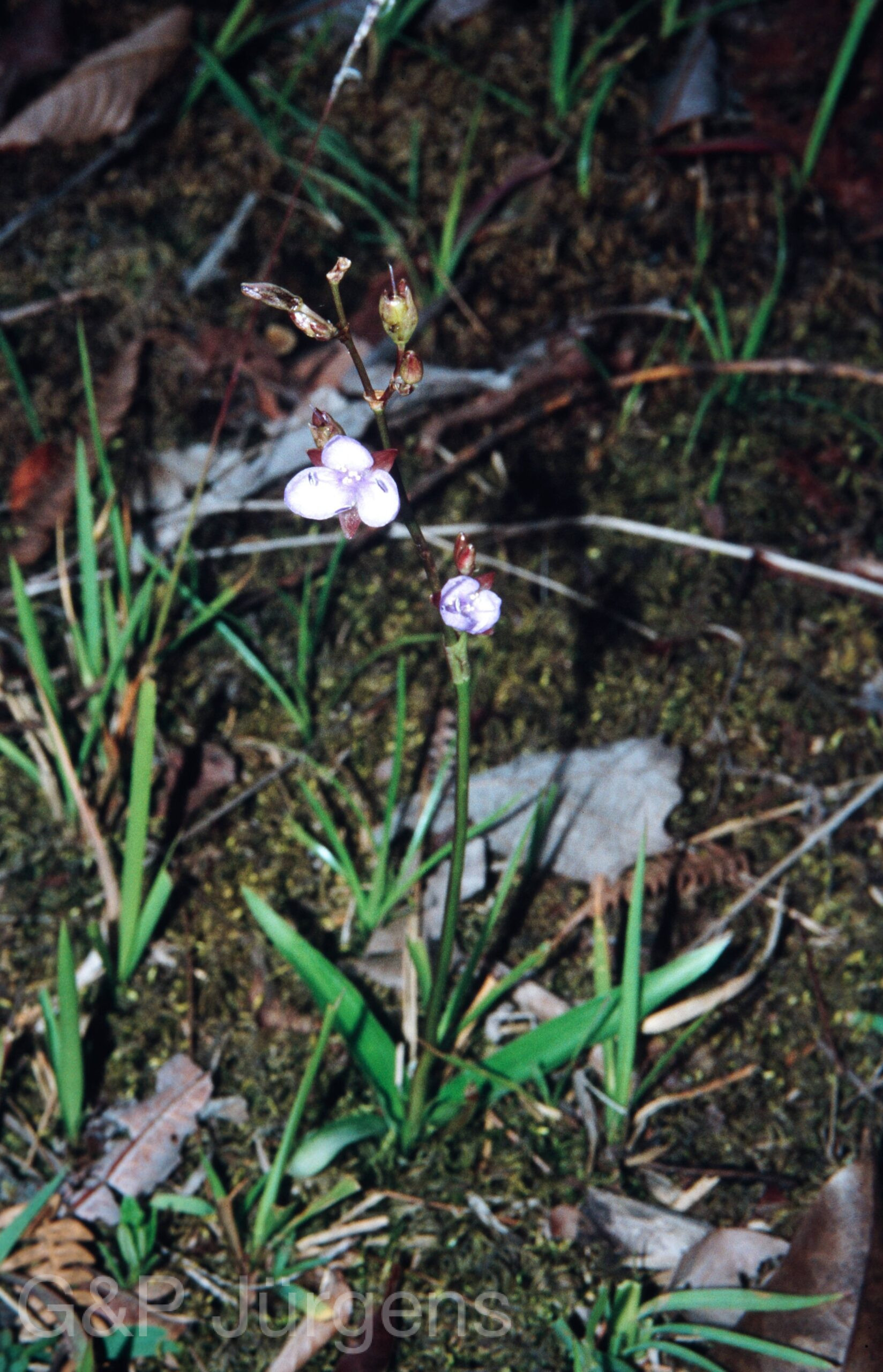
Murdannia edulis is a tuberous-rooted dayflower relative distributed across tropical and subtropical Asia, from the Himalaya (Nepal, Bhutan, northeast India) through southern China, Taiwan, Myanmar, Thailand and Indochina to Malesia, the Philippines and New Guinea. It grows in open grassland, scrub, forest margins and seasonally moist banks, often on disturbed or cultivated ground, principally at low to mid elevations. The plant recorded at Mulabari in the Gorkha district of Nepal at 1,340 m in May represents its presence in the warm subtropical foothill zone, where it emerges and flowers with the onset of the pre-monsoon rains.

The plant is a perennial herb arising from a cluster of fleshy, fusiform, fascicled tuberous roots that store water and nutrients. The leaves are mostly radical, linear to lanceolate, sheathing at the base and arranged in a basal tuft, with parallel venation typical of the family. The inflorescence is a scapose, terminal panicle of cincinni bearing ephemeral, actinomorphic flowers with three free, pink to pale blue or mauve petals and conspicuous bearded staminodes accompanying the fertile stamens. The fruit is a small, loculicidal, ellipsoid capsule containing few angular seeds.

The genus Murdannia, segregated from Aneilema and Commelina, is distinguished by its enantiostylous, regular flowers and characteristic stamen arrangement; M. edulis was transferred to the genus by Faden, its basionym attributed to Stokes. As the epithet indicates, the starchy tuberous roots are edible and have been used as a famine or supplementary food across its range. The species is widespread, weedy and adaptable, and is of no conservation concern.

Author: (Stokes) Faden · Sources: POWO (Kew), Flora of China Vol. 24, Flora of Nepal, GBIF, Faden: Commelinaceae systematics

Vahl

Bh09 388 P615
Bhutan Punaka-Chju 1600m, June
Nepal 2001 468 ergebnis ergebnis
Nepal (Gorkha) Gunda 1700m, May

Description

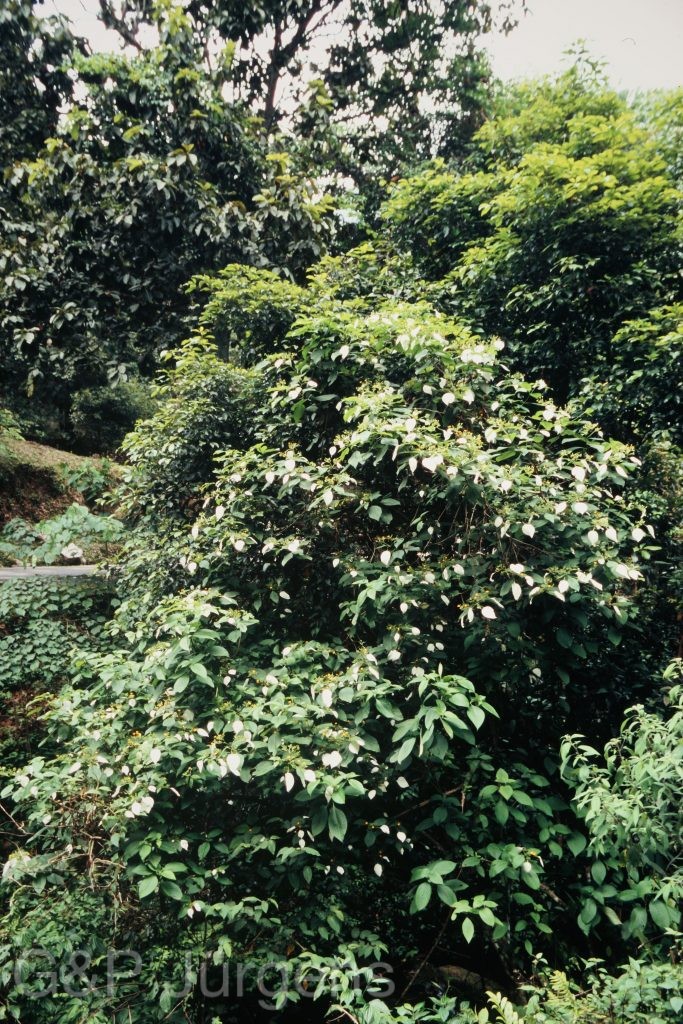
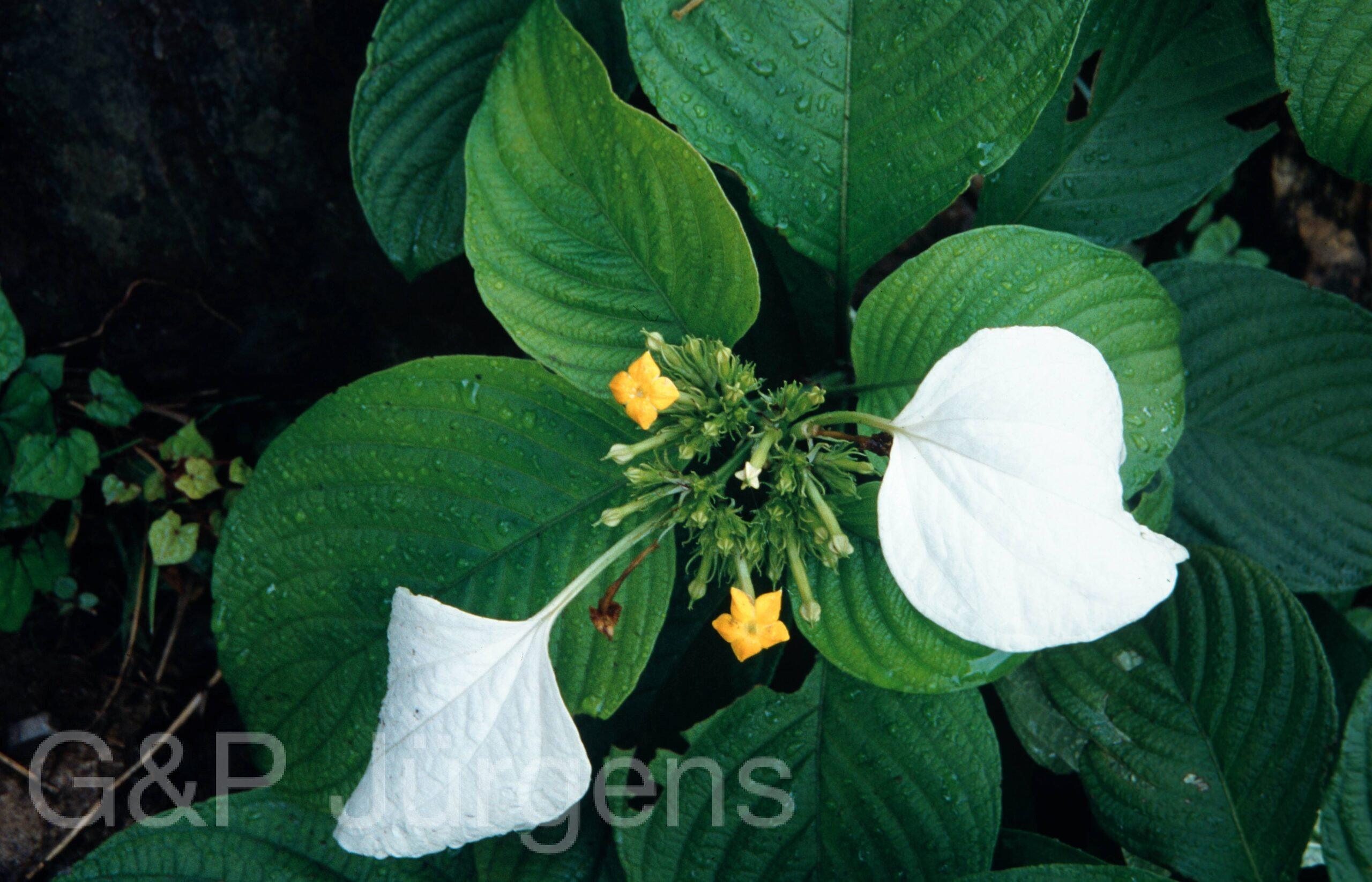
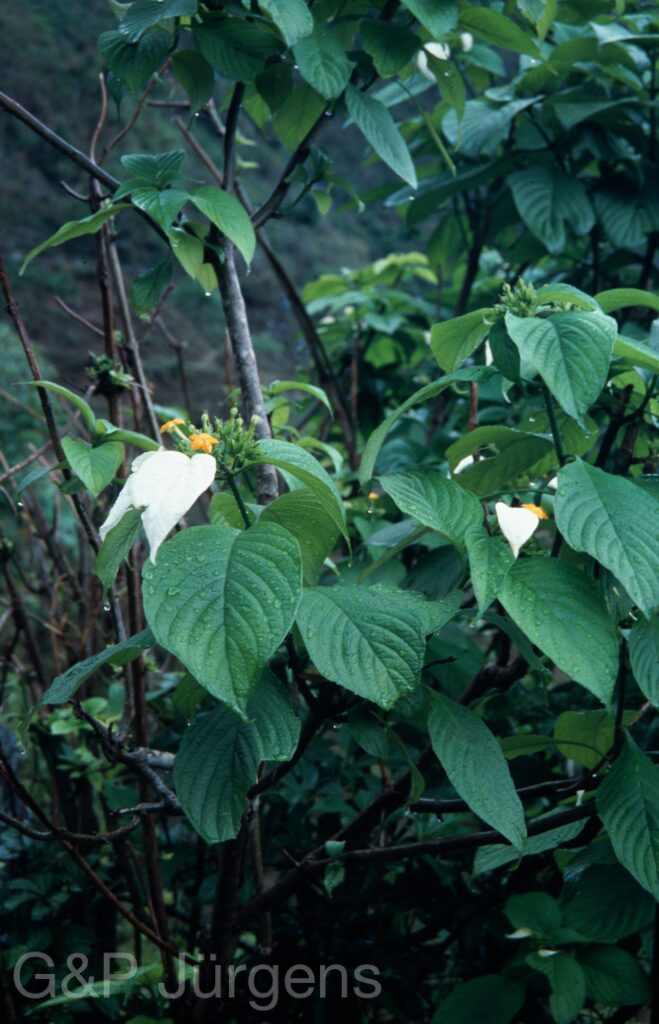
Mussaenda glabra is a widely distributed tropical to subtropical shrub or scrambling liana of Southeast Asia and the eastern Himalaya, documented from numerous countries including India, China, Myanmar, Thailand, Vietnam, Malaysia, Indonesia and Nepal across some 355 GBIF occurrences. The illustrated material was gathered at Punaka-Chu in Bhutan at 1600 m in June and at Gunda in Gorkha, Nepal at 1700 m in May. It grows in moist broad-leaved forest, along streamsides, thickets and forest margins from the lowlands up to about 1800 m, thriving in warm, humid, partly shaded situations.

It is an evergreen shrub or woody climber with terete, often pubescent young branches. The leaves are opposite, ovate to elliptic, entire, acuminate at the apex, with interpetiolar stipules characteristic of the Rubiaceae. The inflorescence is a terminal cyme bearing tubular flowers with a five-lobed orange-yellow corolla; the diagnostic feature is the enlargement of a single calyx lobe in some flowers into a large, conspicuous, white, leaf-like petaloid bract (semaphyll) that advertises the inflorescence to pollinators. The fruit is a fleshy berry containing numerous minute seeds.

The genus Mussaenda is renowned for these showy expanded calyx lobes, an adaptation enhancing pollinator attraction in the shaded understory and a feature widely exploited in horticulture. The fleshy berries are dispersed by birds. With its broad range spanning continental and insular Asia, the species is of least concern, being common across much of its distribution, though dependent on the persistence of intact lowland and submontane forest.

Author: Vahl · Sources: POWO (Kew), GBIF, Flora of China, Flora of Bhutan, Flora of Nepal, Jayaweera – The Genus Mussaenda (Rubiaceae) revision

(D.Don) S.C.Chen & J.J.Wood

Nepal 97 408 P789
Nepal Tashigaon 3000m May

Description

Mycaranthes floribunda is a widespread epiphytic orchid of tropical and subtropical Asia, recorded from India, Nepal, Bhutan, Bangladesh, Myanmar, Thailand, Laos, Cambodia, Vietnam and southern China. With some 182 georeferenced collections in GBIF, it is among the more frequently encountered species of its genus. In the eastern Himalaya it ascends into the temperate zone, as shown by material gathered near Tashigaon in eastern Nepal at around 3000 m in May. It grows chiefly as an epiphyte on the trunks and boughs of trees in humid broad-leaved and mixed evergreen forest, favouring mossy, shaded situations with reliable atmospheric moisture, and occasionally occurs lithophytically on shaded rock.

The plant forms clustered, slender, cane-like pseudostems arising from a short rhizome and clothed in persistent leaf bases. The leaves are several, distichous, narrowly elliptic to lanceolate, coriaceous and acute, articulated to sheathing bases. Inflorescences are lateral or terminal, erect to arching racemes bearing numerous small, densely arranged flowers, the axis and ovaries often furnished with fine mealy or hairy indument. The flowers are pale, the sepals ovate-lanceolate with a short mentum formed at the column foot, the petals narrower, and the trilobed labellum bearing low keels or calli on the disc. The fruit is a small ellipsoid capsule.

The species was originally described by D. Don and was transferred to Mycaranthes by S.C. Chen and J.J. Wood, reflecting the segregation of this lineage from the broadly circumscribed genus Eria, a realignment supported by molecular phylogenetic analyses of the Eriinae. Its wide elevational and geographic amplitude and tolerance of disturbed forest margins render it relatively secure across much of its range, though continuing deforestation locally reduces suitable epiphytic habitat.

Author: (D.Don) S.C.Chen & J.J.Wood · Sources: POWO (Kew), GBIF, Flora of Bhutan, Flora of China, Genera Orchidacearum

(Clarke ex Hook.f.) Kitam.

Bhutan2015 74
Bhutan Wangdi 1400m, October
Sikkim2011 73
Sikkim Tanghu 4000m, June
Bh09 25 G46
Bhutan Chele-La, 3500m June

Description

Nannoglottis hookeri is a Himalayan and Sino-Himalayan species recorded from Nepal, Pakistan, Bhutan, India and south-western China, GBIF logging about 145 occurrences across this arc. It inhabits a notably broad altitudinal span, from warm-temperate forest understorey and shrubby slopes to high subalpine and alpine meadows. The cited gatherings illustrate this amplitude: Wangdi in Bhutan at only 1400 m in October, Tanghu in Sikkim near 4000 m in June, and the Chele-La pass at around 3500 m in June. Such occurrence in moist, partly shaded ground, on humus-rich soils among rocks and along forest margins, characterises the species through the Eastern Himalayan ranges.

It is a perennial herb growing from a stout woody rhizome and producing erect, leafy, glandular-pubescent stems. The leaves are alternate, the lower ones petiolate with ovate to elliptic, coarsely toothed blades, becoming sessile and amplexicaul above; both surfaces bear scattered hairs. The capitula are radiate and arranged in a loose terminal corymb; the involucre is hemispheric with subequal, herbaceous phyllaries in few rows. Ray florets are yellow, ligulate and female, while the disc florets are tubular, yellow and bisexual. The cypselae are oblong and ribbed, surmounted by a pappus of slender barbellate bristles, an arrangement linking the genus to the Astereae.

Nannoglottis (Astereae) is a small Sino-Himalayan genus of fewer than a dozen species, distinguished by its radiate heads and montane forest ecology, and molecular work places it near the base of the tribe, making it of phylogenetic interest. Named for J. D. Hooker, N. hookeri is treated as an accepted species. Its dependence on cool, moist montane habitat and relatively narrow distribution warrant attention, though no formal threat status has been assigned; populations appear stable where forest cover persists.

Author: (Clarke ex Hook.f.) Kitam. · Sources: POWO (Kew), GBIF, Flora of Bhutan, Flora of China, Annotated Checklist of the Flowering Plants of Nepal, Gao's systematic study of Nannoglottis (Astereae)

(D.Don) DC.

BhutanPG2011 707 01 01
Bhutan Chele-La, 3850m July
Sikkim2003 195 P273
Sikkim Dzongri 4000m 08.2003
Nepal 99 283 ergebnis
Nepal Loccu 3155m, May
Nepal 99 366 ergebnis
Nepal Loccu 3155m, May
Nepal 99 822 ergebnis
West-Nepal Baga-La-Phedi 4200m, July

Description

Nardostachys jatamansi, the source of the aromatic drug spikenard, is an alpine herb of the high Himalaya and the Tibetan plateau margins. GBIF records confirm its native distribution across China, Nepal, India, Bhutan and Myanmar, with cultivated or processed material recorded from several other countries, totalling around 1110 occurrences. It grows on open alpine meadows, rocky slopes, grassy ledges and stable scree, generally between about 3000 and 5000 m, in the cool, summer-moist conditions of the high mountains. The photographed collections span its range and altitude well, from the Chele-La in Bhutan at 3850 m and Dzongri in Sikkim at 4000 m to Loccu in Nepal at 3155 m and the Baga-La-Phedi in West Nepal at 4200 m, recorded from May to August during the alpine flowering season.

It is a small, erect perennial herb arising from a stout, woody, aromatic rhizome densely clothed in the fibrous remains of old leaf-bases. The leaves are mostly basal, elongate-spathulate to oblong, entire and somewhat fleshy. The flowering stem bears a compact terminal cyme or head of small flowers; each has a campanulate, pink to pale rose corolla with five lobes, four stamens and an inferior ovary. The fruit is a small, one-seeded achene crowned by the persistent calyx.

Nardostachys is here placed in the Caprifoliaceae, into which the former valerian family Valerianaceae is now subsumed. The species is of great economic and cultural importance, its fragrant rhizome being the jatamansi or spikenard of ancient commerce, still harvested for essential oils, perfumery and traditional medicine. Intensive wild collection coupled with its restricted alpine habitat has led to serious population decline, and the species is assessed as Critically Endangered and listed under CITES Appendix II.

Author: (D.Don) DC. · Sources: POWO (Kew), GBIF, Flora of Nepal, Flora of China (Valerianaceae/Caprifoliaceae), Medicinal Plants of the Himalaya (Polunin & Stainton)

R.R.Mill

BhutanPG2011 420 scaled
Bhutan Ludlow-Sherriff-Trail Warrtlang-La, 4400m June

Description

Neopicrorhiza minima is an extremely localised high-alpine herb known only from Bhutan, where GBIF holds a mere five records, underscoring its rarity and narrowly endemic distribution in the Eastern Himalaya. It is a plant of the upper alpine zone, growing on open rocky slopes, moist screes, moraines and short turf near the limit of vascular plant life, at around 4400 m. The plant photographed along the Ludlow-Sherriff Trail at Warrtlang-La in Bhutan at 4400 m in June captures it flowering in this severe, wind-exposed, snowmelt-fed environment during the brief alpine summer.

It is a small, dwarf perennial herb, as the epithet minima indicates, arising from a creeping, bitter rhizome and forming compact tufts or low mats. The leaves are basal, spathulate to oblong and crenate-toothed, narrowing into a petiole. The flowers are borne in a short, dense, terminal raceme or spike on a low scape; each flower has a small calyx and a tubular, somewhat two-lipped corolla, typically bluish-purple to mauve, with four exserted stamens. The fruit is a small capsule containing numerous minute seeds.

Neopicrorhiza was segregated from Picrorhiza, the bitter-rhizomed Himalayan herbs once placed in Scrophulariaceae and now referred to Plantaginaceae following molecular work on the lamiid families; N. scrophulariiflora is the better-known relative, valued medicinally. N. minima, described by R.R. Mill, is distinguished by its diminutive stature and high-alpine habitat. Its single-country endemism and very small number of records mark it as a species of genuine conservation concern, dependent on its restricted Bhutanese high-mountain habitat.

Author: R.R.Mill · Sources: POWO (Kew), GBIF, Flora of Bhutan, Annotated Checklist of the Flowering Plants of Nepal, Hong Scrophulariaceae monograph