Author

GP Jürgens

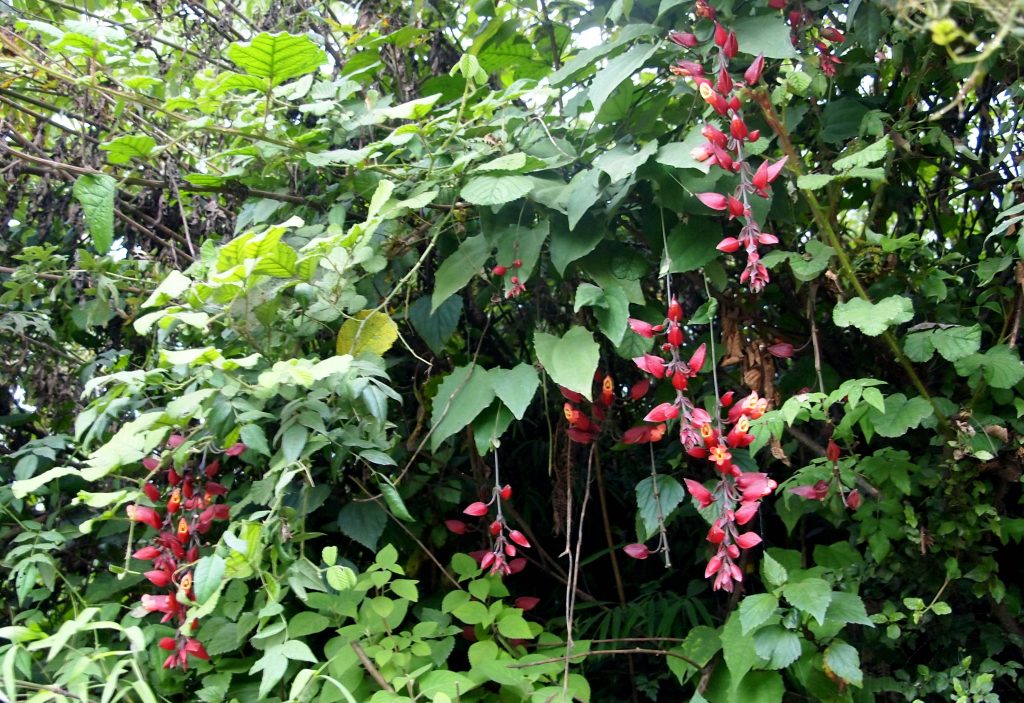
Wall. ex. D.Don.

Bhutan2012 363
Bhutan Wangdi 2500m, September

Description

Thunbergia coccinea Wall. ex D.Don is a vigorous woody climber of the eastern Himalaya and Indo-Burmese region, with GBIF documenting nearly 692 occurrences across India, China, Nepal, Bhutan, Myanmar, Thailand, Laos, Sri Lanka and Bangladesh, alongside numerous cultivated records in tropical and subtropical gardens worldwide. In the wild it scrambles through the canopy of moist broadleaved and subtropical forest, along streamsides and forest margins, flowering in the post-monsoon months. The illustrated plant from Wangdi (Wangdue Phodrang) in western Bhutan at 2500 m in September captures it at the upper edge of its altitudinal range, twining over shrubs and trees in humid hill forest.

The species is a perennial liana with twining stems and opposite, petiolate leaves that are ovate to cordate, acuminate, with toothed to entire margins and palmate basal venation. The flowers hang in long, pendulous, many-flowered racemes; each scarlet to brick-red corolla is tubular and curved with a slightly oblique, shortly five-lobed limb, subtended by paired bracteoles, and contains four didynamous stamens. The fruit is the characteristic acanthaceous capsule, beaked and explosively dehiscent, ejecting a few flattened seeds borne on retinacula.

Thunbergia, sometimes segregated in Thunbergiaceae but generally placed in Acanthaceae, comprises Old World tropical climbers and shrubs, several grown ornamentally; T. coccinea is valued in horticulture for its dramatic drooping red flower chains. Its bird- and insect-visited blooms point to a mixed pollination syndrome. The species is widespread and not of conservation concern, though as a forest liana it depends on the persistence of intact moist montane and submontane woodland.

Author: Wall. ex. D.Don. · Sources: POWO (Kew), GBIF, Flora of Bhutan, Flora of China, Acanthaceae of the Indian Subcontinent, Bremekamp studies on Thunbergia
Roxb.

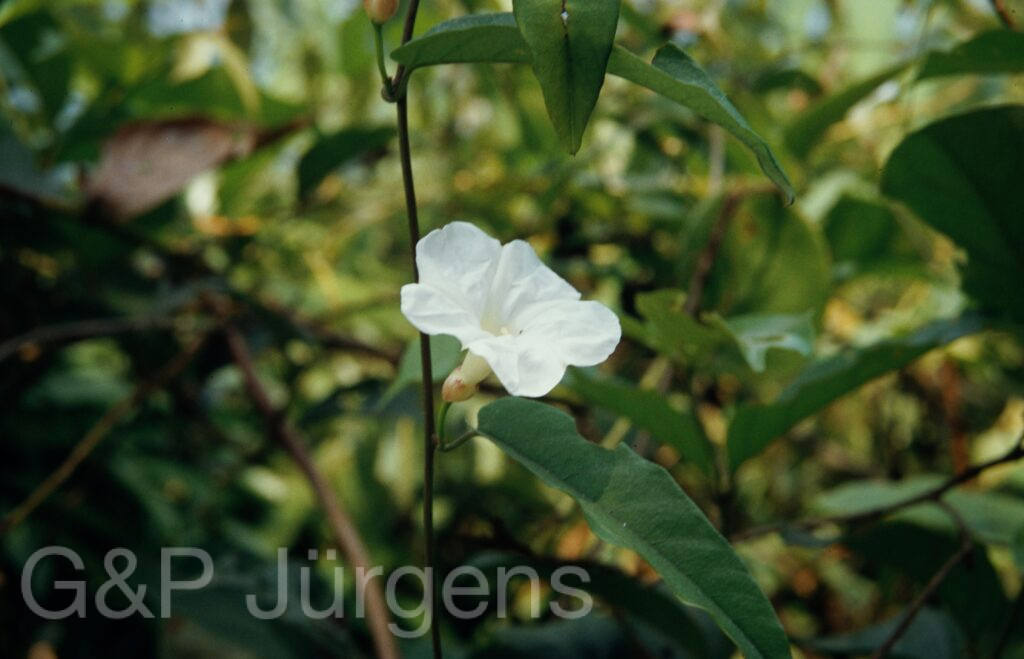
Nepal 1994 16 ergebnis
Ost-Nepal Kandbari 490m April

Description

Thunbergia fragrans is a slender twining herbaceous climber native to tropical and subtropical Asia, from the Indian subcontinent and the Himalayan foothills eastward to China, Sri Lanka and Southeast Asia, and now naturalised across the Americas, the Pacific and Australia. It grows in thickets, hedgerows, forest edges, scrub and disturbed ground in the warm lowlands and lower hills, generally below about 1500 m. The photographed plant comes from Kandbari in East Nepal at around 490 m, flowering in April. With nearly 4900 georeferenced records, many from its introduced range, it is a conspicuous and frequently collected vine. Although filed here under Lamiaceae, the species belongs to the Acanthaceae.

The stems are twining, slender and angled, often finely hairy. The leaves are opposite, ovate to triangular-hastate, with a cordate to truncate base, entire to sinuately lobed or toothed margins, and a slender petiole. The flowers are solitary in the leaf axils on long peduncles, subtended by two large leafy bracteoles that enclose the much-reduced calyx. The corolla is salverform with a broad spreading limb of five rounded lobes and is pure white, the throat sometimes pale, the flowers faintly fragrant. Four didynamous stamens are inserted within the corolla tube. The fruit is a beaked, woody, explosively dehiscent capsule, the persistent style forming a long apical beak, scattering the few seeds.

Widely grown as an ornamental for its clean white flowers, T. fragrans has escaped cultivation in many warm regions and is regarded as an environmental weed in parts of Australia, the Pacific and the neotropics, where it smothers low vegetation. Within Thunbergia it is recognised by its white, fragrant corolla and hastate leaves. Abundant and expanding, it is of least conservation concern.

Author: Roxb. · Sources: POWO (Kew), GBIF, Flora of China, Flora of Nepal, Acanthaceae monographs (Thunbergia)

D. Don

Bhutan2014 588
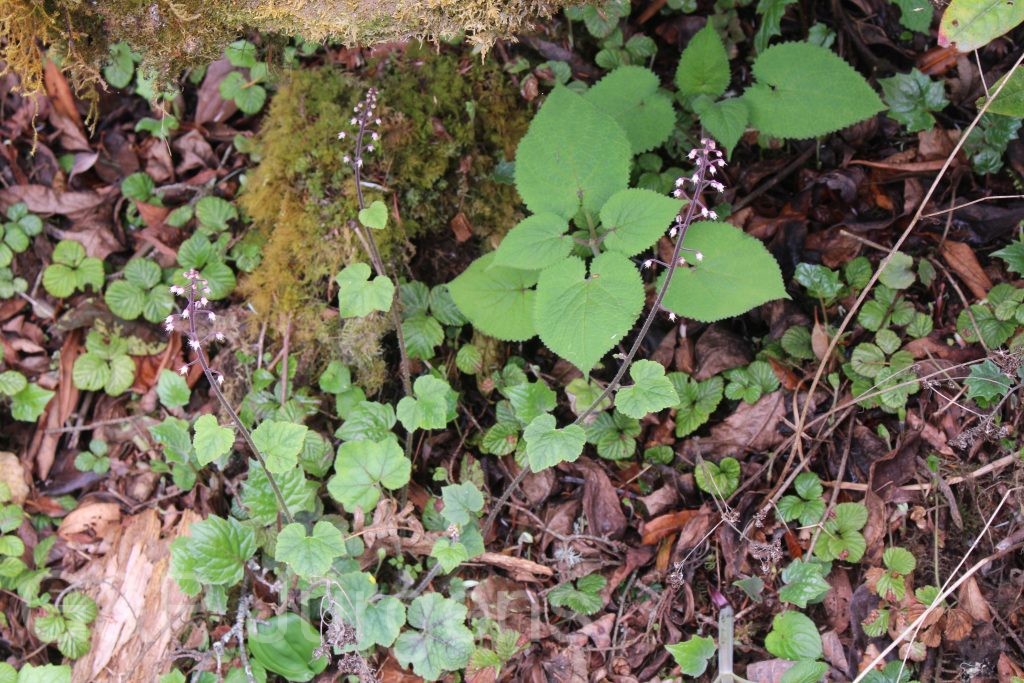
Bhutan Phobjika 2810m, May
Nepal 97 128 G222
Nepal Mewa-Khole 2500m April
Nepal 1994 194 ergebnis
Ost-Nepal Mewa-Khola 2100m April
Nepal 2001 252 ergebnis ergebnis
Nepal (Gorkha) Niuli Kharka 2700m, May

Description

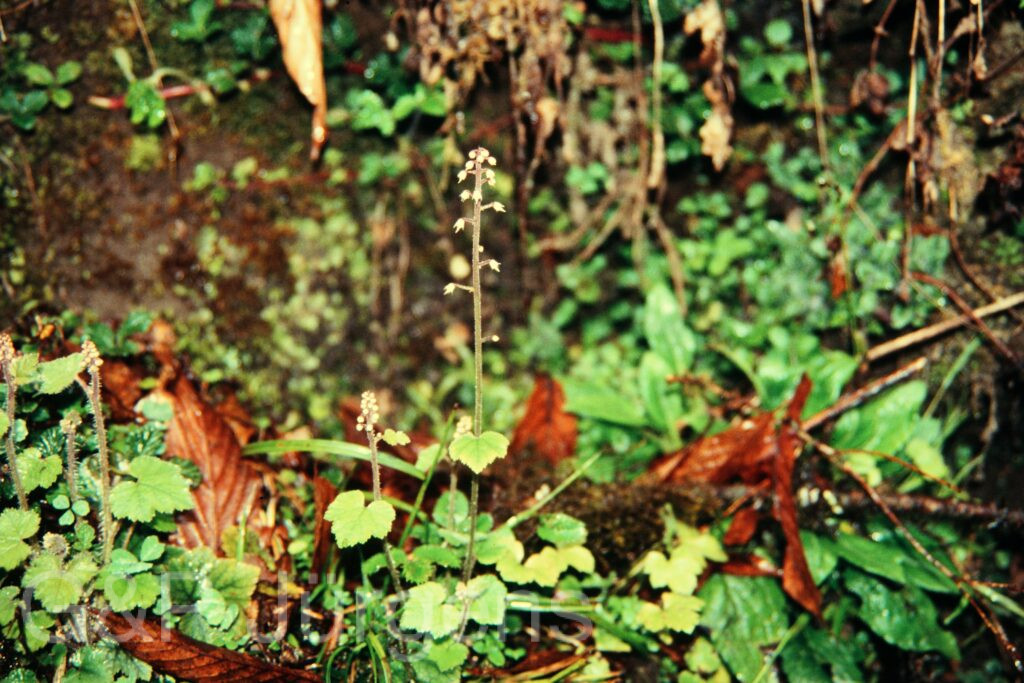
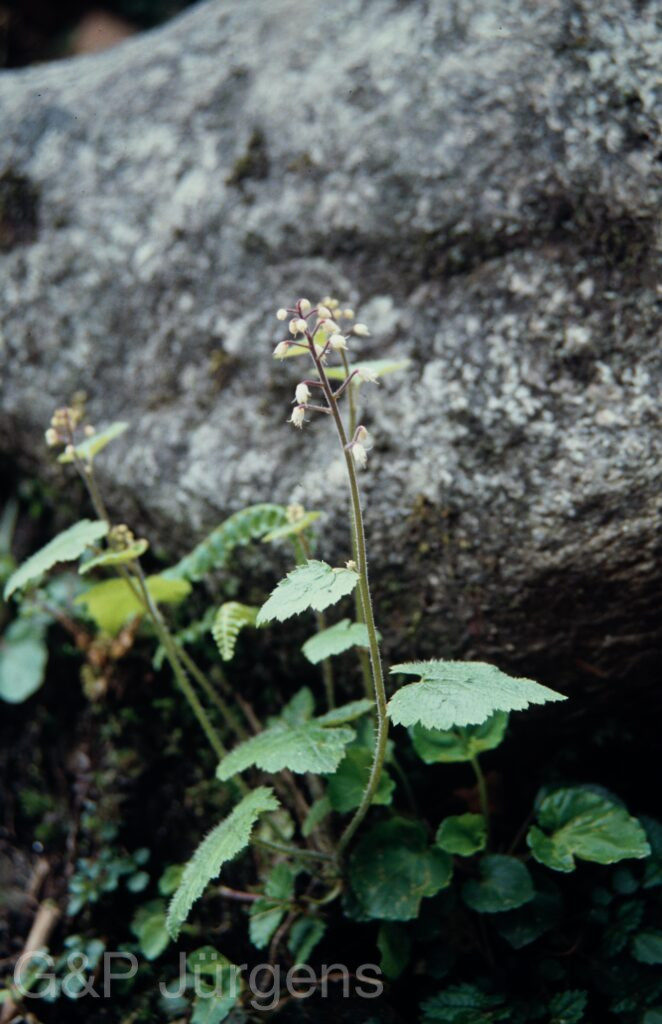
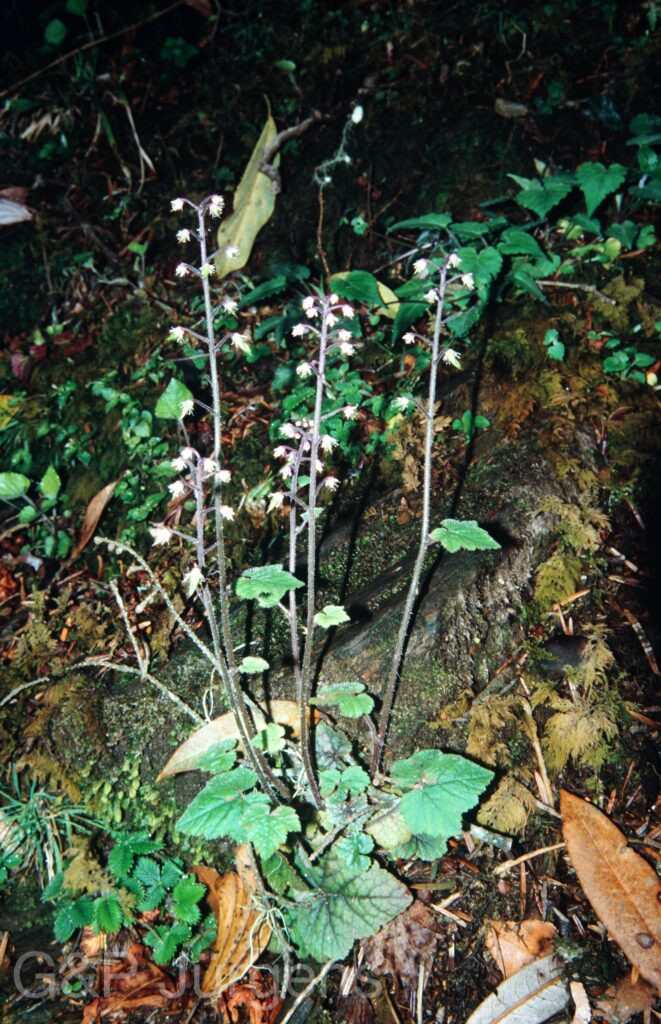
Tiarella polyphylla is a perennial herb with a wide East Asian and Himalayan distribution, recorded from China, Japan, Korea, Taiwan, Nepal, India, Bhutan and Myanmar, and reliably documented by over 4300 GBIF occurrences. It is a plant of cool, shaded, humid forests, growing in moist humus-rich soil along streamsides, on mossy banks and in the understorey of broadleaved and mixed forest, generally between about 1500 and 3500 m. The photographed populations span Bhutan (Phobjika, 2810 m, May) and eastern and central Nepal (Mewa Khola 2100-2500 m, and Gorkha at Niuli Kharka 2700 m), flowering through the spring months.

The plant grows from a short rhizome and produces a basal rosette of long-petioled leaves; the lamina is cordate-orbicular, shallowly three- to five-lobed, with toothed margins and scattered hairs. The slender, erect flowering stem bears a few reduced cauline leaves and terminates in a narrow, elongate raceme of small flowers. Each flower has five white to greenish, narrow petals and conspicuously exserted stamens, giving the inflorescence a delicate, foamy appearance. The fruit is a distinctive two-valved capsule with markedly unequal valves, splitting to release the small seeds.

Tiarella is a small genus of the Saxifragaceae, and T. polyphylla is the principal Asian representative, the remaining species being North American; this disjunction is a classic example of the eastern Asian-North American floristic link. The plant is shade-tolerant and clonal, often forming loose colonies on forest floors. Though not threatened across its broad range, it depends on intact moist forest and is locally sensitive to logging and disturbance of streamside habitats.

Author: D. Don · Sources: POWO (Kew), GBIF, Flora of China, Flora of Bhutan, Saxifragaceae monograph

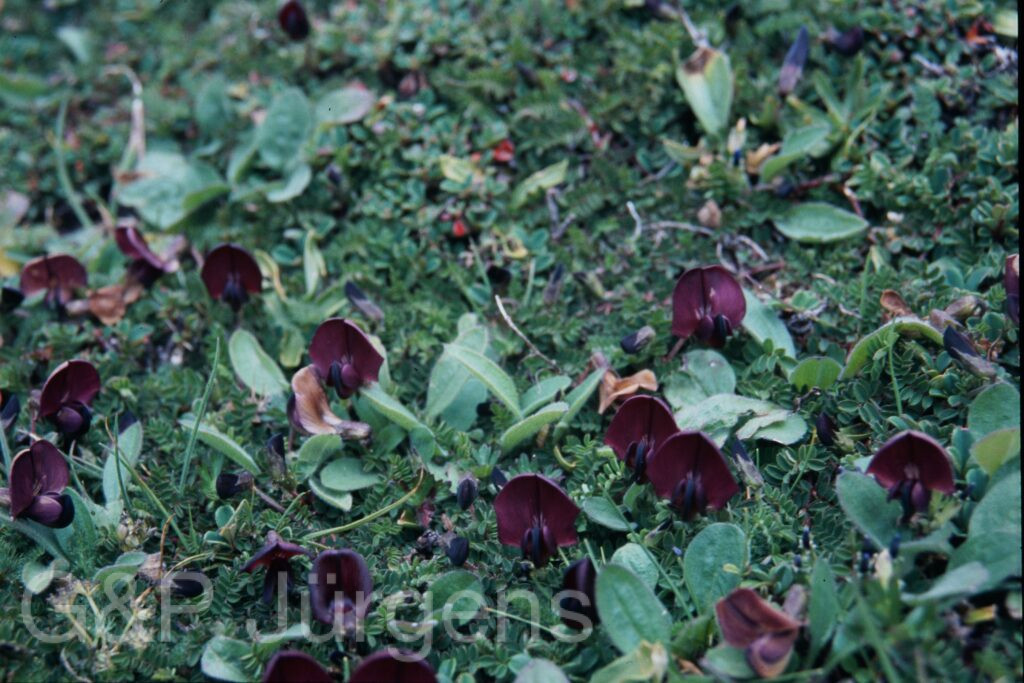
Tibetia himalaica

by GP Jürgens

(Baker) H.B. Cui

Sikkim2003 527 P735
Sikkim Yume Samdong 4600m August
Sikkim2003 528 P736
Sikkim Yume Samdong 4600m August

Description

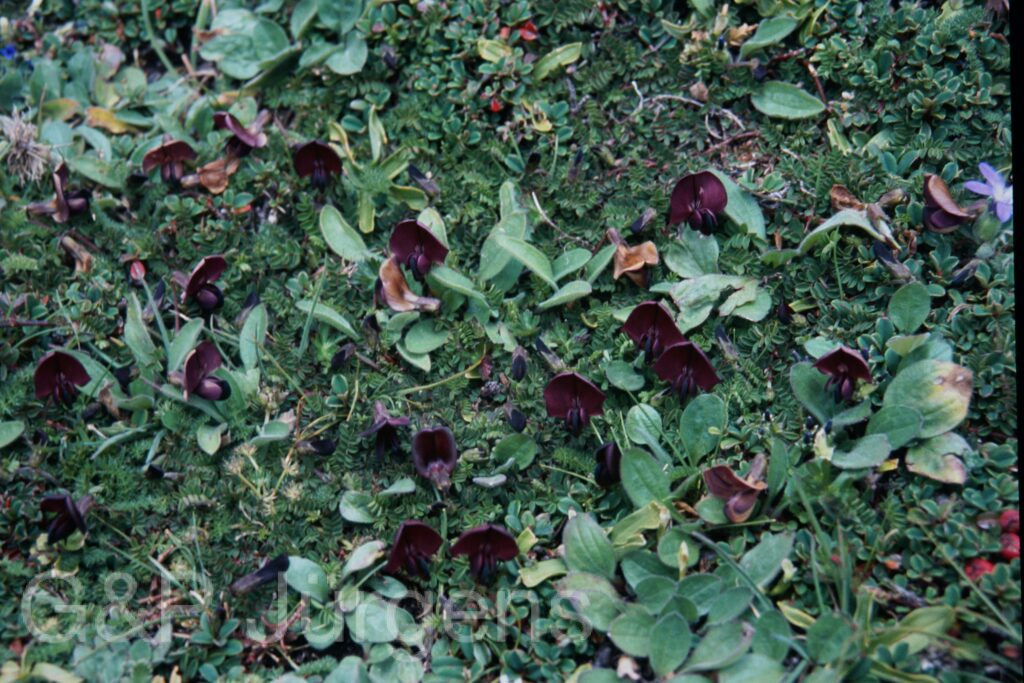
Tibetia himalaica is a high-altitude legume of the Sino-Himalayan region, distributed across the Tibetan Plateau and adjoining mountains in China, Nepal, India and Bhutan; GBIF records over 800 occurrences concentrated in the high alpine belt. It is a plant of alpine meadows, short turf, gravelly slopes, riverine flats and open stony ground, typically between 3,000 and 5,000 m. The individual photographed at Yume Samdong in northern Sikkim at 4,600 m in August captures the species near the upper limit of its range, flowering during the late-summer monsoon on the cold, well-drained alpine soils characteristic of this trans-Himalayan locality.

It is a low, cushion-forming or mat-like perennial herb arising from a slender, often woody taproot and a branched caudex, the stems short and largely prostrate. The leaves are imparipinnate, with several pairs of small, obovate to elliptic, often emarginate leaflets on short petioles, the whole appressed-pubescent. The flowers are solitary or few in an umbel-like arrangement on slender scapes; each is a typical papilionaceous flower with a campanulate, hairy calyx and a blue to purplish or violet corolla comprising a broad standard, oblong wings and an incurved keel. The fruit is a cylindrical, glabrescent legume that dehisces to release several small seeds.

Tibetia is a small genus of about half a dozen species segregated from Gueldenstaedtia, restricted to the high mountains of the Sino-Himalayan and Central Asian region and distinguished by its solitary or few-flowered scapes, persistent stipules and alpine cushion habit. As a nitrogen-fixing legume forming root nodules with rhizobia, T. himalaica contributes to soil enrichment in nutrient-poor alpine turf and is grazed by livestock and wild herbivores. Its wide but high-altitude distribution renders it ecologically secure at present, though high-elevation specialists of this kind are regarded as potentially sensitive to climate warming; it has not been formally assessed for the IUCN Red List.

Author: (Baker) H.B. Cui · Sources: POWO (Kew), GBIF, Flora of China, Flora of Bhutan, Annotated Checklist of the Flowering Plants of Nepal, revision of Tibetia and Gueldenstaedtia (Fabaceae)

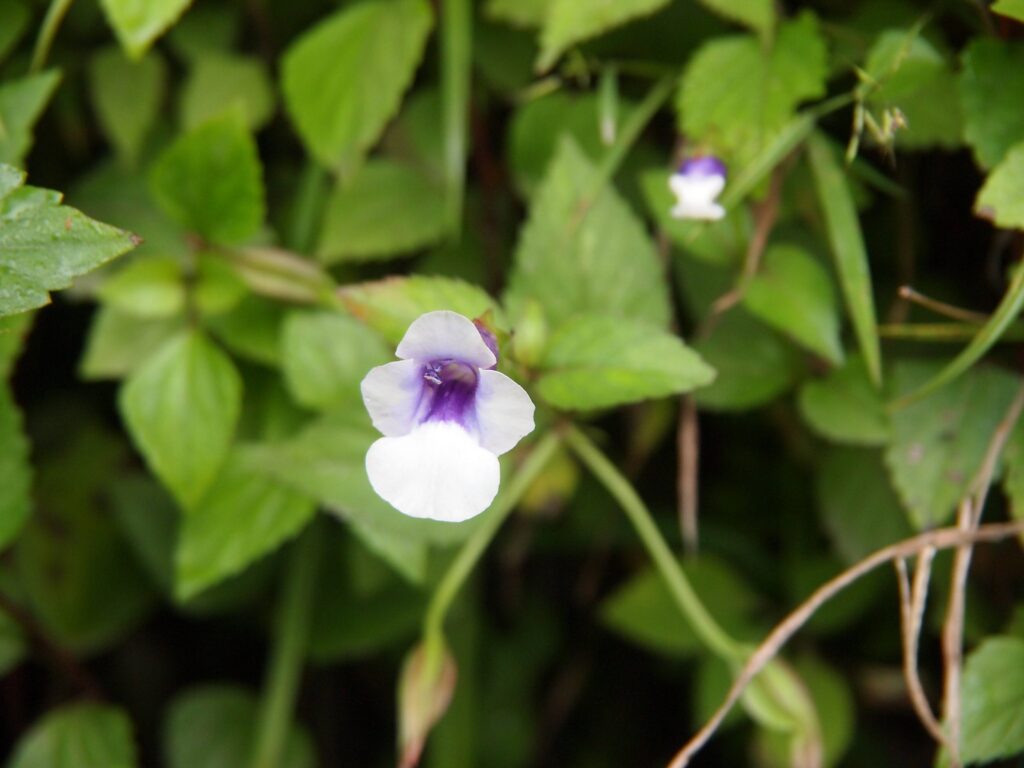
(Azaola) Pennell

Bhutan2012 1338 ergebnis
Bhutan Pemagatsel 300m, October

Description

Torenia violacea is a small annual herb widely distributed across tropical and subtropical Asia, recorded by GBIF, with over a thousand occurrences, from India, Nepal, Bhutan and Bangladesh through China, Taiwan and Japan to Myanmar, Thailand, Laos, Cambodia, Vietnam, the Philippines, Malaysia, Singapore, Brunei, Indonesia and Papua New Guinea. It is a plant of warm, humid lowland and lower montane situations, growing on moist, shaded ground in rice-field margins, ditches, streamsides, damp roadside banks, forest paths and other disturbed wet places, mostly at low elevations. The photographed plant from Pemagatsel in southeastern Bhutan, at about 300 m and flowering in October, exemplifies this low-altitude, monsoon-influenced habitat, where the species flowers into the post-monsoon autumn in the warm foothill zone.

It is a slender, erect to ascending or somewhat decumbent annual with quadrangular, narrowly winged stems that branch from the base. The leaves are opposite, ovate to ovate-lanceolate, with a serrate margin, an acute apex and a rounded to broadly cuneate base, borne on short petioles. The flowers are axillary or in terminal racemes, each subtended by a tubular, five-winged (ridged) calyx. The corolla is two-lipped and violet to pale lilac, often with a yellow throat, the lower lip three-lobed and the tube curved; the four didynamous stamens are a diagnostic feature, the anterior filaments often bearing a slender appendage at the base. The fruit is a narrow, oblong, septicidal capsule enclosed by the persistent winged calyx and releasing numerous minute seeds.

Long placed in Scrophulariaceae and later in Veronicaceae or Plantaginaceae, Torenia is now assigned to the segregate family Linderniaceae, recognised on molecular grounds, alongside Lindernia and Vandellia, to which several species formerly called Torenia have been transferred. T. violacea, based on Azaola's name and recombined by Pennell, is distinguished within the genus by its five-winged calyx and violet corolla. The species is a self-compatible weedy annual of disturbed wet ground, abundant and adaptable across its very large range, and is of no conservation concern; ornamental relatives in the genus (the "wishbone flowers") are popular bedding plants.

Author: (Azaola) Pennell · Sources: POWO (Kew), GBIF, Flora of China Vol. 18, Flora of Bhutan Vol. 2, Flora of Nepal, Flora of Pakistan, Fischer's revision of Linderniaceae

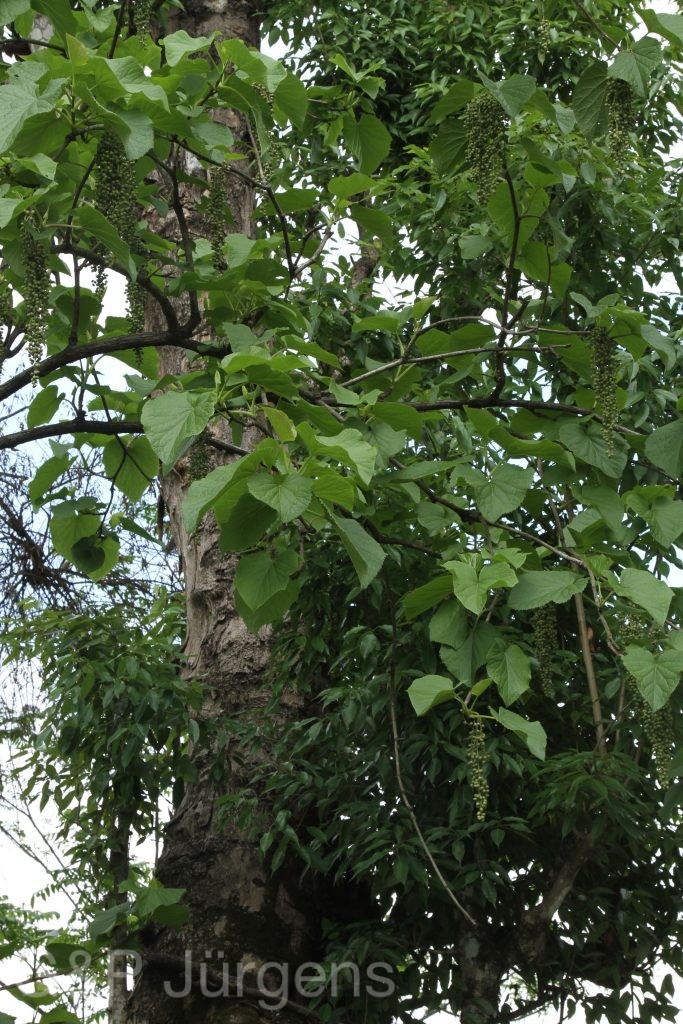
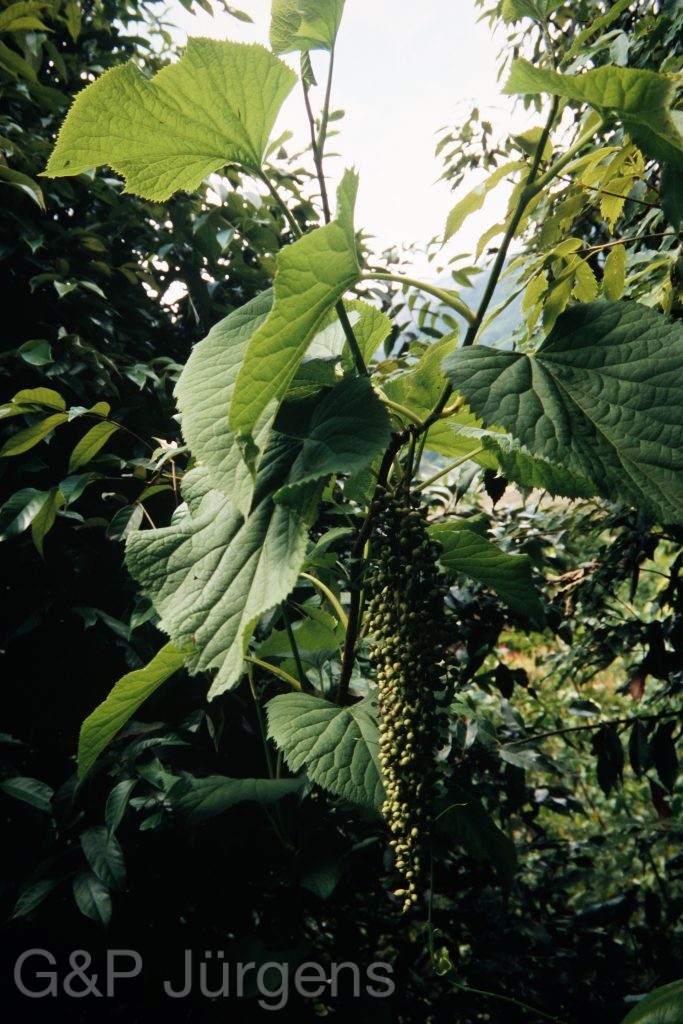
DC.

Bhutan2014 272
Bhutan Trithangebe 700m, May
Bh2008 541 G819
Bhutan Limbukha 2200m April

Description

Toricellia tiliifolia DC. is a small deciduous tree or large shrub of the Cornaceae (or the segregate family Toricelliaceae), restricted to the Himalaya and southwestern China. GBIF records, totalling 23 occurrences, place it in China, Nepal, Bhutan and India. The species grows on moist, often disturbed slopes, ravine margins, forest edges and streamsides through the subtropical to lower temperate belt, broadly from 700 to 2,300 m. The cited Bhutanese collections from Trithangebe at 700 m in May and from Limbukha at 2,200 m in April illustrate this altitudinal span across the southern Bhutanese foothills.

The plant is a soft-wooded tree with stout, somewhat pithy branchlets and conspicuous leaf scars. The leaves are alternate, long-petiolate, broadly ovate to orbicular with a cordate base, palmately veined and shallowly lobed with a serrate margin, recalling those of a lime (Tilia), hence the epithet; the petiole base is dilated and sheathing. The plant is functionally dioecious, the small greenish flowers borne in long, slender, pendulous panicles; staminate flowers have minute petals and stamens, while the pistillate flowers have a reduced perianth and an inferior ovary. The fruit is a small ovoid drupe crowned by the persistent styles.

Toricellia is a relictual, taxonomically isolated genus whose placement has shifted between Cornaceae, Araliaceae and its own family Toricelliaceae within the Apiales, reflecting an ambiguous combination of cornoid and aralioid characters. Its disjunct, narrow Sino-Himalayan distribution makes it of considerable biogeographic interest as a Tertiary relict, and although not formally assessed as threatened, its limited range warrants attention where lower-montane forests are being cleared.

Author: DC. · Sources: POWO (Kew), GBIF, Flora of China Vol. 14, Flora of Bhutan Vol. 2, Flora of Nepal, Eyde: Comparative anatomy and phylogeny of the Cornaceae

(K.C.Sahni & Bahadur) C.Y.Wu & T.L.Ming

Bhutan2015 212
Bhutan Zhemgang 1000m, October

Description

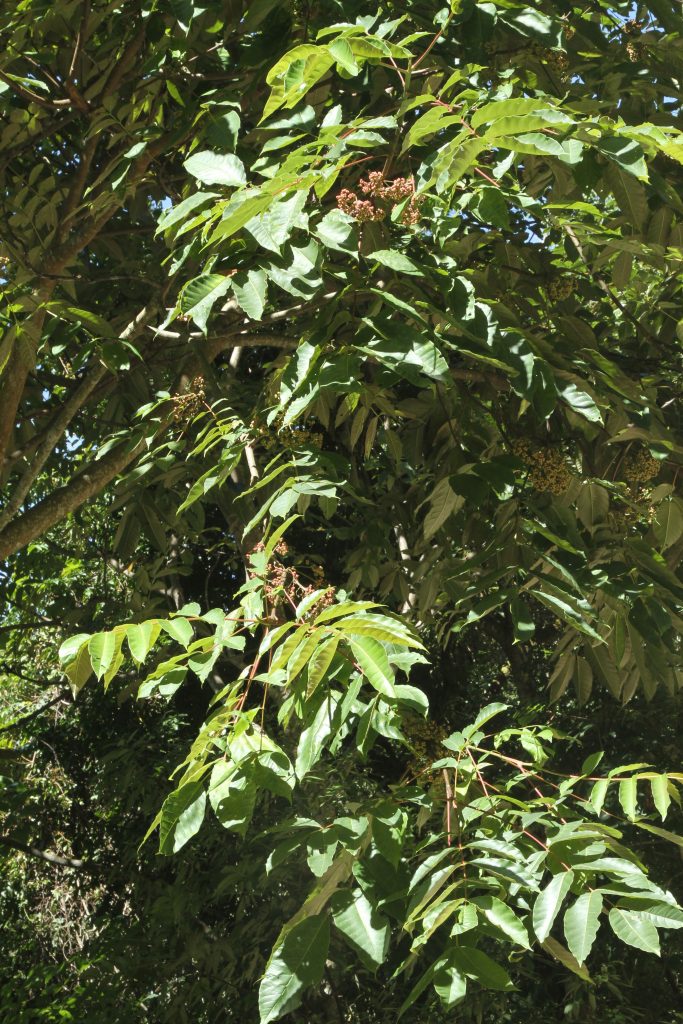
Toxicodendron hookeri is a Himalayan and southwest Chinese sumac distributed through Nepal, the Indian Himalaya, Bhutan, southern China and into Thailand, with about 104 GBIF occurrences. It is a tree of warm subtropical and lower temperate broadleaved forest, growing along forest margins, on open slopes, in secondary woodland and in ravines on well-drained soils. The plant photographed at Zhemgang in central Bhutan at about 1000 m in October is representative of its preferred lower-montane belt of roughly 800-2500 m, where the autumn collection captures the foliage as it turns brilliant red, the leaves reddening before they fall.

It is a deciduous shrub or small to medium tree with greyish bark and stout, glabrescent twigs exuding an irritant resinous sap. The leaves are alternate and pinnately compound with several pairs of opposite, ovate to oblong-lanceolate, entire leaflets and a terminal one, the rachis sometimes narrowly winged, the whole turning vivid scarlet in autumn. The small, greenish-yellow, functionally unisexual flowers are borne in axillary panicles, with a five-parted calyx and corolla and a single-loculed ovary. The fruit is a small, dry, somewhat compressed drupe with a hard endocarp, ripening pale and persisting on the bare branches.

The plant's legacy link refers to it under the name Rhus succedanea, reflecting the former placement of these taxa in a broad Rhus; modern treatments segregate the lacquer-sap species into Toxicodendron, of which T. hookeri is one. As in poison ivy and the lacquer tree, the sap contains urushiol-type alkylcatechols that cause severe contact dermatitis. The species belongs to the resin-yielding, wax-producing group long valued in eastern Asia, and its bright autumnal colour makes it conspicuous in the Himalayan forest.

Author: (K.C.Sahni & Bahadur) C.Y.Wu & T.L.Ming · Sources: POWO (Kew), GBIF, Flora of China, Flora of Bhutan, Min & Barfod Anacardiaceae account, Gillis revision of Toxicodendron

(Roxb. ex Lindl.) Vis.

Bhutan2015 591
Bhutan Mo-Chu 1900m, October
Sikkim 2006 308 ergebnis
India West-Bengal, Chaana 1750m, May

Description

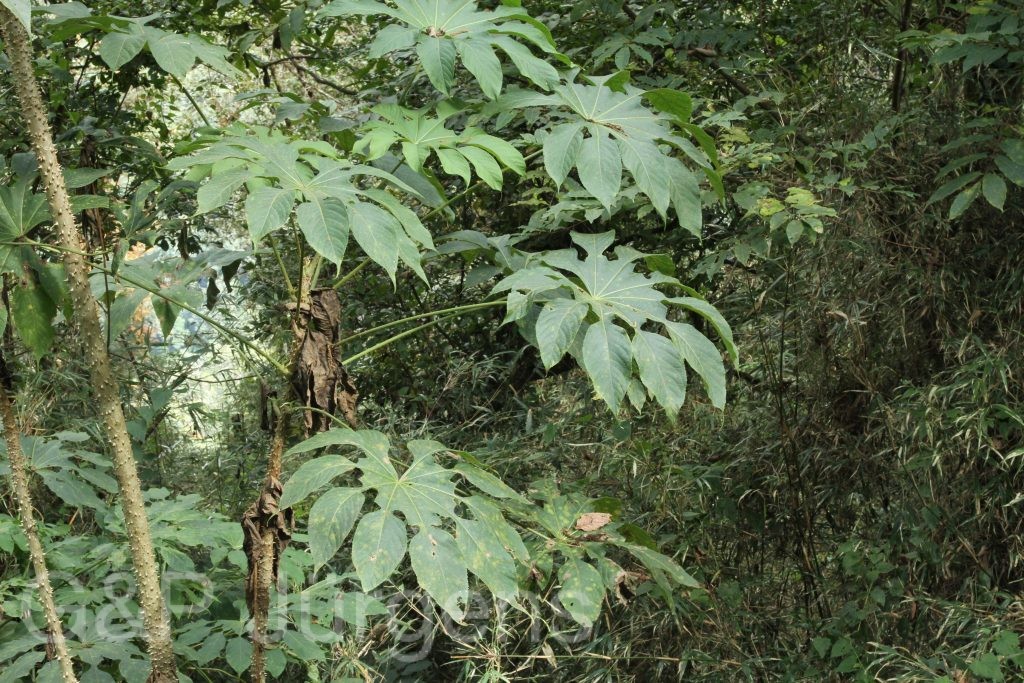
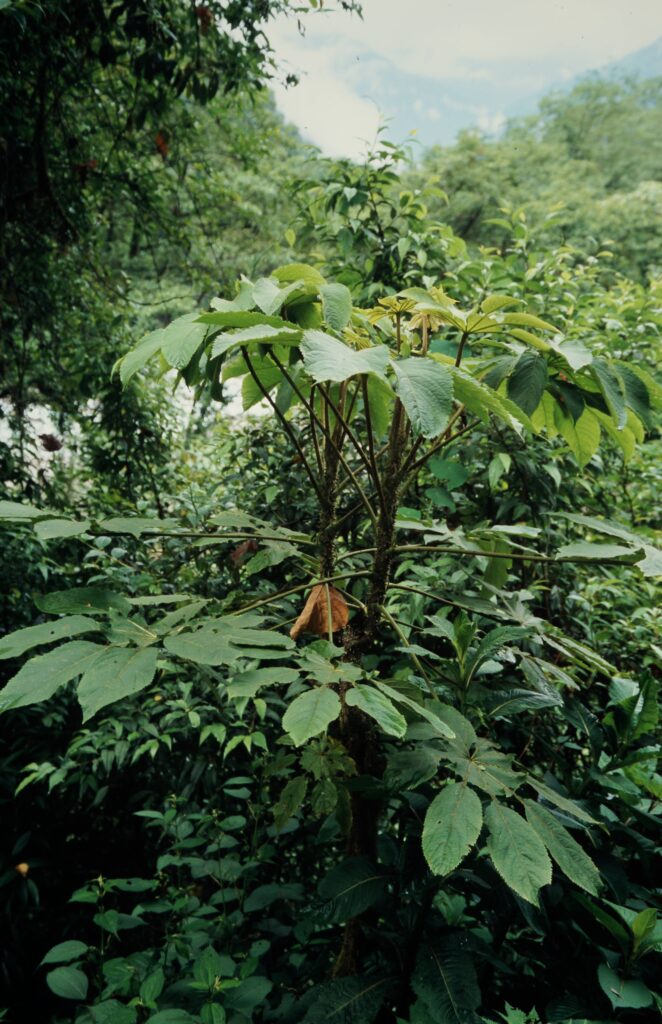
Trevesia palmata, the snowflake tree, is a tropical and subtropical Asian aralioid ranging from the Himalaya of Nepal, India and Bhutan through Bangladesh, Myanmar, Thailand, Laos, Cambodia, Vietnam, southern China and into Malaysia, with more than 700 GBIF occurrences including many from cultivation in botanic gardens worldwide. It grows in warm, humid broadleaved forest, in ravines, along streams, on shaded slopes and in clearings on moist, fertile soils. The localities illustrated, the Mo Chu valley in Bhutan at about 1900 m in October and Chaana in West Bengal at 1750 m in May, are typical of its lower-montane belt of roughly 500-2000 m in the eastern Himalaya.

It is a small, sparsely branched evergreen tree or treelet, often prickly on the trunk and petioles, with a stout pithy stem. The very large leaves are palmately lobed and again deeply incised, so that each is divided almost to the centre into spreading, toothed segments arranged like a snowflake, borne on long prickly petioles and clustered toward the stem apex. The numerous small flowers are creamy to greenish-white and grouped in dense globose umbels arranged along a large, branched terminal panicle. Each flower has a fleshy disc and an inferior ovary of several carpels, and the fruit is a small, somewhat ribbed, fleshy drupe containing several seeds.

Trevesia is a small genus of the ivy family centred on tropical Asia, and T. palmata is its most familiar and widespread species. The dramatically dissected juvenile foliage makes it a popular ornamental and conservatory plant, which explains the many cultivated records far outside its native range. In its forest habitat it is an understorey to mid-canopy element pollinated by insects, and its fruits are dispersed by birds and other animals.

Author: (Roxb. ex Lindl.) Vis. · Sources: POWO (Kew), GBIF, Flora of China, Flora of Bhutan, Frodin & Govaerts World Checklist of Araliaceae, Hooker Flora of British India

DC.

Bhutan2015 462
Bhutan Trongsa 2100m, October
Bhutan2012 1326
Bhutan Pemagatse 1900m, October

Description

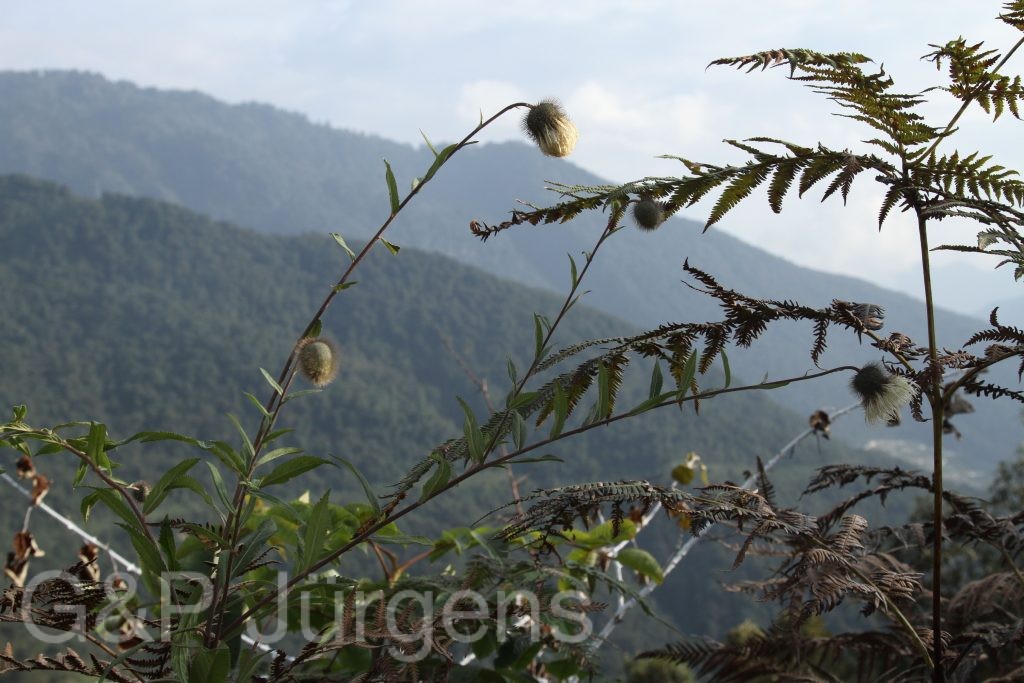
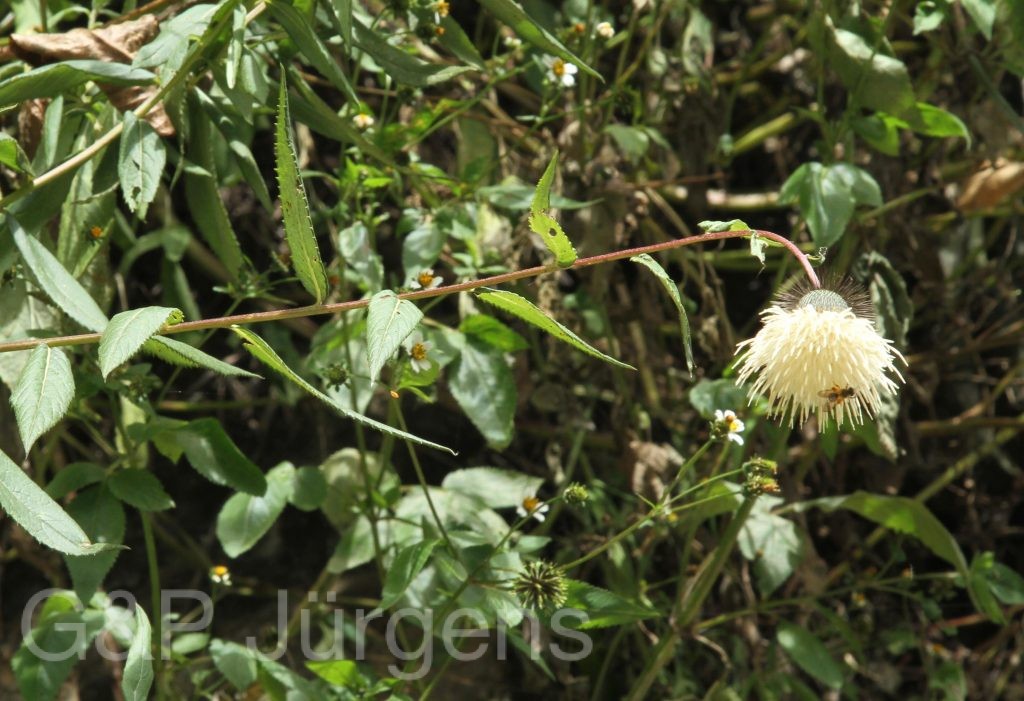
Tricholepis furcata is a thistle-like composite of the Himalaya and adjacent regions, recorded from India, Nepal, Bhutan, Pakistan and China, with 148 georeferenced occurrences. It is a plant of open, sunny, often dry situations, occupying grassy hill slopes, scrub, rocky banks, roadsides and disturbed ground in the subtropical to lower temperate zone, typically between about 1000 and 2500 m. It was photographed near Trongsa at 2100 m and Pemagatse at 1900 m in Bhutan in October, flowering at the close of the monsoon when many montane composites reach their peak on warm, well-drained slopes.

It is an erect, branched perennial or biennial herb, the slender striate stems often forking (furcate) above and bearing alternate, narrow, entire to pinnately divided leaves that are roughly hairy and frequently decurrent on the stem. The flower heads are solitary or few at the branch tips, with an ovoid involucre of many imbricate bracts whose tips are characteristically fringed or laciniate, a diagnostic feature of the genus Tricholepis. All florets are tubular (discoid) and pink to purple, the corolla deeply five-lobed. The fruit is a small obovoid cypsela crowned by a pappus of barbellate or plumose bristles.

The genus Tricholepis belongs to tribe Cardueae (the thistle tribe) and is centred on the Indian subcontinent and Iran, allied to Centaurea and Saussurea. The fimbriate phyllary tips that give the genus its name ("hairy scale") separate it from related cardueoid genera. Ecologically the species is a coloniser of open and disturbed slopes and contributes to autumn-flowering grassland communities. It is widespread and common, of no conservation concern.

Author: DC. · Sources: POWO (Kew), GBIF, Flora of Bhutan, Flora of Pakistan, Compositae monograph (Cardueae, in The Families and Genera of Vascular Plants)

Benth. ex C.B.Clarke

BhutanPG2011 452
Bhutan Tsochenchen, 3550m June
Nepal 99 516 ergebnis
West-Nepal Churta-Khola 3800m, June
Nepal 99 615 ergebnis
West-Nepal Kagmara-La 4100m, July

Description

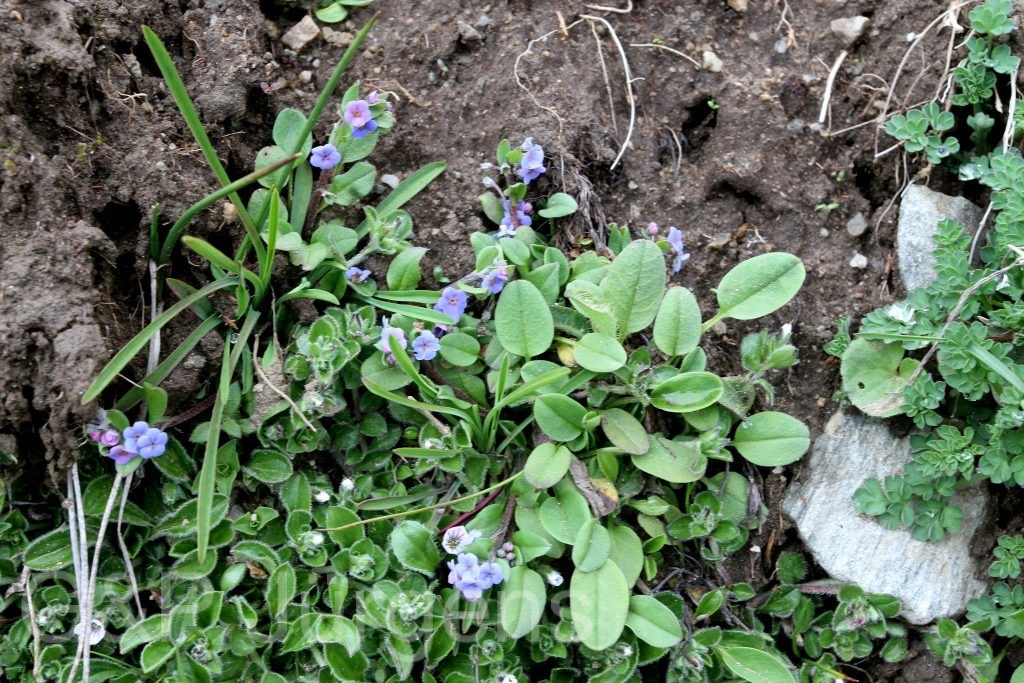
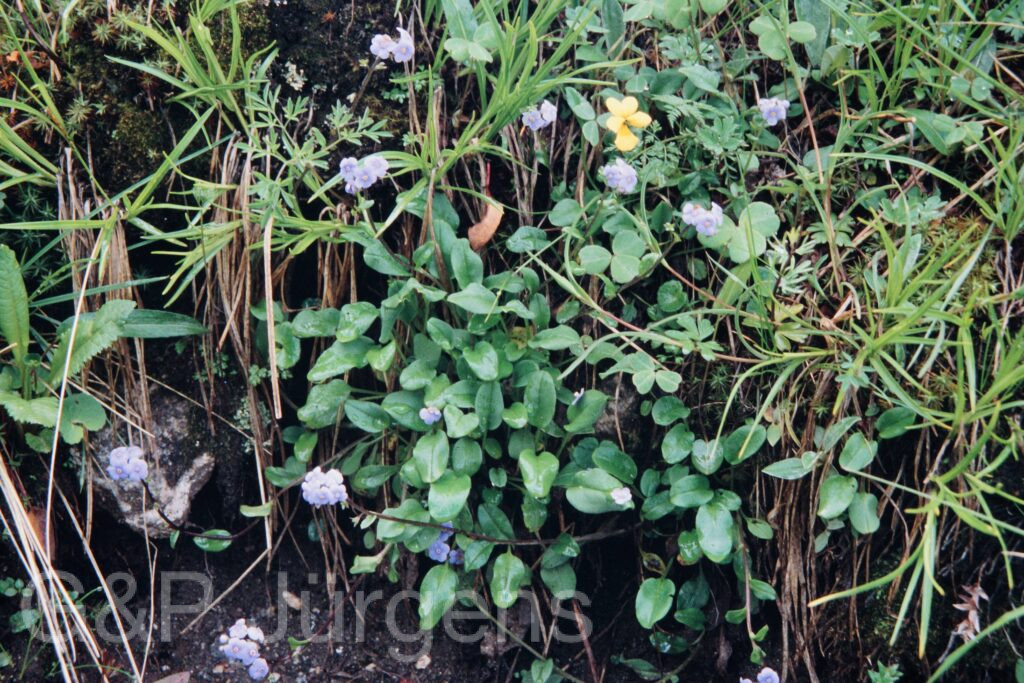
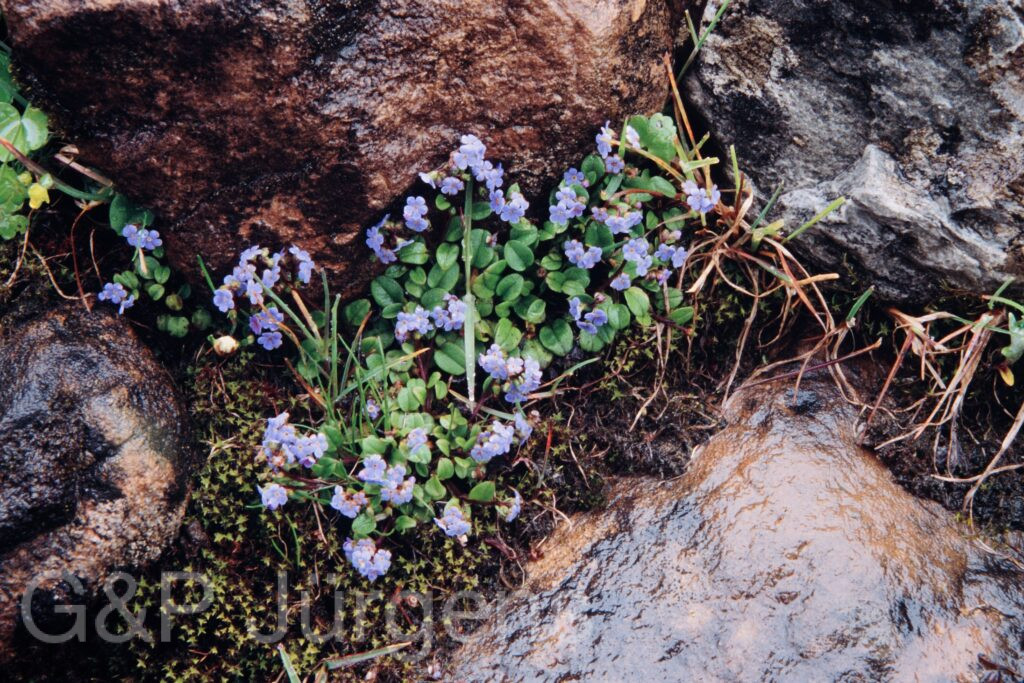
Trigonotis rotundifolia is a low-growing alpine forget-me-not relative of the Himalaya, with roughly 106 GBIF records across India, Nepal, China and Bhutan. It is a true high-alpine specialist, colonising open stony slopes, screes, moraine, rock crevices and short turf well above the treeline. The locations documented for the photographed material span a broad altitudinal band, from Tsochenchen in Bhutan at about 3550 m in June, through Churta-Khola in West Nepal at 3800 m, to the Kagmara-La at around 4100 m in July, confirming its preference for the upper subalpine to alpine zone where snow lingers and the season is brief.

It is a small, mat- or cushion-forming perennial herb with a branched rootstock and short, often prostrate or ascending stems clothed in appressed to spreading hairs. The leaves are small, crowded, and rounded to orbicular or spathulate, as the epithet indicates, narrowing into a winged petiole. The flowers are borne singly or in few-flowered leafy cymes; each has a deeply five-lobed calyx and a salverform to rotate, bright blue corolla with five yellow or white throat appendages (fornices) typical of the tribe. The fruit comprises four small, smooth, trigonous to keeled nutlets borne on short pedicels.

The genus Trigonotis is distinguished from Myosotis chiefly by nutlet morphology, the nutlets being triangular or pyramidal rather than dorsiventrally compressed. The genus is centred on the Sino-Himalayan and East Asian region, and the dwarf cushion habit of this species reflects convergent adaptation to cold, exposed, wind-pruned alpine sites. It is not formally assessed for conservation but, as a high-elevation endemic, is intrinsically sensitive to alpine habitat shifts under climate change.

Author: Benth. ex C.B.Clarke · Sources: POWO (Kew), GBIF, Flora of China, Flora of Bhutan, Flora of Nepal, Riedl Boraginaceae of the Himalaya