Author

G & P Jürgens

(L.) Roth

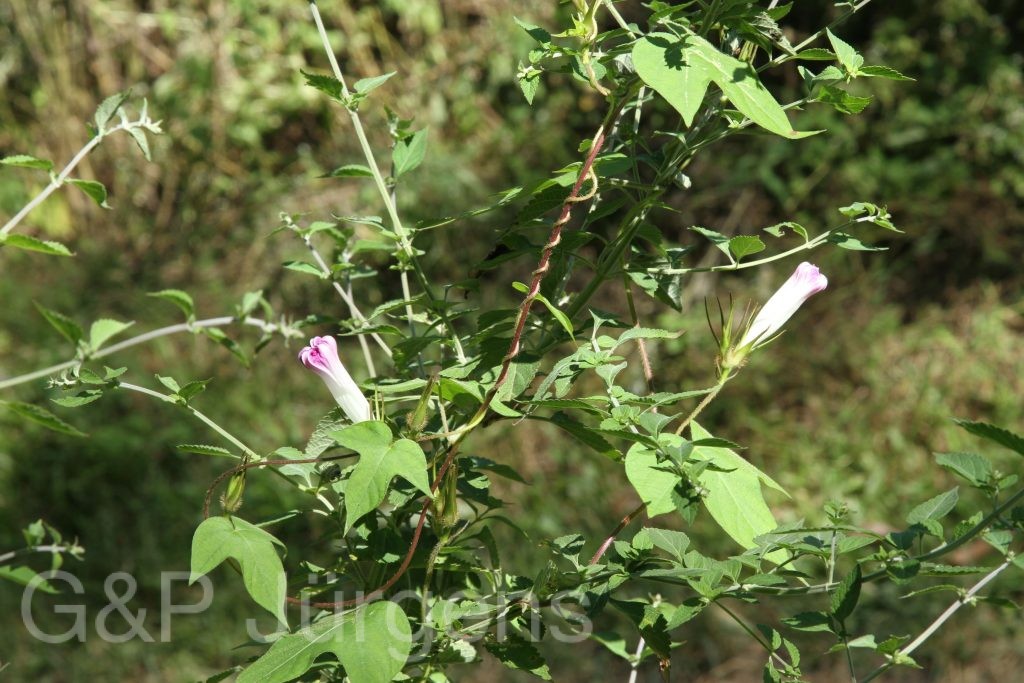
Bhutan2015 304
Bhutan between Zhemgang-Trongsa 1700m, October

Description

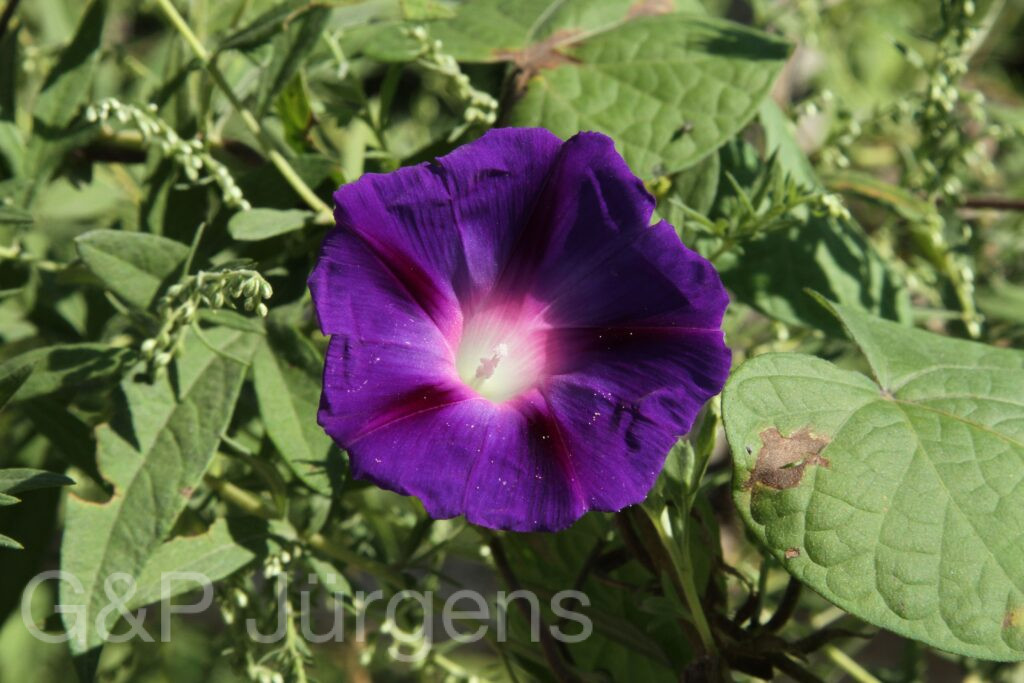
Ipomoea nil is a pantropical annual morning glory of uncertain native origin, most likely originating in tropical America but now cosmopolitan in warm regions worldwide. It occurs throughout South and Southeast Asia, East Asia, Africa, and the Americas, with over 13,000 occurrence records in GBIF spanning more than 70 countries. The species thrives in disturbed habitats, field margins, roadsides, waste ground, and forest edges from lowland areas up to approximately 2,500 m elevation. In Bhutan, it has been documented along the road between Zhemgang and Trongsa at 1,700 m, flowering in October during the late monsoon season.
Ipomoea nil is a twining or scrambling annual herb with stems 1–3 m long, retrorsely hispid with spreading, tawny hairs. Leaves are alternate, broadly ovate to orbicular in outline, 5–15 cm long, typically three-lobed (occasionally entire or five-lobed), with a cordate base and hispid indumentum on both surfaces. The inflorescence consists of one to three flowers on axillary peduncles. The calyx is deeply divided into five lanceolate, densely hispid sepals with long, spreading basal hairs — a key diagnostic character. The corolla is funnelform, 3–5 cm long, typically blue to purple, occasionally red, pink, or white, with a paler tube. Stamens are five, included. The fruit is a globose, trilocular capsule 8–10 mm in diameter, enclosed by the persistent calyx, containing four to six seeds that are dark brown to black and finely pubescent.
Ipomoea nil holds exceptional cultural significance in East Asia, particularly in Japan, where it has been cultivated since the Nara period (eighth century) and subjected to intensive selection that has produced hundreds of ornamental cultivars (asagao) with extraordinary floral diversity in form, colour, and patterning. It has also become a model organism in molecular genetics for the study of transposable elements controlling flower pigmentation. Taxonomically, I. nil belongs to Ipomoea section Pharbitis and is distinguished from the closely related I. purpurea by its densely hispid, long-awned calyx lobes.

Author: (L.) Roth · Sources: POWO (Kew), GBIF, Flora of China Vol. 16, Flora of Bhutan Vol. 2, Austin: Convolvulaceae of the Southeastern United States (1978)
(L.) Roth

Garh 07 250 ergebnis
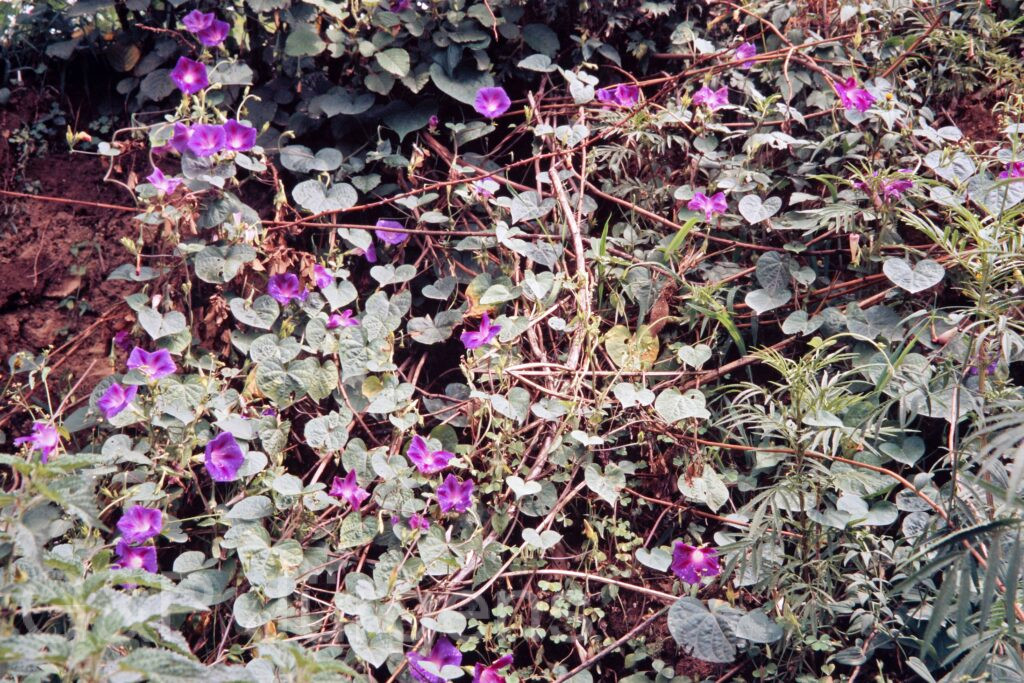
India Garhwal Barron Chatti 2300m, June
Bhutan2015 563
Bhutan Mo-Chu 1550m, October

Description

Ipomoea purpurea, the common morning glory, is a neotropical species of Mexican and Central American origin now thoroughly naturalised worldwide; GBIF records exceed 36,000 occurrences spanning the Americas (US, MX, BR, EC, PE, AR, BO, CO), Europe, southern Africa, eastern Asia and Australia. In the Himalaya it persists as an escaped ornamental and weed of disturbed ground, hedgerows, field margins and roadsides. The plants noted at Barron Chatti in Garhwal at 2300 m in June and along the Mo-Chu in Bhutan at 1550 m in October illustrate its tolerance of a broad warm-temperate to subtropical elevation range and its long, monsoon-spanning flowering season.

It is an annual twining herb with slender, retrorsely hairy stems climbing by means of left-handed coiling. The leaves are alternate, long-petiolate, broadly ovate-cordate and usually entire, acuminate at the apex with a deep basal sinus. Flowers arise in axillary cymes of one to several; each has a hairy, lanceolate-lobed calyx and a showy funnelform corolla 4 to 6 cm across, varying from purple and violet-blue to pink, magenta and white, with a paler throat and five faint interplical bands. The five stamens are unequal and included; the superior ovary ripens into a globose, three-locular capsule releasing several glabrous, dark trigonous seeds.

The species is taxonomically straightforward within Ipomoea but horticulturally polymorphic, with numerous colour cultivars. Its self-compatible, bee-pollinated flowers and prolific hard-coated seed make it a successful colonist and, in warm regions, an agricultural weed. It is of no conservation concern; rather, its capacity to naturalise warrants monitoring in ruderal habitats.

Author: (L.) Roth · Sources: POWO (Kew), GBIF, Flora of China Vol. 16, Flora of Bhutan Vol. 2, Flora of Pakistan, A Monograph of the Convolvulaceae (Ipomoea)

Iris collettii

by G & P Jürgens

Hook.f.

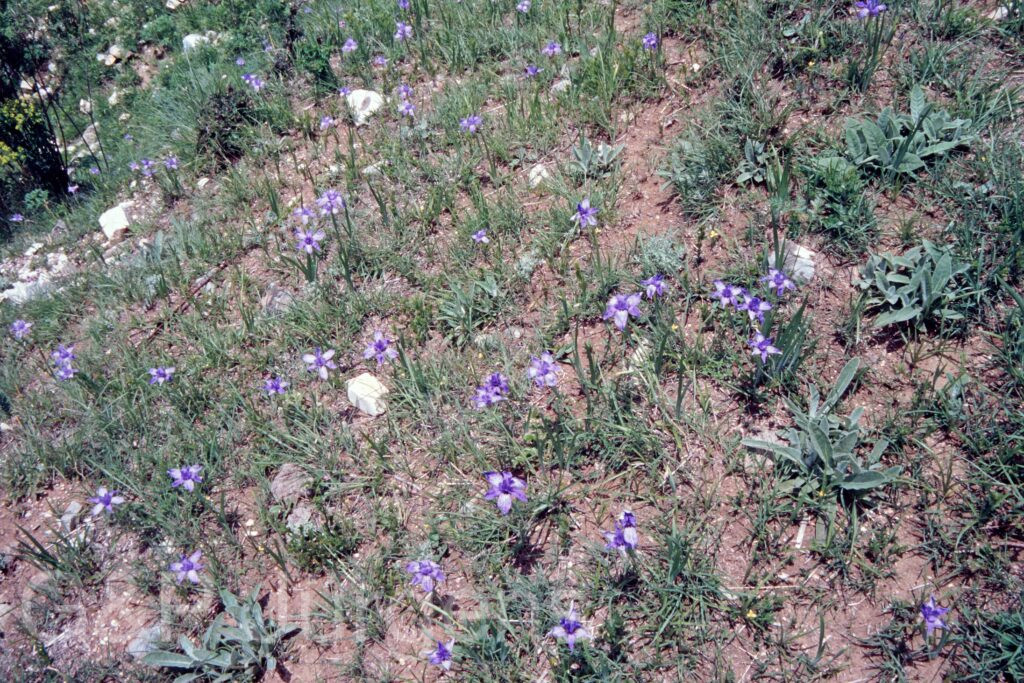
Nepal 99 413 ergebnis
West-Nepal Talphi 2830m, June
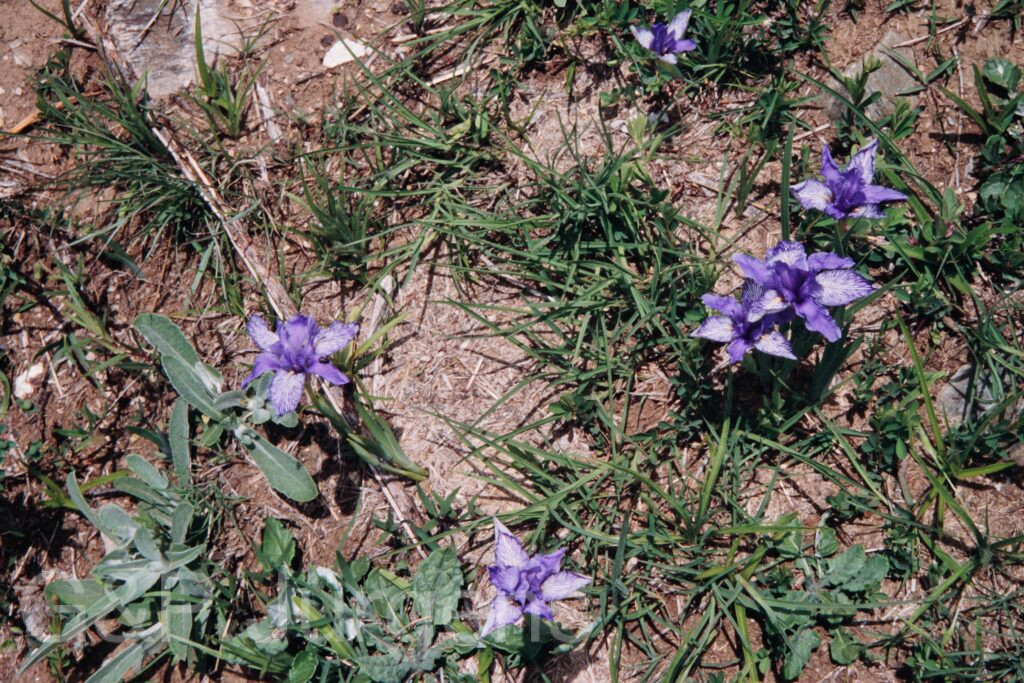
Nepal 99 414 ergebnis
West-Nepal Talphi 2830m, June
Nepal 99 415 ergebnis
West-Nepal Talphi 2830m, June

Description

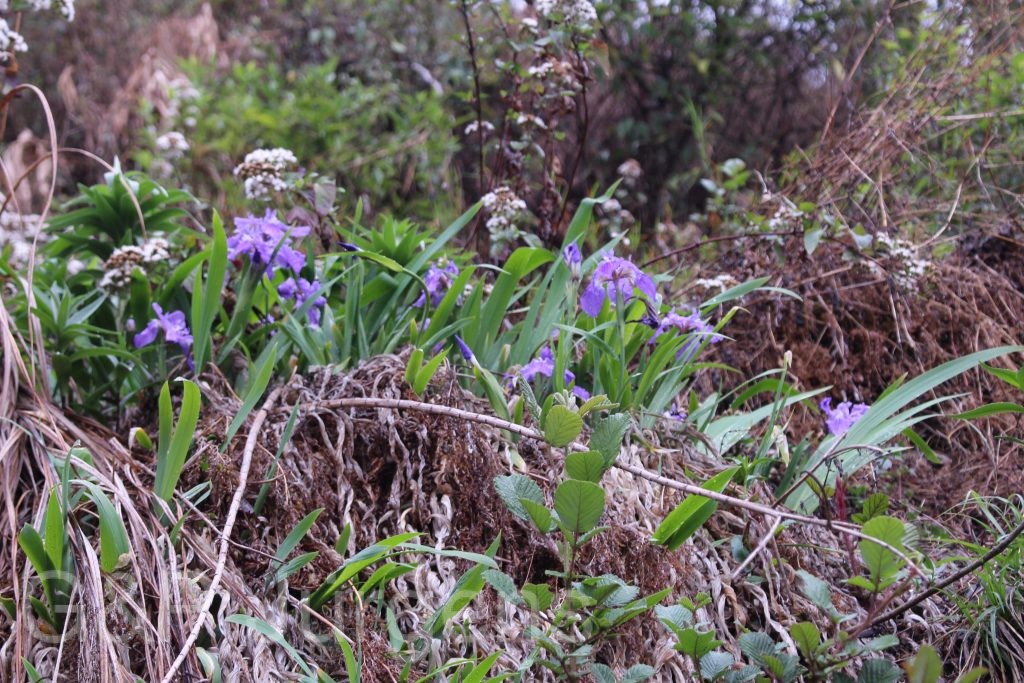
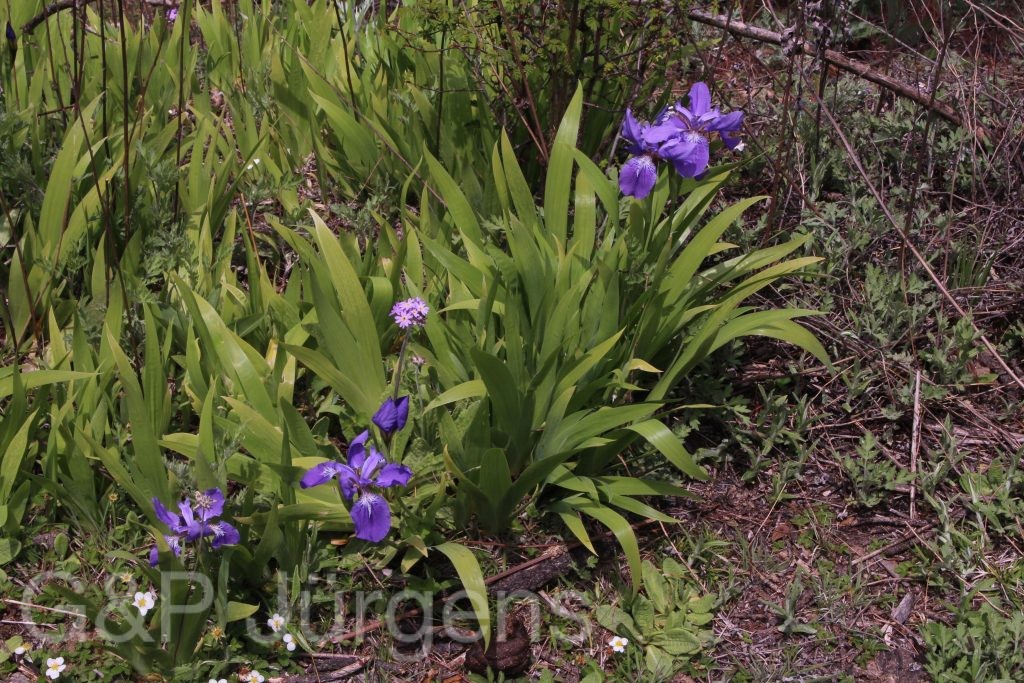
Iris collettii is a Himalayan iris distributed from western Nepal through northeast India and northern Myanmar to southwest China (Yunnan, Sichuan) and northern Thailand. GBIF records approximately 349 occurrences, with the majority from China and Myanmar. The species favours open, grassy slopes, forest margins, and pine-oak woodland clearings at elevations of 1,800–3,200 m, typically on well-drained soils. At Talphi in western Nepal at 2,830 m, it grows in open montane grassland and along forest edges, flowering in June at the onset of the monsoon season — a period when the grassy slopes of the western Nepalese mid-hills support a rich herbaceous flora.
Iris collettii is a rhizomatous perennial herb, 20–40 cm tall. The rhizome is slender, creeping, and clothed in persistent fibrous leaf bases. Leaves are basal, linear-ensiform, 15–30 cm long and 5–10 mm wide, with a prominent midrib, often slightly falcate. The stem bears 1–3 terminal flowers subtended by a pair of spathaceous bracts. Flowers are 4–6 cm in diameter, blue-violet to deep purple; the falls are obovate with a prominent white and yellow signal patch and darker veining, while the standards are erect, oblanceolate, and slightly paler. The style branches are petaloid and arching over the stamens. The fruit is an ellipsoid capsule, trigonous, 2–3 cm long, containing brown angular seeds.
Iris collettii was described by J.D. Hooker and named in honour of Sir Henry Collett, who collected extensively in Myanmar and northern India. The species belongs to subgenus Limniris, section Lophiris (crested irises), and is distinguished from the related I. decora by its generally shorter stature, narrower leaves, and deeper violet flower colour. Its occurrence in western Nepal at Talphi represents the westernmost limit of its known Himalayan distribution. The species is of biogeographical interest as a link between the Sino-Himalayan and Indo-Burmese iris floras.

Author: Hook.f. · Sources: POWO (Kew), GBIF, Flora of China Vol. 24, Flora of Nepal Checklist, Mathew: The Iris (1981)

Iris decora

by G & P Jürgens

Wall.

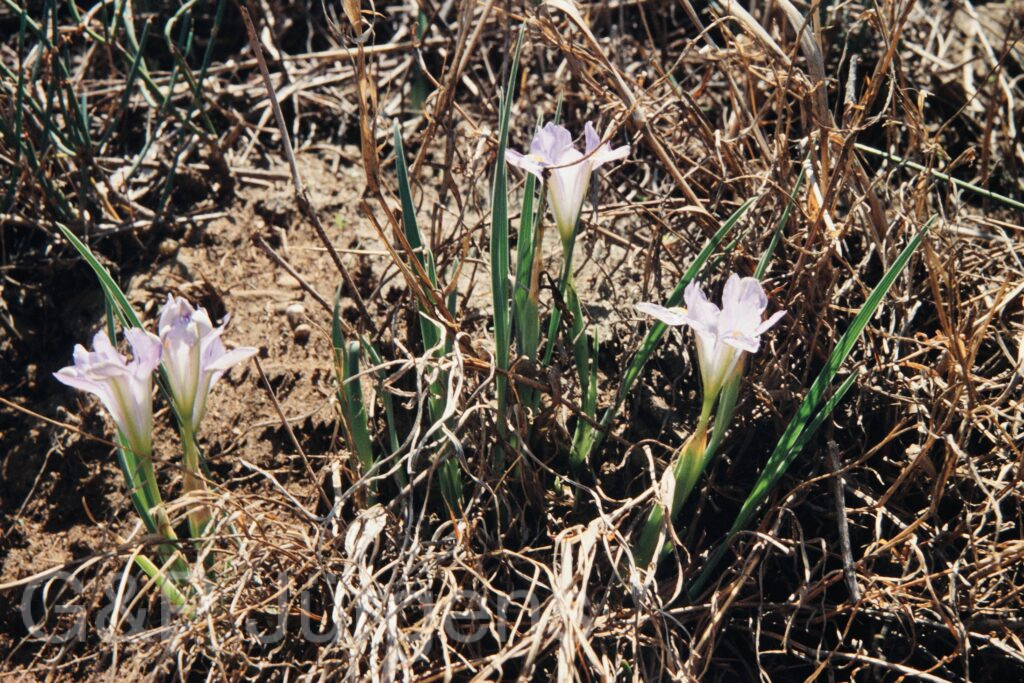
Nepal 99 13 ergebnis
West-Nepal, Jumla 2500m june
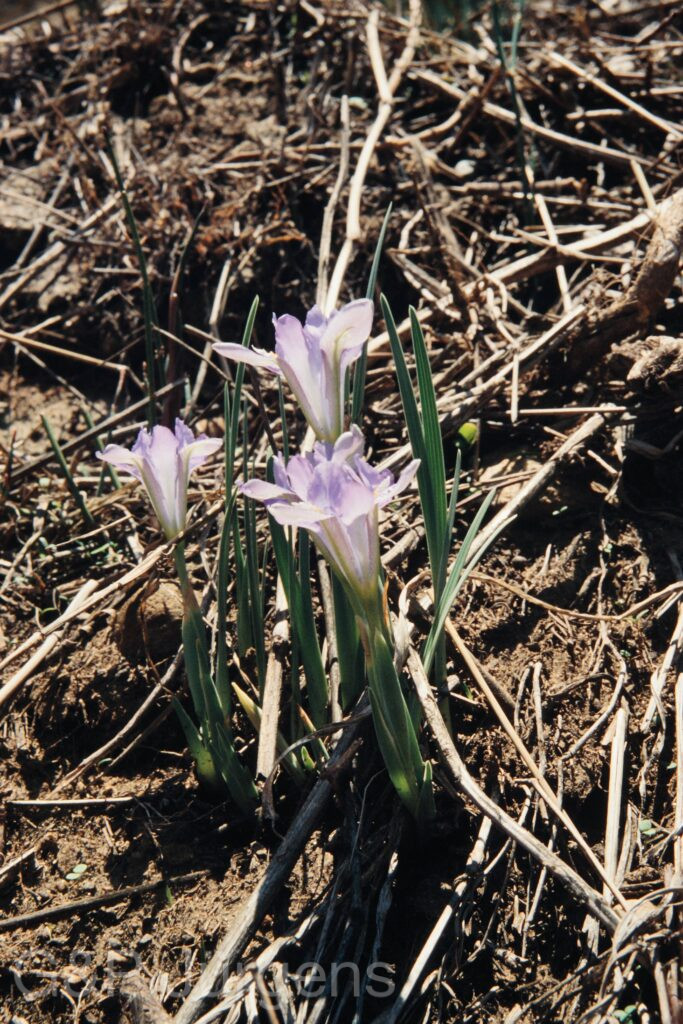
Nepal 99 14 ergebnis
West-Nepal, Jumla 2500m june

Description

Iris decora Wall. is a tuberous-rooted iris of the Himalaya and the mountains of southwestern China. GBIF data confirm its presence in Nepal, India, Bhutan, Pakistan, China and Myanmar, a range extending the length of the Himalayan arc into Yunnan. It grows on open grassy hillsides, stony slopes and among scrub in the temperate zone, characteristically between about 1,800 and 3,300 m. The plant recorded near Jumla in west Nepal at 2,500 m, flowering in June, typifies its early-summer flowering on sunny montane meadows.

The species arises from a cluster of slender, fleshy, fascicled roots rather than a true rhizome, and produces narrow, grass-like, ribbed leaves that develop fully after flowering. The flowering stem is short, bearing one to several flowers in succession, each subtended by membranous spathe valves. The flowers are lilac to pale violet-blue, the falls bearing a conspicuous yellow or white crest along the central ridge and the standards smaller and erect. The capsule is oblong-cylindric with a beaked apex, splitting to release numerous seeds.

Iris decora belongs to the subgenus Nepalensis (section Pseudoregelia in older treatments), a small group of Sino-Himalayan irises characterised by fascicled fleshy roots and crested falls. It is grown by alpine-plant enthusiasts and is the type of its species group. Although locally common in suitable grassland, it is vulnerable to overgrazing and habitat conversion in the more accessible parts of its range.

Author: Wall. · Sources: POWO (Kew), GBIF, Flora of China Vol. 24, Flora of Bhutan Vol. 3, Mathew: The Iris (1989)

Iris tectorum

by G & P Jürgens

Maxim.

Bhutan2014 42
Bhutan Trashigang 1200m, May
Bhutan2014 974
Bhutan Chele-La 3400m, May
Bhutan2014 975
Bhutan Chele-La 3400m, May

Description

Iris tectorum, the roof iris or wall iris, is native to China and long cultivated across East Asia, with naturalised and planted populations widely recorded; GBIF documents 1128 occurrences in China, Japan, Korea, the United States, India, Bhutan, Myanmar, Taiwan, Kazakhstan and parts of Europe. It grows on dry banks, grassy slopes, rocky ground and, famously, on thatched roofs and old walls where it was traditionally established. In Bhutan the illustrated plants span a wide range, from Trashigang at about 1200 m to Chele-La at 3400 m, both flowering in May, showing its tolerance of both warm valley and high-pass conditions.

The plant is a rhizomatous perennial with a stout, shortly creeping rhizome bearing tufts of broadly ensiform, soft, ribbed leaves arranged in flat fans. The flowering stem is branched and bears several large flowers; each has the iris structure of three spreading, reflexed outer perianth segments (falls) and three smaller erect inner segments (standards). The falls are pale lilac-blue, conspicuously veined and mottled with darker blue, and bear a fringed or crested white-and-violet ridge in place of a beard, identifying it as a crested (Evansia) iris. The three petaloid style branches arch over the stamens; the inferior ovary matures into an oblong, ridged loculicidal capsule releasing rounded seeds.

Assigned to subgenus Limniris and the crested-iris alliance, I. tectorum is a long-standing ornamental and the source material for traditional medicinal use of its rhizome. POWO and GBIF accept the name. Its frequent cultivation accounts for the scattered extralimital records far beyond its East Asian native range.

Author: Maxim. · Sources: POWO (Kew), GBIF, Flora of China, Flora of Bhutan, The Iris (Iridaceae monograph), Annotated Checklist of the Flowering Plants of Nepal

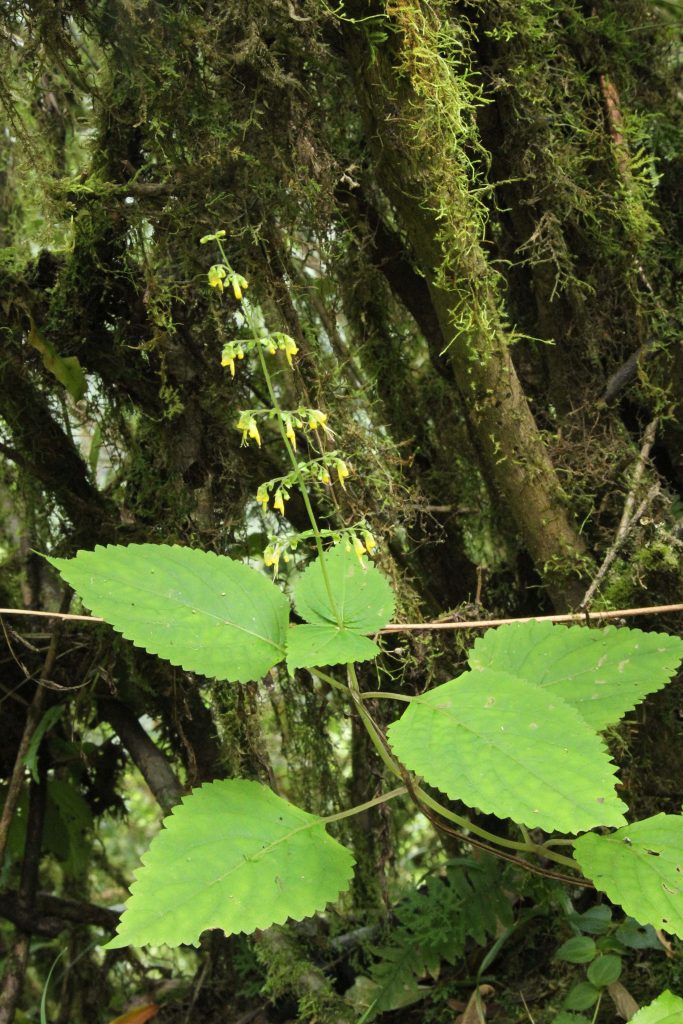
(Benth.) Murata

Bhutan2015 29
Bhutan Dochu-La 2800m, October

Description

Isodon hispidus (Benth.) Murata is a perennial herb of the mint family distributed across the eastern Himalaya and the mountains of southern China and mainland Southeast Asia. GBIF records confirm its presence in Bhutan, India, China, Myanmar, Laos, Vietnam, Thailand and Korea, with an outlying record from Tanzania likely representing a cultivated or misidentified collection. It favours moist forest margins, shrubby clearings and open slopes in the temperate and subalpine zones, typically between 1,500 and 3,000 m. The photographed plant at the Dochu-La in Bhutan, at 2,800 m and flowering in October, exemplifies its preference for cool, humid montane habitats where autumn blooms persist after the monsoon.

The species forms an erect, branched herb 0.5–1.5 m tall arising from a woody rootstock, with quadrangular stems that are densely hispid with spreading hairs. The opposite leaves are ovate to broadly ovate, acuminate, with a coarsely serrate margin and a rugose, pubescent surface, narrowing to a winged petiole. The inflorescence is a lax terminal panicle composed of numerous cymes; the small flowers have a campanulate, two-lipped calyx and a pale violet to purplish corolla with the characteristic declinate lower lip of the genus, enclosing four exserted stamens. The fruit comprises four smooth, ovoid nutlets.

Isodon hispidus belongs to a large and taxonomically intricate genus (formerly placed in Rabdosia and Plectranthus) noted for diterpenoid chemistry of pharmacological interest. Several congeners are used in traditional Asian medicine, and the genus is a focus of phytochemical research into ent-kaurene diterpenoids. The species is widespread and not considered threatened across its broad range.

Author: (Benth.) Murata · Sources: POWO (Kew), GBIF, Flora of China Vol. 17, Flora of Bhutan Vol. 2, Murata: Revision of Asian Isodon (Lamiaceae)

(Buch.-Ham. ex D.Don) H.Hara

Bhutan2015 586
Bhutan Mo-Chu 1800m, October
Bhutan2015 587
Bhutan Mo-Chu 1800m, October

Description

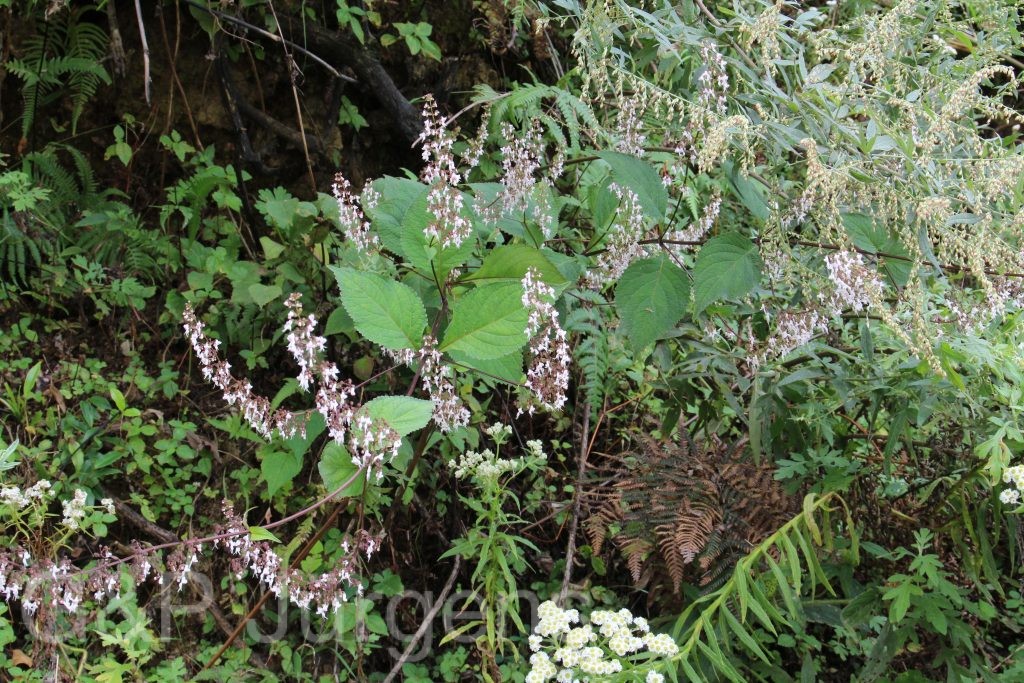
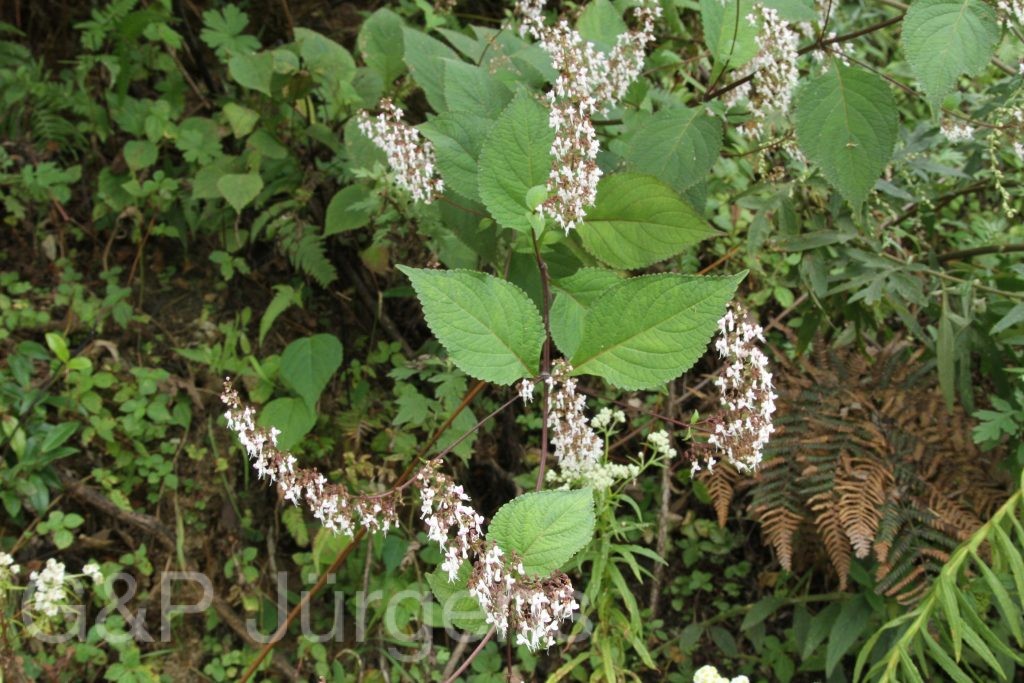
Isodon lophanthoides is a widespread herb of the Sino-Himalayan region, recorded from China, the Indian Himalaya, Nepal, Bhutan, Pakistan, Myanmar, Thailand, Laos, Vietnam, Bangladesh, Malaysia and Hong Kong, and represented by nearly two thousand georeferenced collections. It occupies a broad subtropical to warm-temperate belt, growing on moist shaded banks, forest margins, streamsides, grassy slopes and disturbed ground. In Bhutan it descends to warm river valleys, as along the Mo-Chu at about 1800 m where it was photographed flowering in October, the late-season anthesis typical of the genus.

The plant is an erect to ascending annual or short-lived perennial herb with quadrangular, often purple-tinged and pubescent or glandular stems. The leaves are opposite, ovate to broadly ovate, crenate-serrate, acuminate, and narrowed at the base into a winged petiole, often gland-dotted beneath. The inflorescence is a lax, much-branched terminal panicle of small cymes. The flowers have a bilabiate, glandular calyx that enlarges in fruit, and a small two-lipped corolla that is white to pale pink or purplish, dotted with darker spots, with a flat lower lip and four declinate didynamous stamens. The fruit consists of four smooth ovoid nutlets (mericarps).

Isodon (formerly included in a broad Rabdosia and Plectranthus) belongs to subfamily Nepetoideae of Lamiaceae; this species was described as Plectranthus lophanthoides by Buchanan-Hamilton and transferred by Hara. Several intraspecific varieties have been recognised across its range. Rich in bioactive ent-kaurane diterpenoids, it is used in Chinese herbal medicine, and its broad ecological tolerance and frequency mean it is not of conservation concern.

Author: (Buch.-Ham. ex D.Don) H.Hara · Sources: POWO (Kew), GBIF, Flora of China, Flora of Bhutan, Flora of Pakistan, taxonomic revisions of Isodon (Lamiaceae) by H. W. Li

(Wall.) Murata

Bhutan2012 352
Bhutan Wangdi 2200m, October

Description

An erect perennial mint of the Himalaya and adjacent mountains, recorded from Nepal, China, India, Bhutan and Myanmar, with about 180 GBIF occurrences. It grows on open slopes, scrub margins, forest edges, roadbanks and disturbed clearings in the warm-temperate and subtropical zones, generally between about 1500 and 2800 m, flowering into the autumn. The illustrated plant was photographed in October at Wangdi in Bhutan at around 2200 m, a sunny mid-elevation montane site typical of its late-season flowering.

The species is a tall, branching herb or subshrub with the characteristic quadrangular stems of the mint family, often finely pubescent. The leaves are opposite and decussate, ovate to ovate-lanceolate, acuminate, with serrate margins and a glandular-punctate, aromatic surface, borne on distinct petioles. The inflorescence is a lax, much-branched terminal panicle of small cymes. Each flower has a campanulate, two-lipped calyx and a small bilabiate corolla, pale lilac to whitish or bluish, with a short tube, a four-lobed upper portion and a larger boat-shaped lower lip enclosing the four declinate stamens. The fruit comprises four small, smooth, ovoid nutlets seated in the persistent calyx.

Accepted by POWO and GBIF, I. scrophularioides belongs to the genus Isodon (formerly within Rabdosia and Plectranthus), a group of mints rich in bioactive diterpenoids and of interest in traditional medicine and phytochemistry. The deflexed lower lip forms a landing platform for bee pollinators, and the dry nutlets are dispersed by gravity and disturbance. Adaptable and frequent in secondary habitats across its range, it is of no conservation concern and exemplifies the largely Asian, montane radiation of the genus.

Author: (Wall.) Murata · Sources: POWO (Kew), GBIF, Flora of China, Flora of Bhutan, Li revision of Isodon

(D.Don) Kudô

Bhutan2015 461
Bhutan Trongtsa 2100m, October

Description

Isodon ternifolius is a shrubby mint distributed across the eastern Himalaya and Southeast Asia, recorded by GBIF (477 occurrences) from China, India, Thailand, Nepal, Myanmar, Vietnam, Bhutan, Bangladesh and Laos. It occupies forest margins, thickets, open hillsides, roadsides and disturbed slopes, mostly at lower to mid montane elevations between roughly 500 and 2500 m. The plant photographed at Trongsa in central Bhutan at 2100 m in October illustrates its autumn flowering, when the airy inflorescences come into bloom along forested valley margins toward the upper end of its altitudinal range.

The species is an erect perennial herb or soft shrub with quadrangular, often densely pubescent stems. As suggested by the epithet, the leaves are frequently borne in whorls of three (ternate), in addition to the opposite arrangement typical of the family; they are ovate to lanceolate, crenate-serrate and shortly petiolate, with a velvety to tomentose indumentum. The flowers are small and arranged in many-flowered thyrses formed of axillary cymes. The corolla is bilabiate with a short tube, the upper lip four-lobed and reflexed and the lower lip boat-shaped and declinate to enclose the four stamens and the bifid style. The fruit comprises four smooth, ovoid nutlets enclosed within the persistent campanulate calyx.

Isodon, long included within Plectranthus or Rabdosia, is now recognised as a distinct genus of Old World mints noted for its rich array of bioactive ent-kaurane diterpenoids, several species being used in traditional Chinese medicine. The nectariferous bilabiate flowers are pollinated by bees and other insects, and the nutlets are dispersed passively from the persistent calyces. The species is common, weedy in disturbed habitats and not regarded as threatened.

Author: (D.Don) Kudô · Sources: POWO (Kew), GBIF, Flora of China, Flora of Bhutan, Flora of Thailand, Revision of the Genus Isodon (Li)

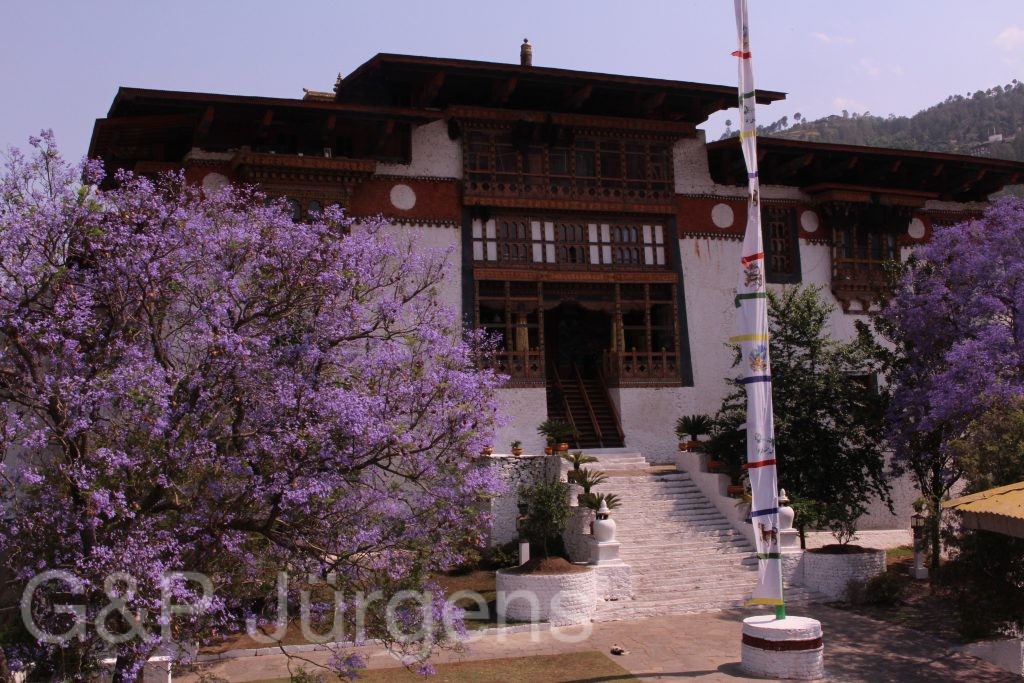
D.Don

Bhutan2014 737
Bhutan Punaka 1200m, May

Description

Jacaranda mimosifolia is a deciduous tree native to subtropical South America, in particular northwestern Argentina and adjacent Bolivia, but it is now one of the most widely planted ornamental trees in warm-temperate and tropical regions worldwide; its more than twenty thousand occurrence records span Australia, South Africa, Spain, Kenya, Mexico, the United States and far beyond. It thrives in well-drained soils in warm valleys, parks and roadsides and is frost-sensitive. The tree photographed at Punakha in Bhutan at 1200 m in May is a cultivated street or garden specimen, flowering in its characteristic spring blaze in the warm lower Himalayan valley, well outside its native New World range.

It is a medium to large tree with a spreading, rounded crown and smooth grey bark. The leaves are large, opposite and bipinnate with many small, oblong, mucronate leaflets, recalling those of mimosoid legumes and giving the species its epithet. The flowers are produced in showy terminal panicles, typically before or with the new foliage; each has a small campanulate calyx and a tubular, two-lipped blue to violet corolla that swells above a narrow base. Four didynamous stamens and a staminode are enclosed within. The fruit is a flattened, woody, rounded to oblong capsule that splits along two valves to release numerous thin, broadly winged, wind-dispersed seeds.

Jacaranda is a Neotropical genus of the Bignoniaceae, and J. mimosifolia is its most familiar member, prized for its lavender-blue spring flowering. In its native range it is assessed as Vulnerable owing to limited and fragmented wild populations, even as it flourishes in cultivation globally; in several regions it has become naturalised or weedy. Its nectar-rich flowers attract bees and other insects, and its showy display has made it an emblematic urban tree across the subtropics.

Author: D.Don · Sources: POWO (Kew), GBIF, Flora Argentina, IUCN Red List assessment, Gentry's treatment of Bignoniaceae