(Buch.-Ham. ex D.Don) H.Gross
Description
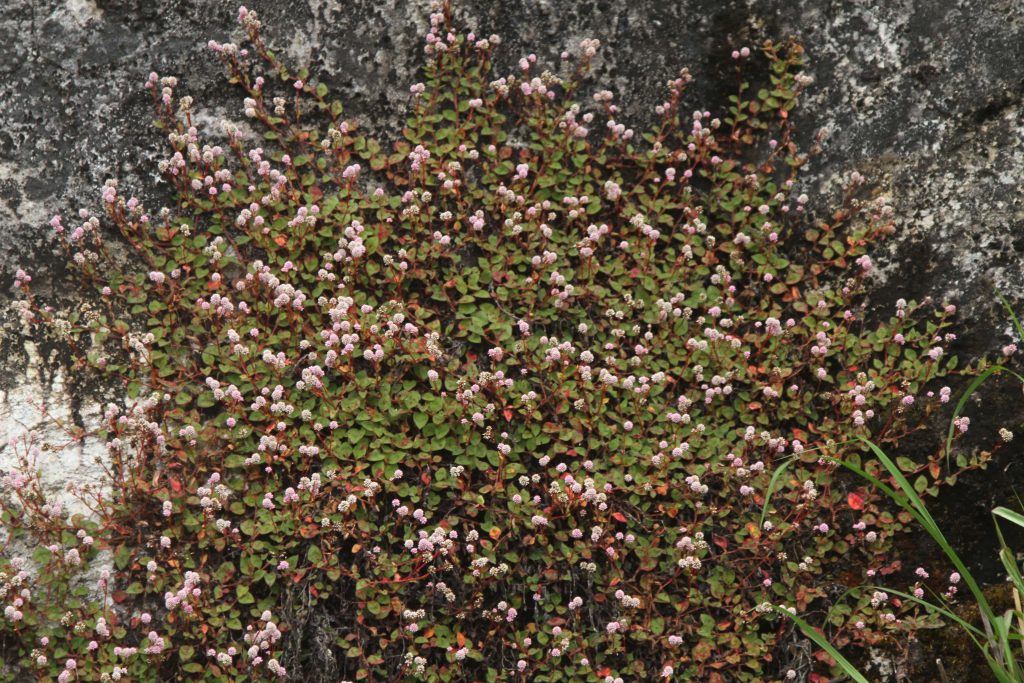
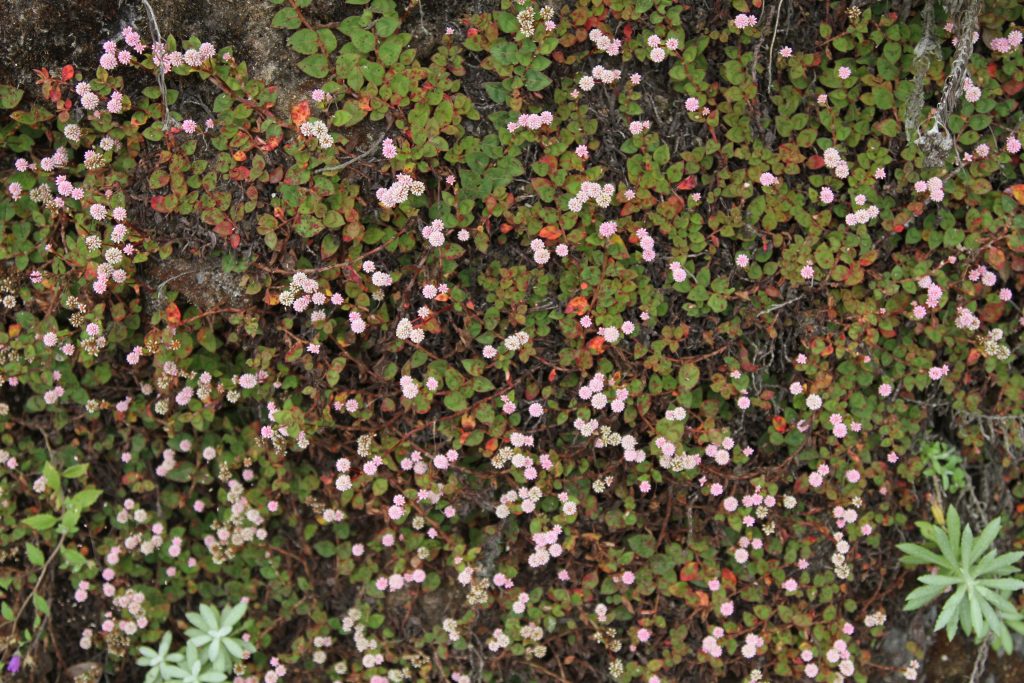
Persicaria capitata (Buch.-Ham. ex D.Don) H.Gross is a mat-forming perennial native to the Himalaya and southern China that has become widely naturalised as an ornamental and weed. GBIF documents nearly 23,000 occurrences, with native records from India, Nepal, China and Taiwan and extensive introduced populations across Portugal, Spain, Italy, the Netherlands, Great Britain, the United States, Mexico, Brazil, Colombia, Ecuador, Costa Rica, Australia, New Zealand, South Africa, Japan and Réunion. In its native range it grows on rocky banks, walls, gravelly slopes and disturbed mid-montane ground. The Bhutanese plant photographed at the Tumching-La, at about 2900 m in October, reflects its occurrence in the cool temperate zone of the eastern Himalaya.
The plant is a low, creeping herb that roots at the nodes to form dense mats; the slender, often reddish stems bear membranous ochreae at the swollen nodes. The leaves are ovate to elliptic, frequently marked with a dark V-shaped band and sometimes tinged purple. The flowers are aggregated into small, dense, globose heads borne on slender peduncles; the perianth is pink, five-lobed and persists in fruit. The fruit is a small trigonous achene enclosed by the perianth.
Widely grown as a ground-cover ornamental, P. capitata escapes readily and is recorded as an environmental weed in parts of the Mediterranean, Macaronesia, Australasia and the Americas. Its capacity to root at the nodes and spread vegetatively, combined with prolific seed production, underlies its colonising success. The species is not of conservation concern; instead it exemplifies how a Himalayan native can attain a near-cosmopolitan distribution through horticultural dispersal and subsequent naturalisation.
Author: (Buch.-Ham. ex D.Don) H.Gross · Sources: POWO (Kew), GBIF, Flora of China, Flora of Bhutan, Flora of Nepal, Hara & Williams Polygonaceae treatments