Author

G & P Jürgens

Wedd. ex. Blume

Garw 2005 220 ergebnis ergebnis
India Garhwal Simkarok 2700m, September

Description

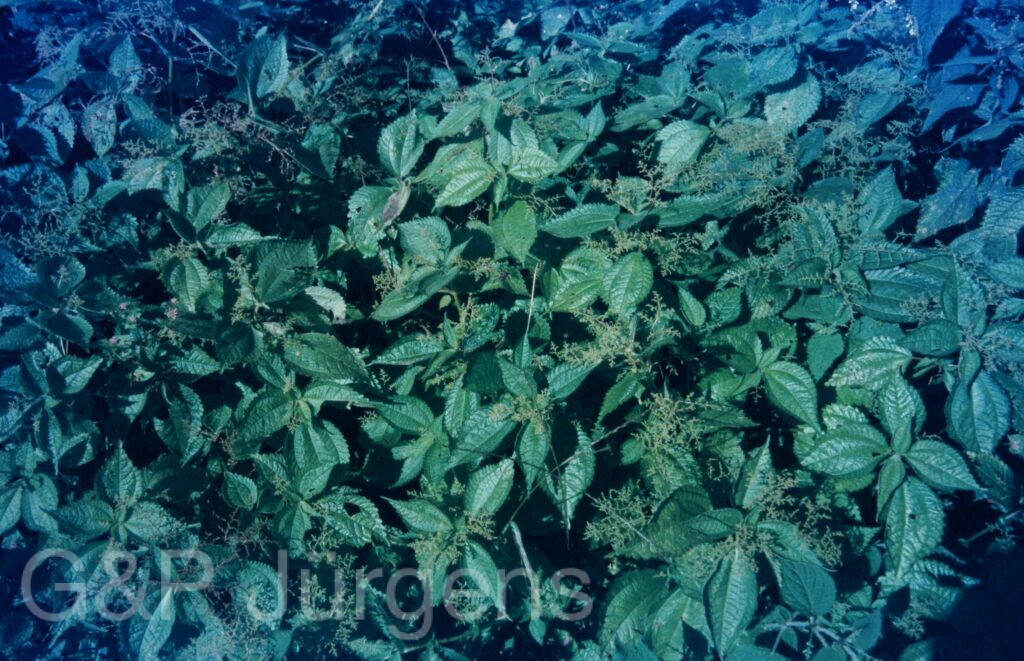
Pilea umbrosa is a shade-loving herb of moist montane forests across the Himalaya and into south-east Asia, recorded from Nepal, India, China, Pakistan, Bhutan and Vietnam. The roughly 307 georeferenced collections trace the temperate forest belt from the western Himalaya eastward. As its epithet (umbrosa, "of shady places") implies, it occupies damp, humus-rich, deeply shaded sites: forest floors, rock crevices, mossy banks and the margins of streams beneath broadleaved and mixed canopy. The photographed material from Garhwal at Simkarok at 2700 m in September is characteristic of its upper-temperate habitat and its late-monsoon fruiting period.

It is a succulent, often fleshy perennial herb with semi-translucent, somewhat brittle stems that may root at the lower nodes. The opposite leaves are markedly anisophyllous, the two of a pair unequal in size, ovate to elliptic, with a toothed (serrate to crenate) margin and a characteristic triple primary venation; linear cystoliths are visible on the surface, a diagnostic feature of the genus. Stipules are present at the nodes. As in most Urticaceae the inflorescences are small, axillary cymes of inconspicuous, unisexual, greenish flowers, the male flowers with reflexed tepals and explosively dehiscent stamens that fling pollen at maturity. The fruit is a minute, compressed achene.

Pilea is one of the largest genera of Urticaceae, predominantly tropical and subtropical, and unusually for the family it lacks stinging hairs, making it harmless to handle. The explosive stamen mechanism enabling wind dispersal of pollen is a hallmark of the family. P. umbrosa is a widespread, locally abundant understorey element with no conservation concern, valued ecologically as ground cover that stabilises soil on shaded forest slopes.

Author: Wedd. ex. Blume · Sources: POWO (Kew), GBIF, Flora of China Vol. 5, Flora of Bhutan Vol. 1, Flora of Pakistan, Friis's Revision of Asian Urticaceae
L.

Sikkim2011 109
Sikkim, Chopta-valley 4300m, June

Description

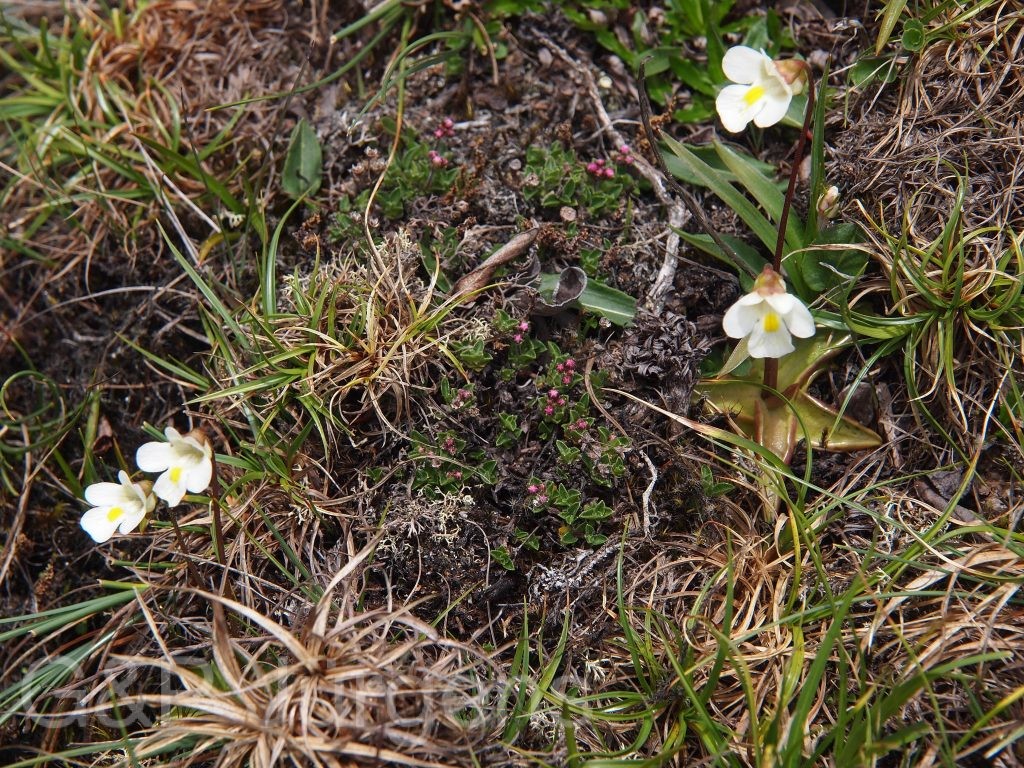
Pinguicula alpina is a circumboreal-alpine carnivorous herb with a vast range across the mountains and high latitudes of Eurasia, from the Alps, Pyrenees and Scandinavia through Russia to China, with disjunct outliers in the Himalaya including Nepal and Sikkim. Its tens of thousands of catalogued occurrences reflect this broad distribution. It grows in wet, base-rich, often calcareous habitats — flushes, dripping rocks, fens, streamsides and damp turf — from the montane belt to high alpine elevations, reaching about 4,300 m in the Himalaya, as in the plant photographed in the Chopta valley of Sikkim at 4,300 m in June, where it flowers at the height of the alpine spring.

It is a small, perennial, insectivorous herb forming a flat basal rosette of yellow-green, oblong to elliptic leaves whose upper surfaces are sticky with glandular hairs that trap and digest minute insects, the margins slightly involute. From the rosette arise one to few erect, leafless scapes bearing a single nodding flower; the corolla is white with one or two yellow spots on the palate, two-lipped and spurred at the base, the spur short and conical. The fruit is a small ovoid capsule releasing numerous minute seeds. The plant overwinters as a resting bud (hibernaculum).

Within Lentibulariaceae, Pinguicula employs flypaper-type passive carnivory, supplementing nutrient uptake in the poor, wet soils it favours. P. alpina is distinguished from the violet-flowered P. vulgaris by its white, yellow-spotted corolla and shorter spur, and the two occasionally co-occur. Though globally secure, its Himalayan populations are localised and dependent on undisturbed calcareous wetlands sensitive to drainage and warming.

Author: L. · Sources: POWO (Kew), Flora of China Vol. 19, Flora of Nepal, GBIF, Casper: Monographie der Gattung Pinguicula (1966)

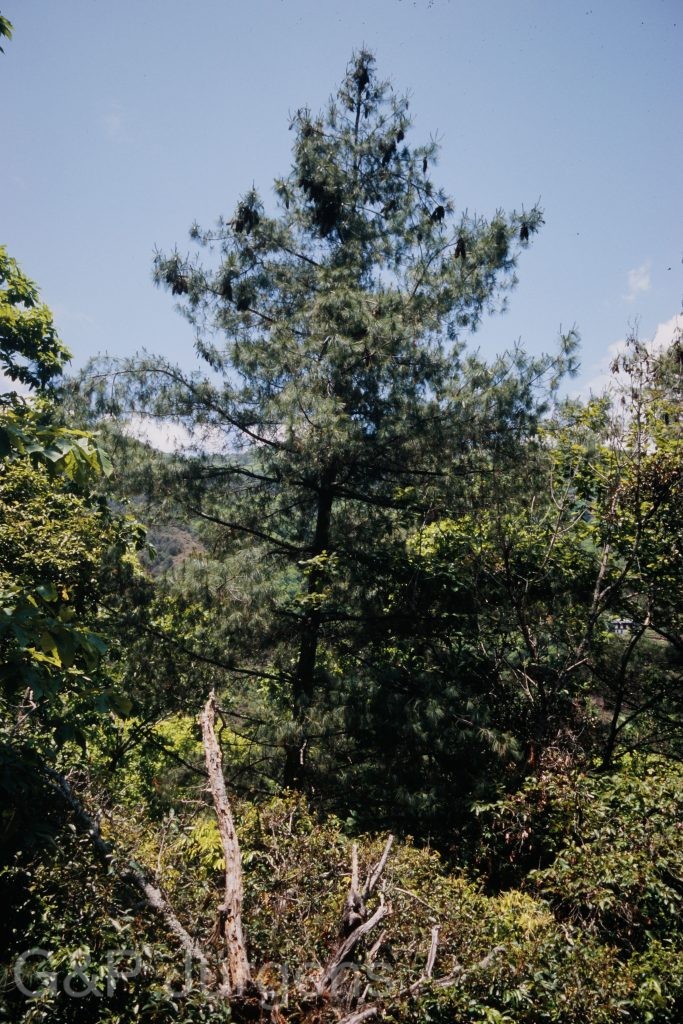
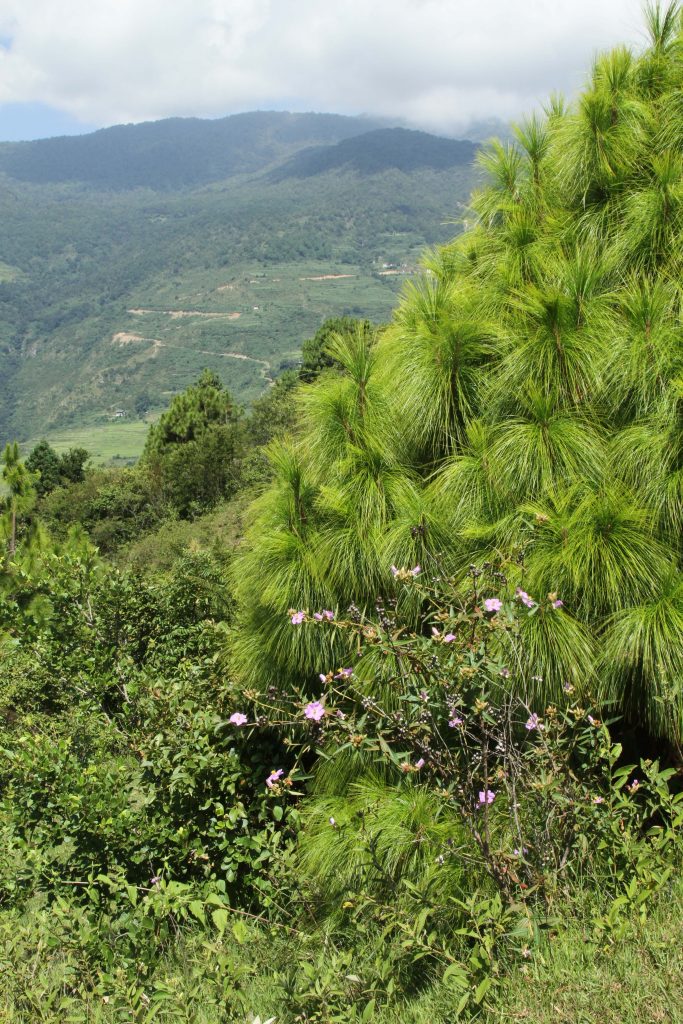
Pinus bhutanica

by G & P Jürgens

Grierson, D.G.Long & C.N.Page

Bhutan2015 468
  Bhutan Trongsa 2300m, October
Bh2008 479 P744
Bhutan, Chongsakha 1800m, May

Description

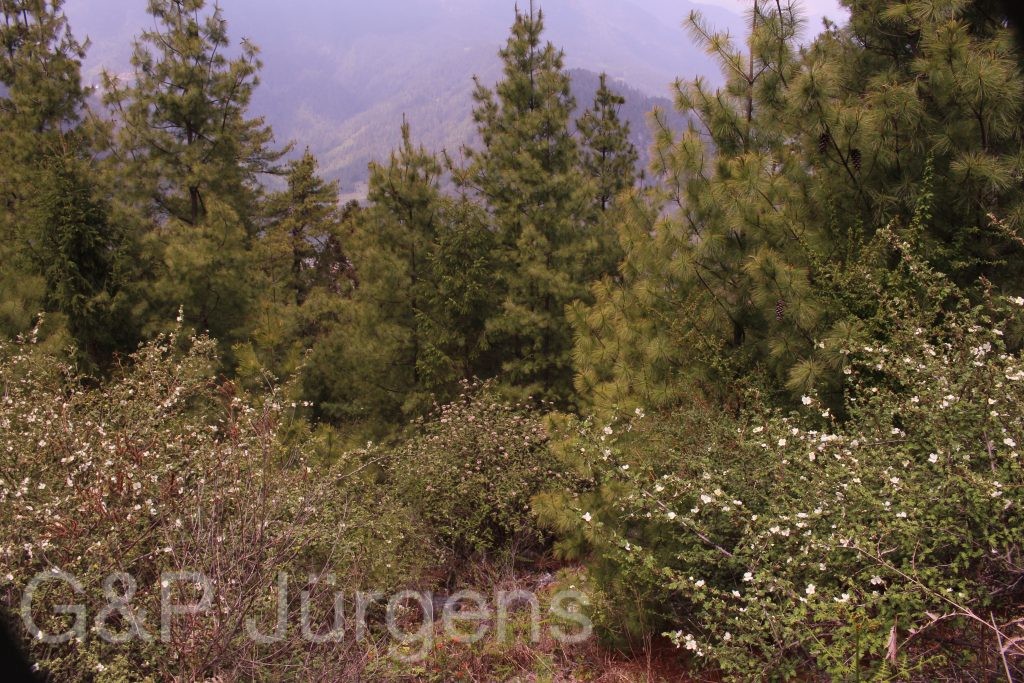
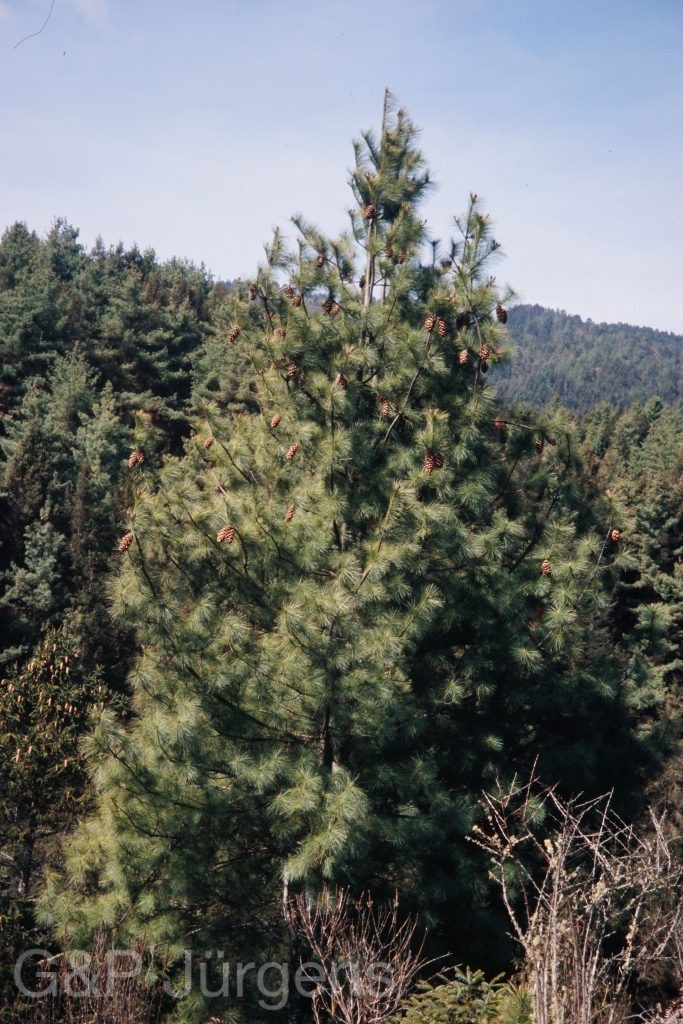
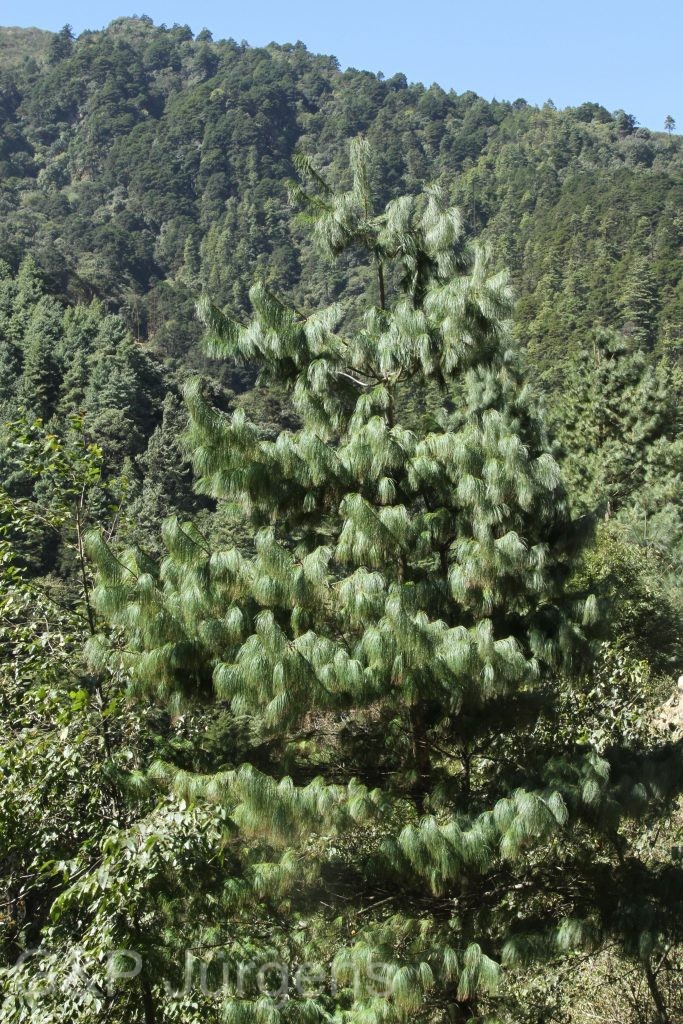
Pinus bhutanica Grierson, D.G.Long & C.N.Page is a five-needled white pine of the eastern Himalaya, restricted to Bhutan, north-eastern India (Arunachal Pradesh) and adjacent south-eastern Tibet (China); GBIF records about 96 occurrences, the few extralimital points reflecting cultivation or database artefacts. It grows in warm-temperate to subtropical montane forest, often on humid, monsoon-exposed slopes, typically between about 1,700 and 2,400 m. Both photographed stands are Bhutanese – Trongsa at 2,300 m in October and Chongsakha at 1,800 m in May – matching its known occurrence in the wet central and eastern Bhutanese hills.

It is an evergreen coniferous tree to 25 m or more, with spreading branches and a somewhat open crown. The needles are borne in fascicles of five, and are notably long, slender and pendulous, drooping gracefully and distinguishing it from the related P. wallichiana. The species is monoecious, with small pollen cones clustered at the base of new shoots and erect young seed cones that mature in the second year. The mature cone is large, cylindrical and resinous, with thin woody scales; the seeds are winged for wind dispersal, borne beneath the cone scales.

Pinus bhutanica was described as recently as 1980 and belongs to subgenus Strobus (the soft or white pines), being closely allied to the widespread Himalayan blue pine P. wallichiana, from which it differs chiefly in its longer, conspicuously drooping needles and more pronounced resin glands. Its narrow eastern Himalayan range makes it of biogeographic interest as a regional endemic of the wetter Bhutan-Arunachal sector; it is assessed by IUCN as Least Concern owing to stable populations within extensive forest.

Author: Grierson, D.G.Long & C.N.Page · Sources: POWO (Kew), GBIF, Flora of Bhutan, Flora of China, IUCN Red List of Threatened Species, Farjon Handbook of the World's Conifers, Grierson Long & Page protologue of Pinus bhutanica

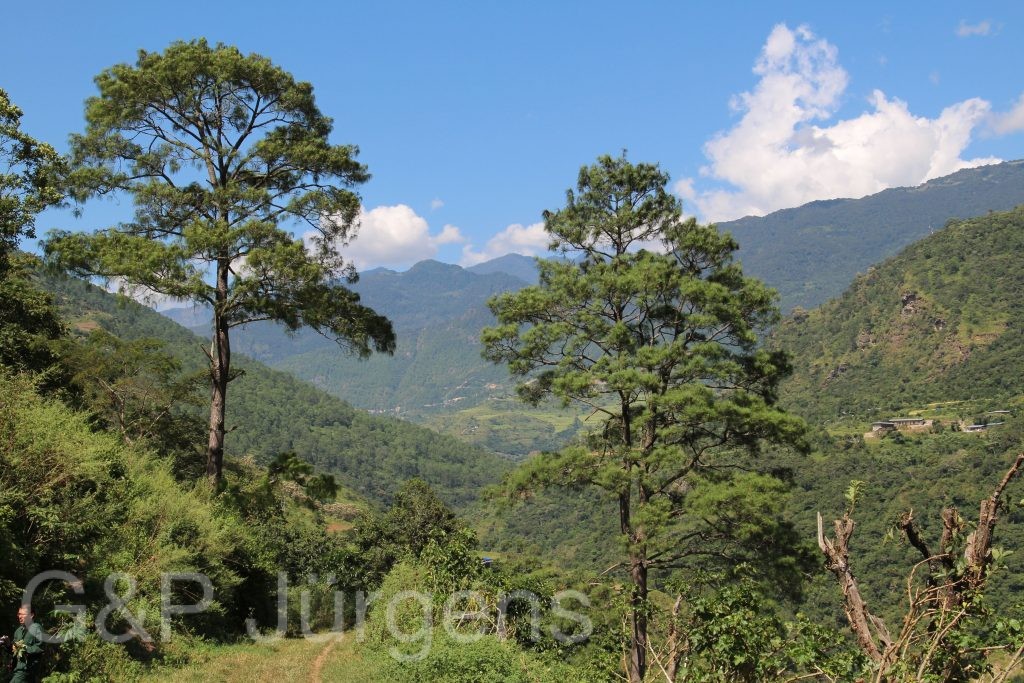
Sarg.

Bhutan2012 531
Bhutan Wangdi, Phodrang 2400m, September
Bhutan2015 312
Bhutan, Trongsa 2100m, October

Description

Pinus roxburghii, the chir or longleaf Himalayan pine, is the dominant conifer of the dry outer ranges and inner valleys of the Himalaya, native across India, Nepal, Bhutan, Pakistan, Afghanistan and China, and widely planted elsewhere, as reflected by occurrence records from South Africa, the United States, New Zealand and Europe. It forms extensive open forests on warm, sun-exposed slopes, ridges and rain-shadowed valleys, characteristically between about 500 and 2300 m. The trees photographed near Wangdi Phodrang at 2400 m and Trongsa at 2100 m in Bhutan illustrate its presence in the dry inner Himalayan valleys, where it forms the lower montane pine belt below the broad-leaved and fir zones.

It is a large evergreen tree with a tall, often clear bole and a rounded to spreading crown, the thick bark deeply fissured into reddish-brown plates that confer fire resistance. The needles are borne in fascicles of three, long, slender and pendulous, light green and finely serrulate, with a persistent basal sheath. It is monoecious: the male strobili cluster at the base of new shoots, while the woody seed cones are large, ovoid-conical and hard, the cone scales bearing a stout, recurved umbo. The winged seeds are released at maturity and dispersed by wind.

Pinus roxburghii belongs to the hard pines (subgenus Pinus) and is the characteristic fire-adapted, drought-tolerant pioneer of the Himalayan subtropical pine forest, regenerating vigorously after burning and forming nearly pure stands. It is economically important as a source of resin (oleoresin tapped for turpentine and rosin), construction timber and fuelwood. Though not threatened given its vast range, its needle litter and flammability strongly shape fire regimes and understorey composition across the lower Himalaya.

Author: Sarg. · Sources: POWO (Kew), GBIF, Flora of China, Conifers of the Himalaya, Annotated Checklist of the Flowering Plants of Nepal, Farjon's A Handbook of the World's Conifers

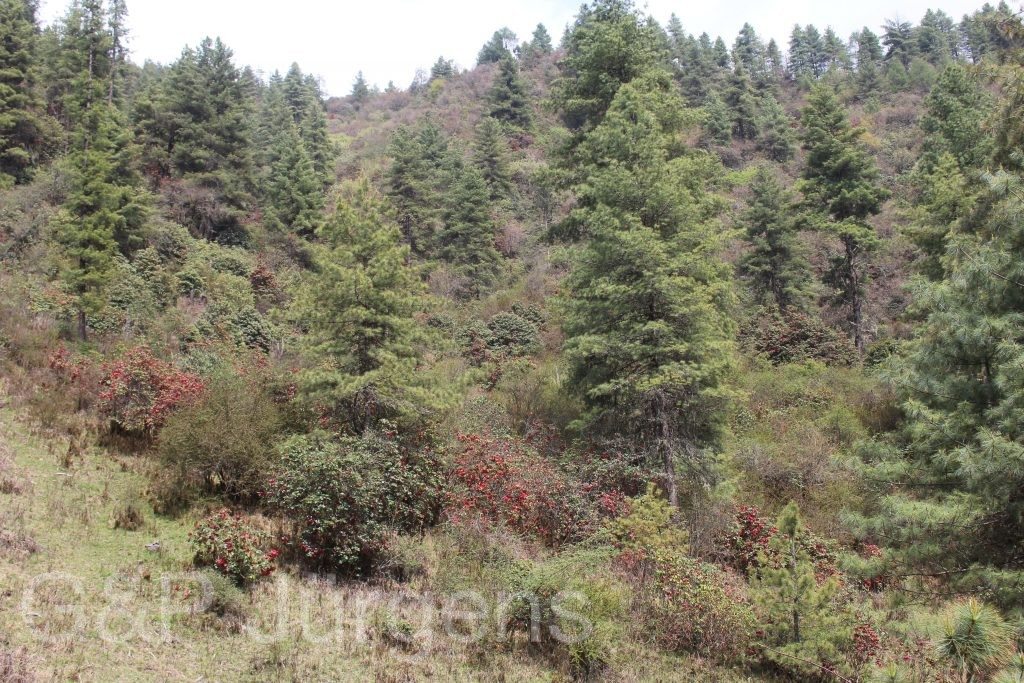
(Wall. ex. D.Don) A.B.Jacks.

Bhutan2014 544
Bhutan, Phobjika 3000m, May
Bhutan2014 961
Bhutan, Haa-valley, 2800m, May
Bh2008 295 P454
Bhutan, Ura 2900m, April

Description

Pinus wallichiana, the Bhutan or blue pine, is a major timber conifer of the Himalaya and Hindu Kush, ranging from Afghanistan and Pakistan through Kashmir, the Indian Himalaya, Nepal and Bhutan to south-eastern Tibet and China. It is among the best-recorded Himalayan trees, GBIF holding over 2400 occurrences, many from cultivation in Europe, North America and Australasia where it is a graceful ornamental. Natively it forms montane forests, often with Picea, Abies and Cedrus, on well-drained slopes between about 1800 and 4000 m. The Bhutanese stands at Phobjikha, the Haa valley and Ura between 2800 and 3000 m exemplify its dominance in the temperate conifer belt.

It is a large evergreen tree to 40 m or more, with a straight trunk, greyish fissured bark and whorled spreading branches forming a broad conical crown. The needle leaves are five per fascicle, slender, soft and drooping, 12 to 20 cm long, glaucous-bluish (whence blue pine) and finely serrulate. It is monoecious: small yellow pollen cones cluster at the base of new shoots, while the seed cones are long-pedunculate, cylindrical and resinous, 15 to 30 cm long and pendent, with broad woody scales spreading at maturity, each fertile scale bearing two winged, wind-dispersed seeds.

A member of Pinus subgenus Strobus (the soft or white pines, section Quinquefoliae), P. wallichiana is allied to P. griffithii and other five-needle pines of eastern Asia and North America, distinguished by its long pendulous cones and drooping foliage. It is important for construction timber, resin and fuel, and ecologically as a pioneer colonising landslides and abandoned terraces. Though widespread and not threatened, it is locally susceptible to blister rust and to over-exploitation near settlements.

Author: (Wall. ex. D.Don) A.B.Jacks. · Sources: POWO (Kew), GBIF, Flora of China Vol. 4, Flora of Bhutan Vol. 1, Flora of Pakistan, Farjon A Handbook of the World's Conifers

Buch.-Ham. ex D. Don

Bhutan2014 293
Bhutan Trithangebe near a farmhouse 800m, May

Description

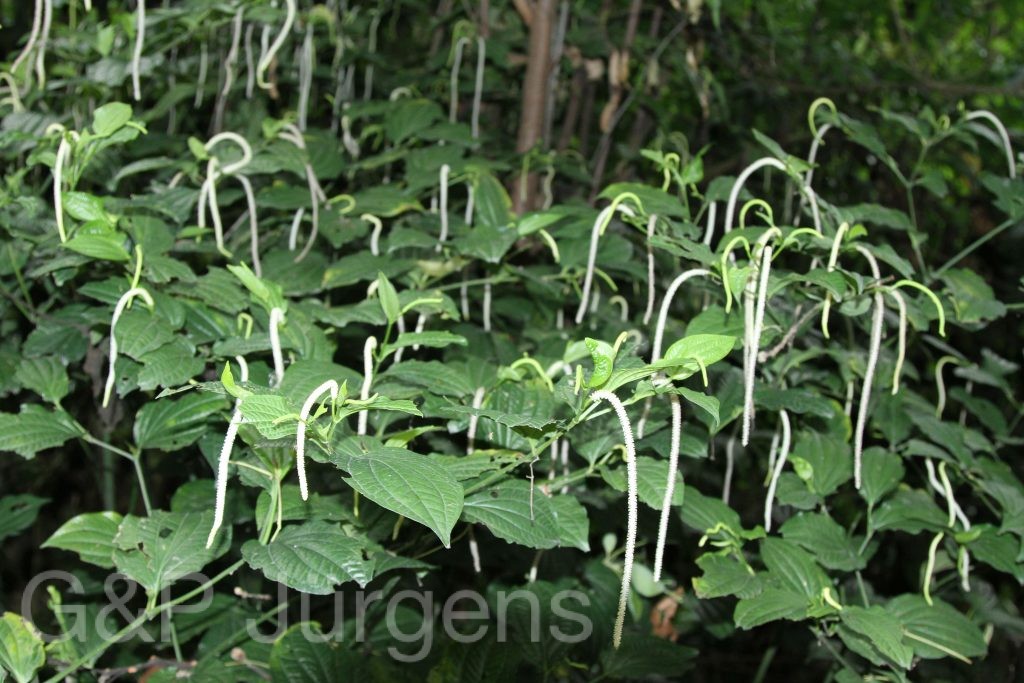
Piper suipigua (Buch.-Ham. ex D. Don) is a climbing pepper of the family Piperaceae distributed across the eastern and central Himalaya and adjacent regions, occurring in India, Nepal, Bhutan, Bangladesh, Thailand and southern China. The roughly 200 GBIF records indicate a relatively narrow but well-defined sub-Himalayan range. It is a plant of warm-temperate to subtropical forest, growing as a root-climber on tree trunks and over rocks, and is frequently encountered in the disturbed margins of cultivation and around dwellings, as reflected in the Bhutanese record from Trithangebe near a farmhouse at 800 m in May. It typically occurs from the foothills to about 1,500 m.

The plant is a woody to herbaceous climber attaching by adventitious clasping roots at the nodes, with somewhat swollen, jointed stems. The leaves are alternate, ovate to ovate-cordate, entire, acuminate at the apex and palmately several-nerved from near the base, the lower surface frequently glandular-dotted. The minute, perianth-less flowers are densely crowded on slender, pendulous or erect spikes opposed to the leaves, each subtended by a peltate bract; the species is generally dioecious. The fruit is a small, sessile, fleshy drupe aggregated into a fleshy fruiting spike.

Piper is a very large pantropical genus of considerable economic importance, including the source of black pepper (P. nigrum) and betel (P. betle). P. suipigua is one of several Himalayan wild peppers whose aromatic leaves and fruits are used locally as a condiment, masticatory and in folk medicine. The genus is characterised by its sympodial growth, swollen nodes and minute flowers densely packed on opposed spikes. Locally common in suitable habitat, the species is not regarded as being of conservation concern.

Author: Buch.-Ham. ex D. Don · Sources: POWO (Kew), Flora of Bhutan Vol. 1, GBIF, Flora of China Vol. 4, Gardner: Pipers of Nepal and the Himalaya

(Hook.) Sweet

Bhutan2014 342
Bhutan Tumching-La 3000m, May
Bhutan2014 886
Bhutan Chele-La 3300m, May

Description

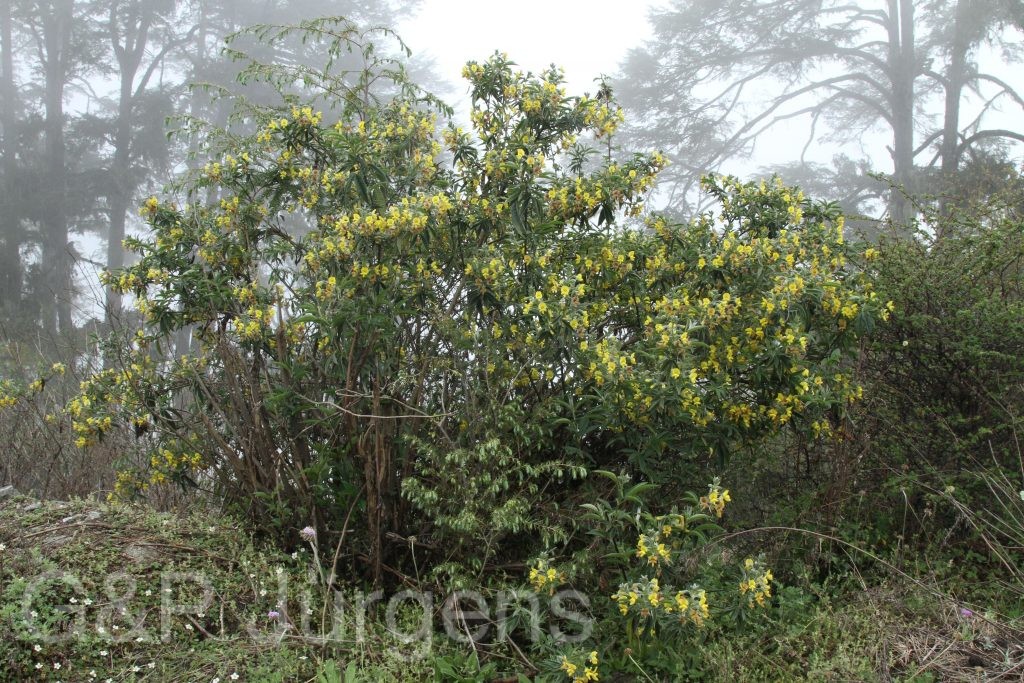
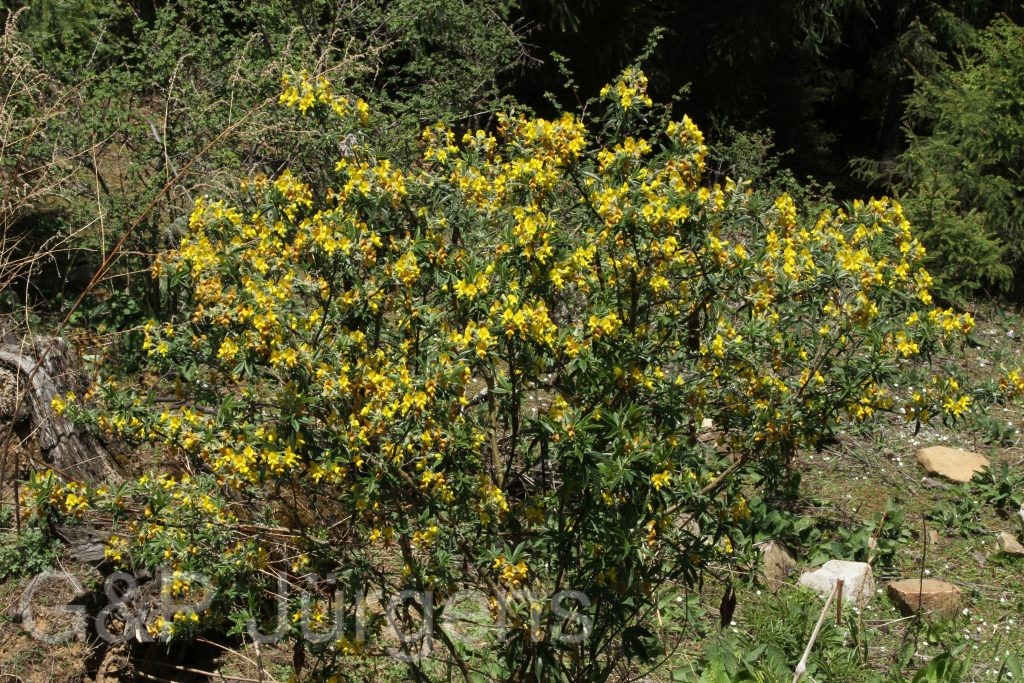
Piptanthus nepalensis is a Sino-Himalayan shrub distributed along the southern flank of the great ranges from Nepal and northern India eastward through Bhutan into south-western China (Yunnan, Sichuan, Xizang), with outlying records in Myanmar; the species is widely cultivated and naturalised in temperate gardens, accounting for the European, North American and Antipodean records (GB, DE, BE, NL, US, CA, NZ) among its more than 1600 georeferenced occurrences. It favours open scrub, forest margins, rocky slopes and stream banks in the upper montane and subalpine belts, typically between about 2500 and 4000 m. The populations on the Bhutanese passes of Tumching-La (3000 m) and Chele-La (3300 m), flowering with the spring thaw in May, are characteristic of its habitat among Rhododendron and conifer scrub.

It is a deciduous to semi-evergreen shrub reaching 1-4 m, with stout greenish branchlets bearing silky-pubescent young growth. The leaves are trifoliolate, long-petiolate and stipulate, the leaflets elliptic to lanceolate, dark green and glabrescent above, glaucous and appressed-silky beneath. The showy golden-yellow papilionaceous flowers, 2.5-3 cm long, are borne in terminal erect racemes; the calyx is bilabiate and silky, and the standard, wings and keel are typical of the tribe Thermopsideae. The fruit is a flattened, elongate, dehiscent legume to 12 cm, glaucous-pubescent and containing several dark reniform seeds.

Piptanthus is a small genus of the broadly defined Thermopsideae allied to Thermopsis and Anagyris, distinguished by its woody habit and trifoliolate leaves. Long-cultivated for its early bloom, P. nepalensis hosts nitrogen-fixing rhizobia that aid colonisation of skeletal soils. It is not considered threatened, being abundant across a broad range, though its toxic quinolizidine alkaloids deter browsing.

Author: (Hook.) Sweet · Sources: POWO (Kew), GBIF, Flora of China, Flora of Bhutan, Flora of Nepal, Turner's revision of Piptanthus (Thermopsideae)

(D.C.) Rehder & E.H. Wilson

Bhutan2014 26
Bhutan Samdrup 850m, May

Description

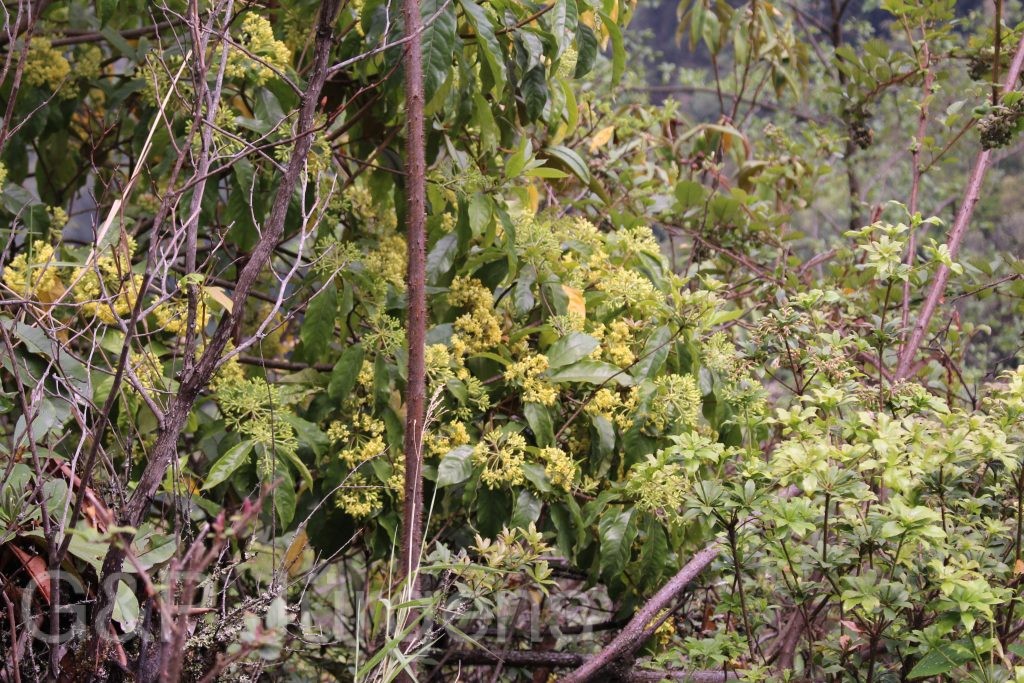
Pittosporum napaulense is an evergreen tree of the Himalaya and adjacent uplands, distributed from northern India and Nepal through Bhutan into southwestern China and Myanmar, with records also from Thailand; GBIF documents over two hundred occurrences across this range. It is a plant of subtropical to warm-temperate broadleaved forest, forest margins and ravine slopes, generally found between about 800 and 2000 m. The tree photographed at Samdrup in southern Bhutan at 850 m, in flower in May, exemplifies this preference for the warm, humid lower foothill forests of the eastern Himalaya, where it grows as an understorey to canopy tree and produces its fragrant flowers in late spring before the onset of the heaviest monsoon rains.

The plant is a small to medium-sized tree with smooth grey bark and glabrous twigs. The leaves are alternate but often crowded toward the branch tips in a pseudo-whorled arrangement, elliptic to oblong-lanceolate, leathery, entire and glossy, with the margins sometimes faintly wavy. The flowers are borne in terminal corymbose panicles and are creamy white to pale yellow and sweetly fragrant; each flower is five-merous, with free petals whose lower portions cohere into a tube and spreading upper lobes, five stamens, and a superior ovary. The fruit is a globose to ovoid woody capsule that splits into valves to expose numerous small seeds embedded in a sticky, resinous orange-red pulp, the viscid coating that gives the genus its name (Pittosporum, "pitch-seed") and aids dispersal by birds.

Pittosporum is a largely Old World genus of trees and shrubs centred on the tropics and subtropics of Asia, Australasia and the Pacific, and P. napaulense is the principal Himalayan representative. The family name is rendered "Pittosporaceaea" in the source; the accepted spelling is Pittosporaceae. The resinous, sticky-seeded capsules are a hallmark of the family, and the bark and leaves of this and related species have featured in local traditional medicine. As a widespread and ecologically adaptable forest tree spanning several countries and a broad elevational band, P. napaulense is not considered threatened, though its lower-elevation forest habitat is subject to ongoing pressure from agriculture and settlement in the densely populated eastern Himalayan foothills.

Author: (D.C.) Rehder & E.H. Wilson · Sources: POWO (Kew), GBIF, Flora of China Vol. 9, Flora of Bhutan Vol. 1 Part 2, Flora of Nepal, A Monograph of the Asian species of Pittosporum (Wenbin Zhang and Hua Peng)

(Hook.f.) Kraenzl.

Nepal 99 395 ergebnis
Nepal, Dzongri 3800m, June

Description

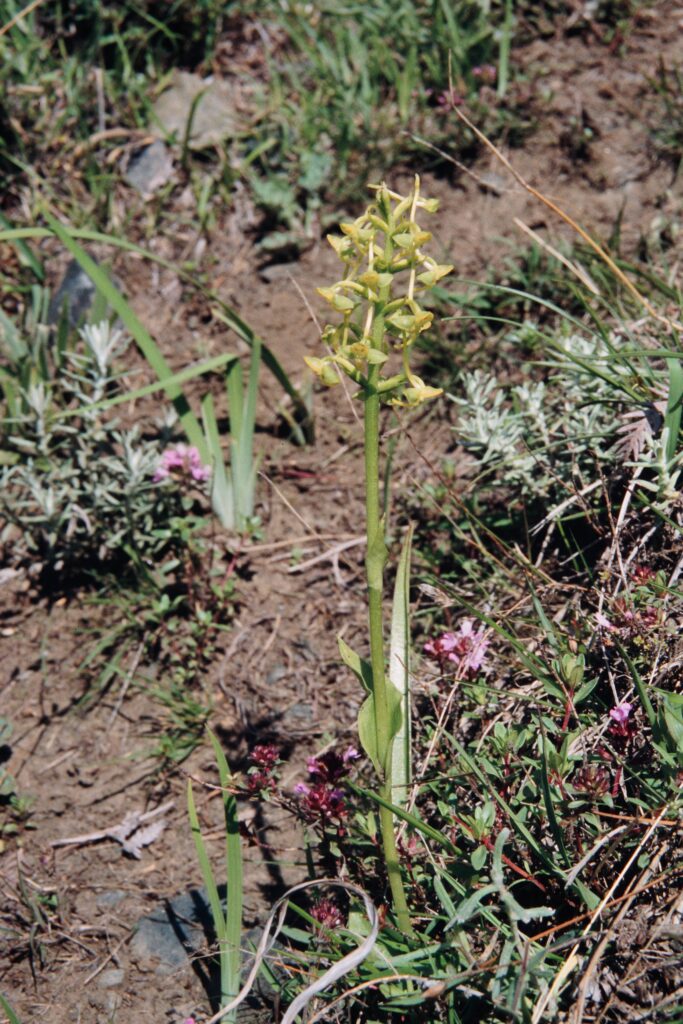
Platanthera concinna (Hook.f.) Kraenzl. is a terrestrial orchid of the high eastern Himalaya. GBIF records, though few (around two dozen occurrences), place it in India and Bhutan, with an anomalous South African record almost certainly representing misidentification or a database error; in practice it is a narrowly Himalayan species. It grows in alpine and subalpine meadows, grassy slopes and open scrub near and above the treeline, at elevations of roughly 3,000 to 4,200 m. The plant recorded at Dzongri at 3,800 m, flowering in June, is characteristic of its high-elevation summer anthesis on humid alpine turf.

The species is a slender, erect terrestrial herb arising from ellipsoid to fusiform root-tubers. The stem bears a few narrow, lanceolate to oblong cauline leaves that sheath at the base. The inflorescence is a lax to moderately dense terminal raceme of small flowers, typically greenish to greenish-white; the dorsal sepal and petals form a hood, the lateral sepals spread, and the lip is narrow and entire to obscurely lobed with a slender, descending spur containing nectar, adapted to pollination by long-tongued insects.

Platanthera is a large, mainly north-temperate genus of butterfly-orchids, and the Himalayan species form a taxonomically difficult complex once dispersed among Habenaria and allied genera. The limited number of records reflects both its restricted high-altitude habitat and undercollection. As an alpine orchid with a small documented range, it warrants conservation attention, and like all Orchidaceae it is protected under CITES Appendix II.

Author: (Hook.f.) Kraenzl. · Sources: POWO (Kew), GBIF, Flora of Bhutan Vol. 3 Part 3 (Orchids), Flora of China Vol. 25, Pearce & Cribb: The Orchids of Bhutan (2002)

Wall.

Garw 2005 222 ergebnis ergebnis
India Garhwal Simkarok 2700m, September

Description

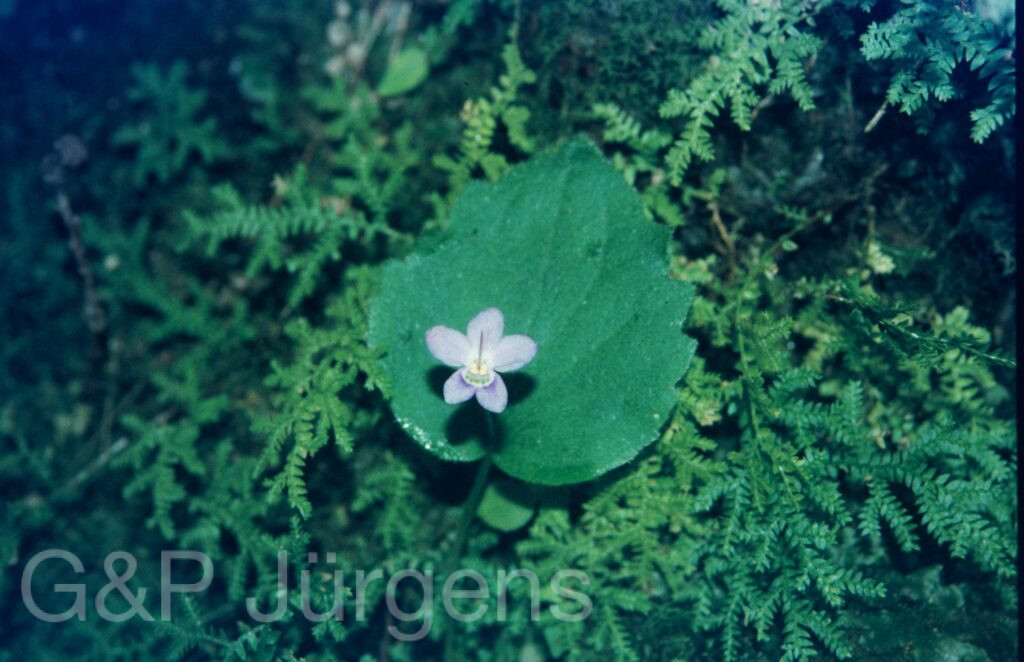
Platystemma violoides is a small Himalayan herb of the Gesneriaceae, restricted to the western and central Himalaya in Nepal, India, Bhutan and adjacent China, with around 179 recorded occurrences across this comparatively narrow range. It is a chasmophyte of moist, shaded rock faces, damp cliffs and mossy boulders, often in spray zones and on dripping banks within temperate forest, flowering toward the close of the monsoon. In the Indian Garhwal Himalaya it occupies the middle montane belt, as documented by the collection at Simkarok at about 2700 m in September, when the plants are in flower on rain-soaked rock.

The plant is a delicate annual or short-lived perennial that develops a single, large, suborbicular to broadly ovate leaf, cordate at the base, softly hairy and shallowly toothed, pressed against the rock surface in the manner of a monophyllous gesneriad. From the base of the leaf arises a slender scape bearing one or a few showy flowers; the corolla is broadly campanulate to rotate and violet to purplish-blue, recalling a violet and giving the epithet violoides, with a short tube, spreading lobes and two to four stamens. The fruit is a small capsule releasing numerous minute seeds.

The family in this record is given as Leptoboeinae, the subtribe of Old World Gesneriaceae to which the monotypic genus Platystemma belongs, alongside Loxostigma, Leptoboea and related rock-dwelling herbs; the species is properly placed in Gesneriaceae. Its single-leaved habit and adaptation to vertical rock microhabitats parallel those of other Himalayan gesneriads such as Corallodiscus and the African Streptocarpus. Confined to specialised cliff niches, P. violoides is naturally local though not currently regarded as threatened, its persistence depending on the integrity of shaded, perennially moist rock habitats.

Author: Wall. · Sources: POWO (Kew), GBIF, Flora of China Vol. 18, Flora of Bhutan Vol. 2, Flora of Nepal, Weber & Burtt classification of Gesneriaceae