
(Wall.) Kamelin & Makhm.
Description
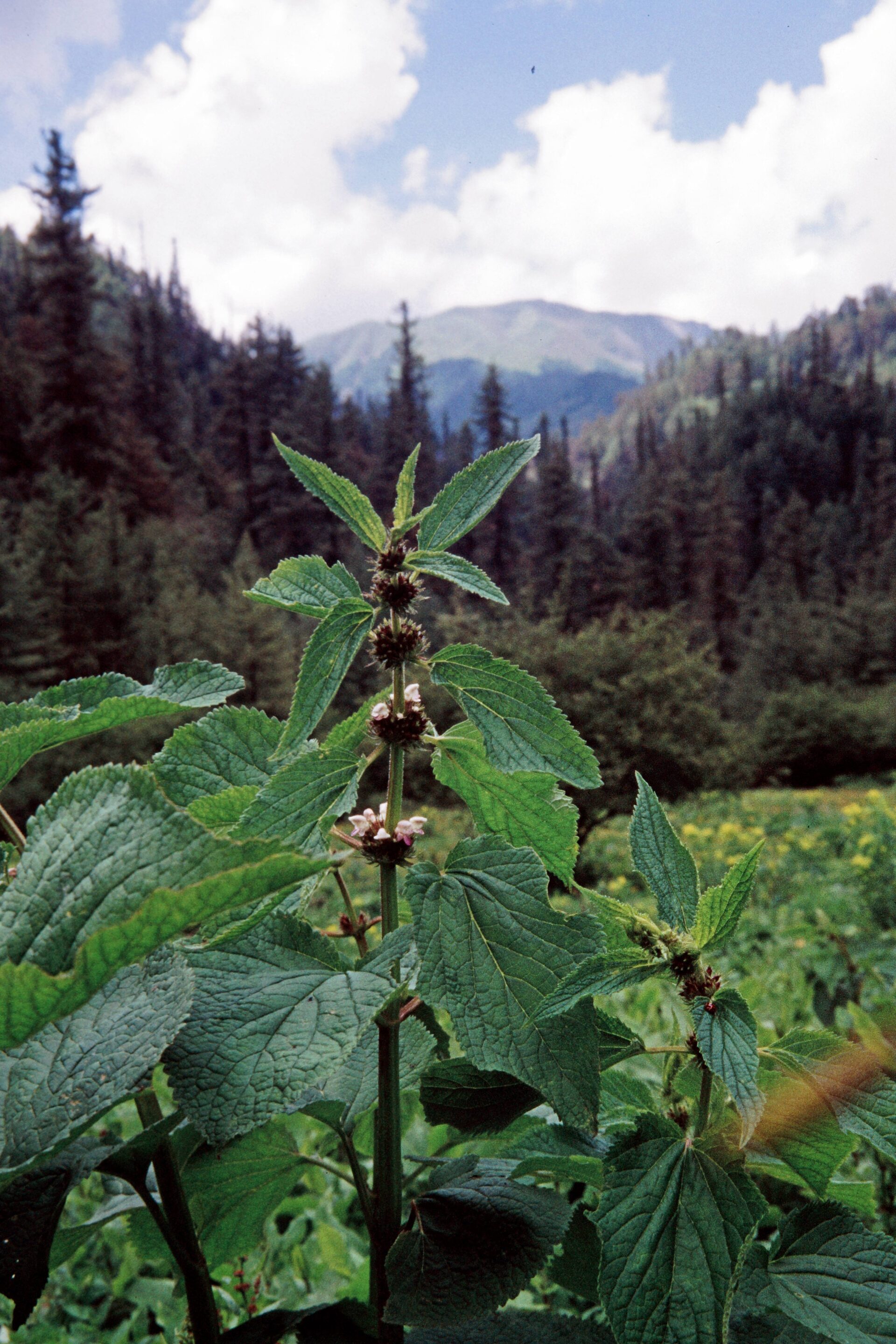
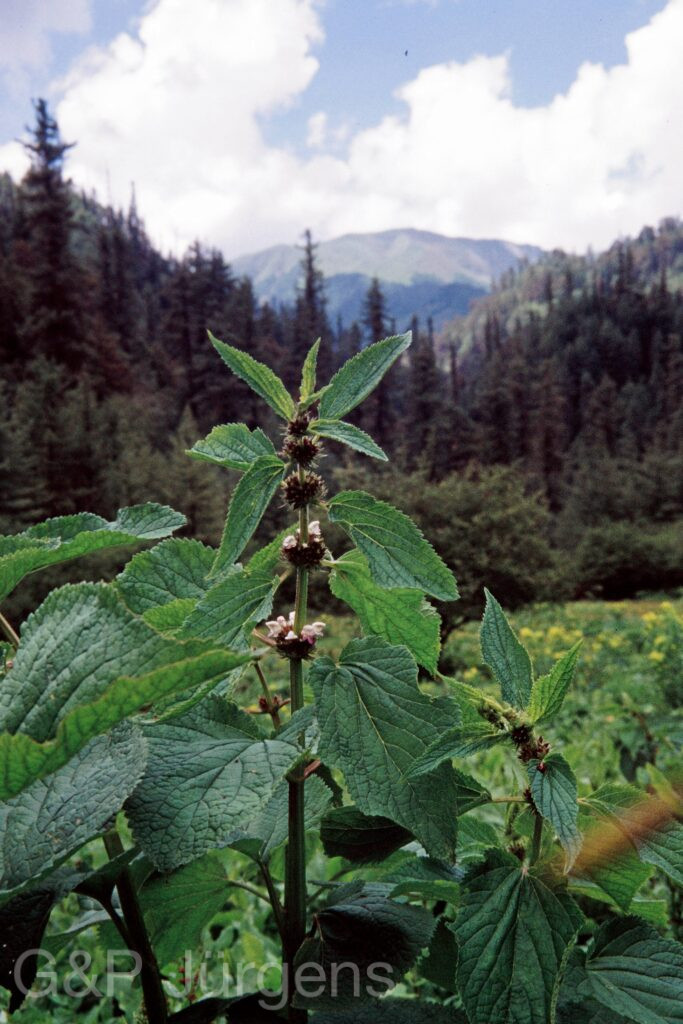
Phlomoides macrophylla is a Himalayan and Central Asian perennial mint distributed across Nepal, India, Pakistan, Bhutan, China and Afghanistan, with GBIF documenting roughly 120 occurrences along the main Himalayan arc and its western extensions. It occupies cool temperate to subalpine habitats, growing on open grassy slopes, in forest clearings, among shrubberies and on rocky banks, generally on well-drained soils in sunny to lightly shaded situations. The collection from Linji-Khola in western Nepal at about 3250 m in June is characteristic of its preferred subalpine elevation and its early monsoon flowering, when the herb-rich meadows of the inner valleys come into bloom.
The plant is an erect, robust perennial herb arising from a thick rootstock, the quadrangular stems clothed in stellate and simple hairs. As the epithet indicates, the leaves are conspicuously large, ovate to broadly cordate, with a crenate to serrate margin, a rugose upper surface and a densely tomentose, paler lower surface, the basal leaves long-petiolate and the upper ones reduced. The inflorescence comprises several dense, many-flowered verticillasters in the upper leaf axils, subtended by linear-subulate, often spinescent bracts. Each flower has a tubular, ribbed and toothed calyx and a strongly two-lipped corolla, typically purple, pink or pale violet, the hooded upper lip bearded and arching over the spreading three-lobed lower lip. Four didynamous stamens lie beneath the galea, and the gynobasic style yields four nutlets.
Described by Wallich and transferred to Phlomoides by Kamelin and Makhmedov, the species reflects the modern segregation of the herbaceous, rhizomatous Asiatic phlomises from the shrubby Mediterranean genus Phlomis s.str., a division supported by molecular phylogenetic study within tribe Phlomideae. Several Phlomoides species are used in regional folk medicine and as forage. Widespread and locally common in suitable montane grassland, P. macrophylla is not currently considered threatened, though it depends on the persistence of undisturbed subalpine meadow vegetation.
Author: (Wall.) Kamelin & Makhm. · Sources: POWO (Kew), GBIF, Flora of China, Flora of Pakistan, Flora of Bhutan, Mathiesen et al. phylogeny of Phlomoides