Author

G & P Jürgens

Cedrus deodara

by G & P Jürgens

(Roxb. ex D.Don) G.Don
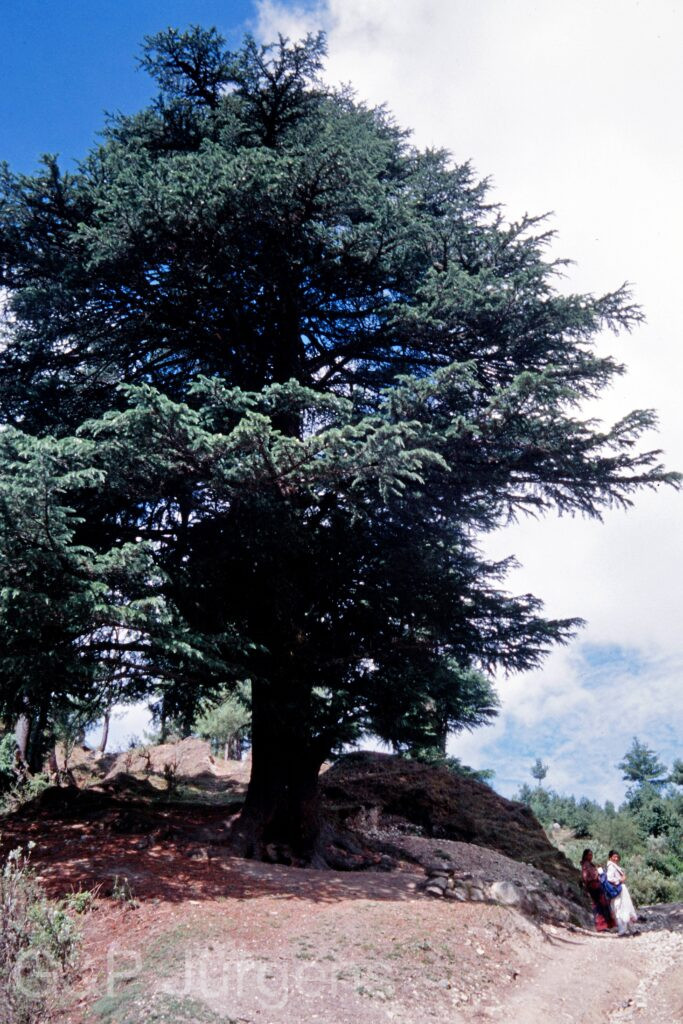
Nepal 99 203 ergebnis
West-Nepal Lara-Lake 2800m, June

Description

Cedrus deodara, the deodar or Himalayan cedar, is a large evergreen coniferous tree of the Pinaceae native to the western and central Himalaya. GBIF data (over 11,000 occurrences) reflect both its natural range across Pakistan, India and Nepal and its extensive cultivation in temperate regions worldwide. In its native belt it forms extensive forests, often dominant, on cool, well-drained mountain slopes generally between about 1,500 and 3,200 m. The tree recorded near Lara Lake in West Nepal at 2,800 m in June represents the upper temperate coniferous zone, where deodar grows in association with blue pine, spruce and oaks.

The tree reaches 40–60 m, with a broadly conical crown and characteristically drooping leader and branch tips. The bark is dark grey and fissured into scaly plates. The needle-like leaves are borne singly on long shoots and in dense whorl-like clusters on short spur shoots; they are stiff, sharp-pointed, 25–50 mm long and glaucous green. Like all true cedars the species is monoecious: pollen cones are erect and catkin-like, shedding pollen in autumn, while the female cones are erect, barrel-shaped, 7–13 cm long, green ripening to reddish-brown, and disintegrate on the tree to release broadly winged seeds.

Cedrus is a small Old World genus of the Atlas, Mediterranean and Himalayan mountains, of which C. deodara is the easternmost member. The deodar is of great economic and cultural importance, valued for its durable, aromatic, decay-resistant timber and revered in South Asian tradition. Though widespread and much planted, native old-growth stands have been depleted by logging, and sustainable management of natural deodar forests remains an ecological priority.

Author: (Roxb. ex D.Don) G.Don · Sources: POWO (Kew), Flora of Pakistan, Flora of China Vol. 4, GBIF, Farjon: A Handbook of the World's Conifers (2010)
C.B.Clarke

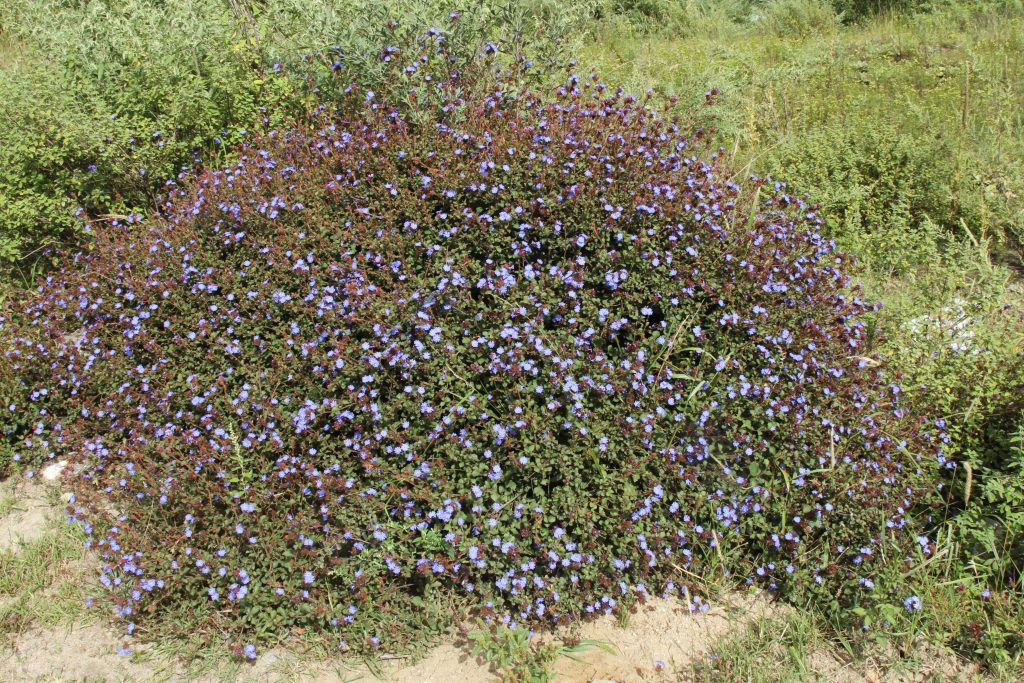
Bhutan2012 315
Bhutan Paro-Chu, 2400m September
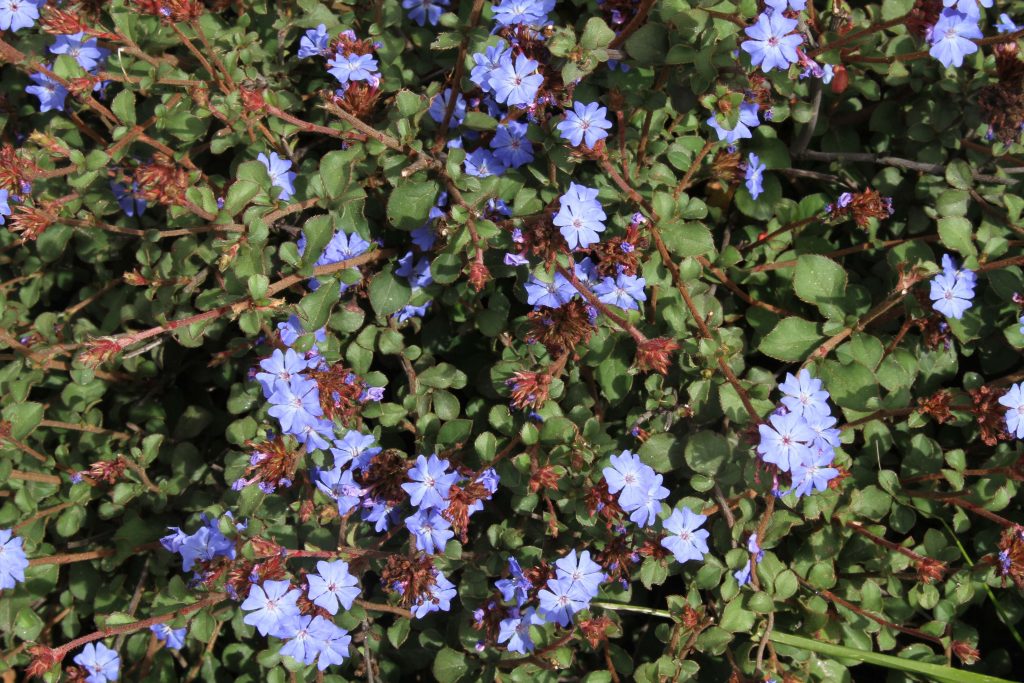
Bhutan2012 316
Bhutan Paro-Chu, 2400m September

Description

Ceratostigma griffithii is a shrub of the dry inner valleys of the eastern Himalaya and southwestern China, recorded from China, Bhutan, India and Myanmar, with cultivated and naturalised occurrences in the United States, Canada, Spain and Korea; GBIF holds about 163 georeferenced records. It grows on dry, sunny, stony slopes, rocky banks, scrub and the margins of cultivation in the rain-shadowed montane valleys, tolerating drought and strong insolation. The photographed plant from the Paro Chu valley in Bhutan at 2400 m in September is characteristic of these semi-arid inner-Himalayan habitats, where it flowers in late summer and autumn on open hillsides.

It is a low, much-branched, semi-evergreen shrub up to about 1 m, with stiff, reddish-tinged twiggy branches that turn bronze-red in autumn. The leaves are small, alternate, obovate to spathulate, entire, bristle-margined and somewhat leathery, often colouring red before falling. The flowers are clustered in dense terminal and lateral heads subtended by bristly bracts; each flower has a tubular, glandular-ribbed calyx and a slender salverform corolla with five spreading lobes of brilliant deep blue. There are five stamens and a five-branched style with stigmatic surfaces along the inner side; the fruit is a small membranous capsule enclosed in the persistent calyx, whose stiff bristles aid epizoochorous dispersal.

The genus Ceratostigma, described by Bunge, comprises a few Asian and African shrubs and subshrubs of Plumbaginaceae noted for their intense blue flowers and autumn foliage, the type collection of this species made by Griffith and named by C.B. Clarke. The bright corollas attract butterflies and bees, and the bristle-armed calyces cling to passing animals. Valued in horticulture for autumn colour, the wild plant is locally common in its dry-valley niche and not considered threatened.

Author: C.B.Clarke · Sources: POWO (Kew), GBIF, Flora of China Vol. 15, Flora of Bhutan Vol. 2, Flora of Nepal, A Revision of the Genus Ceratostigma (Plumbaginaceae)

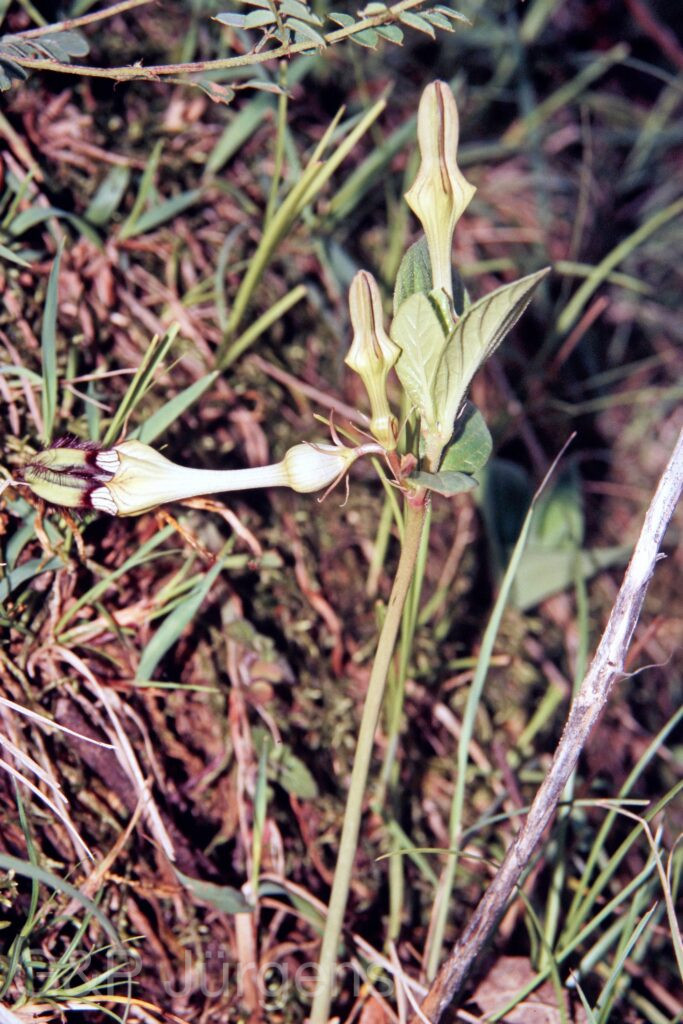
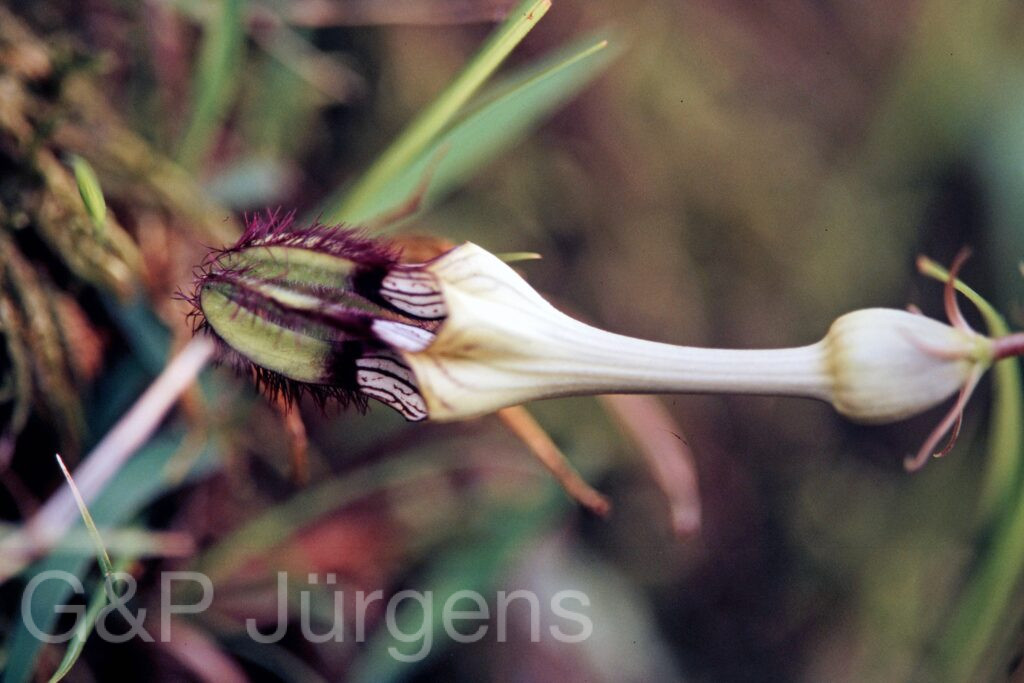
H.Huber

Nepal 99 917 ergebnis
West-Nepal Roha 2900m, July
Nepal 99 918 ergebnis
West-Nepal Roha 2900m, July

Description

Ceropegia meleagris is a narrowly endemic herbaceous climber of the Apocynaceae (subfamily Asclepiadoideae), known only from the western Himalaya. GBIF records are few (18 occurrences) and confined to Nepal, indicating a restricted range and limited collection. The species grows in the temperate forest belt, scrambling through shrubs and herbaceous vegetation on banks, in scrub and at forest margins. The photographed plant from Roha in West Nepal at 2,900 m in July reflects its occurrence in the monsoon-moist middle hills, where flowering coincides with the summer rains.

The plant arises from a tuberous or fascicled rootstock and produces slender, twining, often somewhat fleshy stems. The leaves are opposite, simple, narrowly ovate to lanceolate and shortly petiolate. The flowers are the diagnostic feature of the genus: tubular and zygomorphic, with the five corolla lobes united at their tips to form a distinctive lantern- or cage-like canopy over the inflated, slightly curved corolla tube. The mottled, speckled patterning of the corolla evokes the guineafowl plumage from which the epithet meleagris is taken. As in all Ceropegia, the flowers function as temporary kettle traps that detain small Diptera, achieving pollination by means of paired pollinia. The fruit is a slender, paired follicle releasing comose seeds.

Ceropegia is a large, taxonomically intricate genus now construed to include the former Brachystelma and stapeliads, united by their elaborate trap-pollination syndrome. As a Himalayan endemic with very few documented localities, C. meleagris is of biogeographic and conservation interest; its restricted range, tuberous habit and specialised pollination make it potentially vulnerable to habitat disturbance and collection.

Author: H.Huber · Sources: POWO (Kew), Flora of Nepal, Flora of Bhutan Vol. 2, GBIF, Bruyns: A Revision of Ceropegia (Apocynaceae, Asclepiadoideae)

Wight

Garh 07 312 ergebnis
Garhwal Bebra, 2450m, June

Description

Ceropegia wallichii is a Himalayan twining herb distributed from northwest India (Uttarakhand, Himachal Pradesh) through Nepal to Myanmar. With only 35 occurrences documented on GBIF, it is among the less frequently recorded species of this large genus. The species inhabits margins of warm-temperate and subtropical broadleaved forests, open scrubby slopes, and rocky outcrops at elevations of 1,500–2,800 m. It is often found climbing through low shrubs or trailing over banks in partially shaded situations with moderate monsoon rainfall.
Ceropegia wallichii is a slender, herbaceous, twining perennial arising from a small, globose to ellipsoid tuber, 1.5–3 cm in diameter. Stems are wiry, glabrous or sparsely pubescent, reaching 1–2 m in length. Leaves are opposite, narrowly lanceolate to ovate-lanceolate, 3–8 cm long, acuminate at the apex, with short petioles. The inflorescence is an axillary, few-flowered umbelliform cyme bearing 2–6 flowers. The flowers are the most striking feature: the corolla tube is 2.5–4 cm long, slightly inflated at the base, curved, and pale green to yellowish with purple streaks; the five corolla lobes are linear, connate at the tips to form the characteristic cage-like structure (lantern flower) that functions as a temporary insect trap for pollination. The follicles are paired, slender, up to 12 cm long, containing comose seeds adapted for wind dispersal.
The species was described by Robert Wight based on material originally collected by Nathaniel Wallich. It belongs to Ceropegia section Ceropegia, a primarily Asian lineage of twining herbs with tuberous rootstocks. The photographed specimen from Bebra in Garhwal at 2,450 m documents an occurrence in the western Himalayan portion of the range. Ceropegia wallichii can be distinguished from the related C. pubescens by its glabrous or sparsely hairy stems and narrower leaf blades. Given its sparse occurrence records and reliance on relatively intact forest-edge habitats, the species may merit conservation attention, though a formal IUCN assessment is currently lacking.

Author: Wight · Sources: POWO (Kew), GBIF, Flora of British India Vol. 4, Ansari: Asclepiadaceae — Genus Ceropegia, Flora of India (1984), Bruyns et al. (2017)

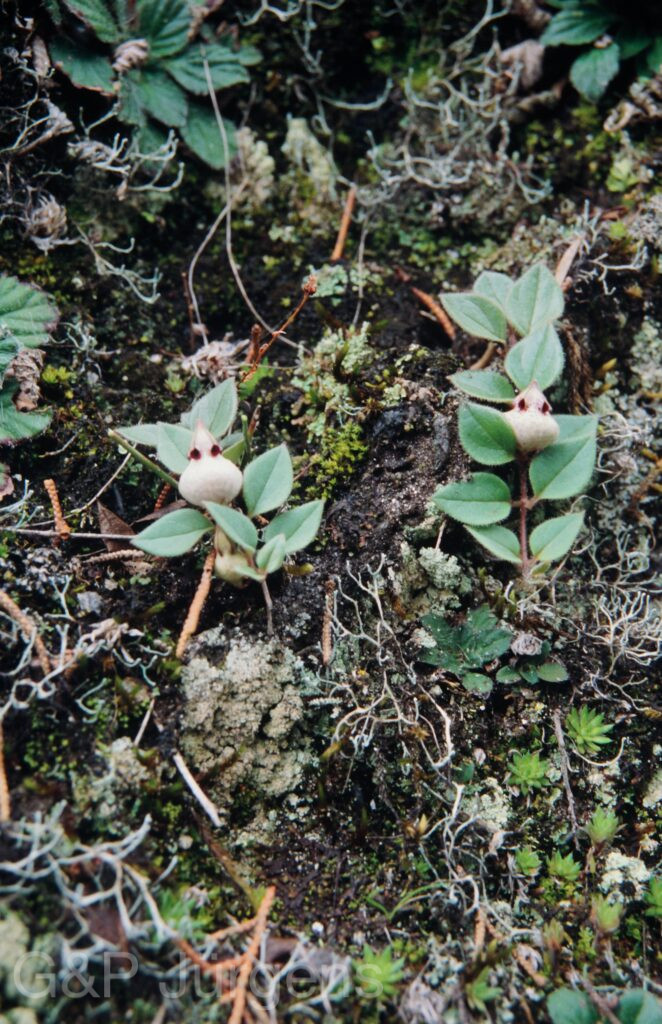
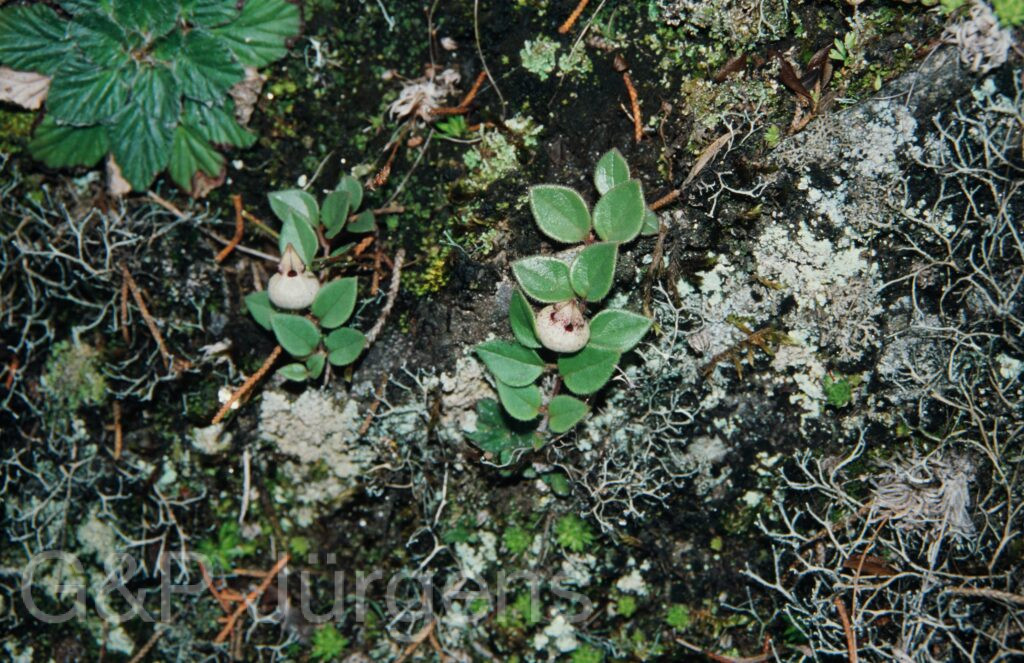
Wight

BhutanPG2011 92 ergebnis
Bhutan Chogcham, 3250m June
Sikkim2011 6
Bhutan Chogcham, 3250m June
Sikkim 2006 228 ergebnis
India West-Bengal, Ramman 2100m, May

Description

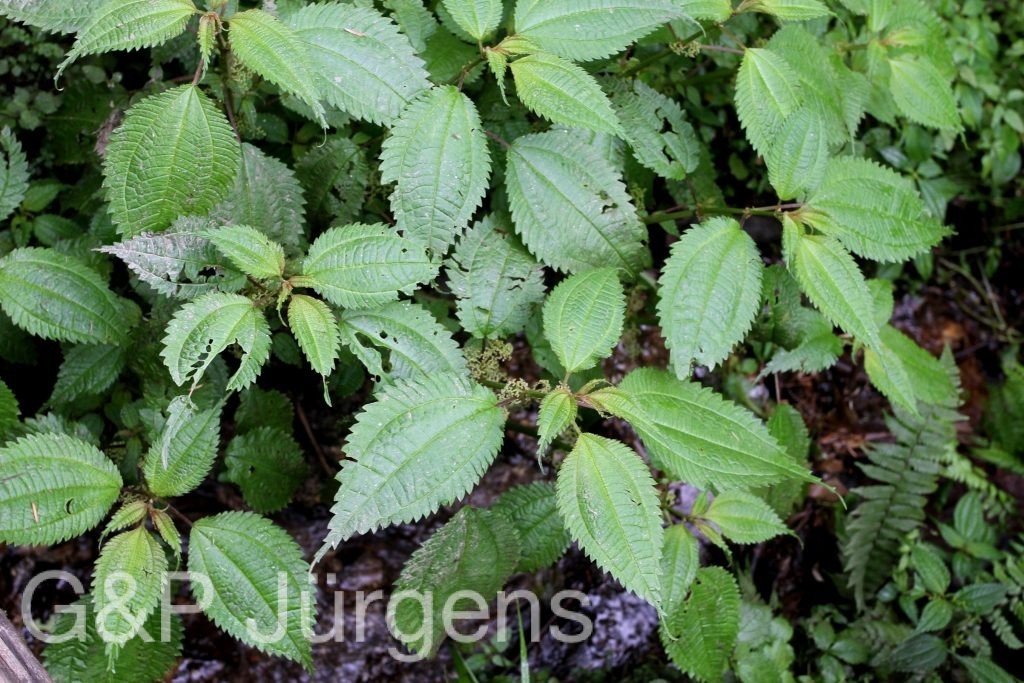
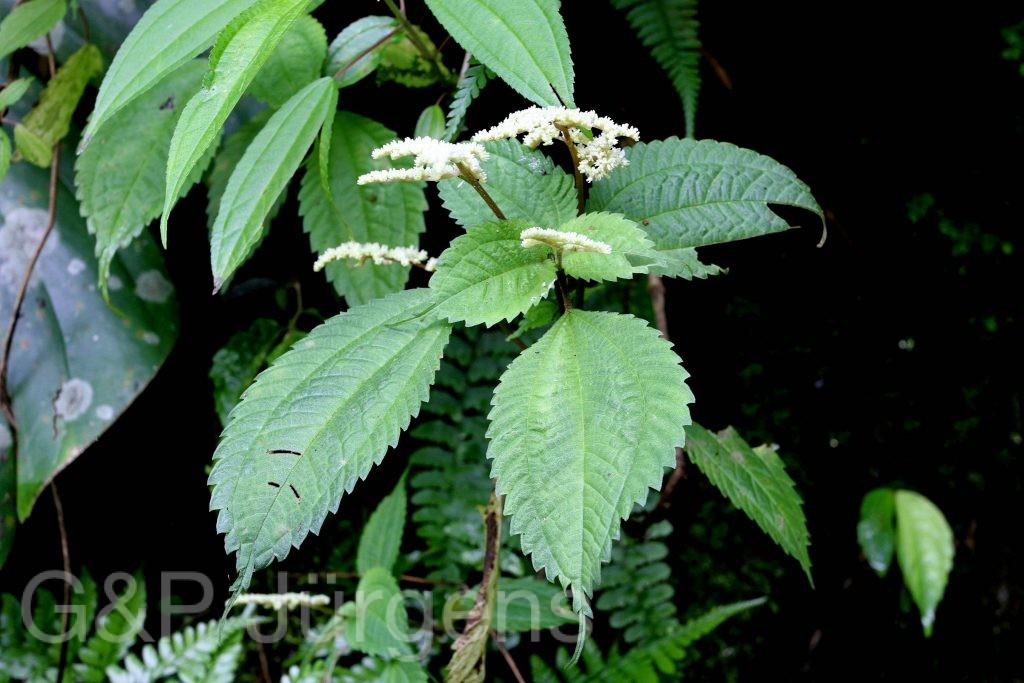
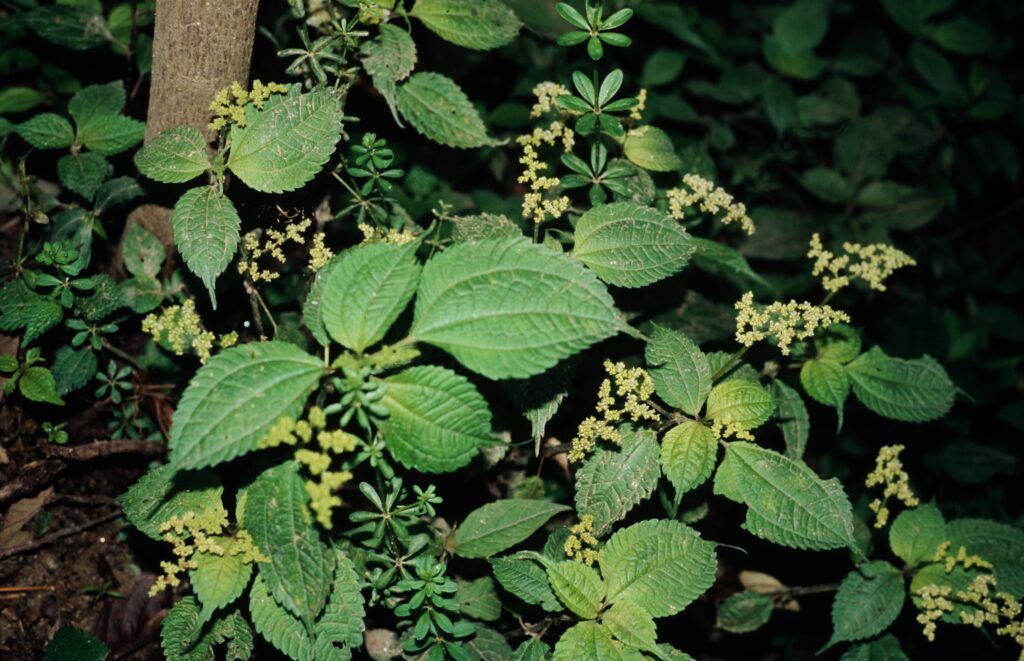
Chamabainia cuspidata is a small creeping member of the nettle family ranging widely through the Himalaya, southern China, Taiwan and Southeast Asia to Sri Lanka and Indonesia; GBIF records around 713 occurrences across China, Taiwan, Nepal, India, the Philippines, Bhutan and other tropical Asian countries. It is a plant of moist, shaded temperate and subtropical forest, carpeting damp banks, rocks, mossy ground and stream sides beneath the canopy. The images from Chogcham in Bhutan at 3250 m in June and from Ramman in West Bengal at 2100 m in May show it across a broad altitudinal span in cool, humid montane forest, where it forms low, spreading mats on the forest floor.

It is a slender, prostrate to creeping perennial herb with filiform stems rooting at the nodes and forming extensive ground-hugging patches. The leaves are small, opposite, ovate to broadly ovate, with a distinctly cuspidate apex (the source of the epithet) and a crenate-toothed margin, three-veined from the base and, like much of the family, lacking the stinging hairs of true nettles. The plant is monoecious, the minute, apetalous unisexual flowers borne in small dense axillary clusters; staminate flowers with a few stamens and pistillate flowers with a single ovary. The fruit is a small ovoid achene enclosed by the persistent perianth.

Chamabainia is a small genus within the Urticaceae, related to Pilea and the broader Elatostema alliance of shade-loving, mostly herbaceous forest plants; this species is the most widespread member and the type of the genus. Its creeping, mat-forming habit, reduced wind- or self-pollinated flowers and nodal rooting suit it to the humid, low-light understorey it occupies. It is common and widespread, of no conservation concern, but characteristic of well-shaded, moisture-retaining montane forest floors across tropical and subtropical Asia.

Author: Wight · Sources: POWO (Kew), GBIF, Flora of Bhutan, Flora of China (Urticaceae), Friis treatment of Urticaceae

(D.Don) Ali

Nepal 99 312 ergebnis
West-Nepal Kalmura 4300m, June

Description

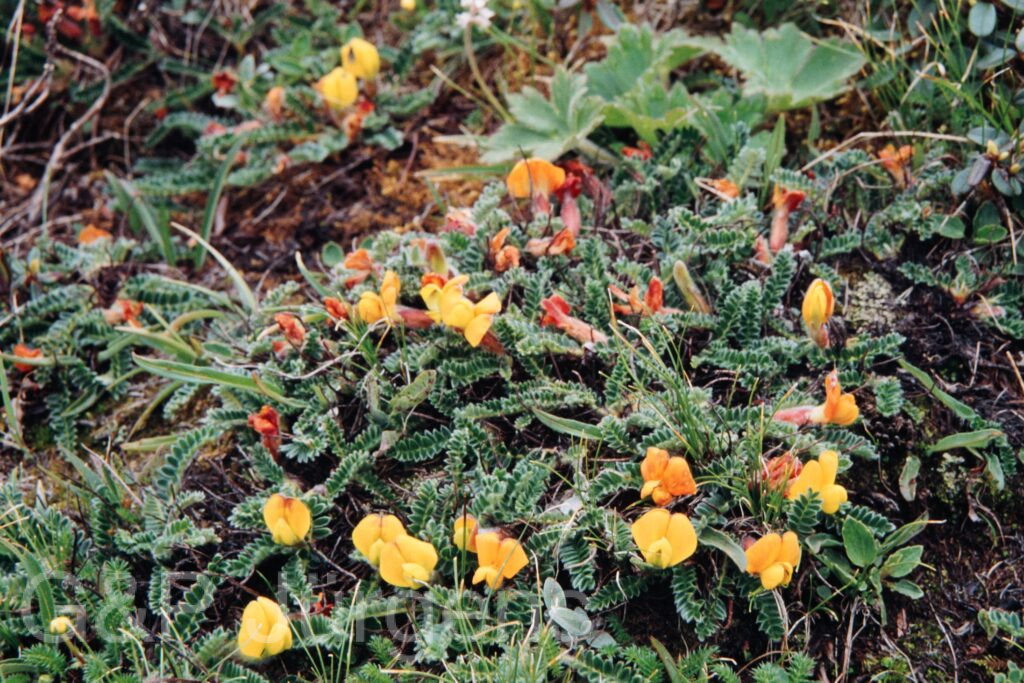
Chesneya nubigena (D.Don) Ali is a prostrate alpine legume of the Himalaya and Hindu Kush, represented by some 318 records concentrated in Nepal, India, Bhutan, Pakistan and adjacent China, with scattered extralimital reports. It is a plant of high open ground: stony alpine slopes, gravelly flats, moraines and the margins of grazed pastures, generally between about 3500 and 4800 m. The individual photographed at Kalmura in West Nepal at 4300 m in June illustrates its occupation of cold, well-drained, often wind-exposed substrates where it grows close-pressed to the ground amid sparse turf.

The species forms a low, mat-forming to shortly tufted perennial from a deep woody rootstock and branched caudex. The leaves are imparipinnate with several pairs of small, oblong to obovate leaflets, often somewhat pubescent and frequently spine-tipped on persistent rachides. The flowers are large relative to the plant and borne singly or few together on short axillary peduncles; the papilionaceous corolla is yellow to reddish or purple-tinged, the standard broad and the keel obtuse. The calyx is tubular and obliquely toothed, and the fruit is an oblong, sessile to shortly stipitate, more or less inflated legume, hairy and several-seeded.

Chesneya is a small genus of central and high Asia closely allied to Astragalus and Gueldenstaedtia, and C. nubigena has been treated under various combinations reflecting its taxonomic history. Its cushion-like habit, deep roots and silky indumentum are classic adaptations to the cold, arid, high-radiation conditions of the inner Himalayan ranges, where it also fixes atmospheric nitrogen. Widespread if local, it is not regarded as threatened, though heavy grazing pressure in alpine pastures can locally reduce populations.

Author: (D.Don) Ali · Sources: POWO (Kew), GBIF, Flora of China, Flora of Pakistan, Flora of Nepal, revision of Chesneya and allied Astragaleae

Miq.

BhutanPG2011 74
Bhutan Menchuang, 2700m June

Description

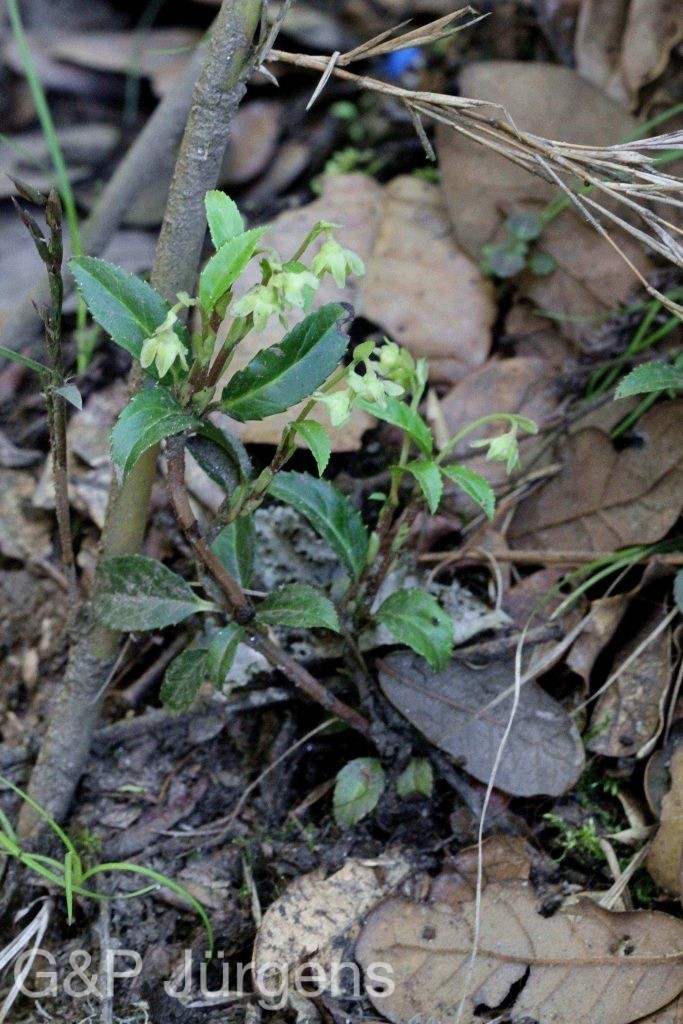
Chimaphila japonica Miq. is a diminutive evergreen subshrub with a wide temperate East Asian and Himalayan range, documented by GBIF from Japan, Korea, China, Russia, Taiwan, Bhutan, India, Myanmar and Nepal across more than 3000 occurrences. It is a plant of shaded, humus-rich coniferous and mixed forest floors, often associated with mossy banks and the litter beneath fir, spruce and oak, generally between 1500 and 3000 m. The individual recorded at Menchuang in Bhutan at about 2700 m in June reflects this montane forest habitat, where the species benefits from the partial mycoheterotrophic nutrition characteristic of the wintergreen group.

The plant produces slender creeping rhizomes from which arise short, erect aerial stems bearing whorled or subverticillate, leathery, evergreen leaves. The leaves are oblanceolate to elliptic, sharply serrate towards the apex, dark green and glossy above, and somewhat clustered in the upper part of the stem. One to several nodding flowers are borne on a terminal peduncle; each flower has five spreading, waxy white to pinkish petals, ten stamens with conspicuously dilated, ciliate filaments and inflated anthers opening by pores, and a stout columnar style topped by a broad peltate stigma. The fruit is an erect, dehiscent globose capsule splitting from the apex.

Chimaphila belongs to the Pyroleae of subfamily Monotropoideae within a broadly circumscribed Ericaceae, partially mycoheterotrophic woodland herbs. Chimaphila japonica is closely allied to the boreal C. umbellata but is distinguished by its smaller stature and leaf form. Given its broad distribution it is not considered threatened, though it depends on intact forest soils and their mycorrhizal networks, making it a useful indicator of mature montane woodland.

Author: Miq. · Sources: POWO (Kew), GBIF, Flora of China, Flora of Japan, Flora of Bhutan, Krisa monograph of Pyrolaceae

(L.) Banfi

Nepal 99 947 ergebnis
Nepal Parela 3000m, July

Description

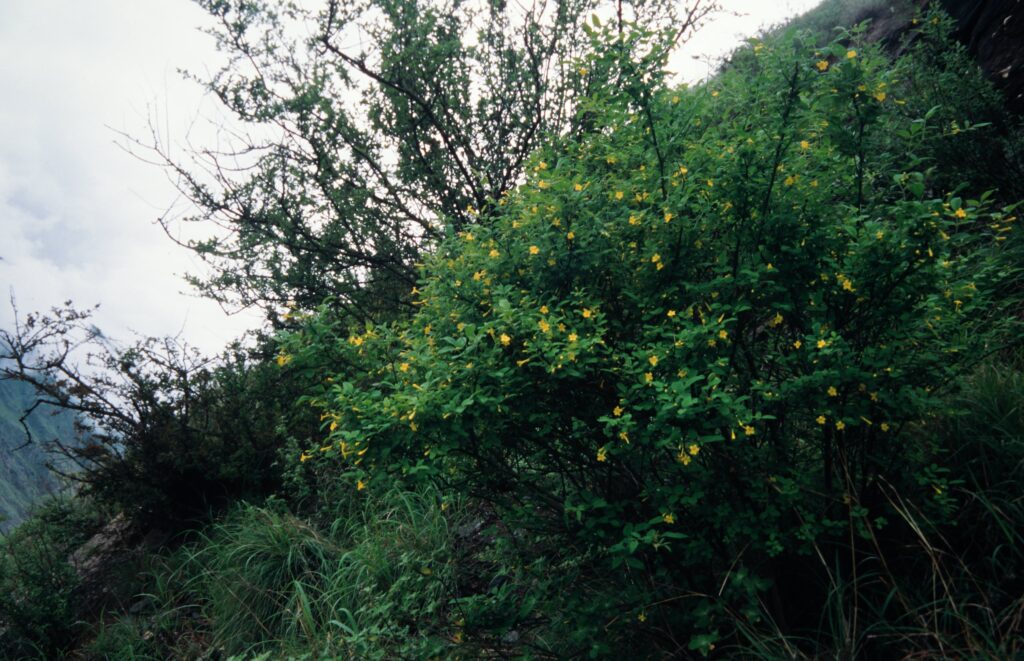
Chrysojasminum fruticans, formerly placed in Jasminum and long known as Jasminum fruticans, is a small evergreen to semi-evergreen shrub of the family Oleaceae. The bulk of its GBIF records lie around the Mediterranean basin and into Western Asia, encompassing France, Spain, Portugal, Italy, the Balkans, Turkey, the Caucasus and North Africa, where it is a classic component of dry maquis and garrigue. Its appearance in the western Himalaya, as in the Nepalese collection from Parela at about 3,000 m in July, represents the eastern extremity of an essentially Irano-Turanian to Mediterranean distribution, where it occupies sunny, rocky, calcareous slopes, open scrub and woodland margins.

The plant forms a much-branched shrub up to about 1–2 m with slender, green, angular twigs. The leaves are alternate and pinnately compound, usually trifoliolate or with up to five small obovate to oblong leaflets, glabrous and somewhat leathery, the foliage persisting through mild winters. The flowers are borne in small terminal cymes of a few blooms; the corolla is salverform with a slender tube expanding into five spreading lobes and is a distinctive bright yellow, only faintly scented in contrast to the white-flowered jasmines. The fruit is a small, shining, globose berry that ripens from green to black.

The transfer of this and allied yellow-flowered jasmines to the segregate genus Chrysojasminum reflects molecular phylogenetic evidence that the yellow jasmines form a distinct lineage within tribe Jasmineae, separate from the white-flowered Jasminum sensu stricto. Ecologically it is drought-adapted and characteristic of thermophilous, calcicolous communities, valued in horticulture as a hardy ornamental. Its scattered, peripheral Himalayan occurrence is biogeographically notable, illustrating the westerly Mediterranean affinities present in the dry inner valleys of the Himalaya.

Author: (L.) Banfi · Sources: POWO (Kew), GBIF, Flora Europaea Vol. 3, Flora of Pakistan, Green: A Revision of Jasminum (Oleaceae), Flora Iberica

(L.) Banfi

Bhutan2014 1028
Bhutan Paro 2400m, May
Nepal 97 73 P115
Nepal above Meta-Khola 1600m April

Description

Chrysojasminum humile, the yellow Italian jasmine, is a shrub native from the Mediterranean and Southwest Asia eastward through the Himalaya into China, with GBIF recording about 1850 occurrences and many cultivated or naturalised collections worldwide. In its Asian range it grows on open hillsides, forest edges, dry rocky slopes and scrub on calcareous or well-drained soils. The illustrated material comes from Bhutan at Paro near 2400 m, flowering in May, and from Nepal above Meta-Khola at about 1600 m in April; across the Himalaya the species typically occupies the warm-temperate zone between roughly 1200 and 2800 m.

The plant is an erect or somewhat sprawling, evergreen to semi-evergreen shrub with green, angled, glabrous twigs. The leaves are alternate and pinnately compound with three to seven (sometimes more) leaflets, the terminal leaflet largest, elliptic to ovate, glabrous and shining. The flowers are borne in terminal cymes and are bright yellow, fragrant, with a slender corolla tube expanding into five spreading lobes; the calyx is small with short teeth. The fruit is a shining black, ellipsoid to globose berry, two-lobed when both carpels develop.

Long treated within Jasminum, this species and its allies were segregated into Chrysojasminum on molecular and morphological grounds, the yellow-flowered jasmines forming a distinct lineage within Oleaceae. Highly variable, it encompasses numerous named forms and is much grown as an ornamental, accounting for its scattered records far outside the native range. Widespread and adaptable, it is of no conservation concern, and its nectar-rich flowers attract bees and butterflies.

Author: (L.) Banfi · Sources: POWO (Kew), GBIF, Flora of China, Flora of Bhutan, Oleaceae revision (Green)

(Asch. & Magnus) Kitam.

Garw 2005 83 ergebnis ergebnis
India Garhwal Gaushon 3100m, September

Description

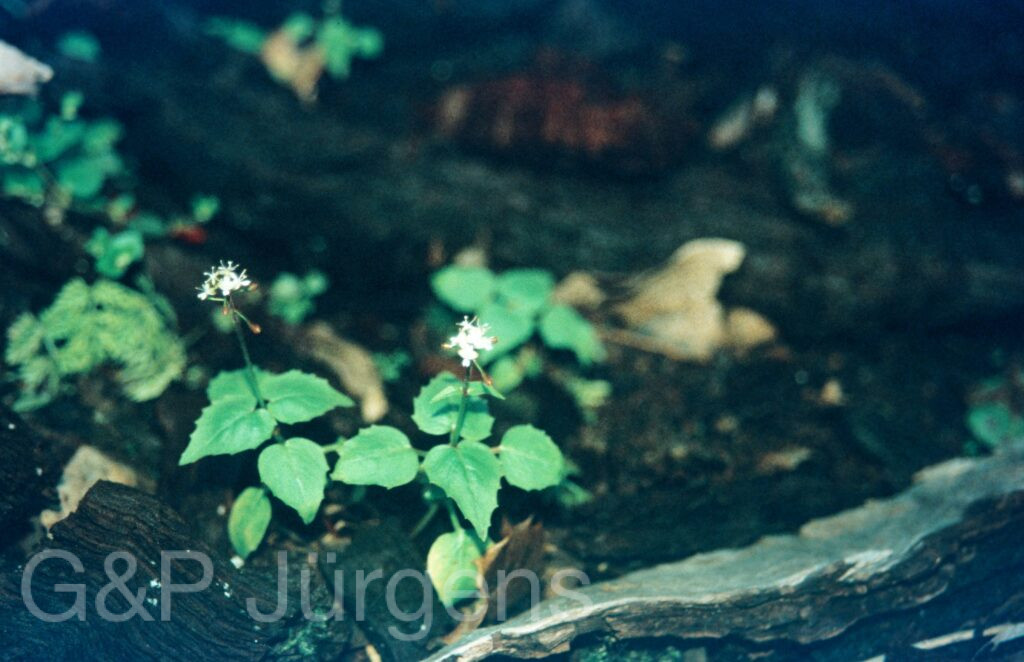
Circaea alpina subsp. imaicola (Asch. & Magnus) Kitam. is the Asian montane race of the circumboreal enchanter's nightshade complex, distributed according to GBIF across China, Taiwan, the Himalaya (India, Nepal, Pakistan), Myanmar, Thailand, Vietnam, Japan and Korea. It is a delicate herb of cool, moist, shaded habitats: damp coniferous and mixed forest floors, mossy banks, stream sides and humus-rich rocky places, typically between about 2,000 and 3,800 m. The September record from Gaushon in Garhwal, India, at 3,100 m reflects its occurrence in the shaded understorey of temperate Himalayan forest, where it grows in moist leaf litter amongst ferns and bryophytes.

The plant is a slender, glabrous to sparsely pubescent perennial spreading by thread-like, often tuber-tipped stolons, with erect stems usually only 5–25 cm tall. The leaves are opposite, thin, ovate to broadly cordate-ovate, with shallowly toothed margins and a translucent texture. The tiny flowers are borne in a lax terminal raceme that elongates in fruit; each flower has two white, deeply notched (bifid) petals, two sepals and two stamens, in the characteristic two-merous floral plan of Circaea. The small, club-shaped fruit is an indehiscent nutlet covered with soft, hooked bristles that promote epizoochorous dispersal.

Within the Circaea alpina complex, subspecies imaicola is distinguished by features of stolon, leaf shape and fruit, and it represents the principal Himalayan and East Asian element of this widespread, taxonomically intricate species. As a shade-demanding mesophyte it is a reliable indicator of humid, undisturbed montane forest. Circaea itself is of phylogenetic interest as one of the few temperate woodland genera in the otherwise largely tropical and warm-temperate Onagraceae.

Author: (Asch. & Magnus) Kitam. · Sources: POWO (Kew), GBIF, Flora of China Vol. 13, Flora of Pakistan (Onagraceae), Boufford: The Systematics of Circaea (Annals of the Missouri Botanical Garden)