Asteraceae

(L.) R.M.King & H.Rob.
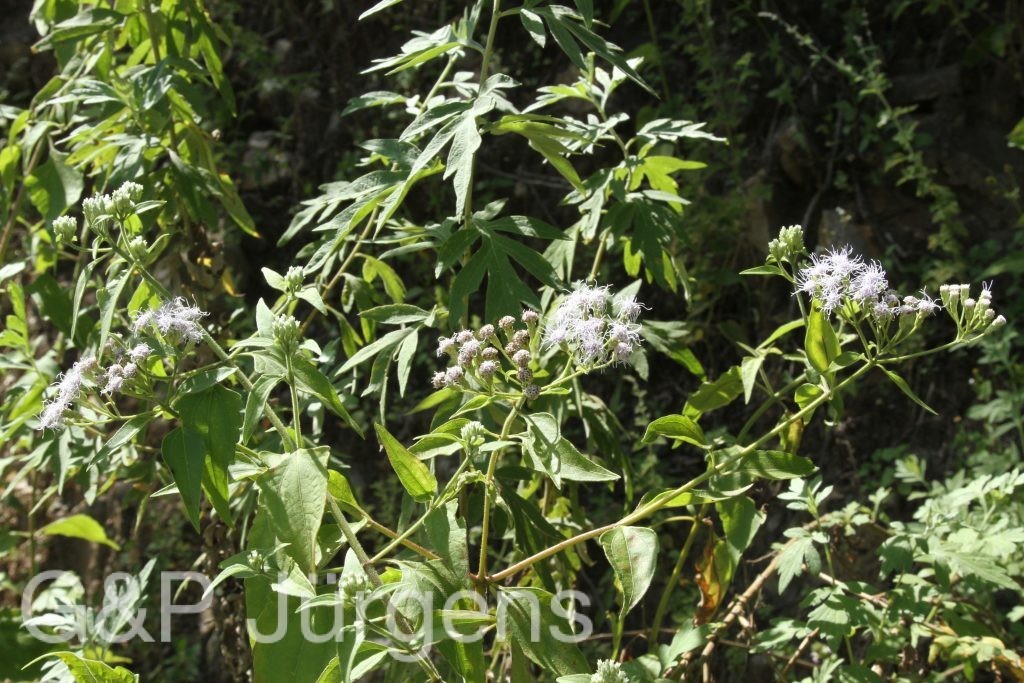
Bhutan2015 309
Bhutan Trongsa 1900m, October

Description

Chromolaena odorata, Siam weed, is native to the Neotropics (Mexico, Central America, the Caribbean and tropical South America) but is now one of the world's most aggressive invasive weeds, reflected in its enormous GBIF dataset of 63,557 occurrences spanning the Americas, sub-Saharan Africa, South and Southeast Asia, Australia and the Pacific. It colonises disturbed ground, forest margins, abandoned fields, roadsides and plantations in the seasonal tropics and lower subtropics. The photograph was taken at Trongsa in central Bhutan at 1900 m in October, near the upper elevational limit of its spread into warm Himalayan valleys, where it forms dense post-monsoon thickets.

It is a scrambling, much-branched perennial shrub or subshrub reaching 1.5-3 m, with brittle, pubescent stems and opposite, triangular to ovate-deltoid leaves that are three-veined from the base, coarsely toothed, and aromatic when crushed. The numerous small, cylindrical capitula are grouped in flat-topped corymbose clusters and contain only tubular (disc) florets, lacking rays; the pale lilac to whitish corollas have exserted styles giving a fluffy appearance. The cypselae are slender, blackish and angled, each crowned by a pappus of barbellate bristles enabling abundant wind dispersal.

Described as Eupatorium odoratum by Linnaeus, it was transferred to Chromolaena by R.M. King & H. Robinson during the dismemberment of the broad genus Eupatorium. Allelopathic, fire-promoting and prolific, it suppresses native vegetation and pasture and is the subject of biological-control programmes worldwide. Its appearance in Bhutan signals the ongoing upslope advance of a serious tropical invasive of major economic and ecological concern.

Author: (L.) R.M.King & H.Rob. · Sources: POWO (Kew), GBIF, Flora of Bhutan, Flora of China, CABI Invasive Species Compendium, Eupatorieae of the World (King & Robinson)
DC.

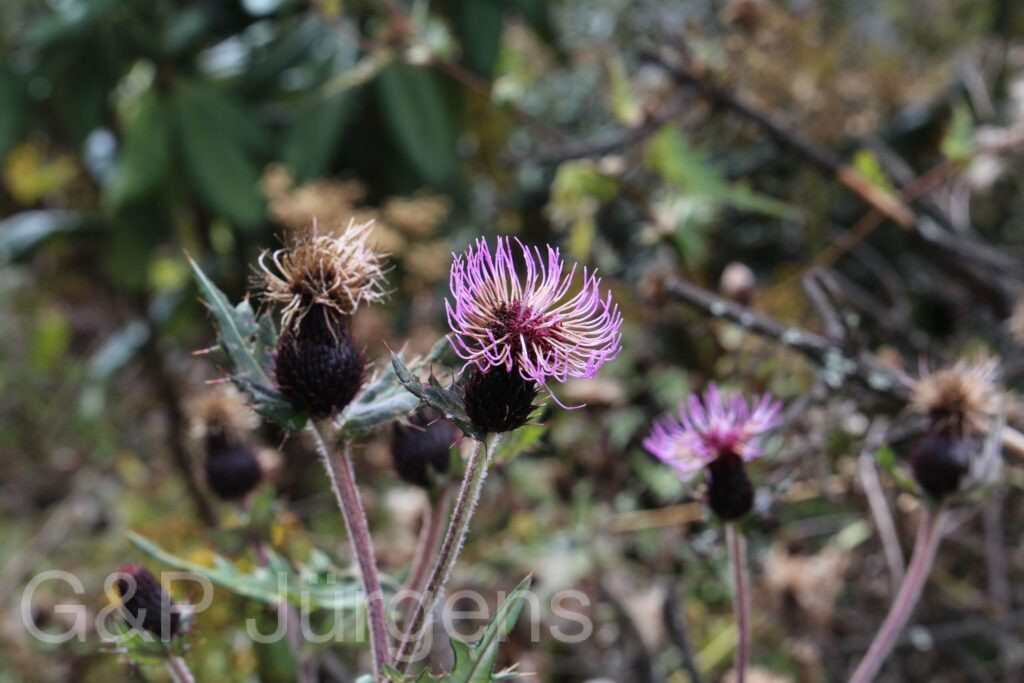
Bhutan2015 492
Bhutan Pele-La 2900m, October
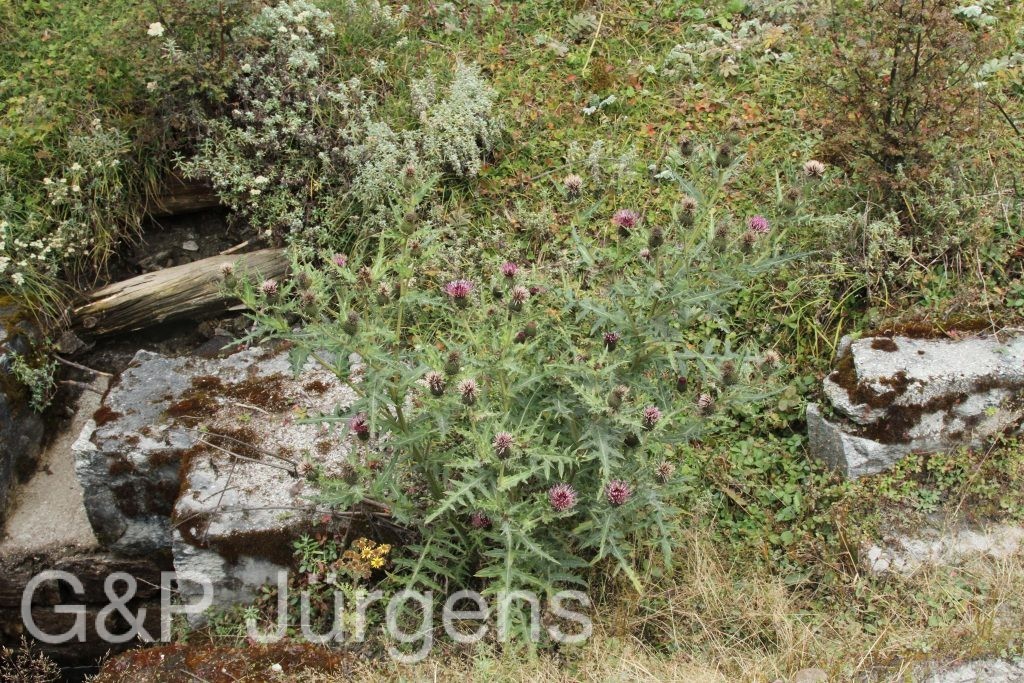
Bhutan2015 399
Bhutan Jakar 3100m, October
Bhutan2015 398
Bhutan Jakar 3100m, October

Description

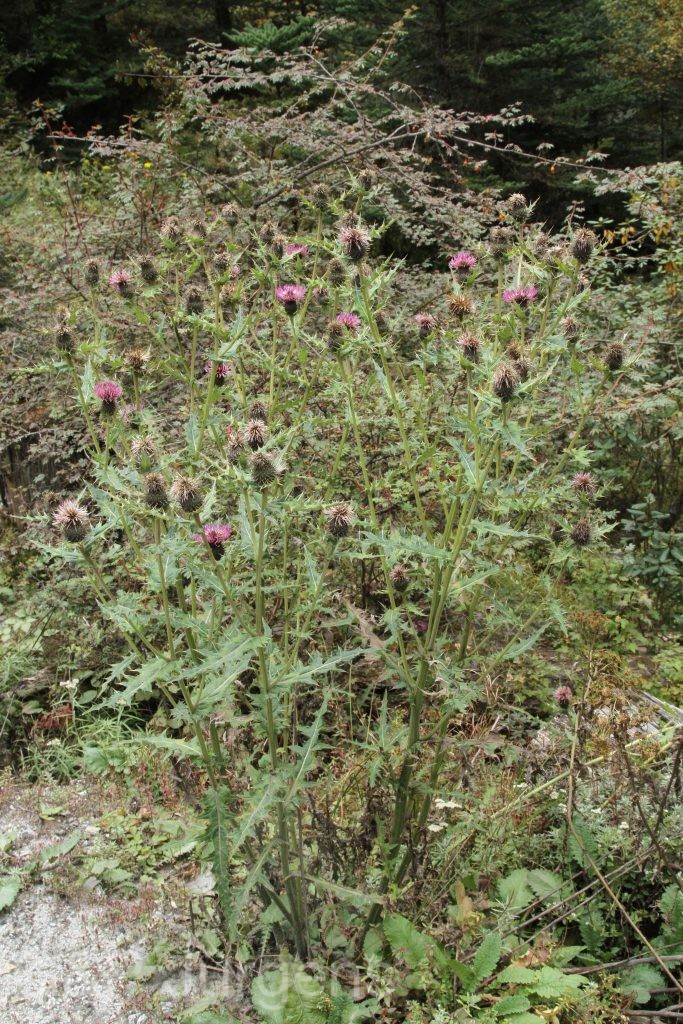
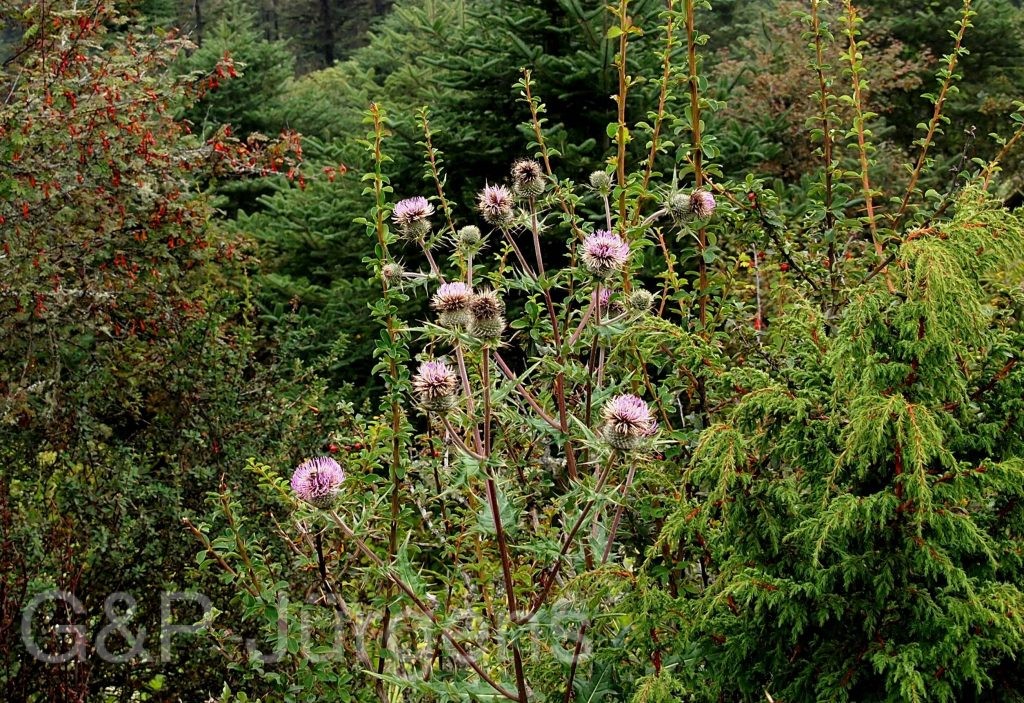
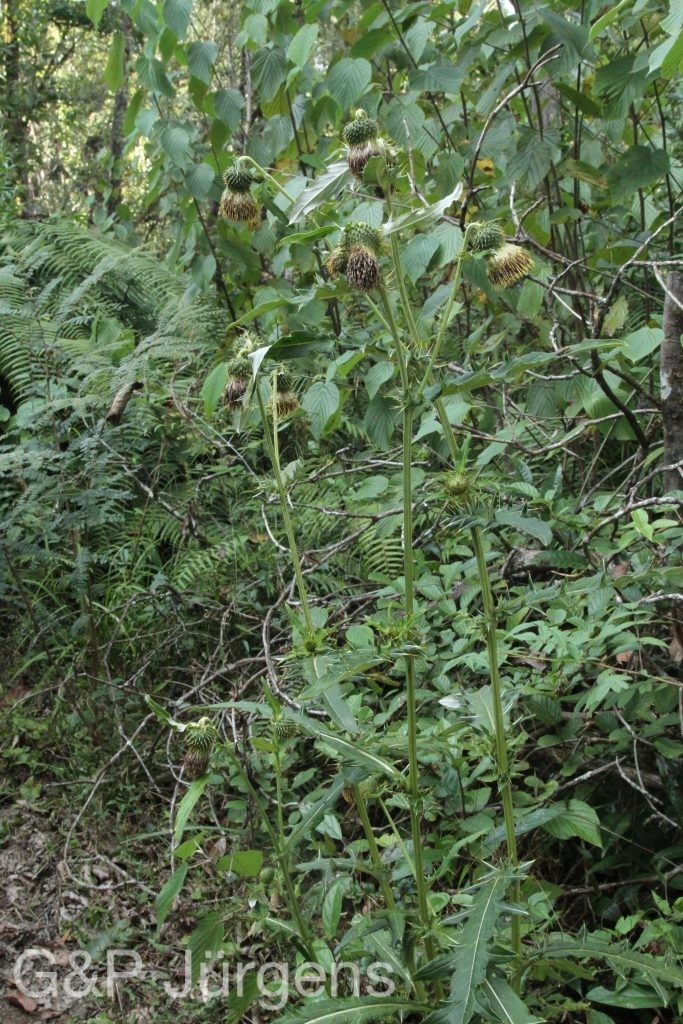
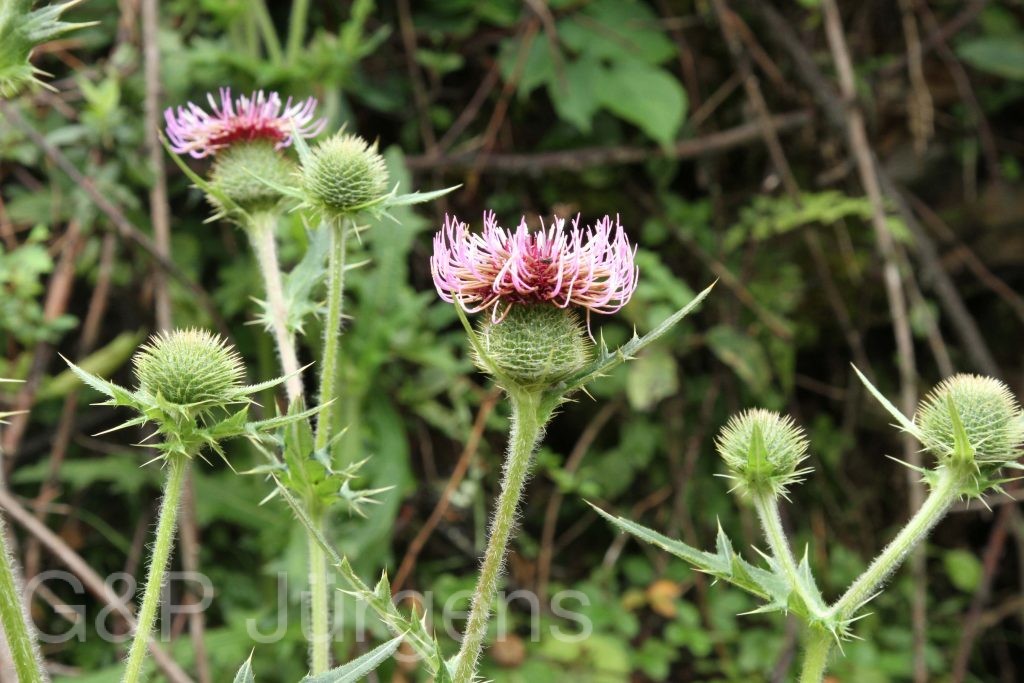
Cirsium argyracanthum is a Sino-Himalayan thistle distributed across China, India, Nepal, Afghanistan, Bhutan and Pakistan, with GBIF holding around 150 occurrences along this mountain belt. It is characteristic of open, sunny, frequently disturbed ground in the temperate and subalpine zones, growing on grassy slopes, pasture, fallow fields, trackside banks and forest clearings where grazing keeps the sward open. The cited records from the Pele-La pass at 2900 m and from Jakar in central Bhutan at 3100 m, both in October, illustrate its occurrence in upper temperate to subalpine settings, where it persists and fruits late into the autumn after the main summer flowering.

It is a stout biennial or perennial herb with an erect, longitudinally ribbed, spiny-winged stem. The leaves are oblong to lanceolate in outline, pinnatifid to pinnatisect with spinose-toothed lobes, the upper surface green and the lower paler and thinly tomentose, the margins armed with stiff spines. The capitula are discoid and ovoid, solitary or few at the branch tips, subtended by spiny upper leaves; the involucre bears numerous imbricate phyllaries tipped with conspicuous silvery, spreading spines that give the species its epithet. The florets are all tubular and bisexual, purple to pinkish. The cypselae are oblong and smooth, crowned by a pappus of long, plumose bristles aiding wind dispersal.

Within the large, taxonomically intricate genus Cirsium (tribe Cardueae), C. argyracanthum is distinguished by its silvery-spined involucre, and it has often been confused with related Himalayan thistles such as C. verutum, reflecting the difficulty of delimiting species in this group. Its spiny defences deter grazing, while the purple heads attract bees and butterflies. As a tolerant plant of disturbed montane habitats it is widespread and secure, of no conservation concern across its range.

Author: DC. · Sources: POWO (Kew), GBIF, Flora of Bhutan, Flora of China, Annotated Checklist of the Flowering Plants of Nepal, Petrak's revision of Asiatic Cirsium (Cardueae)

Petr.

Sikkim2011 257
Sikkim Lada-La 3800m, June
BhutanPG2011 284
Bhutan Jule-Tso, 4200m June
Sikkim2003 412 W574
Sikkim Zemu Valley 3400m August

Description

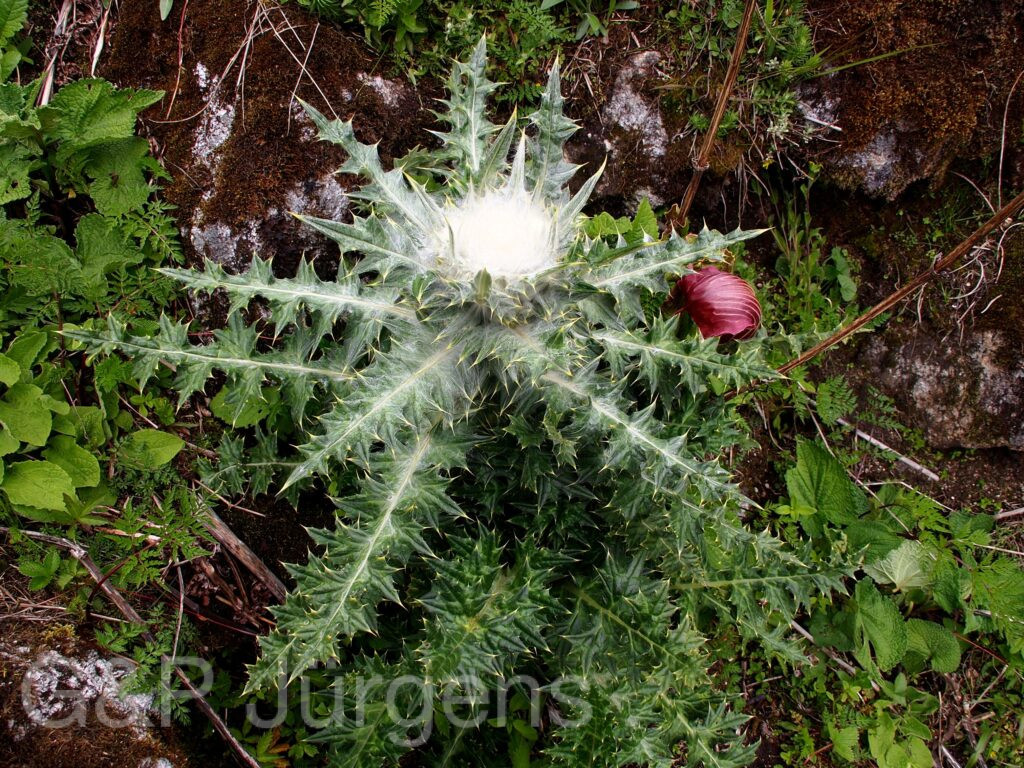
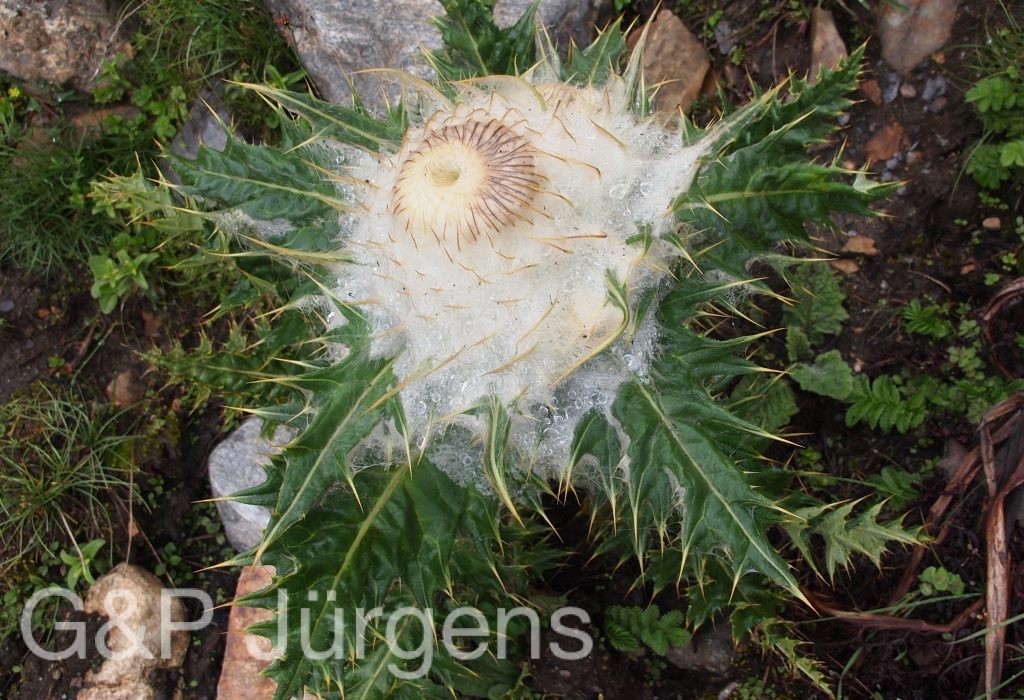
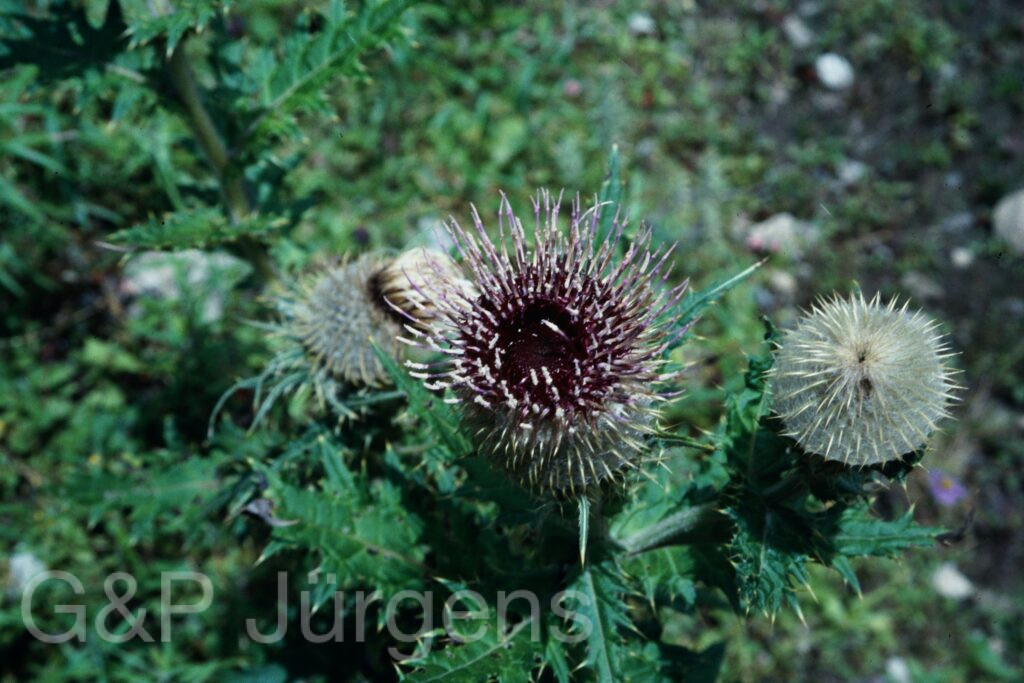
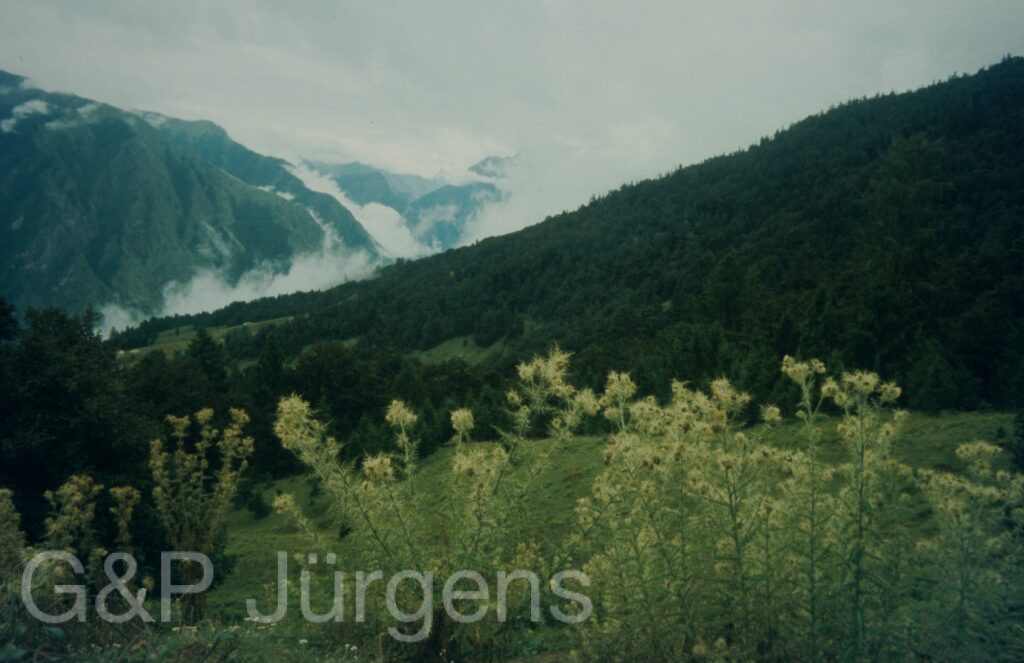
Cirsium eriophoroides is a robust alpine thistle of the eastern Himalaya and Sino-Tibetan mountains, recorded from China, India, Bhutan, Myanmar and Nepal, with about 234 GBIF occurrences. It grows in subalpine to alpine meadows, open grassy slopes, forest clearings and disturbed pasture, generally between about 3000 and 4500 m. The photographed plants come from Lada-La in Sikkim (3800 m, June), Jule-Tso in Bhutan (4200 m, June) and the Zemu Valley in Sikkim (3400 m, August), spanning the early and late high-Himalayan growing season.

The plant is a stout biennial or perennial herb with an erect, ridged, cobwebby-woolly stem reaching well over a metre. The leaves are oblong-lanceolate, deeply pinnatifid and conspicuously spiny along the margins, decurrent on the stem and white-tomentose beneath. The large capitula are solitary or few at the stem apex, subtended by leafy bracts and densely enveloped in long, white, arachnoid wool, the epithet "eriophoroides" likening this to the cottongrass Eriophorum. The involucral phyllaries are narrow and spine-tipped; the florets are tubular and purple to reddish, the fruit a smooth cypsela bearing a plumose pappus of feathery bristles.

Cirsium is a large genus of the tribe Cardueae, and C. eriophoroides represents the woolly-headed high-montane element well developed in the Sino-Himalaya. Its conspicuous capitula are visited by bumblebees and other long-tongued insects. Widespread and often associated with grazed ground, it is not regarded as threatened.

Author: Petr. · Sources: POWO (Kew), GBIF, Flora of China, Flora of Bhutan, Annotated Checklist of the Flowering Plants of Nepal, Compositae of the Sino-Himalaya (Cardueae studies)

(Hook.f.) Petr.

Bhutan2012 65
Bhutan Shele-La, 3900m September

Description

Cirsium falconeri is a robust subalpine to alpine thistle distributed along the Himalaya and adjacent ranges, recorded from Pakistan, India, Nepal, Bhutan, Myanmar and south-western China (Xizang, Yunnan), with some 207 georeferenced occurrences documenting its broad east-to-west arc. It favours open grassy hillsides, forest margins, moist meadows and disturbed slopes between roughly 2700 and 4300 m, where it forms scattered stands among tall-herb communities. The photographed plant from the Shele-La pass in Bhutan at about 3900 m in September typifies its preference for cool, humid high-altitude grasslands flowering toward the end of the monsoon.

The species is a stout biennial or short-lived perennial herb 0.6–2 m tall, with erect, longitudinally ribbed, often arachnoid-tomentose stems arising from a thickened taproot. The leaves are large, pinnatifid to pinnatisect, glabrescent to thinly cottony above and grey-tomentose beneath, with the lobes spiny-margined and the stem-leaves decurrent or amplexicaul. The capitula are large, hemispheric and usually nodding, solitary or few, subtended by reduced spiny floral leaves; the involucral bracts are linear-lanceolate and spinescent. Florets are numerous, tubular and purple to pinkish-red. The cypselae are oblong and glabrous, crowned by a copious pappus of plumose, basally connate bristles aiding wind dispersal.

Within Cirsium, a large Holarctic genus of spiny-leaved thistles, C. falconeri belongs to the Himalayan assemblage of stout nodding-headed species and was originally described under Cnicus before transfer to Cirsium. The nodding capitula are interpreted as protecting pollen and developing achenes from monsoon rain, while the nectar-rich heads attract bumblebees and other long-tongued alpine pollinators. The species remains widespread and locally common and is of no recognised conservation concern, though high-elevation grazing locally affects populations.

Author: (Hook.f.) Petr. · Sources: POWO (Kew), GBIF, Flora of China Vol. 20-21, Flora of Bhutan, Flora of Nepal, Kitamura Compositae of the Himalaya

Petr.

Bhutan2015 459
Bh15-549
Bhutan2014 204
Bhutan Trashyangtse 2100m, May

Description

Cirsium interpositum is a Himalayan and East Asian thistle recorded from China, Turkey, India and Korea, with 55 georeferenced occurrences. Under the GBIF backbone the name is treated as a SYNONYM, with Cirsium interpositum itself given as the accepted name in this dataset, reflecting unsettled circumscription within the genus; it is closely allied to the C. lipskyi complex referenced in the source record. It grows on grassy montane slopes, in open scrub, forest margins and disturbed clearings, generally in the temperate zone. It was photographed at Trashyangtse in eastern Bhutan at 2100 m in May, flowering in the cool spring of the mid-montane valleys.

It is an erect spiny perennial herb with a ribbed, often winged and prickly stem arising from a stout rootstock. The alternate leaves are oblong-lanceolate, pinnately lobed and conspicuously armed with marginal spines, green and roughly hairy above and frequently paler or tomentose beneath, the bases decurrent. The flower heads are ovoid to subglobose, solitary or clustered at the stem tips, with an involucre of many imbricate, spine-tipped phyllaries. All florets are tubular (discoid) and purple to reddish-purple, the slender corollas deeply lobed. The fruit is a smooth oblong cypsela crowned by a pappus of long plumose (feathery) bristles, a defining feature of Cirsium.

The genus Cirsium belongs to tribe Cardueae and is distinguished from the closely related Carduus by its plumose rather than barbellate pappus. The taxonomic ambiguity surrounding C. interpositum is typical of the genus, in which hybridisation and variation blur species limits across the Sino-Himalaya. Ecologically it is a plant of open, disturbed montane ground, visited by bees and butterflies. It is not assessed as threatened.

Author: Petr. · Sources: POWO (Kew), GBIF, Flora of China, Flora of Bhutan, Cirsium monograph (Cardueae systematics, Werner & Petrak)

(M.Bieb.) Fisch.

Bh09 287 P470
Bhutan Pele-La, 2900m June

Description

Cirsium laniflorum is a thistle whose GBIF-documented range lies chiefly in the Pontic–Caucasian and adjacent regions, with records from Ukraine, Turkey, Azerbaijan, Russia and Belgium among its roughly 92 occurrences; the himalayaflora image, taken at the Pele La in central Bhutan at 2900 m in June, documents a Himalayan population of a Cirsium of this affinity flowering in early summer. The plant occupies open grassy slopes, meadow margins, disturbed ground and roadside banks, growing on well-drained mineral soils in cool montane conditions where it forms part of the tall-herb and pasture vegetation.

The species is a robust biennial or perennial herb with an erect, often longitudinally ridged stem arising from a stout rootstock. The leaves are alternate, oblong-lanceolate in outline and pinnatifid, their lobes and margins armed with stiff yellowish spines, and the surfaces are more or less woolly, particularly beneath. The capitula are terminal, solitary or in small clusters, subtended by spine-tipped involucral bracts and conspicuously clothed in cobwebby, woolly indumentum, a feature evoked by the epithet laniflorum ("woolly-flowered"). The florets are all tubular and purple to pink-purple, and the cypselae bear a plumose, feathery pappus that detaches as a unit.

Cirsium belongs to tribe Cardueae of the Asteraceae, the spiny thistle group, in which the woolly involucres of species like C. laniflorum help insulate the developing florets and deter herbivores. The tubular flowers are visited by bumblebees, butterflies and other long-tongued insects, and the plumed achenes disperse on the wind. With a broad if scattered Eurasian distribution, the species is not of conservation concern; like many thistles it can behave as a ruderal coloniser of disturbed and grazed ground.

Author: (M.Bieb.) Fisch. · Sources: POWO (Kew), GBIF, Flora of China (Asteraceae), Flora of Bhutan, Werner Cirsium revision

Petr.

Bhutan2012 167
Bhutan Haar-Valley, 3200m September

Description

Cirsium shansiense is an Asian thistle distributed from China through the Himalaya, recorded from China, India, Bhutan, Japan and Turkey, with 575 georeferenced occurrences indicating a broad and well-collected range. It grows on grassy slopes, in open scrub, along forest margins, roadsides and disturbed clearings, from the warm-temperate into the montane zone. It was photographed in the Haa Valley of western Bhutan at 3200 m in September, flowering in the late-monsoon to early-autumn period when it is conspicuous on open montane slopes and pastures.

It is a robust erect perennial herb 0.5 to 1.5 m or more tall, with ribbed, often somewhat cobwebby stems arising from a stout root. The alternate leaves are lanceolate to elliptic in outline, pinnately lobed and conspicuously spiny along the margins, green above and grey-arachnoid-tomentose beneath, with bases that are sessile or slightly decurrent. The flower heads are ovoid, solitary or few at the branch tips, with an involucre of numerous imbricate, narrow, spine-tipped phyllaries that are usually arachnoid-hairy. All florets are tubular and reddish-purple to rose-purple. The fruit is a smooth oblong cypsela crowned by a pappus of long plumose bristles.

The species belongs to tribe Cardueae; like other members of Cirsium it is separated from Carduus by the feathery (plumose) pappus bristles. Cirsium shansiense is one of the more widespread and variable East Asian thistles, and its broad distribution from Japan to Turkey reflects considerable ecological tolerance. Its nectar-rich heads attract bees and butterflies, and it readily colonises grazed and disturbed ground. It is common and of no conservation concern.

Author: Petr. · Sources: POWO (Kew), GBIF, Flora of China, Flora of Bhutan, Cirsium monograph (Cardueae systematics, Petrak & Werner)

(Hook.f.) Aswal & Mehrotra

Garw 2005 76 ergebnis ergebnis
India Gaushon 3000m, September

Description

Cirsium wallichii var. platylepis is a Himalayan thistle taxon recorded by GBIF only from India, with about 8 occurrences, reflecting its status as a narrowly recognised variety raised by Aswal and Mehrotra from a Hooker name. It occupies open grassy slopes, pastures, forest margins, clearings and disturbed banks through the temperate and subalpine zones, broadly 2000 to 3300 m. The plant photographed at Gaushon in the Indian Himalaya at 3000 m in September, flowering and fruiting at the close of the monsoon, is consistent with its preference for sunny, somewhat disturbed montane grassland.

It is a robust biennial or perennial herb forming an erect, often winged and spiny stem from a stout rootstock. The leaves are oblong to lanceolate in outline, pinnatifid to pinnatisect, the lobes and margins armed with sharp spines and the undersurface frequently whitish-tomentose. The capitula are large and ovoid to subglobose, solitary or clustered, subtended by an involucre of many spine-tipped bracts; the variety platylepis is distinguished chiefly by its broader involucral phyllaries. The florets are tubular and pinkish-purple to whitish, and the cypselae are smooth and crowned by a pappus of plumose, feathery bristles that aid wind dispersal.

Cirsium is a large genus of true thistles in which Himalayan taxa form a difficult complex, and the variety platylepis represents fine-scale infraspecific differentiation within the widespread C. wallichii. The spiny armature and bitter foliage deter grazing in heavily pastured uplands, while the plumose pappus disperses the achenes effectively across open ground. As a narrowly defined variety with few records, its taxonomic standing merits further study, though the parent species is common and the entity is of no immediate conservation concern.

Author: (Hook.f.) Aswal & Mehrotra · Sources: POWO (Kew), GBIF, Flora of India (Asteraceae), Annotated Checklist of the Flowering Plants of Nepal, Flora of China (Asteraceae), Petrak revision of Asian Cirsium

R.D.Good

Garw 2005 46 ergebnis ergebnis
India Garhwal Valley of flowers 3300m, September

Description

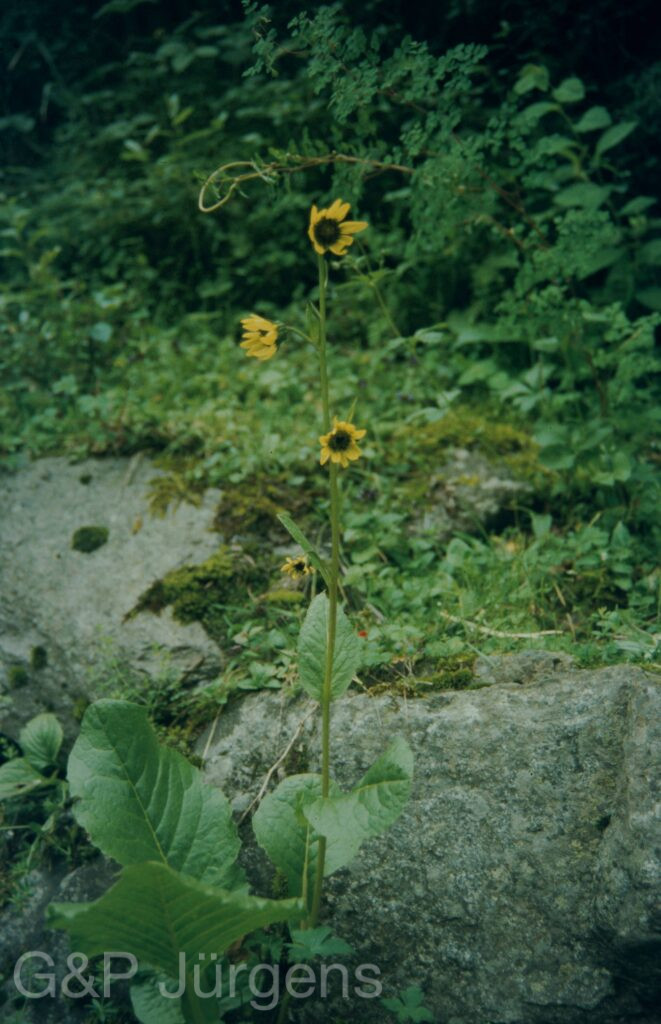
Cremanthodium arnicoides is a Sino-Himalayan alpine composite recorded from Nepal, India and China, with additional herbarium-based occurrences abroad; GBIF lists about 268 records concentrated along the high ranges. It inhabits alpine meadows, moist grassy slopes, scree margins and streamsides, generally between roughly 3000 and 4500 m. The plant photographed in the Valley of Flowers, Garhwal (India), at about 3300 m in September captures its characteristic montane meadow habitat at the close of the monsoon flowering season, when its nodding golden capitula are conspicuous among late summer herbage.

The species is a tufted perennial herb arising from a short rhizome with fibrous roots. The basal leaves are long-petiolate with reniform to cordate, palmately veined blades and dentate margins, forming a rosette, while the stem leaves are smaller and progressively sessile. The erect, sparsely arachnoid-hairy scape bears solitary, nodding radiate capitula; the involucral bracts are blackish-green and somewhat hairy, the ligulate ray florets are yellow and elongate, and the central disc florets are tubular. The cylindrical achenes are glabrous and crowned by a copious white pappus of soft barbellate bristles.

Cremanthodium is a genus of about seventy alpine species characteristic of the Himalaya and Hengduan Mountains, distinguished from related Ligularia and Senecio by its typically solitary, nodding capitula adapted to cold, high-altitude conditions, the pendent heads protecting the florets from rain and intense radiation. Many species are narrow endemics; C. arnicoides has a moderately wide Himalayan range and is not regarded as threatened, though as a high-elevation specialist it is potentially sensitive to climate warming and habitat shifts in the alpine zone.

Author: R.D.Good · Sources: POWO (Kew), GBIF, Flora of China, Flora of Bhutan, Annotated Checklist of the Flowering Plants of Nepal, Good's revision of Cremanthodium

(Hook.f.) Kitam.

Nepal 95 164 P266 ergebnis
Nepal Rupien La 3900m October

Description

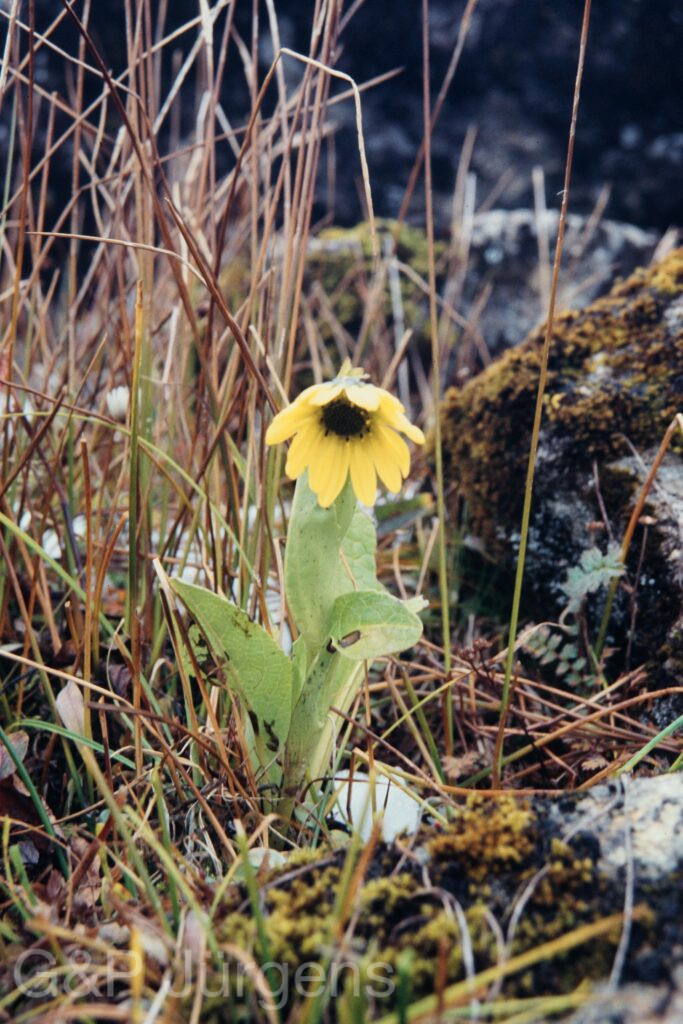
Cremanthodium ellisii is an alpine perennial of the Himalaya and the eastern Tibetan plateau, recorded from China, India, Nepal, Pakistan and Bhutan, with 754 occurrences in GBIF. It is a plant of high, open habitats: alpine meadows, scree, moraine, rocky slopes and stream margins, characteristically between 3500 and 5600 m, ranking among the highest-ascending composites of the region. The Nepalese collection figured, from Rupien La at 3900 m in October, reflects its occupancy of cold, exposed pass environments and its persistence into late autumn at the lower edge of its altitudinal span, on stony, well-drained alpine soils.

It forms a stout perennial rootstock from which arise erect, often woolly or purplish flowering stems 10-40 cm tall. The basal leaves are petiolate with ovate to reniform, dentate to lobed blades, while the stem leaves become smaller and amplexicaul upward. The stems are crowned by one to several large, nodding (cernuous) capitula, the nodding habit characteristic of the genus; the involucral bracts are densely covered with dark or pale hairs. Ray florets are golden-yellow, ligulate and female, surrounding numerous tubular yellow disc florets. The fruit is a glabrous cylindrical achene bearing a pappus of soft white bristles.

Cremanthodium (Asteraceae, tribe Senecioneae) is a Sino-Himalayan genus of roughly seventy species, closely allied to Ligularia and Senecio and distinguished by its nodding heads, an adaptation protecting florets from rain and intense alpine irradiance. C. ellisii is a variable, widespread species, broadly distributed and not threatened, though as a true alpine specialist it is potentially vulnerable to upward habitat compression under climate warming.

Author: (Hook.f.) Kitam. · Sources: POWO (Kew), GBIF, Flora of China, Flora of Bhutan, Monograph of Cremanthodium (Compositae, Senecioneae)