
(L.) R.M.King & H.Rob.
Description
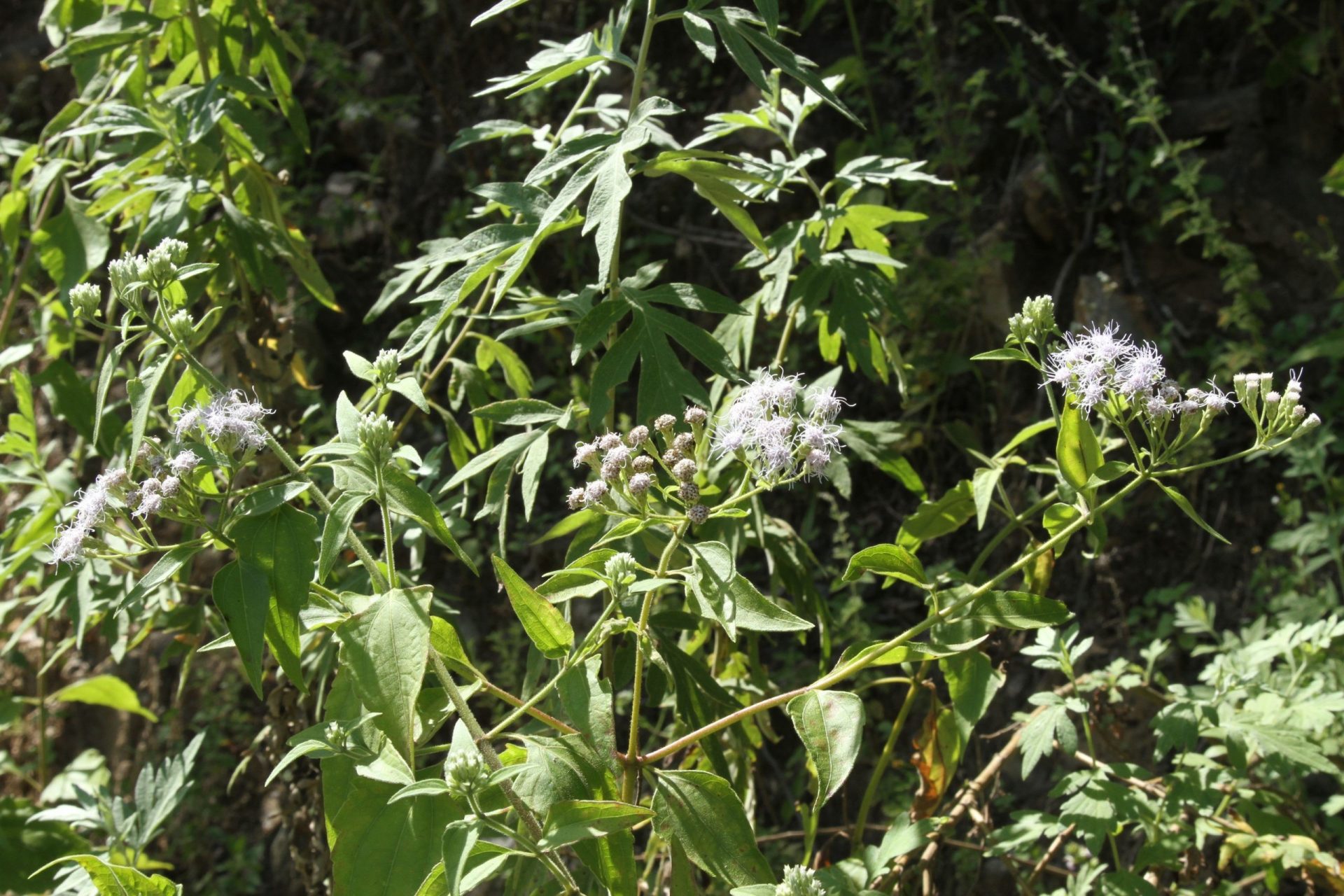
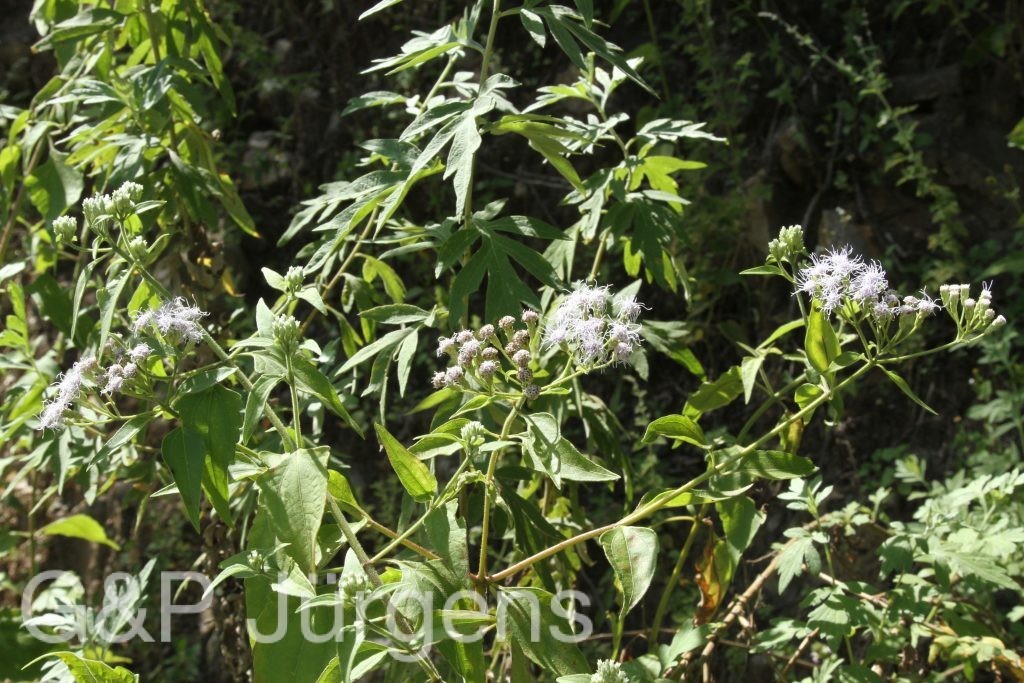
Chromolaena odorata, Siam weed, is native to the Neotropics (Mexico, Central America, the Caribbean and tropical South America) but is now one of the world's most aggressive invasive weeds, reflected in its enormous GBIF dataset of 63,557 occurrences spanning the Americas, sub-Saharan Africa, South and Southeast Asia, Australia and the Pacific. It colonises disturbed ground, forest margins, abandoned fields, roadsides and plantations in the seasonal tropics and lower subtropics. The photograph was taken at Trongsa in central Bhutan at 1900 m in October, near the upper elevational limit of its spread into warm Himalayan valleys, where it forms dense post-monsoon thickets.
It is a scrambling, much-branched perennial shrub or subshrub reaching 1.5-3 m, with brittle, pubescent stems and opposite, triangular to ovate-deltoid leaves that are three-veined from the base, coarsely toothed, and aromatic when crushed. The numerous small, cylindrical capitula are grouped in flat-topped corymbose clusters and contain only tubular (disc) florets, lacking rays; the pale lilac to whitish corollas have exserted styles giving a fluffy appearance. The cypselae are slender, blackish and angled, each crowned by a pappus of barbellate bristles enabling abundant wind dispersal.
Described as Eupatorium odoratum by Linnaeus, it was transferred to Chromolaena by R.M. King & H. Robinson during the dismemberment of the broad genus Eupatorium. Allelopathic, fire-promoting and prolific, it suppresses native vegetation and pasture and is the subject of biological-control programmes worldwide. Its appearance in Bhutan signals the ongoing upslope advance of a serious tropical invasive of major economic and ecological concern.
Author: (L.) R.M.King & H.Rob. · Sources: POWO (Kew), GBIF, Flora of Bhutan, Flora of China, CABI Invasive Species Compendium, Eupatorieae of the World (King & Robinson)