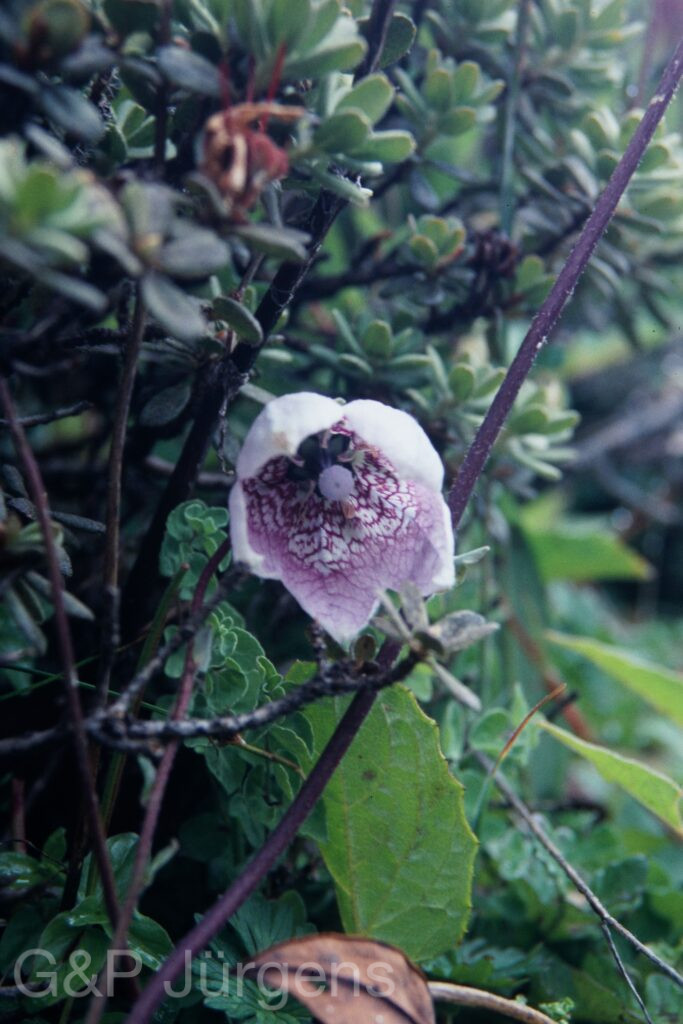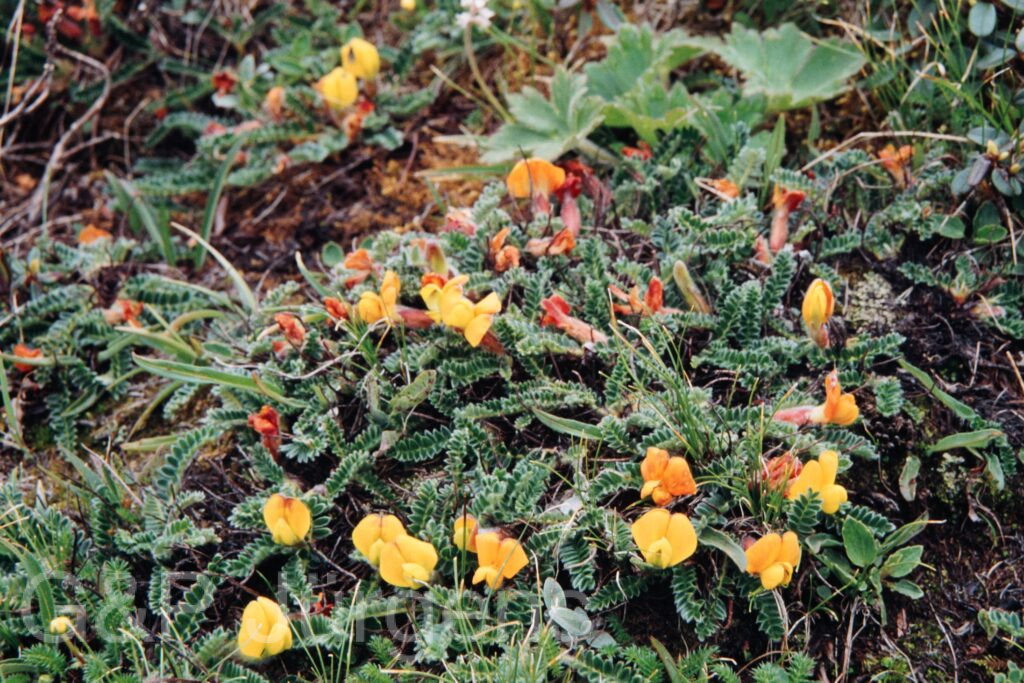
Tag:

Alpine (>3500 m)

(D.Don) Ali

Nepal 99 312 ergebnis
West-Nepal Kalmura 4300m, June

Description

Chesneya nubigena (D.Don) Ali is a prostrate alpine legume of the Himalaya and Hindu Kush, represented by some 318 records concentrated in Nepal, India, Bhutan, Pakistan and adjacent China, with scattered extralimital reports. It is a plant of high open ground: stony alpine slopes, gravelly flats, moraines and the margins of grazed pastures, generally between about 3500 and 4800 m. The individual photographed at Kalmura in West Nepal at 4300 m in June illustrates its occupation of cold, well-drained, often wind-exposed substrates where it grows close-pressed to the ground amid sparse turf.

The species forms a low, mat-forming to shortly tufted perennial from a deep woody rootstock and branched caudex. The leaves are imparipinnate with several pairs of small, oblong to obovate leaflets, often somewhat pubescent and frequently spine-tipped on persistent rachides. The flowers are large relative to the plant and borne singly or few together on short axillary peduncles; the papilionaceous corolla is yellow to reddish or purple-tinged, the standard broad and the keel obtuse. The calyx is tubular and obliquely toothed, and the fruit is an oblong, sessile to shortly stipitate, more or less inflated legume, hairy and several-seeded.

Chesneya is a small genus of central and high Asia closely allied to Astragalus and Gueldenstaedtia, and C. nubigena has been treated under various combinations reflecting its taxonomic history. Its cushion-like habit, deep roots and silky indumentum are classic adaptations to the cold, arid, high-radiation conditions of the inner Himalayan ranges, where it also fixes atmospheric nitrogen. Widespread if local, it is not regarded as threatened, though heavy grazing pressure in alpine pastures can locally reduce populations.

Author: (D.Don) Ali · Sources: POWO (Kew), GBIF, Flora of China, Flora of Pakistan, Flora of Nepal, revision of Chesneya and allied Astragaleae
Hook.f. & Thomson

BhutanPG2011 277
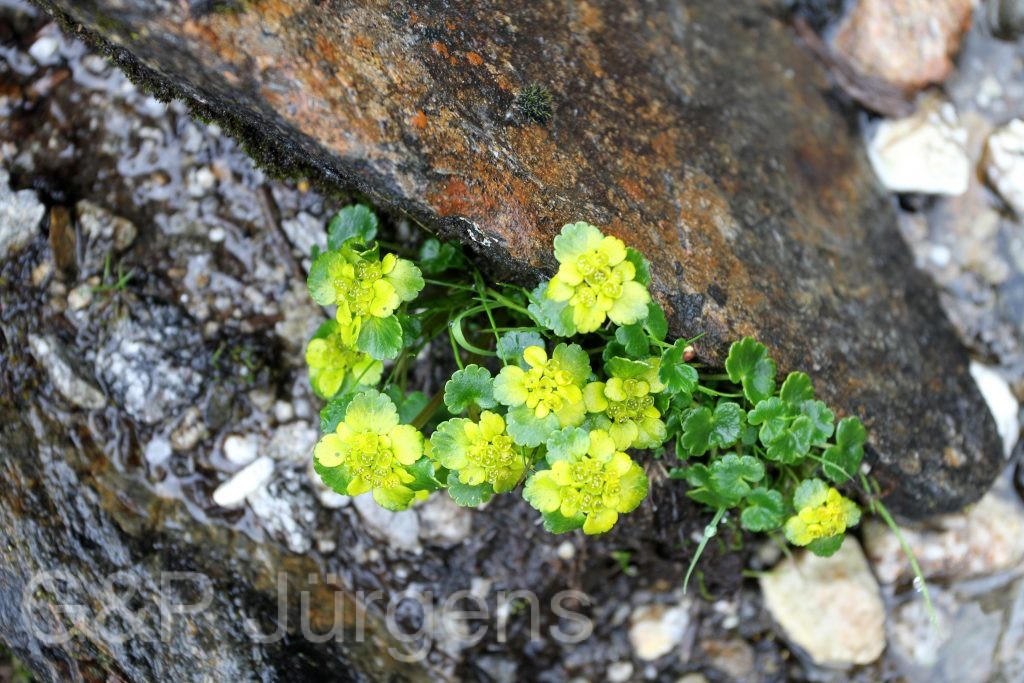
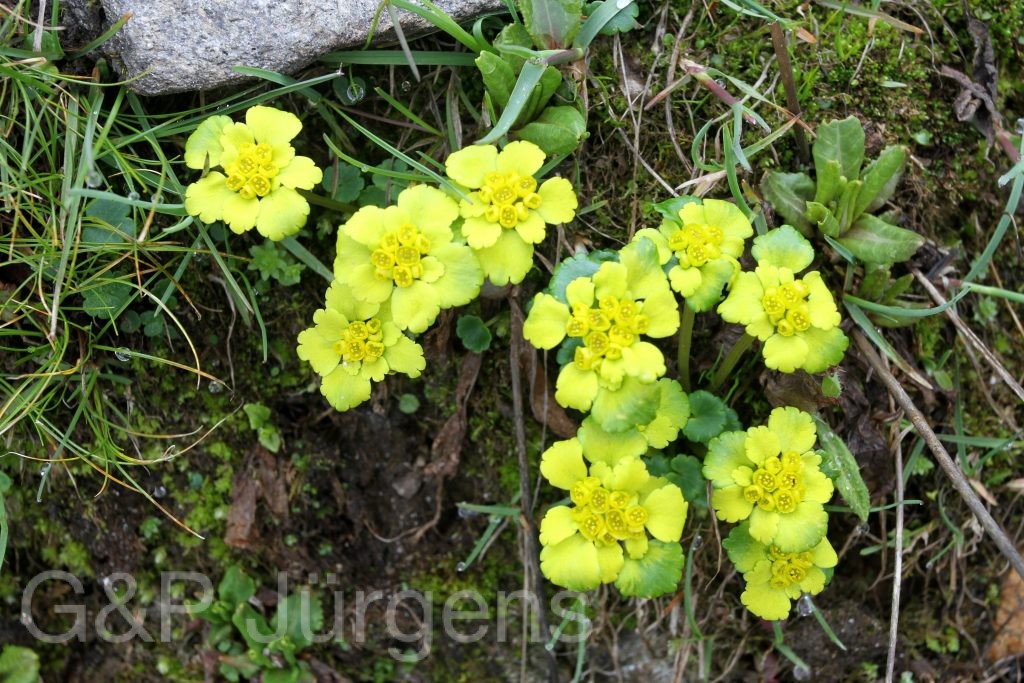
Bhutan Jule-La 4610m, June

Description

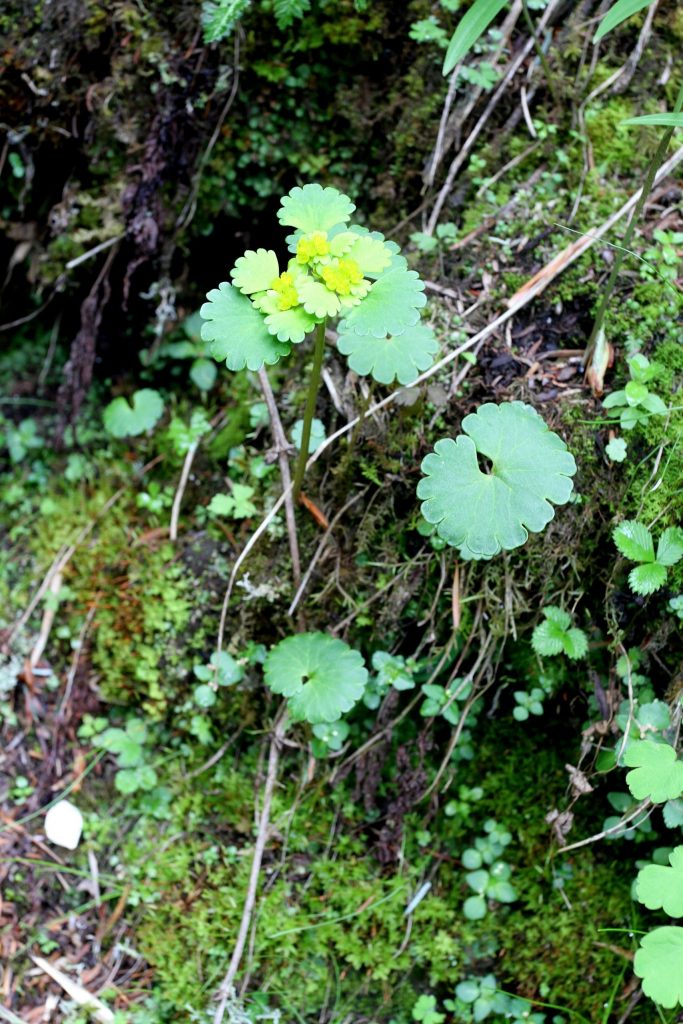
A small perennial golden-saxifrage of the high Himalaya and the eastern Tibetan region, recorded from China, Bhutan, India and Nepal, with about 485 GBIF occurrences. It is a plant of cold, wet ground, frequenting seepages, stream margins, dripping rock ledges, snowmelt flushes and moist alpine meadows, generally between about 3300 and 4800 m. The figured plant was photographed in June on the Jule-La in Bhutan at roughly 4610 m, an exceptionally high, water-saturated alpine habitat that suits its preference for permanently moist, cool substrates.

The species is a low, somewhat fleshy herb spreading by short stolons and slender rhizomes to form loose patches. The leaves are mostly alternate, with rounded to flabellate, crenate blades on slender petioles. The inflorescence is a flattened, leafy-bracted cyme in which the conspicuous element is not the petals, which are absent, but the four spreading, yellow to greenish-yellow sepals surrounding a flat floral disc. Each flower has eight stamens inserted around the disc and a semi-inferior ovary of two carpels with divergent styles. The fruit is a two-beaked, widely gaping capsule that opens to expose numerous tiny seeds, which are splashed out by raindrops, a dispersal mode well suited to its wet habitats.

Accepted by POWO and GBIF, C. griffithii belongs to a genus of typically apetalous, water-loving herbs in which species are separated by leaf arrangement, stolon habit and seed surface. Ecologically it is a specialist of alpine springs and flushes, often growing among mosses, and is an indicator of cold, base-rich seepage. Restricted to such microhabitats but widespread across the high Himalaya, it is locally frequent and not regarded as threatened, though dependent on stable hydrology in a warming alpine environment.

Author: Hook.f. & Thomson · Sources: POWO (Kew), GBIF, Flora of China, Flora of Bhutan, Hara revision of Himalayan Saxifragaceae

Bunge

BhutanPG2011 422
Bhutan Warrthang, 4400m June
BhutanPG2011 212 scaled
Bhutan Warrthang, 4400m June

Description

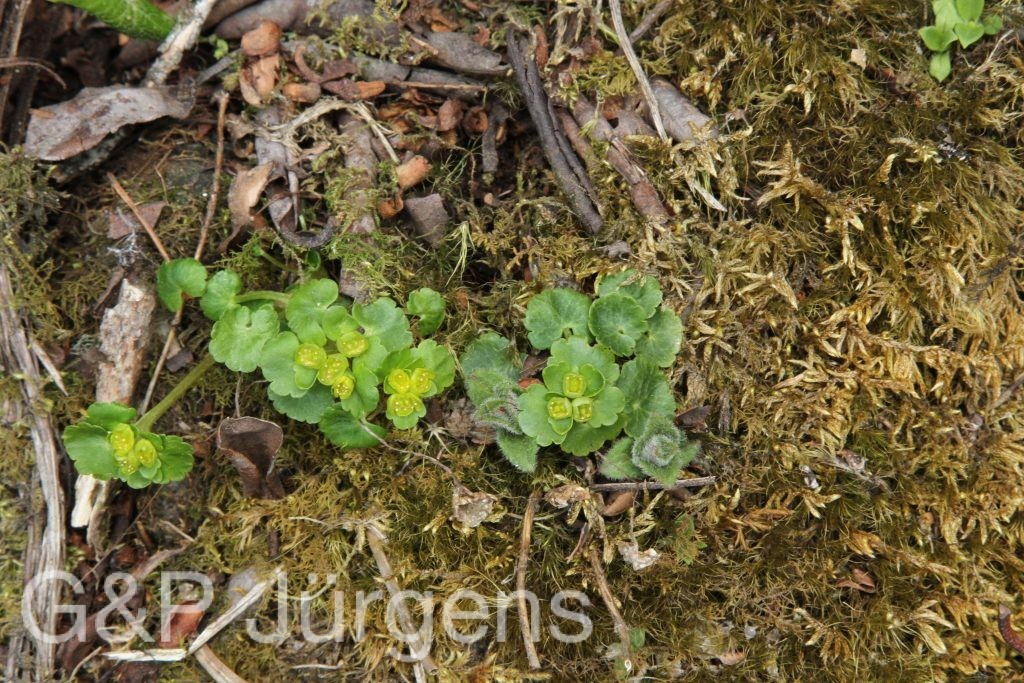
Chrysosplenium nudicaule is a small alpine herb of the high mountains of central and eastern Asia, recorded from China, the Russian Far East and Siberia, Kazakhstan, Kyrgyzstan, Nepal, Bhutan, northern India and Japan, with 323 GBIF occurrences. It is a plant of moist, cold, rocky habitats: streambanks, wet gravels, seepages, scree and the margins of snow-melt rills in the alpine and subnival zones, generally between 3500 and 5300 m. The illustrated plant was photographed at Warrthang in Bhutan at 4400 m in June, when the species flowers shortly after snow-melt in the brief high-alpine growing season.

It is a low, tufted, fleshy perennial spreading by slender stolons or rhizomes and forming small mats. The largely basal leaves are reniform to flabellate with a few broad crenate teeth, somewhat succulent, on slender petioles, while the flowering stems are nearly leafless (hence nudicaule). The inflorescence is a compact terminal cyme subtended by conspicuous yellow-green floral bracts. The flowers are apetalous, the showy parts being four erect, suborbicular yellow-green sepals; there are eight stamens and a bicarpellate ovary with two diverging styles. The fruit is a two-lobed capsule splitting to release numerous minute, finely papillose seeds.

The golden saxifrages, Chrysosplenium, are a north-temperate and arctic-alpine genus distinguished by petal-less, sepal-coloured flowers; C. nudicaule belongs to a Sino-Himalayan group of stoloniferous high-elevation species. Its small bract-framed flowers attract flies and other small insects, and stolon growth permits clonal spread across unstable wet substrates. With a very wide circum-Asian distribution it is not considered threatened, although its dependence on reliable snow-melt moisture makes it a useful indicator of alpine hydrological change.

Author: Bunge · Sources: POWO (Kew), GBIF, Flora of China, Flora of Bhutan, Hara: The Flora of Eastern Himalaya

Hook.f. & Thomson

Bhutan2014 917
Bhutan Chele-La 4300m, May
Bh2008 583 P873
Bhutan Chele-La 3900m April

Description

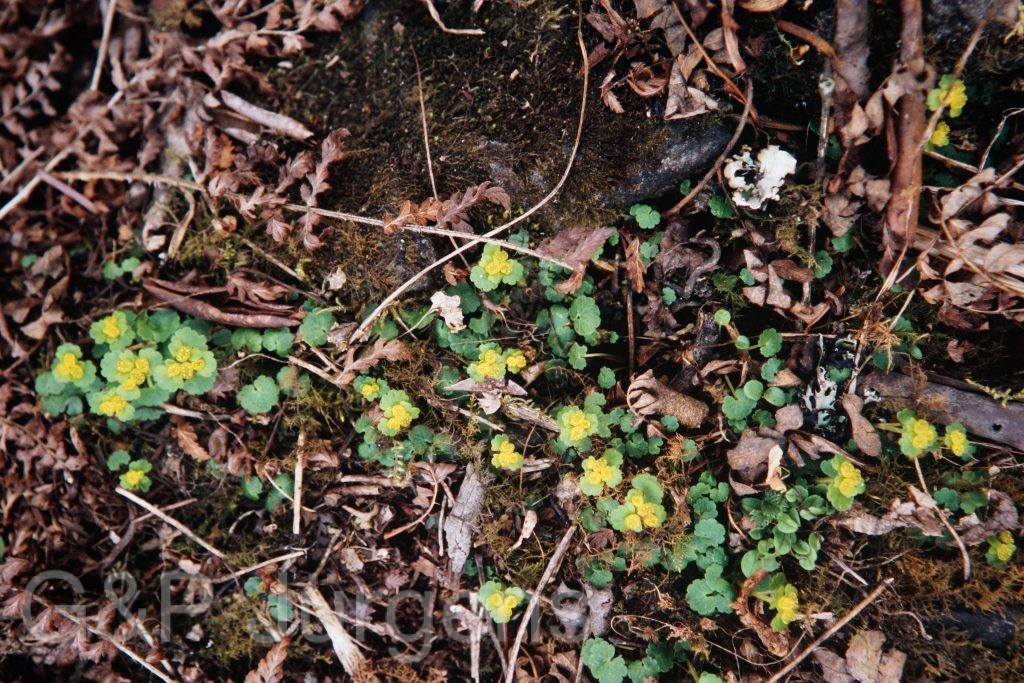
Chrysosplenium tenellum is a diminutive, high-alpine member of its genus restricted to the central and eastern Himalaya, with a sparse GBIF record (32 occurrences) from India, Nepal, Bhutan and China that reflects both its narrow range and its inconspicuous habit. It grows in cold, wet places near the upper limit of vegetation: on dripping rocks, beside snowmelt rills, in mossy seepages and on shaded humus among boulders, generally between about 3500 and 4500 m. The collections illustrated from the Chele La in Bhutan, at 4300 m in May and 3900 m in April, document its very early flowering immediately following snowmelt at these elevations.

The plant is a delicate, slender perennial herb, the epithet tenellum aptly describing its tenuous form. It produces fine, creeping and rooting stems that form small loose patches, with thin filiform stolons. The leaves are small, alternate or the lower opposite, petiolate and reniform to orbicular with a few shallow crenations. As in all Chrysosplenium the flowers lack petals; the tiny terminal cyme is subtended by small yellowish-green leafy bracts that provide the floral display. Each flower has four greenish sepals, few stamens and a half-inferior ovary maturing into a small two-lobed, divaricately beaked capsule that opens to release minute seeds dispersed by splashing water.

Within the moisture-dependent genus Chrysosplenium, C. tenellum represents the alpine extreme, a slight plant of fragile, ephemerally wet microhabitats at the margins of permanent snow. Its small flowers are visited by the few high-altitude flies active early in the season. Owing to its restricted distribution, specialised hydrological niche and low number of documented occurrences, the species is potentially vulnerable to warming-driven shifts in snowmelt regimes, although it has not been formally assessed.

Author: Hook.f. & Thomson · Sources: POWO (Kew), GBIF, Flora of China, Flora of Bhutan, Annotated Checklist of the Flowering Plants of Nepal, Monograph of Chrysosplenium (Hara)

Petr.

Sikkim2011 257
Sikkim Lada-La 3800m, June
BhutanPG2011 284
Bhutan Jule-Tso, 4200m June
Sikkim2003 412 W574
Sikkim Zemu Valley 3400m August

Description

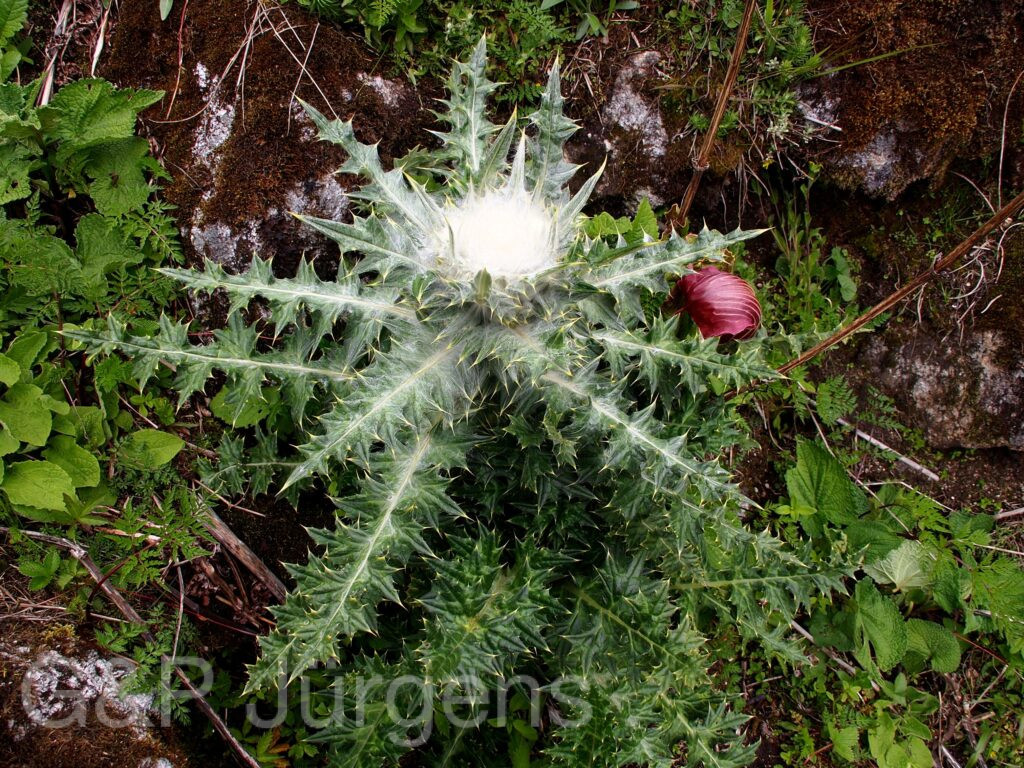
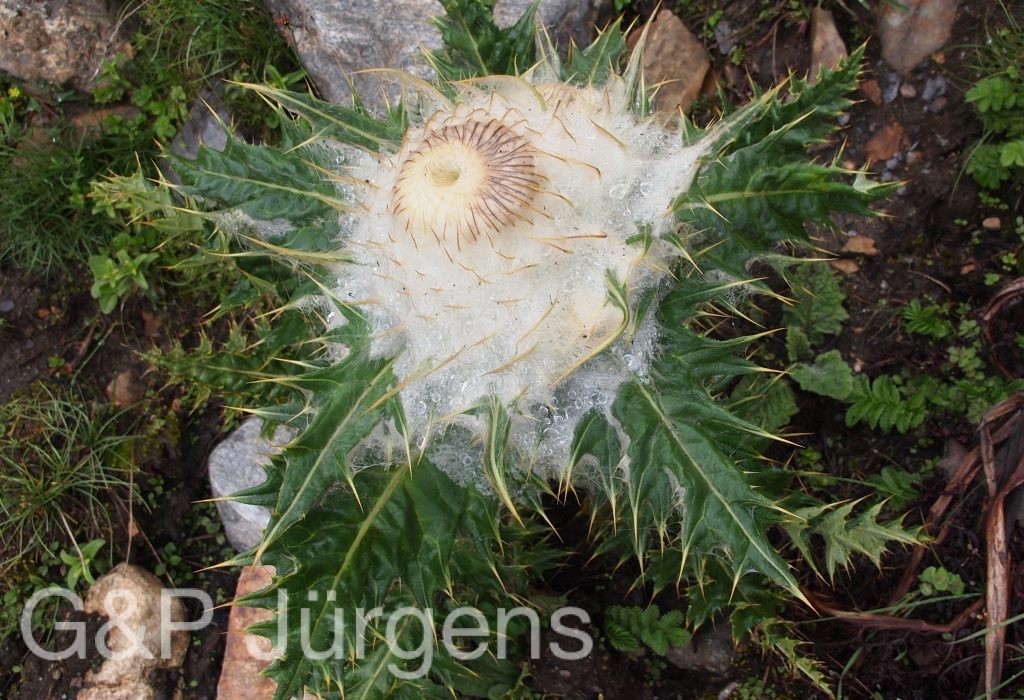
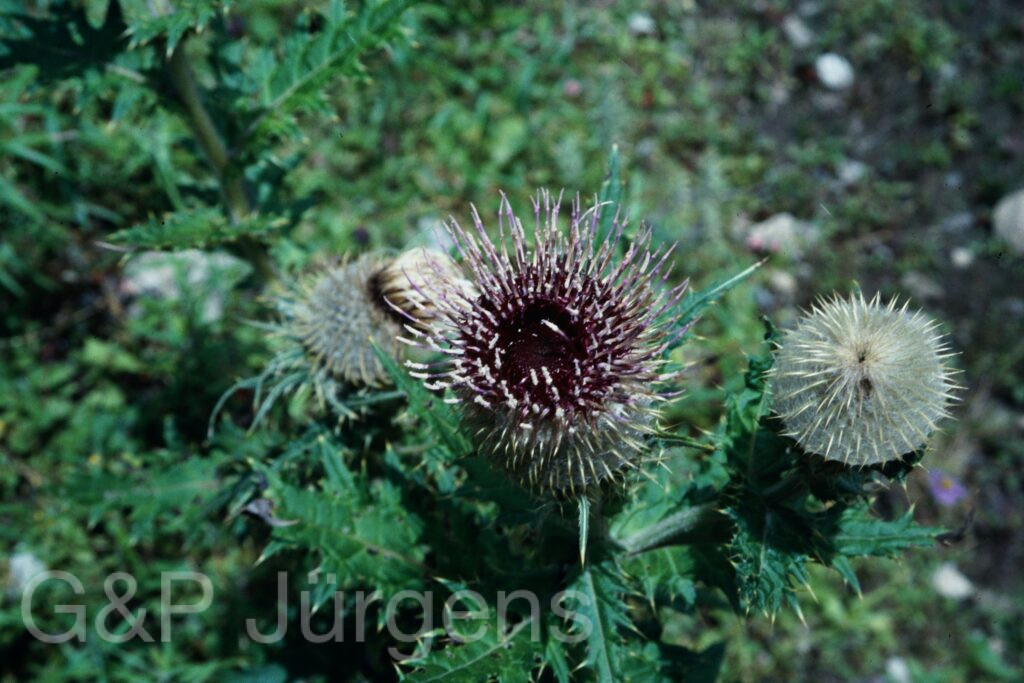
Cirsium eriophoroides is a robust alpine thistle of the eastern Himalaya and Sino-Tibetan mountains, recorded from China, India, Bhutan, Myanmar and Nepal, with about 234 GBIF occurrences. It grows in subalpine to alpine meadows, open grassy slopes, forest clearings and disturbed pasture, generally between about 3000 and 4500 m. The photographed plants come from Lada-La in Sikkim (3800 m, June), Jule-Tso in Bhutan (4200 m, June) and the Zemu Valley in Sikkim (3400 m, August), spanning the early and late high-Himalayan growing season.

The plant is a stout biennial or perennial herb with an erect, ridged, cobwebby-woolly stem reaching well over a metre. The leaves are oblong-lanceolate, deeply pinnatifid and conspicuously spiny along the margins, decurrent on the stem and white-tomentose beneath. The large capitula are solitary or few at the stem apex, subtended by leafy bracts and densely enveloped in long, white, arachnoid wool, the epithet "eriophoroides" likening this to the cottongrass Eriophorum. The involucral phyllaries are narrow and spine-tipped; the florets are tubular and purple to reddish, the fruit a smooth cypsela bearing a plumose pappus of feathery bristles.

Cirsium is a large genus of the tribe Cardueae, and C. eriophoroides represents the woolly-headed high-montane element well developed in the Sino-Himalaya. Its conspicuous capitula are visited by bumblebees and other long-tongued insects. Widespread and often associated with grazed ground, it is not regarded as threatened.

Author: Petr. · Sources: POWO (Kew), GBIF, Flora of China, Flora of Bhutan, Annotated Checklist of the Flowering Plants of Nepal, Compositae of the Sino-Himalaya (Cardueae studies)

(Hook.f.) Petr.

Bhutan2012 65
Bhutan Shele-La, 3900m September

Description

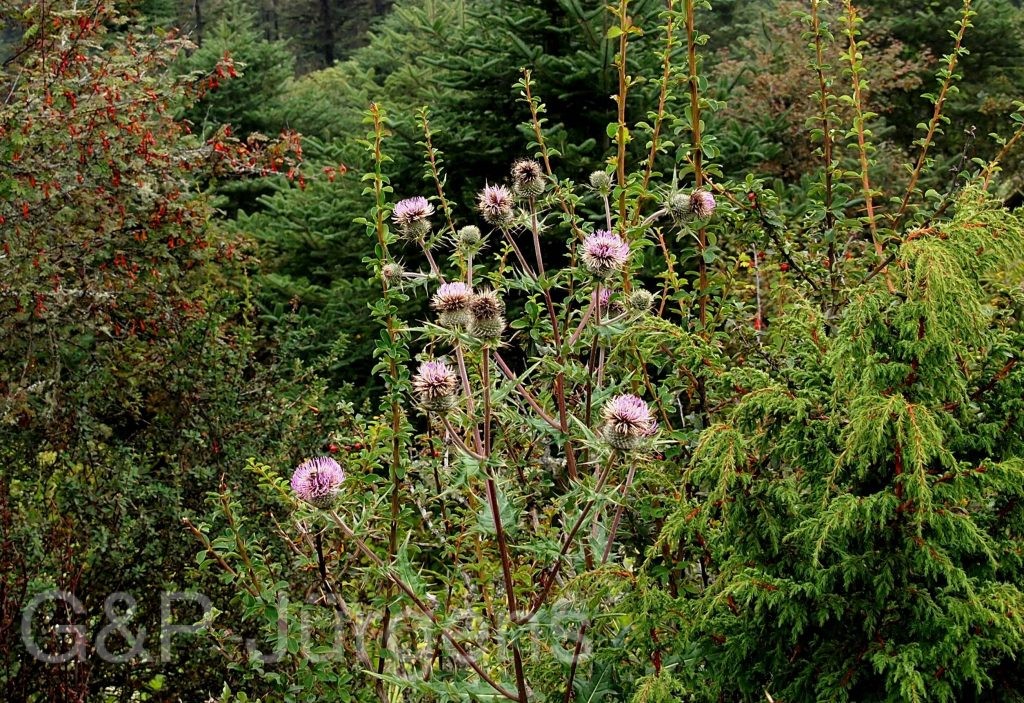
Cirsium falconeri is a robust subalpine to alpine thistle distributed along the Himalaya and adjacent ranges, recorded from Pakistan, India, Nepal, Bhutan, Myanmar and south-western China (Xizang, Yunnan), with some 207 georeferenced occurrences documenting its broad east-to-west arc. It favours open grassy hillsides, forest margins, moist meadows and disturbed slopes between roughly 2700 and 4300 m, where it forms scattered stands among tall-herb communities. The photographed plant from the Shele-La pass in Bhutan at about 3900 m in September typifies its preference for cool, humid high-altitude grasslands flowering toward the end of the monsoon.

The species is a stout biennial or short-lived perennial herb 0.6–2 m tall, with erect, longitudinally ribbed, often arachnoid-tomentose stems arising from a thickened taproot. The leaves are large, pinnatifid to pinnatisect, glabrescent to thinly cottony above and grey-tomentose beneath, with the lobes spiny-margined and the stem-leaves decurrent or amplexicaul. The capitula are large, hemispheric and usually nodding, solitary or few, subtended by reduced spiny floral leaves; the involucral bracts are linear-lanceolate and spinescent. Florets are numerous, tubular and purple to pinkish-red. The cypselae are oblong and glabrous, crowned by a copious pappus of plumose, basally connate bristles aiding wind dispersal.

Within Cirsium, a large Holarctic genus of spiny-leaved thistles, C. falconeri belongs to the Himalayan assemblage of stout nodding-headed species and was originally described under Cnicus before transfer to Cirsium. The nodding capitula are interpreted as protecting pollen and developing achenes from monsoon rain, while the nectar-rich heads attract bumblebees and other long-tongued alpine pollinators. The species remains widespread and locally common and is of no recognised conservation concern, though high-elevation grazing locally affects populations.

Author: (Hook.f.) Petr. · Sources: POWO (Kew), GBIF, Flora of China Vol. 20-21, Flora of Bhutan, Flora of Nepal, Kitamura Compositae of the Himalaya

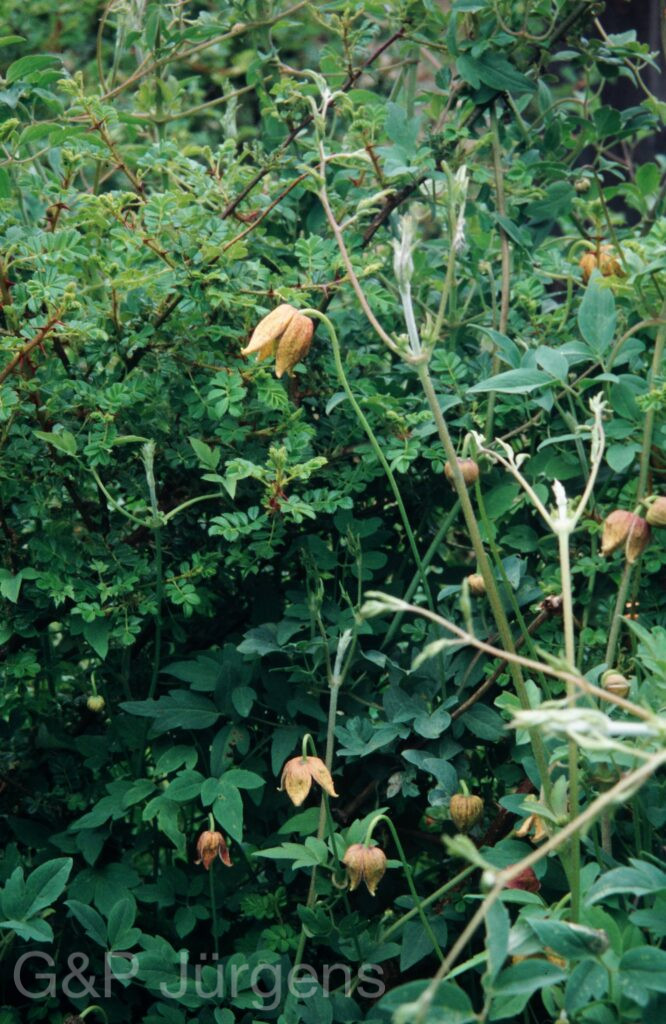
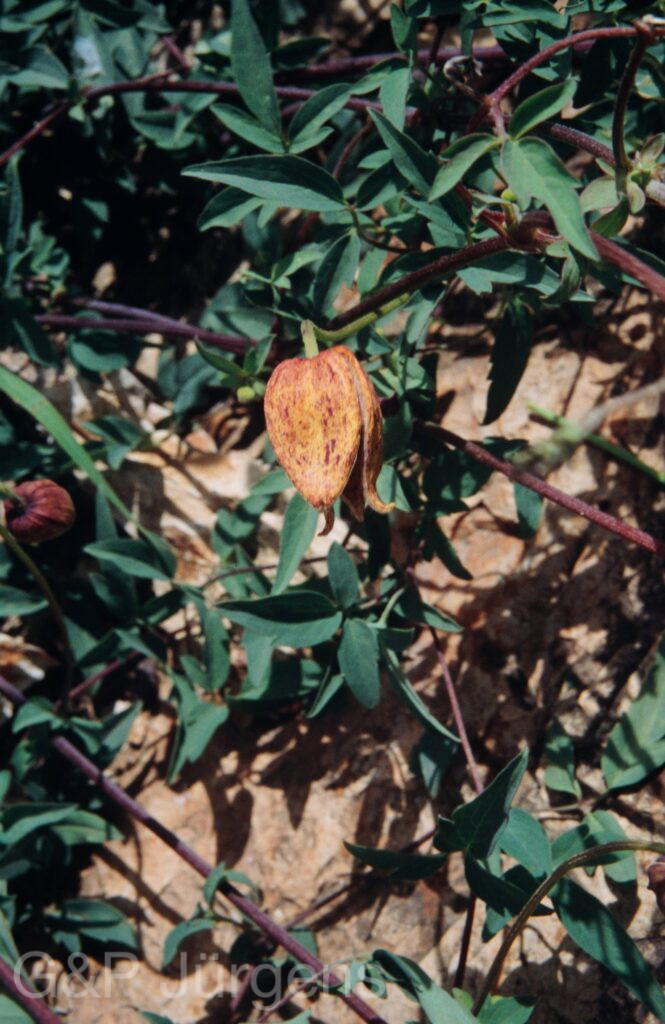
(C.E.C.Fisch.) Grey-Wilson

Nepal 99 712 ergebnis
West-Nepal, Bauli-Khola 3500m, July
Nepal 99 713 ergebnis
West-Nepal, Bauli-Khola 3500m, July
Nepal 99 714 ergebnis
West-Nepal, Bauli-Khola 3500m, July

Description

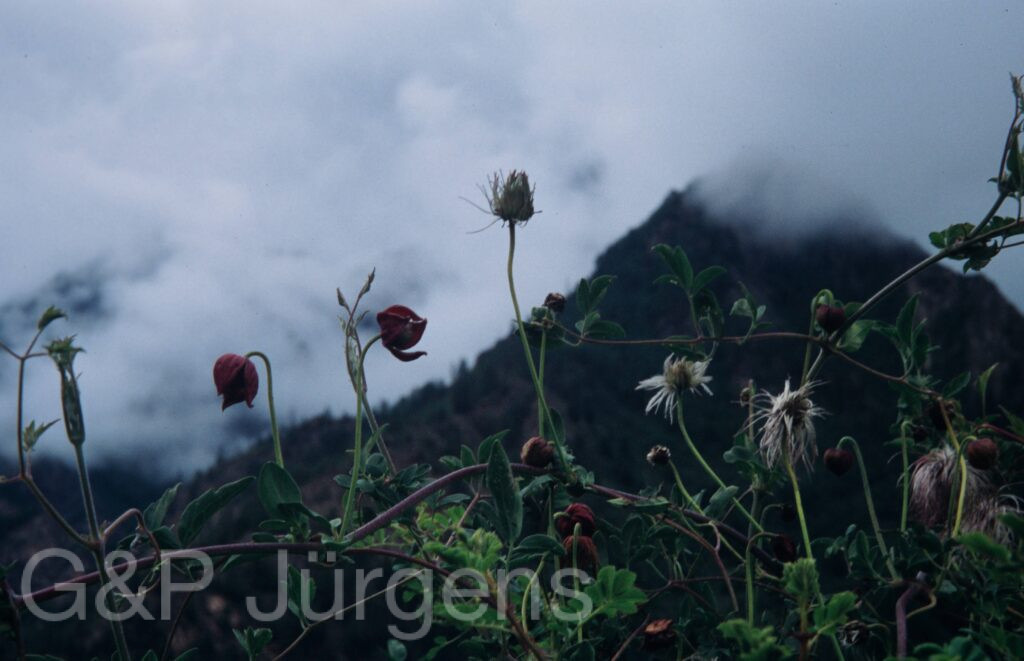
Clematis tibetana var. vernayi is a Himalayan and Tibetan climber recorded principally from China and Nepal among its roughly 289 occurrences, the records from New Zealand, the Netherlands, the United States and Canada reflecting its popularity in horticulture rather than a natural range, since this is the celebrated nodding yellow-flowered clematis widely cultivated in temperate gardens. In the wild it inhabits open subalpine and alpine slopes, scrub, rocky banks and dry valley sides, often scrambling over shrubs and boulders in well-drained, sunny situations. The photographed plant from the Bauli-Khola in West Nepal, at about 3500 m and flowering in July, is typical of its high-montane occurrence in the inner, drier Himalayan valleys.

It is a woody-based, semi-scandent perennial climbing by twining petioles, with deeply divided, pinnately compound leaves whose narrow leaflets are often lobed, toothed and somewhat glaucous, an adaptation to the dry, exposed habitat. The flowers are solitary, nodding and broadly campanulate to lantern-shaped, lacking true petals; the showy structures are four thick, leathery sepals coloured deep yellow, frequently flushed purple-brown outside, surrounding numerous stamens. The fruit is a head of achenes each bearing a long, conspicuously plumose persistent style, forming the silvery feathery seed-heads characteristic of the genus and aiding wind dispersal.

Clematis section Meclatis, the yellow-flowered Asian group to which this taxon belongs, has been studied in detail by Grey-Wilson, who recombined the variety; the thick-sepalled, glaucous, dry-habitat forms of the C. tibetana complex have long been valued by gardeners as the orange-peel clematis for their unusually substantial sepals. Ecologically the plumed achenes exploit wind for dispersal across open terrain. Widespread in the wild and abundant in cultivation, the variety is of no conservation concern, and its garden derivatives remain among the most familiar Himalayan contributions to ornamental horticulture.

Author: (C.E.C.Fisch.) Grey-Wilson · Sources: POWO (Kew), GBIF, Flora of China, Annotated Checklist of the Flowering Plants of Nepal, Grey-Wilson's monograph Clematis the Genus

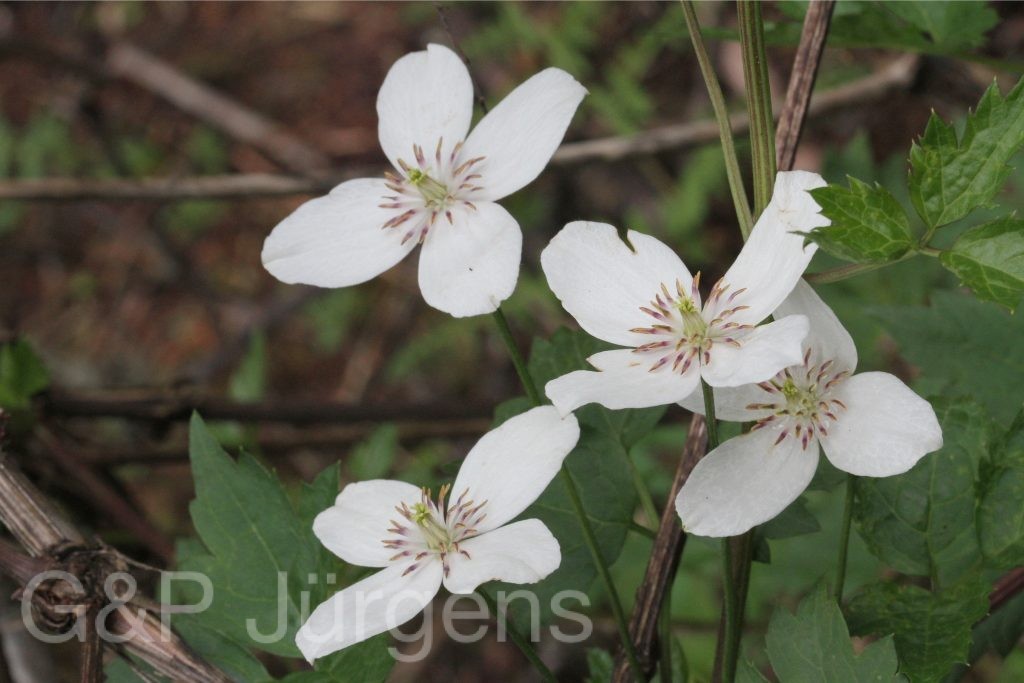
(Bruehl) Tamura

BhutanPG2011 157 5
Bhutan Tsochenchen, 3550m June

Description

Clematis tongluensis is a Himalayan climber recorded from Nepal, Bhutan, India, China and Myanmar, with additional cultivated or vouchered material noted from Canada; GBIF holds around 58 occurrences. It is a plant of temperate to subalpine forest, scrambling through shrubberies, over forest-edge thickets and along open slopes, generally between about 2700 and 3700 m. It was photographed at Tsochenchen in Bhutan at 3550 m in June, where it climbs through rhododendron and conifer woodland margins, flowering at the onset of the summer monsoon.

The species is a woody to semi-woody climber with ribbed, somewhat pubescent stems that twine and clamber by means of the petioles. The leaves are ternate to pinnate, the leaflets ovate to lanceolate, acuminate and serrate, often thinly hairy. The flowers, borne singly or in few-flowered cymes, are nodding and broadly campanulate, lacking true petals; the four (rarely more) thick, spreading to recurved sepals are usually creamy-white to pale yellow, sometimes flushed purplish, with tomentose margins. Numerous stamens surround the carpels, and the fruit is a head of achenes each bearing a long, plumose persistent style.

Clematis tongluensis sits within the bell-flowered Sino-Himalayan groups of the genus, allied to the Montanae and related sections, and has at times been treated under or confused with the variable C. montana complex. Its nodding campanulate flowers and montane forest habitat are diagnostic. The species is fairly widely distributed and faces no recognised conservation threat, though it depends on the persistence of intact temperate broad-leaved and coniferous forest.

Author: (Bruehl) Tamura · Sources: POWO (Kew), GBIF, Flora of Bhutan, Flora of China, A Revision of the Genus Clematis (Grey-Wilson), Annotated Checklist of the Flowering Plants of Nepal

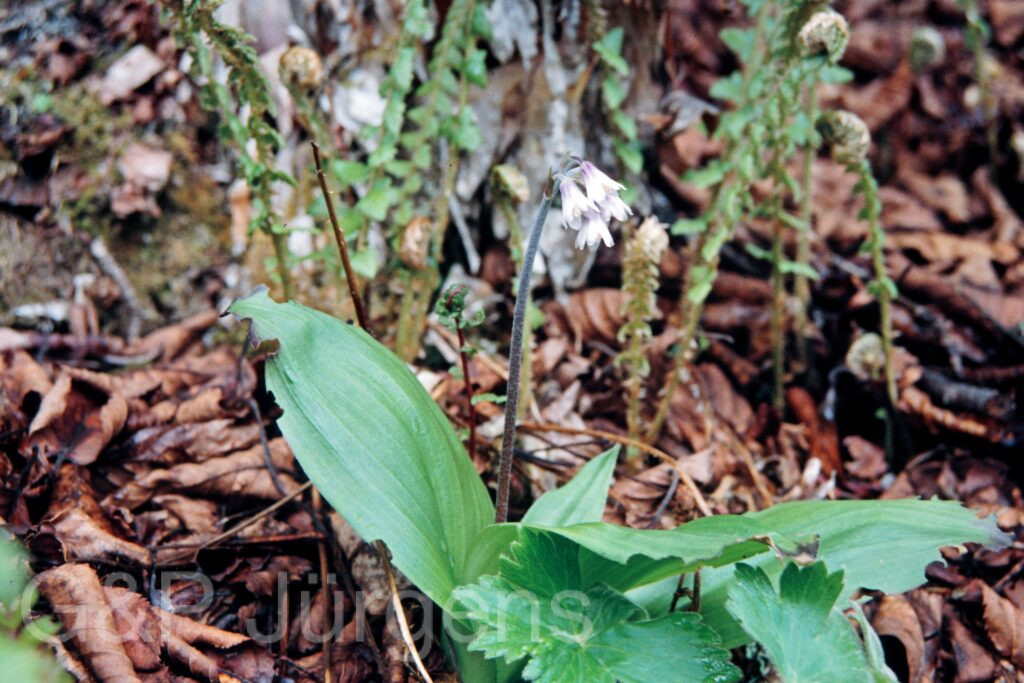
Trautv. & C.A.Mey.

Nepal 99 154 ergebnis
West-Nepal South of Rara-Lake 3500m, June

Description

Clintonia udensis is a woodland perennial with a remarkably wide East Asian to Himalayan distribution, recorded from China, Japan, Russia (Far East), Korea, Nepal, India, Bhutan, Myanmar and Pakistan, with over 3800 GBIF occurrences across this temperate arc. It is a shade-loving plant of moist, humus-rich coniferous and mixed forests, fir and rhododendron understorey, bamboo thickets and damp shaded gullies, typically between about 2500 and 4000 m in the Himalaya. The plant photographed south of Rara Lake in West Nepal at 3500 m in June, flowering as the high forests emerge from winter, exemplifies its preference for cool, sheltered subalpine forest floors where deep leaf litter retains moisture.

The species arises from a short, creeping rhizome and produces a basal rosette of two to five broadly elliptic to oblong-obovate leaves that are conspicuously parallel-veined, entire and ciliate at the margin, sheathing at the base. A leafless scape rises above the foliage bearing a terminal raceme of a few nodding, campanulate flowers. The six white tepals are oblong and free, subtending six stamens with linear anthers, and the superior ovary matures into a fleshy, ellipsoid to ovoid berry that ripens from green to a deep blue-black, containing several seeds and crowned by the persistent style base.

Clintonia is a small Holarctic genus of about five species traditionally placed in the Liliaceae and treated by some authors within an expanded Convallariaceae or Uvulariaceae. C. udensis is the sole Asian representative and the only one with white flowers and a black berry, the remaining species being North American. Its disjunct amphi-Pacific generic distribution is a classic example of the East Asian–North American floristic link. The berries are dispersed by birds, and the species is widespread and common; it is of no particular conservation concern.

Author: Trautv. & C.A.Mey. · Sources: POWO (Kew), GBIF, Flora of China Vol. 24, Flora of Bhutan Vol. 3, Flora of Nepal, A Monograph of the Genus Clintonia (Liliaceae)

Hook.f. & Thomson

Sikkim2003 425 G591
Sikkim Chopta Valley 4250m August

Description

Codonopsis foetens is an alpine herb of the eastern Himalaya, distributed across China, Bhutan, India, Myanmar and Nepal, with about 712 georeferenced records in GBIF. It occupies high-elevation meadows, alpine scrub, screes and rocky slopes, typically between roughly 3500 and 4800 m. The plant illustrated was photographed in Sikkim's Chopta Valley at 4250 m in August, during the monsoon flowering season, where it grows among dwarf rhododendron scrub and damp alpine turf in the upper subalpine to alpine zone.

The species is an erect to ascending perennial herb arising from a thickened root, with simple or sparingly branched stems bearing small, scattered, ovate to lanceolate leaves. The flowers are solitary and terminal, nodding, with a broadly campanulate corolla that is pale blue to greyish-blue or violet and conspicuously marked internally with darker veins or blotches. The five corolla lobes are short and the throat often bears coloured patterning; the fruit is a capsule subtended by the persistent calyx lobes and releasing numerous minute seeds at maturity.

Codonopsis (Campanulaceae) is well diversified in the Sino-Himalayan alpine flora, and as the epithet foetens indicates, this species emits a strong, unpleasant odour when the foliage is bruised, a trait shared with several relatives and thought to deter herbivores while attracting particular insect visitors. The pendent bell-shaped flowers are pollinated chiefly by bumblebees. Restricted to high alpine habitats, C. foetens is not formally assessed as threatened but is dependent on intact alpine vegetation and is potentially sensitive to grazing pressure and climate-driven shifts in the alpine belt.

Author: Hook.f. & Thomson · Sources: POWO (Kew), GBIF, Flora of China, Flora of Bhutan, Annotated Checklist of the Flowering Plants of Nepal, Hong Monograph of the Genus Codonopsis