Tag:

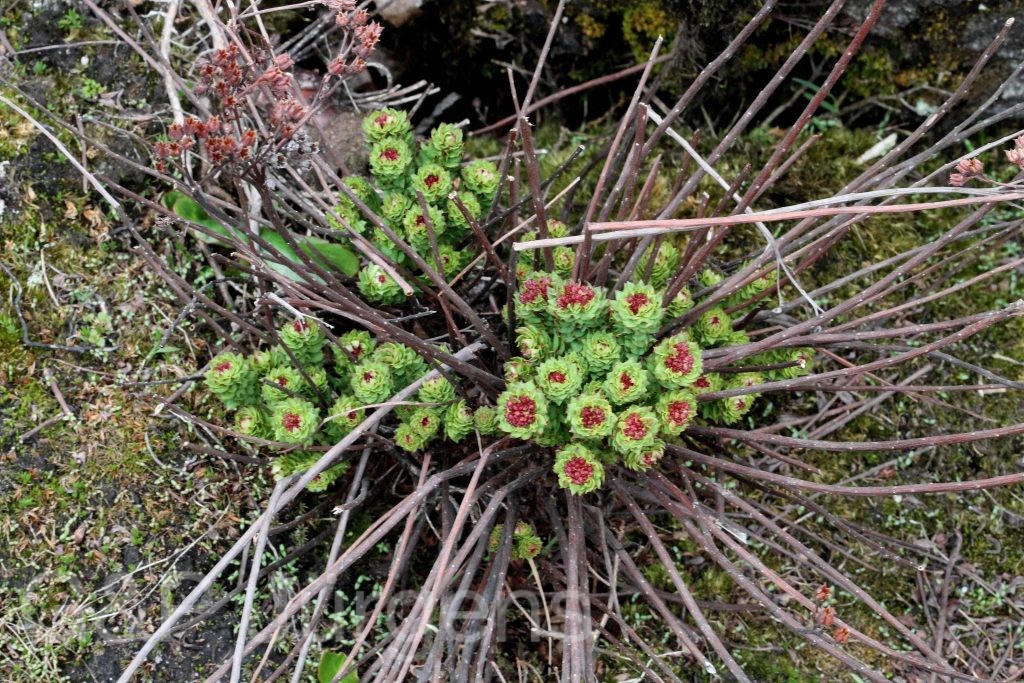
Autumn

Royle

Garw 2005 324 ergebnis
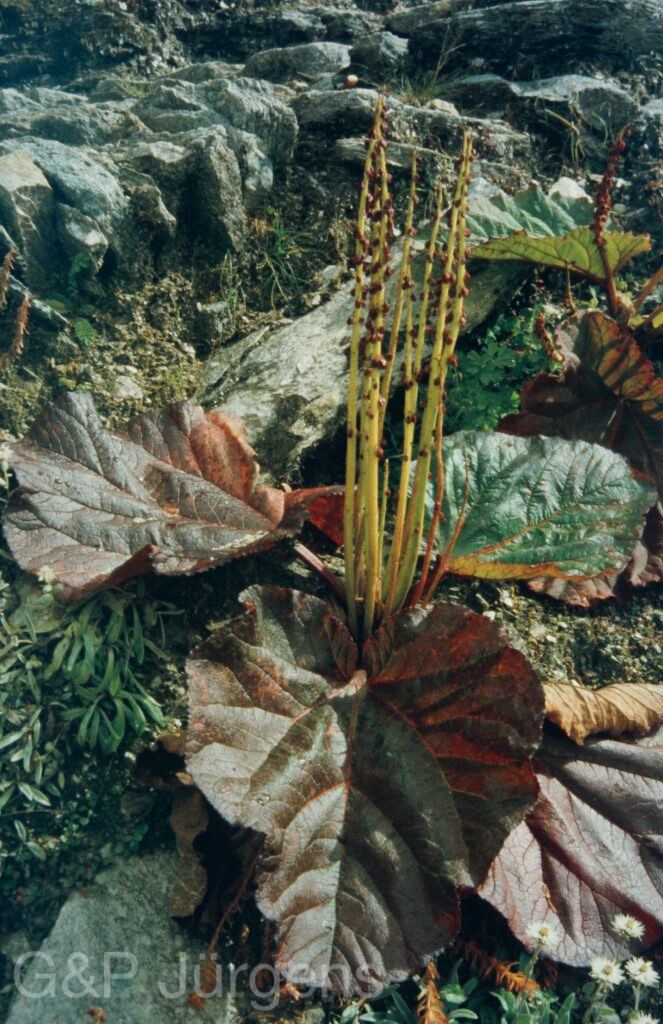
India Garhwal Bagubasa 4100m, September

Description

Rheum moorcroftianum is a high-alpine rhubarb of the Western and Central Himalaya, ranging from Pakistan and Kashmir eastward through the Indian Himalaya (including Garhwal) and Nepal to the Tibetan plateau of China; GBIF records 129 occurrences across China, Nepal and India (with stray data points). It is a plant of open alpine slopes, screes, stabilised moraines, glacial flats and grazed meadows generally between 3500 and 5000 m, where it withstands intense insolation, drought and a short growing season. The illustrated specimen from Bagubasa in Garhwal at 4100 m in September shows the plant in its post-flowering, fruiting state at the close of the alpine summer.

It is a low, stout, often almost stemless perennial herb developing from a thick woody rhizome and tap-root. The conspicuous radical leaves form a flattened rosette and are orbicular to ovate-cordate, leathery, the blade prominently reticulate-veined and frequently flushed red or with reddish margins and undersides; petioles are short and stout. The inflorescence is a congested, scapose panicle scarcely exceeding the leaves, bearing numerous small flowers with usually six greenish to reddish perianth segments. The fruit is a broadly winged trigonous achene, the three membranous wings reddish-tinged and conspicuously veined, an adaptation aiding wind and surface dispersal across open terrain.

The species belongs to Rheum (Polygonaceae), a genus centred on the high mountains of Central Asia and the Sino-Himalaya. Its dwarf, ground-hugging rosette habit is a classic adaptation to the cold, windswept alpine environment, contrasting with the giant "glasshouse" rhubarbs such as R. nobile. Like other Himalayan Rheum it is locally harvested for medicinal roots and is subject to grazing pressure, but its wide range and remote habitat mean it is not currently considered threatened.

Author: Royle · Sources: POWO (Kew), GBIF, Flora of China Vol. 5, Flora of Pakistan, Flora of Nepal, A Revision of the Genus Rheum (Losina-Losinskaja)
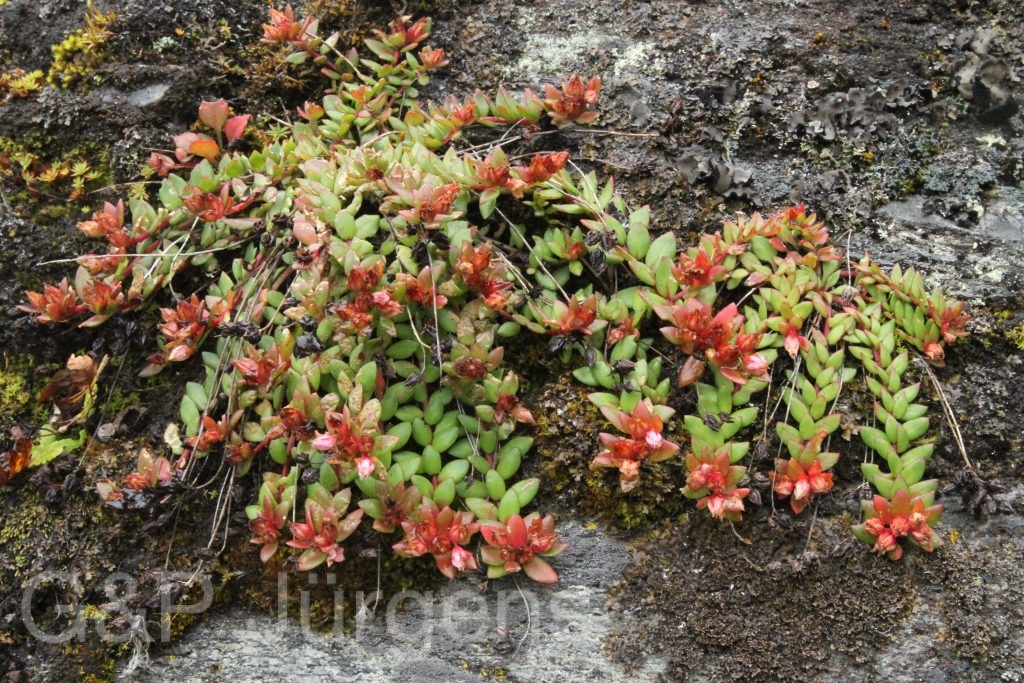
(D. Don) Fu

Garw 2005 349 ergebnis
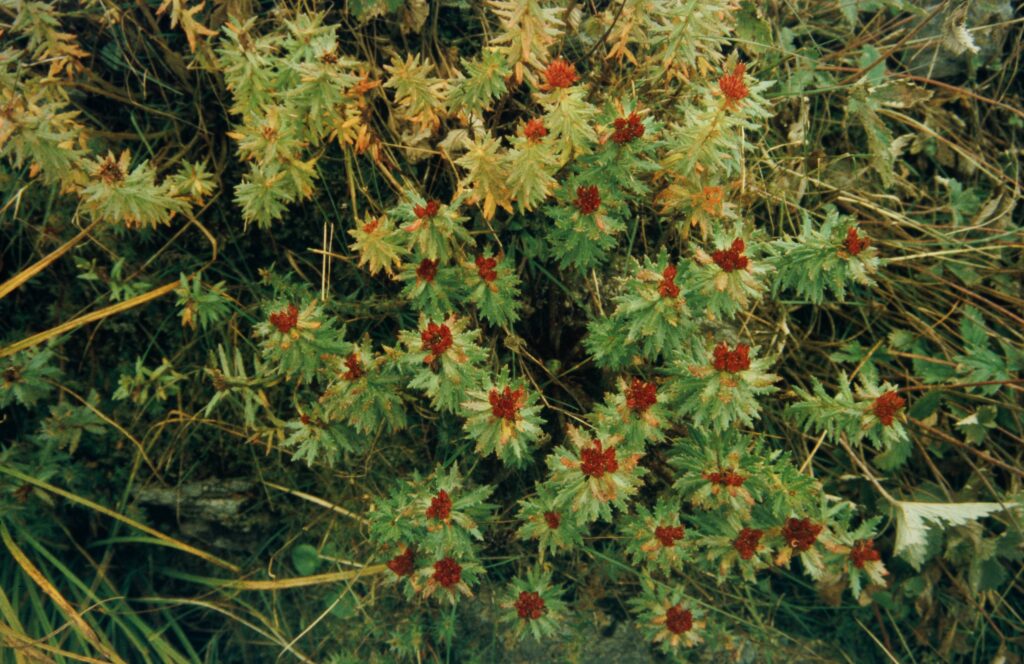
Garhwal Pataathi 4150 m, September
Bh09 132 P231
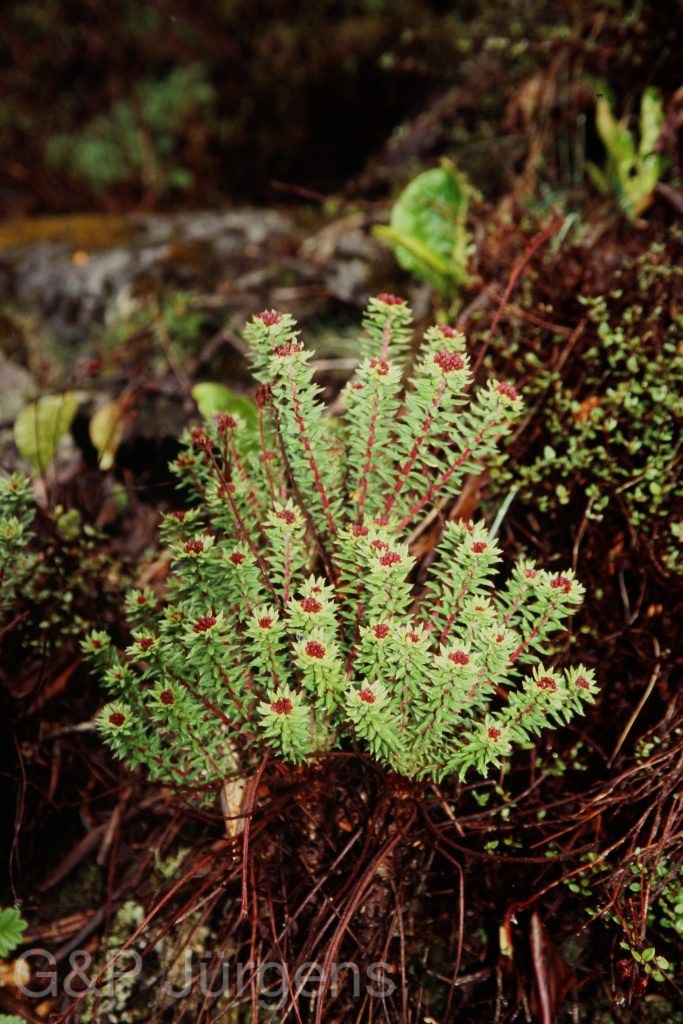
Bhutan Jimilangtso 4050m, June
Sikkim2011 292
Sikkim Lada-La 4000m, June

Description

Rhodiola himalensis is a characteristic high-alpine succulent of the Himalaya and adjacent Sino-Himalayan mountains, documented by some 562 georeferenced records from Nepal (NP), China (CN), India (IN), Bhutan (BT), Pakistan (PK) and Mongolia (MN), with a peripheral record in Japan (JP). It occupies the alpine zone, broadly between 3500 and 5000 m, on rocky slopes, screes, grassy alpine meadows, stream banks and moist ledges. The collections cited from Pataathi in Garhwal at 4150 m, Jimilangtso in Bhutan at about 4050 m and Lada-La in Sikkim at 4000 m, flowering between June and September, illustrate its broad occurrence across the central and eastern Himalaya at consistently high elevation.

It is a perennial herb arising from a stout, scaly, branched caudex topped by a fleshy rootstock. The flowering stems are erect to ascending and clothed with numerous, spreading, flat, sessile leaves; these are oblong-lanceolate to elliptic, fleshy, entire to minutely toothed, and often somewhat glaucous. The species is dioecious, the small flowers gathered into a dense terminal corymb; the staminate flowers are dark red to purplish with four parts and eight stamens, while the pistillate flowers develop into clusters of erect, dark red to purplish follicles bearing numerous minute seeds. The dark, often blackish-purple inflorescence colour is a notable field character.

Rhodiola (Crassulaceae), segregated from Sedum, comprises cold-adapted, perennating CAM succulents whose persistent woody caudex enables survival of harsh alpine winters and short growing seasons. R. himalensis, like several congeners, is gathered for use in Tibetan and Himalayan traditional medicine, contributing to localised harvesting pressure. The species remains widespread and is not formally threatened, though slow regeneration makes high-altitude Rhodiola populations vulnerable to sustained overcollection.

Author: (D. Don) Fu · Sources: POWO (Kew), GBIF, Flora of China, Flora of Bhutan, Annotated Checklist of the Flowering Plants of Nepal, Ohba monographic studies of Himalayan Crassulaceae (Rhodiola)

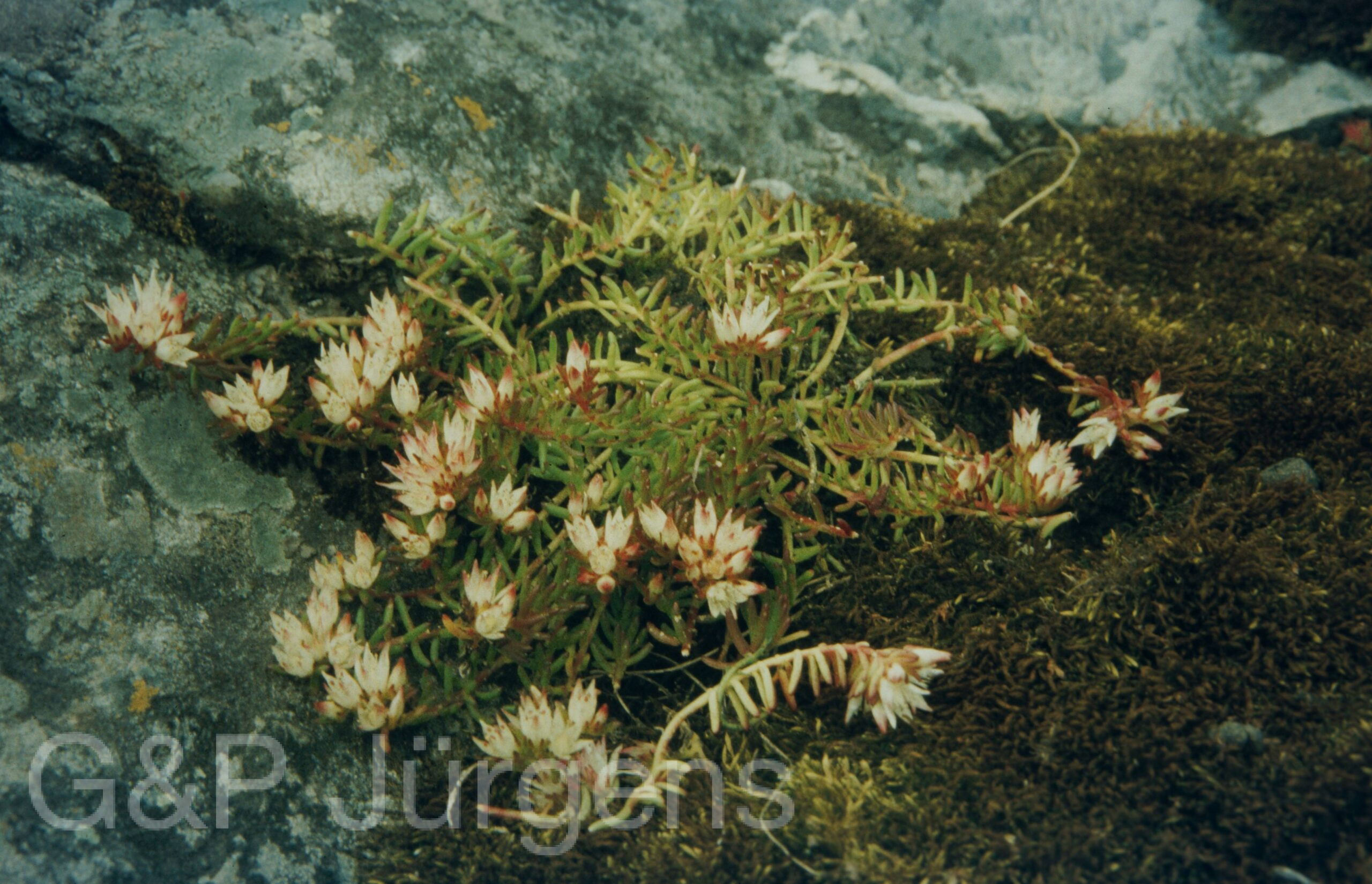
(Prain ex Raym.-Hamet) S.H.Fu

Bhutan2012 88
Bhutan Chele La 4150m, September

Description

Rhodiola hobsonii is an alpine succulent perennial of the eastern Himalaya and adjacent southwestern China, recorded from Bhutan, northern India (Sikkim, Arunachal), Nepal and the Chinese provinces of Xizang and Yunnan; GBIF holds about 101 records. It inhabits open stony slopes, gravelly screes, rock crevices and short alpine turf, generally between about 3800 and 5000 m, enduring intense insolation and a brief growing season. The photographed plant was collected at the Chele La pass in western Bhutan at around 4150 m in September, on the well-drained, frost-disturbed substrates it occupies near the upper limit of vascular plant growth.

The plant arises from a stout, woody, persistent caudex crowned by the scaly remains of old leaf bases, from which several short, fleshy, erect or ascending flowering stems develop. The leaves are alternate, sessile, succulent, oblong to obovate, entire or sparingly toothed toward the apex, and rather densely set. The inflorescence is a compact terminal cyme; the species is dioecious, the flowers four- or five-merous and dull purplish-red, the petals narrow. The fruit comprises several erect follicles that split to release minute seeds.

Rhodiola (Crassulaceae) is a large genus of cold alpine and arctic regions, segregated from Sedum by its perennial woody caudex and predominantly dioecious flowers. R. hobsonii belongs to the diverse Sino-Himalayan assemblage of the genus, many members of which are rich in rosavins and salidroside and used in regional traditional medicine. Restricted to high elevations, it is naturally localised but not currently assessed as threatened, though such cushion-zone specialists are vulnerable to warming.

Author: (Prain ex Raym.-Hamet) S.H.Fu · Sources: POWO (Kew), GBIF, Flora of China Vol. 8, Flora of Bhutan Vol. 1, Flora of Nepal, Flora of Pakistan, Ohba monograph of Himalayan Sedoideae and Rhodiola

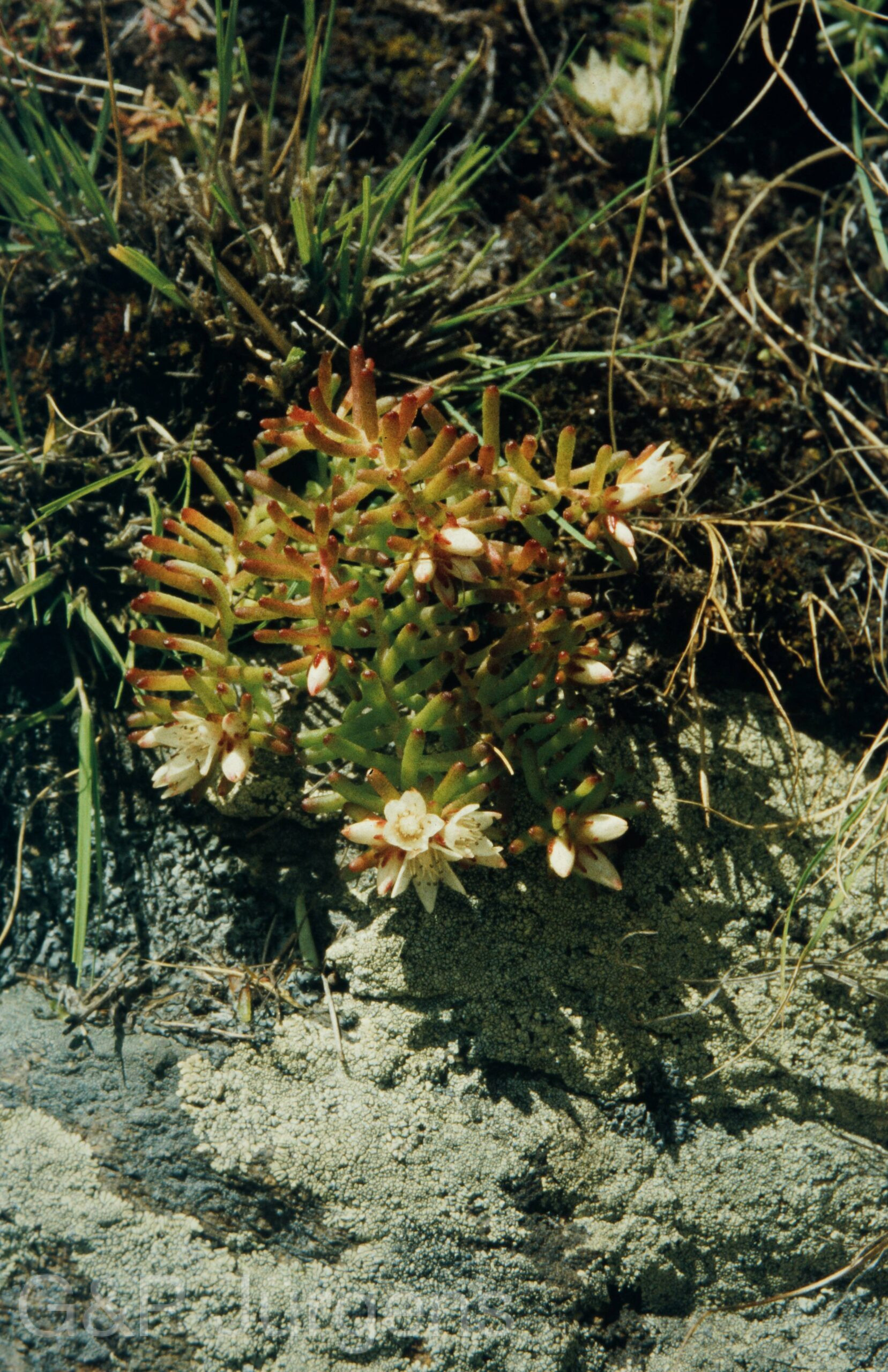
(Hook. f. & Thomson) Fu

Bhutan2012 88
Bhutan Shele-La, 4100m September

Description

Rhodiola humilis is a dwarf high-alpine stonecrop of the Himalaya and adjacent China, recorded from south-central China (Xizang), the Indian Himalaya, Nepal and Bhutan, with around one hundred GBIF occurrences (a few extra-Himalayan records being cultivated or misattributed). It inhabits the highest open habitats, including alpine screes, rock crevices, gravelly slopes and the stony margins of the upper alpine zone, generally well above 4000 m. The photographed plant from the Shele-La in Bhutan at 4100 m, flowering in September, exemplifies its preference for exposed, frost-prone, mineral-rich substrates near the upper limit of vascular plant life.

The species is a small, glabrous, cushion- or mat-forming perennial succulent arising from a stout, branched, persistent caudex clothed in old leaf bases. The numerous short flowering stems bear crowded, small, fleshy, linear to oblong leaves with entire margins. The inflorescence is a compact terminal cyme of few flowers; as is typical of Rhodiola the plants are usually dioecious, with four- to five-merous flowers, the petals reddish, purplish or greenish, and the carpels erect, becoming spreading, beaked follicles at maturity that release minute seeds.

The GBIF backbone treats this name as doubtful, but it is here treated under the accepted name Rhodiola humilis within Rhodiola (Crassulaceae, subfamily Sempervivoideae), a genus segregated from Sedum and centred on the high mountains of Asia. Its succulent caudex, dwarf cushion form and crassulacean physiology are adaptations to drought, cold and intense radiation at extreme altitude. Like many Rhodiola, it may be gathered for traditional medicinal use; though not formally assessed, its slow growth and harvesting pressure suggest caution.

Author: (Hook. f. & Thomson) Fu · Sources: POWO (Kew), GBIF, Flora of China, Flora of Bhutan, Ohba monograph of Himalayan Sedoideae/Rhodiola (Crassulaceae)

(Royle ex Edgew.) Fu

Description

Rhodiola sinuata (Royle ex Edgew.) Fu is a high-altitude succulent perennial of the Himalaya, recorded from India, Nepal, Bhutan, Pakistan and adjacent China, with comparatively few collections (GBIF lists about 349 occurrences, the European and Central Asian points representing herbarium or database artefacts rather than native range). It grows on rock ledges, cliff crevices, stony slopes and moist alpine turf, generally between 3,000 and 4,500 m. The illustrated plant was gathered in the Indian Garhwal Himalaya near Tali at 3,100 m in September, when the inflorescences are maturing and the foliage takes on autumnal reddish tints.

The plant arises from a stout, woody, perennating rhizome (caudex) crowned with scarious scale-leaves, from which spring several erect to ascending leafy flowering stems. The cauline leaves are alternate, sessile, fleshy, oblong to obovate, with a characteristically sinuate-dentate to coarsely toothed margin. The flowers are small and clustered in a dense terminal corymbose cyme; the species is typically dioecious, with 4- or 5-merous flowers bearing narrow yellowish to greenish-yellow petals, the staminate flowers with exserted stamens. The fruit is a cluster of erect follicles releasing minute seeds.

Rhodiola (Crassulaceae) comprises the Asian-alpine "roseroots" formerly placed in Sedum, distinguished by their thick perennial rhizome and frequently unisexual flowers. Like its congeners, R. sinuata accumulates phenylpropanoid glycosides in the rootstock and is gathered in Himalayan folk medicine, a pressure that, with grazing, warrants monitoring although the species is not formally assessed. Its restricted Sino-Himalayan distribution reflects adaptation to cold, exposed, high-elevation rock habitats.

Author: (Royle ex Edgew.) Fu · Sources: POWO (Kew), GBIF, Flora of China, Flora of Pakistan, Annotated Checklist of the Flowering Plants of Nepal, Ohba monograph of Himalayan Sedoideae, Hooker Flora of British India

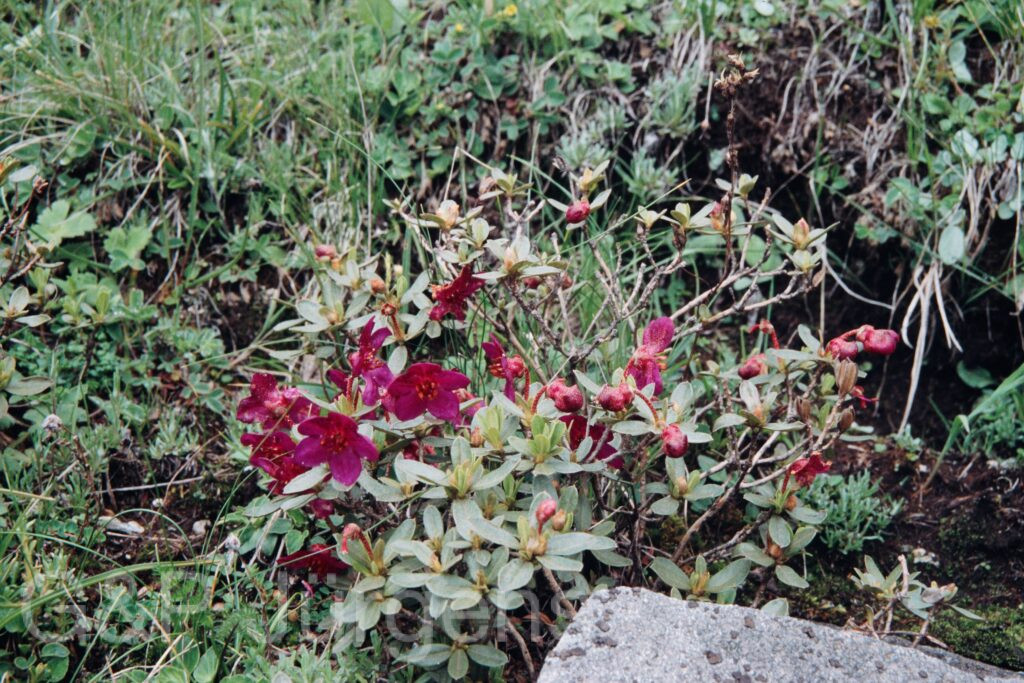
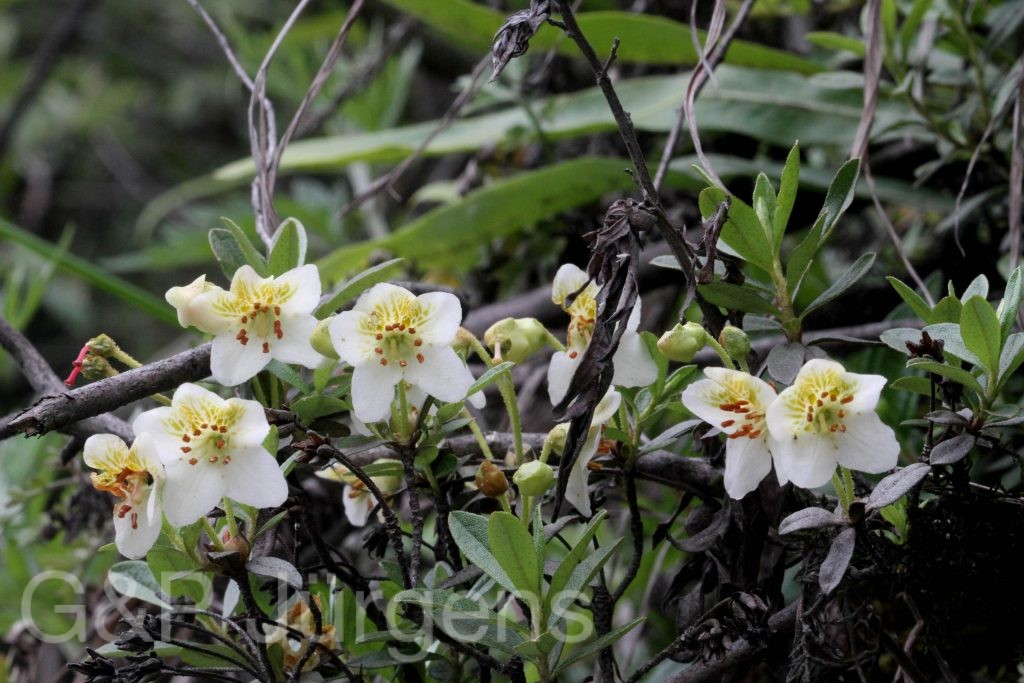
Hook.f.

Nepal 95 386 P685 ergebnis
Nepal Bahanjyang 3800m October
Nepal 95 424 P738 ergebnis
Nepal Bahanjyang 3800m October
BhutanPG2011 629 01
Bhutan Ludlow-Sherriff-Trail Ken-La, 4300m July
BhutanPG2011 620 scaled
Bhutan Ludlow-Sherriff-Trail Ken-La, 4300m July
Nepal 99 548 ergebnis
West-Nepal Churta-Khola, 3800m June
Sikkim2011 183
Sikkim Lachung 2650m, June

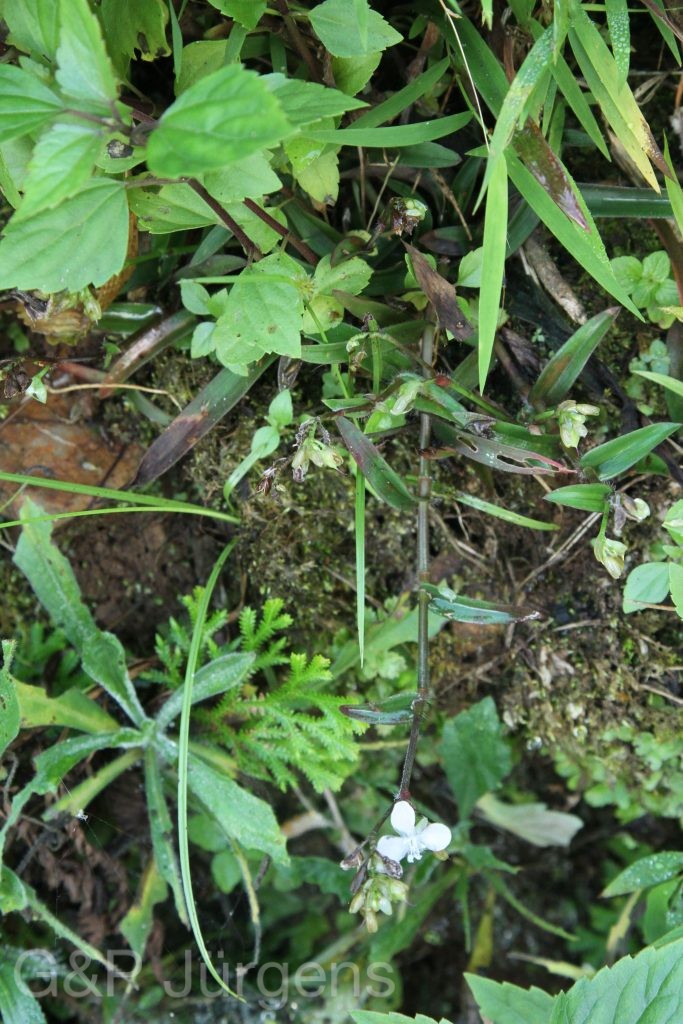
(Blume) Faden

Bhutan2015 254
Bhutan Zhemgang 910m, October

Description

Rhopalephora scaberrima is a tropical to subtropical spiderwort widely distributed across South and Southeast Asia, recorded from India, Nepal, Bhutan, Bangladesh, Sri Lanka, Myanmar, Thailand, Malaysia, Indonesia, the Philippines, Vietnam, southern China and Taiwan. Its GBIF profile, with about 1,104 occurrences spanning these countries, confirms a broad Indomalayan range. The plant illustrated was photographed in southern Bhutan at Zhemgang at about 910 m in October. It is a species of warm, humid lowland and lower-montane settings, growing in forest understorey, along shaded streambanks, in moist grassy clearings and on disturbed roadsides, generally below about 1,500 m where high rainfall and warmth prevail.

It is a perennial, somewhat straggling herb with ascending to decumbent stems that root at the lower nodes, the surfaces and leaf-sheaths conspicuously scabrid-hispid, as the epithet indicates. The leaves are alternate, ovate-lanceolate to elliptic, with a closed sheathing base and an acuminate apex. The flowers are borne in small scorpioid cymes aggregated into a terminal panicle; each has three free sepals and three blue to violet petals, with the androecium showing the differentiation characteristic of the family, the fertile stamens separated from reduced staminodes. The fruit is a small loculicidal capsule, distinctively two-locular with the seeds arranged in two rows, a key feature separating Rhopalephora from related genera.

The genus Rhopalephora was segregated from the broadly defined Aneilema and Commelina on the basis of its bilocular capsule, biseriate seeds and stamen architecture, as clarified in Faden's revisionary work. As a common and adaptable plant of disturbed humid habitats, R. scaberrima is not threatened and serves as a useful indicator of warm, moist forest edge in the eastern Himalayan foothills.

Author: (Blume) Faden · Sources: POWO (Kew), Flora of China Vol. 24, Flora of Bhutan Vol. 3, GBIF, Faden: Commelinaceae (revisionary studies)

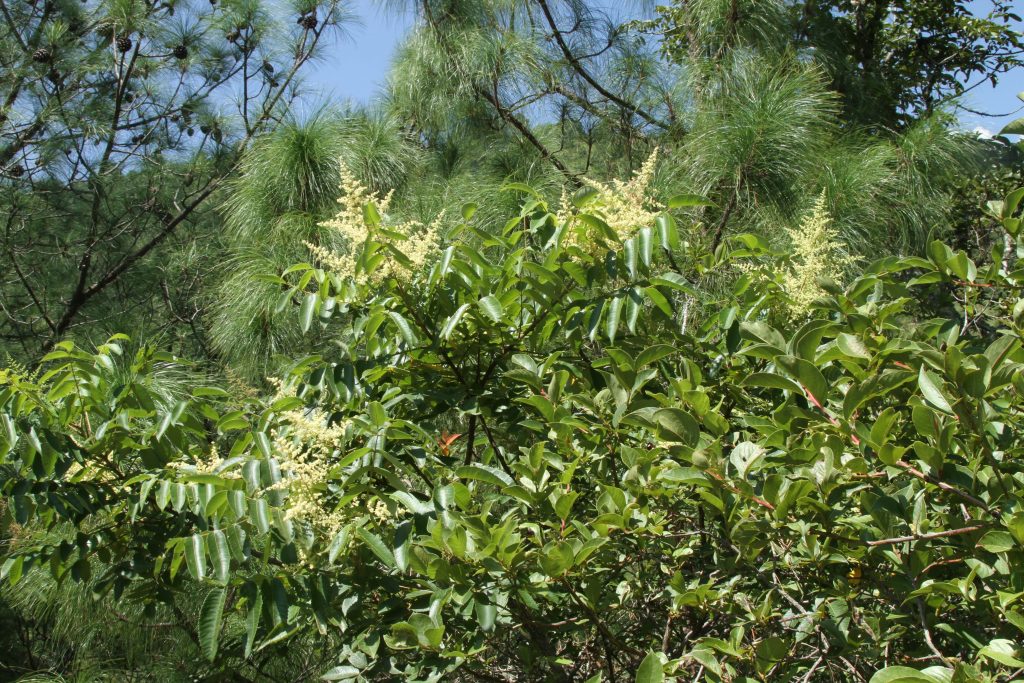
Mill.

Bhutan2012 535
Bhutan Wangdi 2600m, September
Bhutan2015 252
Bhutan Zhemgang 900m, October

Description

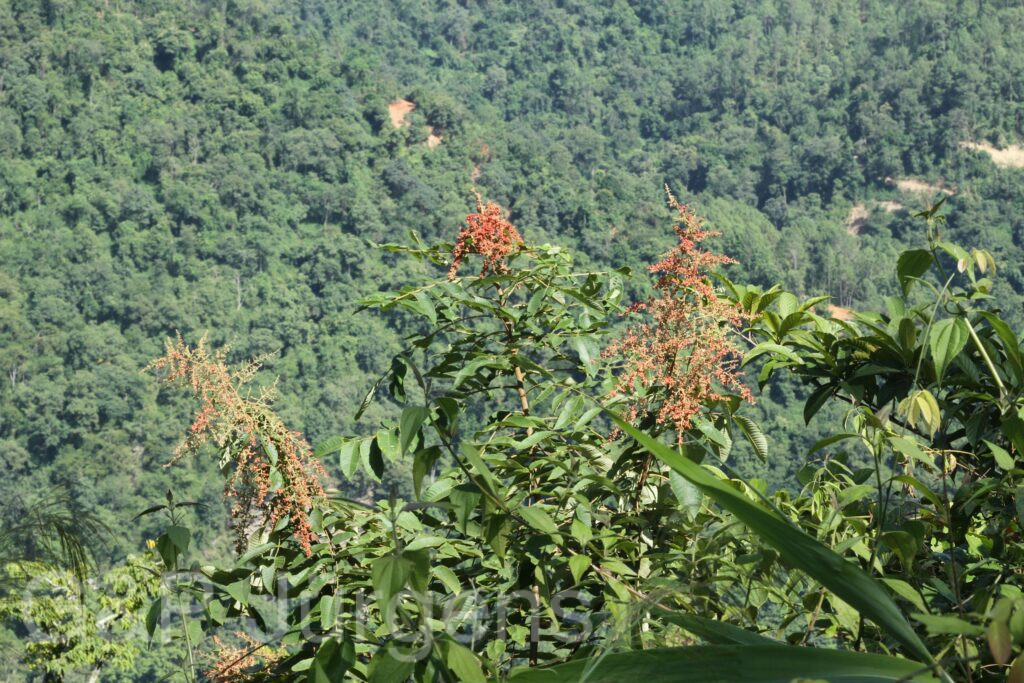
Rhus chinensis is a widespread deciduous shrub or small tree of East and South Asia, recorded across China, Taiwan, Japan, Korea, India, Vietnam, Thailand, Myanmar, Nepal, Bhutan and beyond, with more than ten thousand documented occurrences making it one of the most frequently collected sumacs in the region. It is a pioneer of open and disturbed ground, colonising forest margins, clearings, roadsides, scrub and abandoned cultivation from the lowlands into the montane zone. In Bhutan it ranges over a wide elevational band, as shown by collections near Wangdi at about 2600 m in September and at Zhemgang at 900 m in October, the autumn dates corresponding to fruiting.

The plant is a shrub to small tree with greyish bark and stout, often warted branchlets. The leaves are alternate and odd-pinnate, the rachis characteristically winged between the leaflets; the leaflets are ovate to oblong, coarsely serrate, acuminate, and tomentose beneath, turning red in autumn. The inflorescence is a large terminal pubescent panicle of numerous small whitish to greenish-yellow flowers, the plant functionally dioecious. The fruit is a small, flattened, reddish drupe covered with short hairs and a sour, salty surface bloom.

Rhus chinensis is the principal host of the Chinese sumac aphid Schlechtendalia chinensis, whose feeding induces large hollow leaf galls extraordinarily rich in tannins; these galls, known as Chinese galls or wubeizi, are harvested as a major commercial source of gallotannic acid and are valued in traditional medicine and dyeing. Wax from the fruit and the tannin-laden tissues have long been utilised economically. Hardy, fast-growing and broadly tolerant of disturbance, the species is abundant throughout its range and faces no conservation concern, functioning ecologically as an early-successional colonist.

Author: Mill. · Sources: POWO (Kew), GBIF, Flora of China Vol. 11, Flora of Bhutan Vol. 2, Flora of Nepal, Flora of Pakistan, Min & Barfod treatment of Anacardiaceae

Blume

Bhutan2012 983
Bhutan Trithangebe 1100m, October
Bhutan2012 984
Bhutan Trithangebe 1100m, October

Description

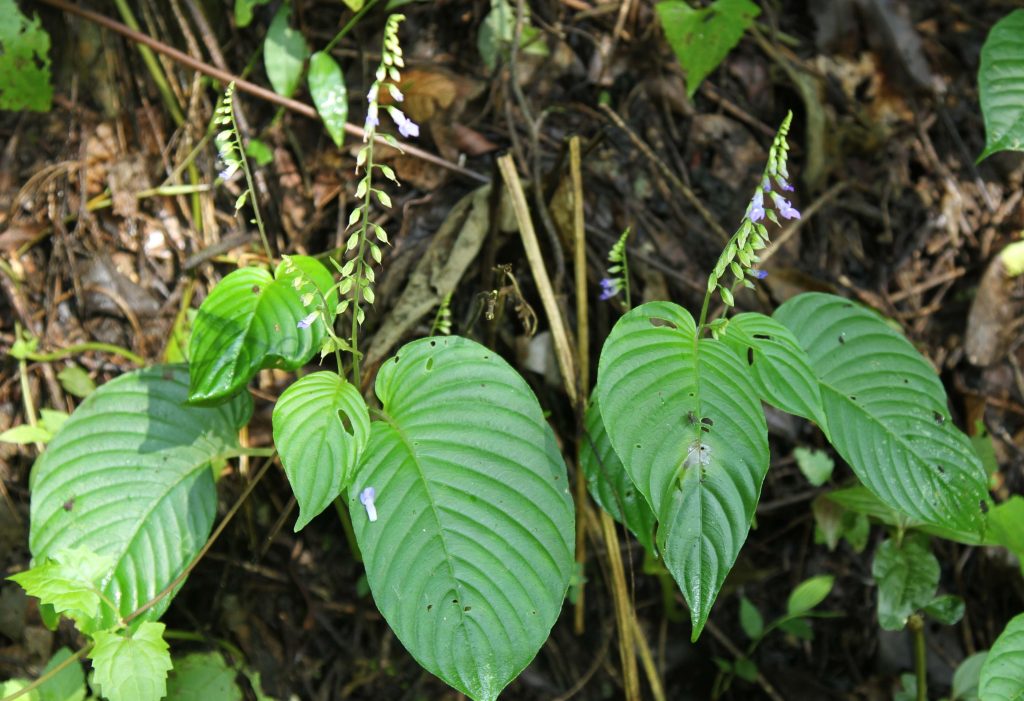
Rhynchoglossum obliquum is a widespread tropical Asian gesneriad ranging from India, Nepal, Bhutan and Bangladesh through Myanmar, Thailand, southern China, Taiwan and the Malesian region (Malaysia, Indonesia, Philippines, New Guinea, Timor) to Indochina, with more than 2200 GBIF occurrences. It is an annual herb of moist, shaded habitats on forest floors, damp rock faces, stream banks and roadside cuttings in the subtropical to tropical lowland and lower-montane zone. The plant recorded at Trithangebe in southern Bhutan at 1100 m, flowering in October at the close of the monsoon, typifies its occurrence on humid, shaded ground at low to mid elevations.

It is a soft, erect annual with succulent, often translucent stems. The leaves are markedly asymmetric (oblique) at the base, ovate to ovate-lanceolate, membranous and entire to obscurely toothed, the strong inequilaterality reflected in the epithet and frequently arranged so that the lamina appears one-sided. The flowers are borne in slender, secund, one-sided terminal racemes; each has a tubular, winged or keeled calyx and a small two-lipped blue to violet corolla with a short tube, the lower lip often marked white. There are two fertile stamens, and the superior ovary ripens into a small ellipsoid capsule enclosed by the persistent calyx, releasing numerous minute seeds.

The input places the species in the subtribe Loxonieae (here as Loxodinae) within Gesneriaceae, where Rhynchoglossum is distinguished by its oblique leaves and secund racemes. Its small bilabiate flowers are insect-pollinated and the dust-like seeds dispersed by rain-wash, aiding colonisation of disturbed shaded ground. As a widespread weedy annual it is of no conservation concern.

Author: Blume · Sources: POWO (Kew), GBIF, Flora of China Vol. 18, Flora of Bhutan Vol. 2, Flora of Nepal, The Gesneriaceae of the Old World (Rhynchoglossum)

Sm.

Nepal 95 114 P202 ergebnis
Nepal south of Rupien La 3200m October
Nepal 99 909 ergebnis
Nepal Sepka 2760 m, JUly

Description

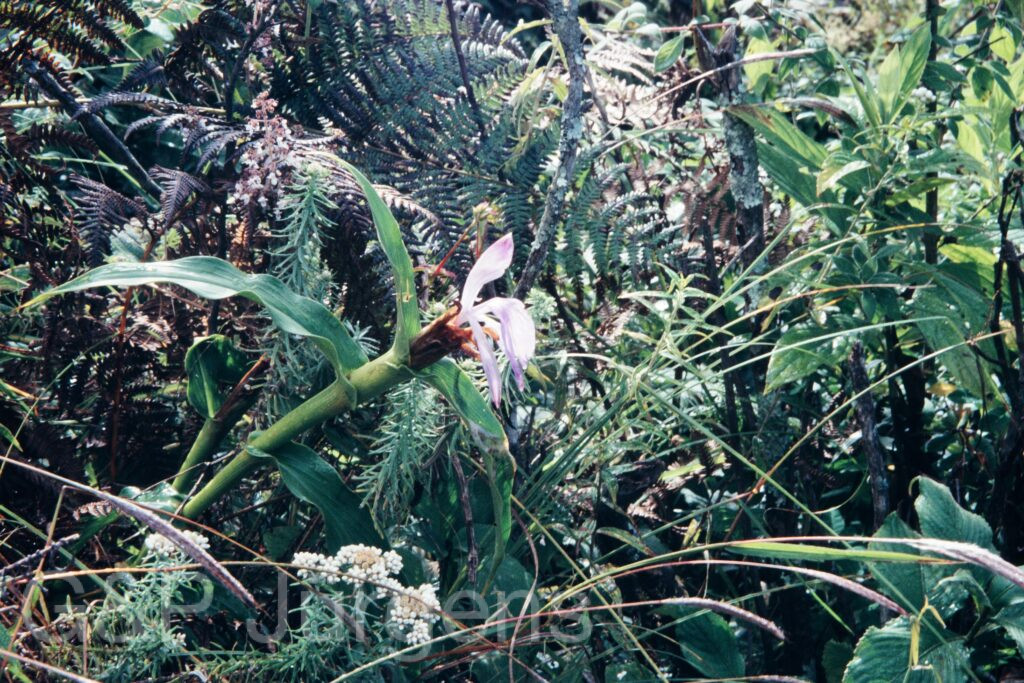
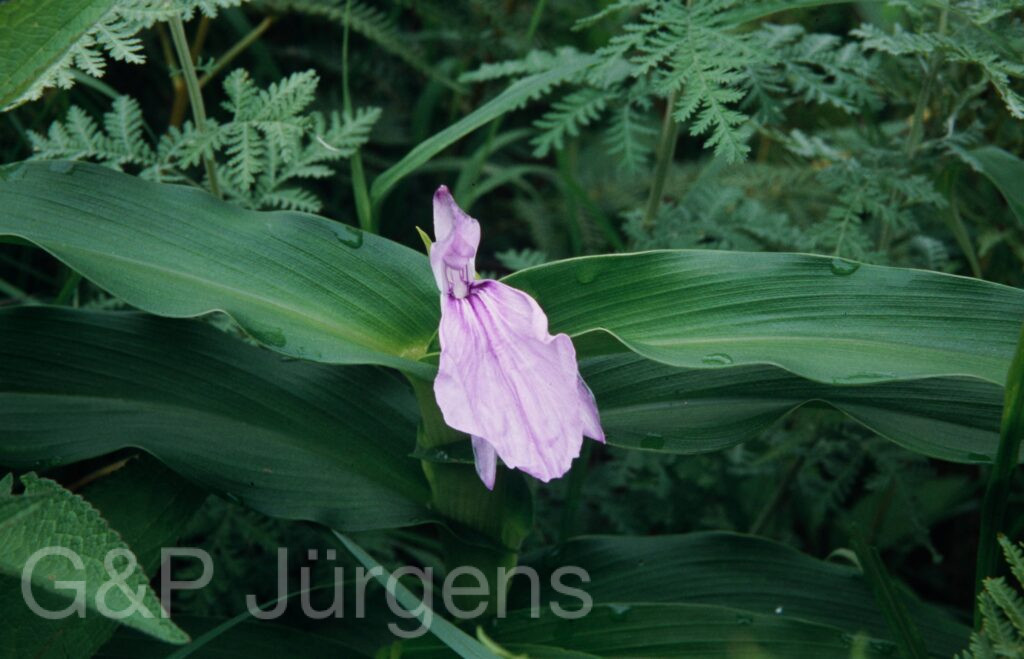
Roscoea purpurea is a tuberous-rooted ginger of the Himalaya, ranging through Nepal, northern India, Bhutan and adjacent China, with peripheral records (KR, MY, US, ZZ) reflecting horticultural cultivation, as it is widely grown as a hardy ornamental. Of nearly 400 georeferenced records, the densest concentration falls in the central and eastern Nepalese hills. It grows on open grassy slopes, in forest clearings, on banks and among shrubs in the upper temperate and subalpine belt. The photographed plants from south of the Rupien La at 3200 m in October and from Sepka at 2760 m in July illustrate its broad altitudinal span and its summer-to-autumn flowering, timed to the monsoon when the rootstock is in active growth.

It is a deciduous perennial herb arising from a cluster of fleshy, fascicled root tubers and a short rhizome. The pseudostem is formed by the overlapping leaf sheaths and bears several lanceolate to oblong, distichous leaves that are smooth and often with a sheathing, ligulate base. The showy flowers emerge from the leaf axils or a short terminal spike; each is enclosed by a green bract and has a slender corolla tube. The perianth is strongly zygomorphic, typically purple to lilac, with a hooded dorsal corolla lobe, narrow lateral lobes, and a large, conspicuously bilobed, deflexed labellum that serves as the pollinator platform. A single fertile stamen with a spurred connective and an inferior ovary produce an elongate capsule.

Roscoea is remarkable within the otherwise tropical Zingiberaceae for its adaptation to cold, seasonally dry montane climates, the genus disjunct between the Himalaya and the mountains of south-west China. R. purpurea is the type-associated and most variable Himalayan species, encompassing several named colour and form variants, and is pollinated chiefly by long-tongued bees and, in some populations, by long-proboscid flies. It remains locally common and is not considered threatened.

Author: Sm. · Sources: POWO (Kew), GBIF, Flora of China Vol. 24, Flora of Bhutan Vol. 3, Flora of Nepal, Cowley's The Genus Roscoea (Kew)