Tag:

Bhutan

Flowers of Bhutan — 1326 plant species documented across the Bhutanese Himalaya, from dense broadleaf and conifer forests to alpine scrub and meadows. Bhutan’s largely intact wilderness shelters an exceptional diversity of orchids, rhododendrons, primulas and Himalayan poppies, many of them regional endemics. Each species page includes a botanical description, distribution, habitat and flowering time, with the original photograph and its recorded altitude and locality.

L.

Bhutan2015 523
Bhutan Phobjika 2410m, October

Description

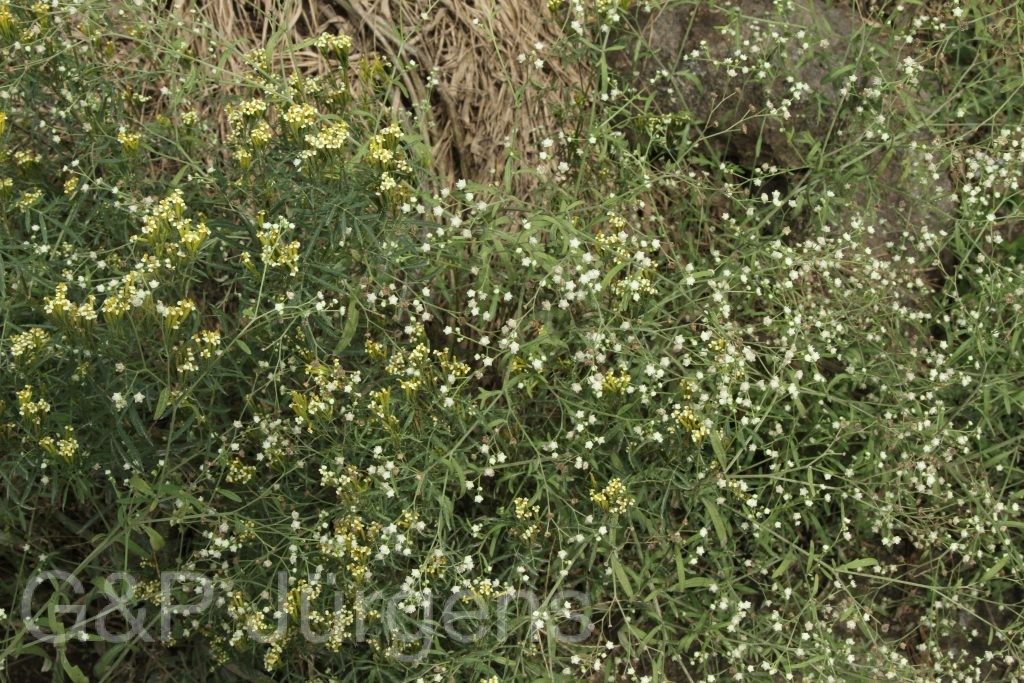
Tagetes minuta L. is native to the temperate grasslands and lower Andes of southern South America but is now a pantropical and warm-temperate weed; GBIF lists over 16,000 occurrences spanning Argentina, Bolivia, Brazil, Ecuador, the United States, Spain, France, Belgium, the Netherlands, South Africa, Kenya, Tanzania, Namibia, Zimbabwe, Ethiopia, India, Korea, Saudi Arabia and Australia. It is a ruderal colonist of cultivated ground, roadsides, waste places and field margins. The record from Phobjika at 2410 m in October shows its naturalisation in the Bhutan Himalaya, where it flowers late in the season on disturbed and abandoned ground.

It is a tall erect annual herb reaching well over a metre, with a strongly aromatic, glandular-punctate foliage. The stems are ribbed and branched above; the leaves are opposite below and alternate above, pinnately divided into numerous lanceolate, sharply serrate leaflets dotted with conspicuous oil glands. The small, narrow, cylindrical capitula are clustered in dense flat-topped corymbs; each head has a single series of fused involucral bracts, few inconspicuous pale-yellow ray florets and several tubular disc florets. The fruit is a slender black cypsela bearing a pappus of a few short scales, some awned.

The oil glands yield the volatile "tagetes oil" used commercially and in traditional medicine, and the plant has well-documented allelopathic and nematicidal properties exploited in companion planting. A highly successful colonising annual, T. minuta is classed as an invasive or noxious weed in several regions and is of no conservation concern.

Author: L. · Sources: POWO (Kew), GBIF, Flora of China, Flora of North America, Soule taxonomic revision of Tagetes
(C.B.Clarke) Kitam.

Sikkim2003 135 P183
India Sikkim Dzongri 4000m, August

Description

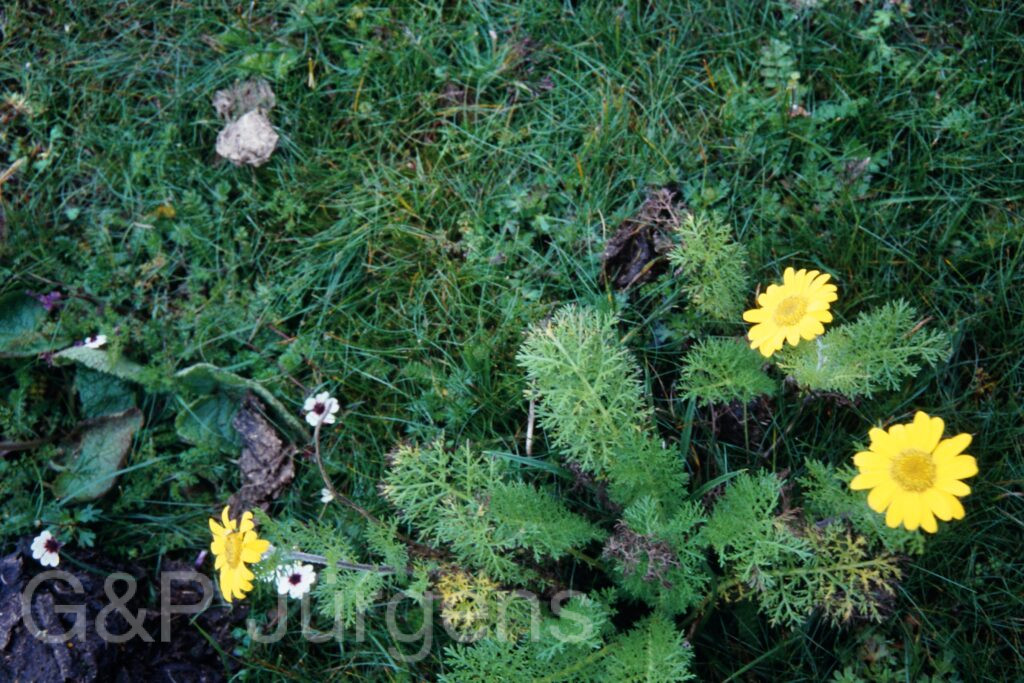
Tanacetum atkinsonii is an aromatic alpine composite of the Himalaya, recorded from Nepal, India, Bhutan and southern China, with GBIF holding around 102 occurrences across this range. It grows on open, stony alpine slopes, rocky pastures, screes and dry grassy banks in the high alpine zone, generally between about 3500 and 4500 m, where it tolerates strong insolation, cold and free-draining substrates. The illustrated plant from Dzongri in Sikkim at 4000 m, flowering in August, is characteristic of these exposed high-altitude habitats and of its late-summer flowering after the monsoon.

It is a perennial, aromatic herb with a woody rootstock producing erect to ascending stems and finely divided, pinnately dissected or bipinnatisect leaves that are grey-green and often hairy, releasing a tansy-like scent when crushed. The capitula (flower heads) are borne in a terminal corymb; each head has an involucre of imbricate, scarious-margined bracts and the typical Tanacetum structure of yellow disc florets, with the marginal florets reduced or shortly rayed rather than conspicuously ligulate. The fruit is a small, ribbed, glandular cypsela, usually with a short membranous corona rather than a true pappus.

Transferred to Tanacetum by Kitamura from an original placement under Chrysanthemum/Pyrethrum by C.B. Clarke, the species sits within the taxonomically fluid tansy group of the tribe Anthemideae, distinguished by its dissected aromatic foliage and reduced ray florets. A widespread high-Himalayan element, it is of no particular conservation concern.

Author: (C.B.Clarke) Kitam. · Sources: POWO (Kew), GBIF, Flora of Bhutan, Flora of China, Compositae of the Himalaya (specialist treatments)

Hand.-Mazz.

Sikkim2003 512 G712 2 ergebnis
Sikkim Yumedzandong 4500m, August

Description

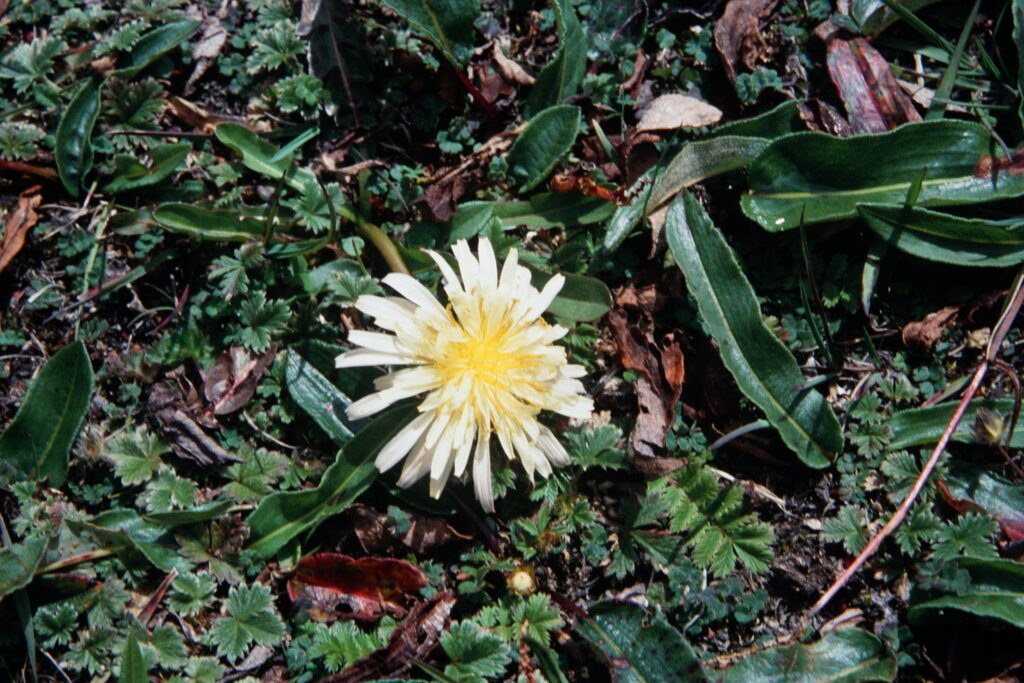
Taraxacum sikkimense is a high-alpine dandelion of the Himalaya and Tibetan Plateau margins, recorded from China, India, Nepal, Bhutan and Pakistan, with a modest set of records (c. 128 in GBIF) reflecting its restricted high-elevation range. It occupies alpine meadows, turfy slopes, moist gravelly ground and the surrounds of snowmelt flushes, typically between about 4000 and 4800 m. The photographed plant from Yumedzandong in Sikkim, at 4500 m and flowering in August, exemplifies the species in its short alpine growing season, when warmth and meltwater briefly permit growth and flowering near the upper limit of vascular plant life.

The plant is a small, acaulescent, rosette-forming perennial herb with a thick, often blackened taproot and a milky white latex characteristic of the tribe Cichorieae. The leaves are all basal, runcinate to pinnatifid or shallowly toothed, sometimes nearly entire in dwarfed alpine forms. The flowering scapes are short, each bearing a single capitulum subtended by an involucre of imbricate phyllaries, the outer often appressed or recurved with a coloured margin. The capitulum is homogamous, composed entirely of yellow ligulate (ray) florets; the fruit is a ribbed, spinulose-muricate cypsela narrowed above into a slender beak that bears a pappus of simple white bristles, dispersed by wind.

Taraxacum is a taxonomically formidable genus owing to widespread apomixis (agamospermy) and polyploidy, which generate innumerable stable microspecies; the Himalayan high-elevation taxa form a distinctive assemblage that remains incompletely revised. Taraxacum sikkimense belongs to this alpine radiation. As a specialised high-altitude plant with a naturally fragmented distribution, it is potentially sensitive to alpine habitat change, though it has not been formally assessed.

Author: Hand.-Mazz. · Sources: POWO (Kew), GBIF, Flora of China (Asteraceae), Flora of Bhutan, Taraxacum: A monograph (Richards)

(DC.) Danser

Bh09 415 P653
Bhutan Paro, 2400m June

Description

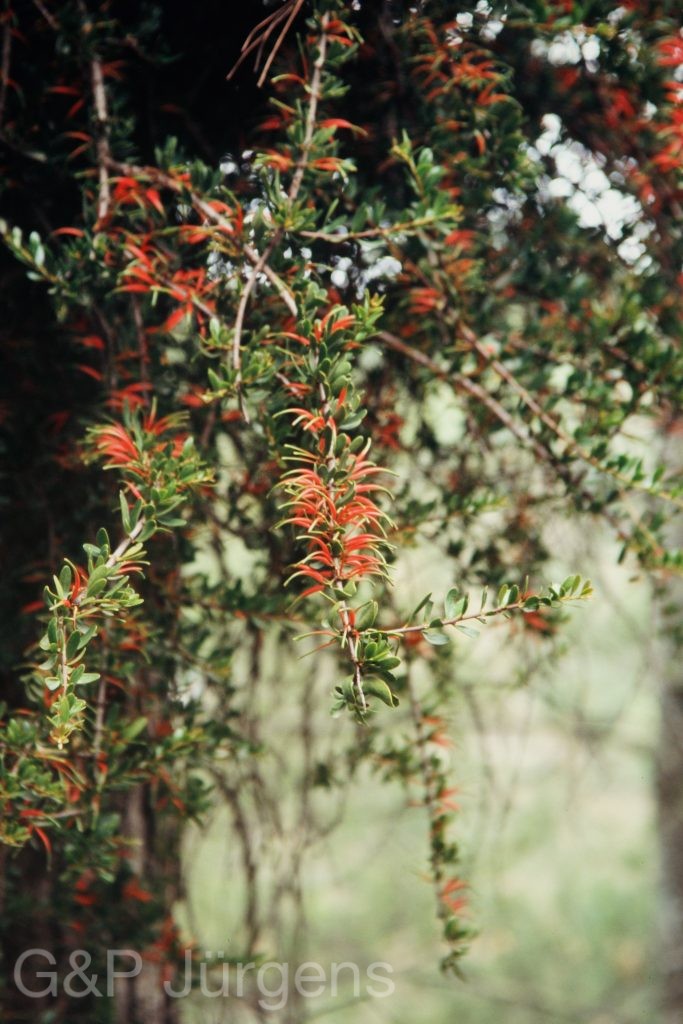
Taxillus kaempferi is a stem-hemiparasitic mistletoe ranging from Japan and Taiwan across China to the eastern Himalaya, with GBIF records from Japan, China, Taiwan, Bhutan and India. It parasitises the branches of trees and shrubs, particularly conifers such as Pinus and Tsuga as well as various broad-leaved hosts, in temperate montane forest generally between 1,500 and 2,800 m. The photographed plant grows near Paro in western Bhutan at about 2,400 m in June, representing the species at the western limit of its distribution in the Himalayan conifer belt.

The plant forms a pendent to spreading shrub attached to the host branch by a haustorial union and often by epicortical runners. The young branchlets, leaf undersides and inflorescences are clothed in a dense rusty to reddish stellate or dendritic tomentum, a key generic feature. The leaves are leathery, alternate to subopposite, ovate to elliptic with entire margins. The flowers are borne in short axillary umbels or racemes; each has a tubular, four-merous corolla that is reddish to orange and curved, splitting into recurved lobes at anthesis to expose the stamens, and is pollinated chiefly by birds. The fruit is a one-seeded berry with viscid pulp, dispersed by frugivorous birds that wipe the sticky seed onto new branches.

Taxillus belongs to the Loranthaceae, the showy aerial-parasite family, and is distinguished from related genera by its tomentum, umbellate inflorescence and floral structure. As a hemiparasite it retains chlorophyll while drawing water and minerals from the host. Though it can locally affect host vigour, T. kaempferi is a natural and widespread forest element, ecologically valuable as a nectar and fruit resource, and is not of conservation concern.

Author: (DC.) Danser · Sources: POWO (Kew), GBIF, Flora of China Vol. 5 (Loranthaceae), Grierson & Long: Flora of Bhutan Vol. 1, Barlow: Loranthaceae of Asia (taxonomic revisions)

L.f.

Bhutan2015 95
Bhutan Galephug 300m, October
Bhutan2015 96
Bhutan Galephug 300m, October

Description

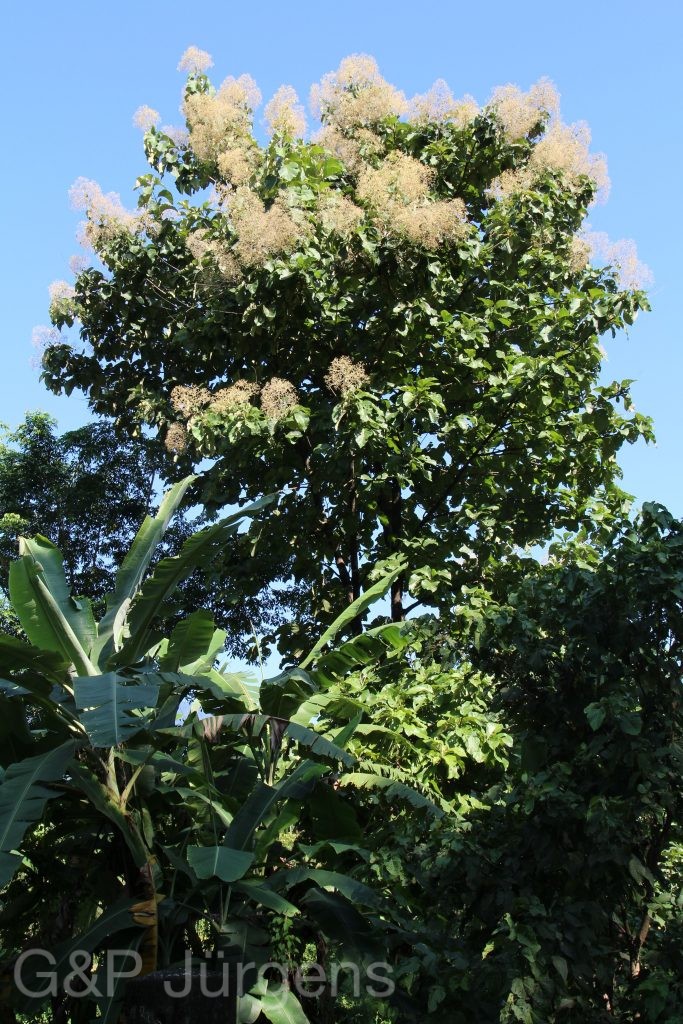
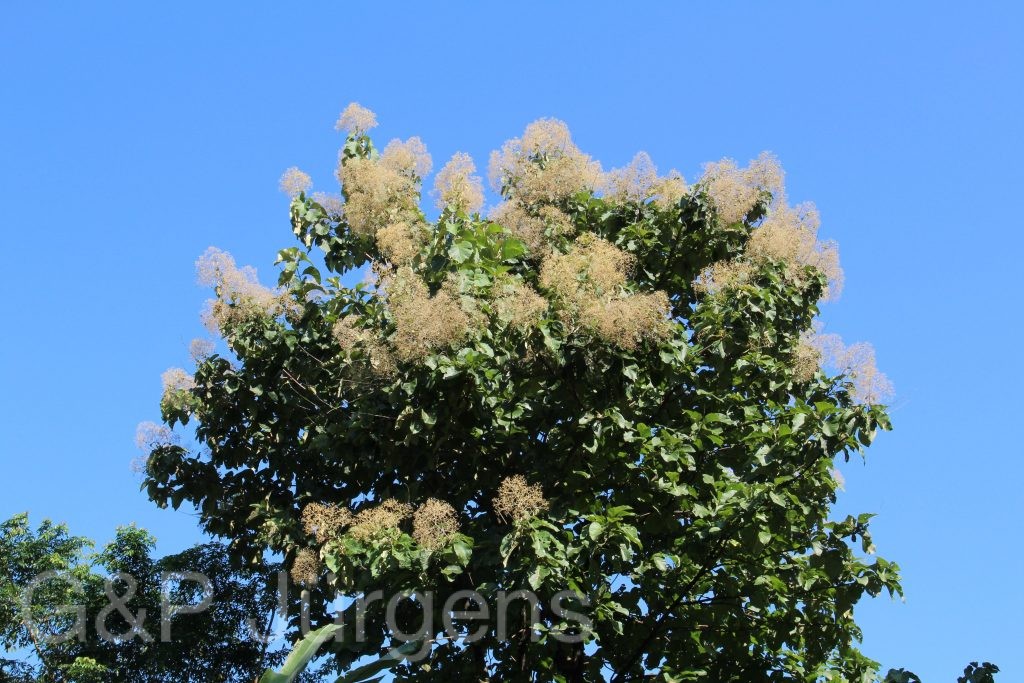
Tectona grandis L.f., the teak, is a large deciduous tree native to the monsoonal forests of South and Southeast Asia, including India, Myanmar, Thailand, Laos and Sri Lanka, and now widely planted and naturalised across the tropics in Indonesia, Brazil, Nigeria, Tanzania, Costa Rica and beyond. In the Himalayan foothills it is recorded from Bhutan at Galephug near 300 m in October, at the warm, low-elevation southern margin of the region. The species grows in tropical dry and moist deciduous forest, on well-drained alluvial and lateritic soils, typically below 1000 m, where a pronounced dry season triggers leaf fall. Its roughly 37 411 GBIF records reflect both its native range and its enormous footprint as a cultivated timber tree.

It is a tall tree reaching 30–40 m with a tall, often fluted bole and pale, fibrous, longitudinally fissured bark. The leaves are very large, opposite or sub-opposite, broadly elliptic to obovate, scabrid above and densely stellate-tomentose beneath, exuding a reddish sap when crushed. The small whitish to pale lilac flowers are five- to six-merous and borne in massive, much-branched terminal panicles. The fruit is a hard, four-chambered drupe enclosed in a conspicuously inflated, bladder-like accrescent calyx that aids wind and water dispersal.

Formerly placed in Verbenaceae, Tectona is now assigned to Lamiaceae (subfamily Tectonoideae) on molecular grounds, here matching the input family. Its heartwood, rich in protective tectoquinones and natural oils, is among the world's most prized timbers for its durability, dimensional stability and resistance to decay and insects, underpinning a vast plantation industry. While extensively cultivated, genuinely wild teak forests have been much reduced and fragmented by logging, and conservation of natural provenances and their genetic diversity is an ongoing priority.

Author: L.f. · Sources: POWO (Kew), GBIF, Flora of British India, Flora of Bhutan, Trees of Tropical Asia, Teak: A Global Overview (FAO monograph)

DC.

Bhutan2012 628
Bhutan Wangdi 2600m September
Bhutan2012 734
Bhutan Galephu 650m, October

Description

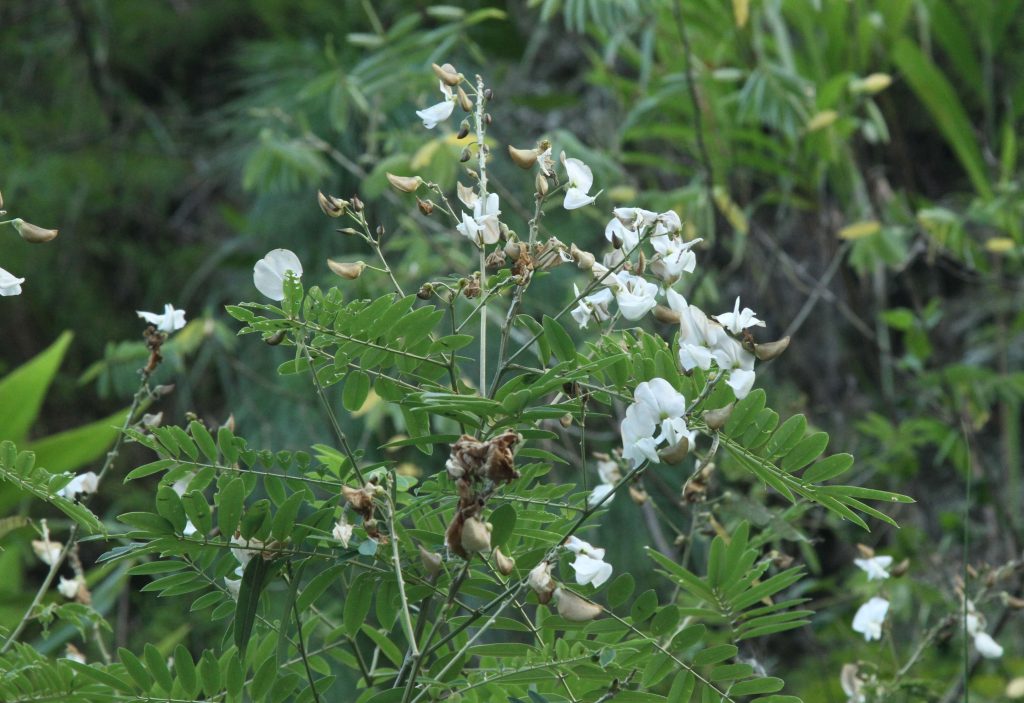
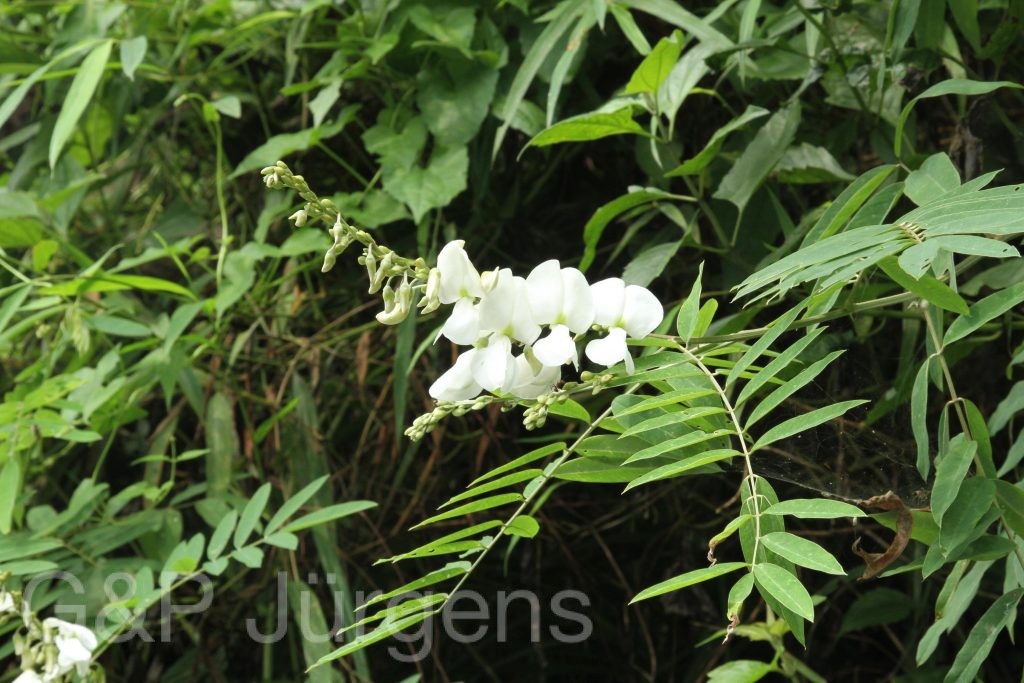
Tephrosia candida is a shrubby legume native to the Indian subcontinent and adjacent Himalaya, including India, Nepal and Bhutan, but now pantropically naturalised through widespread cultivation, with GBIF records from Brazil, Indonesia, Taiwan, China, Papua New Guinea, Australia, Madagascar, the Caribbean, the Mascarenes and beyond. It thrives in warm subtropical and tropical conditions on forest margins, roadsides, river banks and disturbed open ground. The Bhutanese collections illustrate its altitudinal breadth, from Galephu in the foothills at about 650 m in October to Wangdi at 2600 m flowering in September.

The plant is an erect, much-branched shrub up to about 3 m, with silky-pubescent young growth. The leaves are imparipinnate with numerous (often 8-12 pairs of) narrowly oblong leaflets that are silky-sericeous beneath, giving the foliage a greyish sheen. The flowers are borne in dense terminal racemes; each papilionate flower has a campanulate pubescent calyx and a white to pale pink or cream corolla with a broad standard silky on the outer face, the keel and wings enclosing diadelphous stamens. The fruit is a flattened, linear, densely velvety-pubescent dehiscent pod that twists on splitting to expel several seeds.

A member of the papilionoid Fabaceae and tribe Millettieae, T. candida is a nitrogen-fixing species long valued as a green manure, cover crop, fallow improver and erosion-control plant, which explains its extensive intentional dispersal across the tropics. Like other Tephrosia it contains rotenoid compounds and has been used as a fish poison and insecticide. Robust and weedy in cultivation, it is in no way of conservation concern and can become locally naturalised.

Author: DC. · Sources: POWO (Kew), GBIF, Flora of Bhutan, Flora of British India, Brummitt's and related revisions of Tephrosia (Leguminosae)

Van Heurck & Müll. Arg.

Bhutan2015 170
Bhutan Zhemgang 950m, October
Bhutan2012 783
Bhutan Zemgang 1800m, October

Description

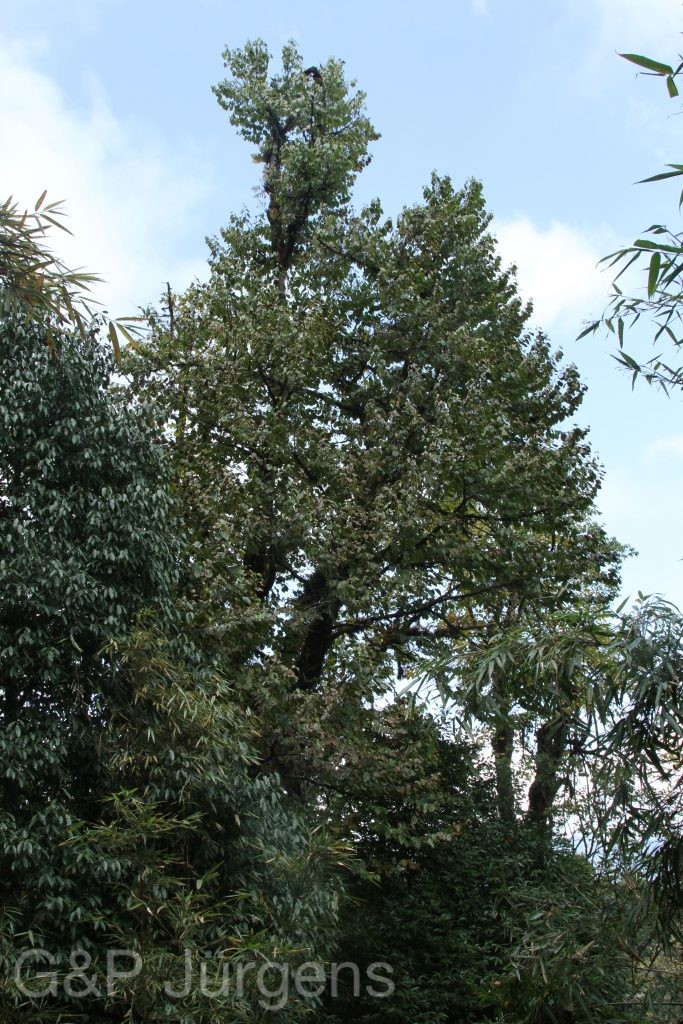
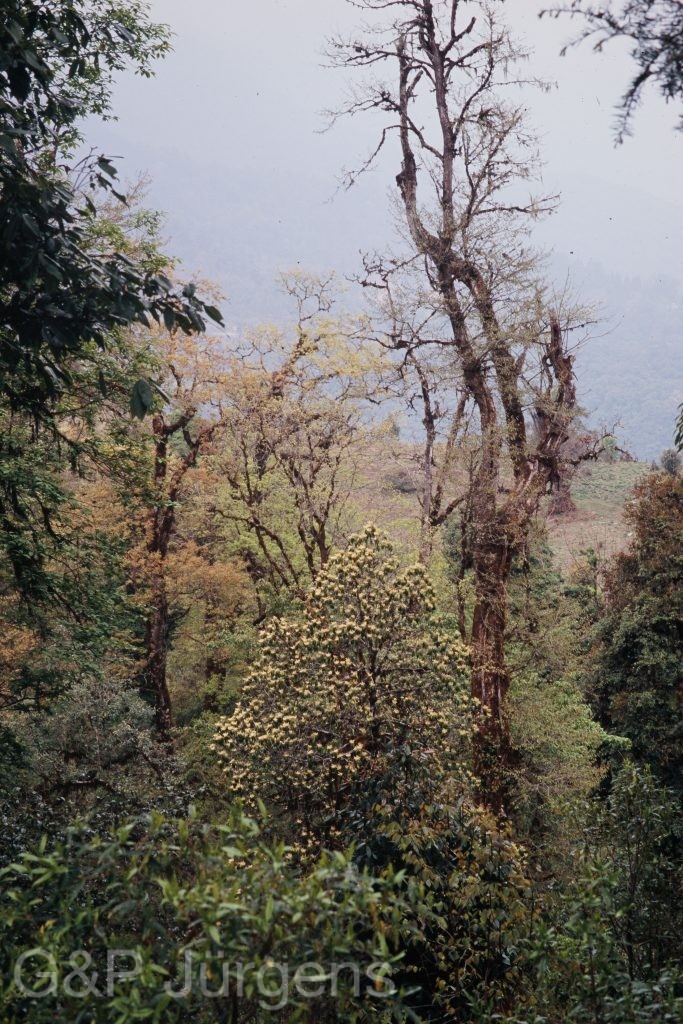
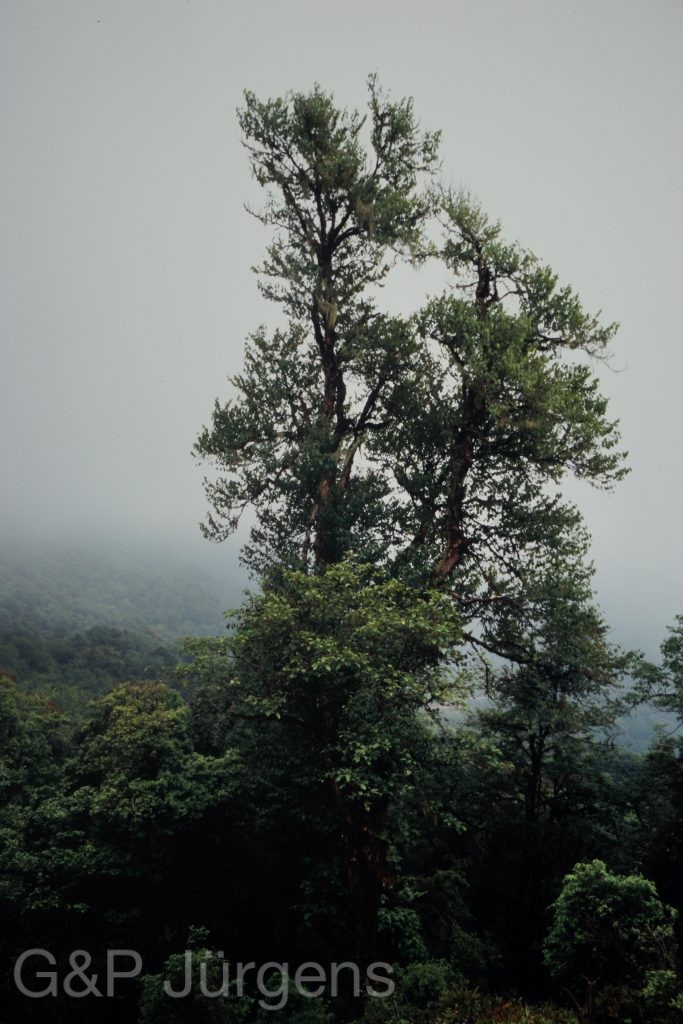
Terminalia myriocarpa Van Heurck & Mull.Arg. is a large evergreen tree of the Combretaceae, distributed across the eastern Himalaya and Indo-Burmese region, ranging from northeastern India, Nepal and Bhutan through Myanmar, Thailand, Laos and Vietnam to southwestern China (GBIF: c. 454 occurrences). It is a canopy tree of subtropical and tropical moist evergreen forests, favouring deep, moist soils along streams and in foothill valleys, generally below about 1,500 m though ascending higher locally. The photographed trees from Zhemgang in central Bhutan, recorded at about 950 m and 1,800 m in October, illustrate its presence in the warm, humid forests of the southern foothills.

The tree is tall, reaching 30 m or more, frequently developing prominent buttresses at the base. The leaves are opposite or subopposite, oblong-elliptic, with an acuminate apex and entire to crenulate margins, and often bear a pair of glands near the base of the petiole. The flowers are small, numerous and bisexual, borne in large, much-branched terminal and axillary panicles, giving rise to the species epithet "myriocarpa" ("many-fruited"). The fruit is a small, two-winged, samaroid nutlet that turns pink to crimson in dense masses, a striking feature that aids wind dispersal.

Terminalia belongs to the pantropical Combretaceae and includes many ecologically and economically important timber trees. Terminalia myriocarpa yields a useful general-purpose hardwood and is a significant component of lowland evergreen forest. Although locally common over a wide range and not globally threatened, its lowland forest habitat is under pressure from logging and land conversion across parts of its distribution.

Author: Van Heurck & Müll. Arg. · Sources: POWO (Kew), Flora of China Vol. 13, Flora of Bhutan Vol. 2, Flora of Nepal, GBIF, Exell: Combretaceae revisions

Oliv.

Bhutan2015 34
Bhutan Thimphu 2200m, October
Bh2008 43 G76
Bhutan Thimphu 2200m, April
Bh09 209 P350
Bhutan Thimphu 2200m, April

Description

Tetracentron sinense is a deciduous tree of the eastern Himalaya and the mountains of central and southwestern China, recorded by GBIF from China, Nepal, Bhutan, India, Myanmar and Vietnam (with cultivated records in Europe and North America) across about 940 georeferenced occurrences. It is a tree of cool, moist temperate broadleaf and mixed forest, growing in valleys, on shaded slopes and along streamsides, generally between about 1,700 and 3,500 m. The cited records from Thimphu in western Bhutan at around 2,200 m, photographed in both April and October, span the leafing-out and the autumnal phases of its annual cycle and place it well within the temperate forest belt of the inner Himalaya, where it occurs scattered among other broadleaved trees.

The tree has a straight trunk and bears its leaves in two kinds of position: simple, alternate, long-petioled leaves on long shoots and solitary leaves terminating short spur shoots. The leaves are ovate to broadly ovate, cordate at the base, acuminate, finely serrate, and conspicuously palmately veined from the base. The minute, perfect flowers are densely crowded on slender, pendulous, catkin-like spikes; each tetramerous flower has four tepals, four stamens and a four-carpellate ovary. The fruit is a small four-locular capsule that splits to release tiny winged seeds. Anatomically the wood is remarkable for being vesselless, the water-conducting tissue consisting only of tracheids.

Tetracentron sinense is one of only two genera in the small, isolated family Trochodendraceae (the other being Trochodendron), an ancient and phylogenetically basal lineage of eudicots whose vesselless wood is regarded as a primitive or secondarily reduced condition of great interest to plant systematists and to studies of angiosperm wood evolution. As a relict species with a disjunct, fragmented distribution, it is of significant conservation concern: it is legally protected in China and assessed as near-threatened, its populations reduced by logging and habitat loss, making it an emblematic "living-fossil" tree of the East Asian temperate flora.

Author: Oliv. · Sources: POWO (Kew), GBIF, Flora of China Vol. 6, Flora of Bhutan Vol. 1, Flora of Nepal, Flora of Pakistan, Endress: systematics and floral morphology of Trochodendraceae

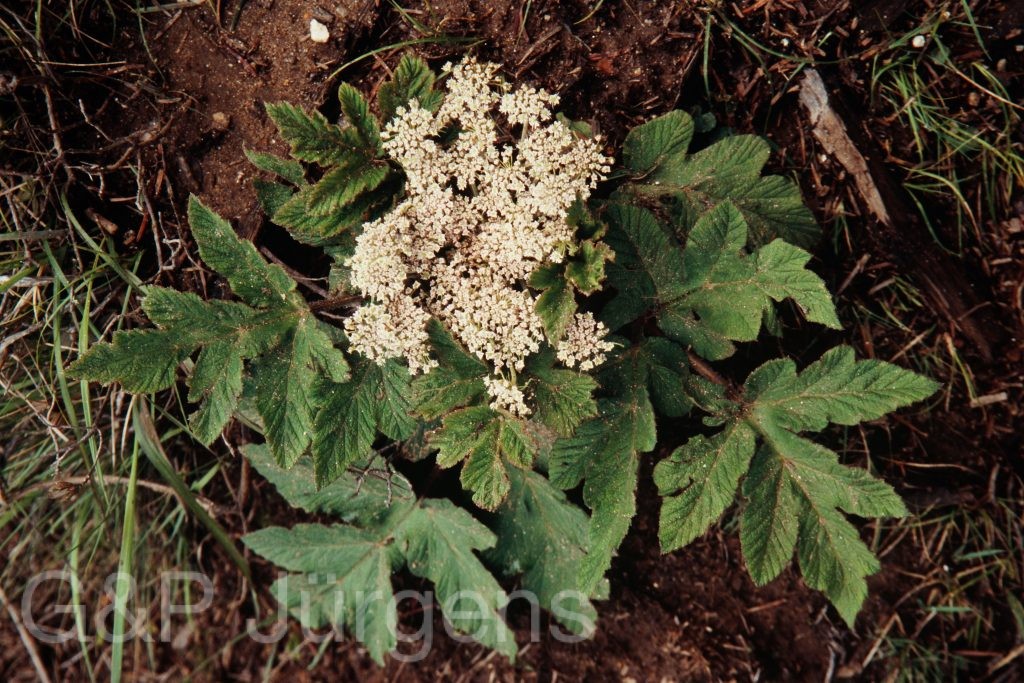
(D.Don) Manden.

Bh09 71 P123
Bhutan Jili-La 3600m, June

Description

Tetrataenium nepalense is a tall Himalayan umbellifer distributed from Nepal and northern India through Bhutan into south-western China and Myanmar. Its 266 GBIF records lie within this native arc, indicating a widespread montane species of the Eastern and Central Himalaya. It occupies subalpine and alpine meadows, open slopes, forest margins and clearings, generally between about 3000 and 4000 m, where it is a characteristic robust herb of moist high-altitude grassland. The plant photographed at Jili-La in Bhutan at about 3600 m in June illustrates the species at its early-summer flowering on these damp, herb-rich montane slopes.

It is a stout, erect biennial or perennial herb arising from a thick taproot, with hollow, ridged, often pubescent stems. The large leaves are pinnate to ternately compound, the broad leaflets ovate, lobed and toothed, the lower leaves long-petiolate with conspicuous sheathing bases. The inflorescence is a large terminal compound umbel with numerous rays; the small white flowers are often radiant, the marginal petals of the outer flowers enlarged. The fruit is a flattened, broadly ovate to obovate, dorsally compressed schizocarp with conspicuous oil ducts (vittae) and narrowly winged lateral ribs.

Long known as Heracleum nepalense (a name preserved in its WordPress URL), the species was transferred to the segregate genus Tetrataenium, distinguished from Heracleum by features of the vittae and fruit. Its hogweed-like habit and large radiant umbels are typical of the group. Widespread and locally common across its range, T. nepalense is not considered threatened and is a prominent component of high Himalayan meadow vegetation.

Author: (D.Don) Manden. · Sources: POWO (Kew), GBIF, Flora of Bhutan, Flora of China, Pimenov & Kljuykov Umbelliferae revision

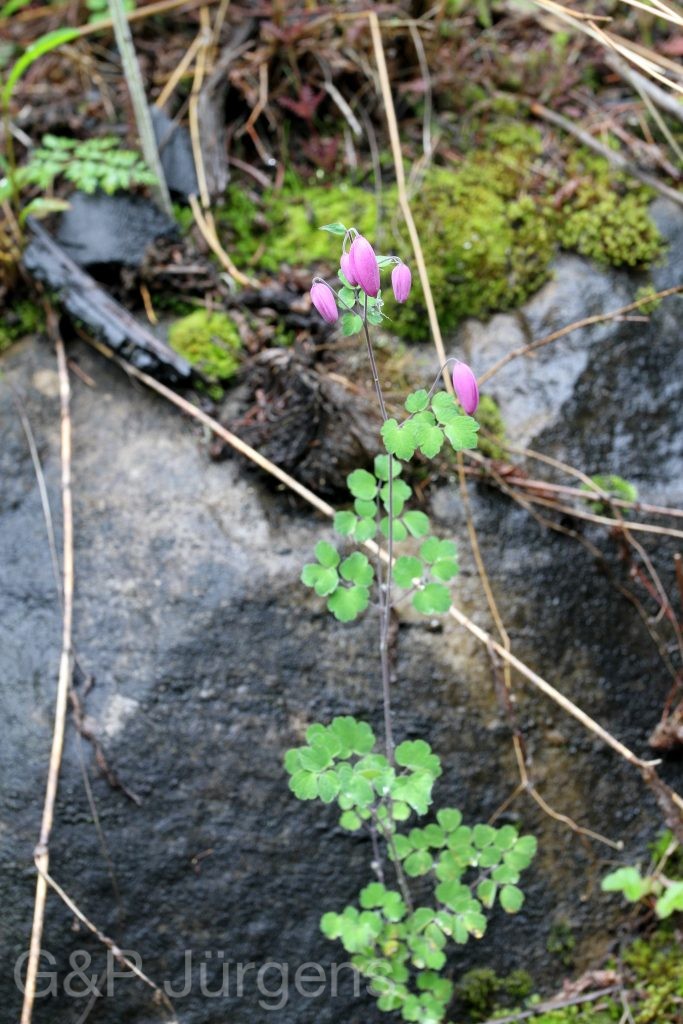
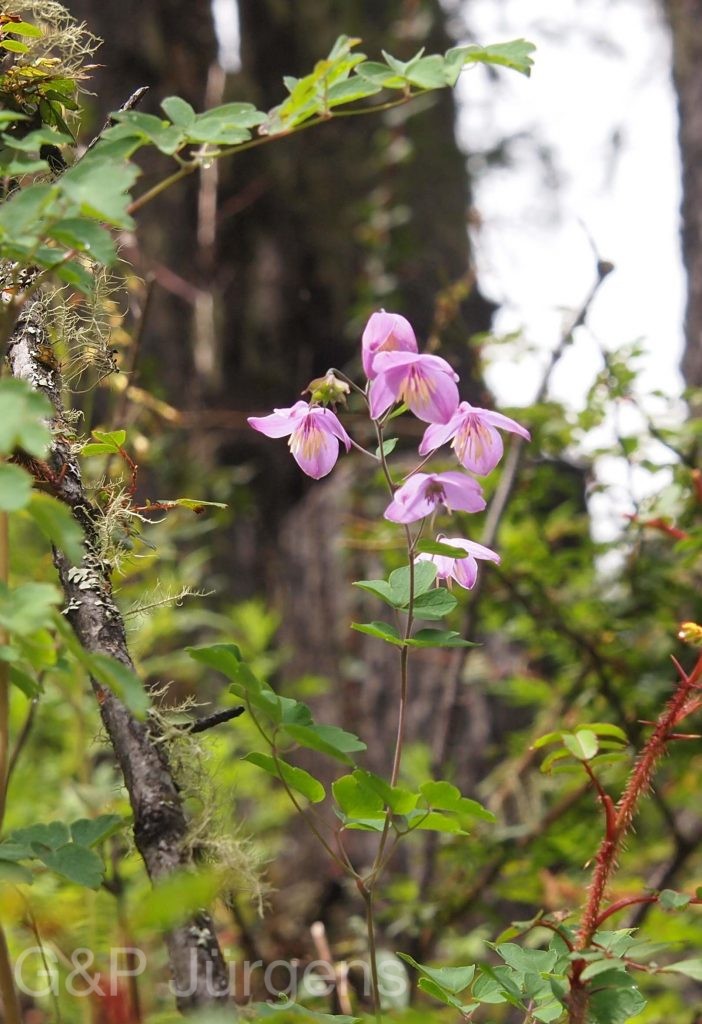
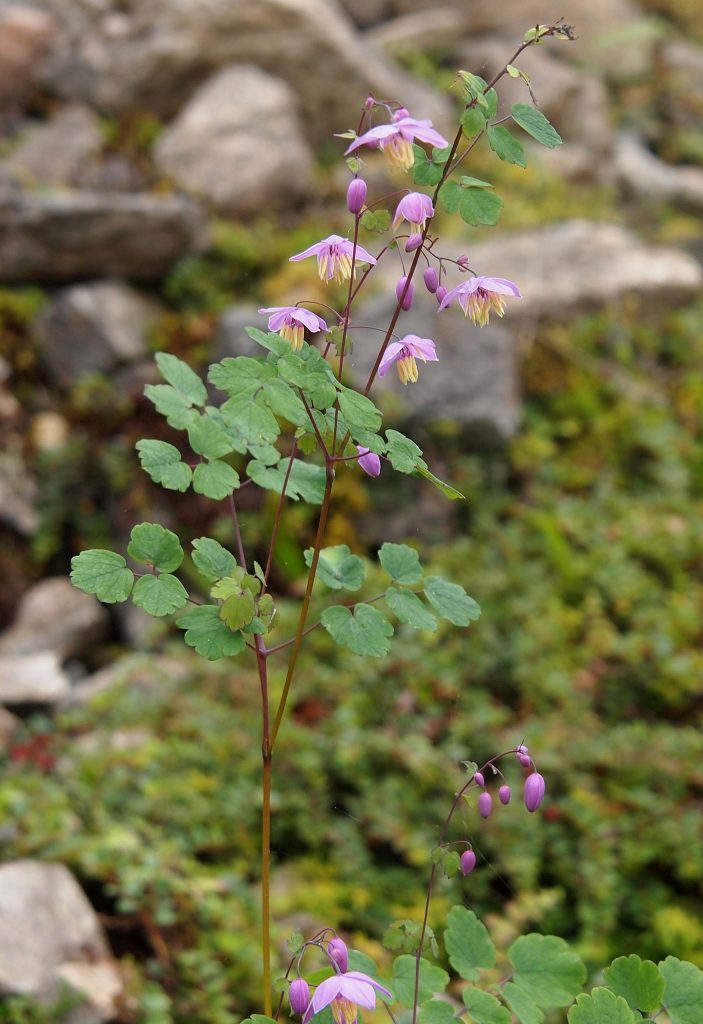
DC.

BhutanPG2011 384
Bhutan Shele-La, 3600m September
Bhutan2012 33
Bhutan Shele-La, 3600m September
Bhutan2012 325
Bhutan Dochu-La, 3600m September
Nepal 95 137 P230 ergebnis
Nepal South of Rupina La 3650m October

Description

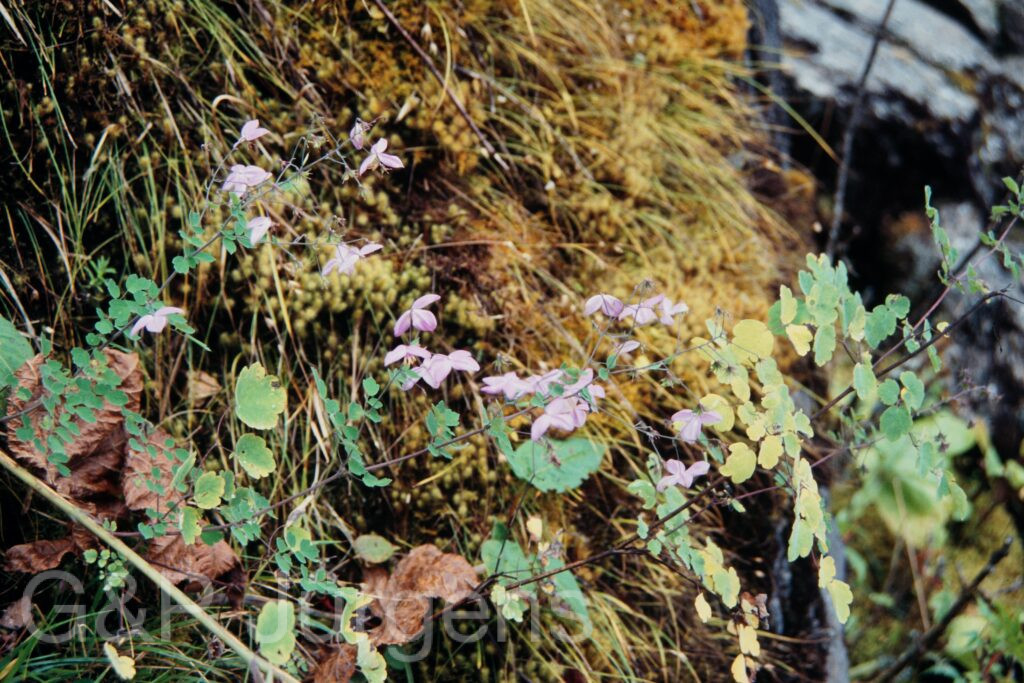
Thalictrum chelidonii is a Himalayan meadow-rue distributed through Nepal, north-east India, Bhutan and south-west China, with 178 georeferenced occurrences. It grows in moist, often partly shaded sites along forest margins, in subalpine scrub, on grassy and rocky slopes and beside streams in the upper temperate to subalpine zones. The cited collections at Shele-La and Dochu-La in Bhutan (both about 3600 m, September) and south of Rupina La in Nepal (3650 m, October) reflect its typical altitudinal range of roughly 2700-4000 m, where it flowers and fruits late in the growing season.

It is an erect perennial herb with slender, branching, often glaucous stems and large, two- to three-times ternately or pinnately compound leaves; the leaflets are rounded to obovate, lobed and toothed, recalling those of Aquilegia. Unlike many wind-pollinated meadow-rues, T. chelidonii has conspicuous flowers in which the four or five petaloid sepals are well developed, lilac to rose-purple, surrounding numerous spreading stamens with slender filaments. The carpels are several and free, ripening into a cluster of stipitate, longitudinally ribbed achenes that hang on slender stalks.

Within Ranunculaceae the genus Thalictrum is distinctive for its apetalous flowers in which sepals and stamens provide the floral display; the showy coloured sepals of this species point to insect rather than purely wind pollination. The pendent, winged-ribbed achenes aid dispersal. Widespread and locally common across the central and eastern Himalaya, the species is of no conservation concern, and like several relatives it contains isoquinoline alkaloids of ethnomedicinal interest.

Author: DC. · Sources: POWO (Kew), GBIF, Flora of Bhutan, Flora of China, Flora of Nepal, Tamura Ranunculaceae treatment (Die natürlichen Pflanzenfamilien)