Tag:

Montane (1500-2500 m)

D. Don

Bh2008 472 P734
Bhutan Samtengang, 2040m April
Bh2008 473 P736
Bhutan Samtengang, 2040m April
Nepal 1994 251 ergebnis
Ost-Nepal Milka-Danda 2400m April 

Description

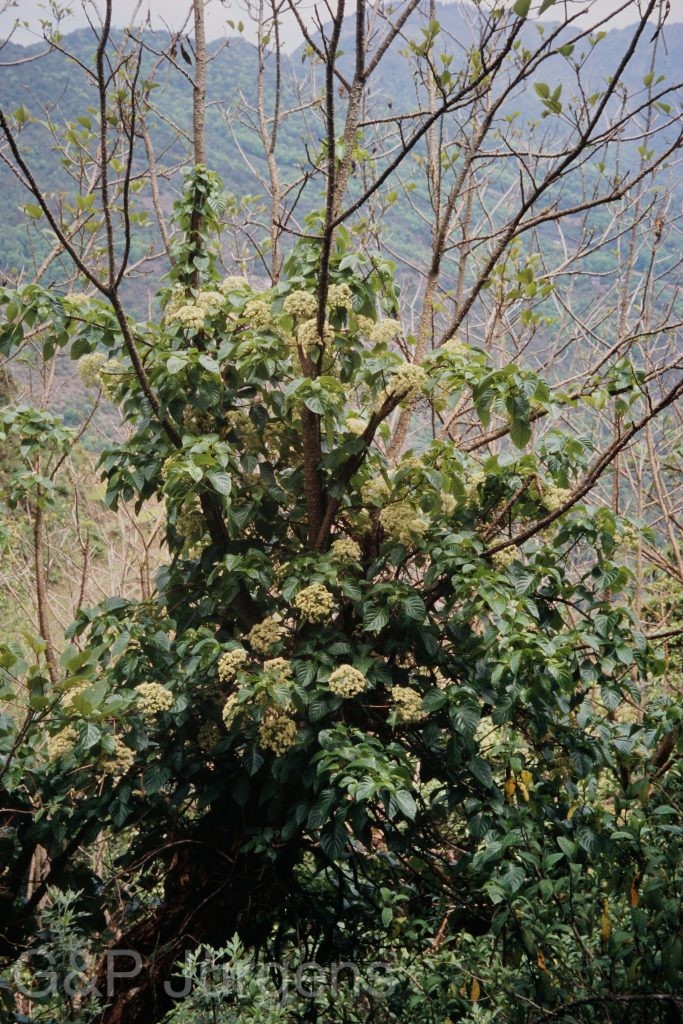
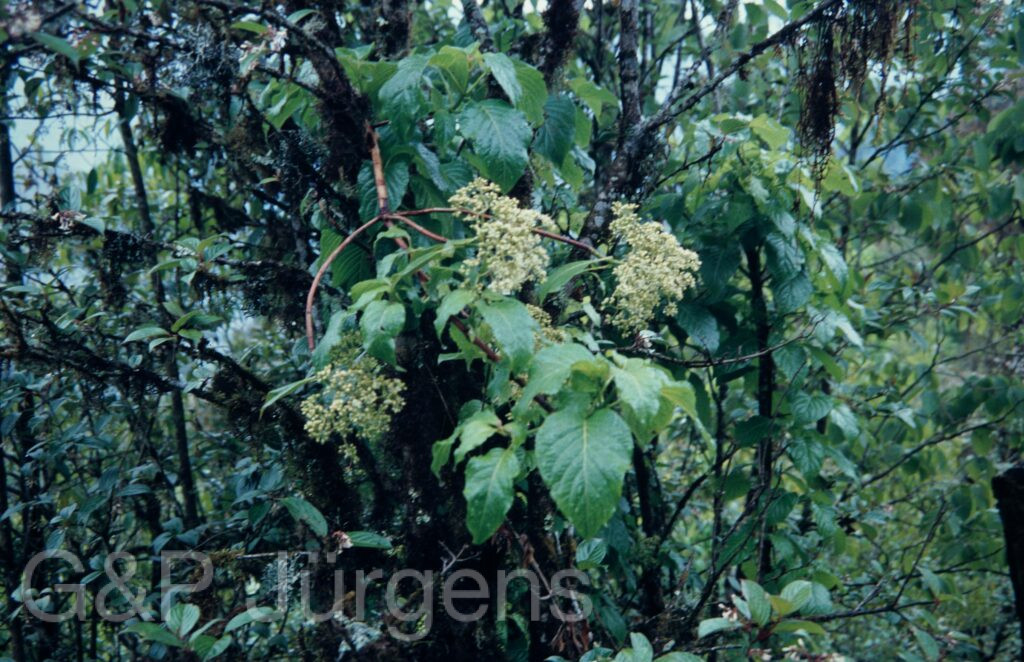
Hydrangea anomala is a climbing shrub of temperate montane forests, one of the most widely recorded species in this group with over 2000 GBIF occurrences. Its native range extends along the Himalaya and through China, Taiwan, Myanmar, Japan and Korea, and it is widely grown in temperate gardens, generating cultivated records across Europe, North America and beyond. It inhabits moist broadleaved and mixed forest, climbing tree trunks and rock faces by adventitious aerial roots. It was photographed at Samtengang in Bhutan at about 2040 m and on the Milka-Danda ridge of eastern Nepal at about 2400 m, both in April, when the flat inflorescences open in the spring forest.

It is a deciduous, root-climbing liana with peeling, reddish-brown bark, attaching by clinging rootlets along the stems. The leaves are opposite, ovate to elliptic, acuminate, serrate and glabrescent, on slender petioles. The inflorescence is a broad, flattened corymb in which numerous small fertile flowers, with minute whitish petals and stamens, are surrounded by a marginal ring of showy sterile flowers bearing three to four enlarged, petaloid white sepals. The fruit is a small, ribbed, urn-shaped capsule opening between the persistent styles to release many minute seeds.

Hydrangea (Hydrangeaceae) comprises shrubs, climbers and small trees of east Asia and the Americas; the climbing species, including H. anomala, are sometimes placed in subgenus Calyptranthe, and H. petiolaris is often regarded as an allied subspecies. Long cultivated as an ornamental climber, H. anomala is widespread and secure across its native range, and is of biogeographic interest within the disjunct Sino-Himalayan to Japanese temperate forest flora.

Author: D. Don · Sources: POWO (Kew), GBIF, Flora of China, Flora of Bhutan, Annotated Checklist of the Flowering Plants of Nepal, McClintock's monograph of Hydrangea (Hydrangeaceae)

(Lour.) Y.De Smet & C.Granados

Sikkim2003 52 P71^
Sikkim above Yoksam 2300m, August

Nepal 2001 431 ergebnis ergebnis
Nepal (Gorkha) Laprak 2000m, May

Description

Hydrangea febrifuga, long familiar under the name Dichroa febrifuga, is a widely distributed shrub of subtropical and warm-temperate Asia, ranging from the Himalaya (Nepal, Sikkim, Bhutan, northeast India) eastward through southern China, Myanmar, Thailand and Indochina to Malesia and the Philippines. It inhabits moist, shaded forest, ravines and streamsides, forming part of the evergreen broad-leaved understorey. It is recorded from low to mid elevations; the populations shown above Yoksam in Sikkim at 2,300 m in August and at Laprak in the Gorkha region of Nepal at 2,000 m in May span its typical mid-montane range in humid forest.

The plant is an erect, much-branched shrub with subquadrangular, often purplish young stems. The leaves are opposite, elliptic to oblong-lanceolate, with a serrate margin, acuminate apex and a glabrous to sparsely pubescent surface. The inflorescence is a terminal or axillary corymbose to paniculate cyme bearing numerous small bisexual flowers; the calyx is shortly toothed and the corolla blue to violet or whitish with thick, valvate petals, the stamens conspicuous. Distinctively for the family, the fruit is a fleshy, indigo-blue berry crowned by the persistent calyx and containing many minute seeds.

Molecular phylogenetic work has shown the segregate genus Dichroa to be nested within Hydrangea, prompting the recombination as Hydrangea febrifuga by De Smet and Granados; the basionym traces to Loureiro's original description of Lourea. The species is of long-standing ethnomedical importance: its roots and leaves, rich in the alkaloid febrifugine, have been used in traditional Chinese and Himalayan medicine against malaria and fevers, a property reflected in the epithet. It remains common and is not considered threatened.

Author: (Lour.) Y.De Smet & C.Granados · Sources: POWO (Kew), Flora of China Vol. 8, Flora of Bhutan Vol. 1, GBIF, De Smet et al.: Hydrangea phylogeny (TAXON)

Wight & Arn.

Bhutan2014 8
Bhutan Sandrup 750m, May
Bhutan2014 222
Bhutan Karu-Chu 1800m, May

Description

Hypericum hookerianum is a Himalayan and Sino-Himalayan shrubby St John's wort, native across China, NE India, Nepal, Bhutan and Myanmar, with GBIF recording some 638 occurrences including numerous cultivated and naturalised records from Europe, North America and Australasia. In the wild it grows in forest margins, clearings, scrub and on open rocky slopes. The photographed Bhutanese plants from Sandrup (750 m) and Karu-Chu (1,800 m), both in May, illustrate its wide altitudinal tolerance from the subtropical foothills to the warm temperate belt.

It is an evergreen or semi-evergreen shrub with terete, often reddish branches. The leaves are opposite, ovate to oblong or lanceolate, sessile or nearly so, frequently glaucous beneath and dotted with pale translucent glands. The flowers are large and showy, borne singly or in few-flowered cymes; they are cup-shaped to bowl-shaped, deep golden-yellow, with five broad concave petals and a dense central boss of numerous stamens grouped in five fascicles surrounding a stout ovary with several styles. The fruit is a many-seeded septicidal capsule.

Hypericum hookerianum is a parent of several widely grown ornamental cultivars and hybrids, valued for its robust habit and bold flowers, which accounts for its scattered occurrence well beyond its native range. The translucent and dark glands of the foliage, characteristic of the genus, contain hypericin and hyperforin and related bioactive compounds. Within the large and complex genus Hypericum, the species belongs to the woody section Ascyreia, distinguished by its shrubby habit, large bowl-shaped flowers and fascicled stamens; it is of no conservation concern given its breadth of range and cultivation.

Author: Wight & Arn. · Sources: POWO (Kew), Flora of Bhutan Vol. 1, GBIF, Flora of China Vol. 13, Robson: Studies in the Genus Hypericum (Bulletin of the Natural History Museum)

Hypoxis aurea

by GP Jürgens

Lour.

Nepal 97 491 P962
Nepal Num 1650m May
Nepal 99 198 ergebnis
West-Nepal Lara-Lake 2900m, June

Description

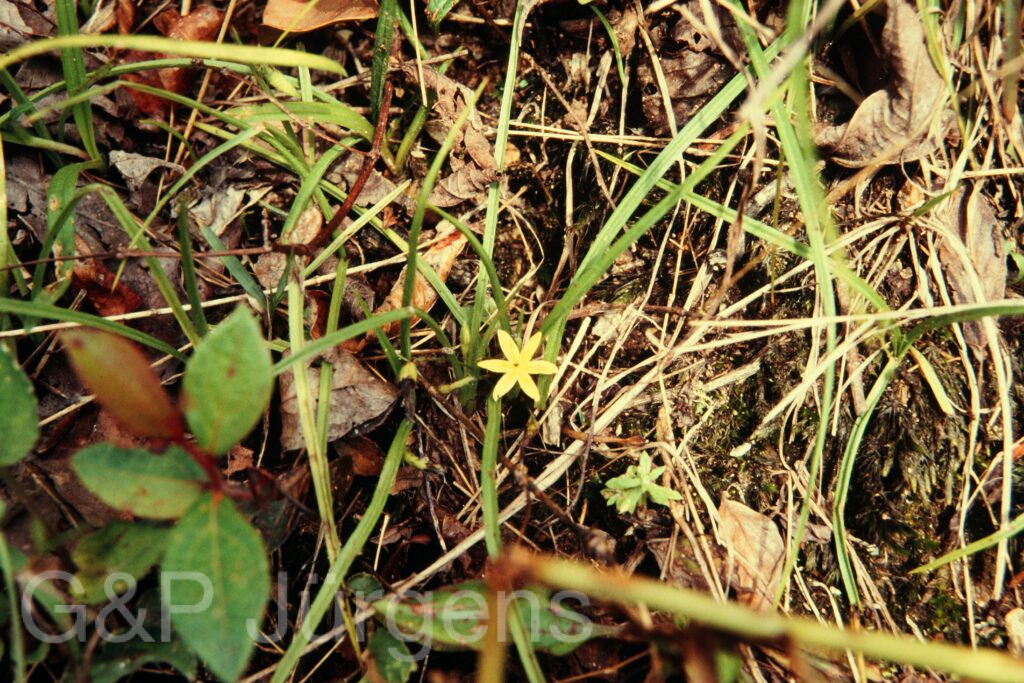
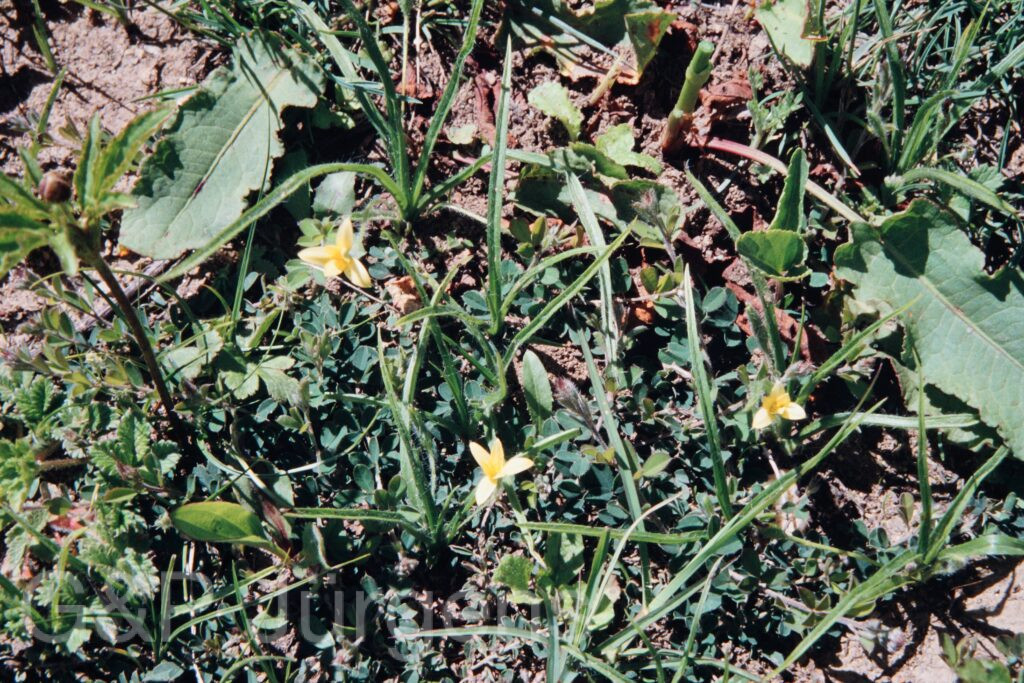
Hypoxis aurea Lour. is a small cormous geophyte of the Hypoxidaceae with a wide Asian and Pacific distribution, recorded from India, Nepal, Bhutan, Sri Lanka and China through Taiwan, Japan and Korea, across Southeast Asia (Myanmar, Thailand, Vietnam, Laos, Cambodia, Indonesia, the Philippines) to New Guinea, with around 1,240 georeferenced occurrences. It grows in open, well-lit grassy habitats: hill grassland, open pine and oak woodland, pasture, terrace banks and disturbed slopes, often in seasonally moist soils. The photographed plants from Num at about 1,650 m and from the Lara-Lake area of West Nepal at about 2,900 m, flowering in May and June, show its broad altitudinal span from subtropical foothills to the lower-temperate zone in the Himalaya.

It is a perennial herb arising from a small ovoid to tuberous corm. The leaves are all basal, several, narrowly linear and grass-like, often keeled and clothed (especially toward the base) in long soft hairs. The flowers are borne singly or few together on slender scapes shorter than or about equalling the leaves; each has six spreading yellow tepals, golden within and frequently greenish and hairy on the outer surface, with six stamens and an inferior, hairy ovary. The fruit is a small capsule opening to release numerous tiny black, often muricate seeds.

Hypoxis is a chiefly tropical and warm-temperate genus of grassland geophytes, and its members are well adapted to fire and seasonal drought through the perennating corm, which resprouts after burning or dry-season dormancy. The yellow, pollen-rich, nectarless flowers attract pollen-gathering insects. Widely distributed and frequently associated with grazed and disturbed grassland, H. aurea is common across its range and not considered threatened.

Author: Lour. · Sources: POWO (Kew), Flora of China Vol. 24, Flora of Bhutan Vol. 3, GBIF, Nordal: Hypoxidaceae (in Kubitzki, 1998)

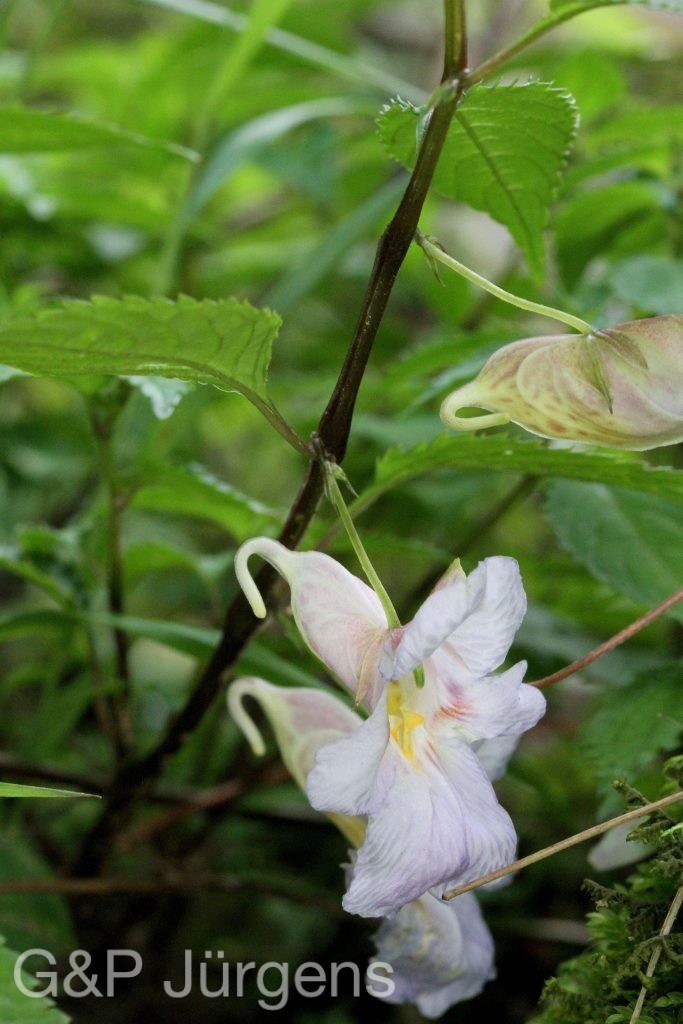
DC.

Bh09 286 P469
Bhutan Tongtsa 2100m, June

Description

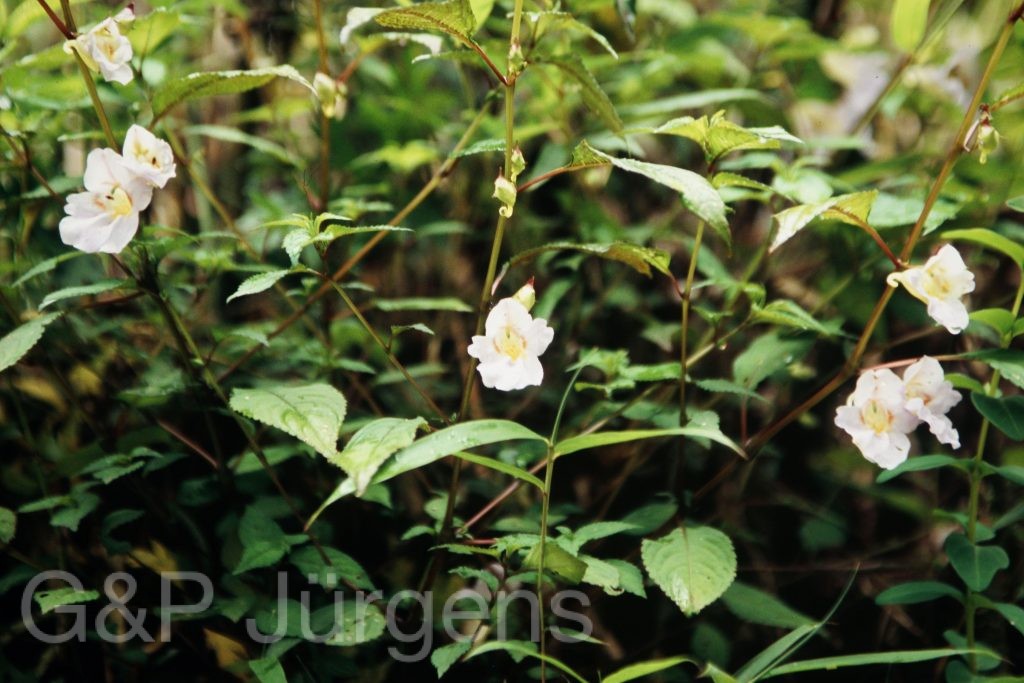
Impatiens discolor is an annual herb of the eastern Himalaya and adjoining ranges, documented by GBIF from Nepal, India, Bhutan, China, Thailand and Papua New Guinea across roughly 78 occurrences, several records being indeterminate as to country. It favours shaded, humid montane forest, growing along stream banks, in moist gullies and on seepage-fed roadside banks within evergreen and mixed broad-leaved woodland, typically at middle elevations. The photographed plant from Tongsa (Trongsa) in central Bhutan at about 2100 m, flowering in June with the onset of the monsoon, is typical of the warm, wet conditions that the genus exploits during the rainy season.

The plant has a succulent, translucent, often reddish stem that is erect or ascending and watery in texture, with swollen nodes. The leaves are alternate, ovate to elliptic, with a serrate or crenate-serrate margin and an acuminate apex, frequently glaucous or paler beneath, giving the discolorous appearance referenced by the epithet. The zygomorphic flowers are borne singly or in few-flowered axillary clusters; the lower sepal forms a saccate spur, and the showy yellow corolla (sometimes spotted) is built from a standard and two lateral united petals. The fruit is a fleshy, club-shaped capsule that dehisces explosively, the valves coiling abruptly to fling the seeds well away from the parent.

Balsaminaceae are notoriously taxonomically difficult, with Impatiens hyper-diverse and richly speciose in the Sino-Himalaya, where rapid radiation has produced many narrowly distributed, ecologically specialised taxa. Explosive seed dispersal and dependence on insect pollinators, together with a strictly annual life cycle, tie the species closely to seasonal monsoon moisture. While not formally assessed as threatened, the group's fine-scale habitat specificity makes individual populations sensitive to forest disturbance and altered rainfall regimes.

Author: DC. · Sources: POWO (Kew), GBIF, Flora of China, Flora of Bhutan, Annotated Checklist of the Flowering Plants of Nepal, Grey-Wilson "Impatiens of Africa" and Sino-Himalayan Impatiens monographic studies

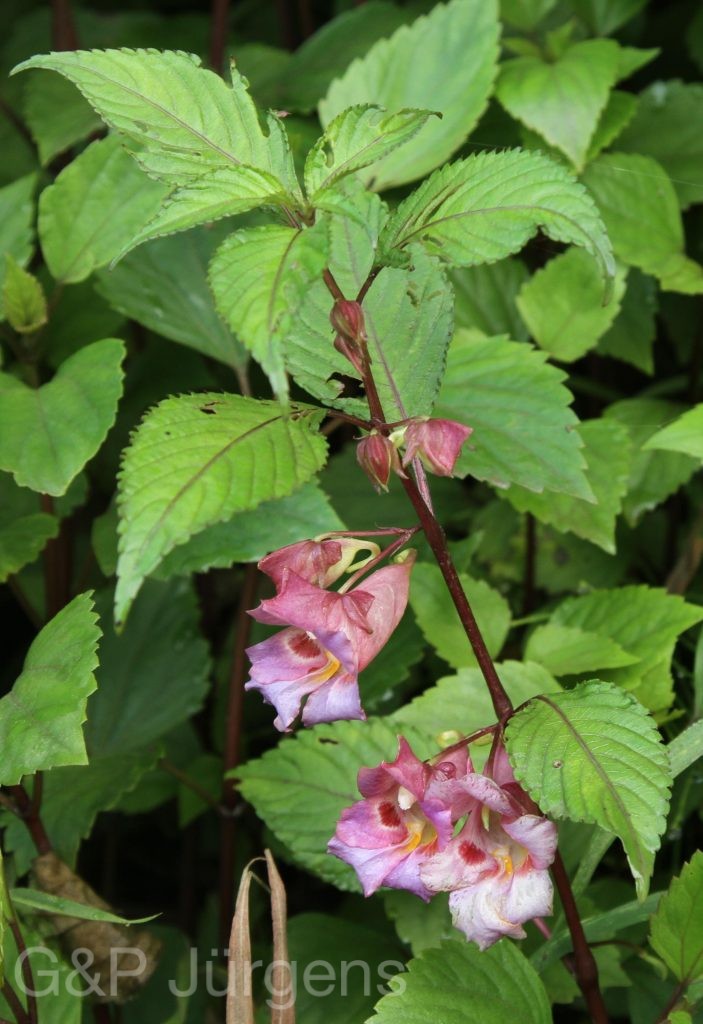
C.B.Clarke ex Hook.f.

Bhutan2012 772
Bhutan Zemgang 1800m, October
Bhutan2012 774
Bhutan Zemgang 1800m, October

Description

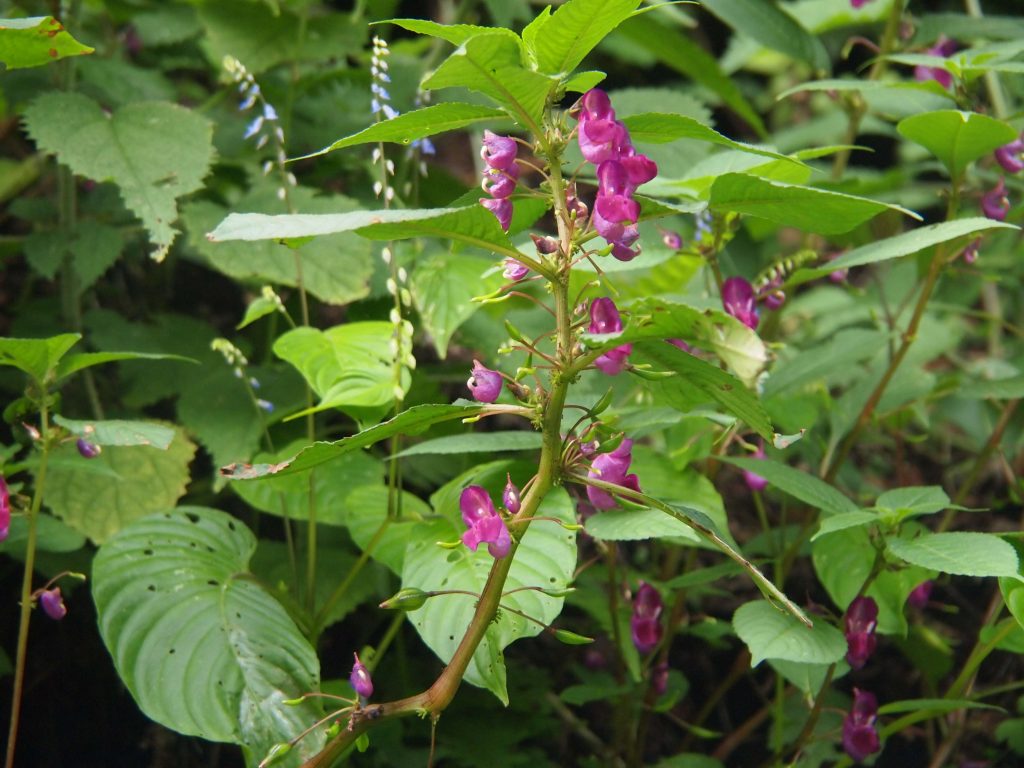
Impatiens florigera is a balsam of the eastern Himalaya, recorded by GBIF (about 29 occurrences) from India, Bhutan and Nepal. It is a herb of moist, shaded habitats in the subtropical and warm-temperate broadleaved forest belt, growing on damp banks, by streams, in forest clearings and along shaded roadsides where soil moisture is high through the monsoon. The illustrated plant was photographed in Bhutan at Zemgang at about 1800 m in October, an autumn-flowering montane forest locality characteristic of the species, which blooms towards the close of the monsoon when many Himalayan Impatiens reach their flowering peak.

The plant is a succulent, glabrous annual with a translucent, watery stem that is often reddish at the swollen nodes and branches freely. The leaves are alternate, ovate to elliptic, with a crenate-serrate margin and shortly acuminate apex, narrowed to a petiole that may bear a few stipitate glands. The flowers are zygomorphic and showy, borne on slender axillary peduncles; each has the balsam structure of three sepals, the lowest enlarged into a spurred boat-shaped lip, and five petals forming a standard and two lateral united pairs, typically pink to purplish. The fruit is a fleshy, club-shaped capsule that dehisces explosively, its valves coiling abruptly to scatter the seeds.

Impatiens is one of the largest genera of flowering plants and especially diverse in the Himalaya, where numerous narrowly distributed species occupy moist forest habitats and are distinguished by fine differences in flower form, spur shape and indumentum. I. florigera belongs to this rich eastern Himalayan radiation. As a monsoon-dependent annual of moist forest it is locally frequent within its range; its explosive seed dispersal and insect pollination are typical of the genus.

Author: C.B.Clarke ex Hook.f. · Sources: POWO (Kew), GBIF, Flora of Bhutan, Flora of China, Annotated Checklist of the Flowering Plants of Nepal, Grey-Wilson's monograph Impatiens of Africa and revisional studies of Asian Impatiens

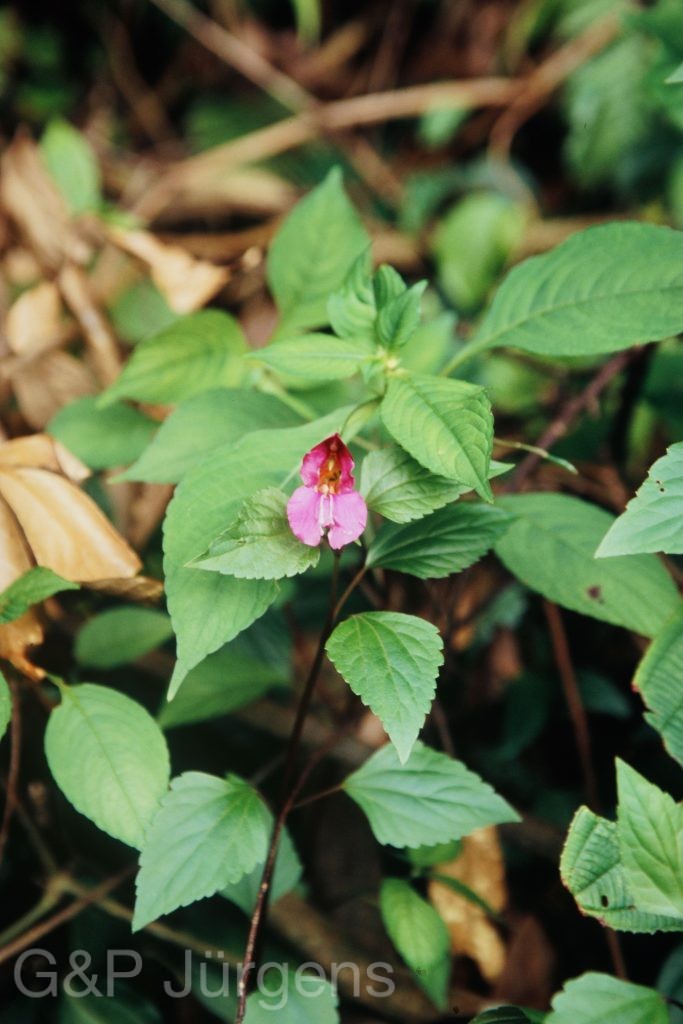
DC.

Bhutan2012 940
Bhutan Jakar 1950m, October

Description

Impatiens puberula is a Himalayan balsam ranging through Nepal, India, China, Bhutan and Myanmar, with around 186 georeferenced records. It is a plant of cool, humid, shaded habitats, occurring on damp banks, stream-sides, seepage slopes and moist forest margins in the temperate zone. The individual photographed near Jakar in the Bumthang region of central Bhutan at about 1950 m in October illustrates its preference for shaded, moisture-retentive ground, where it flowers late into the monsoon season on rich, organic soils.

The species is a succulent annual with translucent, often reddish-tinged stems that are minutely puberulous, the indumentum giving rise to its epithet. The leaves are alternate, ovate to elliptic-lanceolate with a crenate-serrate margin, the teeth often gland-tipped, and taper to a petiole. The zygomorphic flowers are borne singly or in few-flowered axillary clusters; the showy lower sepal is prolonged into a slender, curved nectar spur, and the lateral united petals form broad wings, as is characteristic of the genus. The fruit is an explosively dehiscent fleshy capsule that, when ripe, coils its valves to fling out the seeds.

Impatiens is one of the largest angiosperm genera and is notably species-rich and taxonomically difficult across the Sino-Himalayan region, where rapid radiation has produced numerous narrowly defined and frequently endemic taxa separated by floral colour, spur curvature and seed sculpturing. Its explosive ballistic seed dispersal and dependence on perennially moist microhabitats make such balsams sensitive to drainage change and forest disturbance, though I. puberula remains widespread.

Author: DC. · Sources: POWO (Kew), GBIF, Flora of Bhutan, Flora of Nepal, Flora of China, Grey-Wilson's monograph of Impatiens

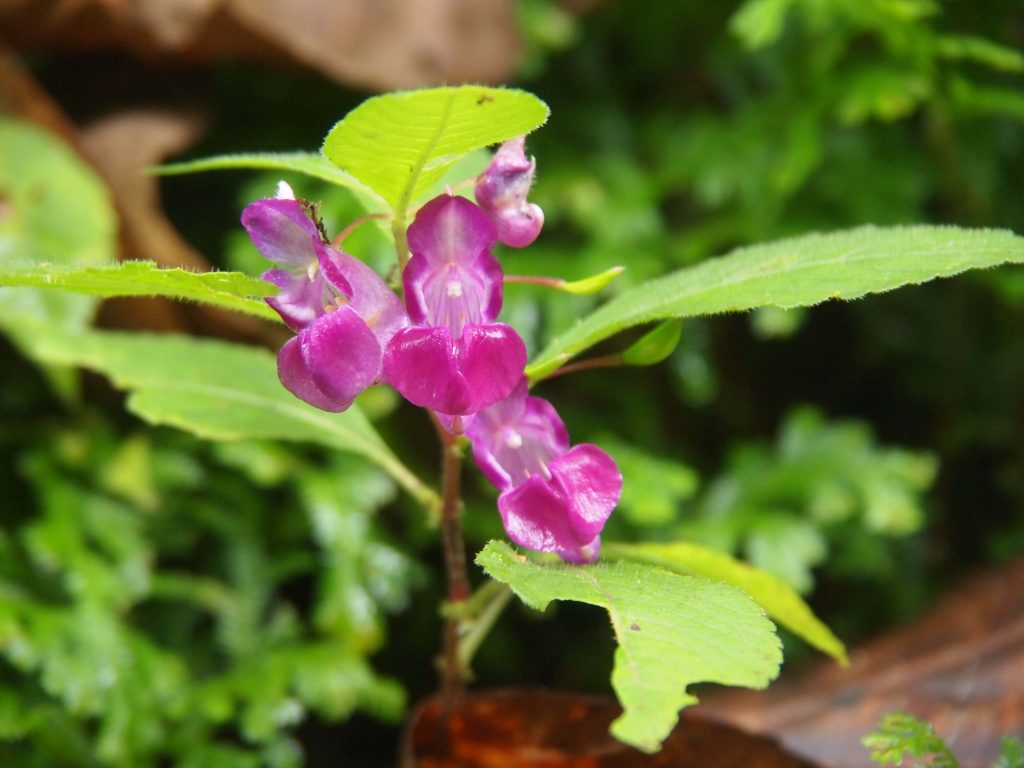
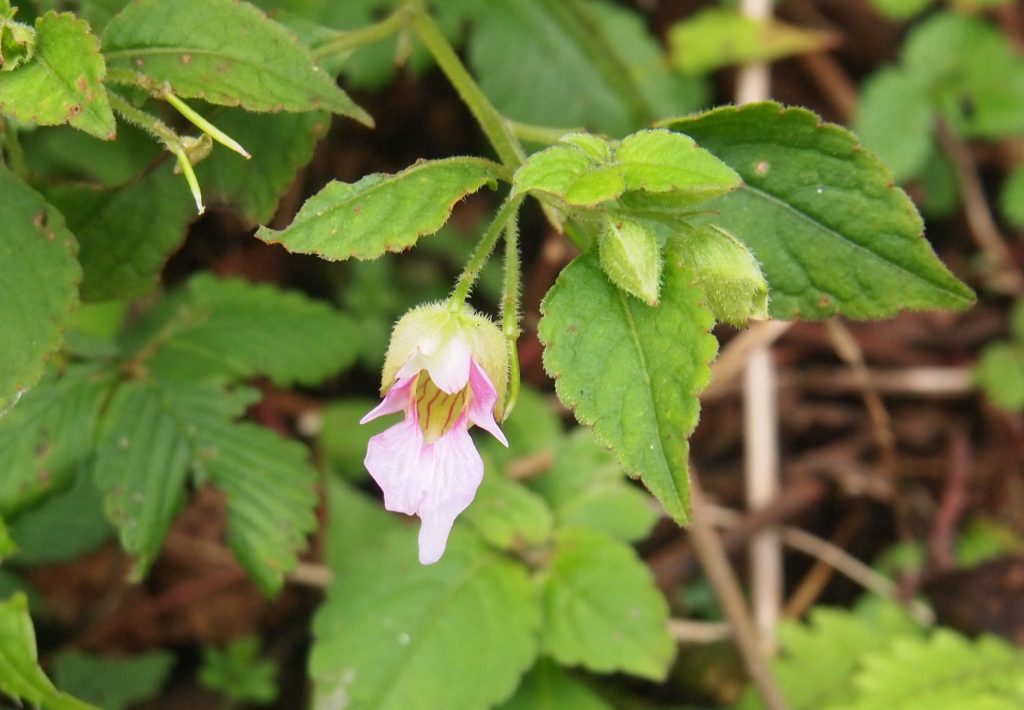
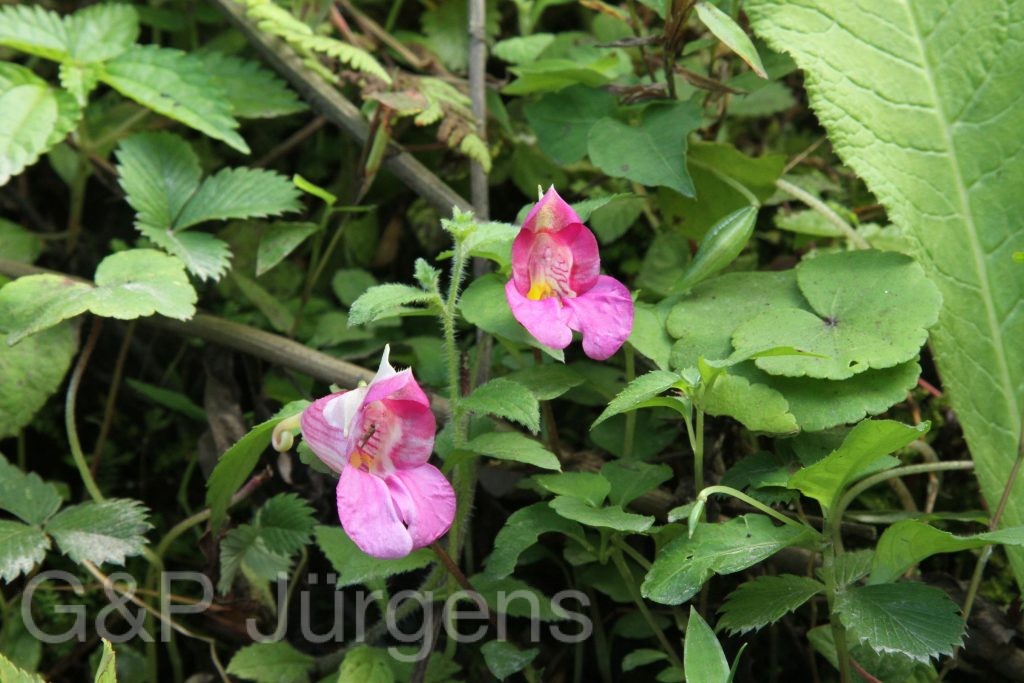
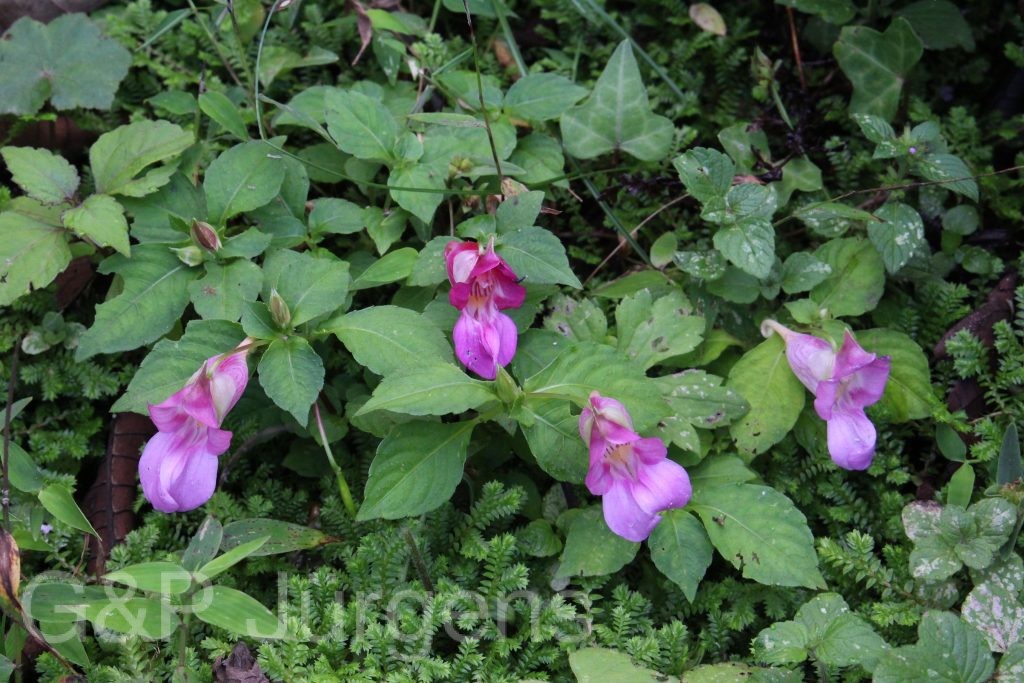
Hook.f. et Thomson

Bhutan2015 60
Bhutan Wangdi Phodrang 2000m, October
Bhutan2015 59
Bhutan Wangdi Phodrang 2000m, October
BhutanPG2011 37
Bhutan Pele-La, 2800m June
Bhutan2012 1338
Bhutan Pemagatse, 2000m October

Description

Impatiens spirifer is an annual balsam of the eastern Himalaya, recorded by GBIF in some 52 occurrences from India, China, Bhutan and Nepal. It favours cool, shaded and humid situations such as forest margins, ravine banks, seepage slopes and roadside ditches in the temperate and upper-subtropical belt, broadly between 1800 and 3000 m. The accompanying images were taken in Bhutan at Wangdi Phodrang and Pemagatse (2000 m, October) and the Pele-La (2800 m, June), documenting a long flowering season that extends through the monsoon into autumn on moist, organic-rich soils where balsams thrive.

The plant is a succulent, glabrous herb with translucent, often reddish-tinged stems that are erect to ascending and somewhat swollen at the nodes. The leaves are alternate, ovate to elliptic, crenate-serrate with the lowermost teeth sometimes gland-tipped, narrowing to a petiole. The flowers are zygomorphic and resupinate, borne singly or in few-flowered axillary clusters; the lower sepal forms a navicular spur that is slender and incurved, while the lateral united petals are deeply two-lobed. The fruit is a fleshy, fusiform capsule that dehisces explosively, the valves coiling to fling out the small seeds.

Impatiens (Balsaminaceae) is among the largest angiosperm genera, exceptionally species-rich and rapidly radiating in the Sino-Himalayan region, where narrow endemism and floral micromorphology drive species delimitation. GBIF treats I. spirifer as accepted. Like many montane balsams it is closely tied to perennially moist microhabitats and is thus vulnerable to drainage, disturbance and shifts in monsoon reliability, although it remains locally frequent within suitable forest.

Author: Hook.f. et Thomson · Sources: POWO (Kew), GBIF, Flora of Bhutan, Flora of China, Grey-Wilson monograph of Impatiens (Balsaminaceae)

Wall.

Bh09 387 P613
Bhutan Mo-Chu, 1500m June

Description

Impatiens sulcata is a tall, robust annual balsam of the Himalaya, recorded by GBIF (361 occurrences) from India, Nepal, Bhutan, Pakistan and adjacent China and Myanmar. It favours damp, nutrient-rich ground along streams, ditches, forest margins, roadside seepages and disturbed moist sites, principally from around 1500 to 3000 m in the warm-temperate and subtropical belts. The cited gathering from the Mo-Chu in Bhutan at 1500 m in June reflects its riparian preference, the plant typically forming dense, gregarious stands in the early monsoon along watercourses where the soil remains saturated.

The species is a succulent herb often exceeding a metre in height, with stout, conspicuously grooved (sulcate), reddish, hollow stems that root at the lower nodes. The leaves are large, ovate to ovate-lanceolate, serrate with crenate-glandular teeth, and arranged oppositely or in whorls toward the apex. Flowers are large and showy, pink to purplish, borne in axillary racemose clusters; the lower sepal forms a saccate spur, the standard is dorsally carinate, and the lateral united petals carry broad auricles. The fruit is a fleshy, club-shaped capsule that dehisces explosively, scattering the seeds by elastic recoil of the valves.

Belonging to the speciose, taxonomically complex genus Impatiens, the species sits among the tall Himalayan annual balsams and is allied to such forms as I. glandulifera, with which it shares vigorous growth and explosive seed dispersal. Its annual, fast-growing, ruderal habit makes it an effective colonist of disturbed riparian ground, while its open flowers are pollinated by bees and butterflies. It is widespread and not threatened.

Author: Wall. · Sources: POWO (Kew), GBIF, Flora of China Vol. 12, Flora of Bhutan Vol. 1, Flora of Nepal, Grey-Wilson Impatiens of Africa and the Himalaya

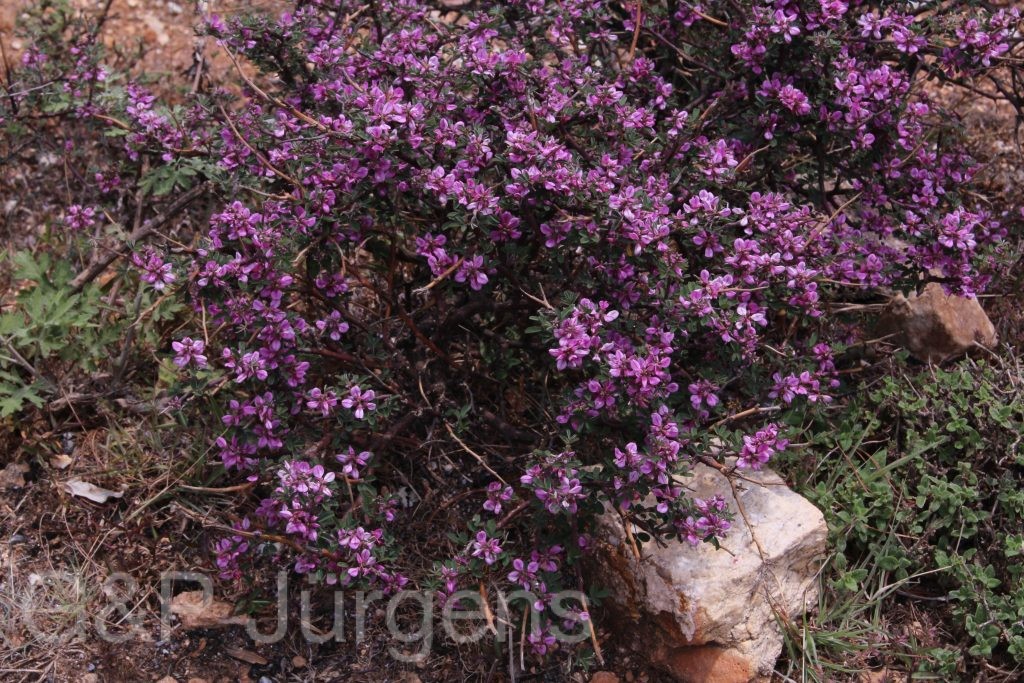
Buch.-Ham. ex D.Don

Bhutan2014 844
Bhutan Thimphu 2230m, May
Bh09 393 G625
Bhutan Mo-Chu, 1550m June

Description

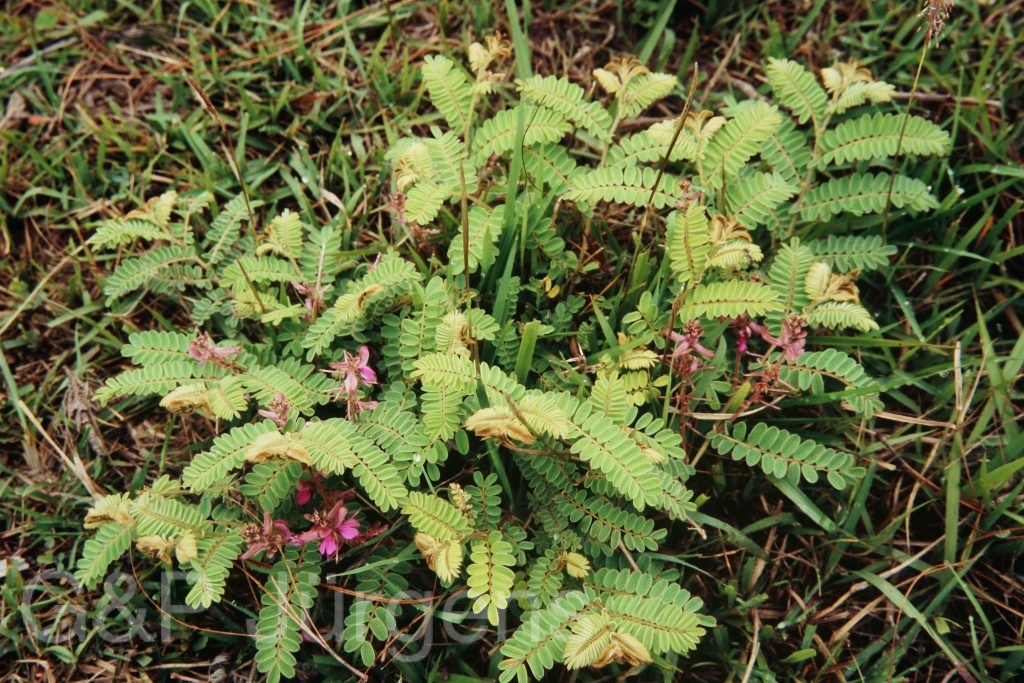
A shrubby indigo widespread across the Himalaya and South to South-East Asia, native to India, Nepal, China, Bhutan, Myanmar, Thailand and Vietnam, with around 436 GBIF occurrences (numerous European and other records represent cultivated or herbarium material). It grows on sunny open slopes, scrub, forest margins, roadbanks and disturbed ground in the warm-temperate and subtropical zones, mostly between about 1200 and 2700 m. The featured plants were recorded in Bhutan in May and June, at Thimphu around 2230 m and the lower Mo-Chu valley at about 1550 m, both warm montane settings.

The species is a much-branched, erect to spreading shrub with slender, ribbed twigs bearing characteristic appressed, biramous (medifixed) hairs. The leaves are imparipinnate with numerous small, opposite, oblong to obovate leaflets that are sparsely strigose and minutely mucronate. Flowers are borne in slender, elongate axillary racemes; each papilionaceous flower has a small campanulate calyx and a pink to purplish-red corolla comprising a broad standard, two wings and a spurred keel, with diadynamous stamens. The fruit is a slender, straight, linear, terete to slightly compressed pod that splits along both sutures to release several small, cylindric seeds, the valves often twisting on dehiscence.

Accepted by POWO and GBIF, I. dosua belongs to the large, taxonomically complex genus Indigofera, distinguished from relatives by its leaflet number, indumentum and pod form. As a nitrogen-fixing legume it enriches poor montane soils and colonises disturbed sites, while its flowers attract bees. Widespread, adaptable and frequent in secondary habitats, it is of no conservation concern and is sometimes used locally for fodder, green manure and as a dye source.

Author: Buch.-Ham. ex D.Don · Sources: POWO (Kew), GBIF, Flora of Bhutan, Flora of China, Sanjappa monograph of Indian Indigofera