Tag:

Montane (1500-2500 m)

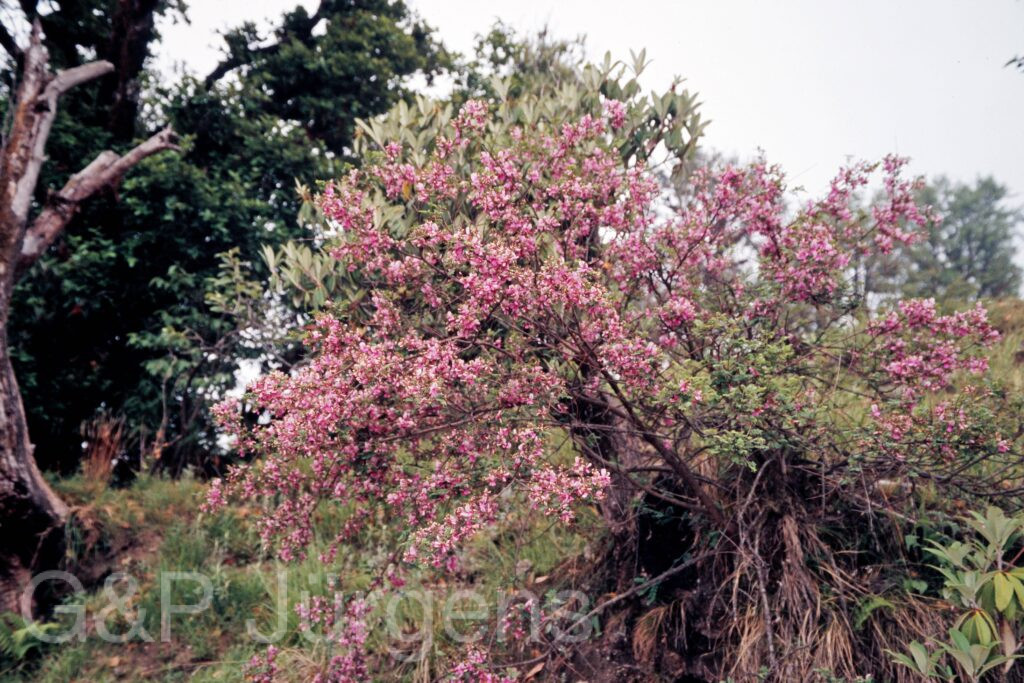
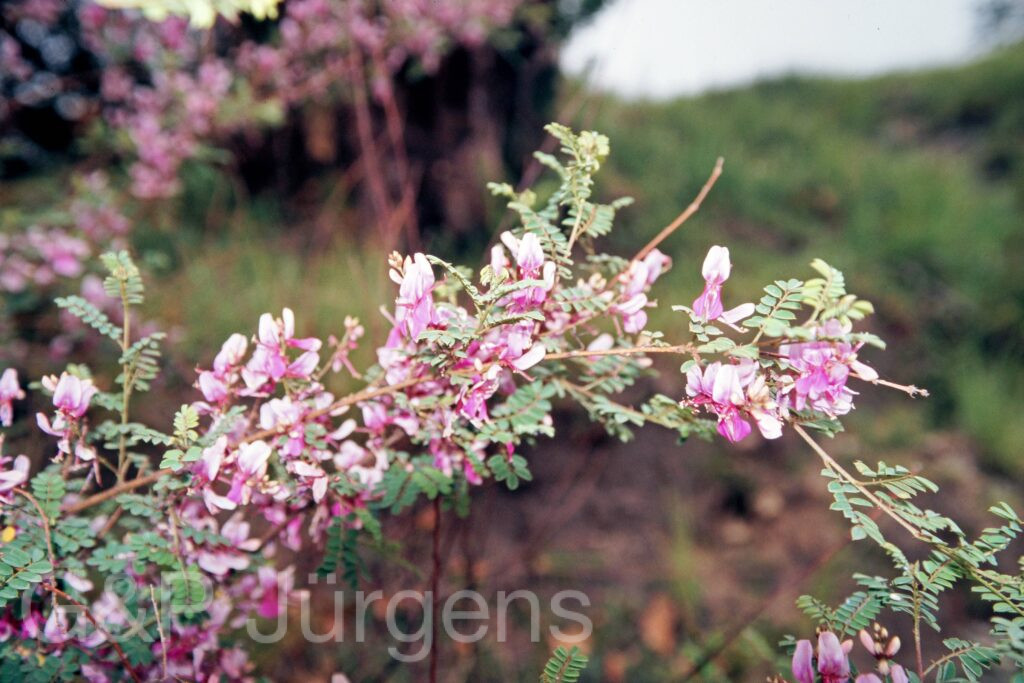
Wall. ex Brandis

Garh 07 220 ergebnis
India Garhwal Kawara 2000m, June
Garh 07 221 ergebnis
India Garhwal Kawara 2000m, June

Description

Indigofera heterantha (Wall. ex Brandis), a deciduous shrub of the subfamily Faboideae, is widely distributed across the western and central Himalaya, ranging from Afghanistan and Pakistan eastward through northern India, Nepal and Bhutan into southwest China. With over 1,100 georeferenced occurrences recorded in GBIF, it is a common and conspicuous element of the temperate zone, and has additionally become naturalised in cultivation across Europe, North America, Japan and the Southern Hemisphere. The species favours open hillsides, forest margins, dry stony slopes and degraded scrub, typically between 1,500 and 3,000 m, as reflected in the collection from Garhwal at Kawara, India, at 2,000 m in June, where it forms part of the sun-loving sub-alpine shrubbery.

The plant is an erect, much-branched shrub reaching 1–2 m in height, with slender, angular, greyish branchlets bearing appressed, biramous (medifixed) hairs that lend a canescent aspect to young growth. The leaves are imparipinnate with 11–21 small, obovate to elliptic leaflets, each mucronate at the apex and silky-pubescent beneath. Numerous purplish-red to bright pink-crimson papilionaceous flowers are borne in dense, erect axillary racemes that often exceed the subtending leaf; the calyx is shortly toothed and the standard petal silky on its outer face. The fruit is a slender, terete, glabrescent legume containing several cuboid seeds.

Formerly treated under the name Indigofera gerardiana, the species is taxonomically allied to the I. hebepetala group of Himalayan legumes. It is an important soil-binding pioneer on eroding slopes, contributing nitrogen through rhizobial symbiosis, and the tough stems are traditionally harvested for basketry and fuel. Its hardiness and floriferous habit have made it a popular ornamental in temperate gardens. The species is not considered threatened, being abundant throughout its broad montane range.

Author: Wall. ex Brandis · Sources: POWO (Kew), Flora of Pakistan, GBIF, Flora of China Vol. 10, Sanjappa: Legumes of India (1992)
(L.) Lam.

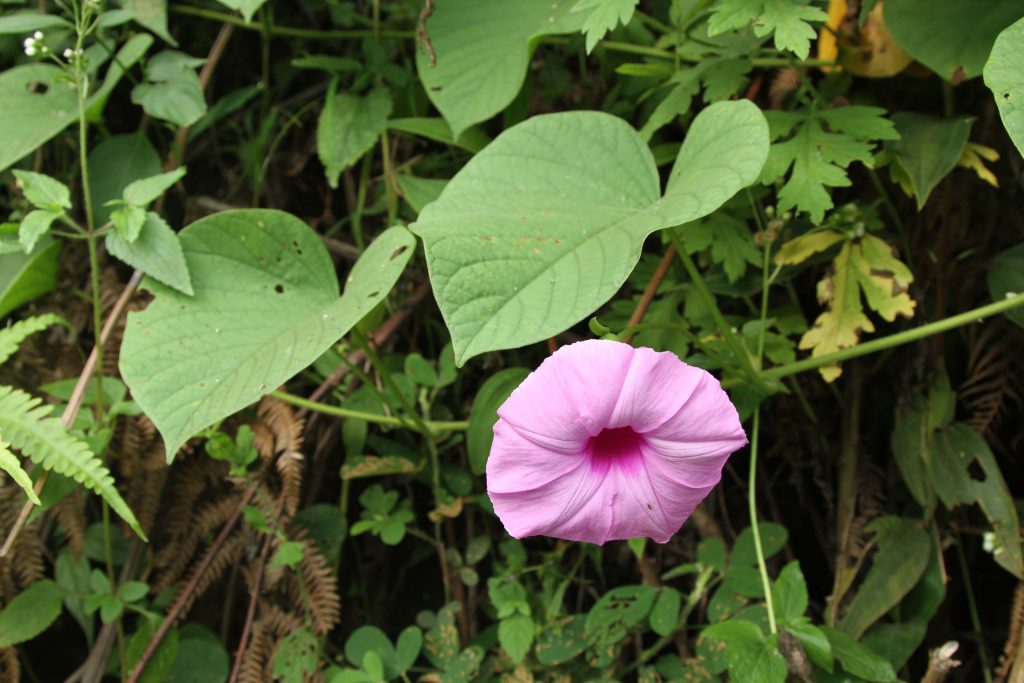
Bhutan2012 785
Bhutan Zemgang 1850m, October
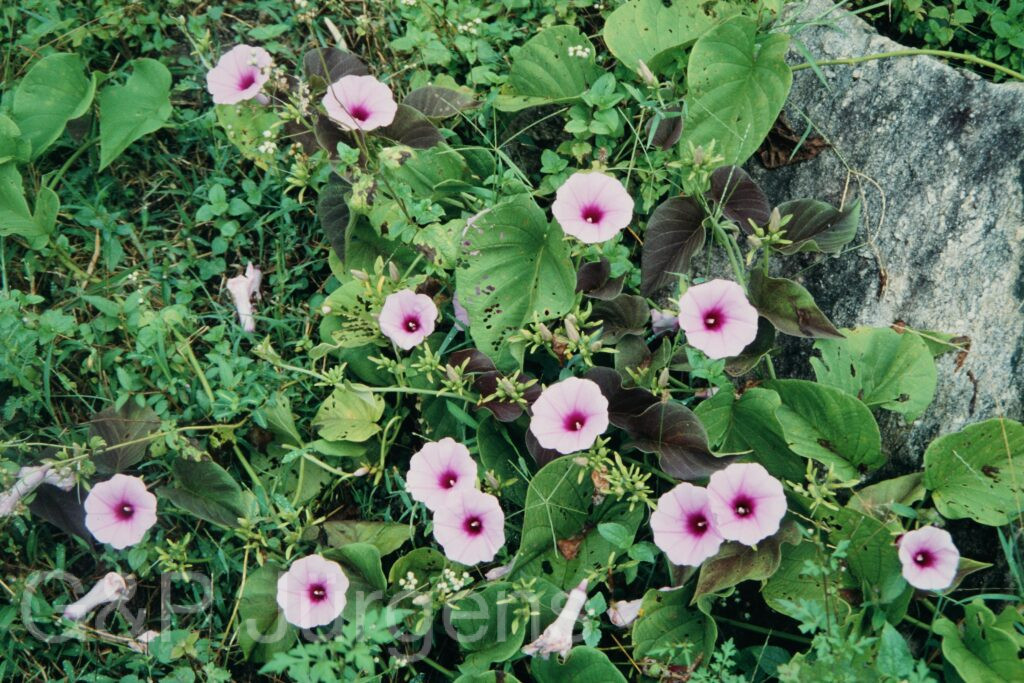
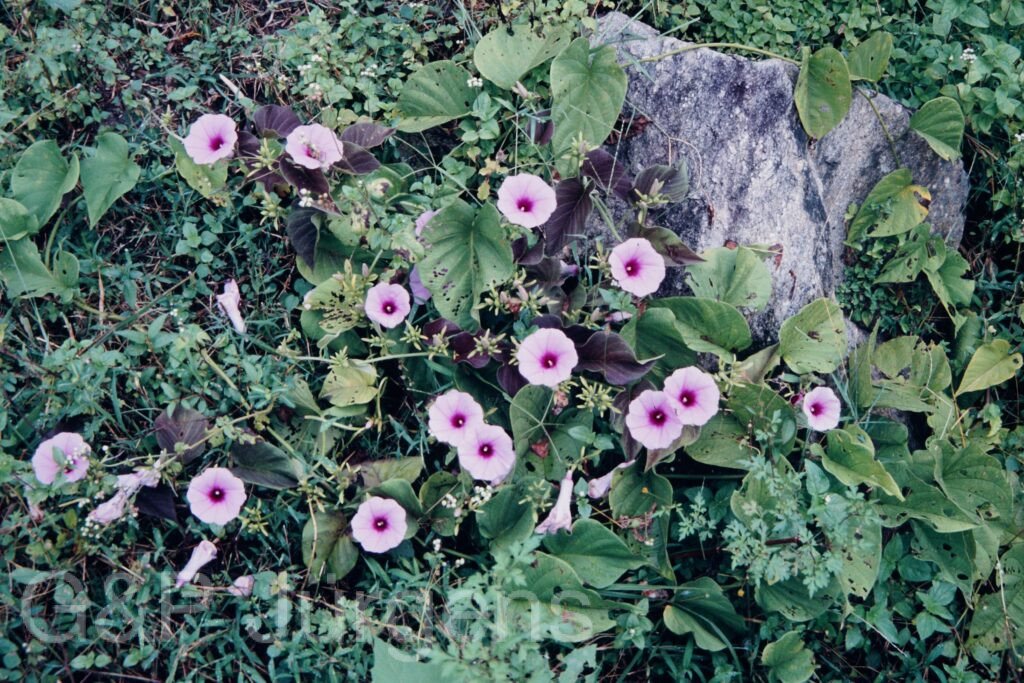
Nepal 95 42 P74 ergebnis
Nepal Darondi-Khola 670m
Nepal 95 43 W75 ergebnis
Nepal Darondi-Khola 670m

Description

Ipomoea batatas, the sweet potato, is a cultigen of Neotropical origin now grown and naturalised throughout the tropics and warm-temperate world; GBIF records 38,679 occurrences spanning the Americas (Peru, Mexico, Brazil, the United States, Colombia, Ecuador and others) through to Asia and Oceania, including Thailand, Taiwan, the Philippines, Indonesia, China and Papua New Guinea. In the Himalaya it is a cultivated and escaped plant of village margins, terraced fields and warm valley bottoms. The illustrated material comes from Bhutan, Zhemgang, at about 1850 m in October, and from Nepal along the Darondi Khola at around 670 m, reflecting the sub-tropical farmed elevations where it is grown.

The plant is a perennial herbaceous vine with prostrate or twining stems that root at the nodes and arise from swollen, edible storage roots (tubers) of variable colour. Leaves are alternate, petiolate and highly variable, from broadly ovate-cordate to deeply palmately lobed, with an entire or sinuate margin. Flowers are borne in few-flowered axillary cymes; the corolla is funnelform and infundibuliform, lavender to pink-purple with a darker throat, subtended by a small calyx of unequal sepals. The five stamens are unequal and included, the ovary superior; the fruit is a small capsule, though many cultivars set seed poorly.

The sweet potato is a hexaploid of long domestication, its wild progenitors lying in Central America, and it ranks among the world's most important root crops. POWO and GBIF accept the name. Its trans-Pacific presence in pre-Columbian Oceania remains a celebrated biogeographic puzzle bearing on early human dispersal.

Author: (L.) Lam. · Sources: POWO (Kew), GBIF, Flora of China, Flora of Bhutan, Annotated Checklist of the Flowering Plants of Nepal, World Checklist of Convolvulaceae (Ipomoea monograph)

(L.) Roth

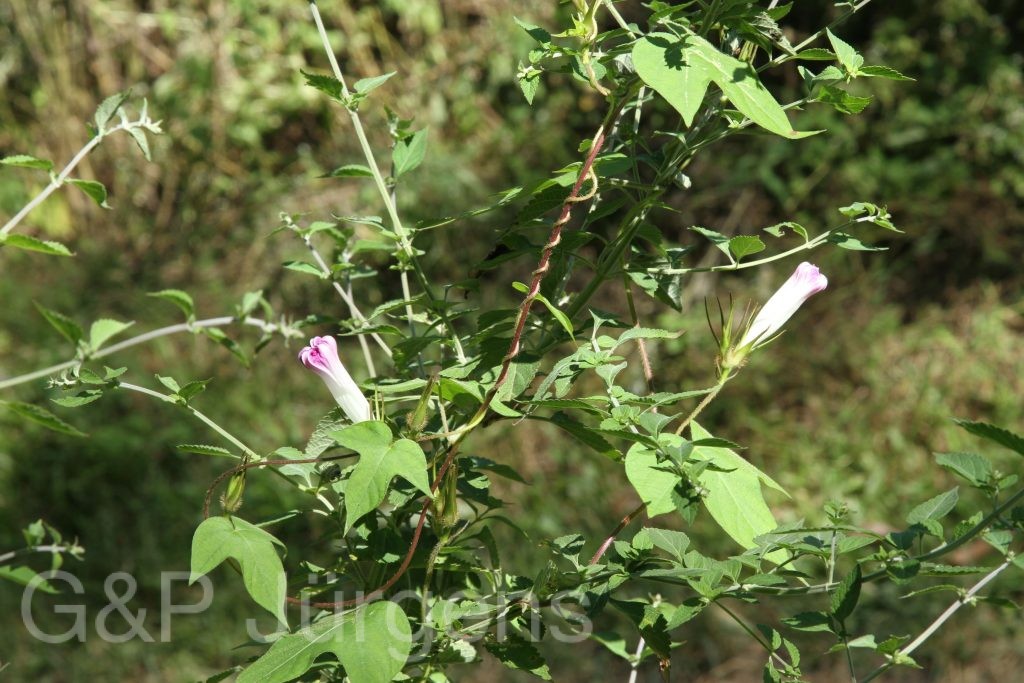
Bhutan2015 304
Bhutan between Zhemgang-Trongsa 1700m, October

Description

Ipomoea nil is a pantropical annual morning glory of uncertain native origin, most likely originating in tropical America but now cosmopolitan in warm regions worldwide. It occurs throughout South and Southeast Asia, East Asia, Africa, and the Americas, with over 13,000 occurrence records in GBIF spanning more than 70 countries. The species thrives in disturbed habitats, field margins, roadsides, waste ground, and forest edges from lowland areas up to approximately 2,500 m elevation. In Bhutan, it has been documented along the road between Zhemgang and Trongsa at 1,700 m, flowering in October during the late monsoon season.
Ipomoea nil is a twining or scrambling annual herb with stems 1–3 m long, retrorsely hispid with spreading, tawny hairs. Leaves are alternate, broadly ovate to orbicular in outline, 5–15 cm long, typically three-lobed (occasionally entire or five-lobed), with a cordate base and hispid indumentum on both surfaces. The inflorescence consists of one to three flowers on axillary peduncles. The calyx is deeply divided into five lanceolate, densely hispid sepals with long, spreading basal hairs — a key diagnostic character. The corolla is funnelform, 3–5 cm long, typically blue to purple, occasionally red, pink, or white, with a paler tube. Stamens are five, included. The fruit is a globose, trilocular capsule 8–10 mm in diameter, enclosed by the persistent calyx, containing four to six seeds that are dark brown to black and finely pubescent.
Ipomoea nil holds exceptional cultural significance in East Asia, particularly in Japan, where it has been cultivated since the Nara period (eighth century) and subjected to intensive selection that has produced hundreds of ornamental cultivars (asagao) with extraordinary floral diversity in form, colour, and patterning. It has also become a model organism in molecular genetics for the study of transposable elements controlling flower pigmentation. Taxonomically, I. nil belongs to Ipomoea section Pharbitis and is distinguished from the closely related I. purpurea by its densely hispid, long-awned calyx lobes.

Author: (L.) Roth · Sources: POWO (Kew), GBIF, Flora of China Vol. 16, Flora of Bhutan Vol. 2, Austin: Convolvulaceae of the Southeastern United States (1978)

(L.) Roth

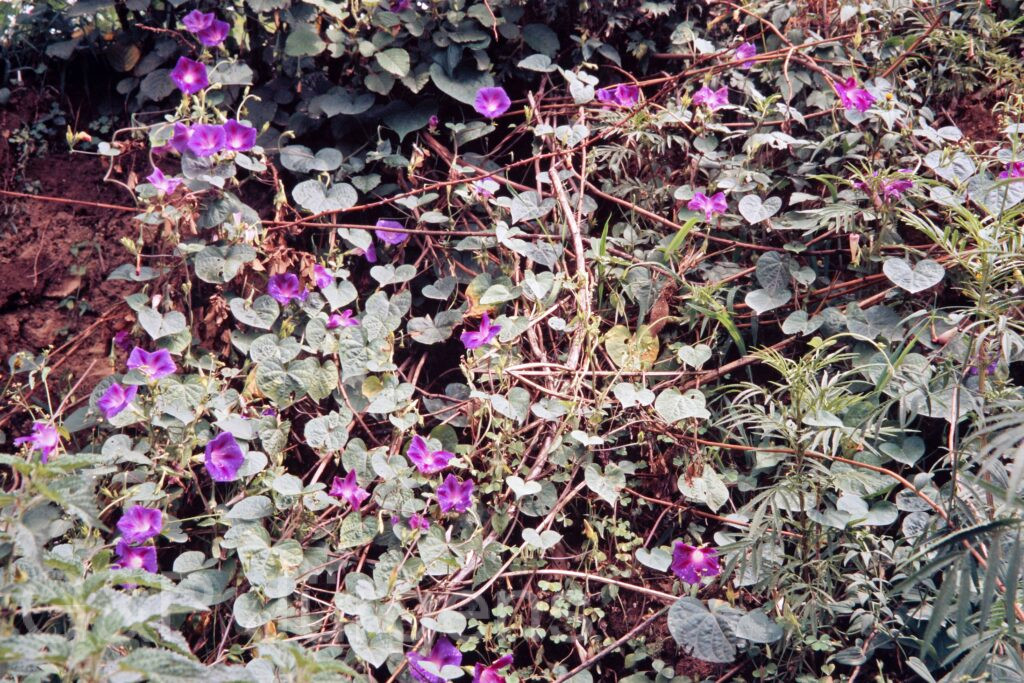
Garh 07 250 ergebnis
India Garhwal Barron Chatti 2300m, June
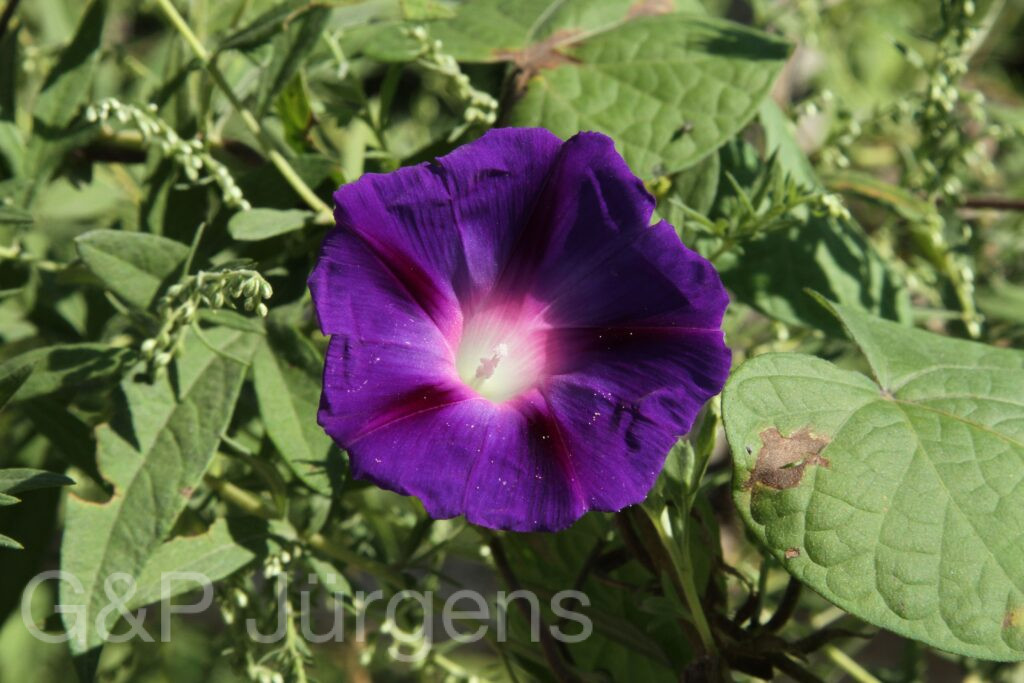
Bhutan2015 563
Bhutan Mo-Chu 1550m, October

Description

Ipomoea purpurea, the common morning glory, is a neotropical species of Mexican and Central American origin now thoroughly naturalised worldwide; GBIF records exceed 36,000 occurrences spanning the Americas (US, MX, BR, EC, PE, AR, BO, CO), Europe, southern Africa, eastern Asia and Australia. In the Himalaya it persists as an escaped ornamental and weed of disturbed ground, hedgerows, field margins and roadsides. The plants noted at Barron Chatti in Garhwal at 2300 m in June and along the Mo-Chu in Bhutan at 1550 m in October illustrate its tolerance of a broad warm-temperate to subtropical elevation range and its long, monsoon-spanning flowering season.

It is an annual twining herb with slender, retrorsely hairy stems climbing by means of left-handed coiling. The leaves are alternate, long-petiolate, broadly ovate-cordate and usually entire, acuminate at the apex with a deep basal sinus. Flowers arise in axillary cymes of one to several; each has a hairy, lanceolate-lobed calyx and a showy funnelform corolla 4 to 6 cm across, varying from purple and violet-blue to pink, magenta and white, with a paler throat and five faint interplical bands. The five stamens are unequal and included; the superior ovary ripens into a globose, three-locular capsule releasing several glabrous, dark trigonous seeds.

The species is taxonomically straightforward within Ipomoea but horticulturally polymorphic, with numerous colour cultivars. Its self-compatible, bee-pollinated flowers and prolific hard-coated seed make it a successful colonist and, in warm regions, an agricultural weed. It is of no conservation concern; rather, its capacity to naturalise warrants monitoring in ruderal habitats.

Author: (L.) Roth · Sources: POWO (Kew), GBIF, Flora of China Vol. 16, Flora of Bhutan Vol. 2, Flora of Pakistan, A Monograph of the Convolvulaceae (Ipomoea)

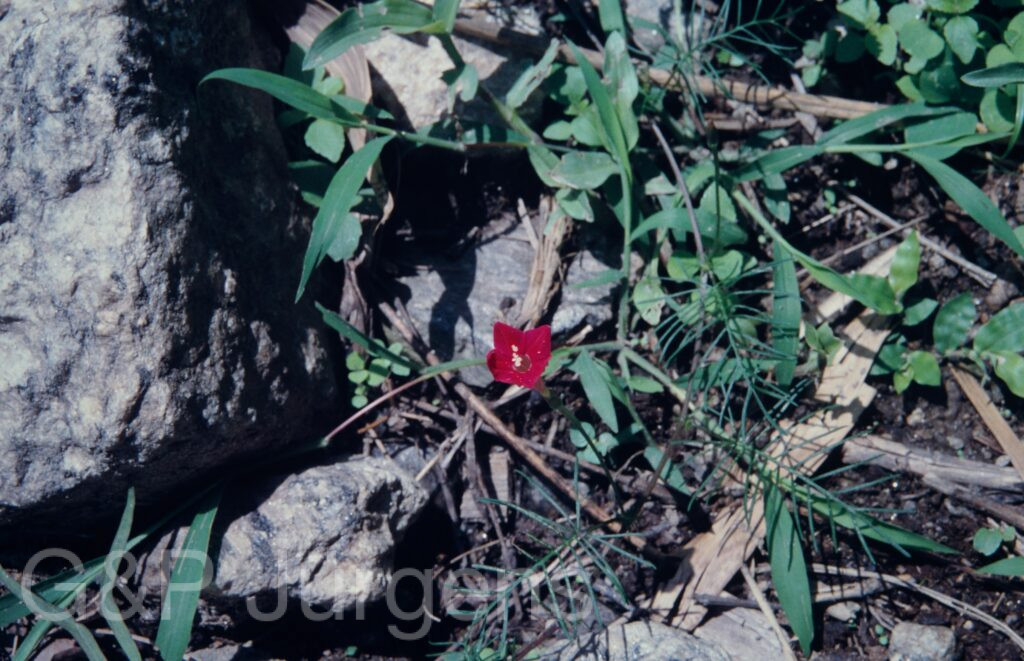
L.

Nepal 1994 231 ergebnis
Ost-Nepal Mewa-Khola 1800m April 

Description

Ipomoea quamoclit, the cypress vine, is a twining annual of Neotropical origin now pantropically naturalised, with over 11,650 GBIF occurrences spanning the Americas (USA, Mexico, Brazil, Colombia, Ecuador, Peru, Venezuela), Asia (India, China, Taiwan, Korea, Japan, Indonesia, Thailand, Nepal), Australia and Africa. In its adventive Asian range it occupies disturbed ground, hedgerows, field margins, riverbanks and village thickets, frequently escaping from cultivation as an ornamental. The collection from the Mewa Khola in eastern Nepal at about 1,800 m in April reflects its establishment in warm low- to mid-montane situations.

It is a slender, glabrous, herbaceous climber to several metres. Its most distinctive feature is the foliage: the leaves are alternate, ovate in outline but pinnately divided almost to the midrib into numerous fine, filiform, parallel segments, giving a delicate feathery appearance. The flowers are solitary or few in axillary cymes, with a long, slender corolla tube expanding into a flat, five-angled, salverform limb about 1.5–2 cm across, brilliant scarlet (rarely white), with exserted stamens and style. The fruit is a small ovoid capsule containing few blackish, ovoid seeds.

The species, sometimes segregated as Quamoclit pinnata, is firmly placed within an enlarged Ipomoea, and GBIF treats the name as accepted. Its salverform red corolla and long tube reflect specialisation for pollination by hummingbirds in its native America and by butterflies and sunbirds elsewhere. Widely grown and self-seeding, it is locally weedy but of no conservation concern.

Author: L. · Sources: POWO (Kew), Flora of China Vol. 16, Flora of Nepal, GBIF, Austin & Huáman: A Synopsis of Ipomoea in the Americas (1996)

(Buch.-Ham. ex D.Don) H.Hara

Bhutan2015 586
Bhutan Mo-Chu 1800m, October
Bhutan2015 587
Bhutan Mo-Chu 1800m, October

Description

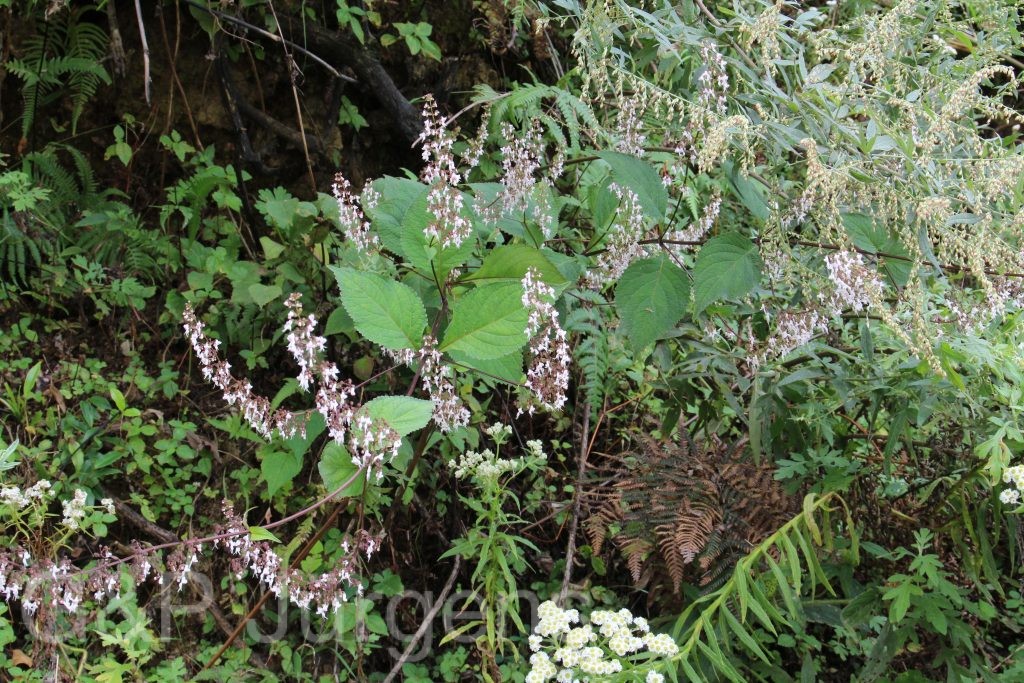
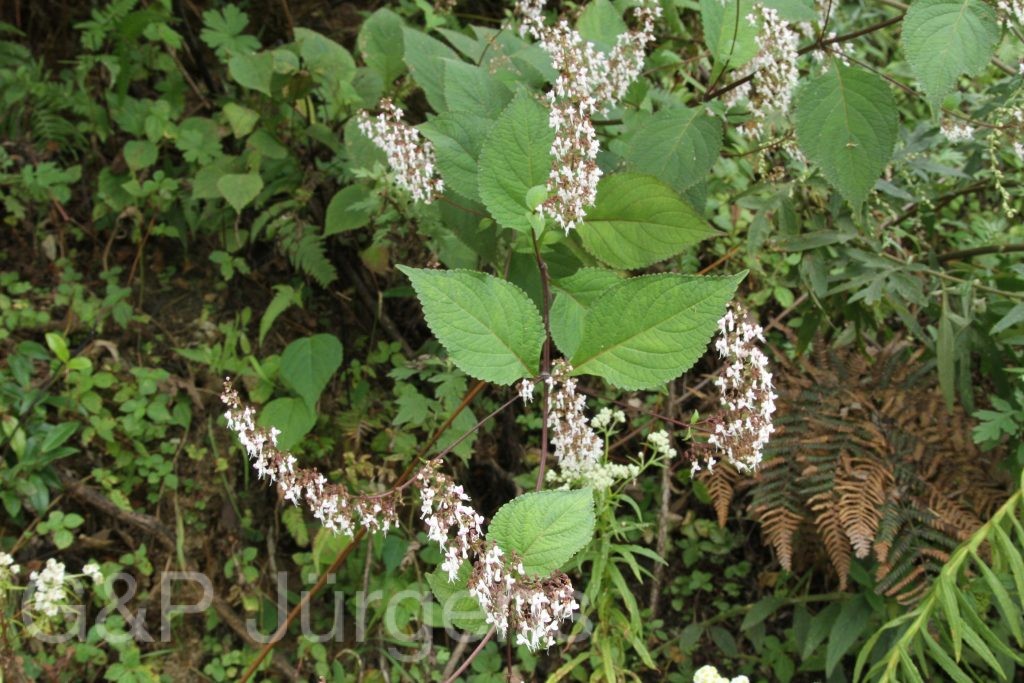
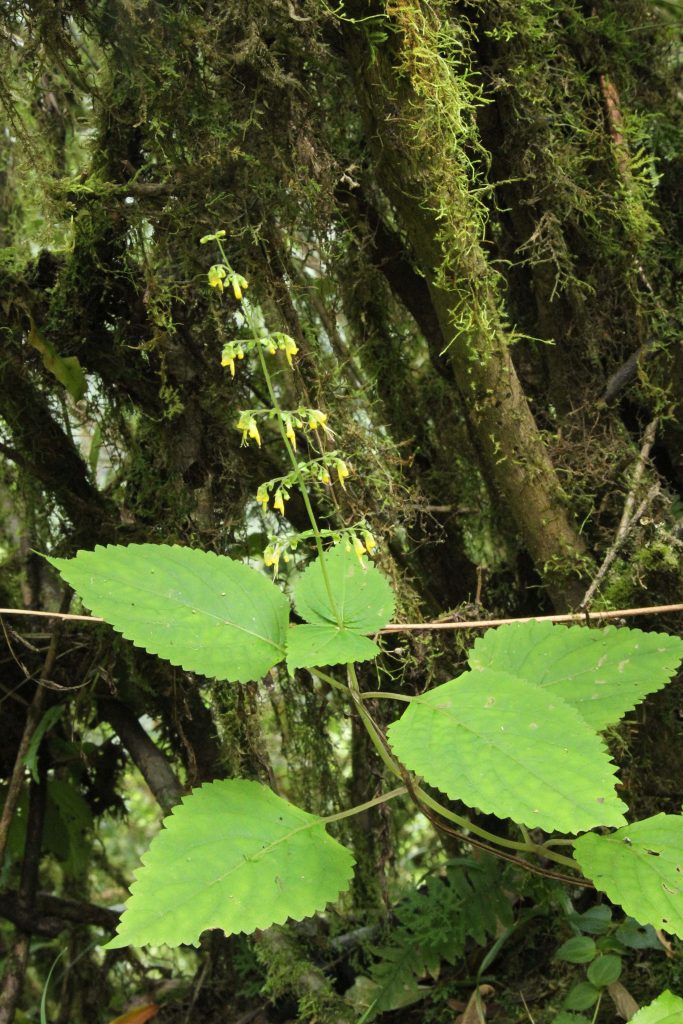
Isodon lophanthoides is a widespread herb of the Sino-Himalayan region, recorded from China, the Indian Himalaya, Nepal, Bhutan, Pakistan, Myanmar, Thailand, Laos, Vietnam, Bangladesh, Malaysia and Hong Kong, and represented by nearly two thousand georeferenced collections. It occupies a broad subtropical to warm-temperate belt, growing on moist shaded banks, forest margins, streamsides, grassy slopes and disturbed ground. In Bhutan it descends to warm river valleys, as along the Mo-Chu at about 1800 m where it was photographed flowering in October, the late-season anthesis typical of the genus.

The plant is an erect to ascending annual or short-lived perennial herb with quadrangular, often purple-tinged and pubescent or glandular stems. The leaves are opposite, ovate to broadly ovate, crenate-serrate, acuminate, and narrowed at the base into a winged petiole, often gland-dotted beneath. The inflorescence is a lax, much-branched terminal panicle of small cymes. The flowers have a bilabiate, glandular calyx that enlarges in fruit, and a small two-lipped corolla that is white to pale pink or purplish, dotted with darker spots, with a flat lower lip and four declinate didynamous stamens. The fruit consists of four smooth ovoid nutlets (mericarps).

Isodon (formerly included in a broad Rabdosia and Plectranthus) belongs to subfamily Nepetoideae of Lamiaceae; this species was described as Plectranthus lophanthoides by Buchanan-Hamilton and transferred by Hara. Several intraspecific varieties have been recognised across its range. Rich in bioactive ent-kaurane diterpenoids, it is used in Chinese herbal medicine, and its broad ecological tolerance and frequency mean it is not of conservation concern.

Author: (Buch.-Ham. ex D.Don) H.Hara · Sources: POWO (Kew), GBIF, Flora of China, Flora of Bhutan, Flora of Pakistan, taxonomic revisions of Isodon (Lamiaceae) by H. W. Li

(Wall.) Murata

Bhutan2012 352
Bhutan Wangdi 2200m, October

Description

An erect perennial mint of the Himalaya and adjacent mountains, recorded from Nepal, China, India, Bhutan and Myanmar, with about 180 GBIF occurrences. It grows on open slopes, scrub margins, forest edges, roadbanks and disturbed clearings in the warm-temperate and subtropical zones, generally between about 1500 and 2800 m, flowering into the autumn. The illustrated plant was photographed in October at Wangdi in Bhutan at around 2200 m, a sunny mid-elevation montane site typical of its late-season flowering.

The species is a tall, branching herb or subshrub with the characteristic quadrangular stems of the mint family, often finely pubescent. The leaves are opposite and decussate, ovate to ovate-lanceolate, acuminate, with serrate margins and a glandular-punctate, aromatic surface, borne on distinct petioles. The inflorescence is a lax, much-branched terminal panicle of small cymes. Each flower has a campanulate, two-lipped calyx and a small bilabiate corolla, pale lilac to whitish or bluish, with a short tube, a four-lobed upper portion and a larger boat-shaped lower lip enclosing the four declinate stamens. The fruit comprises four small, smooth, ovoid nutlets seated in the persistent calyx.

Accepted by POWO and GBIF, I. scrophularioides belongs to the genus Isodon (formerly within Rabdosia and Plectranthus), a group of mints rich in bioactive diterpenoids and of interest in traditional medicine and phytochemistry. The deflexed lower lip forms a landing platform for bee pollinators, and the dry nutlets are dispersed by gravity and disturbance. Adaptable and frequent in secondary habitats across its range, it is of no conservation concern and exemplifies the largely Asian, montane radiation of the genus.

Author: (Wall.) Murata · Sources: POWO (Kew), GBIF, Flora of China, Flora of Bhutan, Li revision of Isodon

(D.Don) Kudô

Bhutan2015 461
Bhutan Trongtsa 2100m, October

Description

Isodon ternifolius is a shrubby mint distributed across the eastern Himalaya and Southeast Asia, recorded by GBIF (477 occurrences) from China, India, Thailand, Nepal, Myanmar, Vietnam, Bhutan, Bangladesh and Laos. It occupies forest margins, thickets, open hillsides, roadsides and disturbed slopes, mostly at lower to mid montane elevations between roughly 500 and 2500 m. The plant photographed at Trongsa in central Bhutan at 2100 m in October illustrates its autumn flowering, when the airy inflorescences come into bloom along forested valley margins toward the upper end of its altitudinal range.

The species is an erect perennial herb or soft shrub with quadrangular, often densely pubescent stems. As suggested by the epithet, the leaves are frequently borne in whorls of three (ternate), in addition to the opposite arrangement typical of the family; they are ovate to lanceolate, crenate-serrate and shortly petiolate, with a velvety to tomentose indumentum. The flowers are small and arranged in many-flowered thyrses formed of axillary cymes. The corolla is bilabiate with a short tube, the upper lip four-lobed and reflexed and the lower lip boat-shaped and declinate to enclose the four stamens and the bifid style. The fruit comprises four smooth, ovoid nutlets enclosed within the persistent campanulate calyx.

Isodon, long included within Plectranthus or Rabdosia, is now recognised as a distinct genus of Old World mints noted for its rich array of bioactive ent-kaurane diterpenoids, several species being used in traditional Chinese medicine. The nectariferous bilabiate flowers are pollinated by bees and other insects, and the nutlets are dispersed passively from the persistent calyces. The species is common, weedy in disturbed habitats and not regarded as threatened.

Author: (D.Don) Kudô · Sources: POWO (Kew), GBIF, Flora of China, Flora of Bhutan, Flora of Thailand, Revision of the Genus Isodon (Li)

Wall.

Nepal 97 92 P153
Nepal above Meta-Khola 2250m April
Nepal 97 312 P616
Nepal above Meta-Khola 2250m April

Description

Jasminum dispermum is a scandent or climbing jasmine widely distributed across the Himalaya and montane south-east Asia, recorded from China, India, Nepal, Myanmar, Thailand and Bhutan, with outlying records (ID, KR, RU, ZZ) reflecting cultivation and herbarium material. Of more than 400 georeferenced collections, the core range lies along the subtropical-to-temperate forest belt of the Himalayan foothills. It grows in forest margins, scrub, ravines and along streams, scrambling over rocks and shrubs in the warm-temperate zone. The photographed plant from above the Meta-Khola in Nepal at 2250 m, flowering in April, is typical of its lower montane habitat and its spring flowering ahead of the monsoon.

It is a woody, twining shrub or liana with terete, often pubescent branchlets. The leaves are opposite and pinnately compound, usually with five to seven leaflets (sometimes reduced to three or trifoliolate uppermost ones), the leaflets ovate to lanceolate, acuminate and entire. The fragrant flowers are borne in terminal and axillary cymose panicles; each has a small, toothed calyx and a salverform corolla with a slender tube and spreading lobes, white within and frequently flushed pink or rose-purple on the outside in bud. Two stamens are inserted in the corolla tube. The fruit, reflected in the epithet dispermum, is a paired or two-seeded berry that ripens black.

Jasminum is a large Old World genus of the olive family centred on tropical and warm-temperate Asia and Africa, many species prized for their scent. J. dispermum is a vigorous, ornamentally attractive climber, occasionally cultivated, and remains common throughout its native range with no conservation concern. Its nocturnally fragrant, pale flowers suggest pollination by long-tongued moths and other nectar-seeking insects.

Author: Wall. · Sources: POWO (Kew), GBIF, Flora of China Vol. 15, Flora of Bhutan Vol. 2, Flora of Nepal, Green's Synopsis of the Oleaceae

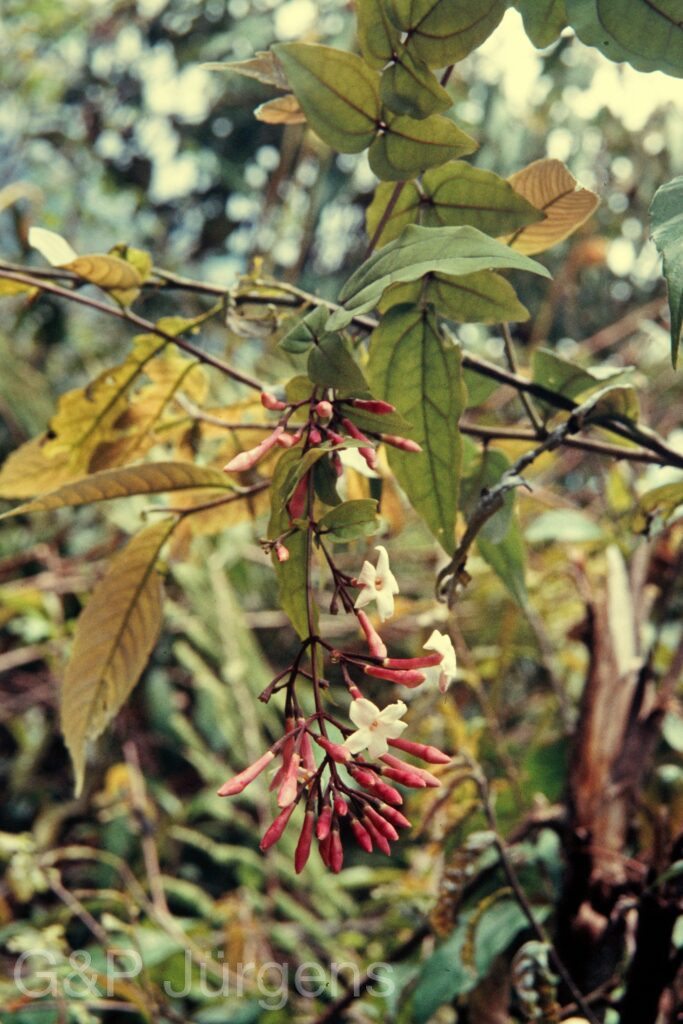
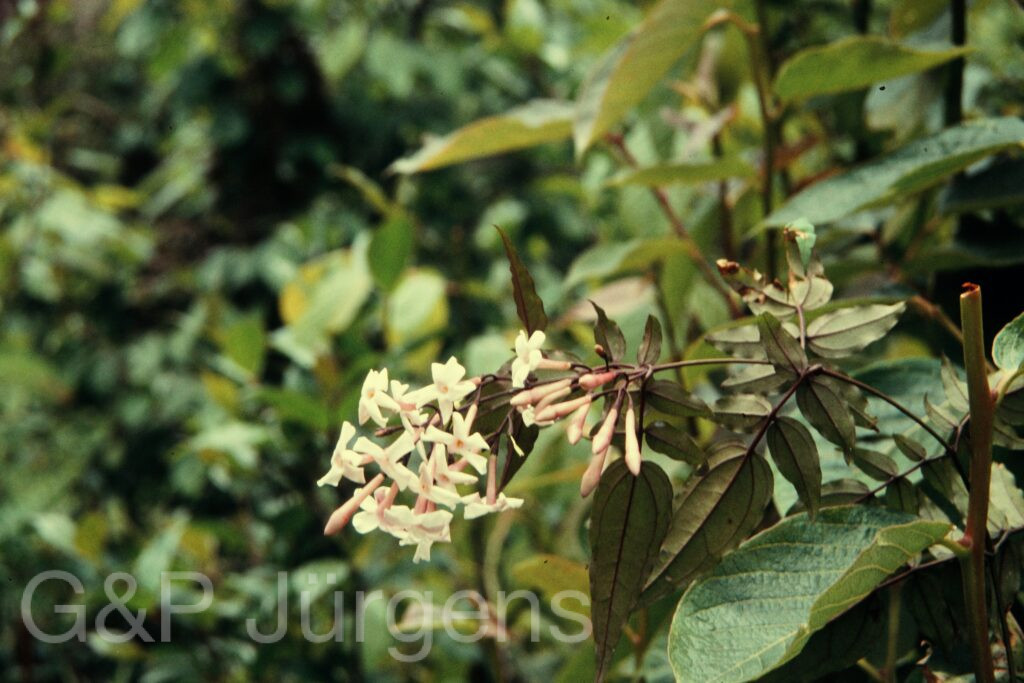
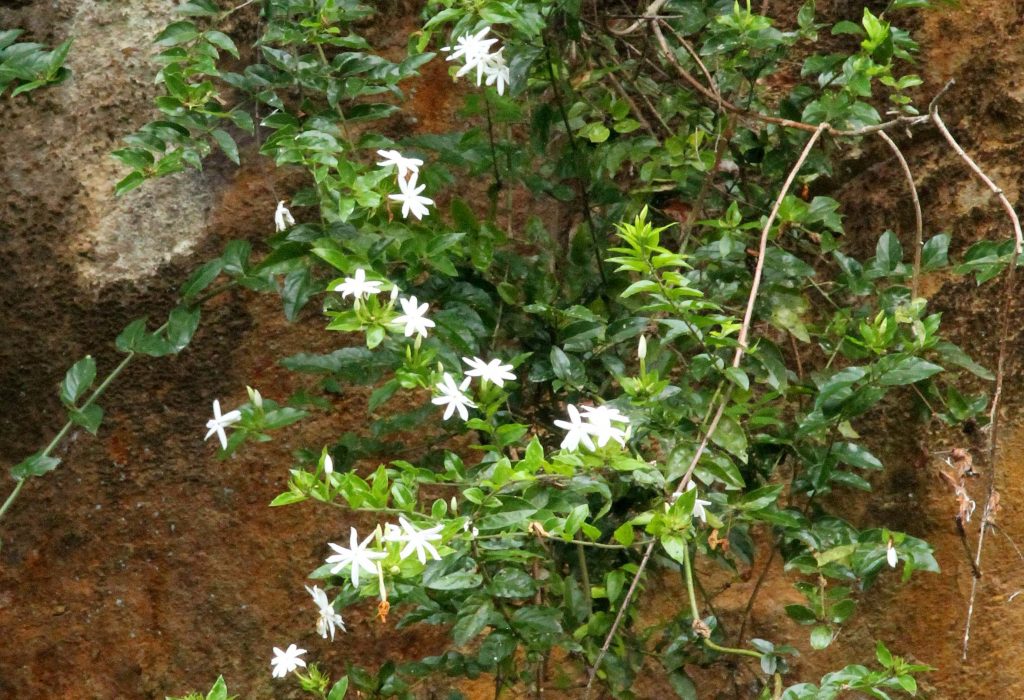
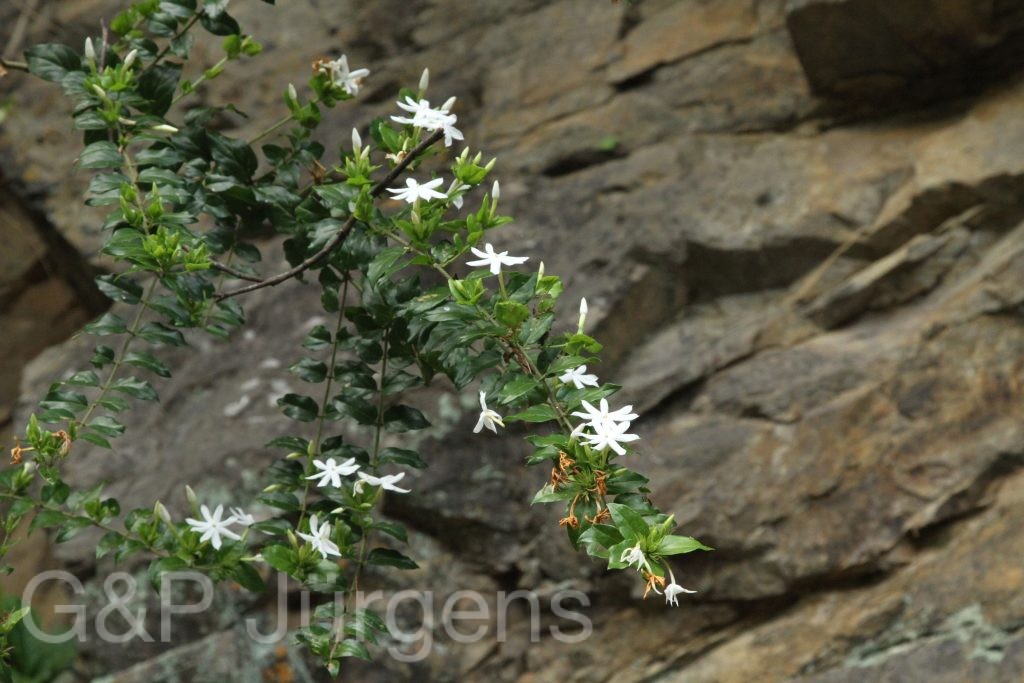
(P.J.Bergius) Willd.

Bhutan2012 787
Bhutan Zemgang 1900m, October
Bhutan2015 277
Bhutan Zhemgang 1000m, October

Description

Jasminum elongatum is a scrambling jasmine of broad Indo-Pacific distribution, recorded by GBIF from Australia, Indonesia, China, Malaysia, the Philippines, New Guinea, Thailand, Vietnam and the eastern Himalaya, with over 2270 occurrences. It grows in subtropical and tropical forest margins, secondary thickets, riverine scrub and clearings, often climbing over shrubs and small trees on warm, well-watered slopes. The illustrated plants come from Bhutan in the Zhemgang district between about 1000 and 1900 m, flowering in October; across its range the species spans the lowlands to roughly 2000 m in the warm submontane belt.

The plant is a woody climber or sprawling shrub with slender, terete to slightly angled, pubescent twigs. The leaves are opposite and simple, ovate to ovate-lanceolate, acuminate, rounded to subcordate at the base, with appressed hairs especially along the veins beneath. The flowers are borne in terminal and axillary cymes, white and fragrant, with a slender corolla tube much longer than the calyx (the epithet elongatum referring to this elongated tube) opening into several spreading lobes; the calyx bears narrow, elongate teeth. The fruit is a black, two-lobed berry.

Jasminum is a large Old World genus of the Oleaceae whose white-flowered, opposite-leaved species form the core lineage distinct from the segregated yellow jasmines. Jasminum elongatum is variable in indumentum and leaf shape across its wide range, prompting a long synonymy. Its fragrant flowers are moth- and bee-pollinated and the berries bird-dispersed. Common, weedy and adaptable, it is of least concern and is occasionally grown for its scented blossom in tropical gardens.

Author: (P.J.Bergius) Willd. · Sources: POWO (Kew), GBIF, Flora of China, Flora of Bhutan, Jasminum monograph (Green)