Tag:

Montane (1500-2500 m)

Roxb. ex Hornem.

Bhutan2014 149
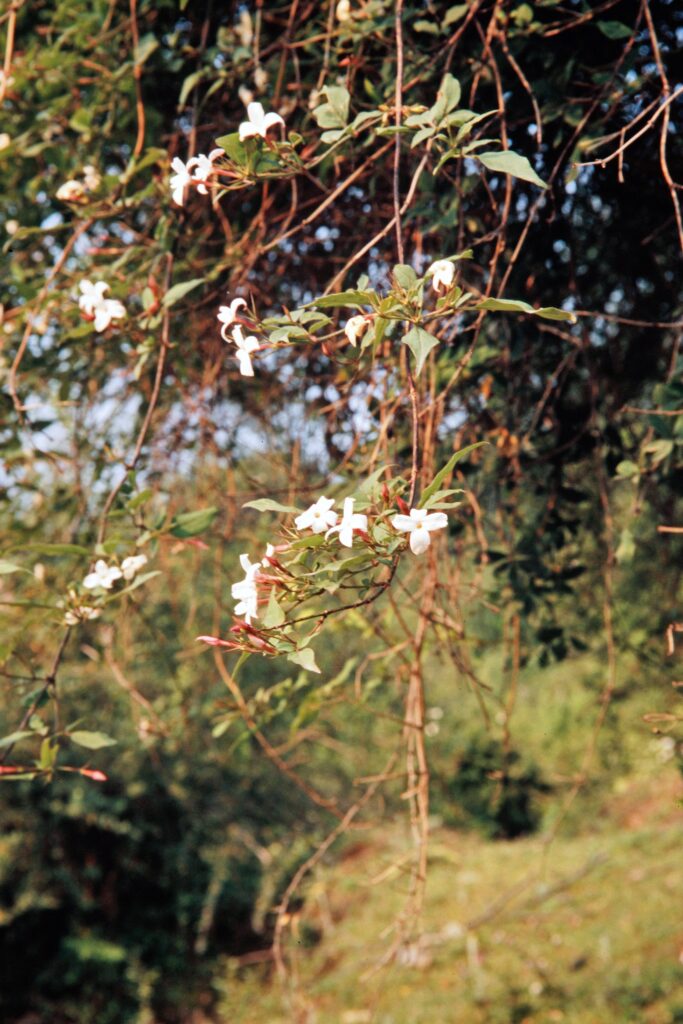
Bhutan Trashigang 2000m, May

Description

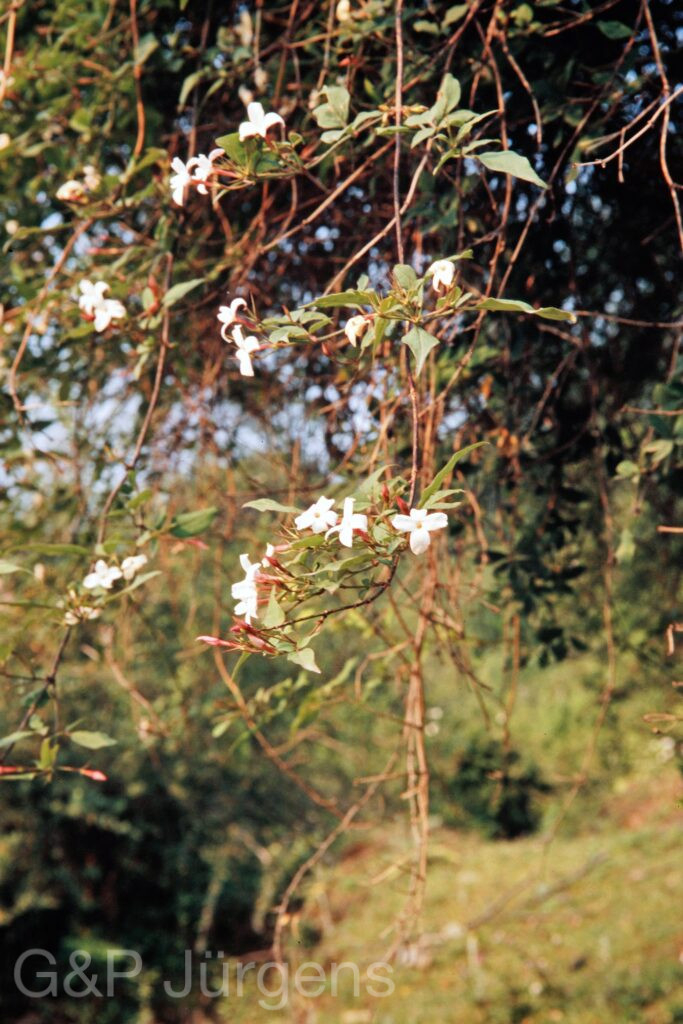
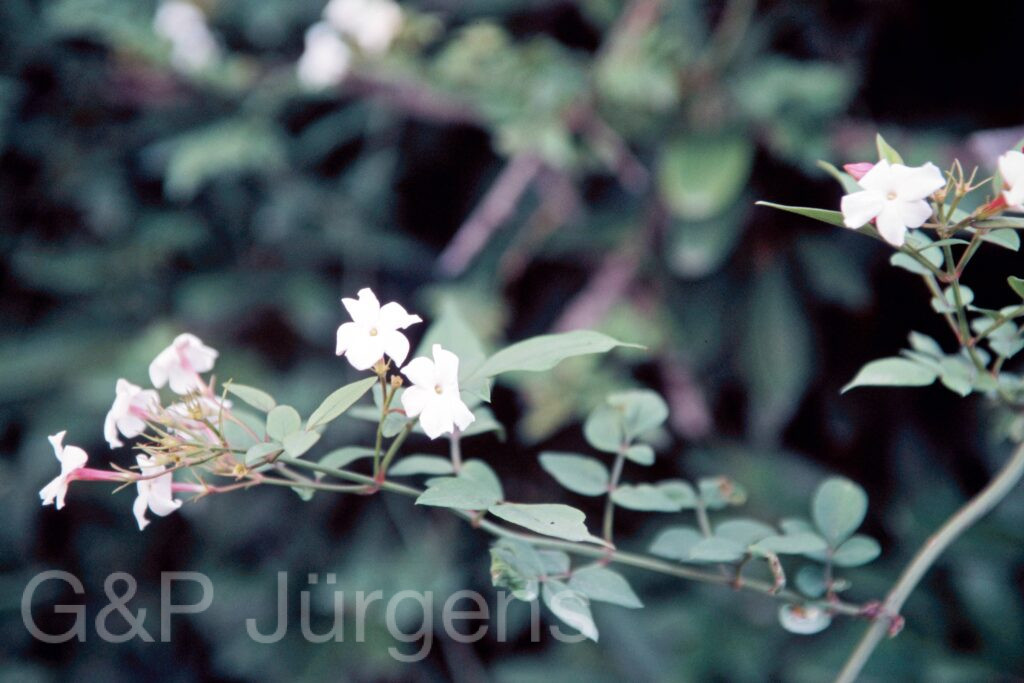
Jasminum laurifolium is a climbing jasmine native to the eastern Himalaya and South-East Asia, occurring in north-eastern India, Bhutan, Nepal, Myanmar, Thailand and southern China, and widely cultivated as an ornamental; its GBIF records (over 440) span this native range together with numerous cultivated occurrences in the Americas, the Pacific and the West Indies that account for the scattered records in Brazil, Colombia, Mexico, French Polynesia and the Caribbean. It grows in evergreen and mixed forest, on forest margins, thickets and shrubby slopes, generally up to about 2000 m. The photographed plant from Trashigang in eastern Bhutan at 2000 m in May reflects its occurrence in warm, humid mid-elevation forest.

It is an evergreen, woody twining shrub or liana with slender, glabrous, terete branchlets. The opposite, simple leaves are leathery and glossy, ovate-lanceolate to elliptic and laurel-like (whence laurifolium), with an entire margin, a long-acuminate apex and prominent pinnate venation. The fragrant flowers are borne in terminal and axillary cymes; each has a small, toothed calyx and a salverform white corolla with a slender tube and several narrow, spreading lobes. The fruit is a small, two-lobed black berry, often only one lobe maturing.

Jasminum is a large genus of the olive family Oleaceae, well represented in tropical Asia. J. laurifolium, sometimes treated with the variety brachylobum, is grown for its fragrant white flowers and is a familiar ornamental and source of perfume. Widespread in the wild and broadly cultivated, it is not of conservation concern, and its escape and naturalisation in warm regions outside its native range account for many of the extralimital records.

Author: Roxb. ex Hornem. · Sources: POWO (Kew), GBIF, Flora of China, Flora of Bhutan, Flora of Thailand, Jasminum (Oleaceae) revision (Green monograph)
L.

Garh 07 94 ergebnis
India Garhwal Meggu Kichatti 3100m, June
Garh 07 309 ergebnis
India Garhwal Bebra 2400m, June

Description

Jasminum officinale, the common or poet's jasmine, is native to the Caucasus, Central Asia and the Himalaya through Afghanistan, Pakistan, N India, Nepal and SW China, but is so widely cultivated that GBIF's 3,200-plus records span France, Britain, Spain, Italy, the United States, Australia and beyond, reflecting naturalisation far outside its native range. In its Himalayan homeland it is a plant of open forest, scrub, thickets and rocky slopes. The photographed material from Garhwal in the Indian Himalaya, at Meggu Kichatti (3,100 m) and Bebra (2,400 m) in June, illustrates its occurrence on warm temperate to subalpine slopes between roughly 1,500 and 3,100 m.

It is a deciduous or semi-evergreen scrambling shrub with slender, angular, twining green branches. The leaves are opposite and imparipinnate, with usually five to nine ovate-lanceolate, acuminate leaflets, the terminal leaflet longer and stalked. The fragrant flowers are borne in terminal and axillary cymes; each has a slender corolla tube expanding into four to five spreading white lobes, often flushed pink in bud. The fruit is a black, two-lobed berry, though fruiting is uncommon in cultivated clones.

The intense evening fragrance, produced by volatile esters and indole, attracts moths and other long-tongued nocturnal pollinators and underlies the long economic history of the species in the perfume and tea-scenting industries. Numerous cultivars and forms exist, including the hardy var. affine. As an extensively cultivated and locally naturalising species it is of no conservation concern, and indeed can behave as a garden escape in mild-climate regions worldwide.

Author: L. · Sources: POWO (Kew), Flora of Pakistan, GBIF, Flora of China Vol. 15, Green: A Revision of the Genus Jasminum (Kew Bulletin)

L. (Aiton)

Garh 07 94 ergebnis
India Garhwal Trijugi Narayan 2250m, June

Description

Jasminum sambac, the Arabian jasmine, is believed to be native to a broad region extending from the Indian subcontinent through Southeast Asia, though its precise original range is obscured by millennia of cultivation. It is now widely grown and naturalized throughout the tropics and subtropics, with GBIF records from over 40 countries including India, China, Indonesia, the Philippines, Thailand, and numerous Pacific islands. The species typically occurs at low to moderate elevations in warm, humid climates, though it has been documented at Trijugi Narayan in the Garhwal Himalaya of Uttarakhand at 2,250 m in June, likely in a cultivated or semi-naturalized context near this important pilgrimage site, representing an unusually high-elevation occurrence.
Jasminum sambac is an evergreen or semi-deciduous scandent shrub or vine, 0.5–3 m tall, with terete, pubescent young branches. Leaves are opposite, simple (unusual in Jasminum, where most species have compound leaves), broadly ovate to elliptic, 4–12 cm long and 2–7 cm wide, with an obtuse to rounded apex, entire margins, and a glossy, dark green upper surface. The inflorescence is a terminal or axillary cyme bearing three to twelve flowers. Flowers are highly fragrant, with a tubular calyx bearing eight to ten linear lobes and a salverform corolla with a slender tube 10–15 mm long and typically eight to nine oblong, spreading, pure white lobes. In cultivated double-flowered forms, the petals are greatly multiplied. The fruit is a globose, two-lobed berry approximately 8 mm in diameter, black when ripe, though fruiting is rare in cultivated plants.
Jasminum sambac holds profound cultural, religious, and economic significance across Asia. It is the national flower of the Philippines (sampaguita) and one of three national flowers of Indonesia (melati putih), used extensively in religious ceremonies, garlands, and traditional medicine throughout South and Southeast Asia. The flowers are a major source of jasmine absolute and essential oil used in the perfume industry and are the traditional scenting agent for jasmine tea in China. Taxonomically, J. sambac is placed in Jasminum section Unifoliolata, reflecting its simple (unifoliolate) leaves. The species was first described by Linnaeus as Nyctanthes sambac and later transferred to Jasminum by Aiton in 1789.

Author: L. (Aiton) · Sources: POWO (Kew), GBIF, Flora of China Vol. 15, Green: A Revision of Jasminum in Asia and Australia (2003), Mabberley: Mabberley's Plant-Book (2017)

L.

Nepal 97 410 P792
Nepal Tashigaon 3000m May
Nepal 2001 173 ergebnis ergebnis
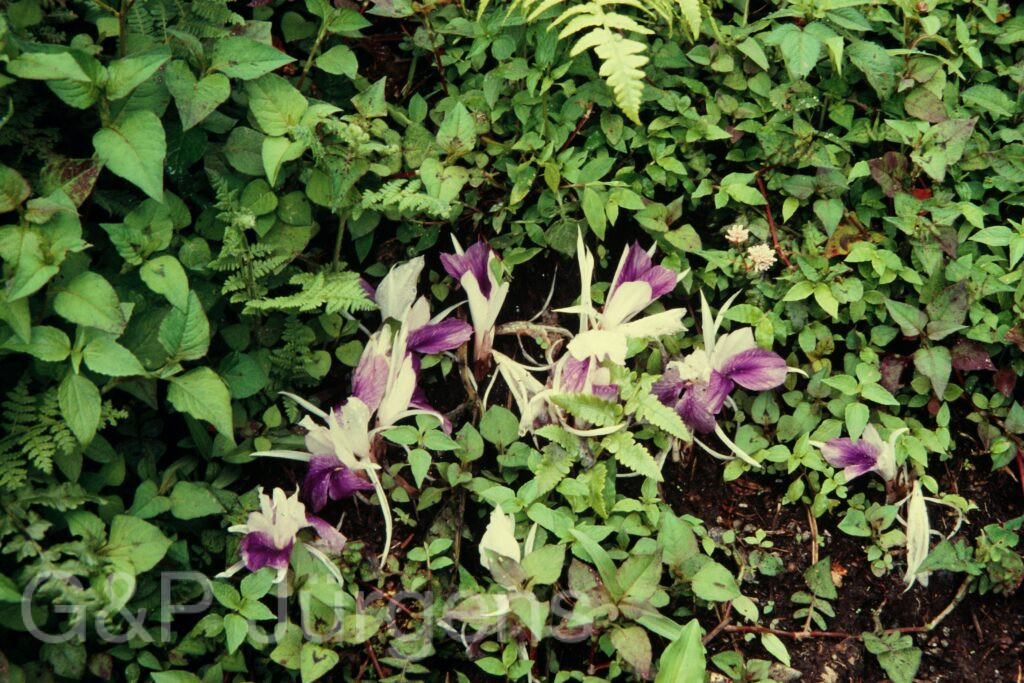
East-Nepal Sabha-Khola 2100m, April

Description

Kaempferia rotunda L. is a tuberous, rhizomatous herb of the ginger family native to tropical and subtropical Asia and very widely cultivated, so that its GBIF record (586 occurrences) spans India, Myanmar, China, Thailand, Bangladesh, Cambodia, Laos, Vietnam, Indonesia and the Philippines alongside many introduced localities in the Neotropics, North America and the Pacific. In the Himalayan foothills it grows in warm, shaded forest, scrub and disturbed ground; it was recorded in eastern Nepal at Sabha-Khola near 2100 m in April and at Tashigaon around 3000 m in May, the latter elevation being unusually high and probably reflecting sheltered, low-frost microsites or local cultivation.

The plant arises from a clustered, aromatic rhizome bearing fleshy tuberous roots. The leaves, two to four per shoot, are oblong-lanceolate, often handsomely variegated with dark and silvery-green zones above and purplish beneath, and appear after or with flowering. The inflorescence is hysteranthous, emerging directly from the rhizome at ground level before the leaves expand: a cluster of short-lived flowers with white, narrowly oblong corolla lobes, two petaloid white staminodes, and a conspicuous, deeply bilobed lilac to violet labellum. The fruit is a three-valved capsule, though propagation is largely vegetative.

Kaempferia rotunda is the type species of its genus and is grown ornamentally as 'peacock ginger' and used in traditional medicine across South and Southeast Asia, its rhizomes valued for fragrant essential oils. Its enormous naturalised range testifies to long human movement of the species. Pollination of the showy ephemeral flowers is by bees and other insects attracted to the labellar nectar guides, while persistence in cultivation buffers it against any wild conservation concern.

Author: L. · Sources: POWO (Kew), GBIF, Flora of China, Flora of Bhutan, Flora of British India, Zingiberaceae monograph (Larsen & Larsen; K. Schumann Zingiberaceae)

Kuntze

Bhutan2014 260
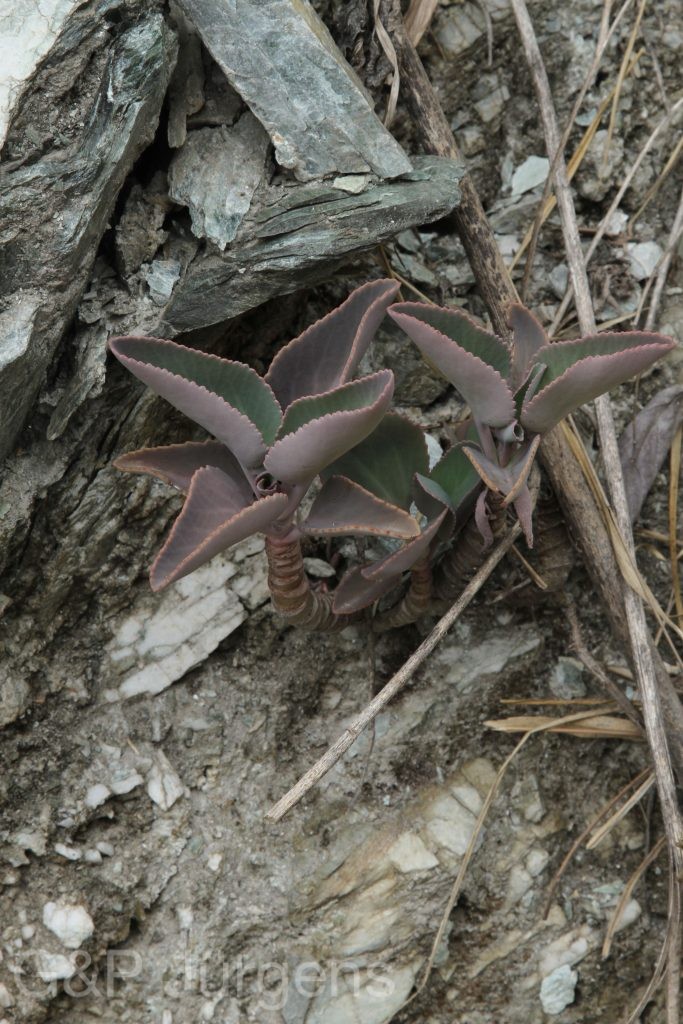
Bhutan Karu-Chu 1800m, May

Description

Kalanchoe integra is a succulent herb of broad palaeotropical and introduced distribution, recorded by GBIF (around 902 occurrences) across tropical and subtropical Asia and beyond, including Taiwan, Indonesia, the Philippines, India, Thailand, China, Japan, Nepal, Myanmar and Bhutan, as well as introduced or cultivated populations in the Americas and Europe. It grows on warm, dry, rocky slopes, open hillsides, walls, ledges and disturbed ground, favouring sunny, well-drained sites in the foothill and lower montane zones. The collection from Karu-Chu in Bhutan at about 1800 m in May marks a Himalayan foothill occurrence and reflects its preference for relatively low, warm elevations and its spring flowering at the onset of the growing season.

The plant is an erect, glabrous, fleshy perennial or biennial herb with a stout, often simple stem. The succulent leaves are opposite and decussate, the lower ones petiolate and obovate to oblong with a crenate or shallowly toothed margin, the upper leaves becoming sessile and sometimes pinnately lobed. The inflorescence is a large, terminal, much-branched corymbose cyme of numerous pendent, tubular flowers. Each flower has a fused, somewhat inflated tubular calyx and a longer tubular corolla in shades of yellow to orange or reddish, with four spreading lobes. There are eight stamens inserted on the corolla tube, and the four free carpels mature into many-seeded follicles.

Described under the combination by Kuntze, Kalanchoe integra belongs to a large Old World genus of the Crassulaceae noted for crassulacean acid metabolism (CAM), an adaptation enabling water conservation in seasonally dry habitats. The genus is taxonomically intricate, many names being confused within the K. integra-K. laciniata-K. spathulata complex. The species is used in traditional medicine in parts of its range and is sometimes cultivated. Being widespread, weedy and tolerant of disturbance, it is not of conservation concern.

Author: Kuntze · Sources: POWO (Kew), GBIF, Flora of China, Flora of Bhutan, Flora of British India, Raymond-Hamet revision of Kalanchoe

Mast.

Bhutan2012 1294
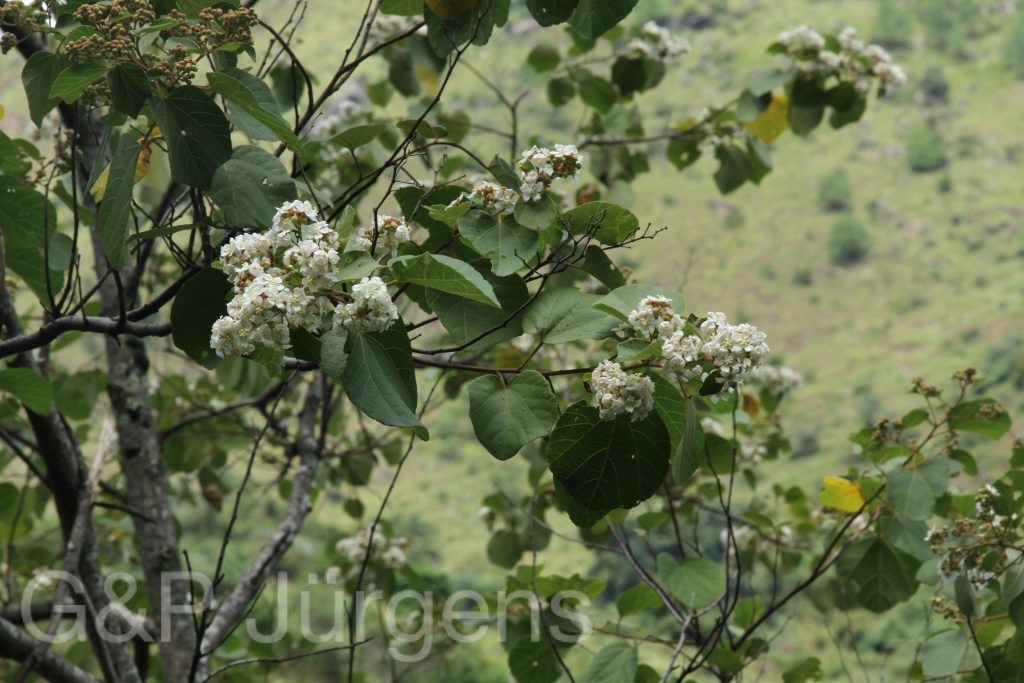
Bhutan Trashigang 1720m, October
Bhutan2012 1295
Bhutan Trashigang 1720m, October

Description

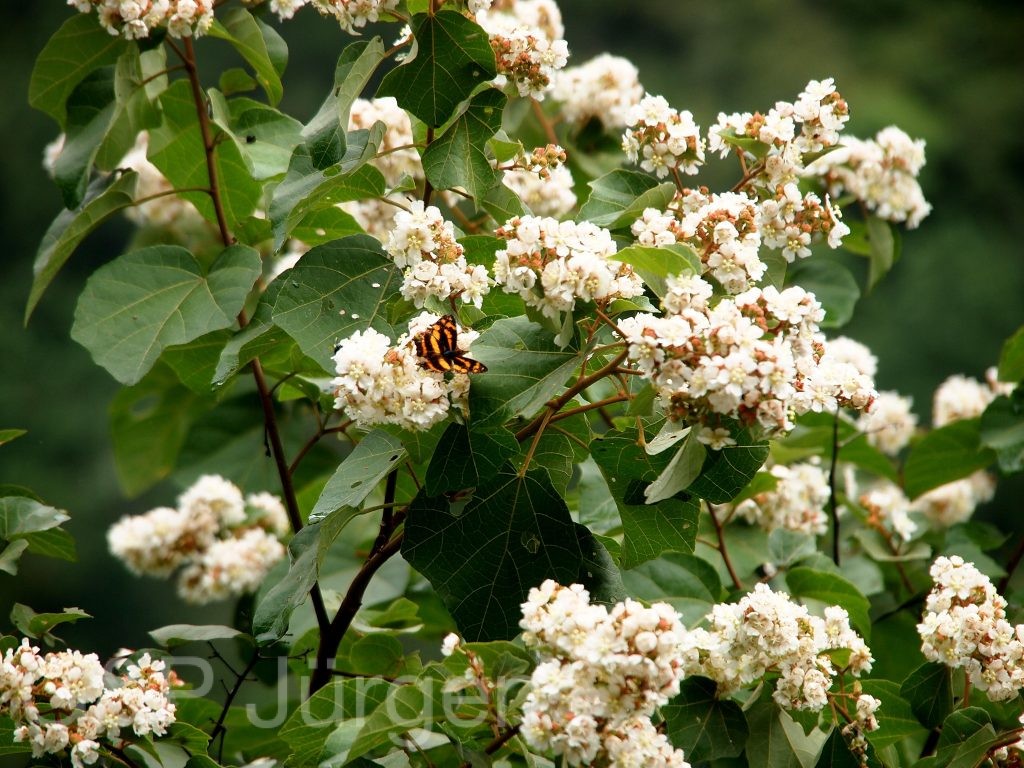
Kydia glabrescens is a small tree of the eastern Himalayan and Indo-Chinese region, recorded from China, Thailand, Nepal, Vietnam, Bhutan, India and Myanmar, with about 140 georeferenced occurrences. It occurs in subtropical and warm-temperate broadleaved forest, secondary woodland and forest margins at low to moderate elevations. The individual documented near Trashigang in eastern Bhutan at about 1720 m in October illustrates its mid-elevation habitat, flowering and fruiting in autumn on well-drained slopes within and at the edges of mixed hill forest.

The plant is a deciduous tree with grey bark whose young parts are stellate-tomentose but become more glabrescent with age, a feature underlying its epithet. The leaves are alternate, broadly ovate to suborbicular, palmately three- to five-veined and often shallowly lobed, with crenate-dentate margins. The flowers are borne in terminal and axillary panicles and are subtended by conspicuous epicalyx bracts that enlarge and become wing-like in fruit, a diagnostic feature of the genus; the small five-petalled corolla is white to pale pink, the stamens united into a staminal column typical of the Malvaceae. The fruit is a small capsule subtended by the accrescent, persistent bracts that aid wind dispersal.

Kydia is a small Asian genus traditionally placed in the Malvaceae (subfamily Grewioideae or related tribes in the broadly circumscribed family), distinguished by its enlarged fruiting epicalyx and dioecious or polygamous breeding system. The timber is used locally and the mucilaginous bark has minor traditional uses. Reasonably widespread through the eastern Himalaya and Southeast Asia, K. glabrescens is not considered threatened.

Author: Mast. · Sources: POWO (Kew), GBIF, Flora of Bhutan, Flora of China, Flora of British India, Tang, Gilbert & Dorr's account of Malvaceae

(D.Don) Tzvelev

Sikkim2004 102 P173
India West-Bengal, Utaray 2000m April
Sikkim 2006 186 ergebnis
India West-Bengal, Samadan 2400m, May

Description

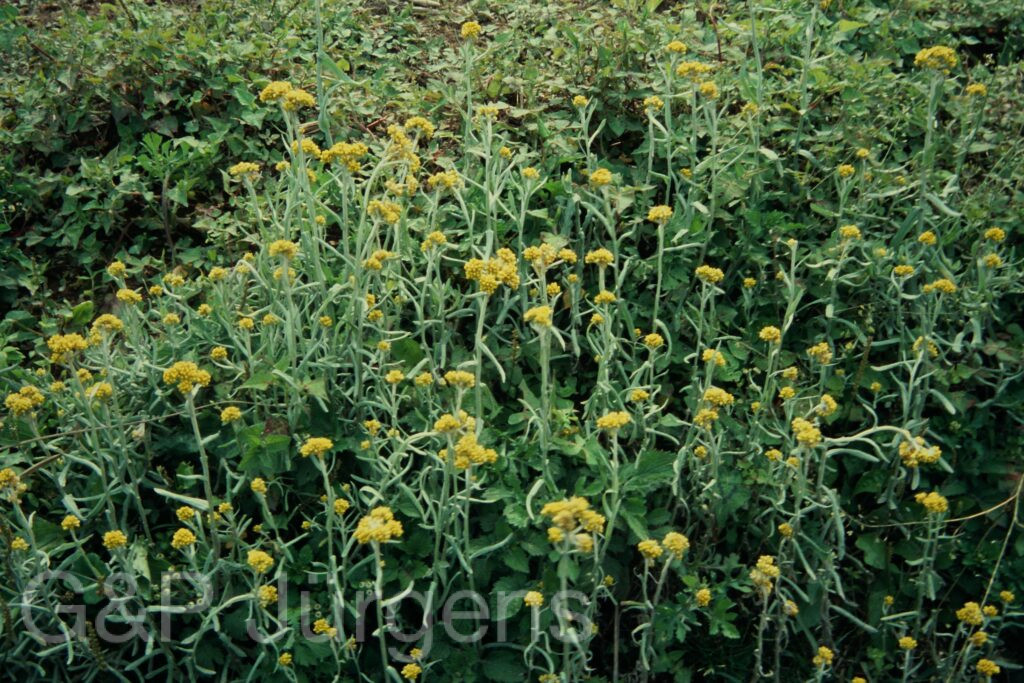
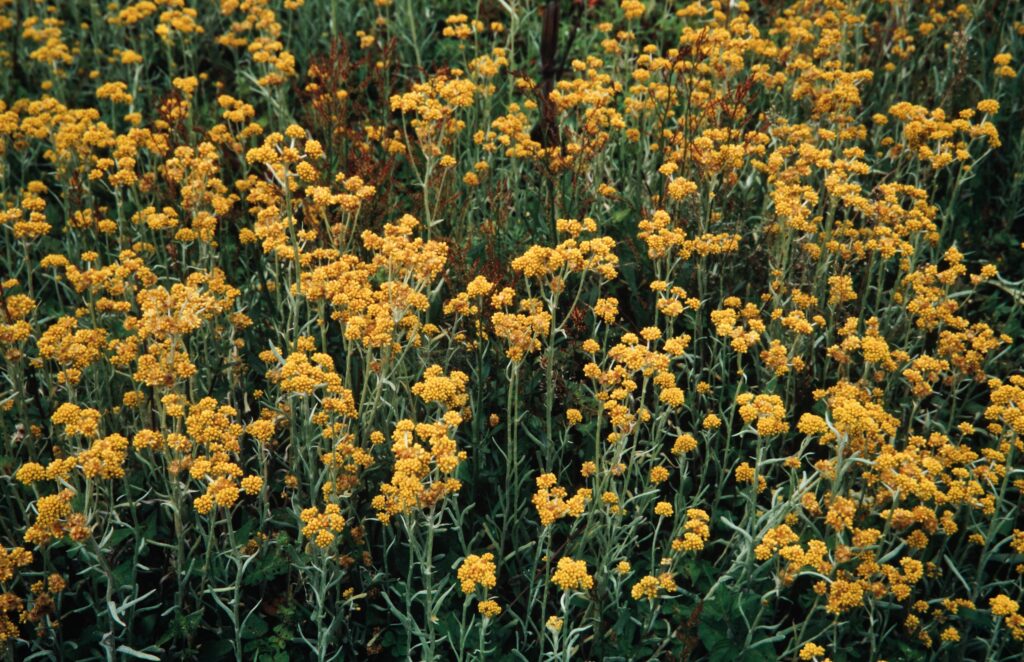
Laphangium affine is a widespread East and South Asian cudweed recorded from China, Japan, India, Taiwan, Vietnam, Nepal, Pakistan, Thailand, Georgia and Turkey, the roughly 99 georeferenced occurrences reflecting a broad continental range that extends westward into the Caucasus and Anatolia. It occurs from lowland to mid-montane elevations, the images documenting plants in West Bengal, India, at Utaray about 2000 m in April and Samadan about 2400 m in May. A plant of open, disturbed and seasonally moist ground, it colonises fields, fallows, roadsides, terrace banks, streamsides and weedy grassland, behaving as a fast-growing ruderal of cultivated and human-modified landscapes.

It is an erect annual or short-lived herb with simple or branched stems clothed, like the foliage, in a soft greyish-white woolly tomentum. The leaves are alternate, sessile, narrowly oblanceolate to linear-spathulate, entire-margined and densely lanate on both surfaces, the lower often withered at flowering. The numerous small capitula are aggregated into dense terminal and axillary glomerules; each head bears straw-coloured to yellowish, dry, scarious involucral bracts and contains many slender female florets surrounding a few central bisexual ones. The cypselae are minute and crowned by a caducous pappus of barbellate bristles, adapted for wind dispersal.

Under GBIF this name is treated as a synonym, with Laphangium affine itself standing as the accepted name; the taxon has been variously placed in Gnaphalium and Pseudognaphalium, reflecting the unsettled generic limits of the woolly cudweeds in tribe Gnaphalieae. Originally described by D. Don and transferred by Tzvelev, it is a successful weed across much of Asia, valued in some regions for medicinal and edible use. Given its wide range and ruderal ecology it is of no conservation concern.

Author: (D.Don) Tzvelev · Sources: POWO (Kew), GBIF, Flora of China, Flora of Pakistan, Gnaphalieae generic revision (Asteraceae)

L.

Garh 07 310 ergebnis
India Garhwal Bebra 2450m, June

Description

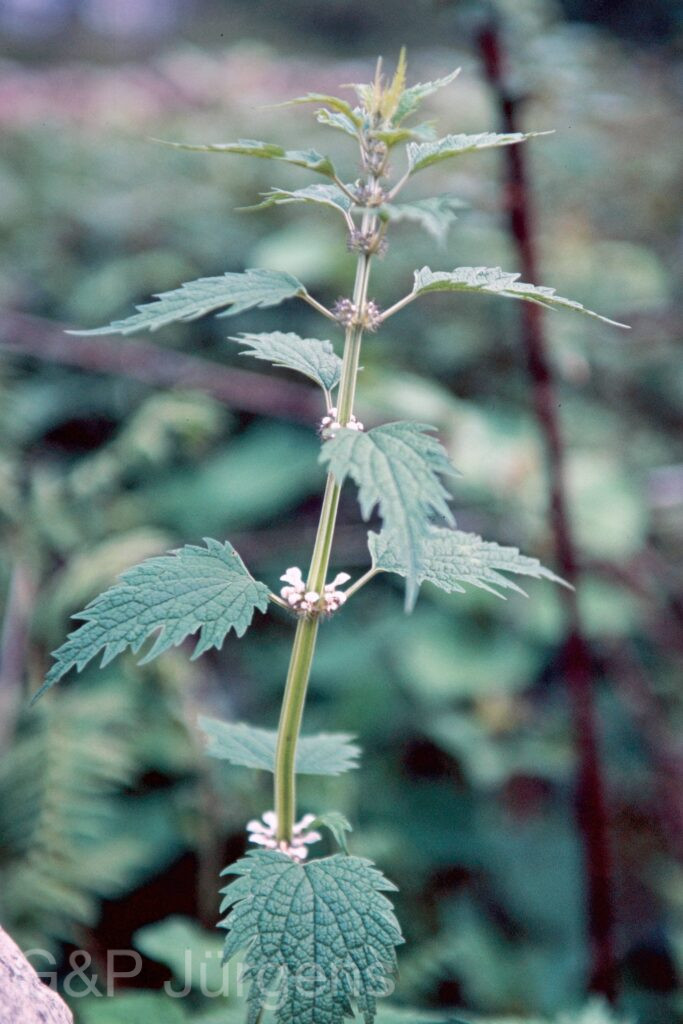
Leonurus cardiaca, motherwort, is a perennial herb of Eurasian origin that has become widely naturalised, with a very large GBIF dataset of 79501 occurrences concentrated in Europe, Russia and temperate North America. It is a plant of disturbed, nutrient-rich ground, occurring on roadsides, hedgerows, waste places, field margins, fallows and around habitation. The plant recorded at Bebra in the Garhwal Himalaya at 2450 m in June represents an introduced or naturalised montane occurrence, where it grows on open, anthropogenically disturbed ground and flowers in early summer.

The species is an erect perennial reaching 0.5-1.2 m, with the quadrangular stems typical of Lamiaceae, often branched and somewhat pubescent. The leaves are opposite and decussate, long-petiolate, the lower palmately three- to five-lobed with coarsely toothed lobes, grading to narrower, fewer-lobed leaves above. The small flowers are borne in dense axillary verticillasters subtended by stiff, spinescent bracteoles; each has a five-toothed, rigid, sharply pointed calyx and a two-lipped pinkish to pale purple corolla, the upper lip densely white-villous and the lower three-lobed, enclosing four didynamous stamens. The fruit comprises four trigonous nutlets.

Leonurus belongs to the subfamily Lamioideae, and L. cardiaca has long been valued in herbal medicine as a cardiac and nervine tonic, the basis of both its scientific and common names. As a hardy, seed-prolific ruderal, it spreads readily in disturbed temperate habitats and is locally established well beyond its native Eurasian range; it is of no conservation concern and is sometimes regarded as a minor weed.

Author: L. · Sources: POWO (Kew), GBIF, Flora of China Vol. 17, Flora of Bhutan Vol. 2, Flora of Nepal, Flora of Pakistan, Krestovskaja's revision of Leonurus

Spring.

Bhutan2012 317
Bhutan Paro-Chu, 2400m September

Description

Leptodermis ludlowii is a narrowly distributed Eastern Himalayan shrub, known from only about 26 georeferenced records confined to China (CN), Bhutan (BT) and India (IN). It is a plant of warm-temperate montane valleys, occupying open hillsides, dry scrub, rocky slopes and forest margins at middle elevations. The plant photographed along the Paro-Chu in western Bhutan at about 2400 m in September is characteristic of these sunny, well-drained inner-valley habitats, where the species flowers into the late monsoon. Its very restricted range and small number of collections mark it out as a regional endemic of the Eastern Himalaya.

It is a small, much-branched deciduous shrub with slender, often pubescent twigs. The leaves are opposite, small, ovate to elliptic, entire, and subtended by characteristic interpetiolar stipules with a membranous base and bristle-like awns, typical of the genus. The flowers are borne in small axillary or terminal clusters; each has a narrowly funnel-shaped, five-lobed corolla, usually white to pale pink or lilac, with the lobes spreading at the mouth. The slender corolla tube and the membranous, often persistent calyx are diagnostic of Leptodermis. The fruit is a small, dry capsule splitting into valves to release the seeds, which are enclosed in a thin, membranous testa from which the genus takes its name.

Leptodermis (Rubiaceae, tribe Paederieae) is an Asian genus centred on the Sino-Himalayan region, with many narrowly distributed, locally endemic species adapted to dry montane scrub. L. ludlowii, commemorating the collector Frank Ludlow, is one such restricted Eastern Himalayan endemic. Its very limited known range and scant collection record make it of conservation interest, although it has not been formally assessed; the integrity of mid-elevation valley scrub is important to its persistence.

Author: Spring. · Sources: POWO (Kew), GBIF, Flora of Bhutan, Flora of China, Robbrecht and Deb taxonomic studies of Asian Rubiaceae (Leptodermis)

Leucas ciliata

by G & P Jürgens

Benth.

Bhutan2015 62
Bhutan Wangdi Phodrang 2000m, October
Bhutan2015 460
Bhutan Wangdi Phodrang 2000m, October

Description

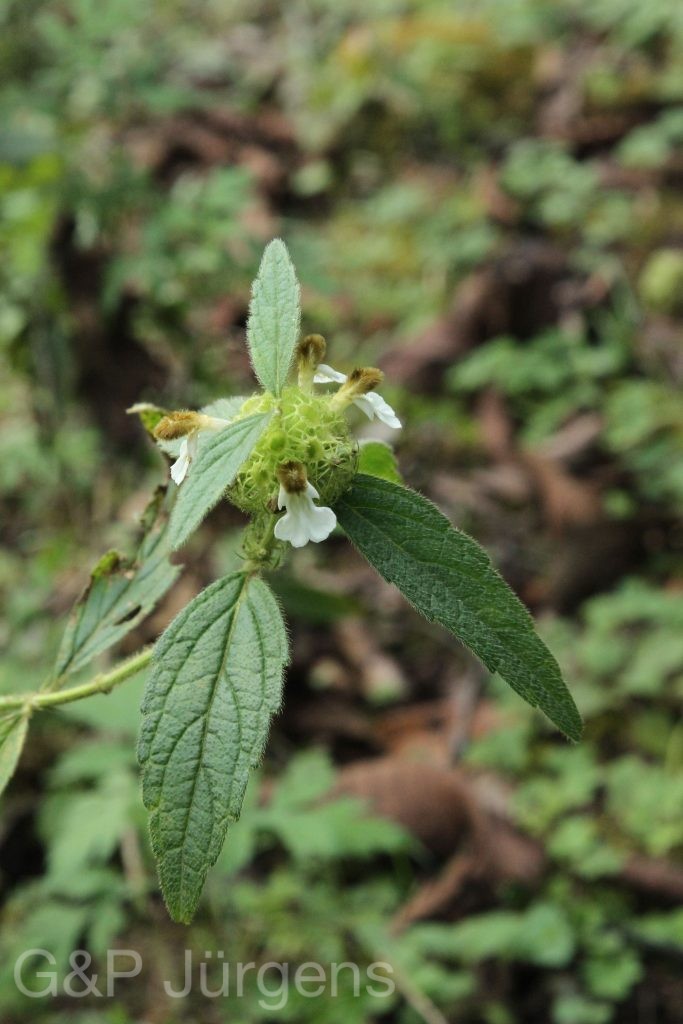
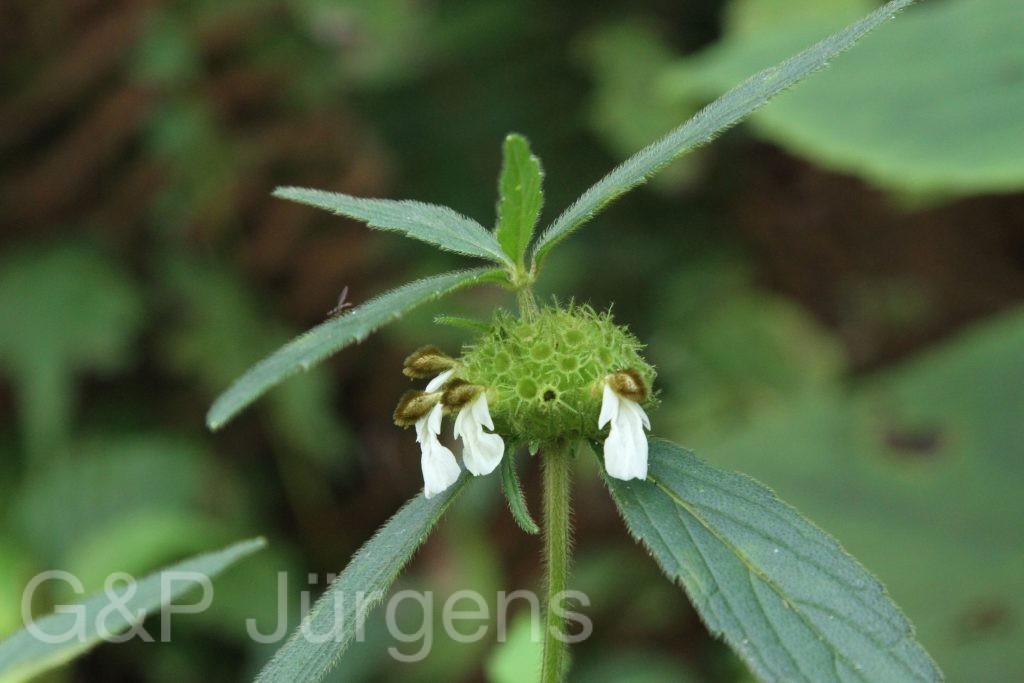
Leucas ciliata is a widely distributed Asian herb ranging across the Himalaya and into China, mainland Southeast Asia (Myanmar, Thailand, Laos, Vietnam), Bangladesh and beyond, with GBIF logging 573 occurrences over a broad set of countries including CN, IN, NP, BT, TH, MM, VN and BD. It is a plant of open, disturbed and seasonally moist ground, occurring on grassy slopes, forest margins, roadsides, scrub and cultivated land at low to mid elevations, generally up to about 2500 m. The photographed plant was recorded at Wangdi (Wangdue) Phodrang in west-central Bhutan around 2000 m, flowering in October at the close of the monsoon.

The species is an erect annual or short-lived perennial herb with the quadrangular stems typical of the Lamiaceae, clothed in spreading, often ciliate hairs. The leaves are opposite, ovate to lanceolate, toothed (crenate-serrate) and short-petiolate. The flowers are aggregated into dense, globose axillary whorls (verticillasters) subtended by bristly, ciliate bracts. Each flower has a tubular, ribbed calyx with spine-tipped teeth and a two-lipped white corolla in which the small upper lip is hooded and densely woolly outside while the larger lower lip is three-lobed; the four didynamous stamens lie beneath the galea. The fruit comprises four smooth nutlets enclosed in the persistent calyx.

Leucas is a large Old World genus of the subfamily Lamioideae, well represented in tropical Asia and Africa and characterised by woolly white corollas adapted to insect pollination. Several species, including L. ciliata, are used in traditional medicine. As a ruderal colonist of open and anthropogenic habitats it is common and widespread, and faces no conservation concern.

Author: Benth. · Sources: POWO (Kew), GBIF, Flora of Bhutan, Flora of China (Lamiaceae), Sebald revision of Leucas (Labiatae)