Tag:

Myanmar

Flowers of the Myanmar Himalaya — 604 species recorded from northern Myanmar (Burma) and the eastern Himalayan borderlands, a biodiversity hotspot linking the Himalaya to the mountains of Yunnan and Southeast Asia. The region’s forests and alpine slopes hold a rich flora of rhododendrons, orchids, balsams and gentians. Every page gives a botanical description, distribution, habitat and flowering time with the original photograph.

D.Don

Bh2008 378 P588
Bhutan Thimphu-Chu, 2800m April
Bh2008 10 P16
Bhutan Thimphu-Chu, 2800m April
Sikkim2004 54 P97
Sikkim West-Bengal, Bersay 2810m April

Description

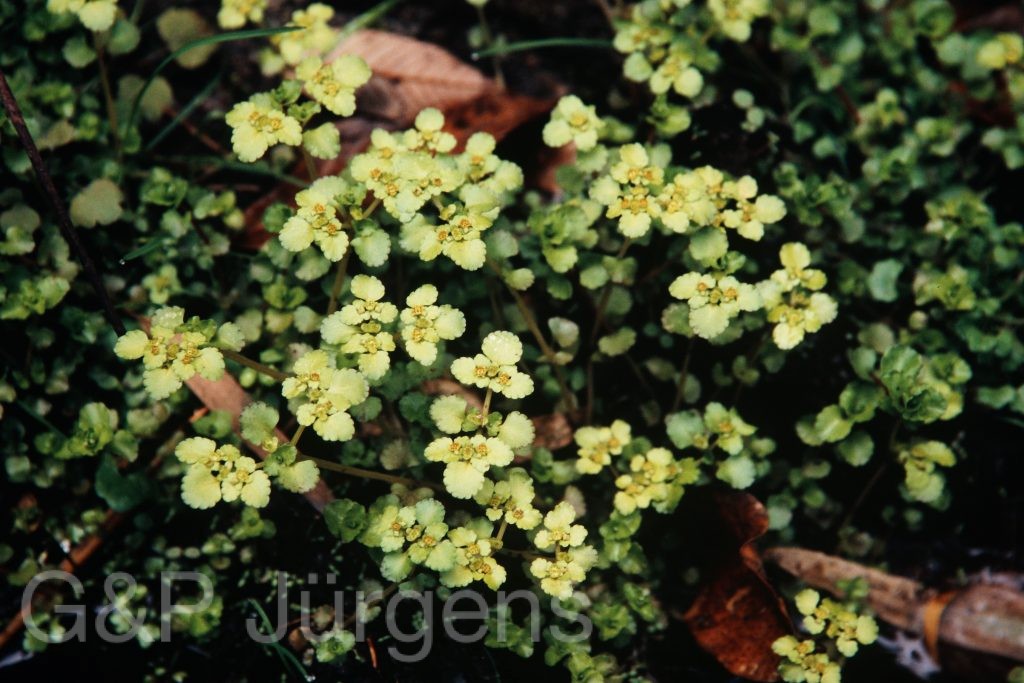
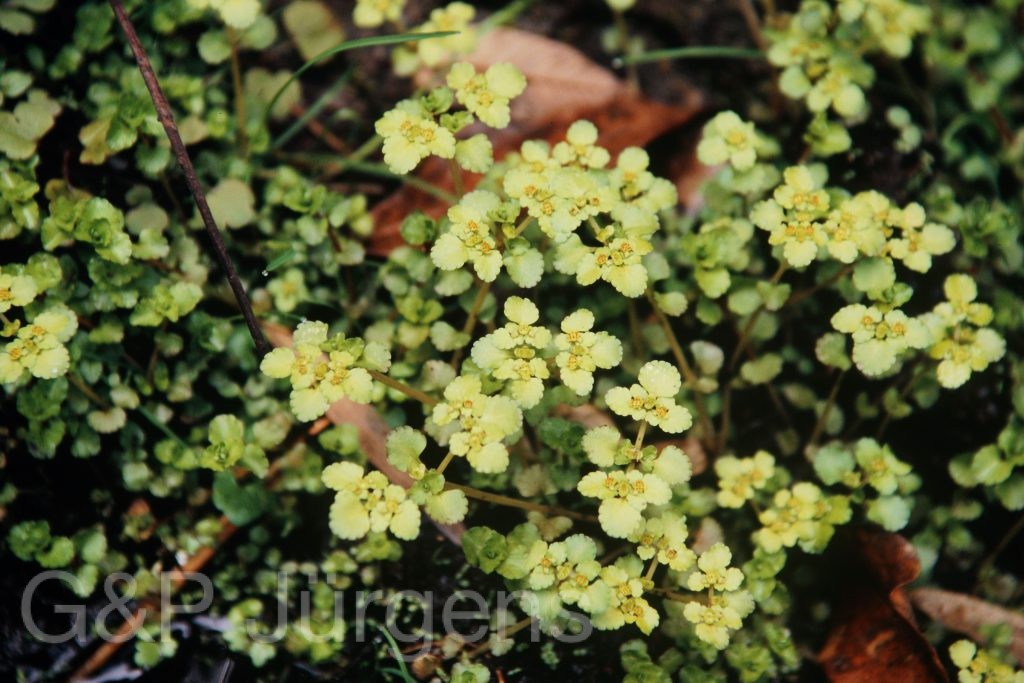
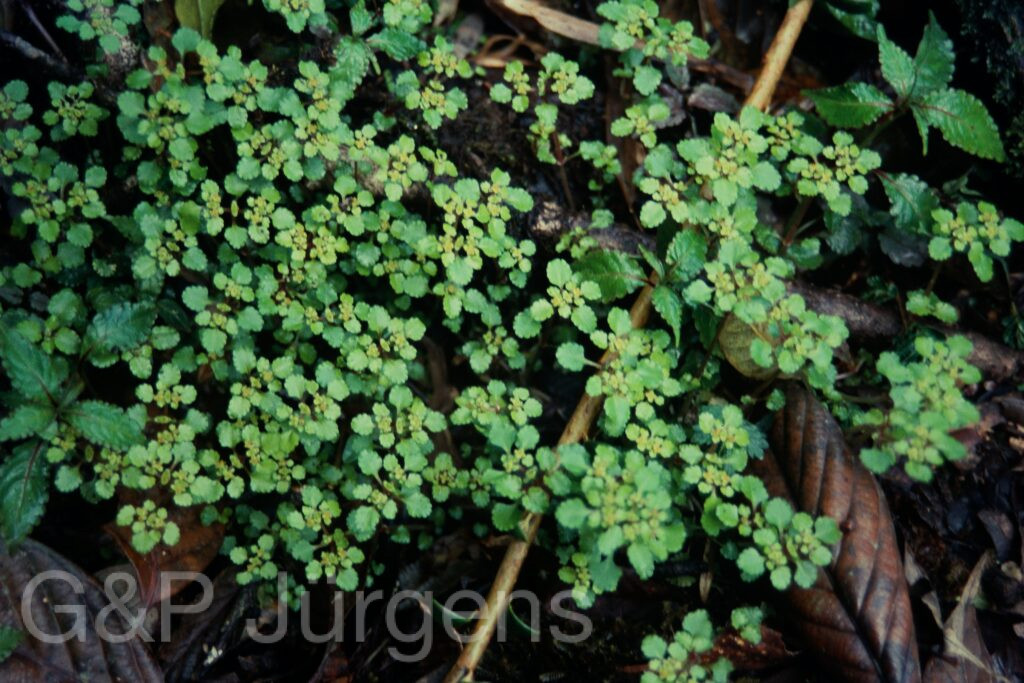
Chrysosplenium nepalense is a small herbaceous perennial of the eastern Himalaya and adjacent mountains, recorded by GBIF (339 occurrences) from Nepal, India, Bhutan, Myanmar and southwestern China. It is a plant of cool, perpetually moist habitats, colonising shaded stream banks, dripping rock faces, springs and damp humus-rich ground within temperate forest, generally between about 2500 and 3500 m. The collections illustrated from the Thimphu Chu in Bhutan at 2800 m and from Bersay in Sikkim, West Bengal, at 2810 m, both in April, are typical of its early-season flowering when snowmelt keeps the substrate saturated.

The plant is a low, mat-forming herb with slender, creeping and rooting stems that produce leafy stolons. The leaves are opposite, petiolate and reniform to broadly ovate, with a shallowly crenate margin and a cordate base. As in the genus, the flowers lack petals; the inflorescence is a flattened terminal cyme subtended by conspicuous yellowish-green leafy bracts that function as the principal visual attractant. Each small flower has four greenish-yellow sepals, four or eight stamens inserted around a flattened disc, and a half-inferior ovary. The fruit is a two-lobed, beaked capsule that splits widely to expose numerous minute seeds.

Chrysosplenium is a taxonomically intricate genus of moisture-loving saxifrages, and C. nepalense belongs to the opposite-leaved Himalayan assemblage that has been variously circumscribed. The petal-less flowers are pollinated by small flies and beetles drawn to the bract display, while the dispersal of seeds is aided by raindrop splash from the open capsules. The species is widespread within its moist montane niche and faces no recognised conservation threat, though its dependence on undisturbed seeps makes it locally sensitive to changes in hydrology and forest cover.

Author: D.Don · Sources: POWO (Kew), GBIF, Flora of China, Flora of Bhutan, Annotated Checklist of the Flowering Plants of Nepal, Monograph of Chrysosplenium (Hara)
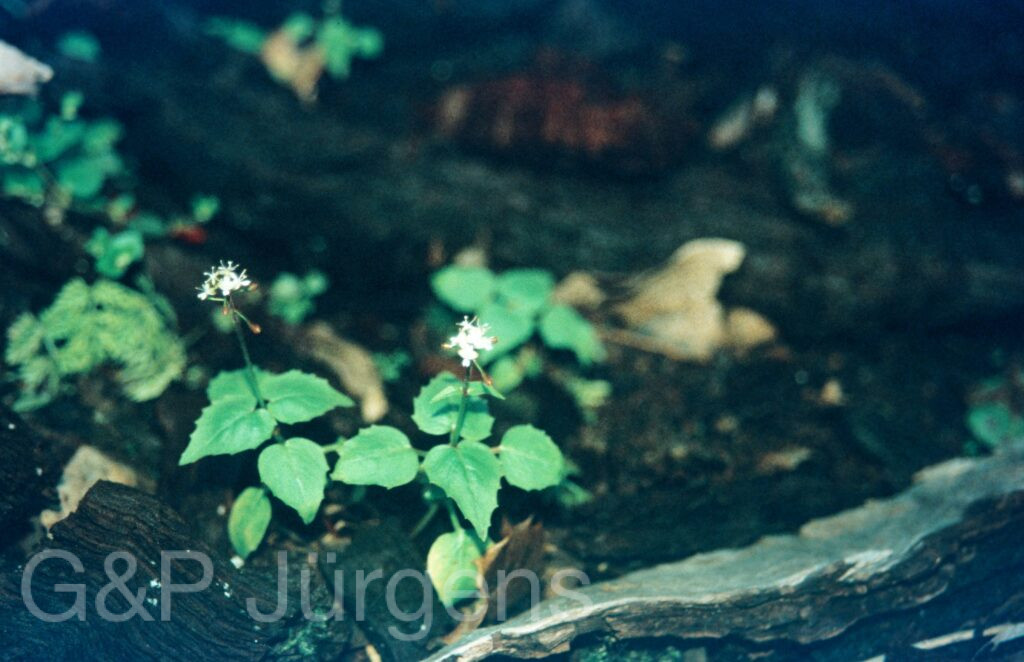
(Asch. & Magnus) Kitam.

Garw 2005 83 ergebnis ergebnis
India Garhwal Gaushon 3100m, September

Description

Circaea alpina subsp. imaicola (Asch. & Magnus) Kitam. is the Asian montane race of the circumboreal enchanter's nightshade complex, distributed according to GBIF across China, Taiwan, the Himalaya (India, Nepal, Pakistan), Myanmar, Thailand, Vietnam, Japan and Korea. It is a delicate herb of cool, moist, shaded habitats: damp coniferous and mixed forest floors, mossy banks, stream sides and humus-rich rocky places, typically between about 2,000 and 3,800 m. The September record from Gaushon in Garhwal, India, at 3,100 m reflects its occurrence in the shaded understorey of temperate Himalayan forest, where it grows in moist leaf litter amongst ferns and bryophytes.

The plant is a slender, glabrous to sparsely pubescent perennial spreading by thread-like, often tuber-tipped stolons, with erect stems usually only 5–25 cm tall. The leaves are opposite, thin, ovate to broadly cordate-ovate, with shallowly toothed margins and a translucent texture. The tiny flowers are borne in a lax terminal raceme that elongates in fruit; each flower has two white, deeply notched (bifid) petals, two sepals and two stamens, in the characteristic two-merous floral plan of Circaea. The small, club-shaped fruit is an indehiscent nutlet covered with soft, hooked bristles that promote epizoochorous dispersal.

Within the Circaea alpina complex, subspecies imaicola is distinguished by features of stolon, leaf shape and fruit, and it represents the principal Himalayan and East Asian element of this widespread, taxonomically intricate species. As a shade-demanding mesophyte it is a reliable indicator of humid, undisturbed montane forest. Circaea itself is of phylogenetic interest as one of the few temperate woodland genera in the otherwise largely tropical and warm-temperate Onagraceae.

Author: (Asch. & Magnus) Kitam. · Sources: POWO (Kew), GBIF, Flora of China Vol. 13, Flora of Pakistan (Onagraceae), Boufford: The Systematics of Circaea (Annals of the Missouri Botanical Garden)

Petr.

Sikkim2011 257
Sikkim Lada-La 3800m, June
BhutanPG2011 284
Bhutan Jule-Tso, 4200m June
Sikkim2003 412 W574
Sikkim Zemu Valley 3400m August

Description

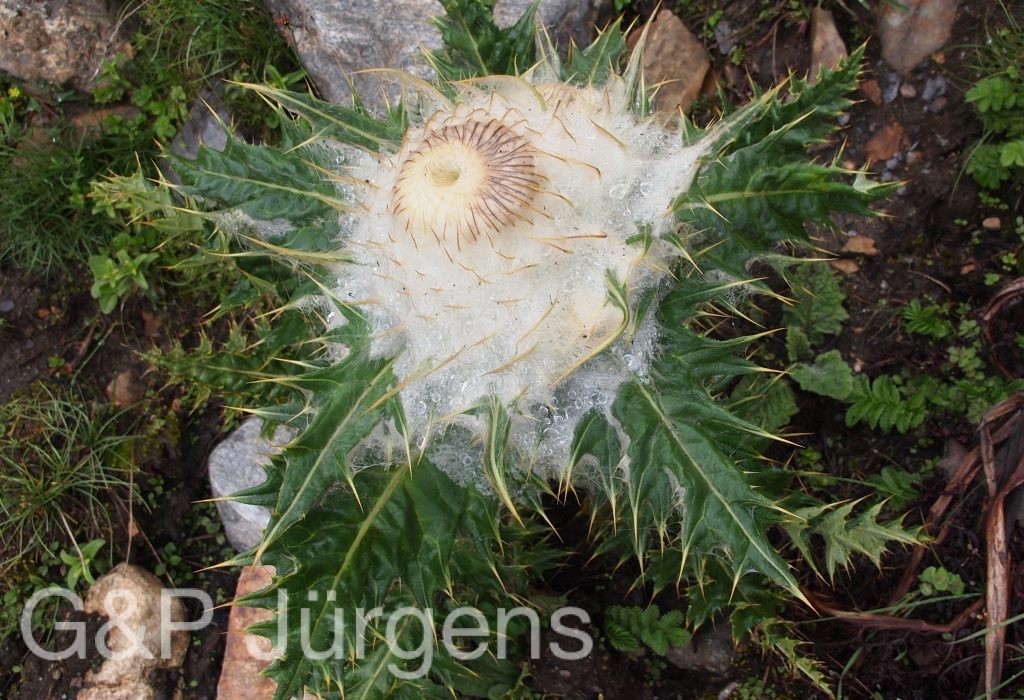
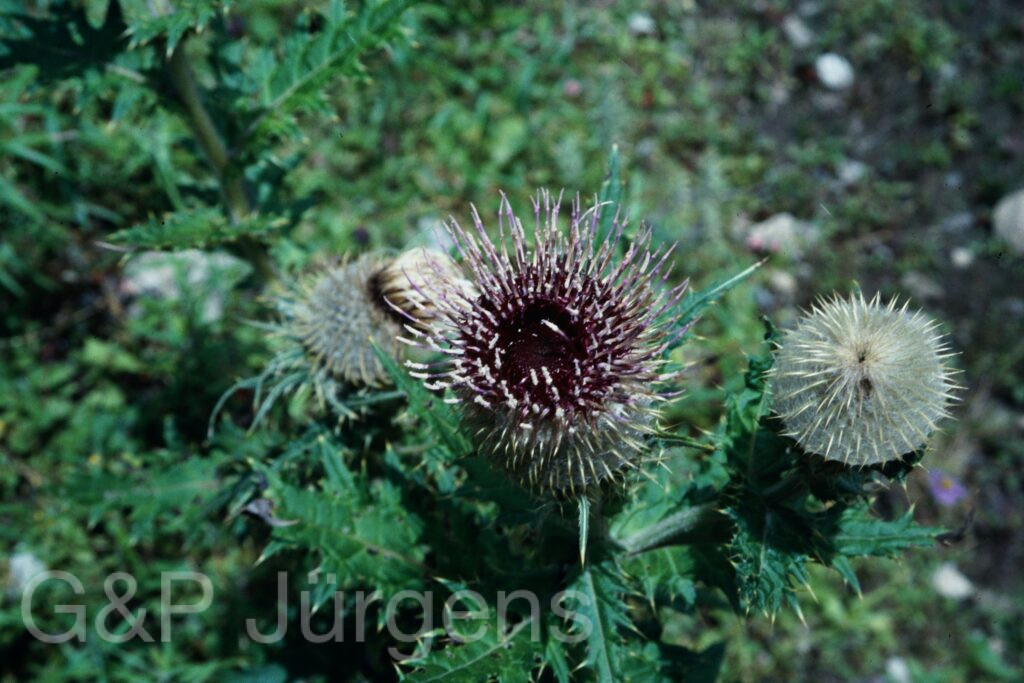
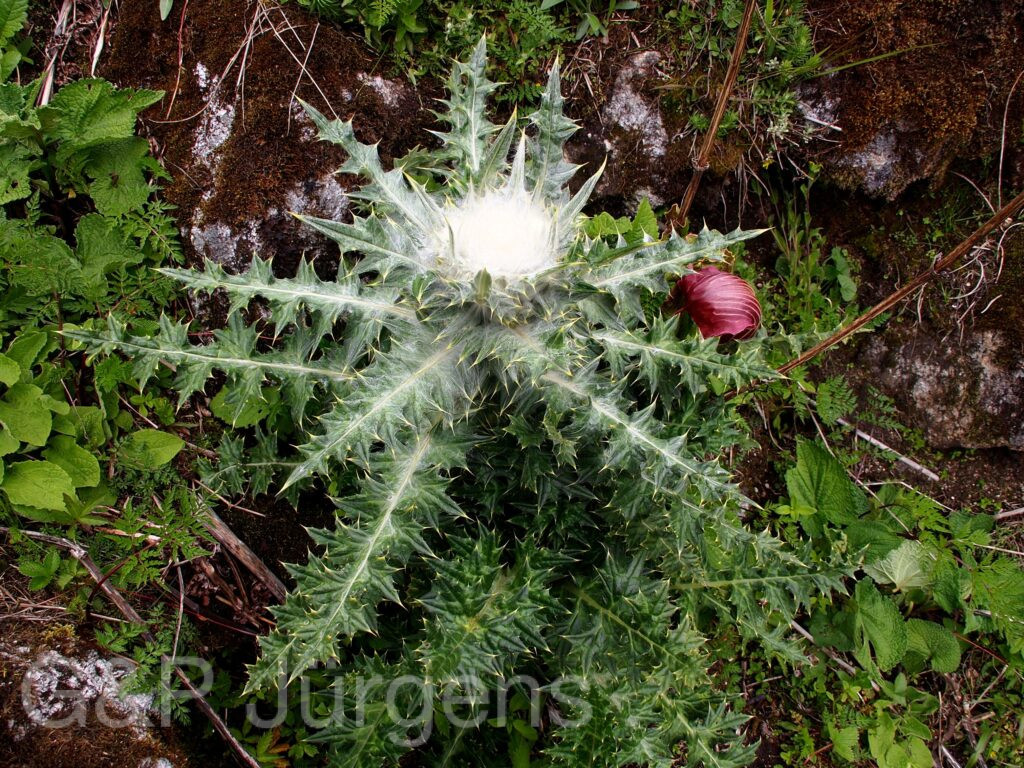
Cirsium eriophoroides is a robust alpine thistle of the eastern Himalaya and Sino-Tibetan mountains, recorded from China, India, Bhutan, Myanmar and Nepal, with about 234 GBIF occurrences. It grows in subalpine to alpine meadows, open grassy slopes, forest clearings and disturbed pasture, generally between about 3000 and 4500 m. The photographed plants come from Lada-La in Sikkim (3800 m, June), Jule-Tso in Bhutan (4200 m, June) and the Zemu Valley in Sikkim (3400 m, August), spanning the early and late high-Himalayan growing season.

The plant is a stout biennial or perennial herb with an erect, ridged, cobwebby-woolly stem reaching well over a metre. The leaves are oblong-lanceolate, deeply pinnatifid and conspicuously spiny along the margins, decurrent on the stem and white-tomentose beneath. The large capitula are solitary or few at the stem apex, subtended by leafy bracts and densely enveloped in long, white, arachnoid wool, the epithet "eriophoroides" likening this to the cottongrass Eriophorum. The involucral phyllaries are narrow and spine-tipped; the florets are tubular and purple to reddish, the fruit a smooth cypsela bearing a plumose pappus of feathery bristles.

Cirsium is a large genus of the tribe Cardueae, and C. eriophoroides represents the woolly-headed high-montane element well developed in the Sino-Himalaya. Its conspicuous capitula are visited by bumblebees and other long-tongued insects. Widespread and often associated with grazed ground, it is not regarded as threatened.

Author: Petr. · Sources: POWO (Kew), GBIF, Flora of China, Flora of Bhutan, Annotated Checklist of the Flowering Plants of Nepal, Compositae of the Sino-Himalaya (Cardueae studies)

(Hook.f.) Petr.

Bhutan2012 65
Bhutan Shele-La, 3900m September

Description

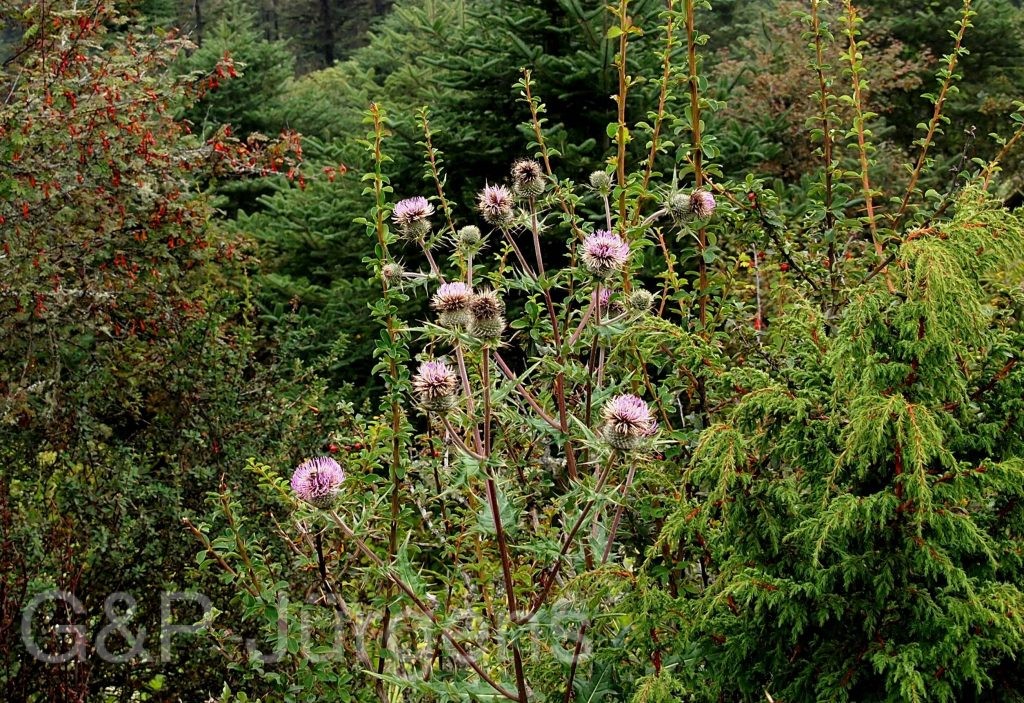
Cirsium falconeri is a robust subalpine to alpine thistle distributed along the Himalaya and adjacent ranges, recorded from Pakistan, India, Nepal, Bhutan, Myanmar and south-western China (Xizang, Yunnan), with some 207 georeferenced occurrences documenting its broad east-to-west arc. It favours open grassy hillsides, forest margins, moist meadows and disturbed slopes between roughly 2700 and 4300 m, where it forms scattered stands among tall-herb communities. The photographed plant from the Shele-La pass in Bhutan at about 3900 m in September typifies its preference for cool, humid high-altitude grasslands flowering toward the end of the monsoon.

The species is a stout biennial or short-lived perennial herb 0.6–2 m tall, with erect, longitudinally ribbed, often arachnoid-tomentose stems arising from a thickened taproot. The leaves are large, pinnatifid to pinnatisect, glabrescent to thinly cottony above and grey-tomentose beneath, with the lobes spiny-margined and the stem-leaves decurrent or amplexicaul. The capitula are large, hemispheric and usually nodding, solitary or few, subtended by reduced spiny floral leaves; the involucral bracts are linear-lanceolate and spinescent. Florets are numerous, tubular and purple to pinkish-red. The cypselae are oblong and glabrous, crowned by a copious pappus of plumose, basally connate bristles aiding wind dispersal.

Within Cirsium, a large Holarctic genus of spiny-leaved thistles, C. falconeri belongs to the Himalayan assemblage of stout nodding-headed species and was originally described under Cnicus before transfer to Cirsium. The nodding capitula are interpreted as protecting pollen and developing achenes from monsoon rain, while the nectar-rich heads attract bumblebees and other long-tongued alpine pollinators. The species remains widespread and locally common and is of no recognised conservation concern, though high-elevation grazing locally affects populations.

Author: (Hook.f.) Petr. · Sources: POWO (Kew), GBIF, Flora of China Vol. 20-21, Flora of Bhutan, Flora of Nepal, Kitamura Compositae of the Himalaya

DC.

Garw 2005 251 ergebnis
India Garhwal Sitel 1850m, September

Description

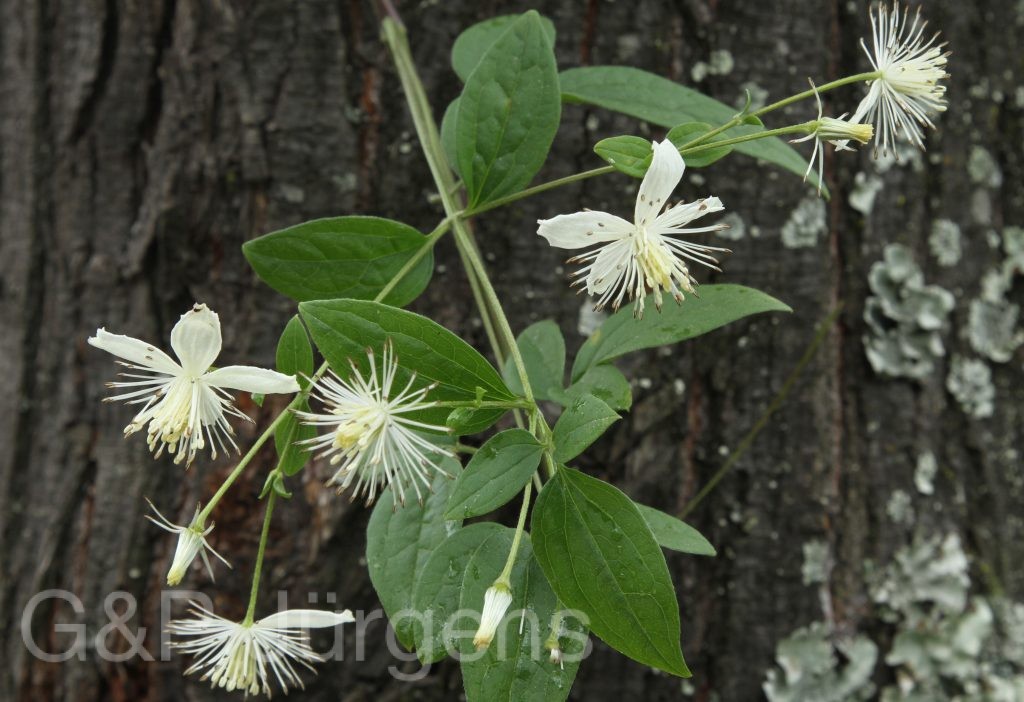
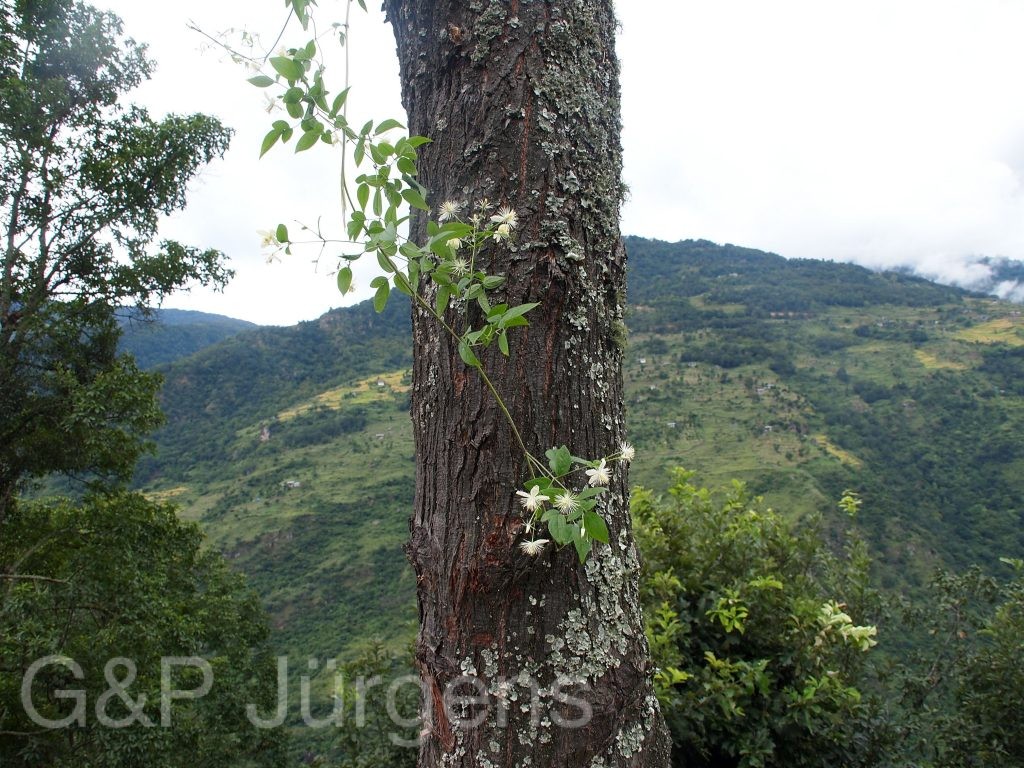
Clematis acuminata is a woody climber of the Himalaya and adjacent uplands, recorded by GBIF from China, India, Nepal, Myanmar, Thailand and Bhutan, with around 173 occurrences spread along the southern ranges. It grows in temperate and warm-temperate forest, scrambling through shrubbery, over forest margins and along open hillsides and ravines, typically on well-drained slopes. The photographed plant was found in the Indian Garhwal Himalaya at Sitel around 1850 m, flowering in September as the monsoon wanes; the species generally occupies the 1500-3000 m belt where it climbs vigorously into the canopy of small trees and thickets.

The plant is a perennial liana with slender, ribbed, climbing stems that ascend by means of clasping, twining petioles. The leaves are opposite and pinnately or ternately compound, the leaflets ovate to lanceolate and conspicuously long-acuminate, giving the epithet, with entire or sparingly toothed margins. The flowers are borne in axillary cymes and lack true petals, the showy parts being four spreading, often pale to creamy or pinkish sepals surrounding numerous stamens. The fruit is a head of achenes, each tipped with a long, persistent, plumose style that aids wind dispersal.

Clematis belongs to the Ranunculaceae and is unusual in the family for its lianescent habit and petaloid sepals. The feathery styled achenes are a hallmark of the genus, ensuring effective anemochory across mountainous terrain. Like many relatives, the herbage contains acrid protoanemonin and is locally used in folk medicine. Clematis acuminata is moderately widespread but nowhere abundant; it is not formally assessed, and its forest-margin populations persist where montane woodland and scrub remain intact.

Author: DC. · Sources: POWO (Kew), GBIF, Flora of China, Flora of Bhutan, Clematis monograph (Grey-Wilson)

Hook.f. & Thomson

Bhutan2012 133
Bhutan Haar-Valley, 3100m September

Description

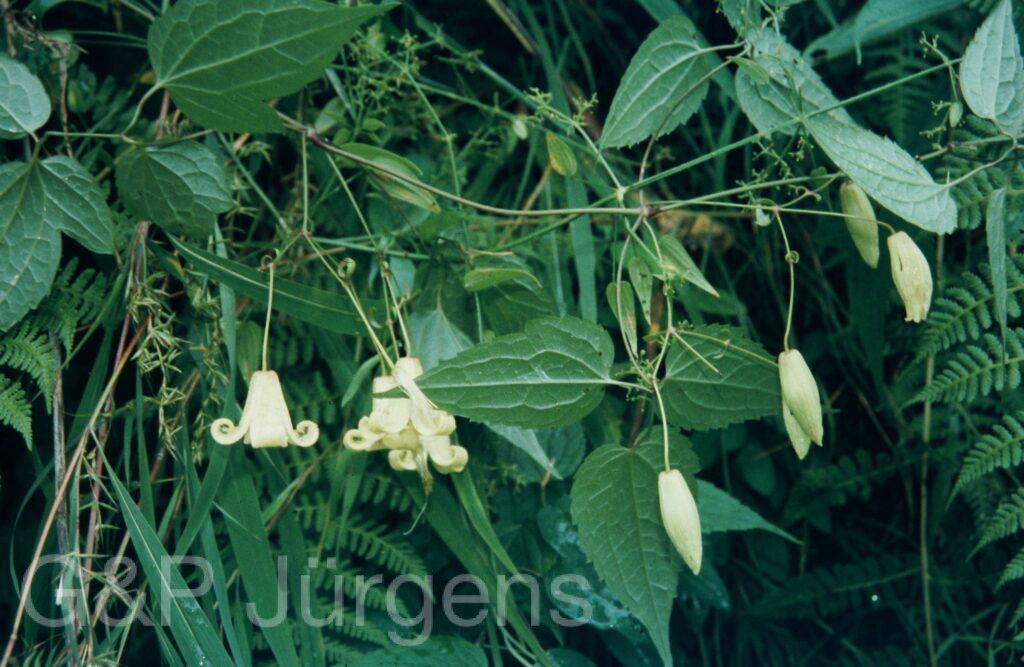
Clematis acutangula is an eastern Himalayan climber distributed through Bhutan, northern India, southern China and northern Myanmar, a comparatively restricted range reflected in the small number of GBIF records, about 61. It is a plant of temperate forest margins, scrub and thickets in the wetter montane ranges, scrambling over shrubs and into the lower canopy. The Bhutanese material photographed in the Haa (Haar) Valley at 3100 m in September documents the species in its upper-montane habitat, flowering at the close of the monsoon when many late-season Himalayan clematis come into bloom.

It is a woody to herbaceous climber whose stems are distinctly angular and sharply ridged, the feature from which the epithet acutangula derives. The leaves are opposite and compound, typically pinnate to biternate with ovate to lanceolate, toothed leaflets, the plant climbing by means of twining petioles and rachides. The flowers are nodding and campanulate, with four thick, recurved-tipped, petaloid sepals coloured yellowish to greenish-yellow, often tinged or dotted with purple; true petals are absent and the numerous stamens are enclosed within the bell. The fruit is a head of compressed achenes each bearing a long, persistent, plumose style that aids wind dispersal.

The species belongs to the autumn-flowering, yellow- to nodding-flowered assemblage of Asian Clematis allied to sect. Meclatis/Tubulosae groups, distinguished within the eastern Himalayan flora by its strongly angled stems and bell-shaped flowers. Its limited distribution and dependence on intact temperate forest scrub make it a characteristic but local element of the Bhutan-Sikkim montane flora; it is not formally assessed for conservation but its narrow range warrants attention.

Author: Hook.f. & Thomson · Sources: POWO (Kew), GBIF, Flora of Bhutan, Flora of China, Grey-Wilson's Clematis the Genus (monograph), Flora of British India

Edgew.

Nepal 99 580 ergebnis
West-Nepal Garpung-Khola 3400m, July
Garh 07 576 ergebnis
India Garhwal Seema 3400m, June

Description

Clematis barbellata is a Sino-Himalayan climber of the temperate and subalpine belt of the central and eastern Himalaya, with georeferenced collections (some 159 occurrences in GBIF) spanning India, Nepal, Bhutan, Pakistan, Myanmar and adjacent China. It ascends through shrubberies, forest margins and open rocky slopes, scrambling over Berberis, Rosa and Rhododendron thickets between roughly 2700 and 3800 m. The species is well represented in the western and central Himalaya, as documented by the photographed populations from West Nepal at the Garpung-Khola at 3400 m in July and from Garhwal at Seema, India, near 3400 m in June, where it flowers during the early monsoon.

It is a woody, deciduous climber with slender, ribbed, often purplish stems clambering by means of twining petioles. The leaves are opposite and pinnately to biternately compound, the leaflets ovate to lanceolate, acuminate, coarsely toothed or lobed and somewhat hairy beneath. The nodding, campanulate flowers are solitary or few in the leaf axils and lack true petals; the four spreading to incurved sepals are dull purple to violet-brown, thick-textured and conspicuously bearded along the margins with pale hairs, hence the epithet barbellata. Numerous stamens surround the many free carpels, which mature into a cluster of achenes bearing long, plumose, persistent styles that aid wind dispersal.

Within Clematis, the species belongs to the group of montane, axillary-flowered bell clematises related to C. montana and C. connata, distinguished by its barbellate sepal margins. As a member of Ranunculaceae it contains protoanemonin-type compounds rendering the foliage acrid and unpalatable to grazers. Though restricted to high elevations, it remains locally frequent across a broad Himalayan range and is not considered threatened, its principal role being as a structural element of subalpine scrub.

Author: Edgew. · Sources: POWO (Kew), GBIF, Flora of Bhutan, Flora of Pakistan, Annotated Checklist of the Flowering Plants of Nepal, Grey-Wilson Clematis: The Genus

DC.

Bhutan2012 503
Bhutan Pele-La 3000m, September

Description

Clematis buchananiana is a widespread climber of the Himalaya and montane Southeast Asia, ranging from Pakistan and Nepal through India, Bhutan and southern China to Myanmar, Thailand and Vietnam; with over 1100 GBIF occurrences it is among the better-documented Asian clematids, the scattered records from Britain, New Zealand and the United States representing cultivation. It scrambles over shrubs, forest margins, hedgerows and roadside thickets in temperate and subtropical zones, broadly between 1500 and 3000 m, flowering late in the season. The photographed plant from the Pele-La in central Bhutan at 3000 m in September shows its characteristic autumn flowering at the upper edge of its altitudinal span.

It is a woody to herbaceous perennial climber with ribbed, often pubescent stems and opposite, pinnate leaves bearing broadly ovate to cordate, coarsely toothed leaflets. The flowers, borne in axillary cymose panicles, are pendulous and bell-shaped (campanulate), the four thick, yellow to greenish-yellow tepals being densely tomentose outside and reflexed or recurved at the tips; true petals are absent. As in all Clematis the showy structures are sepaloid, surrounding numerous stamens and carpels. The fruit is a head of achenes, each bearing a long, plumose, feathery style that aids wind dispersal.

The species belongs to Clematis section Connatae (the nodding, campanulate-flowered, woolly-tepalled Asian group), in which it is distinguished by leaf form and the dense indumentum of its tepals. Ecologically valuable as a late-season nectar source, it is a common and adaptable species across a vast range and is of no conservation concern.

Author: DC. · Sources: POWO (Kew), GBIF, Flora of Bhutan, Flora of China, A Monograph of the Genus Clematis (Grey-Wilson)

Roxb. ex DC.

Bhutan2012 1218
Bhutan Gom Kora 1850m, October
Bhutan2012 1216
Bhutan Gom Kora 1850m, October

Description

Clematis gouriana is a vigorous climbing vine with a broad tropical-Asian and Himalayan distribution, recorded from China, India, Taiwan, the Philippines, Japan, Indonesia, Nepal, Myanmar, Thailand and many other countries, with a large dataset of around 2207 occurrences. It scrambles over shrubs, hedgerows, forest margins, thickets and roadside vegetation, predominantly in subtropical to warm-temperate hill country. The photographed plant from Gom Kora in eastern Bhutan at 1850 m, flowering in October, exemplifies its autumn blooming in low to mid-elevation forest borders.

It is a woody to semi-woody liana climbing by means of twining, clasping petioles. The leaves are opposite and pinnately compound, usually with three to five ovate, acuminate, entire or toothed leaflets borne on slender stalks. The inflorescences are large, much-branched axillary and terminal panicles of numerous small, fragrant flowers; lacking petals, each flower has four spreading, creamy-white, narrowly oblong sepals and a central tuft of many stamens and carpels. The fruit is an aggregate of compressed, pubescent achenes, each bearing a long, persistent, plumose feathery style that forms silvery seed-heads dispersed by wind.

Clematis gouriana, described by Roxburgh and DC., belongs to a complex of white-flowered, panicle-bearing climbers in section Clematis and is morphologically close to species such as C. grata. Its massed autumn flowering provides abundant late-season nectar for bees and other insects. Widespread, fast-growing and tolerant of disturbance, it can behave almost weedily along forest edges and is of no conservation concern.

Author: Roxb. ex DC. · Sources: POWO (Kew), GBIF, Flora of China (Ranunculaceae), Annotated Checklist of the Flowering Plants of Nepal, Grierson & Long Flora of Bhutan, Johnson's monograph Clematis: The Genus

Buch.-Ham. ex DC.

Bhutan2014 36
Bhutan Sandrup 1000m, May
Bhutan2014 971
Bhutan Chele-La 3400m, May
Nepal 1994 66 ergebnis
Ost-Nepal Jaljale Himal 2400m, April

Description

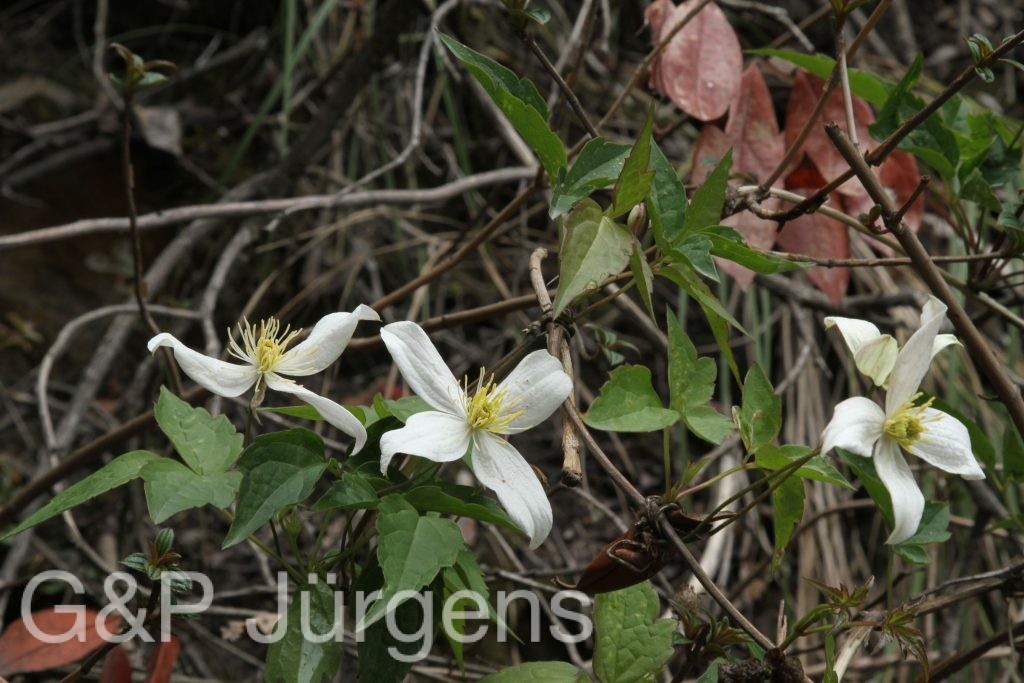
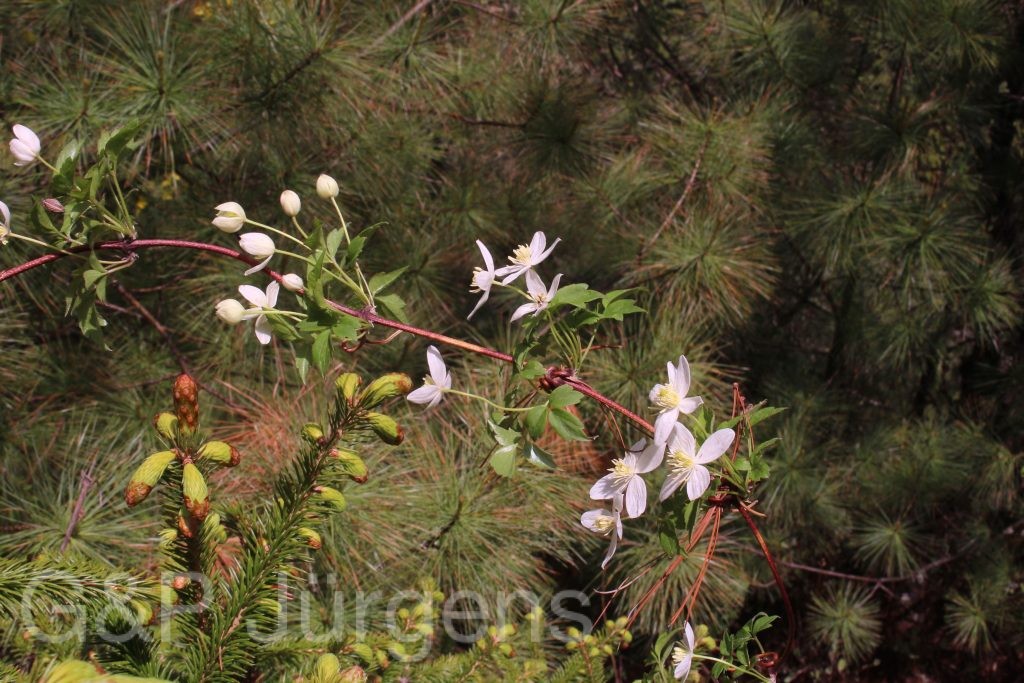
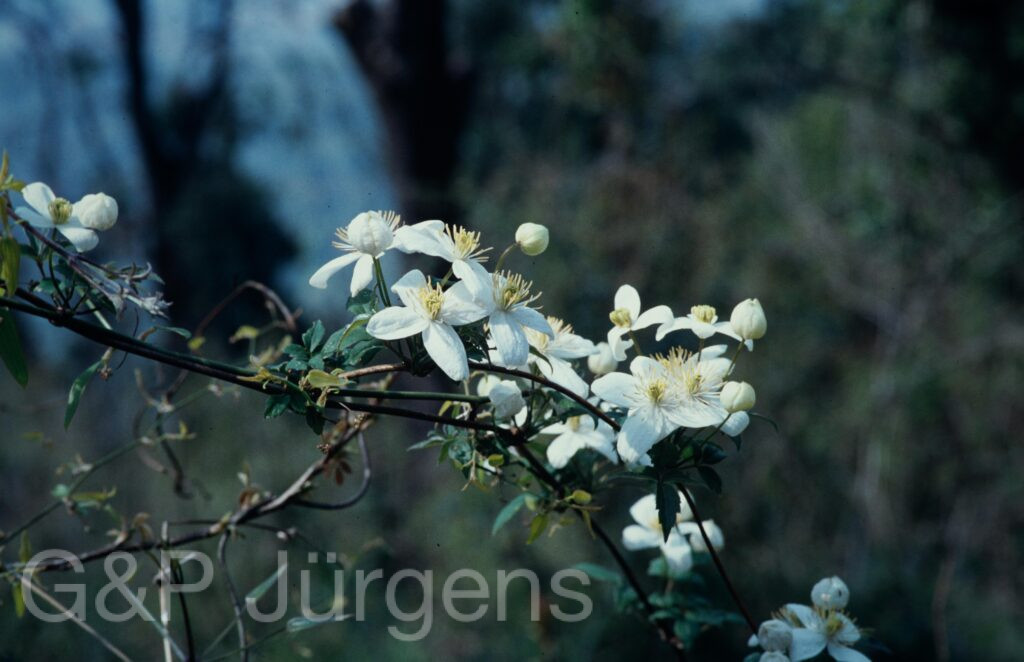
Clematis montana is a widespread Himalayan and Sino-Himalayan climber ranging from Pakistan and Kashmir eastward through Nepal, Bhutan and northern India into central and southwestern China and Myanmar. Reflecting its long history in horticulture, GBIF records exceed 6300 and include numerous cultivated and naturalised occurrences in Britain, continental Europe, North America, New Zealand and Australia alongside its native Asian range. In the wild it grows over an exceptionally broad elevational span, scrambling through forest margins, scrub, hedgerows and over rock from warm temperate valleys to high subalpine slopes. The Bhutanese material imaged at Sandrup (1000 m) and Chele La (3400 m) and the East Nepal population on the Jaljale Himal (2400 m), all flowering April to May, illustrate its vernal, pre-monsoon blooming across this range.

It is a vigorous woody climber with slender, ridged, eventually brown stems and clambering by twining petioles. The leaves are opposite and ternate, the three leaflets ovate to lanceolate, irregularly toothed or lobed and often softly hairy. Flowers are borne singly or in fascicles from the axils of the previous year's growth, each large and showy with four (occasionally more) spreading, petaloid sepals that are white to pink and frequently fragrant; true petals are absent. The numerous stamens have yellow anthers. The fruit is an aggregate of achenes, each tipped by a long, persistent, plumose silky style aiding wind dispersal.

Within Clematis the species belongs to sect. Montanae of spring-flowering, ternate-leaved climbers, and is morphologically variable, with several named varieties and many garden cultivars selected for flower colour and size. It is an early-season nectar source and a robust coloniser of disturbed and edge habitats. It is common and not of conservation concern; its naturalisation beyond Asia underscores its competitive vigour and broad climatic tolerance.

Author: Buch.-Ham. ex DC. · Sources: POWO (Kew), GBIF, Flora of China, Flora of Bhutan, Annotated Checklist of the Flowering Plants of Nepal, Grey-Wilson's Clematis the Genus (monograph)