Tag:

Myanmar

Flowers of the Myanmar Himalaya — 604 species recorded from northern Myanmar (Burma) and the eastern Himalayan borderlands, a biodiversity hotspot linking the Himalaya to the mountains of Yunnan and Southeast Asia. The region’s forests and alpine slopes hold a rich flora of rhododendrons, orchids, balsams and gentians. Every page gives a botanical description, distribution, habitat and flowering time with the original photograph.

A.DC.

Bhutan2014 87
Bhutan Trashigang 1400m, May
Bhutan2014 167
Bhutan Trashigang 1400m, May
Bhutan2014 165
Bhutan Trashigang 1400m, May

Description

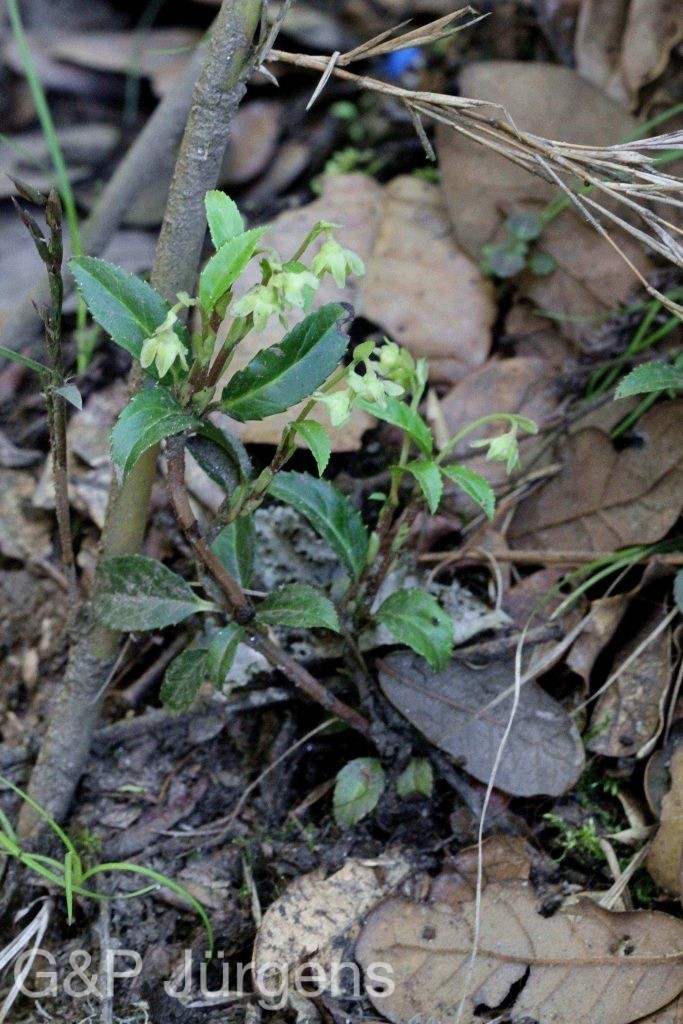
Castanopsis tribuloides is an evergreen chinquapin widely distributed across the eastern Himalaya and Indo-Burma into southern China and Japan, recorded from Nepal, Bhutan, north-eastern India, Bangladesh, Myanmar, Thailand, Indochina and the Sino-Japanese region. GBIF aggregates some 766 occurrences, concentrated in the montane forests of the eastern Himalaya and South-East Asia. It is a canopy or sub-canopy tree of subtropical and warm-temperate evergreen broad-leaved forest, often in mixed oak-laurel associations on hill slopes, typically between about 1000 and 2500 m. The tree photographed near Trashigang in eastern Bhutan (1400 m, May) reflects its place in the moist mid-elevation forests of the eastern Himalayan belt, flowering in the pre-monsoon season.

The species is a medium-sized tree with greyish bark and slender twigs. The leaves are simple, alternate, coriaceous, lanceolate to oblong-lanceolate, entire or finely serrate toward the apex, glabrous and glossy above and often thinly scaly or coppery beneath when young. The flowers are unisexual, borne in erect catkin-like spikes, the staminate inflorescences slender and the pistillate flowers in few-flowered clusters. The diagnostic fruit is a small nut enclosed in a globose cupule densely covered with slender, spreading, often branched spines, recalling a Tribulus burr and giving the epithet; the spiny involucres are borne in dense infructescences and dehisce to release the nut.

Castanopsis is a large genus of Asian Fagaceae distinguished from Castanea and Lithocarpus by its evergreen habit and persistently spiny cupules. C. tribuloides, described by Alphonse de Candolle, is variable in leaf form and cupule spininess, and is closely allied to other Himalayan chinquapins with which it can intergrade. As a widespread, often common forest dominant it is not threatened, while being ecologically valuable as wildlife mast and locally used for timber and fuelwood.

Author: A.DC. · Sources: POWO (Kew), GBIF, Flora of China, Flora of Bhutan, Flora of Thailand, Annotated Checklist of the Flowering Plants of Nepal, monograph of Asian Fagaceae (Camus)
(Link) Tirveng.

Nepal 97 542 G1061
Nepal Dhoban 740m April

Description

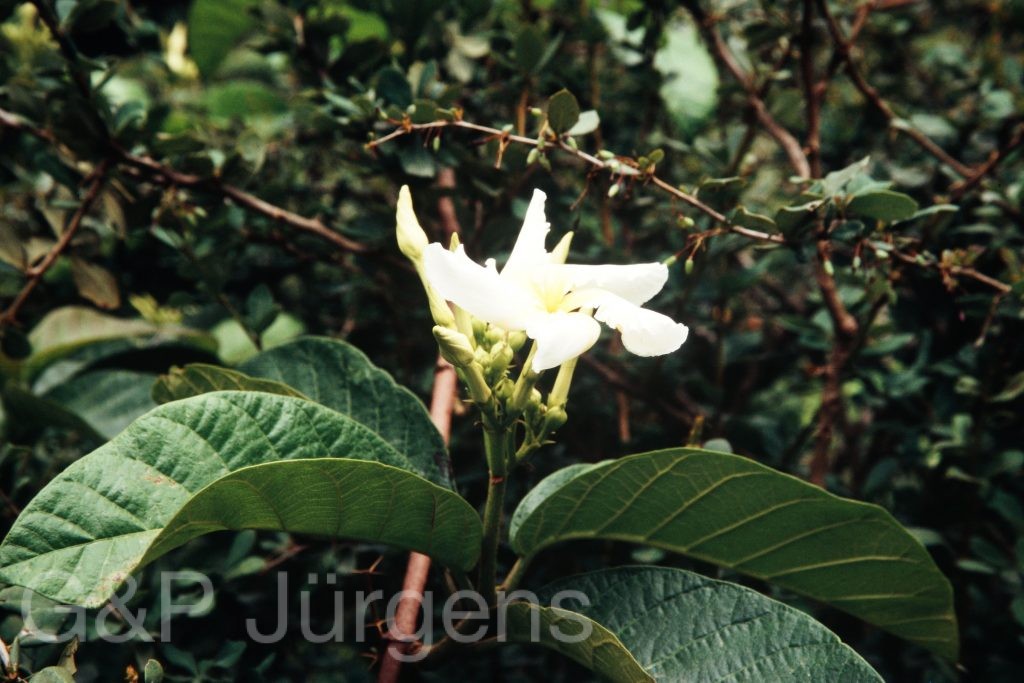
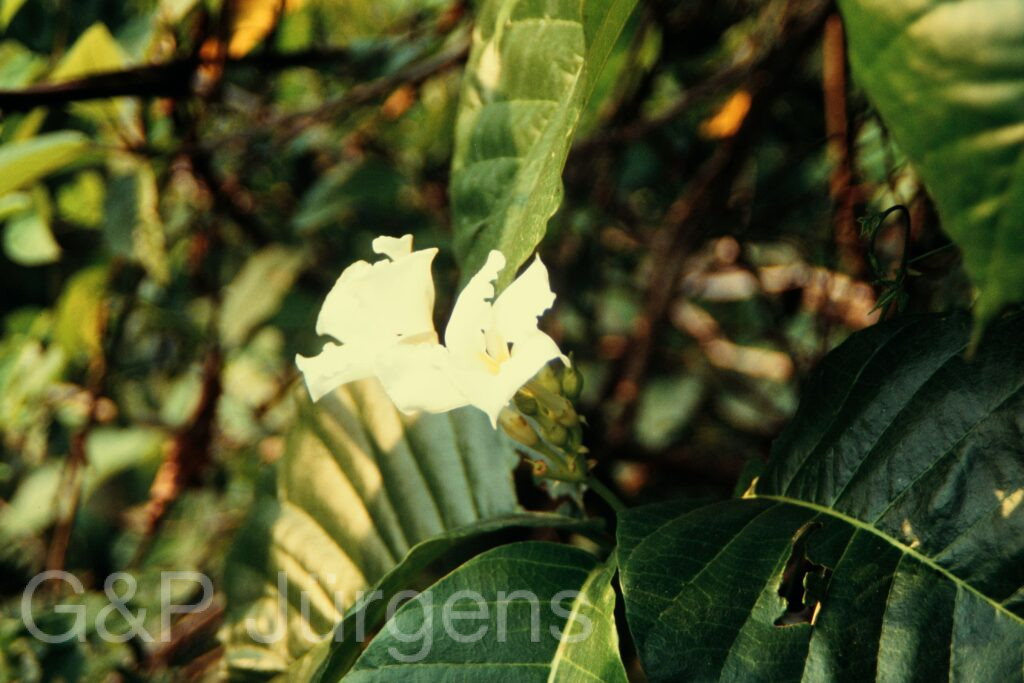
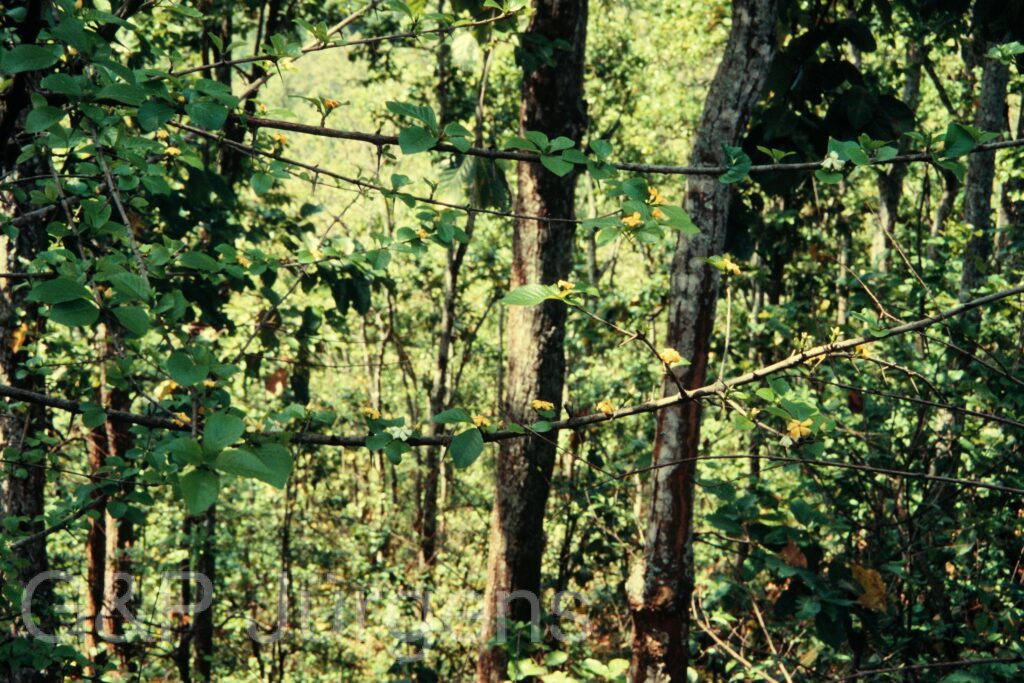
Catunaregam longispina is a spiny shrub or small tree of tropical and subtropical Asia, distributed from India and Nepal through Bhutan, Myanmar, Thailand, Cambodia and Vietnam. GBIF records about 165 occurrences across this range, concentrated in the Indian subcontinent and mainland South-East Asia. It is a plant of dry deciduous and mixed forest, thorn scrub, open hillsides and disturbed ground at low elevations, typically in the warm subtropical foothill and plains zone. The population imaged at Dhoban in Nepal (740 m, April) is characteristic of its habitat in the warm, seasonally dry hill country of the lower Himalayan foreland, flowering in spring before the monsoon.

The plant is a much-branched, often armed shrub bearing stout, straight, axillary thorns from which the epithet derives. The leaves are opposite or fascicled on short shoots, obovate to elliptic, entire, often clustered at the nodes, with interpetiolar stipules. The flowers are solitary or few at the shoot tips, fragrant, with a campanulate calyx and a salver- to funnel-shaped corolla that opens white or cream and frequently ages to yellow, the five lobes spreading and contorted in bud. Five stamens are inserted in the corolla throat and the ovary is inferior. The fruit is a leathery to woody, globose berry crowned by the persistent calyx and containing numerous seeds embedded in pulp.

Catunaregam (tribe Gardenieae) was segregated from the broadly defined Randia, and this species, transferred by Tirvengadum, has circulated under several synonyms in the Randia/Xeromphis complex; care is needed in distinguishing it from related thorny gardenioid shrubs. As a widespread and adaptable species of secondary and dry forest it is not of conservation concern, and its fruit and bark have local ethnobotanical uses, including as a fish poison and in folk medicine.

Author: (Link) Tirveng. · Sources: POWO (Kew), GBIF, Flora of British India, Flora of Bhutan, Flora of Thailand, Annotated Checklist of the Flowering Plants of Nepal, revision of Catunaregam and allied Gardenieae (Tirvengadum)

(Sm.) Dandy

Sikkim2004 336 P598
Sikkim/India Choka 3000m May
Garh 07 92 ergebnis
India Garhwal Trijugi Narayan 2500m, June
Sikkim 2006 210 ergebnis
India West-Bengal, Samadan 2300m, May

Description

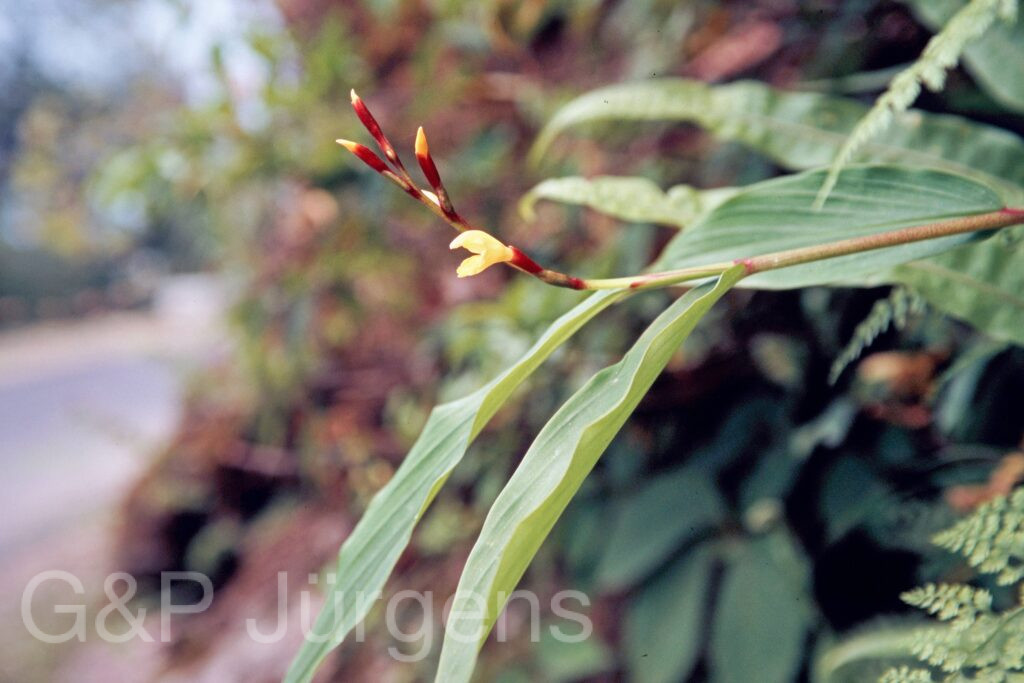
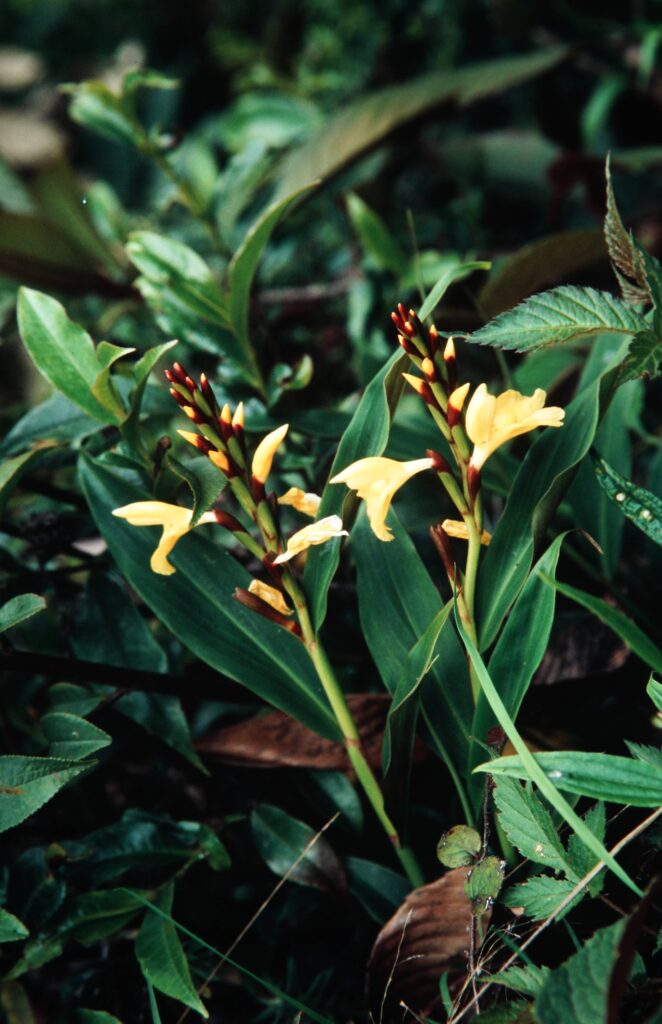
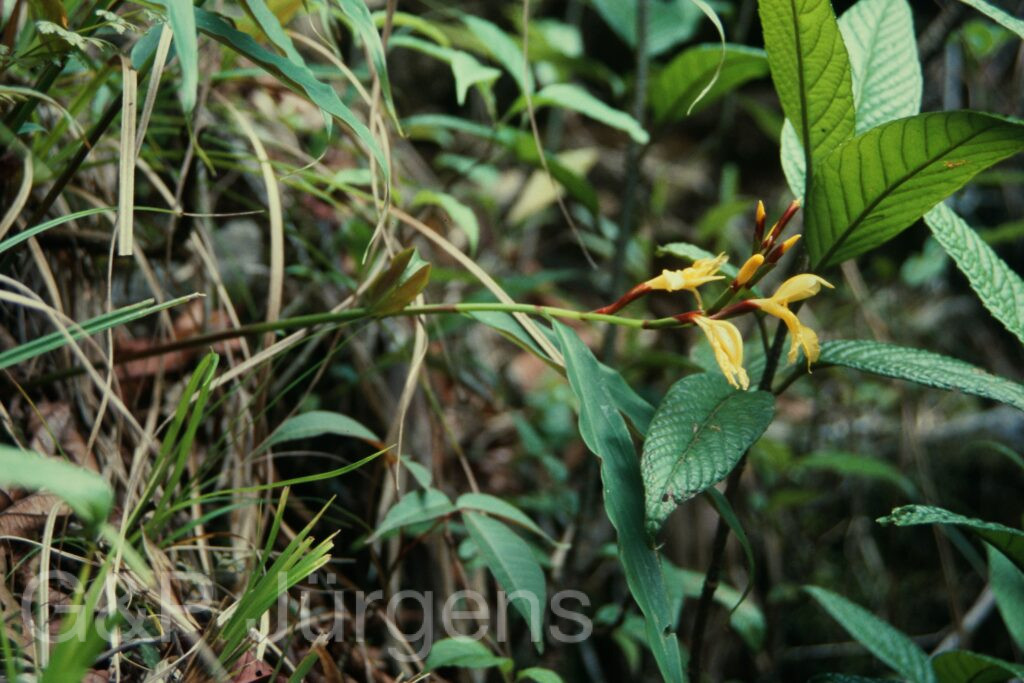
Cautleya gracilis is a slender ginger widely distributed through the Sino-Himalayan region, documented by GBIF from China, India, Nepal, Bhutan, Myanmar and adjacent Southeast Asia, with well over 650 occurrences making it the best-recorded species of its genus. It is frequently epiphytic or lithophytic, growing on mossy tree trunks, dripping cliffs and humid bank ledges in temperate broadleaved and mixed forest. The illustrated gatherings span Sikkim at Choka around 3000 m, Garhwal near Trijugi Narayan at 2500 m, and West Bengal at Samadan near 2300 m, flowering from May to June; the species generally favours the 1500-3000 m belt under monsoon humidity.

The plant grows from a short, fibrous-rooted rhizome producing a graceful leafy shoot to about 30-60 cm. The distichous leaves are lanceolate to oblong-lanceolate, acuminate, narrowed to a sheathing base, glabrous and often glaucous beneath. The inflorescence is a terminal, lax spike of few to several yellow flowers subtended by green or reddish bracts; each flower bears a slender corolla tube, a hooded dorsal lobe, prominent lateral staminodes and a bilobed labellum, with a single fertile stamen typical of the family. The fruit is a capsule splitting to reveal arillate seeds.

Cautleya is a small genus of perhaps two to three species centred on the Himalaya and southern China, closely allied to Roscoea but distinguished by its often epiphytic habit and capsular fruit. The yellow flowers are visited by long-tongued bees and the seeds dispersed when capsules open. Widespread and locally common, C. gracilis is of least concern, though epiphytic populations depend on intact, humid forest canopies vulnerable to logging and desiccation.

Author: (Sm.) Dandy · Sources: POWO (Kew), GBIF, Flora of China, Flora of Bhutan, Zingiberaceae of the Indian Subcontinent (Sabu)

(Sm.) Baker

Sikkim2003 56 P75
Sikkim above Yoksam 2650m 08.2003

Description

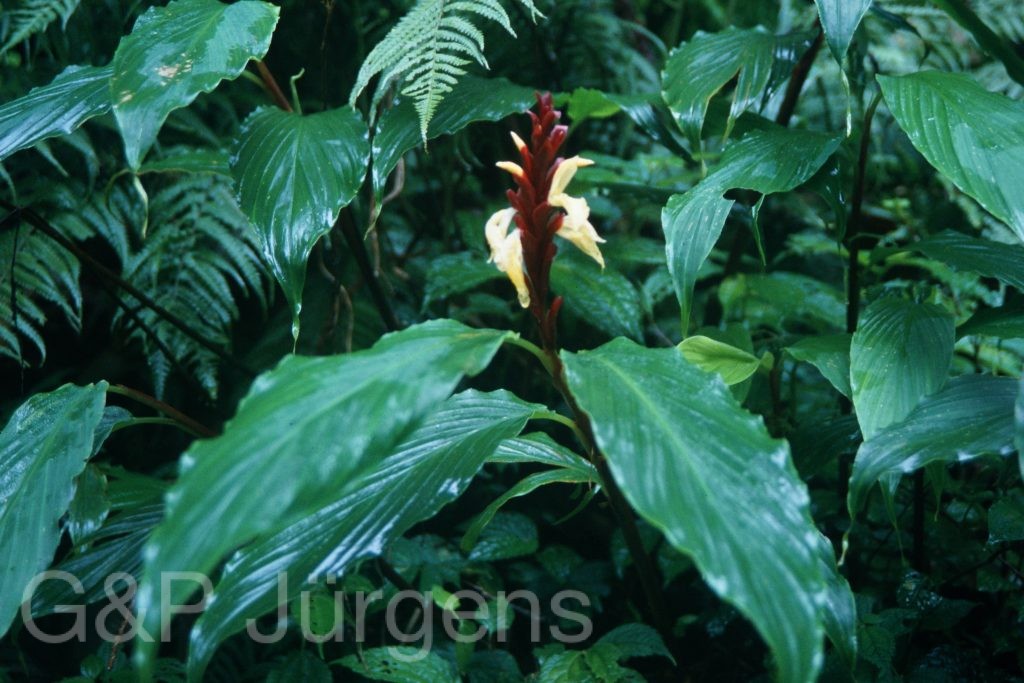
Cautleya spicata is a robust Himalayan ginger distributed through India, Nepal, China and Bhutan, with GBIF recording some 226 occurrences along the southern slopes of the range and into Myanmar. It grows in moist, shaded temperate forest, on humus-rich banks, mossy boulders and stream gullies, occasionally epiphytic but more often terrestrial in deep leaf litter. The photographed plant was found in Sikkim above Yoksam at about 2650 m in August, at the height of the monsoon flowering season; the species characteristically occupies the cool, humid 1800-3000 m belt of the eastern and central Himalaya.

The plant arises from a stout, horizontal rhizome to form leafy shoots reaching about 60-100 cm, taller and more substantial than its slender relative C. gracilis. The distichous leaves are oblong-lanceolate, acuminate and sheathing at the base, green above and often paler beneath. The inflorescence is an erect terminal spike with conspicuous, persistent red or maroon bracts subtending the bright yellow flowers; each flower has a slender corolla tube, a hooded dorsal segment, petaloid lateral staminodes, a deflexed bilobed labellum, and a single fertile stamen. The fruit is a capsule bearing arillate seeds.

Cautleya spicata is closely related to C. gracilis within a small Himalayan genus allied to Roscoea, distinguished by its larger stature, conspicuous coloured bracts and predominantly terrestrial habit. The contrasting red bracts and yellow flowers signal to long-tongued bee pollinators. It is widely cultivated as a hardy ornamental ginger, contributing extralimital GBIF records. Locally frequent and not threatened, it nonetheless depends on intact, humid montane forest for its core populations.

Author: (Sm.) Baker · Sources: POWO (Kew), GBIF, Flora of China, Flora of Bhutan, Zingiberaceae of the Indian Subcontinent (Sabu)

C.B.Clarke

Bhutan2012 315
Bhutan Paro-Chu, 2400m September
Bhutan2012 316
Bhutan Paro-Chu, 2400m September

Description

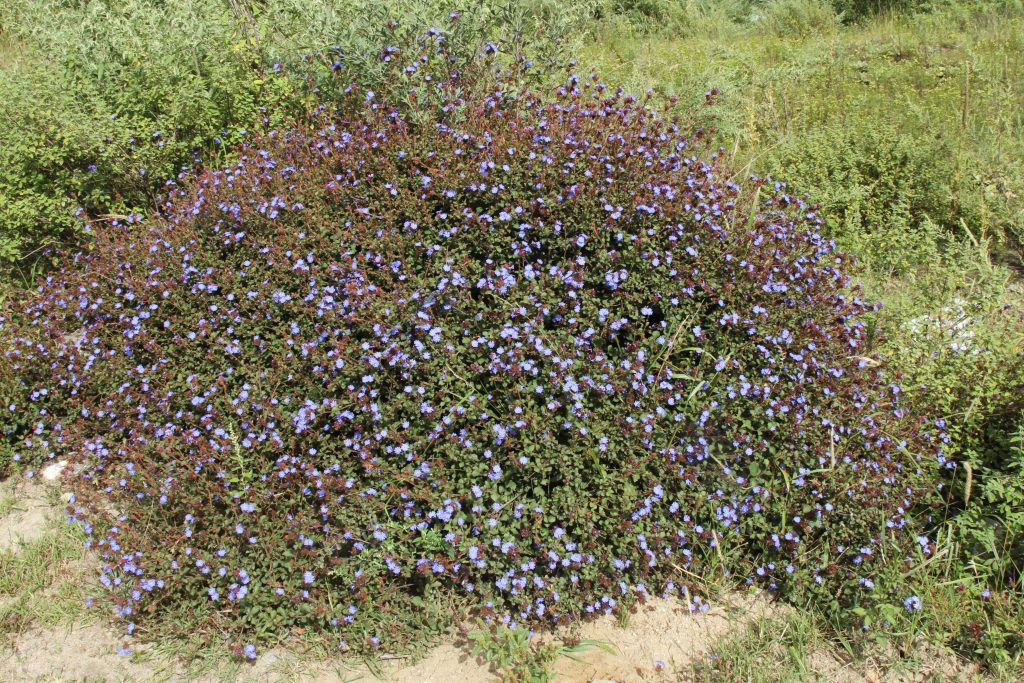
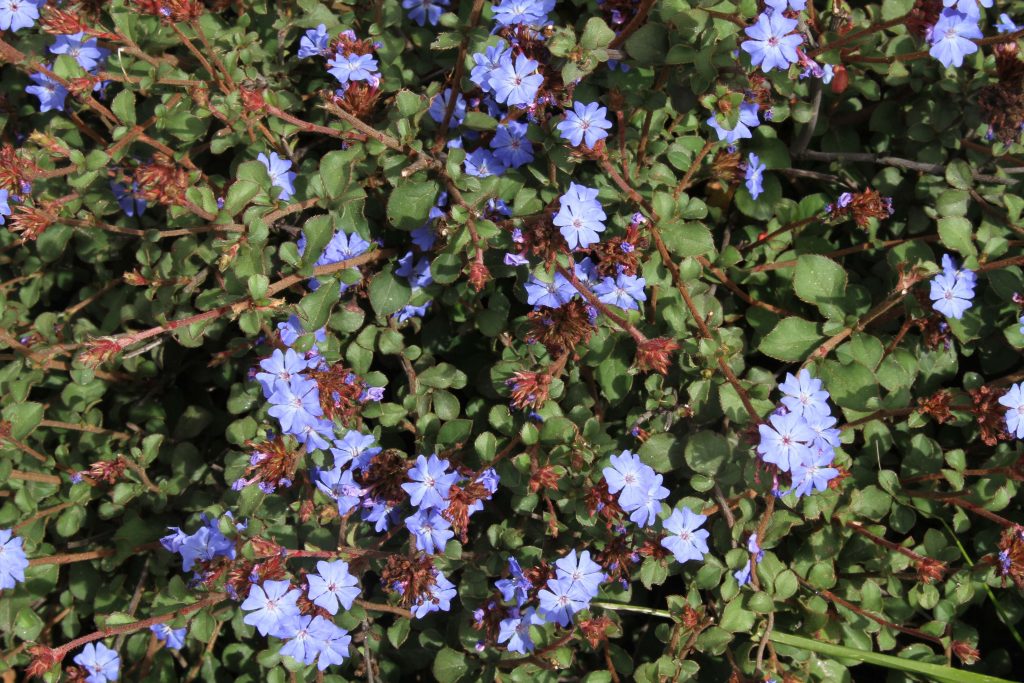
Ceratostigma griffithii is a shrub of the dry inner valleys of the eastern Himalaya and southwestern China, recorded from China, Bhutan, India and Myanmar, with cultivated and naturalised occurrences in the United States, Canada, Spain and Korea; GBIF holds about 163 georeferenced records. It grows on dry, sunny, stony slopes, rocky banks, scrub and the margins of cultivation in the rain-shadowed montane valleys, tolerating drought and strong insolation. The photographed plant from the Paro Chu valley in Bhutan at 2400 m in September is characteristic of these semi-arid inner-Himalayan habitats, where it flowers in late summer and autumn on open hillsides.

It is a low, much-branched, semi-evergreen shrub up to about 1 m, with stiff, reddish-tinged twiggy branches that turn bronze-red in autumn. The leaves are small, alternate, obovate to spathulate, entire, bristle-margined and somewhat leathery, often colouring red before falling. The flowers are clustered in dense terminal and lateral heads subtended by bristly bracts; each flower has a tubular, glandular-ribbed calyx and a slender salverform corolla with five spreading lobes of brilliant deep blue. There are five stamens and a five-branched style with stigmatic surfaces along the inner side; the fruit is a small membranous capsule enclosed in the persistent calyx, whose stiff bristles aid epizoochorous dispersal.

The genus Ceratostigma, described by Bunge, comprises a few Asian and African shrubs and subshrubs of Plumbaginaceae noted for their intense blue flowers and autumn foliage, the type collection of this species made by Griffith and named by C.B. Clarke. The bright corollas attract butterflies and bees, and the bristle-armed calyces cling to passing animals. Valued in horticulture for autumn colour, the wild plant is locally common in its dry-valley niche and not considered threatened.

Author: C.B.Clarke · Sources: POWO (Kew), GBIF, Flora of China Vol. 15, Flora of Bhutan Vol. 2, Flora of Nepal, A Revision of the Genus Ceratostigma (Plumbaginaceae)

Wight

Garh 07 312 ergebnis
Garhwal Bebra, 2450m, June

Description

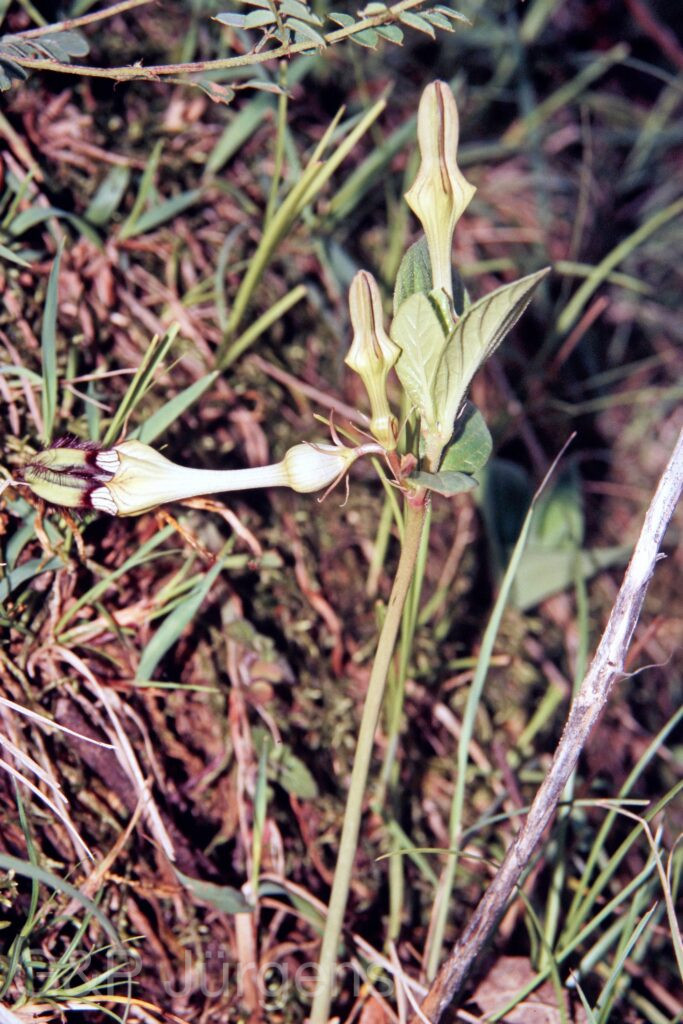
Ceropegia wallichii is a Himalayan twining herb distributed from northwest India (Uttarakhand, Himachal Pradesh) through Nepal to Myanmar. With only 35 occurrences documented on GBIF, it is among the less frequently recorded species of this large genus. The species inhabits margins of warm-temperate and subtropical broadleaved forests, open scrubby slopes, and rocky outcrops at elevations of 1,500–2,800 m. It is often found climbing through low shrubs or trailing over banks in partially shaded situations with moderate monsoon rainfall.
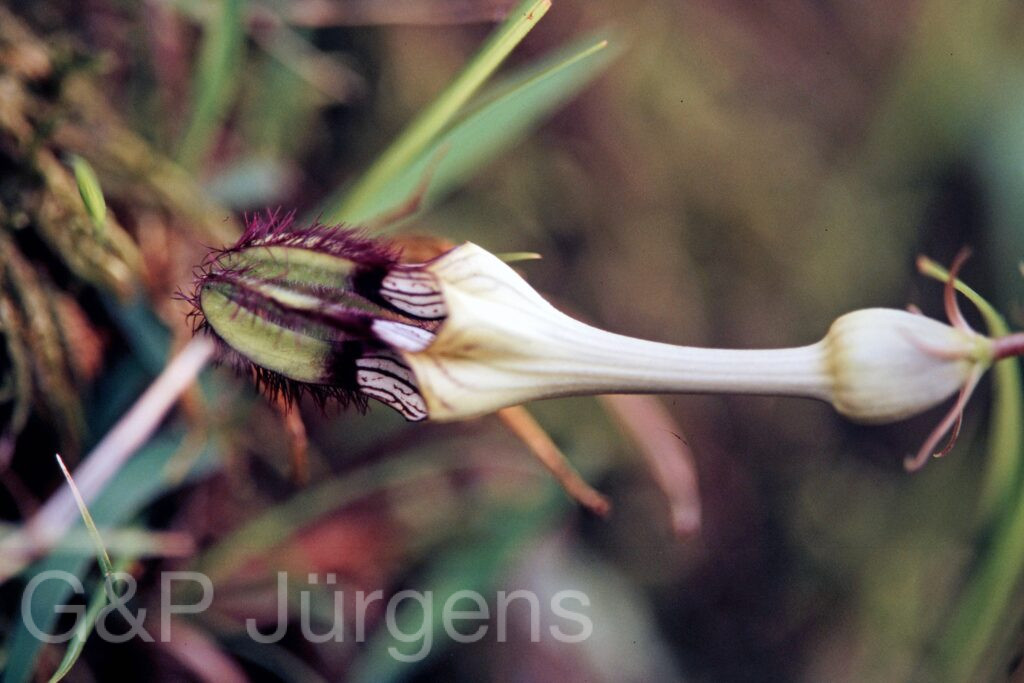
Ceropegia wallichii is a slender, herbaceous, twining perennial arising from a small, globose to ellipsoid tuber, 1.5–3 cm in diameter. Stems are wiry, glabrous or sparsely pubescent, reaching 1–2 m in length. Leaves are opposite, narrowly lanceolate to ovate-lanceolate, 3–8 cm long, acuminate at the apex, with short petioles. The inflorescence is an axillary, few-flowered umbelliform cyme bearing 2–6 flowers. The flowers are the most striking feature: the corolla tube is 2.5–4 cm long, slightly inflated at the base, curved, and pale green to yellowish with purple streaks; the five corolla lobes are linear, connate at the tips to form the characteristic cage-like structure (lantern flower) that functions as a temporary insect trap for pollination. The follicles are paired, slender, up to 12 cm long, containing comose seeds adapted for wind dispersal.
The species was described by Robert Wight based on material originally collected by Nathaniel Wallich. It belongs to Ceropegia section Ceropegia, a primarily Asian lineage of twining herbs with tuberous rootstocks. The photographed specimen from Bebra in Garhwal at 2,450 m documents an occurrence in the western Himalayan portion of the range. Ceropegia wallichii can be distinguished from the related C. pubescens by its glabrous or sparsely hairy stems and narrower leaf blades. Given its sparse occurrence records and reliance on relatively intact forest-edge habitats, the species may merit conservation attention, though a formal IUCN assessment is currently lacking.

Author: Wight · Sources: POWO (Kew), GBIF, Flora of British India Vol. 4, Ansari: Asclepiadaceae — Genus Ceropegia, Flora of India (1984), Bruyns et al. (2017)

(W.W.Sm.) Smedmark

Sikkim2011 285
Sikkim Lada-La 3800m, June
Sikkim2011 286
Sikkim Lada-La 3800m, June
Nepal 2001 285 ergebnis ergebnis
Nepal (Gorkha) Lambra Kharka 3100m, May

Description

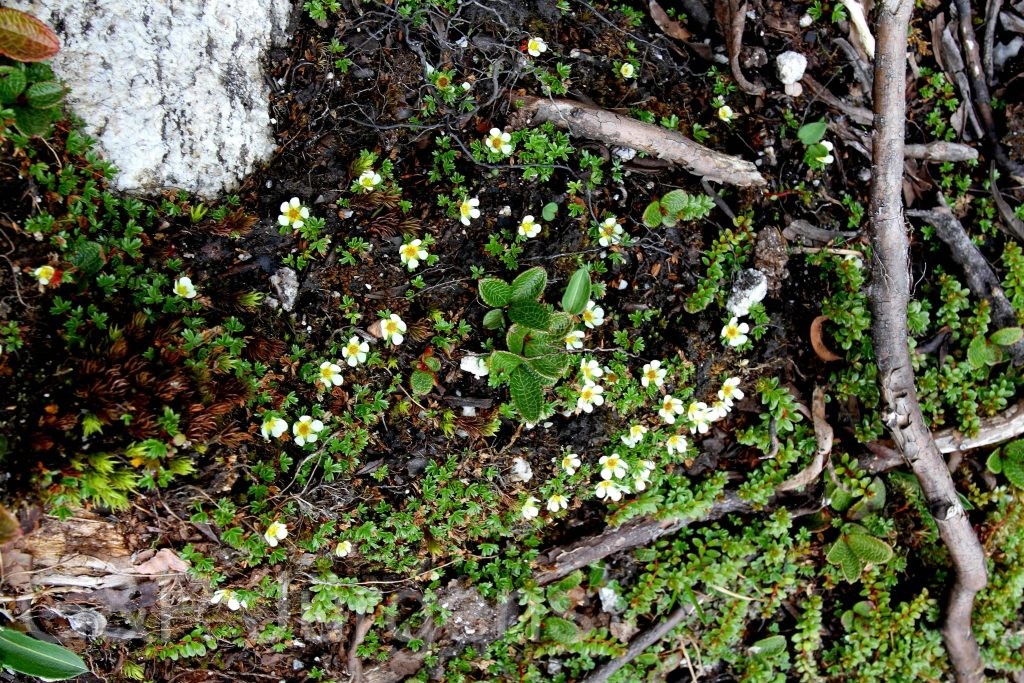
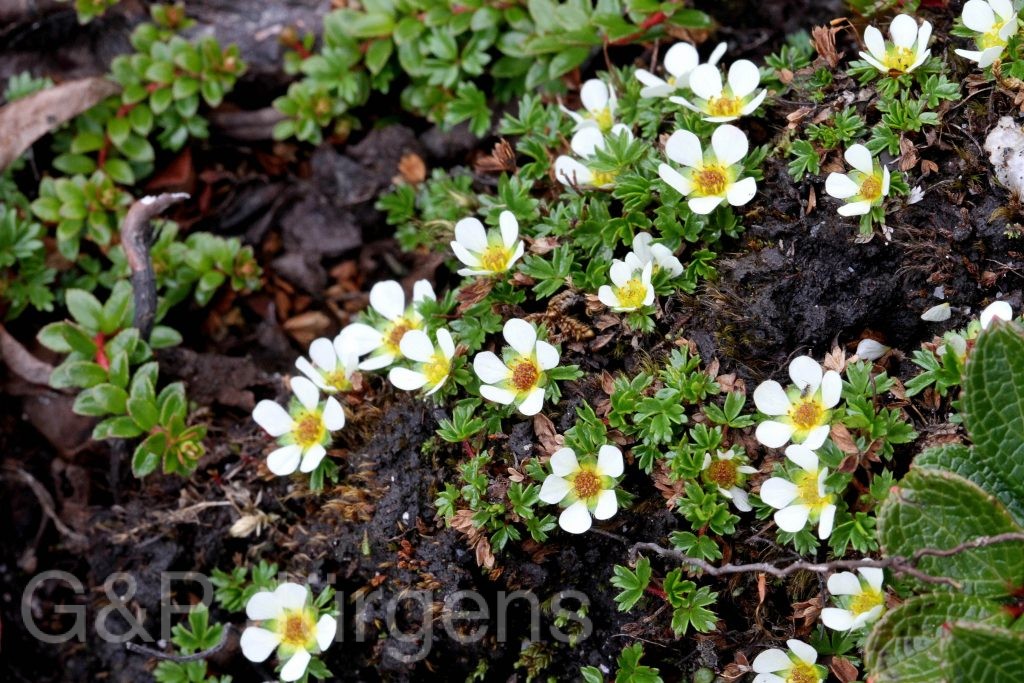
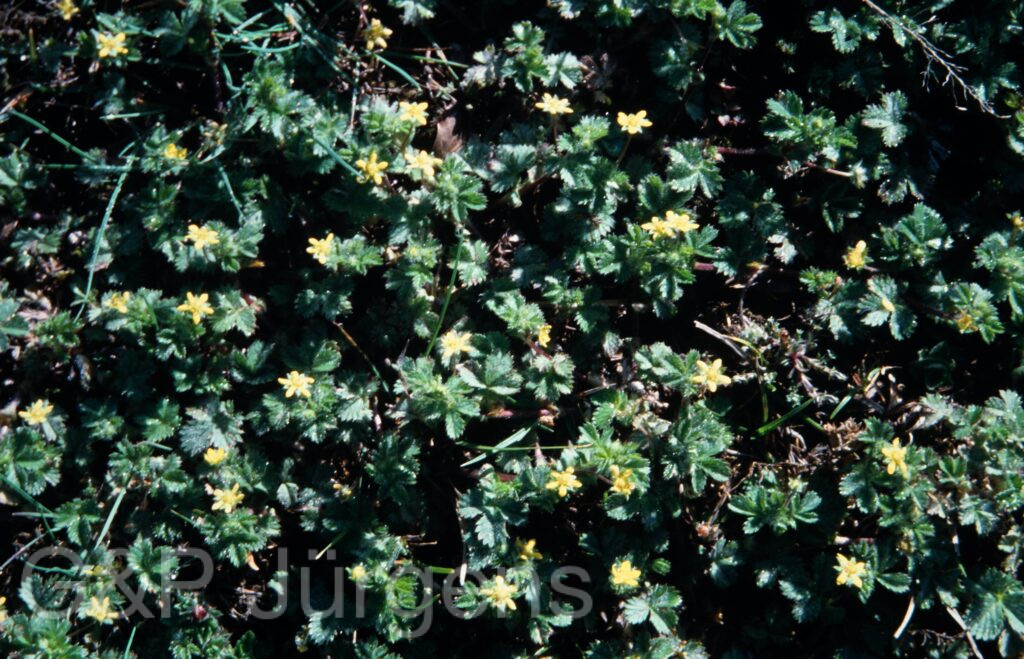
Chamaecallis perpusilloides is a diminutive alpine cushion herb of the eastern Himalaya and adjacent China, recorded from China, Nepal, Myanmar and Bhutan; its roughly 64 georeferenced collections trace a narrow Sino-Himalayan distribution. The species occupies the upper subalpine and alpine belt, where it grows in short turf, among rocks and on humus-rich, well-drained alpine slopes. The gatherings noted in the caption, from Lada-La in Sikkim at 3800 m in June and from Lambra Kharka in Gorkha, Nepal at 3100 m in May, are representative, the plant flowering early in the season at roughly 3000-4500 m on cool, moist, often grazed pasture.

It is a low, tufted to mat-forming perennial growing from a slender branched rootstock that gives rise to dense rosettes of small leaves. The leaves are crowded, trifoliolate with cuneate, few-toothed leaflets, and somewhat hairy, forming compact rosettes pressed close to the ground. The small flowers are solitary or few in number on short pedicels and barely overtop the foliage; they have five sepals alternating with an epicalyx, five small petals and few stamens, the receptacle bearing a small cluster of carpels that mature into dry achenes.

This taxon, based on the basionym described by W. W. Smith and transferred by Smedmark to the segregate genus Chamaecallis, exemplifies the recent dismemberment of the broadly defined Sibbaldia on molecular and morphological evidence; the original web placement under the Sibbaldia name reflects that history. The dwarf cushion habit and early flowering are adaptations to a short, cold growing season at high elevation. Pollination is by generalist alpine insects. No formal Red List assessment exists, but its restricted high-montane niche makes it potentially sensitive to alpine warming and grazing pressure.

Author: (W.W.Sm.) Smedmark · Sources: POWO (Kew), GBIF, Flora of China, Annotated Checklist of the Flowering Plants of Nepal, Sibbaldia phylogeny (Smedmark) monograph

Rolfe

Bh2008 488 G757 1
Bhutan Puna Tsang-Chu 1600m, May
Nepal1992 75 P108 ergebnis
Nepal Chirwa 1260m March 

Description

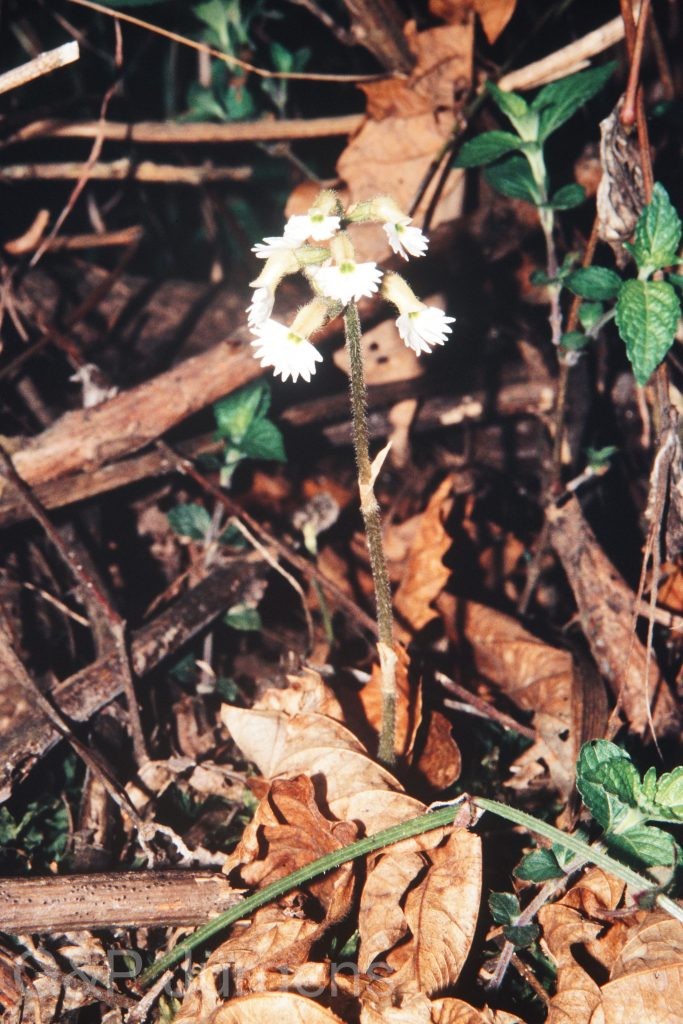
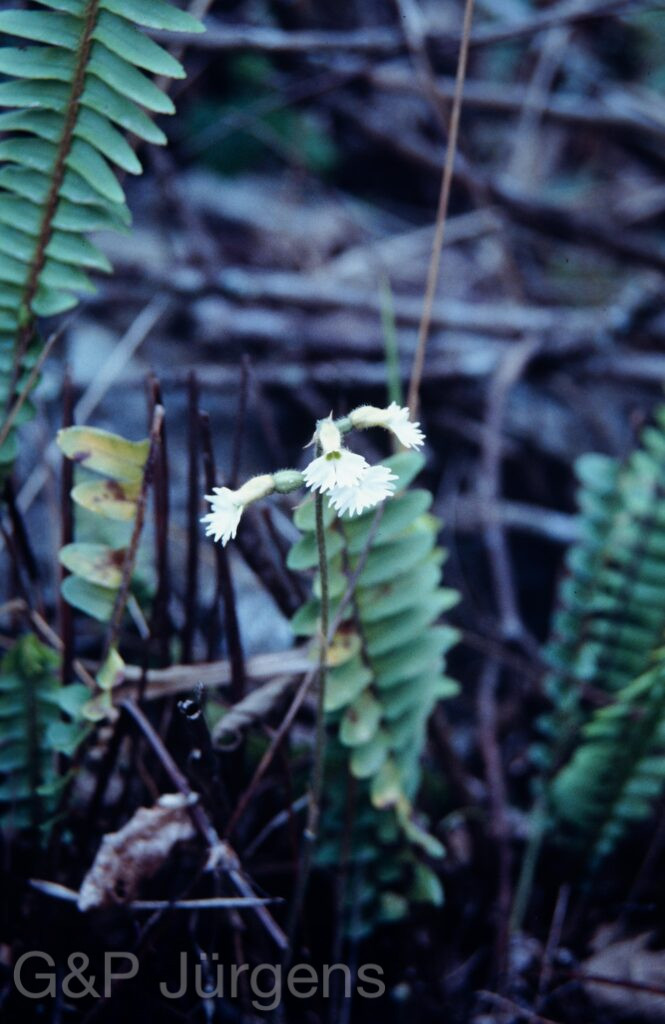
Cheirostylis yunnanensis is a small terrestrial jewel orchid of the eastern Himalaya and adjacent Southeast Asia, recorded by GBIF (129 occurrences) from China, Vietnam, Hong Kong, India, Bhutan, Myanmar and Thailand. It inhabits shaded, humus-rich forest floors, mossy banks and rocky slopes in warm-temperate to subtropical broad-leaved and evergreen forest, broadly between 1000 and 2000 m. The documented plants from the Puna Tsang-Chu valley in Bhutan at 1600 m (May) and from Chirwa in eastern Nepal at 1260 m (March) bracket its lower-montane range and reveal a spring flowering period coinciding with the pre-monsoon flush of forest growth.

The species is a diminutive, creeping herb arising from a fleshy, jointed, often reddish rhizome that runs along the substrate surface, rooting at the nodes. The few small leaves are ovate, clustered toward the stem base, sometimes withering by flowering, with a velvety green to bronzed lamina. The inflorescence is a short, few-flowered terminal raceme on a glandular-pubescent peduncle. The small white flowers have connate sepals forming a tube; the diagnostic lip (labellum) bears a saccate base enclosing two glandular calli and an apex that is broadened and divided into two fan-shaped, fringed or toothed lobes, the generic name referring to this hand-like column structure. The fruit is a small ribbed capsule.

Described by Rolfe, the species belongs to genus Cheirostylis (subfamily Orchidoideae, tribe Cranichideae, subtribe Goodyerinae), the rhizomatous jewel orchids prized for foliage and intricate floral architecture. Like all terrestrial orchids it relies on mycorrhizal fungi and on shaded, undisturbed forest floor microhabitats, making it sensitive to forest clearance. Its inconspicuous size means populations are easily overlooked; though not formally assessed, it is CITES-listed as an orchid and locally uncommon.

Author: Rolfe · Sources: POWO (Kew), GBIF, Flora of China, Flora of Bhutan, Genera Orchidacearum: Orchidoideae (Pridgeon et al.)

Miq.

BhutanPG2011 74
Bhutan Menchuang, 2700m June

Description

Chimaphila japonica Miq. is a diminutive evergreen subshrub with a wide temperate East Asian and Himalayan range, documented by GBIF from Japan, Korea, China, Russia, Taiwan, Bhutan, India, Myanmar and Nepal across more than 3000 occurrences. It is a plant of shaded, humus-rich coniferous and mixed forest floors, often associated with mossy banks and the litter beneath fir, spruce and oak, generally between 1500 and 3000 m. The individual recorded at Menchuang in Bhutan at about 2700 m in June reflects this montane forest habitat, where the species benefits from the partial mycoheterotrophic nutrition characteristic of the wintergreen group.

The plant produces slender creeping rhizomes from which arise short, erect aerial stems bearing whorled or subverticillate, leathery, evergreen leaves. The leaves are oblanceolate to elliptic, sharply serrate towards the apex, dark green and glossy above, and somewhat clustered in the upper part of the stem. One to several nodding flowers are borne on a terminal peduncle; each flower has five spreading, waxy white to pinkish petals, ten stamens with conspicuously dilated, ciliate filaments and inflated anthers opening by pores, and a stout columnar style topped by a broad peltate stigma. The fruit is an erect, dehiscent globose capsule splitting from the apex.

Chimaphila belongs to the Pyroleae of subfamily Monotropoideae within a broadly circumscribed Ericaceae, partially mycoheterotrophic woodland herbs. Chimaphila japonica is closely allied to the boreal C. umbellata but is distinguished by its smaller stature and leaf form. Given its broad distribution it is not considered threatened, though it depends on intact forest soils and their mycorrhizal networks, making it a useful indicator of mature montane woodland.

Author: Miq. · Sources: POWO (Kew), GBIF, Flora of China, Flora of Japan, Flora of Bhutan, Krisa monograph of Pyrolaceae

Alston

Bh09 349 P564
Bhutan Wangdi, 2600m June
Nepal 97 552 G1079
Nepal Sabha-Khola 550m May

Description

Chonemorpha fragrans Alston is a large woody climber of tropical and subtropical Asia, ranging from India, Nepal and Myanmar through southern China and Indochina to Thailand, Sri Lanka and western Malesia; GBIF documents about 769 occurrences across this Indo-Malesian span. It is a liana of moist forest, forest margins and riverine thickets, climbing into the canopy from low elevations into the lower hills. The photographed material spans this amplitude, from the Sabha-Khola in lowland Nepal at 550 m in May to Wangdi in Bhutan at 2,600 m in June, the latter an unusually high record for an essentially subtropical climber.

It is a robust, twining liana with stout woody stems exuding milky latex when cut, as is general in the family. The leaves are opposite, large, broadly ovate to obovate, often softly tomentose beneath, with an acuminate apex and entire margin. The flowers are large and showy, borne in terminal cymes; the salverform corolla is white with a yellow throat, fragrant, and 5-8 cm across, with five broad, asymmetric, overlapping lobes. The fruit is a pair of long, slender, cylindrical follicles that split to release numerous flattened seeds, each bearing an apical tuft of silky hairs (coma) for wind dispersal.

Chonemorpha belongs to the Apocynaceae (subfam. Apocynoideae), the woody twining members of the dogbane family. C. fragrans is grown as an ornamental for its large fragrant blooms and yields a stem fibre and medicinally used alkaloids. Widespread across forested Indo-Malesia and tolerant of forest-edge and disturbed habitats, it is not of conservation concern; its comose seeds and liana habit support effective dispersal and rapid colonisation of canopy gaps.

Author: Alston · Sources: POWO (Kew), GBIF, Flora of China, Flora of Nepal, Flora of Bhutan, Apocynaceae treatment in Flora Malesiana, Middleton studies of Asian Apocynaceae