Tag:

Myanmar

Flowers of the Myanmar Himalaya — 604 species recorded from northern Myanmar (Burma) and the eastern Himalayan borderlands, a biodiversity hotspot linking the Himalaya to the mountains of Yunnan and Southeast Asia. The region’s forests and alpine slopes hold a rich flora of rhododendrons, orchids, balsams and gentians. Every page gives a botanical description, distribution, habitat and flowering time with the original photograph.

(Franch.) Prain

Bhutan2014 68
Bhutan Trashigang 1600m, May
Bhutan2014 67
Bhutan Trashigang 1600m, May

Description

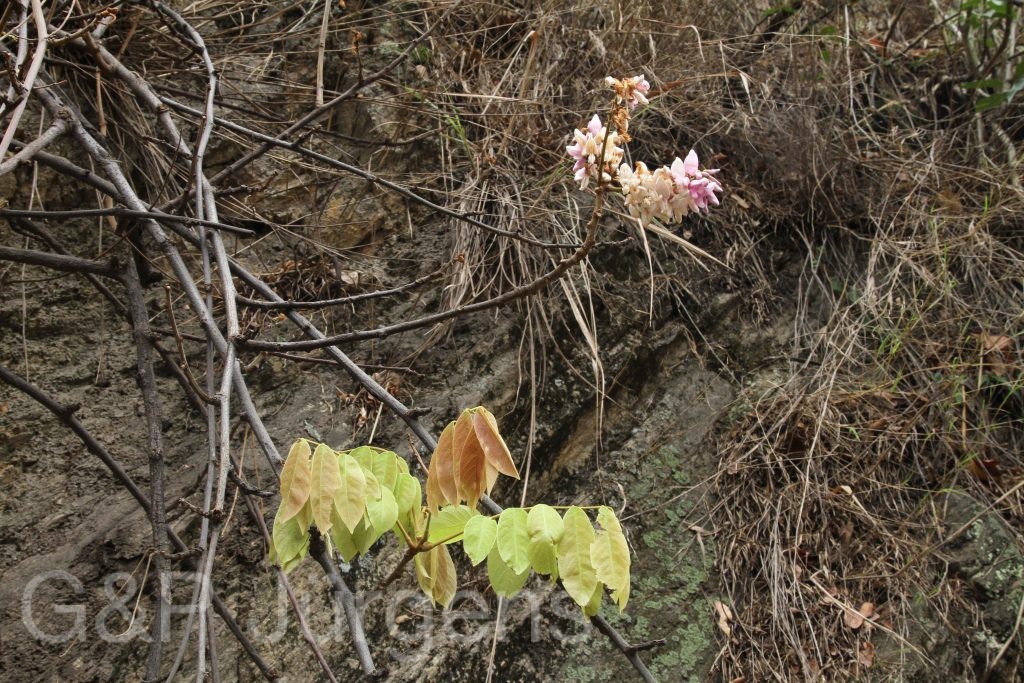
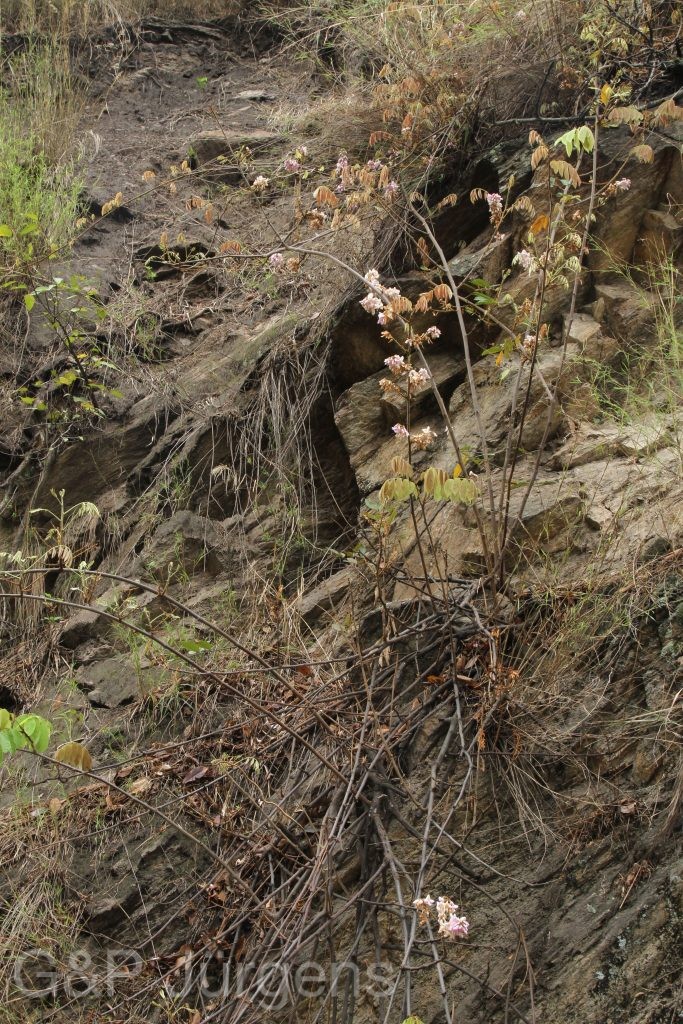
Cladrastis delavayi (here spelled Cadrastis delavayi) is a deciduous tree of the eastern Sino-Himalaya, distributed from Bhutan and northeast India through northern Myanmar into south-central and southwestern China. It occurs in mixed broad-leaved and evergreen forest on warm-temperate to subtropical mountain slopes, generally between roughly 1000 and 2500 m. The photographed individual was recorded at Trashigang in eastern Bhutan at about 1600 m, flowering in May. The associated GBIF record is a spurious genus-level match (returning the kingdom-rank name and a global occurrence figure), so distribution here follows regional floristic accounts rather than the misapplied dataset.

The species is a medium-sized tree with smooth bark and odd-pinnate (imparipinnate) leaves bearing several alternate, ovate-elliptic, entire leaflets that are softly pubescent beneath. The flowers are borne in terminal, branched panicles and have the papilionaceous structure typical of Faboideae: a broad standard, two lateral wings and a keel of two partly fused petals, the colour white to creamy and often fragrant. The androecium comprises ten free or basally connate stamens, and the fruit is a flattened, several-seeded legume that is narrowly winged along the sutures and dehisces tardily.

Cladrastis is a small disjunct genus of the temperate Northern Hemisphere, with species in eastern Asia and a single North American representative (the yellowwood, C. kentukea), making it a classic example of the East Asian–North American floristic disjunction. C. delavayi, named for the French missionary-collector Père Delavay, is one of the Chinese species and yields a hard, attractively grained timber. It is locally distributed but not regarded as globally threatened.

Author: (Franch.) Prain · Sources: POWO (Kew), GBIF, Flora of Bhutan, Flora of China (Fabaceae), Duley & Vincent revision of Cladrastis (Leguminosae)
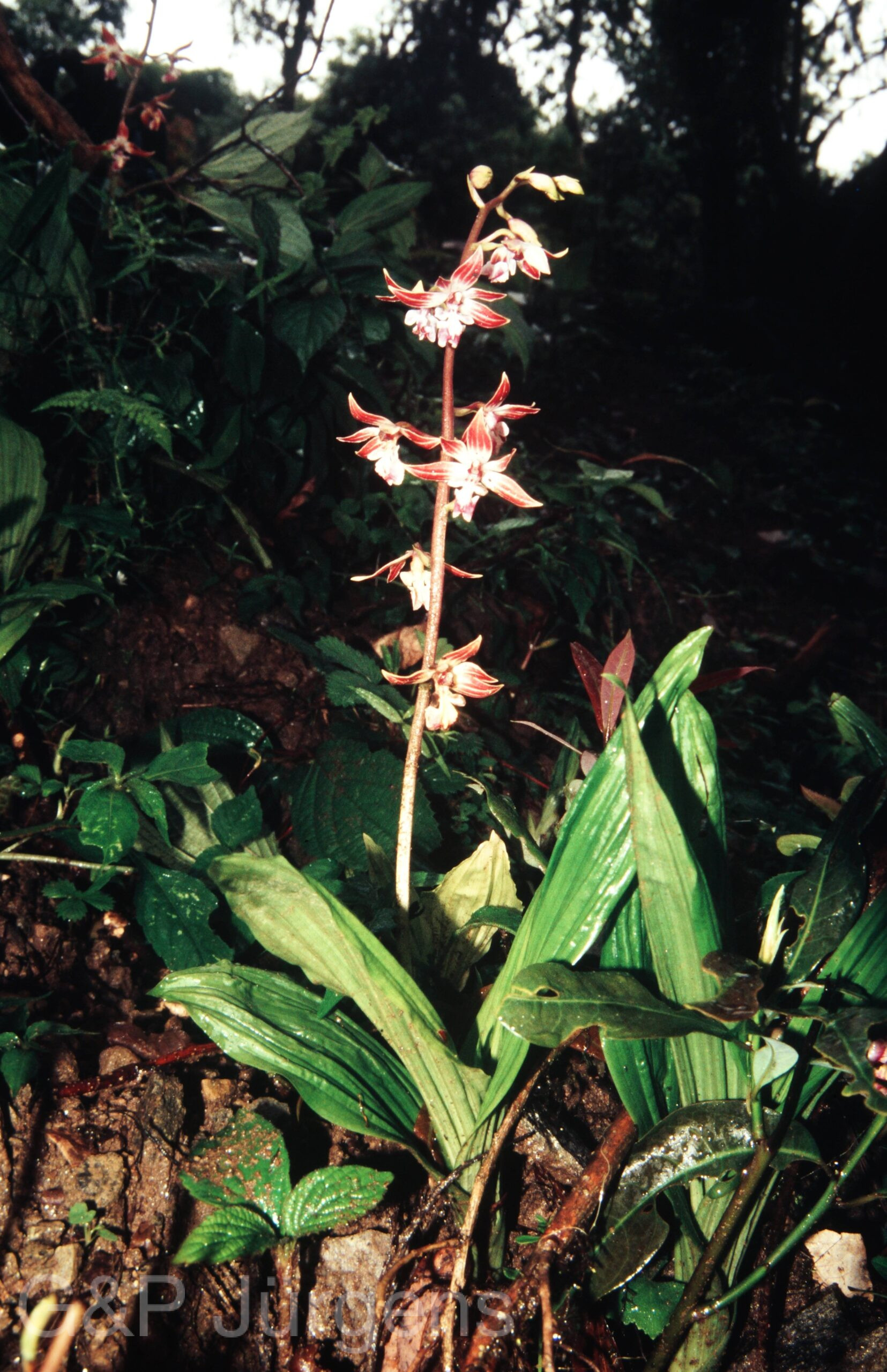
Lindl.

Description

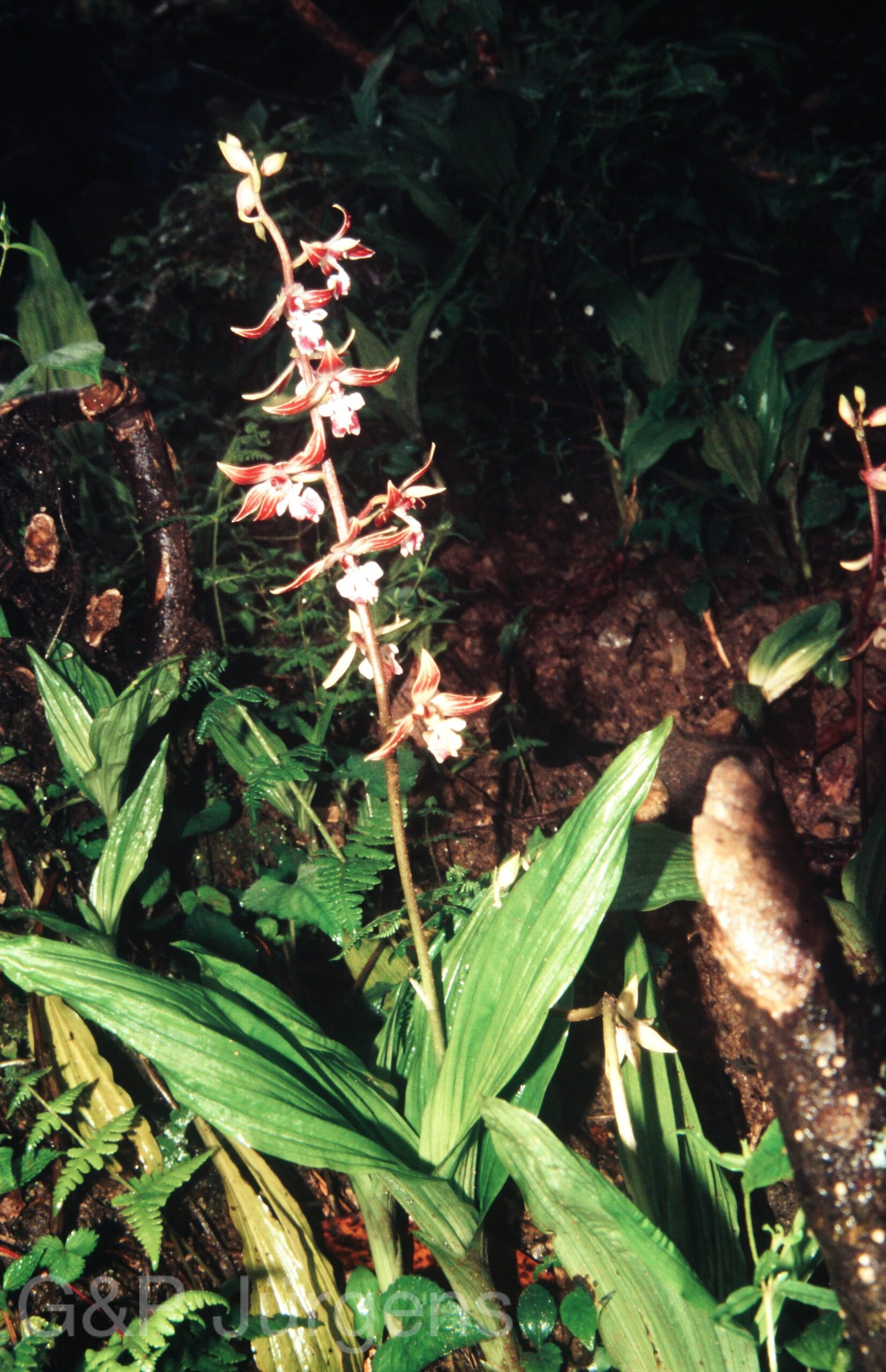
Calanthe brevicornu is a terrestrial orchid distributed across the Himalayas and East Asia, from Nepal and northeast India through Bhutan and Myanmar to China and Japan. GBIF records over 320 occurrences, with the majority from China. The species inhabits montane and subalpine forests, growing in deep leaf litter and humus-rich soil in the understory of Rhododendron, Quercus, and mixed broadleaved-coniferous forests at 1,300–3,600 m elevation.

This is an evergreen Calanthe of compact habit. The pseudobulbs are reduced, largely concealed by leaf sheaths. Leaves are 2–4, elliptic-lanceolate, 15–30 cm long, plicate, persisting through the winter. The inflorescence is an erect raceme 15–35 cm tall, bearing 5–15 flowers that open sequentially. The specific epithet 'brevicornu' (short horn) refers to the characteristically short, stout spur, only 3–6 mm long — distinguishing it from many congeners with elongate spurs. Flowers are 2–3 cm across, white to pale pink, the lip trilobed with a yellowish callus. Flowering occurs from April to June.

The record from Helambu at 3,550 m represents the upper elevational limit for this species. At such altitudes, flowering coincides with the pre-monsoon spring, when Calanthe brevicornu blooms alongside Rhododendron species in the subalpine zone of central Nepal.

Author: Lindl. · Sources: POWO (Kew), Flora of Nepal Checklist, GBIF, Flora of China Vol. 25, Pearce & Cribb: The Orchids of Bhutan (2002)

Hook.f.

Bhutan2014 804
Bhutan Mo-Chu 1600m, May
Bh2008 463 G724
Bhutan, Samtengang 1950m, May

Description

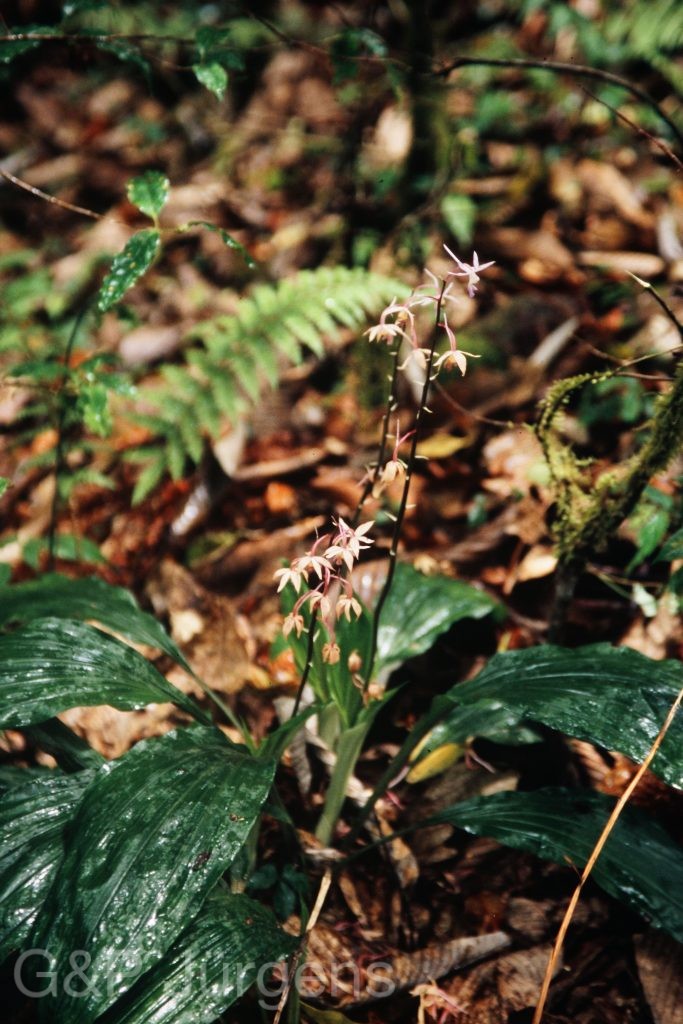
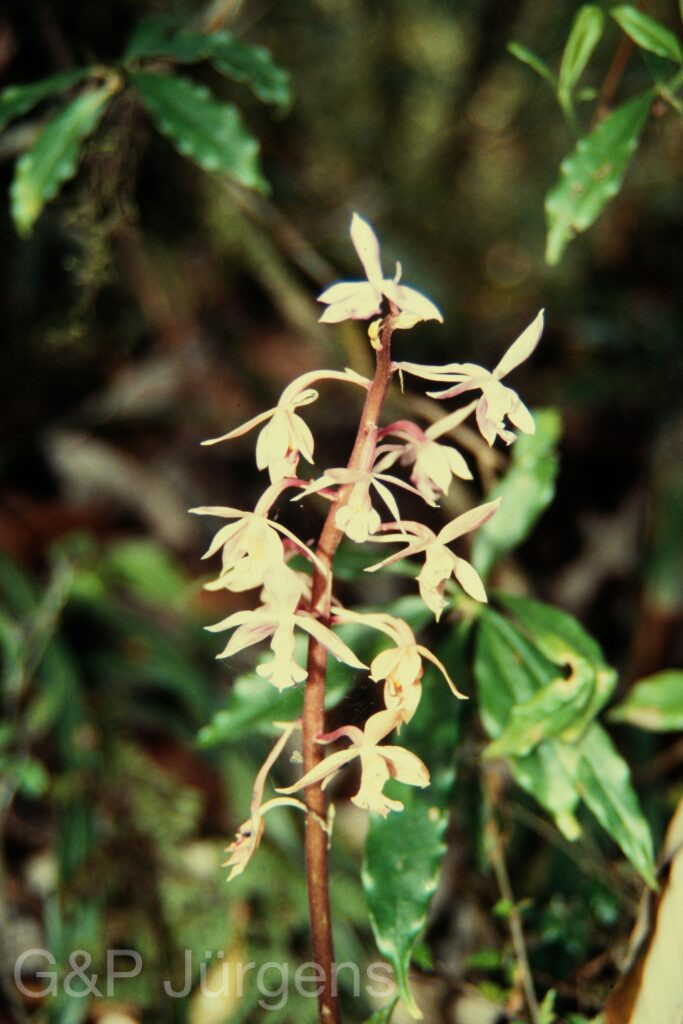
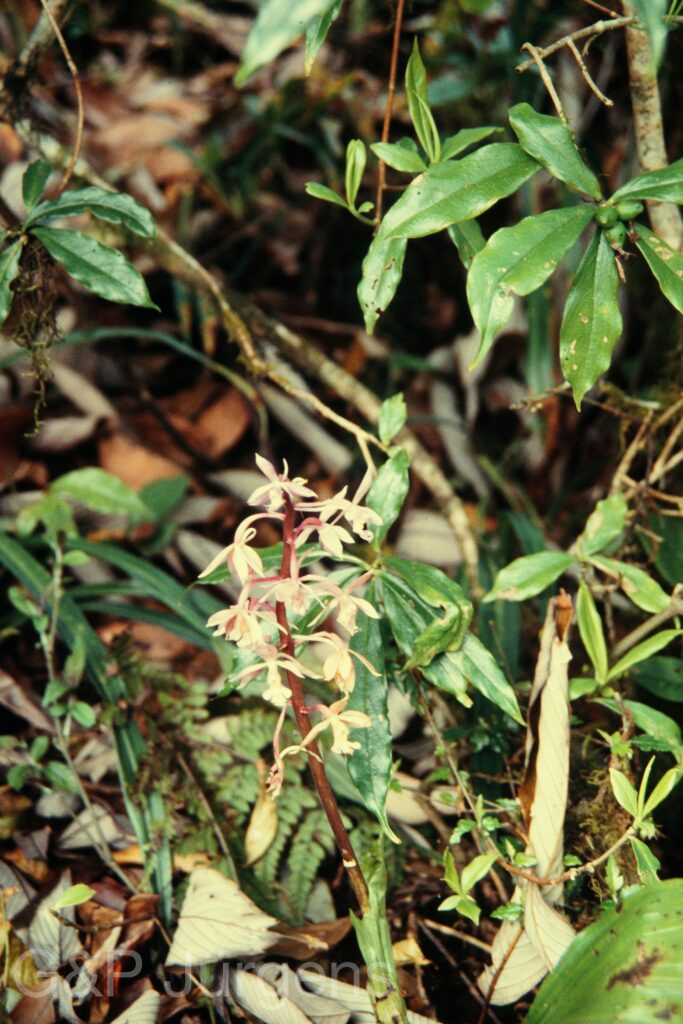
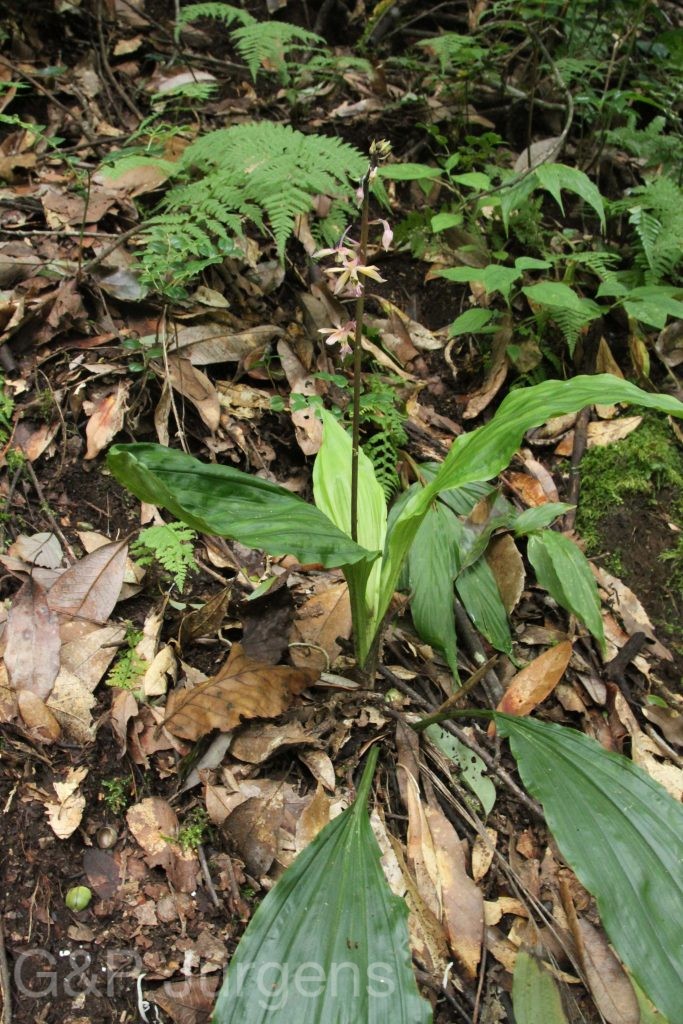
Calanthe mannii is a terrestrial orchid distributed across the eastern Himalayas and East Asia, from Nepal and northeast India through Bhutan, Myanmar, southern China (Yunnan, Guizhou, Guangxi), to Japan (Ryukyu Islands). GBIF records nearly 100 occurrences across this range. The species grows in warm to temperate broadleaved forests, often along streams and in ravines with rich humus soil, at elevations of 1,000–2,500 m.

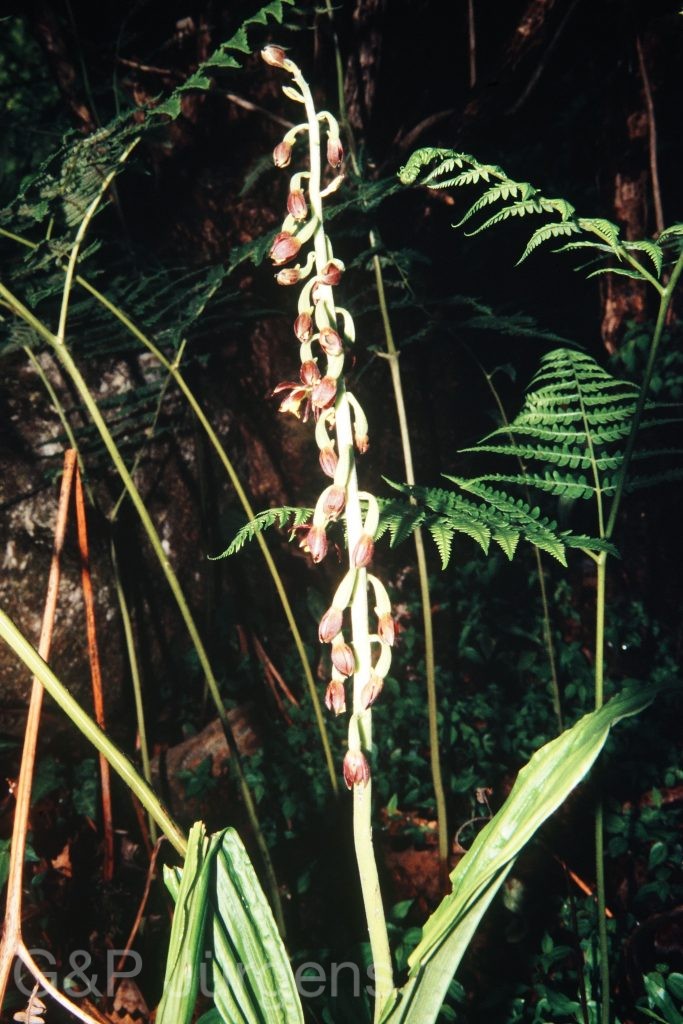
The plant is an evergreen Calanthe producing narrow, conical pseudobulbs partially enclosed by leaf sheaths. Leaves are 3–5, elliptic-lanceolate, 20–40 cm long, plicate, with prominent veins. The inflorescence is an erect, densely many-flowered raceme 30–50 cm tall, bearing 15–30 flowers. Flowers are 2–2.5 cm across, with a distinctive colour combination: the sepals and petals are yellowish-brown to olive-green, while the lip is pale, trilobed, with the mid-lobe deeply bilobed and a prominent yellow callus. The spur is curved, 8–12 mm long. Flowering occurs from April to June.

Calanthe mannii is named after Gustav Mann (1836–1916), the German-born botanical collector who worked in northeast India. The species is distinguished from the similar C. puberula by its more densely flowered raceme and different lip morphology. Its presence in both subtropical (Mo-Chu valley, 1,600 m) and temperate zones in Bhutan indicates broad ecological tolerance.

Author: Hook.f. · Sources: POWO (Kew), Flora of Bhutan Vol. 3, GBIF, Flora of China Vol. 25, Pearce & Cribb: The Orchids of Bhutan (2002)

Lindl.

Bh2008 531 P809 1
Bhutan Chongsakha, 1900m April

Description

Calanthe plantaginea is one of the most widespread and conspicuous terrestrial orchids of the Himalayan montane forest zone. Its range extends from Pakistan through the entire Himalayan arc (Nepal, India, Bhutan) into Myanmar and southern China. GBIF documents over 110 occurrences. The species grows in the understory of broadleaved and mixed forests, in moist leaf litter and humus, at elevations of 1,000–3,000 m.

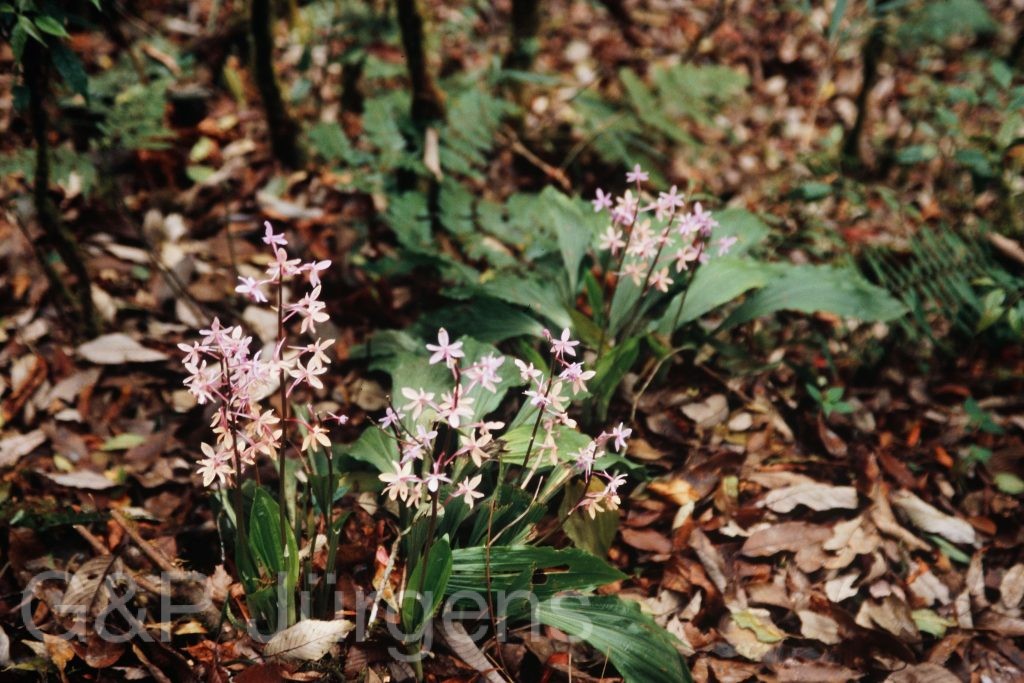
The plant produces reduced pseudobulbs hidden by persistent leaf sheaths. Leaves are 3–5, large, broadly elliptic, 15–40 cm long, prominently plicate, resembling plantain leaves — hence the epithet 'plantaginea'. The inflorescence is a stout, erect raceme 20–40 cm tall, bearing 10–20 showy flowers. Flowers are 3–4 cm across, the largest among Himalayan Calanthe, and range from pale pink to deep rose-pink, occasionally white. The lip is trilobed, the mid-lobe deeply bifid, with a prominent callus of 3–5 raised, yellow lamellae. The spur is slender, 1.5–2 cm long. Flowering occurs from March to May, typically before full canopy closure.

Calanthe plantaginea is arguably the most recognisable spring-flowering orchid in the Himalayan mid-altitude forests. Its large, brightly coloured flowers and broad leaves make it conspicuous even to non-specialists. It is often the first orchid to flower in the understory after winter.

Author: Lindl. · Sources: POWO (Kew), Flora of Bhutan Vol. 3, Flora of Nepal Checklist, GBIF, Pearce & Cribb: The Orchids of Bhutan (2002)

Lindl.

Bhutan2012 448
Bhutan Wangdi 2500m, September

Description

Calanthe sylvatica is a terrestrial orchid with one of the widest distributions in the genus, spanning from tropical and subtropical Africa (East Africa, Madagascar, Réunion, Comoros) to South and Southeast Asia (India, Bhutan, Nepal, Myanmar, China, Thailand, Vietnam). This pantropical range is reflected in GBIF's over 2,700 documented occurrences. In the Himalayas, it grows in the understory of humid broadleaved forests at 500–2,800 m elevation.

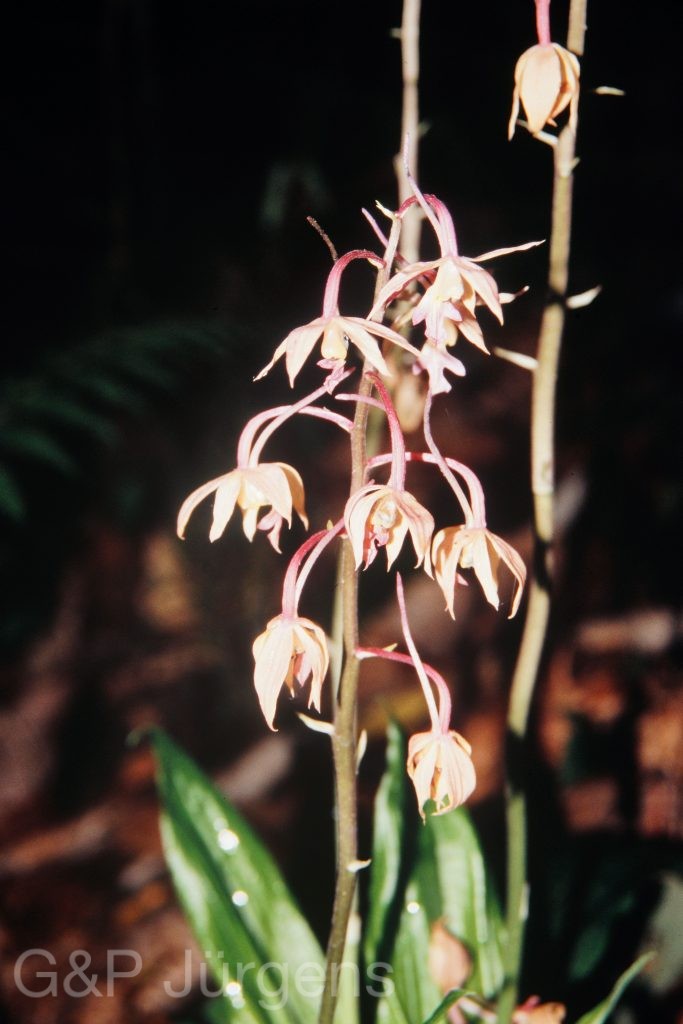
The plant is an evergreen species with inconspicuous pseudobulbs concealed by leaf sheaths. Leaves are 3–5, elliptic-lanceolate, 20–40 cm long, plicate, dark green. The inflorescence is an erect raceme 30–60 cm tall, bearing 10–30 flowers. Flowers are 2.5–3.5 cm across, typically deep violet to lilac-purple, though colour varies across the vast range from white to pink to deep purple. The lip is trilobed with a violet mid-lobe and a yellow callus with raised lamellae. The spur is slender, 1.5–2.5 cm long. In the Himalayas, flowering occurs from August to October.

The remarkable biogeographical range of Calanthe sylvatica — bridging Africa and Asia — has made it a subject of interest in orchid phylogeography. The Himalayan populations belong to the Asian lineage, and some taxonomists treat them as a distinct variety or subspecies. The species is adaptable and locally common in suitable habitats.

Author: Lindl. · Sources: POWO (Kew), Flora of Bhutan Vol. 3, GBIF, Cribb & Hermans: Field Guide to the Orchids of Madagascar (2009)

Lindl.

Bh09 214 G369
Bhutan Dochu-La, 3000m June
Bh09 215 G361
Bhutan Dochu-La, 3000m June
Nepal 99 190 ergebnis
West-Nepal Lara-Lake 3000m, June
Garh 07 91 ergebnis
India Garhwal Trijugi Narayan 2500m, June

Description

Calanthe tricarinata is a distinctive terrestrial orchid widely distributed from the western Himalayas (Pakistan, northwest India) through Nepal, Bhutan, and Myanmar to China, Taiwan, and Japan. With over 1,000 documented GBIF occurrences, it is one of the better-known Himalayan Calanthe species. It inhabits cool, moist montane forests and subalpine Rhododendron scrub at 1,500–3,500 m elevation.

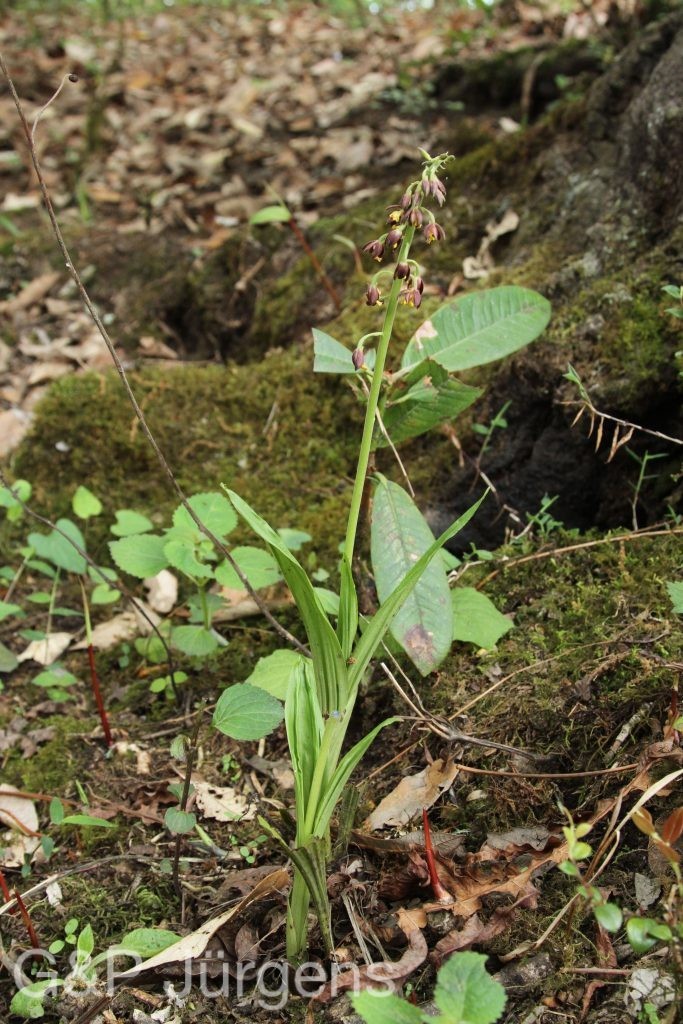
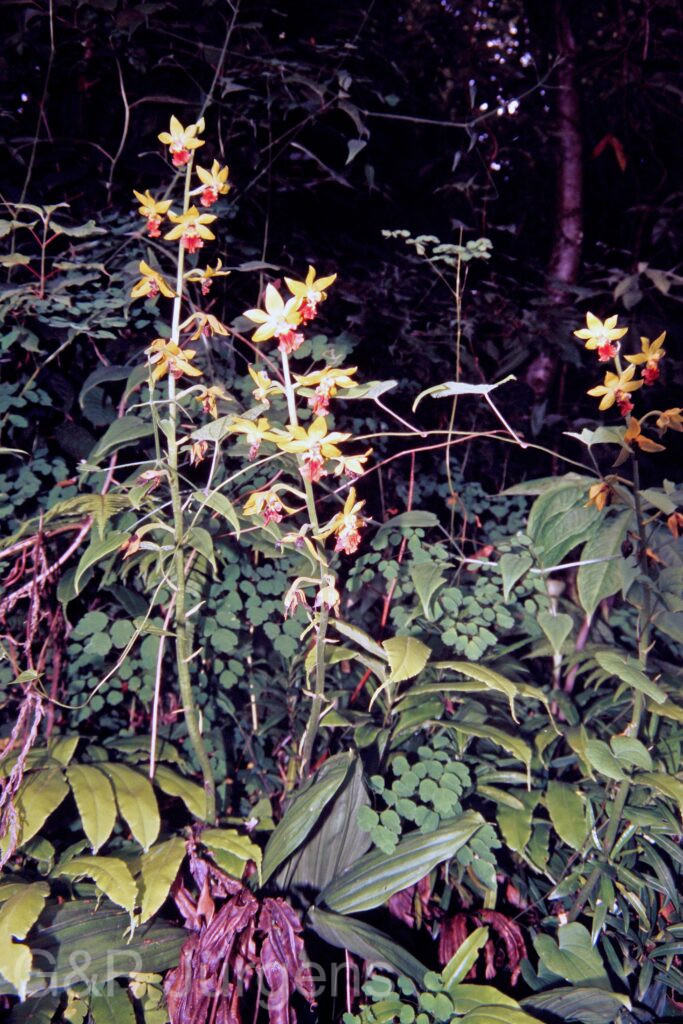
The plant is an evergreen species with short, stout pseudobulbs. Leaves are 3–5, broadly elliptic, 20–35 cm long, plicate, and persist through winter. The inflorescence is an erect raceme 25–40 cm tall, bearing 8–15 flowers. The flowers are unmistakable: 3–4 cm across, with olive-green to yellowish-green sepals and petals, contrasting strikingly with the large, pendent, reddish-brown to maroon lip. The lip is deeply trilobed, the mid-lobe bifid, with three prominent parallel keels (carinae) on the disc — the diagnostic feature reflected in the name 'tricarinata'. The spur is short, 5–8 mm. Flowering occurs from May to July.

Calanthe tricarinata is readily identified by its unique green-and-brown colour combination, unlike any other Himalayan orchid. The species was photographed at the Dochu-La pass (3,000 m) in Bhutan, also recorded from the Lara Lake area of western Nepal and Garhwal (India) — documenting its broad Himalayan distribution.

Author: Lindl. · Sources: POWO (Kew), Flora of Bhutan Vol. 3, Flora of Nepal Checklist, GBIF, Pearce & Cribb: The Orchids of Bhutan (2002)

Roxb.

Nepal 97 566 P1099
Nepal Sabha-Khola 550m May
Nepal 97 567 P1100
Nepal Sabha-Khola 550m May

Description

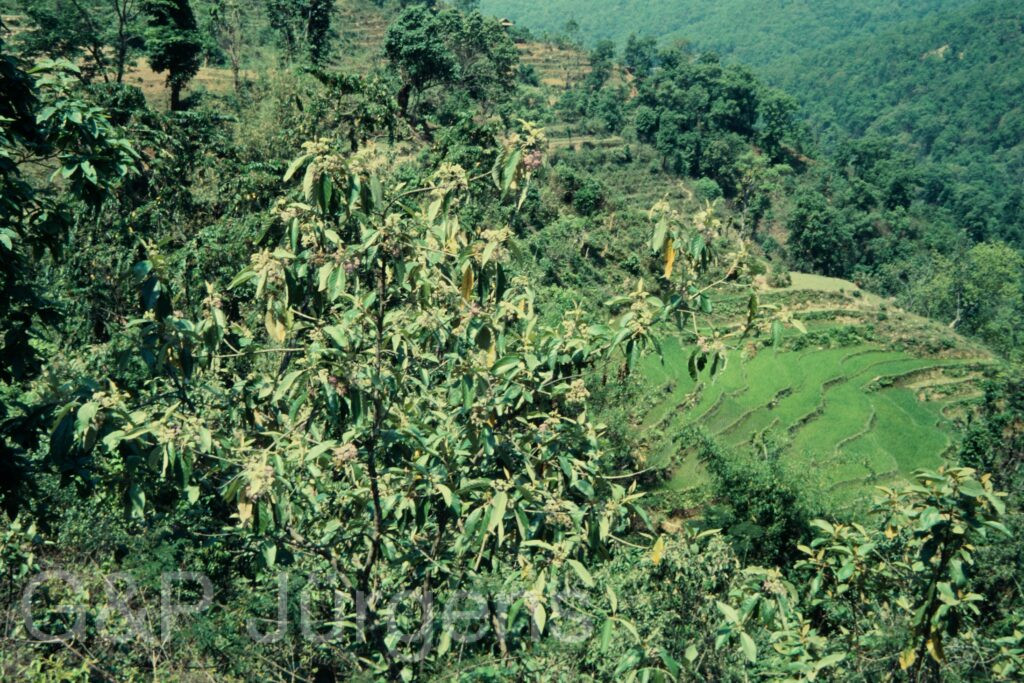
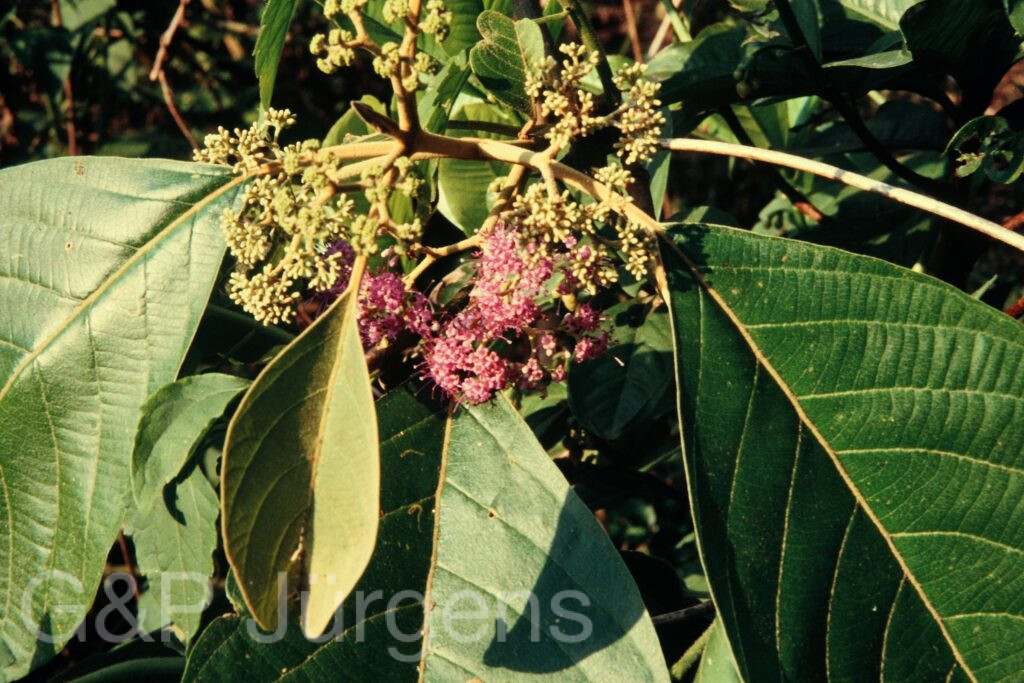
Callicarpa arborea is a tree of the Indo-Malesian tropics, distributed from the Himalayan foothills of Nepal, India, Bhutan and Bangladesh through Myanmar, Thailand, Indochina and southern China to the Malay Peninsula, the Indonesian archipelago, the Philippines and New Guinea; GBIF records nearly 1,200 occurrences. It is a characteristic component of secondary and disturbed lowland and lower-montane forest, forest margins and regrowth on cleared land, generally from near sea level to about 1,500 m. The plant photographed along the Sabha Khola in eastern Nepal at 550 m in May illustrates its occurrence in warm, humid subtropical foothill forest at the western limit of its range.

It is a small to medium-sized evergreen tree reaching 5-15 m, with young branchlets, petioles and inflorescences densely covered in a stellate, rusty- to grey-tomentose indumentum. The leaves are large, opposite, elliptic to oblong-lanceolate, 12-25 cm long, acuminate and entire, dark green and glabrescent above but conspicuously whitish- or brownish-tomentose beneath. The flowers are small and numerous, borne in dense, branched axillary cymes; the corolla is pinkish to purple, tubular with four short spreading lobes, and the four stamens are exserted. The fruit is a small globose drupe, ripening purplish to black and crowned by the persistent calyx, containing four pyrenes.

Callicarpa (now placed in Lamiaceae following the dismemberment of the traditional Verbenaceae) comprises some 140 species of pantropical and warm-temperate shrubs and trees, of which C. arborea is one of the largest and most arborescent. Its abundant insect-pollinated flowers and bird-dispersed drupes make it an effective coloniser of disturbed ground, and it is frequently encountered in successional forest. The tomentose foliage and bark have a long history of local medicinal and minor timber use across South and Southeast Asia. Widespread, common and ecologically adaptable, it is not regarded as threatened.

Author: Roxb. · Sources: POWO (Kew), GBIF, Flora of China, Flora of Bhutan, Annotated Checklist of the Flowering Plants of Nepal, revision of Callicarpa (Lamiaceae)

Lindl.

Bhutan2015 644
Bhutan Mo-Chu 1600m, October
Bhutan2015 642
Bhutan Mo-Chu 1600m, October

Description

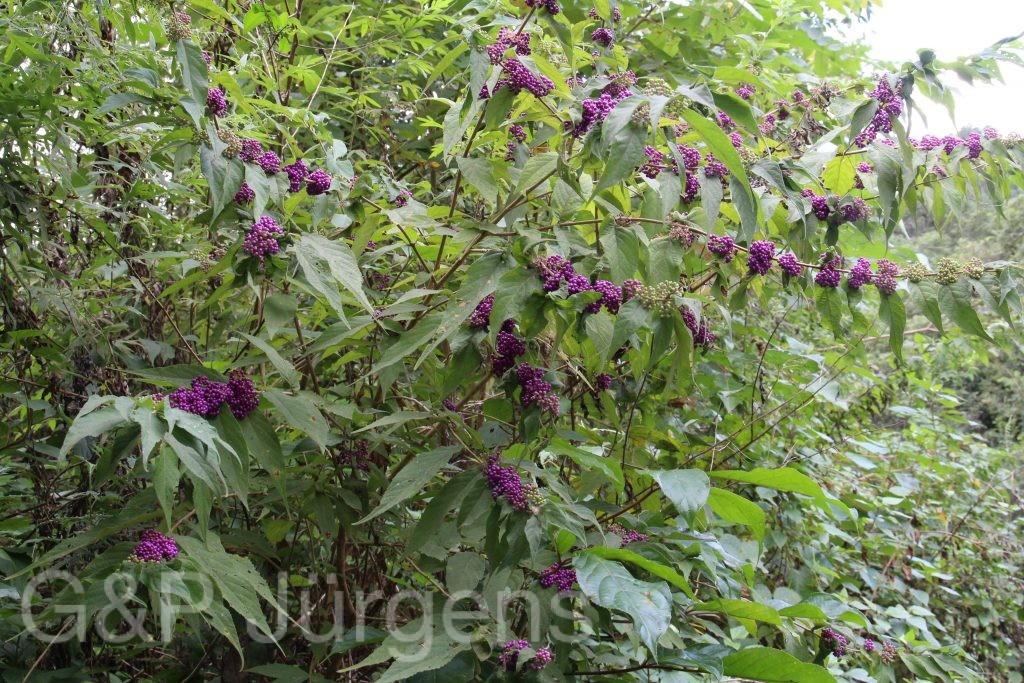
Callicarpa rubella is a widespread subtropical shrub ranging from the Himalaya and southern China across mainland and insular South-East Asia, with GBIF records from China, India, Bhutan, Myanmar, Thailand, Laos, Vietnam, Malaysia, Indonesia, Taiwan, Hong Kong, Bangladesh and Japan, alongside scattered introduced or cultivated occurrences elsewhere. Its 2863 georeferenced records reflect a common, much-collected species of warm-temperate to subtropical forest. The Bhutanese material from the Mo-Chu valley at 1600 m in October is typical, the species growing in forest margins, secondary scrub, clearings and along streams at roughly 200-2000 m, often as an early successional component of disturbed broadleaf woodland.

It is an erect shrub whose young branchlets, petioles and inflorescences are densely clothed in reddish-brown stellate, gland-dotted and sometimes glandular hairs. The opposite leaves are oblong to obovate-oblong, acuminate, serrate to serrulate, cordate or auriculate at the base, and stellate-pubescent beneath with conspicuous yellowish to reddish glands. The flowers are borne in dense axillary cymes; the small calyx is cupular and the rose-pink to reddish-purple corolla is shortly four-lobed, with four exserted stamens and a slender style. The fruit is a small globose drupe, purplish at maturity, containing four pyrenes.

The placement here under Lamiaceae follows current circumscription, in which Callicarpa and the former Verbenaceae beautyberries are referred to the mint family on molecular grounds. Within Callicarpa, C. rubella is distinguished by its reddish stellate-glandular indumentum and auriculate leaf bases. The colourful drupes are dispersed by birds, and the species is locally used in traditional medicine and occasionally grown as an ornamental. Given its vast range and tolerance of disturbance it is of least conservation concern.

Author: Lindl. · Sources: POWO (Kew), GBIF, Flora of China, Flora of Bhutan, Revision of Callicarpa (Verbenaceae/Lamiaceae) monograph

Hook.f. & Thomson

BhutanPG2011 448
Bhutan Ludlow-Sherriff-Trail Warrtlang-La, 4500m June
Sikkim2003 105 P143
Sikkim below Dzongri 3850m 08.2003
Nepal 2001 312 ergebnis ergebnis
Nepal (Gorkha) Kharka 3100m, May

Description

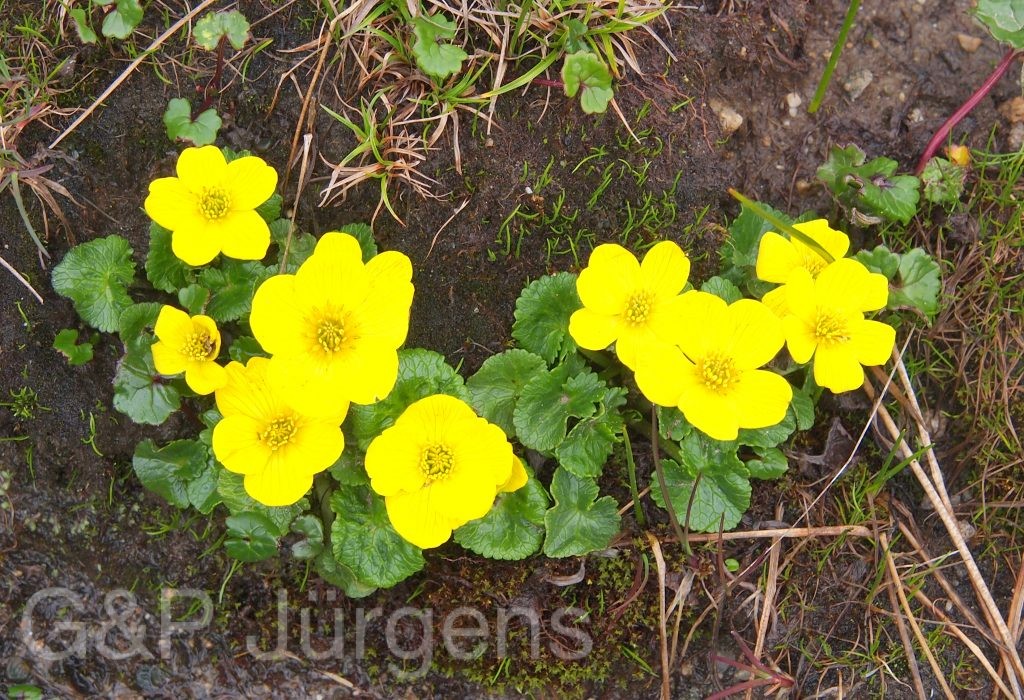
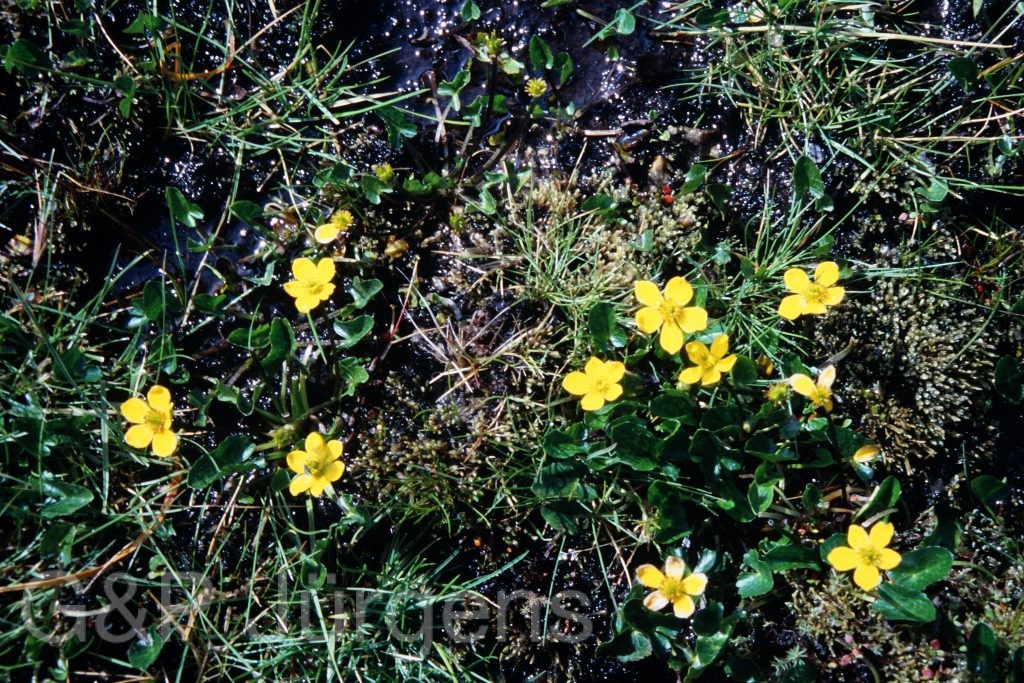
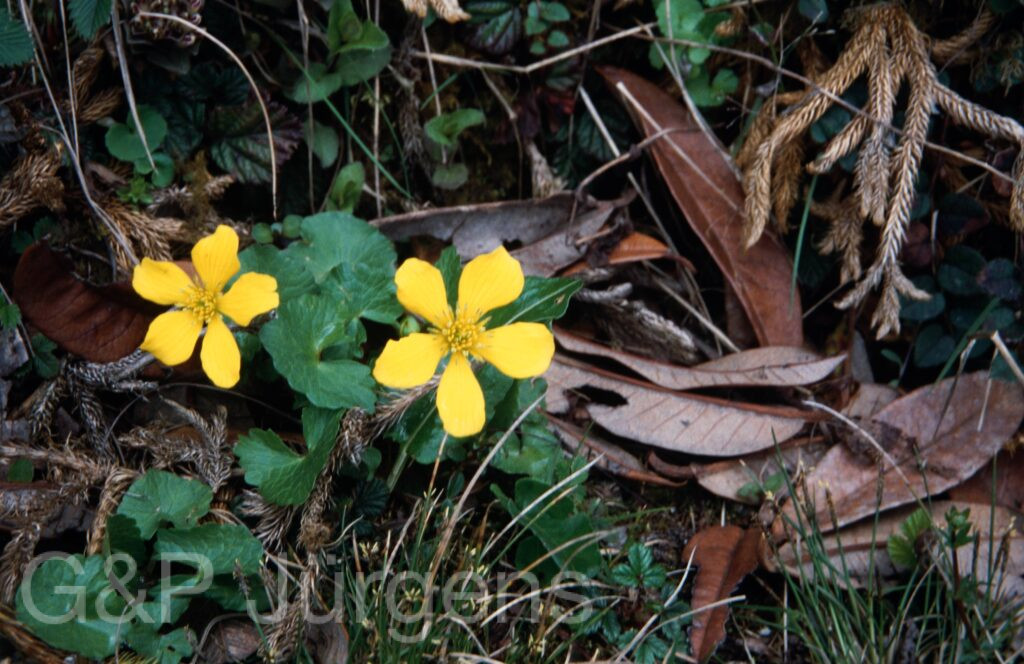
Caltha scaposa is a high-alpine marsh marigold of the Sino-Himalayan region, with records from China, India, Nepal, Bhutan and Myanmar and disjunct documentation in Korea and Mongolia; GBIF aggregates over 1,000 occurrences. It is a plant of wet alpine turf, snowmelt flushes, streamsides and moist gravelly meadows, typically between roughly 3,100 and 4,500 m. The collections illustrated span this gradient, from Warrtlang-La on the Ludlow-Sherriff trail in Bhutan at about 4,500 m in June, to the slopes below Dzongri in Sikkim near 3,850 m, and a comparatively low Gorkha station in Nepal at 3,100 m in May, where it flowers as the snow recedes.

It is a small, glabrous, somewhat fleshy perennial herb arising from a short, fibrous-rooted rhizome. The leaves are largely basal and long-petiolate, with cordate to reniform-orbicular blades bearing crenate margins and a deep cordate sinus. The flowering stem is scapose, as the epithet indicates, usually leafless and bearing a solitary terminal flower. The showy perianth consists of five to several petaloid, golden-yellow sepals, true petals being absent; the numerous stamens surround a cluster of free, sessile carpels. The fruit is an aggregate of spreading, beaked follicles dehiscing along the ventral suture.

Within Caltha, the scapose habit and solitary flower distinguish C. scaposa from the leafy-stemmed, multiflowered C. palustris group. As an obligate wetland species of the alpine zone, it indicates permanently moist soils and is pollinated chiefly by flies and early-season insects. Though locally common across a wide range and not presently considered threatened, its dependence on snowmelt hydrology makes populations sensitive to glacial retreat and altered precipitation in a warming Himalaya.

Author: Hook.f. & Thomson · Sources: POWO (Kew), GBIF, Flora of China, Flora of Bhutan, Annotated Checklist of the Flowering Plants of Nepal, Tamura's monograph of Ranunculaceae

Wall.

Bhutan2012 188
Bhutan Haar-Valley, 3300m September
Bhutan2012 313
Bhutan Haar-Valley, 3300m September
Sikkim2003 381 P537
Sikkim Tista valley 3300m August

Description

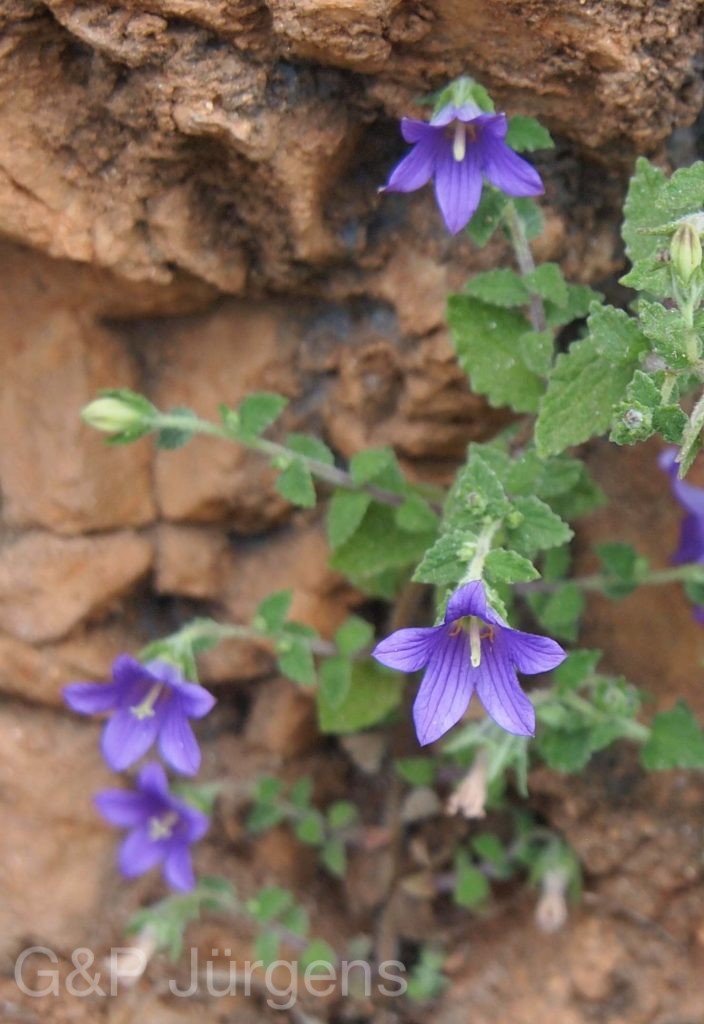
Campanula pallida is a widespread Asian bellflower with an extensive GBIF record (over 68,000 occurrences) centred on China, India, Nepal, Pakistan, Bhutan and Afghanistan, with numerous further reports across the broader range from Myanmar and Thailand to scattered cultivated and recorded localities elsewhere. It is a plant of open, well-drained ground, frequenting grassy slopes, rocky banks, terrace margins, roadside cuttings and forest clearings in the temperate and subalpine zones, broadly between about 1500 and 3500 m. The plants illustrated from the Haa valley in Bhutan at 3300 m in September and the Tista valley in Sikkim at 3300 m in August reflect its long summer-to-autumn flowering across the eastern Himalaya.

The species is a perennial herb with slender, ascending to decumbent stems bearing scattered hairs and clear latex. The leaves are alternate, ovate to oblong-lanceolate, with a crenate to serrate margin, the lower leaves petiolate and the upper sessile. The flowers are nodding, borne singly or in a loose few-flowered inflorescence; the corolla is broadly campanulate, five-lobed and pale blue to lilac or sometimes whitish, with reflexed appendages between the calyx lobes. The five stamens have dilated filament bases, and the inferior ovary matures into a nodding capsule that dehisces by basal pores to shed numerous small seeds.

Campanula is a large and taxonomically difficult genus, and C. pallida belongs to a complex of variable Himalayan bellflowers in which flower size and indumentum vary geographically. The pendulous, protandrous flowers are pollinated principally by bees, and the pore-dehiscent capsule disperses seed by wind shaking. The species is abundant, ecologically tolerant and frequently associated with semi-disturbed ground, and it is of no conservation concern.

Author: Wall. · Sources: POWO (Kew), GBIF, Flora of China, Flora of Bhutan, Flora of Pakistan, Revision of the Asiatic Campanula (Kolakovsky)