Tag:

Myanmar

Flowers of the Myanmar Himalaya — 604 species recorded from northern Myanmar (Burma) and the eastern Himalayan borderlands, a biodiversity hotspot linking the Himalaya to the mountains of Yunnan and Southeast Asia. The region’s forests and alpine slopes hold a rich flora of rhododendrons, orchids, balsams and gentians. Every page gives a botanical description, distribution, habitat and flowering time with the original photograph.

D.Don

Description

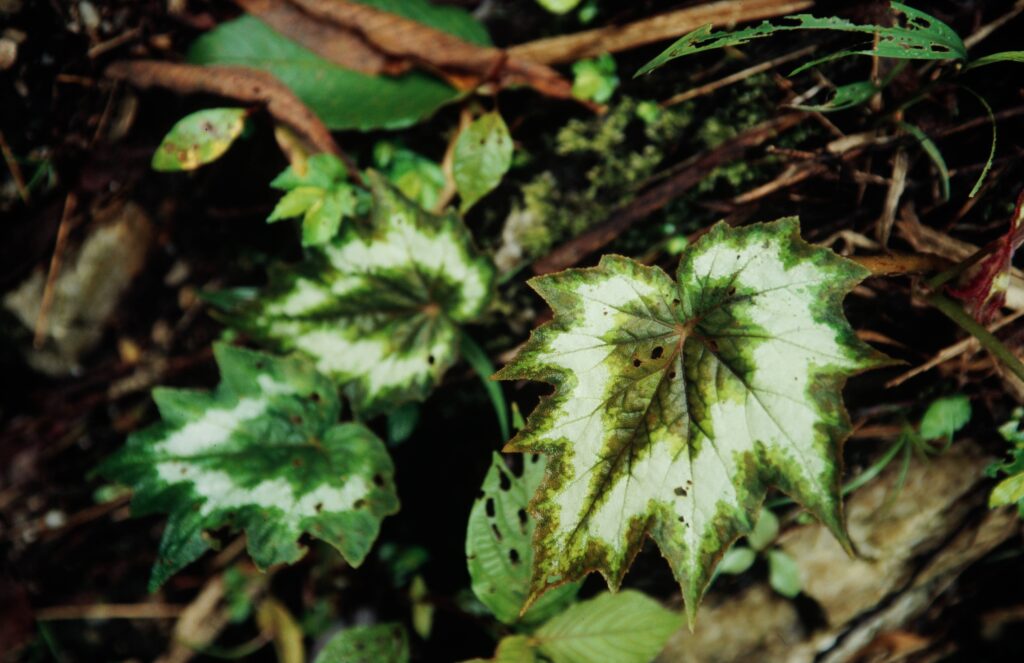
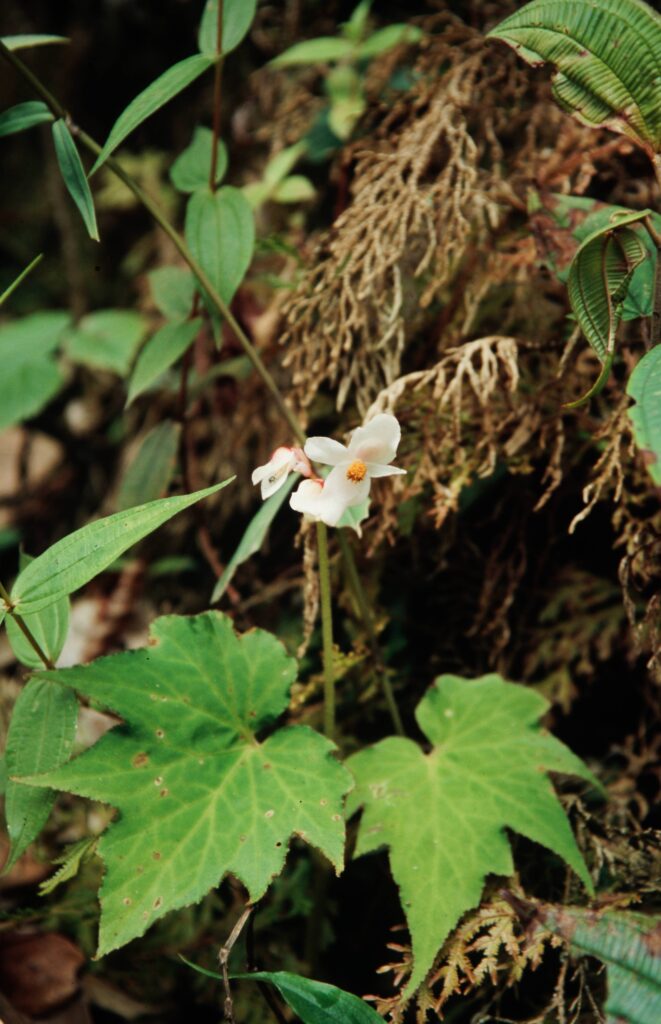
Begonia palmata D.Don is a widespread and highly variable perennial herb of the Sino-Himalaya and Southeast Asia, recorded by GBIF from across China and Taiwan, the eastern Himalaya (Nepal, India, Bhutan), Myanmar, Thailand, Laos, Vietnam, Bangladesh and Malesia. It is a characteristic plant of shaded, humid evergreen and broad-leaved forest, growing on moist rocks, mossy banks, ravine sides and beside streams from the foothills to roughly 2,500 m. The May collection from Chaana in Darjeeling district of West Bengal at 1,600 m exemplifies its monsoon-forest habitat, where it thrives in deep shade and high atmospheric humidity.

The plant is a succulent, rhizomatous to shortly caulescent herb with reddish, hispid stems. The asymmetric, palmately lobed leaves give the species its epithet: they are broadly ovate in outline, deeply incised into several acuminate, toothed lobes, often bristly-hairy and frequently marked with a paler or silvery zone above and reddish coloration beneath. As in all begonias the flowers are unisexual and monoecious, borne in axillary cymes; the pink to white male flowers bear two larger and two smaller tepals, while the female flowers have an inferior, three-winged ovary that develops into the characteristic unequally winged, dehiscent capsule containing very numerous minute seeds.

Begonia palmata is taxonomically a notoriously polymorphic species complex, with numerous varieties and segregate names reflecting wide variation in leaf division and indumentum across its range. Such variability has made it a focus of biogeographic and systematic study within the megadiverse genus Begonia. Many of its forms are cultivated as foliage ornamentals, and its broad distribution underlines the high endemism and diversification of begonias in the wet forests of tropical Asia.

Author: D.Don · Sources: POWO (Kew), GBIF, Flora of China Vol. 13, Flora of Bhutan Vol. 2, Tebbitt: Begonias — Cultivation, Identification, and Natural History
Hook.

Bhutan2015 132
Bhutan Galephug 600m, October
Bhutan2015 135
Bhutan Galephug 600m, October

Description

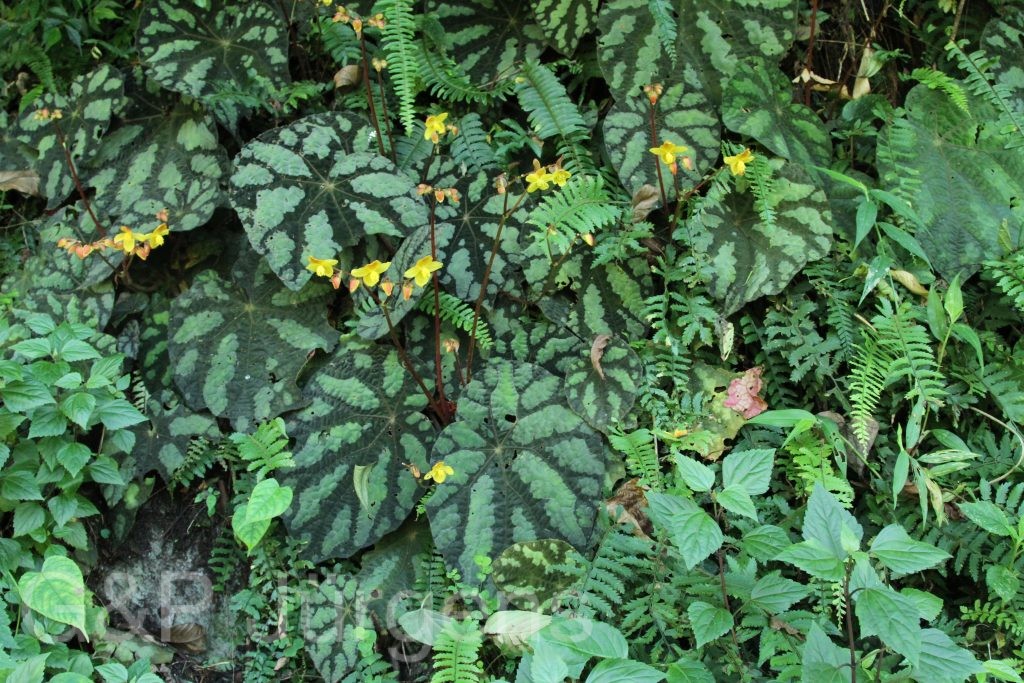
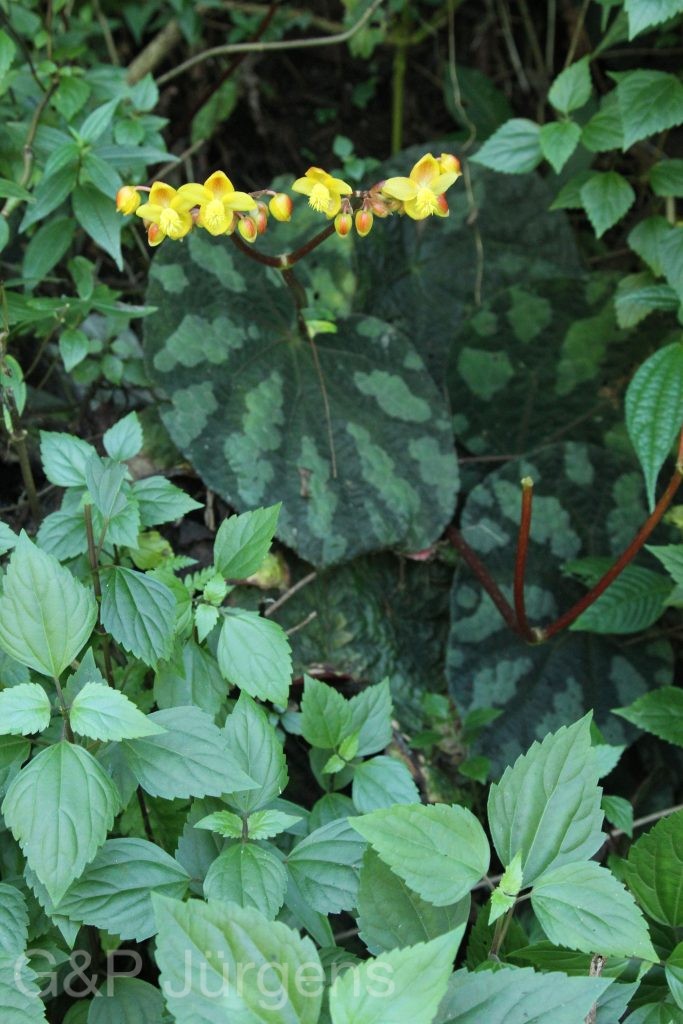
Begonia xanthina is a herbaceous perennial of the eastern Himalaya and adjacent Indo-Burma, recorded from northeastern India, Bhutan, Nepal, southern China and Myanmar, with cultivated occurrences in Belgium and the Netherlands; GBIF holds about 61 georeferenced records. It inhabits shaded, humid evergreen forest, growing on moist rocks, mossy banks, ravine sides and seepage slopes at low to mid elevations, favouring deep shade and the high humidity of monsoon forest. The photographed plant from Gelephu (Galephug) in southern Bhutan at 600 m in October is typical of these warm, wet subtropical foothill forests where it flowers in the post-monsoon season.

It is a rhizomatous, monoecious herb with a stout creeping rhizome and few large basal leaves. The leaves are broadly ovate, markedly asymmetric (oblique) at the base, cordate, often coloured deep green above with reddish or purplish tinting beneath and a long fleshy petiole. The inflorescence is an axillary cyme borne on an erect peduncle, carrying showy nodding flowers; the tepals are yellow, the staminate flowers with four tepals and numerous yellow stamens, the pistillate flowers with an inferior, three-winged ovary bearing unequal wings and twisted bifid stigmas. The fruit is a pendulous winged capsule dehiscing to release minute seeds.

Described by W.J. Hooker, Begonia xanthina is notable as one of the few yellow-flowered Asian begonias, placed in section Platycentrum, and has long been valued in horticulture for its handsome foliage and unusual flower colour. Its monoecious habit and reliance on small generalist insect pollinators are typical of the genus. Restricted to specialised forest microhabitats, it is sensitive to habitat loss, and conservation of intact foothill forest is important for its persistence.

Author: Hook. · Sources: POWO (Kew), GBIF, Flora of China Vol. 13, Flora of Bhutan Vol. 2, Flora of Nepal, Begonias of the Himalaya (Tebbitt)

(Wall.) Brongn.

Nepal 97 582 P1121
Nepal Sabha-Khola 560m May

Description

Berchemia floribunda is a widely distributed scrambling shrub or woody climber of East and South Asia, recorded from China, Japan, Korea, Hong Kong, Taiwan, India, Thailand, Nepal, Vietnam, Laos, Myanmar and Bhutan, with more than six thousand documented occurrences. It grows in forest margins, thickets, scrub and hedgerows from the lowlands into the lower montane zone, clambering over shrubs and small trees by means of its long flexuous branches. In Nepal it descends to warm subtropical foothills, as shown by the collection along the Sabha Khola at about 560 m in May, coinciding with its flowering season.

The plant is a deciduous liana with slender, glabrous, often zigzag branchlets. The leaves are alternate, ovate to elliptic, entire, acute to shortly acuminate at the apex and rounded at the base, with numerous fine, parallel, arching lateral veins that give the lamina a neatly pinnate-veined appearance. The inflorescence is a large, lax terminal panicle of many small flowers, the epithet floribunda referring to their abundance; each flower has five greenish to yellowish triangular petals, a five-lobed calyx and five stamens. The fruit is a small, narrowly ellipsoid drupe, green ripening through red to blue-black, seated on the persistent disk.

Berchemia belongs to the tribe Rhamneae within Rhamnaceae and comprises twining or scandent shrubs of Asia and the Americas distinguished by their many-veined leaves and small drupaceous fruits. The fleshy fruits are dispersed by frugivorous birds, while the climbing habit allows the plant to reach light at forest edges. Berchemia floribunda is locally common and economically minor, its tough stems used in basketry and its roots and fruits in folk medicine. Broadly distributed and tolerant of disturbed habitats, it is of no conservation concern.

Author: (Wall.) Brongn. · Sources: POWO (Kew), GBIF, Flora of China Vol. 12, Flora of Bhutan Vol. 2, Flora of Nepal, Flora of Pakistan, Medan & Schirarend treatment of Rhamnaceae

(Hook.f. & Thomson) Engl.

Sikkim2011 288
Sikkim Yumthang 3600m, June
BhutanPG2011 606 scaled
Bhutan Ludlow-Sherriff-Trail Warrtlang-La, 4500m June
Sikkim 2006 394 ergebnis
India West-Bengal, Kishong 3700m, May

Description

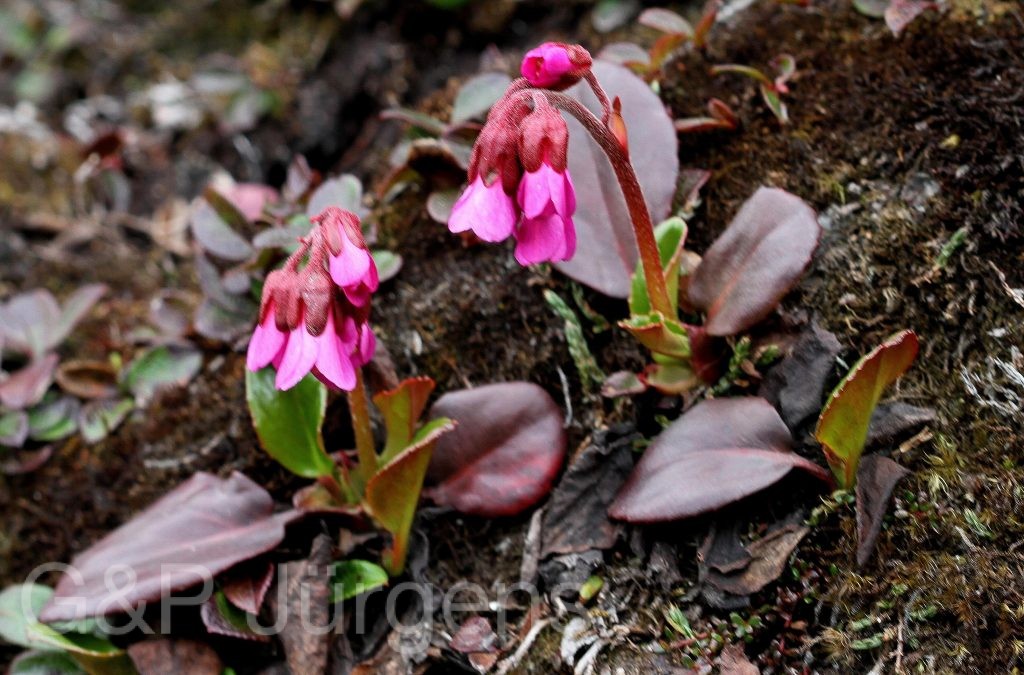
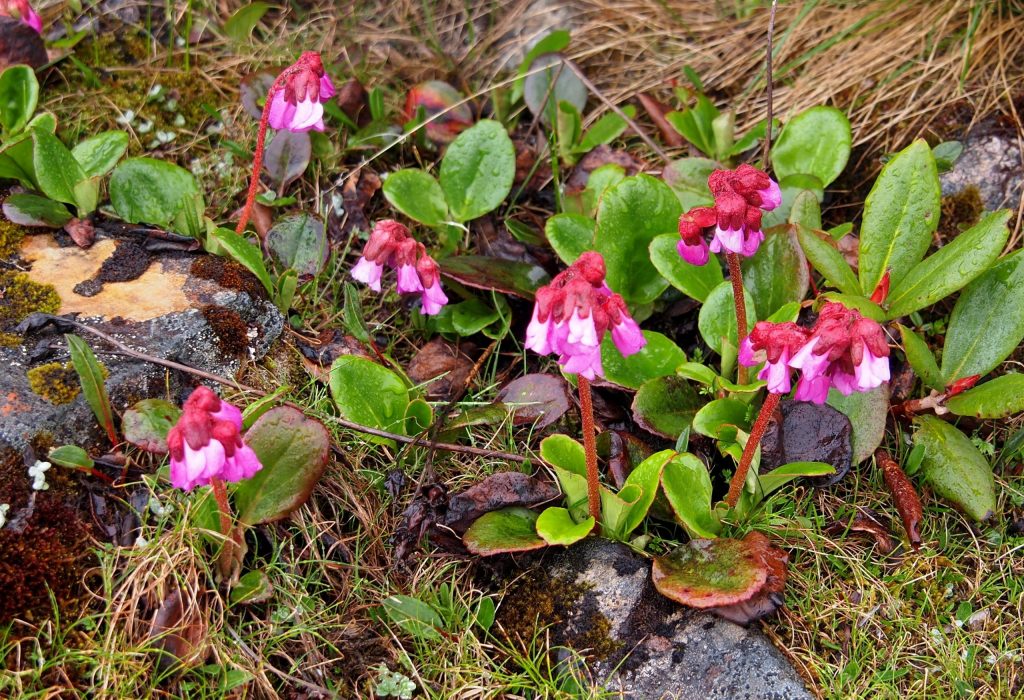
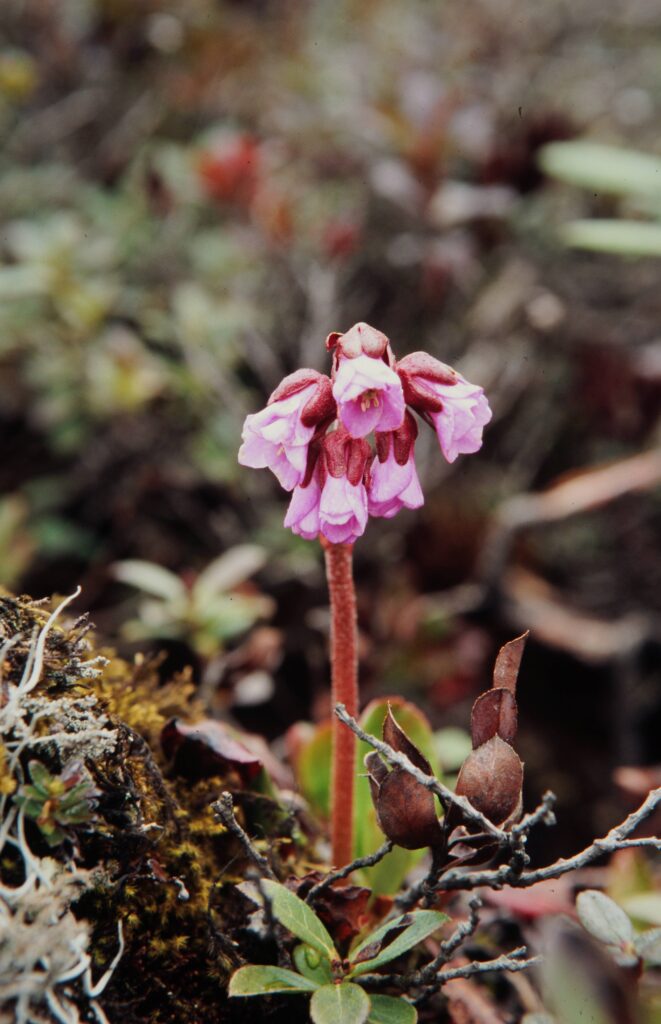
Bergenia purpurascens is a robust perennial of the high Himalaya and adjacent mountains, native to China, Nepal, India, Bhutan and Myanmar, and represented in cultivation across Europe and North America, where naturalised or garden-derived records inflate its GBIF tally to nearly a thousand occurrences. In the wild it is a plant of the alpine and upper subalpine belt, growing on rocky slopes, cliff ledges, moist meadows and the margins of rhododendron scrub. Field records illustrate this altitudinal range well: Sikkim at Yumthang around 3600 m in June, the Ludlow-Sherriff-Trail near Warrtlang-La in Bhutan at some 4500 m in June, and Kishong in West Bengal at about 3700 m in May.

The plant arises from a stout, woody, creeping rhizome bearing a basal rosette of large, leathery, obovate to elliptic leaves; these are glabrous, with entire to obscurely toothed margins and prominent reticulate venation, frequently flushing deep red or purple in autumn and cold exposure. The flowering scape is erect, reddish and glandular, terminating in a dense, nodding cyme. The flowers are showy, with five purple-red to magenta petals, a campanulate calyx of fleshy, often purplish sepals, ten stamens, and a bicarpellate ovary. The fruit is a capsule splitting to release numerous small seeds.

Described by Engler on the basis of Hooker and Thomson's material, B. purpurascens is the principal high-elevation representative of the genus in the eastern Himalaya. Its rhizomes are used in local traditional medicine, and the species is a parent of numerous ornamental Bergenia hybrids. It remains common within its broad range and is not considered threatened.

Author: (Hook.f. & Thomson) Engl. · Sources: POWO (Kew), GBIF, Flora of China, Flora of Bhutan, Pan's monograph of Bergenia

Buch.-Ham.

Bhutan2014 432
Bhutan Yatong-La 2800m, May

Description

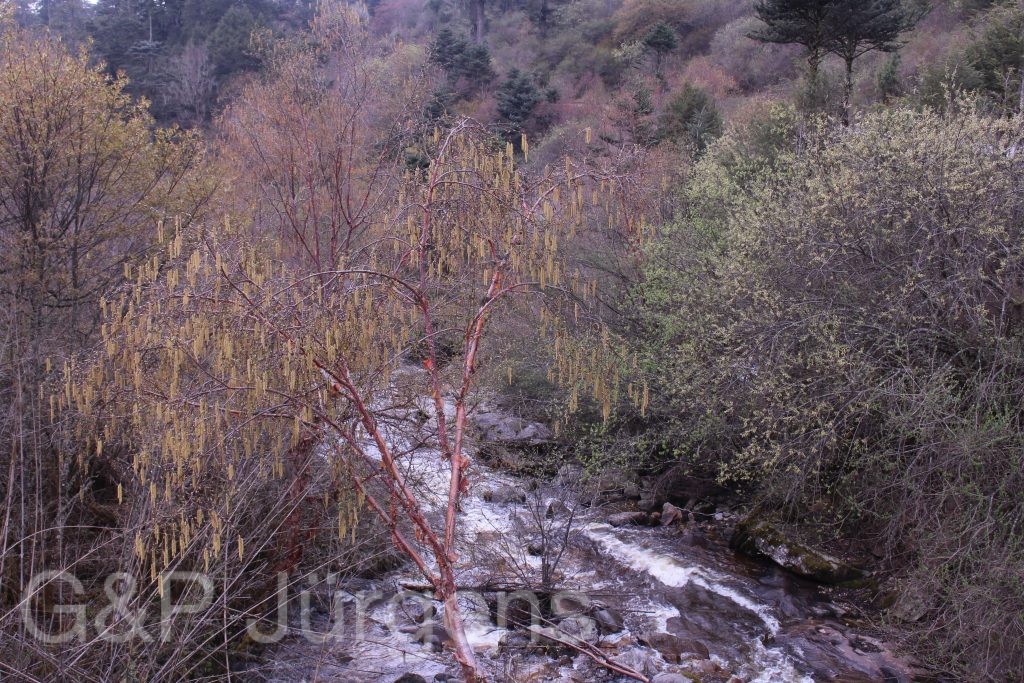
Betula alnoides Buch.-Ham. ex D.Don is a tall, fast-growing birch of the warm-temperate and subtropical mountains of southern and eastern Asia. Its distribution covers Nepal, northeast India, Bhutan, southern China, Myanmar, Thailand, Laos and Vietnam, with cultivated and trial occurrences recorded elsewhere. It is a light-demanding, often pioneering tree of moist broad-leaved and mixed montane forests, ravines and disturbed slopes, typically between about 1,000 and 2,800 m. The tree photographed at Yatong-La in Bhutan at 2,800 m in May sits near the upper edge of this band, within the humid mid-montane forest belt where the species frequently colonises gaps and forest margins.

The tree is deciduous and may reach 20–30 m, with smooth, brownish to reddish bark that exfoliates in thin papery sheets and bears conspicuous horizontal lenticels. The leaves are alternate, ovate-lanceolate with a long acuminate apex, doubly serrate margins and several pairs of straight lateral veins. As in all birches the plant is monoecious: the pendulous male catkins elongate at anthesis, while the smaller female catkins develop into slender, drooping, cylindrical infructescences that disintegrate to release small two-winged samaras adapted for wind dispersal.

Betula alnoides is the most important commercial birch of subtropical Asia, valued for its high-quality, reddish, fine-grained timber and increasingly grown in plantations and agroforestry across southern China and adjacent countries. Its rapid early growth and ability to fix sites make it useful in reforestation of degraded montane land. The species belongs to a group of subtropical birches distinct from the better-known temperate white birches, and although widely exploited it remains common and is not regarded as threatened.

Author: Buch.-Ham. · Sources: POWO (Kew), GBIF, Flora of China Vol. 4, Flora of Bhutan Vol. 1, Ashburner & McAllister: The Genus Betula (2013)

Bistorta emodi

by GP Jürgens

(Meisn.) H.Hara

Bhutan2015 385
BH15
BhutanPG2011 569 01 scaled
Bhutan Ludlow-Sherriff-TrailMiluthang, 4350m July

Description

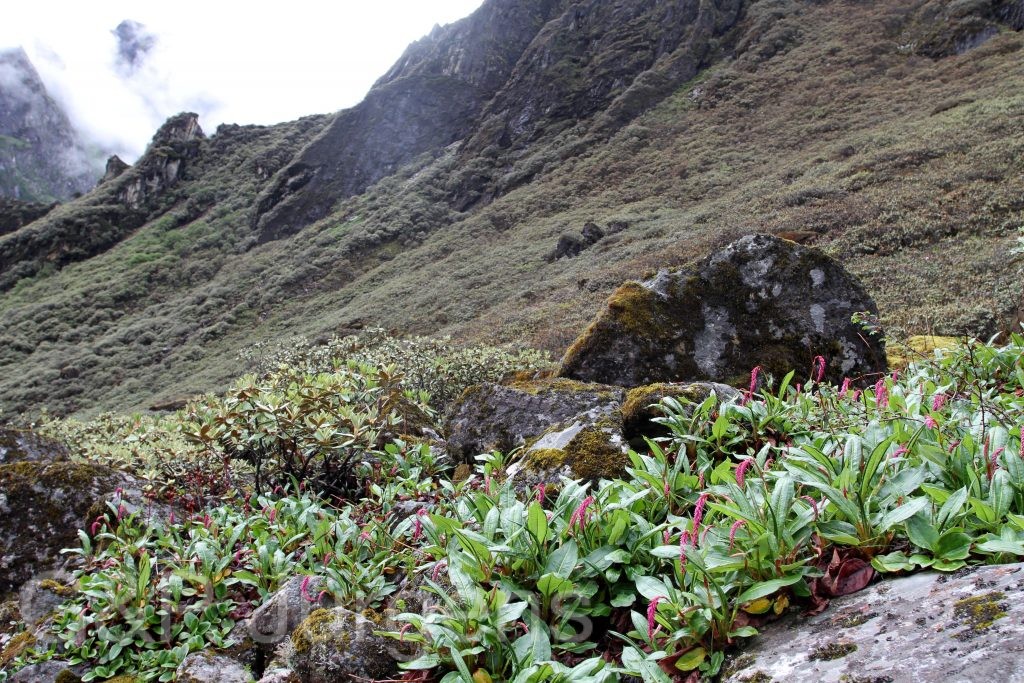
Bistorta emodi (Meisn.) H.Hara is an alpine knotweed of the Himalaya and adjacent China, recorded from about 363 collections in China, Nepal, India, Bhutan and Myanmar, with scattered extralimital reports. It grows in moist alpine meadows, dwarf-shrub heath, streamsides, seepages and damp rocky slopes in the alpine and upper subalpine zone, broadly between about 3500 and 4800 m. The plant photographed on the Ludlow-Sherriff trail at Miluthang in Bhutan at 4350 m in July occupies the cool, moisture-retentive high pastures that are characteristic of the species during the monsoon flowering period.

This is a perennial herb arising from a stout, often contorted, woody rhizome. The stems are erect and simple, sheathed at the nodes by tubular, membranous ochreae diagnostic of the family. Basal and lower leaves are long-petioled with ovate to lanceolate blades, often cordate or truncate at the base, the upper leaves smaller and sessile. The inflorescence is a dense, terminal, cylindrical to oblong spike of small flowers, the perianth pink to reddish or white, five-parted, with eight stamens; the lower part of the spike sometimes bears bulbils. The fruit is a small, trigonous, dark, shining achene enclosed in the persistent perianth.

The species belongs to Bistorta, segregated from Polygonum sensu lato (under which it appears as Polygonum emodi) and supported by molecular phylogenetics as a distinct lineage within Polygonaceae. Its rhizomes store carbohydrates that fuel rapid flowering in the short alpine summer, and the nectariferous spikes attract diverse insects. Widespread and often locally abundant in high Himalayan pasture, B. emodi is not of conservation concern, though it forms an important component of grazed alpine grassland.

Author: (Meisn.) H.Hara · Sources: POWO (Kew), GBIF, Flora of China, Flora of Bhutan, Flora of Nepal, revision of Bistorta / Polygonaceae

(Hook. f.) Grierson

BhutanPG2011 500
Bhutan Ludlow-Sherriff-Trail Mangde-Chu, 3950m July

Description

Bistorta griffithii (Hook. f.) Grierson is an alpine perennial herb of the eastern Himalaya, ranging through Bhutan, Sikkim and northern India into south-western China (Xizang, Yunnan) and northern Myanmar; the GBIF record of around 176 occurrences also includes herbarium-based citations from the United Kingdom and the United States. It is a plant of high alpine meadows, damp turf, rocky slopes and the upper margins of Rhododendron scrub, favouring cool, moisture-retentive soils kept wet by snowmelt and monsoon mist. The illustrated material was gathered along the Ludlow-Sherriff Trail at Mangde-Chu in central Bhutan at 3950 m in July, typical of the short midsummer flowering window in the upper alpine zone where this species reaches its display.

The plant arises from a short, thick, somewhat woody and contorted rhizome, producing erect, simple, unbranched stems. Basal leaves are long-petiolate with ovate to lanceolate or oblong blades, the margins entire and the lower surface often paler or thinly hairy; cauline leaves are few, smaller and shortly petiolate to sessile, subtended by membranous, tubular ochreae characteristic of the family. The inflorescence is a solitary, dense, terminal cylindrical to oblong spike of small flowers; perianth segments are five, white to pale pink, with eight stamens and a trifid style. As in many bistorts the lower flowers may be replaced by reddish bulbils. The fruit is a small, trigonous, dark brown shining achene enclosed by the persistent perianth.

Formerly placed in the broadly circumscribed genus Polygonum, this species is now treated in Bistorta on the basis of its perennial habit, unbranched flowering stems and dense terminal spikes. It is closely allied to other Himalayan bistorts such as B. macrophylla and B. vivipara, from which it is distinguished by leaf shape and inflorescence characters. Ecologically it contributes to the herbaceous turf grazed by livestock and wild ungulates, and the production of bulbils provides an effective means of vegetative propagation in the short, harsh alpine growing season. It has not been formally assessed for conservation but appears locally frequent within suitable habitat.

Author: (Hook. f.) Grierson · Sources: POWO (Kew), GBIF, Flora of Bhutan, Flora of China, Polygonaceae monograph (Hong & Steward)

Wedd.

Bhutan2012 693
Bhutan Galephu 900m, September

Description

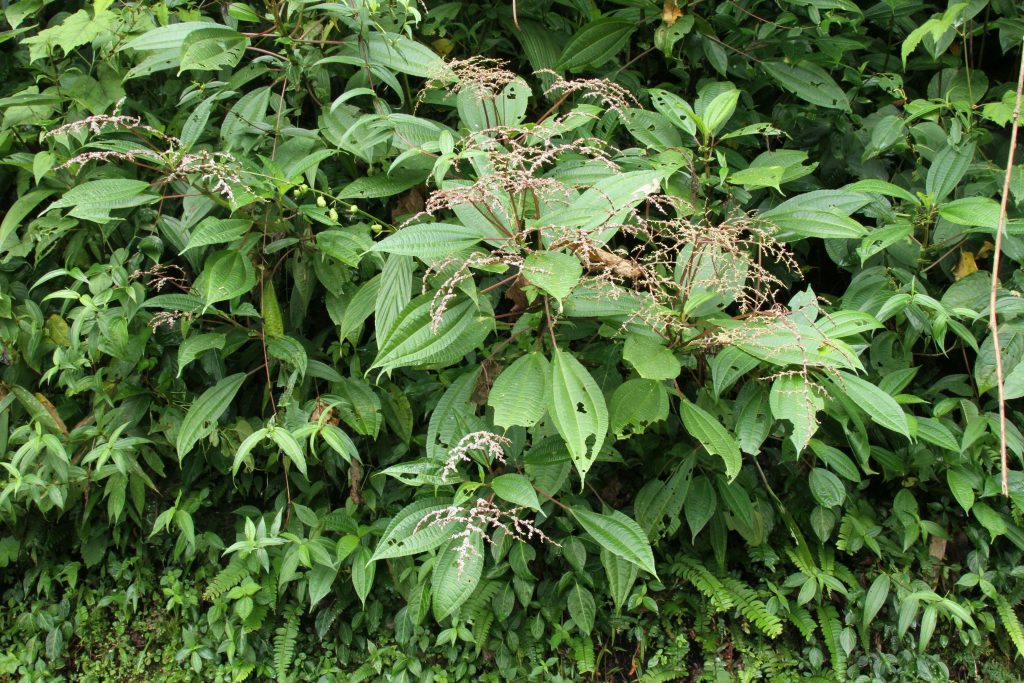
Boehmeria hamiltoniana is a subtropical shrub or tall herb of the Himalayan foothills and adjacent Southeast Asia, recorded from India, China, Nepal, Thailand, Bhutan, Myanmar and Indonesia across some 115 GBIF occurrences. The illustrated plant was photographed at Galephu in southern Bhutan at about 900 m in September. It grows in warm, humid lowland and submontane settings, along forest margins, streamsides, ravines and disturbed ground generally below about 1500 m, favouring shaded, moist, fertile soils.

The plant is a perennial herb or soft-wooded shrub with erect, sometimes pubescent stems. The leaves are opposite or alternate, ovate to ovate-lanceolate, with a serrate or dentate margin and an acuminate apex, three-nerved from the base and often roughish or hairy. As in the Urticaceae the flowers are small, greenish and unisexual, lacking petals; they are densely aggregated into slender, often interrupted axillary spikes or panicles. The female flowers develop into small dry achenes enclosed in the persistent perianth, each containing a single seed.

Boehmeria belongs to the nettle family but, unlike true nettles, lacks stinging hairs. The genus includes the economically important ramie (Boehmeria nivea), valued for its strong bast fibres, and several Himalayan species are used locally for cordage. Wind plays a role in pollination of the inconspicuous flowers. B. hamiltoniana is widespread and ecologically tolerant of disturbance, and is therefore of least conservation concern, persisting readily along trails and forest edges.

Author: Wedd. · Sources: POWO (Kew), GBIF, Flora of China, Flora of Bhutan, Flora of Nepal, Friis & Wilmot-Dear – Revision of Boehmeria (Urticaceae)

J. D. Hooker et Thomson

BhutanPG2011 101
Bhutan Chognam 3240m, June

Description

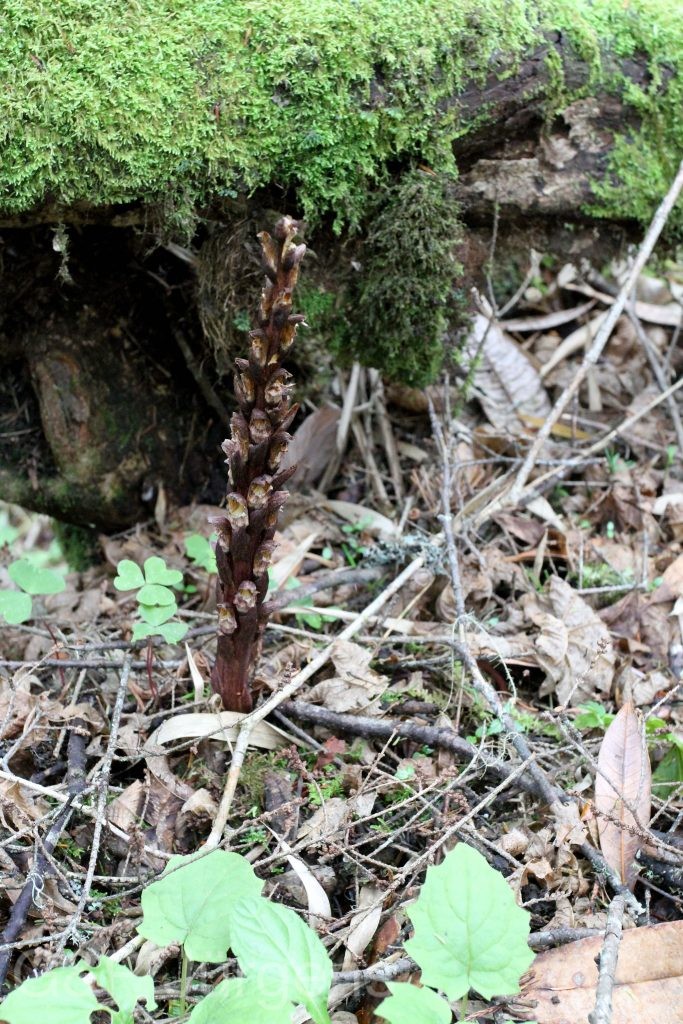
A non-photosynthetic, root-parasitic herb of the eastern Himalaya and East Asia, recorded from China, Taiwan, Nepal, India, Bhutan, Japan and Myanmar, with about 711 GBIF occurrences (a few outlying entries reflect data errors). It parasitises the roots of woody Ericaceae, particularly Rhododendron and Gaultheria, and is found in subalpine shrubberies, forest margins and moist thicket floors, generally between about 2700 and 4000 m. The illustrated plant was photographed in June at Chognam in Bhutan at around 3240 m, a typical rhododendron-dominated montane habitat.

Lacking chlorophyll, the plant draws all nutrition from its host. It arises from a swollen, tuberous, scale-covered basal organ attached to the host root, from which emerge fleshy, erect, unbranched stems coloured purplish-brown, yellowish or reddish and clothed only in small scale-leaves. The inflorescence is a dense, cylindrical, many-flowered terminal spike. Each flower is subtended by a bract and has a short cup-like calyx and a two-lipped, tubular corolla in dull purple to brownish-yellow, with a hooded upper lip and a shorter spreading lower lip; four didynamous stamens are inserted in the tube. The superior ovary ripens into a capsule packed with numerous minute, dust-like seeds adapted to wind dispersal.

Accepted by POWO and GBIF, B. himalaica is one of a small genus of broomrape relatives specialised on ericaceous hosts. Its life cycle is intimately governed by host availability and the germination of its tiny seeds in response to host-root chemical cues. Because it depends entirely on healthy Rhododendron-rich communities, it serves as an indicator of intact subalpine ericaceous vegetation. It is widespread but inconspicuous and locally sporadic; no significant conservation concern is recognised at present.

Author: J. D. Hooker et Thomson · Sources: POWO (Kew), GBIF, Flora of China, Flora of Bhutan, Beck monograph of Orobanchaceae

(Blume) Regel

Bhutan2014 186
Bhutan Trashyangtse 2150m, May

Description

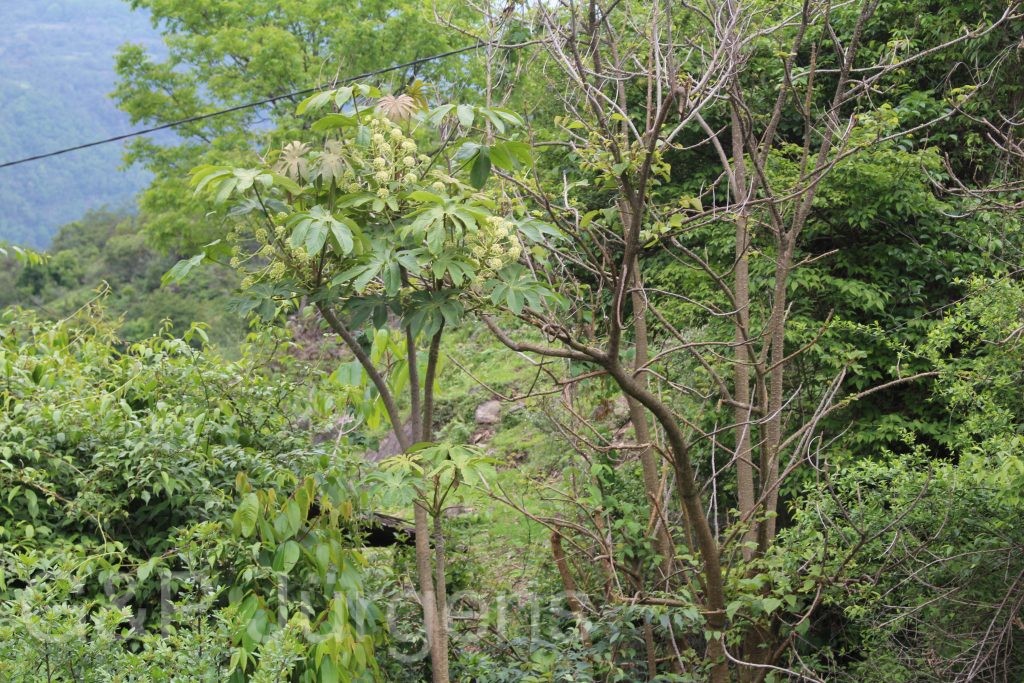
Brassaiopsis glomerulata is a small tree or large shrub of the eastern Himalaya and Southeast Asia, distributed from India, Nepal and Bhutan through Myanmar, Thailand, Laos, Vietnam, Cambodia, Malaysia and Indonesia into southern China; its c. 954 georeferenced records make it the most widespread member of its genus. It inhabits evergreen broadleaf forest, secondary woodland, ravines and forest margins, generally between 1000 and 2400 m. The plant photographed at Trashyangtse in eastern Bhutan at 2150 m in May grows in the humid subtropical to warm-temperate forest belt where it occupies the understorey and disturbed forest gaps along streams.

It is an evergreen, sparsely branched tree to c. 8-10 m, the young stems and petioles often armed with short prickles. The leaves are large and palmately compound or deeply palmately lobed, long-petioled, with serrate, acuminate leaflets, clustered toward the branch tips in typical araliaceous fashion. The inflorescence is a large terminal panicle of numerous small umbels, the flowers densely aggregated into globose clusters (hence "glomerulata"). The flowers are small, greenish to whitish, with five petals and five stamens and an inferior ovary crowned by a short style. The fruit is a small, globose, fleshy purple-black drupe containing flattened seeds.

Described originally in Hedera by Blume and transferred to Brassaiopsis by Regel, the species belongs to the Araliaceae, the ivy and ginseng family. Its small drupes are dispersed by frugivorous birds, while the open umbels are visited by generalist insects. The leaves and bark feature in regional ethnomedicine. Widespread and adaptable to disturbed habitats, B. glomerulata is not considered threatened across its broad range.

Author: (Blume) Regel · Sources: POWO (Kew), GBIF, Flora of Bhutan, Flora of China, Flora of Thailand, Lowry & Wen's studies of Asian Araliaceae