

Lindl.


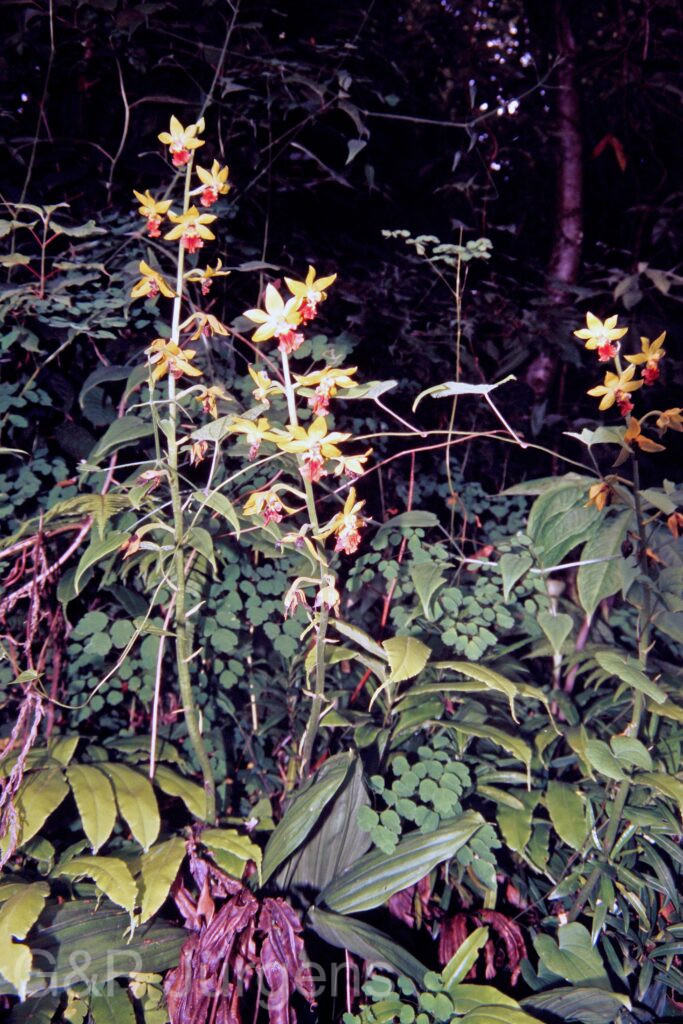
Description
Calanthe tricarinata is a distinctive terrestrial orchid widely distributed from the western Himalayas (Pakistan, northwest India) through Nepal, Bhutan, and Myanmar to China, Taiwan, and Japan. With over 1,000 documented GBIF occurrences, it is one of the better-known Himalayan Calanthe species. It inhabits cool, moist montane forests and subalpine Rhododendron scrub at 1,500–3,500 m elevation.
The plant is an evergreen species with short, stout pseudobulbs. Leaves are 3–5, broadly elliptic, 20–35 cm long, plicate, and persist through winter. The inflorescence is an erect raceme 25–40 cm tall, bearing 8–15 flowers. The flowers are unmistakable: 3–4 cm across, with olive-green to yellowish-green sepals and petals, contrasting strikingly with the large, pendent, reddish-brown to maroon lip. The lip is deeply trilobed, the mid-lobe bifid, with three prominent parallel keels (carinae) on the disc — the diagnostic feature reflected in the name 'tricarinata'. The spur is short, 5–8 mm. Flowering occurs from May to July.
Calanthe tricarinata is readily identified by its unique green-and-brown colour combination, unlike any other Himalayan orchid. The species was photographed at the Dochu-La pass (3,000 m) in Bhutan, also recorded from the Lara Lake area of western Nepal and Garhwal (India) — documenting its broad Himalayan distribution.
Author: Lindl. · Sources: POWO (Kew), Flora of Bhutan Vol. 3, Flora of Nepal Checklist, GBIF, Pearce & Cribb: The Orchids of Bhutan (2002)