Tag:

Myanmar

Flowers of the Myanmar Himalaya — 604 species recorded from northern Myanmar (Burma) and the eastern Himalayan borderlands, a biodiversity hotspot linking the Himalaya to the mountains of Yunnan and Southeast Asia. The region’s forests and alpine slopes hold a rich flora of rhododendrons, orchids, balsams and gentians. Every page gives a botanical description, distribution, habitat and flowering time with the original photograph.

D.Don

Garh 07 77 ergebnis
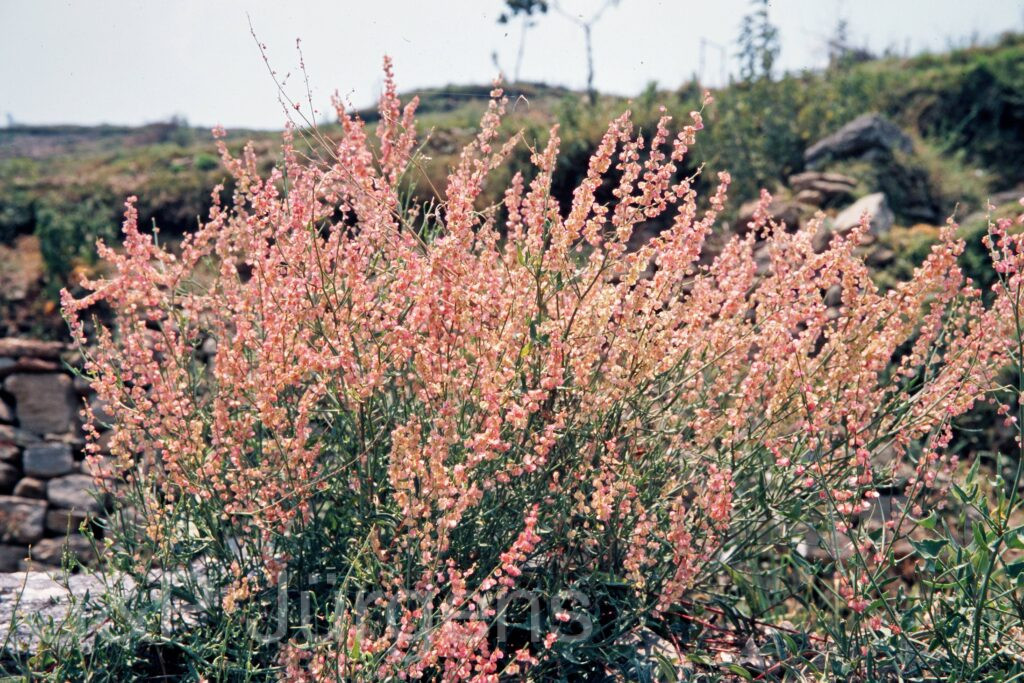
India Garhwal Sana at Mandakini 1750m, June

Description

Rumex hastatus is a widespread sub-shrubby dock distributed across the Himalaya and adjacent uplands, with GBIF documenting some 756 occurrences spanning China, India, Pakistan, Nepal, Afghanistan, Bhutan and Myanmar, alongside scattered introduced records in New Zealand and North America that mark it as a casual alien beyond its native range. It is a colonist of dry, sunny, often disturbed ground: rocky banks, terraced field margins, road cuttings, riverine gravels and open hillsides, ranging from around 700 m to over 3000 m. The plant photographed at Sana on the Mandakini in Garhwal, India, at about 1750 m in June, represents a typical warm-temperate montane locality where the species forms conspicuous reddish-tinged stands on stony slopes.

Morphologically it is a much-branched, woody-based perennial or subshrub reaching 30 to 100 cm, the slender intricate branches glabrous and often reddish. The leaves are characteristically hastate, the small narrow blade bearing a pair of spreading basal lobes, hence the epithet; lower leaves may be obovate, and the foliage is somewhat fleshy and grey-green. As in all Rumex the stem is sheathed at the nodes by membranous ochreae. The inflorescence is a large, lax, much-branched terminal panicle of small dioecious or polygamous flowers. The fruiting perianth develops three enlarged, rounded, membranous and often rose-tinted inner valves (wings) without conspicuous tubercles, enclosing a small trigonous brown nutlet and aiding wind dispersal.

The species sits within Rumex subgenus Acetosa, the sorrels, distinguished by their hastate or sagittate leaves, sour oxalate-rich sap and unisexual flowers. R. hastatus is valued locally as a pot-herb and in traditional medicine, the acidic foliage used as a refreshing condiment and astringent. Ecologically it is a hardy pioneer of degraded and eroding substrates, tolerant of drought and grazing, which underlies both its abundance throughout the Himalayan foothills and its capacity to naturalise elsewhere. It is of no conservation concern, being common and adaptable across a broad altitudinal and geographic span.

Author: D.Don · Sources: POWO (Kew), GBIF, Flora of China Vol. 5, Flora of Pakistan, Flora of Nepal, Rechinger Monograph of Rumex
Wall.

Nepal 97 268 P552
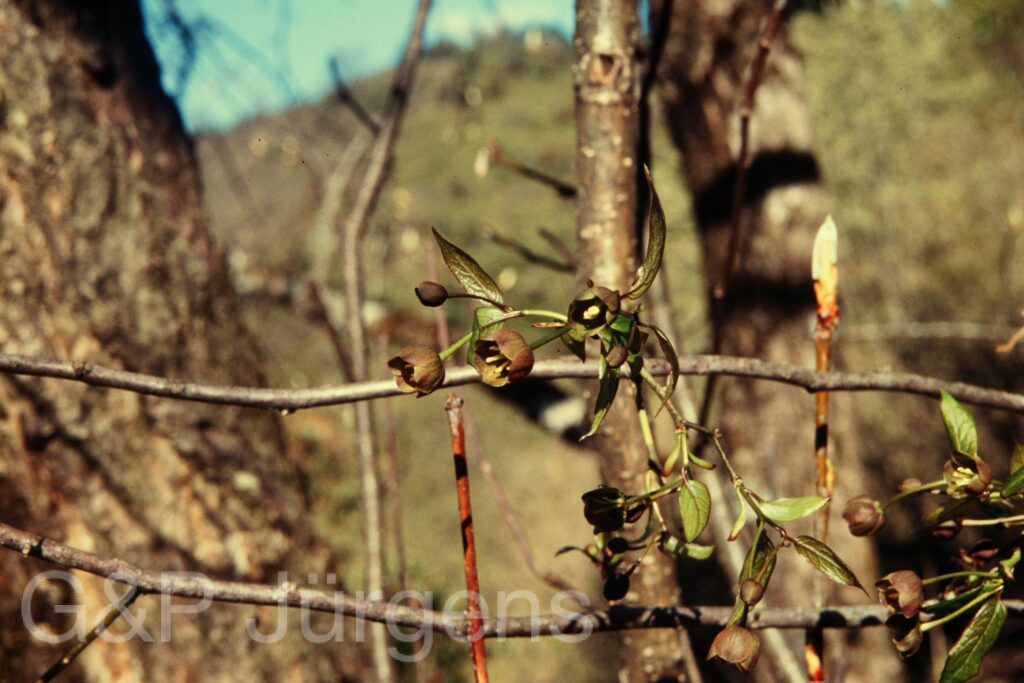
Nepal Bagong-Khola 2700m April

Description

Sabia campanulata is a climbing shrub of the Himalaya and southwestern China, recorded from China, India, Nepal, Bhutan, Myanmar, Pakistan and Japan, with around 1019 georeferenced occurrences in GBIF. It grows in temperate broad-leaved and mixed forests, thicket margins, forest edges and along ravines, scrambling over shrubs and small trees on humid montane slopes. The photographed plant from the Bagong Khola in Nepal at 2700 m in April is typical of these cool mid-montane forest habitats, where the species flowers in spring as new growth emerges along streamside woodland.

It is a deciduous woody climber or scandent shrub with slender, somewhat flexuous branches. The leaves are alternate, simple, ovate to elliptic-oblong, entire-margined, acuminate at the apex and with a thin to slightly leathery texture, the venation pinnate and prominent beneath. The flowers are small and borne solitary or in few-flowered axillary clusters; the corolla is campanulate, as the epithet indicates, with five greenish to dull purple or yellowish petals, five sepals, and five stamens opposite the petals, set on a small fleshy disc. The fruit is a flattened, reniform to obovoid drupe, paired or solitary, ripening blue to bluish-black, with a single curved seed and a reticulate endocarp.

The genus Sabia gives its name to the small family Sabiaceae, an isolated lineage of the basal eudicots (Proteales sensu lato in some treatments) with no close affinities among other Himalayan woody climbers. Sabia campanulata is distinguished within the genus by its relatively large bell-shaped flowers. Its drupaceous, bird-dispersed fruits aid seed dispersal through forest. Locally distributed but not rare across its montane range, it is not regarded as threatened, though dependent on intact temperate forest.

Author: Wall. · Sources: POWO (Kew), GBIF, Flora of China Vol. 5, Flora of Bhutan Vol. 2, Flora of Nepal, A Revision of the Genus Sabia (Sabiaceae)

Wall. ex Andersson

Garh 07 395 2 ergebnis
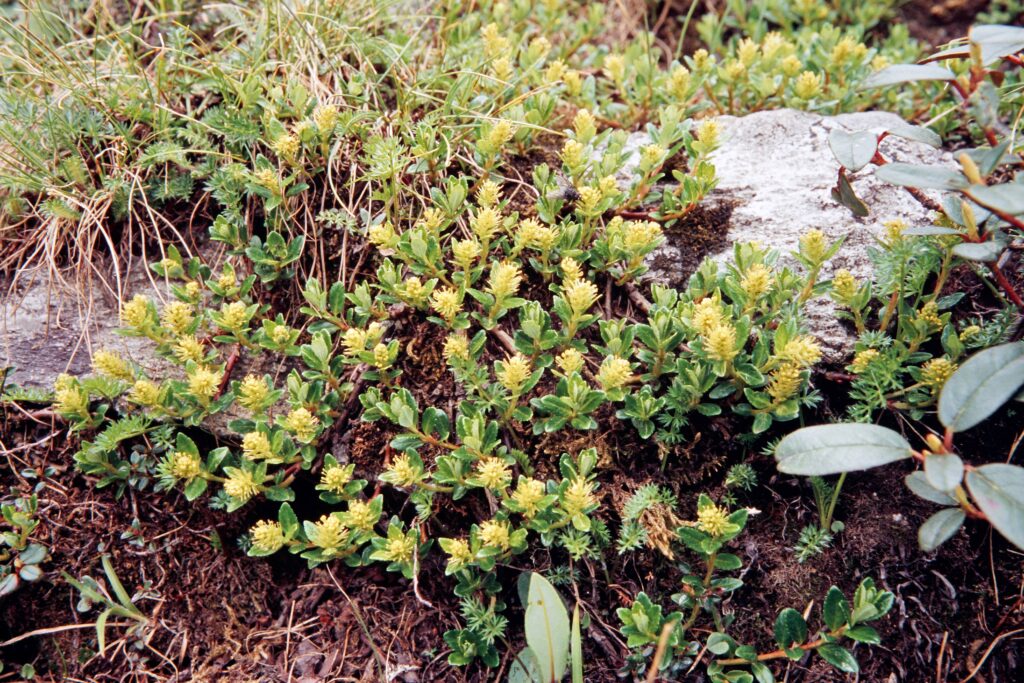
India Garhwal Khiar Kutti 3950m, June

Description

Salix lindleyana is a high-altitude dwarf willow distributed across the Himalayas from Pakistan through northern India, Nepal, and Bhutan to southwest China (Xizang, Yunnan) and northern Myanmar. GBIF records approximately 773 occurrences, concentrated in the alpine zones of the western and central Himalayas. The species is a characteristic element of subnival and alpine habitats at 3,500–5,200 m elevation, growing on moraines, scree slopes, stream margins, and moist alpine meadows. At Khiar Kutti in Garhwal at 3,950 m, it forms prostrate mats on gravelly substrates near glacial meltwater channels, flowering in June as the snowpack recedes and summer warmth permits a brief growing season.
Salix lindleyana is a prostrate, creeping deciduous shrub rarely exceeding 5–15 cm in height. Stems are slender, woody, rooting at the nodes, spreading laterally to form dense mats up to 1 m or more across. Leaves are small, elliptic to obovate, 5–15 mm long, entire or obscurely crenulate, glabrous at maturity, bright green above and slightly glaucous beneath. Catkins are terminal, erect, 1–3 cm long, appearing with or just after the leaves; male catkins bear stamens with purple-tipped filaments and yellow anthers, while female catkins develop into capsules 3–5 mm long containing minute, comose seeds that are dispersed by wind. The entire growth form is adapted to minimise exposure to desiccating alpine winds and to capture warmth from the ground surface.
Salix lindleyana is one of the highest-growing woody plants in the Himalayas and an important pioneer species in alpine and subnival ecosystems. Its prostrate, mat-forming habit stabilises loose substrates on moraines and scree slopes, facilitating soil development and subsequent colonisation by other alpine plants. The species is named after the English botanist John Lindley and was formally described by Andersson based on Wallich's Himalayan collections. It belongs to the section Chamaetia, a group of arctic-alpine dwarf willows, and is closely related to S. serpyllifolia of the European Alps — a biogeographical parallel reflecting Tertiary migration routes between the Alpine and Himalayan orogens.

Author: Wall. ex Andersson · Sources: POWO (Kew), GBIF, Flora of China Vol. 4, Flora of Pakistan Vol. 203, Polunin & Stainton: Flowers of the Himalaya (1984)

Wall. ex Benth.

BhutanPG2011 767 01 01
Bhutan Dur-Tso, 3600m June
also included: Anemone rivularis DC.
BhutanPG2011 374
Bhutan Dur-Tso, 3600m June

Description

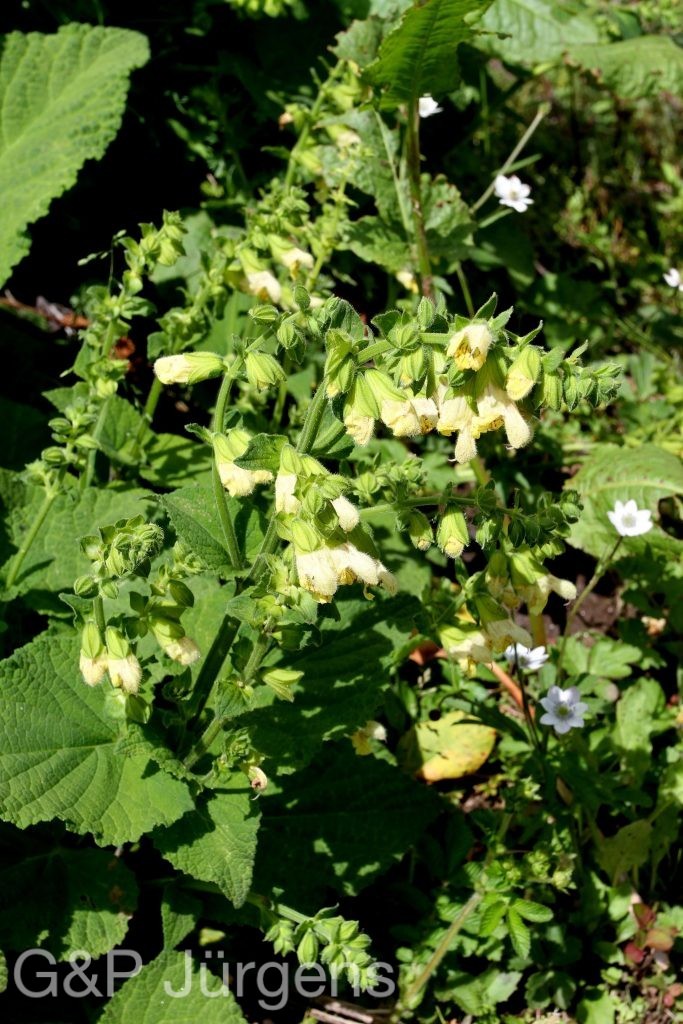
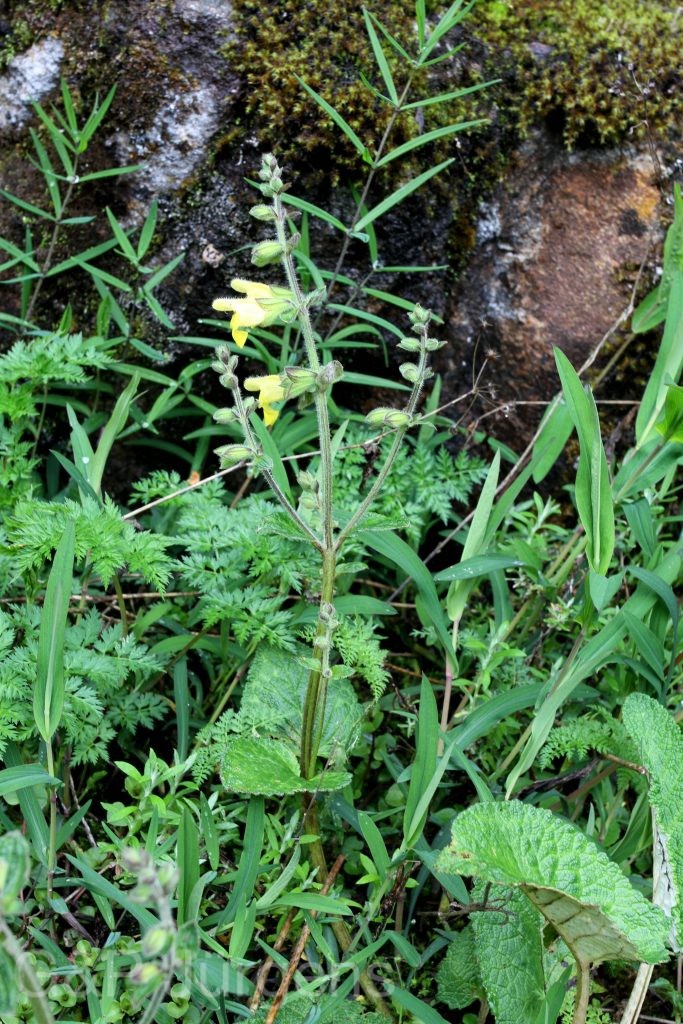
Salvia campanulata is a robust perennial sage of the Himalaya and adjacent China, with verified occurrences in Nepal, China, India, Bhutan and Myanmar. It grows on open grassy slopes, in forest clearings, scrub and along streamsides through the upper-temperate and subalpine zones, broadly between about 2500 and 3800 m. The plant illustrated from near Dur-Tso in Bhutan at around 3600 m in June, where it grows in company with Anemone rivularis, exemplifies its preference for moist, open subalpine grassland flowering early in the monsoon season.

The species arises from a stout rootstock and produces erect, quadrangular stems clothed, like the foliage, in soft hairs. The leaves are mostly basal and on the lower stem, large, broadly ovate to triangular-hastate with cordate bases and crenate-serrate margins, and long-petiolate. The inflorescence is an elongate terminal raceme of remote whorls (verticillasters), each of a few flowers. The calyx is bell-shaped, the feature noted in the epithet campanulata, and the corolla is comparatively large, yellow to greenish-yellow often marked with brown or purple, strongly two-lipped with a hooded upper lip enclosing the two functional stamens characteristic of the genus. The fruit comprises four smooth nutlets enclosed in the persistent calyx.

Salvia, the largest genus of Lamiaceae, is distinguished by its specialised lever-arm stamen mechanism that promotes precise pollen placement on visiting bees and other long-tongued insects. S. campanulata, described by Bentham from a Wallich collection, belongs to the Himalayan assemblage of large-leaved montane sages. It is widespread and locally common across its range and is not regarded as being of conservation concern.

Author: Wall. ex Benth. · Sources: POWO (Kew), GBIF, Flora of China, Flora of Bhutan, Annotated Checklist of the Flowering Plants of Nepal

Wall.

Bhutan2012 676
Bhutan Galephu 900m, September

Description

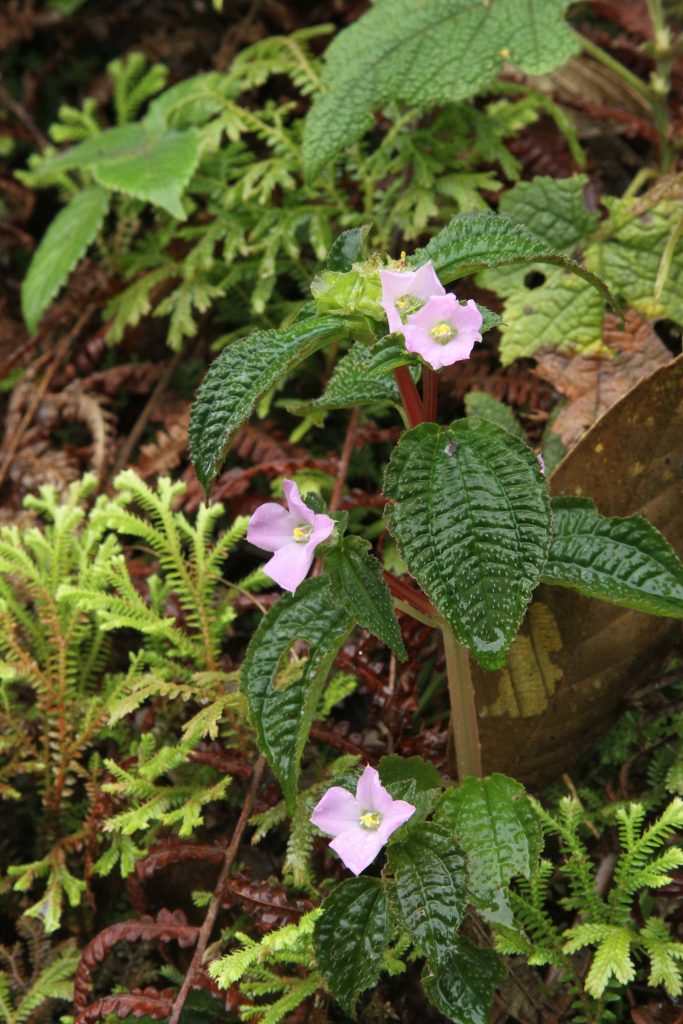
Sarcopyramis nepalensis Wall. is a small, delicate herb of the Melastomataceae distributed through the eastern Himalaya and Southeast Asia. Its several hundred records range across Nepal, northeast India, Bhutan, southern China, Taiwan, Myanmar, Vietnam, Malaysia, Indonesia and the Philippines. The species is a denizen of cool, shaded, perpetually moist habitats, growing on damp humus-rich banks, mossy rocks, ravine sides and the forest floor of evergreen broad-leaved and subtropical forests. It generally occupies low to mid elevations, and the plant photographed near Galephu in southern Bhutan at 900 m in September, late in the monsoon when these herbs flower, is typical of its preference for humid, dripping microsites.

The plant is a small, succulent, low annual or short-lived perennial with weak, ascending, four-angled stems that often root at the lower nodes. The leaves are opposite, membranous, broadly ovate to elliptic, with the three to five arcuate, longitudinally curved veins characteristic of the family, the margins finely toothed and sometimes reddish beneath. The flowers are borne singly or in few-flowered terminal cymes; they have a distinctive urceolate, four-angled hypanthium with prominent crested or winged angles, four pink to pale rose-purple petals, and eight stamens with conspicuously appendaged connectives. The fruit is a small, four-lobed, cup-shaped capsule crowned by the persistent calyx.

Sarcopyramis is a small Asian genus closely allied to Bredia and Phyllagathis within tribe Sonerileae, and the species has at times been treated as a variable complex with several segregate taxa and varieties. Its dependence on humid, shaded forest microhabitats makes it a useful indicator of intact, moisture-rich forest understorey. While not currently regarded as threatened across its broad range, local populations are sensitive to deforestation and the drying of streamside and seepage habitats.

Author: Wall. · Sources: POWO (Kew), GBIF, Flora of China Vol. 13, Flora of Bhutan Vol. 2, Renner et al.: Melastomataceae systematics

D.Don

Sikkim2003 363 P512
Sikkim Lachen Tista Tal 3450m August
Sikkim2003 364 P511
Sikkim Lachen Tista Tal 3450m August
Nepal 95 100 P178 ergebnis
Nepal Barphak 2450m October
Nepal 95 135 P228 ergebnis
Nepal Barphak 2450m October

Description

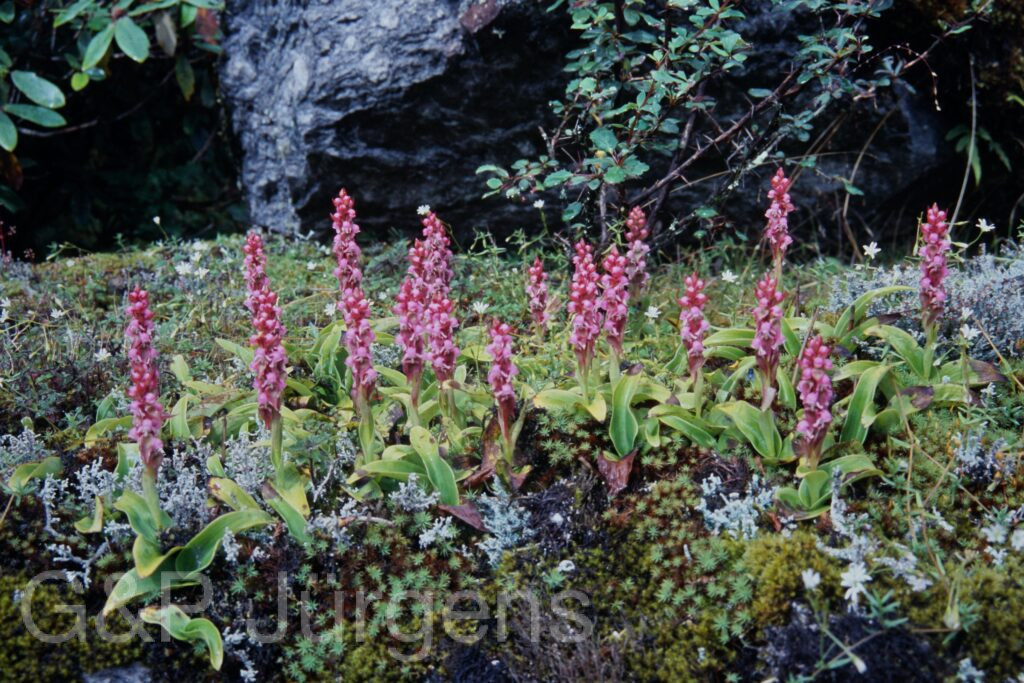
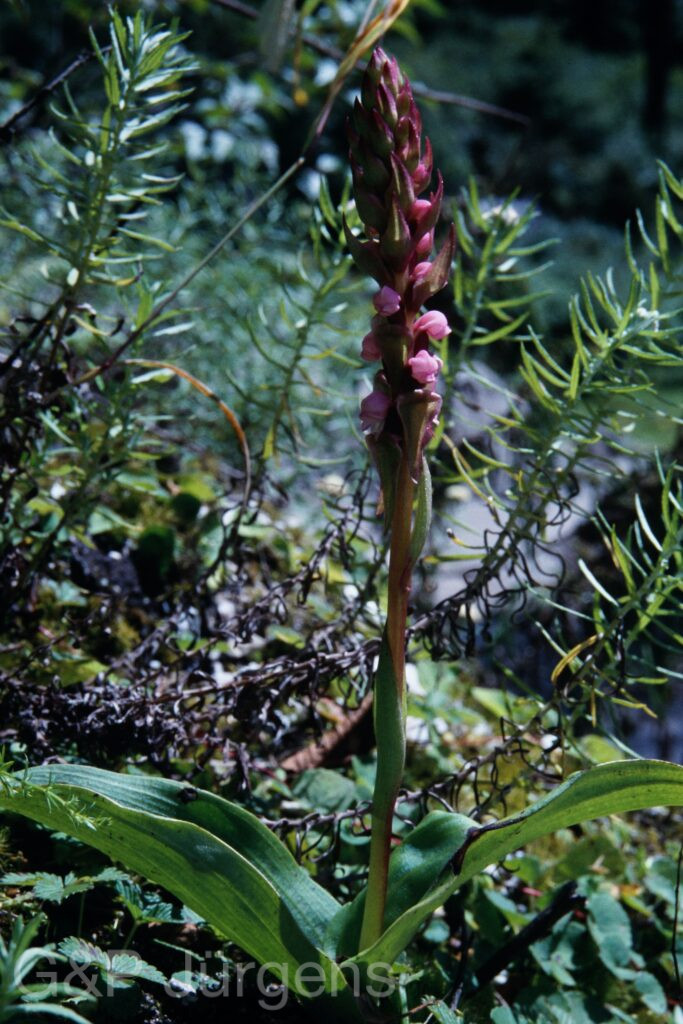
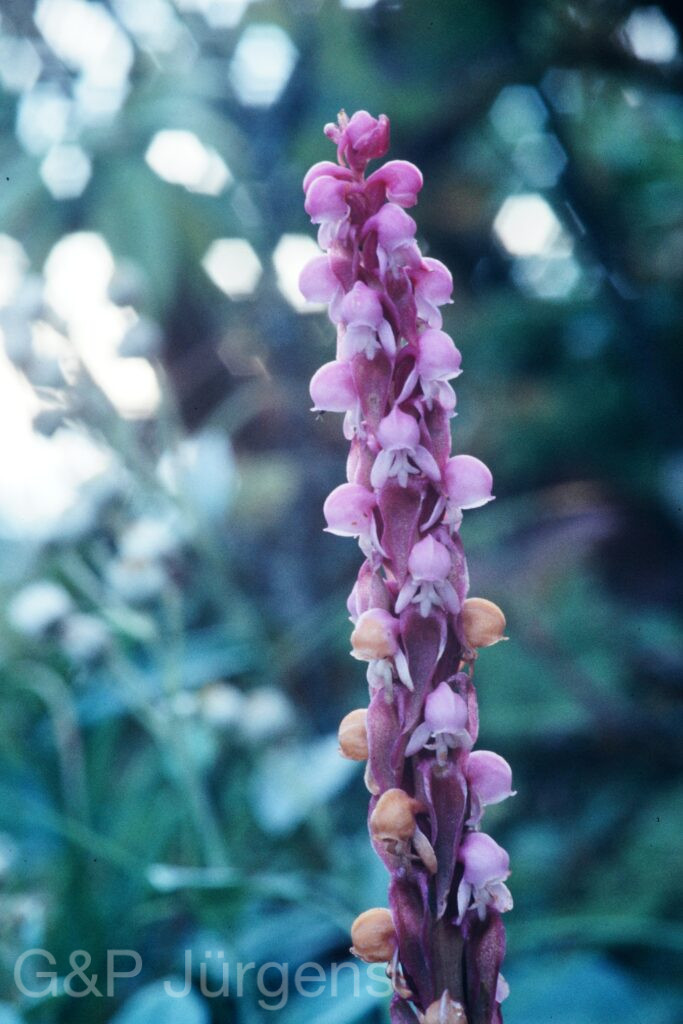
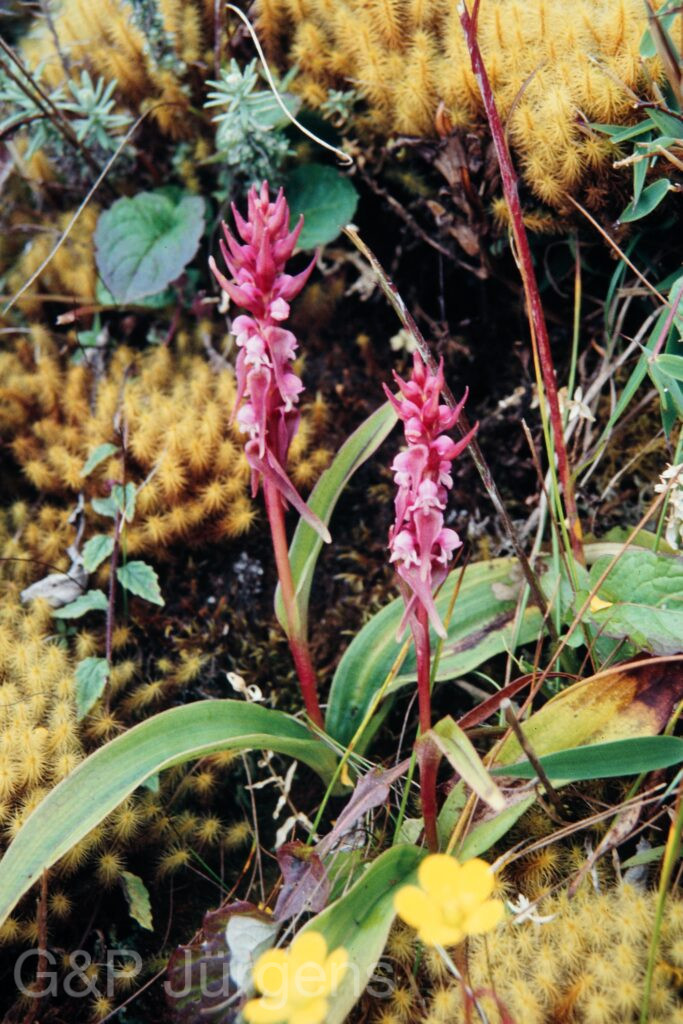
Satyrium nepalense D.Don is a terrestrial orchid of remarkably wide distribution, ranging across the Himalaya and southern Asia from Pakistan, India, Nepal, Bhutan, Sri Lanka and southern China to Myanmar, and extending through tropical and southern Africa; GBIF records nearly 1921 occurrences, reflecting its broad ecological tolerance. It grows in open grassy slopes, meadows, scrub and forest clearings from the submontane belt to high alpine pastures, broadly between about 1500 and 3700 m. The cited material from Lachen in Sikkim at 3450 m in August and Barphak in central Nepal at 2450 m in October illustrates its long flowering season across a wide altitudinal range.

The species is a terrestric herb arising from paired ovoid, tomentose tubers, with an erect leafy stem bearing a few ovate to lanceolate sheathing leaves. The inflorescence is a dense cylindrical raceme of many small, pink to rose-purple, fragrant flowers; each flower is non-resupinate, with the lip uppermost and produced into two slender, parallel spurs at its base, a diagnostic feature of the genus. The fruit is a small dehiscent capsule releasing abundant dust-like seeds.

Satyrium (Orchidaceae, subtribe Satyriinae) is a chiefly African genus with an outlying Asian representation, of which S. nepalense is the most widespread; its twin-spurred, non-resupinate flowers and moth pollination are characteristic. Valued in traditional medicine for its tubers, the species is locally collected, and although still common it warrants monitoring where harvesting pressure is intense.

Author: D.Don · Sources: POWO (Kew), GBIF, Flora of Bhutan, Flora of China, Orchids of Sikkim Himalaya, Pridgeon et al. Genera Orchidacearum

DC.

Bhutan2012 757
Bhutan Zemgang 1200m, October
Bhutan2012 758
Bhutan Zemgang 1200m, October

Description

Saurauia napaulensis is a subtropical tree or large shrub widely distributed through the southern Himalaya and Southeast Asia, with abundant GBIF occurrences in China, Nepal, India, Bhutan, Bangladesh, Myanmar, Thailand, Laos, Vietnam, Malaysia and Sri Lanka. It is a frequent component of moist subtropical broad-leaved forest, secondary forest, ravines and stream sides, generally between 600 and 2,100 m. The photographed individual was recorded at Zhemgang in central Bhutan at about 1,200 m in October, within the warm mid-hill belt where the species is a conspicuous understorey and gap-colonising tree.

The plant is a small evergreen tree, typically with stout twigs and young parts clothed in scaly or bristly indumentum characteristic of the genus. The leaves are large, alternate, oblanceolate to elliptic, leathery, with serrate margins and prominent lateral venation, the lower surface bearing scattered scales or appressed setae. The flowers are borne in branched axillary panicles; each is five-merous with white to pink, somewhat cup-shaped petals, numerous stamens, and several distinct or basally united styles. The fruit is a small, fleshy, depressed-globose, greenish to whitish berry containing many minute seeds, attractive to birds and other animal dispersers.

Saurauia is the only genus of Actinidiaceae with a wide Old World tropical distribution, the family also containing the kiwifruit genus Actinidia, and the scaly indumentum and many-styled flowers are diagnostic. Saurauia napaulensis is among the most common and widespread Asian species, used locally for fuel, fodder and edible fruit. It is abundant, regenerates readily in disturbed ground, and is not of conservation concern.

Author: DC. · Sources: POWO (Kew), GBIF, Flora of China Vol. 12 (Actinidiaceae), Grierson & Long: Flora of Bhutan Vol. 2, Hunter: Revision of the Asian species of Saurauia

(Wall. ex Schott) Cusimano & Hett.

Nepal 99 241 ergebnis
West-Nepal Tallekh 3000m, June
Nepal 2009 97 ergebnis
Nepal Helambu Samathang 2410, May

Description

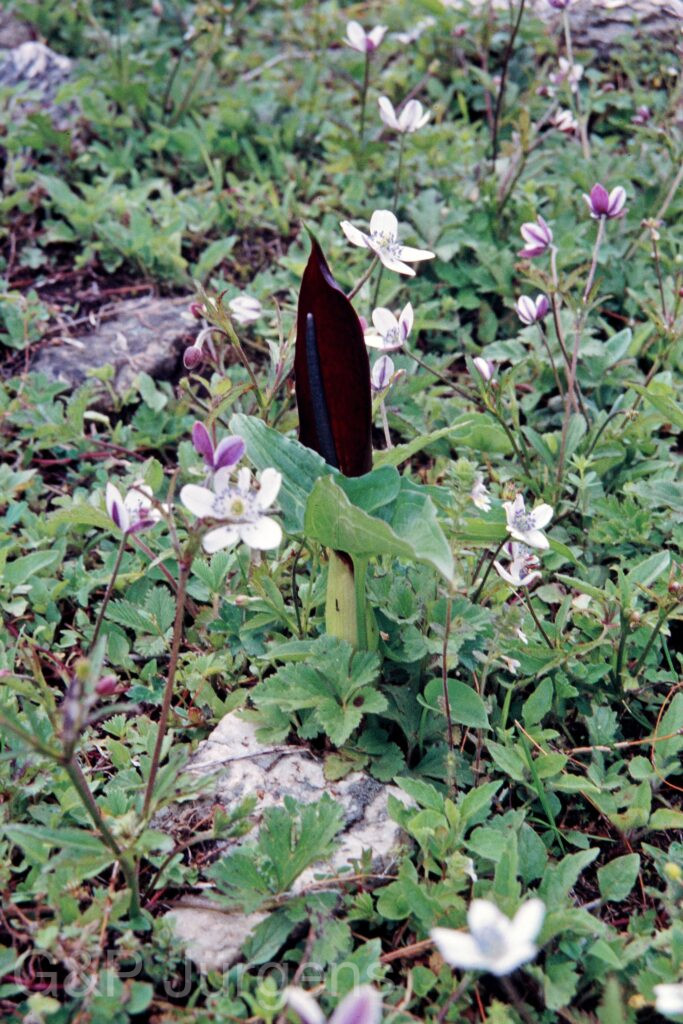
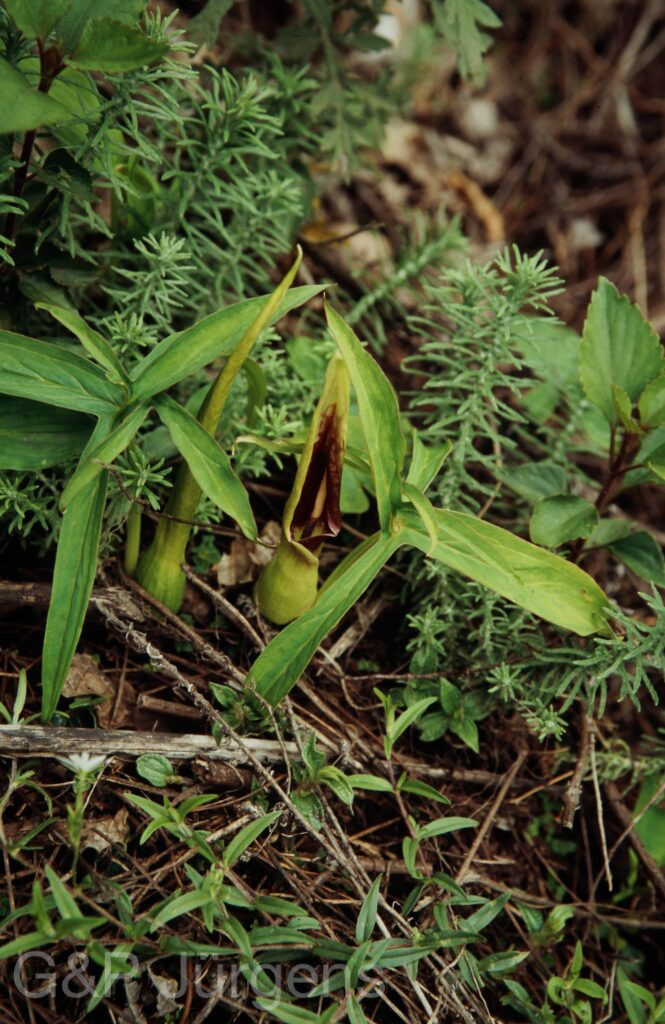
Sauromatum diversifolium is a tuberous aroid of the Himalaya and adjacent uplands, distributed through India, China, Nepal, Bhutan, Myanmar and Thailand, with around 146 recorded occurrences. It grows in moist temperate forest, on shaded banks, in open grassy slopes and among rocks where seasonal soil moisture is reliable, emerging with the onset of the warm season and dying back to its tuber during the dry winter. In Nepal it occupies the middle to upper montane zone, as shown by collections from Tallekh in the west at about 3000 m in June and from Samathang in the Helambu region at 2410 m in May, the latter dates coinciding with its early-season flowering.

The plant arises from a subglobose, depressed tuber and typically produces a single long-petiolate leaf whose blade is deeply pedately divided into several lanceolate to elliptic segments, the lobes acuminate and the petiole often mottled. The inflorescence is a typical aroid spadix subtended by a spathe, the spathe tube convolute and the limb expanded, lanceolate and often dull purple or marked within. The spadix bears a sterile terminal appendix above separated zones of female and male flowers, and emits a faint odour at anthesis to attract small dipteran and beetle pollinators. The fruiting head is a cluster of small berries.

The species was transferred to Sauromatum by Cusimano and Hettich on molecular and morphological evidence that united the former Typhonium diversifolium with the saururoid lineage. The genus is protogynous and largely sapromyophilous, with thermogenic spadices that volatilise scent to lure pollinators into the floral chamber. Widespread and locally frequent in suitable montane habitat, S. diversifolium is not regarded as threatened, though like many tuberous aroids it is sensitive to grazing pressure and the loss of forest-edge microhabitats.

Author: (Wall. ex Schott) Cusimano & Hett. · Sources: POWO (Kew), GBIF, Flora of China Vol. 23, Flora of Bhutan Vol. 3, Flora of Nepal, Cusimano et al. molecular phylogeny of Areae (Araceae)

(DC.) Sch.Bip.

Garw 2005 104 ergebnis ergebnis
India Garhwal Gaushon 3200m, September
Nepal 95 160 P261 ergebnis
Nepal South of Rupina La October

Description

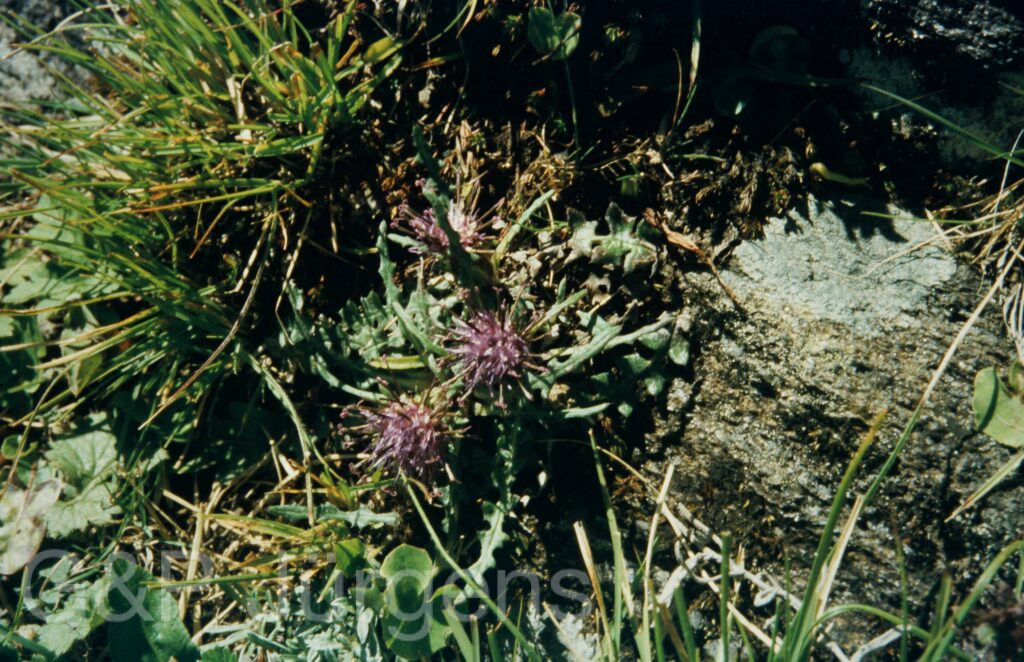
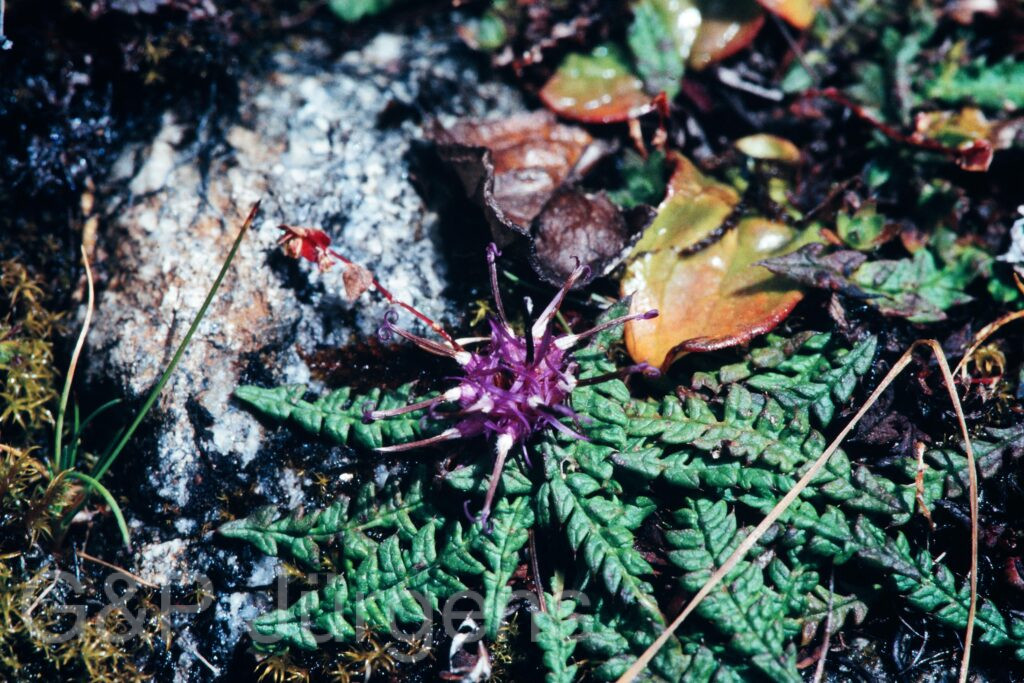
Saussurea leontodontoides is a widespread high-alpine composite of the Himalaya and the Tibetan plateau, distributed through China, India, Nepal, Myanmar and Bhutan and well documented with some 683 GBIF records. It colonises stony alpine slopes, screes, gravelly pastures and open turf, generally between about 3000 and 5000 m. The cited material from Garhwal at Gaushon (3200 m, September) and from south of the Rupina La in Nepal (October) illustrates its broad longitudinal range and its late-summer to autumn flowering, when the rosettes persist on exposed, well-drained substrates baked by intense montane sun and chilled by night frosts.

The plant is a low, more or less stemless perennial herb forming a flat basal rosette from a stout, often woody taproot. The leaves, evoking those of Leontodon as the epithet implies, are oblanceolate in outline and deeply pinnatifid to runcinate, with the surfaces frequently grey-tomentose, and they spread radially against the ground. The capitula are sessile or shortly stalked at the rosette centre, solitary or few, with imbricate, often purple-tinged involucral bracts. The florets are all tubular (discoid) and purple to pink-purple, characteristic of the genus, and the cypselae bear a feathery, plumose pappus aiding wind dispersal.

Saussurea belongs to tribe Cardueae of the Asteraceae, and S. leontodontoides sits among the cushion- and rosette-forming alpine snow-line species adapted to extreme cold, desiccation and high irradiance. Its tap-rooted, ground-hugging habit and woolly indumentum are classic alpine survival traits. Pollination is by alpine insects, and the plumed achenes disperse readily on mountain winds. The species is common and not of conservation concern, though, like related Saussurea, it may be gathered locally for traditional medicinal use.

Author: (DC.) Sch.Bip. · Sources: POWO (Kew), GBIF, Flora of China (Asteraceae), Annotated Checklist of the Flowering Plants of Nepal, Lipschitz Saussurea monograph

(DC.) Edgew.

Sikkim2003 453 G623
Sikkim Chopta Valley 3800m August
Sikkim2003 451 P628
Sikkim Chopta Valley 3800m August

Description

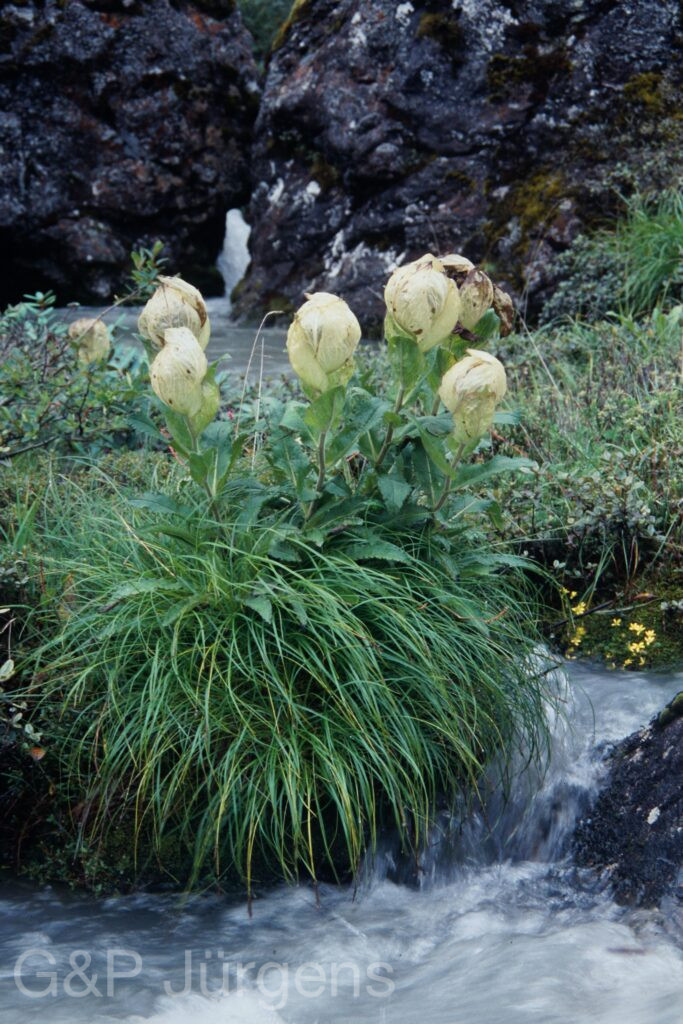
Saussurea obvallata is a high-alpine herb of the Sino-Himalayan region, distributed across the mountains of China, India, Bhutan, Nepal, Myanmar and Pakistan, with some 350 georeferenced records documenting a broadly continuous arc along the Greater Himalaya. It is a plant of open alpine meadows, moraines, scree slopes and rocky pastures, typically between about 3500 and 4800 m. The photographed material from the Chopta Valley in Sikkim at 3800 m, flowering in August, is characteristic of its preferred late-monsoon habitat on moist, well-drained alpine turf where snow lies long into early summer.

The species is a stout perennial arising from a thick taproot, with an erect, simple, leafy stem. The lower leaves are oblanceolate and dentate, narrowing to a winged petiole, while the upper leaves grade into membranous, pale, semi-translucent bracts that arch inward to enclose the inflorescence. These greenish-straw involucral bracts form the conspicuous globose to urn-shaped "lantern" that almost entirely hides the cluster of dark purple capitula within. The florets are tubular and purple-black, and the achenes bear a feathery, plumose pappus that aids wind dispersal.

The enclosing bract chamber is widely interpreted as an adaptation that buffers temperature, protects pollinating insects from cold and wind, and shelters developing florets at extreme elevation, a striking example of greenhouse-like alpine convergence shared with Rheum nobile. Long known in Himalayan tradition as the sacred "Brahma Kamal," the plant is heavily collected for ornament and medicine, and populations near pilgrimage routes face local pressure of regional conservation concern.

Author: (DC.) Edgew. · Sources: POWO (Kew), GBIF, Flora of China, Flora of Bhutan, Annotated Checklist of the Flowering Plants of Nepal, Lipschitz monograph of Saussurea