Tag:

Nepal

Flowers of Nepal — 1313 wild plant species documented from the Nepalese Himalaya, from subtropical foothills to high alpine meadows above 4,000 m. Nepal’s dramatic elevation gradient makes it one of the richest botanical regions on Earth, home to rhododendrons, primulas, gentians and the famed blue poppies (Meconopsis). Every entry gives a botanical description, native distribution, habitat and flowering season, alongside the original field photograph and the location where it was taken.

I.M. Johnst.

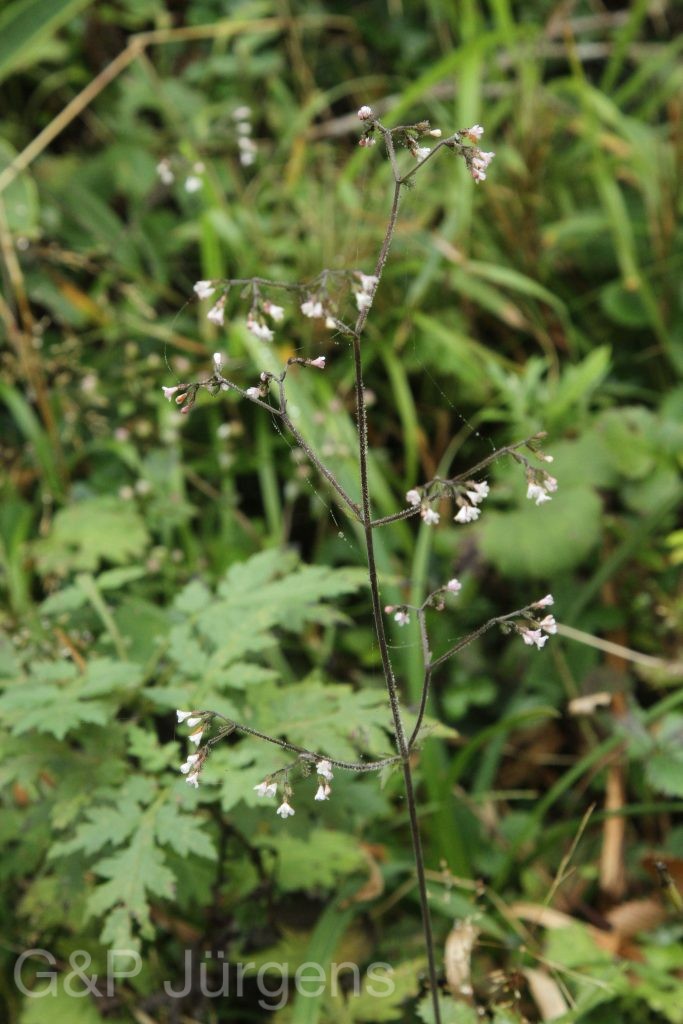
Nepal 99 812 ergebnis
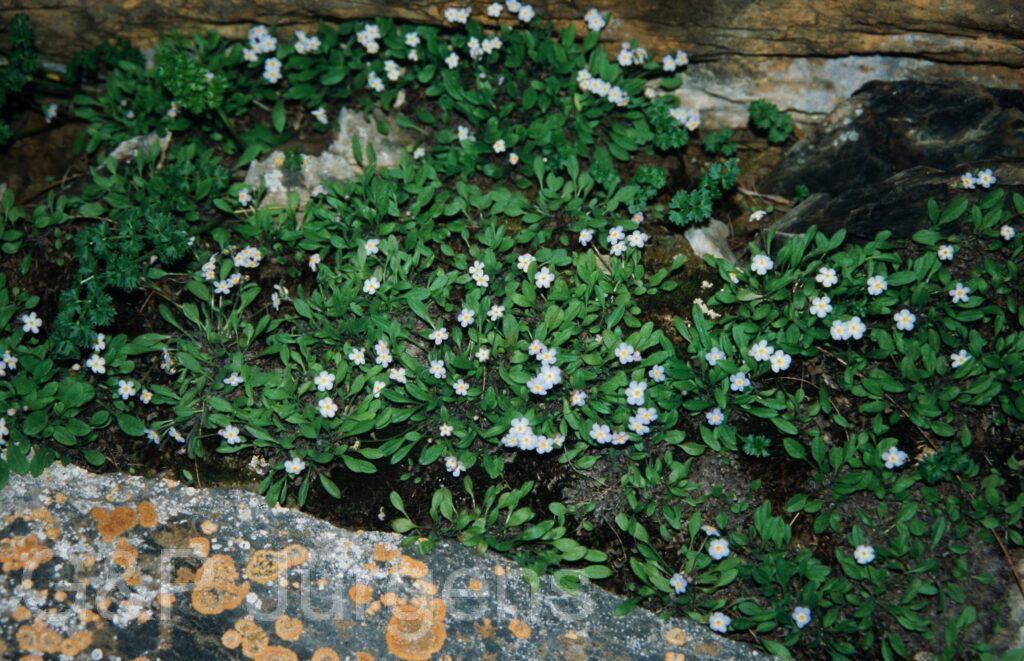
West-Nepal, Baga-La-Phedi 4300m, July
Nepal 99 813 ergebnis
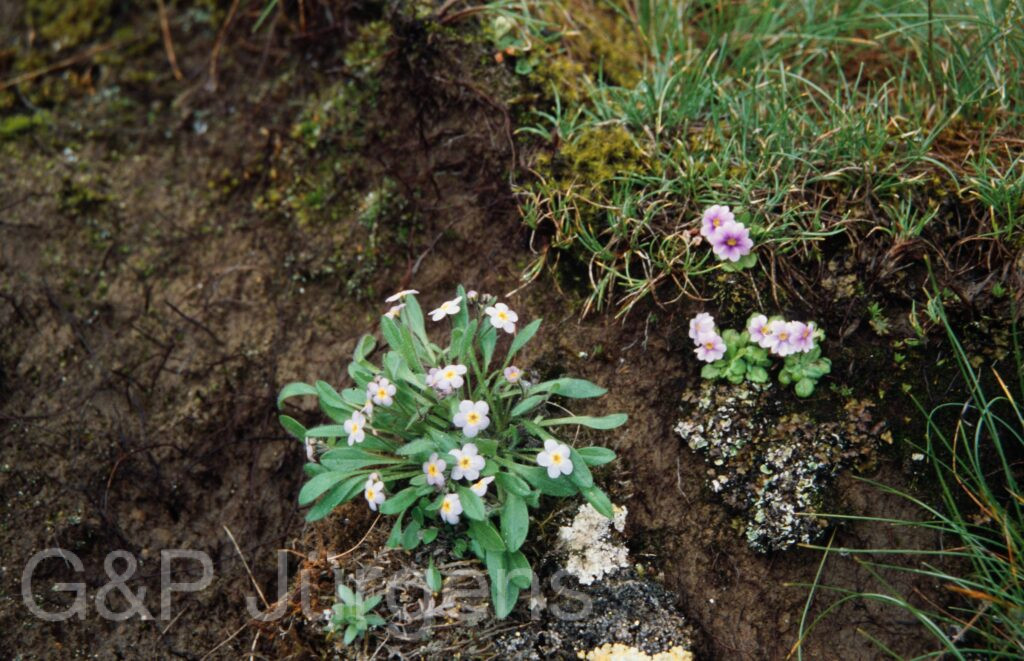
West-Nepal, Baga-La-Phedi 4300m, July

Description

Trigonotis tibetica is a small alpine forget-me-not relative distributed across the Tibetan Plateau and the high Himalaya, recorded from China, India, Nepal, Bhutan and Pakistan, and reasonably well collected (c. 278 records in GBIF) across this broad arc. It inhabits open alpine turf, gravelly slopes, stabilised screes and the margins of meadows, typically between about 3500 and 5000 m, where snowmelt provides moisture through the brief summer. The photographed plant from West Nepal at Baga-La-Phedi (4300 m, July) is typical of the species in mid-summer flower in this cold, well-drained high-elevation setting.

The plant is a low, often tufted perennial herb with a slender taproot and prostrate to ascending stems, the whole frequently appressed-strigose or hispid. The leaves are small, spathulate to oblong-elliptic, entire, and crowded toward the base. The inflorescence is a short, ebracteate or basally bracteate cyme that elongates in fruit; the flowers are small and gamopetalous, with a blue (occasionally white) rotate to shallowly campanulate corolla bearing five vaulted faucal scales at the throat. The androecium has five included stamens; the gynoecium develops into the characteristic four nutlets, which in Trigonotis are conspicuously trigonous and tetrahedral, often borne on short gynobasic stalks.

The genus Trigonotis (tribe Trigonotideae) is distinguished from Myosotis and allied forget-me-nots chiefly by these sharply angled, pyramidal nutlets. Note that this taxon has historically been treated under Microula, and the source links accordingly to a Microula tibetica page; current nomenclature places the accepted name in Trigonotis. As a widespread plateau and Himalayan alpine, the species is not considered threatened.

Author: I.M. Johnst. · Sources: POWO (Kew), GBIF, Flora of China (Boraginaceae), Flora of Nepal, Flora of Pakistan, Monograph of Trigonotis (I.M. Johnston)
Wall. ex D.Don

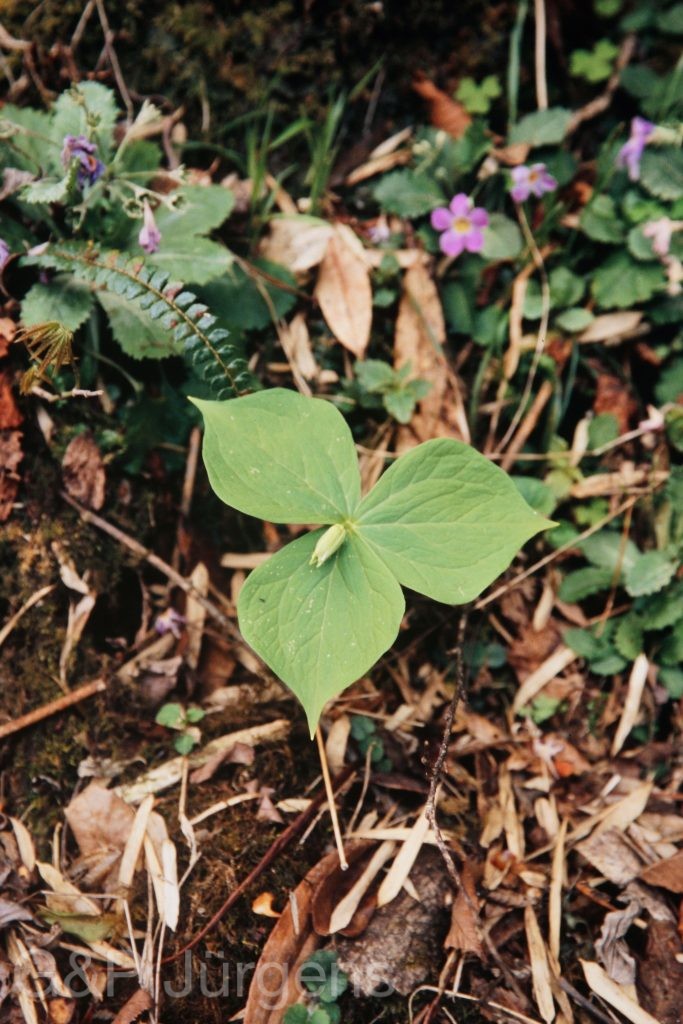
Nepal 99 141 ergebnis
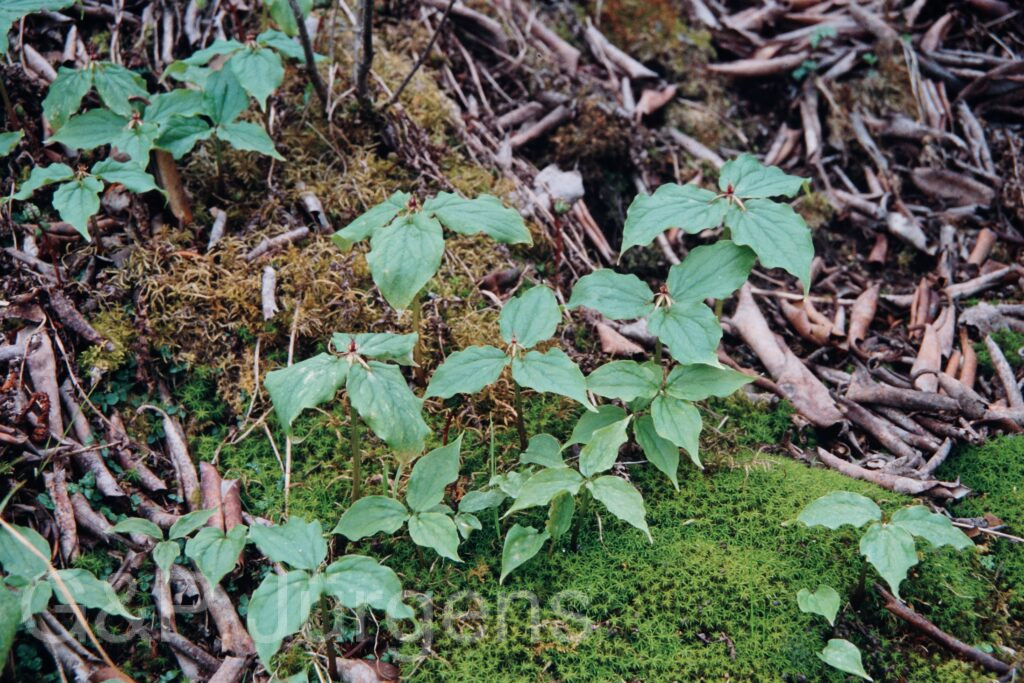
West-Nepal South of Rara-Lake 3800m, June
Nepal 2001 308 ergebnis ergebnis
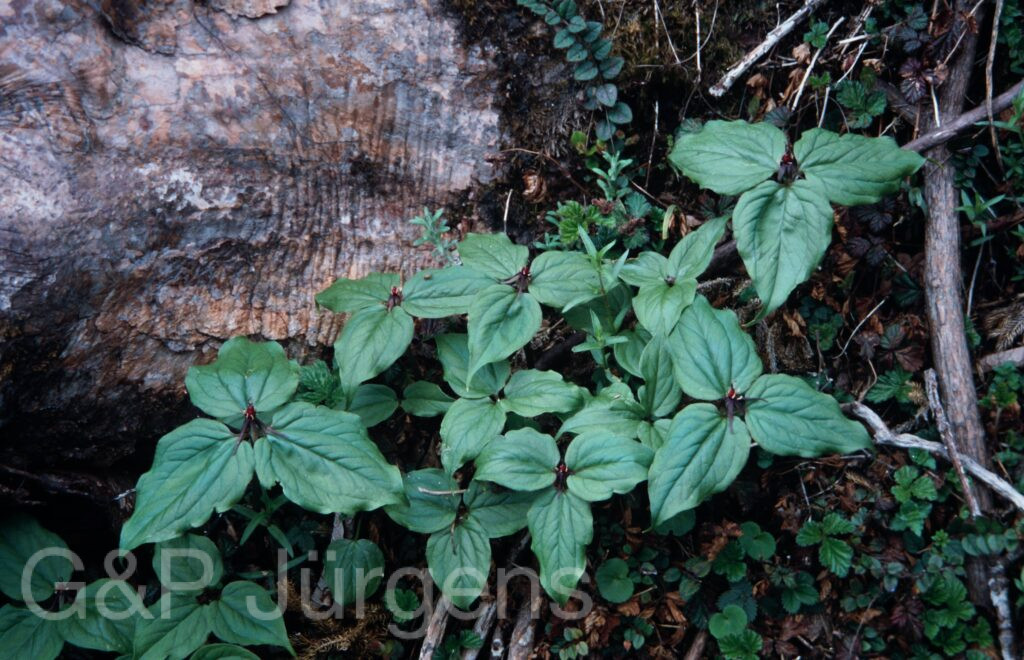
Nepal (Gorkha) Kharka 3100m, May

Description

Trillium govanianum is a rhizomatous perennial herb of the family Melanthiaceae and the sole representative of the otherwise North American and East Asian genus Trillium in the Himalaya. GBIF data confirm a core distribution through Pakistan, India and Nepal, extending into Bhutan and the western fringe of China. It is a plant of moist, shaded temperate and subalpine forest, growing on humus-rich soils beneath Abies, Betula and rhododendron, and in damp alpine scrub and meadow margins, typically between about 2,800 and 4,000 m. The collections illustrated from south of Rara Lake in west Nepal at 3,800 m in June and from Kharka in Gorkha at 3,100 m in May are characteristic of this shaded, high-montane habitat.

The species arises from a short, thick, creeping rhizome and produces a single erect stem 10–30 cm tall bearing the diagnostic whorl of three broadly ovate, net-veined, sessile leaves at its summit. From the centre of this whorl a solitary, sessile or shortly stalked flower is borne; it is small and dark, with three narrow green sepals and three slender petals that are deep maroon to purplish-brown, accompanied by six stamens and a three-loculed ovary. The fruit is a fleshy, reddish berry-like capsule containing several seeds, in contrast to the dry capsules of many congeners.

The presence of a single Trillium in the Himalaya is of considerable biogeographic interest, representing a disjunct outlier of a genus otherwise centred on temperate North America and Japan. The species, locally known as nag chhatri, has become the focus of intense and unsustainable harvesting for its rhizome, which is traded for purported steroidal saponin content. This pressure, combined with slow growth and a narrow ecological niche, has raised serious conservation concern, and the plant is now regarded as threatened across much of its range.

Author: Wall. ex D.Don · Sources: POWO (Kew), GBIF, Flora of Nepal, Flora of Pakistan, Annotated Checklist of the Flowering Plants of Nepal, Farmer & Schilling: Phylogenetics of Trillium

Maxim.

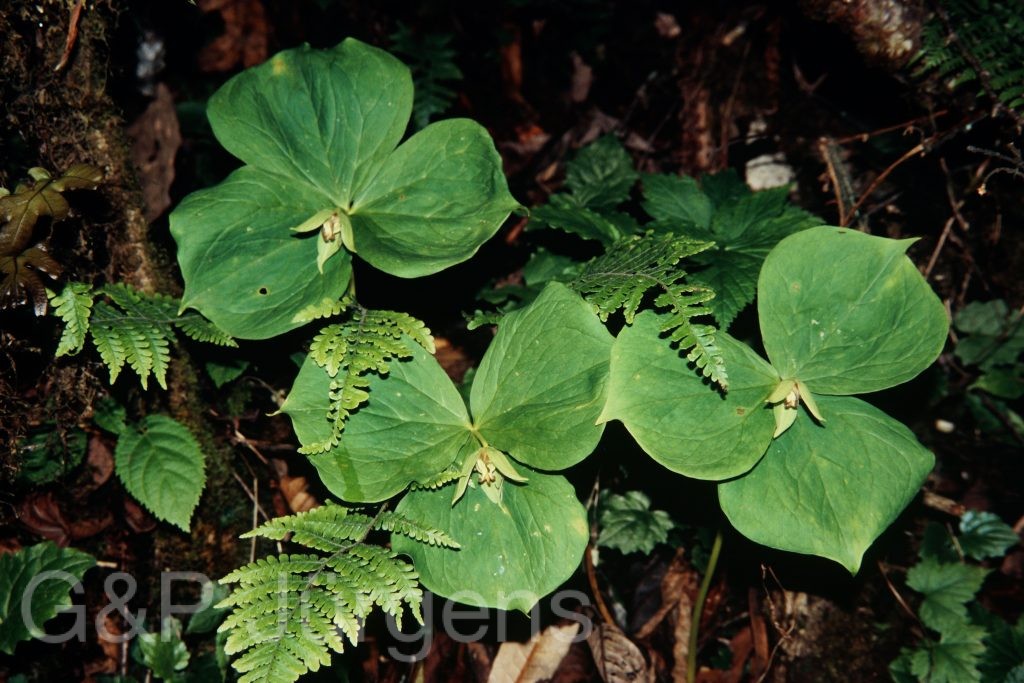
Bh2008 35 P57
Bhutan Doch-La, 3000m April
Bh09 212 G355
Bhutan Paro, 2400m June

Description

Trillium tschonoskii is a wide-ranging woodland herb of temperate East and South Asia, distributed from Japan, Korea and Taiwan through eastern and central China and into the Himalaya, reaching India, Bhutan and Nepal, with records also from the Russian Far East. With more than two thousand GBIF occurrences it is by far the most widespread Asian trillium, though it thins markedly toward its western Himalayan limit. It is a plant of cool, shaded, humus-rich broadleaved and conifer forest, favouring moist slopes and stream banks, generally between about 2300 and 3600 m in the Himalaya. The Bhutanese material illustrated, from Doch-La at 3000 m in April and from Paro at 2400 m in June, spans the species' flowering season as it tracks elevation, emerging soon after snowmelt in the deep shade of the forest floor.

The plant is a glabrous perennial arising from a short, thick, horizontal rhizome, producing a single erect stem that bears at its summit a single whorl of three broadly rhombic to ovate, net-veined, sessile or short-stalked leaves. Above this whorl a solitary flower is borne on a short erect pedicel. The flower is trimerous, with three green, lanceolate sepals and three white (sometimes ageing pinkish) ovate petals; six stamens with prominent anthers surround a superior, three-locular ovary topped by three recurved stigmas. The fruit is a fleshy, ovoid, reddish to dark berry-like capsule containing numerous seeds, each bearing an oily elaiosome that promotes dispersal by ants.

Trillium, now placed in the Melanthiaceae, is a classic component of the temperate deciduous forest flora of the Northern Hemisphere, and T. tschonoskii is the principal Asian representative reaching the Himalaya, exemplifying the floristic links between East Asian and Sino-Himalayan woodlands. Its slow growth, dependence on undisturbed forest humus and ant-mediated seed dispersal make it sensitive to habitat disturbance, and like many trilliums it has horticultural appeal and some traditional medicinal use of the rhizome, which can drive local collection. Although broadly distributed and not globally threatened, its peripheral Himalayan populations warrant monitoring as forest cover and microclimate change.

Author: Maxim. · Sources: POWO (Kew), GBIF, Flora of China Vol. 24, Flora of Bhutan Vol. 3 Part 1, Flora of Nepal, Trillium (Frederick W. Case and Roberta B. Case)

Wall.

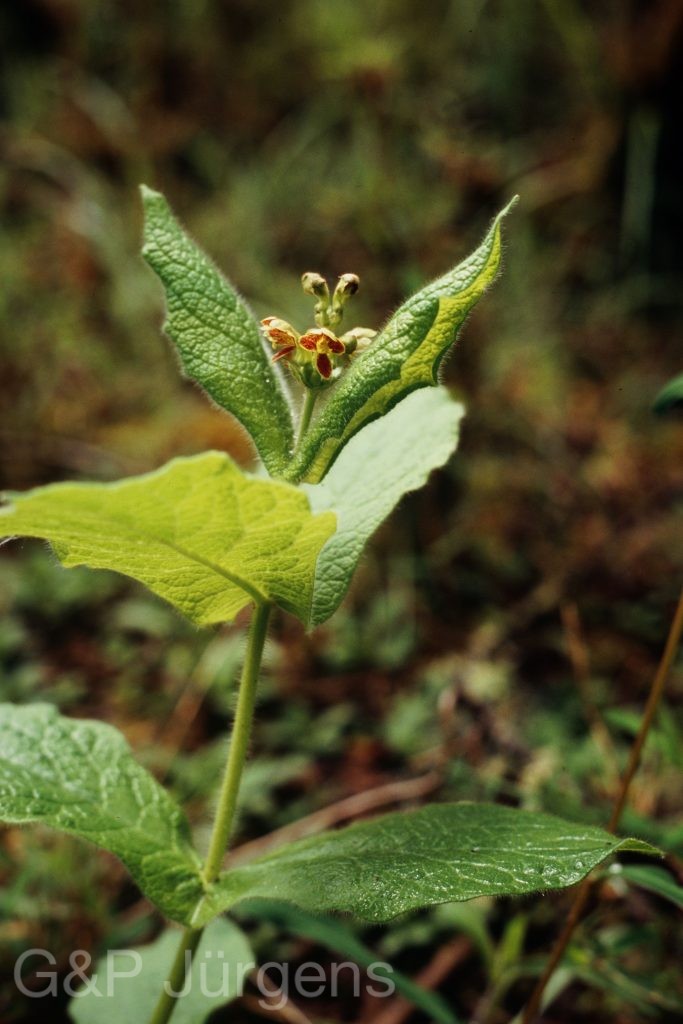
Bh09 321 G527
Bhutan Jakar 3200m, June
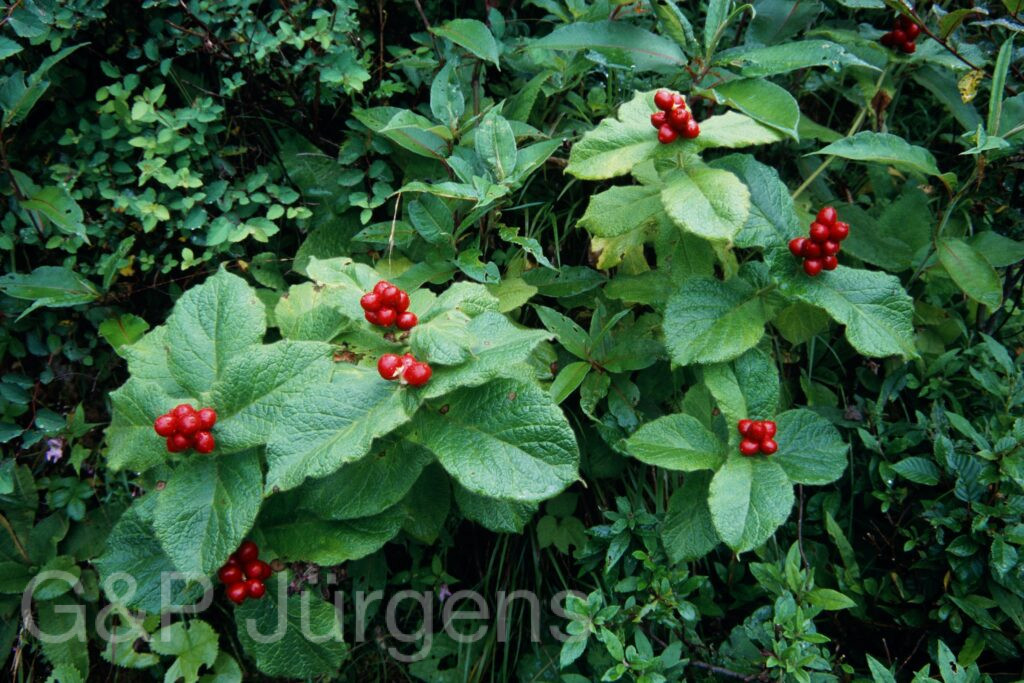
Sikkim2003 377 G529
Sikkim Tista valley 3400m August

Description

Triosteum himalayanum is a Sino-Himalayan perennial herb distributed across China, Nepal, Bhutan, Sikkim and northern India, with GBIF aggregating around 990 occurrences. It is characteristic of the upper temperate to subalpine forest belt, recorded here from Jakar in Bhutan at 3200 m in June and the Tista valley in Sikkim at 3400 m in August. The species grows in moist shaded forest, woodland margins, scrub and tall-herb communities along streams and on cool, humus-rich slopes, typically between roughly 2500 and 4000 m, where it forms part of the shade-tolerant understorey flora.

It is an erect, softly hairy herbaceous perennial 0.4-1 m tall arising from a stout rhizome, the stems unbranched and glandular-pubescent. The leaves are opposite, large, broadly obovate to elliptic, often shortly connate at the base around the stem (perfoliate to subconnate), entire to shallowly lobed and softly hairy on both surfaces. Small tubular flowers are clustered in dense axillary and terminal verticels; the corolla is dull purplish to greenish-yellow, weakly two-lipped, and the calyx bears persistent, leafy, ciliate lobes. The most conspicuous feature is the fruit, a fleshy, bright red, bristly-hairy drupe crowned by the persistent calyx and containing three bony pyrenes.

Triosteum (horse-gentian) is a small, disjunct genus of about six species in eastern Asia and North America, now placed within an enlarged Caprifoliaceae; this striking amphi-Pacific distribution makes it a classic example of the eastern-Asian-North-American biogeographic link. T. himalayanum is widespread and locally common within its montane range and is not of conservation concern; its showy red drupes are dispersed by birds, and the rhizome has a place in regional herbal traditions.

Author: Wall. · Sources: POWO (Kew), GBIF, Flora of China, Flora of Bhutan, Flora of British India (Hooker), Gould & Donoghue revision of Triosteum (Caprifoliaceae)

Wall. ex DC.

Bhutan2015 26
Bhutan Dochu-La 3100m, October

Description

Triplostegia glandulifera is a slender montane herb broadly distributed through the Sino-Himalaya and into Malesia, ranging from Nepal, northern India and Bhutan eastward across China and Taiwan to Myanmar, Malaysia, Indonesia and New Guinea, with outliers in Japan. GBIF documents over 1500 occurrences, concentrated in China, Taiwan and the Himalayan countries. It grows in moist temperate forest, on shaded grassy banks, in clearings and along forest margins on humus-rich soils, broadly between about 2000 and 3500 m. The plant illustrated was photographed in Bhutan at the Dochu-La at 3100 m in October, in cool, misty broad-leaved and conifer forest typical of its autumn fruiting.

The plant is a delicate, erect perennial herb with slender, four-angled stems that are glandular-pubescent above. The leaves are opposite, the lower ones often lyrate-pinnatifid and the upper smaller and less divided, with toothed segments. The inflorescence is a lax, dichotomously branched cyme bearing small, regular, five-lobed white to pinkish flowers. Diagnostically, each ovary is enclosed in a double involucel of bracteoles densely covered with stalked, hooked glandular hairs, which persists around the single-seeded fruit and aids epizoochorous dispersal.

The genus Triplostegia comprises only a couple of species and has had an unsettled placement, treated variously within Dipsacaceae, Valerianaceae or its own family Triplostegiaceae; molecular phylogenetics now situates it within an enlarged Caprifoliaceae (the dipsacalean clade), as a sister lineage to the teasels and valerians. Its glandular double involucel is a key character linking it to that alliance. The species is widespread and ecologically unremarkable in distribution, and is not considered of conservation concern.

Author: Wall. ex DC. · Sources: POWO (Kew), GBIF, Flora of China, Flora of Bhutan, An Annotated Checklist of the Flowering Plants of Nepal, Phylogeny and Classification of Dipsacales (Caprifoliaceae s.l.)

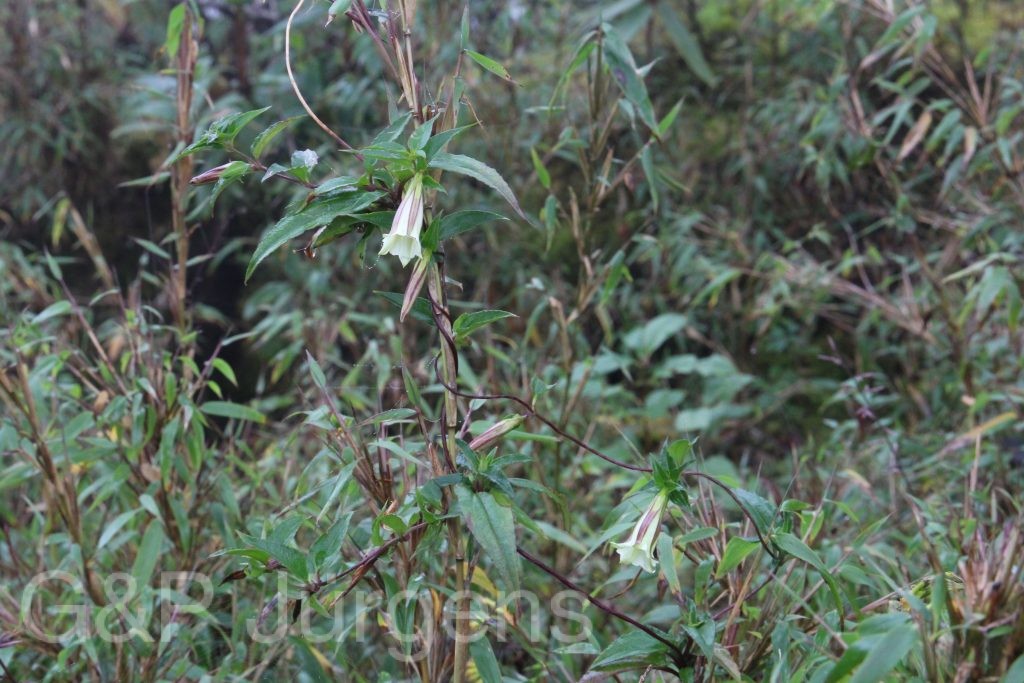
H.Hara

Bhutan2015 23
Bhutan Dochu-La 3000m, October
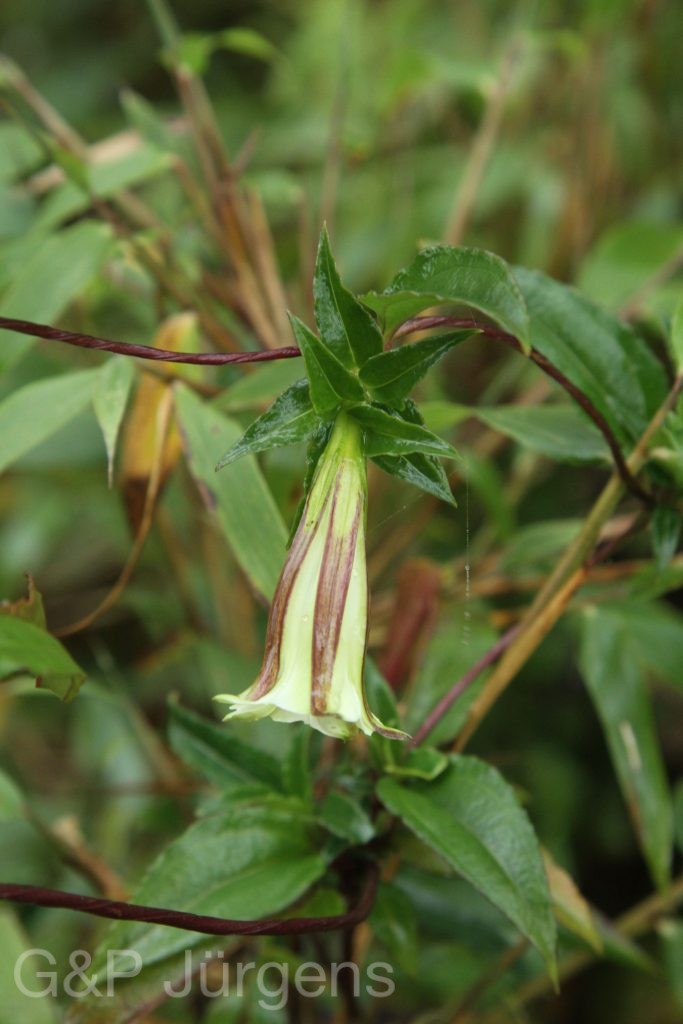
Bhutan2015 25
Bhutan Dochu-La 3000m, October

Description

Tripterospermum nigrobaccatum is an eastern Himalayan twining gentian recorded from Nepal, Bhutan and India, and is among the least-collected taxa in this set with only about 11 GBIF occurrences. It is a forest plant of the temperate zone, scrambling through shaded broadleaved and mixed forest, shrubby margins and mossy banks, broadly between about 2500 and 3500 m. The photograph from the Dochu-La in Bhutan at 3000 m in October reflects its autumn flowering and fruiting, when this well-known forested pass carries a rich understorey flora in the cooling post-monsoon months.

Unlike the erect alpine gentians, it is a slender, herbaceous perennial climber or trailer with twining stems. The leaves are opposite, ovate to lanceolate, acuminate and three- to five-veined, borne on a vine-like stem. The flowers are solitary or few in the leaf axils, with a campanulate to narrowly funnel-shaped corolla that is blue to purplish, the five lobes alternating with small plicate folds in the sinuses as is typical of the Gentianeae. Most diagnostic is the fruit: rather than a dry capsule, Tripterospermum produces a fleshy berry, here ripening black or blackish (the meaning of "nigrobaccatum"), containing flattened, often winged seeds.

The genus Tripterospermum was segregated from Crawfurdia and Gentiana on the basis of its climbing habit, baccate fruit and three-winged or angled seeds, and is centred on East and Southeast Asia. The fleshy fruits suggest at least partial bird dispersal, contrasting with the wind-dispersed capsules of most gentians. Its narrow range and few records make it a plant of biogeographic note, though no formal conservation assessment is established.

Author: H.Hara · Sources: POWO (Kew), GBIF, Flora of Bhutan, Flora of China, Gentianaceae of the World (Ho & Pringle / Struwe)

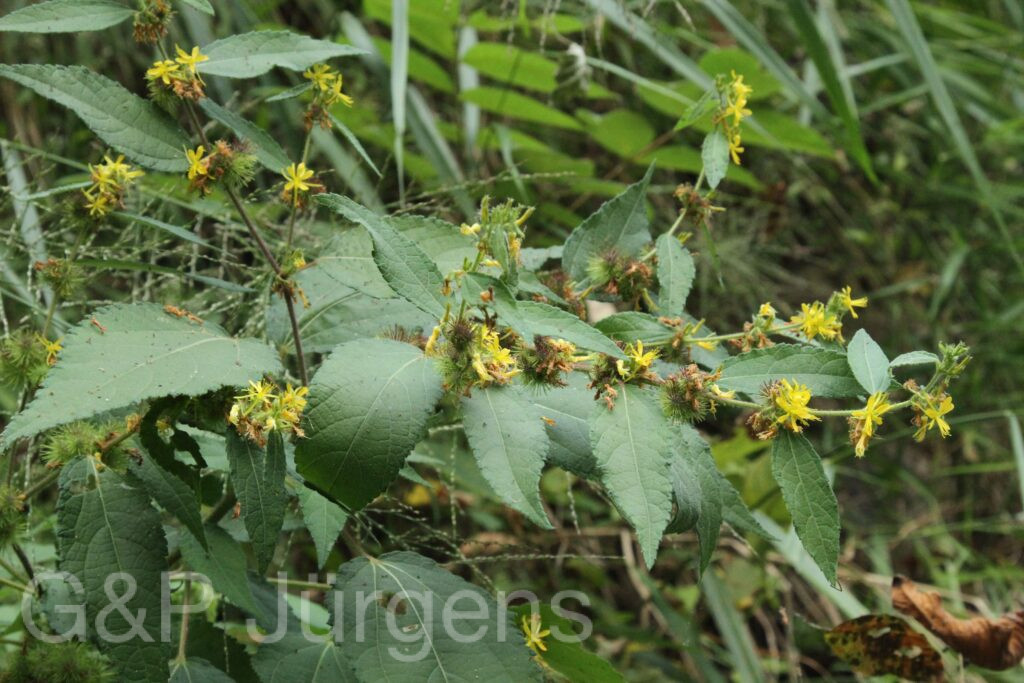
L.

Bhutan2015 280
Bhutan Zhemgang 1000m, October

Description

Triumfetta annua L. is a widespread herb of the Old World tropics and subtropics, with a pantropical distribution that GBIF records across tropical Africa (from Ethiopia and Tanzania to Angola, Zambia and South Africa), Madagascar, and southern and southeastern Asia, including China, Nepal, India, the Philippines, Indonesia, Malaysia and Papua New Guinea. In the Himalaya it is a plant of disturbed ground, forest clearings, roadsides, field margins and warm broad-leaved forest, ascending from the lowlands to around 1,500–2,000 m. The October record from Zhemgang in central Bhutan at 1,000 m typifies its occurrence as a seasonal weed of cultivated and ruderal subtropical habitats.

The species is an erect, branching annual herb up to about 1–1.5 m tall, with stems sparsely covered in stellate or simple hairs. The leaves are alternate, long-petiolate, ovate in outline and frequently three- to five-lobed, with serrate margins, an acuminate apex and palmate venation. Small yellow flowers are borne in leaf-opposed or axillary cymose clusters; each flower has five sepals, five petals, numerous stamens and a superior ovary. The diagnostic fruit is a globose, indehiscent capsule densely covered with hooked, glochidiate spines, a burr adapted for epizoochorous dispersal by adhering to animal fur and clothing.

Formerly placed in Tiliaceae, Triumfetta is now treated within an enlarged Malvaceae (subfamily Grewioideae). Its hooked fruits make it an effective colonist and an occasional agricultural weed across continents, while the bark yields a serviceable bast fibre used locally. The genus is taxonomically complex, and its wide ecological amplitude renders T. annua a classic example of a successful tropical synanthropic species.

Author: L. · Sources: POWO (Kew), GBIF, Flora of China Vol. 12, Flora of Bhutan Vol. 2, Bayer & Kubitzki: The Families and Genera of Vascular Plants Vol. V (Malvaceae)

Lindl.

Description

Trollius acaulis is a dwarf perennial of the high Himalaya, ranging along the alpine belt from Afghanistan and Pakistan through the western and central Himalaya into Nepal, Uttarakhand and Himachal Pradesh, and the western Tibetan Plateau in China. GBIF aggregates 188 georeferenced records, the species being strongest in the north-west. It grows in open alpine turf, moist grassy slopes, screes and snow-melt flushes, typically between 3000 and 4500 m. The plant photographed at Khiar Kutti in Garhwal at 3900 m in June is characteristic, flowering as the snow recedes.

It forms a compact, almost stemless herb arising from a short fibrous-rooted rhizome, the flowering stem reduced so the bloom appears to rest on the foliage (hence acaulis). The basal leaves are long-petiolate and palmately divided into deeply incised, toothed segments, glabrous and somewhat fleshy. The solitary flower is large, broadly cup-shaped and golden-yellow, the petaloid sepals enclosing numerous narrow nectariferous petals and a dense boss of stamens. The fruit is a head of many sessile, longitudinally veined follicles, each beaked and dehiscing ventrally to shed small angular seeds.

Within Ranunculaceae, Trollius (the globeflowers) is allied to Anemone and Ranunculus but set apart by its persistent petaloid sepals and clustered follicles. T. acaulis is among the most reduced, high-altitude members of the genus, its acaulescent habit an adaptation to short seasons, intense insolation and wind exposure. Like its congeners it yields acrid protoanemonin and is unpalatable to stock. Not assessed as threatened, it is nonetheless sensitive to overgrazing and the upward shift of climatic belts.

Author: Lindl. · Sources: POWO (Kew), GBIF, Flora of China Vol. 6, Flora of Pakistan, Flora of Bhutan Vol. 1, Annotated Checklist of the Flowering Plants of Nepal, Doroszewska monograph of the genus Trollius

D.Don

BhutanPG2011 332
Bhutan Jule-Tso 4250m, June

Description

Trollius pumilus is a dwarf globeflower of the high alpine zone of the Himalaya and western China, native to China, Nepal, India and Bhutan, with over 520 georeferenced records (those reported from Europe, Canada and Japan representing cultivated and herbarium material). It grows in moist alpine meadows, on grassy and peaty slopes and beside snow-melt streams, typically between about 3500 and 4800 m. The photographed plant was recorded at Jule-Tso in Bhutan at 4250 m, flowering in June, early in the alpine growing season as snowbeds retreat and the high pastures come into bloom.

The species is a small, tufted perennial herb with a short rhizome and fibrous roots, the basal leaves long-petiolate with palmately three- to five-partite blades, the segments further lobed and toothed. The flowering stems are low, simple and few-leaved, bearing usually a single terminal flower. The flower is shallowly bowl-shaped and does not close into the globe characteristic of some congeners; the five or more petaloid sepals are bright golden-yellow, often flushed purplish or greenish outside, surrounding numerous small linear nectariferous petals (staminodes) and many stamens. The fruit is a cluster of several many-seeded follicles with short beaks.

Trollius, of the family Ranunculaceae and tribe Helleboreae, comprises the globeflowers of northern temperate and alpine regions; T. pumilus is among the smallest, distinguished by its open, single-flowered, low-growing habit. As an early snow-melt alpine it is insect-pollinated and a familiar component of Himalayan high-meadow flora. Widespread and locally abundant, it is of no conservation concern and is occasionally grown as an alpine ornamental.

Author: D.Don · Sources: POWO (Kew), GBIF, Flora of Bhutan, Flora of China, A Monograph of the Genus Trollius (Doroszewska)

(Bruehl) Dorosz.

BhutanPG2011 218
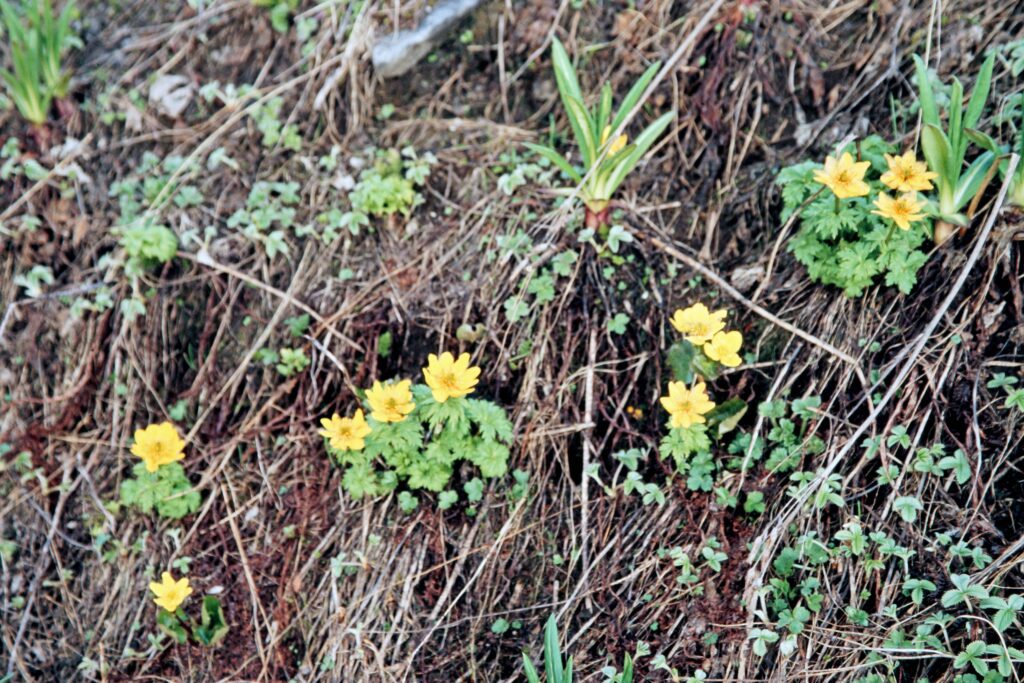
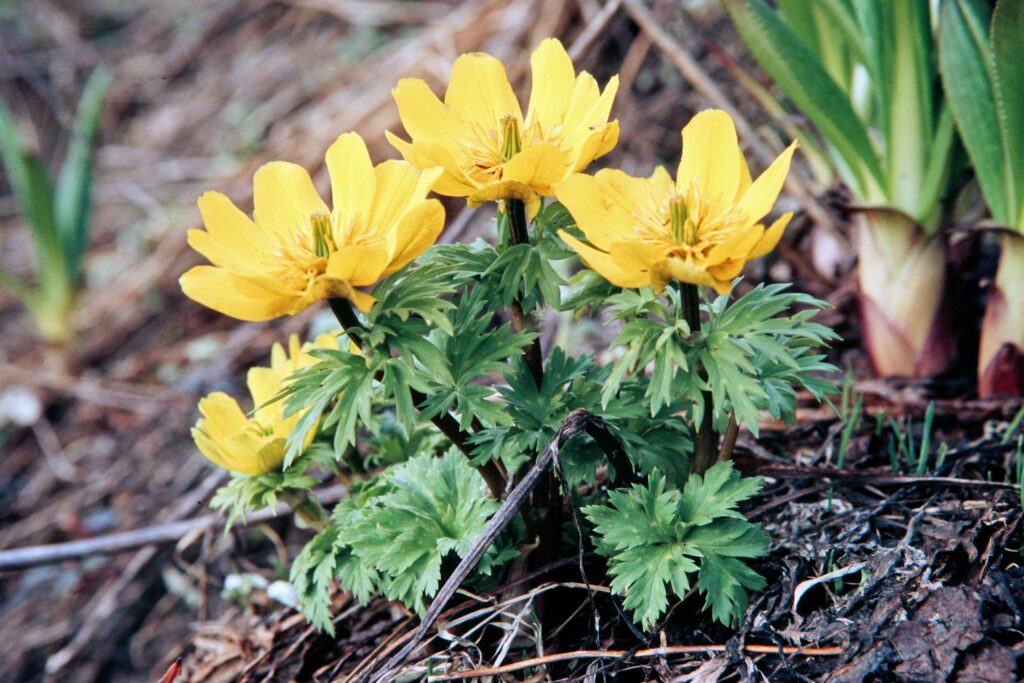
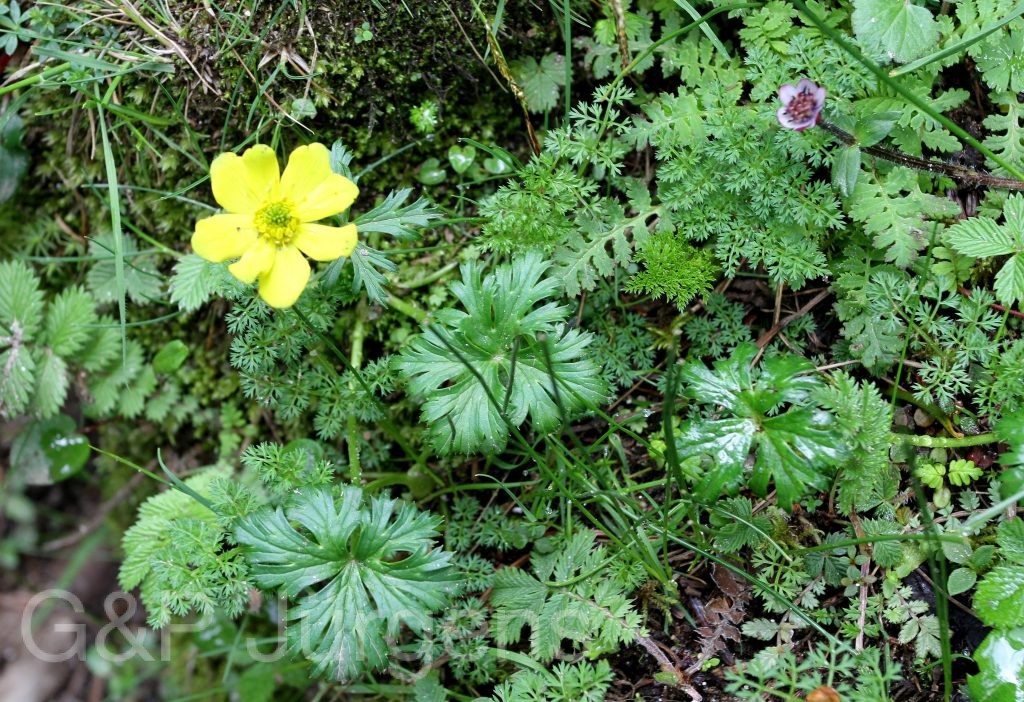
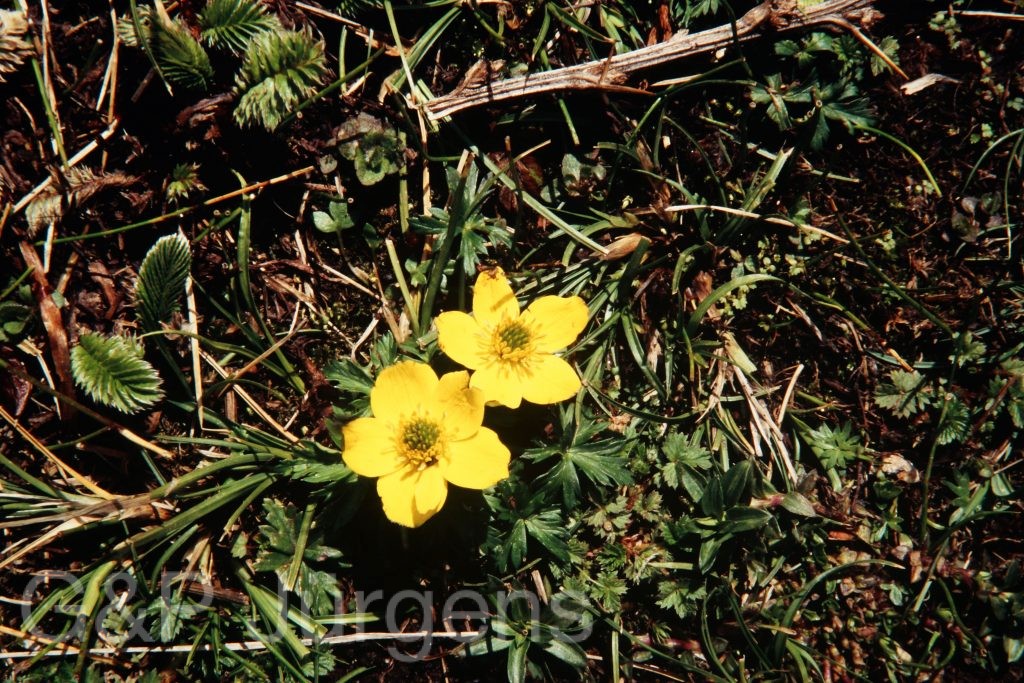
Bhutan Jimilangtso, 4000m June;
also included: Anemone rupestris Hook.f. & Thomson
Bh09 137 P239
Bhutan Jimilangtso, 4000m June

Description

Trollius sikkimensis is a high-alpine globeflower restricted to the eastern and central Himalaya, recorded from Nepal, China, Bhutan and India, with only about 31 georeferenced occurrences indicating a comparatively narrow and incompletely documented range. It inhabits moist alpine meadows, marshy turf, streamsides and the margins of glacial tarns between roughly 3500 and 4500 m. The photographed plants from Jimilangtso in Bhutan at 4000 m, flowering in June, exemplify its damp high-meadow habitat near alpine lakes, where it grows alongside other snowmelt herbs such as the Anemone rupestris noted from the same locality.

It is a glabrous perennial herb arising from a short rhizome, with erect, simple or sparingly branched stems. The basal leaves are long-petioled and palmately divided into deeply cut, toothed segments, the cauline leaves smaller and subsessile. The flowers are large and solitary or few, the showy part formed by several broad, spreading, golden-yellow petaloid sepals that open more widely than in the cupped European globeflowers; within are numerous narrow nectariferous petals and many stamens. The fruit is a head of many-seeded, beaked follicles.

Unlike the closed, globular flowers of Trollius europaeus, the open, saucer-shaped perianth of the Asian species facilitates access by a wider range of alpine pollinators. Trollius sikkimensis is closely allied to other Himalayan and Chinese globeflowers and is distinguished on perianth and follicle characters. Its restricted distribution and dependence on intact alpine wetlands make it potentially sensitive to grazing pressure and climatic warming.

Author: (Bruehl) Dorosz. · Sources: POWO (Kew), GBIF, Flora of Bhutan, Flora of China, Doroszewski's revision of Trollius