Tag:

Nepal

Flowers of Nepal — 1313 wild plant species documented from the Nepalese Himalaya, from subtropical foothills to high alpine meadows above 4,000 m. Nepal’s dramatic elevation gradient makes it one of the richest botanical regions on Earth, home to rhododendrons, primulas, gentians and the famed blue poppies (Meconopsis). Every entry gives a botanical description, native distribution, habitat and flowering season, alongside the original field photograph and the location where it was taken.

(D.Don) Eichler

Nepal 2001 283 ergebnis ergebnis
Nepal (Gorkha) Lambra Kharka 3000m, May

Description

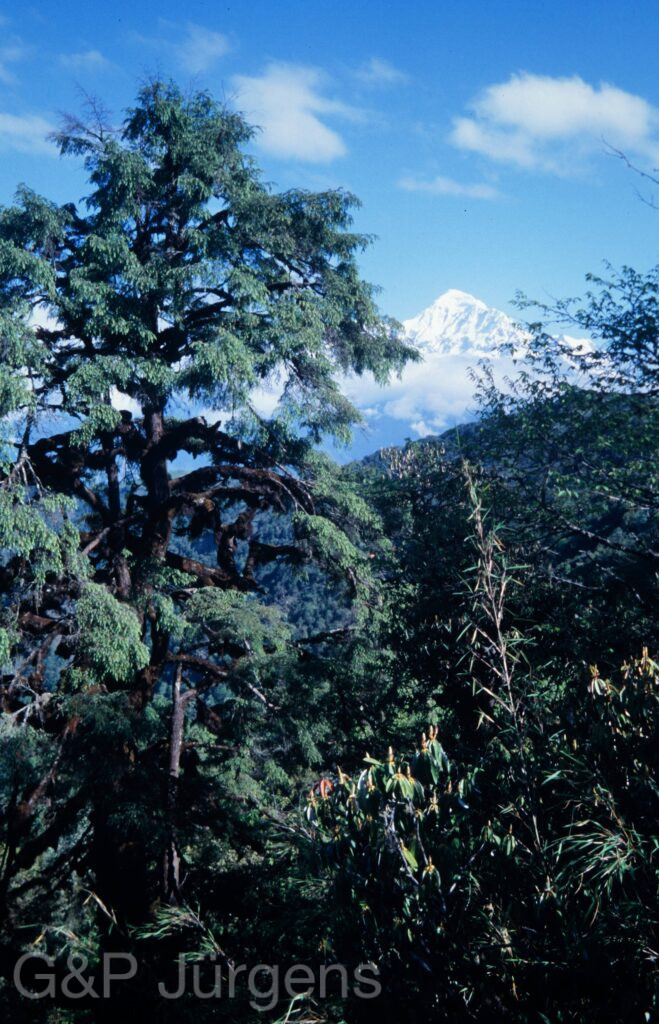
Tsuga dumosa, the Himalayan hemlock, is a large evergreen conifer distributed across the Himalaya from central Nepal eastward through Sikkim, Bhutan, and northeast India into southern China (Xizang, Yunnan, Sichuan, Guizhou), Myanmar, and northern Vietnam. It is a characteristic component of cool temperate and upper montane forests at elevations of 2,000–3,500 m, where it often forms pure stands or grows in association with Abies, Picea, Acer, and Rhododendron species. The species has been documented at Lambra Kharka in the Gorkha district of Nepal at approximately 3,000 m, near the upper limit of its elevational range.
Tsuga dumosa is a tree attaining 25–40 m in height with a trunk up to 1.5 m in diameter, bearing a broadly conical to irregular crown. The bark is dark greyish-brown, deeply fissured and scaly on mature trees. Leaves are linear, flattened, 10–25 mm long and 2–3 mm wide, with a rounded or emarginate apex, dark glossy green above with two conspicuous white stomatal bands beneath, arranged in a pectinate (comb-like) pattern on lateral shoots. Male strobili are small, axillary, and globose. Female seed cones are pendulous, ovoid to oblong, 1.5–2.5 cm long, with thin, rounded cone scales that open at maturity to release two small winged seeds per scale. The cones mature in a single season.
Tsuga dumosa is the sole Himalayan representative of the genus Tsuga, which comprises approximately nine species with a disjunct distribution between eastern Asia and North America. Phylogenetic studies place it sister to the East Asian T. chinensis complex. The species is of considerable ecological importance as a canopy dominant in Himalayan temperate forests, providing critical habitat for epiphytic bryophytes, lichens, and orchids. Its timber is locally valued for construction. While not currently assessed as threatened globally, localized deforestation and climate-driven upward range shifts pose potential concerns for some populations.

Author: (D.Don) Eichler · Sources: POWO (Kew), GBIF, Flora of China Vol. 4, Flora of Bhutan Vol. 1, Farjon: A Handbook of the World's Conifers (2017)
Uraria lagopus

by GP Jürgens

DC.

Bhutan2012 520
Bhutan Wangdi 2800m, September

Description

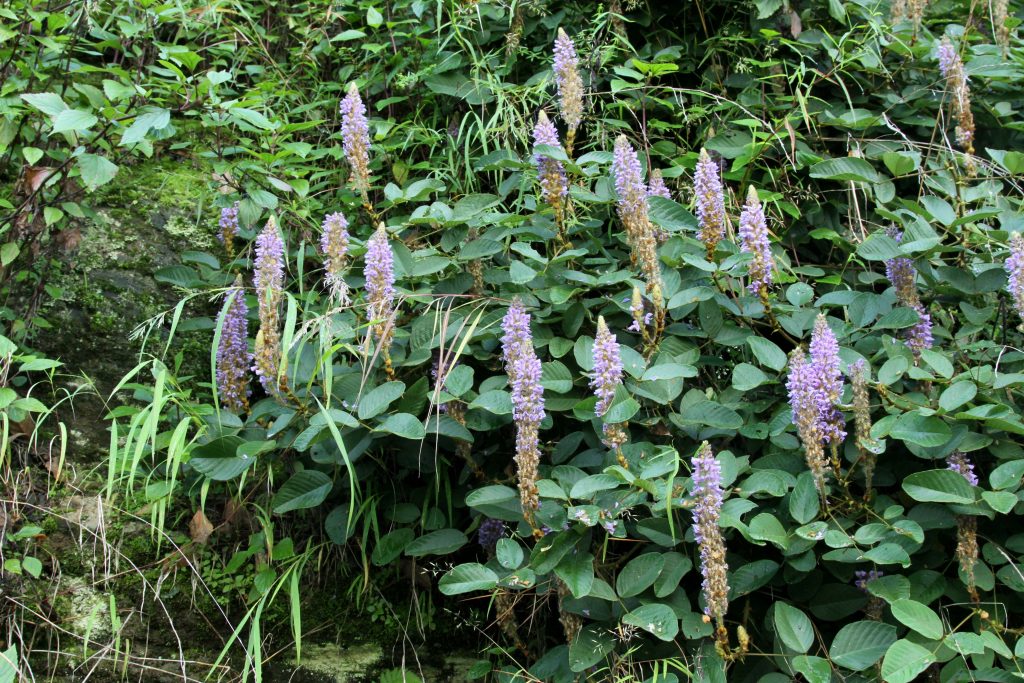
Uraria lagopus is a perennial herb or subshrub widely distributed through the Himalaya, southern China and South and Southeast Asia, recorded from India, China, Nepal, Myanmar, Taiwan, Bhutan, Sri Lanka, Bangladesh and Indonesia, with about 222 occurrences in GBIF. It is a plant of open grassy slopes, scrub, forest margins, roadsides and disturbed sunny ground, ranging from the lowlands into the lower montane zone. The photographed plant was collected in Bhutan near Wangdi (Wangdue) at about 2800 m in September, towards the upper end of its altitudinal range and during the post-monsoon flowering and fruiting season.

The plant produces erect to ascending stems from a woody base, clothed in spreading hairs. The leaves are pinnately compound, usually with three to several leaflets, the leaflets oblong to elliptic, entire, with prominent venation and a hairy underside; stipules are present at the nodes. The flowers are borne in dense, elongate, terminal racemes that are conspicuously shaggy with long hairs, giving the inflorescence the hare's-foot appearance recorded in the epithet lagopus. Each papilionaceous flower is small, pinkish to purplish. The fruit is a small jointed legume (loment) breaking into one-seeded segments at maturity.

Uraria belongs to the tribe Desmodieae of the Fabaceae, a group characterised by loment fruits dispersed as individual articles. Several species, including U. lagopus, are valued in traditional medicine and as fodder, and as legumes they fix atmospheric nitrogen through root-nodule symbiosis with rhizobia, contributing to soil fertility. The species is a tolerant colonist of open and disturbed habitats and is not regarded as threatened across its broad range.

Author: DC. · Sources: POWO (Kew), GBIF, Flora of China, Flora of Bhutan, Legumes of South Asia (Kew)

Oliv.

BhutanPG2011 698 01 01
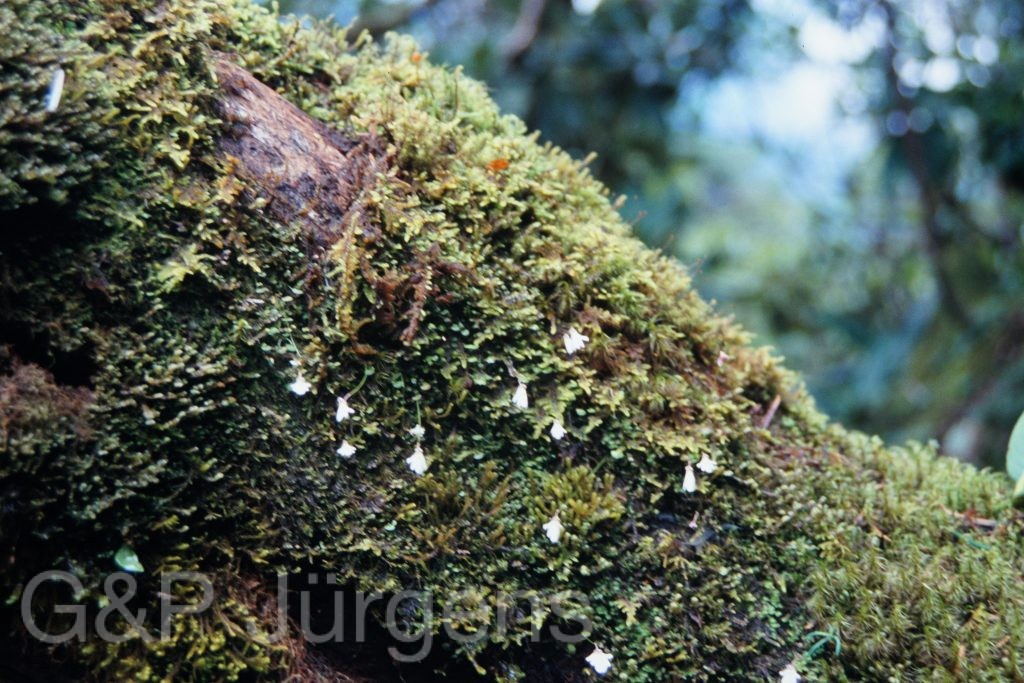
Bhutan Luksor, 2850m July

Description

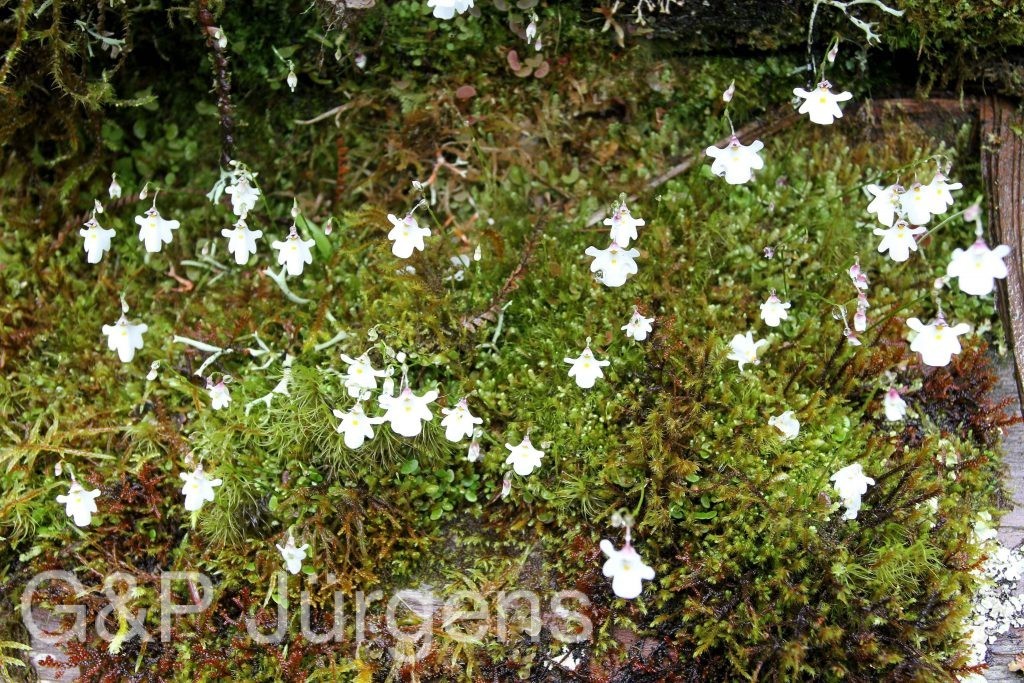
Utricularia brachiata is a small carnivorous herb of the Himalaya and adjacent mountains, recorded by GBIF (about 94 occurrences) from China, India, Nepal, Bhutan, Japan and Myanmar, a relatively modest tally reflecting both its inconspicuous habit and its specialised wet montane habitat. It is a terrestrial to subaquatic species of permanently moist ground: dripping rocks, mossy seepages, wet banks, boggy turf and the margins of springs and streams, generally between 2500 and 4000 m. The plant photographed at Luksor in Bhutan at about 2850 m in July grows in such a damp seepage habitat during the monsoon, the season when high humidity sustains the saturated substrates on which this bladderwort depends.

As in all members of the genus the vegetative body is much reduced and rootless, consisting of fine, thread-like stolons that ramify through the moss and wet soil. Borne on these are minute leaf-like organs and the diagnostic carnivorous traps: tiny bladders (utricles) that capture and digest microscopic soil and water invertebrates through a sophisticated suction mechanism triggered by sensory bristles. The flowering scape is slender and erect, bearing one to few small bilabiate flowers. The corolla is typically white to pale violet or bluish, with a prominent palate and a basal spur, the personate two-lipped form characteristic of the genus and adapted to small insect pollinators. The fruit is a tiny capsule releasing numerous minute seeds.

Lentibulariaceae are wholly carnivorous, and Utricularia, the bladderworts, is the largest and most widespread genus of carnivorous plants, its trap mechanism among the most morphologically refined in the plant kingdom. Carnivory allows U. brachiata to supplement nitrogen and phosphorus in the nutrient-poor, leached, waterlogged substrates it occupies, an adaptive strategy that defines its narrow ecological niche. Though not assessed as globally threatened, its dependence on intact high-altitude wetland seepages renders it locally sensitive to hydrological disturbance, drainage and the disruption of mountain spring systems.

Author: Oliv. · Sources: POWO (Kew), GBIF, Flora of China Vol. 19, Flora of Bhutan Vol. 2, Flora of Nepal, Taylor The Genus Utricularia: A Taxonomic Monograph

P. Taylor

Sikkim2003 80 P111
India Sikkim Choka 3100m, August

Description

Utricularia christopheri P.Taylor is a small terrestrial bladderwort of the Lentibulariaceae, narrowly restricted to the eastern Himalaya. The very sparse GBIF record (only 14 occurrences) reflects its rarity and confined distribution across Nepal, north India, and Bhutan. It was photographed in Sikkim at Choka at 3,100 m in August, during the monsoon flowering season, in seepage-wet alpine and subalpine ground. The species grows on damp, mossy rocks, wet humic soil, and dripping banks at high elevations, where constant moisture sustains its carnivorous habit.

The plant is a diminutive, rootless herb with slender, creeping rhizoid stolons bearing numerous minute bladder-traps that capture protozoa and small soil invertebrates. The vegetative parts are inconspicuous, with small spathulate leaves. The flowering scape is erect and slender, bearing one to a few comparatively large violet to purplish flowers; the corolla is two-lipped and spurred, the lower lip prominent, distinguishing christopheri within the section to which it belongs by its floral proportions and high-montane ecology.

Utricularia, the largest carnivorous plant genus, is divided into numerous sections, and christopheri belongs to a small group of Himalayan terrestrial species. Its extreme rarity, narrow elevational band, and dependence on permanently wet microhabitats make it potentially vulnerable to hydrological disturbance and climate change, although its remoteness affords some protection. The species remains poorly collected, and its full range is likely undersampled.

Author: P. Taylor · Sources: POWO (Kew), Flora of Bhutan Vol. 2, Flora of Nepal, GBIF, Taylor: The Genus Utricularia – A Taxonomic Monograph (1989)

Hook. f. & Thomson ex C.B. Clarke

Bh2008 392 G607
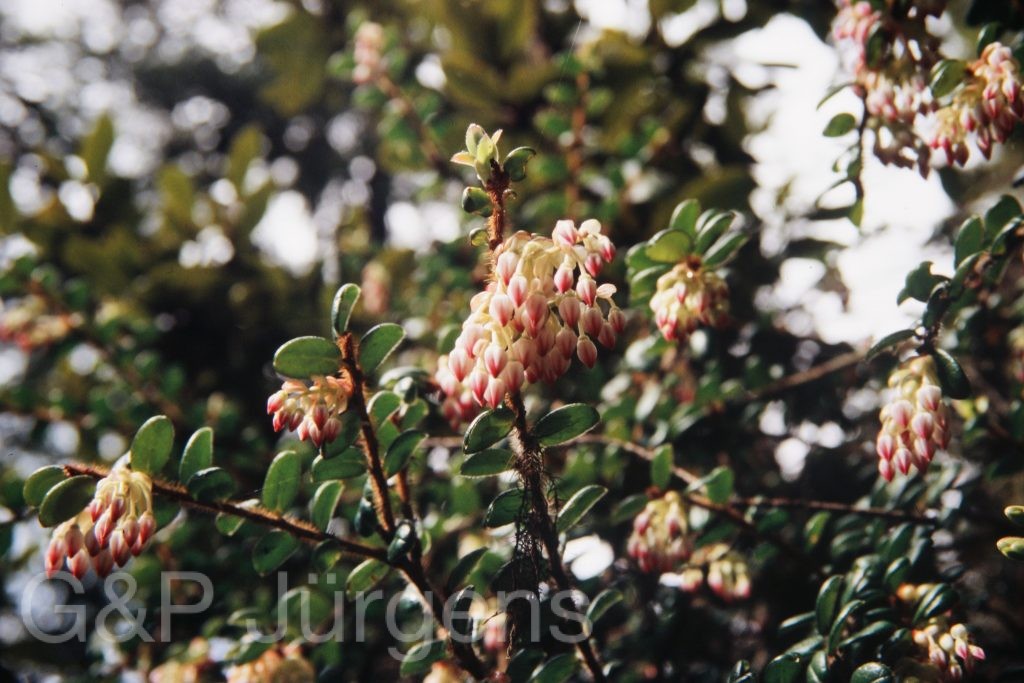
Bhutan Gogona 3250m, May
Vaccinium nummularia
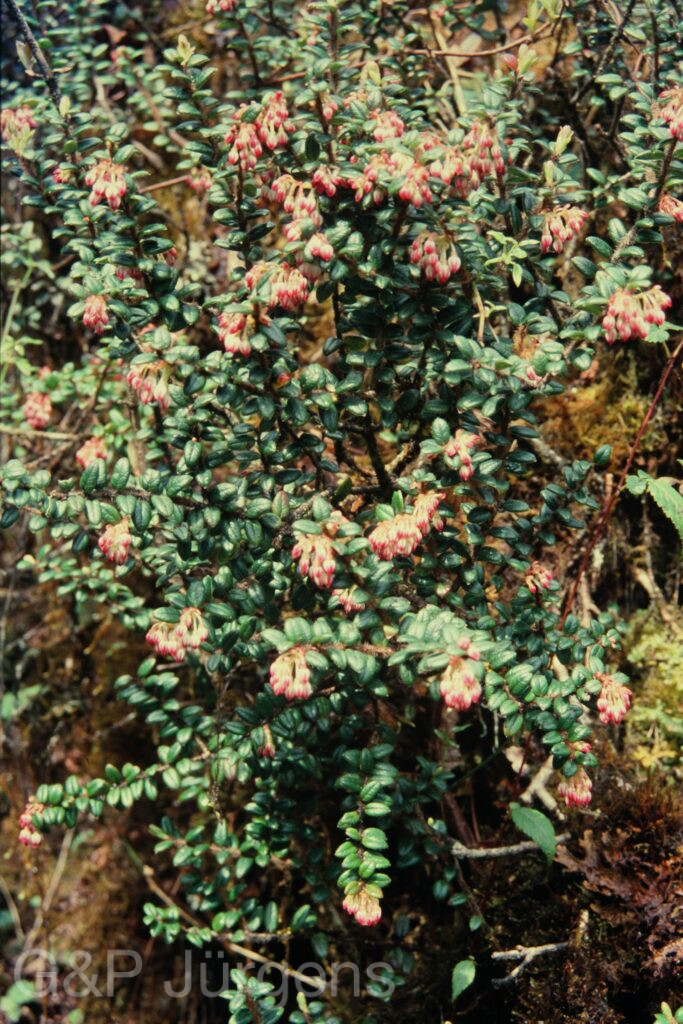
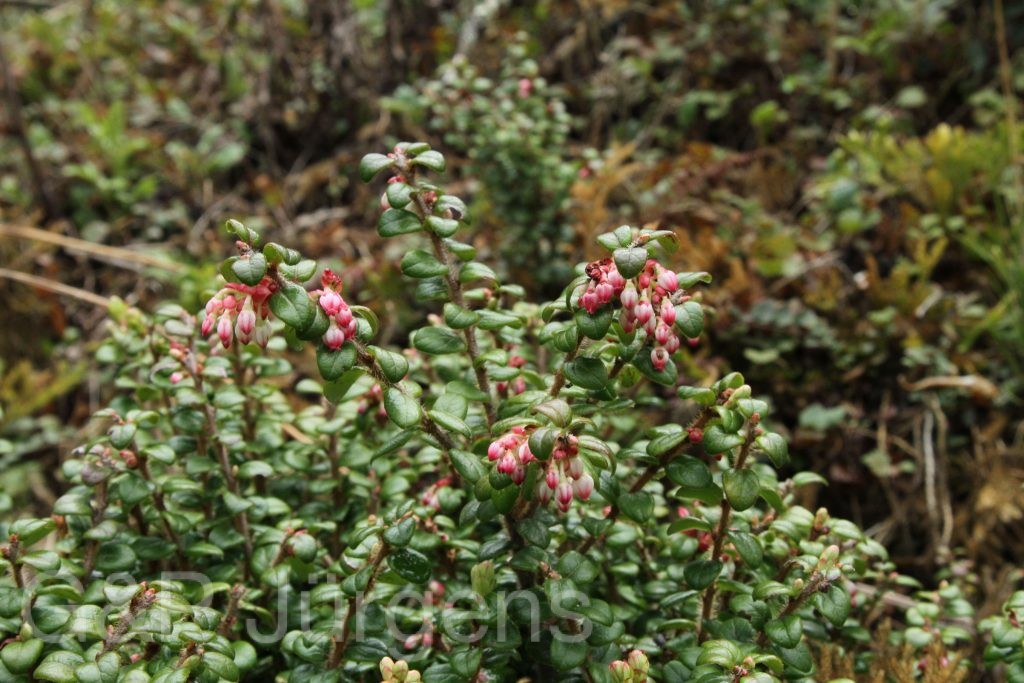
Sikkim West-Bengal, Bersay 2700m April

Description

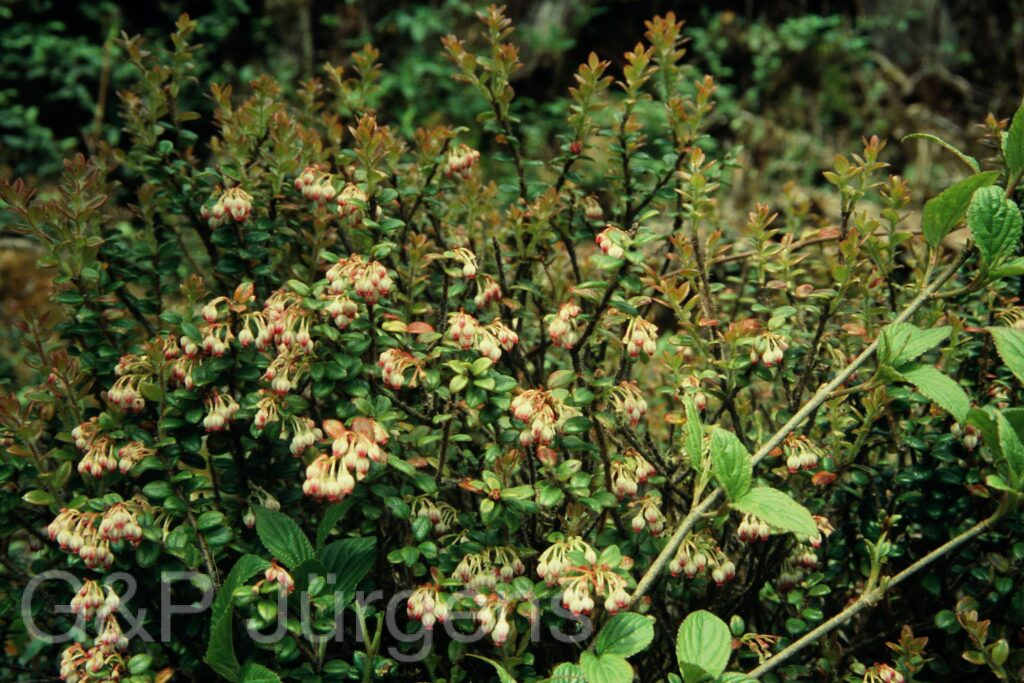
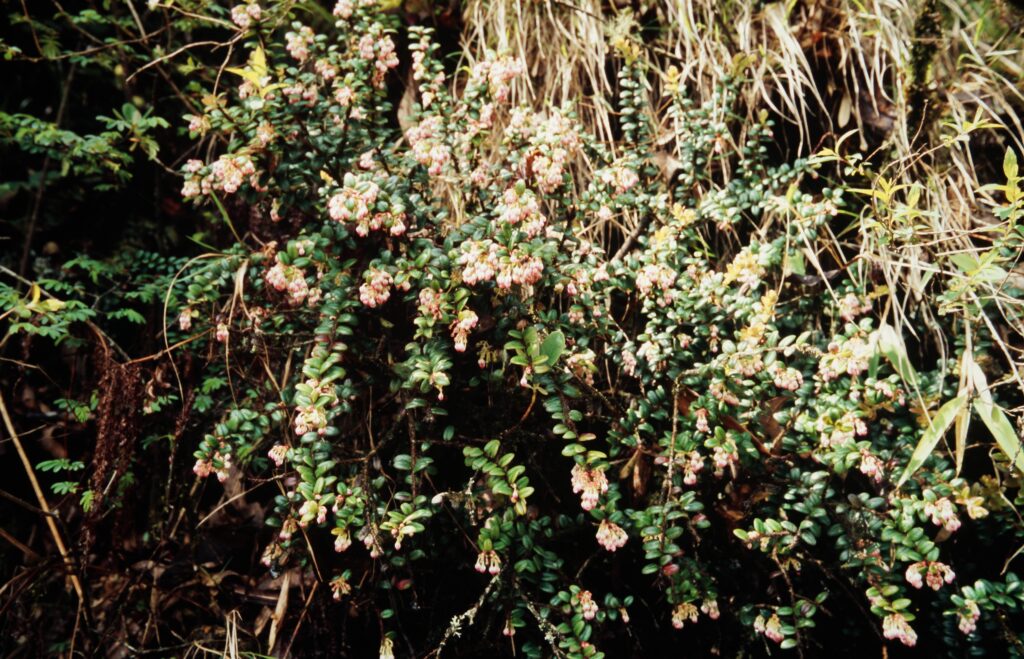
Vaccinium nummularia is an eastern Himalayan blueberry relative distributed through Nepal, northern India, Bhutan, south-central China and Myanmar, with around two hundred and ten GBIF records (a few cultivated or herbarium entries from Britain and the United States reflecting its horticultural interest). It is a characteristic epiphyte or terrestrial shrub of moist temperate forest, growing on mossy tree trunks, banks and cliff faces in the cloud-forest belt. The illustrated plants from Gogona in Bhutan at 3250 m in May and from Bersay in the Sikkim/West Bengal hills at 2700 m in April typify its mid- to upper-temperate, high-humidity habitat.

The species is a low, much-branched evergreen shrub whose young stems and leaf undersides are conspicuously clad in stiff, brown, bristly hairs (setae). The leaves are small, ovate to orbicular, coriaceous and nearly sessile, distichously arranged, with finely serrulate, setose margins, the rounded outline giving rise to the epithet nummularia ('coin-like'). The flowers are borne in short axillary racemes; the corolla is urceolate (urn-shaped), red to pink and waxy, with a small five-lobed limb, and the calyx, ovary and pedicels are likewise setose. The fruit is a globose, purplish-black, edible berry.

Vaccinium nummularia is an accepted species within Vaccinium (Ericaceae, subfamily Vaccinioideae), allied to the setose-leaved Himalayan epiphytic blueberries. Its epiphytic habit, leathery setose leaves and bird-dispersed berries are adaptations to the humid, mossy cloud-forest canopy, and it is cultivated by specialist growers for its handsome bristly foliage and red urn-shaped flowers. The species is locally common and not assessed as threatened, but it depends on intact, humid temperate forest.

Author: Hook. f. & Thomson ex C.B. Clarke · Sources: POWO (Kew), GBIF, Flora of China, Flora of Bhutan, Sleumer revision of Asian Vaccinium (Ericaceae monograph)

(Griff.) Hook. f. ex C.B. Clarke

Bhutan2014 576
Bhutan Bhutan 2950m, May
Sikkim2004 71 G163
Sikkim West-Bengal, Bersay 2700m April
Sikkim 2006 20 ergebnis
India West-Bengal Tonglu 3100m, May

Description

Vaccinium retusum is an evergreen Himalayan shrub distributed through Nepal, India, Bhutan and into adjacent China and northern Indochina (NP, IN, BT, VN, CN, MM, LA, with cultivated and other records), amounting to some 254 occurrences. It is a plant of cool, humid temperate forest, growing as a shrub or small tree among Rhododendron, oak and conifer woodland, on mossy banks and forest margins, and frequently as an epiphyte or hemi-epiphyte on the limbs of larger trees. The cited gatherings span 2700 to 3100 m in Bhutan, Sikkim and the Darjeeling hills of West Bengal (Bersay, Tonglu), flowering in the April-May spring, an elevation and season typical of its occurrence in the mist-laden middle-montane belt.

The plant is a glabrous, much-branched shrub with reddish young shoots. The leaves are leathery and evergreen, elliptic to obovate with a characteristically retuse or emarginate apex from which the epithet derives, the margins entire or finely toothed and the venation reticulate beneath. The flowers are borne in short axillary racemes; the corolla is urceolate (urn-shaped) and white to pinkish, with a five-toothed limb, enclosing the included stamens whose anthers bear terminal tubules. The fruit is a globose, many-seeded berry, ripening dark purple-black and crowned by the persistent calyx.

Vaccinium (the blueberry and bilberry genus, tribe Vaccinieae of the Ericaceae) is richly developed in the Sino-Himalayan region, where many species are epiphytic. The urceolate corolla and inferior, berried ovary are diagnostic, and the flowers are pollinated by bees attracted to nectar. The fleshy berries are dispersed by birds, accounting for the establishment of epiphytic seedlings high in the forest canopy. Widespread and locally common, V. retusum is not considered threatened, though it depends on the persistence of intact temperate broadleaf forest.

Author: (Griff.) Hook. f. ex C.B. Clarke · Sources: POWO (Kew), GBIF, Flora of Bhutan, Flora of China, The Genus Vaccinium (Sleumer monograph of Asian Vaccinieae)

(Roxb.) Sleumer

Nepal 97 77 P127
Nepal above Meta-Khola 1850m April
Nepal 97 90 P151
Nepal above Meta-Khola 1850m April

Description

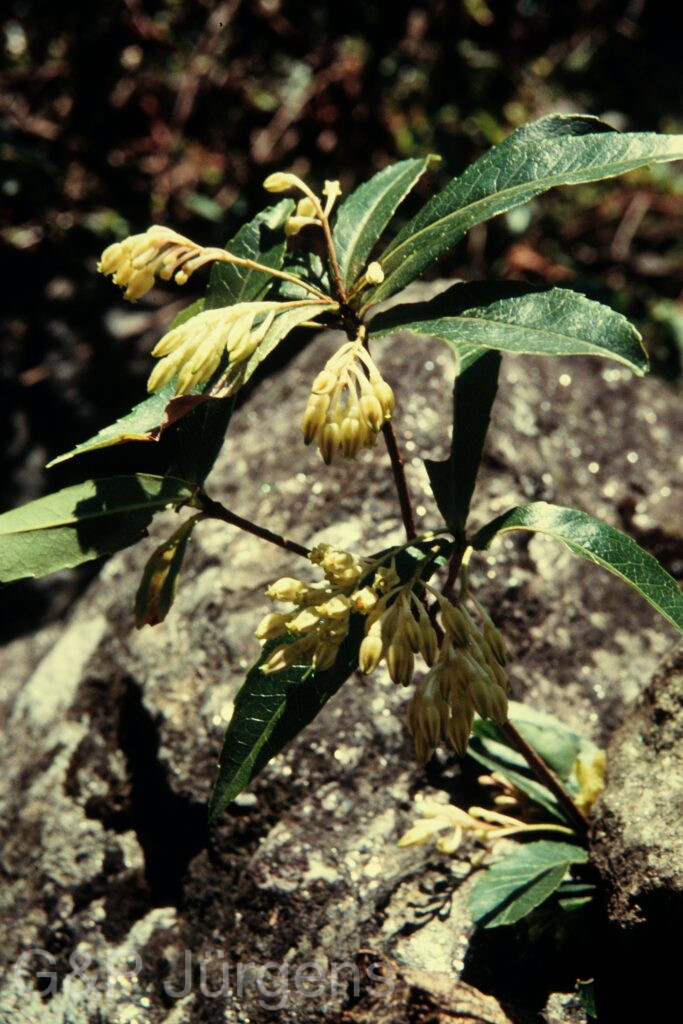
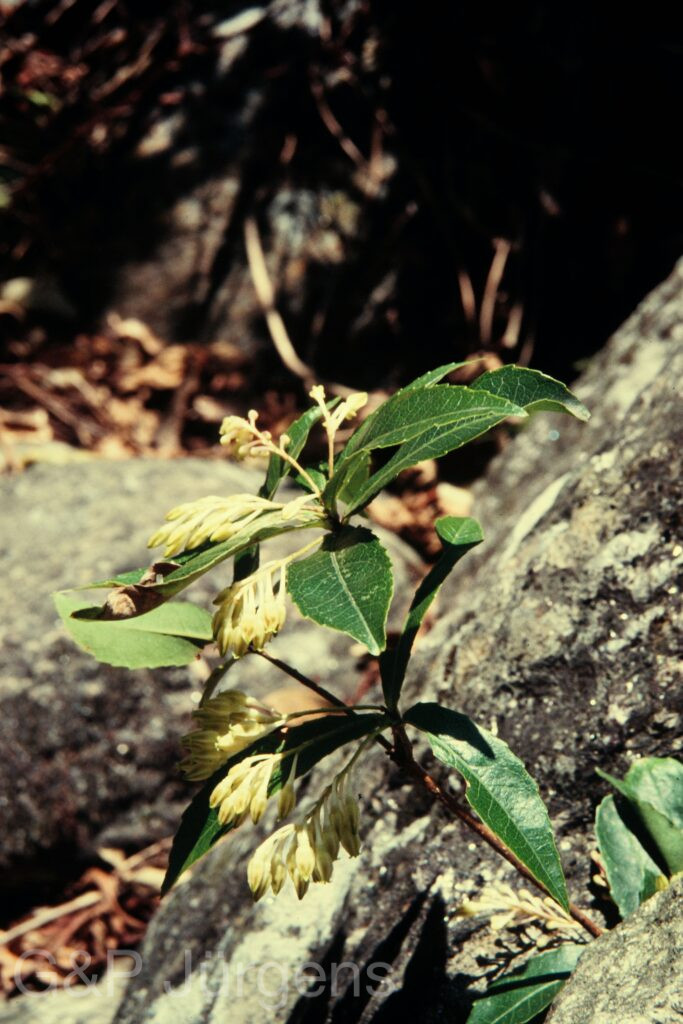
Vaccinium vacciniaceum is a shrub of the eastern Himalaya and adjoining ranges, recorded by GBIF from India, Nepal, Bhutan, China, Myanmar and Bangladesh across about 187 occurrences. It is characteristically epiphytic or lithophytic, growing on the trunks and branches of forest trees and on mossy rocks in humid temperate and subtropical broad-leaved and evergreen forest, typically between roughly 1500 and 2700 m. The plant photographed above the Meta-Khola in Nepal at about 1850 m, in April, reflects this moist mid-montane forest habitat where high humidity and abundant epiphytic moss support its growth.

The plant is a small, much-branched evergreen shrub, often pendent or scrambling when epiphytic, with a somewhat woody, swollen base. The leaves are alternate, leathery, elliptic to ovate-lanceolate, with an acuminate apex, an entire or finely serrulate margin, and prominent venation. The flowers are borne in short axillary racemes and are urceolate (urn-shaped), the corolla white to pale pink with five short recurved lobes, subtended by small bracts; the stamens have awned anthers opening by terminal pores, as is typical of the genus. The fruit is a small globose berry, ripening dark and fleshy, attractive to birds that disperse the numerous tiny seeds.

The species, transferred to Vaccinium by Sleumer in his comprehensive treatment of Asian Ericaceae, belongs to the largely epiphytic Sino-Himalayan element of the genus. Its epiphytic habit and dependence on humid, moss-rich forest tie it closely to intact, well-shaded montane woodland, and the fleshy berries indicate ornithochorous dispersal. Although not formally assessed as threatened, epiphytic Vaccinium are sensitive to forest clearance and to declines in the canopy humidity on which their establishment depends.

Author: (Roxb.) Sleumer · Sources: POWO (Kew), GBIF, Flora of China, Flora of Bhutan, Sleumer revision of Asian Vaccinium (Ericaceae), Annotated Checklist of the Flowering Plants of Nepal

(Roth) Kuntze

Bhutan2014 231 1
Bhutan Karu-Chu 1800m, May
Bhutan2014 234
Bhutan Karu-Chu 1800m, May
Nepal 97 28 P45
Nepal Dhoban 735m April

Description

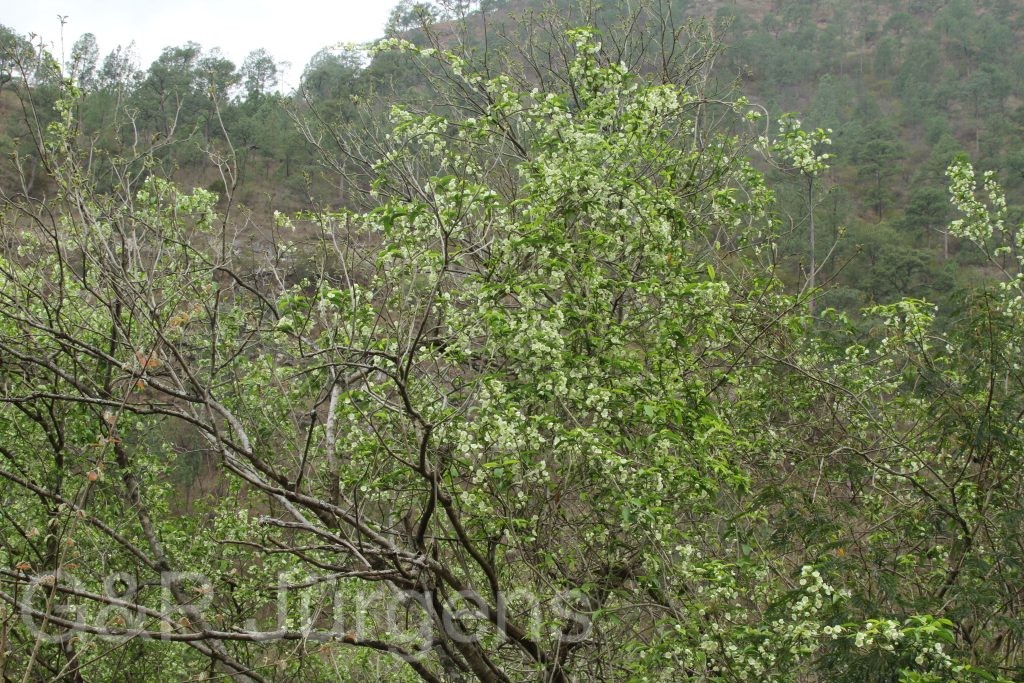
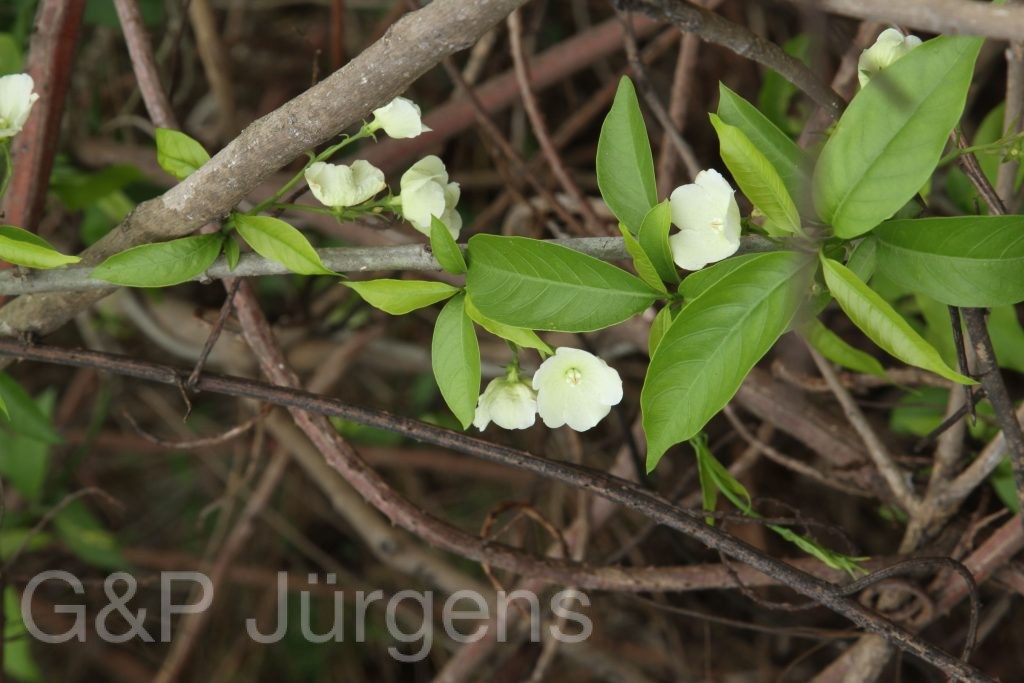
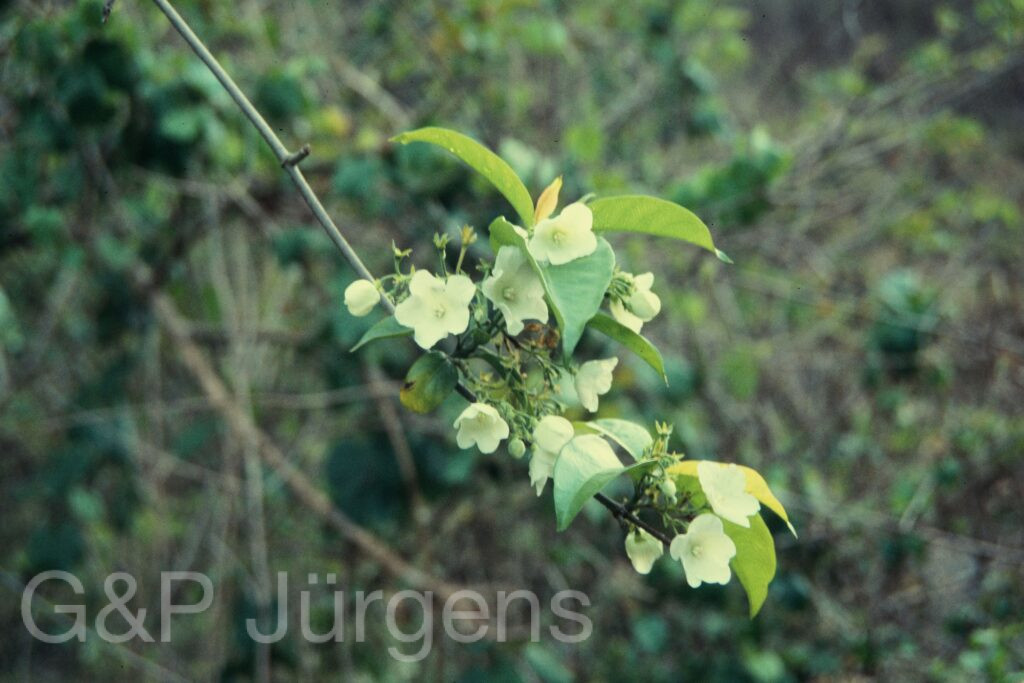
Vallaris solanacea is a woody climber of tropical and subtropical Asia, broadly distributed from the Indian subcontinent and the Himalayan foothills through Indochina, southern China and the Malesian region (gbif_countries: IN, TH, CN, NP, MM, US, ZZ, LK, MY, GP, KH, LA, BD, BT, VN, ID, PK, SC), with GBIF documenting some 536 occurrences. It grows in lowland and submontane forests, thickets, riverine scrub and forest margins, often scrambling over shrubs and small trees. The illustrated gatherings range from Dhoban in Nepal at about 735 m, flowering in April, up to Karu-Chu in Bhutan near 1800 m in May, reflecting its preference for warm, humid lower hill country.

The plant is a glabrous to finely pubescent liana with milky latex and opposite, elliptic to ovate leaves that are entire, pinnately veined and shortly petiolate. The flowers are borne in axillary or terminal cymes and are fragrant, with a white, rotate to broadly campanulate corolla bearing five spreading lobes, the throat marked with hairy appendages; the floral form recalls a Solanum, the resemblance enshrined in the epithet. The androecium consists of five stamens with connivent anthers adhering to the stigmatic head, and the fruit is a pair of slender, spreading follicles releasing comose seeds adapted to wind dispersal.

A member of subfamily Apocynoideae, Vallaris is a small Indomalayan genus of latex-bearing twiners. V. solanacea is locally valued as an ornamental for its sweetly scented blossoms and is used in traditional medicine, while its latex and tissues, like those of many Apocynaceae, contain bioactive compounds. Widespread and adaptable, it is of no conservation concern across its extensive range.

Author: (Roth) Kuntze · Sources: POWO (Kew), GBIF, Flora of Nepal, Flora of China, Flora of British India, Flora Malesiana account of Apocynaceae

Griff.

Bhutan2014 121
Bhutan Trashigang 1550m, May
Bhutan2014 122
Bhutan Trashigang 1550m, May

Description

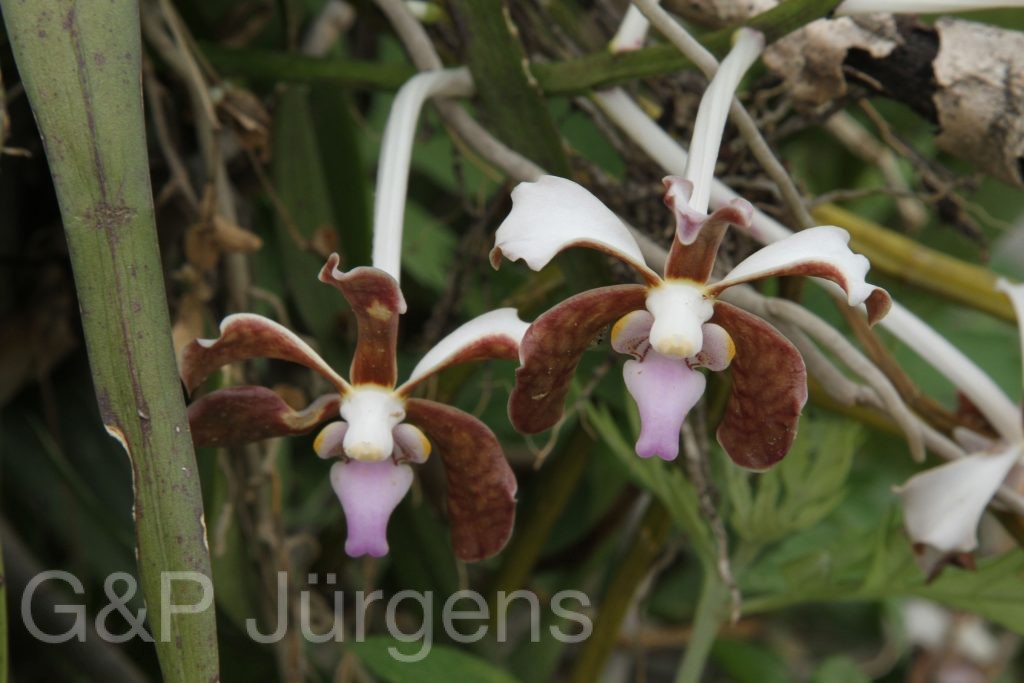
Vanda bicolor is a comparatively rare epiphytic orchid of the eastern Himalaya, known from Bhutan, north-east India, Nepal and adjacent southern China, with GBIF recording only about 35 occurrences that underline its localised distribution. It grows on the trunks and larger limbs of trees in warm-temperate to subtropical broad-leaved forest, generally at lower-montane elevations between roughly 1000 and 1800 m, in humid, partially shaded conditions. The illustrated plant from Trashigang in eastern Bhutan at 1550 m, flowering in May, is typical of the foothill forests where the species reaches its centre of abundance.

A monopodial epiphyte, it forms a stout, erect to ascending stem clothed in two ranks of strap-shaped (ligulate), leathery, channelled leaves with unequally bilobed, praemorse tips, and produces thick aerial roots. The inflorescence is a short, few- to several-flowered axillary raceme of large, fleshy, fragrant flowers. As the epithet indicates, the flowers are bicoloured: sepals and petals are broad, somewhat clawed and tessellated or flushed brownish over a paler ground, contrasting with the small, trilobed, spurred labellum. The fruit is an elongate, ribbed dehiscent capsule containing copious minute seeds.

Vanda comprises strap-leaved monopodial orchids of tropical Asia, within which V. bicolor is set apart by its flower colouration and labellum structure. Like all Vanda it is listed on CITES Appendix II, and its naturally restricted range, low population density and desirability to collectors make it vulnerable to habitat loss and illegal trade, warranting careful local protection.

Author: Griff. · Sources: POWO (Kew), GBIF, Flora of Bhutan, Orchids of Bhutan, Genera Orchidacearum (Pridgeon et al.)

Vanda cristata

by GP Jürgens

Wall. ex Lindl.

Nepal 1994 224 ergebnis
Ost-Nepal Mewa-Khola 1900m April 

Description

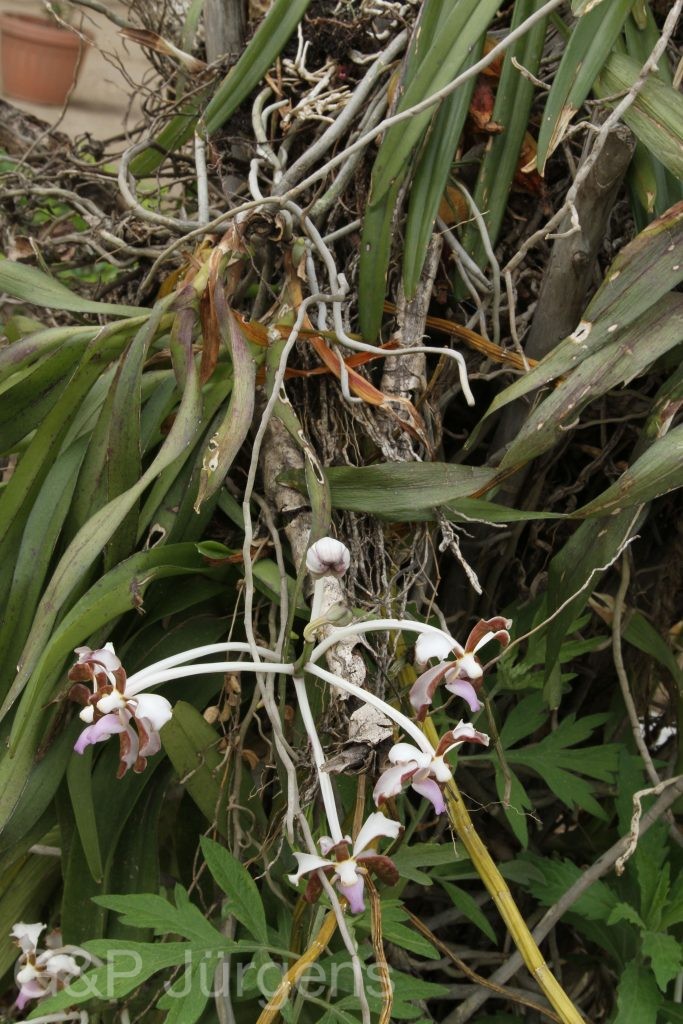
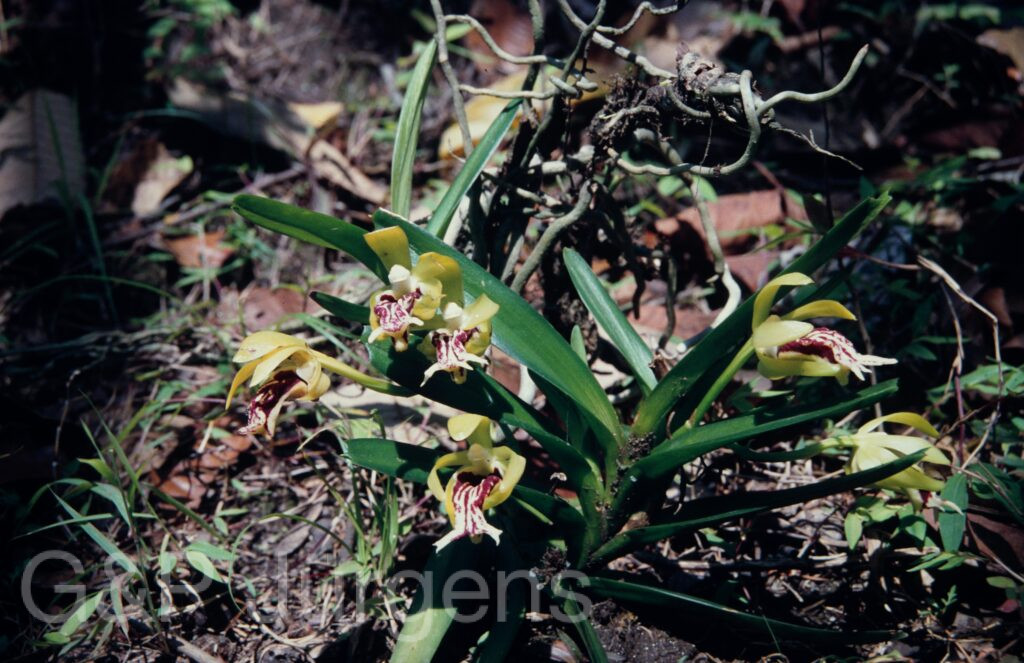
Vanda cristata is an epiphytic orchid distributed along the Himalaya from northern India through Nepal and Bhutan into southwestern China, with cultivated and naturalised records reflected in the GBIF dataset (136 occurrences across NP, IN, BT, CN and horticultural reports from CR, DE, TH and US). It inhabits humid, broad-leaved and mixed evergreen forest belts, growing as a twig and trunk epiphyte in dappled light, typically at montane elevations between roughly 1200 and 2200 m. The plant photographed in eastern Nepal in the Mewa Khola valley at about 1900 m in April illustrates its characteristic flowering during the pre-monsoon dry season, when cooler nights and high atmospheric humidity prevail.

The species is a compact, monopodial epiphyte with a short, erect stem clothed in the persistent imbricate bases of distichous leaves. The leaves are linear-ligulate, coriaceous, channelled above and unequally bilobed at the apex. Few-flowered racemes arise laterally from the leaf axils, bearing one to several long-lasting, waxy, fragrant flowers. The sepals and petals are yellowish-green, oblong and somewhat reflexed, while the three-lobed labellum is the diagnostic feature: the small lateral lobes flank a prominent fleshy mid-lobe marked with crimson to maroon longitudinal striations, narrowing to a sharply forked or bristled apex. The short column bears a terminal anther with waxy pollinia.

Within Vanda, V. cristata belongs to a group of small-statured, cool-growing Himalayan species and is sometimes placed in the segregate genus Trudelia, a treatment not adopted by POWO. Pollination is by bees attracted to the patterned labellum, and the long flowering period favours outcrossing. As with most showy Vanda species it is subject to horticultural collection pressure, and although not formally assessed as threatened it is protected under CITES Appendix II governing international trade in wild-collected orchids.

Author: Wall. ex Lindl. · Sources: POWO (Kew), GBIF, Flora of Nepal, Flora of Bhutan, Flora of China, The Genus Vanda (Motes)