Lindl.
Description
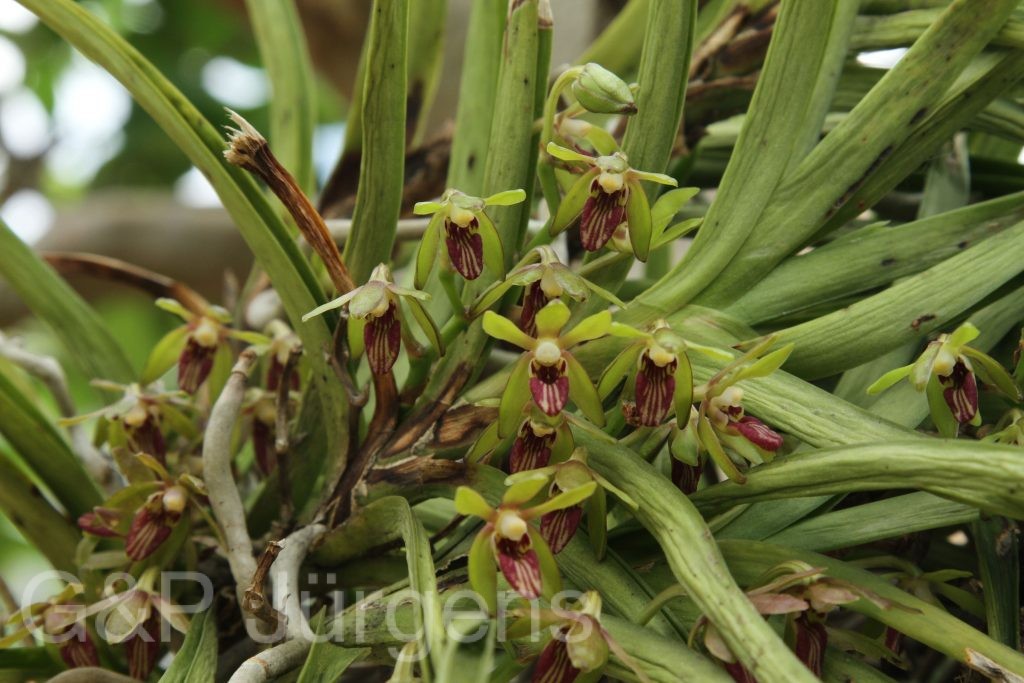
Vanda griffithii is an epiphytic orchid of the eastern Himalaya, documented in GBIF from Bhutan, India and Nepal across a modest 19 occurrences, reflecting both its localised distribution and the under-collection of canopy epiphytes. It inhabits warm to cool broad-leaved forest, growing on tree trunks and branches at low to mid elevations, roughly 700-1800 m. The photographed plant was recorded in Bhutan at Trithangebe, perched near a farmhouse at about 700 m in May, illustrating its tolerance of disturbed and semi-cultivated settings where suitable phorophytes persist.
It is a monopodial epiphyte with a short to elongate stem clothed in distichous, ligulate, leathery leaves that are channelled and obliquely praemorse (toothed) at the apex, with stout aerial roots anchoring the plant. The inflorescence is a short axillary raceme of a few fleshy, long-lived flowers; the sepals and petals are subequal, spreading, typically greenish-yellow to brownish and often barred or tessellated, while the small three-lobed labellum bears a saccate or shortly spurred base characteristic of the genus. The column is short and footless, with a beaked anther cap and waxy pollinia, and fertilised flowers develop into an elongate, ribbed capsule releasing dust-like seeds.
Vanda (Orchidaceae, subtribe Aeridinae) is a horticulturally celebrated genus of monopodial epiphytes, and like all orchids it is listed on CITES Appendix II, regulating international trade. Reproduction depends on specific pollinators and mycorrhizal fungi for seed germination. Its narrow Himalayan range and reliance on intact forest canopy render it vulnerable to deforestation and over-collection for the ornamental trade.
Author: Lindl. · Sources: POWO (Kew), GBIF, Flora of Bhutan, The Orchids of Bhutan, CITES Appendix II listing, Genera Orchidacearum