Tag:

Nepal

Flowers of Nepal — 1313 wild plant species documented from the Nepalese Himalaya, from subtropical foothills to high alpine meadows above 4,000 m. Nepal’s dramatic elevation gradient makes it one of the richest botanical regions on Earth, home to rhododendrons, primulas, gentians and the famed blue poppies (Meconopsis). Every entry gives a botanical description, native distribution, habitat and flowering season, alongside the original field photograph and the location where it was taken.

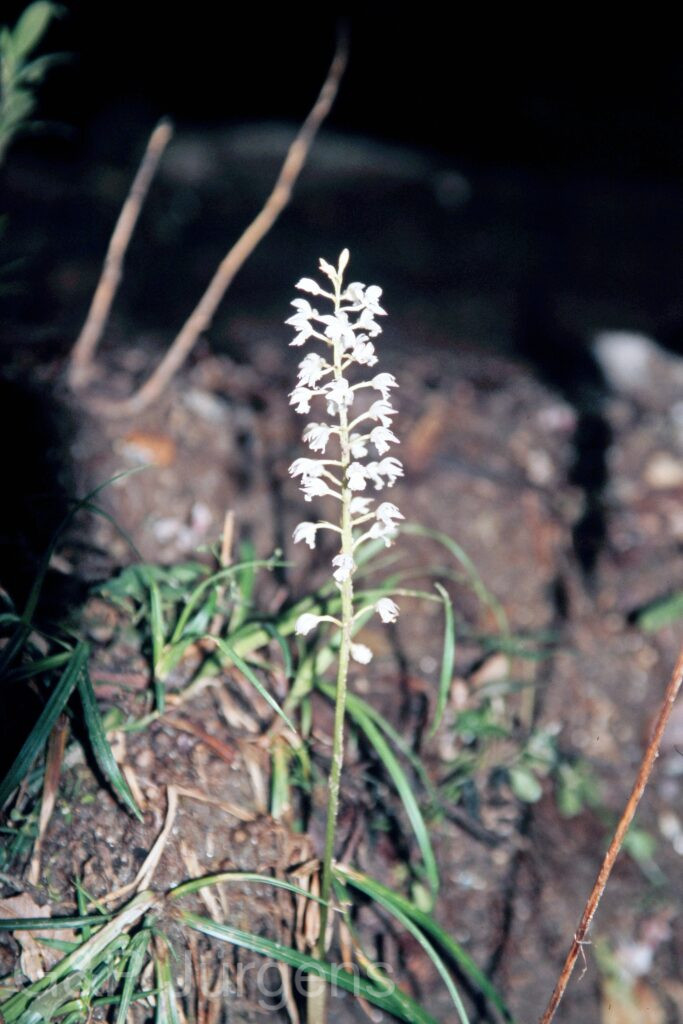
Lindl.

Garh 07 88 ergebnis
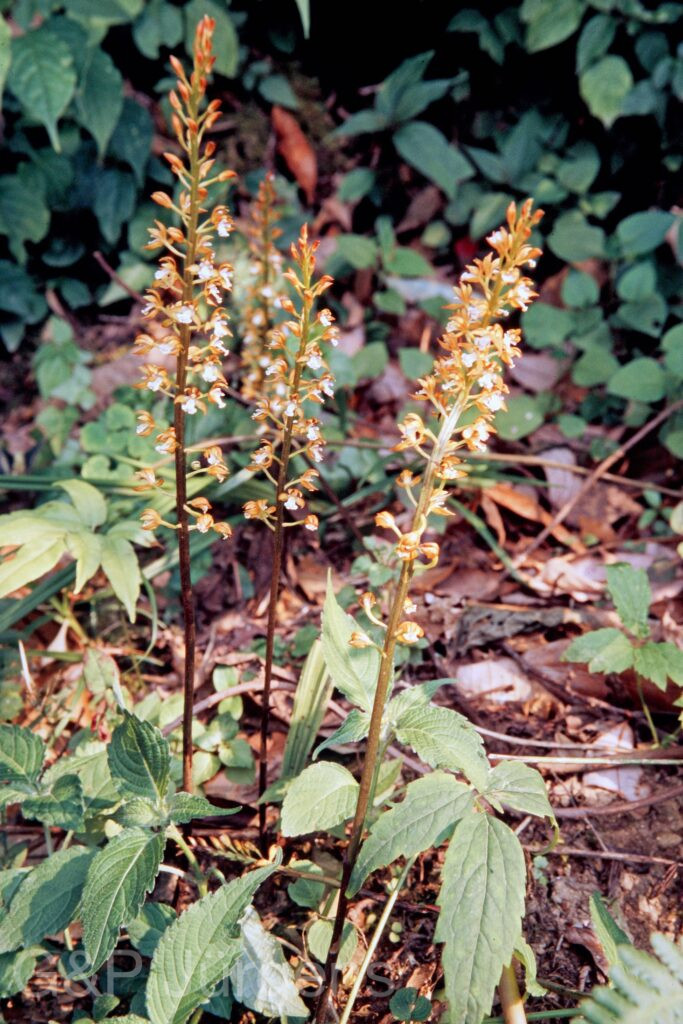
India Garhwal Trijugi Narayan 2500m, June
Garh 07 89 ergebnis
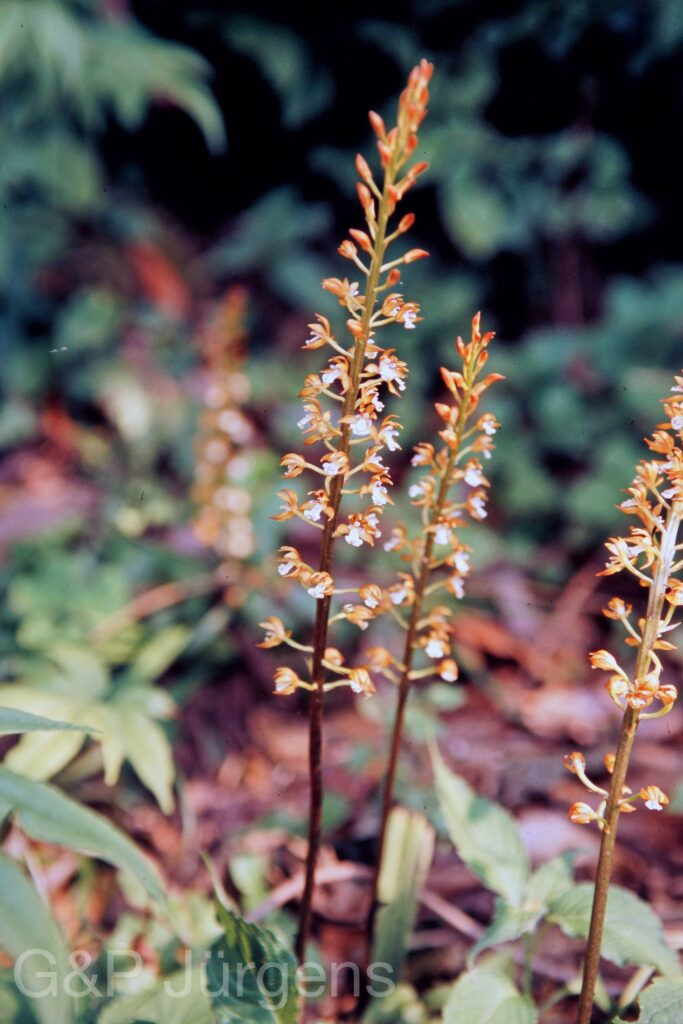
India Garhwal Trijugi Narayan 2500m, June

Description

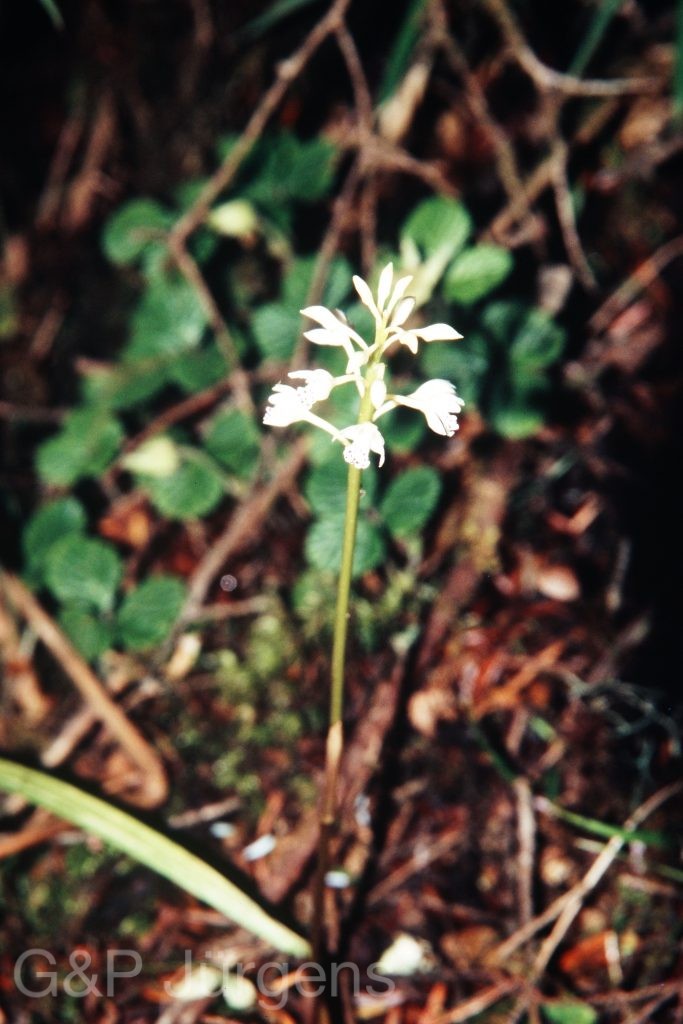
Oreorchis foliosa is a terrestrial orchid distributed across the Himalaya and into south-western China, with verified occurrences in China, India, Nepal, Bhutan and Myanmar. It grows in the humus-rich shade of temperate broadleaved and coniferous forest, on mossy banks and among leaf litter, generally between about 2400 and 3500 m. The material illustrated, from Trijugi Narayan in Garhwal (India) at around 2500 m and from the Dochu-La in Bhutan near 3000 m, both in June, shows the species flowering in the pre- to early-monsoon period in its characteristic moist, lightly shaded forest-floor habitat.

The plant grows from a chain of subterranean corm-like pseudobulbs (corms) that store reserves through the dormant season. From these arise one or two narrowly lanceolate, plicate (longitudinally pleated) leaves, the foliose character noted in the epithet. The erect scape bears a many-flowered raceme of small flowers; the spreading sepals and petals are yellowish to brownish, and the three-lobed labellum is paler, marked with reddish to purple spots or streaks, with a small basal callus or short spur-like base. The fruit is a pendulous dehiscent capsule releasing the dust-fine seeds typical of the family.

The family is written here as in the source as "Orchideaceae"; the correctly formed family name is Orchidaceae. Oreorchis is a small Asian genus of subfamily Epidendroideae allied to Corallorhiza and Cremastra, and like many forest orchids depends on mycorrhizal fungi for germination and establishment. O. foliosa, described by Lindley, is widespread but typically thinly scattered; while not formally assessed as threatened, such forest-dwelling orchids are sensitive to habitat loss and to collection pressure.

Author: Lindl. · Sources: POWO (Kew), GBIF, Flora of China, Flora of Bhutan, Genera Orchidacearum (Pridgeon et al.)
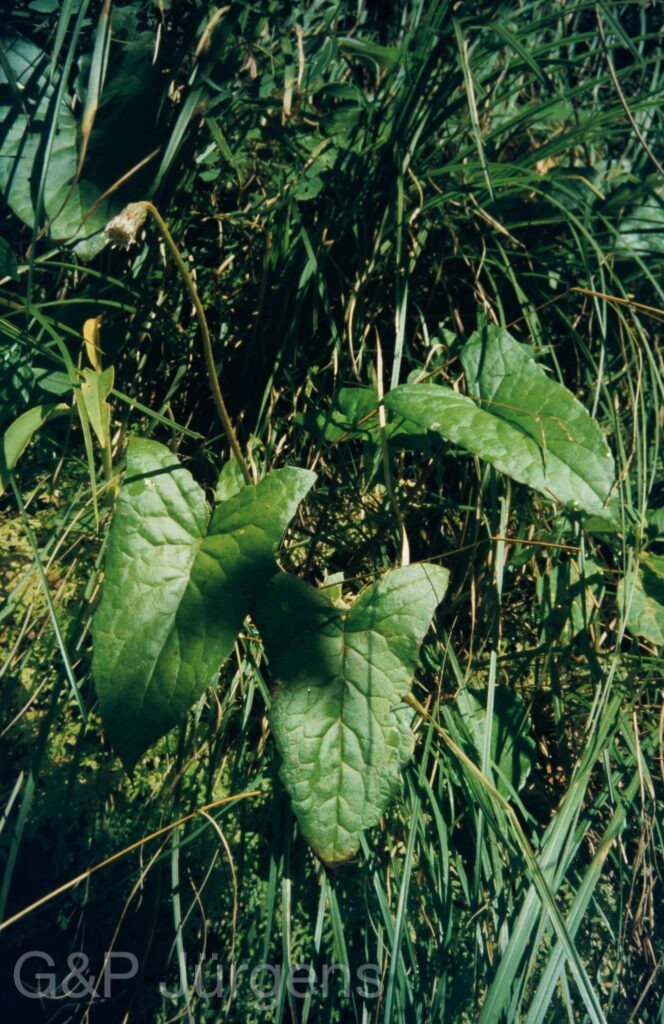
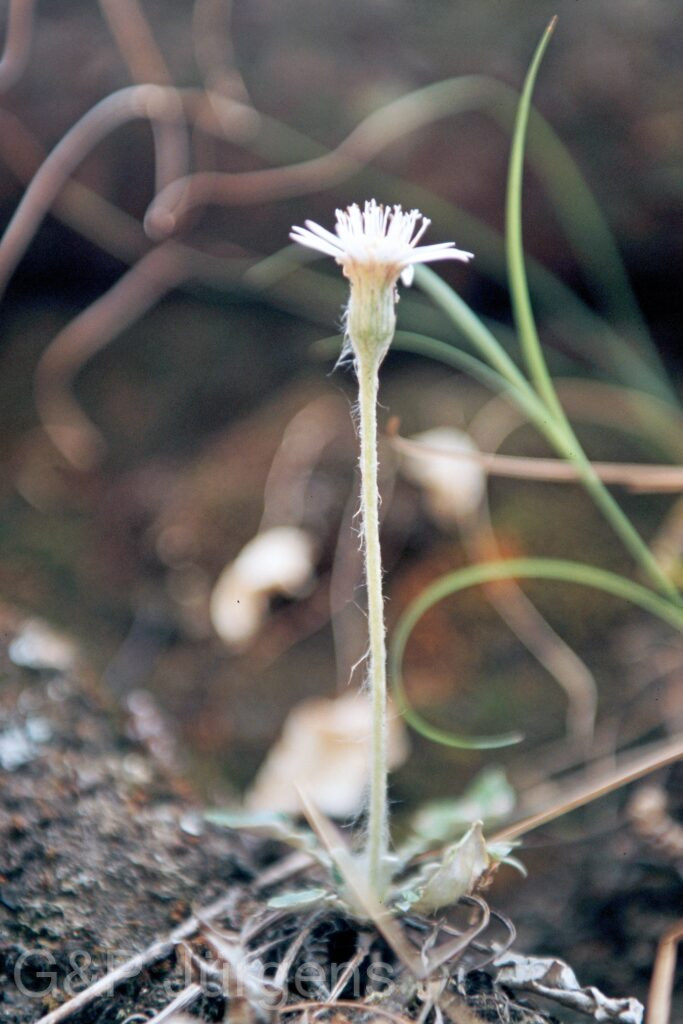
(Royle) X.D.Xu & V.A.Funk

Garw 2005 419 ergebnis
India Garhwal Didina 2470m, September
Garh 07 70 ergebnis
India Garhwal Nanu Mandakini 2300m, June

Description

Oreoseris gossypina is a rosette-forming perennial herb of the temperate and subalpine Himalaya, recorded from Pakistan, India, Nepal, China and Bhutan across more than 300 occurrences. It typically inhabits open grassy slopes, rocky banks and forest margins, often on disturbed or grazed ground, at elevations of roughly 1800 to 3500 m. The documented collections derive from Garhwal in India, at Didina (2470 m, September) and the Nanu Mandakini valley (2300 m, June), the two dates spanning much of its long flowering and fruiting season in the Western Himalaya.

The plant produces a basal rosette of obovate to oblanceolate leaves that are conspicuously white-woolly beneath, the dense cottony indumentum giving rise to the epithet gossypina. The leaf margins are sinuate-dentate and the lamina narrows into a winged petiole. Solitary capitula are borne on slender, bracteate scapes; each head is heterogamous and radiate, with an involucre of imbricate, often arachnoid-hairy phyllaries. The marginal ray florets are ligulate and pale, the disc florets tubular; the achenes are ribbed and surmounted by a pappus of barbellate bristles aiding wind dispersal.

The species was long placed in Gerbera and is also encountered under Leibnitzia; its current placement in Oreoseris (Mutisieae) reflects molecular and morphological revision by X.D. Xu and V.A. Funk. As a member of an early-diverging composite lineage it is of phylogenetic interest, and its mutisioid floral structure attracts a range of pollinating insects. The species is widespread and faces no recognised threat.

Author: (Royle) X.D.Xu & V.A.Funk · Sources: POWO (Kew), GBIF, Flora of China, Flora of Pakistan, Annotated Checklist of the Flowering Plants of Nepal, Xu & Funk revision of Mutisieae

(L.) Kurz

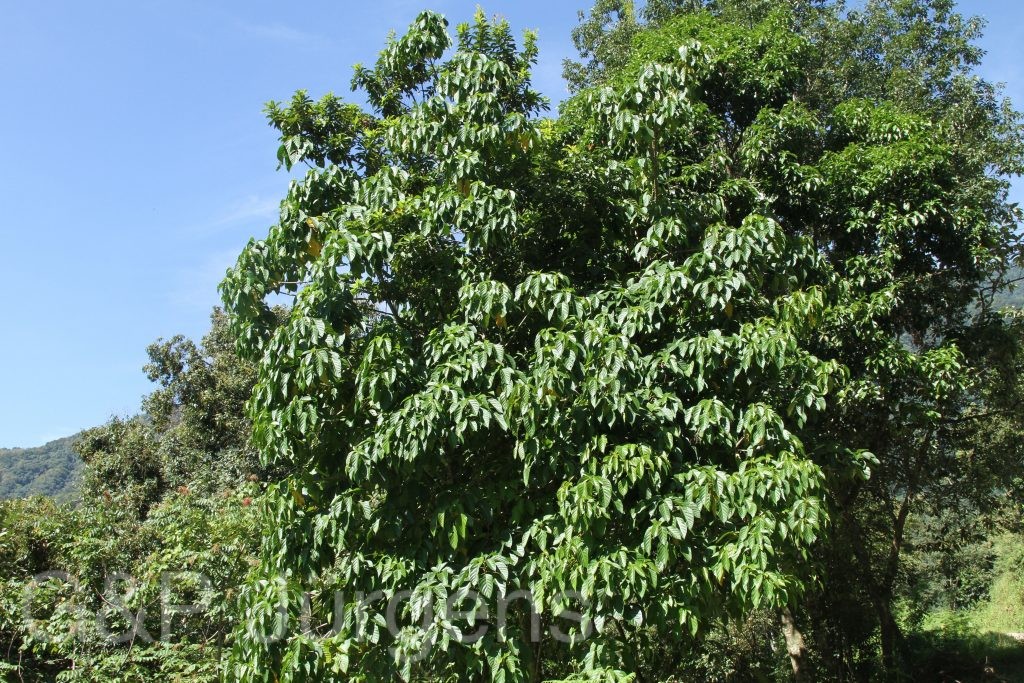
Bhutan2012 969
Bhutan Trithangebe 900m, October
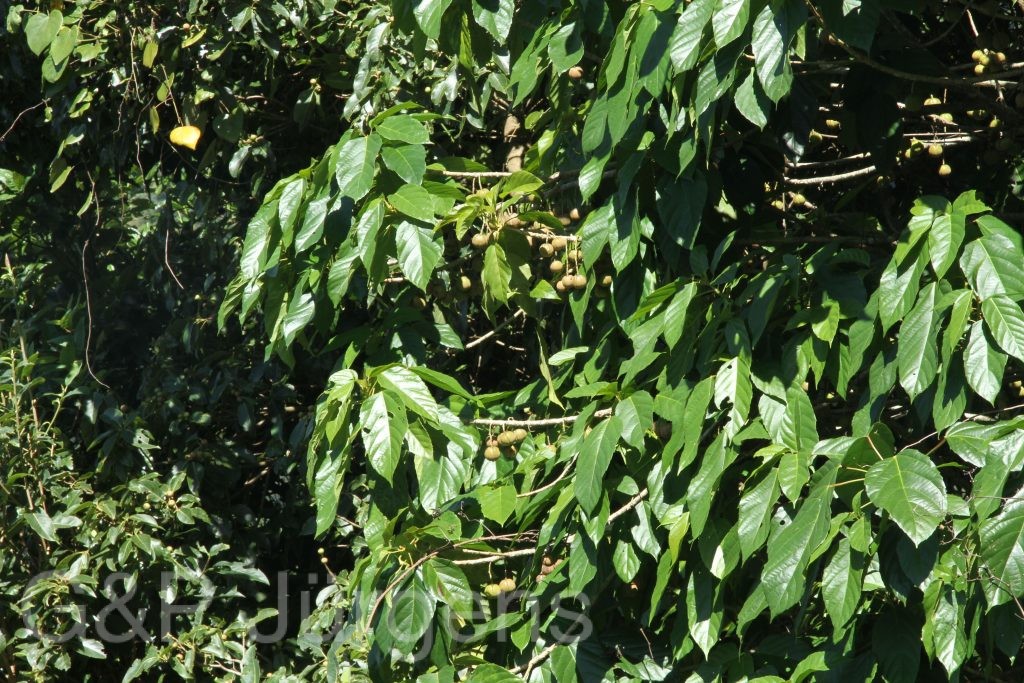
Bhutan2015 103
Bhutan Galephug 500m, October

Description

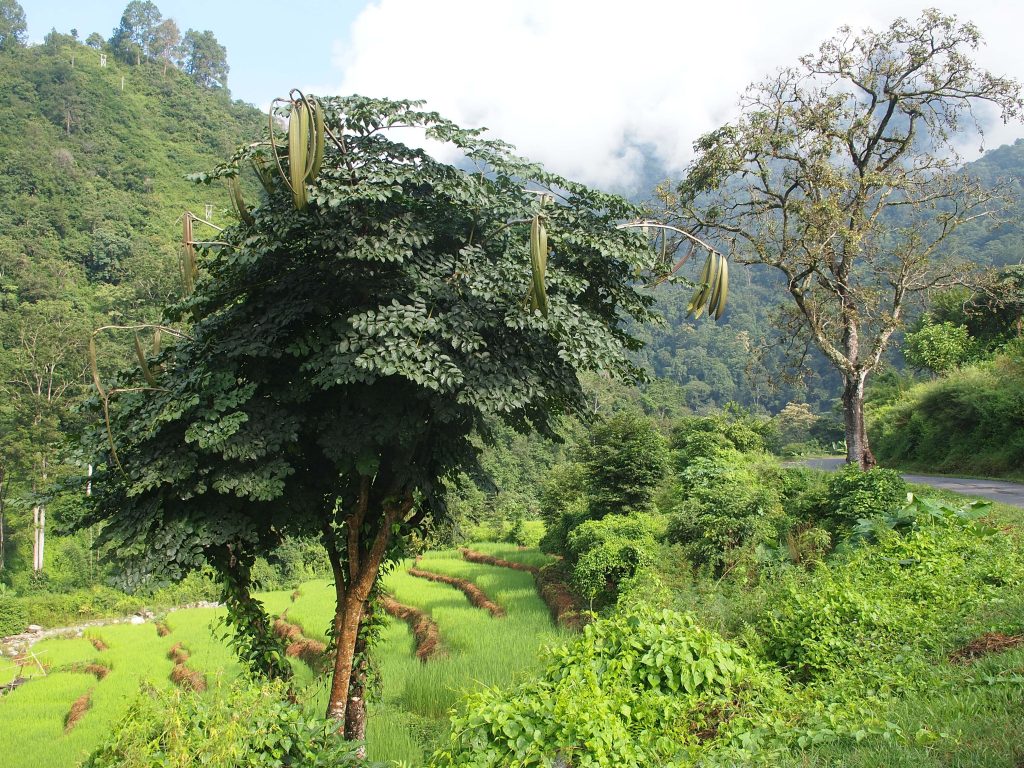
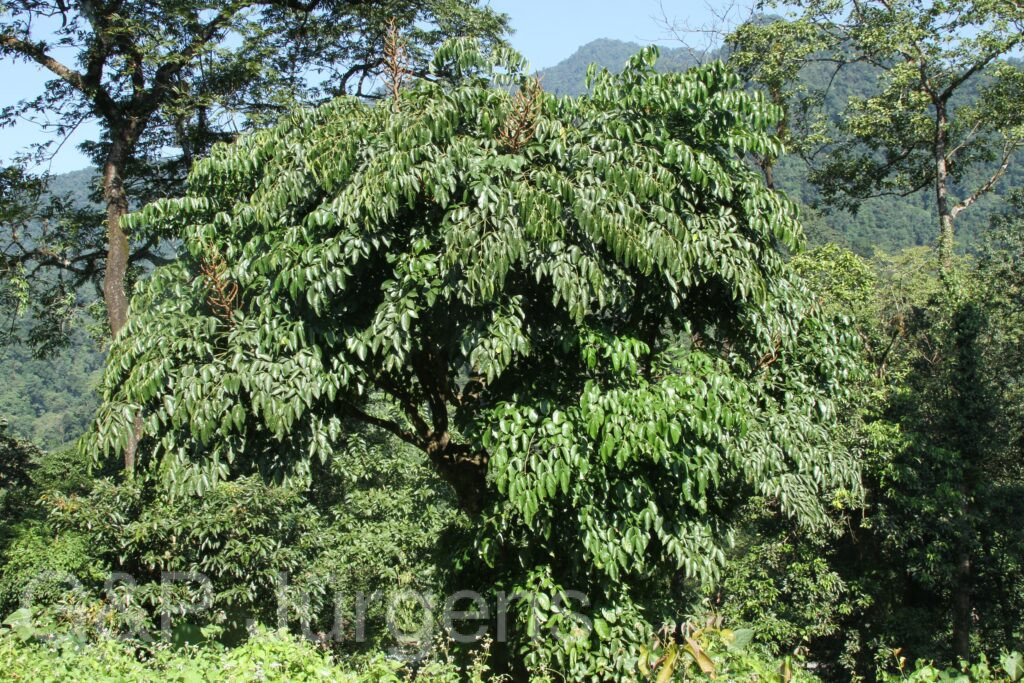
Oroxylum indicum, the Indian trumpet tree or midnight horror, is a small deciduous tree of subtropical and tropical Asia, ranging from India, Nepal and Bhutan through Bangladesh, Myanmar and southern China to Indochina, Thailand, Sri Lanka and across Malesia to the Philippines. GBIF aggregates around 1440 occurrences. It is a tree of forest margins, secondary growth, ravines and roadsides at low to moderate elevations, often in seasonally dry monsoon forest. The Bhutanese specimens at Trithangebe (900 m) and Galephug (500 m) in October occupy this warm foothill zone, fruiting at the close of the monsoon when the great pendulous pods become conspicuous.

The tree has a sparse crown and stout, soft-wooded branches marked with prominent leaf scars. Its leaves are very large, opposite and two- to three-pinnate, often a metre or more across, with ovate, acuminate leaflets, the falling rachides littering the ground beneath. The flowers open at night in a long erect terminal raceme, each large, fleshy and campanulate, lurid reddish-purple outside and paler within, malodorous and bat-pollinated. Most striking is the fruit: a flattened, sword-shaped, sabre-like capsule up to a metre long that splits into two woody valves to release numerous flat seeds broadly winged with a papery membrane for wind dispersal.

A member of Bignoniaceae, Oroxylum is a distinctive near-monotypic genus set apart by its enormous pinnate leaves, nocturnal chiropterophilous flowers and giant samaroid pods. The species is of considerable ethnobotanical importance: its bark, seeds and young fruit are widely used in Ayurvedic and traditional medicine, and the tender pods are eaten as a vegetable. Despite localised harvesting it remains common and widespread, and is not regarded as globally threatened.

Author: (L.) Kurz · Sources: POWO (Kew), GBIF, Flora of China Vol. 18, Flora of Bhutan Vol. 2, Annotated Checklist of the Flowering Plants of Nepal, Gentry monograph of Bignoniaceae

Oryza sativa

by G & P Jürgens

L.

Bhutan2015 559
Bhutan Moshu 1700m, October

Description

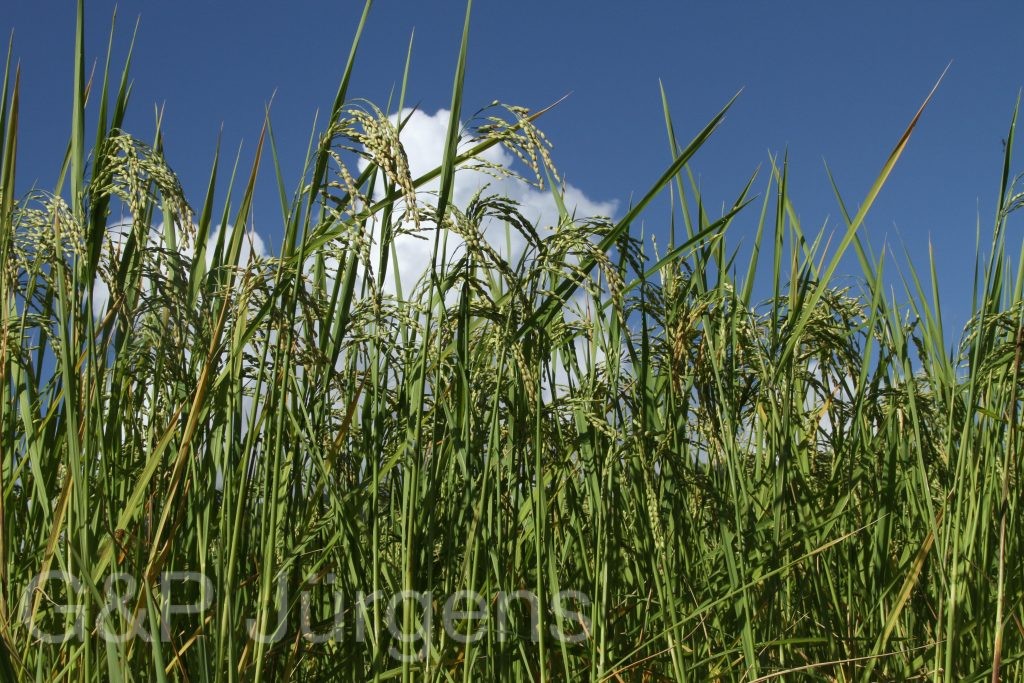
Oryza sativa, Asian cultivated rice, is the world's most important cereal staple and is grown across the warm-temperate to tropical zones of every inhabited continent. Domesticated in Asia from wild progenitors such as O. rufipogon, it is documented in GBIF by more than four hundred thousand occurrences spanning India, China, Southeast Asia, the Americas, Africa, Europe and beyond, reflecting both its agricultural ubiquity and intensive germplasm collection. It is essentially never truly wild but rather a cultigen of flooded paddies, irrigated terraces and seasonally inundated fields, with weedy and feral forms persisting around cultivation. The plant photographed at Moshu in Bhutan at 1700 m in October represents the terraced mid-montane rice cultivation characteristic of the Bhutanese Himalaya, where hardy, often red-grained landraces are grown well above the typical lowland range and are harvested as the autumn paddies ripen to gold.

The plant is an annual (occasionally short-lived perennial) grass forming erect tufts of hollow, jointed culms typically 0.5 to 1.5 m tall, rooting at the lower nodes and tolerant of standing water. The leaves are linear, flat and scabrous, with a long membranous ligule and well-developed auricles at the junction of sheath and blade. The inflorescence is a terminal, much-branched, nodding panicle bearing numerous laterally compressed spikelets, each reduced to a single fertile floret subtended by two small sterile lemmas; the fertile lemma is keeled and may be awned or awnless. Six stamens and a feathery, two-branched stigma effect predominantly self-pollination, and the fruit is the familiar caryopsis (grain), enclosed by the persistent lemma and palea as the husk.

Oryza belongs to the grass family Poaceae, tribe Oryzeae, a lineage of marsh-adapted grasses. As a domesticate, O. sativa encompasses immense genetic diversity organised principally into the indica and japonica subspecies groups, together comprising tens of thousands of landraces and modern cultivars adapted to environments from deepwater floodplains to upland terraces. Bhutanese and Himalayan rice agriculture, often involving cold-tolerant high-altitude landraces, is of particular interest for crop genetic conservation. The species is of no conservation concern itself, but the in-situ and ex-situ preservation of its traditional landraces and of wild Oryza relatives is a recognised priority for global food security.

Author: L. · Sources: POWO (Kew), GBIF, Flora of China Vol. 22, Flora of Bhutan Vol. 3 Part 2, Flora of Nepal, Flora of Pakistan, Wild and Cultivated Rices (Oryza): a Taxonomic Treatment (T.T. Chang; Vaughan, The Wild Relatives of Rice)

Hook.

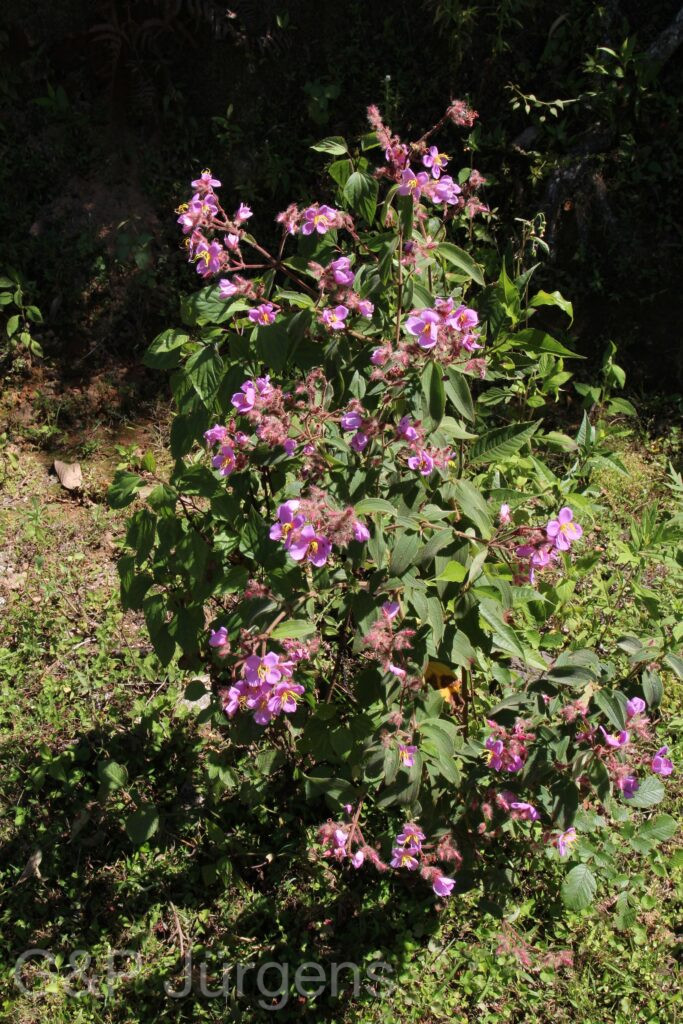
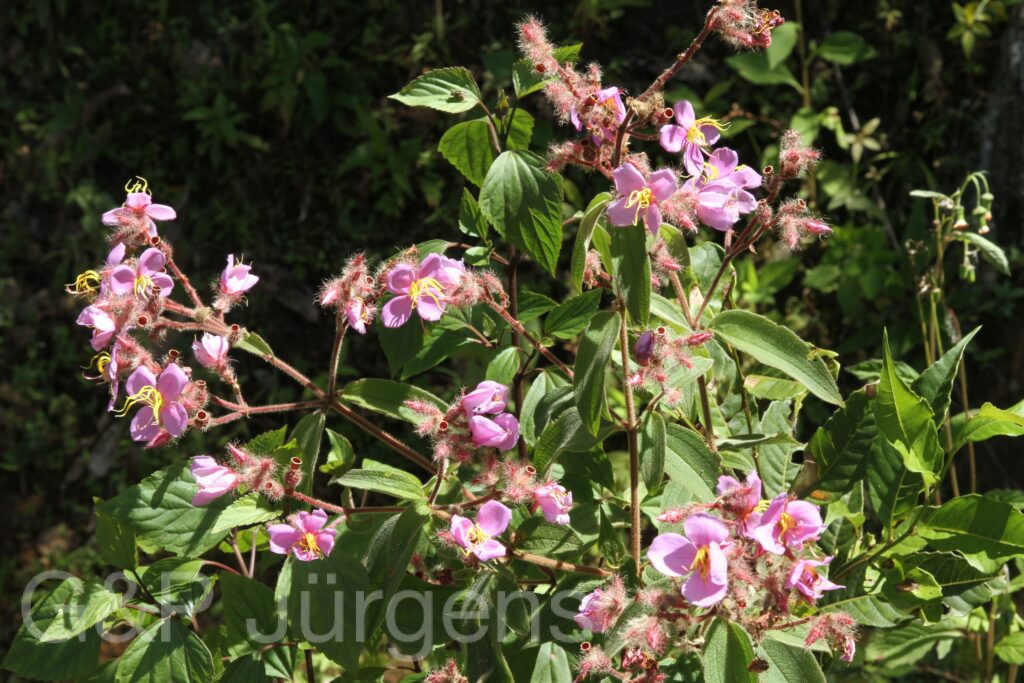
Nepal 95 22 P31 ergebnis
Nepal Darondi-Khola 630m, Octobre

Description

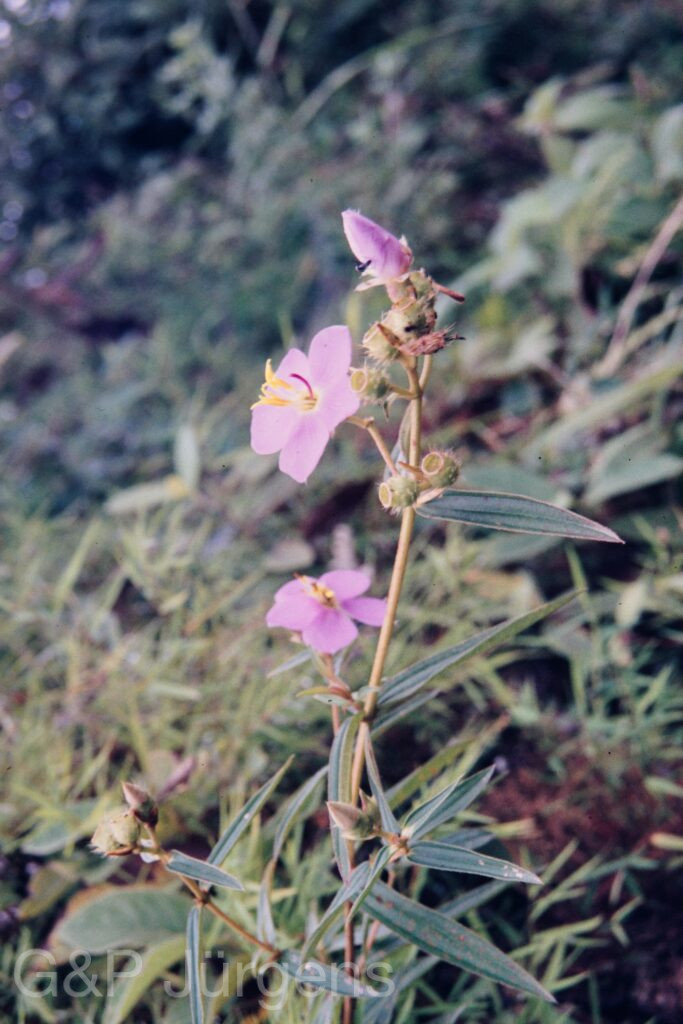
Osbeckia nepalensis is a subtropical to warm-temperate herb or subshrub of the eastern Himalaya and southeastern Asia, ranging through China, Nepal, India, Bhutan, Bangladesh, Myanmar, Thailand, Vietnam, Malaysia and Indonesia; its roughly 563 GBIF occurrences trace a broad Sino-Himalayan to Indochinese arc. In Nepal it descends to low elevations along river valleys, as recorded along the Darondi Khola at about 630 m in October, when the post-monsoon period brings peak flowering. It favours open, sunny situations on grassy hillsides, forest margins and roadside banks, behaving as an early-successional colonist of seasonally humid foothill habitats.

The plant is an erect, branched herb or soft subshrub with four-angled stems clothed, like the foliage, in stiff bristly hairs. The leaves are opposite, ovate-lanceolate, and bear the curved-parallel primary veins diagnostic of Melastomataceae. The handsome flowers are clustered in terminal heads, each with a bristly urn-shaped hypanthium and usually four broad, rounded petals of rich rose-purple to magenta; within are twice as many stamens with geniculate filaments and elongate, beaked, poricidal anthers adapted for buzz-pollination by bees. The fruit is a bristly capsule enclosed in the persistent hypanthium, releasing many minute seeds.

Osbeckia is closely allied to Melastoma, from which it is separated by its smaller, dry, poricidal capsules rather than fleshy berries. O. nepalensis is among the most ornamental species of the genus, valued horticulturally and used locally in herbal medicine. As a common, weedy coloniser of disturbed ground over a very large area, it carries no significant conservation concern.

Author: Hook. · Sources: POWO (Kew), GBIF, Flora of China Vol. 13, Flora of Bhutan Vol. 2, Flora of Nepal, A Revision of Osbeckia (Melastomataceae)

Wall.

Bhutan2015 71
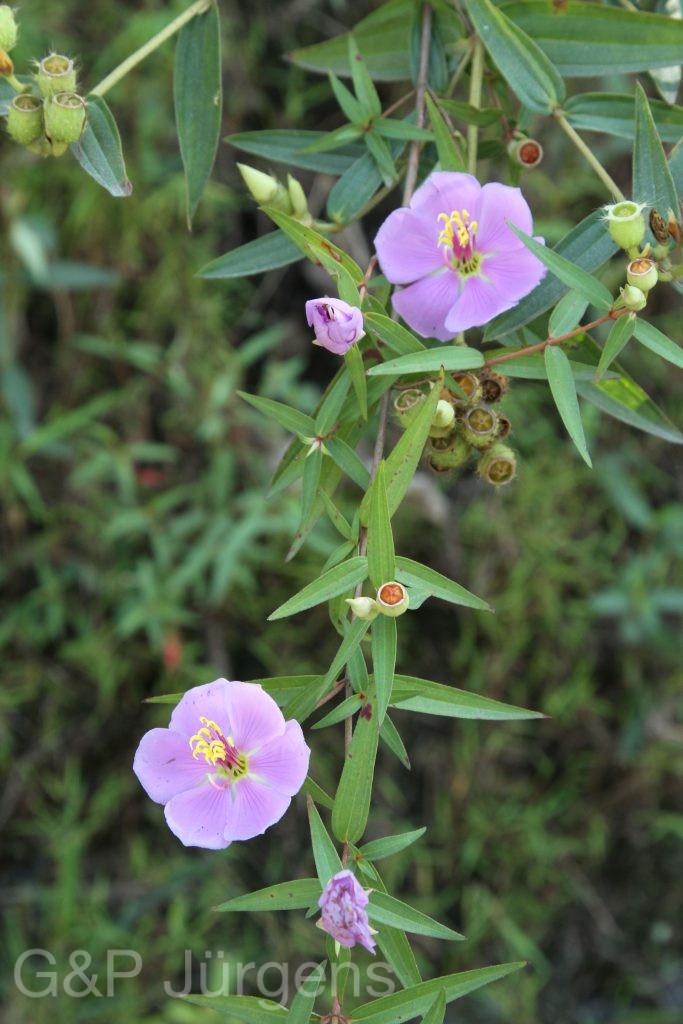
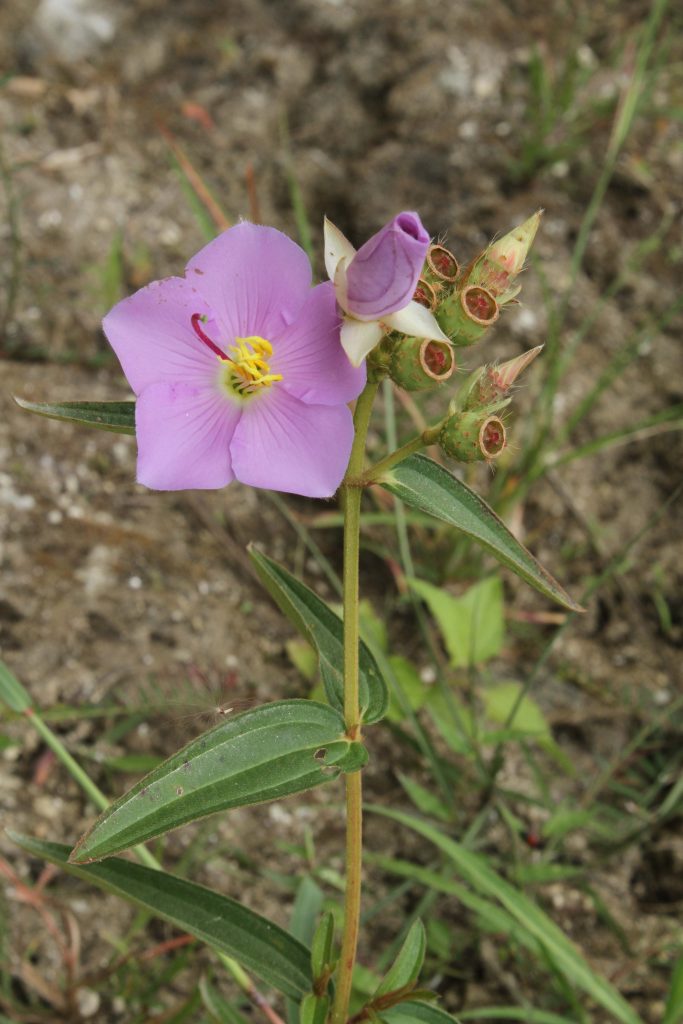
Bhutan Wangdi Phodrang 1700m, October
Bhutan2012 422
Bhutan Wangdi 2700m, September

Description

Osbeckia nutans Wall. is a subshrubby herb of the eastern Himalaya and adjoining Southeast Asia, recorded by GBIF (71 occurrences) from India, Nepal, Bhutan, Myanmar and Vietnam. It is a plant of open hillsides, grassy banks, forest clearings and roadside scrub in the subtropical to lower temperate zone, flowering chiefly in the autumn months. The cited Bhutanese material, gathered near Wangdue Phodrang at 1700 m in October and at 2700 m in September, illustrates its tolerance of a fairly wide altitudinal span on the warm, humid southern slopes where it colonises disturbed and seasonally moist ground.

The plant is an erect to ascending perennial with quadrangular, often setose stems bearing opposite, sessile to subsessile leaves. The leaf blades are lanceolate to ovate-lanceolate with the characteristic melastomataceous three-to-five strongly arcuate longitudinal nerves, and the surfaces are clothed in stiff appressed bristles. As the epithet nutans implies, the flowers or buds are inclined to nodding; the showy pink to purplish blooms have four petals, a setose, urceolate hypanthium, and the typical Melastomataceae androecium of geniculate stamens with elongate, beaked anthers opening by terminal pores. The fruit is a setose, urceolate capsule enclosed in the persistent hypanthium.

Osbeckia is a palaeotropical genus of around 50 species centred on tropical Asia, distinguished from the related Melastoma by its smaller, dry, pore-opening capsules. Its poricidal anthers are adapted to buzz-pollination by bees. Several Osbeckia species have ethnomedicinal uses in the region. Osbeckia nutans is locally frequent and not regarded as threatened, persisting well in open and lightly disturbed habitats.

Author: Wall. · Sources: POWO (Kew), GBIF, Flora of Bhutan, Flora of China, Melastomataceae of the Indian Subcontinent, Hansen monograph on Osbeckia

Buch.-Ham. ex D.Don

Bhutan2012 530
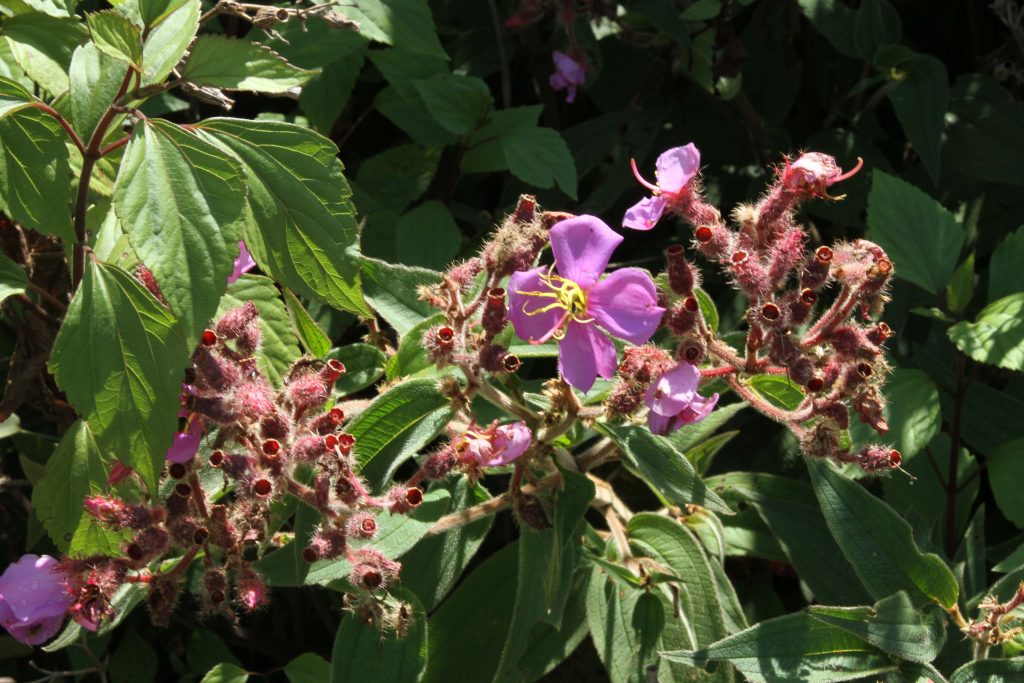
Bhutan Tserang 1300m, September
Bhutan2012 660
Bhutan Tserang 1600m, September
Bhutan2015 206
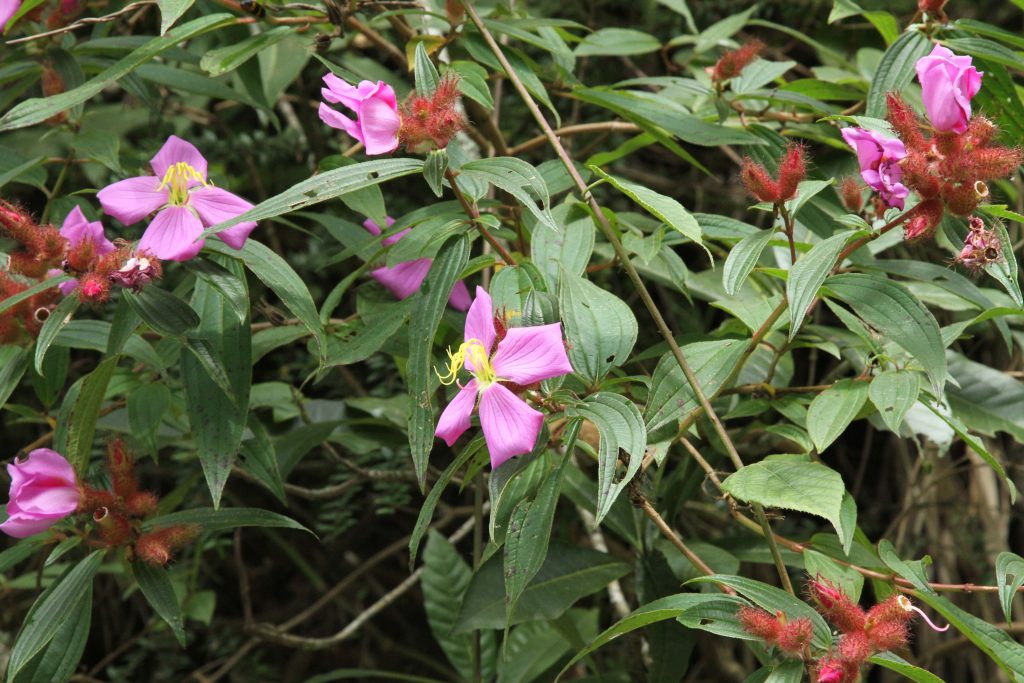
Bhutan Zhemgang 1000m, October
Bhutan2015 207
Bhutan Zhemgang 1000m, October

Description

Osbeckia stellata Buch.-Ham. ex D.Don is a shrub of the melastome family ranging across the Himalaya and tropical Asia, recorded from China, India, Nepal, Bhutan, Myanmar, Thailand, Vietnam, Malaysia and Laos, with about 704 GBIF occurrences. It grows on open hillsides, forest margins, scrub, grassy banks and disturbed slopes in the subtropical and warm-temperate belt, generally between about 900 and 2000 m. It was recorded in Bhutan at Tserang at 1300 and 1600 m and at Zhemgang around 1000 m, flowering in September and October, when its conspicuous magenta blooms colour the autumn hill vegetation of the outer ranges.

It is an erect, branched shrub with quadrangular, often reddish stems bearing appressed, bristly stellate or strigose hairs. The leaves are opposite, ovate-lanceolate, entire, and conspicuously three- to five-nerved with the characteristic curved-convergent venation of Melastomataceae, both surfaces rough with stiff hairs. The flowers are large and showy, borne in terminal cymose clusters; the four broad obovate petals are rose-purple to magenta, surrounding eight stamens with distinctively geniculate, beaked anthers, set on an urceolate hypanthium clothed in branched, stellate-tipped bristles. The fruit is an urn-shaped capsule enclosed by the persistent bristly hypanthium, releasing numerous minute cochleate seeds.

Osbeckia is distinguished from the related Melastoma by its smaller seeds and capsular fruit, and O. stellata is among the most ornamental and widespread Himalayan species, sometimes grown for its vivid flowers. Its poricidal anthers are buzz-pollinated by bees, while the small seeds are dispersed from the dry capsules. Common in disturbed and secondary habitats, it readily colonises cleared ground and is of no conservation concern.

Author: Buch.-Ham. ex D.Don · Sources: POWO (Kew), GBIF, Flora of China, Flora of Bhutan, Flora of British India, Melastomataceae monograph (Hansen revision of Osbeckia)

King ex C.B.Clarke

Bh2008 14 G24
Bhutan Thimphu-Chu, 2800m April
Nepal 2001 110 ergebnis ergebnis
East-Nepal Gupka Pokhari 3200m, April

Description

Osmanthus suavis King ex C.B.Clarke is an evergreen shrub or small tree of the olive family endemic to the eastern Himalaya and adjacent mountains, recorded from Nepal, India, Bhutan, China and Myanmar (158 GBIF occurrences). It grows in the understorey and margins of temperate broad-leaved and mixed conifer forest, on slopes, ridges and forest edges roughly between 2400 and 3500 m. It was documented in Bhutan along the Thimphu-Chu at 2800 m in April and in eastern Nepal at Gupka Pokhari around 3200 m, also in April, its flowering coinciding with the spring warming of the mid-montane forest belt.

It forms a densely branched shrub with grey, lenticellate bark. The leaves are opposite, coriaceous, elliptic to ovate-lanceolate, the margins entire or sparsely spinulose-serrate, glossy dark green above and dotted with minute glands beneath. The fragrant flowers are small and clustered in short axillary fascicles or cymes; the corolla is white to cream, gamopetalous with four spreading lobes united into a short tube, bearing two stamens, and the whole shrub is sweetly scented in flower, as the epithet suavis records. The fruit is an ovoid drupe ripening blue-black, with a single hard-walled stone.

Osmanthus belongs to tribe Oleeae and is centred on East and Southeast Asia, with O. suavis representing the Himalayan extension of this largely Sino-Japanese genus, allied to the fragrant cultivated O. fragrans. Its scented insect-pollinated flowers and drupaceous bird-dispersed fruits are typical of the genus. While not formally threatened, it is dependent on intact temperate forest and is locally valued as an ornamental and for its aromatic blossoms.

Author: King ex C.B.Clarke · Sources: POWO (Kew), GBIF, Flora of China, Flora of Bhutan, Flora of Nepal, Oleaceae monograph (Green revision of Osmanthus)

Blume

Bhutan2015 194
Bhutan Zhemgang 1000m, October
Bhutan2015 195
Bhutan Zhemgang 1000m, October

Description

Ostodes paniculata is a tree or large shrub widely distributed through tropical and subtropical Asia, recorded by GBIF from China, Indonesia, Thailand, India, Myanmar, Vietnam, Nepal, Bhutan, Laos, Cambodia, Malaysia and Korea across more than 1100 occurrences. It is a component of evergreen and semi-evergreen broad-leaved forest in warm, humid lowland and lower montane settings, usually below about 1500 m, often on hillslopes and in valley forest. The photographed individual from Zhemgang in southern Bhutan at about 1000 m, in October, reflects this warm-temperate to subtropical foothill habitat where the species reaches the northern margin of its range along the Himalayan front.

The plant is a monoecious, evergreen tree with smooth bark and a milky or watery exudate. The leaves are alternate, simple, broadly elliptic to ovate, long-petiolate with a pair of glands at the petiole apex, the margin serrate to glandular-toothed and the base often with a few prominent basal nerves. The inflorescences are terminal panicles bearing numerous small white to creamy flowers, the staminate and pistillate flowers separate, with five petals and conspicuous disk glands; staminate flowers have numerous stamens. The fruit is a globose, three-locular capsule, somewhat woody, that splits septicidally to release the large smooth seeds.

Ostodes is a small genus of the Euphorbiaceae (subfamily Crotonoideae) centred on tropical Asia, and O. paniculata is its most widespread and well-known species, valued locally for its timber and seed oil. Its broad range and tolerance of secondary forest mean it is not of conservation concern, and it is frequent across much of Indo-Malaya. Phytogeographically it exemplifies the Indo-Malayan element that penetrates the Himalaya through the warm, wet foothill forests of Bhutan and northeast India.

Author: Blume · Sources: POWO (Kew), GBIF, Flora of China, Flora of Bhutan, Flora of Thailand, Radcliffe-Smith Euphorbiaceae treatments

Hochst. & Steud.

Bhutan2014 151
Bhutan Trashigang 1700m, May

Description

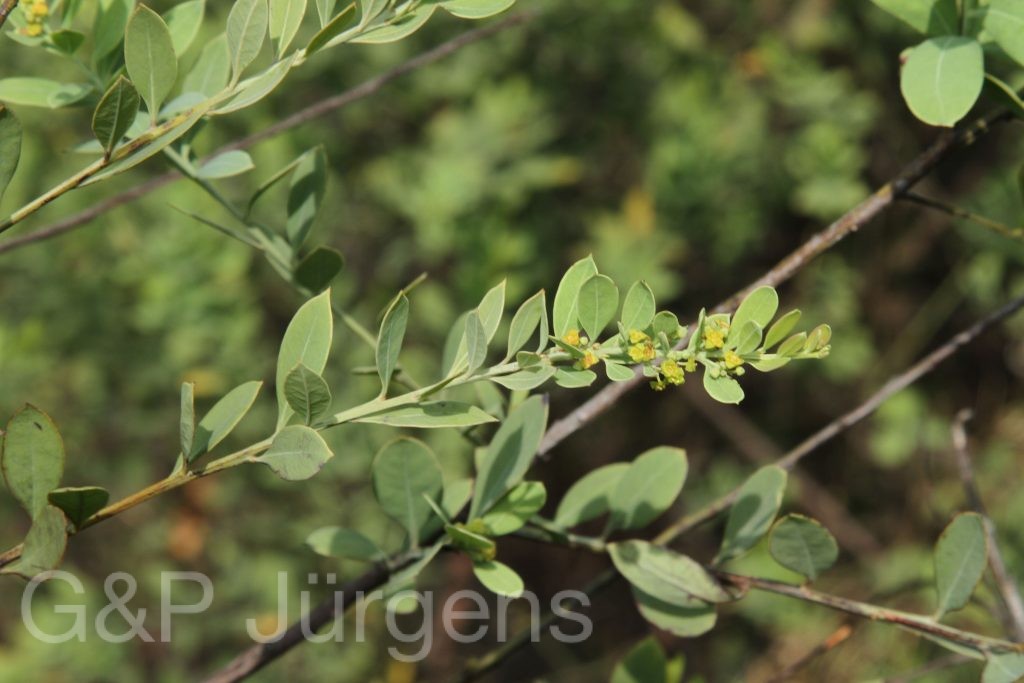
Osyris lanceolata, the East African sandalwood, is a remarkably wide-ranging evergreen shrub spanning the Mediterranean basin, much of Africa and southern Asia; its roughly 4217 GBIF records reach from Spain, Portugal and Morocco through eastern and southern Africa (Kenya, Tanzania, Ethiopia, South Africa, Zimbabwe, Namibia, Angola) to India, Sri Lanka, Nepal, China and Bhutan. In the eastern Himalaya it occupies warm, dry montane slopes, as recorded near Trashigang in eastern Bhutan at about 1700 m in May. It favours open woodland, scrub and rocky hillsides on well-drained soils, persisting as a hardy, drought-tolerant component of seasonally dry vegetation.

The plant is a glabrous, much-branched shrub or small tree with slender, angular green twigs and alternate, leathery leaves that are narrowly lanceolate to elliptic, sometimes reduced and scale-like. Like other Santalaceae it is a hemiparasite, attaching by root haustoria to neighbouring plants while retaining green, photosynthetic foliage. The species is dioecious, bearing small, greenish-yellow flowers in axillary clusters on separate plants; the inferior ovary develops into a small, globose, fleshy drupe ripening red to blackish and dispersed by birds.

Osyris belongs to the sandalwood family, and O. lanceolata is exploited as a substitute for true sandalwood, its aromatic, oil-rich heartwood harvested for fragrant oil, carvings and incense. This demand has driven heavy, often illegal exploitation, particularly in East Africa, causing severe population declines and the listing of its populations under CITES Appendix II. The Himalayan populations form part of this broad, biogeographically intriguing range.

Author: Hochst. & Steud. · Sources: POWO (Kew), GBIF, Flora of China Vol. 5, Flora of Bhutan Vol. 1, Flora of Nepal, Flora of Tropical East Africa (Santalaceae)