Tag:

Sikkim

Flowers of Sikkim — 350 species from the Sikkim Himalaya in northeast India, a compact yet botanically extraordinary region that climbs from subtropical valleys to the alpine zone beneath Kangchenjunga. Sikkim is a classic centre of Himalayan plant diversity, celebrated for its rhododendrons, primulas, orchids and gentians. Each entry provides a botanical description, distribution, habitat and flowering season with the original field photograph.

Wall.

Sikkim 2006 449 ergebnis
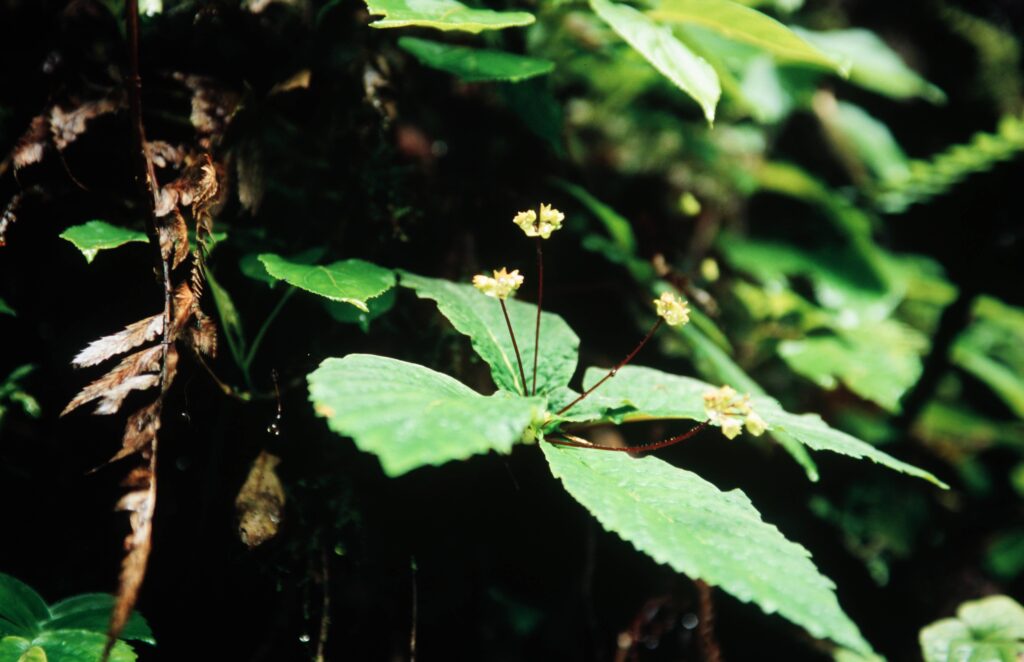
India West-Bengal, Tolung 2450m, May

Description

Didymocarpus oblongus is a relatively uncommon gesneriad endemic to the eastern Himalaya, recorded from Nepal, northeast India (Sikkim, Darjeeling, Assam), Bhutan, and adjacent parts of southern China (Xizang, Yunnan). It inhabits shaded, damp rock faces, mossy cliff ledges, and steep earth banks in montane broadleaved and mixed forests, typically at elevations between 1,800 and 3,000 m. The species has been documented from the Tolung area of West Bengal at approximately 2,450 m, where it grows in the moist understorey of temperate forests during the spring season.
The plant is a perennial herb with a short, erect stem 5–15 cm tall, arising from a fleshy rootstock. Leaves are arranged in an opposite, often crowded rosette-like cluster near the stem apex; they are oblanceolate to oblong, 5–15 cm long and 2–5 cm wide, with a crenate to serrate margin, the upper surface dark green and sparsely pilose, the lower surface paler and more densely pubescent. The inflorescence is a lax cyme of 2–6 flowers borne on a slender peduncle 5–10 cm long. The calyx is tubular, five-lobed. The corolla is tubular-funnelform, 2–3 cm long, typically pale purple to lavender with darker markings in the throat. Stamens are two, with the filaments inserted at mid-tube; the anthers are coherent face to face. The fruit is a slender, elongate capsule 2–4 cm long, dehiscing loculicidally.
Didymocarpus is a genus of approximately 100 species centred in mainland Asia, with the Himalayan region representing a significant centre of diversity. D. oblongus is distinguished from allied species by its oblong leaf shape, relatively long peduncles, and high-elevation habitat preference. With only 88 occurrence records in GBIF and a restricted distribution along the eastern Himalayan arc, the species warrants conservation attention, particularly as its cliff-face and forest-understorey habitats are sensitive to deforestation and landslide disturbance.

Author: Wall. · Sources: POWO (Kew), GBIF, Flora of Bhutan Vol. 2, Flora of China Vol. 18, Möller & Clark: Gesneriaceae classification (2013)
Hook.f. & Thomson

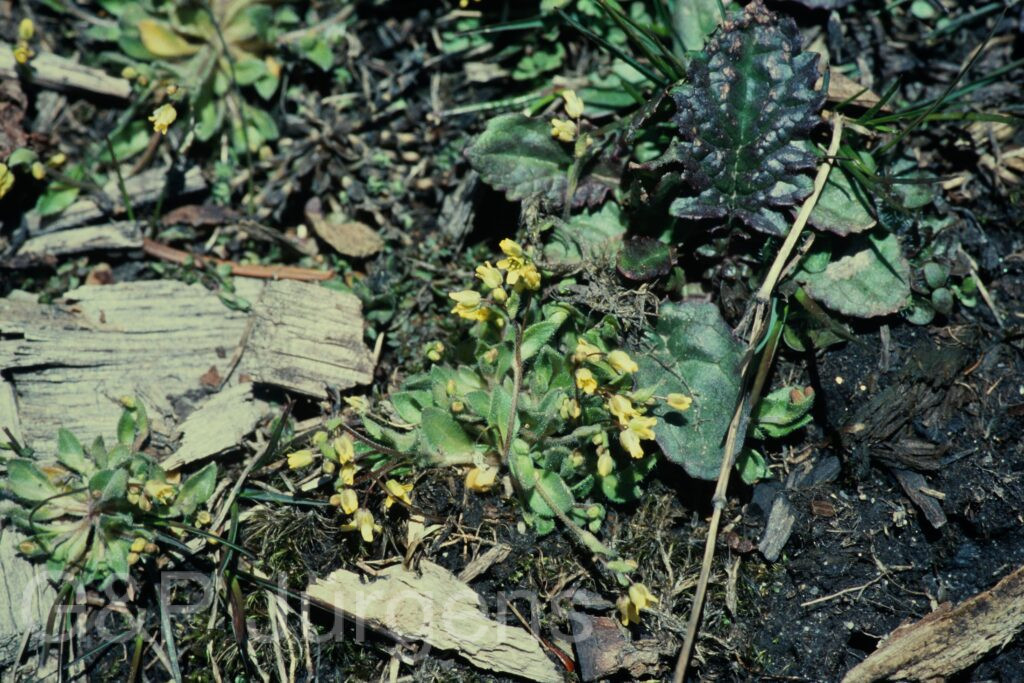
Sikkim2004 139 P241
Sikkim/India Singalila 3800m April

Description

Draba tibetica is a cushion- to mat-forming alpine crucifer with a wide distribution across the Himalaya, Tibetan Plateau and the mountains of Central Asia. GBIF records around 173 occurrences spanning India, Pakistan, Tajikistan, Uzbekistan, China, Afghanistan, Kazakhstan, Kyrgyzstan and Nepal. It colonises stony alpine turf, rock ledges, fellfield and the gravelly margins of seasonal snowmelt, generally between 3500 and 5000 m. The illustrated population was found along the Singalila ridge of Sikkim, India, at 3800 m in April, flowering early as the higher slopes begin to thaw on well-drained, base-rich substrates.

The plant develops a woody, much-branched caudex bearing dense rosettes of small, oblanceolate to spathulate leaves clothed in stellate and simple hairs that give a greyish indumentum. Erect, leafless or few-leaved scapes rise above the foliage carrying short racemes of small flowers. The four petals are yellow, fading paler with age, exceeding the hairy sepals; the six tetradynamous stamens surround a superior ovary. The fruit is a flattened, ovate to elliptic silicula, glabrous or sparsely pubescent, held on ascending pedicels and splitting to release numerous minute seeds in two rows.

Draba (Brassicaceae) is a large, taxonomically intricate genus centred on arctic and alpine habitats, and D. tibetica belongs to the yellow-flowered Himalayan-Tibetan assemblage where cushion habit and indumentum vary clinally, complicating delimitation. GBIF treats the name as accepted. As a hardy pioneer of unstable high-altitude ground it is locally common and faces no recognised conservation concern across its extensive range.

Author: Hook.f. & Thomson · Sources: POWO (Kew), GBIF, Flora of China, Flora of Pakistan, Al-Shehbaz revisions of Draba (Brassicaceae)

Drosera peltata

by GP Jürgens

Thunb.

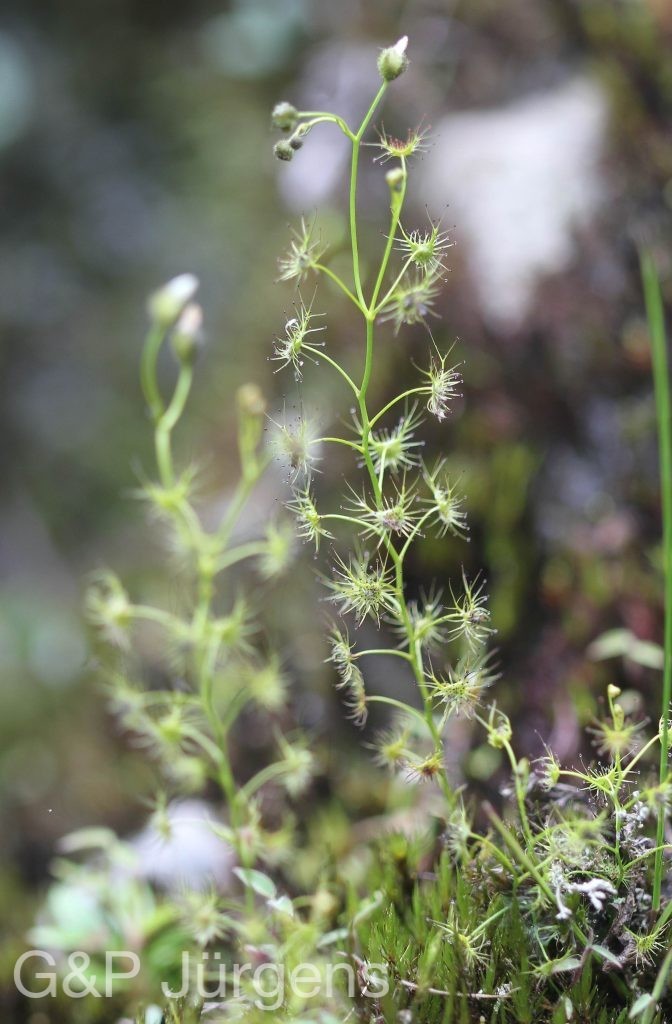
Sikkim2011 185
Sikkim Lachung 2600m, June
Nepal 99 996 ergebnis
West-Nepal Juphal 2550m, July

Description

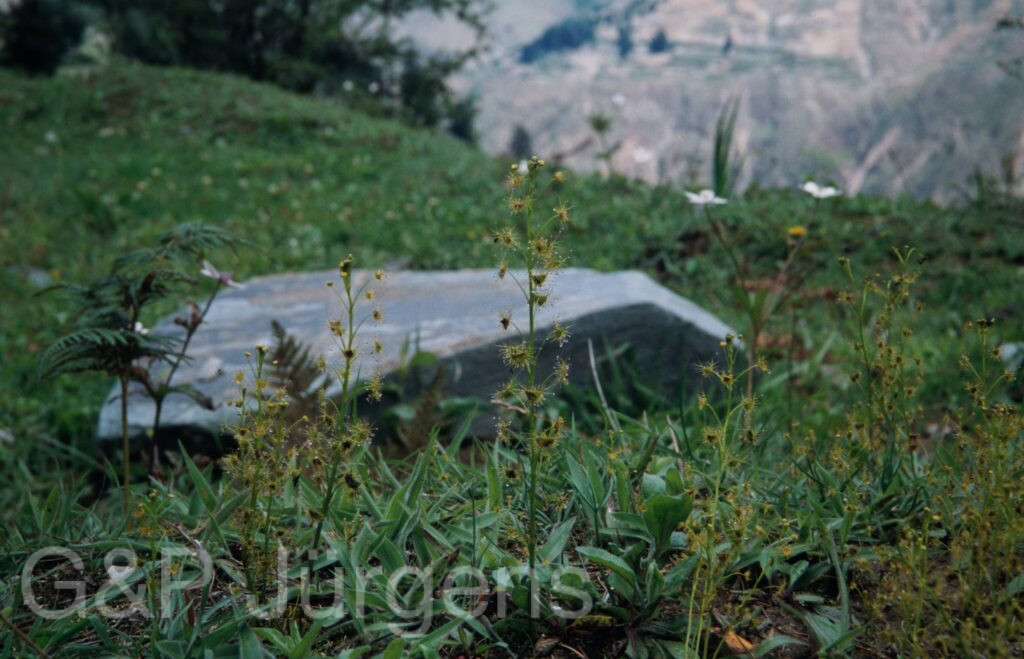
Drosera peltata is one of the most widely distributed of all sundews, a carnivorous herb ranging from Australia and New Zealand through East and Southeast Asia to the Himalaya, with GBIF holding an exceptional 32363 occurrences across Australia, China, Japan, India, Nepal, Thailand, Indonesia, the Philippines, Korea and many further countries. In the Himalaya it grows in open, wet, nutrient-poor situations: boggy grassland, mossy banks, seepage slopes, marshy meadows and damp roadside cuttings, generally between 1500 and 3000 m. The localities cited for the image, Lachung in Sikkim at about 2600 m in June and Juphal in West Nepal at around 2550 m in July, are typical mid-montane wet-meadow sites where the plant flowers during the early monsoon.

Unlike the rosette-forming sundews, D. peltata is an erect, often tuberous-rooted herb whose slender stem bears alternate, peltate to lunate leaves on long petioles. The leaf blades are crescent-shaped and clothed on their margins and upper surface with stalked glandular hairs (tentacles) tipped with glistening mucilaginous droplets that entrap small insects; the tentacles then bend inward and the leaf secretes enzymes to digest the prey. Basal rosette leaves may be present at germination but wither as the stem elongates. The inflorescence is a one-sided raceme of small white to pinkish five-merous flowers, opening in bright sunshine, and the fruit is a small capsule with numerous minute seeds.

Droseraceae are carnivorous, and the tuberous, stem-forming peltata complex constitutes a distinctive lineage within Drosera that has been variously subdivided into segregate species and subspecies by different authors, making it one of the more taxonomically contentious sundew groups. Insect capture supplies nitrogen and phosphorus otherwise scarce in the acidic, waterlogged soils it inhabits, and the underground tuber permits dormancy through dry or unfavourable seasons. Given its enormous geographic range the species as a whole is of no conservation concern, although individual Himalayan wetland populations are locally susceptible to drainage and habitat loss.

Author: Thunb. · Sources: POWO (Kew), GBIF, Flora of China Vol. 8, Flora of Bhutan Vol. 1, Flora of Nepal, Lowrie Carnivorous Plants of Australia Magnum Opus

(Griff.) C.K.Schneid.

Sikkim2004 377 G654
Sikkim/India Lachung 2900m May
Nepal 1994 259 ergebnis
Ost-Nepal Milka-Danda 2850m May 

Description

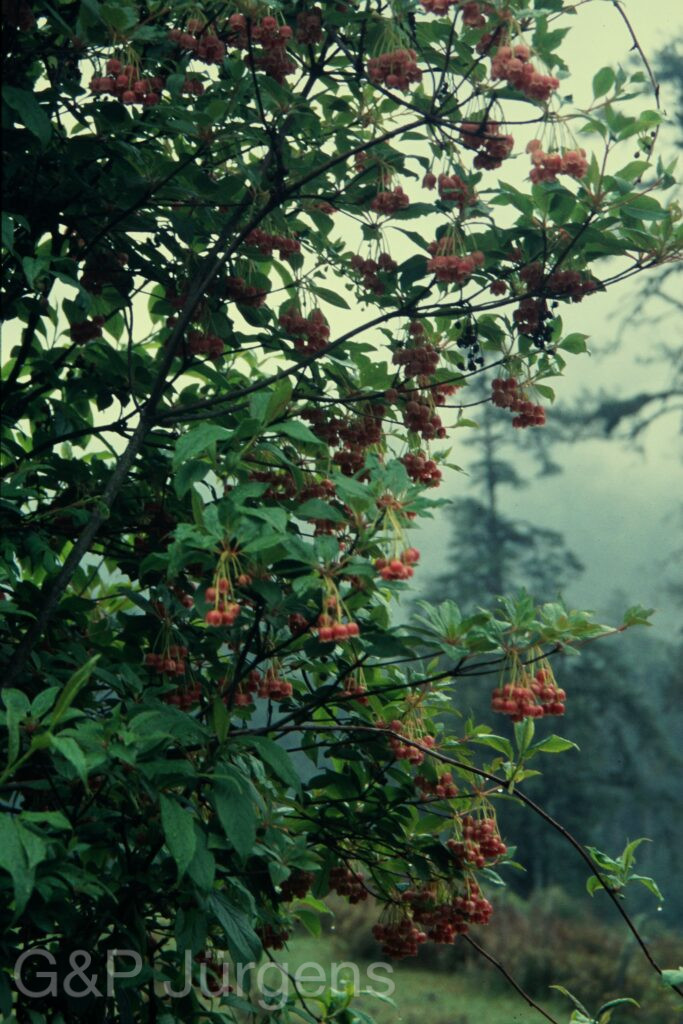
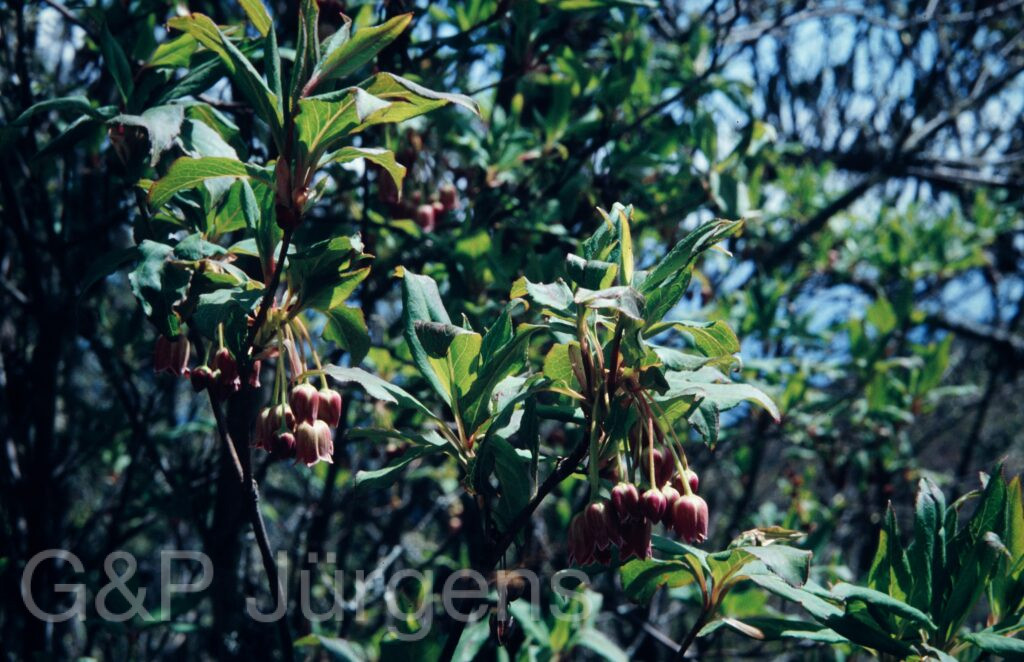
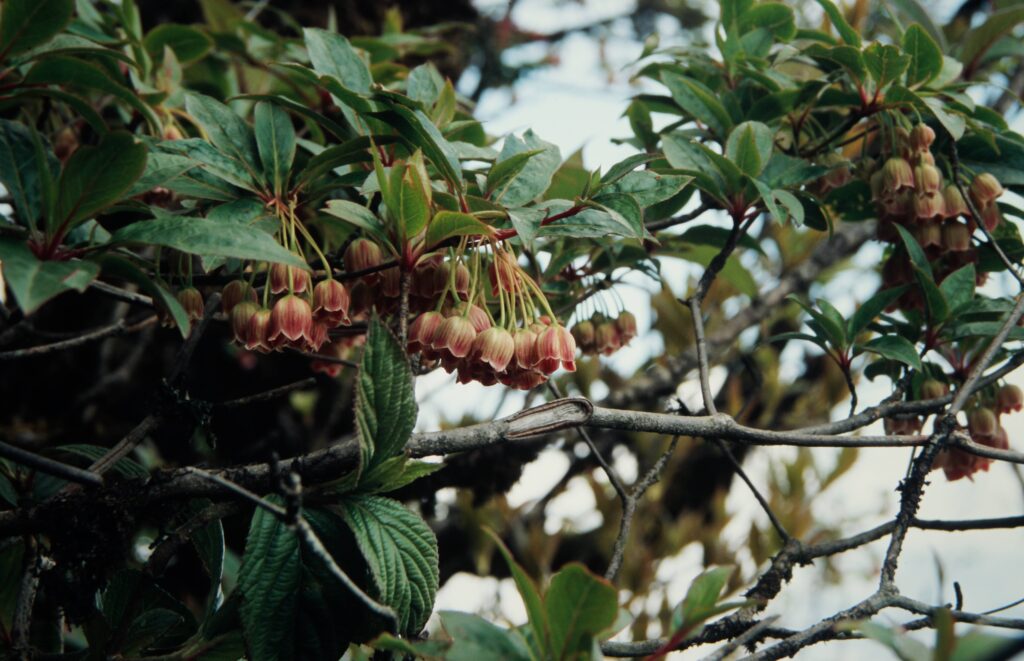
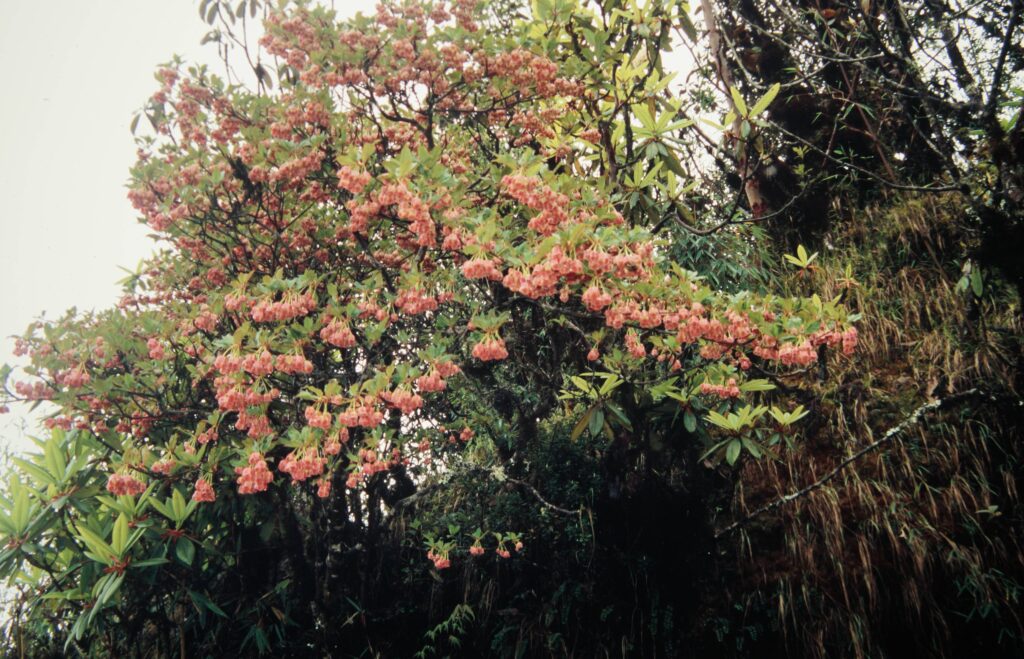
Enkianthus deflexus is a deciduous shrub or small tree of the temperate Himalaya and southwestern China, distributed through China, India, Nepal, Bhutan and Myanmar, and very well documented with around 1667 GBIF records (further records reflect wide cultivation in Europe, North America and East Asia). It forms part of the understorey and forest-margin vegetation of moist temperate forest and Rhododendron-dominated slopes, typically between about 2400 and 3600 m. The cited collections from Lachung in Sikkim (2900 m), Milka Danda in east Nepal (2850 m) and Tonglu in West Bengal (3100 m), all flowering in May, mark its synchronous late-spring anthesis across the cool, humid mid-montane belt.

The species is a many-branched shrub whose leaves cluster toward the ends of the twigs in pseudowhorls; they are obovate to elliptic, finely serrulate, often colouring richly in autumn, and subtended by reddish young growth. The flowers are borne in pendent terminal racemes or umbel-like clusters, each on a slender, often reflexed pedicel (whence deflexus). The corolla is campanulate, creamy to yellowish suffused with red veining, with five short recurved lobes; ten stamens are enclosed within. The fruit is an erect, dehiscent woody capsule on the recurving pedicel, releasing small winged or angled seeds.

Enkianthus is an early-diverging genus of the Ericaceae, sister to much of the rest of the family, and its bell-shaped, nectar-bearing flowers are pollinated by bees and other insects. E. deflexus is valued horticulturally for its dainty blossoms and brilliant autumn foliage, explaining its broad cultivated footprint. Within its native range it is common and not of conservation concern, a characteristic and widespread component of Himalayan temperate forest understoreys.

Author: (Griff.) C.K.Schneid. · Sources: POWO (Kew), GBIF, Flora of Bhutan, Flora of China (Ericaceae), Stevens Revision of Enkianthus

(Grierson & D.G.Long) Panigrahi

Nepal 97 51 P77
Nepal Mewa-Khola 1130m April
Nepal 97 50 P76
Nepal Mewa-Khola 1130m April

Description

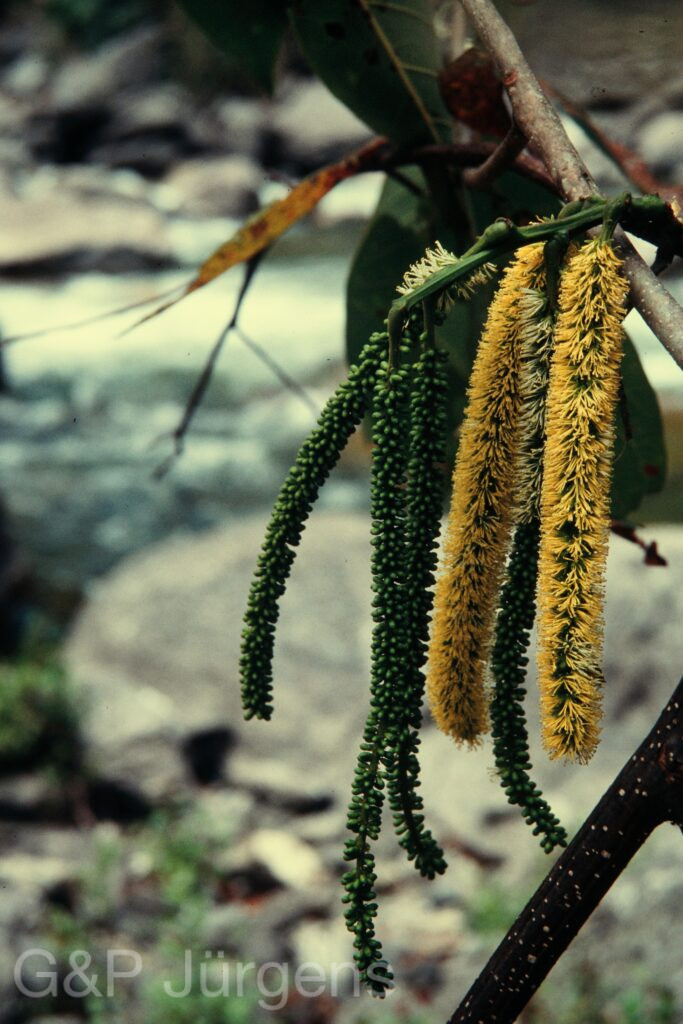
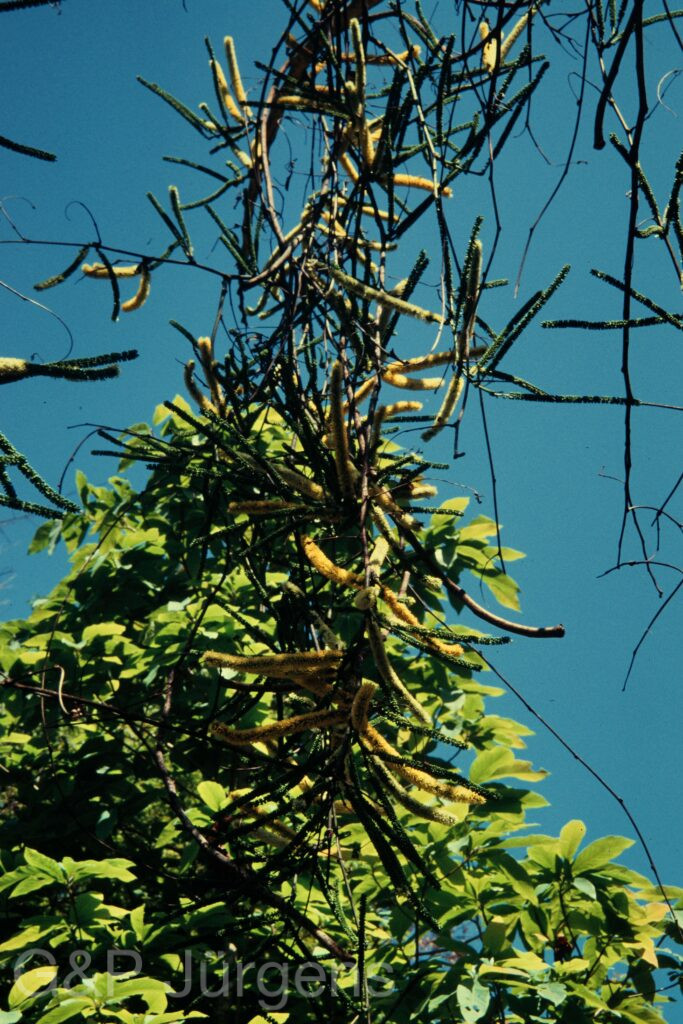
Entada rheedii subsp. sinohimalensis is a Sino-Himalayan liana of warm lower-montane forest, treated by GBIF as a synonym of the accepted Entada rheedii sinohimalensis (under E. rheedii Spreng.). It is a localised eastern Himalayan taxon ranging from Nepal and Sikkim into Bhutan and adjacent China and Myanmar; GBIF holds a single Bangladesh record, underscoring how sparsely this giant climber is documented. It grows in broadleaved subtropical forest and ravine vegetation at low elevations, as in the Mewa Khola of eastern Nepal at 1130 m in April, where it scrambles high into the canopy along humid river valleys.

It is a massive woody liana with stout, twining stems and tendrillate, bipinnate leaves whose pinnae bear several pairs of asymmetric oblong leaflets, the terminal pair of pinnae often modified into a coiling tendril. The flowers are small, sessile and crowded in slender elongate spikes, creamy white to greenish-yellow, with a five-toothed calyx, five free petals and ten exserted stamens giving the inflorescence a feathery aspect. The fruit is among the largest of any legume – a huge, woody, flattened pod up to a metre long that breaks transversely into one-seeded segments, each enclosing a large, hard, glossy brown "sea bean" capable of long-distance hydrochory.

Within the mimosoid clade of Fabaceae, Entada is a pantropical genus of lianas, and subsp. sinohimalensis represents the inland Himalayan-Chinese expression of the widespread E. rheedii. The buoyant, durable seeds are dispersed by water and ocean currents and are used as charms and in folk medicine. The taxon is rarely collected and its conservation status remains unassessed.

Author: (Grierson & D.G.Long) Panigrahi · Sources: POWO (Kew), GBIF, Flora of China, Flora of Bhutan, Annotated Checklist of the Flowering Plants of Nepal, Brenan monograph of Entada

Stapf.

BhutanPG2011 338
Bhutan Jule-Tso 4250m, June
Bhutan2014 937
Bhutan Chele-La 4100m, May
Sikkim2003 522 P727
Sikkim Yume Samdong 4700m August

Description

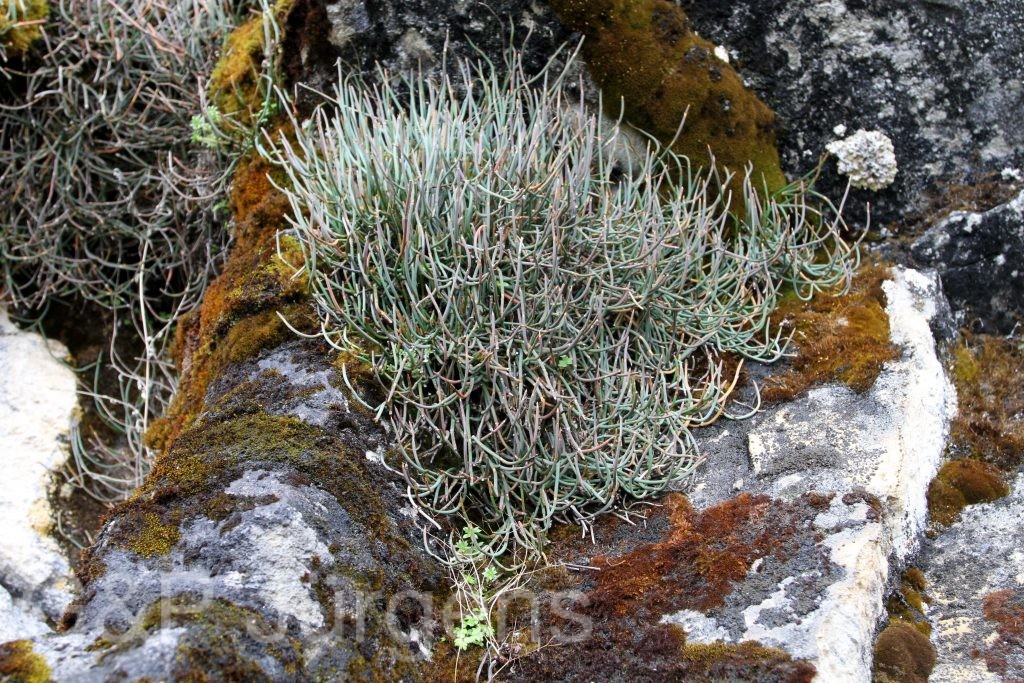
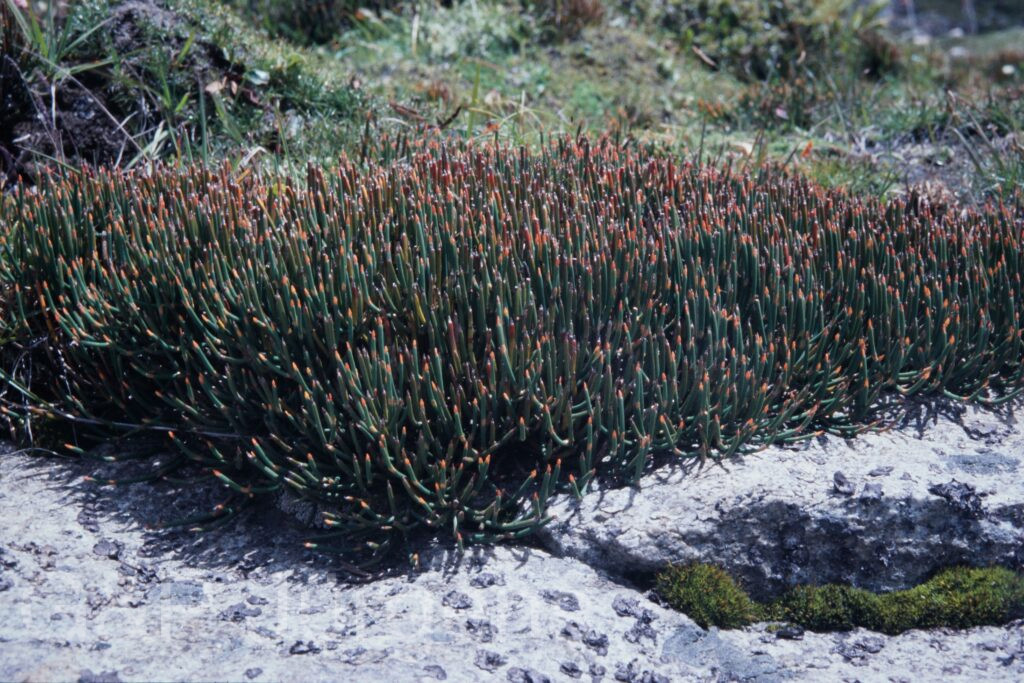
Ephedra gerardiana var. sikkimensis is a high-alpine gymnosperm shrublet of the Himalaya and Tibetan plateau margins, recorded from China, Bhutan, India and Nepal, with the species complex widely held in cultivation across Europe and North America. It is a plant of dry, exposed, stony alpine slopes, gravel flats, moraine and rocky pasture in the arid trans-Himalayan and high-alpine zone, characteristically between about 3500 and 5000 m. The cited collections from Jule-Tso (4250 m) and Chele-La (4100 m) in Bhutan and Yume Samdong in Sikkim at 4700 m exemplify its occurrence at the very upper limits of vascular plant growth, on wind-swept, well-drained, frost-exposed ground.

The plant is a low, densely tufted, mat-forming or cushion shrublet with slender, jointed, longitudinally grooved green branchlets that perform photosynthesis, the true leaves reduced to small connate scales at the nodes. Like all Ephedra it is dioecious and non-flowering: pollen is borne in small ovoid male strobili, while the female cones, after fertilisation, develop fleshy red, berry-like seed cones enclosing one or two seeds, an adaptation to bird dispersal in an otherwise austere environment.

The epithet sikkimensis denotes the type region in the eastern Himalaya, var. sikkimensis being a high-elevation segregate of the polymorphic E. gerardiana. Members of this genus are notable sources of ephedrine alkaloids and have a long history of medicinal and ritual use. As pioneers of stabilised scree and moraine, these dwarf shrubs are ecologically important in fragile alpine systems; though not currently threatened, harvesting and climate-driven habitat shifts warrant monitoring.

Author: Stapf. · Sources: POWO (Kew), GBIF, Flora of China Vol. 4, Flora of Bhutan Vol. 1, Flora of Nepal, A Monograph of the Genus Ephedra (Stapf)

Hausskn.

Sikkim2003 213 G297
Sikkim Dzongri 3900m, August

Description

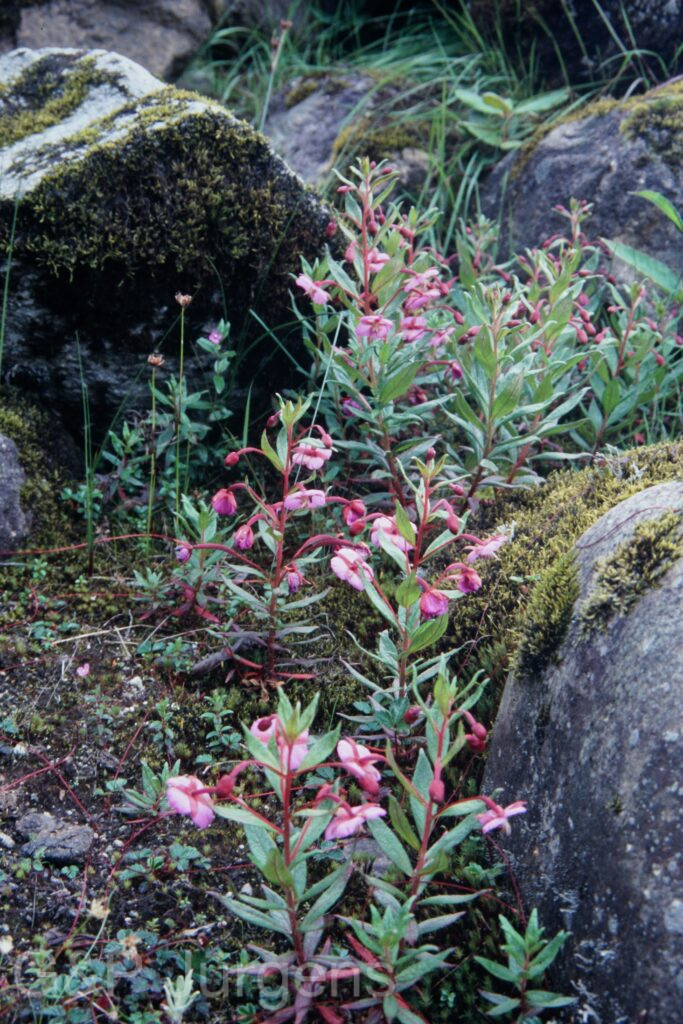
Epilobium conspersum is a perennial herb of the Sino-Himalayan and East Asian mountains, distributed through southwestern China, Nepal, northern India, Myanmar, Bhutan and Japan, with introduced records in the United States; GBIF documents about 134 occurrences. It is a plant of moist, open subalpine and alpine habitats such as stream banks, wet meadows and gravelly flushes, typically between about 3000 and 4200 m. The photographed plant was collected at Dzongri in western Sikkim at around 3900 m in August, on the cool, wet ground this willowherb favours during the monsoon. In GBIF the name carries the status SYNONYM, while Epilobium conspersum is here recognised as the accepted name for this Himalayan material.

The plant produces erect to ascending stems from a perennating base that overwinters by leafy rosettes or short turions. The leaves are opposite below and alternate above, sessile or shortly petiolate, lanceolate to ovate, with a toothed margin, the stems often finely hairy in lines. The flowers are borne in the upper leaf axils; as in the genus they have an inferior, elongate ovary, four notched pink to rose-purple petals, four sepals and eight stamens. The fruit is a long, slender, four-valved capsule that splits to release numerous seeds, each bearing a silky coma for wind dispersal.

Epilobium (Onagraceae) is a large temperate and cold-region genus in which the comose seeds and elongate capsular fruit are diagnostic. The Himalayan species form a taxonomically intricate group, and the synonymy reflected in the GBIF status underscores their nomenclatural complexity. Widespread along its moist alpine corridor, the species is not considered threatened.

Author: Hausskn. · Sources: POWO (Kew), GBIF, Flora of China Vol. 13, Flora of Bhutan Vol. 2, Flora of Nepal, Flora of Pakistan, Raven monograph of Old World Epilobium

DC.

Sikkim2004 3 G4
Sikkim West-Bengal, Sambon 1750m April
Sikkim2004 4 P5
Sikkim West-Bengal, Sambon 1750m April

Description

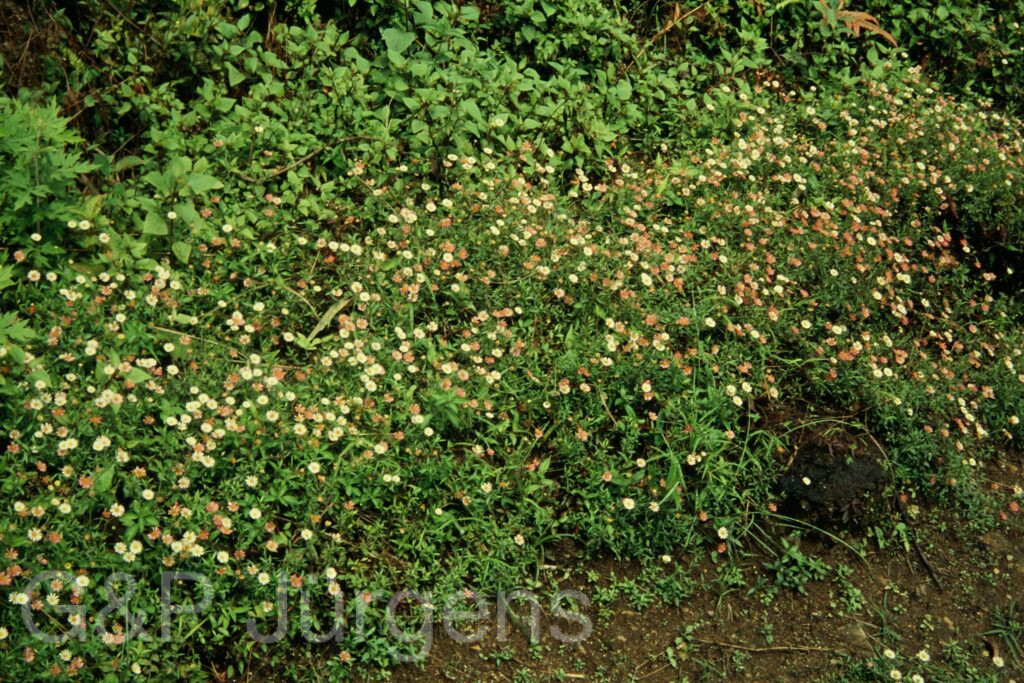
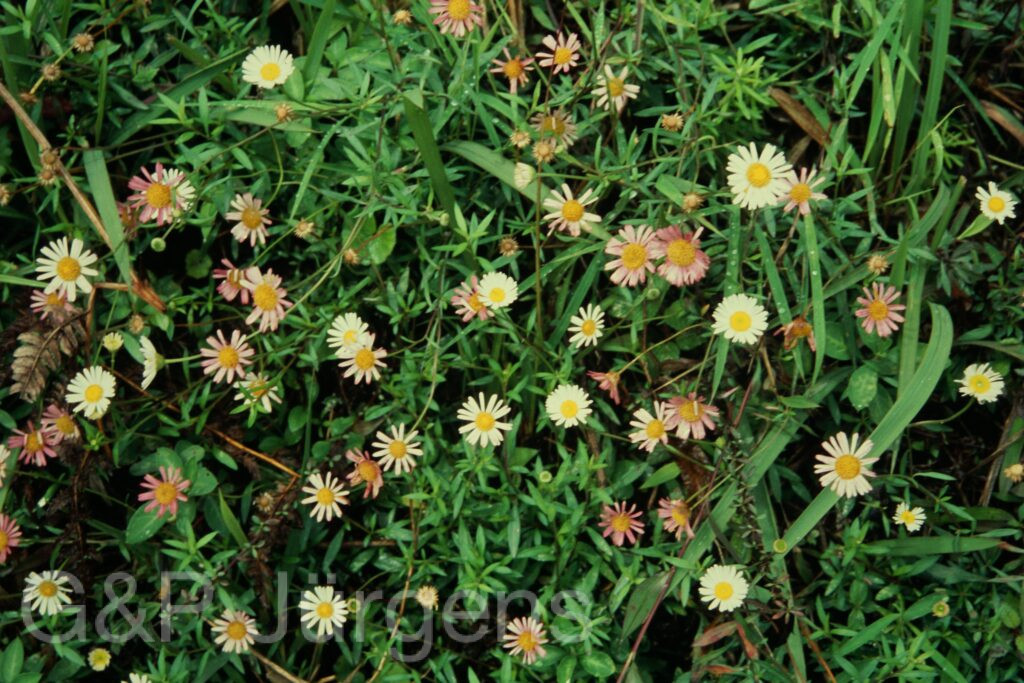
Erigeron karvinskianus, the Mexican fleabane, is a sprawling daisy native to Mexico and Central America but now naturalised across much of the temperate and subtropical world. GBIF documents it from Britain, France, the Netherlands, Spain, Italy, the United States, Mexico, New Zealand, Australia, South Africa, Japan and India, among many others, with over 67,000 occurrences reflecting its status as a cosmopolitan introduced species. It colonises walls, rocky banks, paths, terraces and disturbed slopes from sea level to about 2500 m. The plant illustrated was photographed near Sambon in the Sikkim/West Bengal hills at 1750 m in April, where it has become established as a garden escape along walls and roadsides.

It is a slender, much-branched, mat-forming perennial with wiry, decumbent to ascending stems. The lower leaves are oblanceolate and few-toothed or trilobed, the upper entire and reduced. The numerous small capitula are borne on slender peduncles; each head has a single series of narrow ray florets that open white and age through pink to purplish-red, so that a plant simultaneously bears flowers of several hues, surrounding a central disc of yellow tubular florets. The fruit is a small ribbed achene crowned by a pappus of fine bristles that facilitates wind dispersal.

A member of tribe Astereae, E. karvinskianus is valued horticulturally for its long, profuse flowering and self-seeding habit, the very trait underlying its weediness. In parts of Australia, New Zealand and South Africa it is regarded as an invasive environmental weed escaping gardens to colonise native rock and cliff habitats. In the Himalaya it is a naturalised alien rather than an indigenous element, of no conservation interest but of some invasion-ecology concern.

Author: DC. · Sources: POWO (Kew), GBIF, Flora of China, Flora of North America, Annotated Checklist of the Flowering Plants of Nepal, Erigeron (Asteraceae: Astereae) systematic monograph

(Lindl. ex DC.) Benth. & Hook.f.

BhutanPG2011 371
Bhutan Dur-Tso, 4000m June
Sikkim2003 429 G596
Sikkim Chopta Valley 4100m August

Description

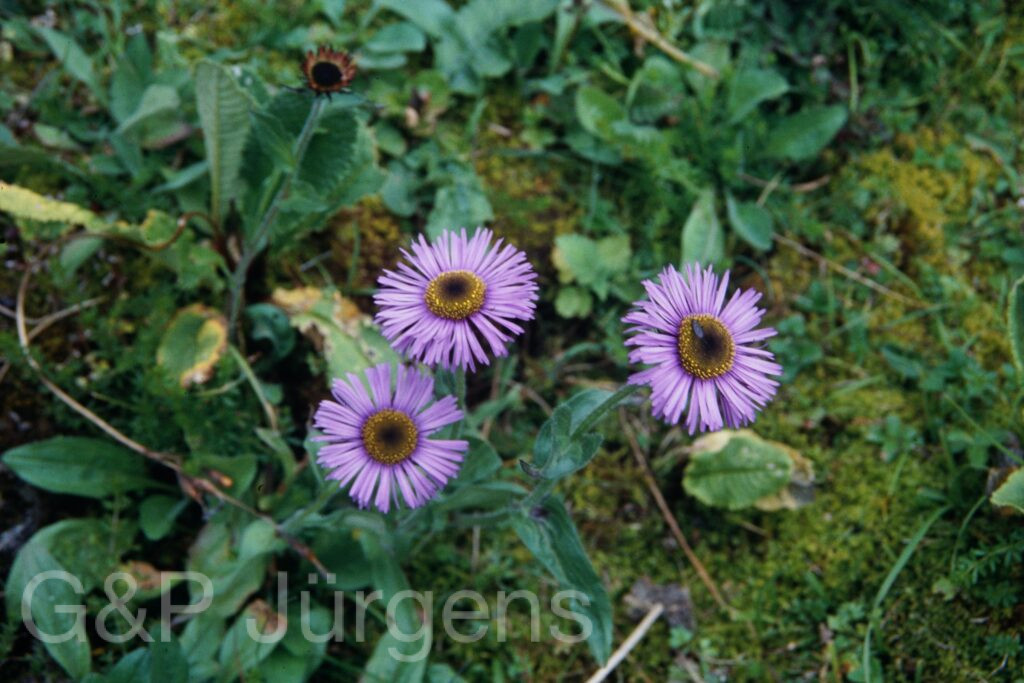
Erigeron multiradiatus (Lindl. ex DC.) Benth. & Hook.f. is a Himalayan and Sino-Himalayan fleabane distributed through China, Nepal, India, Pakistan, Afghanistan and Bhutan, with around 1400 georeferenced occurrences in GBIF. It is a plant of alpine and subalpine meadows, open grassy slopes, rocky ground and forest clearings, generally between about 2700 and 4500 m. The collections from Dur-Tso at 4000 m in June and the Chopta valley in Sikkim at 4100 m in August are characteristic of its high-altitude summer flowering across the central and eastern Himalaya.

It is a tufted perennial herb arising from a short rhizome, with erect, simple or sparingly branched stems bearing spreading hairs. The basal leaves are oblanceolate to spatulate, narrowed to a petiole and entire to slightly toothed, forming a rosette; the cauline leaves are smaller, sessile and clasping. The solitary or few terminal capitula are large and showy, with an involucre of narrow, hairy, somewhat purplish phyllaries; the numerous, very fine ray florets, alluded to in the epithet multiradiatus, are pinkish-purple to violet and surround a central disc of yellow tubular florets. The fruit is a small, compressed, hairy cypsela topped by a double pappus of fine bristles.

Erigeron is a large, taxonomically intricate genus, and the densely many-rayed alpine Himalayan species form a distinctive assemblage within it, recognised by their broad showy heads and high-elevation habitat. A widespread and locally common alpine herb, E. multiradiatus is of no particular conservation concern, though it is valued horticulturally and in regional traditional medicine.

Author: (Lindl. ex DC.) Benth. & Hook.f. · Sources: POWO (Kew), GBIF, Flora of China, Flora of Bhutan, Grierson & Long Flora of Bhutan Compositae account

Benth.

Sikkim2003 319 P458
Sikkim Saniti-Lake 4300m August
Sikkim2003 322 P457
Sikkim Saniti-Lake 4300m August

Description

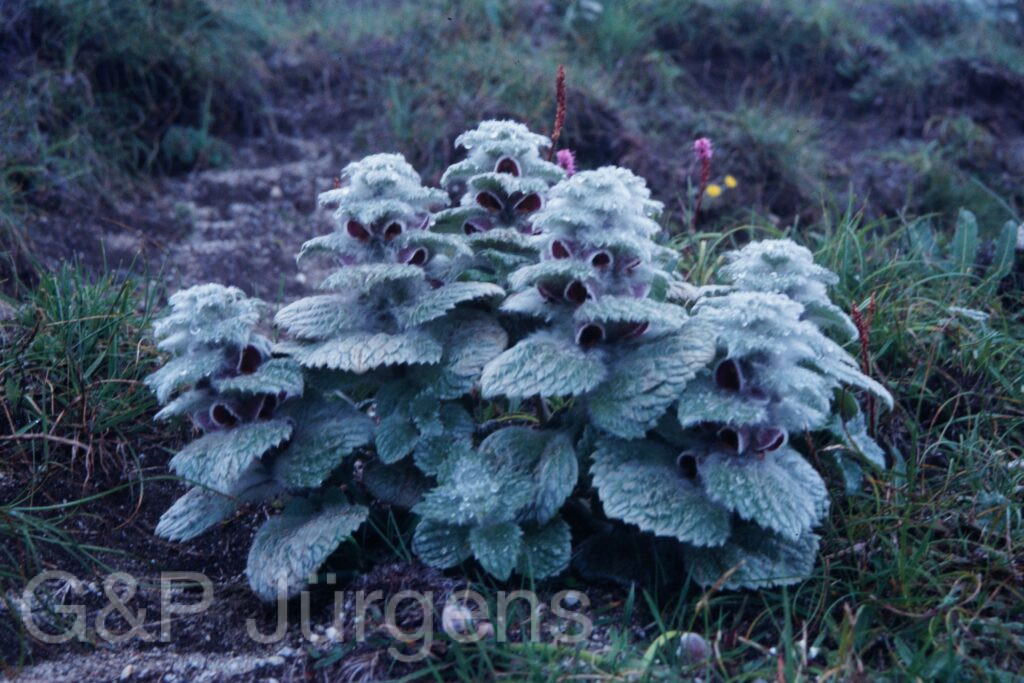
Eriophyton wallichii is a high-alpine perennial of the central and eastern Himalaya and the Tibetan Plateau, recorded from China, Nepal, India, Bhutan and Afghanistan, with some 605 georeferenced occurrences documented in GBIF. It is a characteristic plant of open screes, moraines and frost-heaved gravels of the upper alpine and subnival zones, typically between 3500 and 5000 m, where the growing season is brief. The photograph from the Saniti Lake area of Sikkim at about 4300 m in August captures the species in its preferred scree habitat at the height of the short montane summer.

The plant forms a stout, deeply buried rhizome from which arise short, ascending stems almost entirely concealed by the foliage. The most conspicuous feature is the dense covering of long, silky white woolly hairs that envelop the upper leaves, an adaptation buffering the flowers against cold and excessive radiation. The leaves are opposite, broadly ovate to suborbicular, becoming progressively larger and more densely lanate upward, where the uppermost pairs form a protective bracteal cup. The bilabiate flowers are borne in the axils of these terminal leaves, with a tubular calyx and a pink to purplish corolla whose lower lip is spreading; the fruit comprises four smooth nutlets enclosed within the persistent calyx.

The genus Eriophyton sensu lato (incorporating elements formerly placed in Alajja and Stachyopsis) is a small, distinctly Sino-Himalayan group of the Lamiaceae adapted to the harshest alpine environments. The pronounced indumentum exemplifies the convergent woolliness seen in unrelated subnival cushion and scree plants such as Saussurea and Soroseris. Long valued in Tibetan and Himalayan ethnomedicine, E. wallichii remains locally frequent across its broad range and is not presently considered threatened, though its specialised scree habitat is sensitive to glacial retreat and shifting alpine climates.

Author: Benth. · Sources: POWO (Kew), GBIF, Flora of China, Flora of Bhutan, Annotated Checklist of the Flowering Plants of Nepal, Harley et al. Labiatae in The Families and Genera of Vascular Plants