Tag:

Sikkim

Flowers of Sikkim — 350 species from the Sikkim Himalaya in northeast India, a compact yet botanically extraordinary region that climbs from subtropical valleys to the alpine zone beneath Kangchenjunga. Sikkim is a classic centre of Himalayan plant diversity, celebrated for its rhododendrons, primulas, orchids and gentians. Each entry provides a botanical description, distribution, habitat and flowering season with the original field photograph.

Wight

Bh2008 154 P253
Bhutan Trongtsa 2120m, April
Nepal 97 115 P198
Nepal Mewa-Khola 2470m April

Description

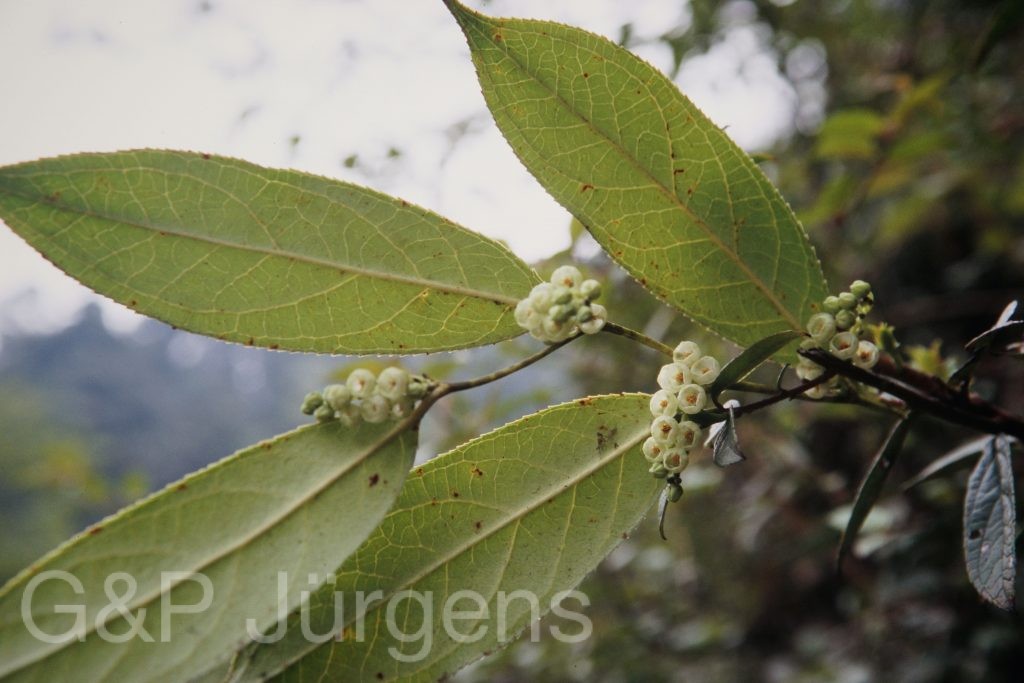
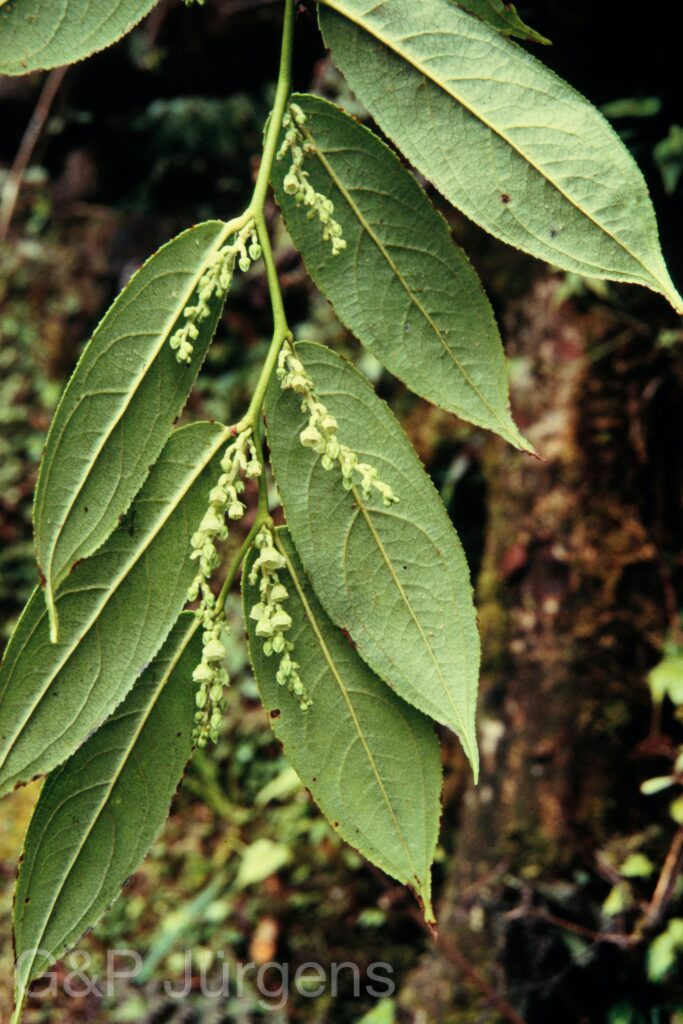
Gaultheria griffithiana is an evergreen shrub of the eastern Himalaya and Indo-Burmese mountains, distributed through Nepal, Sikkim and Darjeeling in India, Bhutan, southern China (Xizang, Yunnan), Myanmar, Laos and Vietnam, with nearly seven hundred georeferenced records. It grows in temperate broadleaved and conifer forest, on shrubby slopes, forest margins and rocky banks, often on acidic humus-rich soils. The cited collections at Trongtsa in Bhutan around 2120 m and Mewa-Khola in east Nepal at 2470 m, both flowering in April, reflect its spring anthesis in the montane forest belt.

The plant is a much-branched shrub with reddish, often bristly or glandular-setose young branchlets. The leaves are alternate, coriaceous, elliptic to oblong-lanceolate, finely serrate with gland-tipped teeth, glossy above and often with bristly hairs or glands, and aromatic when crushed. The flowers are borne in axillary racemes, each subtended by bracts; the calyx is five-lobed and the corolla is small, urceolate (urn-shaped), white to pinkish, with ten included stamens whose anthers open by terminal pores. The fruit is a small berry-like structure, the capsule being enclosed by the fleshy, accrescent calyx that turns blue-black or dark purple at maturity.

Gaultheria (Ericaceae, subfamily Vaccinioideae) is well represented in the Sino-Himalaya, and this species, named for William Griffith, belongs to the assemblage of wintergreen-scented shrubs containing methyl salicylate. The fleshy fruiting calyces are dispersed by birds, while the urceolate flowers are pollinated by bees. Locally common and ecologically widespread, the species is not regarded as threatened.

Author: Wight · Sources: POWO (Kew), GBIF, Flora of China, Flora of Bhutan, Middleton's revision of Asian Gaultheria (Ericaceae)
C.B.Clarke

Sikkim2003 409 P569
Sikkim Zemu Valley 3400m August

Description

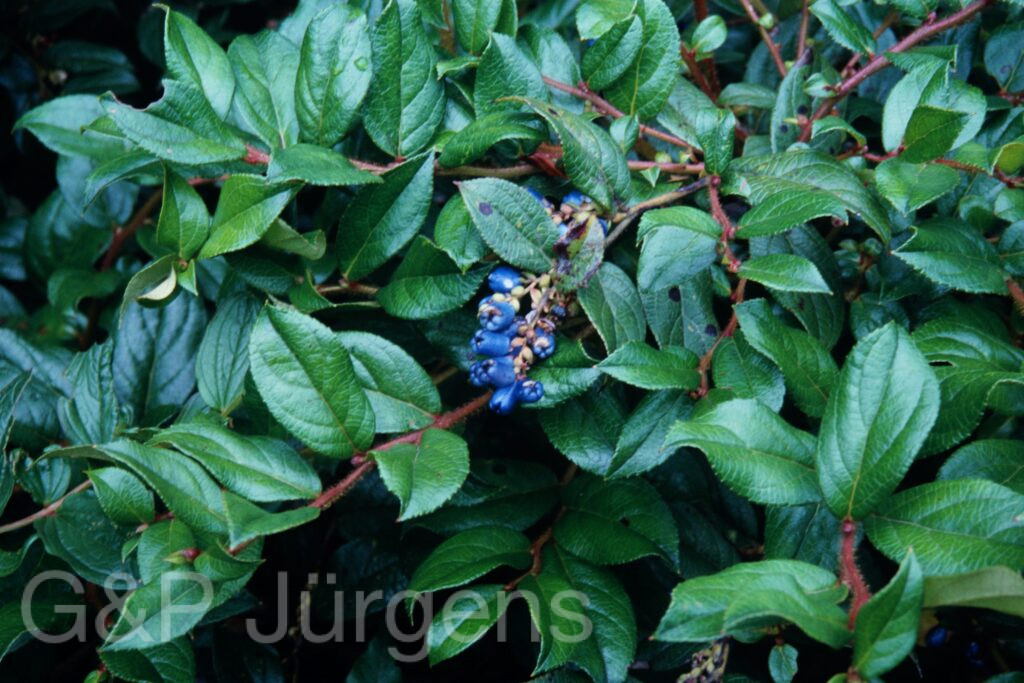
Gaultheria hookeri is an evergreen shrub native to the eastern Himalayas and extending into southwestern China and northern Myanmar. Its range encompasses Nepal, northeast India (Sikkim, Arunachal Pradesh), Bhutan, Myanmar, and China (Yunnan, Xizang, Sichuan). The species is a characteristic element of upper temperate to subalpine forests, occurring at elevations of 2,500–4,000 m in Rhododendron-Abies forests, bamboo thickets, and along stream margins. It is well documented from the Zemu Valley in Sikkim at 3,400 m, where it can be found growing in the understorey of dense montane forests during August.
Gaultheria hookeri forms a densely branched, spreading to erect shrub 0.3–1.5 m tall. The young branchlets are setose-hispid with rusty brown hairs. The leaves are alternate, coriaceous, ovate to elliptic-ovate, 4–10 cm long, with a serrate to serrulate margin, the veins impressed above and prominent beneath. The flowers are borne in short axillary racemes; each flower has a campanulate to urceolate corolla, white to pinkish, 4–6 mm long. The calyx is five-lobed and becomes fleshy and enlarged in fruit, enclosing the capsule to form a conspicuous, globose, fleshy pseudoberry that is blue to deep purple-black at maturity, 8–12 mm in diameter.
Described by C.B. Clarke and named in honour of Sir Joseph Dalton Hooker, who extensively explored the Sikkim Himalaya, G. hookeri is one of the more robust and widely collected species in the genus across the eastern Himalayan region. With over 750 occurrence records in GBIF, it is comparatively well documented. The species is of ecological importance as a food source for montane birds and mammals that disperse its fleshy fruits. Its aromatic, wintergreen-scented foliage, rich in methyl salicylate, is occasionally used in traditional medicine. The species has also been introduced to cultivation in botanical gardens in Europe and North America.

Author: C.B.Clarke · Sources: POWO (Kew), GBIF, Flora of Bhutan Vol. 2, Flora of China Vol. 14, Hooker: Flora of British India Vol. 3 (1882)

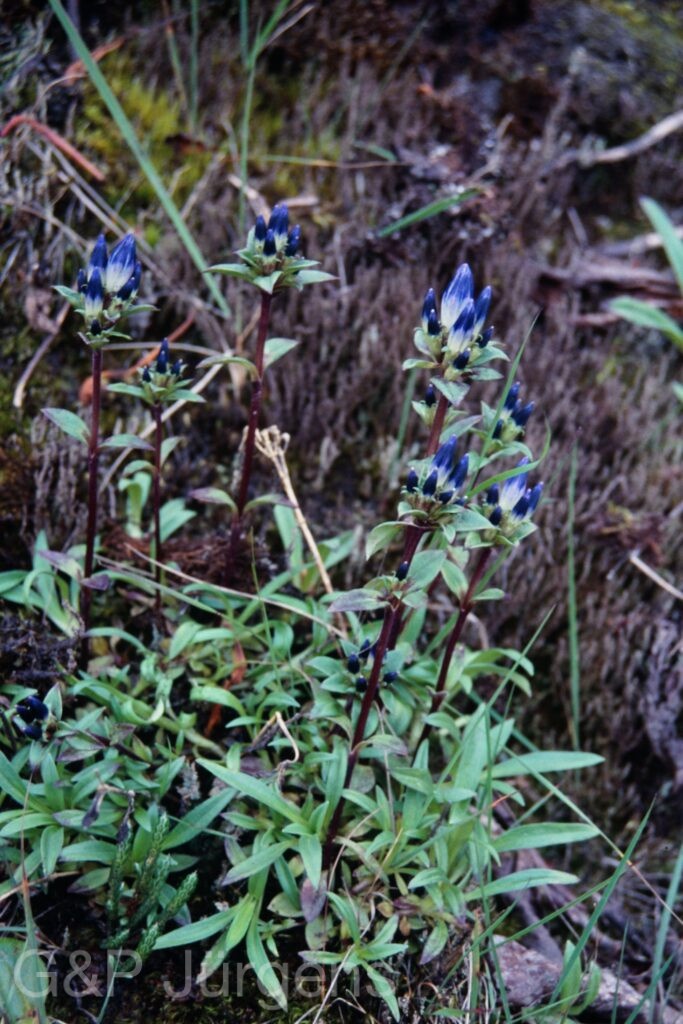
C.B.Clarke

Sikkim2003 164 G219
Sikkim Dzongri 4000m, August
Sikkim2003 165 P220
Sikkim Dzongri 4000m, August

Description

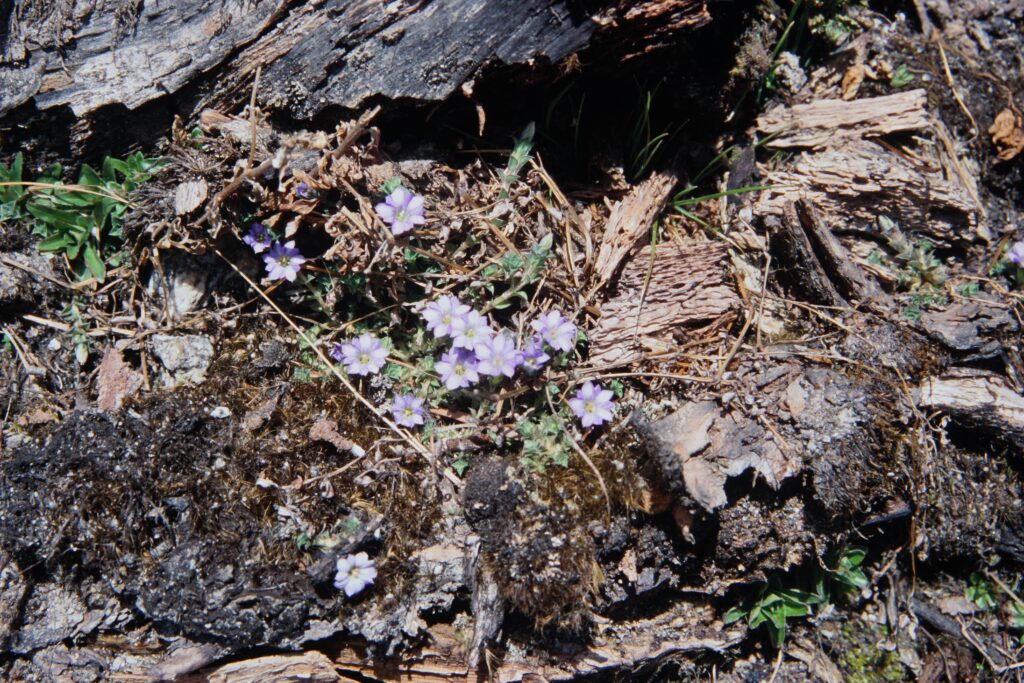
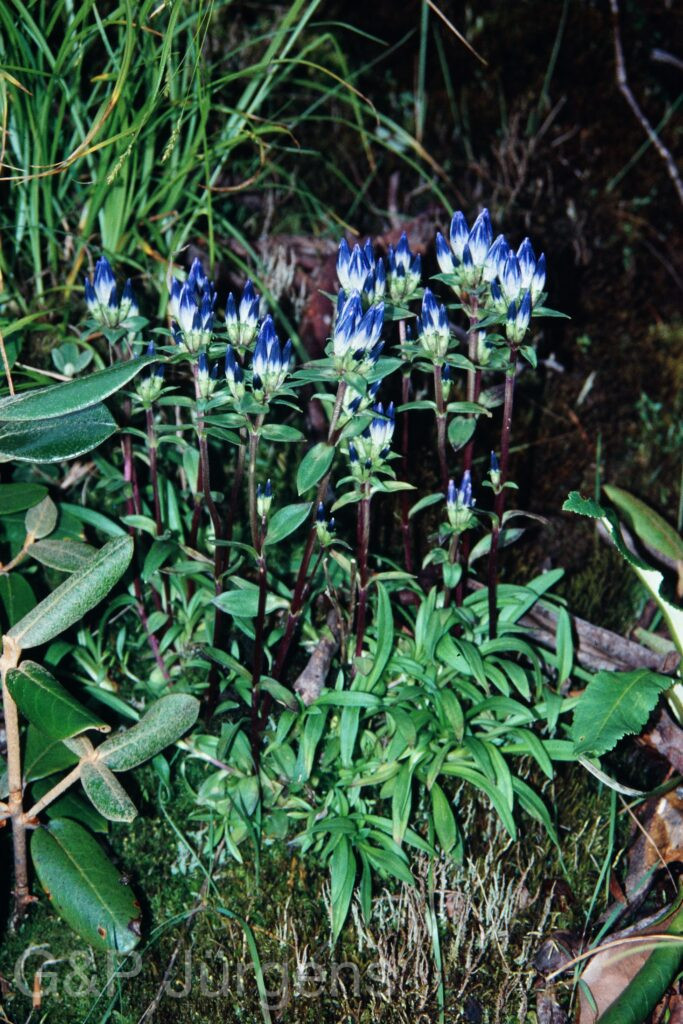
Gentiana elwesii is an eastern Himalayan gentian recorded from Nepal (NP), Bhutan (BT), India (IN) and China (CN), with 100 GBIF occurrences reflecting its restricted high-mountain range. It is a plant of alpine meadows, open turf, grassy slopes and rocky pastures in the upper subalpine and alpine zones, generally between about 3500 and 4500 m. The illustrated material was collected at Dzongri in Sikkim at roughly 4000 m in August, when many Himalayan autumnal gentians come into flower at the close of the monsoon.

It is a small annual or biennial herb with a slender, erect to ascending, often branched stem arising from a basal rosette. The leaves are small, ovate to lanceolate, opposite and sessile, the rosette leaves frequently larger than the cauline ones. The flowers are borne singly or few together at the stem and branch apices; the calyx is tubular with narrow lobes, and the corolla is funnel-shaped to narrowly campanulate, typically blue to purplish-blue, with five spreading lobes alternating with smaller, fringed or toothed plicae in the sinuses, a diagnostic feature of the autumn-flowering gentians. The fruit is a stipitate, two-valved capsule releasing numerous minute seeds.

Gentiana elwesii belongs to the species-rich annual gentians (section Chondrophyllae and allies) that characterise Himalayan alpine grasslands, a group noted for intricate corolla-plait morphology and bee pollination. The Sino-Himalayan region is a global centre of Gentiana diversity, and such narrow-range alpine annuals are valuable indicators of high-elevation grassland habitats sensitive to grazing and climatic change.

Author: C.B.Clarke · Sources: POWO (Kew), GBIF, Flora of China, Flora of Nepal, Flora of Bhutan, Ho & Liu Worldwide Monograph of the genus Gentiana

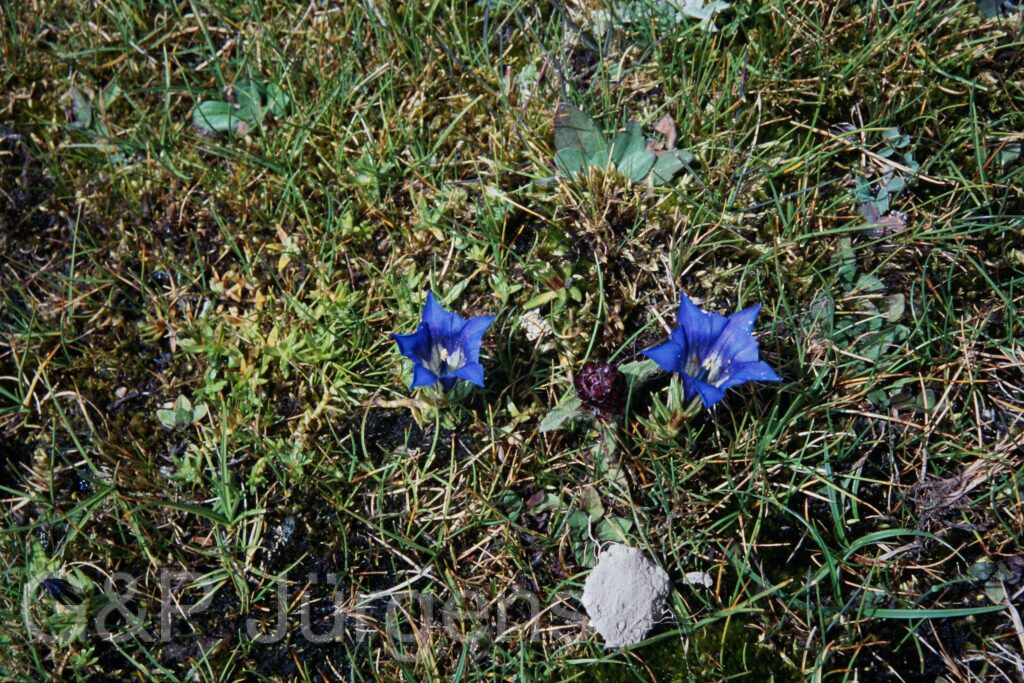
C.B.Clarke

Sikkim2003 526 P734
Sikkim Yume Samdong 4600m August

Description

Gentiana micans is an alpine gentian of the eastern and central Himalaya, with GBIF occurrences spanning southwest China, Bhutan, India and Nepal. It is a characteristic component of moist alpine meadow, seepage slopes and short turf above the treeline, generally between 3,500 and 4,800 m. The illustrated plant was recorded at Yume Samdong in northern Sikkim at about 4,600 m in August, coinciding with the late-monsoon flowering peak when these gentians carpet the high pastures alongside Primula, Pedicularis and Saxifraga.

The species is a small annual or short-lived herb with slender, ascending to erect stems often branching from the base and frequently tinged purple. The leaves are small, sessile, ovate to lanceolate and arranged in opposite pairs. The flowers are solitary and terminal on the branchlets, with a tubular to narrowly campanulate corolla that is brilliant deep blue, the five lobes spreading and separated by small plicate folds; the calyx is tubular with narrow teeth. The fruit is a stalked, two-valved capsule containing numerous minute seeds adapted to wind dispersal.

Gentiana micans belongs to the species-rich Himalayan assemblage of small annual gentians (section Chondrophyllae and allies), a group whose delicate taxonomy rests on corolla, calyx and seed characters. Though individually inconspicuous, these annuals are ecologically important early colonisers of disturbed and grazed alpine ground. The taxon is widespread and not considered threatened, but its meadow habitats are sensitive to overgrazing and to the shifting precipitation regimes of the monsoonal high Himalaya.

Author: C.B.Clarke · Sources: POWO (Kew), GBIF, Flora of China Vol. 16 (Gentianaceae), Grierson & Long: Flora of Bhutan Vol. 2, Ho & Liu: A Worldwide Monograph of Gentiana

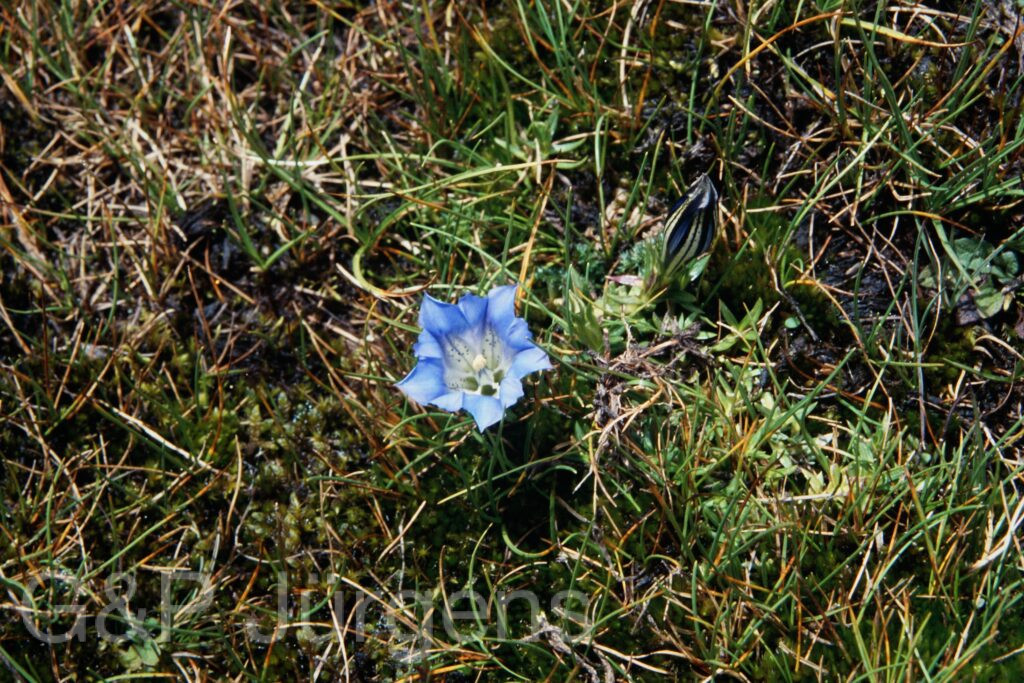
Burkill

Sikkim2011 105
Sikkim Chopta-valley 4200m, June
Bhutan2014 908
Bhutan Chele-La 3700m, May

Description

Gentiana micantiformis Burkill is a diminutive alpine gentian of the high Sino-Himalaya, recorded from China, Nepal, Bhutan, India and Japan (gbif_countries: CN, NP, BT, IN, JP) with a modest 59 occurrences in GBIF, reflecting both its small stature and restricted high-elevation range. It inhabits short alpine turf, open stony slopes, moist meadows and the margins of snow-melt flushes, generally between about 3500 and 4500 m. The image data, from the Chopta valley in Sikkim at 4200 m in June and Chele-La in western Bhutan at 3700 m in May, place it firmly in the early-season alpine zone where it flowers as the snow recedes.

It is a small annual or short-lived herb forming low tufts, with slender, often branched stems. The leaves are small, opposite, ovate to oblong and crowded toward the base, frequently with cartilaginous mucronate tips and white membranous margins. The flowers are solitary or few at the stem apices, with a tubular-campanulate, lobed calyx and a tubular-funnelform corolla that is blue to pale blue-violet, the lobes alternating with smaller plicate folds (plicae) characteristic of section Chondrophyllae. The capsule is stipitate and many-seeded, dehiscing to release minute seeds.

Gentiana section Chondrophyllae comprises numerous small annual Asian gentians whose delimitation is notoriously difficult, and the epithet signals close affinity with G. micans. Flowers open in bright sun and close in cold or cloud, a heliotropic adaptation typical of high-alpine gentians and aiding warmth-dependent insect pollination. Although nowhere abundant, the species is widely scattered across the high ranges and is not regarded as threatened.

Author: Burkill · Sources: POWO (Kew), GBIF, Flora of China (Gentianaceae), Flora of Bhutan, Ho & Liu monograph A Worldwide Monograph of Gentiana

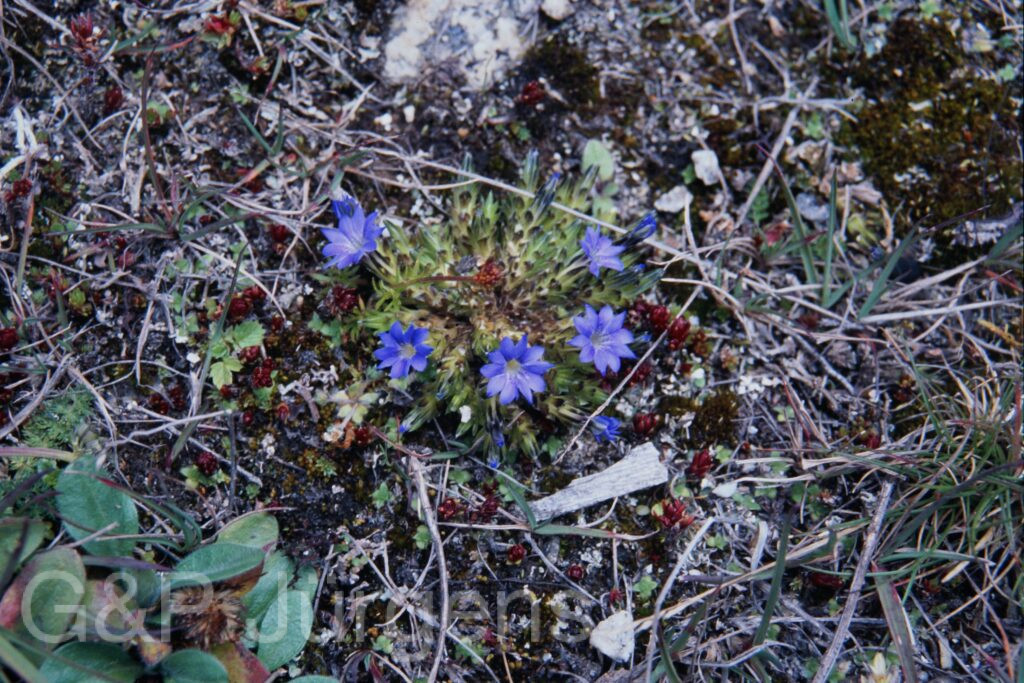
Edgew.

Sikkim2003 515 G715
Sikkim Yume Samdong 4600m August
Sikkim2003 514 P714
Sikkim Yume Samdong 4600m August

Description

Gentiana nubigena is a high-alpine gentian of the Himalaya and the Tibetan plateau, recorded from China, Nepal, India, Bhutan and Pakistan, with GBIF documenting around 330 occurrences. It inhabits cold alpine meadows, gravelly slopes, screes, moraine and damp turf in the upper alpine and subnival zones, typically from about 4000 to 5000 m. The photographed plant was found in Sikkim at Yume Samdong at 4600 m in August, flowering at the height of the brief alpine summer; the epithet "nubigena," meaning cloud-born, aptly evokes its habitat in the mist-shrouded high pastures.

The plant is a small, tufted perennial herb forming low rosettes from a short rootstock, with several short ascending flowering stems. The basal leaves are crowded, linear-lanceolate to oblong and somewhat fleshy; the stem leaves are smaller and opposite. The flowers are solitary or few at the stem tips, comparatively large; the corolla is funnelform to narrowly campanulate, pale blue to whitish with darker greenish or blue-spotted bands externally, the five lobes separated by shorter plicate folds (plicae) characteristic of the genus. There are five included stamens and a superior ovary that matures into a stipitate, two-valved capsule releasing numerous small seeds.

The species belongs to genus Gentiana (Gentianaceae), within the large complex of Sino-Himalayan autumn-flowering alpine gentians (section Frigida and allies). Adapted to intense cold, high irradiance and a short growing season, it is a characteristic component of the highest vegetated zones. It is not regarded as threatened given its extensive remote range, but as a strict high-alpine specialist it is sensitive to warming-driven upslope compression of subnival habitats.

Author: Edgew. · Sources: POWO (Kew), GBIF, Flora of China, Flora of Nepal, Flowers of the Himalaya (Polunin & Stainton), monograph of Gentiana (Ho & Liu)

C.Marquand

Sikkim2004 286 G499 ergebnis
Sikkim/India Dzongri 3900m May

Description

Gentiana simulatrix is an alpine gentian of the eastern Himalaya and adjacent China, with GBIF records concentrated in south-central China (Xizang, Yunnan) and Bhutan, and extending into Sikkim in the Indian Himalaya; the roughly forty-three documented occurrences indicate a localised but reasonably collected high-altitude range. It inhabits open alpine turf, moist pastures, stony slopes and seepage margins above the treeline. The illustrated plant from Dzongri in Sikkim at about 3900 m, flowering in May, exemplifies its spring-to-early-summer phenology in the upper alpine zone, where it emerges as snowmelt exposes the short-cropped sward.

The species is a small tufted perennial with a slender rootstock giving rise to numerous decumbent to ascending leafy shoots. The leaves are small, opposite, ovate to oblong and somewhat fleshy, forming dense basal and cauline pairs. The flowers are solitary and terminal or few in the upper axils; the calyx is tubular with narrow lobes, and the corolla is campanulate to narrowly funnelform, blue to deep azure with darker stripes and conspicuous plicae (folds) between the lobes. The capsule is stipitate within the persistent corolla and releases numerous small seeds.

Gentiana simulatrix belongs to the genus Gentiana (Gentianaceae) and is an accepted species, placed among the small-flowered alpine gentians of section Chondrophyllae, a critical complex where it has been confused with allied taxa such as G. prolata. Its cushion-forming habit, fused corolla plicae and protective floral folds are adaptations to the cold, windy, high-radiation alpine environment. No formal IUCN status has been published, but its dependence on intact alpine grassland makes it sensitive to overgrazing and climate-driven upslope shifts.

Author: C.Marquand · Sources: POWO (Kew), GBIF, Flora of China, Flora of Bhutan, Ho & Liu monograph of the genus Gentiana

Sweet

BhutanPG2011 106
Bhutan Tsochenchen, 3450m June
Sikkim2003 181 G247
Sikkim Dzongri 4100m 08.2003

Description

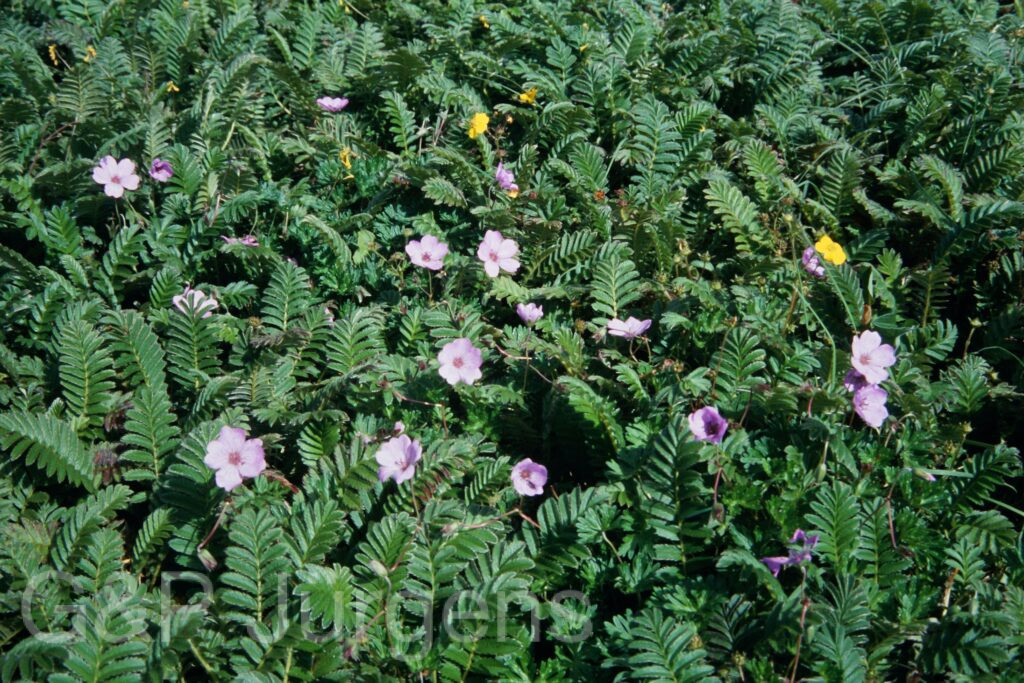
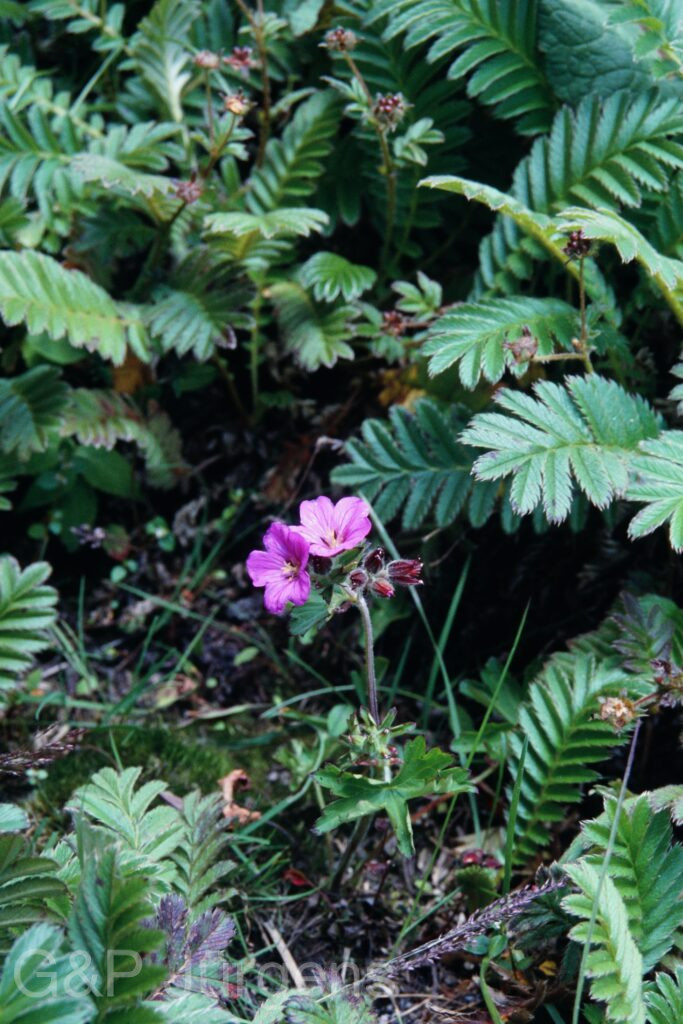
Geranium donianum is an alpine cranesbill of the Himalaya and southwestern China, recorded by GBIF from China, Nepal, India, Bhutan and Myanmar across roughly 795 occurrences. It grows in alpine and subalpine meadows, open grassy slopes, scrub margins and stony turf, generally at high elevations where it forms part of the herb-rich alpine sward. The photographed plants were found in Bhutan at Tsochenchen at 3450 m in June and in Sikkim at Dzongri at 4100 m in August, situations typical of its preference for sunny, well-drained montane grassland through the brief alpine summer.

It is a low, tufted perennial arising from a stout, often woody rootstock, with somewhat spreading, hairy stems. The leaves are orbicular to reniform in outline and palmately divided nearly to the base into several wedge-shaped, deeply lobed segments, the lobes again toothed; basal leaves are long-petiolate. The flowers are relatively large and showy, with five free, obovate petals that are typically deep pink to purplish-red and conspicuously darker-veined, sometimes notched at the apex. There are ten stamens and a five-lobed superior ovary; the fruit is the characteristic beaked schizocarp of the genus, whose mericarps separate elastically at maturity to fling out the seeds.

GBIF accepts the name. Within Geranium it belongs among the Himalayan alpine cranesbills allied to G. orientali-tibeticum and related taxa, a group well represented across the high ranges. The vivid dark-veined petals serve as nectar guides for bee and fly pollinators. Widespread and locally common in alpine pastures, G. donianum is assessed as of least conservation concern.

Author: Sweet · Sources: POWO (Kew), GBIF, Flora of Nepal, Flora of China, Yeo monograph of Geranium

H.Hara

BhutanPG2011 372
Bhutan Dur-Tso, 3800m June
Also included: Pedicularis siphonantha D.Don
Sikkim2003 176 P240
Sikkim Dzongri 4100m, August

Description

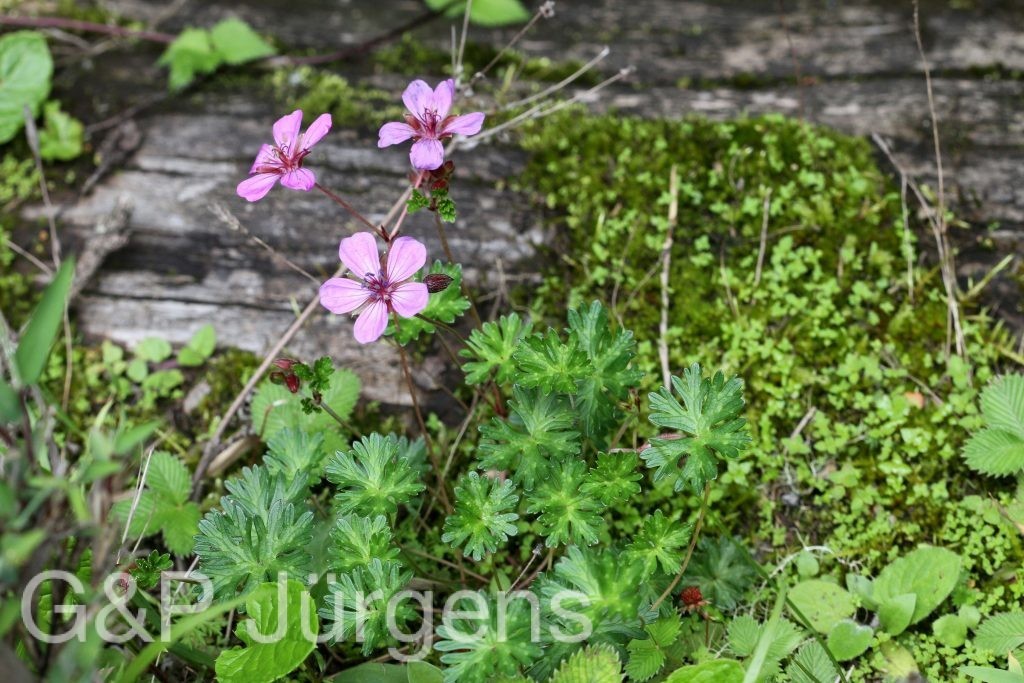
Geranium nakaoanum is a Himalayan cranesbill known from Nepal, the Indian Himalaya, Bhutan and adjacent China, with around 61 GBIF occurrences reflecting its montane to alpine distribution. It occupies open alpine meadows, grassy slopes, streamsides and the herbaceous margins of dwarf rhododendron and juniper scrub on moist, humus-rich soils. The locality figured, Dur Tsachu in Bhutan at about 3800 m in June, sits within its typical band of roughly 3300-4500 m; the accompanying note of Pedicularis siphonantha at Dzongri in Sikkim at 4100 m in August underscores the high-elevation meadow community in which it grows, flowering through the monsoon summer.

It is a low, tufted perennial herb with a thickened rootstock, producing slender, often decumbent or ascending stems clothed in spreading or retrorse hairs. The leaves are long-petioled and palmately divided into five to seven deeply incised, lobed segments forming a rounded outline, the laminae sparsely hairy on both surfaces. The flowers are borne in few-flowered cymes on glandular-hairy pedicels; the five free petals are pink to rose-purple, frequently darker-veined and shallowly notched. Ten stamens surround the five-carpellate ovary, which matures into the characteristic beaked schizocarp whose mericarps spring apart elastically to disperse the seeds.

The species commemorates the Japanese botanist Sasuke Nakao, a participant in mid-twentieth-century Himalayan expeditions. It belongs to the large temperate genus Geranium, well represented in the Himalaya by several allied alpine taxa distinguished by indumentum, petal colour and leaf dissection. As a meadow perennial it contributes to the diverse alpine herb flora and is pollinated chiefly by bees and flies; no specific threat is recorded, though alpine grazing pressure can affect such populations.

Author: H.Hara · Sources: POWO (Kew), GBIF, Flora of Bhutan, Flora of Nepal, Aedo monograph of Geranium, Yeo Hardy Geraniums

Edgew. & Hook.f.

Sikkim2003 204 P284
Sikkim Dzongri 3900m 08.2003

Description

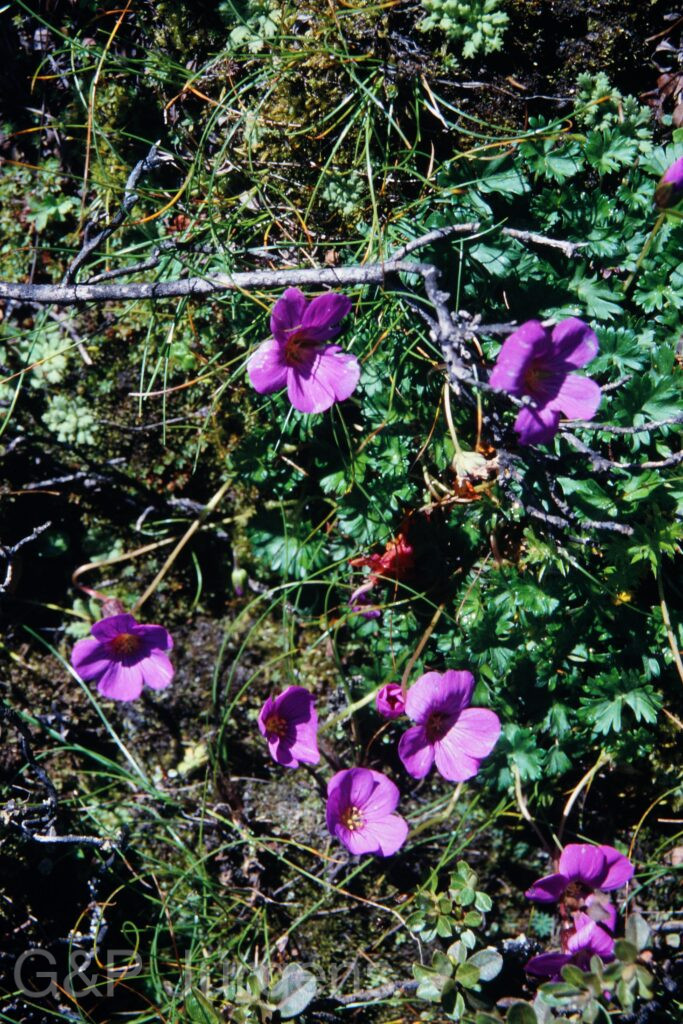
Geranium polyanthes is a perennial cranesbill of the high Himalaya and the mountains of southwestern China, recorded by GBIF from China, India, Nepal, Bhutan and Myanmar (with scattered cultivated or vouchered records elsewhere) across about 331 georeferenced occurrences. It is a plant of subalpine and alpine meadows, open hillsides, grassy slopes and forest clearings near and above the treeline, characteristically flowering in the monsoon months of July and August. Its elevational range extends from roughly 3,000 m to over 4,000 m, well represented by the photographed plant from Dzongri in Sikkim at about 3,900 m in August, where it grows among dwarf rhododendron and herbaceous alpine turf.

The species forms a clump from a stout rootstock, the stems erect to ascending and clothed, like the rest of the plant, in spreading hairs. The leaves are orbicular-reniform in outline and palmately lobed into shallow, broad, crenate-toothed segments, the basal leaves long-petioled. As the epithet polyanthes ("many-flowered") indicates, the inflorescence is comparatively dense and many-flowered, an umbel-like cluster of pink to rose-pink flowers with five obovate, slightly notched petals veined with darker lines, ten stamens and a beaked pistil. The fruit is the characteristic geraniaceous schizocarp with an elongate rostrum that splits explosively into one-seeded mericarps, ejecting the seeds.

Geranium polyanthes belongs to the large genus Geranium (subgenus Geranium) and is one of a suite of pink-flowered Himalayan perennial cranesbills that includes G. donianum and G. nakaoanum, from which it is separated by its denser, many-flowered inflorescence and leaf division. As a nectar-rich alpine herb it is visited by bees and other insects and contributes to the floral diversity of Himalayan summer pastures. It is locally common and not considered threatened, though the alpine meadow habitats it occupies are sensitive to overgrazing and to the upslope shifts in vegetation associated with a warming climate.

Author: Edgew. & Hook.f. · Sources: POWO (Kew), GBIF, Flora of China Vol. 11, Flora of Bhutan Vol. 2, Flora of Nepal, Flora of Pakistan, Yeo: Hardy Geraniums and the systematic monograph of the genus Geranium