Tag:

Sikkim

Flowers of Sikkim — 350 species from the Sikkim Himalaya in northeast India, a compact yet botanically extraordinary region that climbs from subtropical valleys to the alpine zone beneath Kangchenjunga. Sikkim is a classic centre of Himalayan plant diversity, celebrated for its rhododendrons, primulas, orchids and gentians. Each entry provides a botanical description, distribution, habitat and flowering season with the original field photograph.

Wall.

Sikkim 2006 184 ergebnis
India West-Bengal, Samadan 2300m, May
BhutanPG2011 82 ergebnis scaled
Bhutan Menchuang 2850m, June

Description

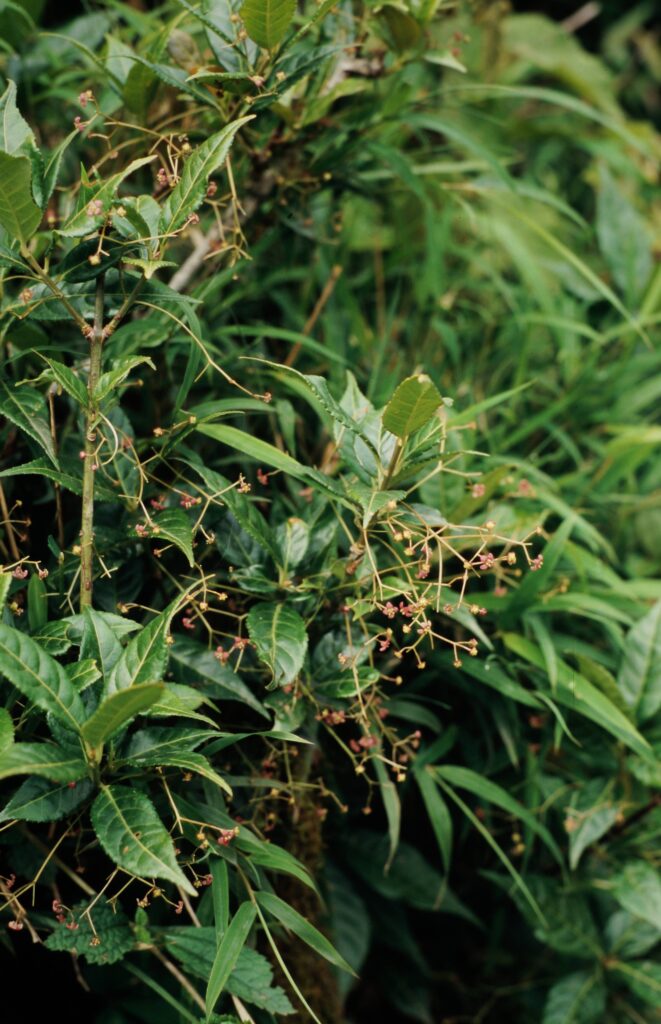
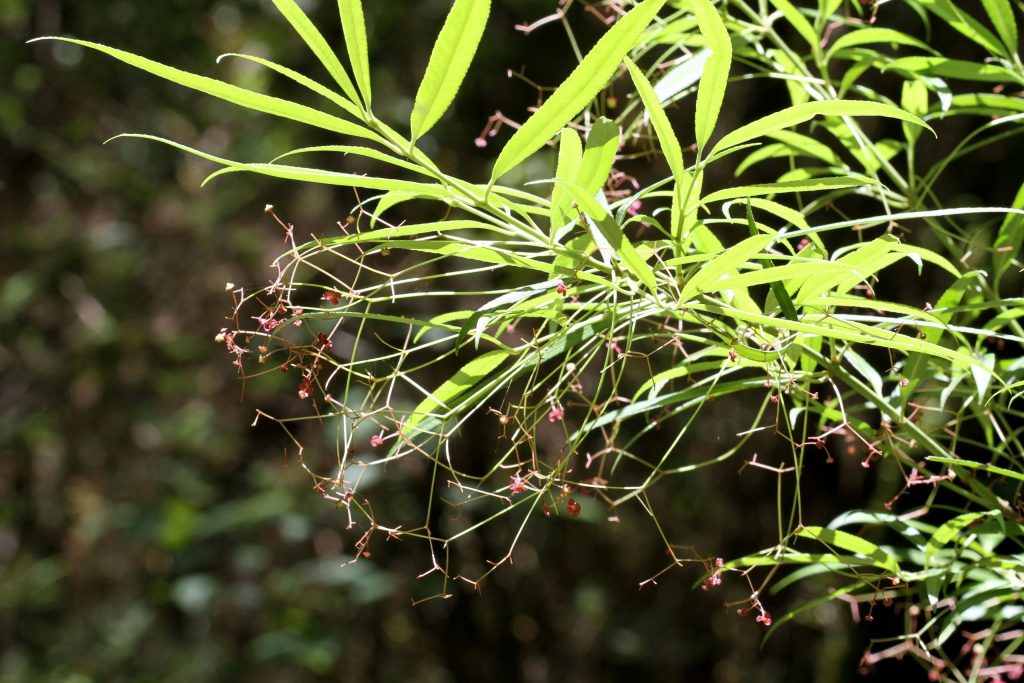
Euonymus frigidus is a Himalayan spindle tree distributed from central Nepal through northeast India, Sikkim, Bhutan, and northern Myanmar to southwest China (Yunnan, Sichuan, Xizang). GBIF records over 1,570 occurrences, with the majority from China and the eastern Himalayas. The species inhabits cool-temperate and subalpine broadleaved and mixed forests, often growing along forest margins, stream gullies, and shaded slopes at elevations of 1,800–3,200 m. Collections from Samadan in West Bengal at 2,300 m and from Menchuang in Bhutan at 2,850 m illustrate its typical occurrence in the mid-elevation broadleaved forest zone of the eastern Himalayan slopes.
Euonymus frigidus is a large deciduous shrub or small tree, reaching 3–8 m in height, with smooth, greyish-green bark on younger branches. Leaves are opposite, elliptic to oblong-lanceolate, 6–14 cm long, acuminate at the apex, cuneate at the base, with finely crenate-serrate margins, glabrous on both surfaces, and turning reddish-purple in autumn. The inflorescence is an axillary, dichasial cyme bearing 7–15 flowers on slender peduncles. Flowers are tetramerous, small, 6–8 mm in diameter, with greenish-yellow to purplish petals and a conspicuous four-lobed disc. The fruit is a deeply four-lobed capsule, pink to crimson at maturity, splitting to reveal four seeds each enclosed in a bright orange aril — a striking ornamental feature.
The specific epithet 'frigidus' alludes to the cold-temperate habitats in which this species predominantly occurs. Euonymus frigidus is distinguished from the closely related E. hamiltonianus by its generally larger leaves, more deeply lobed capsules, and preference for higher elevations. The conspicuous arillate fruits are an important food source for frugivorous birds, including minivets and laughingthrushes, which serve as effective dispersal agents. The species is occasionally cultivated as an ornamental in European and North American gardens for its vivid autumn colour and decorative fruit.

Author: Wall. · Sources: POWO (Kew), GBIF, Flora of China Vol. 11, Flora of Bhutan Vol. 2, Grierson & Long: Flora of Bhutan (1991)
D.G.Long

Sikkim2004 412 P707
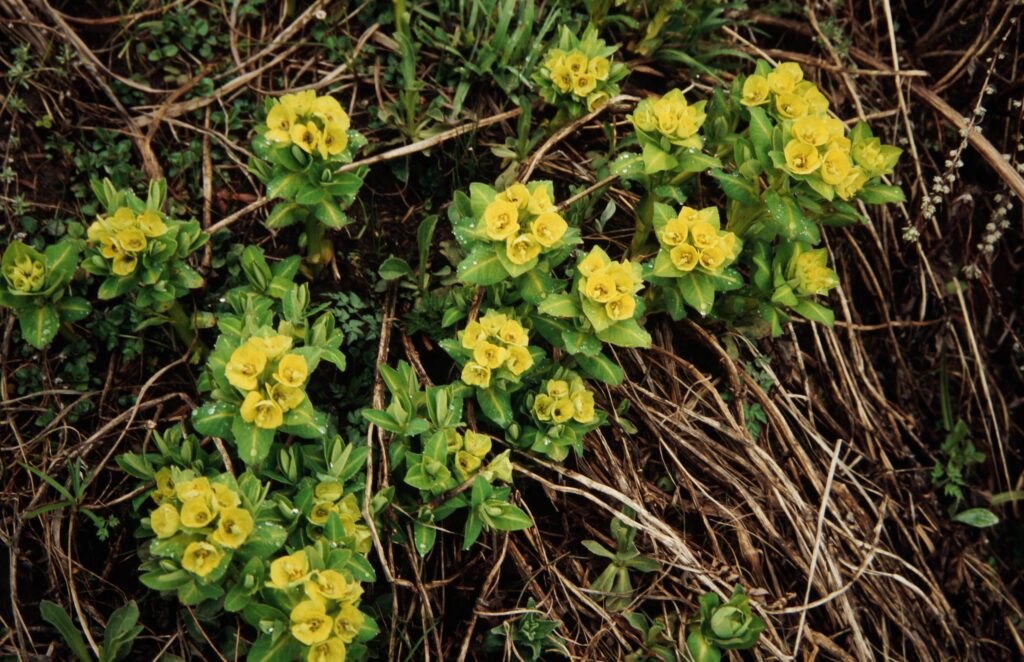
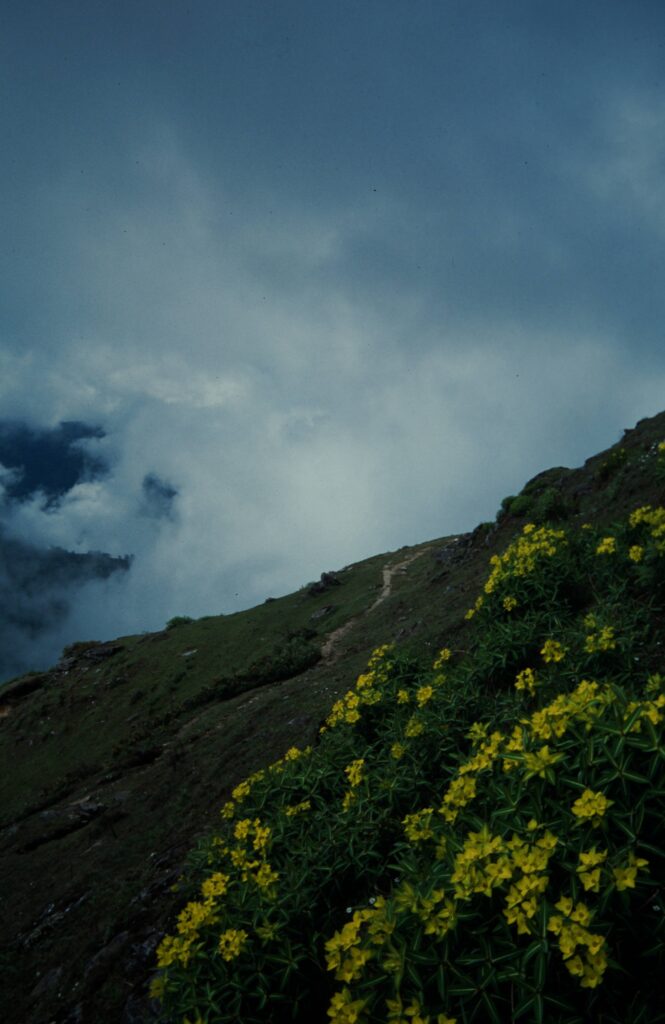
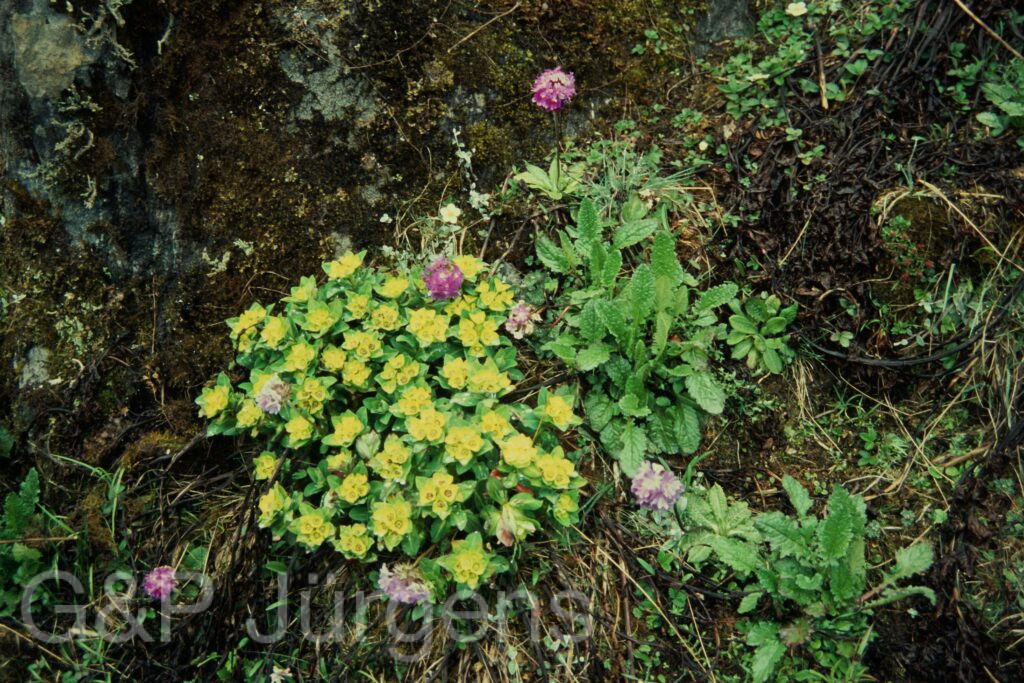
Sikkim/India Lachung 3700m May

Description

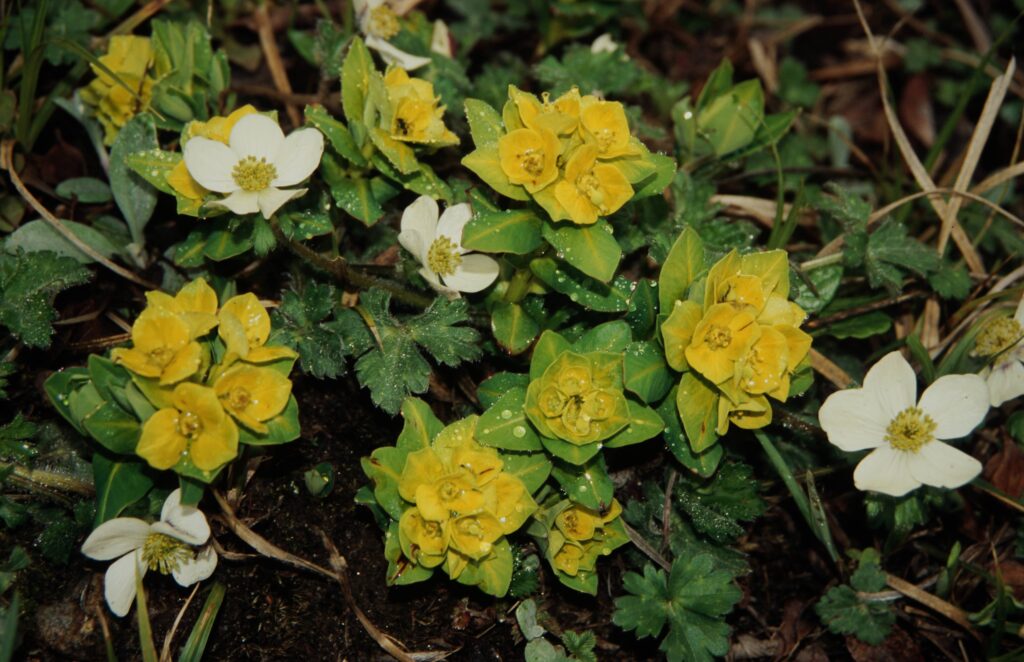
Euphorbia luteoviridis D.G.Long is an eastern Himalayan spurge recorded from Nepal, India, China and Bhutan (NP, IN, CN, BT), with GBIF documenting about 38 occurrences across this narrow range. It is a plant of the upper temperate to subalpine zone, growing on open slopes, forest margins, rocky banks and grazed pastures generally between about 3000 and 4000 m. The images from Lachung in Sikkim at 3700 m and Molley in West Bengal at 3630 m, both in May, illustrate its spring flowering, when the yellowish-green cyathial bracts emerge against the recovering alpine sward.

It is a perennial herb arising from a woody rootstock, producing one to several erect or ascending stems. The leaves are alternate, entire, oblong to oblanceolate or spathulate, with whorled, broader floral leaves subtending the inflorescence. This is the characteristic euphorbioid pseudanthium: a terminal pleiochasium with several rays, each cyathium subtended by yellow-green bracts and enclosing a single naked female flower surrounded by reduced male flowers, with crescentic nectar glands on the rim. The fruit is a three-lobed schizocarpic capsule splitting explosively into cocci; all parts exude the toxic milky latex typical of the genus.

Euphorbia luteoviridis was described comparatively recently by D.G.Long during work on the eastern Himalayan flora, and belongs to the herbaceous perennial spurges well represented in the high mountains. Its restricted distribution gives it significance as a regional endemic, while the latex confers chemical defence against herbivores in the grazed pastures it inhabits. No global threat assessment is widely published, but its limited range warrants attention.

Author: D.G.Long · Sources: POWO (Kew), GBIF, Flora of Bhutan Vol. 1, Flora of China Vol. 11, Flora of Nepal, Radcliffe-Smith treatments of Himalayan Euphorbia

(Hurus. & Tanaka) Radcl.-Sm.

Sikkim 2006 323 ergebnis
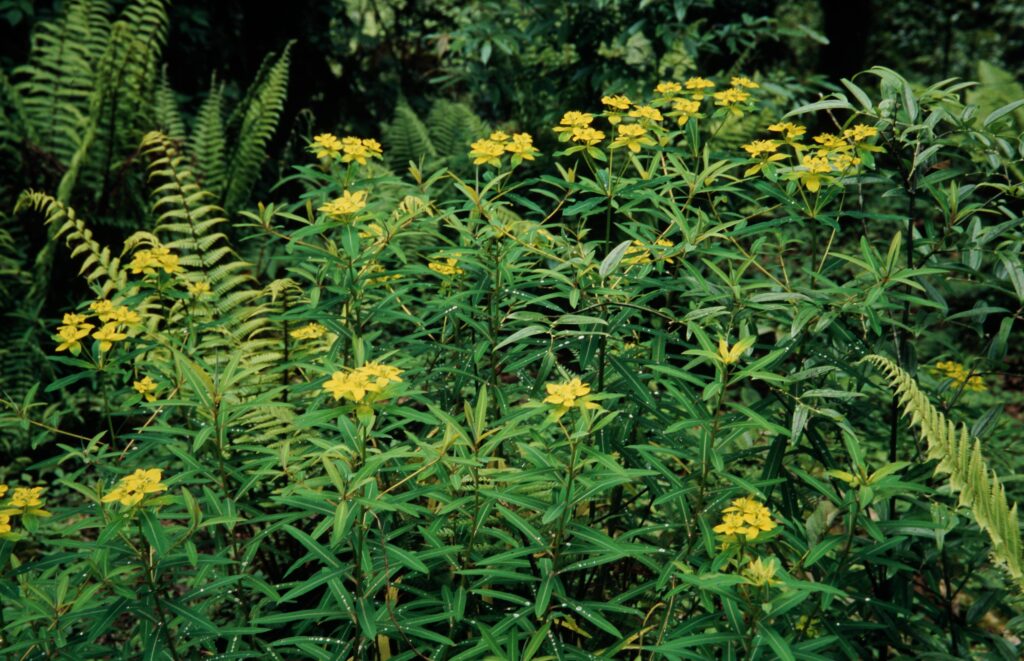
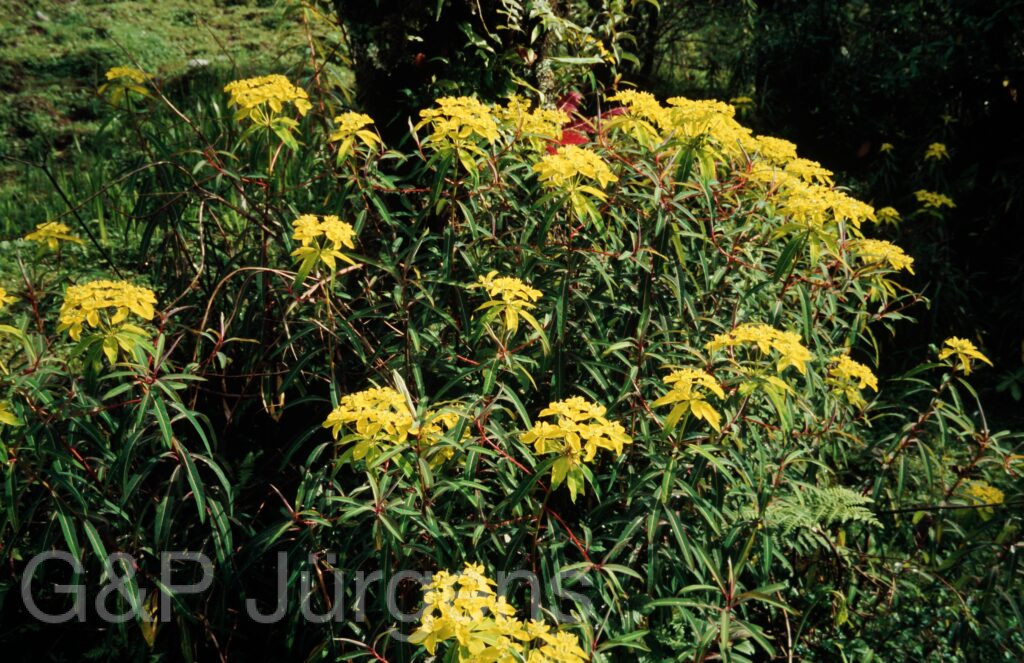
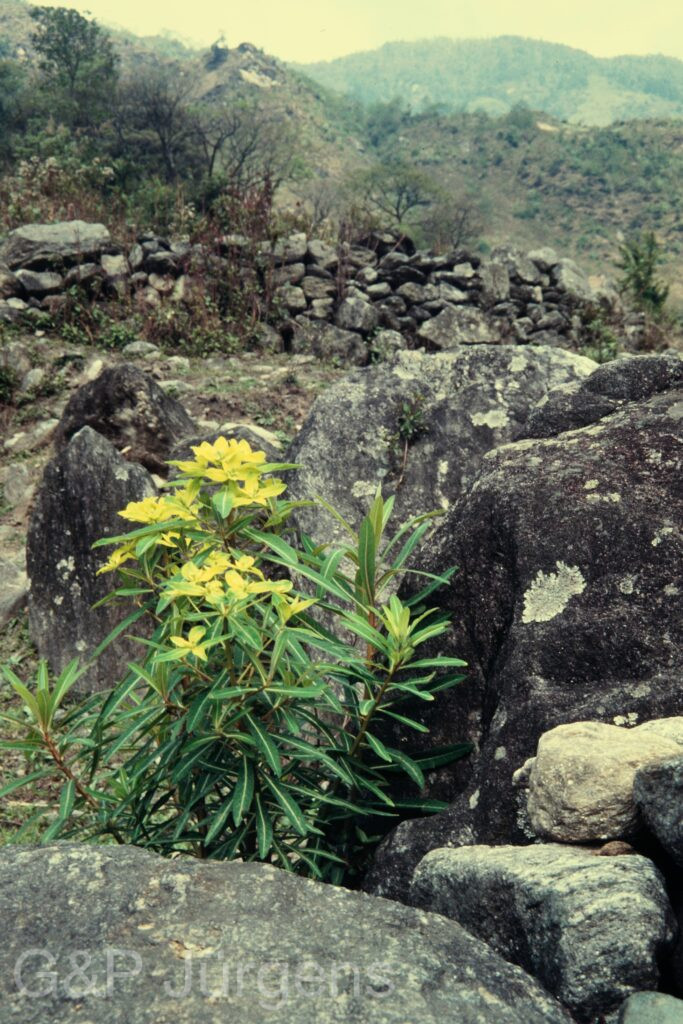
India Sikkim Ringi-Chu 2250m, May
Sikkim 2006 464 ergebnis
India Sikkim Ringi-Chu 2250m, May
Sikkim 2006 324 ergebnis
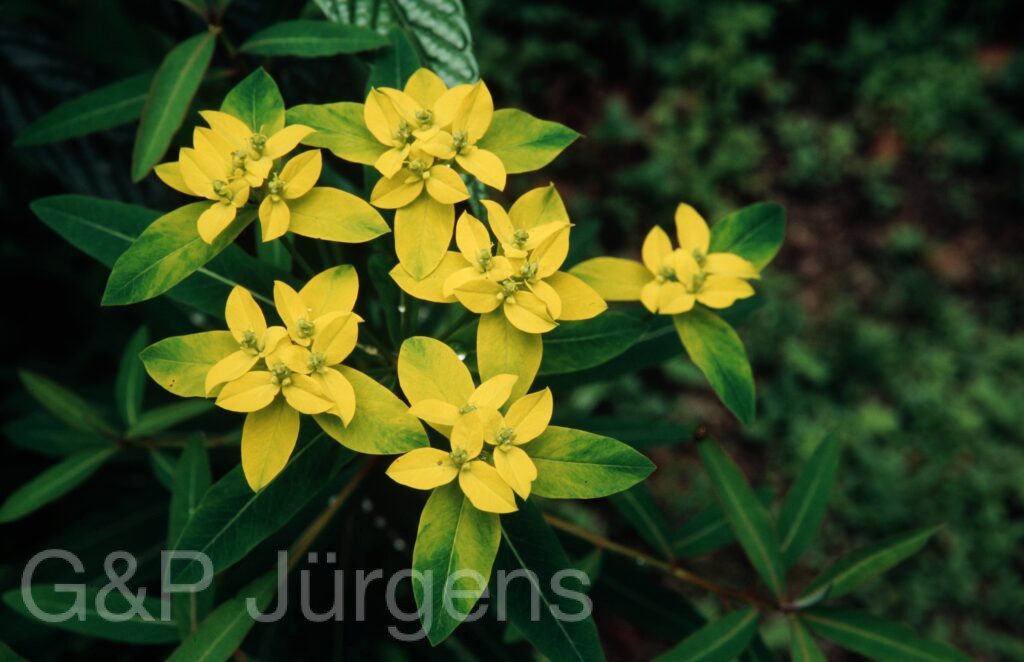
India Sikkim Ringi-Chu 2250m, May

Description

Euphorbia pseudosikkimensis is a robust perennial spurge native to the eastern Himalayas, occurring in Nepal, Sikkim, Bhutan, and adjacent parts of China. It inhabits moist forests, forest clearings, and stream banks at 1,800–3,000 m.

The plant forms tall, erect stems up to 1.5 m high, with whorled, oblong-lanceolate leaves that are dark green above and paler beneath. The inflorescence is a large, showy cyathium with conspicuous bright yellow-green glands, giving the impression of striking yellow flowers in spring. Like all Euphorbia species, it exudes a milky white latex when stems or leaves are broken.

In traditional medicine of the region, the latex has been used cautiously as a purgative, though it is irritant and toxic in larger quantities. The species is sometimes confused with E. sikkimensis, from which it differs in leaf shape and gland morphology.

Author: (Hurus. & Tanaka) Radcl.-Sm. · Sources: POWO (Kew), Flora of Bhutan, eFlora of China

Boiss.

Nepal 2001 302 ergebnis ergebnis
Nepal (Gorkha) Lambra Kharka 3100m, May
Nepal 2001 301 ergebnis
Nepal (Gorkha) Lambra Kharka 3100m, May
Nepal 97 86 P146
Nepal Tankhu 2100m April

Description

Euphorbia sikkimensis is a robust herbaceous spurge distributed across the eastern and central Himalaya, from central Nepal through Sikkim, Bhutan, and northeast India into southern China (Xizang, Yunnan), with peripheral records from Myanmar, Laos, and Vietnam. It occurs in subalpine meadows, forest clearings, scrub margins, and open hillsides at elevations of 1,800–3,500 m. The species has been documented from the Gorkha district of Nepal at Lambra Kharka at 3,100 m in May and near Tankhu at 2,100 m in April, indicating a broad elevational amplitude and early-season phenology at lower altitudes.
The plant is a stout, erect perennial herb, 30–80 cm tall, with thick, fleshy rootstock and unbranched or sparingly branched stems that exude copious white latex when cut. Leaves are alternate, sessile, linear-lanceolate to oblanceolate, 8–15 cm long and 1–2.5 cm wide, with a prominent pale midrib, entire margins, and a glaucous undersurface. The inflorescence is a terminal, compound cyathium typical of the genus, with a broad umbel of 4–8 primary rays, each ray subtended by obovate, yellowish-green floral bracts. The cyathia bear crescent-shaped glands with short horns. The fruit is a smooth, trilocular capsule approximately 6–8 mm in diameter, explosively dehiscent at maturity, with carunculate seeds.
Euphorbia sikkimensis was described by Boissier from Sikkim collections and belongs to Euphorbia subgenus Esula, a predominantly Eurasian clade of herbaceous spurges. It is notable for its striking appearance in early spring, when the bright red or pink-tinged new stems contrast with the yellowish-green inflorescences. The species has gained horticultural recognition in temperate gardens and is increasingly cultivated as an ornamental perennial in Europe. Ecologically, its copious latex deters herbivory, and it plays a role in early-season pollinator support in montane grassland ecosystems.

Author: Boiss. · Sources: POWO (Kew), GBIF, Flora of China Vol. 11, Annotated Checklist of the Flowering Plants of Nepal

D. Don

Sikkim2003 179 G245
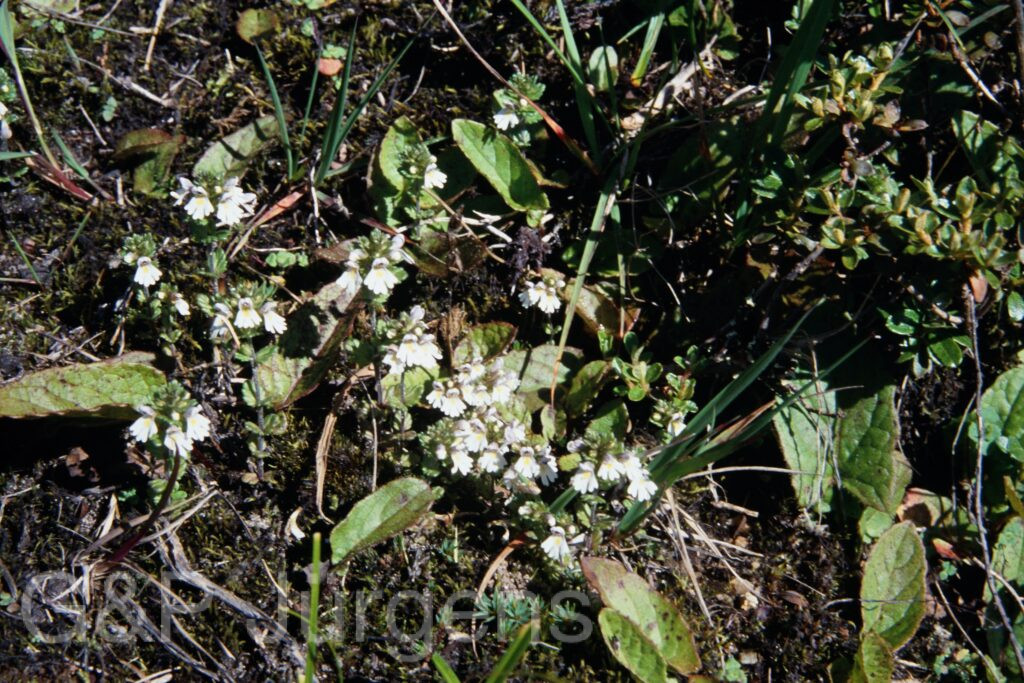
Sikkim Dzongri 4100m 08.2003
Sikkim2003 504 P704
Sikkim Dzongri 4100m, August

Description

Euphrasia simplex is an alpine eyebright of the Himalaya, recorded from India and Nepal, and known from only a handful of georeferenced occurrences (five in GBIF), reflecting both its small stature, which makes it easily overlooked, and its restricted high-altitude range. It is a plant of short alpine turf, open grassy slopes and moist meadows above treeline. The illustrated material from Dzongri in Sikkim, gathered at about 4100 m in August, is characteristic of its occurrence high in the eastern Himalayan alpine zone, where it flowers in the late-summer growing season among low alpine vegetation.

The plant is a small, slender annual, as the epithet simplex suggests often little-branched or unbranched, with an erect, leafy stem. The leaves are small, opposite, sessile and ovate with a few coarse, often bristle-tipped teeth. The flowers are borne in the axils of the upper leaves, forming a leafy terminal spike; each has a tubular, four-lobed calyx and a two-lipped (bilabiate) corolla, the upper lip hooded and the lower lip three-lobed and spreading, the whole typically white to pale lilac with darker veining and a yellow throat-blotch. The fruit is a small, flattened, two-valved capsule containing several seeds.

Like other members of its genus, E. simplex is a hemiparasite, photosynthetic but attaching by haustoria to the roots of neighbouring grasses and herbs to draw water and nutrients; the genus has been transferred from the traditional Scrophulariaceae to the Orobanchaceae in light of this parasitic habit and molecular evidence. Euphrasia is notoriously difficult taxonomically owing to plasticity and hybridisation, and the high-altitude Himalayan species are imperfectly known. Its rarity in collections makes the status of E. simplex uncertain, and further field survey would clarify its true distribution and abundance.

Author: D. Don · Sources: POWO (Kew), GBIF, Flora of Nepal, Annotated Checklist of the Flowering Plants of Nepal, Yeo: monographic studies of the genus Euphrasia

Hook.f. & Thomson

Sikkim2011 248
Sikkim Yumthang 3800m, June

Description

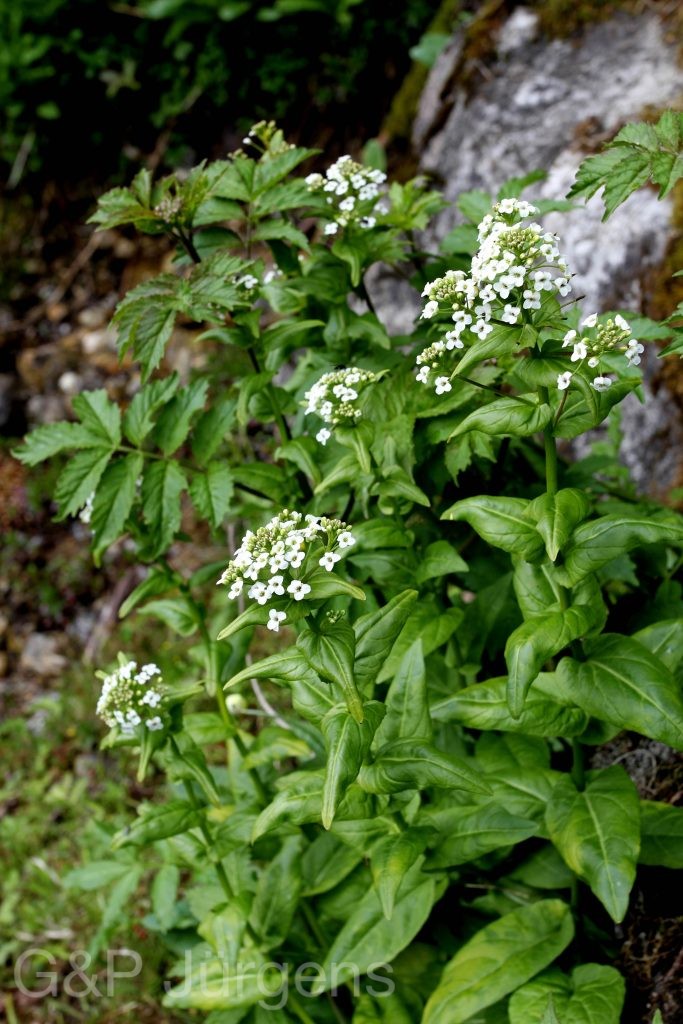
Eutrema himalaicum Hook.f. & Thomson is an alpine crucifer of the high Himalaya and adjacent China, recorded from China, India and Bhutan, with around 249 georeferenced occurrences in GBIF (further scattered records reflect cultivation and herbarium holdings). It occupies moist alpine meadows, streamsides, seepage slopes, gravelly flats and rocky places near snowmelt, generally between about 3500 and 4800 m. The photographed plant was found at Yumthang in Sikkim at about 3800 m in June, in the lush, well-watered subalpine to alpine turf that this small herb favours as the snow recedes.

The plant is a slender annual or short-lived perennial with erect or ascending, often glabrous stems arising from a basal rosette. The leaves are simple, the basal ones petiolate with ovate to deltoid or somewhat hastate blades (recalling the form once distinguished as E. deltoideum), the cauline leaves smaller and shortly stalked to subsessile. The flowers are small and borne in terminal racemes; each has four white petals arranged in the cruciform pattern typical of the family, four free sepals and the tetradynamous stamens of the Brassicaceae. The fruit is a slender silique, the seeds in a single row within each locule.

The genus Eutrema, which includes the cultivated wasabi (E. japonicum), has been substantially recircumscribed by molecular studies, absorbing several formerly segregate Himalayan genera; this accounts for the species' nomenclatural history and the alternate epithet seen on the source page. As a snowbed and seepage specialist it is adapted to short, cool growing seasons. The species is fairly widespread within its alpine band and not of conservation concern, though sensitive to habitat disturbance.

Author: Hook.f. & Thomson · Sources: POWO (Kew), GBIF, Flora of China, Flora of Bhutan, Al-Shehbaz revision of Eutrema and Tribe Eutremeae, Hara Flora of the Eastern Himalaya

J.Gay

Bh09 291 P480
Bhutan Pele-La, 3200m June

Description

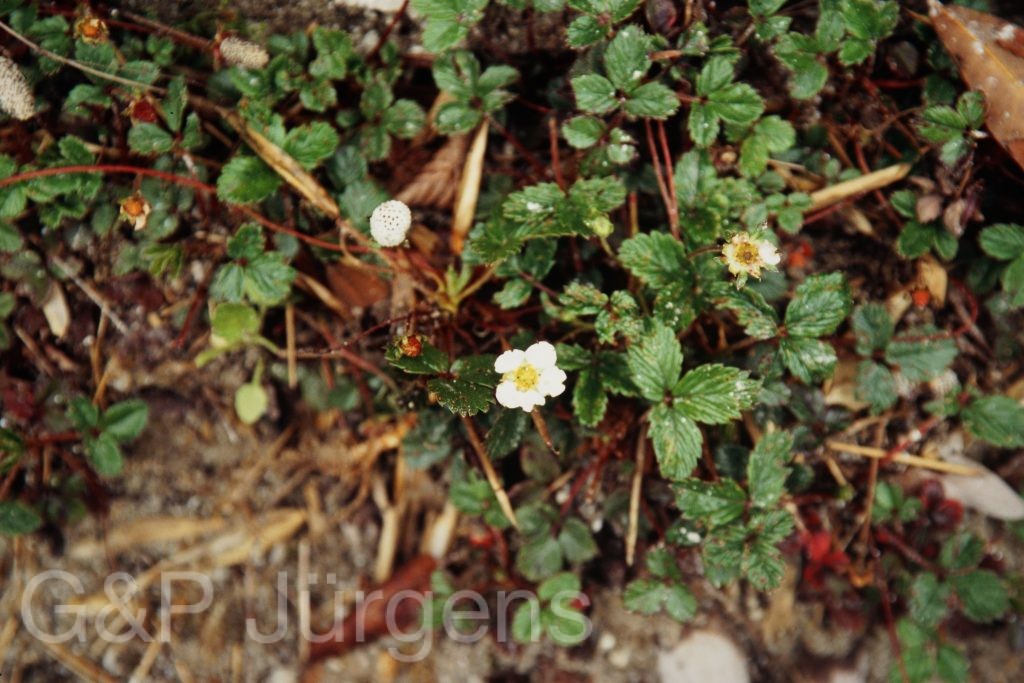
Fragaria daltoniana, the Sikkim strawberry, is a Himalayan wild strawberry native to Nepal, India, Bhutan, southern Tibet (China) and northern Myanmar; the additional GBIF country codes (USA, Norway, France, Sweden, Armenia) reflect cultivated material and herbarium holdings rather than wild range, the dataset listing some 181 records. It grows in moist montane forest margins, clearings, mossy banks, grassy slopes and along streamsides, generally between about 2500 and 4000 m. The plant photographed at the Pele-La in Bhutan at around 3200 m in June represents its typical temperate-forest belt habitat.

It is a slender, stoloniferous perennial herb forming open mats by rooting runners. The trifoliolate leaves are long-petiolate, the leaflets thin, obovate and coarsely serrate, sparsely hairy. Solitary or few white flowers are borne on slender pedicels, each with five spreading petals, numerous stamens and an epicalyx alternating with the sepals. The fleshy receptacle ripens into the diagnostic fruit: an elongate, narrowly ovoid to oblong scarlet 'strawberry' bearing numerous achenes superficially on its surface, larger and more cylindrical than in most relatives but reputedly insipid.

Fragaria daltoniana is one of the few strawberries of the Sino-Himalayan region and is notable to horticulturists and breeders as a wild diploid genetic resource within the genus. Its long, narrow red receptacle distinguishes it from the rounder fruits of F. nubicola and F. vesca, with which it can co-occur. The species is not considered threatened, being locally common across a wide range, though it depends on cool, humid forest-edge microhabitats vulnerable to deforestation and to climatic drying at the lower limits of its altitudinal band.

Author: J.Gay · Sources: POWO (Kew), GBIF, Flora of Bhutan, Flora of China, Annotated Checklist of the Flowering Plants of Nepal, Staudt Taxonomic Studies in the Genus Fragaria

D.Don

Sikkim2011 68
Sikkim Tanghu 3900m, June
Sikkim2011 69
Sikkim Tanghu 3900m, June
Sikkim2004 414 G713
Sikkim/India Yumthang 3700m May
Sikkim2004 415 P712
Sikkim/India Yumthang 3700m May

Description

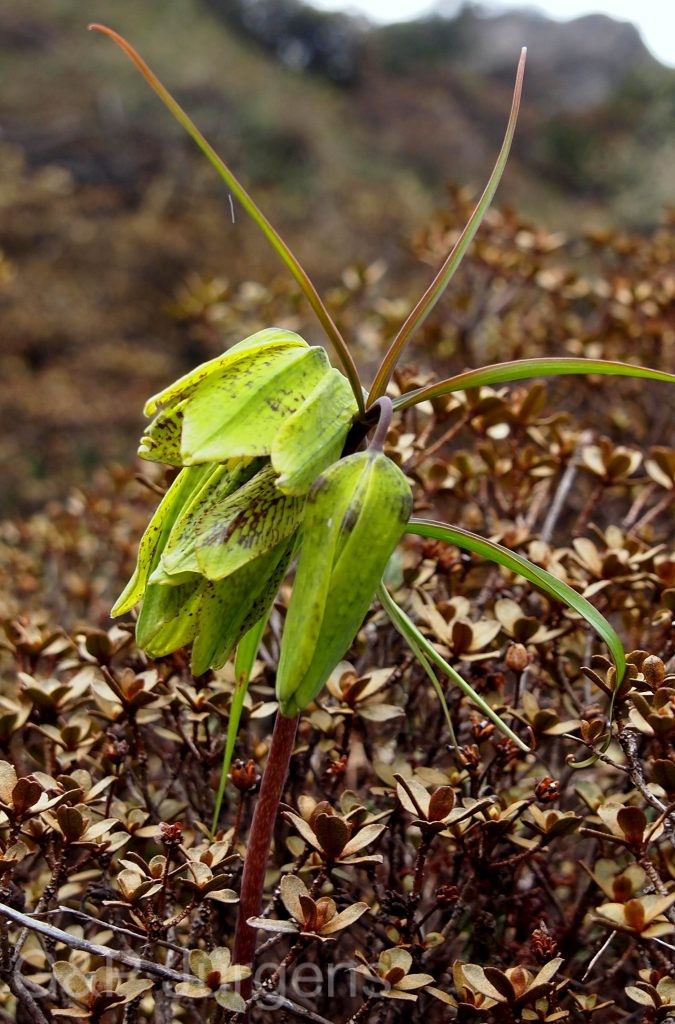
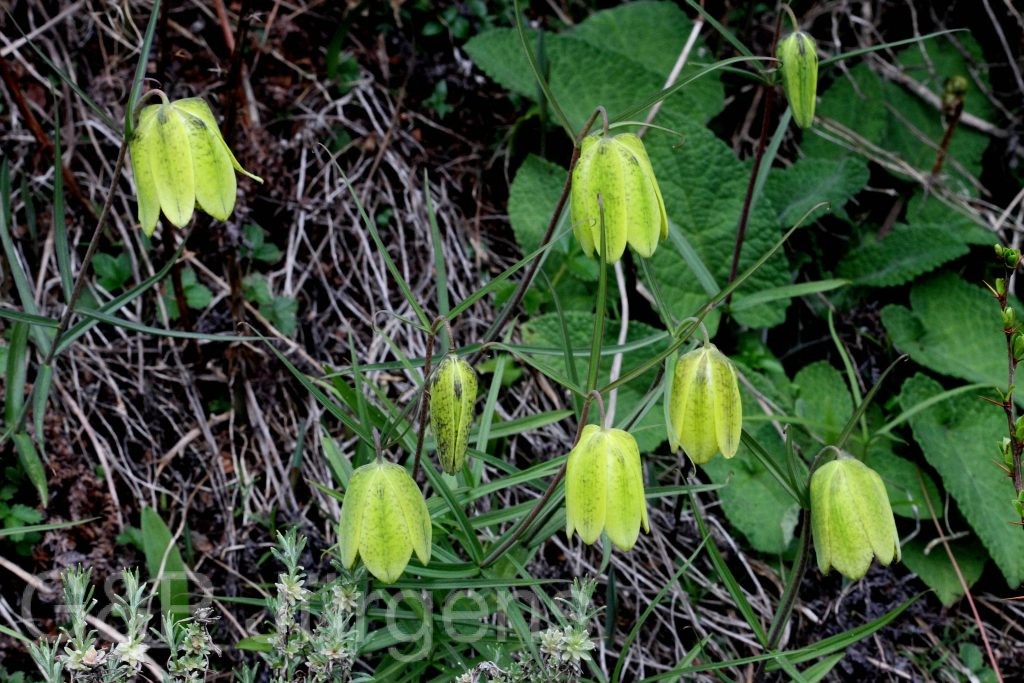
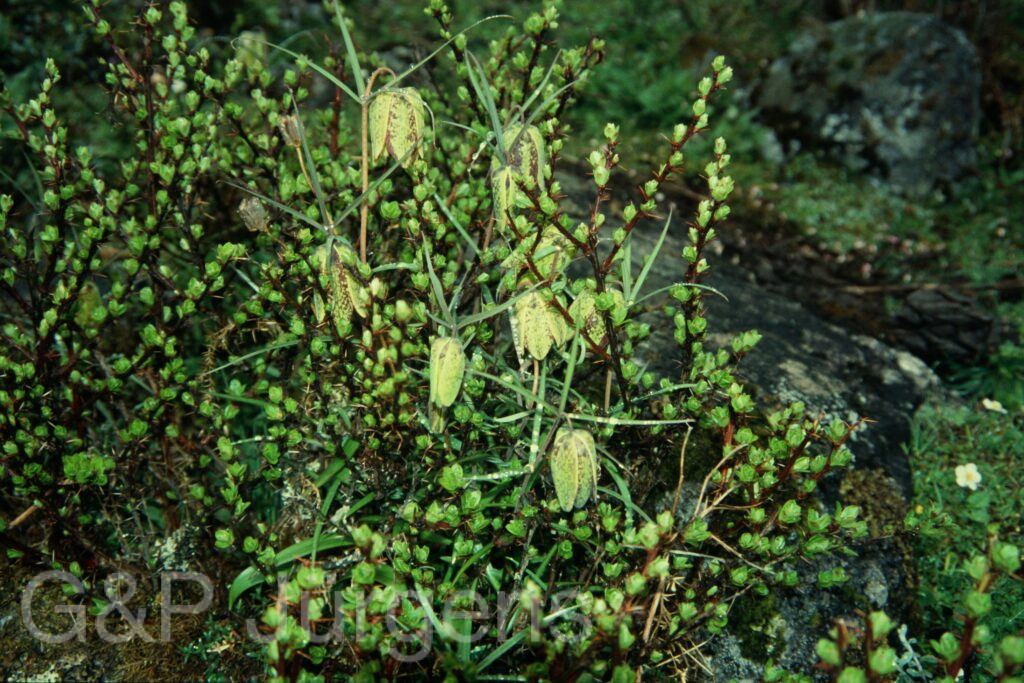
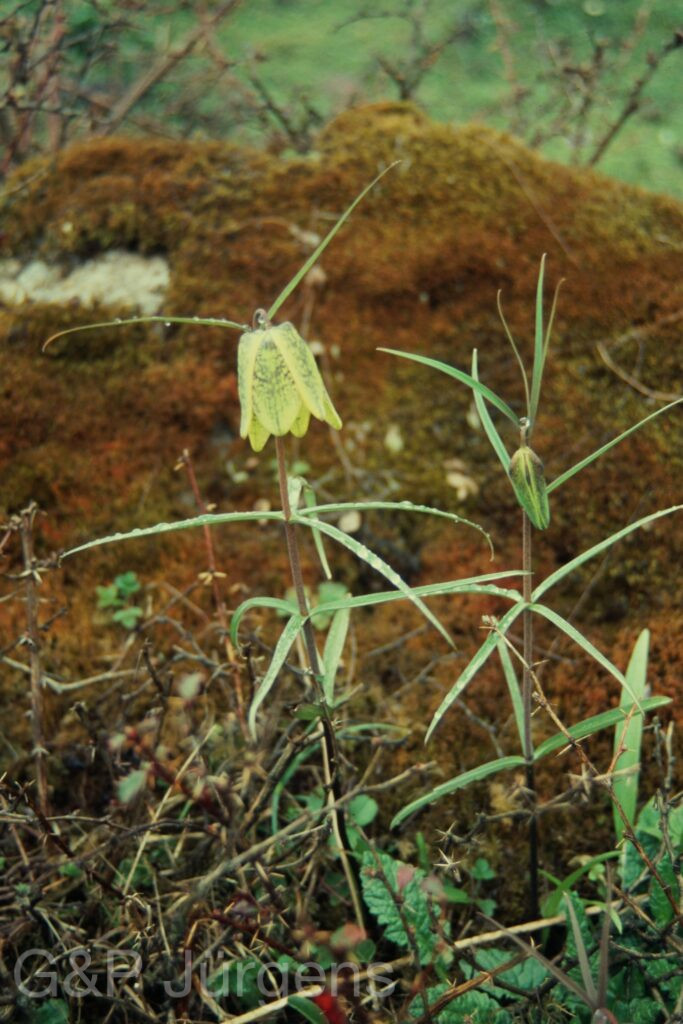
Fritillaria cirrhosa is a bulbous alpine lily of the Himalaya and the Hengduan mountains, native to China, India, Nepal, Pakistan, Bhutan and Myanmar, the very large total of c. 962 records reflecting its wide range and economic importance. It inhabits alpine meadows, scrub, rocky slopes, screes and grassy clearings, mostly between roughly 3200 and 4600 m. The illustrated plants were photographed at Tanghu in Sikkim at 3900 m in June and at Yumthang on the Sikkim/India border at 3700 m in May, sites characteristic of the species, which flowers shortly after snowmelt on cool, moist, well-drained high-montane ground.

It is a perennial herb arising from a small bulb of a few fleshy scales. The slender erect stem bears scattered to whorled, linear to lanceolate leaves, the uppermost of which are prolonged into slender, curling, tendril-like tips, the cirrhose feature from which the epithet derives. The flowers are usually solitary and nodding, broadly campanulate, with six tepals that are yellowish-green to purplish and conspicuously tessellated (chequered) with darker purple-brown; a nectary gland sits near the base of each tepal. The six stamens surround a superior trilocular ovary with a three-lobed style. The fruit is an erect, six-angled or narrowly winged loculicidal capsule.

Fritillaria (Liliaceae) is a Holarctic genus delimited by section on bulb structure, leaf arrangement and style form, and F. cirrhosa is a polymorphic species of the subgenus Fritillaria. Its dried bulb is the source of the renowned traditional Chinese medicine "chuan bei mu," used as an antitussive, and this heavy commercial harvesting is the principal conservation concern: although still widespread, the species is subject to intense wild collection, and the chuan bei mu trade has prompted cultivation efforts and regulatory attention across its range.

Author: D.Don · Sources: POWO (Kew), GBIF, Flora of China, Flowers of the Himalaya (Polunin & Stainton), Rix monograph of Fritillaria

Gagea flavonutans

by GP Jürgens

(H.Hara) Zarrei & Wilkin

Sikkim2011 100
Sikkim Chopta-valley 4200m, June
Sikkim2011 120
Sikkim Chopta-valley 4200m, June

Description

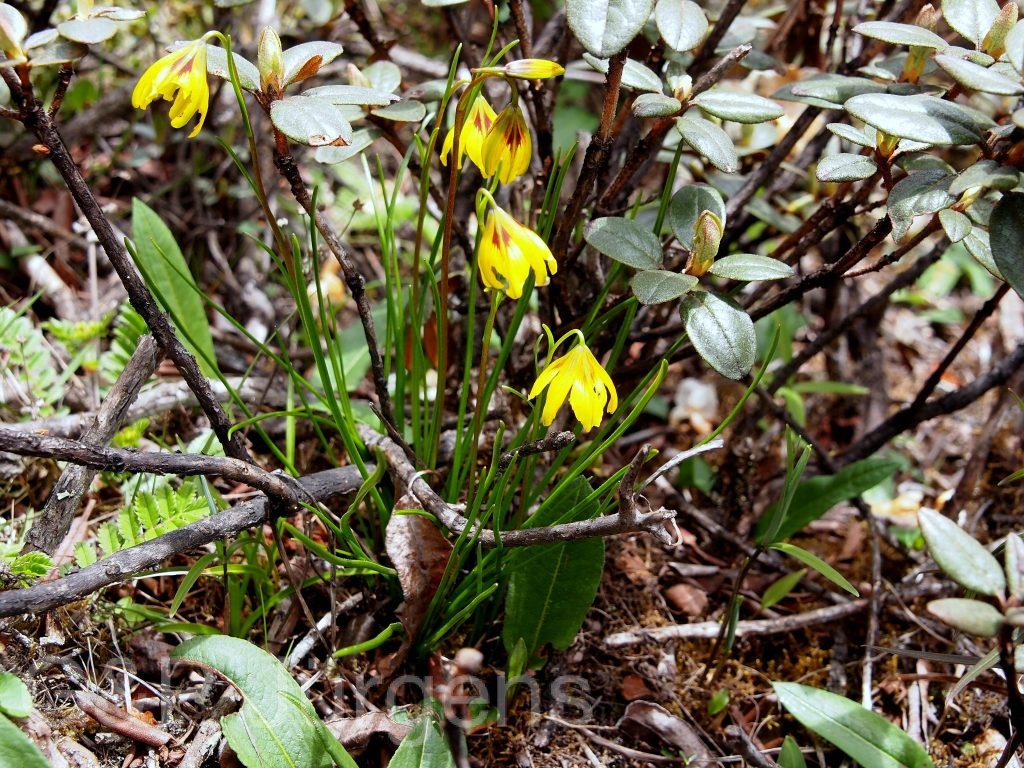
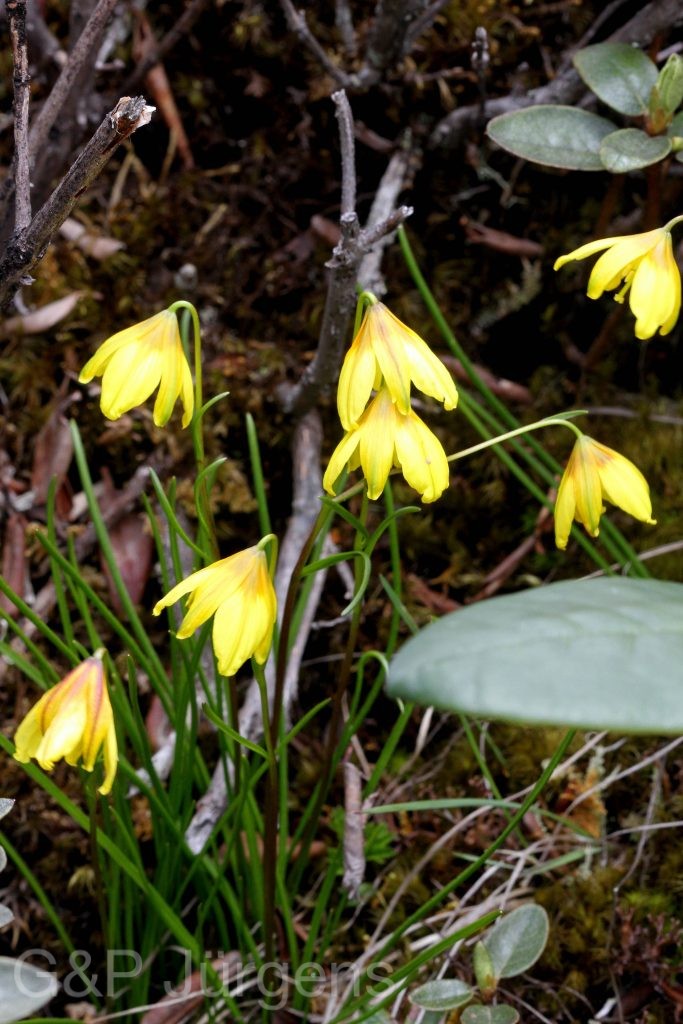
Gagea flavonutans is a small alpine bulbous geophyte of the eastern Himalaya, recorded from Nepal, India, China, Bhutan and Myanmar, with about 104 georeferenced occurrences clustered along the high inner ranges. It grows in open alpine turf, on grassy and stony slopes, screes and moist ground at the edge of melting snow, chiefly between roughly 3800 and 4500 m. The plant was photographed in the Sikkim Chopta Valley at 4200 m in June, an elevation and season characteristic of the genus, whose members flush and flower rapidly in the brief interval following snowmelt before the soil dries.

It is a slender, hairless perennial arising from one or few ovoid tunicate bulbs. There are typically two narrowly linear basal leaves, channelled and grass-like, considerably exceeding the short scape. The inflorescence is few-flowered, the flowers nodding as the epithet flavonutans implies. The perianth comprises six free, narrowly elliptic to oblong tepals, yellow within and often greenish or purplish-tinged on the outer surface; the six stamens have slender filaments and small anthers, and the superior tricarpellate ovary bears a single style. The fruit is a small loculicidal capsule containing numerous seeds.

Gagea (Liliaceae) is a large, taxonomically difficult Old World genus in which species are delimited by bulb structure, leaf number and section, and floral orientation; G. flavonutans, originally described by Hara, was transferred to Gagea in the molecular reassessment by Zarrei and Wilkin that absorbed the segregate Lloydia into a broadened Gagea. Its nodding yellow flowers and high-Himalayan range distinguish it within this complex. As a short-statured snowbed geophyte it is sensitive to changes in snow cover and grazing, though it remains locally frequent and is not currently regarded as threatened.

Author: (H.Hara) Zarrei & Wilkin · Sources: POWO (Kew), GBIF, Flora of China, Annotated Checklist of the Flowering Plants of Nepal, Zarrei & Wilkin phylogenetic revision of Gagea

(Lindl.) P.F.Hunt

Sikkim2011 207
Sikkim Lachung 3100m, June
Nepal 99 809 ergebnis
West-Nepal Baga-La-Phedi 4300m, July

Description

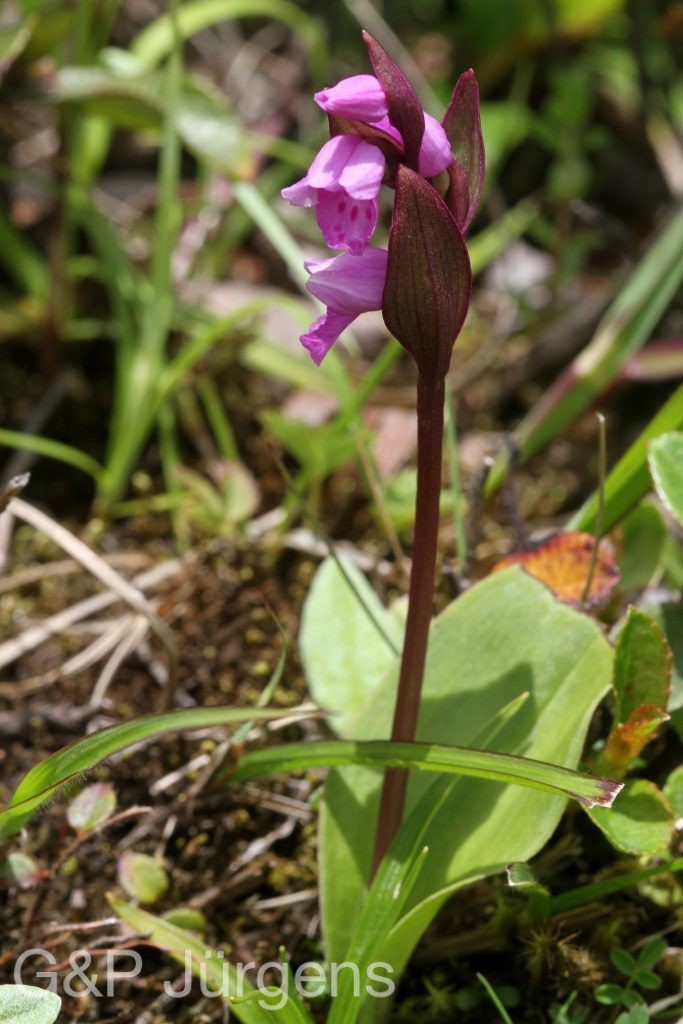
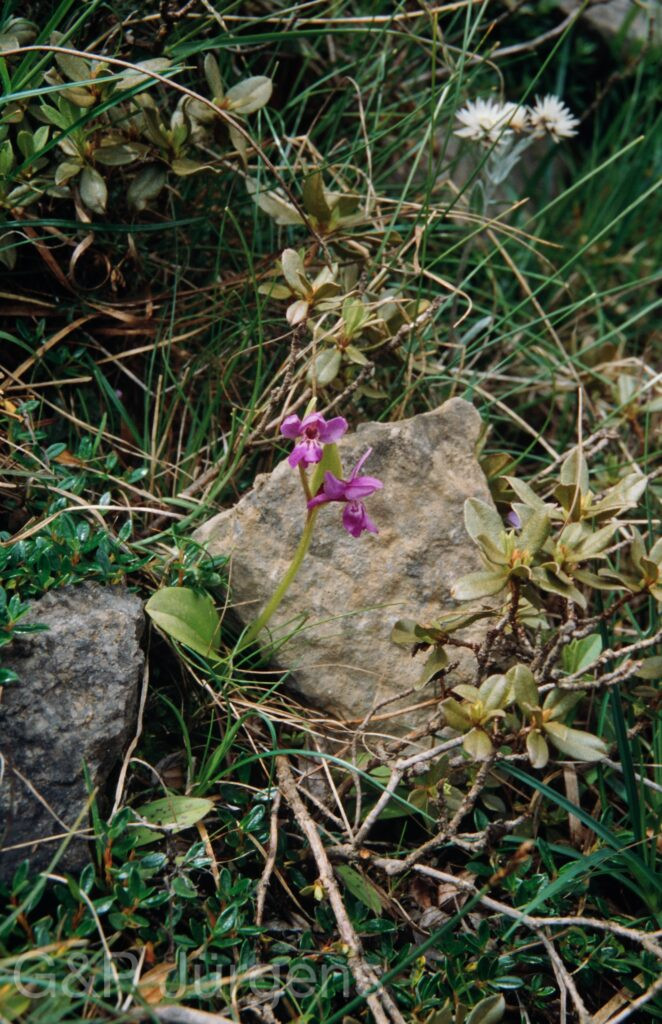
Galearis spathulata is a small terrestrial orchid of the high Himalaya and the mountains of western China, recorded from China, India, Nepal, Bhutan and Myanmar, with over 500 occurrences in GBIF. It is a plant of moist alpine and subalpine meadows, open Rhododendron and juniper scrub, grassy slopes and rocky turf, generally between about 3,000 and 4,500 m. The illustrated gatherings span this range, from Lachung in Sikkim at around 3,100 m in June to Baga-La-Phedi in West Nepal at about 4,300 m in July, where the species flowers through the early summer monsoon.

It is a dwarf, glabrous perennial herb arising from slender, fleshy root-tubers and bearing usually one or two basal, spathulate to oblong leaves that taper to a sheathing base. The short, erect stem terminates in a few-flowered raceme of small purplish-pink flowers, each subtended by a bract. The dorsal sepal and petals converge to form a hood over the column, the lateral sepals spreading; the labellum is entire to obscurely lobed, directed forward and produced at the base into a short, cylindrical to saccate spur. The fruit is an erect, ribbed capsule releasing dust-like seeds.

Galearis is a small holarctic-temperate to Sino-Himalayan genus segregated from Orchis, and G. spathulata is distinguished by its spathulate basal leaves and short-spurred, hooded flowers. Pollination is by insects, with seedling establishment dependent on mycorrhizal association, as in all orchids. Widespread and locally common across the alpine Himalaya, the species is not regarded as threatened, although, being an orchid, it falls under the general CITES Appendix II listing for the family.

Author: (Lindl.) P.F.Hunt · Sources: POWO (Kew), GBIF, Flora of China, Flora of Bhutan, Annotated Checklist of the Flowering Plants of Nepal, Pridgeon et al. Genera Orchidacearum