Tag:

Sikkim

Flowers of Sikkim — 350 species from the Sikkim Himalaya in northeast India, a compact yet botanically extraordinary region that climbs from subtropical valleys to the alpine zone beneath Kangchenjunga. Sikkim is a classic centre of Himalayan plant diversity, celebrated for its rhododendrons, primulas, orchids and gentians. Each entry provides a botanical description, distribution, habitat and flowering season with the original field photograph.

Hook.f.

Sikkim2003 457 K631.2
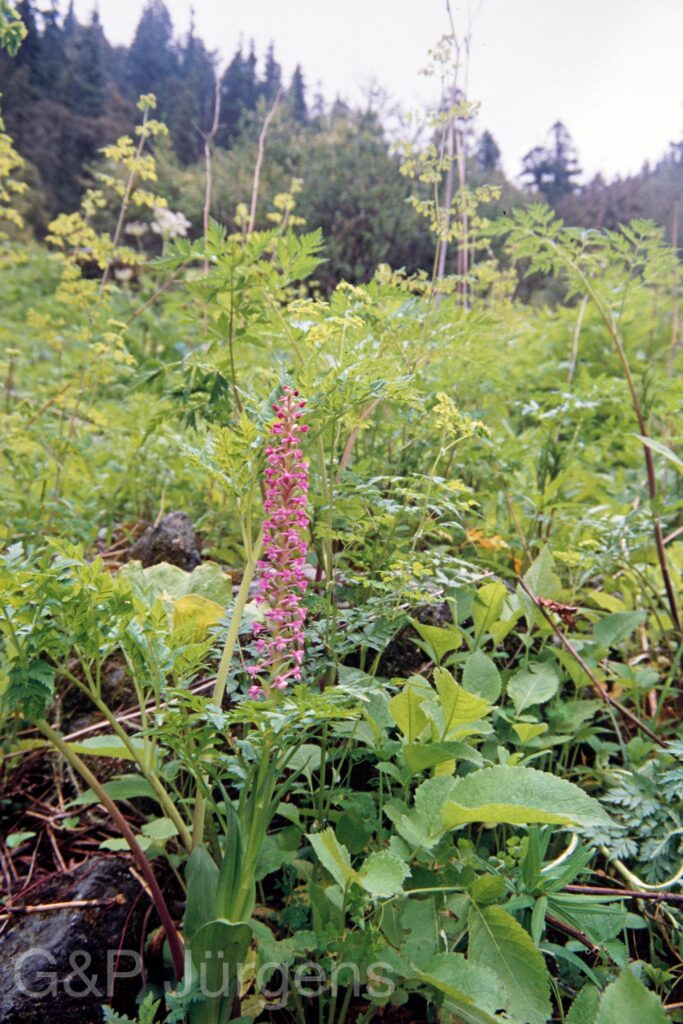
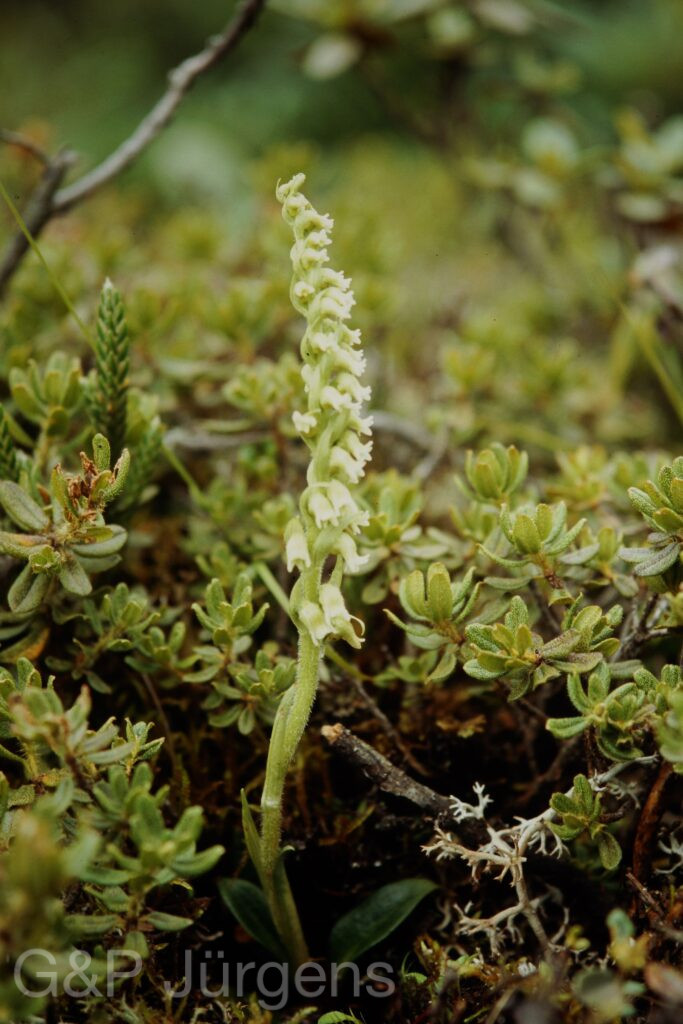
Sikkim Chopta Valley 3900m August

Description

Goodyera fusca is a terrestrial orchid of the higher Himalaya, ranging through Nepal, China, Bhutan, India and Myanmar (NP, CN, BT, IN, MM), with about 101 recorded occurrences. It grows in cool, shaded humus among mossy rocks, in subalpine Rhododendron and conifer thickets and at the upper forest margin, generally in the upper temperate to subalpine zone. The plant illustrated was found in the Chopta Valley of Sikkim at 3900 m in August, an elevation and late-summer flowering period typical of the species, where it occupies damp, sheltered pockets of leaf litter and bryophyte cover beneath open scrub near the treeline.

It is a small, erect herb arising from a creeping, fleshy, few-noded rhizome rooting at the nodes. The leaves are few and clustered toward the stem base, ovate to elliptic, somewhat fleshy, and in many populations marked with the reticulate veining characteristic of the 'jewel orchids'. The inflorescence is an erect, glandular-pubescent spike bearing a secund to spiralled series of small, dull brownish to greenish flowers, each subtended by a lanceolate bract. The dorsal sepal and petals are connivent to form a hood over the column, the lateral sepals spreading, and the saccate, concave lip lacks a free spur. The fruit is a small, erect, ribbed capsule releasing dust-fine seeds.

Goodyera (subtribe Goodyerinae, tribe Cranichideae of the Orchidaceae) is a chiefly Asian genus of forest-floor orchids whose germination and establishment depend on association with mycorrhizal fungi. The small, drab, nectar-bearing flowers are pollinated by small bees and other insects, and the minute seeds are wind-dispersed. As an obligately mycotrophic forest understorey orchid, G. fusca is vulnerable to disturbance of its humus-rich habitat, though across its wide Himalayan-Chinese range it is not currently regarded as threatened.

Author: Hook.f. · Sources: POWO (Kew), GBIF, Flora of Bhutan, Flora of China, Genera Orchidacearum (Goodyerinae)
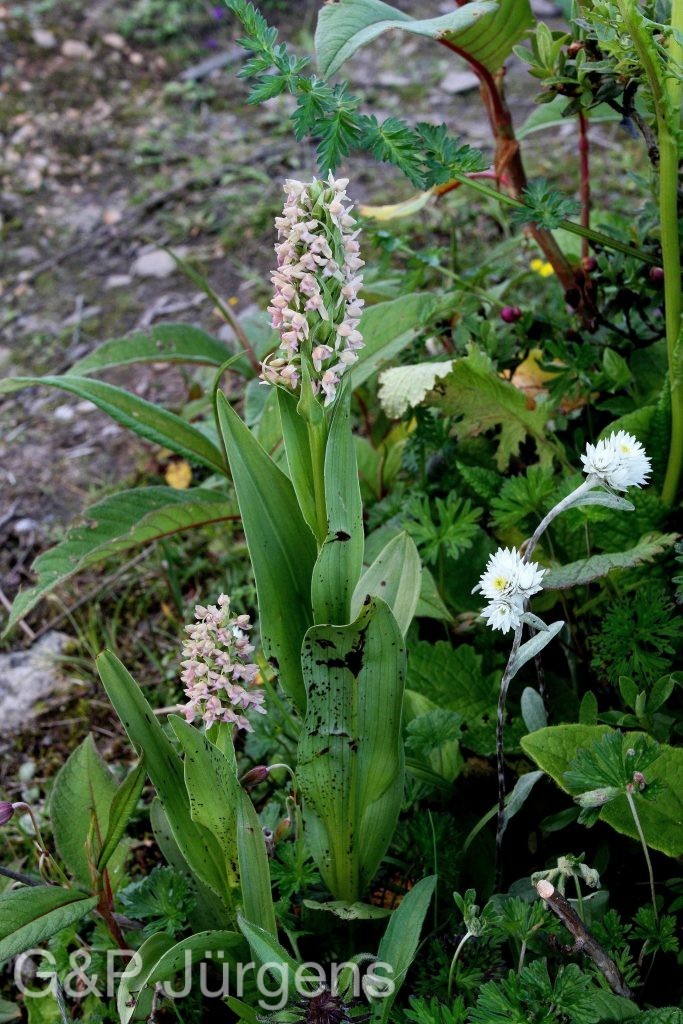
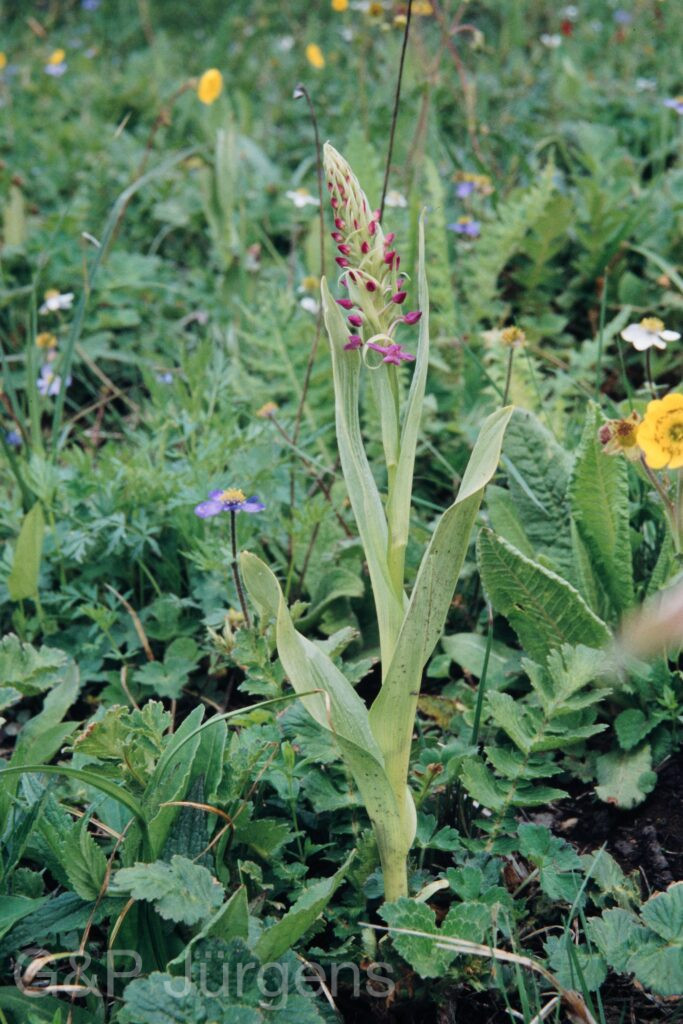
Lindl.

BhutanPG2011 801 01 01
Bhutan Chele-La, 3800m July
also included: Anaphalis busua (D.Don) DC. and Anemone demissa Hook.f. & Thomson
Nepal 99 371 ergebnis
West-Nepal Linji-Khola 3400m, June
Nepal 99 474 ergebnis
West-Nepal Churta-Khola 3200m, June

Description

Gymnadenia orchidis is a terrestrial orchid of the Himalaya and adjacent China, distributed through China, Nepal, India, Bhutan, Myanmar and Pakistan, with GBIF documenting some 795 occurrences. It is a plant of open alpine and subalpine meadows, grassy slopes, forest clearings and damp turf, growing in full sun to light shade on humus-rich soils. The species occupies the upper montane to alpine zone; the photographed material from the Chele-La pass in Bhutan at about 3800 m in July, sharing its habitat with Anaphalis busua and Anemone demissa, and from the Linji-Khola and Churta-Khola valleys of West Nepal at 3200-3400 m in June, illustrates its summer flowering across this high-elevation belt.

The plant arises from palmately lobed, fleshy root-tubers and bears an erect, leafy stem. The leaves are several, oblong to lanceolate, sheathing at the base and reduced upward to bracts. The inflorescence is a dense, cylindrical terminal spike of many small flowers, ranging in colour from purple and pink-magenta to occasionally white. Each flower has spreading lateral sepals, a hooded arrangement of the dorsal sepal and petals, and a trilobed labellum bearing a slender, decurved spur about equalling or shorter than the ovary, containing nectar. The pollinaria have naked, exposed viscidia characteristic of the genus. The fruit is a small, erect capsule.

The species belongs to Gymnadenia, a genus of nectar-spurred terrestrial orchids closely allied to Dactylorhiza and Platanthera; it has at times been segregated into Habenaria or treated under broader generic concepts, reflecting ongoing debate over the limits of the orchidine genera. Pollinated by long-tongued insects attracted to its spur nectar, it remains widespread and locally common in Himalayan alpine grasslands, although meadow degradation and grazing may affect individual populations.

Author: Lindl. · Sources: POWO (Kew), GBIF, Flora of China, Flora of Bhutan, The Orchids of Sikkim and Bhutan (Pearce & Cribb)

Kraenzl.

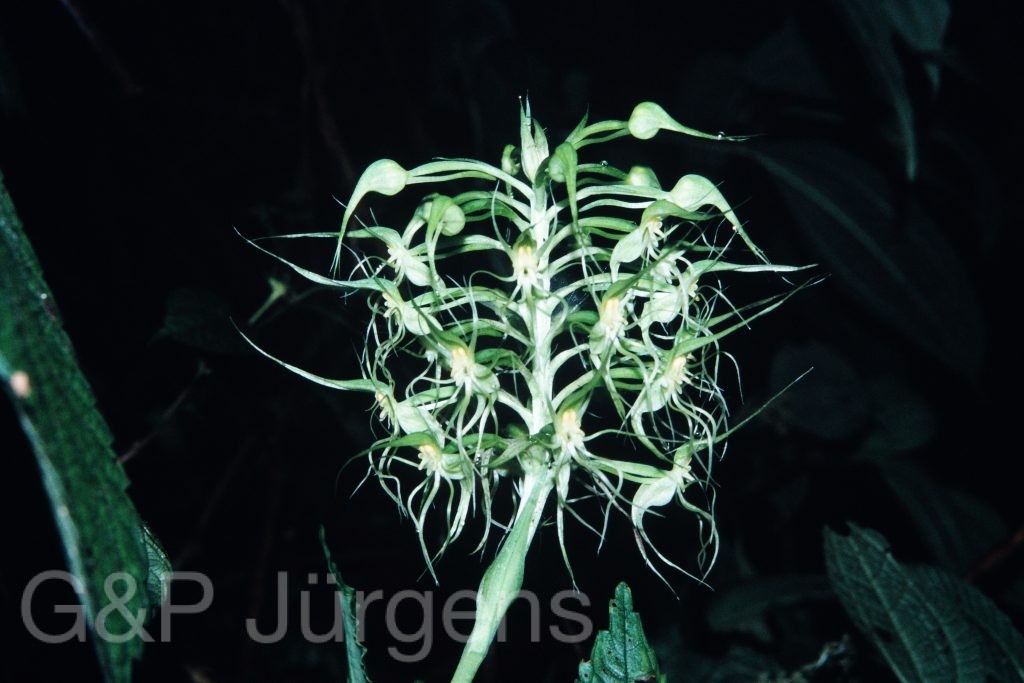
Sikkim2003 35 G48
Sikkim above Yoksam 1880m 08.2003
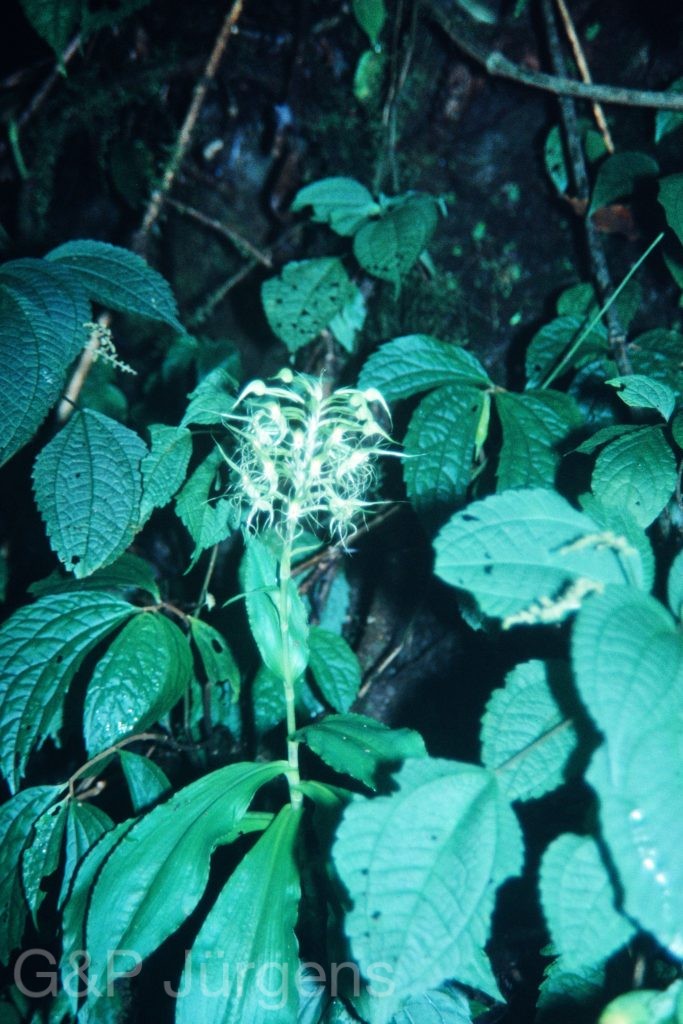
Sikkim2003 34 W47
Sikkim above Yoksam 1880m 08.2003

Description

Habenaria pantlingiana is a terrestrial orchid distributed across the eastern Himalaya and East Asia, with GBIF records (322 occurrences) spanning Taiwan, Japan, China, India, Nepal, Bhutan and Vietnam. It grows in moist, humus-rich soils on shaded forest floors, grassy slopes and stream banks within warm-temperate and subtropical broad-leaved forest, broadly between 1000 and 2500 m. The documented plant from above Yoksam in western Sikkim at about 1880 m, flowering in August, reflects its summer-monsoon phenology, when the tuberous geophyte emerges and blooms during the period of maximum humidity and rainfall.

The plant arises from ovoid, fleshy underground tubers and produces an erect, leafy stem. The cauline leaves are oblong-lanceolate to elliptic, sheathing at the base, grading into bract-like organs above. The inflorescence is a many-flowered terminal raceme of small greenish to greenish-white flowers, each subtended by a narrow bract. As in Habenaria, the lip (labellum) is deeply three-lobed with slender, often filiform divisions, and bears a prominent slender spur arising at its base. The dorsal sepal and petals form a loose hood over the column, the lateral sepals spreading; the rostellum and stigmatic processes are characteristically elaborate. The fruit is a ribbed, dehiscent capsule releasing dust-like seeds.

Described by Kraenzlin and commemorating the Sikkim orchidologist R. Pantling, the species sits within the large, taxonomically intricate genus Habenaria (subfamily Orchidoideae, tribe Orchideae), where spur and lip lobing are key diagnostic features. Like most terrestrial orchids it depends on mycorrhizal fungi for germination and establishment, rendering it sensitive to forest disturbance. Although its wide range buffers it against global extinction, local populations are vulnerable to habitat loss and collection, and all wild orchids are CITES-listed.

Author: Kraenzl. · Sources: POWO (Kew), GBIF, Flora of China, The Orchids of Sikkim-Himalaya (Pantling & King), Genera Orchidacearum (Pridgeon et al.)

L.

Sikkim2003 550 P773
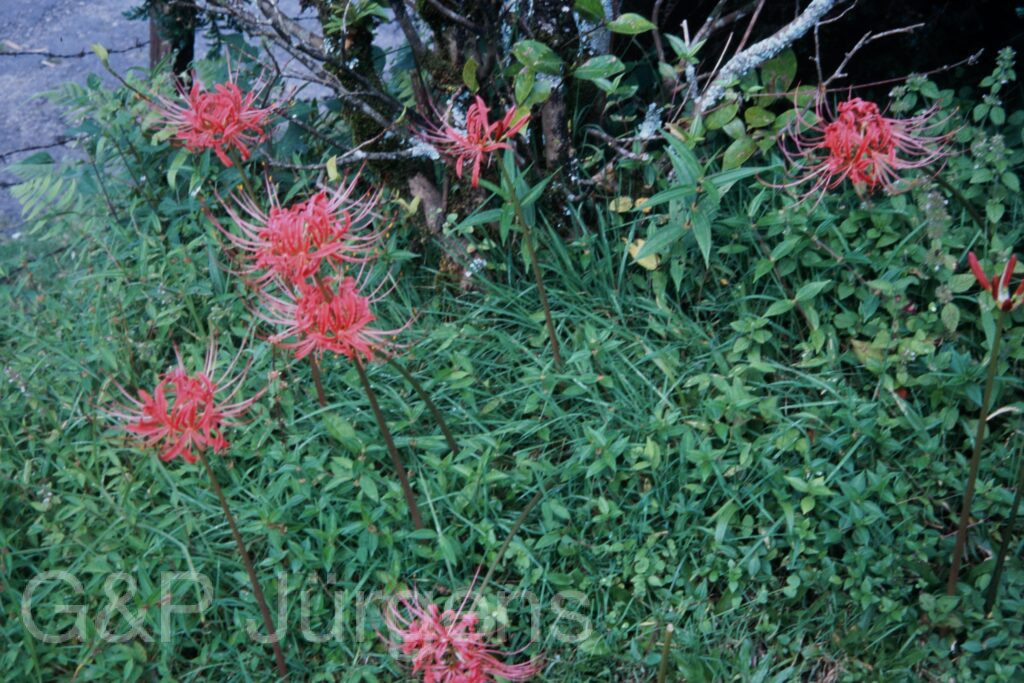
Sikkim Gangtok 1750m August

Description

Haemanthus coccineus is a bulbous geophyte native to the winter-rainfall regions of South Africa and Namibia, where the overwhelming majority of its more than three thousand records originate; the further occurrences in Australia, New Zealand, the United States and Europe represent cultivation and naturalisation. In its homeland it grows on rocky slopes, in sandy or stony soils and seasonally dry scrub of the Cape, flowering in late summer to autumn after the foliage has died back. The plant photographed at Gangtok in Sikkim at 1750 m in August is a cultivated specimen well outside the species' natural range, the Himalaya being far removed from its Mediterranean-climate African home.

The plant arises from a large, flattened, fleshy bulb. It typically produces only two (occasionally more) broad, strap-shaped, prostrate leaves that lie flat on the ground, often spotted or barred with red-purple beneath and ciliate at the margin; these are usually borne after flowering. The inflorescence is a stout, mottled scape topped by a dense umbel of small flowers tightly enclosed by several showy, fleshy, bright scarlet spathe bracts, giving the plant its common name of blood lily or paintbrush lily. Numerous coral-red stamens with prominent yellow anthers project beyond the perianth, and the fruit is a fleshy, brightly coloured berry containing few large seeds.

Haemanthus is a southern African genus of the Amaryllidaceae characterised by the brush-like umbel framed by coloured bracts, and H. coccineus is its most widespread and variable species. The bright bracts and exserted stamens attract bird and insect pollinators, while the fleshy berries are dispersed by animals. Long cultivated as an ornamental, it is secure in the wild; its appearance in Himalayan gardens underscores its horticultural popularity rather than any natural Asian distribution.

Author: L. · Sources: POWO (Kew), GBIF, Flora of Southern Africa, The Color Encyclopedia of Cape Bulbs, Snijman's revision of Haemanthus (Amaryllidaceae)

(Adams) Komarov

Sikkim2004 68 P119
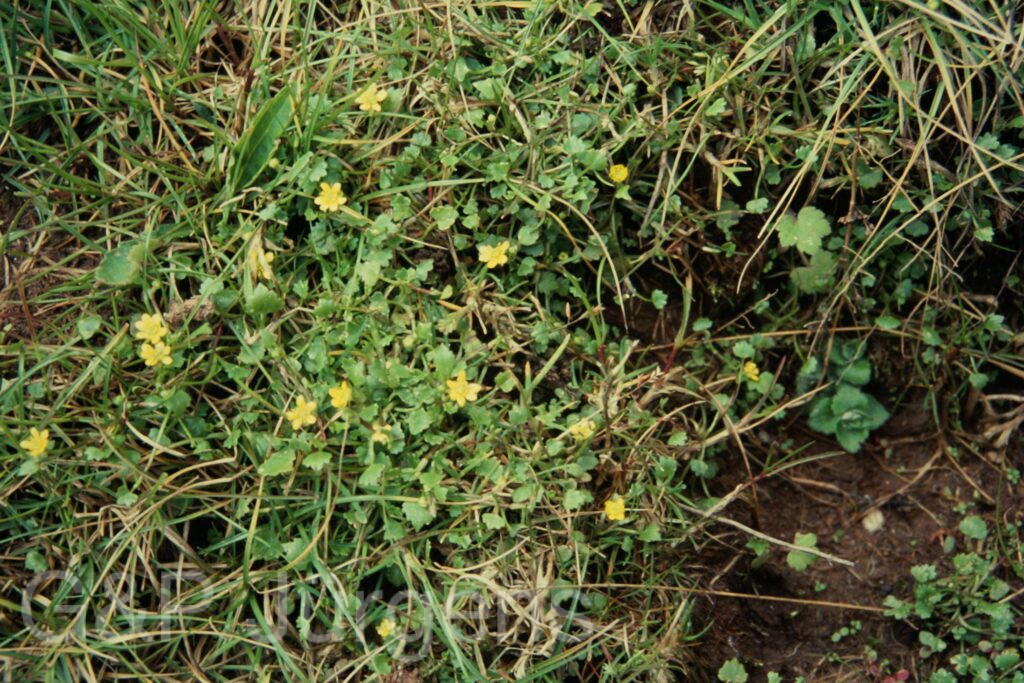
Sikkim West-Bengal, Bersay 2800m April

Description

Halerpestes sarmentosa is a widely distributed stoloniferous perennial of saline and moist open ground across temperate Eurasia, documented from Russia, China, India, Mongolia, Kazakhstan, Afghanistan, Tajikistan, Pakistan, Kyrgyzstan, Nepal and Uzbekistan, with disjunct and partly introduced records in the Americas (the more than 2170 GBIF occurrences include adventive populations). It favours damp meadows, lake and stream margins, marshy depressions and alkaline flats, typically from the lowlands to around 4500 m. The plant photographed at Bersay (Sikkim, West Bengal) at about 2800 m in April reflects its occurrence in moist montane grassland during early flowering.

The species is a low, mat-forming herb spreading by slender rooting stolons (sarmentose runners), from which arise long-petiolate basal leaves. The leaf blades are simple, ovate to reniform or somewhat three-lobed, with crenate margins and a cordate to truncate base, rather thick and slightly fleshy. The leafless scapes bear one to a few small flowers; the five spreading sepals subtend five narrow, yellow, nectariferous petals each with a basal scale. Stamens and carpels are numerous, the latter densely aggregated on an elongating receptacle and maturing into a globose to ovoid head of small, flattened, faintly ribbed achenes with a short straight beak.

Halerpestes was segregated from Ranunculus on the basis of its stoloniferous halophytic habit, leathery entire leaves and distinctive achene structure, the genus being centred on the steppe and saline wetlands of Central Asia. The taxon is also catalogued under the orthographic variant Halerpestes sarmentosus. Ecologically it is a salt-tolerant wetland colonist of grazed and disturbed shores; its broad range and tolerance of human-modified habitats render it of least concern, and its near-cosmopolitan spread illustrates the biogeographic links between Eurasian and American cold-temperate floras.

Author: (Adams) Komarov · Sources: POWO (Kew), GBIF, Flora of China, Flora of Bhutan, Annotated Checklist of the Flowering Plants of Nepal, Tamura's monograph of Ranunculaceae

(Maxim.) Hand.-Mazz.

Sikkim2004 282 P494 ergebnis
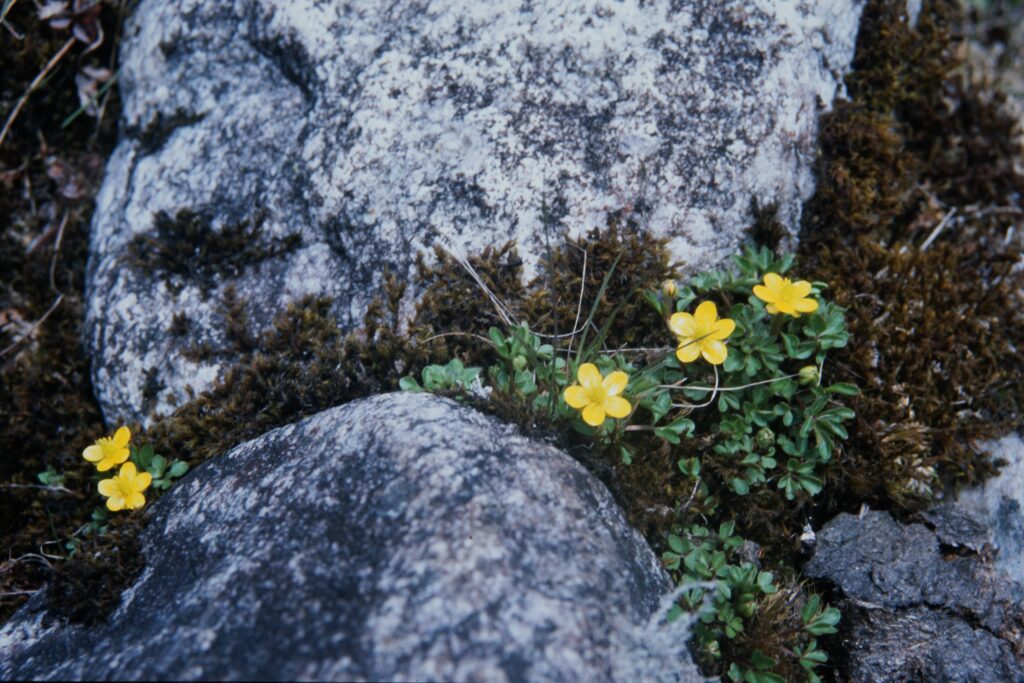
Sikkim Dzongri 4000m, May

Description

Halerpestes tricuspis is a small, stoloniferous perennial of the Ranunculaceae, distributed across the high mountains of Central Asia and the Himalaya. GBIF records (377 occurrences) document its presence in China, Nepal, India, Bhutan, Mongolia and Pakistan, where it occupies the alpine and subalpine zone. It is a characteristic plant of moist, often saline or marshy ground, the margins of glacial lakes, seepage flushes and streamsides, typically between 3,000 and 5,000 m. The photographed material from Dzongri in Sikkim at around 4,000 m in May exemplifies this preference for wet alpine meadows where snowmelt sustains permanently damp substrates.

The plant forms low mats by means of slender, rooting stolons. The leaves are basal, long-petiolate, with a small, fleshy, broadly cuneate to obovate blade that is characteristically three-toothed or shallowly three-lobed at the apex, the feature from which the epithet tricuspis derives. Flowering scapes are leafless and rise just above the foliage, each bearing one to few small, bright yellow flowers. The flowers have five sepals and five glossy petals each with a basal nectary scale; the numerous stamens surround a domed receptacle that develops into a globose to ovoid head of small, compressed, finely ridged achenes.

Formerly placed in Ranunculus, the genus Halerpestes is distinguished by its stoloniferous habit, the toothed leaf apices and the longitudinally ribbed achenes adapted to wetland dispersal. The species is an indicator of intact alpine wetland and flush communities, habitats sensitive to grazing pressure, trampling and hydrological change driven by glacial retreat. Though not currently of conservation concern owing to its wide range, its dependence on specialised wet microhabitats makes local populations vulnerable.

Author: (Maxim.) Hand.-Mazz. · Sources: POWO (Kew), Flora of China Vol. 6, Flora of Bhutan Vol. 1, GBIF, Tamura: Die natürlichen Pflanzenfamilien – Ranunculaceae (1995)

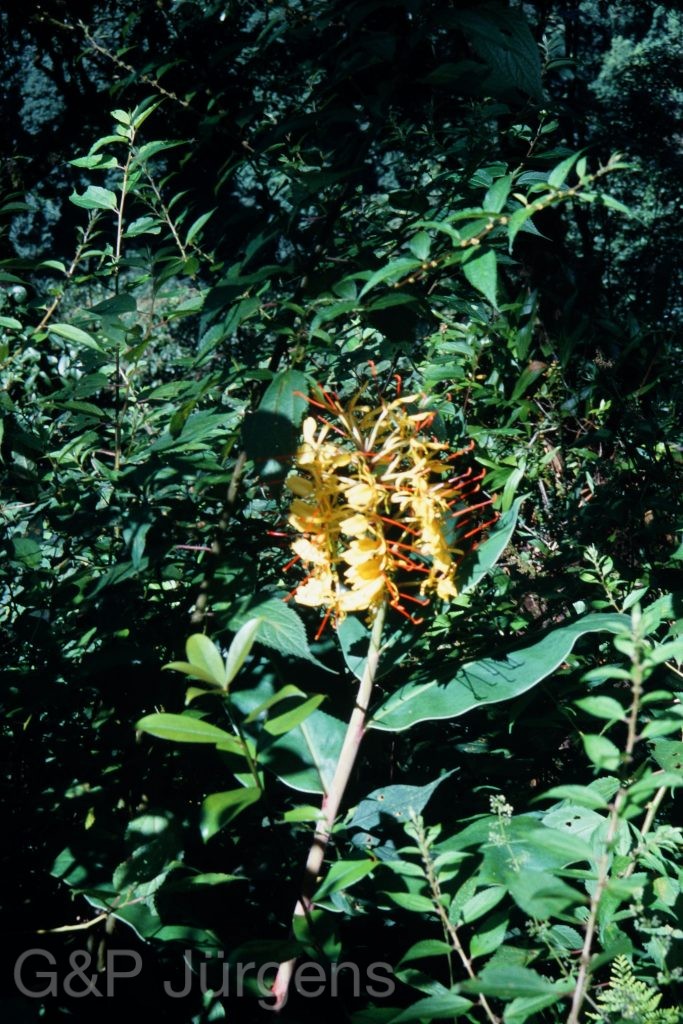
Wall.

Sikkim2003 54 P73
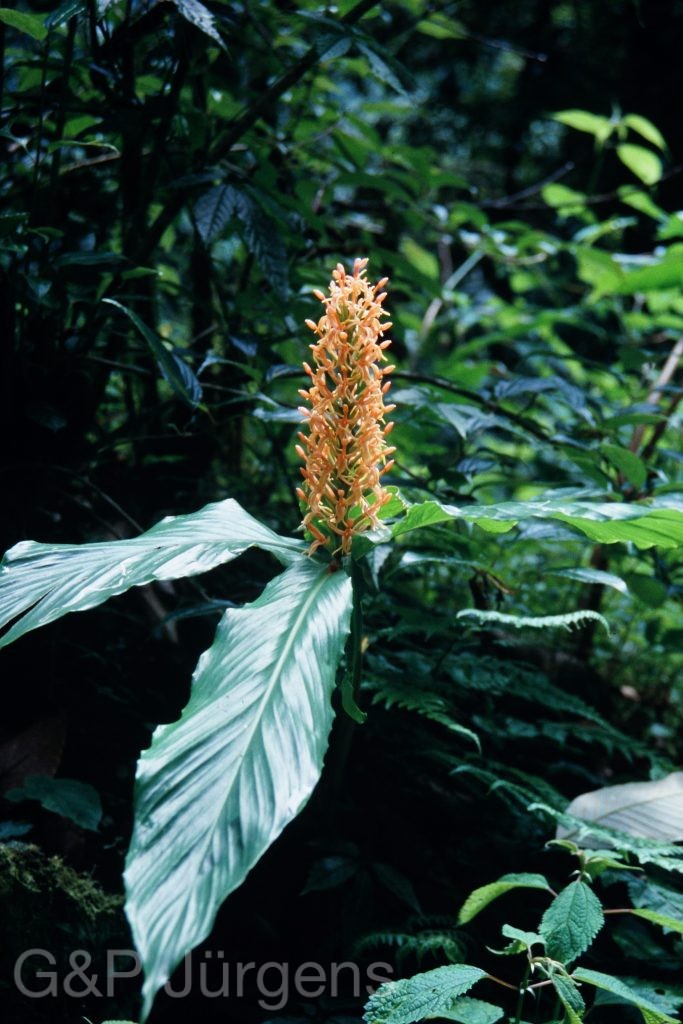
Sikkim avove Yoksam 2600m 08.2003

Description

Hedychium densiflorum Wall. is a robust rhizomatous ginger native to the eastern Himalaya, ranging through China (CN), India (IN), Nepal (NP), Bhutan (BT) and Myanmar (MM); GBIF records 255 occurrences, with additional points from cultivation in Britain, North America and elsewhere reflecting its popularity as a hardy ornamental. In the wild it grows in moist temperate forest, shaded banks and clearings, frequently as an epilithic or terrestrial herb among rocks. It was photographed in Sikkim above Yoksam at 2600 m in August, in the cool, monsoon-drenched broadleaf forest belt that typifies its habitat.

The plant grows from a stout, aromatic, creeping rhizome, producing tall leafy pseudostems formed by overlapping leaf-sheaths. The leaves are distichous, oblong-lanceolate, acuminate and shortly petiolate, with a conspicuous membranous ligule. The inflorescence is a dense, narrowly cylindrical terminal spike, much denser than in most congeners, from which the epithet derives; the bracts are imbricate and each subtends one or more flowers. The flowers are slender and orange to soft yellow, with a long corolla tube, narrow petals, a prominent exserted filament bearing the anther, and a bilobed or entire labellum. The fruit is a globose capsule splitting to reveal seeds enclosed in a bright arillus.

Hedychium belongs to tribe Zingibereae and is centred on the Indo-Malayan and Himalayan region, where many species are pollinated by moths and butterflies attracted to the long-tubed, often fragrant flowers. H. densiflorum and its selections such as 'Assam Orange' and 'Stephen' are widely grown for their hardiness. The original family field, spelled "Zingiberacaea", is retained verbatim though the correct orthography is Zingiberaceae. The species faces localised pressure from forest disturbance but remains common across its range.

Author: Wall. · Sources: POWO (Kew), GBIF, Flora of Bhutan, Flora of China, Zingiberaceae monograph (Schumann; T. L. Wu & K. Larsen)

Sheph. ex Ker Gawl.

Bhutan2012 668
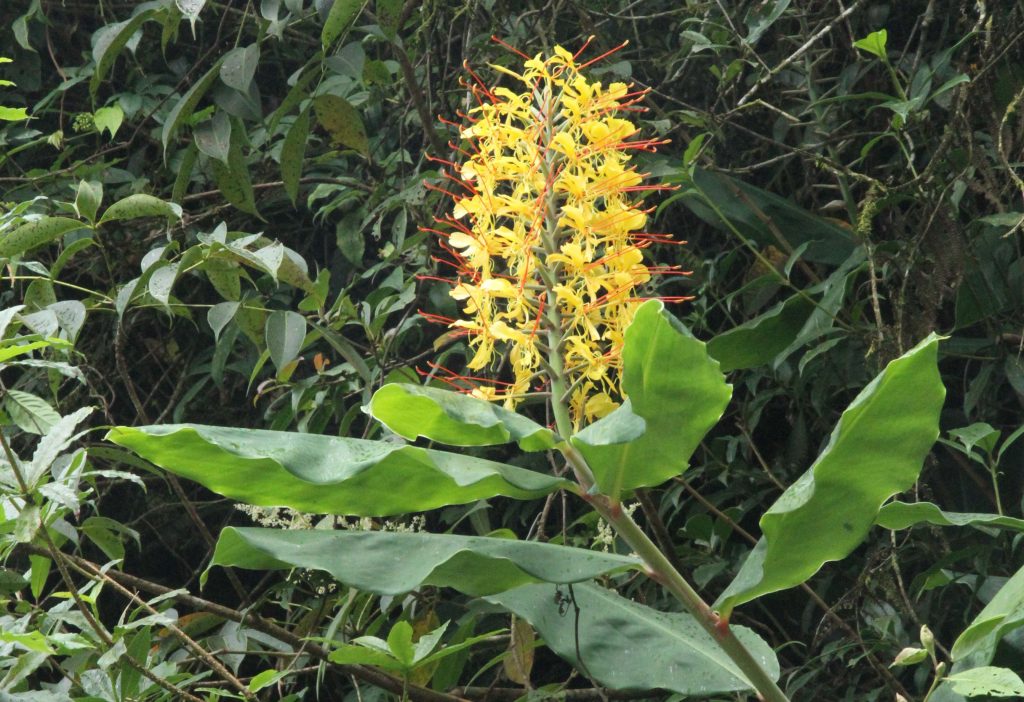
Bhutan Tserang 1100m, September
Sikkim2003 45 P60
Sikkim above Yoksam 200m 08.2003

Description

Hedychium gardnerianum, the Kahili ginger, is native to the eastern Himalaya of India, Nepal and Bhutan but has been very widely introduced and naturalised worldwide; GBIF records over 20,000 occurrences, the great majority from naturalised populations in Hawaii, New Zealand, the Azores, South Africa and Australia far outside its native range. In its homeland it grows in moist subtropical and lower temperate forest, on shaded banks, ravines and clearings. The images from Tserang in Bhutan at about 1100 m in September and above Yoksam in Sikkim show it flowering in late summer in its native warm, humid foothill forest belt.

It is a robust, clump-forming perennial herb arising from a stout, fleshy, branching rhizome and reaching two metres or more, with erect, leafy pseudostems formed by overlapping leaf sheaths. The leaves are large, oblong-lanceolate, glabrous above and shortly pubescent beneath, with a sheathing base and prominent midrib. The inflorescence is a dense, showy terminal cylindrical spike of many bracteate flowers; each is fragrant and lemon-yellow with a long-exserted bright red filament bearing the anther, the floral tube slender and the lip and lateral staminodes petaloid. The fruit is a fleshy capsule splitting to reveal numerous seeds enclosed in a bright orange-red aril.

Within Hedychium this species is notable for its conspicuous red stamens and is among the most ornamental gingers. The same vigour, rhizomatous spread and bird-dispersed arillate seeds make it a serious invasive in island and oceanic-climate floras, where it forms dense monocultures that suppress native regeneration, and it is listed among the world's worst invasive plants. Conservation concern thus relates not to its survival but to its impact where introduced.

Author: Sheph. ex Ker Gawl. · Sources: POWO (Kew), GBIF, Flora of Bhutan, Flora of China (Zingiberaceae), Branney Hardy Gingers including Hedychium, Roscoea and Zingiber

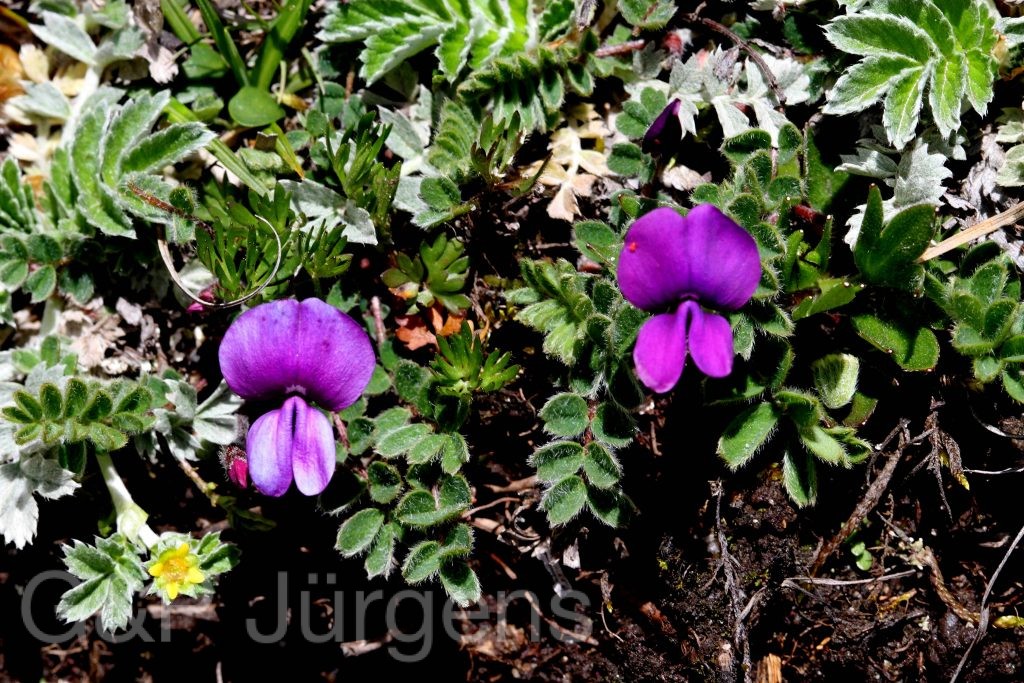
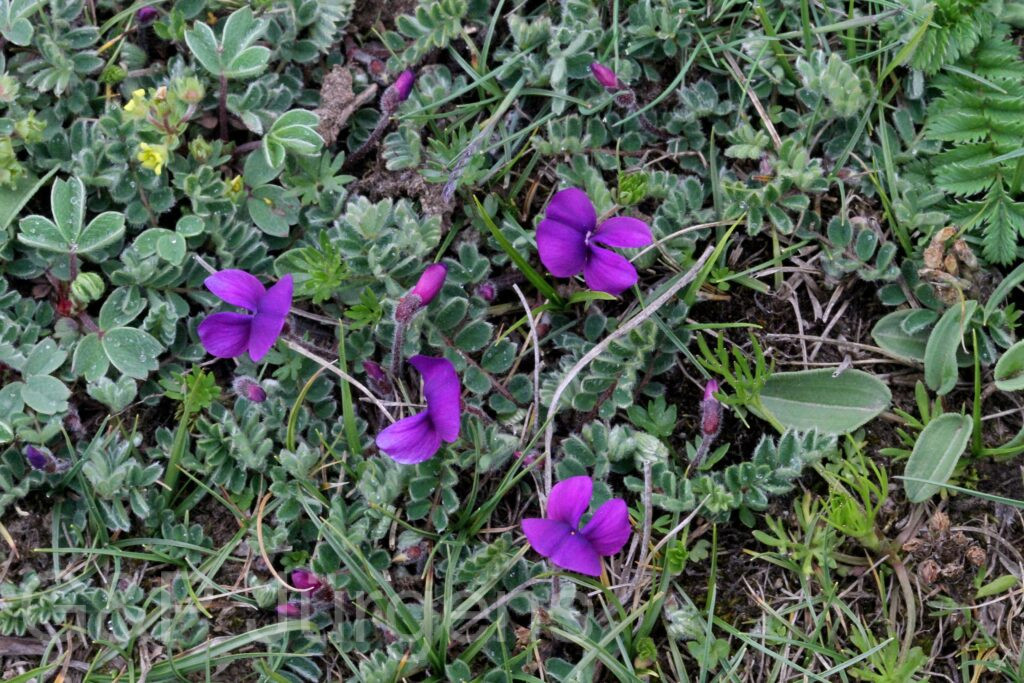
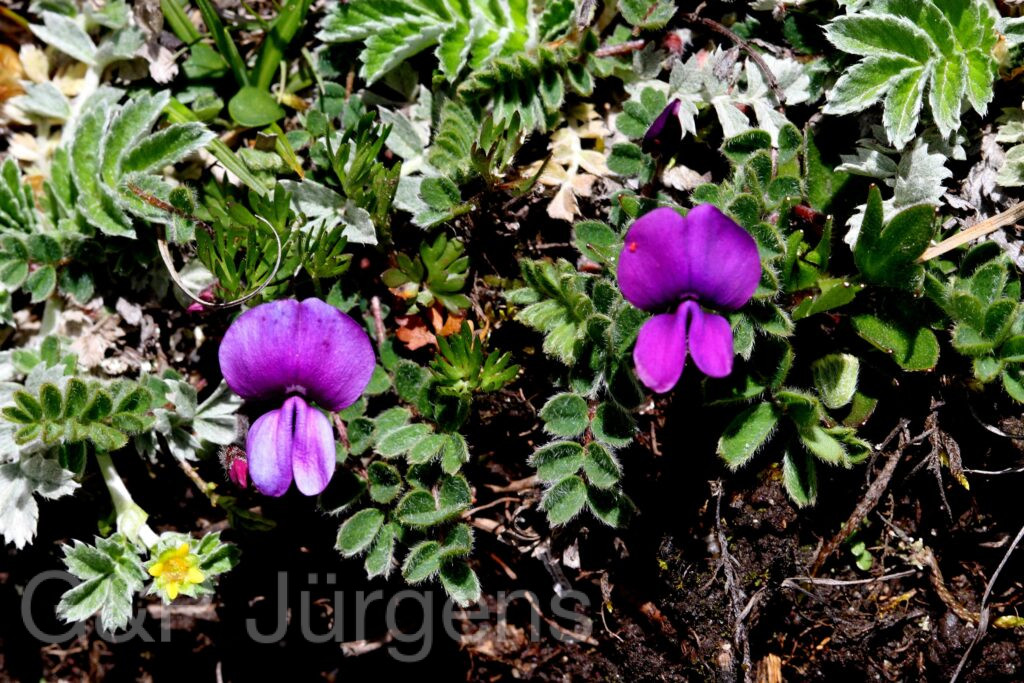
(Benth.) B.H.Choi & H.Ohashi

Sikkim2011 44
Bhutan Chele-La 4000m, May
Sikkim2011 78
Sikkim Vista-valley 3700m, June
Sikkim2011 44 1
Sikkim Vista-valley 3700m, June

Description

Hedysarum tibeticum is a high-alpine legume of the Himalaya and Tibetan plateau, distributed across China, India, Nepal and Bhutan, with around 295 GBIF records; it has historically also been treated under the name Stracheya tibetica, reflecting earlier generic placement. It grows on open stony alpine slopes, gravelly pastures, moraine flats and dry grassy banks near and above treeline, generally between about 3500 and 4500 m. The collections cited from Chele-La in Bhutan at 4000 m in May and from the Vista-valley in Sikkim at 3700 m in June show its early-summer flowering across the high eastern Himalaya.

It is a low, cushion- or mat-forming perennial herb arising from a stout woody rootstock and deep taproot. The leaves are imparipinnate with several pairs of small, oblong to elliptic leaflets that are often appressed-hairy. The flowers are borne in short, dense racemes; each is the typical papilionaceous pea-flower, with a standard, two wings and a keel, coloured pink to purplish-red. The diagnostic fruit is a flattened, transversely jointed lomentum that breaks at maturity into one-seeded segments, the articles often margined or prickly, aiding epizoochorous dispersal.

The taxon has been the subject of nomenclatural revision, the monotypic genus Stracheya having been merged into Hedysarum by Choi and Ohashi on the basis of morphological and molecular evidence, so that POWO now treats Hedysarum tibeticum as accepted. The low cushion habit and deep root are adaptations to wind, cold and the thin soils of the high plateau, while the jointed lomentum is an efficient dispersal device. Widespread across the Tibetan borderlands, the species is not considered threatened and is a characteristic component of high-alpine legume communities.

Author: (Benth.) B.H.Choi & H.Ohashi · Sources: POWO (Kew), GBIF, Flora of China (Fabaceae), Flora of Bhutan, Annotated Checklist of the Flowering Plants of Nepal, Choi & Ohashi systematic revision of Hedysarum

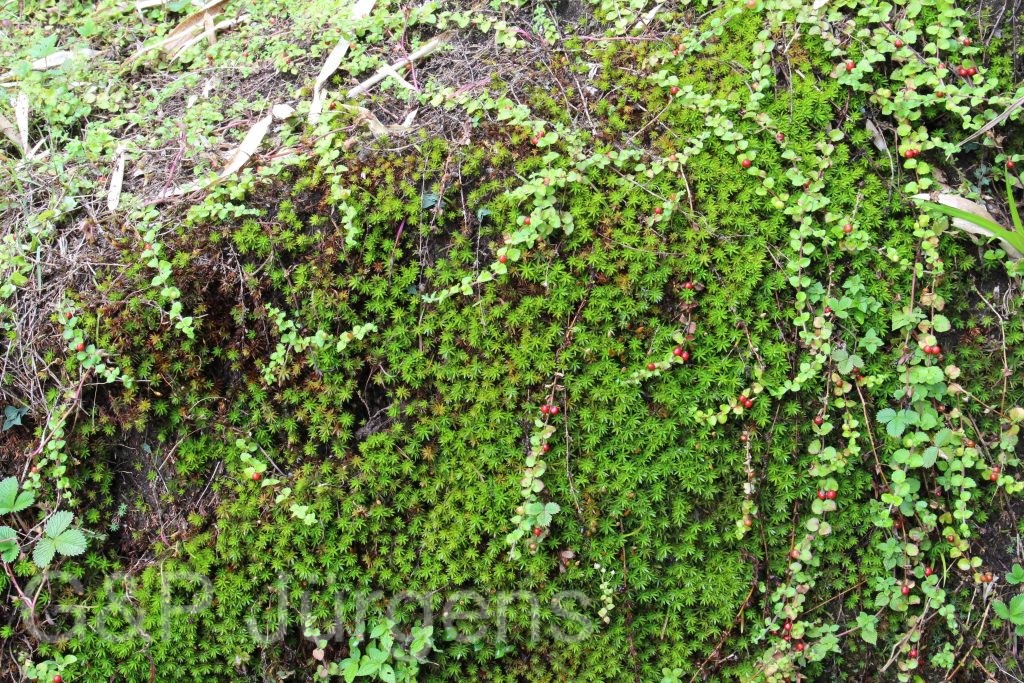
Wall.

Bhutan2015 39
Bhutan Dochu-La 2700m, October
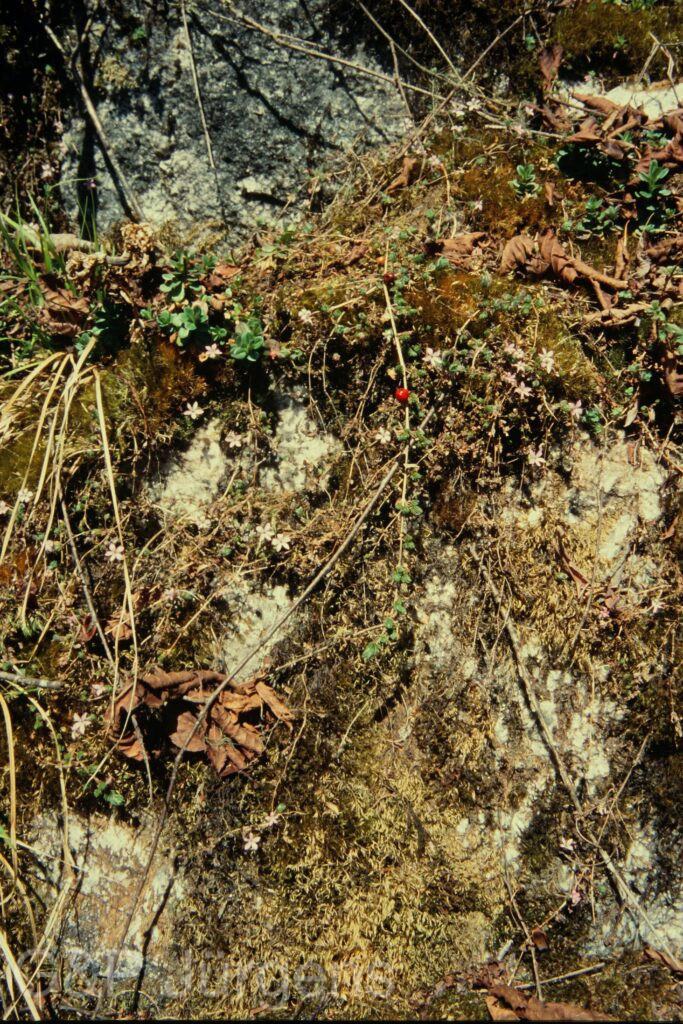
Sikkim2004 301 G524
Sikkim/India Choka 3800m May
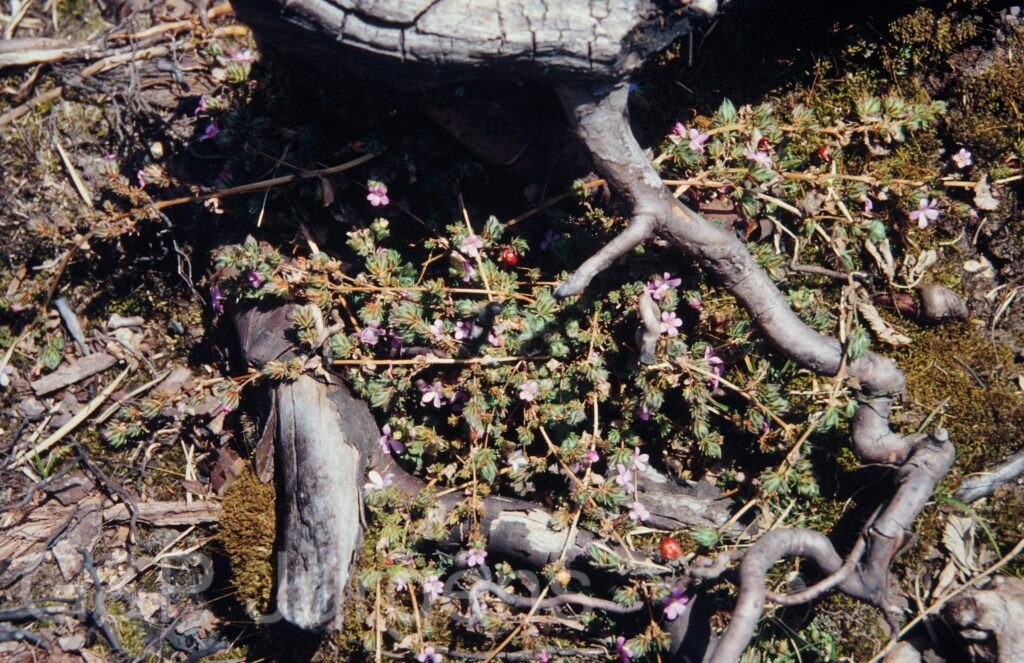
Nepal 1994 90 ergebnis
Ost-Nepal Jaljale Himal
3100m April

Description

Hemiphragma heterophyllum is a widespread Asian creeping herb extending along the Himalaya from Pakistan through Nepal, Sikkim, Bhutan and northeast India to China and Taiwan, and southward into the mountains of Myanmar, Thailand, Vietnam, the Philippines and Indonesia, with naturalised records elsewhere; GBIF logs 2751 occurrences across this broad range. It grows on open banks, grassy slopes, mossy rocks, forest paths and disturbed ground in the temperate to alpine zone, roughly 2500 to 4000 m. The cited records from Dochu-La in Bhutan (2700 m, October), Choka in Sikkim (3800 m, May) and the Jaljale Himal in eastern Nepal (3100 m, April) demonstrate its wide elevational and seasonal amplitude.

It is a small, mat-forming perennial herb with slender, much-branched, prostrate and rooting stems. The leaves are conspicuously dimorphic, as the epithet heterophyllum indicates: those on the main stems are broad, orbicular to reniform and crenate, while the clustered axillary fascicles bear numerous narrow, needle-like (acicular) leaves. The flowers are small, solitary and nearly sessile in the leaf axils, with a campanulate calyx and a pink to white rotate-campanulate corolla. The fruit is the most striking feature: a fleshy, berry-like, bright scarlet to orange globose capsule that is exserted among the foliage and conspicuous in fruit.

The sole species of the genus Hemiphragma, it is now placed in Plantaginaceae following the dismemberment of the traditional Scrophulariaceae, having formerly been assigned to that family. Its brightly coloured fleshy fruits suggest endozoochorous dispersal by birds, unusual within its largely dry-fruited relatives. The species is abundant, ecologically versatile and frequently colonises trodden or disturbed habitats, so it is of least conservation concern; its capacity to establish outside its native range is reflected in scattered exotic records.

Author: Wall. · Sources: POWO (Kew), GBIF, Flora of China Vol. 18, Flora of Bhutan Vol. 2, Flora of Nepal, Genera Plantarum and Hooker's Flora of British India