
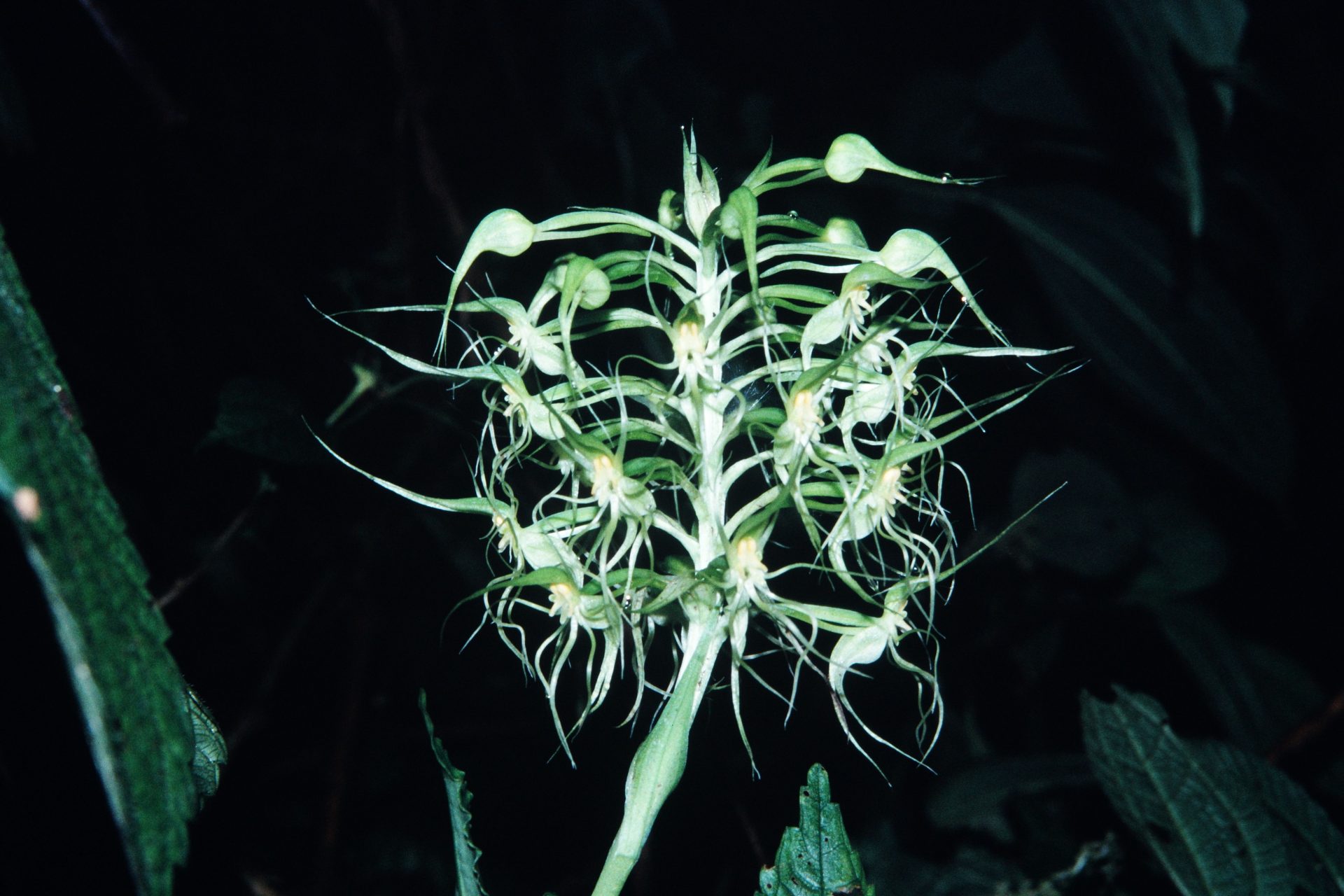
Kraenzl.
Description
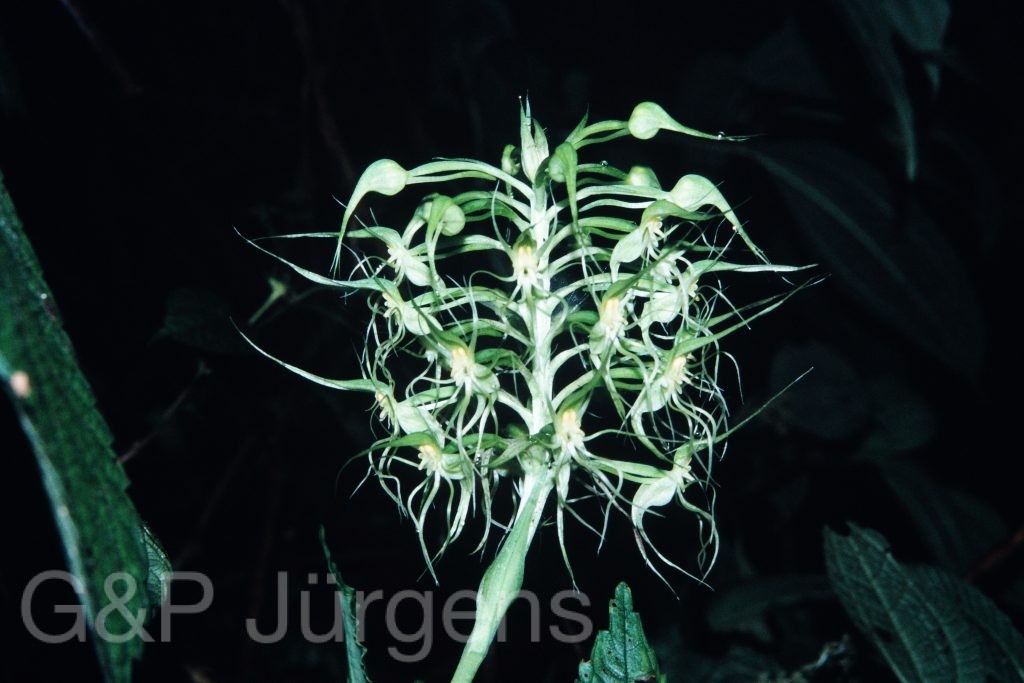
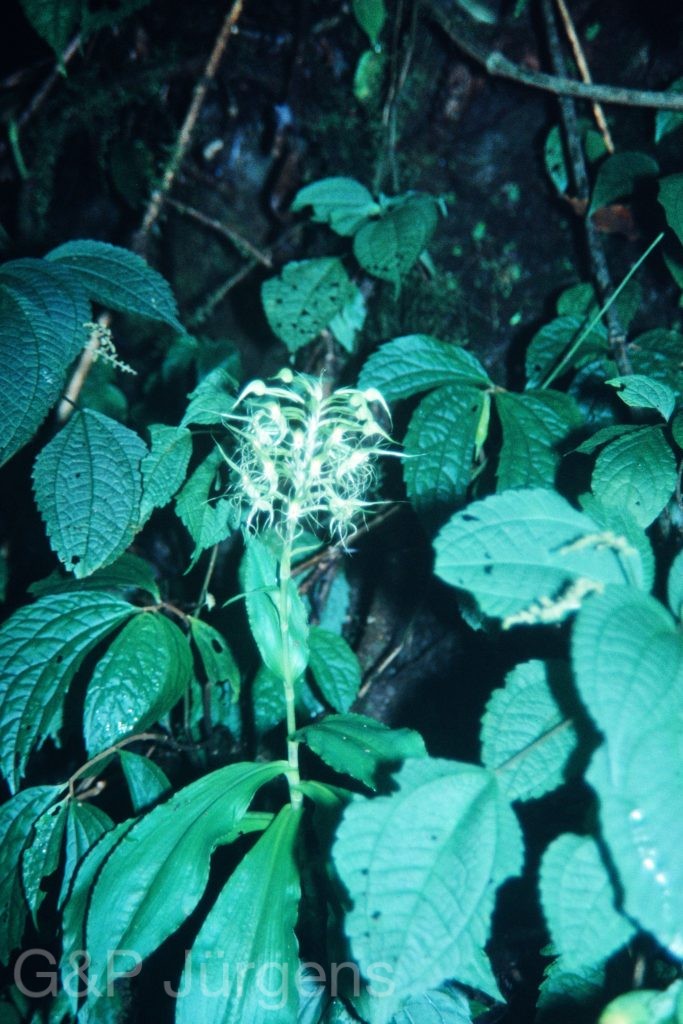
Habenaria pantlingiana is a terrestrial orchid distributed across the eastern Himalaya and East Asia, with GBIF records (322 occurrences) spanning Taiwan, Japan, China, India, Nepal, Bhutan and Vietnam. It grows in moist, humus-rich soils on shaded forest floors, grassy slopes and stream banks within warm-temperate and subtropical broad-leaved forest, broadly between 1000 and 2500 m. The documented plant from above Yoksam in western Sikkim at about 1880 m, flowering in August, reflects its summer-monsoon phenology, when the tuberous geophyte emerges and blooms during the period of maximum humidity and rainfall.
The plant arises from ovoid, fleshy underground tubers and produces an erect, leafy stem. The cauline leaves are oblong-lanceolate to elliptic, sheathing at the base, grading into bract-like organs above. The inflorescence is a many-flowered terminal raceme of small greenish to greenish-white flowers, each subtended by a narrow bract. As in Habenaria, the lip (labellum) is deeply three-lobed with slender, often filiform divisions, and bears a prominent slender spur arising at its base. The dorsal sepal and petals form a loose hood over the column, the lateral sepals spreading; the rostellum and stigmatic processes are characteristically elaborate. The fruit is a ribbed, dehiscent capsule releasing dust-like seeds.
Described by Kraenzlin and commemorating the Sikkim orchidologist R. Pantling, the species sits within the large, taxonomically intricate genus Habenaria (subfamily Orchidoideae, tribe Orchideae), where spur and lip lobing are key diagnostic features. Like most terrestrial orchids it depends on mycorrhizal fungi for germination and establishment, rendering it sensitive to forest disturbance. Although its wide range buffers it against global extinction, local populations are vulnerable to habitat loss and collection, and all wild orchids are CITES-listed.
Author: Kraenzl. · Sources: POWO (Kew), GBIF, Flora of China, The Orchids of Sikkim-Himalaya (Pantling & King), Genera Orchidacearum (Pridgeon et al.)