Tag:

Sikkim

Flowers of Sikkim — 350 species from the Sikkim Himalaya in northeast India, a compact yet botanically extraordinary region that climbs from subtropical valleys to the alpine zone beneath Kangchenjunga. Sikkim is a classic centre of Himalayan plant diversity, celebrated for its rhododendrons, primulas, orchids and gentians. Each entry provides a botanical description, distribution, habitat and flowering season with the original field photograph.

(Lour.) Y.De Smet & C.Granados

Sikkim2003 52 P71^
Sikkim above Yoksam 2300m, August

Nepal 2001 431 ergebnis ergebnis
Nepal (Gorkha) Laprak 2000m, May

Description

Hydrangea febrifuga, long familiar under the name Dichroa febrifuga, is a widely distributed shrub of subtropical and warm-temperate Asia, ranging from the Himalaya (Nepal, Sikkim, Bhutan, northeast India) eastward through southern China, Myanmar, Thailand and Indochina to Malesia and the Philippines. It inhabits moist, shaded forest, ravines and streamsides, forming part of the evergreen broad-leaved understorey. It is recorded from low to mid elevations; the populations shown above Yoksam in Sikkim at 2,300 m in August and at Laprak in the Gorkha region of Nepal at 2,000 m in May span its typical mid-montane range in humid forest.

The plant is an erect, much-branched shrub with subquadrangular, often purplish young stems. The leaves are opposite, elliptic to oblong-lanceolate, with a serrate margin, acuminate apex and a glabrous to sparsely pubescent surface. The inflorescence is a terminal or axillary corymbose to paniculate cyme bearing numerous small bisexual flowers; the calyx is shortly toothed and the corolla blue to violet or whitish with thick, valvate petals, the stamens conspicuous. Distinctively for the family, the fruit is a fleshy, indigo-blue berry crowned by the persistent calyx and containing many minute seeds.

Molecular phylogenetic work has shown the segregate genus Dichroa to be nested within Hydrangea, prompting the recombination as Hydrangea febrifuga by De Smet and Granados; the basionym traces to Loureiro's original description of Lourea. The species is of long-standing ethnomedical importance: its roots and leaves, rich in the alkaloid febrifugine, have been used in traditional Chinese and Himalayan medicine against malaria and fevers, a property reflected in the epithet. It remains common and is not considered threatened.

Author: (Lour.) Y.De Smet & C.Granados · Sources: POWO (Kew), Flora of China Vol. 8, Flora of Bhutan Vol. 1, GBIF, De Smet et al.: Hydrangea phylogeny (TAXON)

D. Don

Sikkim2011 179
Sikkim Lachen 2760m, June

Description

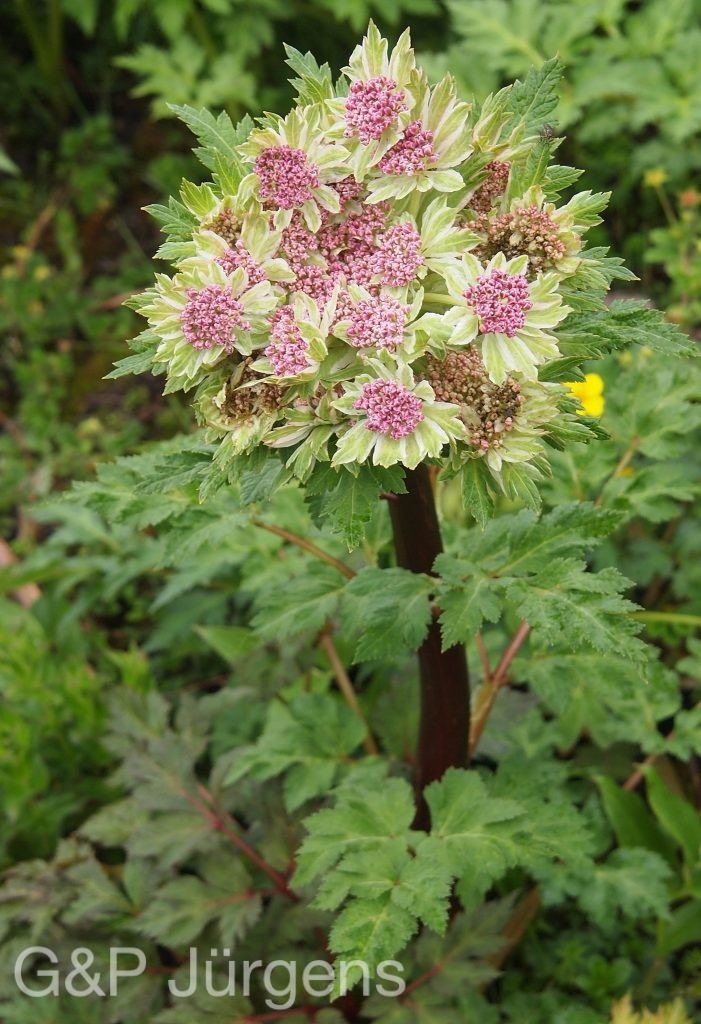
Hydrangea heteromalla is a deciduous shrub or small tree of the Himalaya and central China, with GBIF returning over 1600 occurrences spanning its native range in China, Nepal, India, Bhutan and Myanmar as well as numerous cultivated and naturalised records from Europe and North America. In the wild it grows in cool temperate forest, on open slopes, forest margins, ravines and shrubberies, typically between about 1500 and 3500 m. The plant photographed near Lachen in northern Sikkim at about 2760 m, flowering in June, occupies the moist temperate montane belt where the species is a frequent understorey and edge shrub.

The plant has stout, spreading branches with peeling bark and opposite leaves that are ovate to elliptic, acuminate, finely serrate, and characteristically discolorous, dark green above and densely pale-tomentose to whitish beneath, the indumentum giving the epithet heteromalla. The inflorescence is a broad, flat-topped to slightly domed corymb bearing many small fertile flowers surrounded at the margin by larger, showy, sterile ray-florets with four enlarged white sepaloid segments. The fertile flowers are small, white, with five petals and numerous stamens. The fruit is a small ribbed capsule opening at the apex to release numerous tiny seeds.

Hydrangea heteromalla is a variable and widespread species, the subject of much horticultural selection and the source of cultivated forms grown for their lacecap inflorescences, which explains its scattered records across temperate gardens worldwide. Within Hydrangea section Hydrangea it represents the principal Himalayan-Chinese montane lineage. Ecologically the marginal sterile florets serve to attract pollinators to the inconspicuous fertile flowers. The species is common and not threatened, and its wide ecological amplitude and ornamental value have ensured both its persistence in the wild and its global cultivation.

Author: D. Don · Sources: POWO (Kew), GBIF, Flora of China, Flora of Bhutan, McClintock "A Monograph of the Genus Hydrangea", Annotated Checklist of the Flowering Plants of Nepal

(Wall. ex DC.) C.B. Clarke

BhutanPG2011 365
Bhutan Jule-Tso 4150m, June
Sikkim2003 159 P212
Sikkim Dzongri 3900m, August
Sikkim2003 160 P213
Sikkim Dzongri 3900m, August

Description

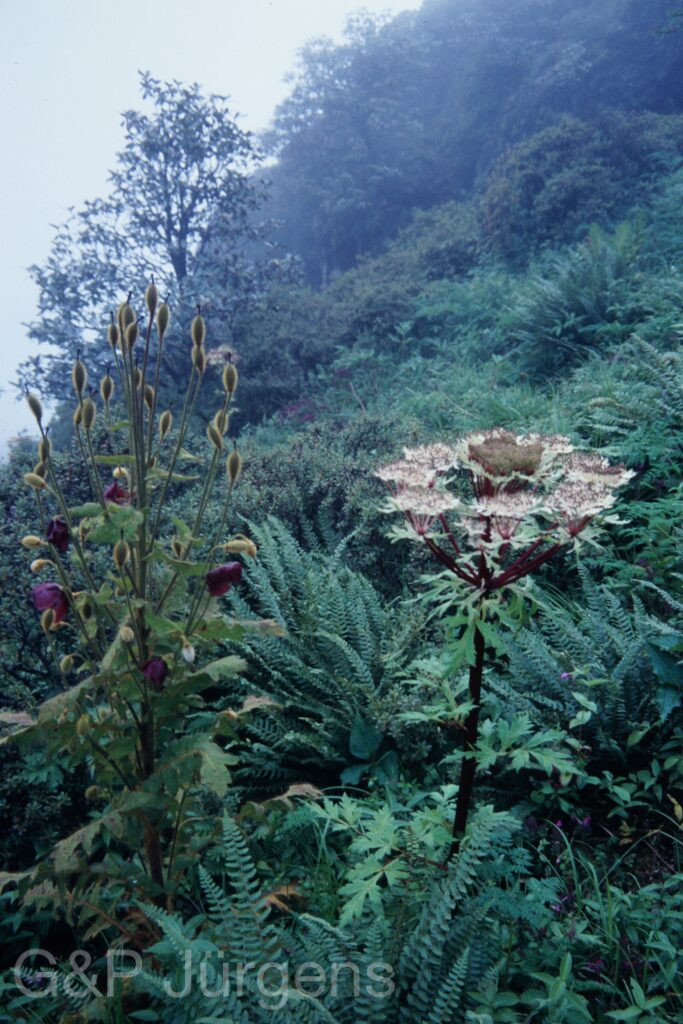
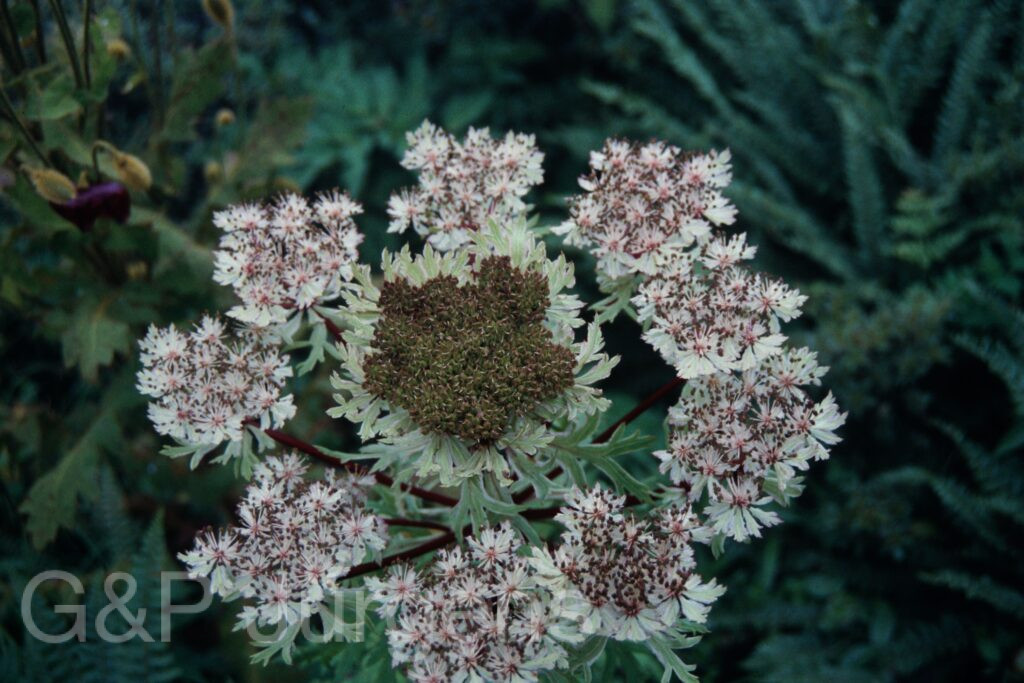
Hymenidium benthamii is a robust alpine umbellifer of the high Himalaya, distributed through Nepal, China, India, Myanmar and Bhutan (gbif_countries: NP, CN, IN, MM, BT), with about 181 GBIF occurrences. It grows in alpine meadows, damp grassy slopes, rocky pastures and streamside flushes above the treeline, where it is a characteristic herb of the moist eastern Himalayan uplands. The illustrated collections span Jule-Tso in Bhutan at about 4150 m, flowering in June, and Dzongri in Sikkim at about 3900 m in August, documenting its occupation of the cool subalpine to alpine zone through the monsoon season.

The plant is a stout perennial arising from a thickened taproot and crown, with erect, ribbed, often hollow stems. The leaves are largely basal, long-petiolate and two- to three-times pinnately divided into toothed or further-dissected segments, the petioles sheathing at the base. The inflorescence is a large, flat-topped compound umbel subtended by a conspicuous involucre of broad, often membranous-margined bracts, a feature recalling the genus name Hymenidium; the small flowers are white to pinkish with five petals. The fruit is a dry schizocarp splitting into two ribbed mericarps, the ridges and oil-canals (vittae) providing key taxonomic characters.

Long known under Pleurospermum benthamii, the species, as the wp_link itself preserves, has been transferred to Hymenidium following revisionary work that dismembered the broadly construed Pleurospermum on molecular grounds. It belongs to the conspicuous-bracted alpine Apiaceae of the Sino-Himalaya, a group much used in regional ethnomedicine. Widespread across its montane range, it is of no conservation concern.

Author: (Wall. ex DC.) C.B. Clarke · Sources: POWO (Kew), GBIF, Flora of Nepal, Flora of China, Annotated Checklist of the Flowering Plants of Nepal, Pimenov & Kljuykov revision of Pleurospermum and allied genera

Wall. ex N.Robson

BhutanPG2011 824 01 01
Bhutan Luksor, 2800m July
BhutanPG2011 695 01 01
Bhutan Luksor, 2800m July
Sikkim2003 378 P531
Sikkim Tista valley 3400m August

Description

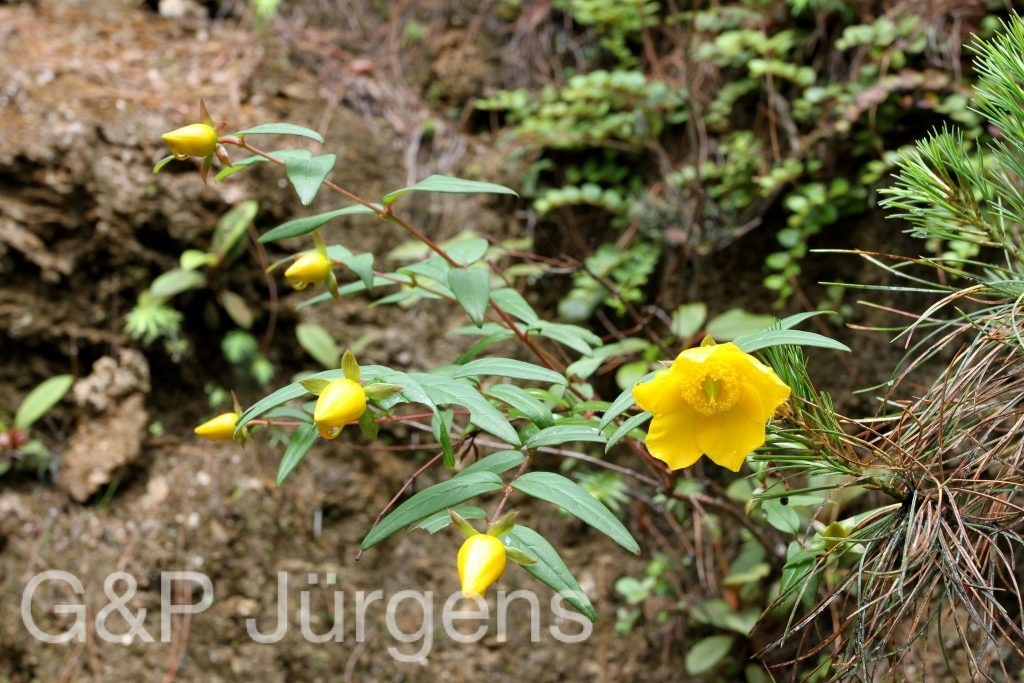
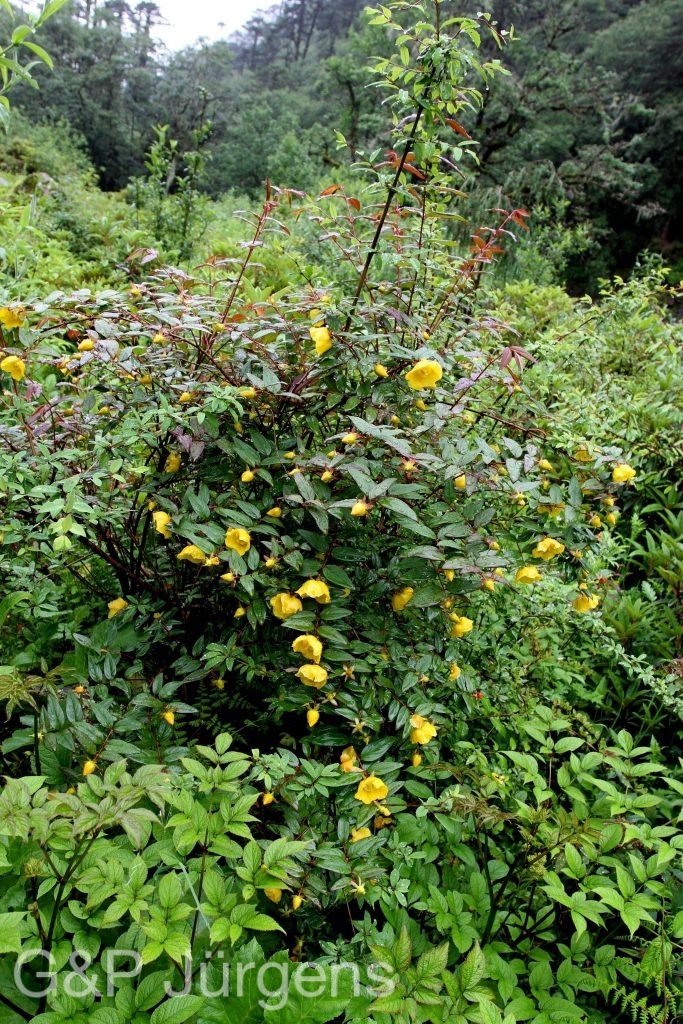
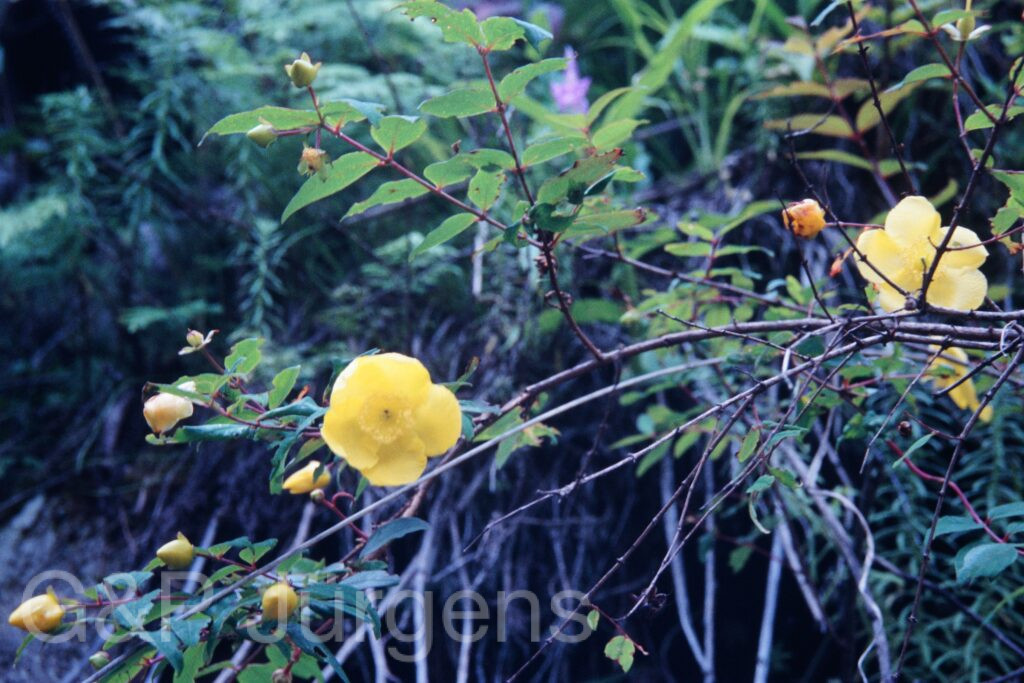
Hypericum choisianum (correctly H. choisyanum) is a handsome shrubby St John's wort of the Himalaya, distributed from Nepal eastward through India, Sikkim, Bhutan and into southwestern China, with outlying records from Myanmar; cultivated and naturalised material accounts for occurrences in Britain, Ireland and Vietnam, contributing to a GBIF total of over two hundred records. It inhabits open temperate forest, forest margins, scrub, banks and rocky slopes, typically between about 1800 and 3600 m. The plants documented from Luksor in Bhutan at 2800 m in July and from the Tista valley in Sikkim at 3400 m in August reflect both its broad elevational tolerance and its mid-to-late summer flowering, when the large golden blooms are conspicuous along forest edges and clearings throughout the monsoon season.

The plant is an evergreen or semi-evergreen shrub of one to two metres, with arching reddish branches and opposite, ovate to oblong-lanceolate, sessile or clasping leaves that are slightly glaucous beneath and dotted with translucent glands. The flowers are large and showy, solitary or few in terminal cymes, with five broad, bright golden-yellow petals that are often somewhat incurved to give a cupped, almost globose bloom. The numerous stamens are united into five fascicles, and the styles are five, free and spreading. The superior, five-locular ovary develops into a leathery to slightly fleshy capsule that dehisces to release many small seeds; the glandular tissue throughout the plant contains the characteristic hypericin and related compounds.

Hypericum, here placed in the Hypericaceae (sometimes treated within a broadly defined Clusiaceae), reaches notable diversity in the Sino-Himalaya, and H. choisyanum belongs to the large-flowered shrubby section Ascyreia, several members of which are valued as garden ornamentals for their bold yellow flowers and hardiness. Described by N. Robson, who monographed the genus, it is part of a closely allied complex of Himalayan shrubs distinguished by subtle differences in leaf shape, stamen fascicles and capsule form. As a common, ecologically adaptable species spanning a wide range and elevation, it is of no conservation concern, and its frequency along disturbed forest margins reflects considerable tolerance of moderate human modification.

Author: Wall. ex N.Robson · Sources: POWO (Kew), GBIF, Flora of China Vol. 13, Flora of Bhutan Vol. 1 Part 2, Flora of Nepal, Studies in the genus Hypericum (Norman Robson, Bulletin of the British Museum)

Wall.

Bh2008 420 P656
Bhutan Phobjika, 3100m April

Description

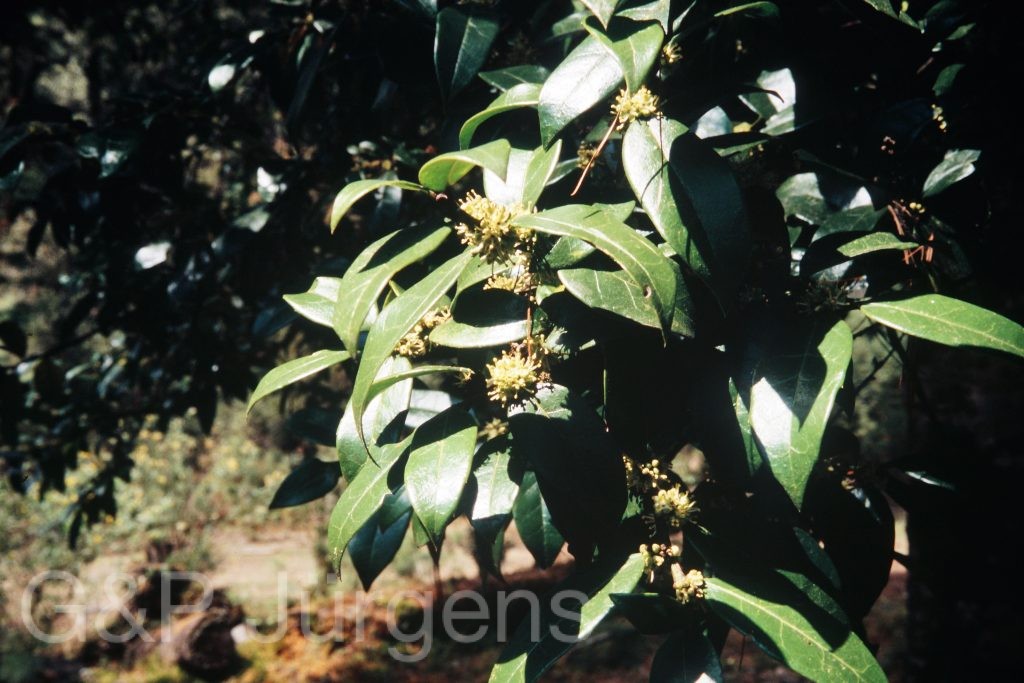
Ilex dipyrena, the Himalayan holly, is an evergreen tree or large shrub distributed along the Himalaya from Pakistan and northern India through Nepal, Sikkim and Bhutan into southern China (Yunnan, Xizang) and Myanmar. It is a characteristic constituent of cool temperate broad-leaved and mixed conifer forest, growing on shaded slopes, ridges and forest margins. It occurs mainly between about 1,800 and 3,300 m; the plant recorded in the Phobjikha valley of Bhutan at 3,100 m in April lies in the upper part of this band, within the moist temperate forest belt where it forms part of the evergreen understorey.

The plant is a small to medium-sized tree with greyish bark and glabrous twigs. The leaves are alternate, leathery and glossy dark green, elliptic to oblong-lanceolate, with a spinose-dentate margin bearing rigid marginal teeth on vigorous shoots, the teeth often reduced on older growth. The plant is dioecious, with small greenish-white, four-merous flowers clustered in the leaf axils. The fruit is a globose drupe ripening dull red, containing typically two pyrenes, a feature reflected in the epithet dipyrena, distinguishing it from the four- to five-seeded common holly.

Ilex is a large, near-cosmopolitan genus and the sole member of its family. Ilex dipyrena, described by Wallich, is the principal native holly of the Himalaya and a long-cultivated ornamental and parent of garden hybrids. Its evergreen, drupe-bearing habit provides food for birds, which disperse the seeds, and it contributes to the structure of temperate Himalayan forest. The species is widespread and common, and is not considered to be of conservation concern.

Author: Wall. · Sources: POWO (Kew), Flora of China Vol. 11, Flora of Bhutan Vol. 2, GBIF, Loizeau et al.: Ilex phylogeny

Hook.f.

Sikkim2003 66 P89
Sikkim Choka 2900m, August

Description

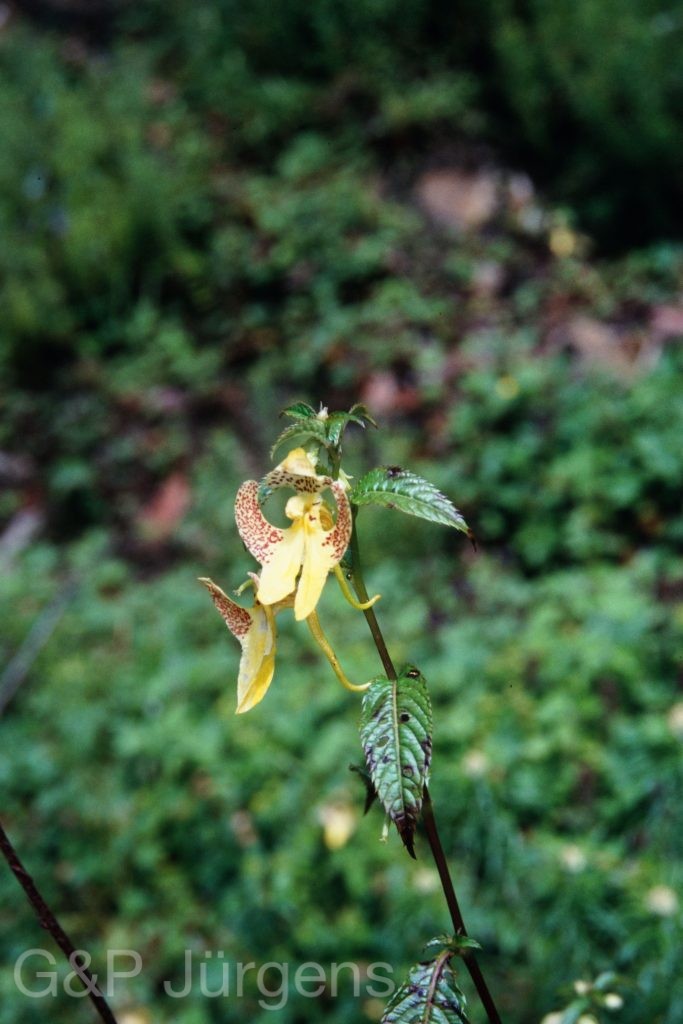
Impatiens falcifer is an eastern Himalayan balsam with a restricted distribution spanning Nepal, Sikkim, Bhutan, and adjacent parts of southern China (Xizang). GBIF records list 67 occurrences, indicating a comparatively uncommon species. It is found in moist, sheltered habitats within temperate and subalpine forests, including shaded stream banks, mossy rock faces, and forest margins, at elevations of 2,200–3,500 m. The species frequently grows among ferns and other shade-tolerant herbaceous perennials in areas of high humidity.
Impatiens falcifer is an erect, succulent annual herb, 30–60 cm tall, with glabrous, translucent stems that are often reddish-tinged at the nodes. Leaves are alternate, elliptic to ovate-lanceolate, 5–12 cm long, with serrate margins bearing small glandular teeth; the petioles are slender, 1–3 cm long. Flowers are borne in few-flowered axillary racemes. The flowers are yellow, often with reddish spots in the throat, 2–3 cm long, with a deeply saccate lower sepal that narrows into a conspicuously curved or falcate spur — the defining character from which the epithet derives. The lateral united petals are bilobed, the upper lobe ovate, the lower lobe distinctly falcate. The fruit is a fusiform capsule that dehisces explosively when ripe, a characteristic of the genus.
Described by Joseph Dalton Hooker from Sikkim collections, Impatiens falcifer belongs to the large and taxonomically challenging eastern Himalayan radiation of the genus. The photographed specimen from Choka in Sikkim at 2,900 m represents a typical mid-elevation occurrence in cloud-forest habitat. The species can be distinguished from superficially similar yellow-flowered congeners such as I. urticifolia by the strongly curved spur and falcate petal lobes. Its narrow geographical range and dependence on intact moist forest habitats suggest potential vulnerability to deforestation and land-use change.

Author: Hook.f. · Sources: POWO (Kew), GBIF, Flora of British India Vol. 1 (Hooker 1875), Grey-Wilson: Impatiens of Africa (1980), Akiyama et al. (1993)

Iris clarkei

by GP Jürgens

Baker ex Hook.f.

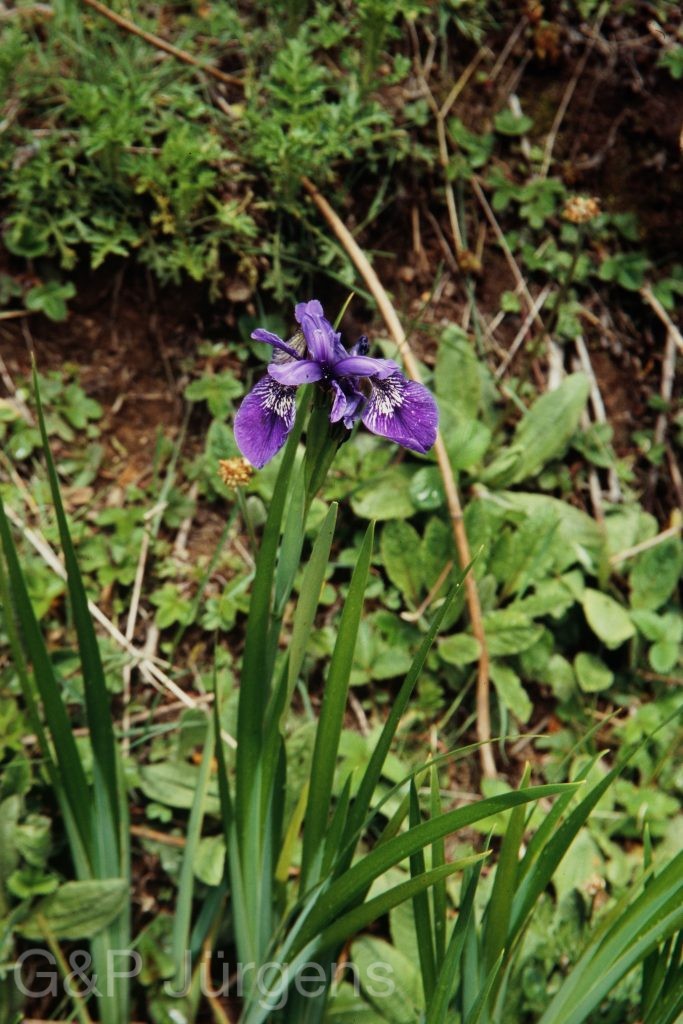
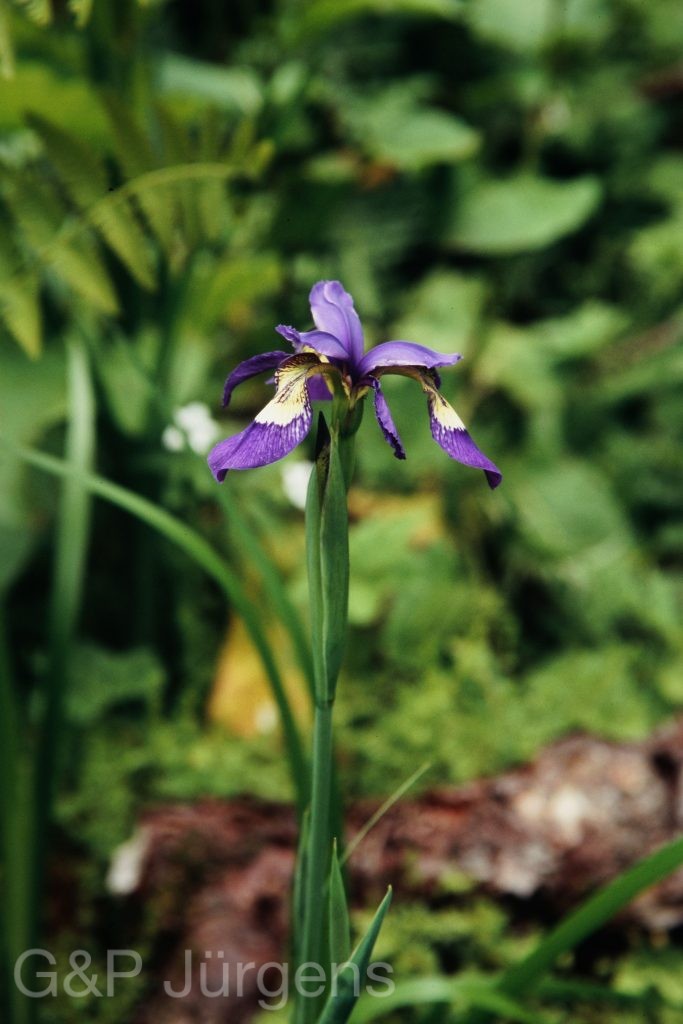
BhutanPG2011 773 01 01
Bhutan Chele-La, 3900m June
Bh09 35 P65
Bhutan Dochu-La, 3000m June
Bh09 206 P346
Bhutan Dochu-La, 3000m June

Description

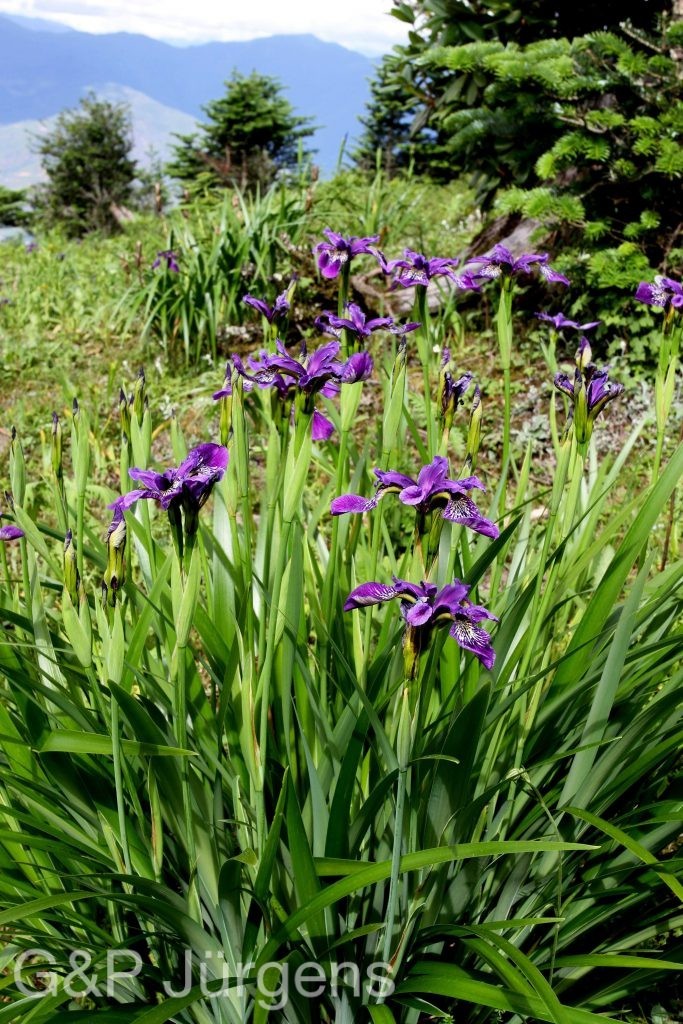
Iris clarkei is an eastern Himalayan beardless iris distributed through Bhutan, Sikkim and northeastern India, Nepal, southern Tibet (China) and northern Myanmar, with GBIF holding about 174 occurrences. It is a subalpine to alpine moisture-lover, recorded here from two Bhutanese passes, Chele-La at 3900 m and Dochu-La at 3000 m, both flowering in June. The species favours wet alpine meadows, marshy hollows, stream sides and seasonally flushed turf on slopes, typically between roughly 3000 and 4300 m, where it forms colonies in the open, moist grassland of the upper temperate and subalpine zones.

It is a tufted rhizomatous perennial of the Sibiricae group, with slender creeping rhizomes producing erect, solid (not hollow) flowering stems that are characteristically branched and bear a distinctive solid pith. The leaves are linear-ensiform, grass-like, ribbed and grouped in basal fans. Each stem carries one to several flowers; the perianth is blue-violet to reddish-purple, the spreading or deflexed falls bearing a paler, conspicuously veined and blotched signal patch, and the standards are smaller and more erect, the flowers beardless and crestless. The fruit is a three-angled loculicidal capsule containing flattened seeds.

Described by Baker (ex Hook.f.) and named for C. B. Clarke, the species belongs to series Sibiricae, the Asian relatives of Iris sibirica, and is of horticultural interest for its solid stems and richly marked falls. Though restricted to specialised wetland habitats, it remains locally common within its range; pressures such as grazing, trampling and drainage of montane mires are the principal local threats to its boggy habitat.

Author: Baker ex Hook.f. · Sources: POWO (Kew), GBIF, Flora of Bhutan, Flora of China, Mathew The Iris, British Iris Society A Guide to Species Irises

(Wall. ex DC.) B.Nord.

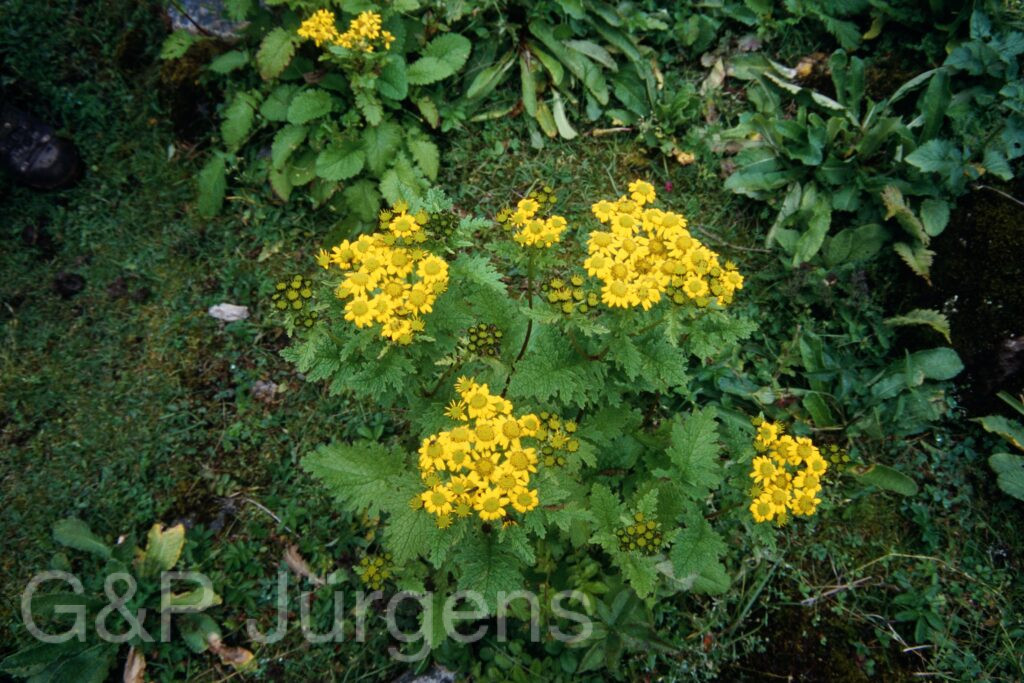
Sikkim2003 444 G617
Sikkim Chopta Valley 3900m August
Nepal 95 130 P222 ergebnis
Nepal south of Rupien La 3600m October
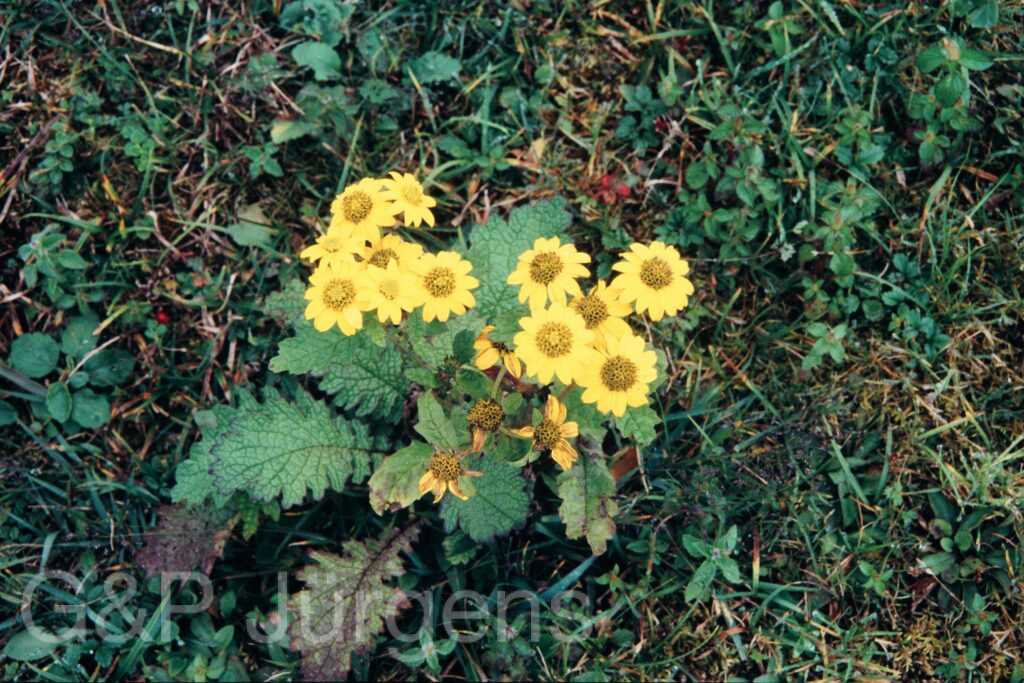
Bhutan2015 379
Bhutan Tumching-La 4000m, October

Description

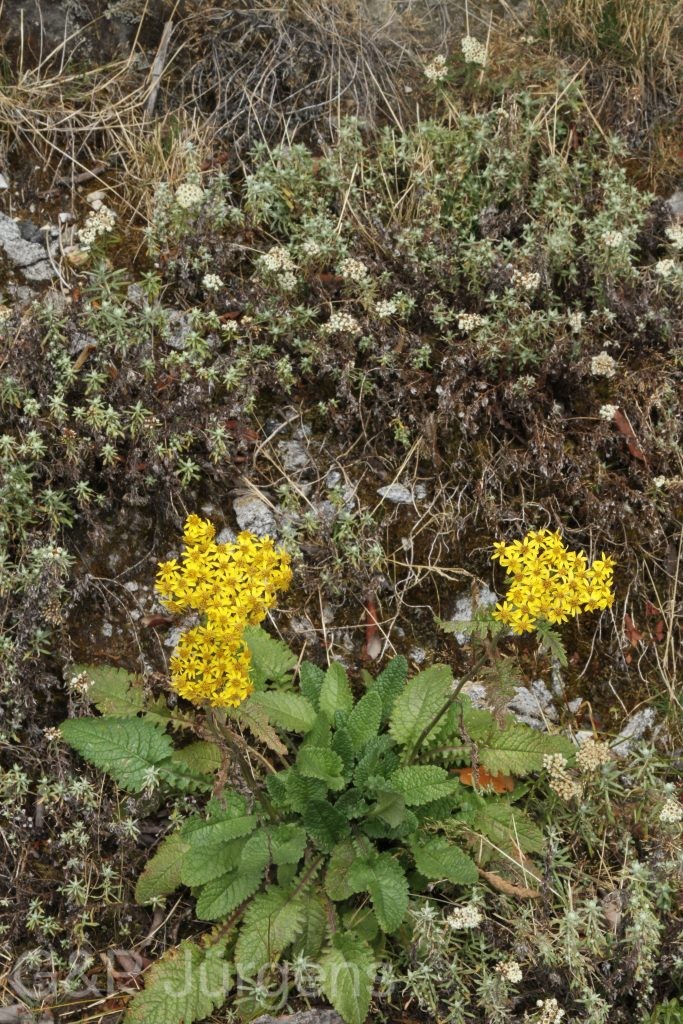
Jacobaea raphanifolia is a perennial herb of the high Himalaya and adjoining mountains of central Asia, recorded by GBIF (some 202 occurrences) from Nepal, India, China, Bhutan, Afghanistan, Pakistan and Myanmar, with scattered records reaching Kenya and South Africa that probably reflect cultivated or naturalised material. It is a plant of the upper subalpine and alpine zones, favouring moist meadows, streamsides, open scrub and damp rocky slopes. The species was photographed across a broad altitudinal band, in the Chopta Valley of Sikkim at about 3900 m in August, south of the Rupien La in Nepal at 3600 m in October, and on the Tumching La in Bhutan near 4000 m, a range centred between roughly 3500 and 4200 m.

It forms an erect, somewhat stout herb arising from a short, fibrous-rooted rhizome, with simple or branched leafy stems. The lower leaves are lyrate-pinnatifid to runcinate with a large terminal lobe, recalling a radish (raphanifolia), the margins toothed and the surfaces sparsely hairy; cauline leaves become smaller, sessile and often auriculate upwards. The capitula are radiate, several to many in a loose terminal corymb, subtended by a single row of narrow green phyllaries with a few short calyculate bracts. Ray florets are yellow, female and ligulate; the disc florets yellow, tubular and bisexual. The fruit is a ribbed, cylindrical cypsela crowned by a pappus of fine white capillary bristles.

The species belongs to a complex of montane ragworts segregated from Senecio into Jacobaea on molecular and morphological grounds. As a wide-ranging meadow herb of the alpine pastures it is locally common and of no conservation concern, though like many Senecioneae it contains pyrrolizidine alkaloids and is generally avoided by grazing stock, a trait that may favour its persistence in heavily pastured high valleys.

Author: (Wall. ex DC.) B.Nord. · Sources: POWO (Kew), GBIF, Flora of Bhutan, Flora of China, Annotated Checklist of the Flowering Plants of Nepal, Nordenstam's revision of Jacobaea and the Senecioneae

Sam.

Sikkim2011 378
Sikkim Lada-La 3400, June

Description

Juncus cephalostigma is a Himalayan rush distributed from Nepal through Sikkim and adjacent India to Bhutan, northern Myanmar and south-western China, with about 139 GBIF records reflecting a restricted eastern Himalayan to Sino-Himalayan range. It is a plant of wet alpine and subalpine habitats: marshy meadows, streamsides, seepage slopes, springs and the margins of pools, generally between about 3,000 and 4,200 m. The plant photographed at Lada-La in Sikkim at 3,400 m, flowering in June, is typical of the cool, perennially moist high-montane grasslands and mires where rushes of this group thrive.

The plant is a tufted perennial herb growing from a short rhizome, with slender, erect, terete to compressed stems. The leaves are basal and cauline, grass-like, with the characteristic open or closed tubular sheaths of the genus. The inflorescence is a small terminal or pseudolateral cluster of few flowers, often condensed into a head (the epithet cephalostigma alluding to the head-like stigmatic arrangement); each flower has six small, scarious-margined, brownish to greenish tepals, six (or three) stamens, and a superior ovary crowned by a style with three stigmas. The fruit is a small loculicidal capsule containing numerous minute seeds.

Juncus is the largest genus of Juncaceae, a wind-pollinated family of cosmopolitan, mostly cool-climate and wetland graminoid herbs. The Himalayan rushes form a taxonomically demanding assemblage in which species are separated by fine characters of the inflorescence, capsule and seed. As an inhabitant of high-altitude wetlands, J. cephalostigma is sensitive to hydrological change and grazing, though it is not currently regarded as threatened.

Author: Sam. · Sources: POWO (Kew), Flora of China Vol. 24, Flora of Bhutan Vol. 3, GBIF, Kirschner: Juncaceae (Species Plantarum: Flora of the World)

D.Don

Sikkim2011 200
Sikkim Yumthang 3300m, June

Description

Juncus concinnus is a tufted, grass-like perennial rush of the Juncaceae, distributed through the Himalaya and the mountains of eastern Asia. GBIF data (nearly 1,000 occurrences) document a native range across China, Nepal, India, Bhutan, Pakistan, Japan, Myanmar and Thailand. The species is characteristic of moist alpine and subalpine habitats, including wet meadows, marshy ground, streamsides, seepage flushes and damp grassy slopes, generally between about 2,500 and 4,500 m. The collection from Yumthang in northern Sikkim at 3,300 m in June reflects its occurrence in the wet, snow-fed alpine meadows of the eastern Himalaya in early summer.

The plant forms dense tufts of slender, erect, terete to slightly compressed stems arising from a short rhizome, with narrow, channelled basal and cauline leaves. The inflorescence is a more or less compact, terminal cluster of several flower heads, each head comprising a few small, dark-coloured flowers. As in all Juncus, the perianth consists of six chaffy, lanceolate tepals (the inner and outer whorls similar), subtending three or six stamens and a superior ovary. The fruit is a small, three-valved loculicidal capsule containing numerous minute seeds, the chaffy perianth persisting around it.

Juncus is a large, cosmopolitan genus of the rush family, an assemblage of wind-pollinated, reduced-flowered monocots adapted predominantly to wet and seasonally inundated ground. As a component of alpine mire and wet-meadow vegetation, J. concinnus contributes to the structure of high-altitude wetland turf and stabilises moist soils. Widely distributed and secure across its range, it nonetheless depends on intact alpine hydrology, making it sensitive to wetland drainage and to changes in snowmelt regimes.

Author: D.Don · Sources: POWO (Kew), Flora of China Vol. 24, Flora of Bhutan Vol. 3, GBIF, Kirschner et al.: Juncaceae – Species Plantarum: Flora of the World