Tag:

Sikkim

Flowers of Sikkim — 350 species from the Sikkim Himalaya in northeast India, a compact yet botanically extraordinary region that climbs from subtropical valleys to the alpine zone beneath Kangchenjunga. Sikkim is a classic centre of Himalayan plant diversity, celebrated for its rhododendrons, primulas, orchids and gentians. Each entry provides a botanical description, distribution, habitat and flowering season with the original field photograph.

Fisch. & C.A.Mey.

Sikkim2011 92
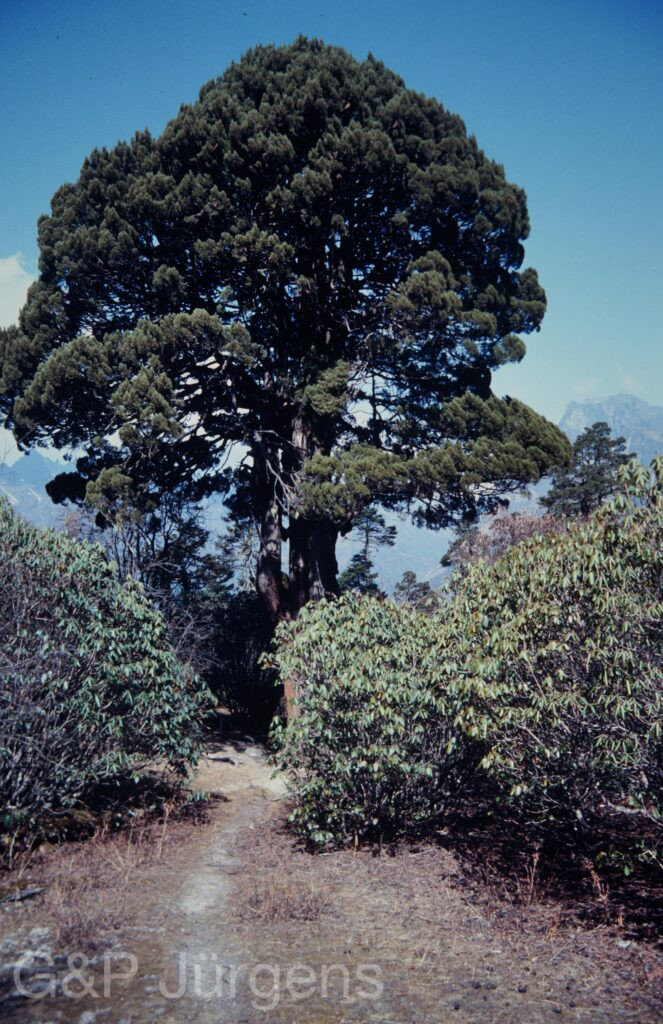
Sikkim Chopta-valley 4300m, June
Nepal1992 120 P170 ergebnis
Nepal Ghunsa 3400m March

Description

Juniperus pseudosabina is a coniferous shrub of the high mountains of Central Asia and the Himalaya, with GBIF documenting around 1678 occurrences across Russia, Kazakhstan, China, Uzbekistan, Mongolia, Kyrgyzstan, Pakistan, Tajikistan, India, Nepal, Afghanistan and Bhutan. It is a constituent of the upper subalpine and alpine zones, forming krummholz and prostrate thickets on stony slopes, rocky ridges, moraines and at the timberline. The photographed plants were recorded in Sikkim's Chopta valley at 4300 m in June and at Ghunsa in Nepal at 3400 m in March, illustrating its occupation of cold, exposed high-montane sites near and above the tree limit.

It is typically a low, spreading, mat-forming or procumbent shrub, occasionally a small tree, with reddish-brown shredding bark. The foliage is mostly squamiform (scale-like), with small, closely appressed, rhombic leaves bearing a conspicuous dorsal resin gland; needle-like juvenile leaves may persist on vigorous shoots. The species is usually dioecious; the pollen cones are small and terminal, while the seed cones are berry-like galbuli that ripen blue-black to purplish-black, are glaucous, and characteristically contain a single large seed.

GBIF accepts the name. Belonging to section Sabina, the multi-seeded and single-seeded savin junipers, J. pseudosabina is closely allied to several Himalayan and Central Asian junipers with which it has been taxonomically confused. Its galbuli are dispersed by birds, and the dwarfed, wind-pruned habit reflects adaptation to severe alpine exposure. Wide-ranging and locally abundant, it is assessed as of least concern.

Author: Fisch. & C.A.Mey. · Sources: POWO (Kew), GBIF, Flora of China, Flora of Nepal, Farjon monograph of Juniperus
(Royle ex Benth.) Rupr.

Sikkim2003 197 P275
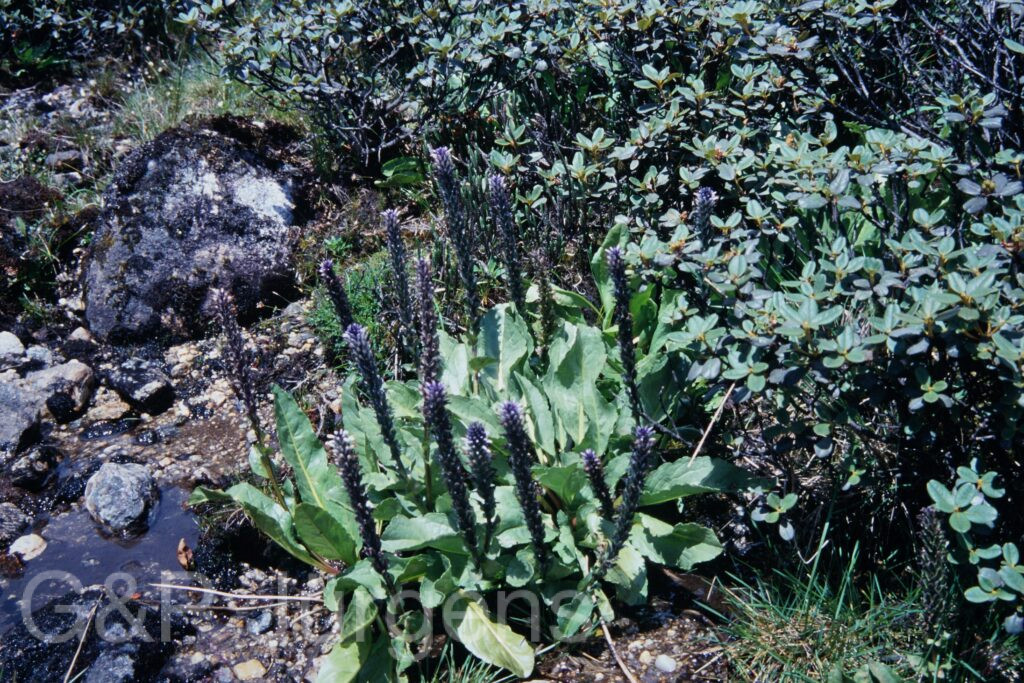
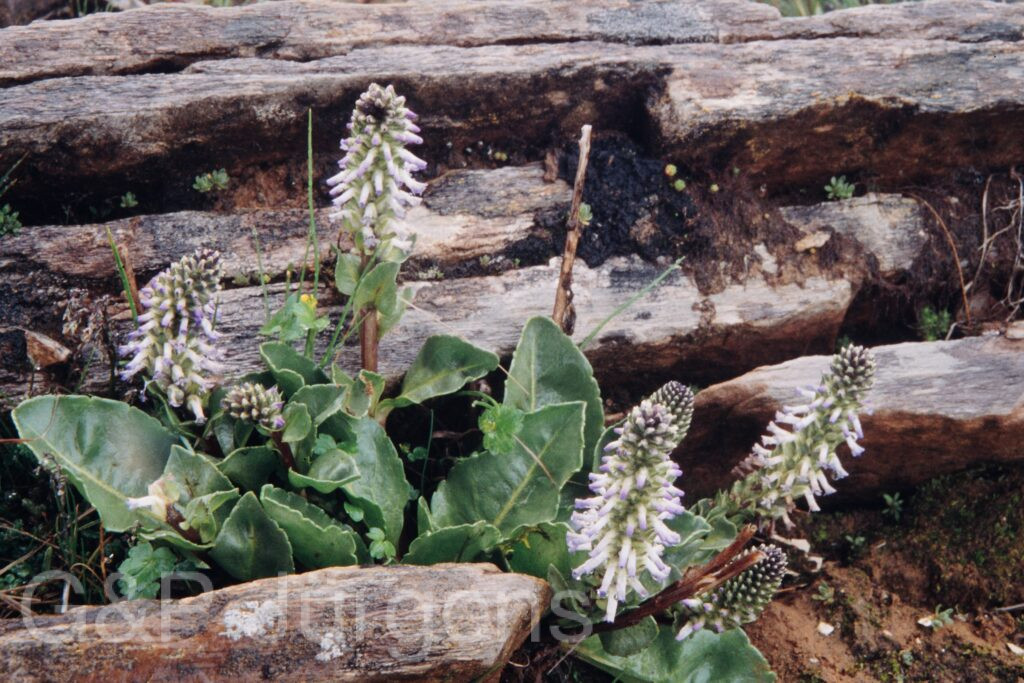
Sikkim Dzongri 4100m 08.2003
Nepal 99 650 ergebnis
West-Nepal Kagmara-La 5000m, July
Nepal 99 648 ergebnis
West-Nepal Kagmara-La 5000m, July
Nepal 99 662 ergebnis
West-Nepal Kagmara-La 5000m, July

Description

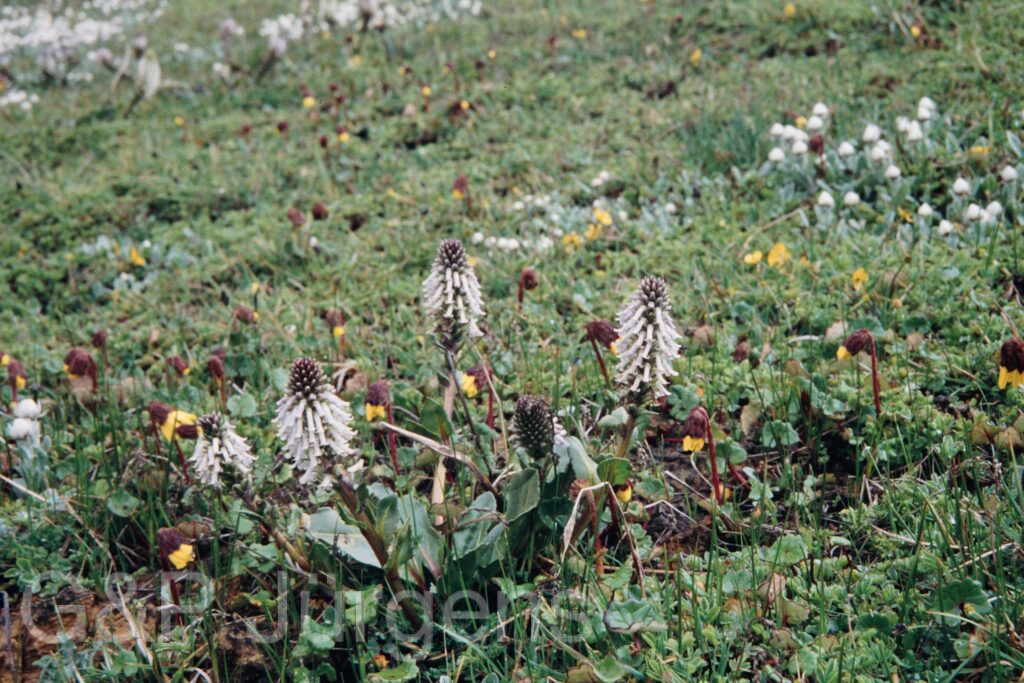
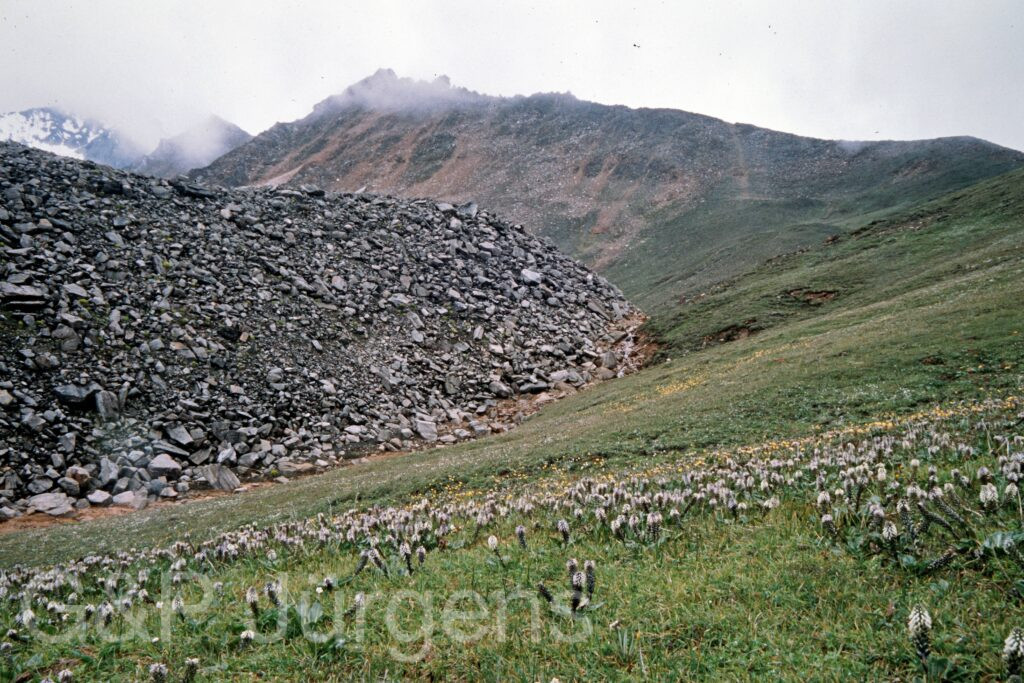
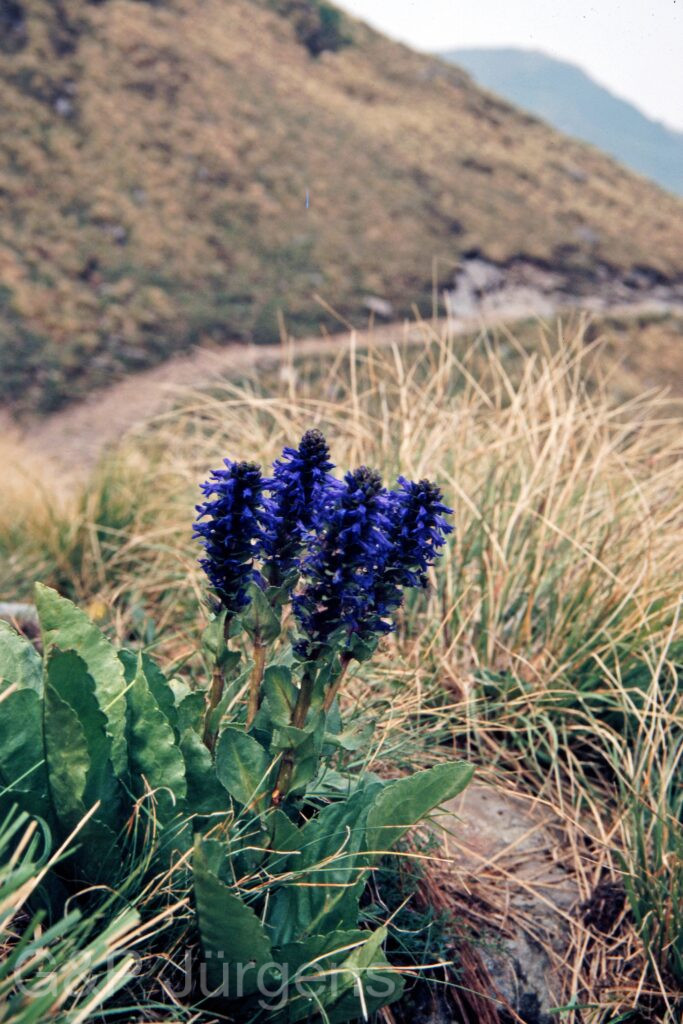
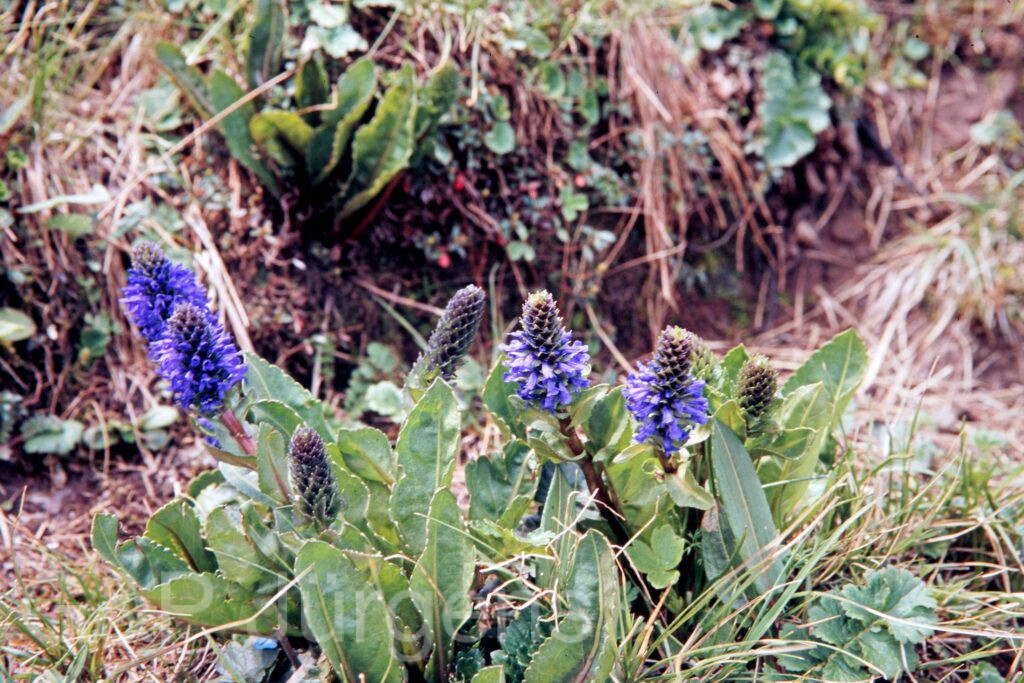
Lagotis kunawurensis is a low alpine herb of the high Himalaya, recorded by GBIF (about 116 occurrences) from Nepal, India, Pakistan and Bhutan, tracing the alpine belt from the western to the eastern part of the range. It is a plant of cold, open, high-elevation ground: short turf, stony slopes, moist alpine meadows, moraines and snow-flush margins, typically from 3500 m to well above 5000 m. The collections cited for the image span this full amplitude, from Dzongri in Sikkim at about 4100 m, to Kinkhola in Garhwal at 3550 m in June, up to the Kagmara-La in West Nepal at around 5000 m in July, the last representing one of the highest zones colonised by flowering plants in the region.

It is a small, fleshy, glabrous perennial arising from a stout rhizome or caudex with thickened roots. The leaves are mostly basal, long-petiolate, with ovate to oblong, somewhat succulent blades that are entire or shallowly crenate-toothed. The flowering stems are short and stout, the inflorescence a dense terminal spike or head of small bracteate flowers. The corolla is two-lipped (bilabiate), blue to violet or purplish, with the upper lip entire or notched and a lower lip of one to three lobes; there are typically two stamens. The fruit is a small drupe-like or two-seeded structure rather than the dry dehiscent capsule of many relatives, a feature distinctive of the genus.

Lagotis, with its concentration of species across the high mountains of Central Asia, the Himalaya and the Tibetan plateau, is now placed in Plantaginaceae following the molecular dismantling of the old Scrophulariaceae. The cushion-like, fleshy habit, short stature and early flowering are classic adaptations to the brief, cold, wind-exposed alpine growing season. Several Lagotis species are used in Tibetan and Himalayan ethnomedicine. As a widespread high-elevation specialist L. kunawurensis is not of conservation concern, though such strictly alpine taxa are intrinsically vulnerable to the upslope compression of habitat under climate warming.

Author: (Royle ex Benth.) Rupr. · Sources: POWO (Kew), GBIF, Flora of China Vol. 18, Flora of Pakistan, Flora of Nepal, Hong Monograph of the Subtribe Lagotidinae (Scrophulariaceae)

Hook.f.

Bhutan2014 610
Bhutan Phobjika 2810, May
Bh2008 266 P418
Bhutan Tumchinching-La 3760m, April

Description

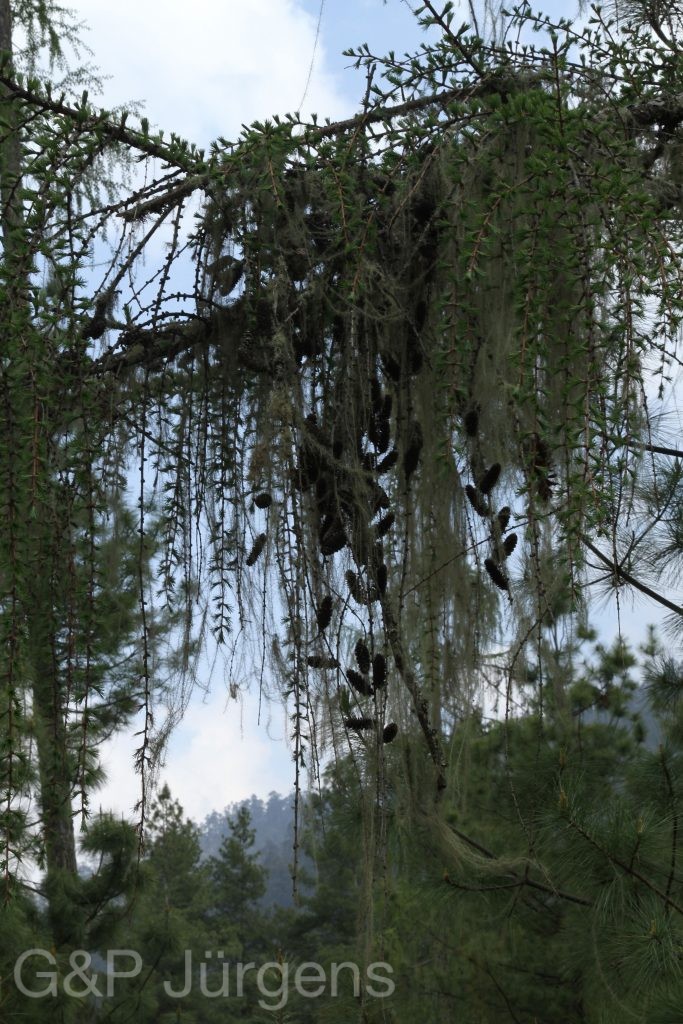
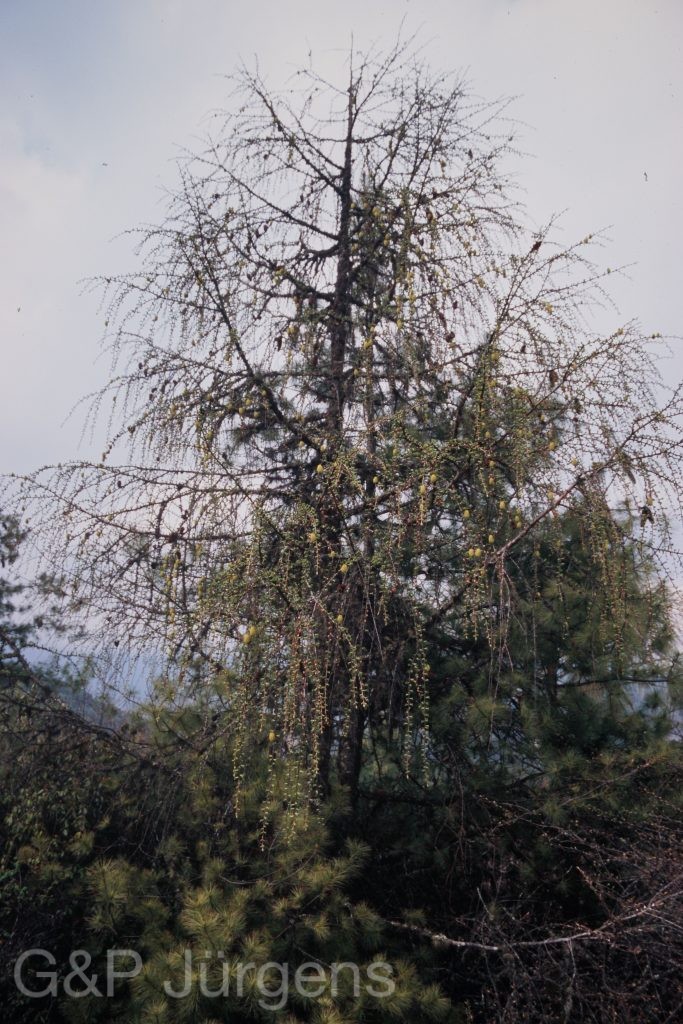
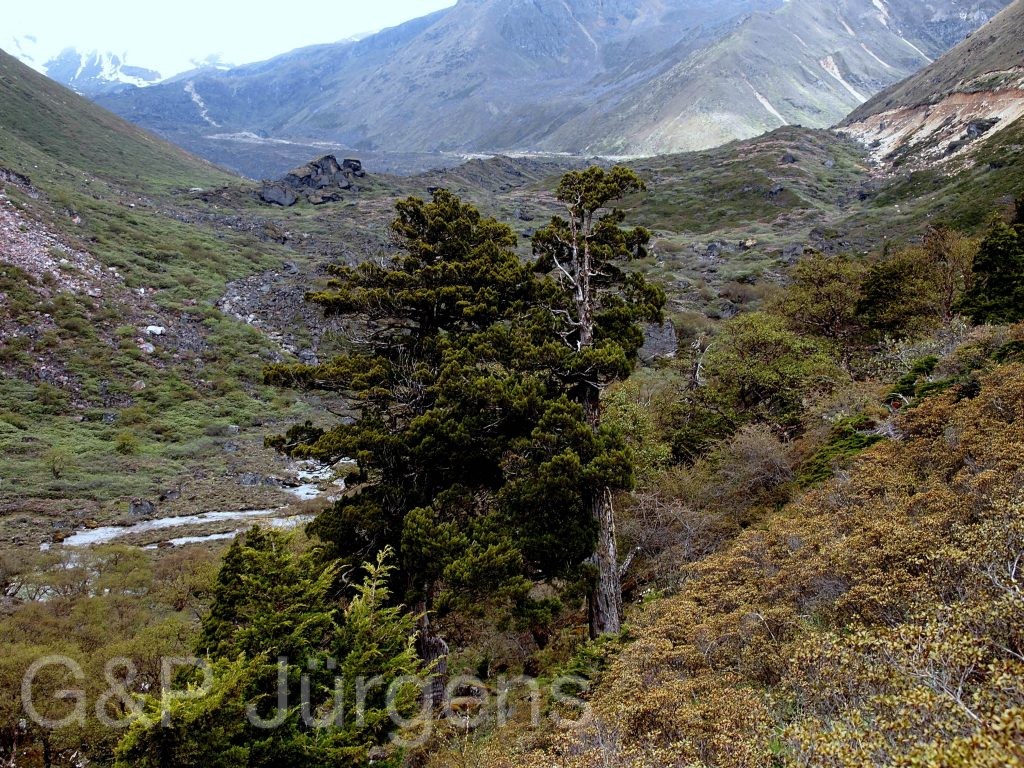
Larix griffithii, the Sikkim or Himalayan larch, is a deciduous conifer of the eastern Himalaya, native to China (Xizang), Bhutan, India (Sikkim) and Nepal; GBIF lists 525 occurrences, including many cultivated specimens in temperate arboreta abroad. In the wild it forms open montane to subalpine forests, often near the treeline on rocky slopes and moraines, generally between about 2800 and 4100 m. The trees illustrated were photographed in Bhutan at Phobjika (2810 m) in May and at the Tumchinching-La pass (3760 m) in April, the latter near its upper altitudinal limit.

It is a medium-sized deciduous tree with a conical crown and long, often pendulous branchlets. The soft, needle-like leaves are borne singly on long shoots and in dense rosette-like clusters on short, knob-like spur shoots; they are bright green, flushing in spring and turning golden-yellow before falling in autumn, an unusual habit among Himalayan conifers. The pendulous seed cones are oblong-cylindrical with conspicuous, exserted, often reflexed bracts that exceed the seed scales, a key diagnostic character; the winged seeds are wind-dispersed when the cones open.

Larix griffithii belongs to Pinaceae and is the principal larch of the eastern Himalaya, characteristically associated with Abies, Picea and rhododendron scrub at the upper forest limit. Its long-exserted cone bracts readily distinguish it from other larches. The wood is used locally for timber and fuel, and the tree's graceful weeping form has led to its cultivation in temperate collections, accounting for the wide scatter of records. Restricted in natural range but locally frequent, it faces pressure from logging, fire and grazing in the fragile treeline ecotone.

Author: Hook.f. · Sources: POWO (Kew), GBIF, Flora of China, Flora of Bhutan, Conifers of the World, Farjon A Handbook of the World's Conifers

Gand.

Sikkim2003 428 P595
Sikkim Chopta Valley 4100m August
Garw 2005 158 ergebnis
India Garhwal valley of flowers 3550m, October

Description

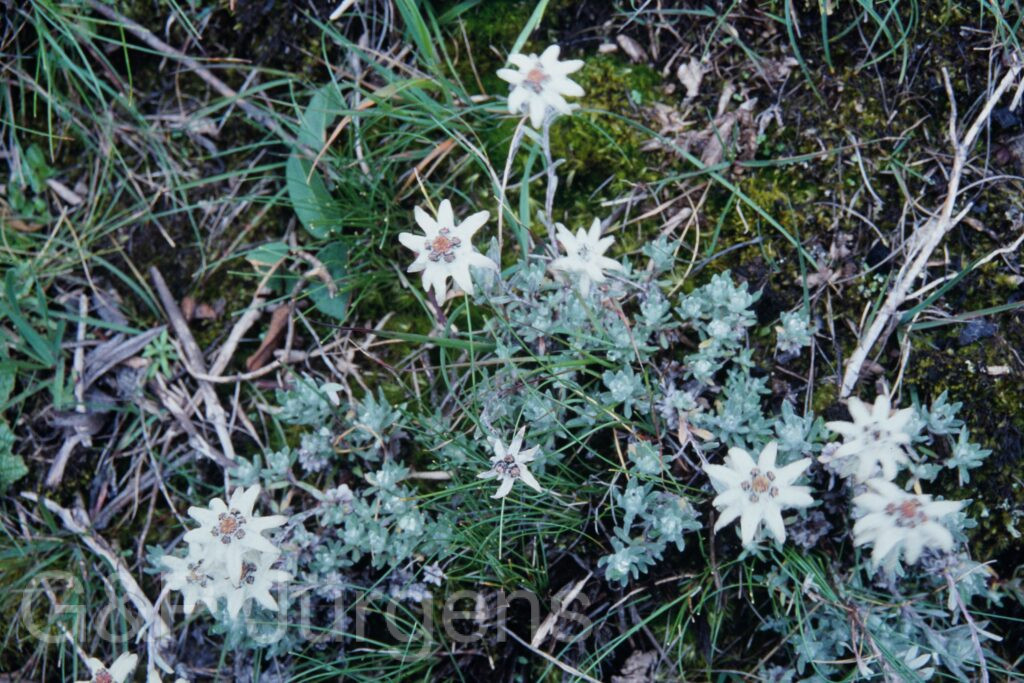
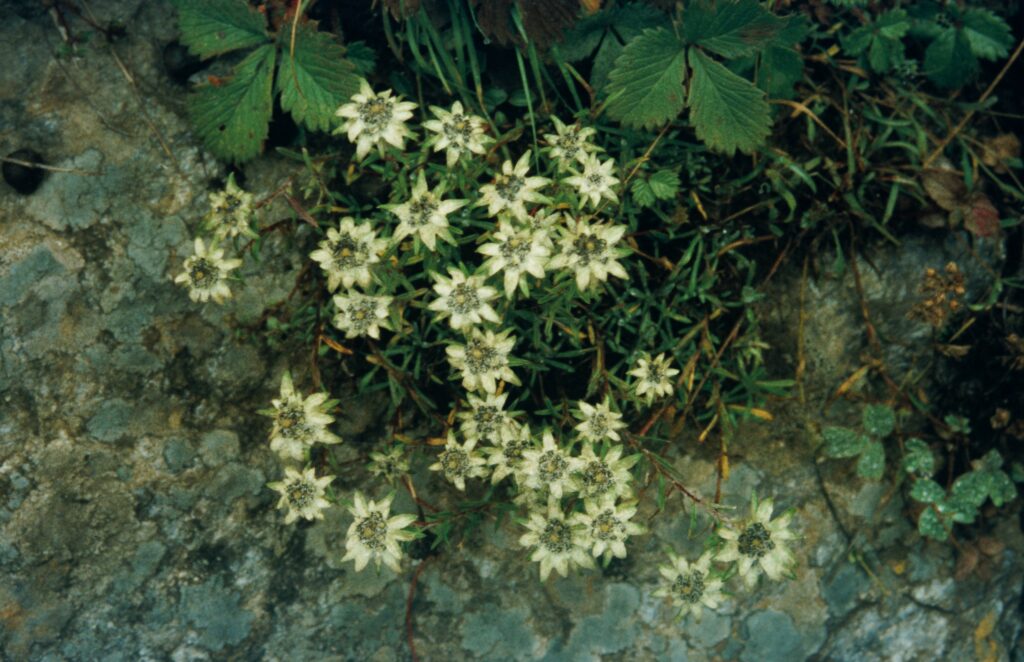
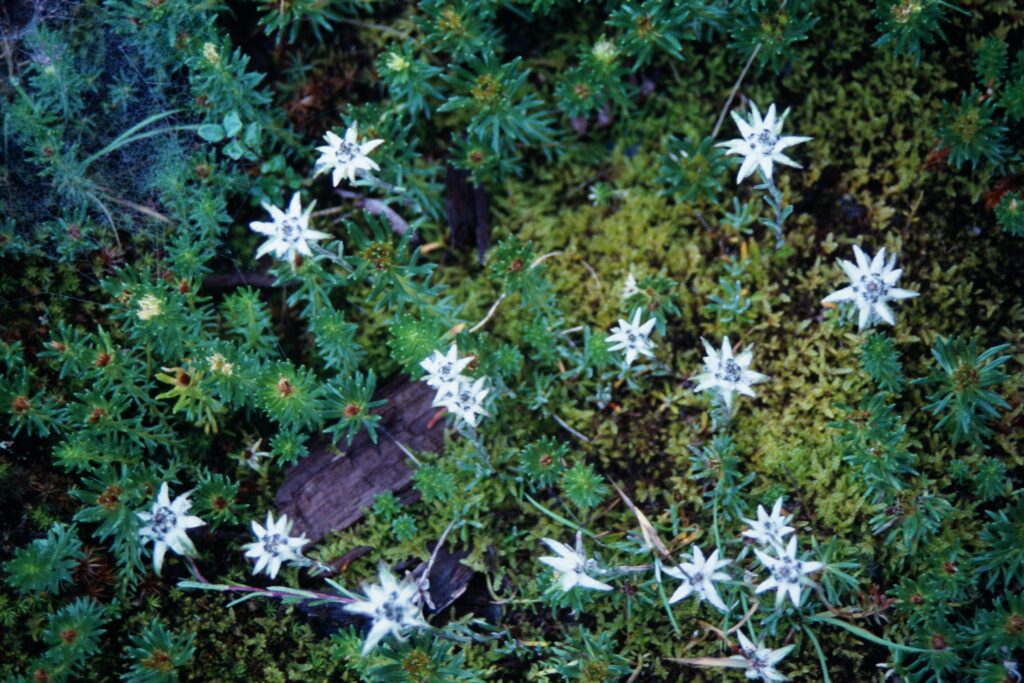
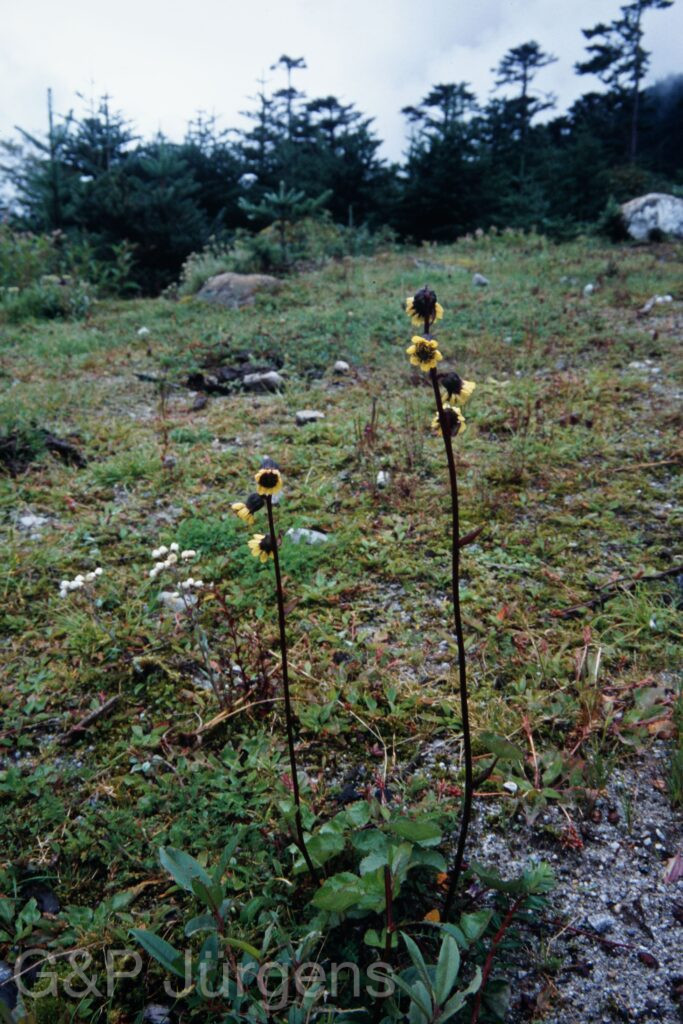
Leontopodium brachyactis is a high-alpine edelweiss of the Sino-Himalayan and Central Asian uplands, recorded from India, Pakistan, Nepal and China, with scattered occurrences extending west into Kyrgyzstan, Tajikistan, Afghanistan and Russia; the c. 92 georeferenced collections trace a distribution centred on the inner Himalaya and Tibetan margins. It inhabits open alpine turf, stony slopes, moraines and grazed meadows above the treeline, typically between 3500 and 4500 m. The species was photographed in the Sikkim Chopta Valley at 4100 m in August and in the Garhwal Valley of Flowers at 3550 m in October, sites representative of its preference for cold, well-drained, seasonally snow-covered ground.

It is a low, tufted, woolly perennial herb arising from a branched woody caudex, the stems erect to ascending and densely white-lanate. The leaves are linear to oblanceolate, entire, grey-green above and clothed beneath in a felt of appressed hairs that reflects intense montane irradiance. The capitula are small, several to many, aggregated into a dense terminal glomerule and subtended by a stellate ruff of leaf-like, densely tomentose floral bracts forming the characteristic edelweiss "star." The heads are heterogamous and disciform, with whitish corollas; the fruit is a small ribbed cypsela bearing a pappus of barbellate bristles.

The genus Leontopodium (tribe Gnaphalieae) is taxonomically intricate, its species delimited by indumentum, bract arrangement and capitulum structure, and L. brachyactis belongs to the compact-headed Himalayan element. Its dense white tomentum is a classic adaptation to alpine cold, desiccating winds and ultraviolet exposure. Though locally frequent across a wide range and not presently considered threatened, populations in accessible valleys face pressure from heavy summer grazing and increasing tourism in the Himalayan flower meadows.

Author: Gand. · Sources: POWO (Kew), GBIF, Flora of China, Flowers of the Himalaya (Polunin & Stainton), Handel-Mazzetti revision of Leontopodium

(Cass.) Greuter

Sikkim2003 325 P462 ergebnis
Sikkim Samiti lake 4000m, July

Description

Leontopodium nivale subsp. alpinum, the classic alpine edelweiss, is a high-mountain perennial of the Asteraceae with a remarkably broad circum-montane distribution. GBIF records (over 20,000 occurrences) document its core European range across the Alps and Carpathians (France, Switzerland, Italy, Austria, Germany, Slovenia, Poland, Romania, Slovakia, Spain, Croatia) extending eastward into Ukraine and disjunctly to the Sino-Himalayan region (China, India). It is a calcicole of stony alpine meadows, rocky ledges and screes, typically between 1,700 and 4,000 m. The Himalayan population photographed at Samiti Lake in Sikkim at 4,000 m in July illustrates the upper elevational reach of the species complex in seasonally snow-fed alpine turf.

The plant forms compact tufts from a woody caudex, with erect unbranched stems 5–20 cm tall arising from basal leaf rosettes. Leaves are lanceolate to oblong, grey-green and densely white-tomentose on both surfaces, the indumentum of interwoven hairs reducing transpiration and reflecting intense UV radiation. The conspicuous "flower" is in fact a pseudanthium: several small yellowish-white capitula are surrounded by a stellate arrangement of densely woolly, snow-white bracts forming the characteristic star. Each capitulum contains tubular florets, with marginal female and central functionally male florets; the achenes are small and bear a pappus of barbellate bristles.

The Leontopodium nivale complex is taxonomically intricate, with subsp. alpinum often treated as the type European edelweiss and frequently confused with Himalayan congeners such as L. himalayanum. A celebrated symbol of alpine flora, it is legally protected in several European countries against collection, and its woolly indumentum is a textbook example of adaptation to cold, high-irradiance environments.

Author: (Cass.) Greuter · Sources: POWO (Kew), Flora of China Vol. 20-21, Flora Europaea Vol. 4, GBIF, Handel-Mazzetti: Monographie der Gattung Leontopodium (1928)

(C.B.Clarke) S.W.Liu

Sikkim2003 365 P512 2
Sikkim Lachen 2740m, August

Description

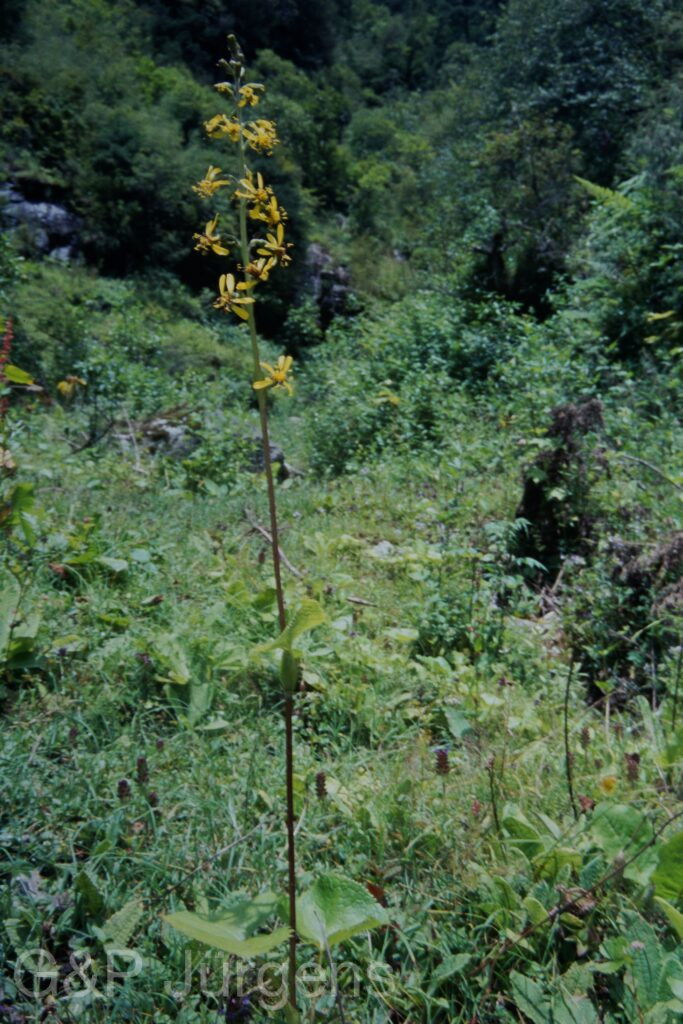
Ligularia atkinsonii is a tall herbaceous perennial of the Himalaya and adjacent China, with verified occurrences in Nepal, China, Bhutan, India and Myanmar. It favours moist, cool situations such as forest margins, streamsides, damp meadows and shrubby slopes through the temperate and subalpine zones, broadly between about 2500 and 4000 m. The plant photographed at Lachen in northern Sikkim at around 2740 m in August represents its late-summer flowering, when these golden composites are conspicuous in the monsoon-fed grasslands and clearings of the inner valleys.

The species arises from a stout rootstock bearing large, long-petioled basal leaves; these are broadly cordate to reniform, with toothed margins and a soft texture, the bases of the petioles often sheathing the stem. The flowering stem is erect, leafy below and bears a narrow elongate inflorescence (a raceme or narrow panicle) of numerous radiate capitula. Each head has an involucre of few narrow phyllaries and carries several spreading yellow ray florets around a disc of tubular florets. The fruit is a glabrous cylindrical achene topped by a pappus of fine brownish bristles aiding wind dispersal.

Ligularia, of tribe Senecioneae, is a large and taxonomically demanding genus centred on the Sino-Himalayan region, and L. atkinsonii, transferred to the genus by S.W. Liu from a C.B. Clarke basionym, is distinguished by its leaf shape and narrow inflorescence. Ecologically these robust herbs are important late-season nectar sources in subalpine meadows. The species is reasonably widespread along the Himalaya and is not currently considered to be of conservation concern, though it depends on the persistence of moist montane grassland.

Author: (C.B.Clarke) S.W.Liu · Sources: POWO (Kew), GBIF, Flora of China, Flora of Bhutan, Annotated Checklist of the Flowering Plants of Nepal

(C.B.Clarke) Hand.-Mazz.

Sikkim2003 242 G332
Sikkim Dzongri 4100m, August

Description

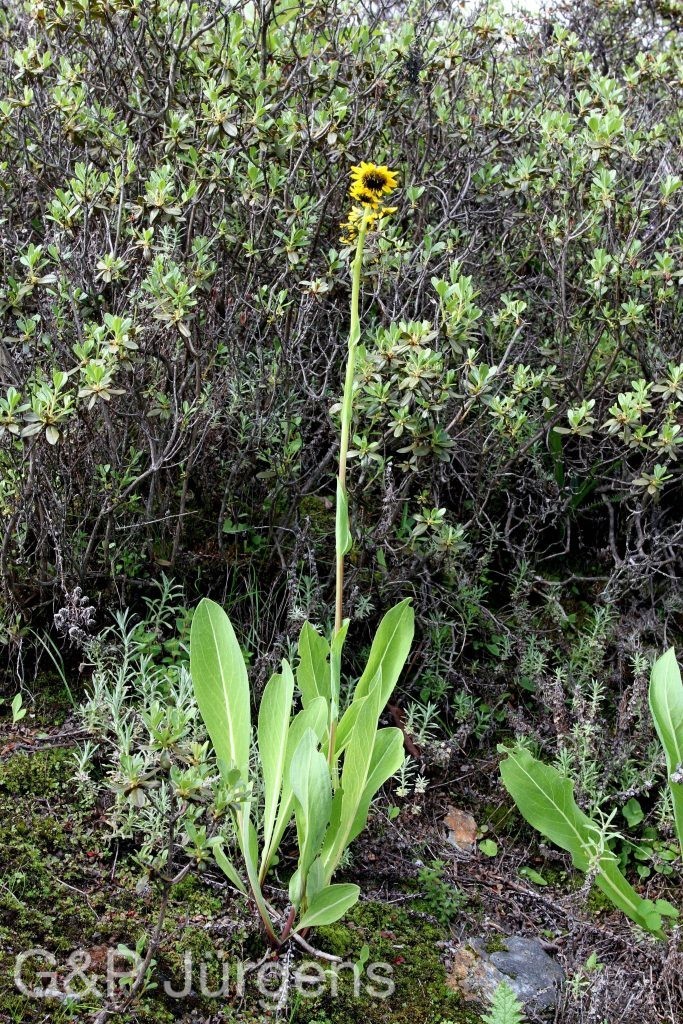
Ligularia hookeri is a robust perennial herb of the eastern Himalaya and adjacent China, recorded from China, Nepal, India, Bhutan and Myanmar, with around 574 georeferenced records spanning the subalpine and alpine zones. It inhabits alpine meadows, open grassy slopes, forest margins and damp, rocky ground, often in seepage areas and along streams. The plant photographed at Dzongri in Sikkim at 4100 m, flowering in August, is characteristic of its high-elevation summer habitat, where it flowers at the height of the monsoon among other tall meadow herbs.

It arises from a stout rootstock and produces a cluster of large basal leaves on long, sometimes purplish petioles; the blades are broadly reniform to orbicular-cordate, palmately veined and toothed at the margin. The flowering stem is erect and stout, bearing few to several large capitula in a lax raceme or corymb. Each head has an involucre of broad bracts and is radiate, with conspicuous yellow to orange-yellow ligulate ray florets surrounding numerous tubular yellow disc florets. The fruit is a glabrous cylindrical cypsela crowned by a pappus of fine bristles.

Ligularia, of tribe Senecioneae, is distinguished from related Senecio and Cremanthodium by its radiate, erect, large-headed inflorescences and broad cordate leaves; C. B. Clarke first described this taxon, later combined in Ligularia by Handel-Mazzetti. The showy heads are pollinated by bumblebees, butterflies and flies of the high meadows, and the pappose cypselae are wind-dispersed. The species is widespread across the eastern Himalaya and of no current conservation concern, though it forms a conspicuous and ecologically important element of alpine pastures.

Author: (C.B.Clarke) Hand.-Mazz. · Sources: POWO (Kew), GBIF, Flora of China, Flora of Bhutan, Annotated Checklist of the Flowering Plants of Nepal, Liu monograph of Ligularia

DC.

Sikkim2003 446 P619
Sikkim Chopta-Valley 4250m, August

Description

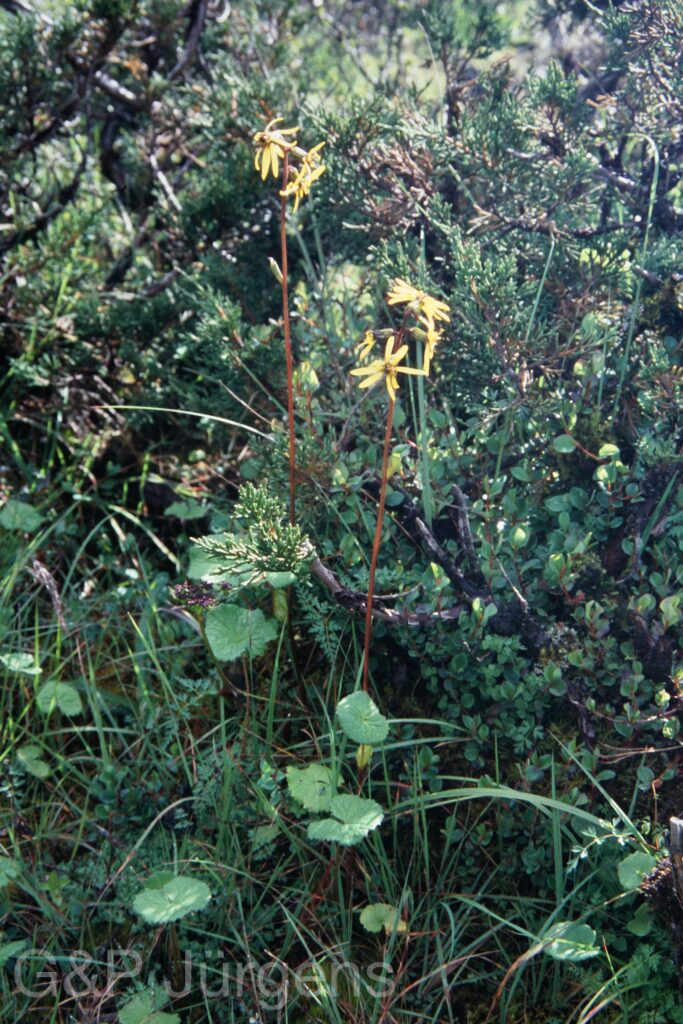
Ligularia retusa is a robust perennial composite of the alpine zone of the eastern Himalaya and adjacent China, native to China, Nepal, Bhutan and India, with about 201 documented occurrences. It grows in moist alpine meadows, streamsides, marshy turf and damp open slopes, typically between about 3500 and 4500 m. The photographed plant was recorded in the Chopta Valley of northern Sikkim at 4250 m, flowering in August, at the height of the monsoon when meltwater and rainfall sustain the lush herbaceous communities of the high pastures.

The species is a stout herb arising from a short rhizome with fibrous roots, producing a few large basal leaves on long petioles; the blades are reniform to broadly cordate with a retuse or shallowly notched apex (the epithet retusa) and a crenate-dentate margin, glabrous or thinly hairy. The cauline leaves are smaller and clasping. The inflorescence is a raceme or narrow corymb of several to many radiate capitula; the involucral bracts are in one or two series, and the heads bear bright yellow to orange-yellow ligulate ray florets surrounding numerous tubular disc florets. The fruit is a glabrous cylindrical cypsela crowned by a pappus of slender bristles.

Ligularia, of the tribe Senecioneae, is a large genus centred on the Sino-Himalayan mountains, distinguished from Senecio by its few-seriate involucre and habit; species delimitation in the Himalayan radiation is often difficult. As a tall meadow herb it is a conspicuous element of late-summer alpine flora and is visited by a range of insects. Widely distributed across the eastern Himalaya, it is not regarded as being of conservation concern.

Author: DC. · Sources: POWO (Kew), GBIF, Flora of Bhutan, Flora of China, The Genera Ligularia, Cremanthodium and Parasenecio (Liu)

Mattf. ex Rehder & Kobuski

BhutanPG2011 799 01 01
Bhutan 2011
Sikkim2003 537 G747
Sikkim, 08.2003

Description

Ligularia virgaurea is a robust perennial of alpine meadows and grasslands centred on the Qinghai-Tibetan Plateau and extending into the Himalaya, with native records from China, Russia, Bhutan, Nepal and India; among the 777 occurrences, the European and other extra-regional points reflect garden cultivation rather than wild range. It forms extensive colonies on moist meadows, marshy pasture, riverbanks and open slopes, typically between about 2600 and 4700 m, and can dominate overgrazed grassland as an unpalatable increaser. The material documented from Bhutan in 2011 and Sikkim in August 2003 places it in the well-watered subalpine to alpine zone of the eastern Himalaya.

The species is a clump-forming herb with a stout rootstock and erect, glabrous to thinly hairy stems. The basal leaves are long-petiolate, with elliptic to ovate-oblong, entire or denticulate blades and sheathing petiole bases; the cauline leaves are reduced and clasping. The capitula are numerous, small and radiate, borne in a dense, narrow, racemose to spike-like synflorescence. Each head has a cylindric involucre of few phyllaries, a small number of yellow ray florets and yellow tubular disc florets. The cypselae are cylindric, glabrous and ribbed, crowned by a pappus of reddish-brown to whitish barbellate bristles.

Ligularia is a large Old World genus of the Senecioneae, richly developed on the Tibetan Plateau, distinguished from the closely allied Cremanthodium by its erect, non-nodding capitula. L. virgaurea is notably variable in leaf shape and inflorescence density, and several infraspecific forms have been recognised. Its tissues contain pyrrolizidine alkaloids and other deterrents, so livestock avoid it, allowing the species to expand under heavy grazing. It is widespread and abundant and is of no conservation concern.

Author: Mattf. ex Rehder & Kobuski · Sources: POWO (Kew), GBIF, Flora of China Vol. 20-21, Flora of Bhutan, Flora of Nepal, Liu Revision of Ligularia

(DC.) Pimenov & Kljuykov

Sikkim2003 98 P135
Sikkim below Dzongri 3700m 08.2003
Sikkim2003 161 P214
Sikkim below Dzongri 3900m, August

Description

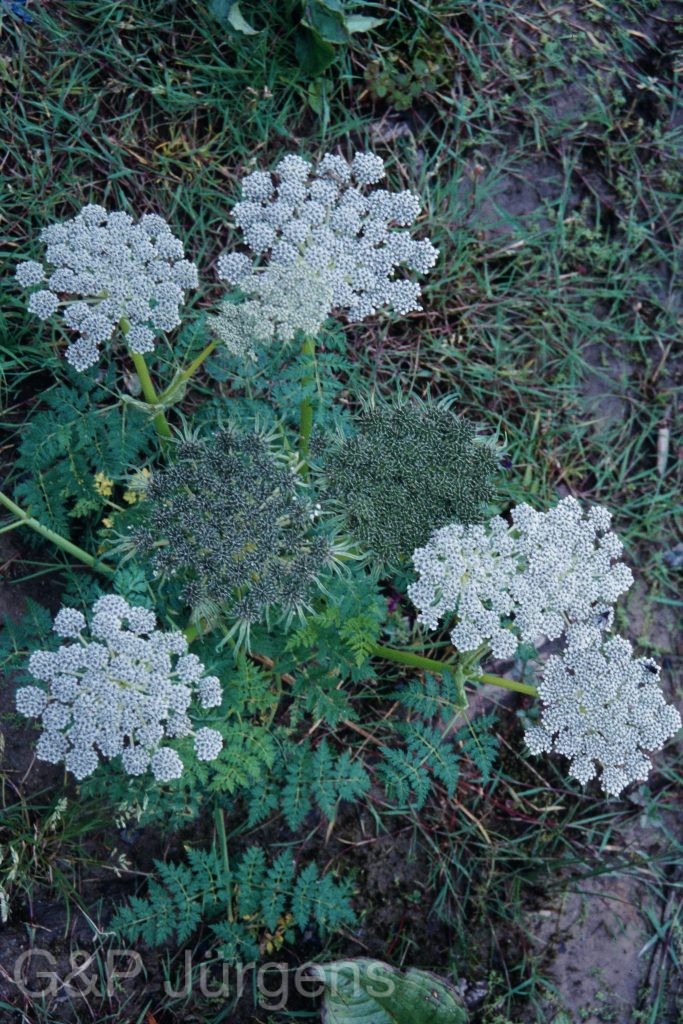
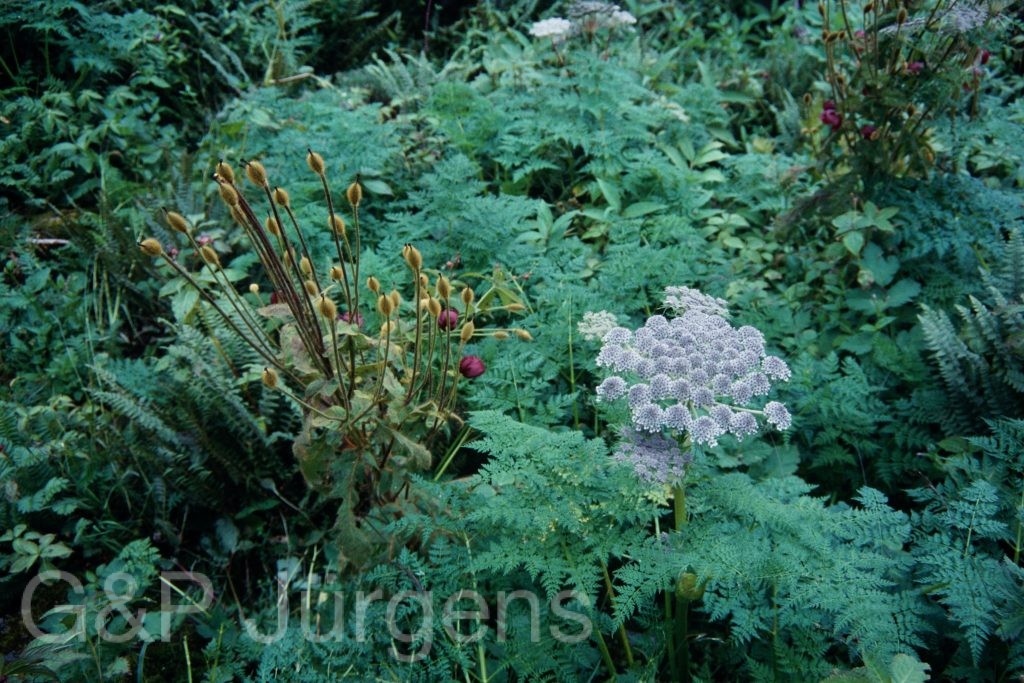
Ligusticopsis wallichiana is a Himalayan umbellifer ranging from Pakistan and northern India through Nepal, Sikkim and Bhutan into south-western China and Myanmar. The 406 GBIF records lie chiefly within this native arc, the European and North American points reflecting herbarium and garden material. It occupies subalpine and alpine meadows, forest clearings, open slopes and streamsides, generally between about 3000 and 4300 m, where it is a characteristic tall herb of moist Himalayan grassland. The plants photographed below Dzongri in Sikkim at 3700 to 3900 m in August illustrate the species at the height of the monsoon flowering season on these damp, herb-rich slopes.

It is a stout, glabrous perennial herb arising from a thick, aromatic rootstock, with erect, ribbed, often purplish stems. The leaves are large and several times pinnate (ternate-pinnate), the ultimate segments lanceolate to ovate and toothed, the lower leaves long-petiolate with sheathing bases. The inflorescence is a terminal compound umbel with numerous rays, subtended by narrow bracts and bracteoles; the small flowers are white. The fruit is an oblong-ellipsoid, dorsally compressed schizocarp with prominently winged lateral ribs, splitting into two mericarps.

Long familiar as Selinum wallichianum (its WordPress URL preserves that name), the species was transferred to Ligusticopsis by Pimenov and Kljuykov in their revision of the Selinum-Ligusticum complex, reflecting carpological and molecular evidence. The aromatic root has a history of use in Himalayan folk medicine. Common and widespread across its range, it is not considered threatened and forms a conspicuous element of high Himalayan meadow vegetation.

Author: (DC.) Pimenov & Kljuykov · Sources: POWO (Kew), GBIF, Flora of Bhutan, Flora of China, Pimenov & Kljuykov Umbelliferae revision