Tag:

Sikkim

Flowers of Sikkim — 350 species from the Sikkim Himalaya in northeast India, a compact yet botanically extraordinary region that climbs from subtropical valleys to the alpine zone beneath Kangchenjunga. Sikkim is a classic centre of Himalayan plant diversity, celebrated for its rhododendrons, primulas, orchids and gentians. Each entry provides a botanical description, distribution, habitat and flowering season with the original field photograph.

C.B.Clarke

Sikkim2003 430 P597
Sikkim below Dzongri 4000m 08.2003
Sikkim2003 430 P597
Sikkim below Dzongri 4000m 08.2003
Sikkim2003 504 P704
Sikkim below Dzongri 4000m 08.2003

Description

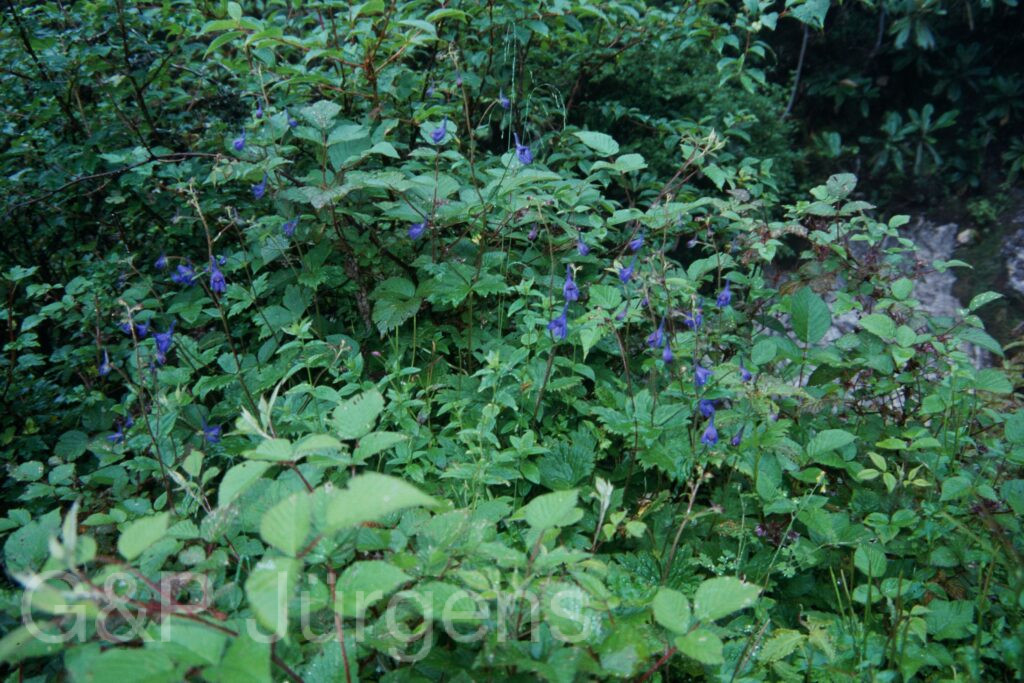
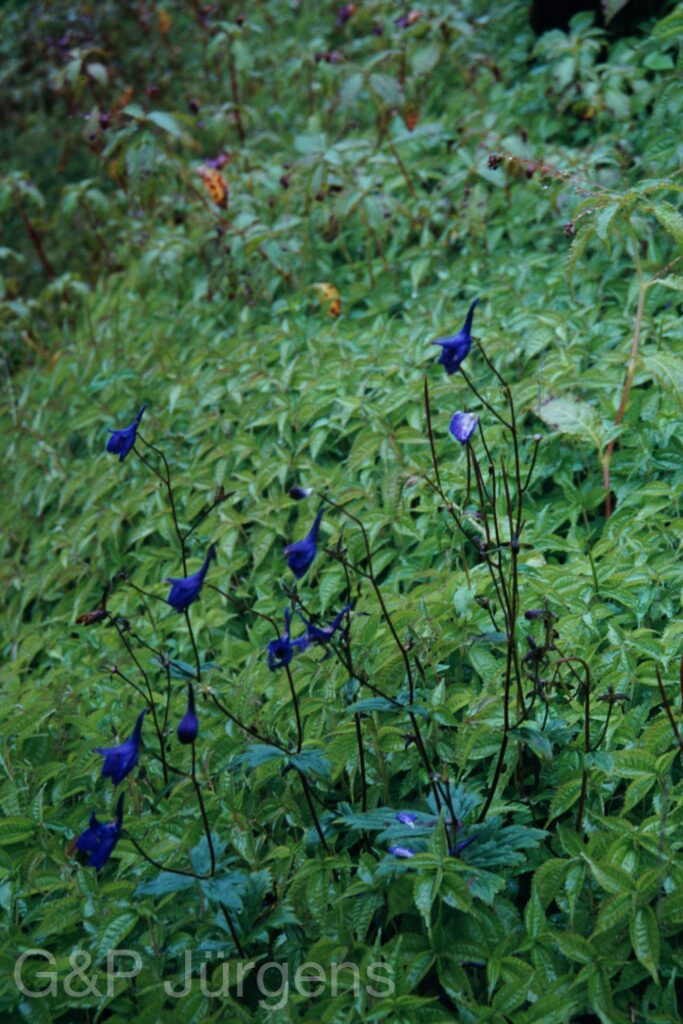
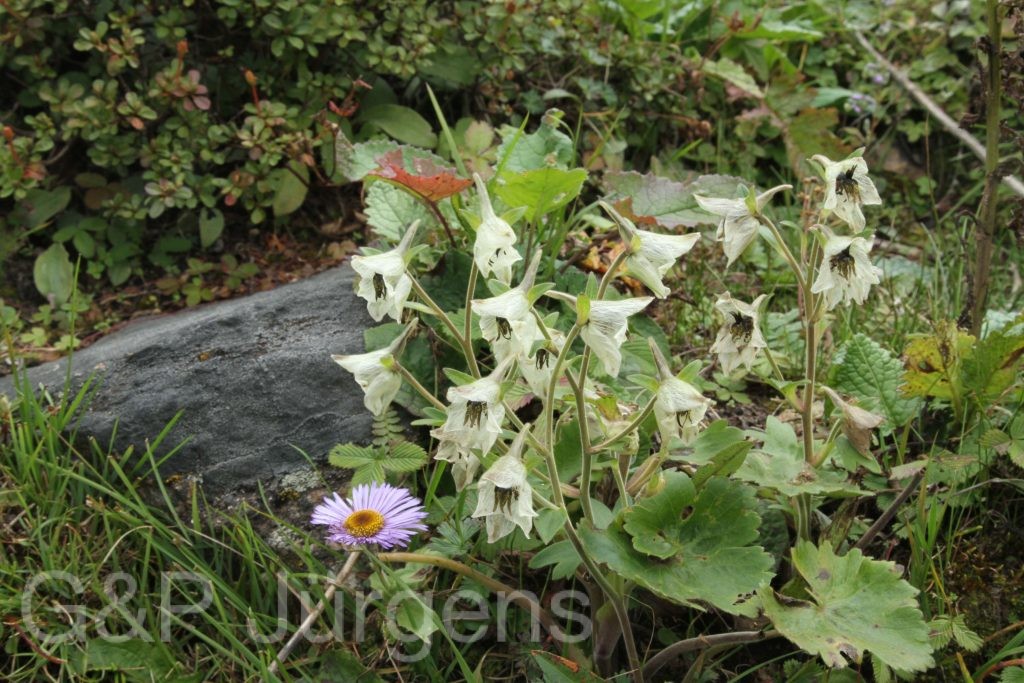
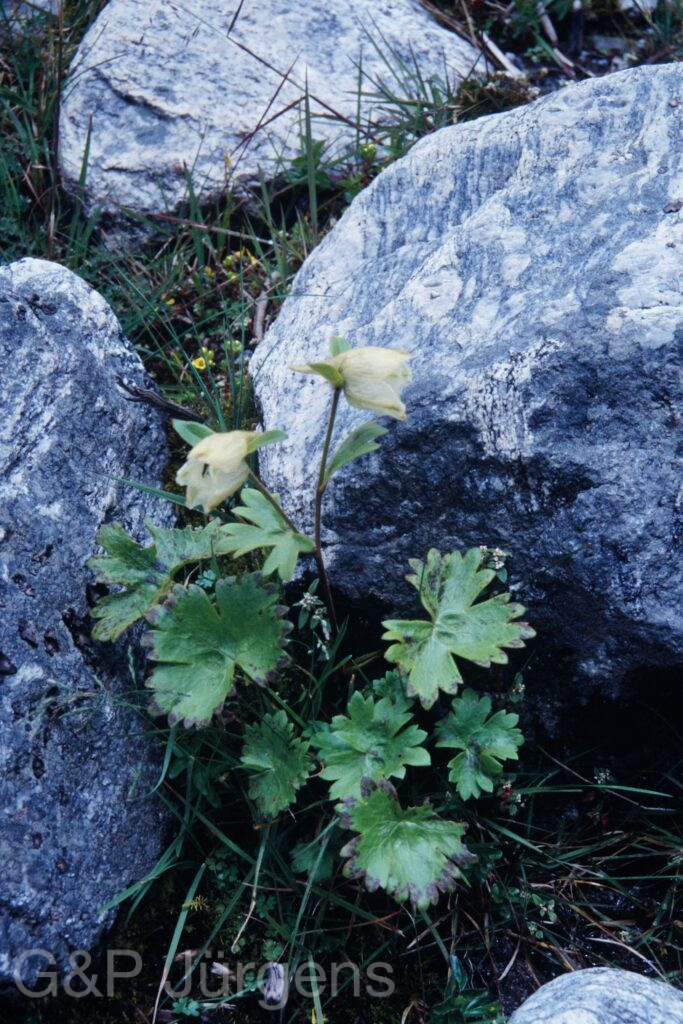
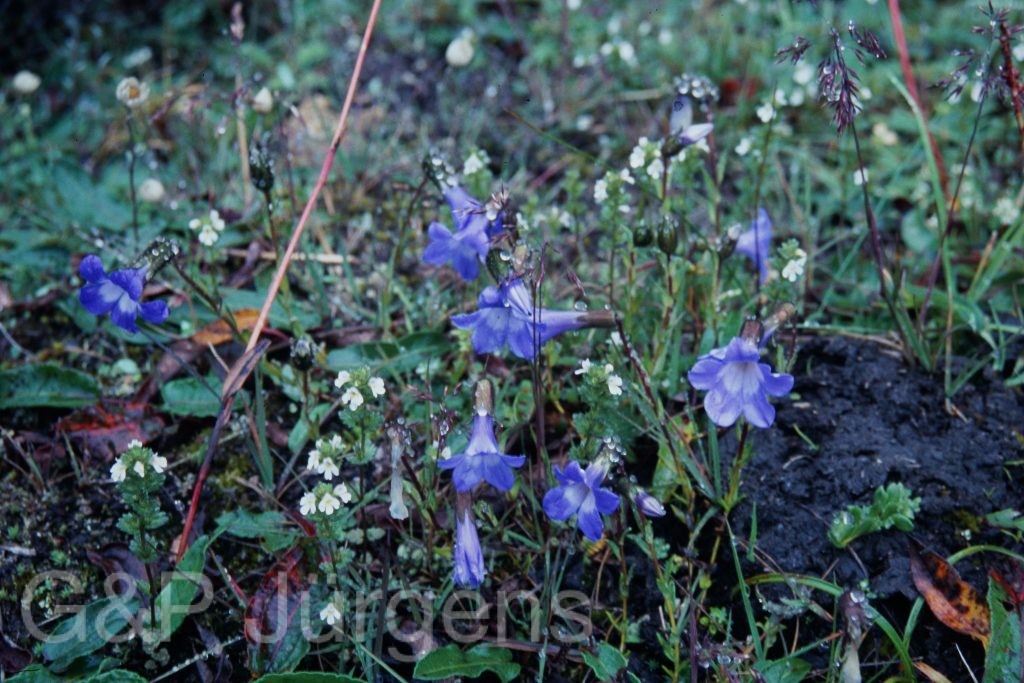
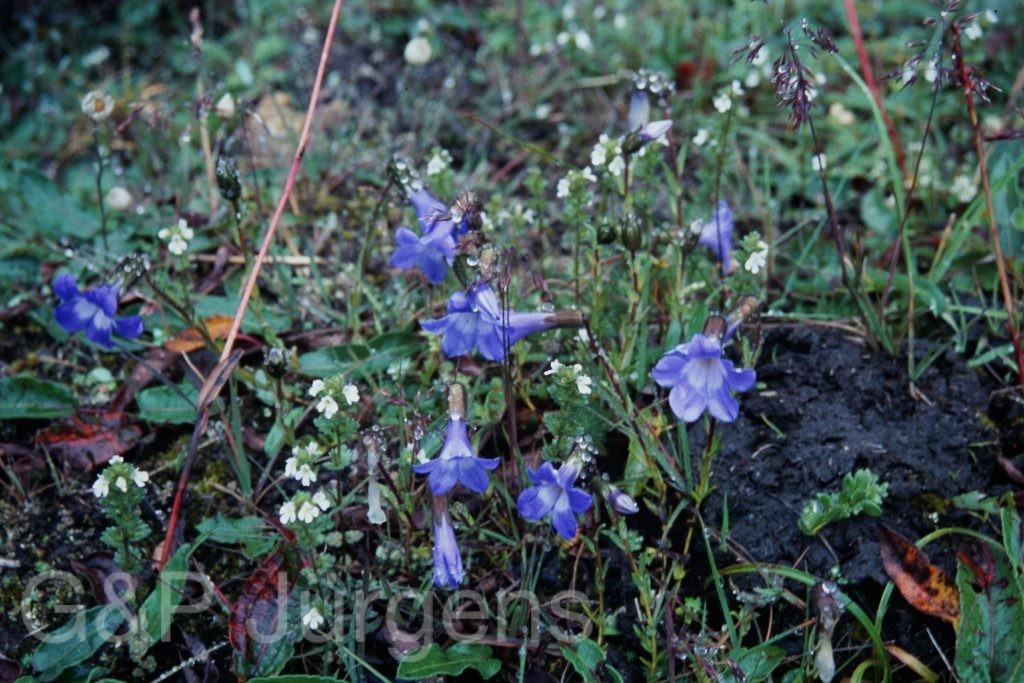
Cyananthus pedunculatus C.B.Clarke is an eastern Himalayan alpine herb confined to the high mountains of Nepal, India (Sikkim, Darjeeling), Bhutan and adjacent southern China, the GBIF record of about 60 occurrences underscoring its restricted distribution. It is a plant of moist alpine turf, rock ledges, scrub margins and grassy slopes in the subalpine to alpine zone, typically between 3500 and 4500 m. The photographed plant below Dzongri in Sikkim at around 4000 m, flowering in August, exemplifies its monsoon-season anthesis in cool, humid, well-drained high-altitude meadows beneath the snow peaks of the eastern ranges.

The species is a low, tufted or shortly ascending perennial arising from a slender woody rootstock, the stems several, prostrate to decumbent and clothed with small, alternate, entire to crenate leaves that are often revolute-margined and sparsely hairy. The flowers are solitary and terminal, borne on conspicuously elongate peduncles that distinguish the species. The corolla is broadly campanulate to funnel-shaped, blue to violet-blue, with five spreading lobes and a dense ring of white hairs in the throat; the calyx is tubular and hairy. Five stamens and a half-inferior ovary are present, the fruit a many-seeded capsule dehiscing apically.

Cyananthus is a genus of around twenty species centred on the Sino-Himalaya and characterised by its throat-bearded, campanulate corollas, sometimes treated near the Lobelioideae but retained within Campanulaceae. C. pedunculatus is recognised by its long flower-stalks, separating it from cushion-forming congeners such as C. lobatus and C. microphyllus. As a localised high-elevation endemic it is potentially sensitive to climate-driven upslope shifts and disturbance, though not formally assessed; it is occasionally grown by alpine-plant specialists.

Author: C.B.Clarke · Sources: POWO (Kew), GBIF, Flora of China, Flora of Bhutan, Annotated Checklist of the Flowering Plants of Nepal, T. T. Yü — Monograph of the genus Cyananthus
Rolfe ex. Hemsl.

BhutanPG2011 188
Bhutan Tsochenchen, 3600m June
BhutanPG2011 794
Bhutan Chele-La, 3850m July
Nepal 99 48 ergebnis
West-Nepal Nyor Gaad 2700m, June
Nepal 99 51 ergebnis
West-Nepal Nyor Gaad 2700m, June
Nepal 99 370 ergebnis
West-Nepal Nyor Gaad 2700m, June

Description

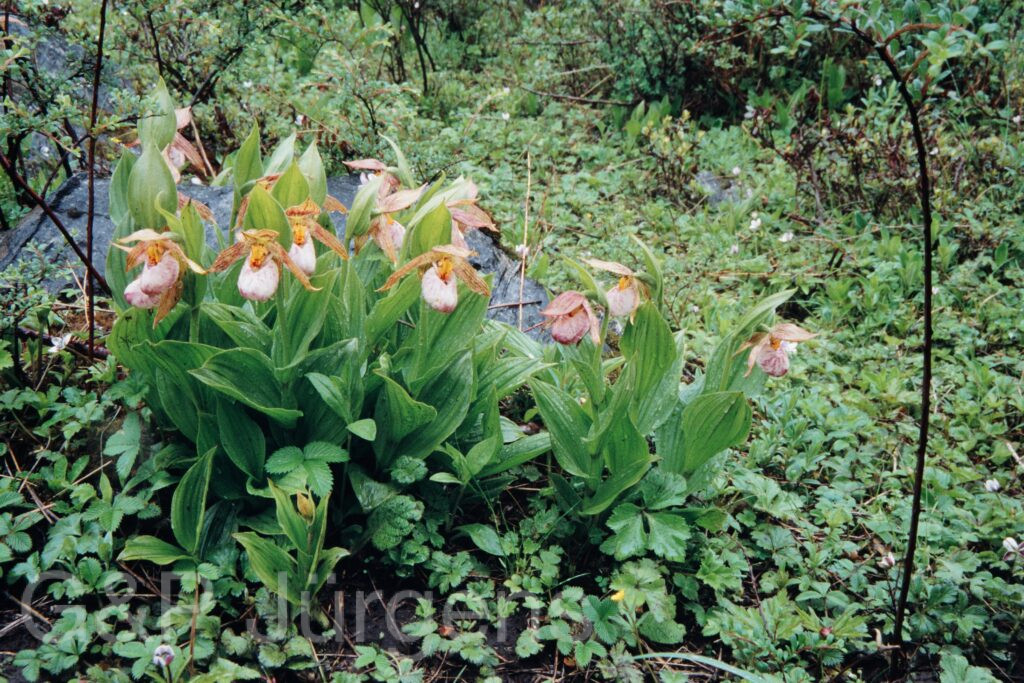
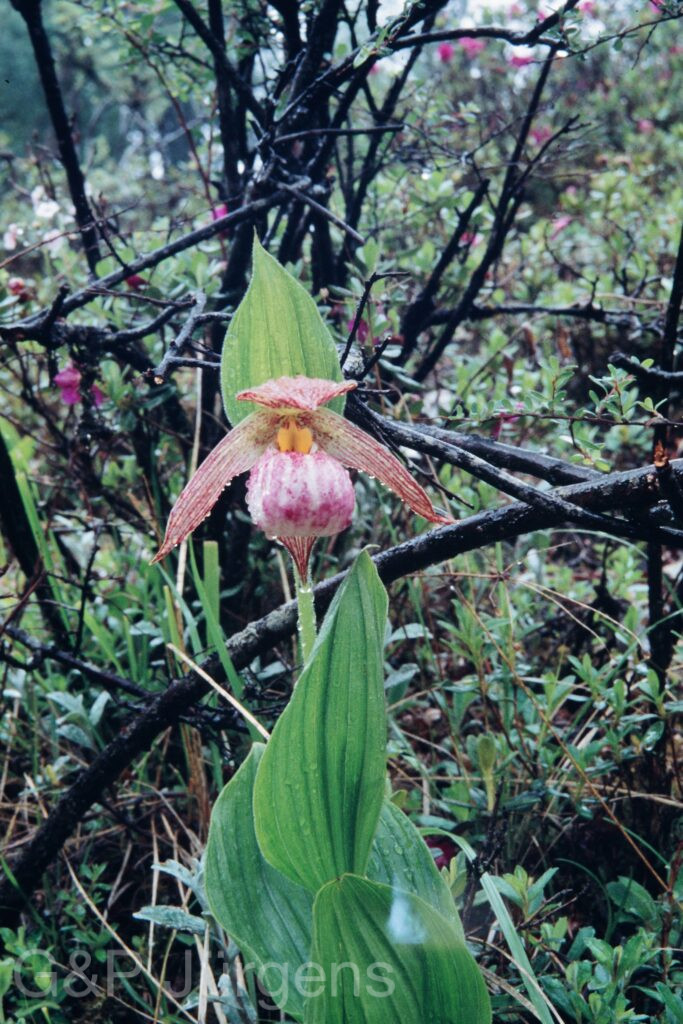
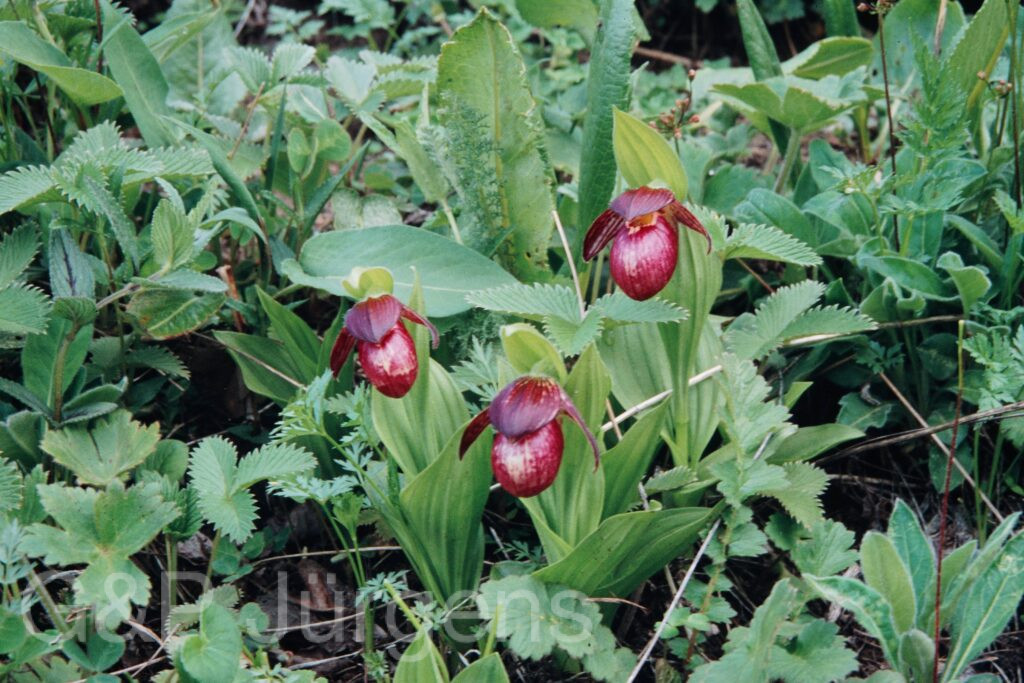
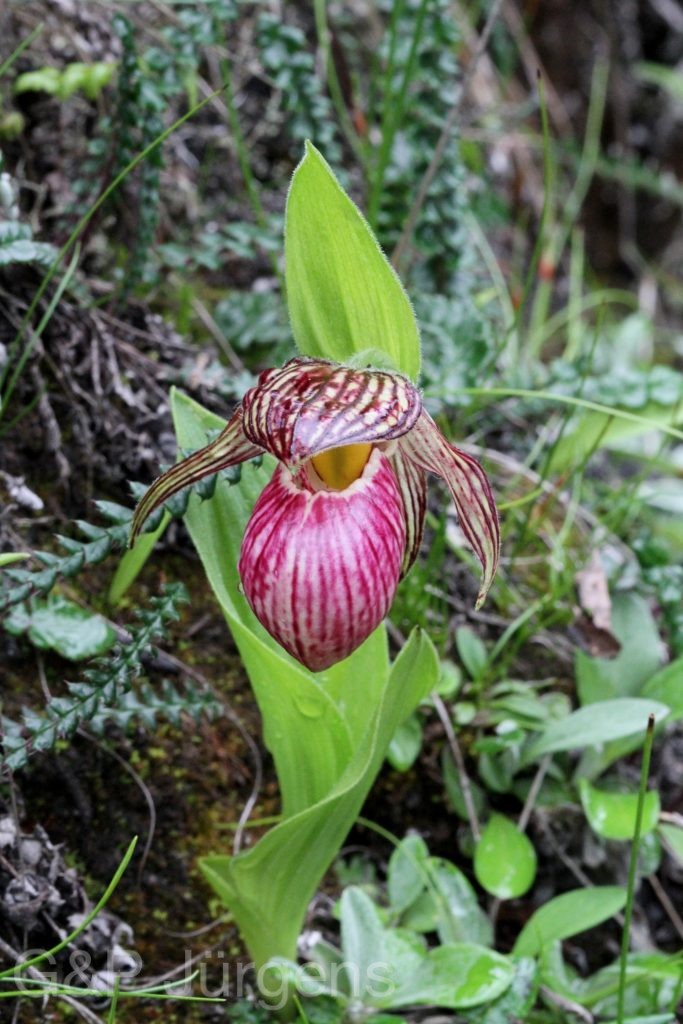
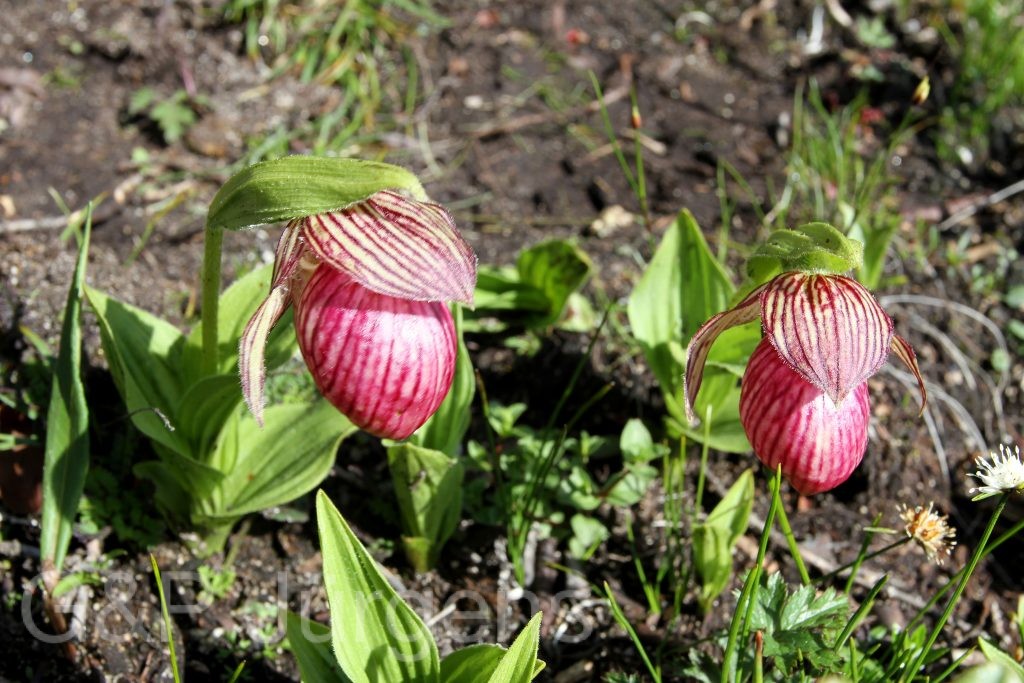
Cypripedium himalaicum is a terrestrial slipper orchid native to the eastern Himalayas, found in Bhutan, Nepal, Sikkim, and southern Tibet. It grows in alpine meadows and open forests at elevations of 3,000 to 4,500 m.

The plant reaches 15–35 cm in height, bearing one or two broadly elliptic leaves. The solitary flower is distinctive: the dorsal sepal is greenish-white with purple veins, the petals are narrow and twisted, and the lip forms a large inflated pouch, pale yellowish-green with purple spotting. Flowering occurs from May to July.

Cypripedium himalaicum is one of the highest-altitude slipper orchids in the world. It is classified as vulnerable due to habitat loss and overcollection. All Cypripedium species are listed under CITES Appendix II.

Author: Rolfe ex. Hemsl. · Sources: POWO (Kew), Flora of Bhutan, CITES Checklist

Hook.f. & Thomson

Sikkim 2006 306 ergebnis
Sikkim Ringi-Chu Tolung Gompa 2410m, May
Sikkim 2006 477 ergebnis
Sikkim Ringi-Chu Tolung Gompa 2410m, May
Sikkim 2006 475 ergebnis
Sikkim Ringi-Chu Tolung Gompa 2410m, May

Description

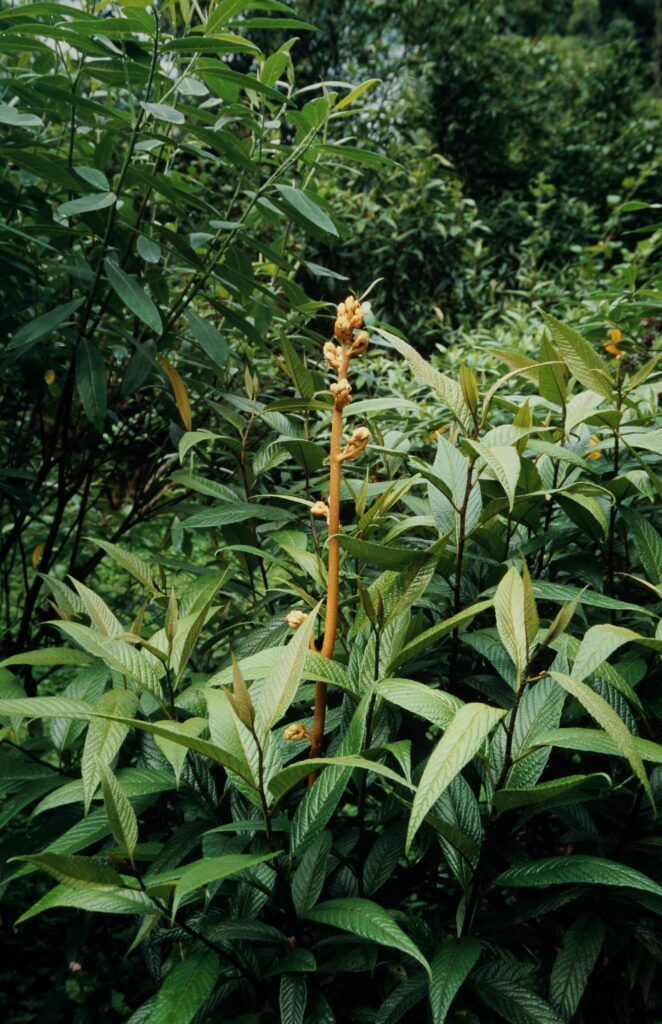
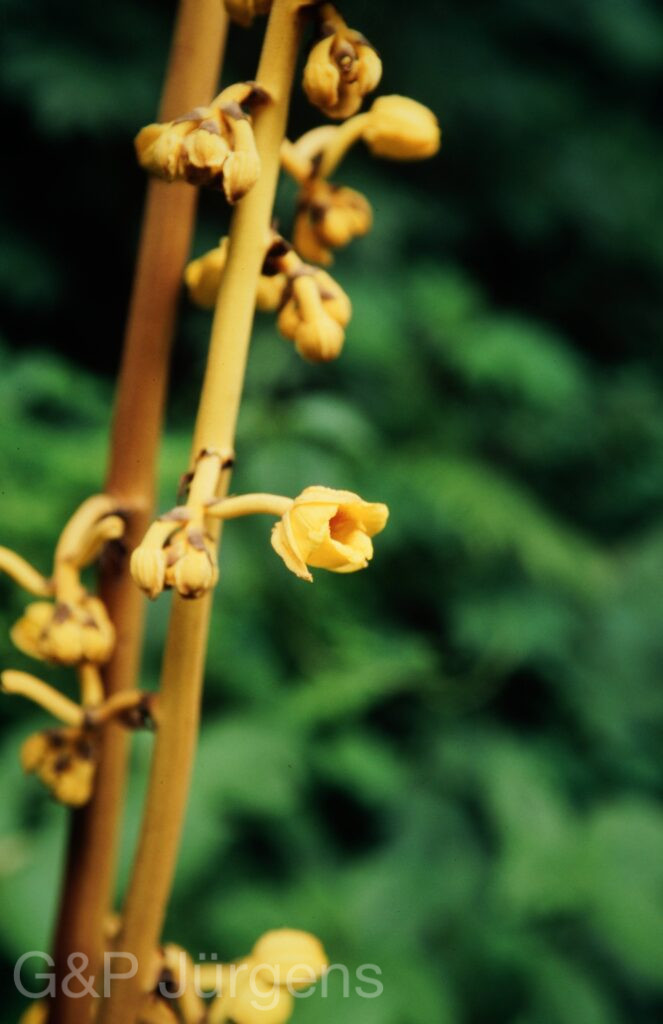
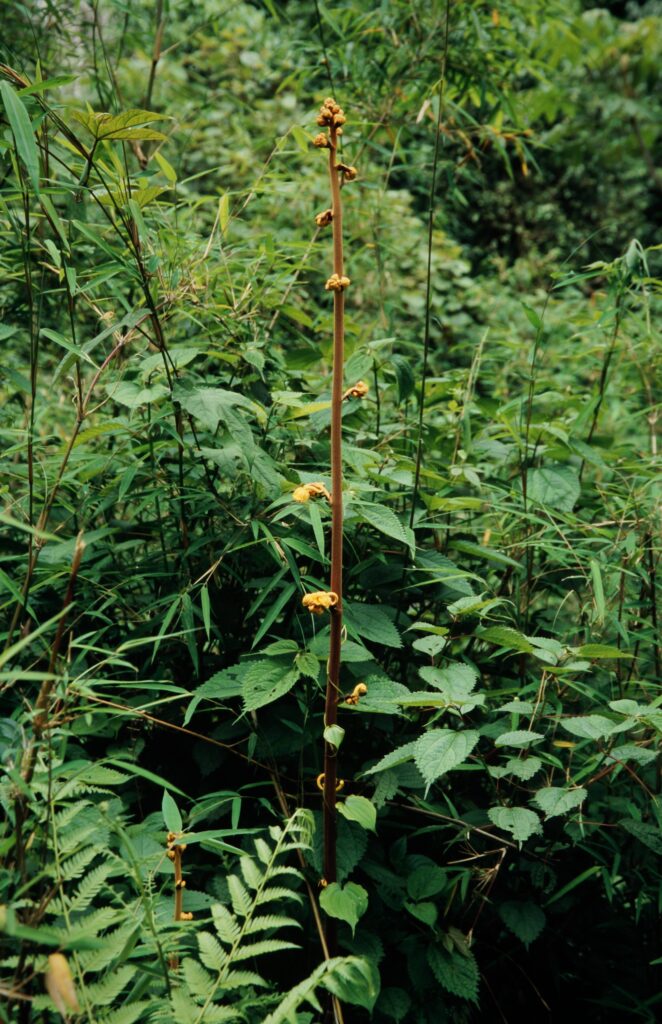
Cyrtosia lindleyana Hook.f. & Thomson is a leafless, mycoheterotrophic orchid of the tribe Vanilleae, distributed across the eastern Himalaya and into mainland and insular Southeast Asia. Its range, documented through some 400 georeferenced records, spans Nepal, northeast India, Bhutan, southern China, Taiwan, Myanmar, Vietnam and Indonesia. The species favours the deep humus and leaf litter of shaded, humid broad-leaved and mixed forests, where it depends on a mycorrhizal fungal partner for its entire nutrition. It typically occurs at montane elevations between roughly 1,500 and 2,800 m, consistent with the photographed population at Ringi-Chu near Tolung Gompa in Sikkim, recorded at 2,410 m in May.

Lacking chlorophyll, the plant emerges only to flower and fruit, arising from a stout, fleshy, coralloid rhizome that ramifies through the substrate. The erect, brownish to ochre, scale-clad inflorescence bears a loose raceme or panicle of comparatively large flowers. These are fleshy and yellowish, often suffused with brown or russet tones, with spreading sepals and petals and a concave, somewhat saccate lip bearing internal ridges. The fruit is distinctive among orchids: a large, fleshy, berry-like, indehiscent capsule, red at maturity, containing hard-coated seeds rather than the typical dust-fine orchid seed.

The genus Cyrtosia, together with allied Galeola, exemplifies the repeated evolution of full mycoheterotrophy within Vanilleae and is of considerable interest for studies of orchid–fungus associations. Because the plants are inconspicuous and only briefly visible, the species is easily overlooked and under-recorded. As an obligate forest-floor mycoheterotroph it is highly sensitive to logging and disturbance of soil mycota, and like all orchids is afforded protection under CITES Appendix II.

Author: Hook.f. & Thomson · Sources: POWO (Kew), GBIF, Flora of China Vol. 25, Flora of Bhutan Vol. 3, Pearce & Cribb: The Orchids of Bhutan (2002)

Daphne bholua

by GP Jürgens

Buch.-Ham. ex D.Don

Sikkim2011 45
Sikkim Vista-valley 3750m, June
Sikkim2011 49
Sikkim Vista-valley 3750m, June

Description

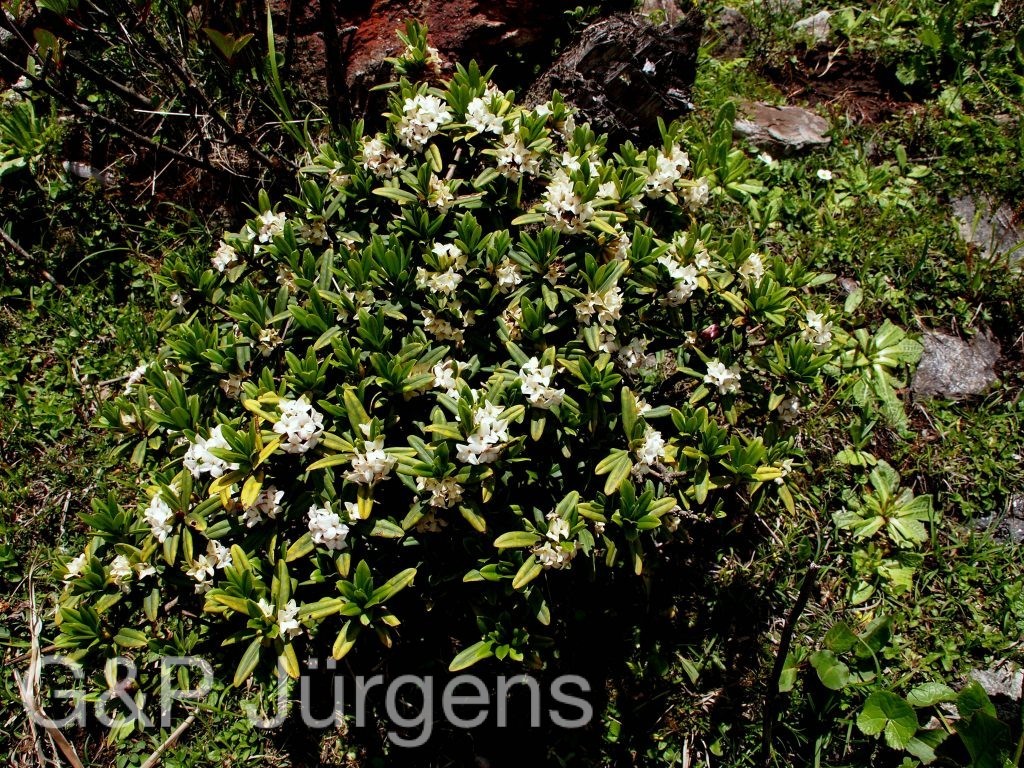
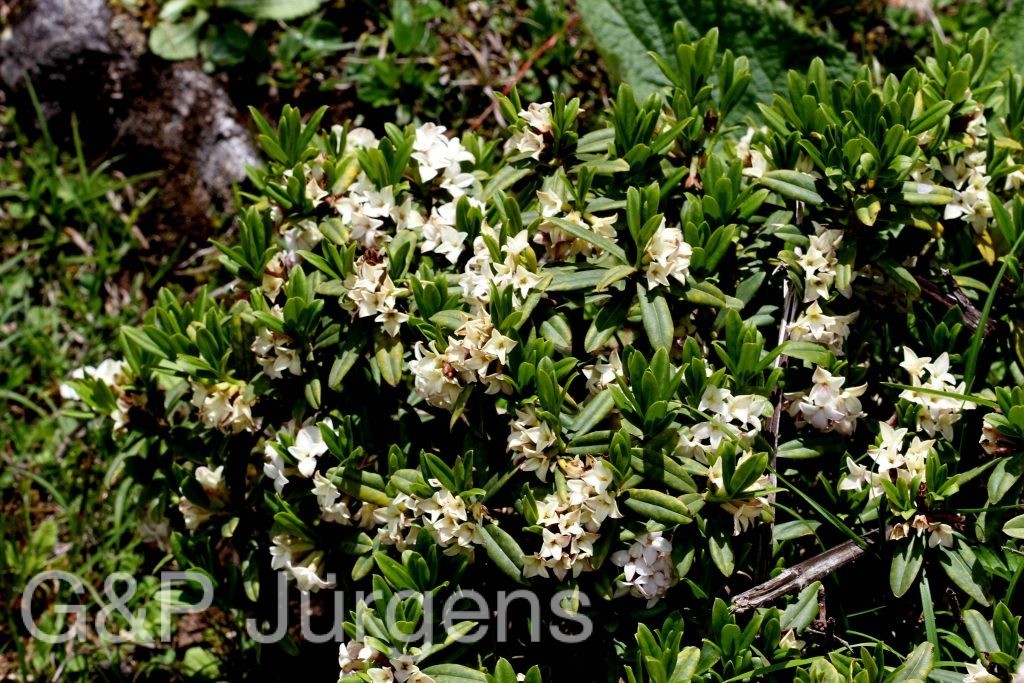
Daphne bholua is an evergreen to semi-deciduous shrub of the central and eastern Himalaya, distributed through Nepal, China, Bhutan and India, with around 758 georeferenced records; its appearance in numerous temperate countries reflects its extensive horticultural cultivation. In the wild it occupies temperate and subalpine forest, scrub and clearings, often in oak, rhododendron and conifer woodland and on open hillsides. The plant photographed in Sikkim's Vista valley at 3750 m, flowering in June, exemplifies its upper-elevation range, where it forms thickets on moist, well-drained slopes.

It grows as an erect shrub to about 2.5 m with tough, fibrous bark and densely leafy branches. The leaves are alternate, clustered toward the branch tips, oblong-lanceolate, leathery, glossy dark green above and entire-margined. The fragrant flowers are borne in dense terminal and subterminal clusters; each has no petals but a petaloid, salverform perianth tube, white within and flushed rose-purple outside, the four spreading lobes strongly scented. The fruit is a fleshy ovoid berry-like drupe, blackening when ripe.

Daphne bholua, described by Buchanan-Hamilton ex D. Don, is celebrated in horticulture for its intensely fragrant winter-to-spring flowers and has given rise to many cultivars. In its homeland the strong bast fibres of the bark are a principal source of traditional Nepali handmade paper (lokta). Like other Thymelaeaceae it contains acrid, toxic compounds. Although widespread and not formally threatened, intensive bark harvesting for paper-making places localised pressure on wild populations.

Author: Buch.-Ham. ex D.Don · Sources: POWO (Kew), GBIF, Flora of Bhutan, Annotated Checklist of the Flowering Plants of Nepal, Halda The Genus Daphne

Munz

Sikkim2003 341 G480
Sikkim Choka 3200m August
Sikkim2003 342 P481
Sikkim Choka 3200m August

Description

Delphinium ludlowii Munz is a narrowly distributed alpine larkspur of the eastern Himalaya, known only from Bhutan and adjacent Nepal and Sikkim, where the very small number of records reflects both its restricted range and its remote, high-elevation habitat. It grows on open alpine and subalpine slopes, among rocks, in moist meadows and along the margins of scrub at the upper limits of vegetation. The photographed plant from Choka in Sikkim at 3200 m, flowering in August at the height of the monsoon growing season, illustrates its association with cool, humid, well-watered high-mountain sites where the snowmelt and summer rains sustain a brief but vigorous flowering period.

The plant is an erect perennial herb arising from a fibrous or somewhat tuberous rootstock, bearing palmately divided leaves whose segments are further cut into narrow lobes. The inflorescence is a terminal raceme of characteristically spurred, zygomorphic flowers; the showy, petaloid sepals are blue to violet-blue, the uppermost prolonged backward into a conspicuous nectar spur, within which the smaller true petals are concealed. The fruit consists of several erect, many-seeded follicles typical of the genus, splitting along the inner suture to release the angular seeds.

Within the taxonomically intricate genus Delphinium, D. ludlowii belongs to the Sino-Himalayan alpine larkspurs and commemorates the collector Frank Ludlow, whose Bhutan expeditions yielded much of the type material. Like related montane species it is bumblebee-pollinated, the long spur matching its visitors, and all parts are toxic owing to diterpene alkaloids. Its very limited known range and few documented occurrences make it of conservation interest, dependent on intact alpine habitats in the eastern Himalaya.

Author: Munz · Sources: POWO (Kew), GBIF, Flora of Bhutan, Flora of China (Ranunculaceae), Ludlow & Sherriff Himalayan collections, A Monograph of the Genus Delphinium (Munz)

Hook.f. & Thomson

Bhutan2012 283
Bhutan Shele-La, 3900m September
Sikkim2003 283 P389
Sikkim Saniti-Lake 4300m August

Description

Delphinium viscosum is an alpine perennial of the Himalaya, recorded from India, Nepal, Bhutan and China, with 105 occurrences in GBIF reflecting its restricted high-altitude range. It inhabits open alpine slopes, stony meadows, scree margins and rocky pastures, generally between 3500 and 4500 m, where it flowers in late summer and early autumn. The collections figured, from Bhutan's Shele-La at 3900 m in September and Sikkim's Saniti-Lake at 4300 m in August, illustrate its occupancy of cold, exposed alpine terrain at the upper limit of herbaceous vegetation, on well-drained gravelly soils among low alpine swards.

The plant arises from a thickened, somewhat woody rootstock, producing erect stems usually 15-40 cm tall that are conspicuously glandular-viscid and hairy, the sticky pubescence giving the species its epithet. The leaves are alternate, orbicular to reniform in outline and palmately divided into several broad, toothed or further-lobed segments. The inflorescence is a few-flowered terminal raceme of showy zygomorphic flowers; the five petaloid sepals are deep blue to violet, the uppermost prolonged backward into a prominent spur enclosing the nectariferous true petals. The fruit is a cluster of usually three erect, glandular follicles releasing winged or scaly seeds.

Delphinium (Ranunculaceae) is a large genus of the northern temperate zone with a notable Sino-Himalayan radiation of alpine species; D. viscosum belongs to the glandular, spur-flowered montane group adapted to short alpine seasons. Like all larkspurs it contains toxic diterpenoid alkaloids. Its spurred flowers favour pollination by long-tongued bumblebees. With a limited high-alpine distribution, it is potentially sensitive to grazing and climatic change, though its remote habitats afford some natural protection.

Author: Hook.f. & Thomson · Sources: POWO (Kew), GBIF, Flora of China, Flora of Bhutan, A Taxonomic Revision of Himalayan Delphinium (Ranunculaceae)

C.E.C. Fisch.

Sikkim2011 17
Sikkim Lachen 2460m, June
Bhutan2014 703
Bhutan Wangdi Phodrang 2280m, May
BhutanPG2011 56 ergebnis
Bhutan Jakar, 20m June
Bhutan2014 702
Bhutan Jakar, 2600m June
Nepal 1994 8 ergebnis
Ost-Nepal Tumlingtar 340m April

Description

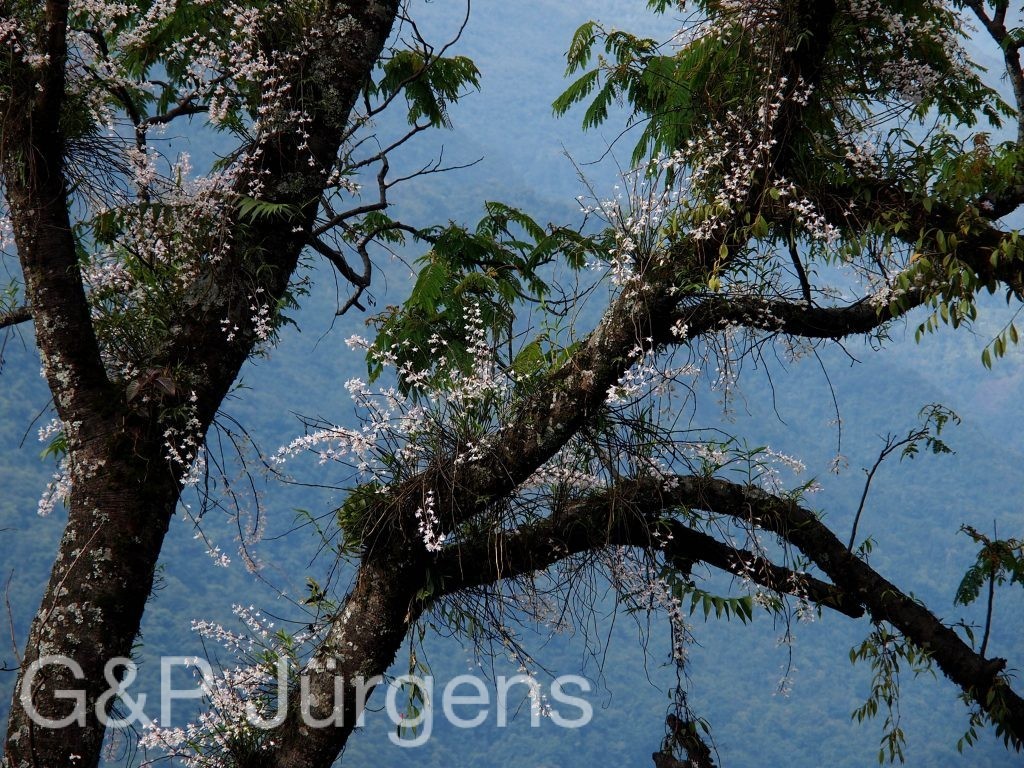
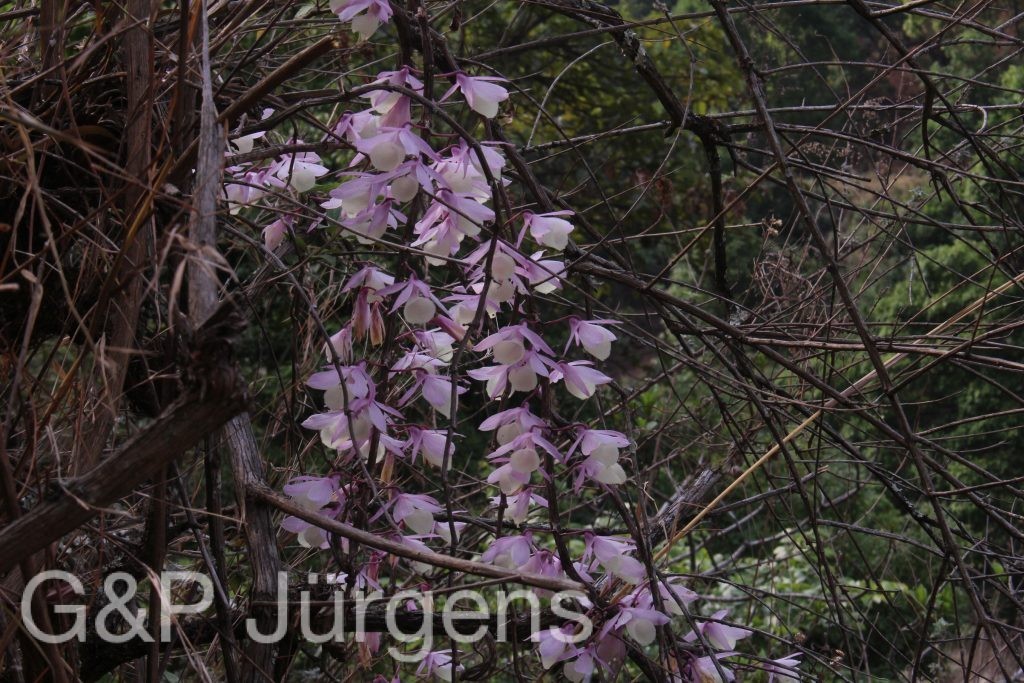
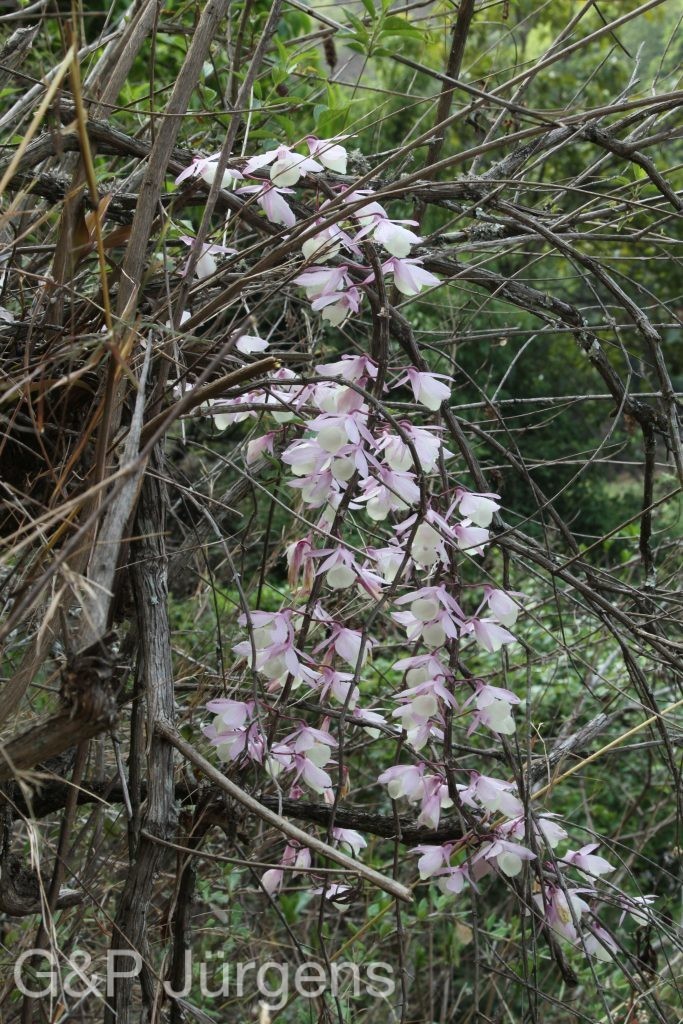
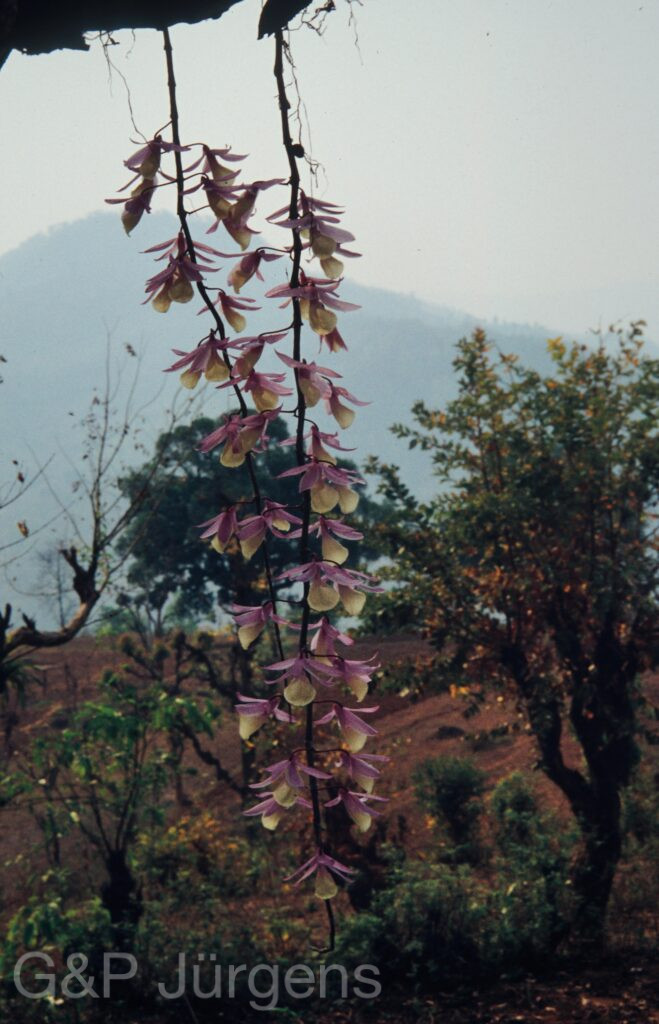
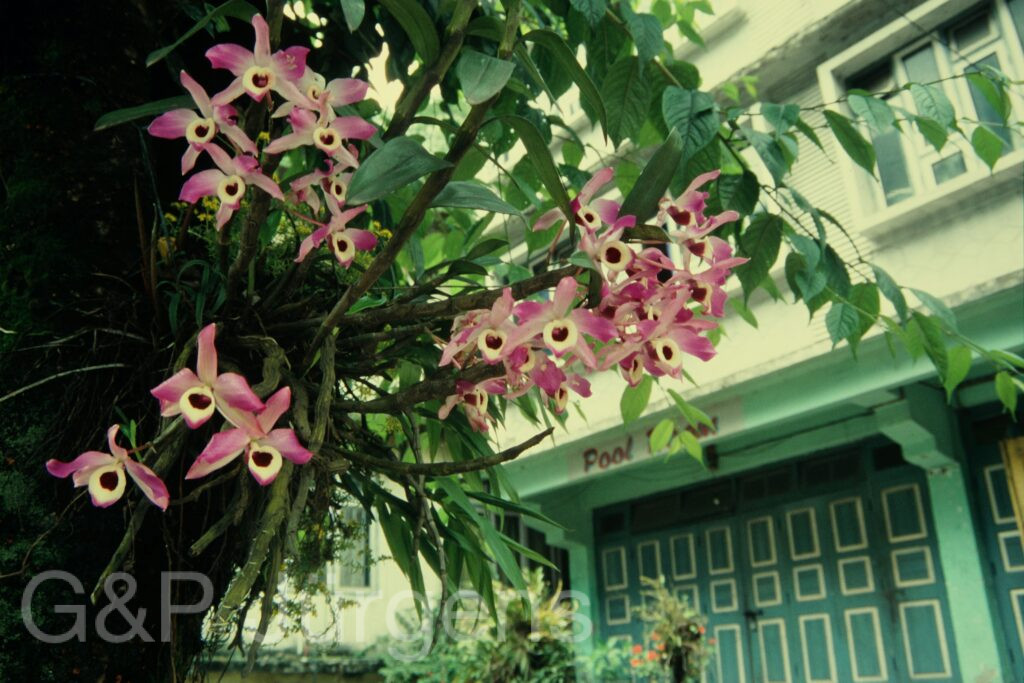
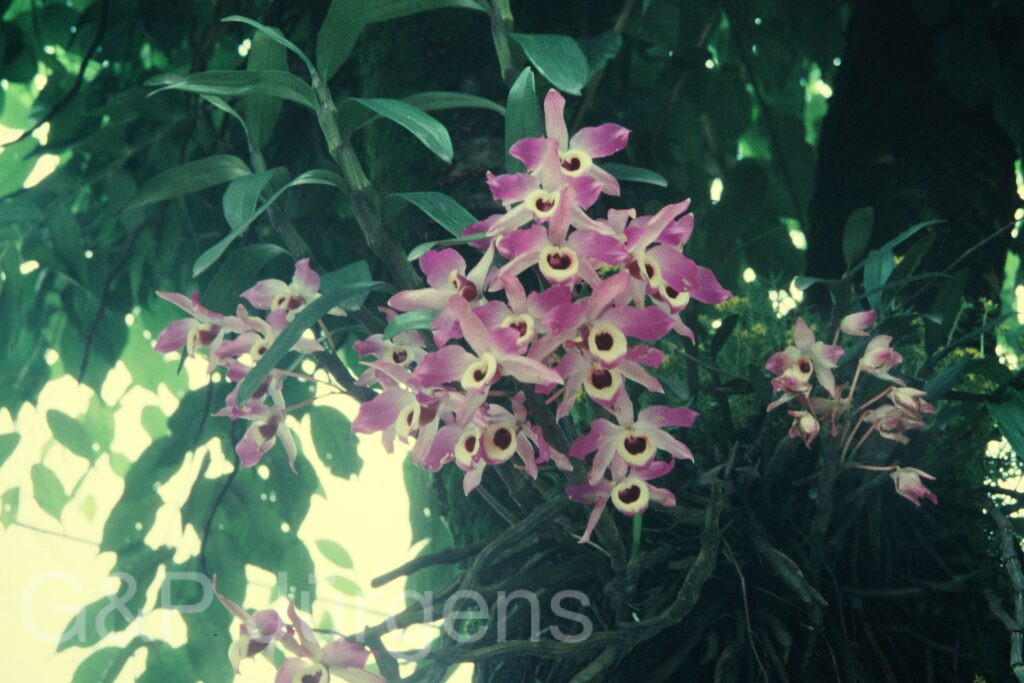
Dendrobium aphyllum is a widespread epiphytic orchid of tropical and subtropical Asia, ranging from India and Nepal through southern China and across mainland Southeast Asia, with GBIF documenting occurrences from India, China, Thailand, Bhutan, Nepal, Vietnam, Myanmar and Laos among many territories. It grows as an epiphyte, and sometimes a lithophyte, on tree trunks and rocks in warm, humid lowland and lower montane forest, enduring a distinct dry season during which the canes shed their leaves. It occupies low to middle elevations; the records span Tumlingtar in eastern Nepal at about 340 m to Sikkim's Lachen and Bhutanese sites up to roughly 2600 m, with the photographed material flowering from April through June across this broad altitudinal range.

The plant produces long, slender, pendulous cane-like stems that branch and trail from the host, leafy when young and largely leaf-shedding before flowering. The leaves are thin, lanceolate and deciduous. The flowers emerge in twos and threes from the nodes of the bare, hanging canes, fragrant and delicately coloured, with pale rose-pink to lilac sepals and petals. The labellum is broadly funnel-shaped to subobicular, cream to pale yellow and finely downy within, often marked with darker veining and rolled around the column to form a trumpet, the lower margin sometimes faintly fringed. The fruit is a pendent capsule.

D. aphyllum is placed in Dendrobium section Dendrobium and is characterised by its leafless flowering canes, as reflected in the epithet; it has accumulated synonymy and is sometimes confused with related pendent species such as D. primulinum and D. anosmum. Long cultivated as an ornamental and used in some traditional medicines, it remains common over much of its vast range, though localised populations are depleted by wild collection and lowland forest clearance.

Author: C.E.C. Fisch. · Sources: POWO (Kew), GBIF, Flora of China, The Orchids of Bhutan (Pearce & Cribb), Dendrobium and its Allies (Lavarack et al.)

(L.) Sw.

Bhutan2014 808
Bhutan Mo-Chu 1880m, June
Bhutan2014 809
Bhutan Mo-Chu 1880m, June
Sikkim2011 173
Sikkim Lachung 2660m, June

Description

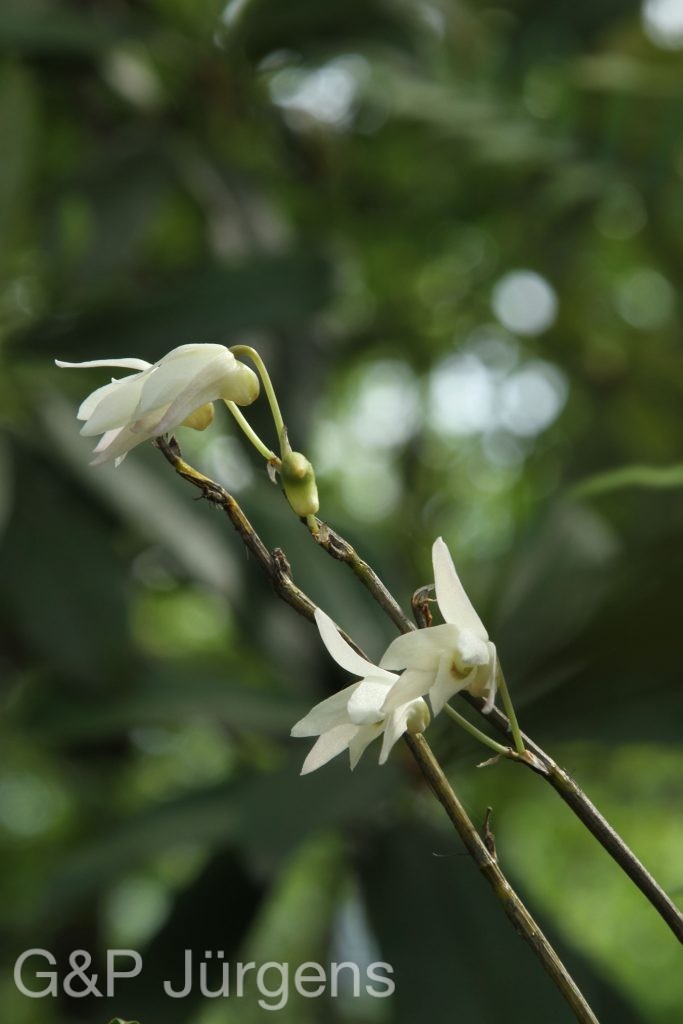
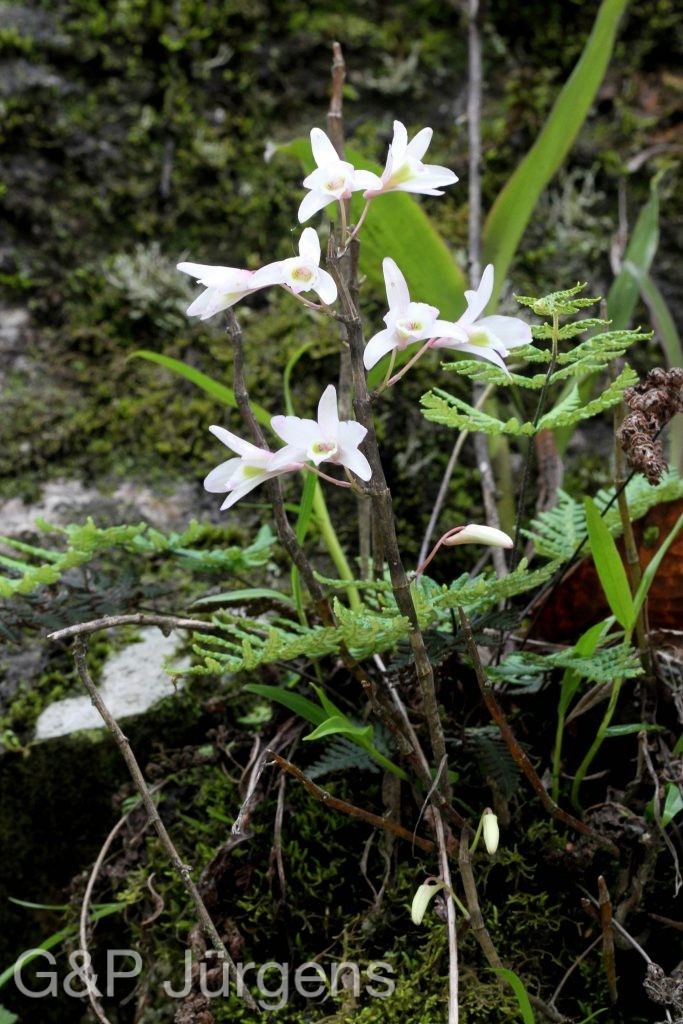
Dendrobium moniliforme is one of the most widely distributed temperate dendrobiums, ranging from Japan, Korea, Taiwan and China westward through the Himalaya to Nepal, with GBIF documenting over a thousand occurrences across this broad East Asian and Himalayan span. It grows as an epiphyte on the trunks and branches of trees, and occasionally as a lithophyte on mossy rock, in cool, humid evergreen and mixed montane forest. The species experiences a pronounced cool, dry winter rest; the photographed material from the Mo-Chu valley in Bhutan at about 1880 m and from Lachung in Sikkim at 2660 m, both in June, illustrates its occupation of mid-elevation temperate forest and its early-summer flowering.

The plant produces tufted, slender, erect or arching cane-like stems that are conspicuously jointed and somewhat swollen at the nodes, giving the necklace-like appearance evoked by the epithet. The stems are leafy above, the leaves narrowly lanceolate, thin-textured and deciduous, leaving the older canes bare. The flowers are borne singly or in pairs from the nodes of leafless stems, fragrant, and variable in colour from white to pale pink, cream or yellowish. The sepals and petals are spreading; the trilobed labellum is often marked with reddish or greenish spots and bears a hairy or warty disc, while the short column has a foot forming a mentum. The fruit is a small ellipsoid capsule.

Highly polymorphic across its enormous range, D. moniliforme is placed in Dendrobium section Dendrobium and has accumulated extensive synonymy, with numerous regional forms and horticultural selections; the alternative name appearing on the source link reflects this nomenclatural complexity. Long cultivated in East Asia and esteemed for its fragrance and cold-hardiness, it remains widespread, but localised populations are reduced by collection and habitat loss.

Author: (L.) Sw. · Sources: POWO (Kew), GBIF, Flora of China, The Orchids of Bhutan (Pearce & Cribb), Dendrobium and its Allies (Lavarack et al.)

Lindl.

Bhutan2014 170
Bhutan Trashiyangtse 2120m, May
Sikkim2004 441 G769
Sikkim/India Tista-Valley 2400m May
Sikkim2004 442 P770
Sikkim/India Tista-Valley 2400m May

Description

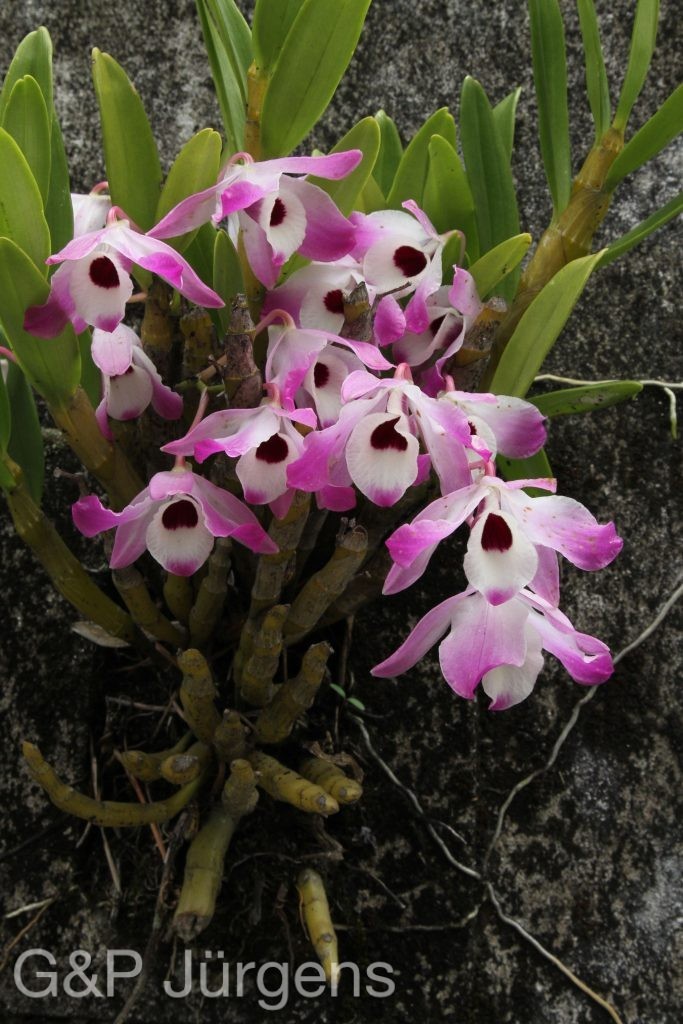
Dendrobium nobile is a widespread epiphytic orchid of the Himalaya and Indochina, native to China, India, Bhutan, Nepal, Myanmar, Vietnam and Laos, and now cultivated and naturalised far beyond, with records reported from many countries reflecting its enormous horticultural popularity. In the wild it grows as an epiphyte on mossy tree trunks and on shaded rocks in subtropical to warm-temperate broadleaved forest, chiefly between about 1000 and 2500 m. The plants documented here come from Trashiyangtse in eastern Bhutan at 2120 m and from the Tista Valley in Sikkim at 2400 m, both flowering in May at the close of the dry season.

The plant forms clustered, erect to pendulous, cane-like pseudobulbous stems that are fleshy, jointed and longitudinally grooved, bearing distichous, oblong-lanceolate leaves along their length; the leaves are usually deciduous before flowering. Inflorescences arise from the nodes of the leafless canes, each short raceme bearing one to three large, showy, fragrant flowers. The sepals and petals are white to rose-pink, deepening toward the tips, while the broad, rounded labellum is downy and conspicuously marked with a deep maroon-purple blotch in its throat ringed by paler margins. The column is short and the pollinia waxy; the fruit is an elongate dehiscent capsule releasing dust-like seeds.

As the nomenclatural type of section Dendrobium, this species is among the most important and intensively bred orchids in cultivation, with countless hybrids and named clones. Wild populations, however, have been heavily depleted by over-collection for horticulture and traditional medicine, and the species is listed on CITES Appendix II. Continued habitat loss across its native range makes in-situ conservation and sustainable trade regulation a significant concern.

Author: Lindl. · Sources: POWO (Kew), GBIF, Flora of China, The Orchids of Bhutan (Pearce & Cribb), Flora of Bhutan, CITES Appendices, Dendrobium monograph

C.B.Clarke

Sikkim2003 22 G26
Sikkim Rathong-Chu 1200 m, August

Description

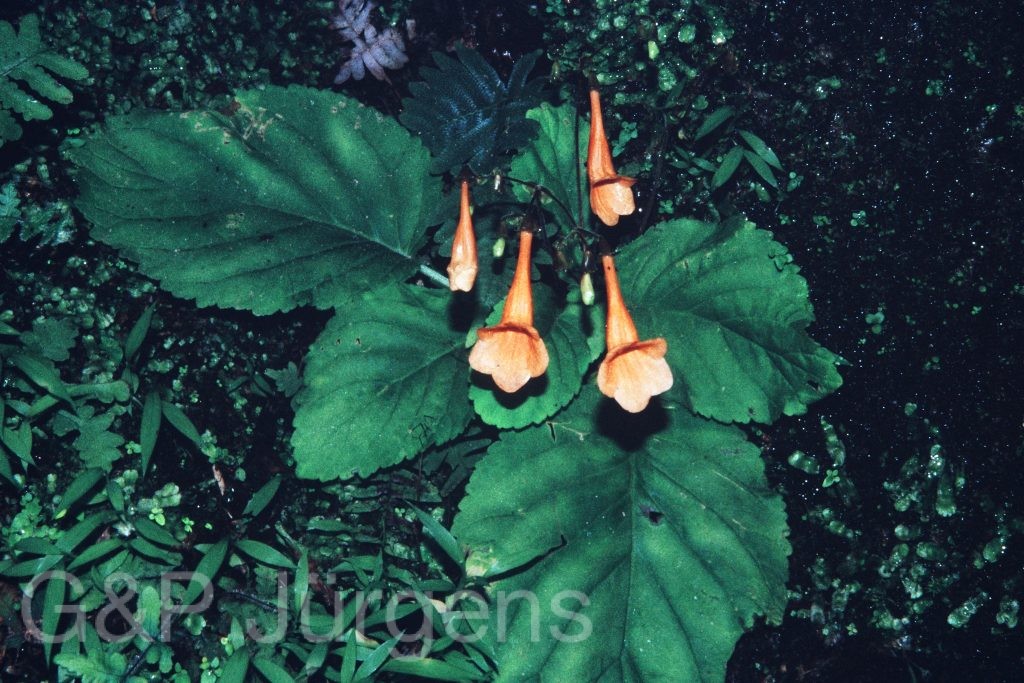
Didymocarpus aurantiacus is an eastern Himalayan gesneriad recorded from India, Nepal and Bhutan, with around 33 occurrences concentrated in the wet, monsoon-drenched subtropical to lower temperate belt of Sikkim, Darjeeling and adjacent regions. It is a lithophyte and epipetric herb growing on shaded, moss-covered rocks, cliff faces and damp ravine walls within evergreen broad-leaved forest, typically between roughly 1000 and 2000 m. The illustrated material from the Rathong-Chu valley in Sikkim at 1200 m, flowering in August, reflects its main flowering during the rainy season, when the humid rock habitats it favours are kept constantly moist by mist and seepage.

It is a small perennial herb with a short rhizomatous base and crowded, opposite or subrosulate leaves. The lamina is ovate to elliptic, with a crenate-serrate margin, an acute to acuminate apex and a thinly hairy surface, the venation impressed above and prominent beneath. The inflorescence is an axillary cyme borne on a slender peduncle. The flowers have a tubular, lobed calyx and a tubular, somewhat ventricose corolla that is orange to orange-yellow (as the epithet aurantiacus indicates), two-lipped with a shorter upper and spreading lower lip. There are two fertile stamens with cohering anthers and staminodes; the gynoecium develops into the elongate, septicidal, two-valved capsule characteristic of the genus.

The input places this taxon under "Didymocarpinae", which is the subtribe within tribe Trichosporeae of the Gesneriaceae rather than a family; the species is correctly accommodated in the genus Didymocarpus. The name D. aurantiacus C.B.Clarke is accepted. As a narrow-ranged rock specialist tied to perhumid forest, it is dependent on intact, shaded microhabitats and is therefore potentially sensitive to deforestation and habitat drying, though it has not been formally assessed.

Author: C.B.Clarke · Sources: POWO (Kew), GBIF, Flora of Bhutan Vol. 2, Flora of Nepal, Weber Gesneriaceae of the World (monograph), Clarke Commelynaceae et Cyrtandreae Bengalenses