Tag:

Spring

Mart.

Bhutan2014 32
Bhutan, Trashigang 1300m, May
Nepal 97 432 G839
Nepal Tashigaon 3100m May
Nepal 1994 269 ergebnis
Ost-Nepal Milka-Danda 3200m May 
Nepal1992 184 P270 ergebnis
Nepal Banyang 1900m March 

Description

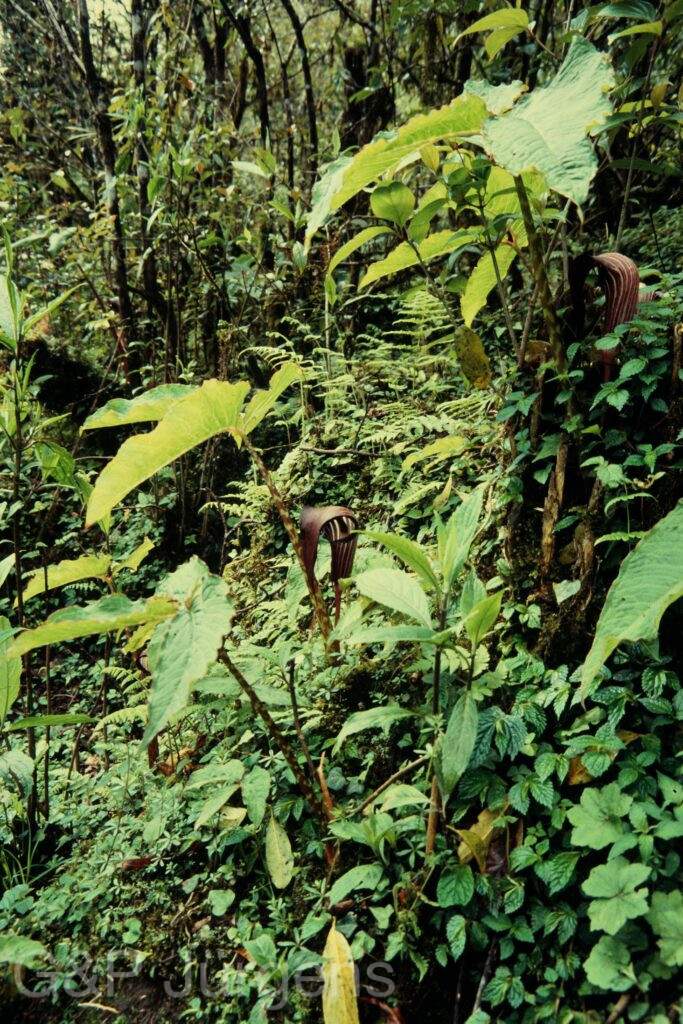
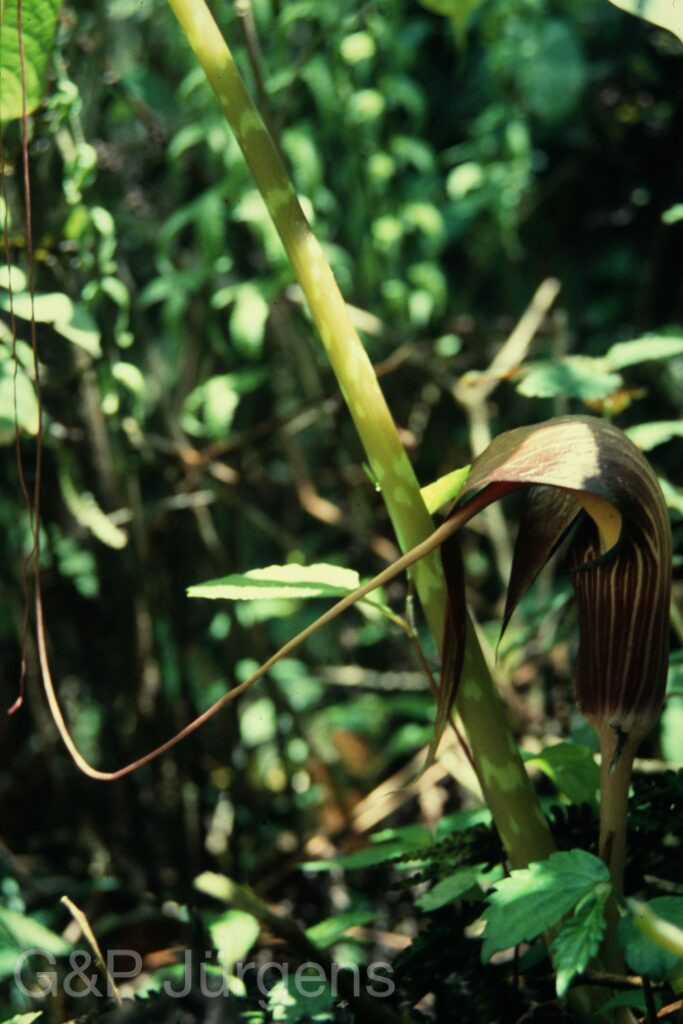
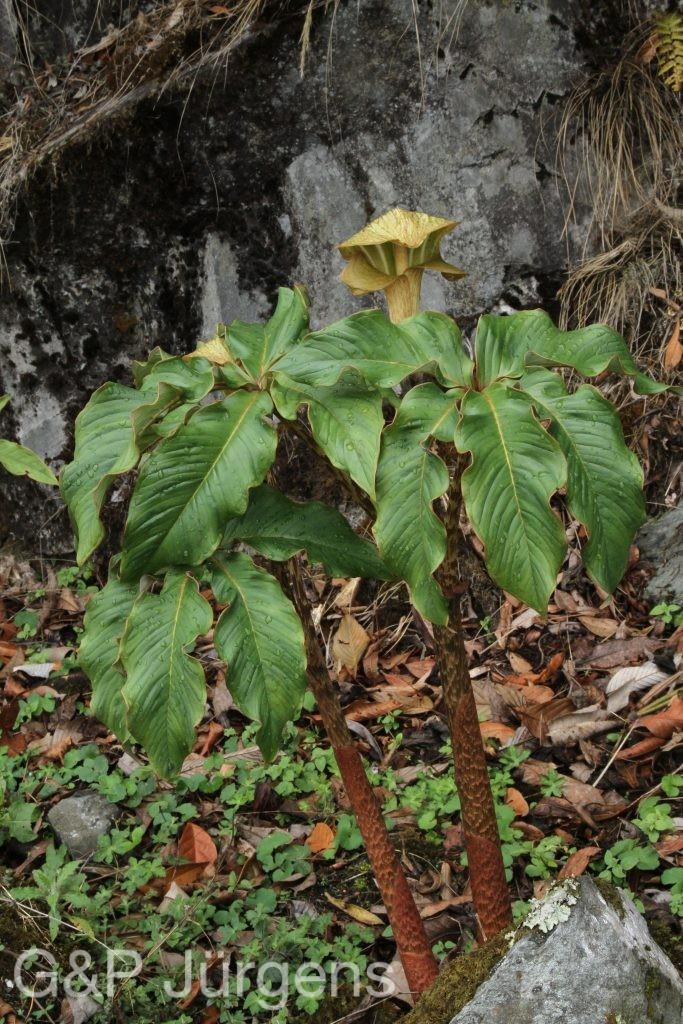
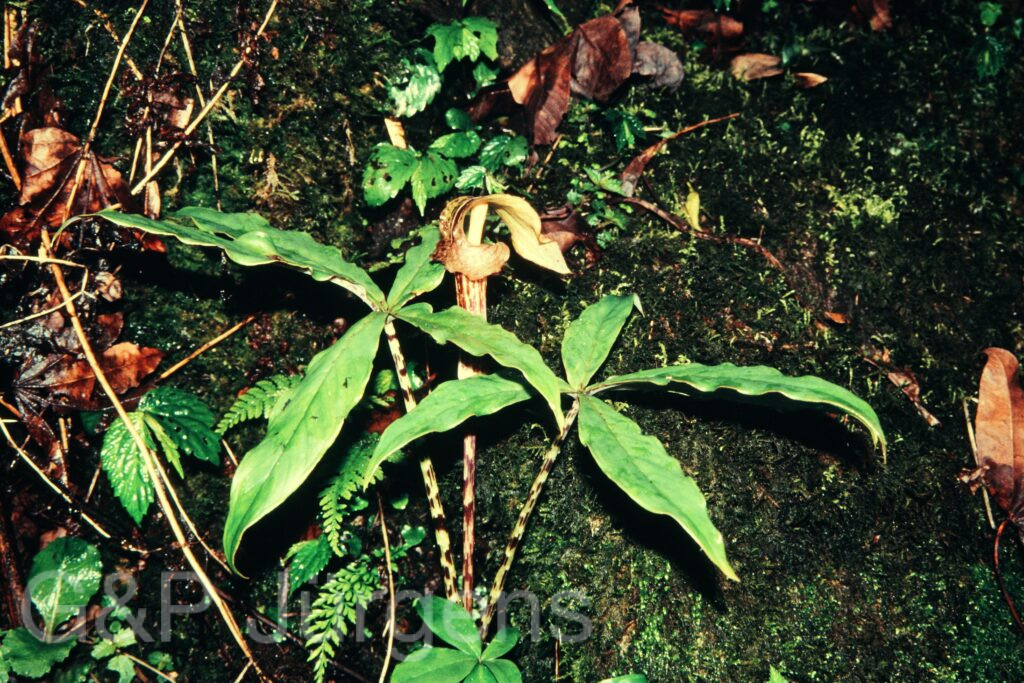
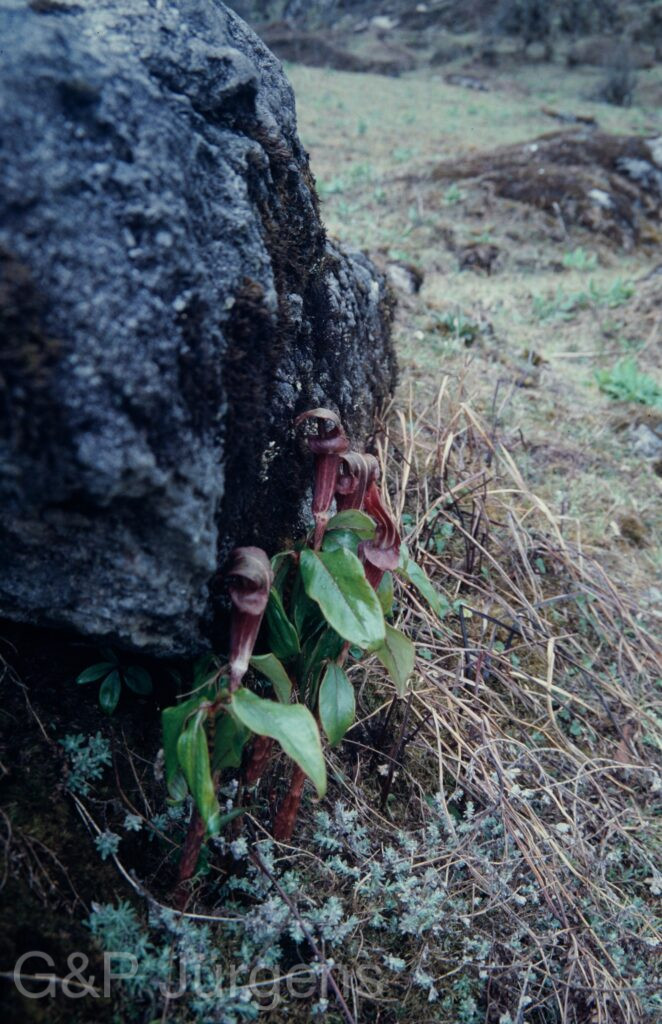
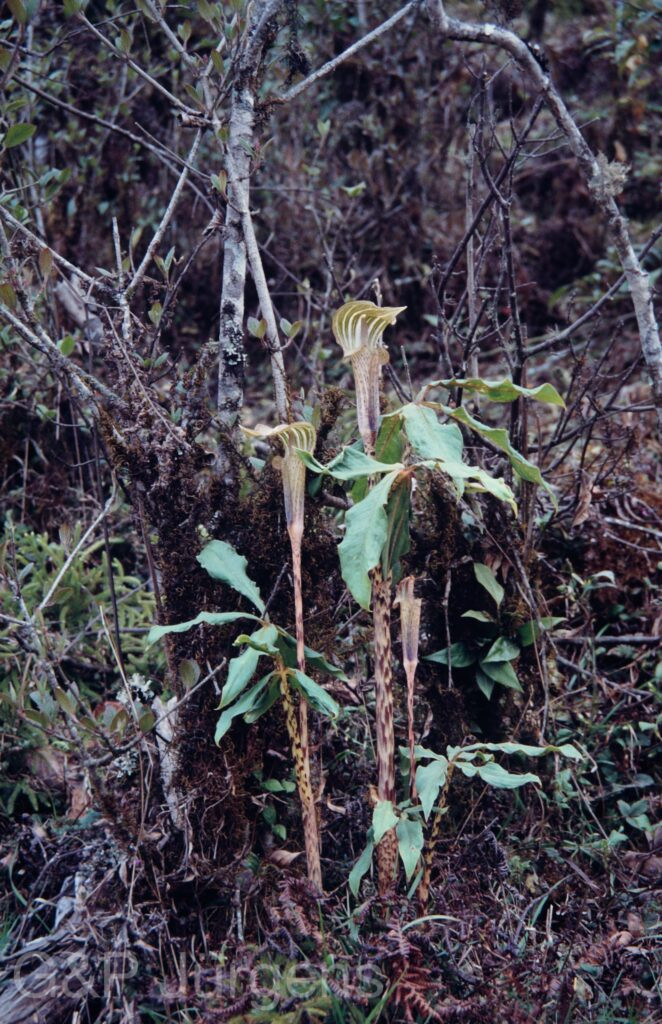
Arisaema nepenthoides is a Himalayan cobra lily distributed from Nepal eastward through Sikkim, Bhutan and north-east India to Myanmar and south-western China, with about 322 GBIF occurrences reflecting its montane range. It is a herb of cool temperate to subalpine forest, growing in moist broad-leaved and conifer-Rhododendron forest, shady banks and forest margins, broadly from 1,900 to 3,600 m. The localities recorded for the photographed plants span this range, from Trashigang in eastern Bhutan at 1,300 m and Banyang in Nepal at 1,900 m to Tashigaon at 3,100 m and Milka Danda at 3,200 m, flowering between March and May as the snows recede.

It is a tuberous perennial arising from a depressed corm, producing a stout, conspicuously mottled pseudostem patterned with brownish-purple and pale markings reminiscent of a snake's skin. Usually two leaves are produced, each pedately divided into several elliptic to oblanceolate leaflets. The inflorescence is a spadix enclosed in a spathe whose tube is greenish and prominently striped, opening into a hooded, incurved limb that recalls the pitcher of a Nepenthes, hence the epithet nepenthoides. The species is dioecious, with the sexes distinguished by the spadix appendage; pollinated female plants develop a dense head of orange-red berries, each with few seeds.

Arisaema is a large genus centred on the Sino-Himalayan region, and A. nepenthoides belongs to a group recognised by its mottled pseudostem and distinctive hooded spathe. Like many relatives it shows sequential gender change, individuals functioning as male when small and as female once the tuber attains sufficient size, an adaptation to resource availability. Pollination is effected by fungus gnats and small flies attracted into the spathe chamber. The conspicuous spathe makes it a sought-after ornamental, but it remains widespread and locally common across the eastern Himalaya and is not considered threatened.

Author: Mart. · Sources: POWO (Kew), GBIF, Flora of China, Flora of Bhutan, The Genus Arisaema (Gusman & Gusman), Araceae of the Himalaya
Arisaema propinquum

by GP Jürgens

Schott

Nepal 2001 310 ergebnis ergebnis
Nepal (Gorkha) Kharka 3100m, May
Nepal 2009 24 ergebnis
Nepal Helambu Koktrok 2600m, May

Description

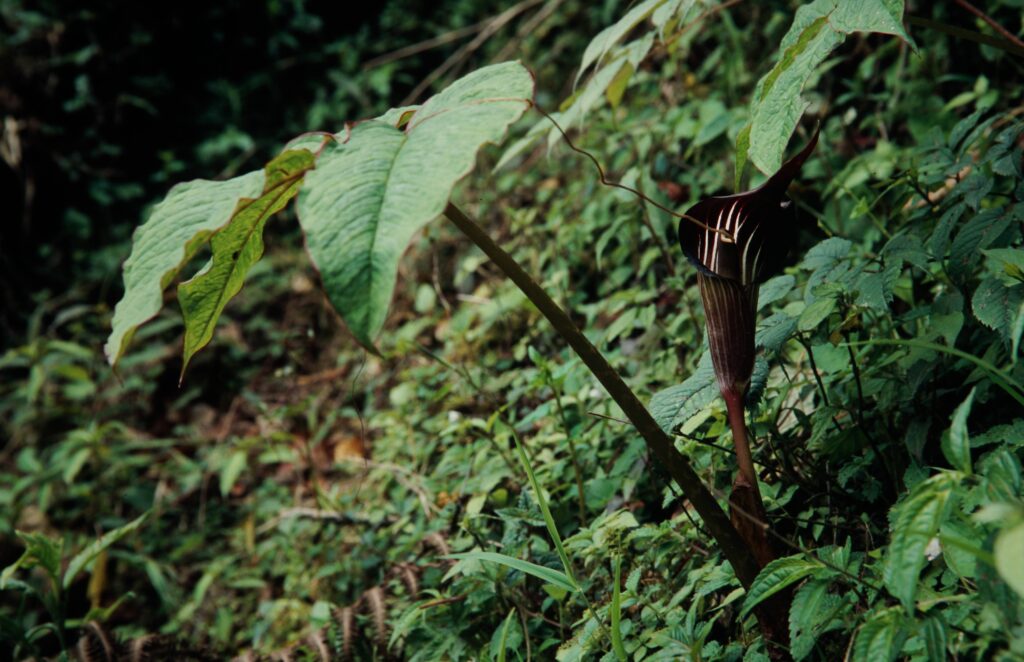
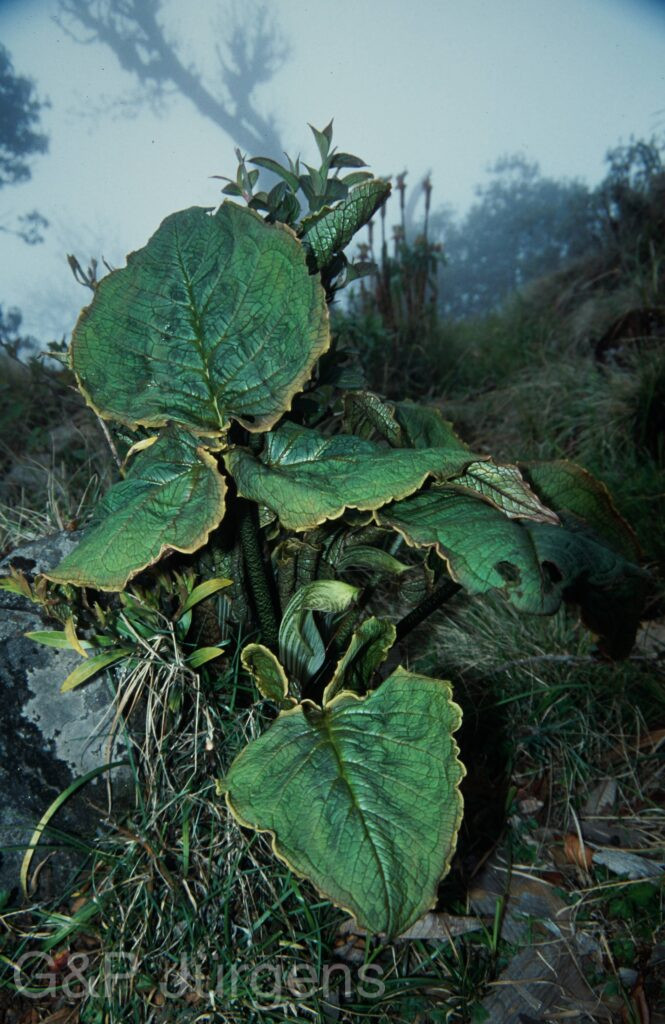
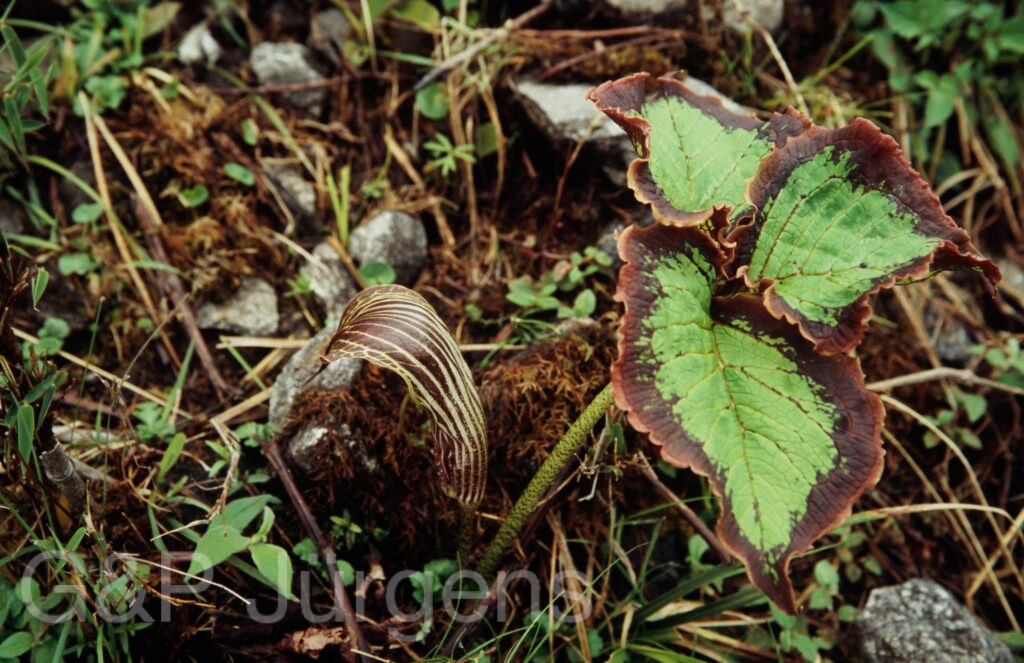
Arisaema propinquum is a Himalayan tuberous aroid distributed from Pakistan and northern India through Nepal, Sikkim and Bhutan into south-western China and Myanmar, with 257 GBIF occurrences across the central and western Himalaya. It grows in moist temperate forest, shrubberies, alpine meadow margins and open slopes, typically between about 2400 and 3700 m. The cited Nepalese collections – from Kharka in the Gorkha district at 3100 m and from Koktrok in Helambu at 2600 m, both in May – place its flowering in the late-spring period as the cobra-lilies emerge with the first monsoon moisture.

It arises from a depressed globose corm and usually produces a single (or paired) leaf divided into three broadly ovate to elliptic leaflets, the lateral ones obliquely based and the whole sometimes flushed purple beneath. The inflorescence is a typical aroid spadix enclosed in a spathe; in A. propinquum the spathe is dark purple with bold whitish or greenish longitudinal stripes, the tube cylindrical and the broad limb arching forward into a long, often filiform tail. The spadix appendage is slender and curved, exserted from the spathe mouth. The fruiting head is a dense ovoid cluster of bright red berries.

Arisaema is a large genus celebrated for paradioecy, in which individuals change sex between female and male states according to size and resources, and for its specialised fly- and fungus-gnat pollination within the trap-like spathe. A. propinquum belongs to the Himalayan striped-spathe assemblage and, while ornamentally prized, remains widespread and is not of conservation concern.

Author: Schott · Sources: POWO (Kew), GBIF, Flora of China, Flora of Bhutan, Annotated Checklist of the Flowering Plants of Nepal, Gusman & Gusman monograph of Arisaema

Arisaema speciosum

by GP Jürgens

(Wall.) Mart.

Nepal 97 439 P855
Nepal Tashigaon 3100m May
Sikkim 2006 6 ergebnis
India West-Bengal Maneybhajang 2000m, May

Description

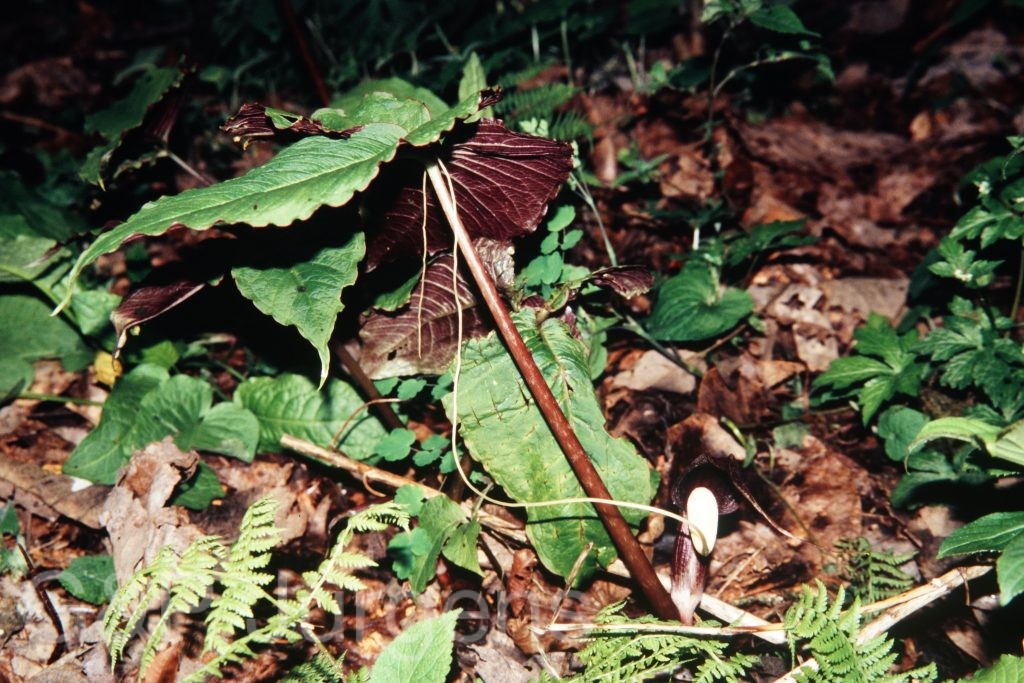
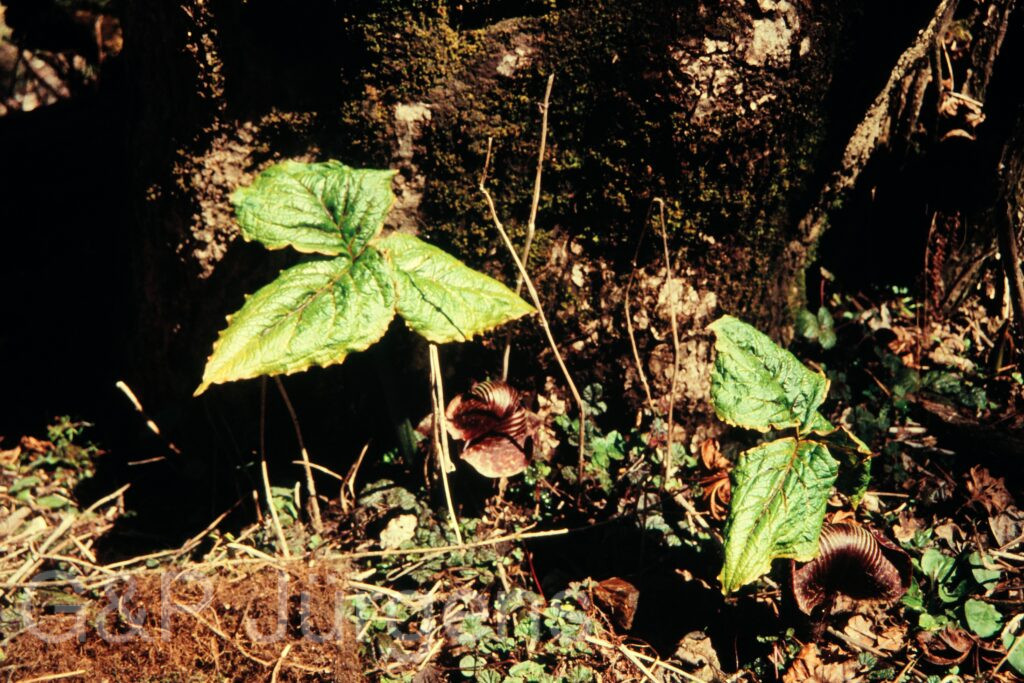
Arisaema speciosum is an eastern Himalayan cobra lily distributed from Nepal through Sikkim and West Bengal in India, Bhutan and into south-central China, with peripheral records in Myanmar and Thailand; GBIF holds nearly 200 occurrences. It grows in cool, humid temperate forest, in the shade of broadleaved and mixed conifer woodland, on rich, moist, humus-laden soils along stream banks, ravines and shaded slopes. The collections illustrated, from Tashigaon in eastern Nepal at about 3100 m and from Maneybhajang in West Bengal at around 2000 m, both in May, reflect its montane belt of roughly 2000-3300 m, where it emerges and flowers as the pre-monsoon rains advance.

The plant arises from a depressed, tuberous corm and produces a single trifoliolate leaf on a stout, mottled petiole; the three leaflets are broadly ovate, acuminate and often suffused dark purplish-red along the margins and central rib. The inflorescence is a spathe with a deep maroon, white-striped tube and an arching, dark purple-brown limb. Most striking is the spadix, whose appendage is prolonged into a very long, pendent, whip-like filiform tail hanging well below the spathe. The plant is typically dioecious, sex expression varying with tuber size, and female spadices ripen into a dense club of bright red berries.

The epithet speciosum, meaning showy, refers to the dramatic spathe and trailing appendage. Within the large Asian genus Arisaema it belongs to a group with trifoliolate leaves and long-tailed spadices. Like its congeners it is protogynous and paradioecious, with pollination effected by fungus gnats lured into the spathe chamber. The species is grown by specialist cultivators, and habitat disturbance and over-collection are potential local conservation concerns.

Author: (Wall.) Mart. · Sources: POWO (Kew), GBIF, Flora of China, Flora of Bhutan, Gusman The Genus Arisaema, Murata monograph of Arisaema

(Schott) Engl.

Bh09 208 G349
Bhutan
Sikkim2004 96 P166
India West-Bengal, Bersay 2600m April
Sikkim2004 98 P168
India West-Bengal, Bersay 2600m April

Description

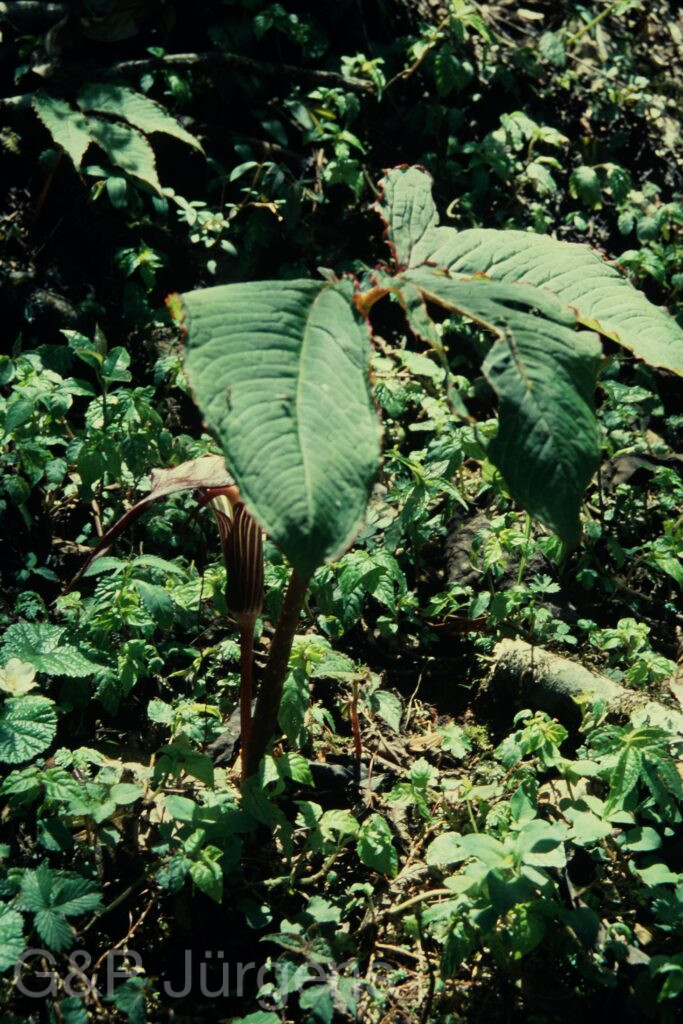
Arisaema speciosum var. mirabile is a striking tuberous aroid of the eastern Himalaya. GBIF holds only some 20 occurrences, from India, China, Nepal and Bhutan, reflecting its restricted range and the limited collection of this montane taxon. It inhabits moist temperate broadleaved and mixed forest, shaded banks and humus-rich slopes, generally between about 2,000 and 3,000 m. The illustrated plant was photographed at Bersay in West Bengal (Darjeeling–Sikkim Himalaya), and in Bhutan, at around 2,600 m in April, emerging and flowering with the pre-monsoon rains. (Despite the input family "Aceraceae", this is an aroid of the Araceae.)

The plant arises from a depressed tuber and bears characteristically a single trifoliolate leaf with three large, broadly ovate to rhombic leaflets, the central one stalked, often with a reddish margin. The inflorescence is a spathe with a dark purple, white-striped tube and a long-acuminate limb; the spadix is prolonged into a very long, thread-like, pendent appendix that hangs well beyond the spathe, the diagnostic feature of this group. The plants are dioecious; female plants produce a dense head of red berries in fruit.

Var. mirabile is distinguished from typical A. speciosum by features of the spathe and the proportions of the leaflets and appendix, though some authors treat the variation as continuous. The exceptionally long flagelliform spadix appendix is thought to function in pollinator attraction (fungus-gnat trapping). Given its narrow distribution and small documented populations, the taxon merits conservation monitoring, and it is much sought after by specialist aroid growers.

Author: (Schott) Engl. · Sources: POWO (Kew), Flora of Bhutan Vol. 3, Flora of China Vol. 23, GBIF, Gusman & Gusman: The Genus Arisaema (2006)

Hara & H.Ohashi

Nepal 97 249 P520
Nepal below Thudam 3450m, May

Description

Arisaema vexillatum is a narrowly distributed tuberous aroid of the eastern Himalaya and adjacent China, known from only China and Nepal with a sparse total of about 11 georeferenced records, reflecting both genuine rarity and limited collecting. It grows in cool-temperate to subalpine forest and shrubberies, in moist, humus-rich soils sheltered by rhododendron and conifer cover. The type material and the photographed plant come from the upper Arun drainage of eastern Nepal below Thudam at around 3450 m, flowering in May as the snow recedes, indicating a strongly montane ecology dependent on persistent soil moisture.

The plant arises from a depressed, subglobose tuber and produces typically a single leaf with a long sheathing petiole. The leaf blade is pedately divided into several oblong-lanceolate, acuminate leaflets arranged in a radiate fashion. The inflorescence is a spathe enclosing the spadix, the spathe tube cylindrical and the limb arching forward; the spadix appendix is slender and the plant is generally monoecious-dioecious depending on tuber size, a sex-lability typical of the genus. The fruiting spadix develops into a dense, club-shaped syncarp of bright red, few-seeded berries.

Arisaema vexillatum belongs to a difficult complex of eastern Himalayan species and was described by Hara and H. Ohashi from Nepalese collections. Like most Arisaema it depends on fungus-gnat and small-fly visitors trapped within the spathe for pollination. Its limited known range and montane habitat suggest vulnerability to habitat disturbance, though its conservation status remains formally unassessed and additional fieldwork would likely clarify its true distribution.

Author: Hara & H.Ohashi · Sources: POWO (Kew), GBIF, Flora of China, Annotated Checklist of the Flowering Plants of Nepal, Gusman & Gusman The Genus Arisaema

Hook.f. & Thomson ex Duch.

Bhutan2014 454
Bhutan Tongsa 2000m, May
Bhutan2014 456
Bhutan Tongsa 2000m, May
Sikkim 2006 340 ergebnis
India West-Bengal, Tolung 2450m, May

Description

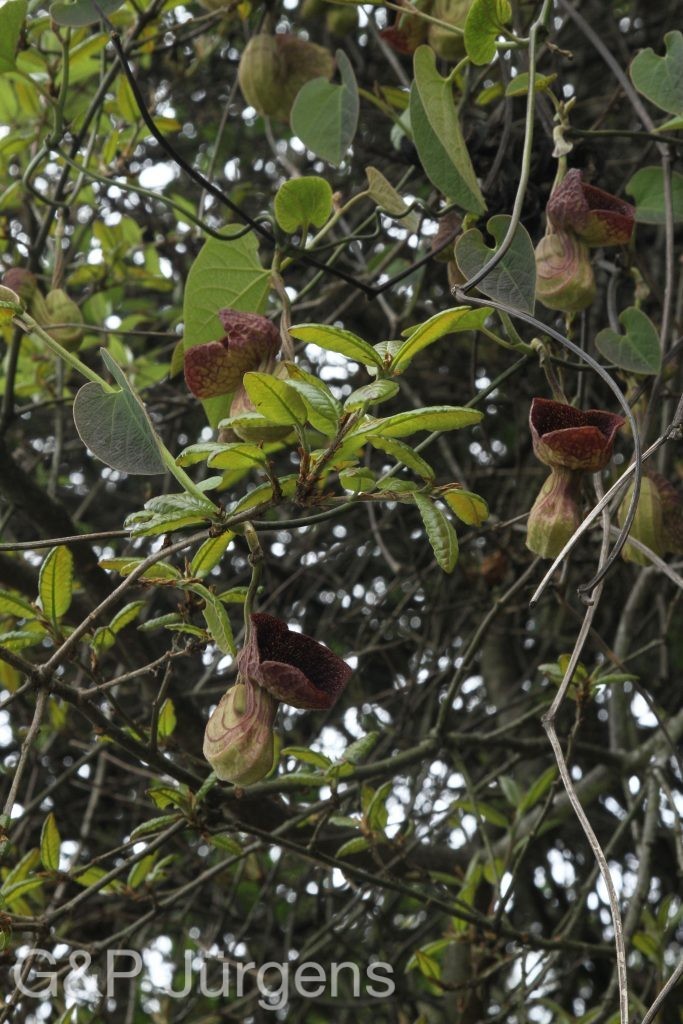
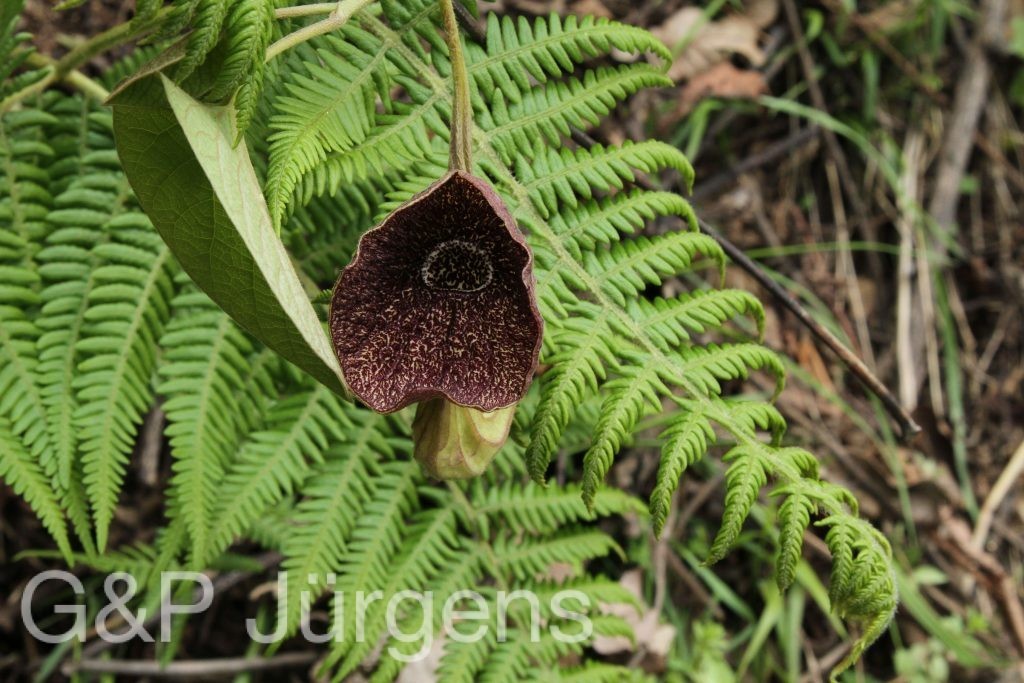
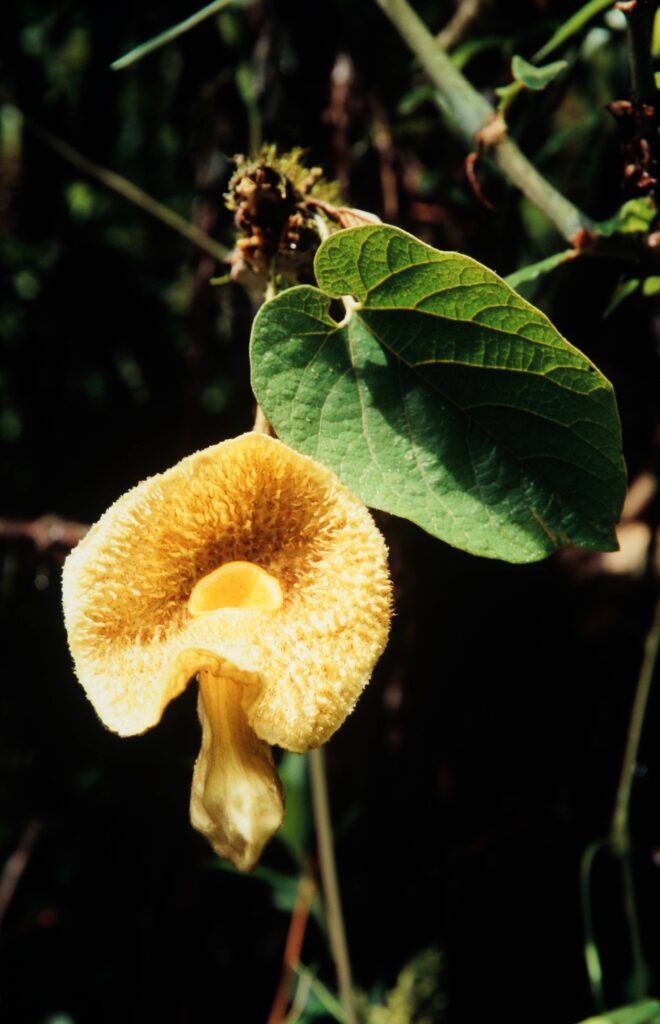
Aristolochia griffithii is an eastern Himalayan woody climber distributed through Nepal, Bhutan, north-east India and south-western China (Xizang, Yunnan), with scattered records extending into northern Myanmar and Thailand. In current taxonomic treatments the name returned as a synonym is referred to the accepted Aristolochia griffithii, under which the species is here treated. It grows in moist temperate broadleaved forest, climbing through trees and shrubs along forest margins and stream gorges, generally between about 1,800 and 3,000 m. The photographs from Tongsa in Bhutan at 2,000 m and from Tolung in West Bengal, India, at 2,450 m, both taken in May, document its late-spring flowering in this mid-montane forest belt.

It is a robust perennial liana with woody, twining stems and large, alternate, ovate-cordate leaves with deeply auriculate bases and entire margins. The flowers are solitary and exceptionally large and showy: the perianth is a strongly inflated, S-curved or globose tube expanding into a broad, spreading, conspicuously netted-veined limb mottled dark purple-brown and yellowish, terminating in a long tail-like appendage. The structure functions as a temporary insect trap, with inwardly directed hairs detaining pollinators (chiefly flies) until the anthers dehisce. The fruit is a pendulous, six-valved, septicidal capsule splitting basipetally into a parachute-like structure releasing flat winged seeds.

Aristolochia (Aristolochiaceae) is notable for its specialised kettle-trap pollination and for the aristolochic acids that render the tissues toxic; the genus includes important larval hosts for swallowtail butterflies. A. griffithii, among the largest-flowered Himalayan species, is prized horticulturally and is locally uncommon, its dependence on intact montane forest making it sensitive to habitat loss.

Author: Hook.f. & Thomson ex Duch. · Sources: POWO (Kew), Flora of China Vol. 5, Flora of Bhutan Vol. 1, GBIF, Hwang, Kelly & Gilbert: Aristolochiaceae in Flora of China

Lam.

Nepal 97 561 P1094
Nepal Sabha-Khola 550m May
Nepal 97 563 P1096
Nepal Sabha-Khola 550m May
Nepal 97 562 P1095
Nepal Sabha-Khola 550m, May
Nepal 1994 44 ergebnis
Ost-Nepal Simbhuwa Kola 
1250m, April

Description

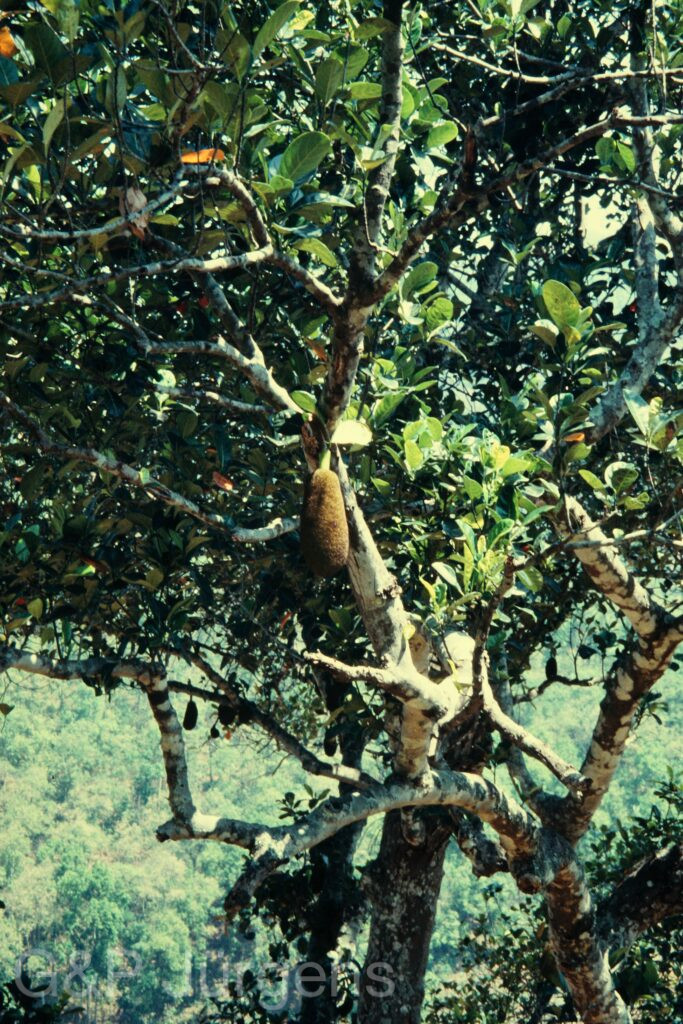
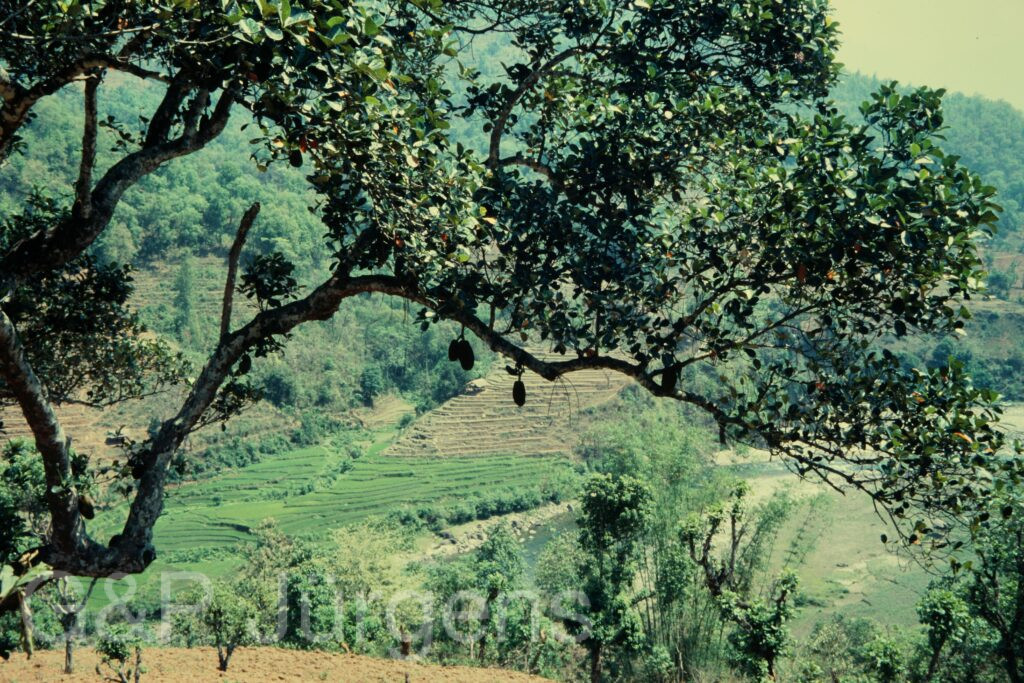
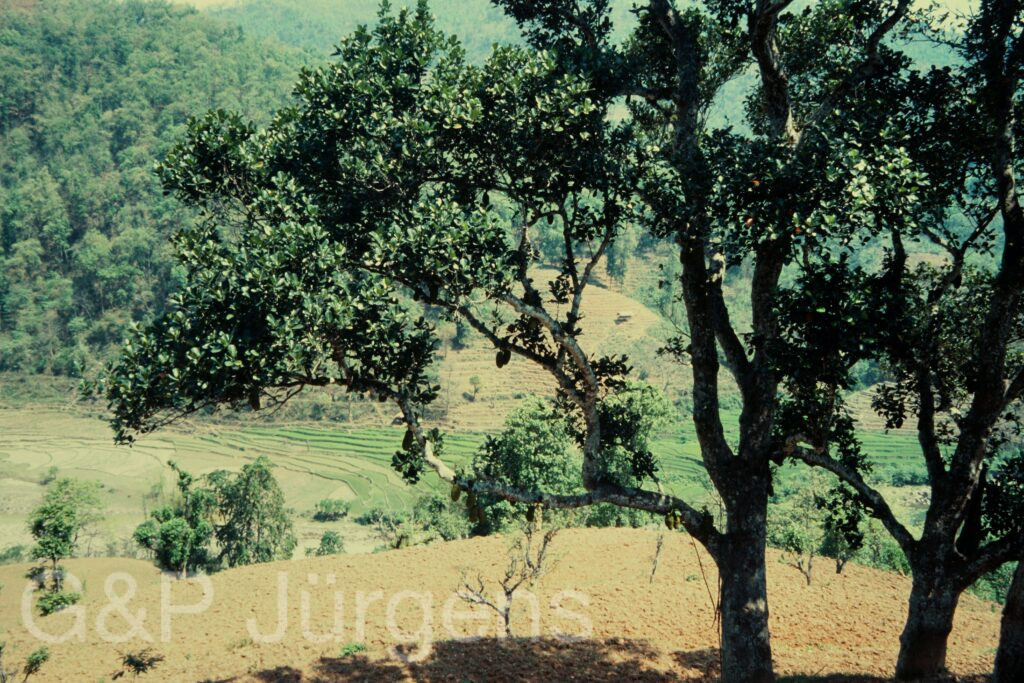
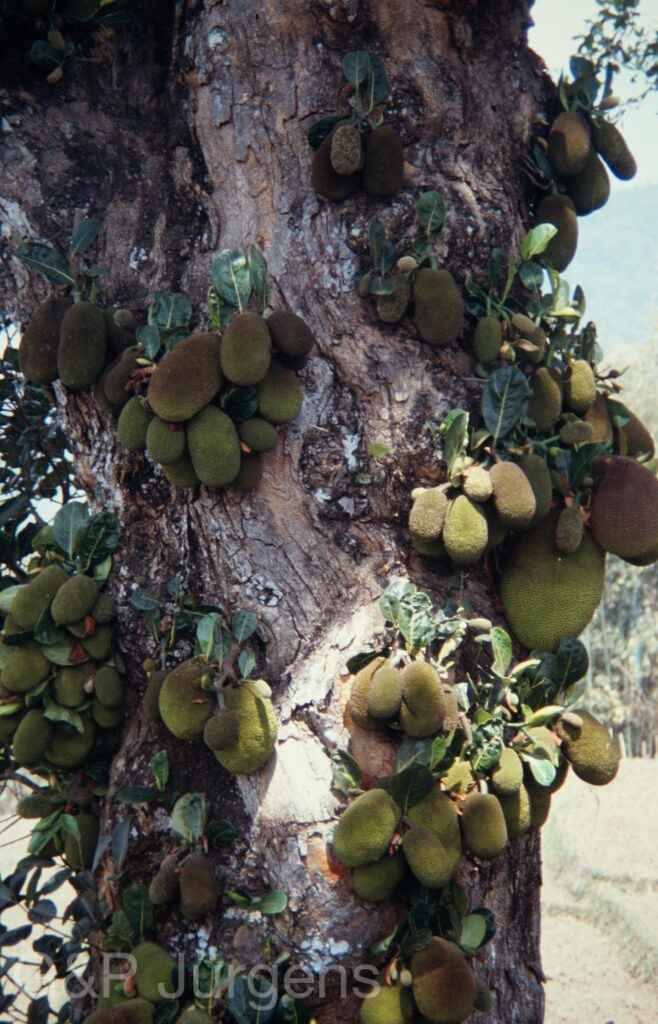
Artocarpus heterophyllus Lam., the jackfruit, is a large evergreen tree believed to be native to the Western Ghats and rainforests of the Indian subcontinent, now cultivated and naturalised throughout the tropics. The extensive GBIF record spans India, Sri Lanka, Bangladesh, China, much of Southeast Asia and Malesia, as well as tropical Africa, the Mascarenes, Brazil and the Pacific, reflecting its pantropical cultivation. In the Himalayan foothills it is grown in warm, humid lowland and lower hill country; the records from the Sabha Khola in Nepal at 550 m in May and the Simbhuwa Khola in east Nepal at 1,250 m in April document its cultivation in subtropical river valleys near the upper limit of its tolerance.

The tree reaches 10–25 m, with a dense, spreading crown and copious white latex in all parts. The alternate, leathery, glossy leaves are obovate to elliptic and entire in adult foliage, although juvenile and coppice leaves may be lobed, accounting for the epithet heterophyllus. The species is monoecious, with minute flowers densely aggregated on separate male and female inflorescences. After pollination the female heads develop into the immense, syncarpous compound fruit, the largest borne by any tree, which may exceed 30 kg; it is oblong, green, covered in conical, hexagonal protuberances, and contains numerous seeds embedded in sweet, aromatic, edible perianth flesh and surrounded by fibrous tissue, the whole borne cauliflorously on the trunk and main branches.

A member of Moraceae, the breadfruit and fig family, jackfruit is among the most important food trees of the humid tropics, the fruit eaten ripe or as a vegetable and the seeds cooked, while the durable, yellow timber and a dye from the heartwood are also valued. As an ancient cultigen of long human domestication it has no conservation concern, but its biogeography illustrates the role of human dispersal in shaping pantropical crop distributions.

Author: Lam. · Sources: POWO (Kew), GBIF, Flora of China Vol. 5, Flora of Nepal, Jarrett: Studies in Artocarpus and Allied Genera (Journal of the Arnold Arboretum)

L.

Bhutan2014 65
Bhutan Trashigang 1300m, May
Bhutan2014 66
Bhutan Trashigang 1300m, May

Description

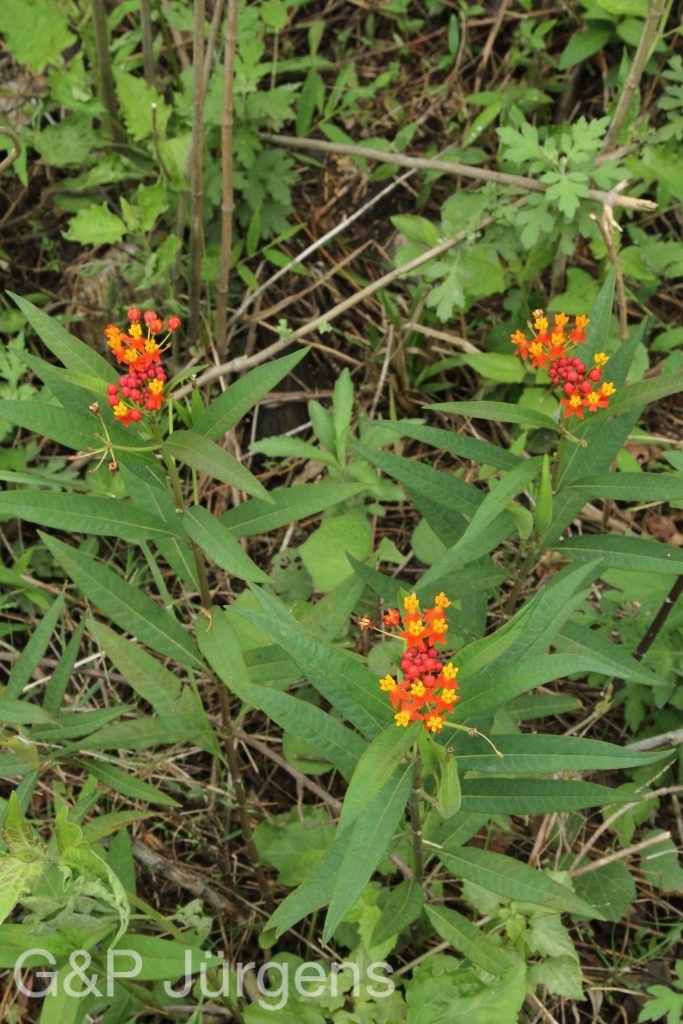
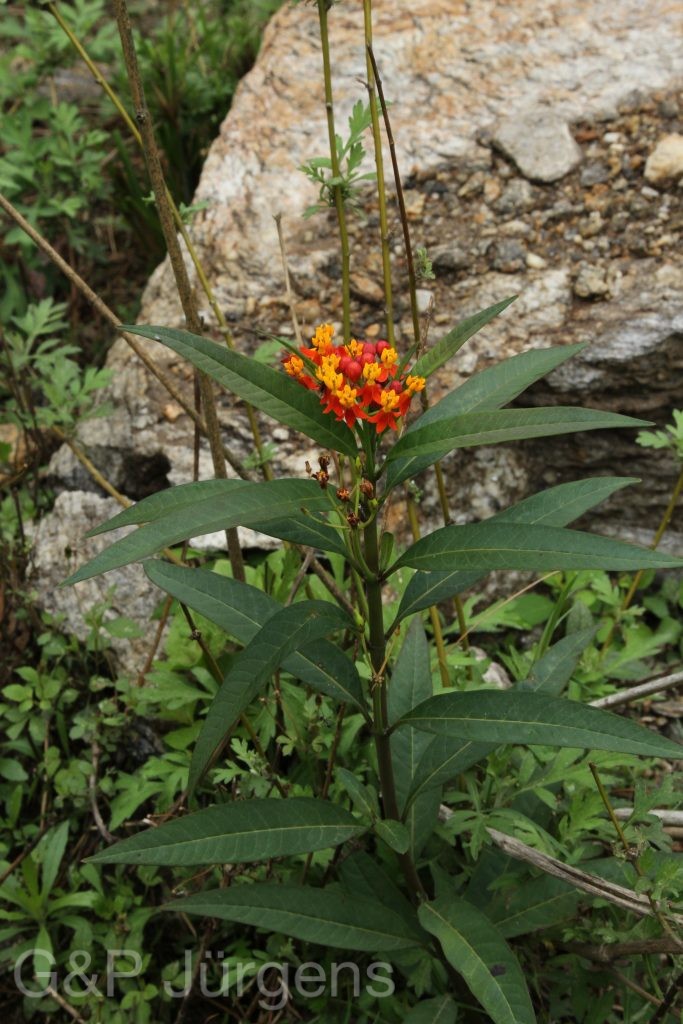
Asclepias curassavica, the scarlet or tropical milkweed, is native to tropical America but is now a pantropical weed of cultivation and waste ground, reflected in its more than 40,000 GBIF occurrences spanning Mexico, the United States, Central America and the Caribbean, Brazil and Andean South America, and introduced populations across China, Taiwan, India and Australia. In the Himalayan region it is naturalised at lower warm elevations along roadsides, field margins and disturbed slopes, as shown by the Bhutanese record from Trashigang at 1300 m in May, well within its preferred frost-free montane-foothill zone.

It is an erect perennial herb or subshrub 0.5-1 m tall with slender, sparingly branched stems exuding milky latex when cut. The leaves are opposite, lanceolate to narrowly elliptic, short-petioled and acuminate. The flowers are borne in terminal and axillary umbel-like cymes; each has five reflexed red to orange-red corolla lobes and a contrasting yellow to orange central corona (gynostegial hoods with incurved horns), the whole forming the characteristic asclepiad pollinarium-bearing structure. The fruit is a slender erect follicle splitting to release numerous flat seeds bearing a silky coma for wind dispersal.

A member of the milkweed subfamily Asclepiadoideae (now placed in Apocynaceae), it is rich in cardenolide toxins and serves as a host for monarch and other danaine butterflies. Widely grown ornamentally and for traditional medicine, it spreads readily and behaves as an invasive in many warm regions; it is of no conservation concern and is instead frequently managed as a weed.

Author: L. · Sources: POWO (Kew), GBIF, Flora of China, Flora of Bhutan, Flora of North America, Woodson monograph of Asclepias

Aster nakaoi

by GP Jürgens

Kitam.

Bh2008 555 P839
Bhutan Paro 3300m, May

Description

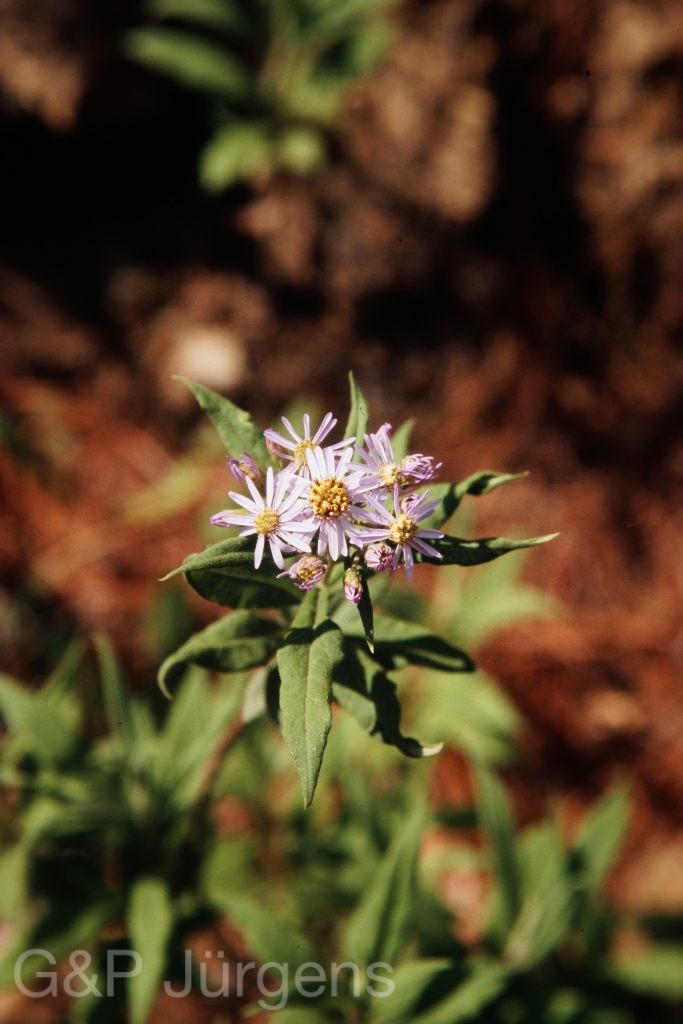
Aster nakaoi is a high-montane perennial of the Eastern Himalaya, presently documented chiefly from Bhutan and adjacent Sikkim and southern Tibet, where it occupies the upper temperate to subalpine belt. The species is poorly represented in aggregated occurrence databases, reflecting its restricted range and infrequent collection rather than true rarity. It favours open grassy slopes, the margins of Rhododendron and Abies forest, rocky banks and the verges of alpine meadows, typically between about 3000 and 4000 m. The plant illustrated here was photographed near Paro in western Bhutan at roughly 3300 m in May, when the earliest flowering heads appear among emerging summer herbage.

The plant forms low tufts arising from a short, somewhat woody rhizome bearing fibrous roots. Stems are erect to ascending, simple or sparingly branched above and often shortly pubescent. Basal and lower cauline leaves are spathulate to oblanceolate, narrowed to a winged petiole, with entire or obscurely toothed margins; the upper leaves are sessile, smaller and progressively reduced. The capitula are solitary or few, radiate, with a hemispherical involucre of imbricate, herbaceous phyllaries in several rows. Ray florets are female, ligulate and lilac to bluish-violet, surrounding numerous yellow tubular disc florets. The achenes are compressed and pubescent, crowned by a pappus of barbellate bristles facilitating wind dispersal.

A member of the large and taxonomically intricate genus Aster, the species commemorates the Japanese botanist who collected extensively in the Himalaya, and it belongs to the assemblage of small Sino-Himalayan asters whose circumscription remains under revision following molecular reappraisal of the tribe Astereae. Its narrow known distribution along the Bhutan–Sikkim axis makes it of biogeographic interest as a regional endemic, and its conservation status is best regarded as data-deficient pending further field survey across the Eastern Himalayan high country.

Author: Kitam. · Sources: POWO (Kew), GBIF, Flora of Bhutan, Flora of China, Grierson & Long Asteraceae account, Monograph of Himalayan Aster

Aster neoelegans

by GP Jürgens

Grierson

Bhutan2014 411
Bhutan Jakar 2400m, May

Description

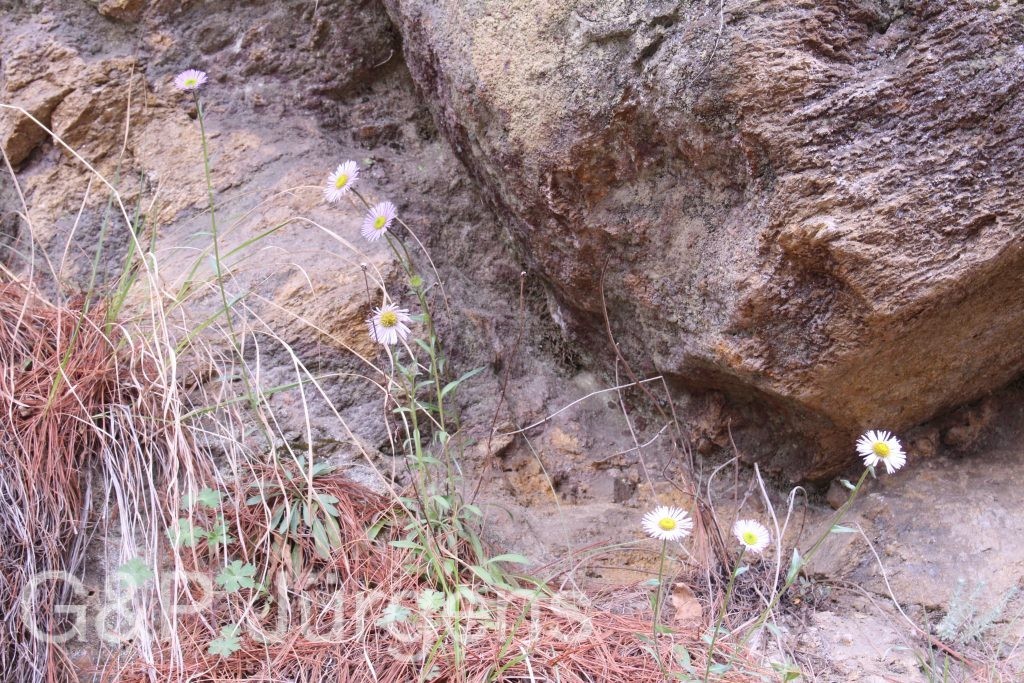
Aster neoelegans is an eastern Himalayan composite native to Bhutan, China (Tibet), India and Nepal, with 53 georeferenced occurrences indicating a fairly localised distribution along the main range. It grows on open grassy slopes, in scrub, forest clearings and on rocky banks in the temperate montane zone. It was photographed near Jakar in central Bhutan at 2400 m in May, flowering in spring on warm, well-drained slopes of the mid-montane belt, where it is a component of meadow and open-woodland communities.

It is an erect perennial herb arising from a short rhizome, with simple or sparingly branched, leafy, finely hairy stems. The alternate leaves are oblong to lanceolate or oblanceolate, entire to slightly toothed, narrowing to a sessile or clasping base and roughly pubescent. The flower heads are radiate and solitary or few in a loose corymb at the stem tips; each head has a hemispherical involucre of imbricate green phyllaries, an outer ring of spreading ligulate ray florets that are pale blue, lilac or mauve, and a central disc of yellow tubular florets. The fruit is a flattened, hairy cypsela bearing a pappus of barbellate bristles.

The genus Aster s.str. belongs to tribe Astereae and, following the segregation of numerous American and Asian species into other genera, comprises a predominantly Eurasian group well represented in the Sino-Himalaya. Aster neoelegans, described by Grierson, is one of several closely related Himalayan asters distinguished by subtle differences in leaf shape, indumentum and phyllary form. Ecologically it is an insect-pollinated meadow species. Owing to its restricted range it warrants monitoring, though it is not currently assessed as threatened.

Author: Grierson · Sources: POWO (Kew), GBIF, Flora of Bhutan, Flora of China, Asteraceae of the Himalaya (Grierson & Long studies)