Tag:

Subalpine (2500-3500 m)

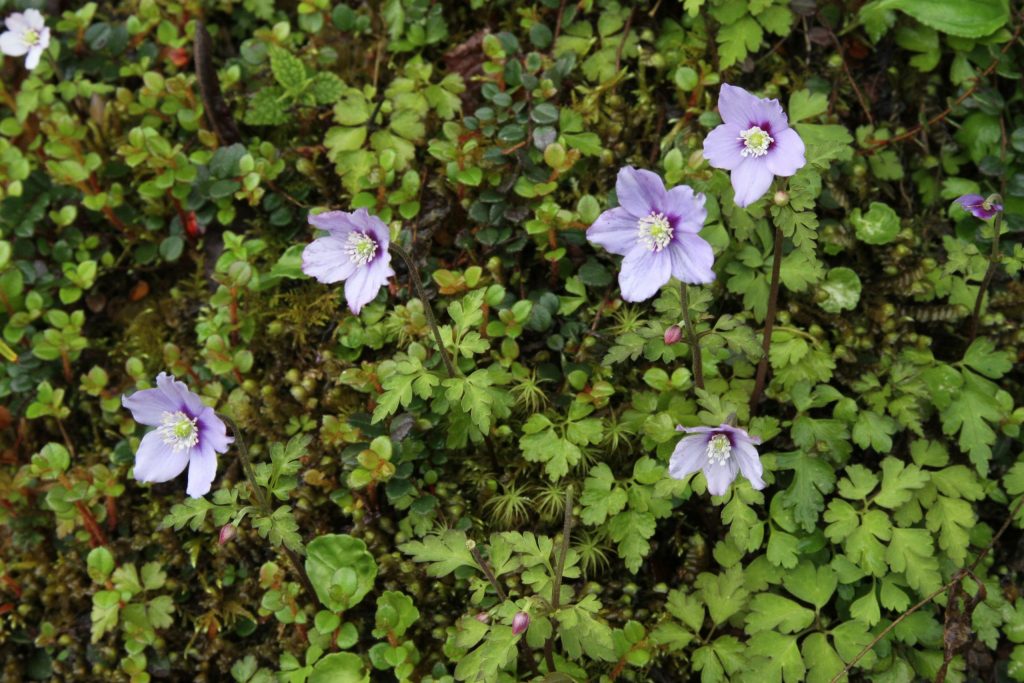
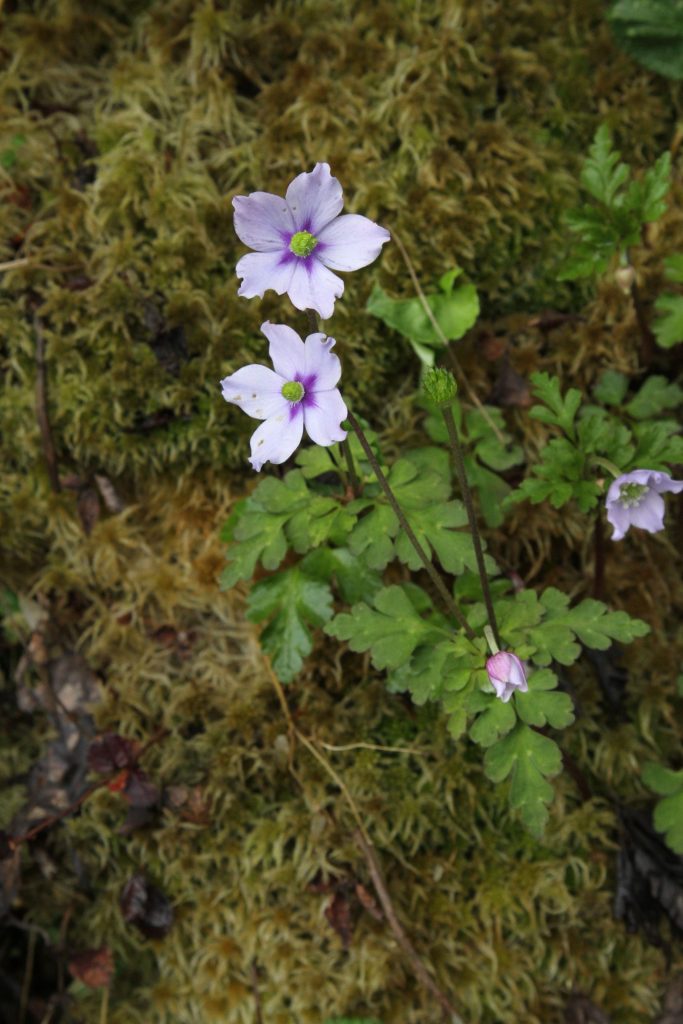
(Wall. ex Hook.f. & Thomson) Mosyakin
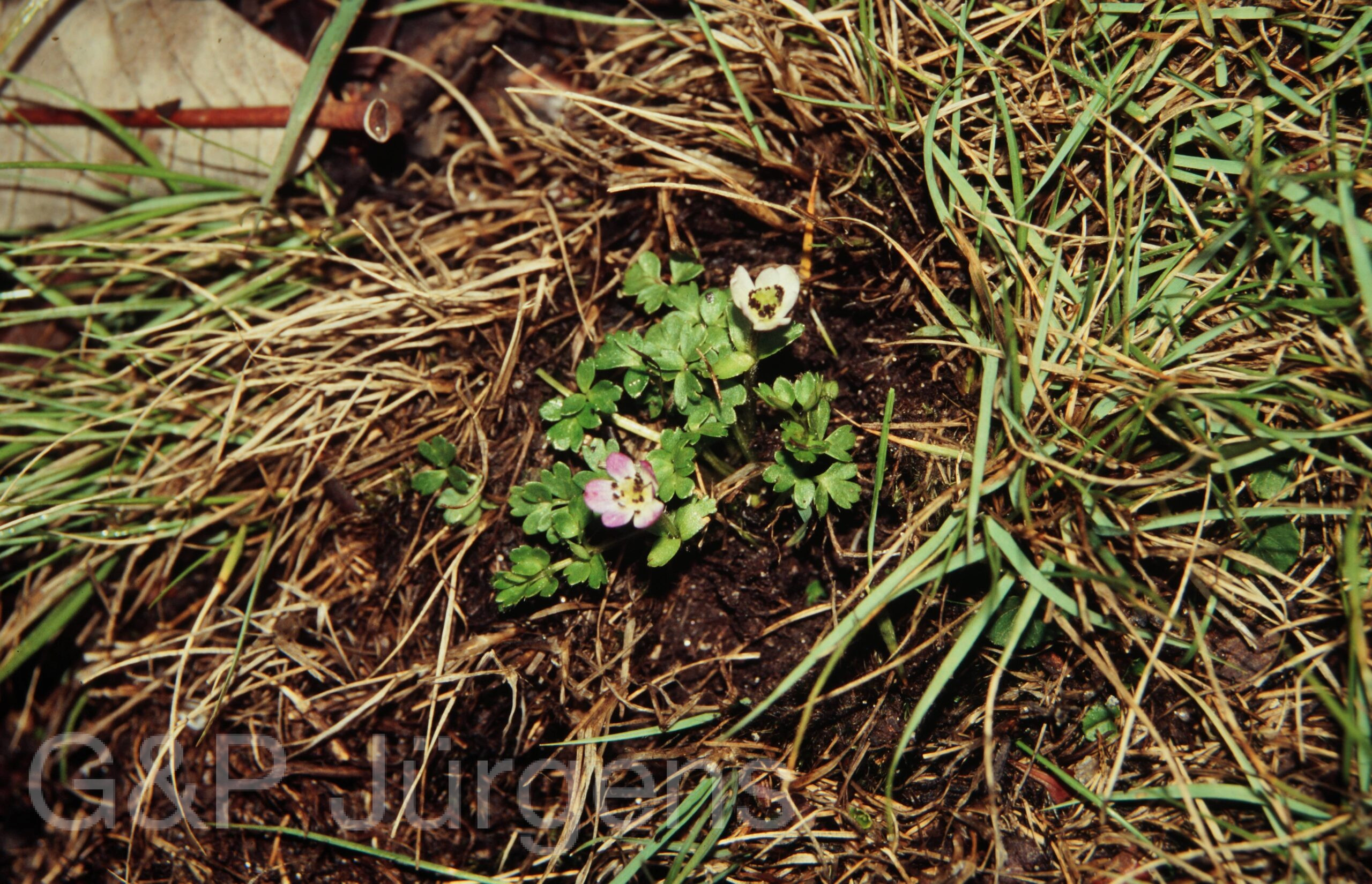
BhutanPG2011 219 scaled
Bhutan Jule-Tso, 4300m June
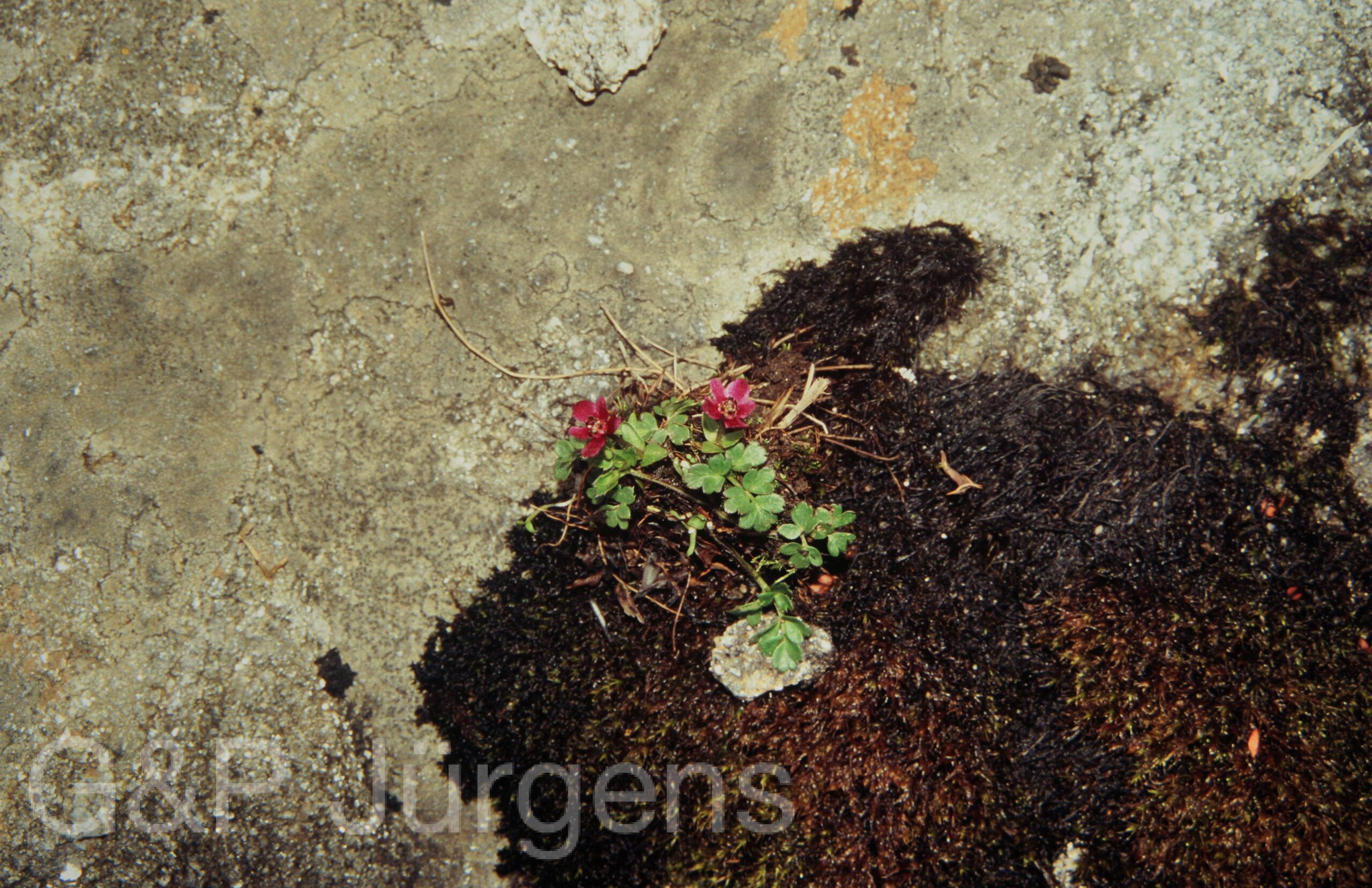
BhutanPG2011 344
Bhutan Jule-Tso, 4300m June

Description

Anemonastrum rupestre (Wall. ex Hook.f. & Thomson) Mosyakin is an alpine perennial of the Himalaya and adjacent mountains, recorded from Nepal, China, India, Bhutan and Myanmar, with about 223 occurrences in GBIF. It inhabits open alpine meadows, rocky slopes, screes and grassy ledges, mostly between 3,000 and 4,500 m. The photographed plants span this range: one from Helambu, Koktrok, in central Nepal at 3,100 m flowering in May, and another from Jule-Tso in Bhutan at 4,300 m in June, illustrating its broad altitudinal occupation of the subalpine to alpine zone.
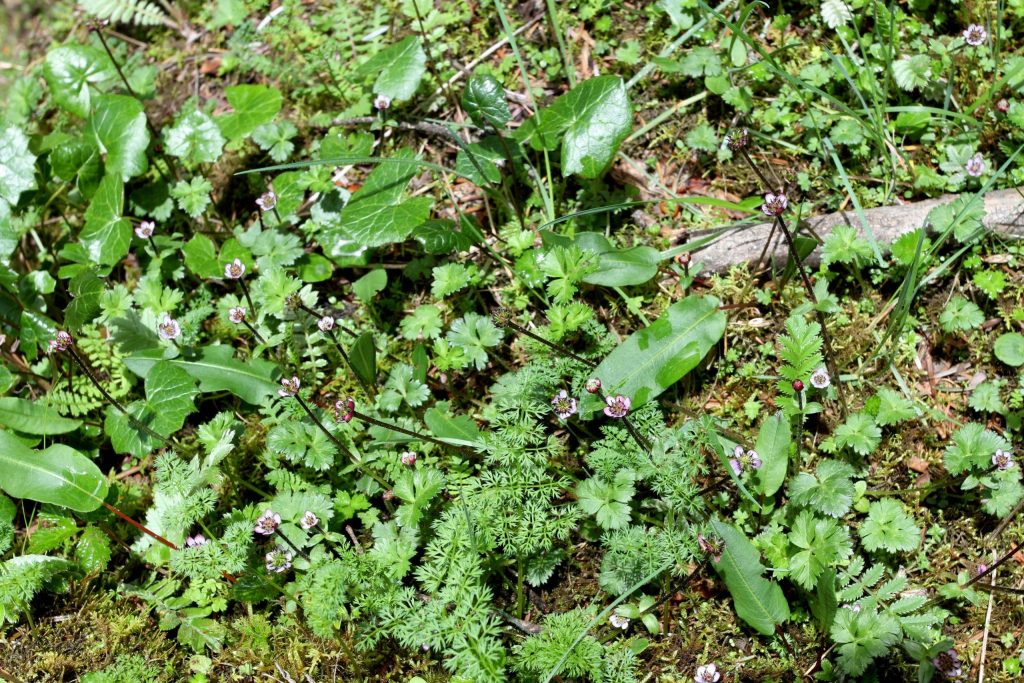
It is a tufted perennial herb arising from a stout rhizome, with the leaves largely basal and long-petiolate; the lamina is palmately divided into lobed and toothed segments. The flowering scape bears an involucre of leaf-like bracts subtending a few-flowered umbel-like cyme. The flowers lack true petals; the showy perianth consists of several white (sometimes pinkish or bluish-tinged) petaloid sepals surrounding numerous stamens and a head of free carpels. The fruit is an aggregate of laterally compressed, glabrous to pubescent achenes with a short persistent style.

The species was traditionally placed in Anemone, but molecular and morphological studies have led to its transfer to the segregate genus Anemonastrum (Ranunculaceae), characterised by basal leaves, bracteate scapes and compressed achenes. This taxonomic realignment reflects the modern reclassification of the Anemone alliance. As a widespread high-altitude element of the Sino-Himalayan flora occupying extensive natural habitat, it is not of conservation concern, though it remains subject to grazing pressure across its alpine pastures.

Author: (Wall. ex Hook.f. & Thomson) Mosyakin · Sources: POWO (Kew), GBIF, Flora of China, Flora of Bhutan, Annotated Checklist of the Flowering Plants of Nepal, Mosyakin reclassification of Anemone s.l., Ziman & Ehrendorfer studies of Anemone
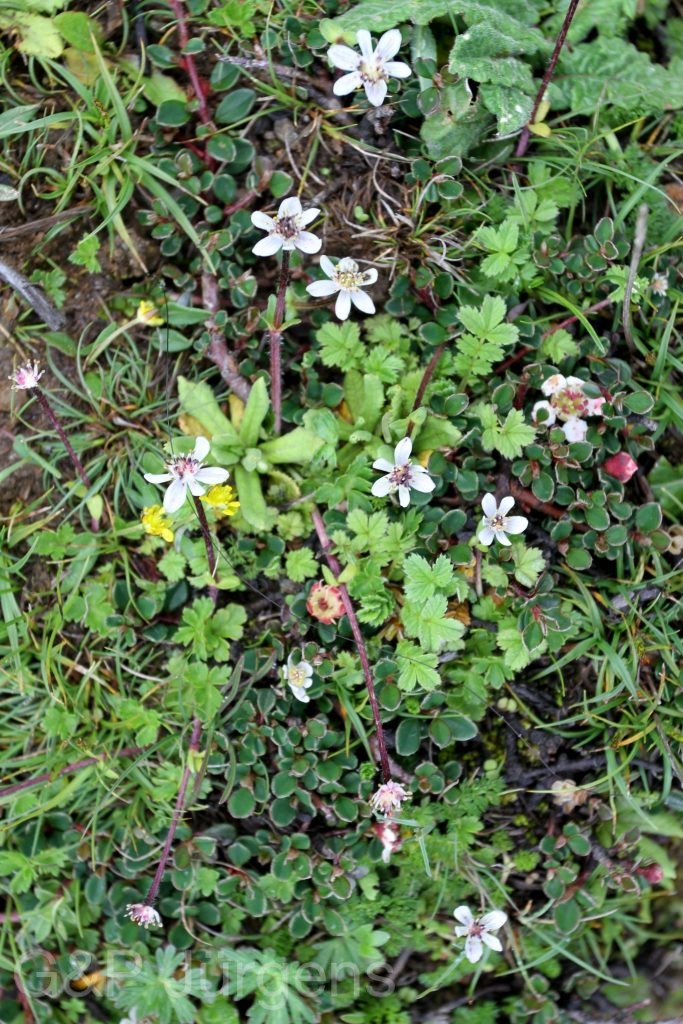
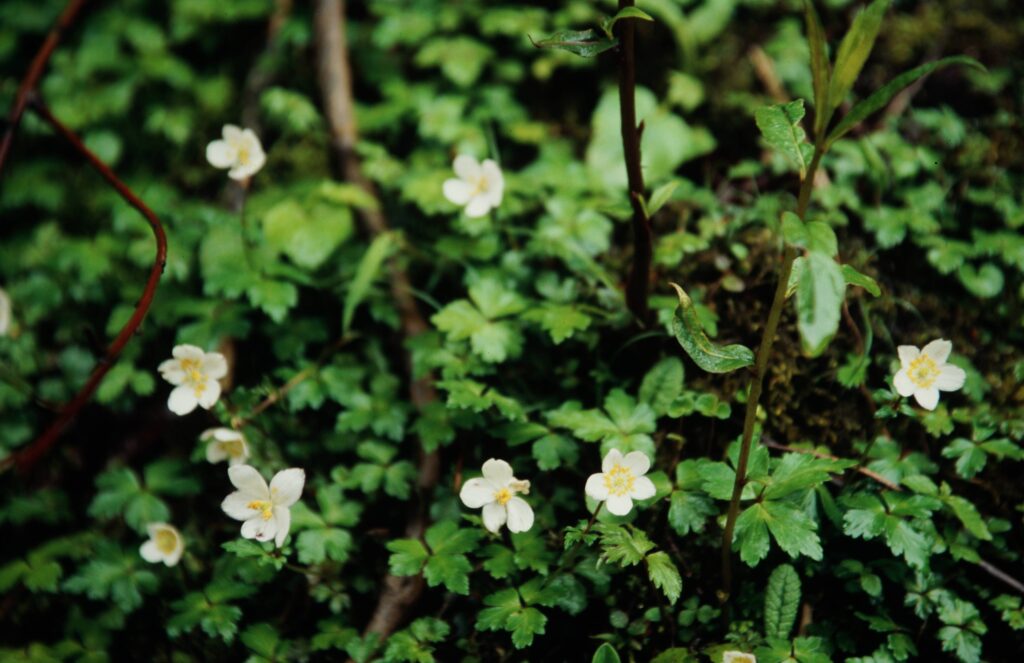
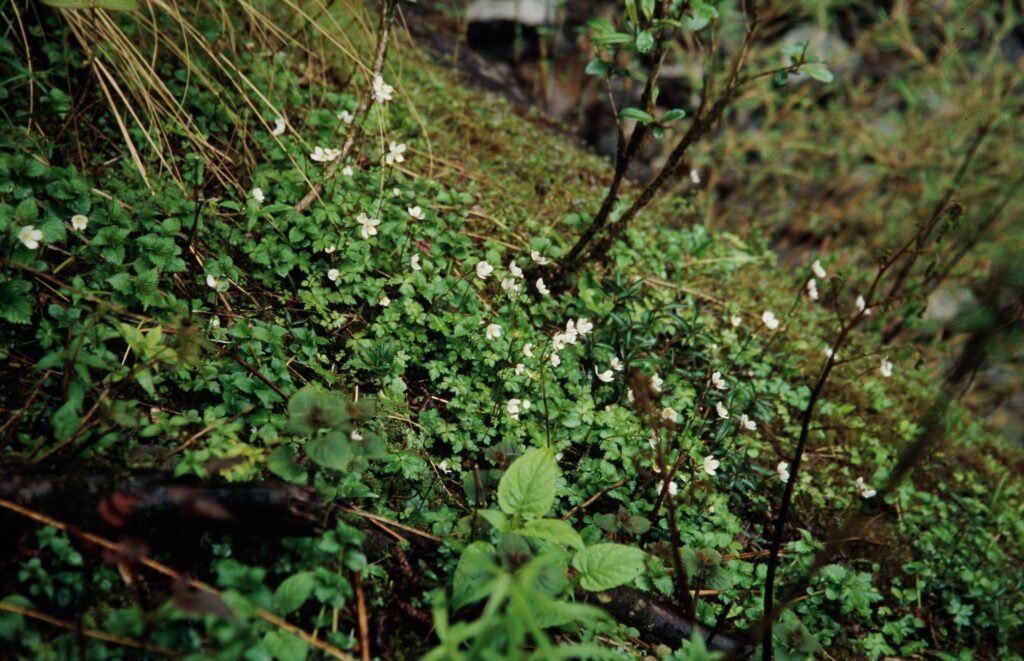
(Hook. & Thomson) Holub

Bhutan2014 325 scaled
Bhutan Tumching-La 2700m, May
Bhutan2014 330 scaled
Bhutan Tumching-La 2700m, May

Description

Anemonoides griffithii is a slender, woodland-floor perennial of the temperate eastern Himalaya, distributed through Sikkim, the Darjeeling district of West Bengal, Bhutan and adjacent southern Tibet (Xizang); GBIF, which records the species under the name Anemonoides griffithii, holds only a sparse occurrence dataset (a single georeferenced point from China), reflecting how thinly this shade-dwelling herb is documented despite a genuinely wider range. It favours the cool, humus-rich understorey of mixed conifer and broad-leaved forest and damp shrubberies, where it flowers in late spring as the canopy leafs out. The accompanying images, gathered at Tamrong (2650 m) in West Bengal and at the Tumching-La pass (2700 m) in Bhutan, both in May, place the plant squarely in its characteristic mid-montane band between roughly 2500 and 3500 m, in the moist, mossy conditions typical of the monsoon-fed Himalayan flank.

The plant arises from a short, creeping rhizome and is a delicate herb seldom exceeding 15-25 cm. The basal leaves are long-petiolate and ternately to palmately divided, with deeply incised, toothed segments and a thin, soft texture. The flowering stem bears a whorl of three stalked involucral leaves resembling reduced basal leaves, above which is borne a solitary terminal flower. There are no true petals; the showy perianth consists of five to several petaloid sepals, white often flushed pink or purple beneath, surrounding numerous stamens and a head of carpels. The fruit is an aggregate of small, ovoid, pubescent achenes tipped by a short style, dispersed as the involucre withers.

The species belongs to Anemonoides, a segregate genus split from the broadly circumscribed Anemone to accommodate the rhizomatous, woodland anemones of the A. nemorosa alliance, and many references still treat it under Anemone griffithii. Within the Himalaya it is one of several closely allied spring-flowering forest anemones, distinguished by leaf dissection and perianth colour. As a low-growing, monsoon-region understorey herb it has not been formally assessed for conservation status, but its dependence on intact temperate forest makes it locally sensitive to logging and grazing pressure across its restricted eastern-Himalayan range.

Author: (Hook. & Thomson) Holub · Sources: POWO (Kew), GBIF, Flora of Bhutan Vol. 1, Flora of China Vol. 6, Flora of Nepal, Tamura's Ranunculaceae treatment in The Families and Genera of Vascular Plants


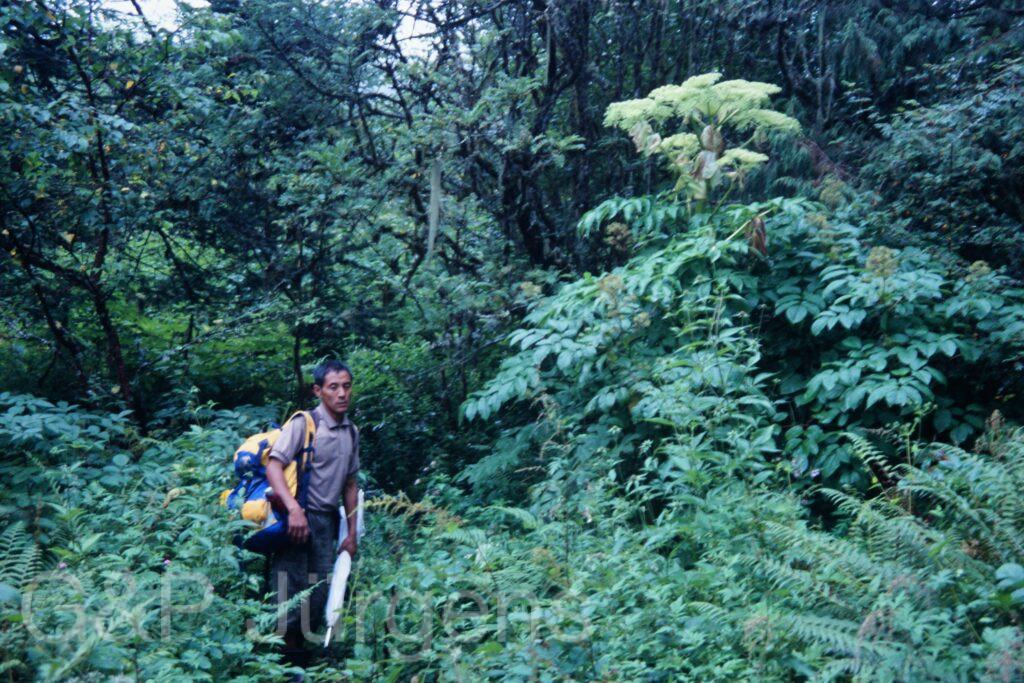
(C.Norman) M.Hiroe
Sikkim2003 398 P560
Sikkim Zemu Valley 3450m, August
Sikkim2003 399 P561
Sikkim Zemu Valley 3450m August

Description

Angelica cyclocarpa is a Himalayan umbellifer distributed along the central and eastern ranges from Pakistan and the Indian Himalaya through Nepal, Sikkim and Bhutan, GBIF documenting 29 occurrences across Nepal, Bhutan, India and Pakistan (NP, BT, IN, PK). It is a plant of moist subalpine and lower alpine habitats, occurring in tall-herb meadows, open forest margins, streamsides and damp grassy slopes generally between about 3000 and 4000 m. The photographed plants from the Zemu Valley in Sikkim at 3450 m in August capture its flowering during the late monsoon, when the lush, herb-rich vegetation of these moist eastern valleys reaches its peak development.

It is a robust, erect, biennial to perennial herb arising from a stout aromatic root, the hollow, ridged stems often purplish below. The large leaves are several-times pinnate or ternate-pinnate with sharply toothed ovate to lanceolate leaflets, the petiole bases expanded into conspicuous inflated sheaths clasping the stem. The white flowers are borne in large compound umbels with numerous rays; petals are obovate with an inflexed apex. The fruit is a dorsally compressed schizocarp with prominent winged lateral ribs and slender dorsal ribs, the rounded, broadly winged outline giving the species its epithet cyclocarpa.

A member of Angelica (Apiaceae, subfamily Apioideae), the species belongs to a complex of Sino-Himalayan tall umbellifers whose generic limits relative to Pleurospermum and allied genera have been repeatedly revised. The combination by M. Hiroe reflects this taxonomic mobility. Its flat-topped white umbels attract a broad spectrum of generalist insect pollinators, and the aromatic, resinous tissues typical of the genus are present. Restricted to remote high-elevation meadows, it is not regarded as threatened.

Sources: POWO (Kew), GBIF, Flora of China Vol. 14, Flora of Bhutan Vol. 2, Flora of Nepal, Umbelliferae of British India (C.B. Clarke)

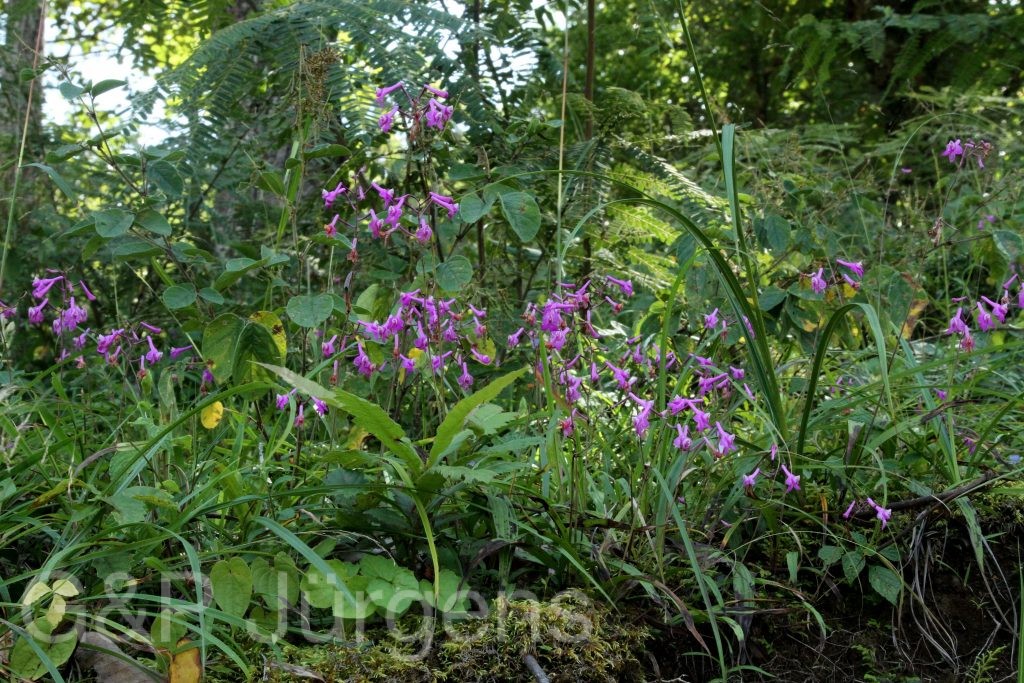
Wall.

Bhutan2012 473
Bhutan Wangdi 2500m, September
Bhutan2012 474
Bhutan Wangdi 2500m, September

Description

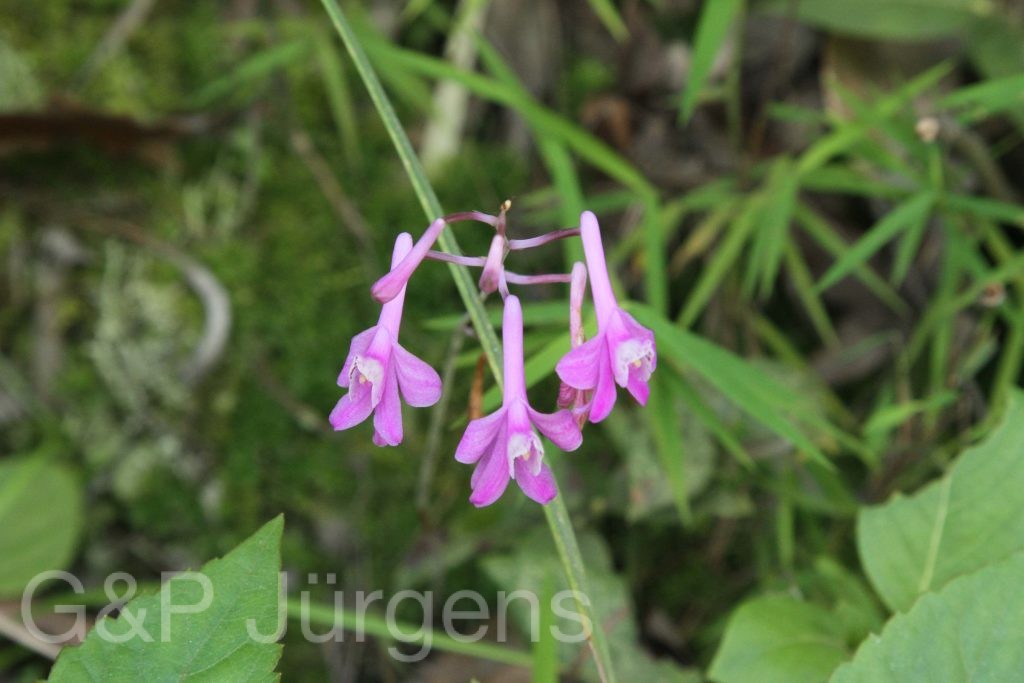
Anthogonium gracile is a terrestrial orchid and the sole species in the monotypic genus Anthogonium. It is distributed from Nepal through northeast India (Sikkim, Darjeeling, Assam, Arunachal Pradesh), Bhutan, and Myanmar into Thailand, Indochina, and southwest China (Yunnan, Guangxi). The species occurs in open, grassy hillsides, pine forests, and degraded forest margins at elevations of 1,000–3,000 m, often in seasonally moist grassland.

The plant produces slender, reed-like stems 30–80 cm tall from underground tubers, with narrow, plicate, grass-like leaves arranged along the upper portion of the stem. The inflorescence is a lax, terminal raceme bearing 5–15 flowers that open successively. Flowers are 3–4 cm across, typically rose-pink to magenta, with a broad, spreading lip that is darker pink with a yellow callus of parallel lamellae. The column is slender and gently curved. Flowering in the Himalayas occurs from August to October.

Anthogonium gracile is taxonomically isolated within the Orchidaceae, though molecular phylogenetic analyses place it close to Calanthe and Phaius. Its preference for open, fire-maintained habitats suggests adaptation to seasonal burning regimes characteristic of Himalayan montane grasslands.

Author: Wall. · Sources: POWO (Kew), Flora of Bhutan Vol. 3, GBIF, Pearce & Cribb: The Orchids of Bhutan (2002)

(Baker) Falc. ex Munz.

Description

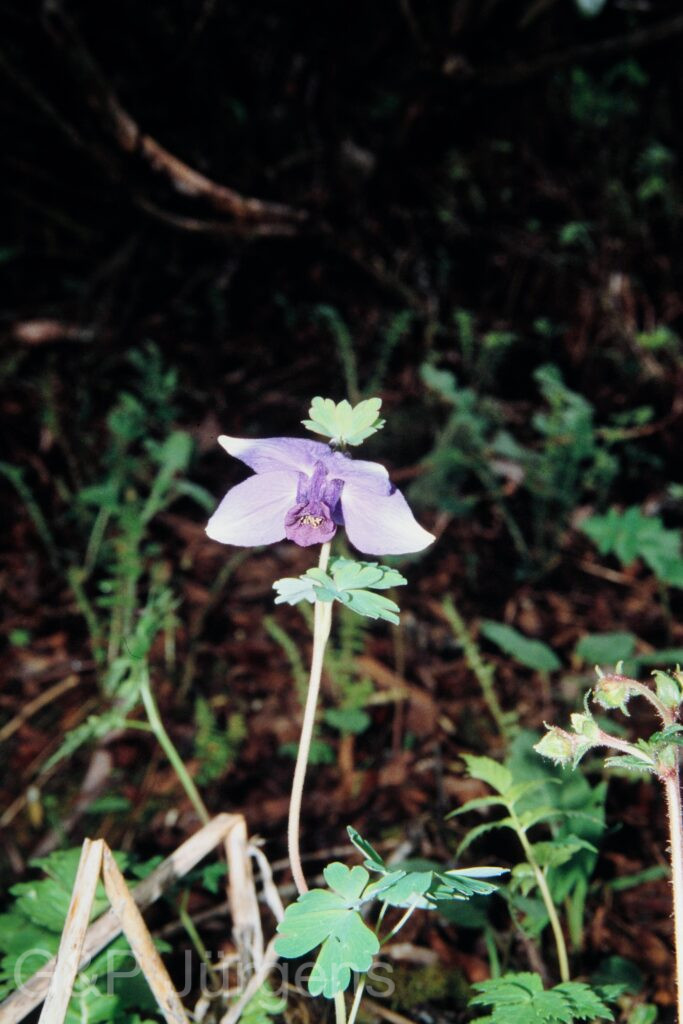
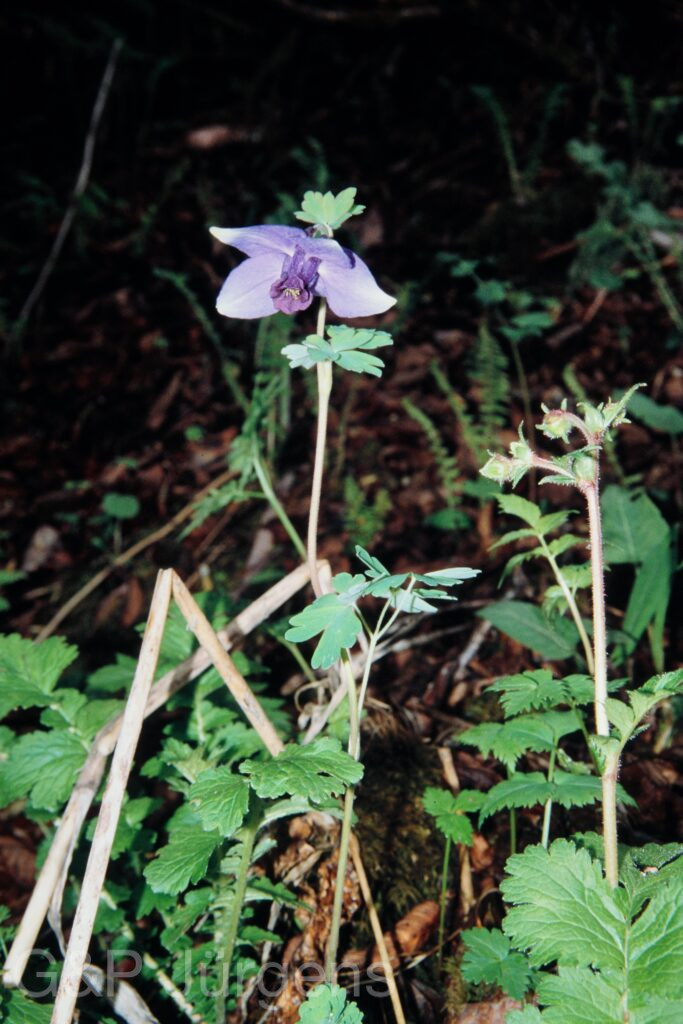
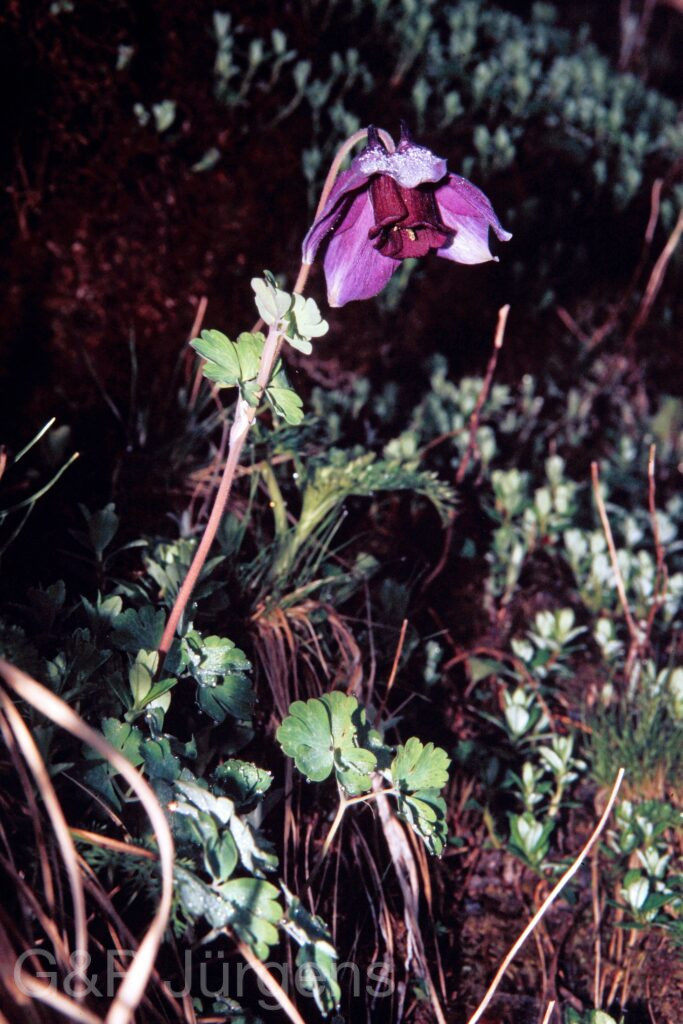
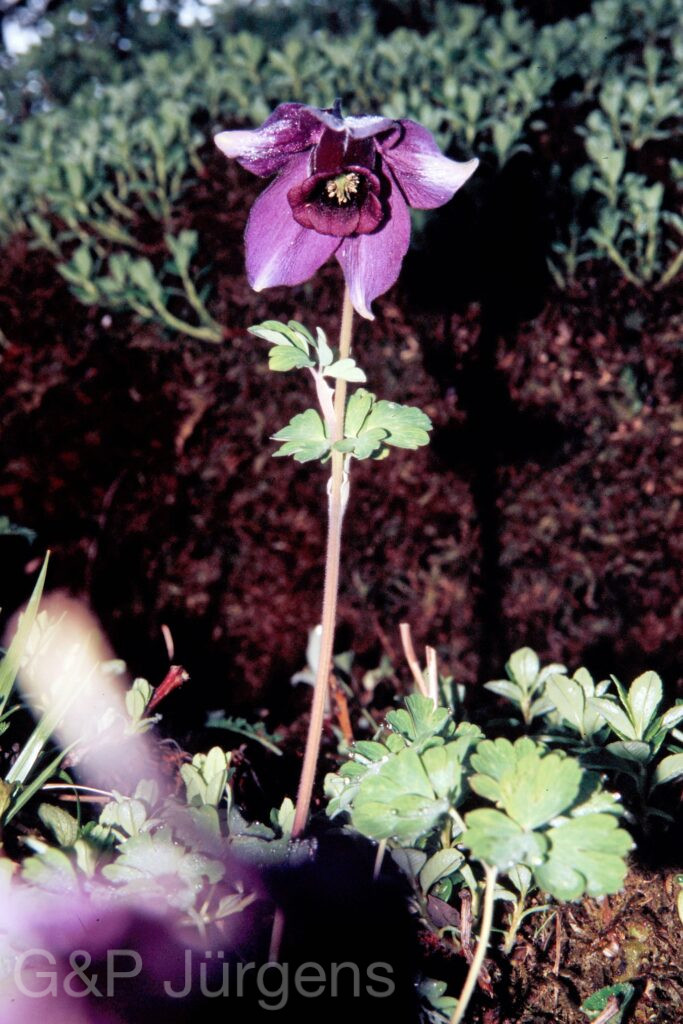
Aquilegia nivalis is a dwarf alpine columbine of the western Himalaya, with GBIF recording around 105 occurrences from Pakistan, India and Nepal. It is restricted to the high alpine zone, growing in moist rocky meadows, screes, glacial moraine and snowbed turf, broadly between 3300 and 4500 m. The photographed plants come from West Nepal south of Tara Lake (3300 m, June) and from Garhwal in India at Meggu Kichatti (3400 m, June), flowering soon after snowmelt on cool, well-drained, gravelly substrates near the upper limit of vascular vegetation.

The plant is a compact perennial arising from a stout rootstock, forming a low tuft of long-petioled, ternately divided basal leaves with rounded, lobed, somewhat glaucous segments. The flowering stem is short and often single-flowered, nodding the large solitary flower well above the foliage. The flower is dark purple to blackish-violet, with five petaloid sepals and five tubular petals each prolonged backward into a short, stout, incurved spur far shorter than in lowland columbines. Numerous stamens surround the carpels, the inner stamens reduced to membranous staminodes. The fruit is a cluster of erect, beaked follicles releasing small black seeds.

Aquilegia (Ranunculaceae) is a model genus for the study of rapid adaptive radiation, in which spur length and flower colour track pollinator shifts; the very short spur and dark, nodding flower of A. nivalis reflect adaptation to a harsh, short alpine season. GBIF treats the name as accepted. Its narrow western-Himalayan range and high-elevation specialism make it a notable endemic, potentially sensitive to climatic warming and snowpack change.

Author: (Baker) Falc. ex Munz. · Sources: POWO (Kew), GBIF, Flora of Pakistan, Flora of British India, Munz monograph of Aquilegia

Royle

Nepal 99 65 ergebnis
West-Nepal Nyor Gaad 2700m, June
Garh 07 245 ergebnis
India Garhwal Barron Chatti 2450m, June

Description

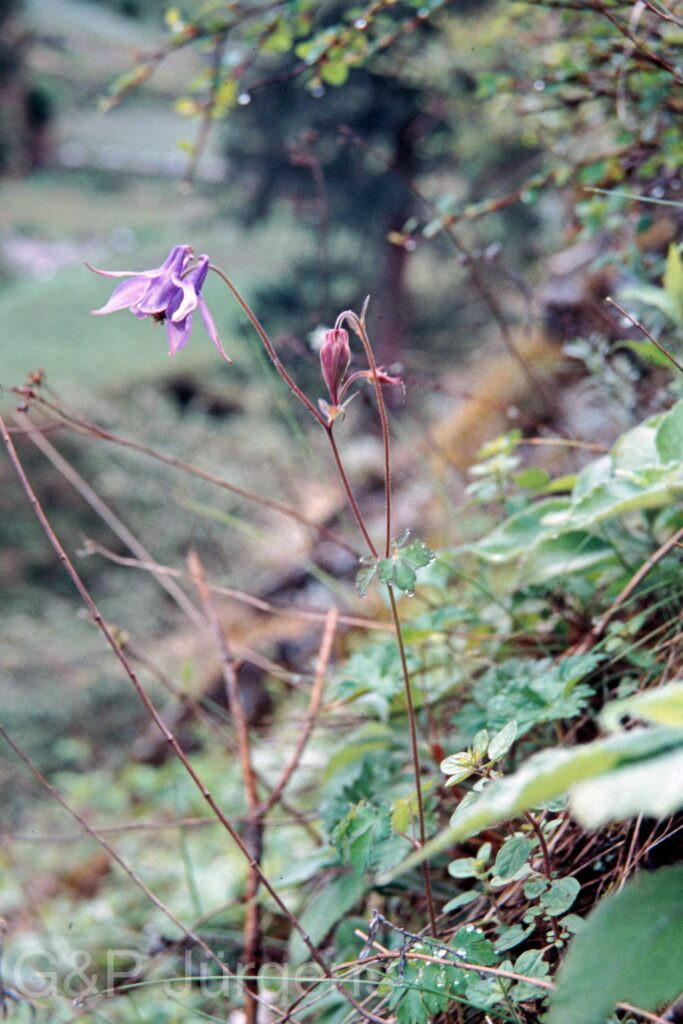
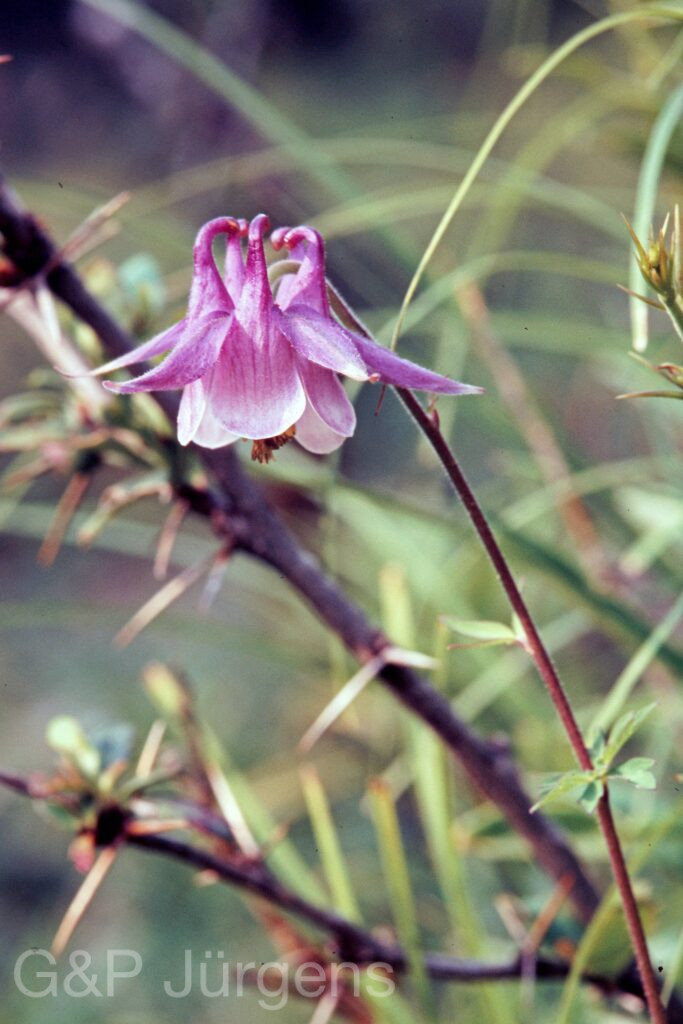
Aquilegia pubiflora is a columbine of the western and central Himalaya, recorded from Afghanistan, Pakistan, India, Nepal and adjacent China. It grows in shady forest, scrub, grassy slopes, stream banks and rocky places in the temperate montane belt, generally between about 2000 and 3600 m. The photographed plants come from Nyor Gaad in West Nepal at around 2700 m and from Barron Chatti in Indian Garhwal at about 2450 m, both flowering in June. With around 240 georeferenced occurrences it is a moderately well-documented and characteristic Himalayan member of its genus along forest margins and in semi-open habitats of the inner valleys.

It is an erect perennial herb up to about 1 m, arising from a stout rootstock, the stems branched above and finely pubescent. The leaves are mostly basal and biternate, the leaflets obovate and lobed, glaucous and softly hairy especially beneath. The nodding to half-nodding flowers are borne on slender pedicels; each has five petaloid sepals and five petals, the petals prolonged backward into prominent hooked or incurved nectar spurs that are the diagnostic feature of Aquilegia. The flowers are pale to deep purple, lilac or whitish, finely pubescent on the outside, as the epithet pubiflora indicates. The numerous stamens are exserted, the inner ones forming membranous staminodes, and the carpels are five and free, ripening into erect, pubescent, many-seeded follicles.

Aquilegia pubiflora belongs to the Asian assemblage of the genus and is distinguished by its softly hairy, spurred flowers and biternate foliage; it intergrades with related Himalayan columbines and has been treated under varying circumscriptions. Like other columbines it is pollinated by long-tongued insects attracted to the nectar spurs. As a widespread temperate herb it is of least conservation concern.

Author: Royle · Sources: POWO (Kew), GBIF, Flora of China, Flora Iranica, Munz monograph of Aquilegia

M.Bieb.

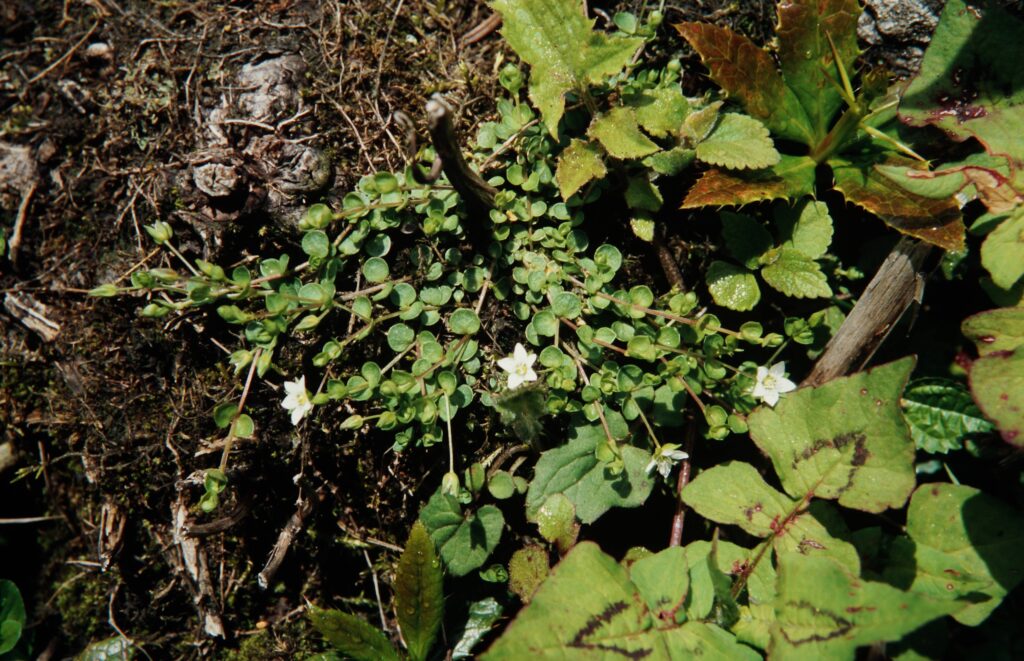
Bh09 185 P322
Bhutan Phajoding, 3600m June
Sikkim 2006 414 ergebnis
India West-Bengal, Kishong 2800m, May

Description

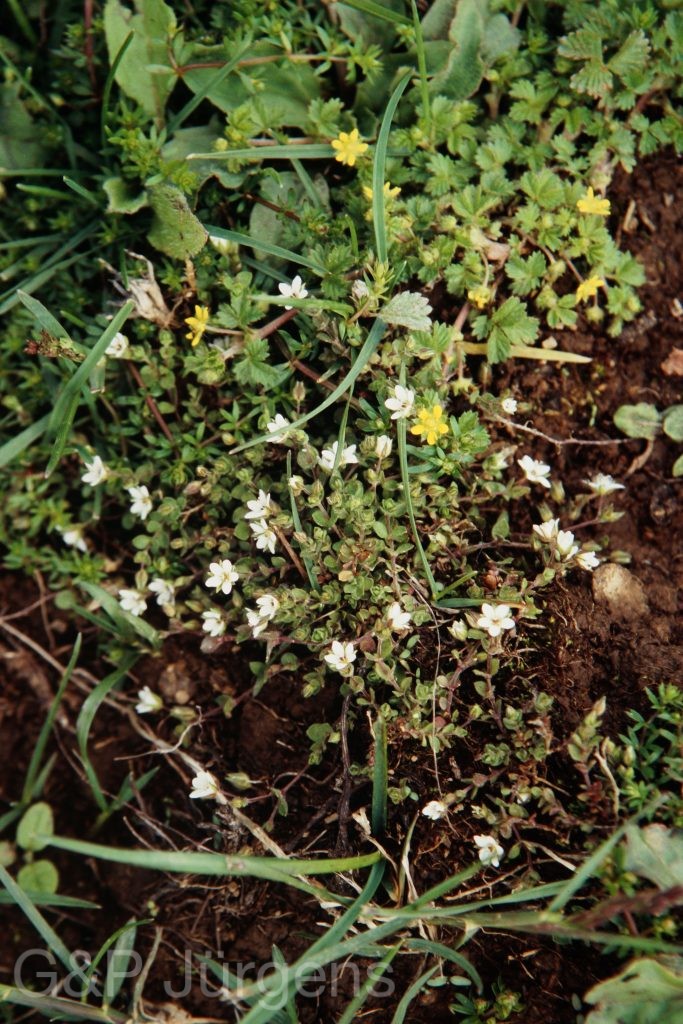
Arenaria rotundifolia is a small alpine sandwort with a wide Eurasian montane distribution, documented by 331 georeferenced records reaching from the Caucasus and Anatolia (TR, GE, AM) and the Balkans (GR, AL, BG, ME, RS) eastward through Iran (IR) and Central Asia (KZ, UZ, TJ, KG) to China (CN), Nepal (NP) and India (IN). It is a plant of moist, open alpine and subalpine ground, growing on rocky slopes, screes, streamsides, damp turf and shaded banks at high elevation. The plants recorded at Phajoding in Bhutan at 3600 m in June and at Kishong in West Bengal at 2800 m in May illustrate its presence in cool, moist Himalayan montane habitats toward the eastern edge of its range.

It is a small, slender, tufted to loosely mat-forming perennial herb with delicate, ascending to decumbent, often glandular-hairy stems. The leaves are opposite, distinctly small and rounded, ovate to suborbicular, shortly petiolate below and sessile above, giving rise to the epithet rotundifolia. The flowers are borne in few-flowered, lax cymes; each has five free, green sepals and five white, entire (not notched) petals, ten stamens and a superior ovary with three styles, in the usual arrangement of the genus. The fruit is a small capsule opening by teeth twice the number of the styles to release numerous minute, reniform seeds.

Arenaria (Caryophyllaceae) is a large, taxonomically difficult genus of mostly cushion- or mat-forming herbs of cold and rocky habitats, in which species circumscription has long been complicated by reticulate variation across its broad Holarctic range. A. rotundifolia, with its wide trans-Eurasian montane distribution, exemplifies this pattern. It is a frequent and widespread alpine herb of no conservation concern, valued chiefly as an indicator of moist, high-elevation rock and turf communities.

Author: M.Bieb. · Sources: POWO (Kew), GBIF, Flora of Bhutan, Flora of China, Flora Europaea, McNeill monographic studies of Arenaria (Caryophyllaceae)

Schott

Bhutan2014 114
Bhutan Kadi 1600m, May
Bh09 254 P423
Bhutan Phobjika, 2900m June
Nepal 99 234 ergebnis
West-Nepal Gattalekh 2800m, June

Description

Arisaema consanguineum Schott is a widespread tuberous aroid of the Sino-Himalayan region, recorded from China, Taiwan, Thailand, Nepal, Bhutan, India, Myanmar, Vietnam, the Philippines, Laos and Japan, with cultivated records reaching Europe and North America; GBIF documents over 2000 occurrences. It grows in shaded forest, forest margins, bamboo thickets, scrub and grassy slopes, generally between about 1500 and 3300 m. The illustrated plants were recorded at Kadi (1600 m, May) and Phobjika (2900 m, June) in Bhutan and at Gattalekh in West Nepal (2800 m, June), spanning the warm-temperate to cool-temperate montane zone where this jack-in-the-pulpit emerges with the early monsoon.

The plant arises from a depressed-globose tuber, producing a stout pseudostem sheathed by the mottled petiole bases. There is usually a single radiate (pedately compound) leaf bearing numerous narrow, lanceolate leaflets that frequently terminate in long, threadlike drip-tips and are sometimes silvery-banded. The inflorescence is a spadix enclosed by a green to purplish, white-striped spathe whose limb arches forward; the spadix appendage is slender and elongate. Plants are typically dioecious, sex expression varying with tuber size. The fruit is a dense cylindrical infructescence of red berries borne on the persistent spadix.

A member of the species-rich genus Arisaema, this taxon belongs to the radiate-leaved Sino-Himalayan group and is prized in horticulture for its striking foliage. Sex change linked to plant vigour is an ecological hallmark of the genus, and the showy berries are bird-dispersed. The species is common and adaptable, not of conservation concern, though wild tubers are locally harvested for traditional medicine.

Author: Schott · Sources: POWO (Kew), GBIF, Flora of China, Flora of Bhutan, Annotated Checklist of the Flowering Plants of Nepal, Gusman & Gusman The Genus Arisaema

Schott

Sikkim 2006 70 ergebnis
Sikkim India Kalipokhri 2900m, May

Description

Arisaema decipiens (Schott) is a tuberous perennial of the family Araceae (the genus is here listed under the synonymous family heading Aceraceae) distributed through the eastern Himalaya and adjacent Southeast Asia, from northeast India and Myanmar through southern China to Vietnam, Japan and Malaysia. With only around 230 GBIF occurrences it is a comparatively localised species of the moist eastern montane forests. It grows in the shaded understorey of evergreen and mixed broad-leaved forest, on humus-rich slopes and among rocks, principally between 2,000 and 3,000 m, as exemplified by the collection from Kalipokhri in Sikkim, India, at 2,900 m in May, when the cohort of fresh inflorescences emerges with the spring growth.

The plant arises from a depressed-globose tuber and produces a pseudostem formed by the overlapping leaf sheaths. Typically a single trifoliolate (occasionally pedately divided) leaf is produced, with elliptic to ovate, acuminate leaflets. The inflorescence is the characteristic aroid spadix enclosed by a green to purplish spathe striped with white; the spathe limb is hooded and tapers to a slender tip, while the spadix appendix is slender and stipitate. As in most Arisaema the species is paradioecious, individual plants changing functional sex between male and female phases according to size and vigour. The fruit is a head of red berries borne on the persistent infructescence.

Arisaema is a large and taxonomically intricate genus in which species boundaries rest heavily on spathe coloration and spadix-appendix form, and A. decipiens belongs to a closely related complex of eastern Himalayan cobra-lilies. Its size-dependent sex change is of considerable interest to reproductive ecologists. Restricted to the wetter eastern ranges, the species is less common than its western congeners but is not currently regarded as threatened.

Author: Schott · Sources: POWO (Kew), Flora of Bhutan Vol. 3, GBIF, Flora of China Vol. 23, Gusman & Gusman: The Genus Arisaema (2006)

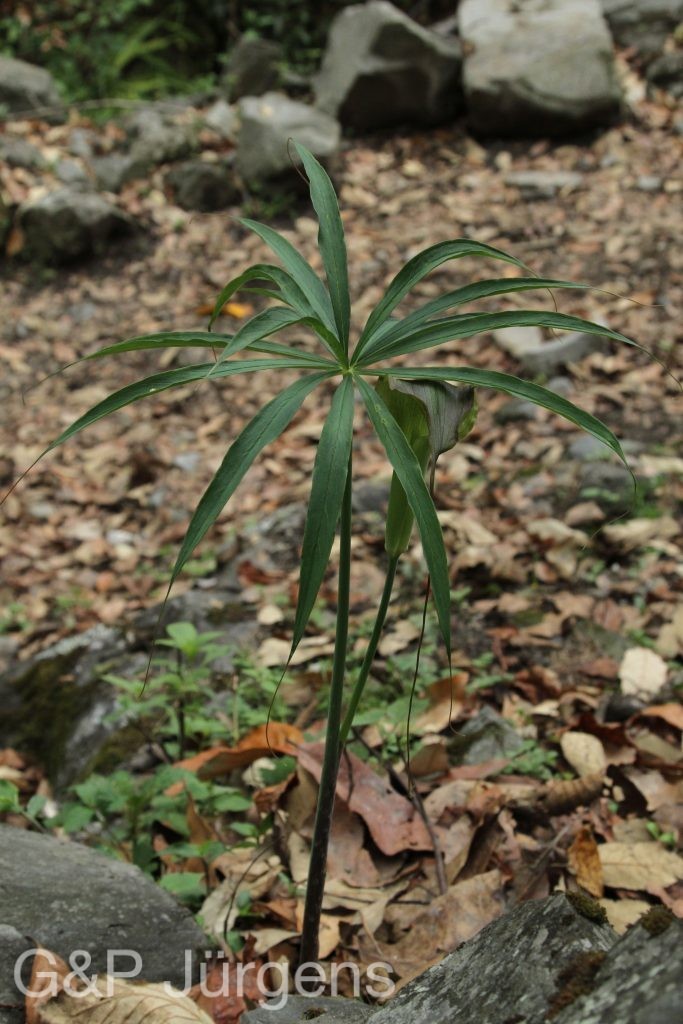
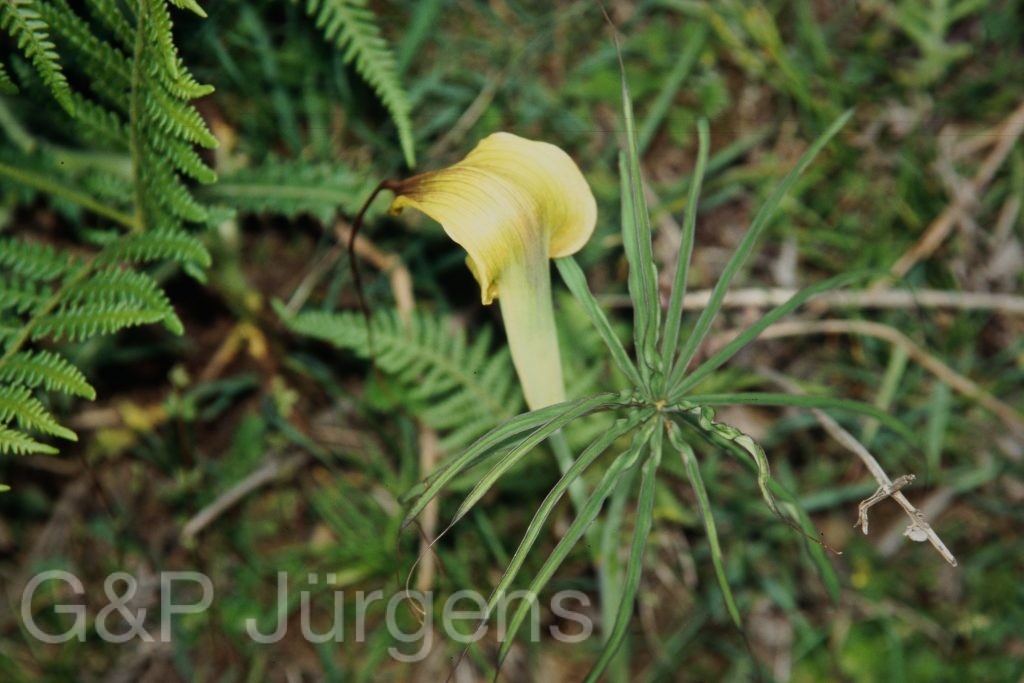
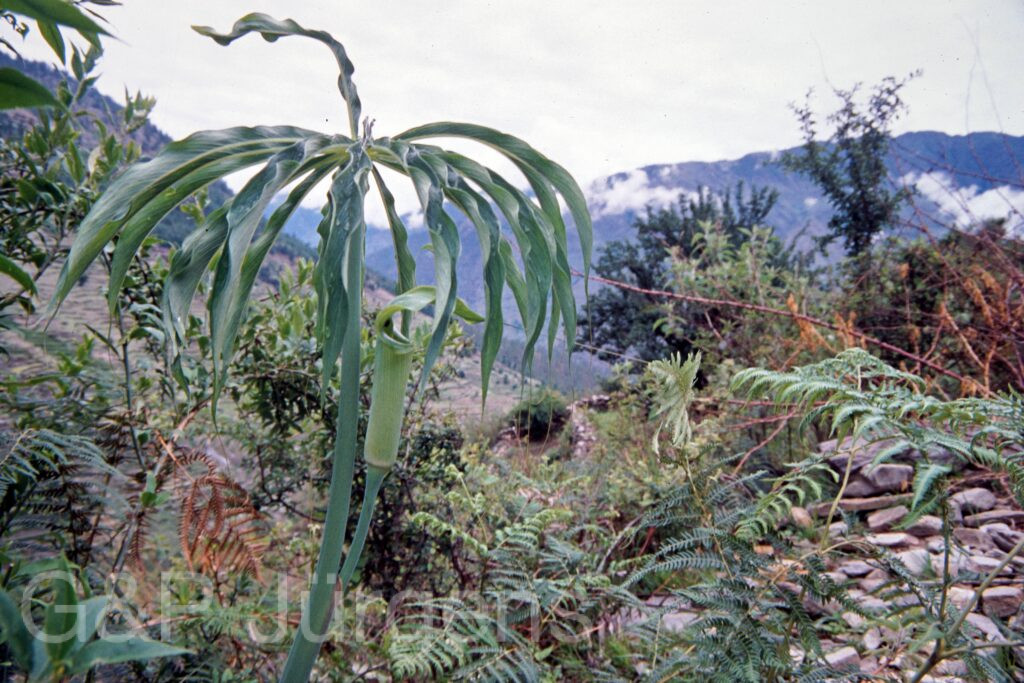
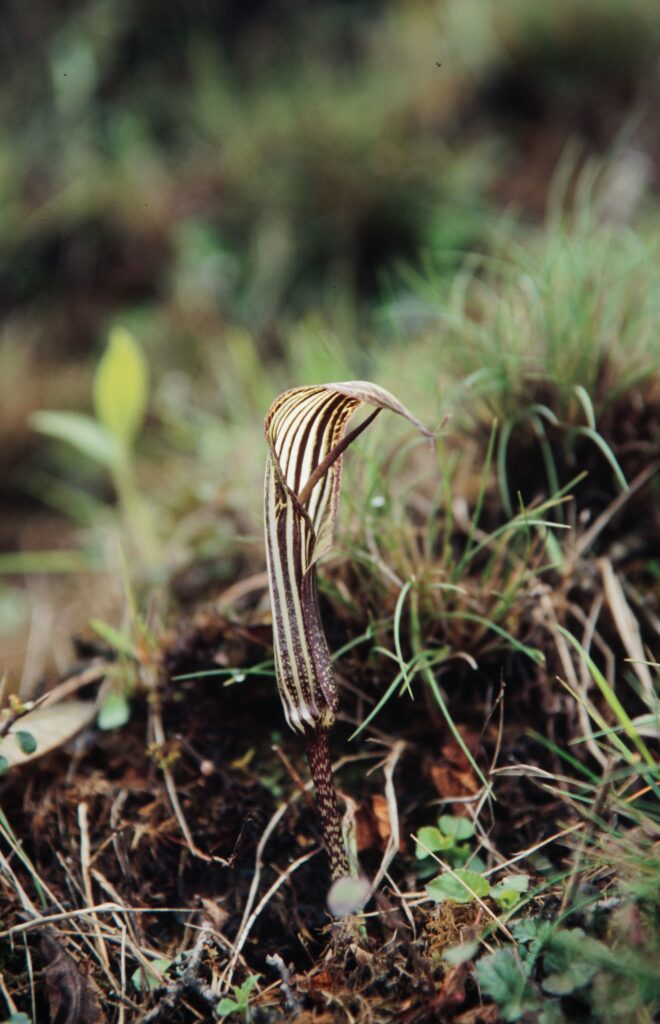
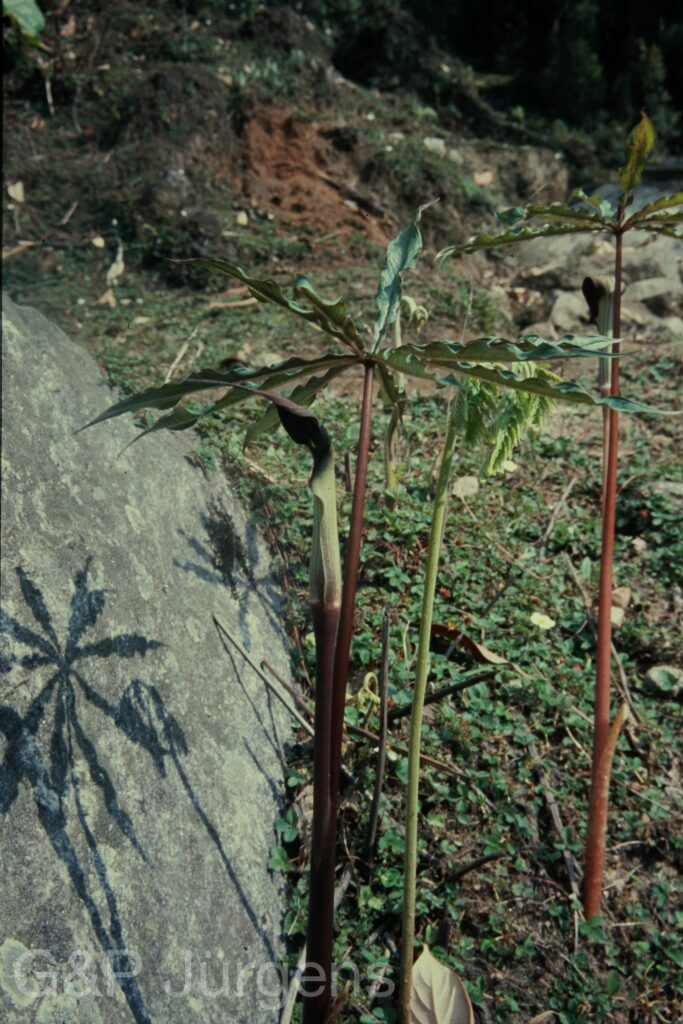
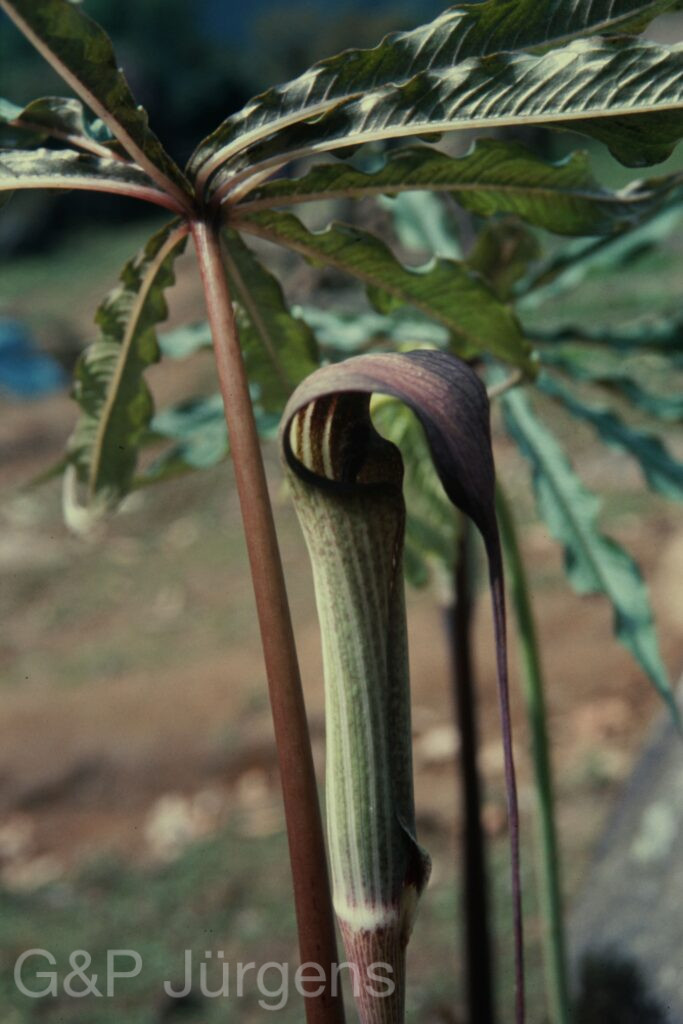
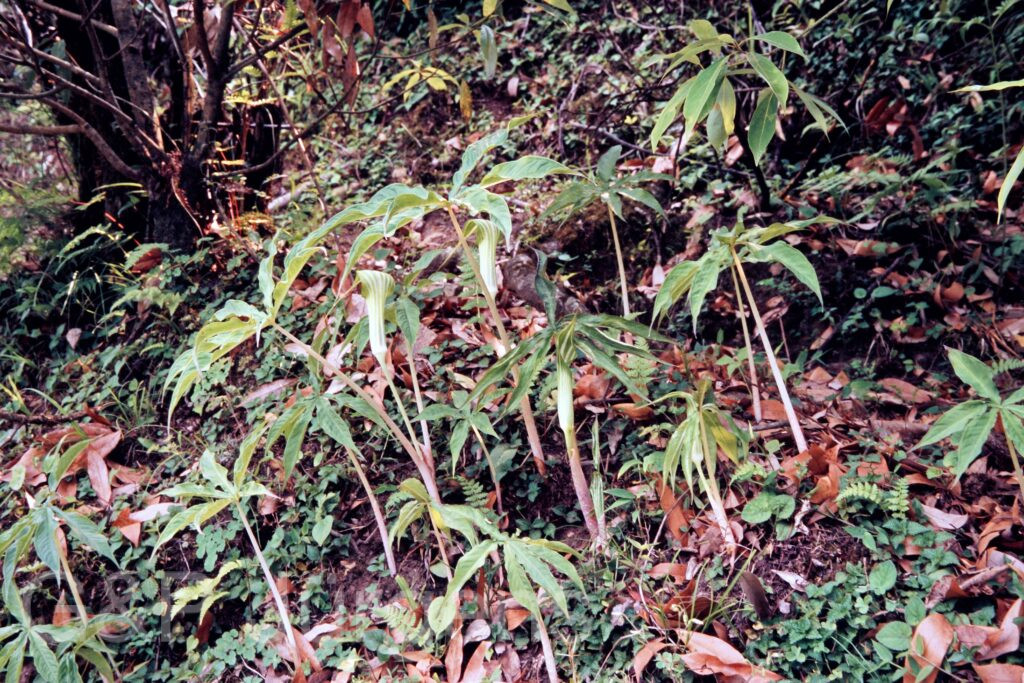
Arisaema echinatum

by GP Jürgens

(Wall.) Schott

Sikkim2004 326 P587
Sikkim/India Kokchurong 3400m May
Sikkim2004 327 P588
Sikkim/India Kokchurong 3400m May
Garh 07 86 ergebnis
India Garhwal Trijugi Narayan 2450m, June

Description

Arisaema echinatum is a tuberous aroid of the Himalaya, distributed through China, Nepal, India and Bhutan, with about 44 georeferenced records spread along the temperate to subalpine Himalayan belt. It grows in moist, shaded forest, among rhododendron and conifer scrub and on humus-rich banks, generally between 2400 and 3500 m. The cited collections from Kokchurong in Sikkim (3400 m, May) and from Trijugi Narayan in Garhwal (2450 m, June) bracket its altitudinal range and show its emergence and flowering through the late spring and early monsoon as the soil warms.

The plant arises from a depressed-globose tuber and usually bears one or two pedately compound leaves, each divided into several oblong-elliptic, acuminate leaflets borne on a long sheathing petiole. The inflorescence comprises a spathe with a cylindrical tube and an incurved, acuminate limb, enclosing the spadix; the diagnostic feature is the sterile appendix of the spadix, which is roughened or echinate with projecting papillae or processes, giving the species its name. As in most Arisaema the plants are sequentially hermaphrodite, shifting sex with size. The infructescence is a dense head of crowded scarlet berries.

Arisaema echinatum, transferred to the genus by Schott from Wallich's basionym, belongs to the taxonomically intricate Himalayan section of the genus, where appendix morphology is a key diagnostic. Pollination is by small flies and fungus gnats lured into and temporarily trapped by the spathe, and the bright berries are bird-dispersed. With a restricted montane range and few records, it is potentially sensitive to forest loss, though it has not been formally assessed for conservation.

Author: (Wall.) Schott · Sources: POWO (Kew), GBIF, Flora of China, Flora of Bhutan, Annotated Checklist of the Flowering Plants of Nepal, Gusman & Gusman The Genus Arisaema