Tag:

Subalpine (2500-3500 m)

Wall. ex DC.

Bhutan2015 26
Bhutan Dochu-La 3100m, October

Description

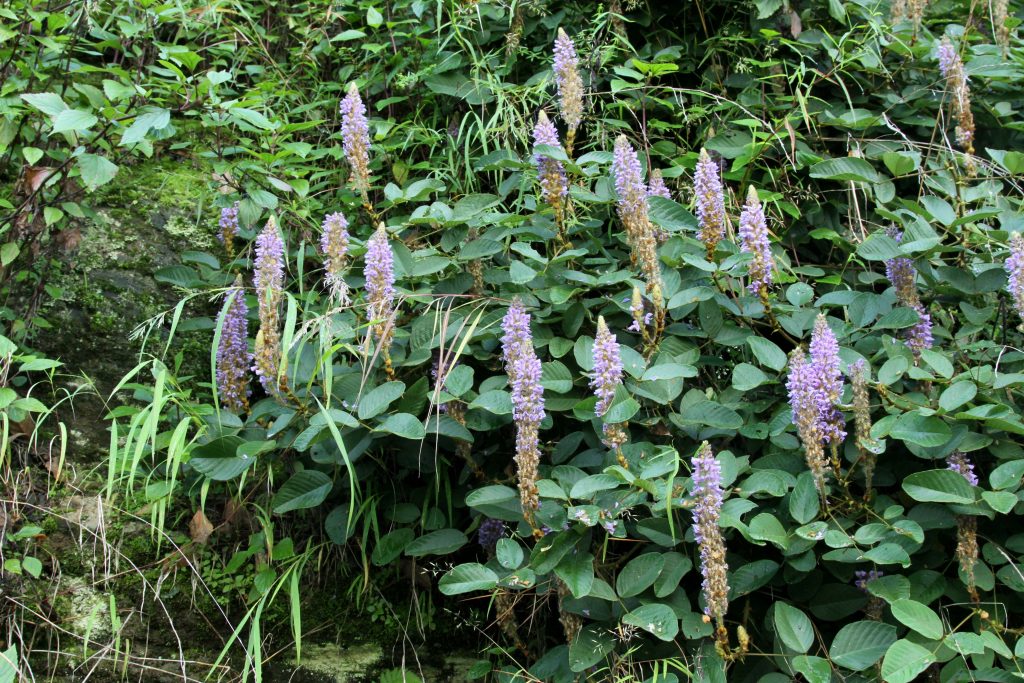
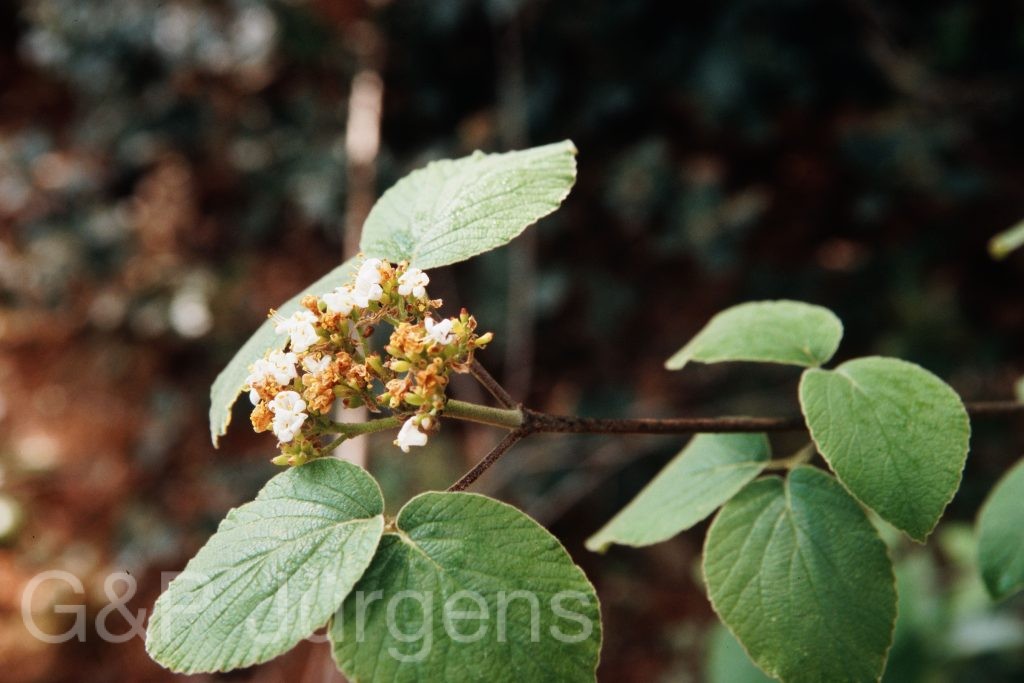
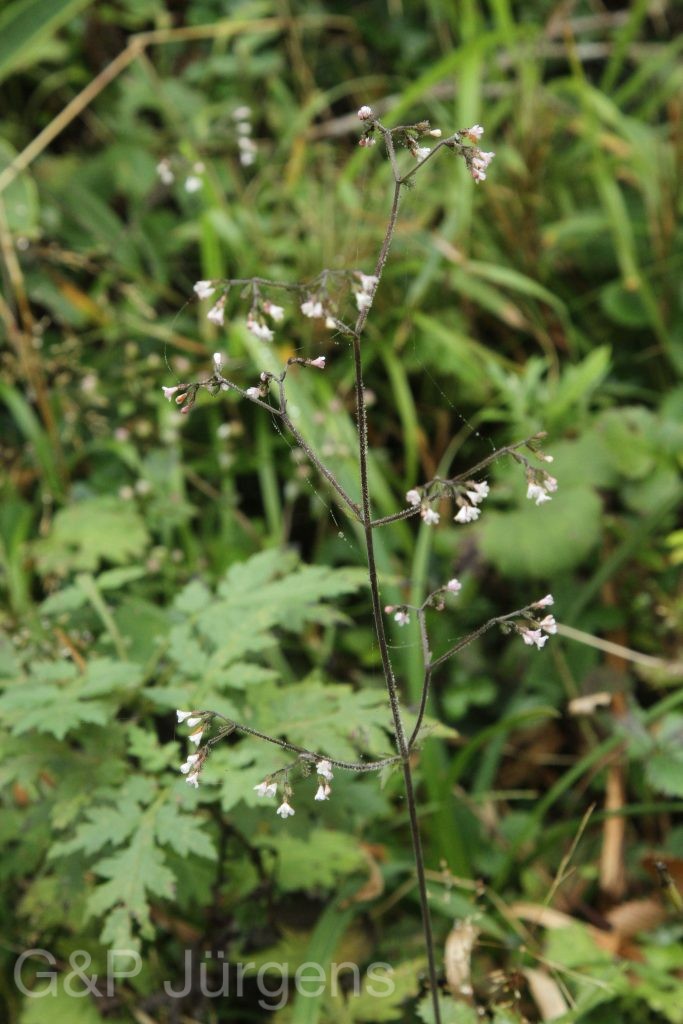
Triplostegia glandulifera is a slender montane herb broadly distributed through the Sino-Himalaya and into Malesia, ranging from Nepal, northern India and Bhutan eastward across China and Taiwan to Myanmar, Malaysia, Indonesia and New Guinea, with outliers in Japan. GBIF documents over 1500 occurrences, concentrated in China, Taiwan and the Himalayan countries. It grows in moist temperate forest, on shaded grassy banks, in clearings and along forest margins on humus-rich soils, broadly between about 2000 and 3500 m. The plant illustrated was photographed in Bhutan at the Dochu-La at 3100 m in October, in cool, misty broad-leaved and conifer forest typical of its autumn fruiting.

The plant is a delicate, erect perennial herb with slender, four-angled stems that are glandular-pubescent above. The leaves are opposite, the lower ones often lyrate-pinnatifid and the upper smaller and less divided, with toothed segments. The inflorescence is a lax, dichotomously branched cyme bearing small, regular, five-lobed white to pinkish flowers. Diagnostically, each ovary is enclosed in a double involucel of bracteoles densely covered with stalked, hooked glandular hairs, which persists around the single-seeded fruit and aids epizoochorous dispersal.

The genus Triplostegia comprises only a couple of species and has had an unsettled placement, treated variously within Dipsacaceae, Valerianaceae or its own family Triplostegiaceae; molecular phylogenetics now situates it within an enlarged Caprifoliaceae (the dipsacalean clade), as a sister lineage to the teasels and valerians. Its glandular double involucel is a key character linking it to that alliance. The species is widespread and ecologically unremarkable in distribution, and is not considered of conservation concern.

Author: Wall. ex DC. · Sources: POWO (Kew), GBIF, Flora of China, Flora of Bhutan, An Annotated Checklist of the Flowering Plants of Nepal, Phylogeny and Classification of Dipsacales (Caprifoliaceae s.l.)
H.Hara

Bhutan2015 23
Bhutan Dochu-La 3000m, October
Bhutan2015 25
Bhutan Dochu-La 3000m, October

Description

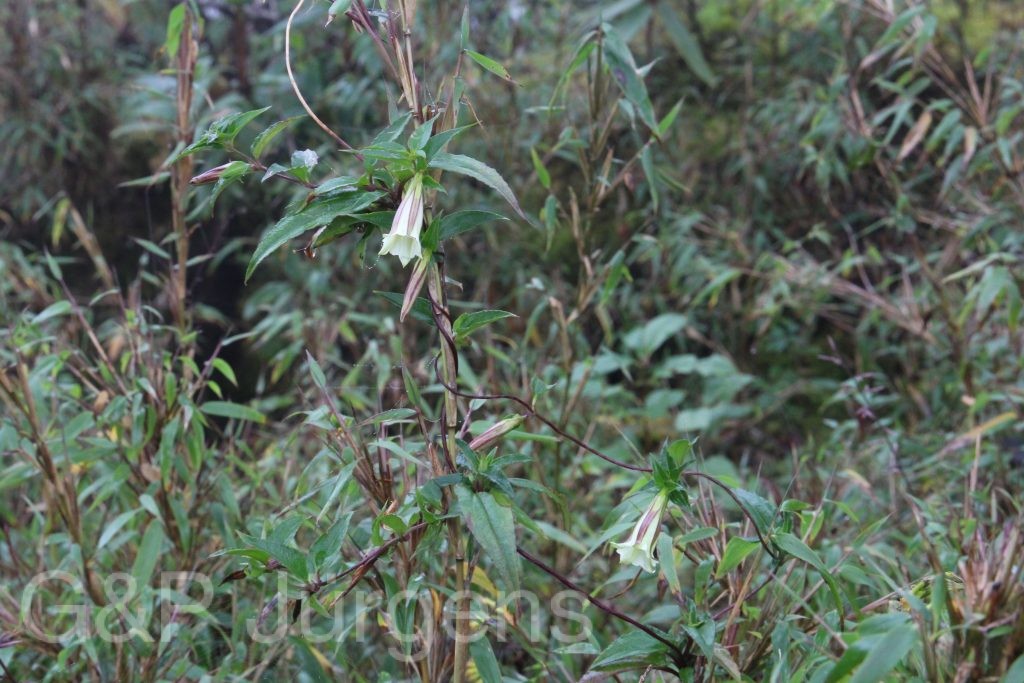
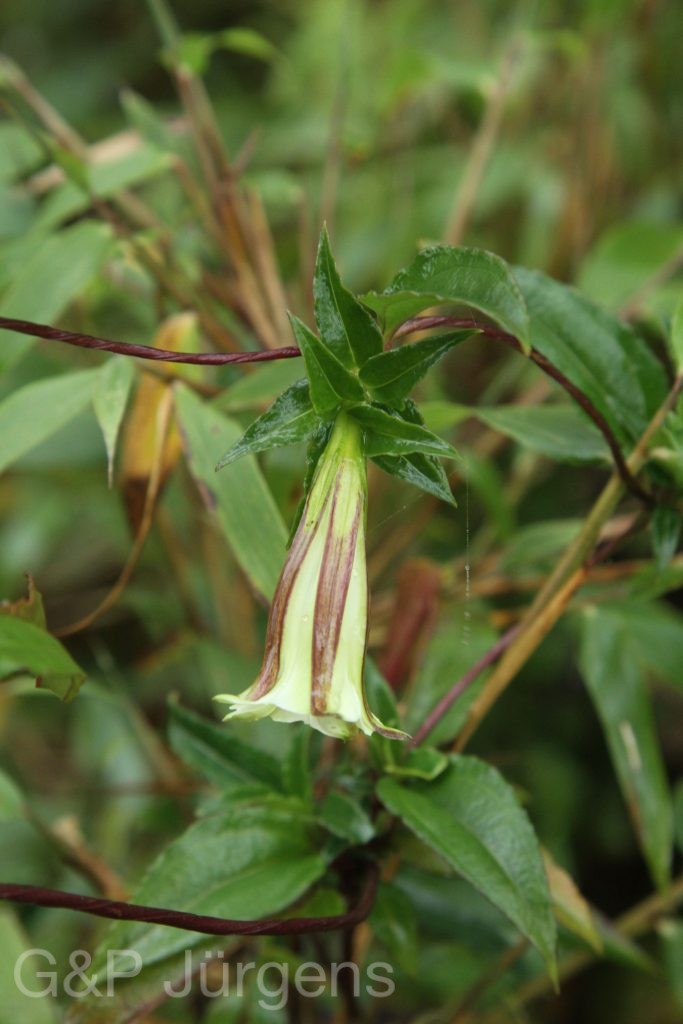
Tripterospermum nigrobaccatum is an eastern Himalayan twining gentian recorded from Nepal, Bhutan and India, and is among the least-collected taxa in this set with only about 11 GBIF occurrences. It is a forest plant of the temperate zone, scrambling through shaded broadleaved and mixed forest, shrubby margins and mossy banks, broadly between about 2500 and 3500 m. The photograph from the Dochu-La in Bhutan at 3000 m in October reflects its autumn flowering and fruiting, when this well-known forested pass carries a rich understorey flora in the cooling post-monsoon months.

Unlike the erect alpine gentians, it is a slender, herbaceous perennial climber or trailer with twining stems. The leaves are opposite, ovate to lanceolate, acuminate and three- to five-veined, borne on a vine-like stem. The flowers are solitary or few in the leaf axils, with a campanulate to narrowly funnel-shaped corolla that is blue to purplish, the five lobes alternating with small plicate folds in the sinuses as is typical of the Gentianeae. Most diagnostic is the fruit: rather than a dry capsule, Tripterospermum produces a fleshy berry, here ripening black or blackish (the meaning of "nigrobaccatum"), containing flattened, often winged seeds.

The genus Tripterospermum was segregated from Crawfurdia and Gentiana on the basis of its climbing habit, baccate fruit and three-winged or angled seeds, and is centred on East and Southeast Asia. The fleshy fruits suggest at least partial bird dispersal, contrasting with the wind-dispersed capsules of most gentians. Its narrow range and few records make it a plant of biogeographic note, though no formal conservation assessment is established.

Author: H.Hara · Sources: POWO (Kew), GBIF, Flora of Bhutan, Flora of China, Gentianaceae of the World (Ho & Pringle / Struwe)

(D.Don) Eichler

Nepal 2001 283 ergebnis ergebnis
Nepal (Gorkha) Lambra Kharka 3000m, May

Description

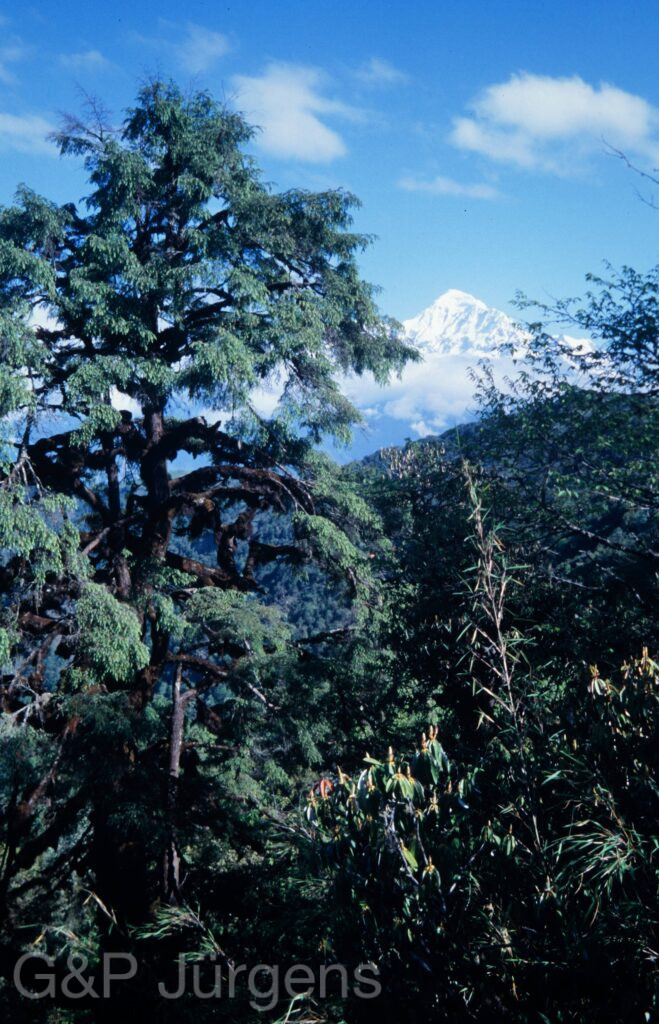
Tsuga dumosa, the Himalayan hemlock, is a large evergreen conifer distributed across the Himalaya from central Nepal eastward through Sikkim, Bhutan, and northeast India into southern China (Xizang, Yunnan, Sichuan, Guizhou), Myanmar, and northern Vietnam. It is a characteristic component of cool temperate and upper montane forests at elevations of 2,000–3,500 m, where it often forms pure stands or grows in association with Abies, Picea, Acer, and Rhododendron species. The species has been documented at Lambra Kharka in the Gorkha district of Nepal at approximately 3,000 m, near the upper limit of its elevational range.
Tsuga dumosa is a tree attaining 25–40 m in height with a trunk up to 1.5 m in diameter, bearing a broadly conical to irregular crown. The bark is dark greyish-brown, deeply fissured and scaly on mature trees. Leaves are linear, flattened, 10–25 mm long and 2–3 mm wide, with a rounded or emarginate apex, dark glossy green above with two conspicuous white stomatal bands beneath, arranged in a pectinate (comb-like) pattern on lateral shoots. Male strobili are small, axillary, and globose. Female seed cones are pendulous, ovoid to oblong, 1.5–2.5 cm long, with thin, rounded cone scales that open at maturity to release two small winged seeds per scale. The cones mature in a single season.
Tsuga dumosa is the sole Himalayan representative of the genus Tsuga, which comprises approximately nine species with a disjunct distribution between eastern Asia and North America. Phylogenetic studies place it sister to the East Asian T. chinensis complex. The species is of considerable ecological importance as a canopy dominant in Himalayan temperate forests, providing critical habitat for epiphytic bryophytes, lichens, and orchids. Its timber is locally valued for construction. While not currently assessed as threatened globally, localized deforestation and climate-driven upward range shifts pose potential concerns for some populations.

Author: (D.Don) Eichler · Sources: POWO (Kew), GBIF, Flora of China Vol. 4, Flora of Bhutan Vol. 1, Farjon: A Handbook of the World's Conifers (2017)

Uraria lagopus

by GP Jürgens

DC.

Bhutan2012 520
Bhutan Wangdi 2800m, September

Description

Uraria lagopus is a perennial herb or subshrub widely distributed through the Himalaya, southern China and South and Southeast Asia, recorded from India, China, Nepal, Myanmar, Taiwan, Bhutan, Sri Lanka, Bangladesh and Indonesia, with about 222 occurrences in GBIF. It is a plant of open grassy slopes, scrub, forest margins, roadsides and disturbed sunny ground, ranging from the lowlands into the lower montane zone. The photographed plant was collected in Bhutan near Wangdi (Wangdue) at about 2800 m in September, towards the upper end of its altitudinal range and during the post-monsoon flowering and fruiting season.

The plant produces erect to ascending stems from a woody base, clothed in spreading hairs. The leaves are pinnately compound, usually with three to several leaflets, the leaflets oblong to elliptic, entire, with prominent venation and a hairy underside; stipules are present at the nodes. The flowers are borne in dense, elongate, terminal racemes that are conspicuously shaggy with long hairs, giving the inflorescence the hare's-foot appearance recorded in the epithet lagopus. Each papilionaceous flower is small, pinkish to purplish. The fruit is a small jointed legume (loment) breaking into one-seeded segments at maturity.

Uraria belongs to the tribe Desmodieae of the Fabaceae, a group characterised by loment fruits dispersed as individual articles. Several species, including U. lagopus, are valued in traditional medicine and as fodder, and as legumes they fix atmospheric nitrogen through root-nodule symbiosis with rhizobia, contributing to soil fertility. The species is a tolerant colonist of open and disturbed habitats and is not regarded as threatened across its broad range.

Author: DC. · Sources: POWO (Kew), GBIF, Flora of China, Flora of Bhutan, Legumes of South Asia (Kew)

Oliv.

BhutanPG2011 698 01 01
Bhutan Luksor, 2850m July

Description

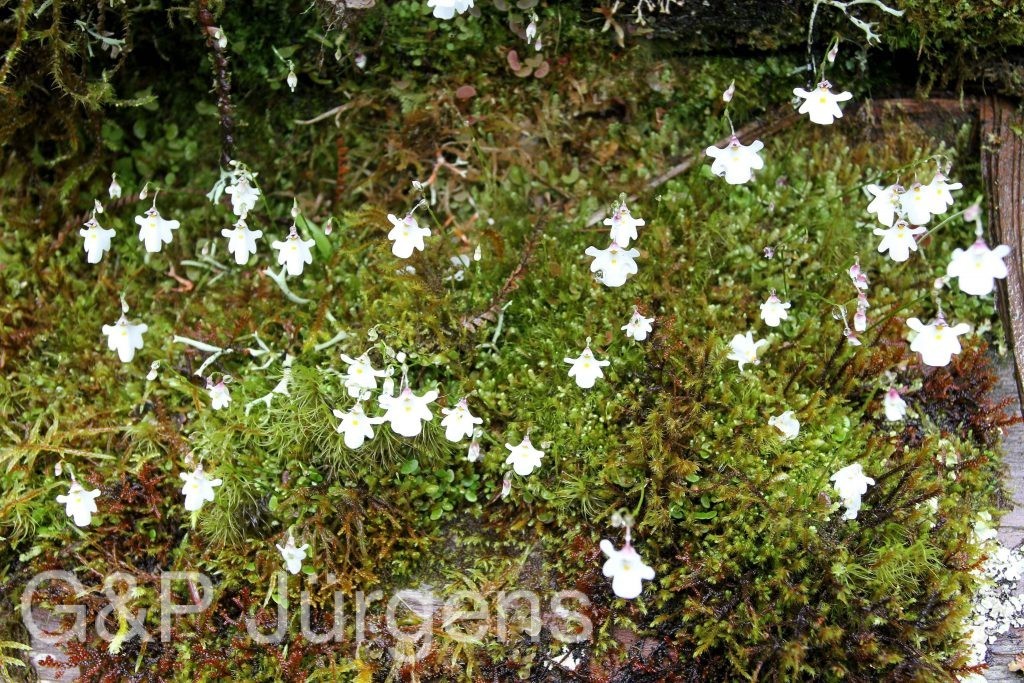
Utricularia brachiata is a small carnivorous herb of the Himalaya and adjacent mountains, recorded by GBIF (about 94 occurrences) from China, India, Nepal, Bhutan, Japan and Myanmar, a relatively modest tally reflecting both its inconspicuous habit and its specialised wet montane habitat. It is a terrestrial to subaquatic species of permanently moist ground: dripping rocks, mossy seepages, wet banks, boggy turf and the margins of springs and streams, generally between 2500 and 4000 m. The plant photographed at Luksor in Bhutan at about 2850 m in July grows in such a damp seepage habitat during the monsoon, the season when high humidity sustains the saturated substrates on which this bladderwort depends.

As in all members of the genus the vegetative body is much reduced and rootless, consisting of fine, thread-like stolons that ramify through the moss and wet soil. Borne on these are minute leaf-like organs and the diagnostic carnivorous traps: tiny bladders (utricles) that capture and digest microscopic soil and water invertebrates through a sophisticated suction mechanism triggered by sensory bristles. The flowering scape is slender and erect, bearing one to few small bilabiate flowers. The corolla is typically white to pale violet or bluish, with a prominent palate and a basal spur, the personate two-lipped form characteristic of the genus and adapted to small insect pollinators. The fruit is a tiny capsule releasing numerous minute seeds.

Lentibulariaceae are wholly carnivorous, and Utricularia, the bladderworts, is the largest and most widespread genus of carnivorous plants, its trap mechanism among the most morphologically refined in the plant kingdom. Carnivory allows U. brachiata to supplement nitrogen and phosphorus in the nutrient-poor, leached, waterlogged substrates it occupies, an adaptive strategy that defines its narrow ecological niche. Though not assessed as globally threatened, its dependence on intact high-altitude wetland seepages renders it locally sensitive to hydrological disturbance, drainage and the disruption of mountain spring systems.

Author: Oliv. · Sources: POWO (Kew), GBIF, Flora of China Vol. 19, Flora of Bhutan Vol. 2, Flora of Nepal, Taylor The Genus Utricularia: A Taxonomic Monograph

P. Taylor

Sikkim2003 80 P111
India Sikkim Choka 3100m, August

Description

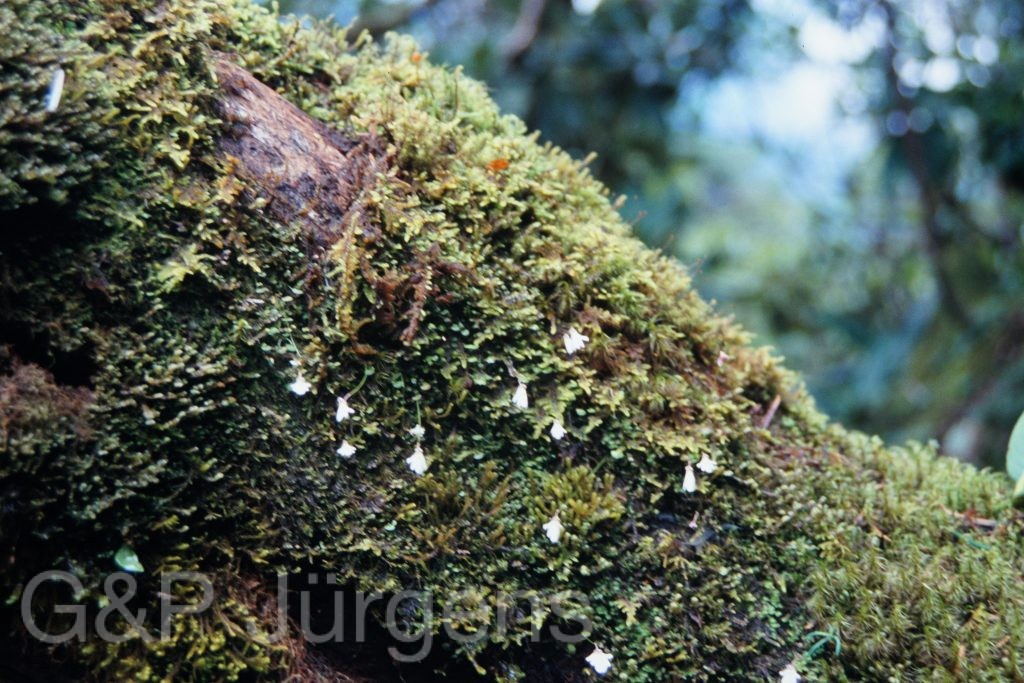
Utricularia christopheri P.Taylor is a small terrestrial bladderwort of the Lentibulariaceae, narrowly restricted to the eastern Himalaya. The very sparse GBIF record (only 14 occurrences) reflects its rarity and confined distribution across Nepal, north India, and Bhutan. It was photographed in Sikkim at Choka at 3,100 m in August, during the monsoon flowering season, in seepage-wet alpine and subalpine ground. The species grows on damp, mossy rocks, wet humic soil, and dripping banks at high elevations, where constant moisture sustains its carnivorous habit.

The plant is a diminutive, rootless herb with slender, creeping rhizoid stolons bearing numerous minute bladder-traps that capture protozoa and small soil invertebrates. The vegetative parts are inconspicuous, with small spathulate leaves. The flowering scape is erect and slender, bearing one to a few comparatively large violet to purplish flowers; the corolla is two-lipped and spurred, the lower lip prominent, distinguishing christopheri within the section to which it belongs by its floral proportions and high-montane ecology.

Utricularia, the largest carnivorous plant genus, is divided into numerous sections, and christopheri belongs to a small group of Himalayan terrestrial species. Its extreme rarity, narrow elevational band, and dependence on permanently wet microhabitats make it potentially vulnerable to hydrological disturbance and climate change, although its remoteness affords some protection. The species remains poorly collected, and its full range is likely undersampled.

Author: P. Taylor · Sources: POWO (Kew), Flora of Bhutan Vol. 2, Flora of Nepal, GBIF, Taylor: The Genus Utricularia – A Taxonomic Monograph (1989)

Hook. f. & Thomson ex C.B. Clarke

Bh2008 392 G607
Bhutan Gogona 3250m, May
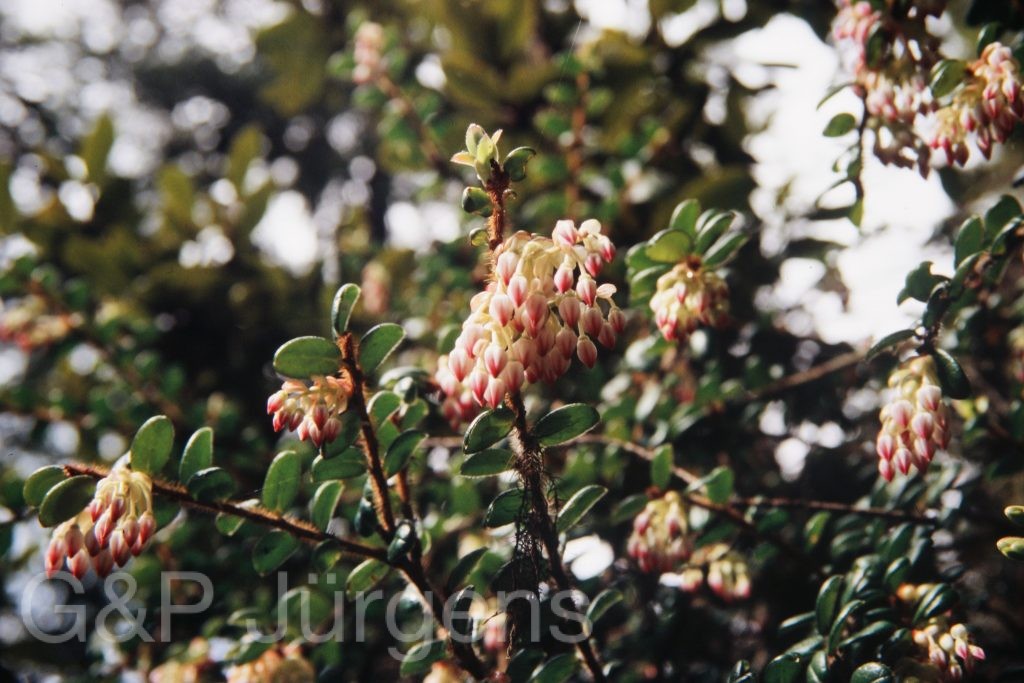
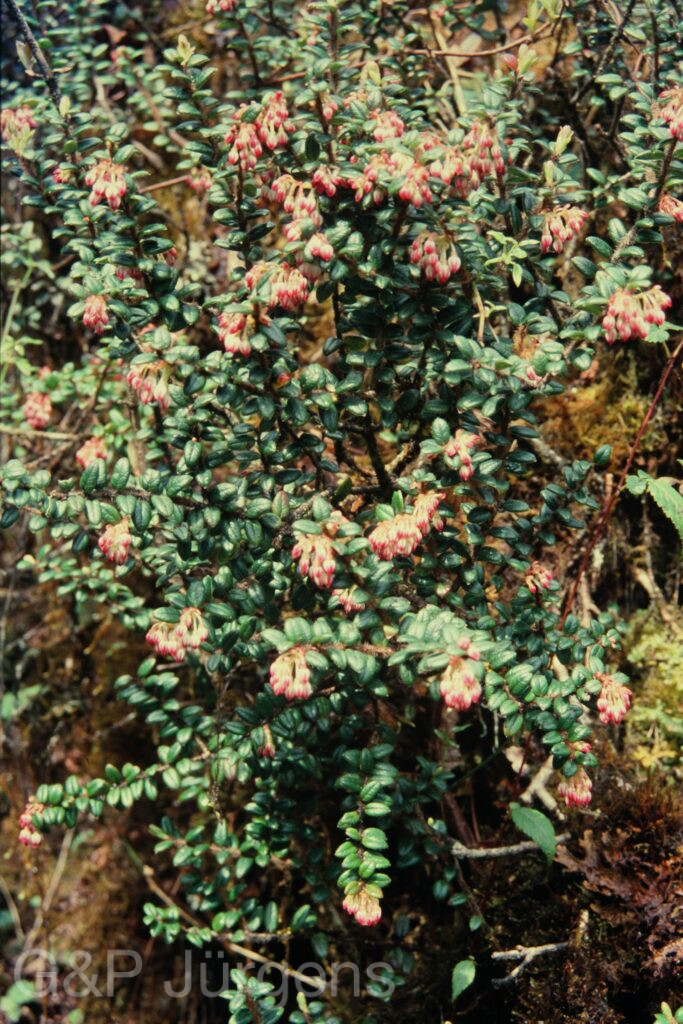
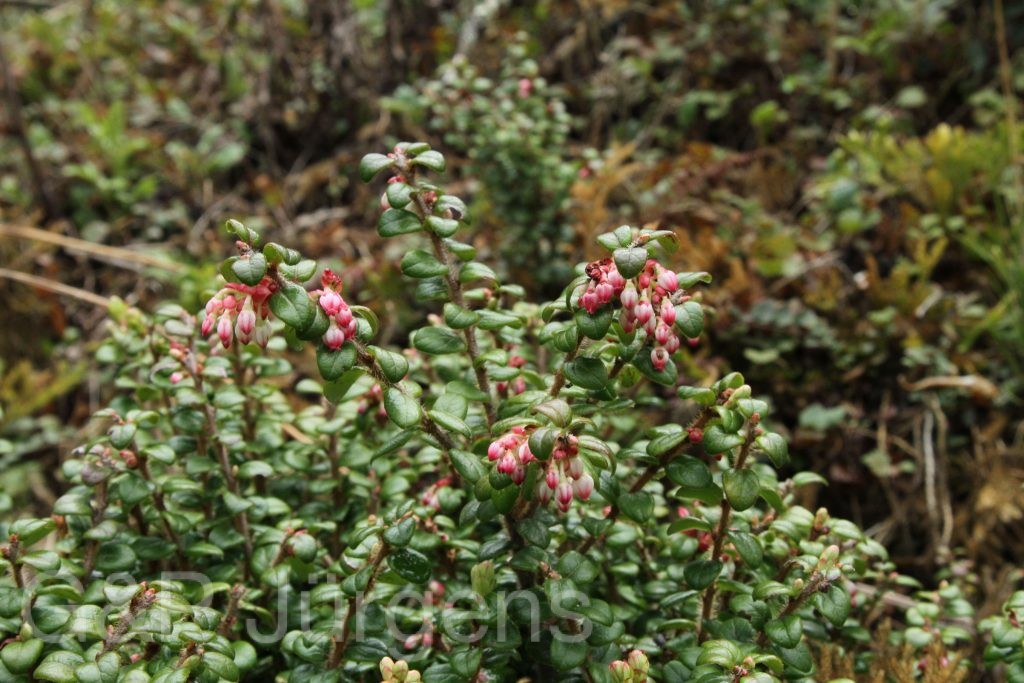
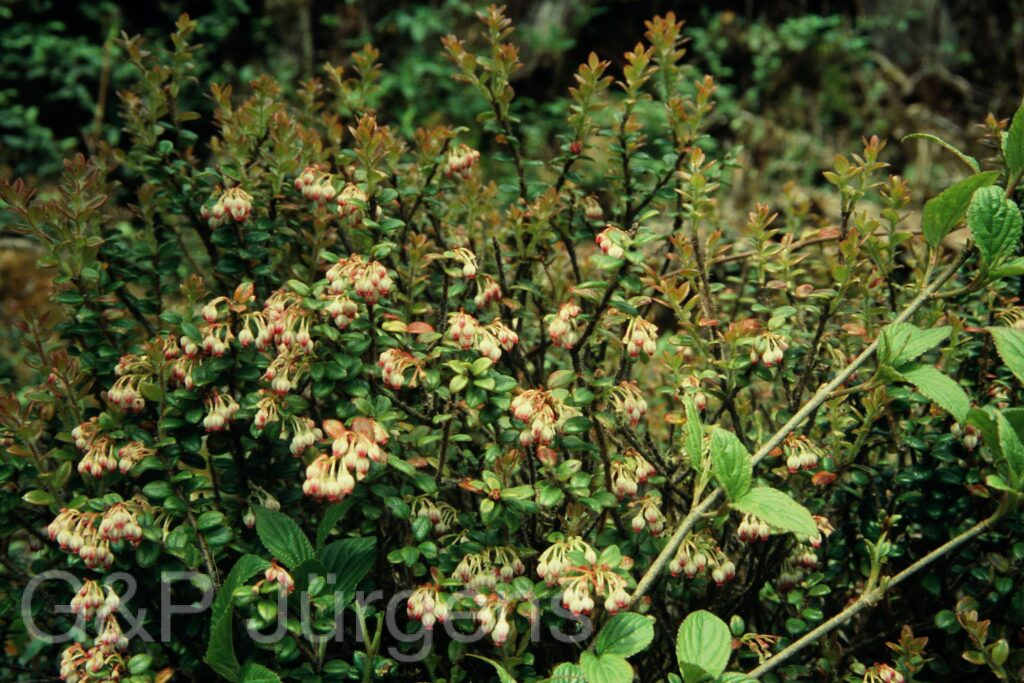
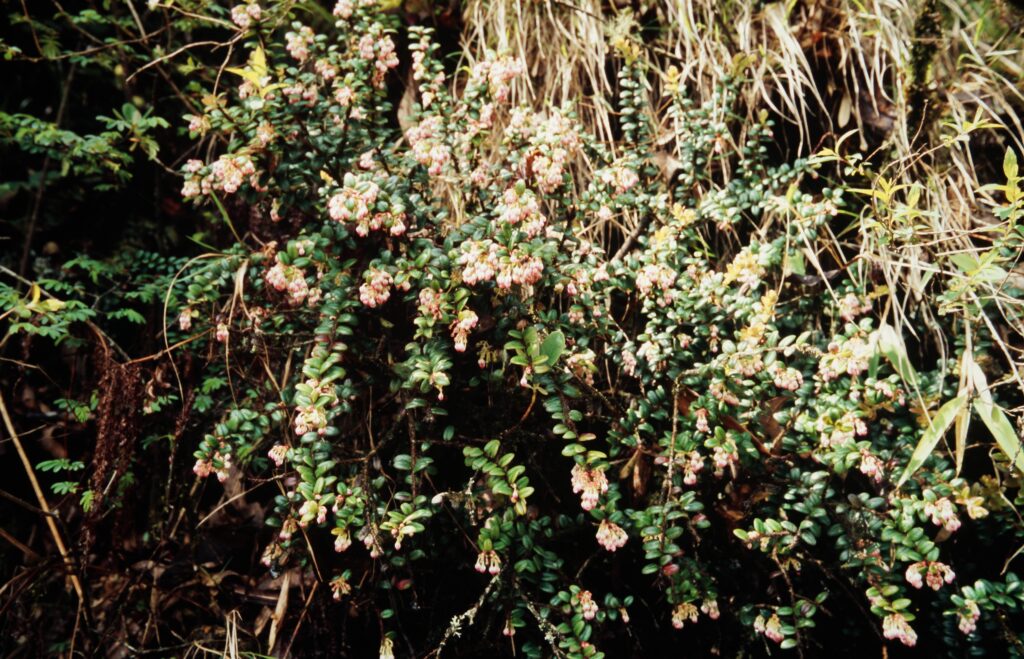
Vaccinium nummularia
Sikkim West-Bengal, Bersay 2700m April

Description

Vaccinium nummularia is an eastern Himalayan blueberry relative distributed through Nepal, northern India, Bhutan, south-central China and Myanmar, with around two hundred and ten GBIF records (a few cultivated or herbarium entries from Britain and the United States reflecting its horticultural interest). It is a characteristic epiphyte or terrestrial shrub of moist temperate forest, growing on mossy tree trunks, banks and cliff faces in the cloud-forest belt. The illustrated plants from Gogona in Bhutan at 3250 m in May and from Bersay in the Sikkim/West Bengal hills at 2700 m in April typify its mid- to upper-temperate, high-humidity habitat.

The species is a low, much-branched evergreen shrub whose young stems and leaf undersides are conspicuously clad in stiff, brown, bristly hairs (setae). The leaves are small, ovate to orbicular, coriaceous and nearly sessile, distichously arranged, with finely serrulate, setose margins, the rounded outline giving rise to the epithet nummularia ('coin-like'). The flowers are borne in short axillary racemes; the corolla is urceolate (urn-shaped), red to pink and waxy, with a small five-lobed limb, and the calyx, ovary and pedicels are likewise setose. The fruit is a globose, purplish-black, edible berry.

Vaccinium nummularia is an accepted species within Vaccinium (Ericaceae, subfamily Vaccinioideae), allied to the setose-leaved Himalayan epiphytic blueberries. Its epiphytic habit, leathery setose leaves and bird-dispersed berries are adaptations to the humid, mossy cloud-forest canopy, and it is cultivated by specialist growers for its handsome bristly foliage and red urn-shaped flowers. The species is locally common and not assessed as threatened, but it depends on intact, humid temperate forest.

Author: Hook. f. & Thomson ex C.B. Clarke · Sources: POWO (Kew), GBIF, Flora of China, Flora of Bhutan, Sleumer revision of Asian Vaccinium (Ericaceae monograph)

(Griff.) Hook. f. ex C.B. Clarke

Bhutan2014 576
Bhutan Bhutan 2950m, May
Sikkim2004 71 G163
Sikkim West-Bengal, Bersay 2700m April
Sikkim 2006 20 ergebnis
India West-Bengal Tonglu 3100m, May

Description

Vaccinium retusum is an evergreen Himalayan shrub distributed through Nepal, India, Bhutan and into adjacent China and northern Indochina (NP, IN, BT, VN, CN, MM, LA, with cultivated and other records), amounting to some 254 occurrences. It is a plant of cool, humid temperate forest, growing as a shrub or small tree among Rhododendron, oak and conifer woodland, on mossy banks and forest margins, and frequently as an epiphyte or hemi-epiphyte on the limbs of larger trees. The cited gatherings span 2700 to 3100 m in Bhutan, Sikkim and the Darjeeling hills of West Bengal (Bersay, Tonglu), flowering in the April-May spring, an elevation and season typical of its occurrence in the mist-laden middle-montane belt.

The plant is a glabrous, much-branched shrub with reddish young shoots. The leaves are leathery and evergreen, elliptic to obovate with a characteristically retuse or emarginate apex from which the epithet derives, the margins entire or finely toothed and the venation reticulate beneath. The flowers are borne in short axillary racemes; the corolla is urceolate (urn-shaped) and white to pinkish, with a five-toothed limb, enclosing the included stamens whose anthers bear terminal tubules. The fruit is a globose, many-seeded berry, ripening dark purple-black and crowned by the persistent calyx.

Vaccinium (the blueberry and bilberry genus, tribe Vaccinieae of the Ericaceae) is richly developed in the Sino-Himalayan region, where many species are epiphytic. The urceolate corolla and inferior, berried ovary are diagnostic, and the flowers are pollinated by bees attracted to nectar. The fleshy berries are dispersed by birds, accounting for the establishment of epiphytic seedlings high in the forest canopy. Widespread and locally common, V. retusum is not considered threatened, though it depends on the persistence of intact temperate broadleaf forest.

Author: (Griff.) Hook. f. ex C.B. Clarke · Sources: POWO (Kew), GBIF, Flora of Bhutan, Flora of China, The Genus Vaccinium (Sleumer monograph of Asian Vaccinieae)

Decne.

Garh 07 119 ergebnis
India Garhwal Meggu Kichatti 3400m, June

Description

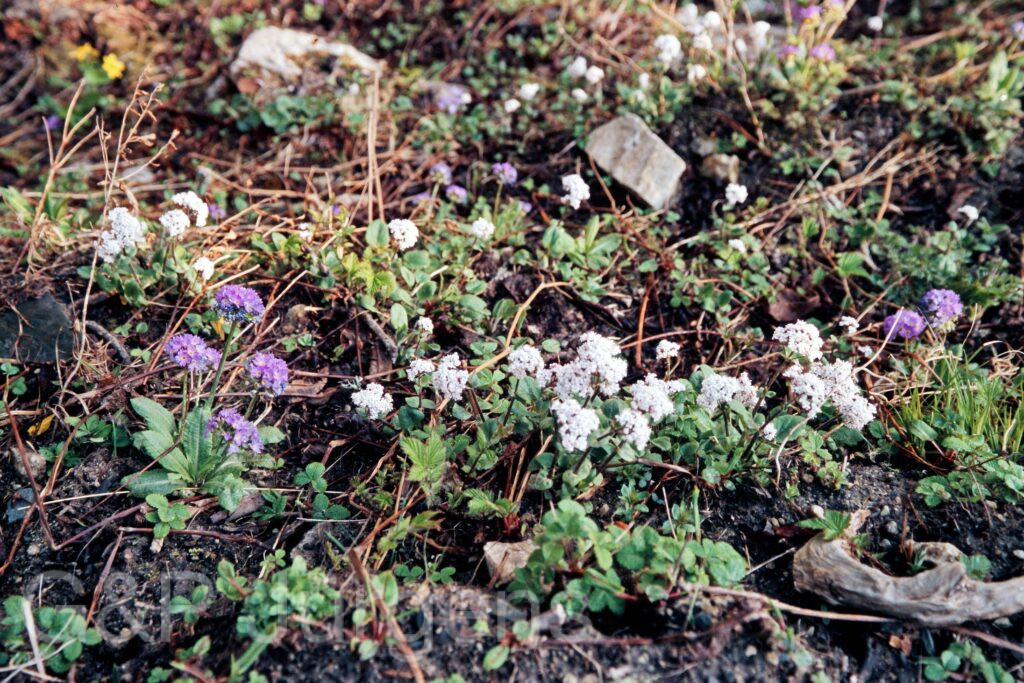
Valeriana pyrolifolia is a western Himalayan valerian distributed from Pakistan (northern areas, Azad Kashmir) through northwestern India (Kashmir, Himachal Pradesh, Uttarakhand). GBIF records 100 occurrences, predominantly from India and Pakistan. The species grows in subalpine meadows, grassy slopes, open scrub, and forest clearings at elevations of 2,800–4,200 m. The photograph from Meggu Kichatti in the Garhwal Himalaya at 3,400 m, taken in June, documents the species at a typical mid-range elevation during its early summer flowering period.
The plant is a perennial herb, 15–40 cm tall, arising from a stout, aromatic rhizome. Basal leaves are distinctive and diagnostic: simple, broadly ovate to orbicular, 3–7 cm long, with entire or obscurely crenate margins, glabrous, somewhat coriaceous, resembling the leaves of Pyrola — hence the specific epithet pyrolifolia. The basal leaves are long-petiolate, forming a conspicuous rosette. Cauline leaves are few, reduced, sessile, and sometimes pinnately lobed with 1–2 pairs of small lateral segments. The inflorescence is a compact, terminal, corymbose cyme that expands in fruit. Flowers are small, 3–5 mm long, funnel-shaped, white to pale pink, with three stamens and an inferior, unilocular ovary. The fruit is a small achene, 2–3 mm long, crowned by a feathery, plumose pappus derived from the accrescent calyx, aiding wind dispersal.
Valeriana pyrolifolia is readily distinguished from other Himalayan valerians by its entire, pyrola-like basal leaves, in contrast to the pinnately divided foliage typical of most congeners. The genus Valeriana, now placed in Caprifoliaceae following APG classifications (formerly Valerianaceae), is represented by numerous species in the Himalayan alpine zone. V. pyrolifolia is not currently considered threatened, though its relatively restricted western Himalayan range and dependence on subalpine grassland habitats merit monitoring in the context of climate change.

Author: Decne. · Sources: POWO (Kew), GBIF, Flora of Pakistan Vol. 150, Duthie: Flora of the Upper Gangetic Plain, Naithani: Flora of Chamoli Vol. 1

D. Don

Bhutan2014 863
Bhutan Chele-La 3100m, May
Bhutan2014 965
Bhutan Chele-La 3400m, May
Bh2008 554 P838
Bhutan Paro 1950m April

Description

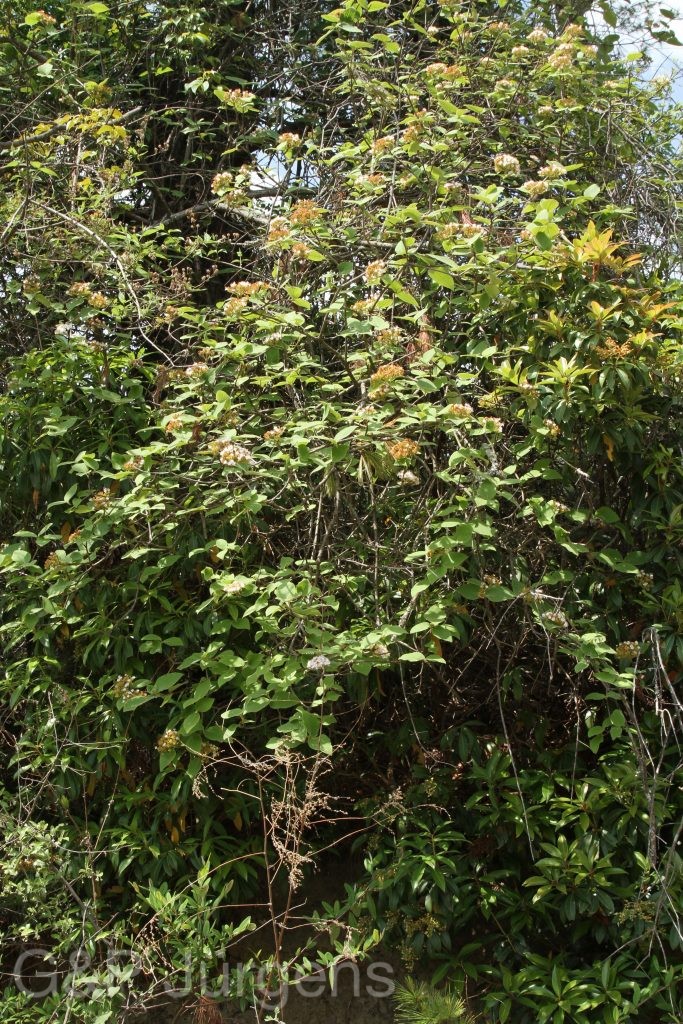
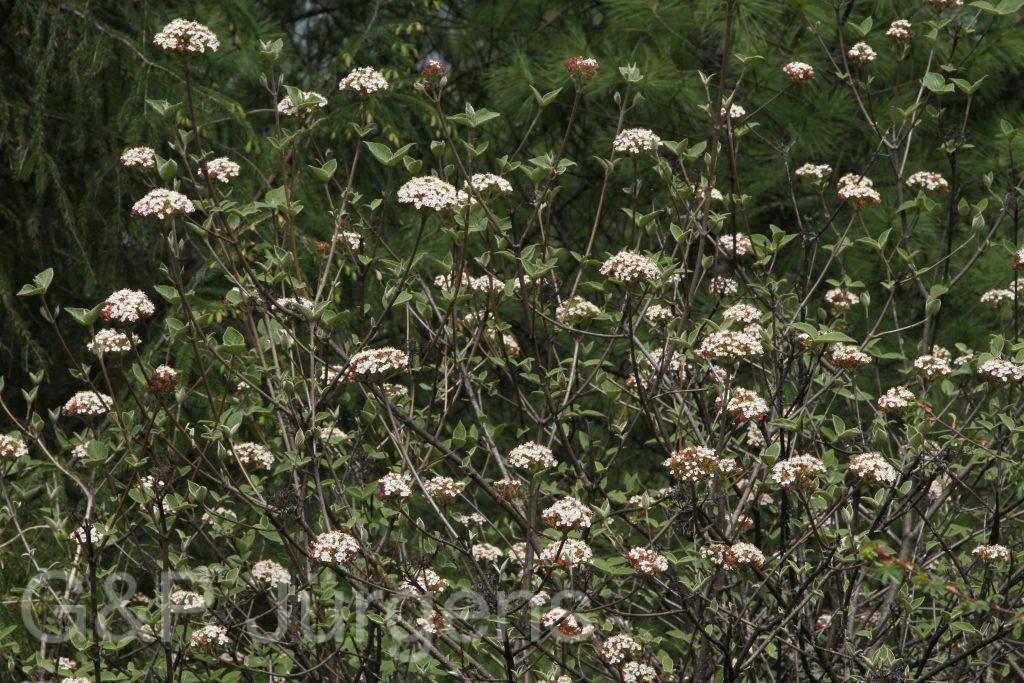
Viburnum cotinifolium is a Himalayan and Central Asian shrub distributed from Afghanistan and Pakistan eastward through Kashmir and the Indian Himalaya, Nepal and Bhutan to western and southwestern China; GBIF records 714 occurrences, principally from Pakistan, Nepal, India, China and Bhutan. It inhabits open temperate forest, scrub, forest margins, ravines and dry rocky slopes, mostly between about 1500 and 3500 m. The cited records from Chele-La in Bhutan at 3100 and 3400 m in May and from Paro at 1950 m in April illustrate its broad elevational range and its spring flowering, when the white-pink corymbs open as the new foliage flushes in the western Bhutanese borderlands.

It is a deciduous shrub with stellate-tomentose young branchlets and opposite, broadly ovate to orbicular leaves that recall those of Cotinus (whence the epithet), the blades entire to obscurely toothed, three- to five-veined at the base and densely grey stellate-pubescent beneath. The flowers are small, white tinged pink, all fertile and aggregated into dense, rounded, peduncled corymbose cymes; each has a short campanulate corolla with five spreading lobes. The fruit is an ovoid, somewhat compressed drupe ripening from red to glossy black, containing a single flattened, grooved stone, and is edible.

The species belongs to Viburnum, transferred with the genus from the traditional Caprifoliaceae to the Adoxaceae on molecular evidence. Its showy fertile corymbs attract diverse insect pollinators, while the colourful drupes are dispersed by birds; the fruits are also gathered locally for food. Widespread, hardy and ornamental, it is cultivated in temperate gardens and is of least conservation concern throughout its extensive range.

Author: D. Don · Sources: POWO (Kew), GBIF, Flora of China Vol. 19, Flora of Bhutan Vol. 2, Flora of Pakistan, A Monograph of the Genus Viburnum (Kern / Hara studies)