Tag:

Subtropical (<1500 m)

L.f.

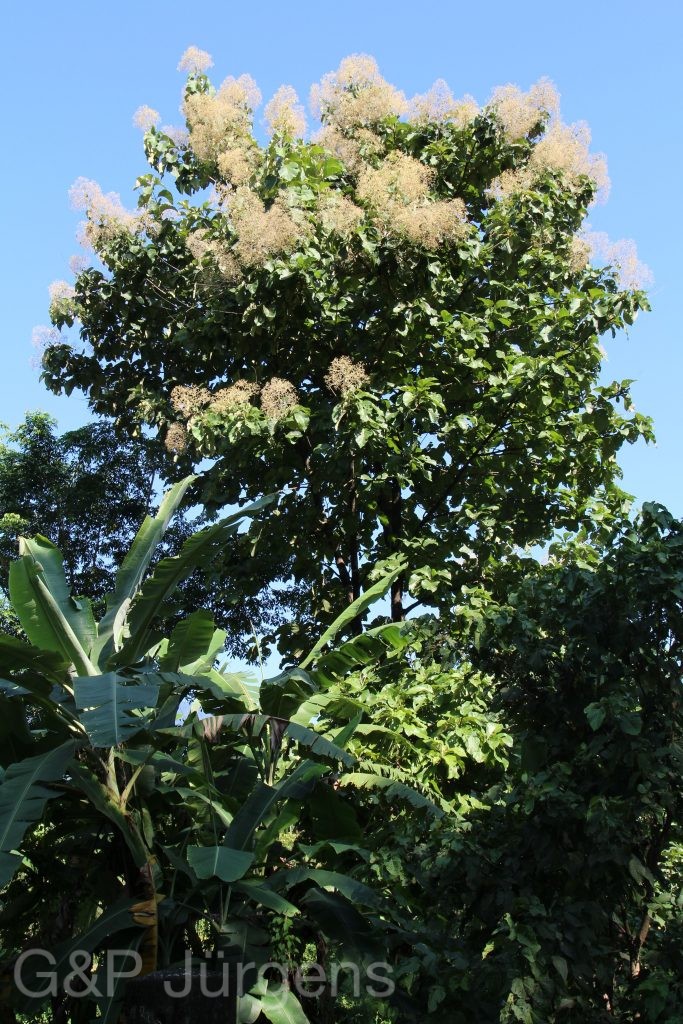
Bhutan2015 95
Bhutan Galephug 300m, October
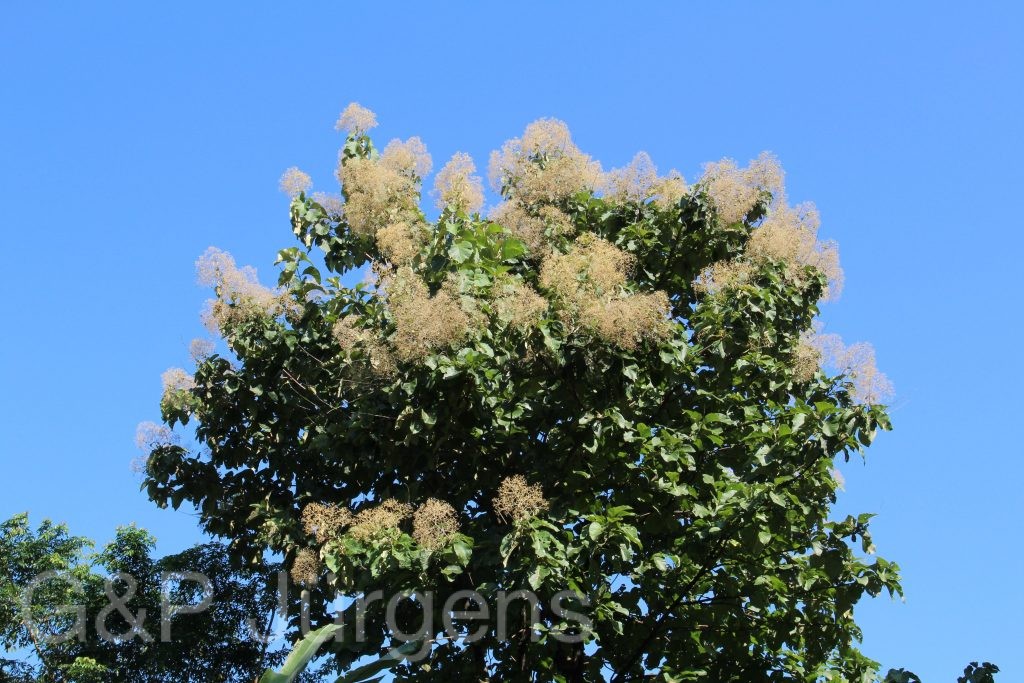
Bhutan2015 96
Bhutan Galephug 300m, October

Description

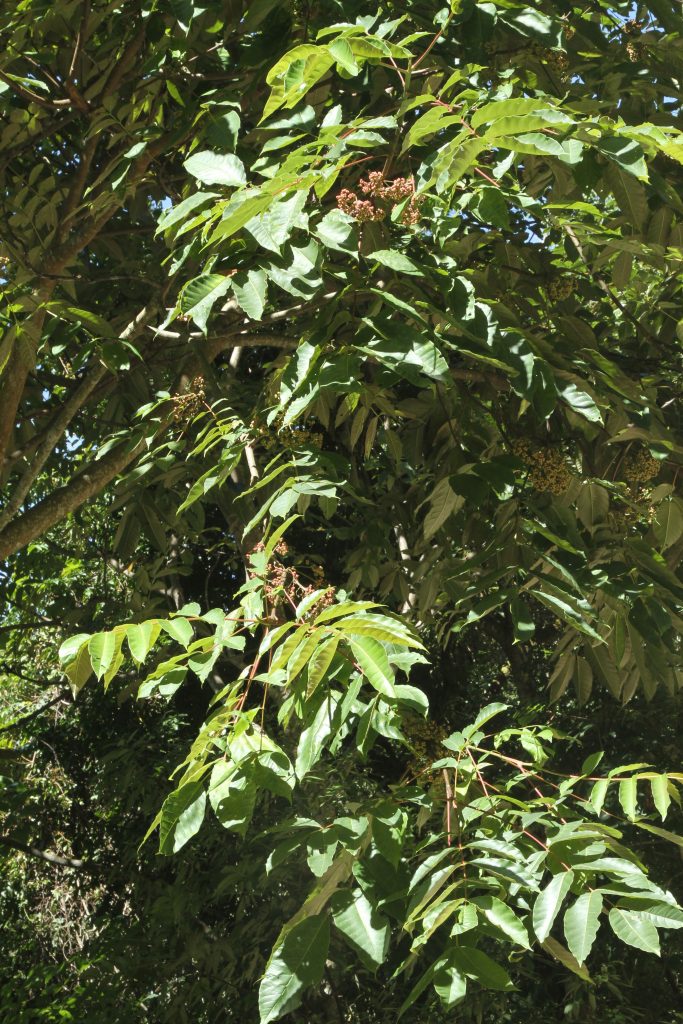
Tectona grandis L.f., the teak, is a large deciduous tree native to the monsoonal forests of South and Southeast Asia, including India, Myanmar, Thailand, Laos and Sri Lanka, and now widely planted and naturalised across the tropics in Indonesia, Brazil, Nigeria, Tanzania, Costa Rica and beyond. In the Himalayan foothills it is recorded from Bhutan at Galephug near 300 m in October, at the warm, low-elevation southern margin of the region. The species grows in tropical dry and moist deciduous forest, on well-drained alluvial and lateritic soils, typically below 1000 m, where a pronounced dry season triggers leaf fall. Its roughly 37 411 GBIF records reflect both its native range and its enormous footprint as a cultivated timber tree.

It is a tall tree reaching 30–40 m with a tall, often fluted bole and pale, fibrous, longitudinally fissured bark. The leaves are very large, opposite or sub-opposite, broadly elliptic to obovate, scabrid above and densely stellate-tomentose beneath, exuding a reddish sap when crushed. The small whitish to pale lilac flowers are five- to six-merous and borne in massive, much-branched terminal panicles. The fruit is a hard, four-chambered drupe enclosed in a conspicuously inflated, bladder-like accrescent calyx that aids wind and water dispersal.

Formerly placed in Verbenaceae, Tectona is now assigned to Lamiaceae (subfamily Tectonoideae) on molecular grounds, here matching the input family. Its heartwood, rich in protective tectoquinones and natural oils, is among the world's most prized timbers for its durability, dimensional stability and resistance to decay and insects, underpinning a vast plantation industry. While extensively cultivated, genuinely wild teak forests have been much reduced and fragmented by logging, and conservation of natural provenances and their genetic diversity is an ongoing priority.

Author: L.f. · Sources: POWO (Kew), GBIF, Flora of British India, Flora of Bhutan, Trees of Tropical Asia, Teak: A Global Overview (FAO monograph)
DC.

Bhutan2012 628
Bhutan Wangdi 2600m September
Bhutan2012 734
Bhutan Galephu 650m, October

Description

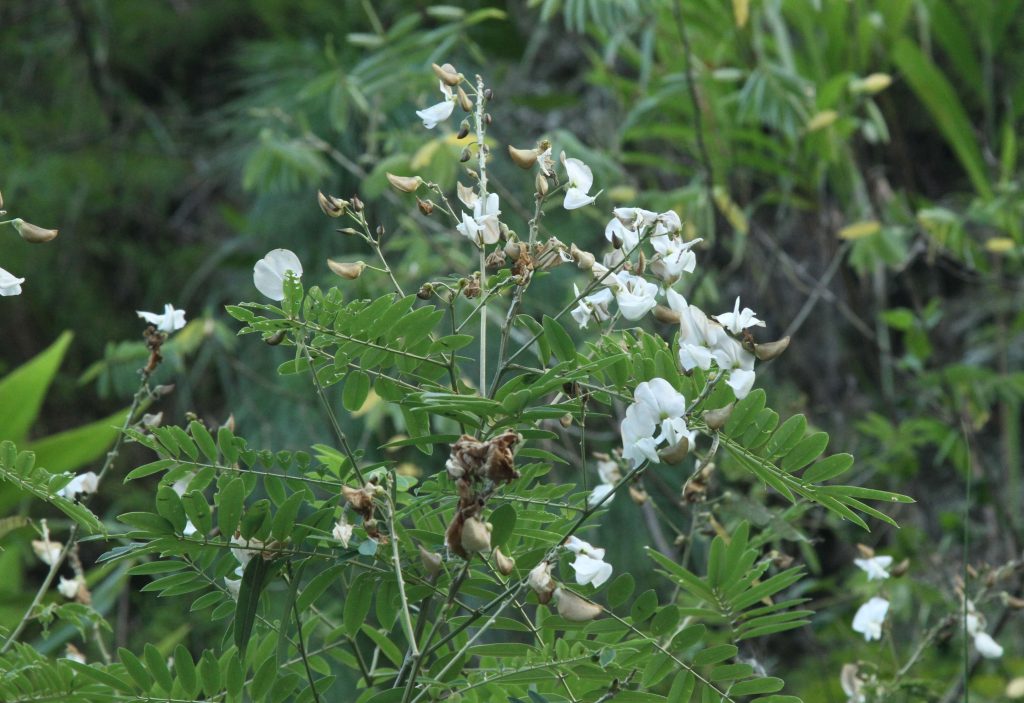
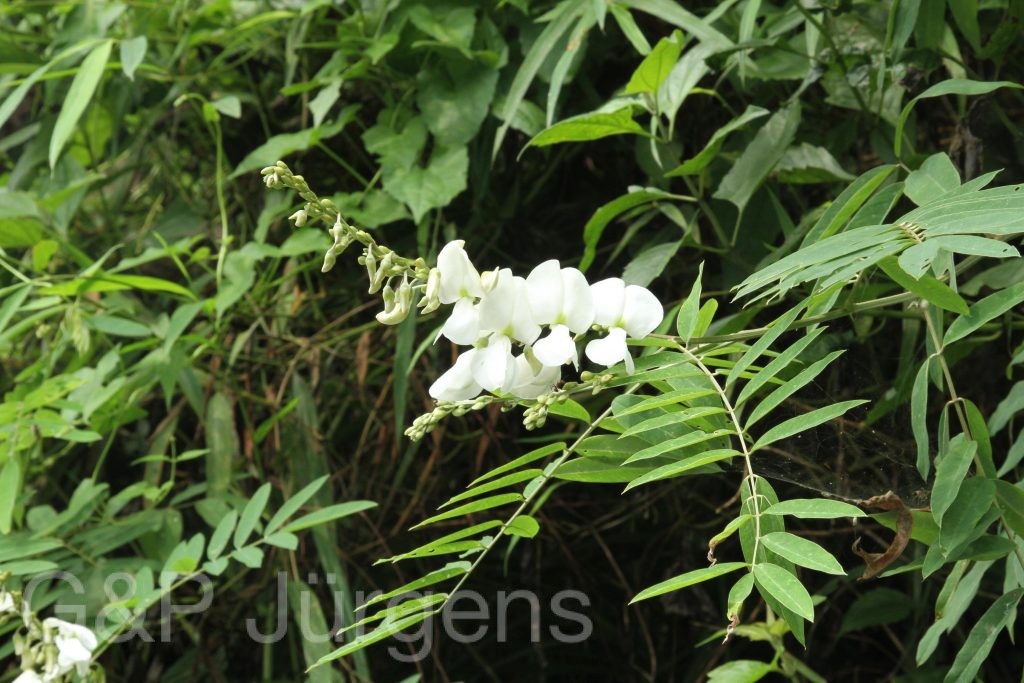
Tephrosia candida is a shrubby legume native to the Indian subcontinent and adjacent Himalaya, including India, Nepal and Bhutan, but now pantropically naturalised through widespread cultivation, with GBIF records from Brazil, Indonesia, Taiwan, China, Papua New Guinea, Australia, Madagascar, the Caribbean, the Mascarenes and beyond. It thrives in warm subtropical and tropical conditions on forest margins, roadsides, river banks and disturbed open ground. The Bhutanese collections illustrate its altitudinal breadth, from Galephu in the foothills at about 650 m in October to Wangdi at 2600 m flowering in September.

The plant is an erect, much-branched shrub up to about 3 m, with silky-pubescent young growth. The leaves are imparipinnate with numerous (often 8-12 pairs of) narrowly oblong leaflets that are silky-sericeous beneath, giving the foliage a greyish sheen. The flowers are borne in dense terminal racemes; each papilionate flower has a campanulate pubescent calyx and a white to pale pink or cream corolla with a broad standard silky on the outer face, the keel and wings enclosing diadelphous stamens. The fruit is a flattened, linear, densely velvety-pubescent dehiscent pod that twists on splitting to expel several seeds.

A member of the papilionoid Fabaceae and tribe Millettieae, T. candida is a nitrogen-fixing species long valued as a green manure, cover crop, fallow improver and erosion-control plant, which explains its extensive intentional dispersal across the tropics. Like other Tephrosia it contains rotenoid compounds and has been used as a fish poison and insecticide. Robust and weedy in cultivation, it is in no way of conservation concern and can become locally naturalised.

Author: DC. · Sources: POWO (Kew), GBIF, Flora of Bhutan, Flora of British India, Brummitt's and related revisions of Tephrosia (Leguminosae)

Van Heurck & Müll. Arg.

Bhutan2015 170
Bhutan Zhemgang 950m, October
Bhutan2012 783
Bhutan Zemgang 1800m, October

Description

Terminalia myriocarpa Van Heurck & Mull.Arg. is a large evergreen tree of the Combretaceae, distributed across the eastern Himalaya and Indo-Burmese region, ranging from northeastern India, Nepal and Bhutan through Myanmar, Thailand, Laos and Vietnam to southwestern China (GBIF: c. 454 occurrences). It is a canopy tree of subtropical and tropical moist evergreen forests, favouring deep, moist soils along streams and in foothill valleys, generally below about 1,500 m though ascending higher locally. The photographed trees from Zhemgang in central Bhutan, recorded at about 950 m and 1,800 m in October, illustrate its presence in the warm, humid forests of the southern foothills.

The tree is tall, reaching 30 m or more, frequently developing prominent buttresses at the base. The leaves are opposite or subopposite, oblong-elliptic, with an acuminate apex and entire to crenulate margins, and often bear a pair of glands near the base of the petiole. The flowers are small, numerous and bisexual, borne in large, much-branched terminal and axillary panicles, giving rise to the species epithet "myriocarpa" ("many-fruited"). The fruit is a small, two-winged, samaroid nutlet that turns pink to crimson in dense masses, a striking feature that aids wind dispersal.

Terminalia belongs to the pantropical Combretaceae and includes many ecologically and economically important timber trees. Terminalia myriocarpa yields a useful general-purpose hardwood and is a significant component of lowland evergreen forest. Although locally common over a wide range and not globally threatened, its lowland forest habitat is under pressure from logging and land conversion across parts of its distribution.

Author: Van Heurck & Müll. Arg. · Sources: POWO (Kew), Flora of China Vol. 13, Flora of Bhutan Vol. 2, Flora of Nepal, GBIF, Exell: Combretaceae revisions

Roxb.

Nepal 1994 16 ergebnis
Ost-Nepal Kandbari 490m April

Description

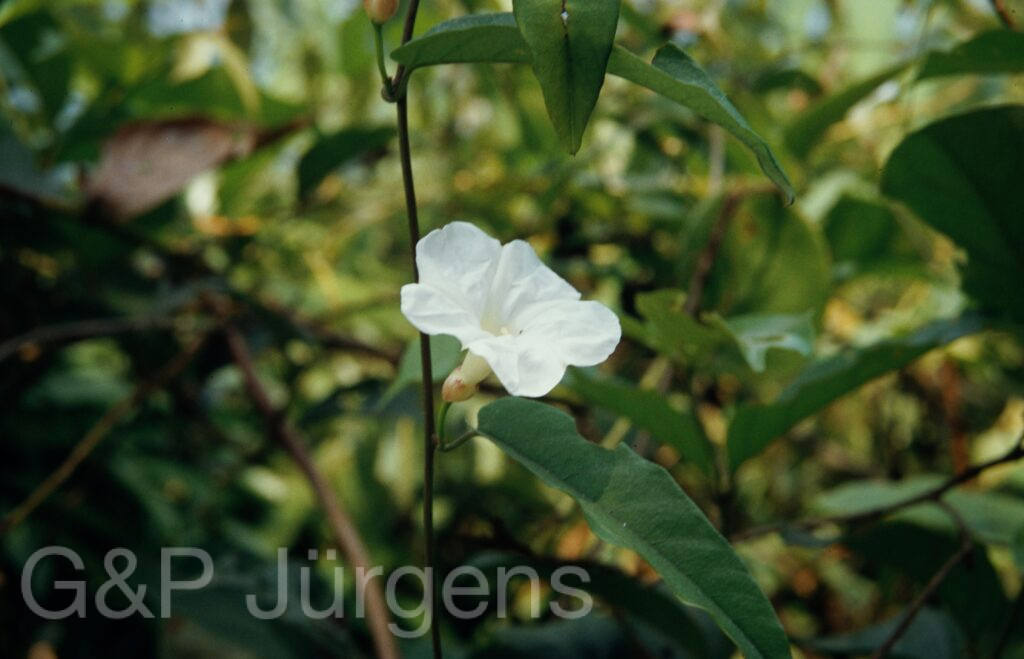
Thunbergia fragrans is a slender twining herbaceous climber native to tropical and subtropical Asia, from the Indian subcontinent and the Himalayan foothills eastward to China, Sri Lanka and Southeast Asia, and now naturalised across the Americas, the Pacific and Australia. It grows in thickets, hedgerows, forest edges, scrub and disturbed ground in the warm lowlands and lower hills, generally below about 1500 m. The photographed plant comes from Kandbari in East Nepal at around 490 m, flowering in April. With nearly 4900 georeferenced records, many from its introduced range, it is a conspicuous and frequently collected vine. Although filed here under Lamiaceae, the species belongs to the Acanthaceae.

The stems are twining, slender and angled, often finely hairy. The leaves are opposite, ovate to triangular-hastate, with a cordate to truncate base, entire to sinuately lobed or toothed margins, and a slender petiole. The flowers are solitary in the leaf axils on long peduncles, subtended by two large leafy bracteoles that enclose the much-reduced calyx. The corolla is salverform with a broad spreading limb of five rounded lobes and is pure white, the throat sometimes pale, the flowers faintly fragrant. Four didynamous stamens are inserted within the corolla tube. The fruit is a beaked, woody, explosively dehiscent capsule, the persistent style forming a long apical beak, scattering the few seeds.

Widely grown as an ornamental for its clean white flowers, T. fragrans has escaped cultivation in many warm regions and is regarded as an environmental weed in parts of Australia, the Pacific and the neotropics, where it smothers low vegetation. Within Thunbergia it is recognised by its white, fragrant corolla and hastate leaves. Abundant and expanding, it is of least conservation concern.

Author: Roxb. · Sources: POWO (Kew), GBIF, Flora of China, Flora of Nepal, Acanthaceae monographs (Thunbergia)

(Azaola) Pennell

Bhutan2012 1338 ergebnis
Bhutan Pemagatsel 300m, October

Description

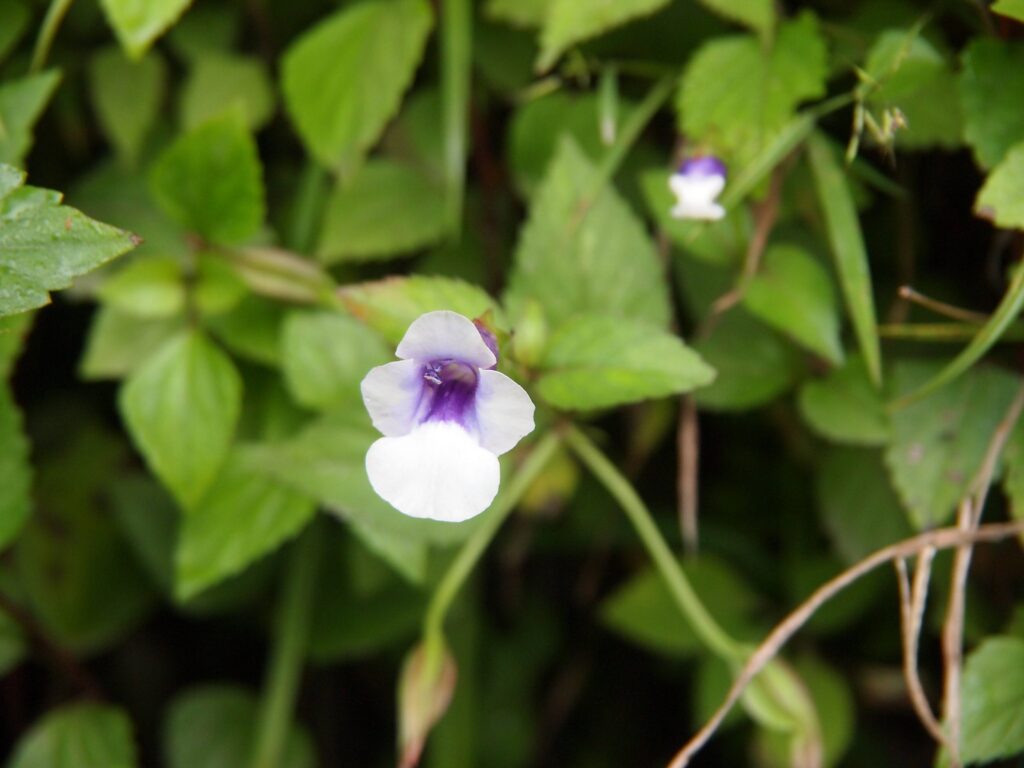
Torenia violacea is a small annual herb widely distributed across tropical and subtropical Asia, recorded by GBIF, with over a thousand occurrences, from India, Nepal, Bhutan and Bangladesh through China, Taiwan and Japan to Myanmar, Thailand, Laos, Cambodia, Vietnam, the Philippines, Malaysia, Singapore, Brunei, Indonesia and Papua New Guinea. It is a plant of warm, humid lowland and lower montane situations, growing on moist, shaded ground in rice-field margins, ditches, streamsides, damp roadside banks, forest paths and other disturbed wet places, mostly at low elevations. The photographed plant from Pemagatsel in southeastern Bhutan, at about 300 m and flowering in October, exemplifies this low-altitude, monsoon-influenced habitat, where the species flowers into the post-monsoon autumn in the warm foothill zone.

It is a slender, erect to ascending or somewhat decumbent annual with quadrangular, narrowly winged stems that branch from the base. The leaves are opposite, ovate to ovate-lanceolate, with a serrate margin, an acute apex and a rounded to broadly cuneate base, borne on short petioles. The flowers are axillary or in terminal racemes, each subtended by a tubular, five-winged (ridged) calyx. The corolla is two-lipped and violet to pale lilac, often with a yellow throat, the lower lip three-lobed and the tube curved; the four didynamous stamens are a diagnostic feature, the anterior filaments often bearing a slender appendage at the base. The fruit is a narrow, oblong, septicidal capsule enclosed by the persistent winged calyx and releasing numerous minute seeds.

Long placed in Scrophulariaceae and later in Veronicaceae or Plantaginaceae, Torenia is now assigned to the segregate family Linderniaceae, recognised on molecular grounds, alongside Lindernia and Vandellia, to which several species formerly called Torenia have been transferred. T. violacea, based on Azaola's name and recombined by Pennell, is distinguished within the genus by its five-winged calyx and violet corolla. The species is a self-compatible weedy annual of disturbed wet ground, abundant and adaptable across its very large range, and is of no conservation concern; ornamental relatives in the genus (the "wishbone flowers") are popular bedding plants.

Author: (Azaola) Pennell · Sources: POWO (Kew), GBIF, Flora of China Vol. 18, Flora of Bhutan Vol. 2, Flora of Nepal, Flora of Pakistan, Fischer's revision of Linderniaceae

DC.

Bhutan2014 272
Bhutan Trithangebe 700m, May
Bh2008 541 G819
Bhutan Limbukha 2200m April

Description

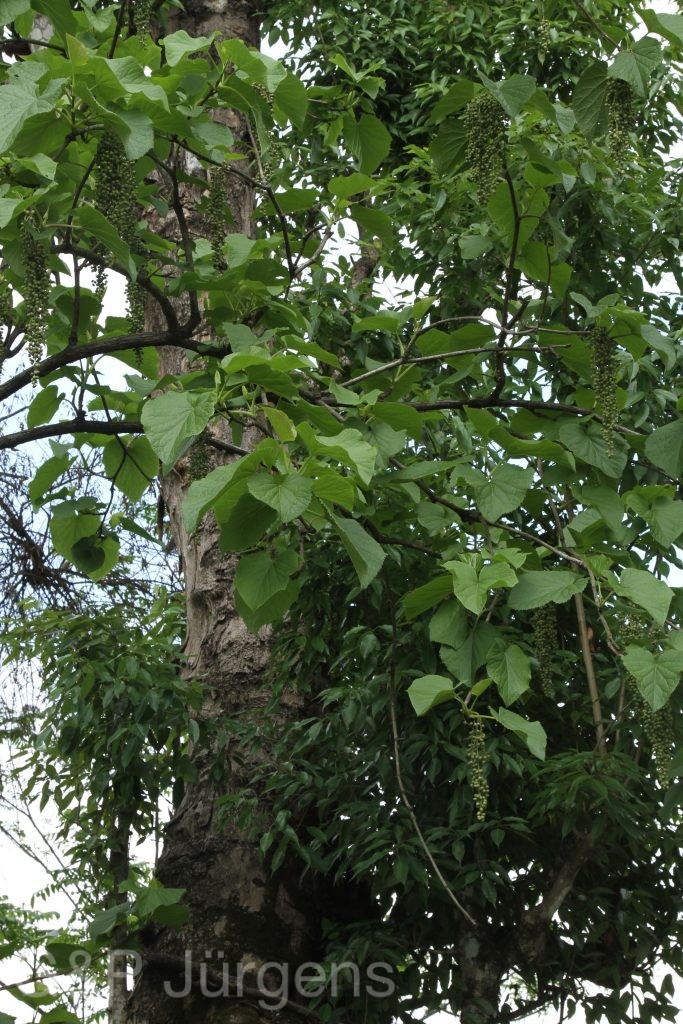
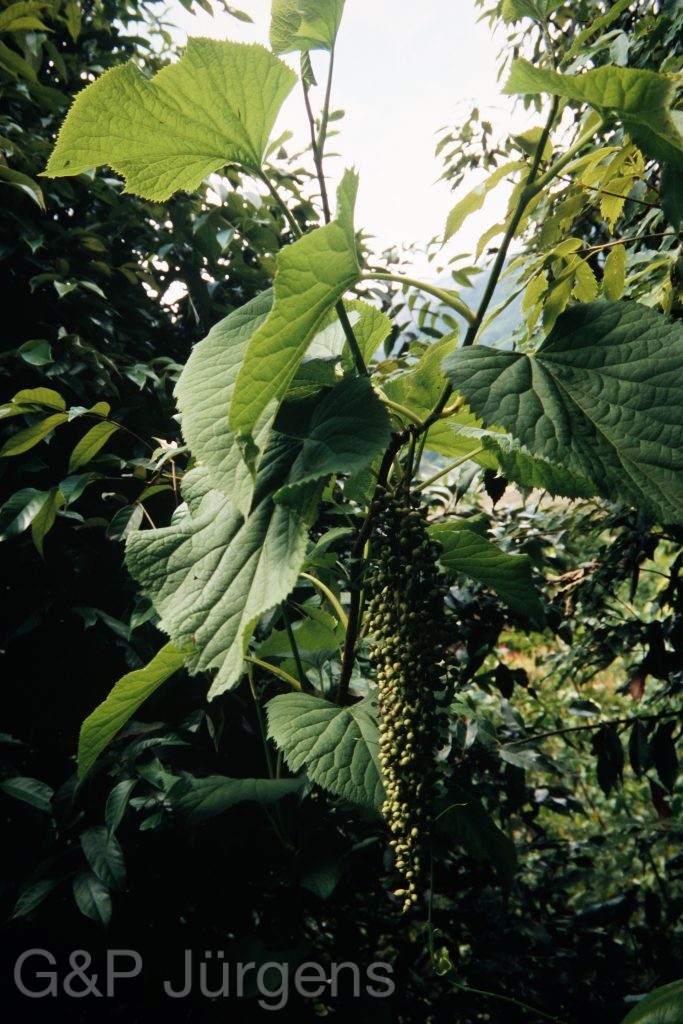
Toricellia tiliifolia DC. is a small deciduous tree or large shrub of the Cornaceae (or the segregate family Toricelliaceae), restricted to the Himalaya and southwestern China. GBIF records, totalling 23 occurrences, place it in China, Nepal, Bhutan and India. The species grows on moist, often disturbed slopes, ravine margins, forest edges and streamsides through the subtropical to lower temperate belt, broadly from 700 to 2,300 m. The cited Bhutanese collections from Trithangebe at 700 m in May and from Limbukha at 2,200 m in April illustrate this altitudinal span across the southern Bhutanese foothills.

The plant is a soft-wooded tree with stout, somewhat pithy branchlets and conspicuous leaf scars. The leaves are alternate, long-petiolate, broadly ovate to orbicular with a cordate base, palmately veined and shallowly lobed with a serrate margin, recalling those of a lime (Tilia), hence the epithet; the petiole base is dilated and sheathing. The plant is functionally dioecious, the small greenish flowers borne in long, slender, pendulous panicles; staminate flowers have minute petals and stamens, while the pistillate flowers have a reduced perianth and an inferior ovary. The fruit is a small ovoid drupe crowned by the persistent styles.

Toricellia is a relictual, taxonomically isolated genus whose placement has shifted between Cornaceae, Araliaceae and its own family Toricelliaceae within the Apiales, reflecting an ambiguous combination of cornoid and aralioid characters. Its disjunct, narrow Sino-Himalayan distribution makes it of considerable biogeographic interest as a Tertiary relict, and although not formally assessed as threatened, its limited range warrants attention where lower-montane forests are being cleared.

Author: DC. · Sources: POWO (Kew), GBIF, Flora of China Vol. 14, Flora of Bhutan Vol. 2, Flora of Nepal, Eyde: Comparative anatomy and phylogeny of the Cornaceae

(K.C.Sahni & Bahadur) C.Y.Wu & T.L.Ming

Bhutan2015 212
Bhutan Zhemgang 1000m, October

Description

Toxicodendron hookeri is a Himalayan and southwest Chinese sumac distributed through Nepal, the Indian Himalaya, Bhutan, southern China and into Thailand, with about 104 GBIF occurrences. It is a tree of warm subtropical and lower temperate broadleaved forest, growing along forest margins, on open slopes, in secondary woodland and in ravines on well-drained soils. The plant photographed at Zhemgang in central Bhutan at about 1000 m in October is representative of its preferred lower-montane belt of roughly 800-2500 m, where the autumn collection captures the foliage as it turns brilliant red, the leaves reddening before they fall.

It is a deciduous shrub or small to medium tree with greyish bark and stout, glabrescent twigs exuding an irritant resinous sap. The leaves are alternate and pinnately compound with several pairs of opposite, ovate to oblong-lanceolate, entire leaflets and a terminal one, the rachis sometimes narrowly winged, the whole turning vivid scarlet in autumn. The small, greenish-yellow, functionally unisexual flowers are borne in axillary panicles, with a five-parted calyx and corolla and a single-loculed ovary. The fruit is a small, dry, somewhat compressed drupe with a hard endocarp, ripening pale and persisting on the bare branches.

The plant's legacy link refers to it under the name Rhus succedanea, reflecting the former placement of these taxa in a broad Rhus; modern treatments segregate the lacquer-sap species into Toxicodendron, of which T. hookeri is one. As in poison ivy and the lacquer tree, the sap contains urushiol-type alkylcatechols that cause severe contact dermatitis. The species belongs to the resin-yielding, wax-producing group long valued in eastern Asia, and its bright autumnal colour makes it conspicuous in the Himalayan forest.

Author: (K.C.Sahni & Bahadur) C.Y.Wu & T.L.Ming · Sources: POWO (Kew), GBIF, Flora of China, Flora of Bhutan, Min & Barfod Anacardiaceae account, Gillis revision of Toxicodendron

Blume

Bhutan2015 160
Bhutan, Zhemgang 910m, October

Description

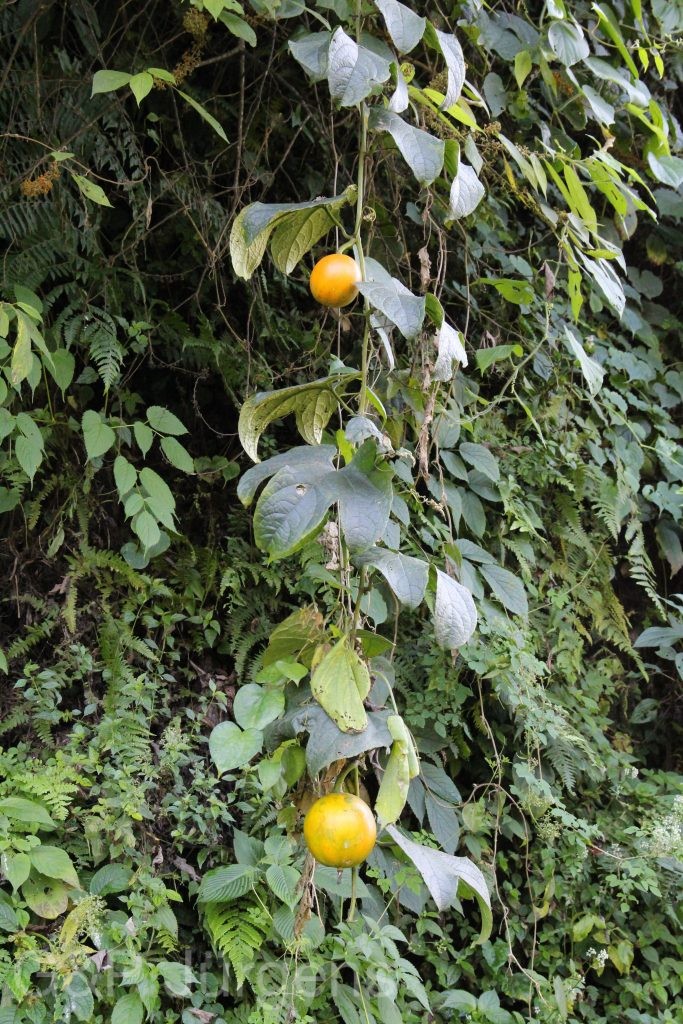
Trichosanthes costata Blume is a climbing cucurbit widely distributed across tropical and subtropical Asia, recorded by GBIF from China, Indonesia, Thailand, Taiwan, India, Malaysia, Vietnam, Cambodia, the Philippines, Myanmar, Laos and Bhutan, with over 600 occurrences. It grows in lowland to lower montane forest, secondary growth and thickets, scrambling over shrubs by tendrils. The Bhutanese material from Zhemgang at 910 m in October reflects its preference for the warm subtropical foothills and its autumn fruiting, when the ribbed fruits that give the epithet mature.

It is a slender, herbaceous to somewhat woody climbing vine with angular or ribbed stems and axillary tendrils. The leaves are alternate, broadly ovate to suborbicular, often three- to five-lobed, cordate at the base, with a dentate margin and palmate venation. The plants are monoecious or dioecious, the white flowers with the fringed corolla lobes characteristic of Trichosanthes, the males in racemes and the solitary females with an inferior ovary. The fruit is a small ellipsoid berry, conspicuously ribbed or costate, ripening red to orange, with several compressed seeds dispersed by frugivores.

Trichosanthes costata, sometimes treated under the segregate name Gymnopetalum but here accepted in the broader Trichosanthes, belongs to a large Old World genus of forest lianas distinguished by their fringed corollas, thought to attract nocturnal hawkmoth pollinators. Its wide Indo-Malesian to Sino-Himalayan range and tolerance of disturbance make it common in secondary forest, and several relatives are economically or medicinally important. It is not considered threatened, reflecting its colonising habit.

Author: Blume · Sources: POWO (Kew), GBIF, Flora of China Vol. 19, Flora of Bhutan Vol. 2, Flora of Nepal, de Wilde & Duyfjes revisions of Asian Cucurbitaceae (Trichosanthes)

L.

Bhutan2015 280
Bhutan Zhemgang 1000m, October

Description

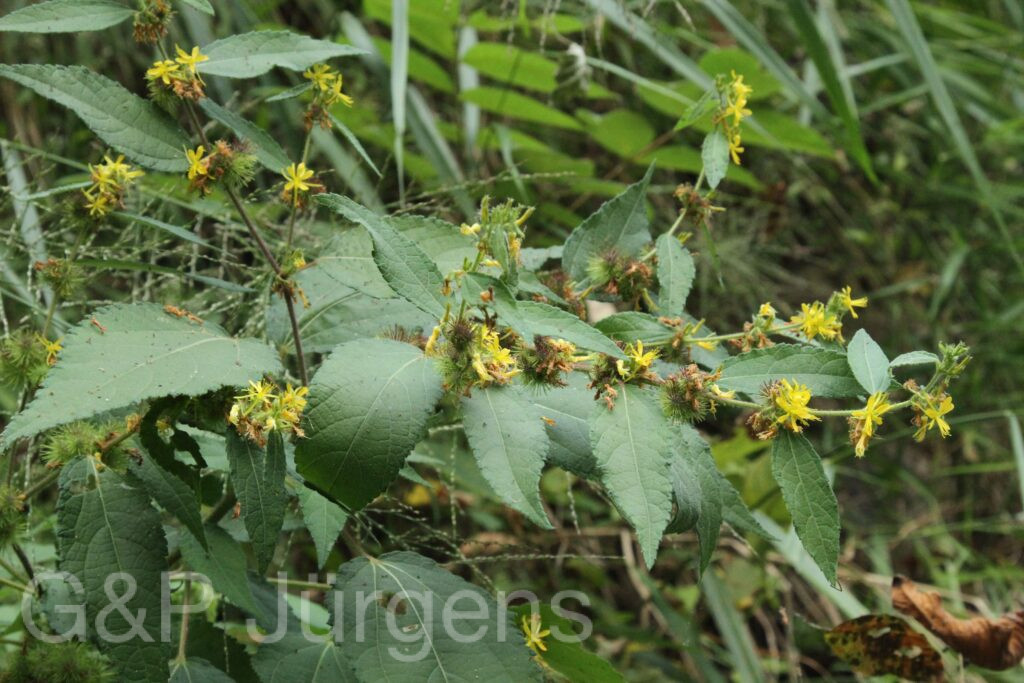
Triumfetta annua L. is a widespread herb of the Old World tropics and subtropics, with a pantropical distribution that GBIF records across tropical Africa (from Ethiopia and Tanzania to Angola, Zambia and South Africa), Madagascar, and southern and southeastern Asia, including China, Nepal, India, the Philippines, Indonesia, Malaysia and Papua New Guinea. In the Himalaya it is a plant of disturbed ground, forest clearings, roadsides, field margins and warm broad-leaved forest, ascending from the lowlands to around 1,500–2,000 m. The October record from Zhemgang in central Bhutan at 1,000 m typifies its occurrence as a seasonal weed of cultivated and ruderal subtropical habitats.

The species is an erect, branching annual herb up to about 1–1.5 m tall, with stems sparsely covered in stellate or simple hairs. The leaves are alternate, long-petiolate, ovate in outline and frequently three- to five-lobed, with serrate margins, an acuminate apex and palmate venation. Small yellow flowers are borne in leaf-opposed or axillary cymose clusters; each flower has five sepals, five petals, numerous stamens and a superior ovary. The diagnostic fruit is a globose, indehiscent capsule densely covered with hooked, glochidiate spines, a burr adapted for epizoochorous dispersal by adhering to animal fur and clothing.

Formerly placed in Tiliaceae, Triumfetta is now treated within an enlarged Malvaceae (subfamily Grewioideae). Its hooked fruits make it an effective colonist and an occasional agricultural weed across continents, while the bark yields a serviceable bast fibre used locally. The genus is taxonomically complex, and its wide ecological amplitude renders T. annua a classic example of a successful tropical synanthropic species.

Author: L. · Sources: POWO (Kew), GBIF, Flora of China Vol. 12, Flora of Bhutan Vol. 2, Bayer & Kubitzki: The Families and Genera of Vascular Plants Vol. V (Malvaceae)

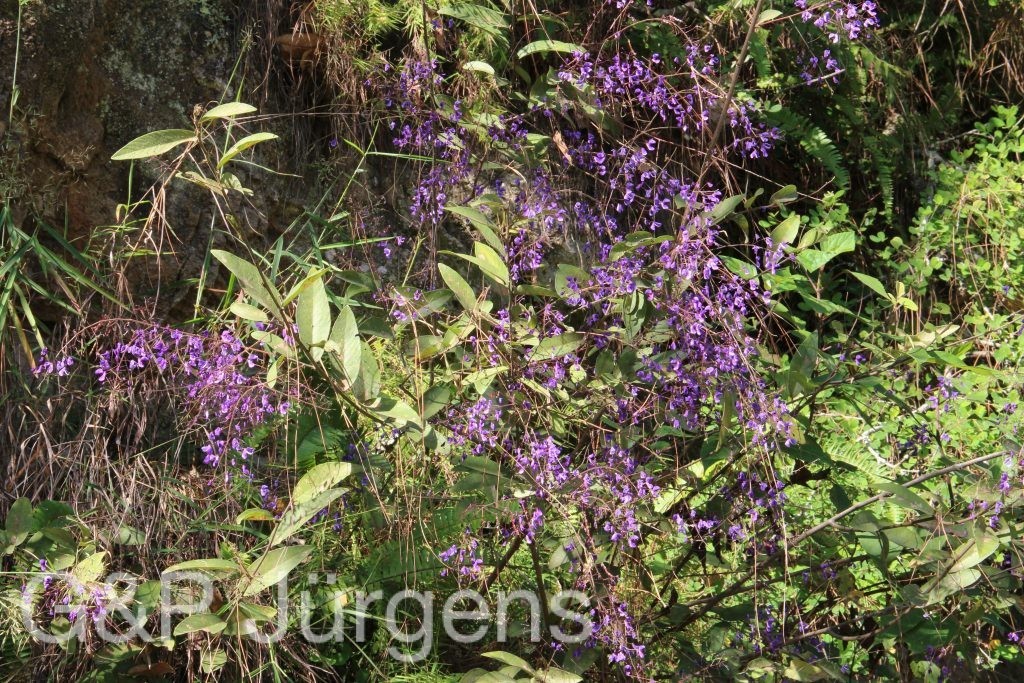
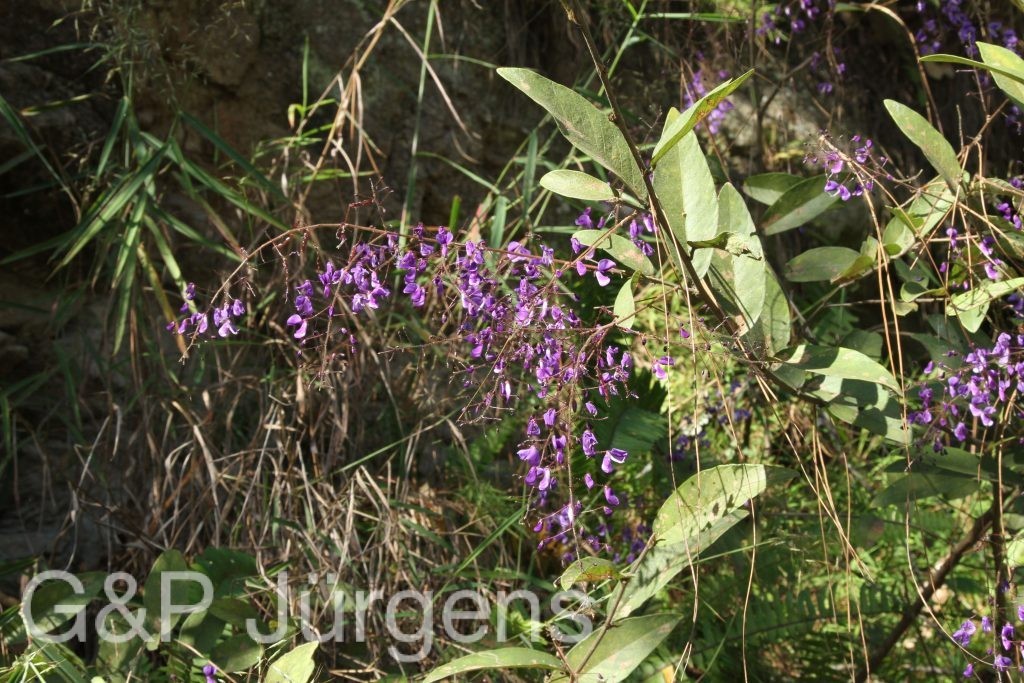
Uraria oblonga

by GP Jürgens

(Wall. ex Benth.) H.Ohashi & K.Ohashi

Bhutan2012 989
Bhutan Trithangebe 1050m, October
Bhutan2015 543
Bhutan Punaka 1240m, October
Bhutan2015 544
Bhutan Punaka 1240m, October

Description

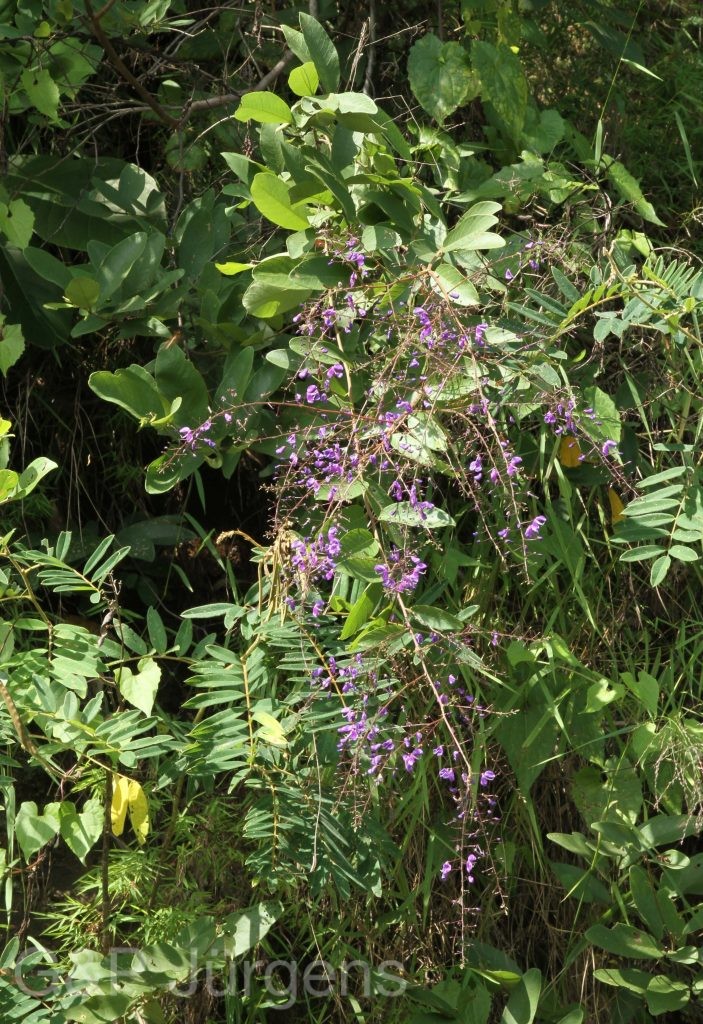
Uraria oblonga is distributed across the warm-temperate and subtropical belt of mainland Asia, with georeferenced records spanning Thailand, China, India, Myanmar, Laos, Vietnam, Bhutan and Japan; the roughly 235 documented occurrences reflect a continuous range along the southern Himalayan foothills and through Indochina. In Bhutan it has been recorded at lower montane elevations, as the accompanying images from Trithangebe at about 1050 m and Punaka at about 1240 m attest, both gathered in October at the close of the monsoon. It favours open grassland, scrub margins, forest clearings and disturbed roadsides on well-drained slopes, behaving as a light-demanding component of secondary herbaceous communities.

The plant is an erect to ascending perennial herb or subshrub arising from a woody rootstock, the stems sparingly branched and clothed in spreading hairs. Leaves are imparipinnate, typically with one to three pairs of leaflets that are oblong to elliptic-oblong, with entire margins, a reticulate venation prominent beneath, and stipels at the base of the petiolules. The inflorescence is an elongate terminal raceme bearing numerous small papilionaceous flowers, the calyx deeply lobed with elongate teeth and the corolla pink to purplish. The fruit is a small lomentum breaking into several folded, indehiscent one-seeded articles characteristic of the genus.

The species belongs to tribe Desmodieae of the Fabaceae (Faboideae), allied to Desmodium, a relationship echoed in the synonymy and the herbarium history of the basionym described by Wallich and Bentham before transfer by H. Ohashi and K. Ohashi. The jointed, hook-haired lomentum promotes epizoochorous dispersal, while the legume root nodules fix atmospheric nitrogen, allowing the plant to colonise nutrient-poor disturbed ground. With its broad transcontinental range and tolerance of human-modified habitats, U. oblonga is not considered threatened.

Author: (Wall. ex Benth.) H.Ohashi & K.Ohashi · Sources: POWO (Kew), GBIF, Flora of China, Flora of Bhutan, Ohashi revision of Desmodieae (Leguminosae)