Author

G & P Jürgens

J.Wen, Lowry & Esser
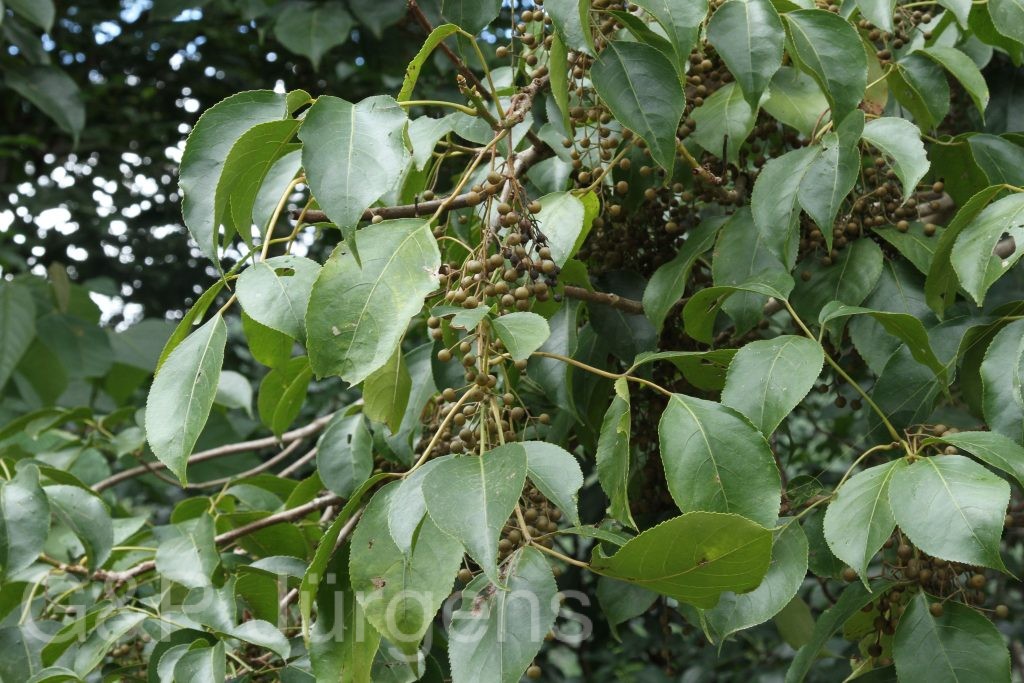
Bhutan2015 646
Bhutan Mo-Chu 1600m, October

Description

Aralia kingdon-wardii is a narrowly distributed eastern Himalayan and southwest Chinese species known from China, Myanmar, Bhutan and northeastern India, with GBIF recording only about 45 occurrences, reflecting its rarity and restricted range. It is a plant of warm-temperate to subtropical broadleaf forest, the photographed material coming from the Mo-Chu valley in western Bhutan at 1600 m in October. It occupies humid forest interiors, ravine slopes, clearings and stream banks on rich, moist soils in the lower montane belt, where it grows as a tall coarse herb or soft-wooded shrub in shaded to semi-open situations.

The species is a robust, often prickly perennial with stout stems and very large, two- to three-pinnately compound leaves, the numerous ovate to ovate-lanceolate leaflets serrate along the margins and acuminate at the apex. The small, five-merous, greenish-white flowers have an inferior ovary and are borne in numerous umbellules aggregated into a very large, much-branched terminal panicle, the typical inflorescence architecture of Aralia. The fruit is a small, dark, more or less globose, ribbed drupe containing several flattened pyrenes, ripening to purple-black and dispersed by birds.

Named for the plant collector Frank Kingdon-Ward, the species was described by J. Wen, Lowry and Esser as part of modern revisionary work clarifying Asian Aralia and the segregation of related Araliaceae genera. Given its limited known range and low number of records, A. kingdon-wardii is of potential conservation interest, dependent on the persistence of intact eastern Himalayan montane forest; its panicles of nectar-rich flowers and bird-dispersed drupes integrate it into forest pollinator and frugivore networks.

Author: J.Wen, Lowry & Esser · Sources: POWO (Kew), GBIF, Flora of China, Flora of Bhutan, Wen, Lowry & Esser studies in Asian Aralia (Araliaceae), Frodin & Govaerts World Checklist of Araliaceae
O.E.Schulz

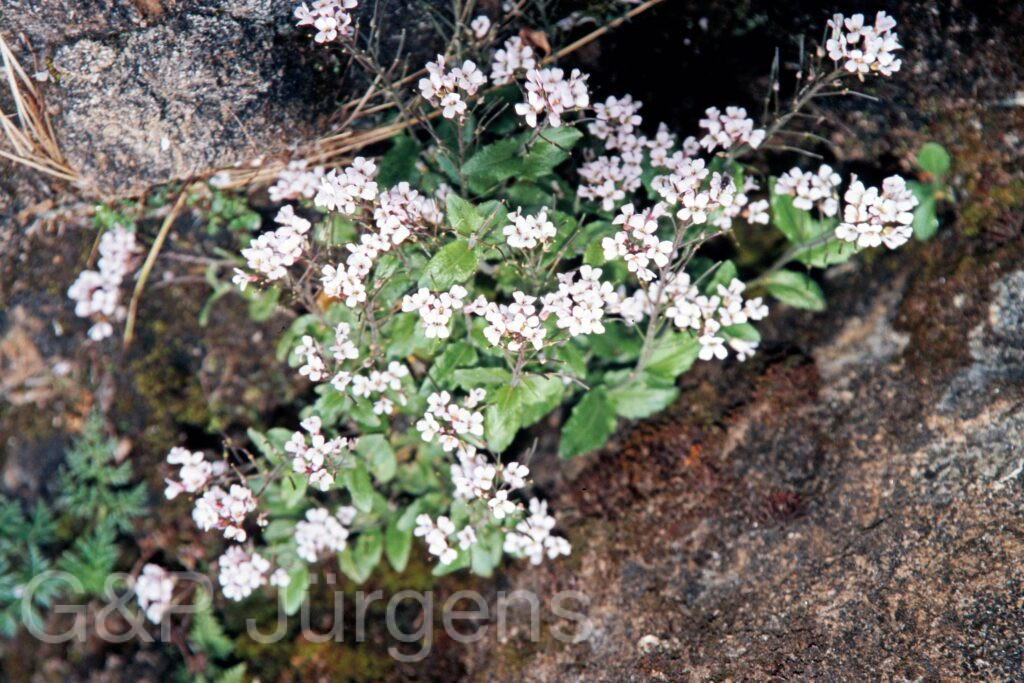
Garh 07 137 ergebnis
India Garhwal Kinkhola 3500m, June

Description

Arcyosperma primulifolium is a Himalayan crucifer of high-elevation forest and meadow margins, with GBIF recording 99 occurrences from India, Nepal, Pakistan and Bhutan. It occupies moist, shaded slopes, forest edges and damp turf in the upper temperate to subalpine zone, often among rocks and along the transition between birch-rhododendron forest and open alpine pasture. The image was taken at Kinkhola in Garhwal, India, at about 3500 m in June, when the plants flower as the high meadows green up after the spring thaw.

It is a perennial herb with a stout rootstock from which arise a rosette of long-petioled, lyrate to pinnatifid basal leaves; the lamina, with its rounded, crenate terminal lobe, recalls the foliage of a primrose, as the epithet primulifolium notes. The flowering stems are erect and bear smaller, less divided leaves below an elongating raceme. The flowers are white, with four sepals, four clawed petals and the tetradynamous stamens of the Brassicaceae. The fruit is a slender, somewhat flattened silique that distinguishes the monotypic genus; the seeds are arranged in the pod in the manner reflected by the generic name Arcyosperma.

Arcyosperma (Brassicaceae) is a monotypic genus segregated by O. E. Schulz, restricted to the Himalaya and allied within the family's diverse Asian montane crucifers. Its distinctive lyrate leaves and fruit characters set it apart from related genera such as Cardamine and Draba with which it co-occurs. Being a narrow-ranged montane endemic of a single species, it is of particular taxonomic and biogeographic interest, and like other high-Himalayan herbs its populations depend on intact subalpine forest and meadow habitats.

Author: O.E.Schulz · Sources: POWO (Kew), GBIF, Flora of Pakistan, Annotated Checklist of the Flowering Plants of Nepal, Jafri's Flora of West Pakistan (Brassicaceae), Schulz's treatment of Cruciferae in Engler's Das Pflanzenreich

Edgew.

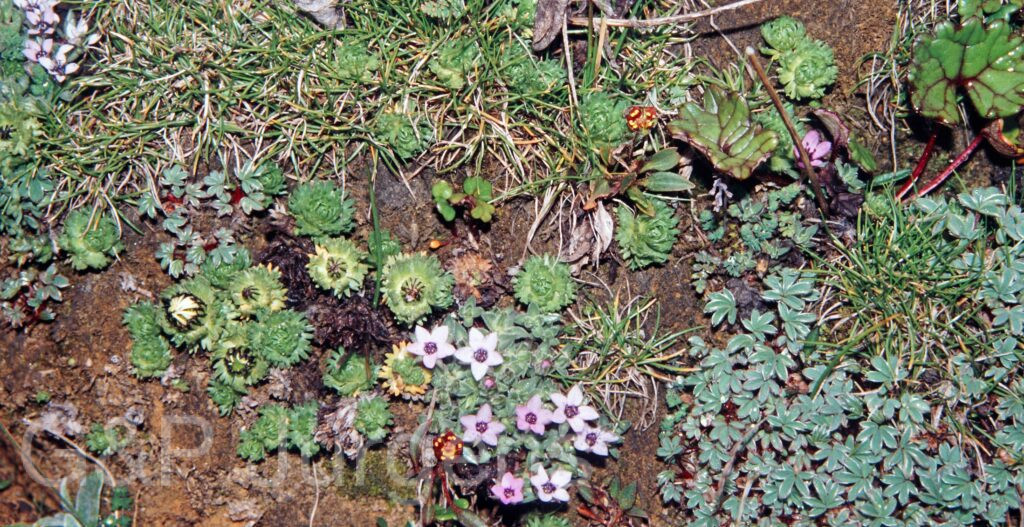
Nepal 99 651 2 ergebnis
West-Nepal Kagmara-La 5000m, July

Description

Arenaria melandryoides is a high-alpine cushion plant of the central and eastern Himalaya, recorded from China, Bhutan, India and Nepal across 35 GBIF occurrences. It is a specialist of the upper alpine and subnival belt, occupying open screes, gravelly slopes, moraines and rock crevices at very high elevations, typically above 4000 m. The population imaged on the Kagmara-La in West Nepal at 5000 m in July exemplifies its extreme montane habitat, where it flowers during the brief summer growing season amid sparse, frost-pruned vegetation on exposed, well-drained substrates.

The species is a low, tufted to cushion-forming perennial herb with a stout, woody rootstock and numerous short, densely leafy shoots forming compact mats. The leaves are small, sessile, linear-lanceolate and somewhat rigid, opposite and crowded, often ciliate. The flowers are solitary or few, borne on short pedicels; the calyx comprises five free, lanceolate sepals, and the five white petals are entire and slightly exceed the calyx. There are typically ten stamens and a superior ovary bearing three styles, ripening into a capsule that dehisces by valves to shed numerous small seeds adapted to wind and gravity dispersal on open ground.

The name Arenaria melandryoides is here treated as a synonym, with the accepted name being Arenaria melandryoides; the related epithet melandryiformis reflected in the source link points to ongoing nomenclatural revision within this taxonomically complex group. Arenaria sensu lato in the Himalaya has been repeatedly recircumscribed, with many species transferred among segregate genera. As a cushion-forming subnival specialist, the plant illustrates the convergent growth forms that buffer alpine Caryophyllaceae against cold, wind and short seasons.

Author: Edgew. · Sources: POWO (Kew), GBIF, Flora of China Vol. 6, Flora of Bhutan Vol. 1, Flora of Nepal, Flora of Pakistan, McNeill's revision of Arenaria

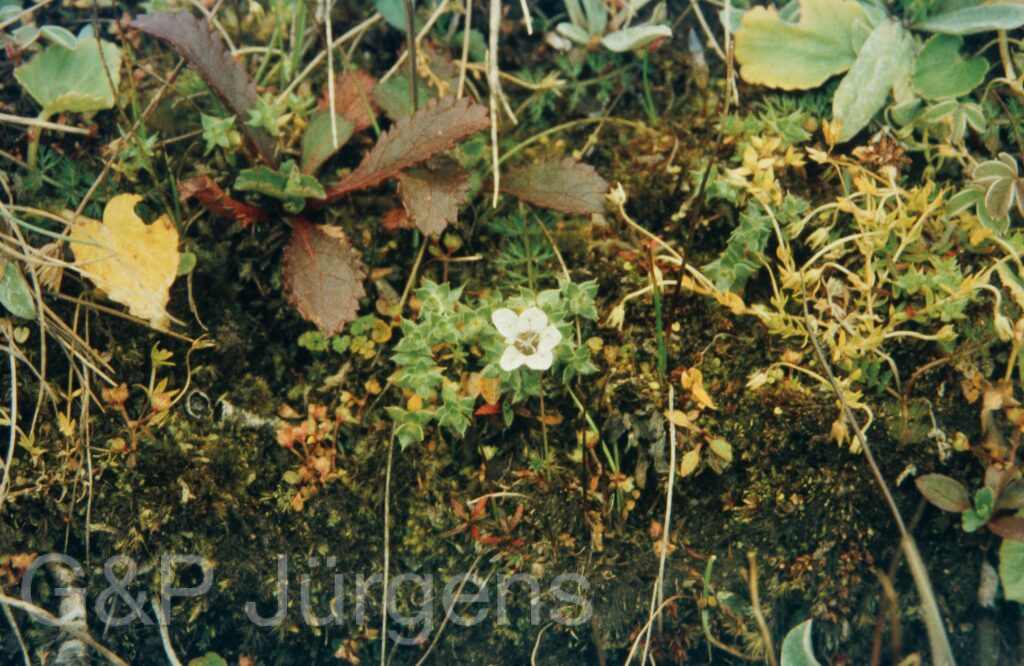
Benth.

Garw 2005 333 ergebnis
India Garhwal Bagubasa 4150m, September

Description

Arenaria festucoides Benth. is a tufted alpine sandwort of the Caryophyllaceae, distributed through the Himalaya and Tibetan plateau in India, Nepal, Pakistan and SW China, with around 126 georeferenced records concentrated along the high Sino-Himalayan ranges. It is a plant of open, well-drained habitats: stony alpine meadows, gravel flats, fine scree and grassy slopes above the treeline, where it forms low patches among rocks. The photographed population from Bagubasa in the Garhwal Himalaya at about 4,150 m in September lies squarely within its typical high-alpine elevational range, where it flowers and fruits late in the short mountain summer. In GBIF the name is treated as a synonym, but the accepted name is likewise rendered Arenaria festucoides, so it stands as the valid designation here.

The species is a densely caespitose perennial forming firm cushions or mats from a branched woody caudex. The leaves are crowded, narrowly linear to subulate and rigid, grass-like (hence the epithet festucoides), often pungent-tipped and somewhat keeled. The small flowers are borne singly or in few-flowered cymes on short pedicels; the five free sepals are lanceolate and acute, exceeded by the five entire white petals. There are typically ten stamens and three styles, the ovary maturing into a small ovoid capsule that dehisces by valves to release several minute seeds.

Arenaria is a large and taxonomically complex genus, and several segregate genera (Eremogone, Odontostemma) have been carved from its Himalayan members, so generic placement of this and allied species has shifted in recent treatments. The compact cushion habit, reduced leaf surface and deep caudex are classic adaptations to wind exposure, drought and frost at high elevation. The species is widespread across its range and not regarded as threatened.

Author: Benth. · Sources: POWO (Kew), Flora of China Vol. 6, Flora of Pakistan, GBIF, McNeill: Taxonomic studies in the Alsinoideae (1962)

(D.Don) Soják

Nepal 99 670 ergebnis
West-Nepal, Kagmara-La 4850m, July
Nepal 99 785 ergebnis
West-Nepal, Baga-La-Phedi 4250m, July

Description

Argentina microphylla is a high-alpine cushion herb of the Sino-Himalayan region, documented by GBIF from Nepal, China, India, Bhutan and Pakistan across some 272 georeferenced records. It is a characteristic species of the upper alpine and subnival belt, colonising stony slopes, glacial moraines, gravelly fellfields and turf at elevations approaching the snowline. The species was photographed in West Nepal on the Kagmara-La at 4850 m and at the Baga-La-Phedi at 4250 m, both in July, the brief window when these wind-swept screes are snow-free and the plants flower.

It forms low, mat- or cushion-forming perennials arising from a stout, woody, branched caudex clothed in persistent leaf-bases. The leaves are imparipinnate and crowded into rosettes, with numerous small, closely overlapping leaflets that are densely silky-sericeous and silvery beneath, an adaptation reducing transpiration and reflecting intense montane radiation. The flowers are solitary or few, borne on short scapes, with five green sepals alternating with an epicalyx, five obovate bright-yellow petals, numerous stamens, and an apocarpous gynoecium of many free carpels seated on a slightly hairy receptacle. The fruit is an aggregate of dry, glabrous achenes.

GBIF treats the name as accepted. The genus Argentina was segregated from Potentilla by Soják, reflecting molecular evidence that the herbaceous, pinnate-leaved "argentine" potentillas form a distinct lineage; the species accordingly appears in older Himalayan floras under Potentilla microphylla. Adapted to extreme cold, short growing seasons and unstable substrates, it is not considered threatened, its wide trans-Himalayan range and remote habitat affording natural protection.

Sources: POWO (Kew), GBIF, Flora of Nepal, Flora of China, Soják revision of Potentilla and allied genera

Schott

Sikkim 2006 70 ergebnis
Sikkim India Kalipokhri 2900m, May

Description

Arisaema decipiens (Schott) is a tuberous perennial of the family Araceae (the genus is here listed under the synonymous family heading Aceraceae) distributed through the eastern Himalaya and adjacent Southeast Asia, from northeast India and Myanmar through southern China to Vietnam, Japan and Malaysia. With only around 230 GBIF occurrences it is a comparatively localised species of the moist eastern montane forests. It grows in the shaded understorey of evergreen and mixed broad-leaved forest, on humus-rich slopes and among rocks, principally between 2,000 and 3,000 m, as exemplified by the collection from Kalipokhri in Sikkim, India, at 2,900 m in May, when the cohort of fresh inflorescences emerges with the spring growth.

The plant arises from a depressed-globose tuber and produces a pseudostem formed by the overlapping leaf sheaths. Typically a single trifoliolate (occasionally pedately divided) leaf is produced, with elliptic to ovate, acuminate leaflets. The inflorescence is the characteristic aroid spadix enclosed by a green to purplish spathe striped with white; the spathe limb is hooded and tapers to a slender tip, while the spadix appendix is slender and stipitate. As in most Arisaema the species is paradioecious, individual plants changing functional sex between male and female phases according to size and vigour. The fruit is a head of red berries borne on the persistent infructescence.

Arisaema is a large and taxonomically intricate genus in which species boundaries rest heavily on spathe coloration and spadix-appendix form, and A. decipiens belongs to a closely related complex of eastern Himalayan cobra-lilies. Its size-dependent sex change is of considerable interest to reproductive ecologists. Restricted to the wetter eastern ranges, the species is less common than its western congeners but is not currently regarded as threatened.

Author: Schott · Sources: POWO (Kew), Flora of Bhutan Vol. 3, GBIF, Flora of China Vol. 23, Gusman & Gusman: The Genus Arisaema (2006)

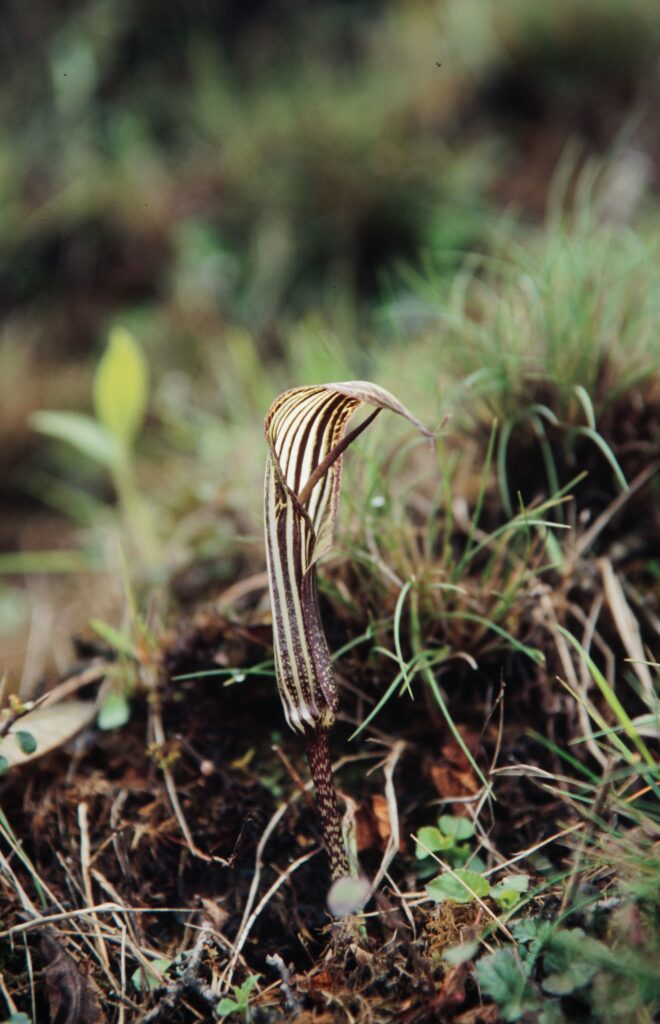
Buchet

BhutanPG2011 134
Bhutan Tsochenchen, 3550m June

Description

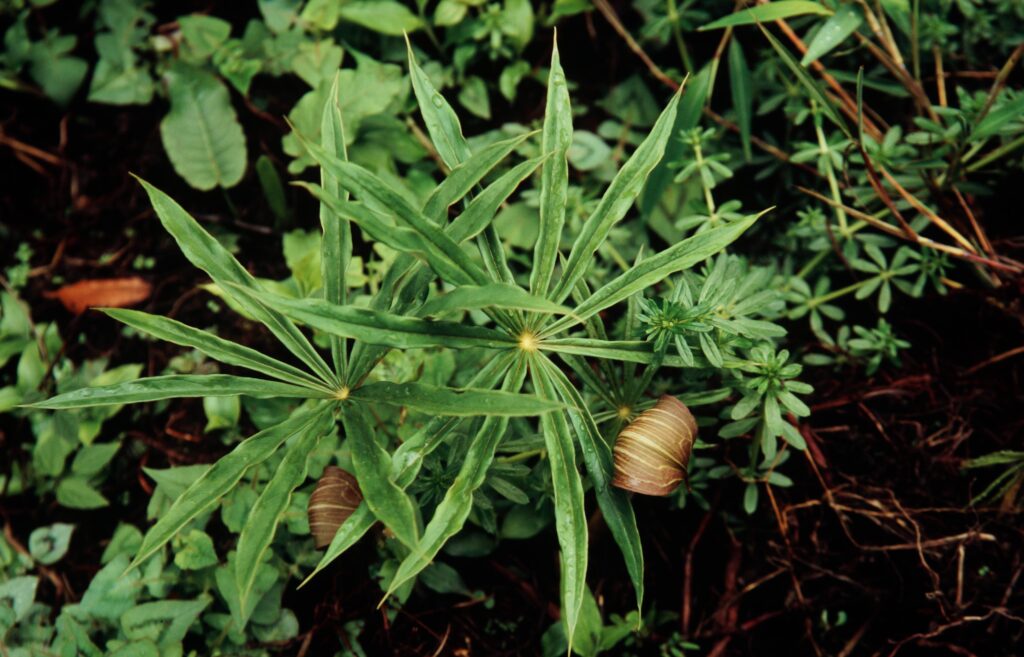
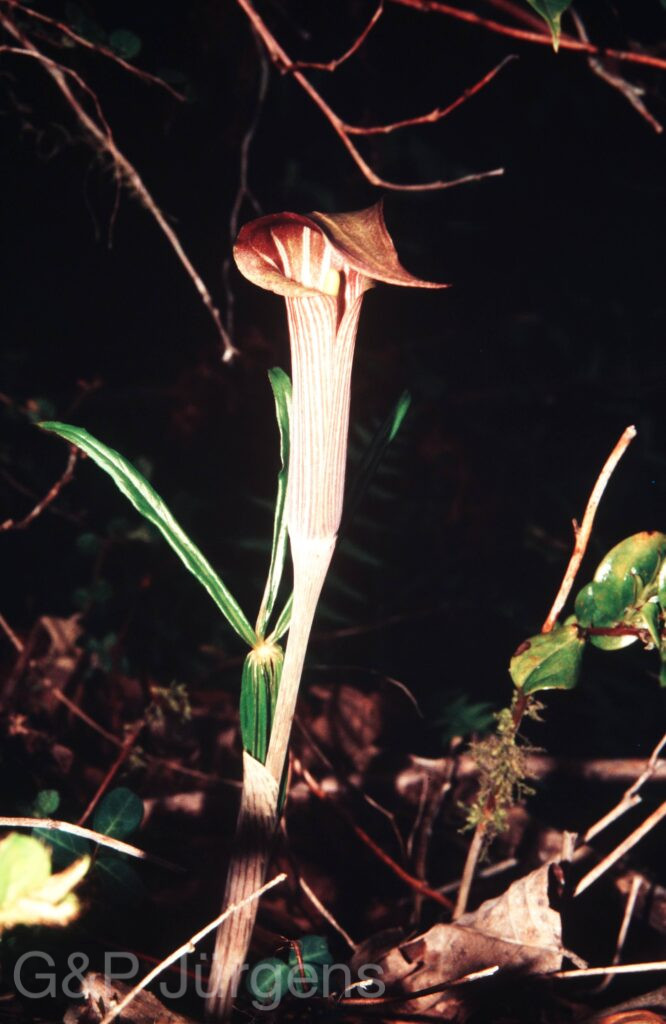
Arisaema elephas is a tuberous perennial aroid of the eastern Himalaya and the Sino-Himalayan mountains, recorded from China, India, Bhutan and Myanmar, with around 426 occurrences in GBIF. It grows in moist subalpine and alpine habitats, in open coniferous and Rhododendron forest, scrub, grassy slopes and meadow margins, generally between about 2700 and 4300 m. The photographed plant was collected in Bhutan at Tsochenchen at 3550 m in June, an elevation and cool, humid montane setting characteristic of the species, which emerges and flowers early in the growing season after snowmelt.

The plant arises from a depressed-globose tuber and typically produces a single leaf divided into three leaflets, the lateral leaflets often markedly asymmetric, with entire to undulate margins. The inflorescence is a spathe enclosing the spadix; the spathe tube is greenish and the limb dark purple to blackish, and the spadix is prolonged into a long, slender, downward-curving appendix that recalls an elephant's trunk, hence the epithet elephas. As in most Arisaema the plants are often functionally dioecious, sex expression shifting with tuber size and vigour. The fruit is a dense club-shaped infructescence of red berries.

Arisaema is a large genus centred on the Himalaya and East Asia, notable for its sequential hermaphroditism (size-dependent sex change) and for pollination by fungus gnats and other small flies attracted into the spathe chamber. Arisaema elephas is a distinctive and well-marked species of the A. elephas group, recognised by its long pendent spadix appendix. It is widespread within its montane range and not currently considered threatened, though alpine populations are sensitive to grazing and habitat disturbance.

Author: Buchet · Sources: POWO (Kew), GBIF, Flora of China, Flora of Bhutan, The Genus Arisaema (Gusman & Gusman)

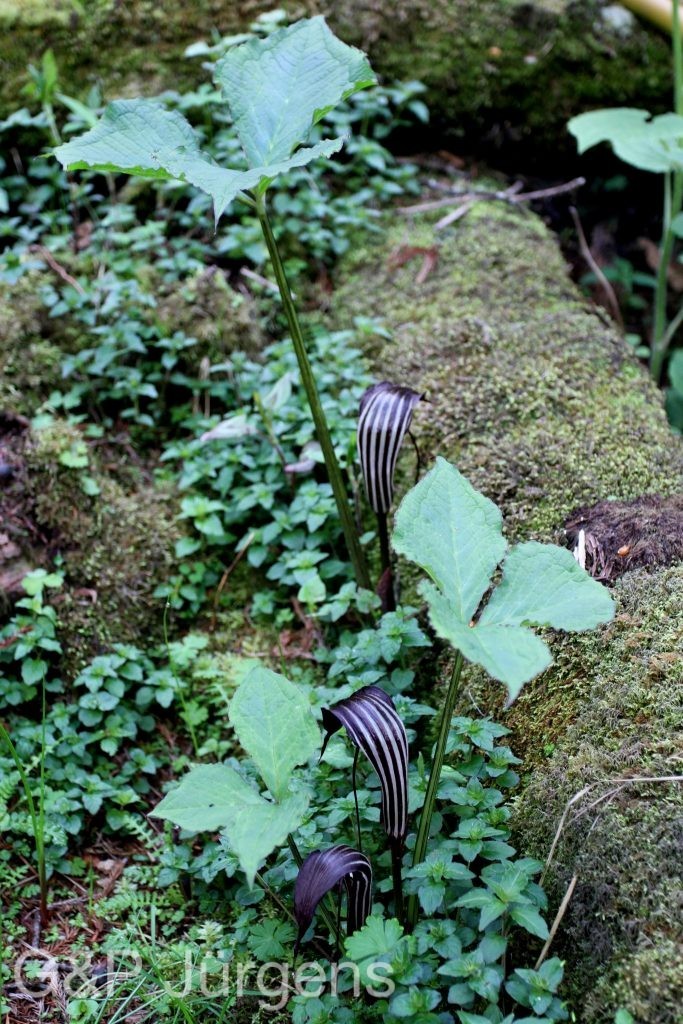
Schott

Nepal 2009 91 ergebnis
Nepal 2009 102 ergebnis

Both: Nepal Bolgoan, 1980m, May

Description

Arisaema erubescens is a widespread tuberous aroid distributed from the Himalaya across much of eastern and southeastern Asia. Its extensive range spans Nepal, northern India (from Uttarakhand to Arunachal Pradesh), Bhutan, Myanmar, Thailand, Vietnam, Taiwan, and much of China, with naturalised populations reported from several other countries. GBIF records over 1,350 occurrences, reflecting its broad distribution. The species inhabits the understorey of subtropical and warm temperate broadleaved forests, forest margins, and shaded ravines at elevations of 900–3,000 m. The photograph from Bolgoan in Nepal at 1,980 m, taken in May, shows the species during its characteristic spring emergence.
The plant arises from a depressed-globose tuber, 2–5 cm in diameter. The pseudostem is 15–40 cm tall, sheathed by cataphylls. Leaves are usually solitary, pedate with 7–15 leaflets; leaflets are elliptic to lanceolate, acuminate, the central one largest, 8–18 cm long, with entire or slightly undulate margins. The spathe is 8–15 cm long, with a tubular lower portion that is green striped with white or pale purple, and an arching, ovate-lanceolate limb that is typically purple-brown to dark maroon — the blushing colour referenced in the epithet erubescens. The spadix appendage is elongate, cylindrical, projecting well beyond the spathe tube, often sigmoid or pendulous. Plants are dioecious or sequentially monoecious. The infructescence is a dense cluster of bright red, globose berries.
Arisaema erubescens is taxonomically variable across its vast range, and several varieties have been described, including var. erubescens and var. onoticum. The species complex has been the subject of considerable systematic revision, as morphological boundaries with related taxa such as A. consanguineum can be subtle. It is one of the most commonly encountered Arisaema species in Himalayan forests and is not considered threatened. The tubers contain calcium oxalate crystals and are toxic if ingested raw, though they have been used in traditional medicine in several cultures.

Author: Schott · Sources: POWO (Kew), GBIF, Li & Hay: Araceae in Flora of China Vol. 23, Pradhan: Himalayan Cobra-Lilies (1997)

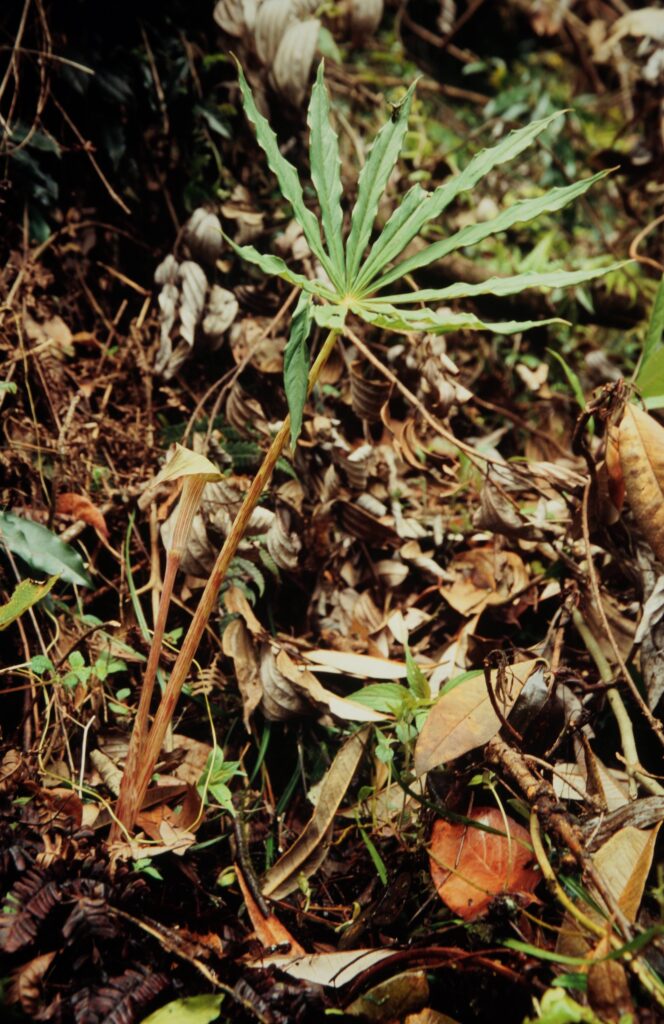
Hara

Nepal 2009 20 ergebnis
Nepal Helambu Koktrok 2500m, May

Description

Arisaema exappendiculatum is a Himalayan tuberous aroid of restricted distribution. GBIF holds only some 43 occurrences, chiefly from Nepal and adjacent China, with a handful of herbarium-derived European records (Belgium). It is a plant of moist temperate broadleaved and mixed forest, shaded ravines and shrubby slopes, growing in humus-rich soils. The illustrated plant was photographed in the Helambu region of central Nepal near Koktrok at about 2,500 m in May, a typical station within its montane band of roughly 2,000–3,000 m, where it emerges and flowers with the onset of the pre-monsoon rains.

The plant arises from a depressed-globose tuber producing usually a single leaf with a long sheathing petiole. The leaf is pedately divided into several oblong-lanceolate, acuminate leaflets. The inflorescence is a spathe with a convolute tube and an arching, acuminate limb, greenish to purplish and often pale-striped. As the epithet indicates, the spadix appendix is reduced or absent (exappendiculate), the spadix tapering abruptly above the fertile zone. The plants are dioecious, sex expression depending on tuber size; the fruiting spadix bears a cluster of red berries.

The absence of a developed spadix appendage distinguishes A. exappendiculatum within the predominantly Asian genus Arisaema and aligns it with related Himalayan species. Owing to its narrow range and modest population sizes it warrants monitoring, though no formal IUCN assessment is established. Note that the input wp_link references A. erubescens, with which this taxon should not be confused.

Author: Hara · Sources: POWO (Kew), Flora of Nepal, Flora of China Vol. 23, GBIF, Gusman & Gusman: The Genus Arisaema (2006)

(Wall. ex G.Don) I.M.Johnst.

Nepal 99 91 ergebnis
West-Nepal Bhulbhule 3500m, June
Nepal 99 92 ergebnis
West-Nepal Bhulbhule 3500m, June

Description

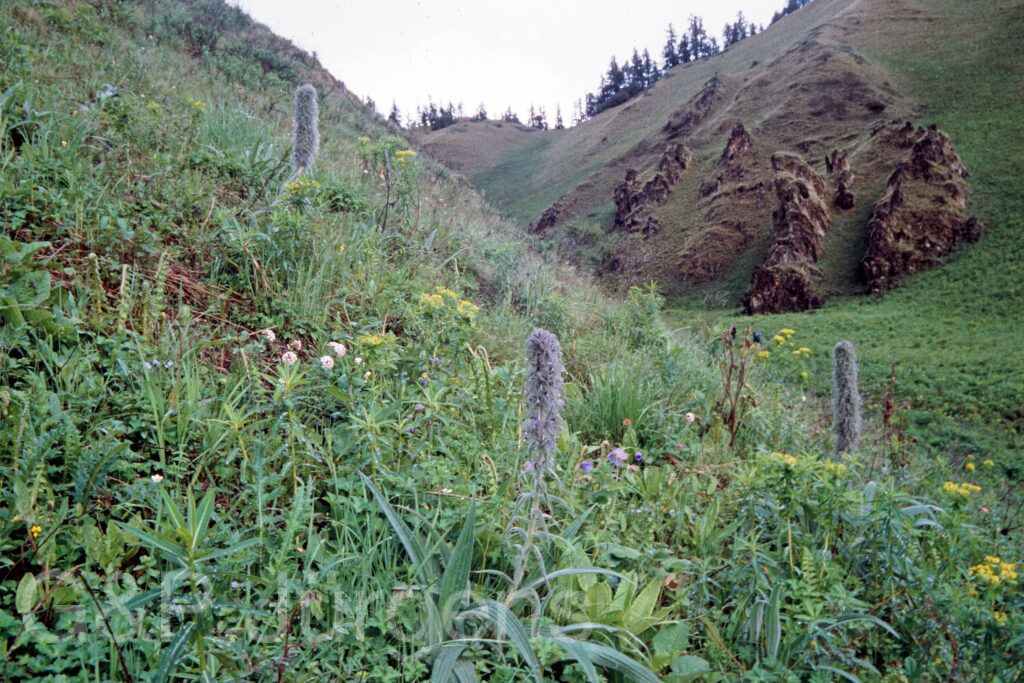
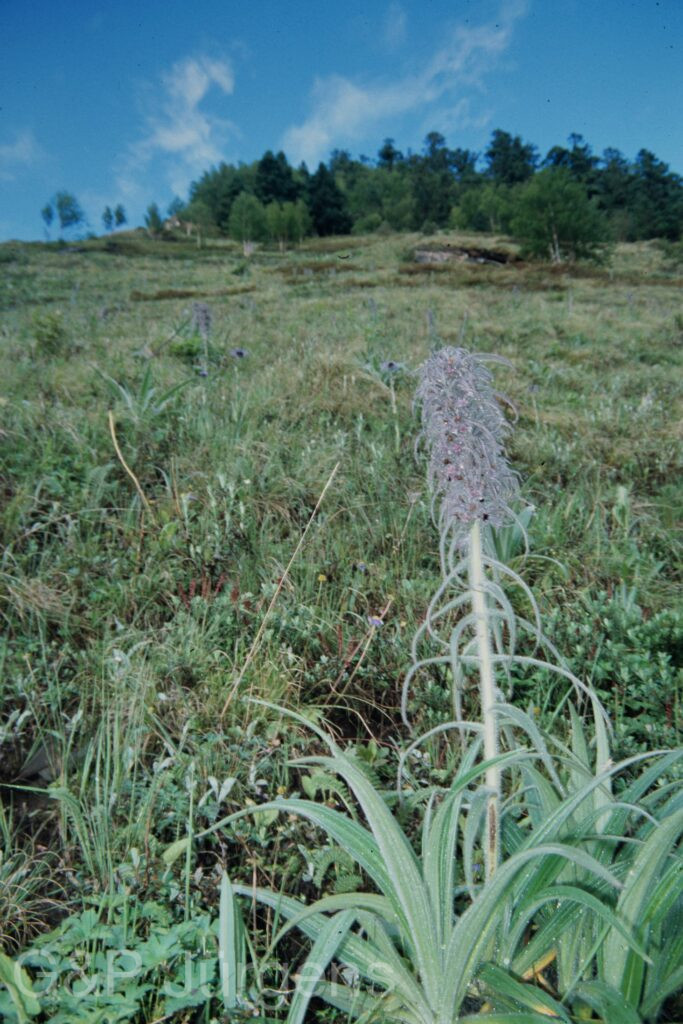
Arnebia benthamii is a stout alpine herb of the western and central Himalaya, distributed through India, Pakistan and Nepal, with GBIF recording roughly 167 occurrences. It inhabits open alpine meadows, grassy and rocky slopes, and stabilised scree in the subalpine and alpine zones, typically from 3000 to 4200 m. The photographed plant grew in West Nepal near Bhulbhule at 3500 m in June, when the species comes into flower as the snow recedes, forming conspicuous erect spikes among the early-summer alpine sward.

The plant is a robust, densely hispid perennial arising from a thick woody rootstock that yields a purple dye. The stems are erect, unbranched and bristly, clothed with sessile, oblong to lanceolate, rough-hairy leaves. The inflorescence is a dense, elongate, cylindrical thyrse of crowded scorpioid cymes subtended by leafy bracts. The flowers are tubular-funnelform, the corolla bluish-purple to violet (drying darker), five-lobed with a hairy throat; the calyx is deeply five-parted and bristly. There are five included stamens and a deeply four-lobed ovary, the gynobasic style producing four hard nutlets at maturity.

The species is referable to genus Arnebia (subfamily Boraginoideae). It is of considerable ethnobotanical importance: the dye-yielding roots, known regionally as "Kahzaban" or "gaozaban," are widely used in Unani and folk medicine, driving substantial wild harvesting. This pressure, combined with grazing and a slow-maturing perennial habit, has caused local declines, and the species is regarded as conservation-sensitive in parts of the western Himalaya, prompting calls for sustainable collection and cultivation.

Author: (Wall. ex G.Don) I.M.Johnst. · Sources: POWO (Kew), GBIF, Flora of Pakistan, Flora of Nepal, Flowers of the Himalaya (Polunin & Stainton)