Author

G & P Jürgens

Griersson & Spring.

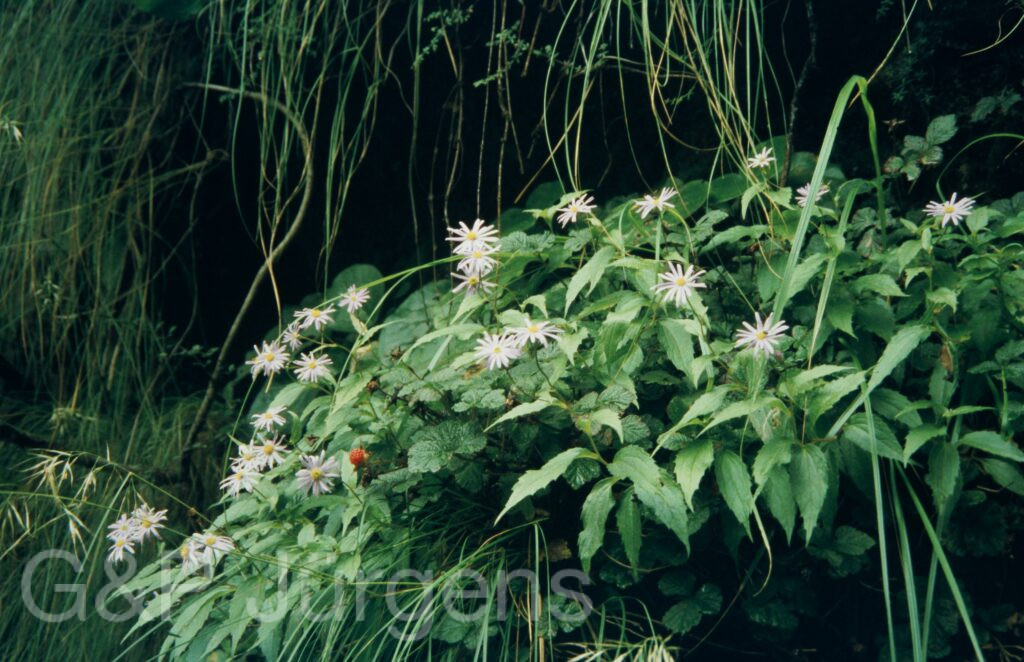
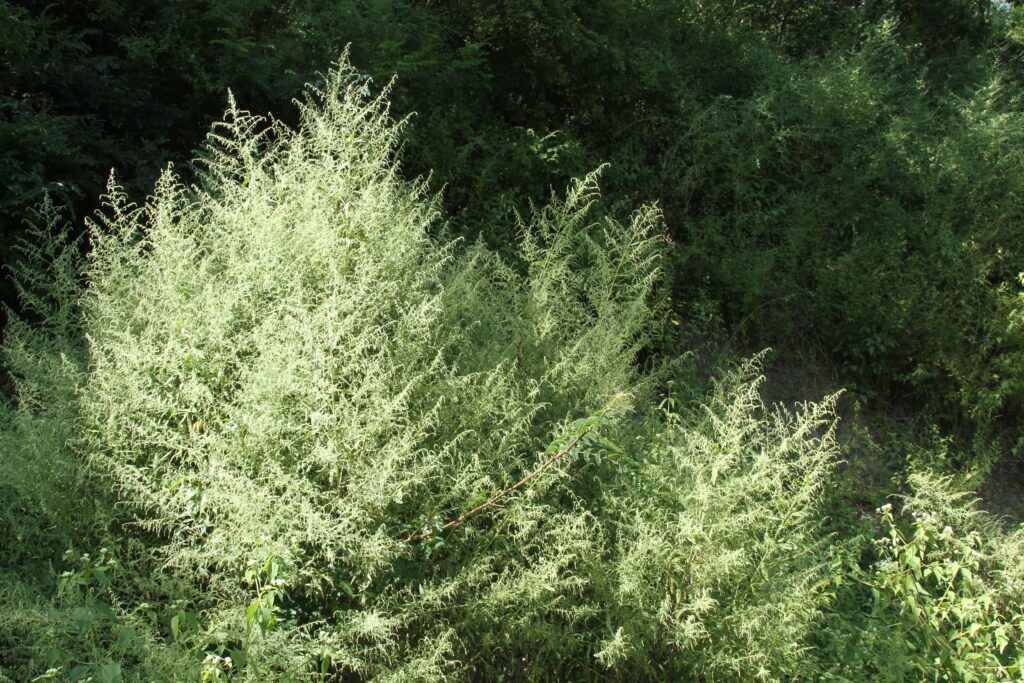
Bhutan2015 310 ergebnis
Bhutan Trongsa 1800m, October
Bhutan2015 311 ergebnis
Bhutan Trongsa 1800m, October

Description

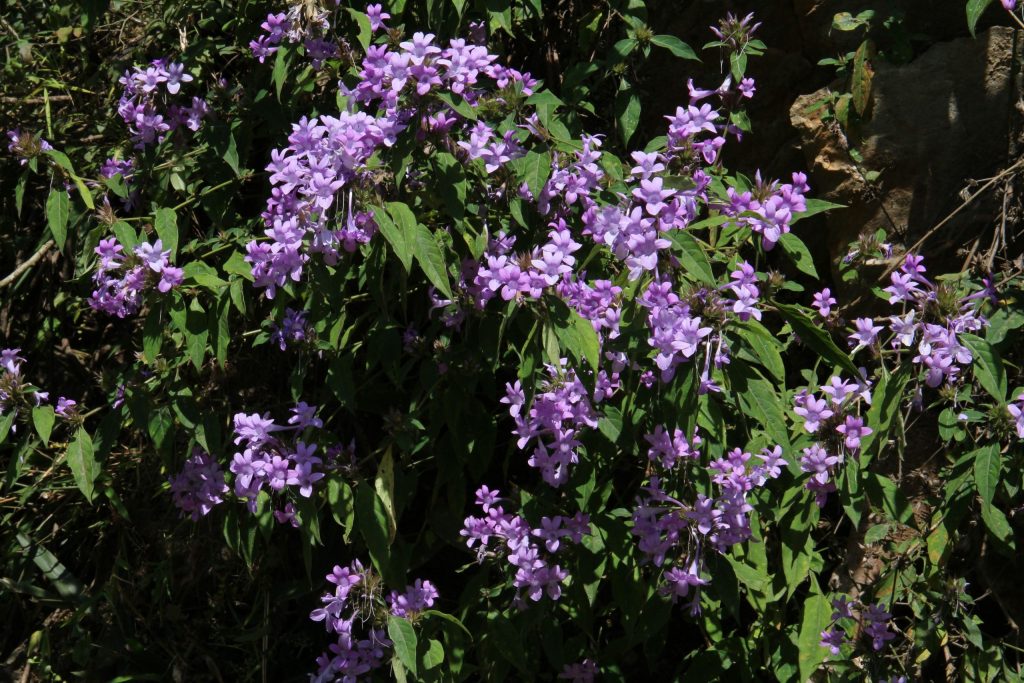
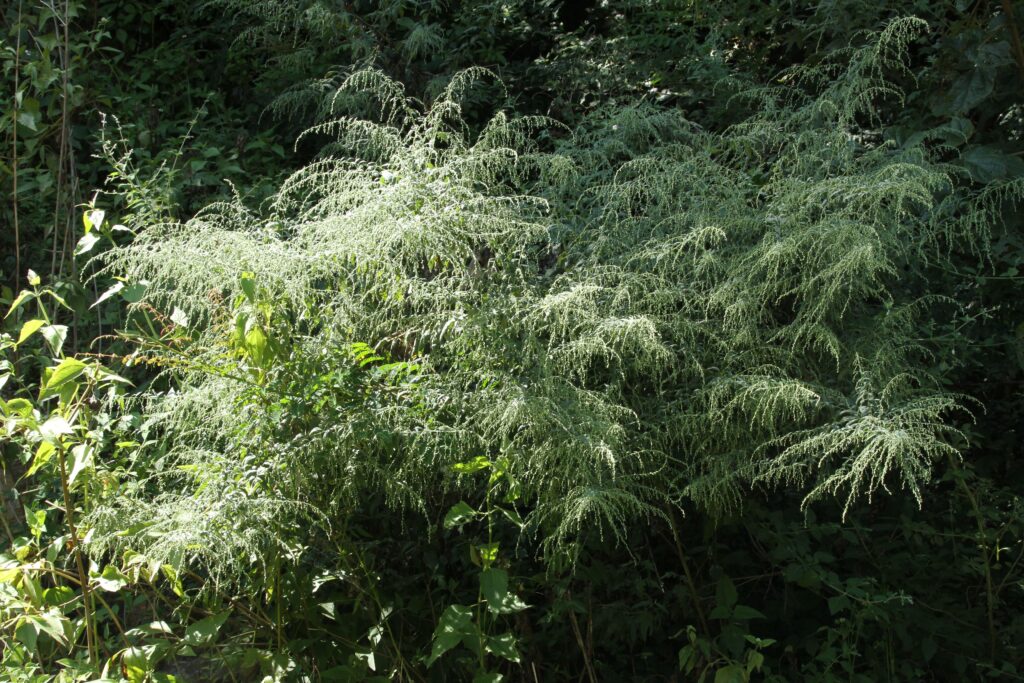
Artemisia bhutanica is a perennial herbaceous species endemic or near-endemic to Bhutan, where it inhabits warm-temperate and subtropical forest margins, roadsides, and disturbed slopes at elevations of approximately 1,200–2,500 m. The species is recorded from the central valleys of Bhutan, including the Trongsa district at around 1,800 m, where it has been photographed flowering in October. With only nine occurrence records documented in GBIF, all confined to Bhutan, the species appears to have a highly restricted distribution and is one of the lesser-known members of this large, cosmopolitan genus in the eastern Himalayan region.
The plant forms erect to ascending, somewhat woody-based stems 40–100 cm tall, branching in the upper portion. The leaves are alternate, deeply pinnatisect to bipinnatisect, with narrowly linear to filiform segments, greyish-green above and more densely tomentose beneath with appressed T-shaped trichomes characteristic of the genus. The capitula are small, nodding, ovoid to subglobose, 2–3 mm in diameter, arranged in lax, paniculate synflorescences. Each capitulum contains few tubular florets; the outer florets are pistillate and the inner ones bisexual. The involucral bracts are imbricate, scarious-margined. Achenes are minute, obovoid, and glabrous.
Artemisia bhutanica was described by Grierson and Springate in the Flora of Bhutan and represents part of the considerable Artemisia diversity in the eastern Himalayas. Its taxonomic placement within the genus requires further molecular study, as morphological boundaries among eastern Himalayan Artemisia species can be unclear. Given its extremely limited documented range and low number of collections, A. bhutanica may warrant conservation assessment, particularly as road construction and land-use change continue to alter warm-temperate habitats in Bhutan's central valleys.

Author: Griersson & Spring. · Sources: POWO (Kew), GBIF, Grierson & Long: Flora of Bhutan Vol. 2 (2001)
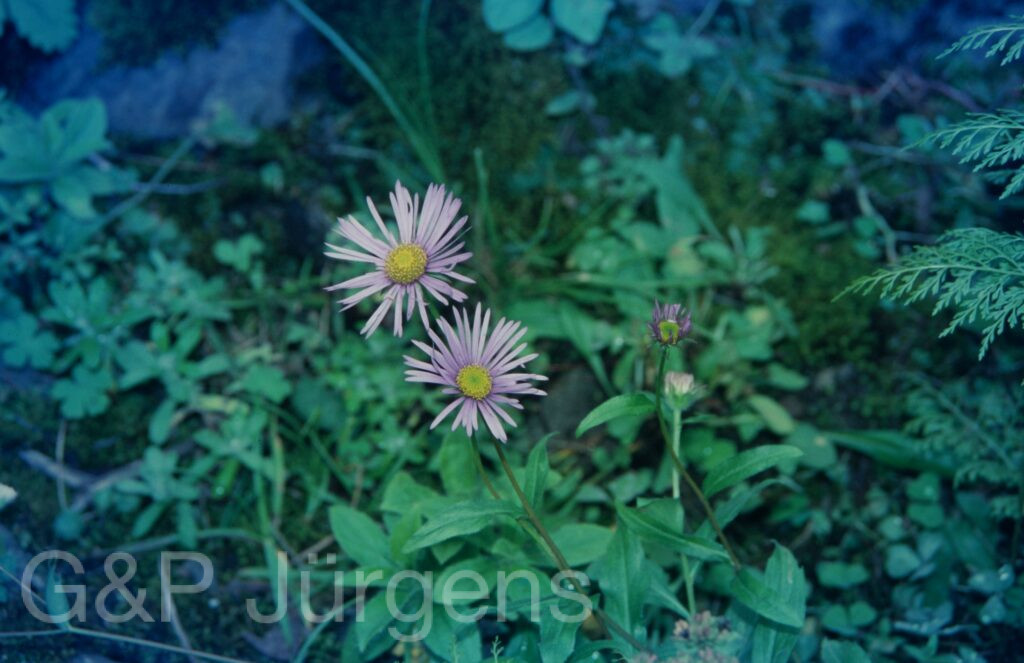
(C.B.Clarke) Hutch.

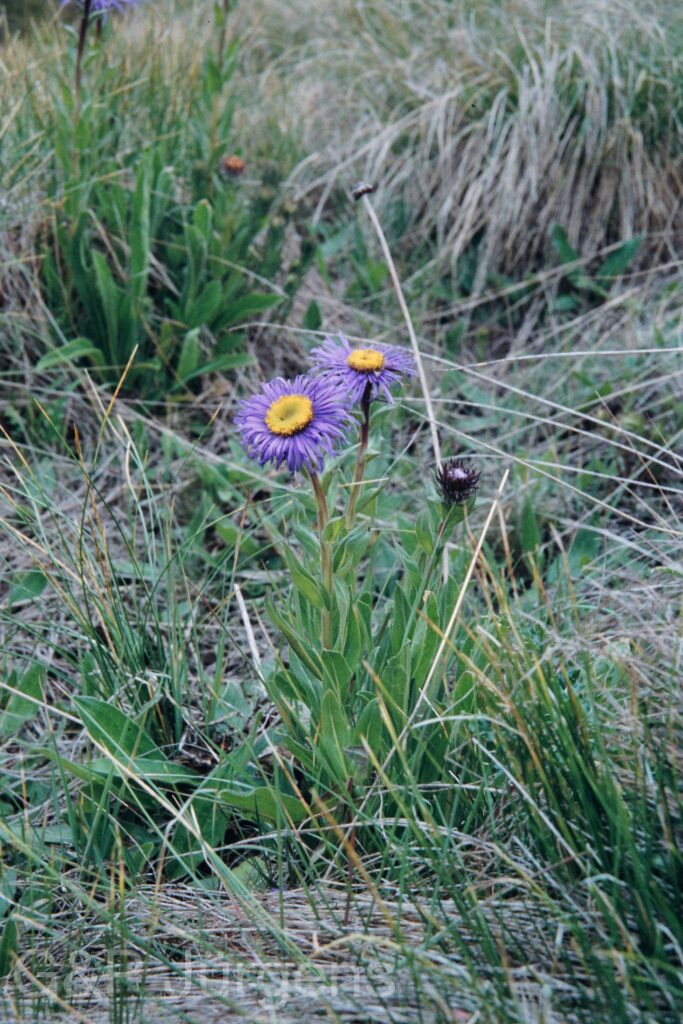
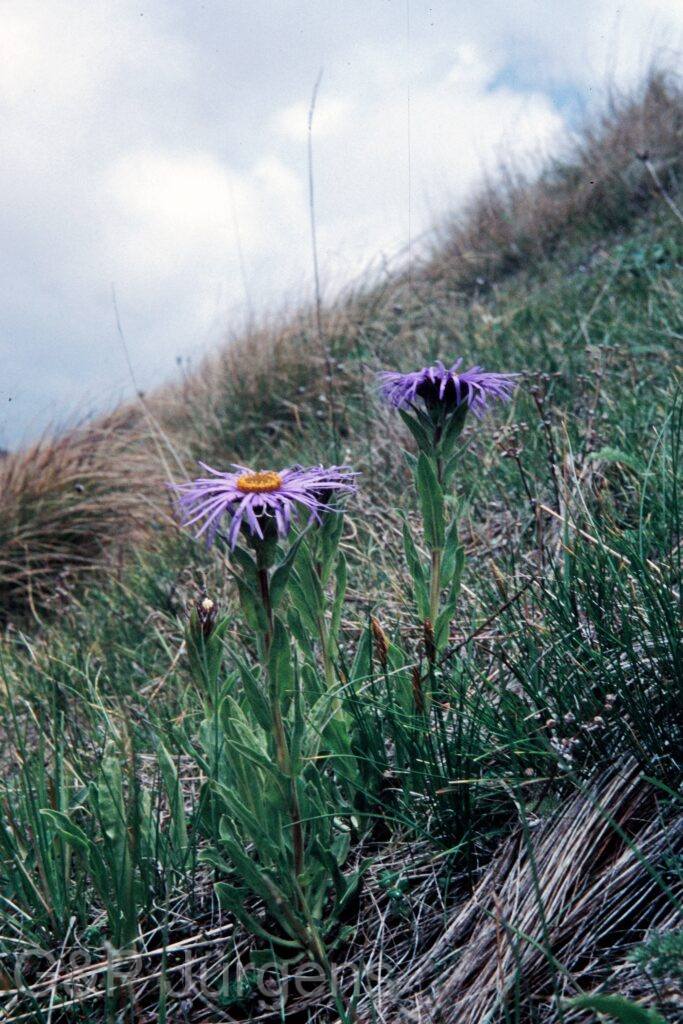
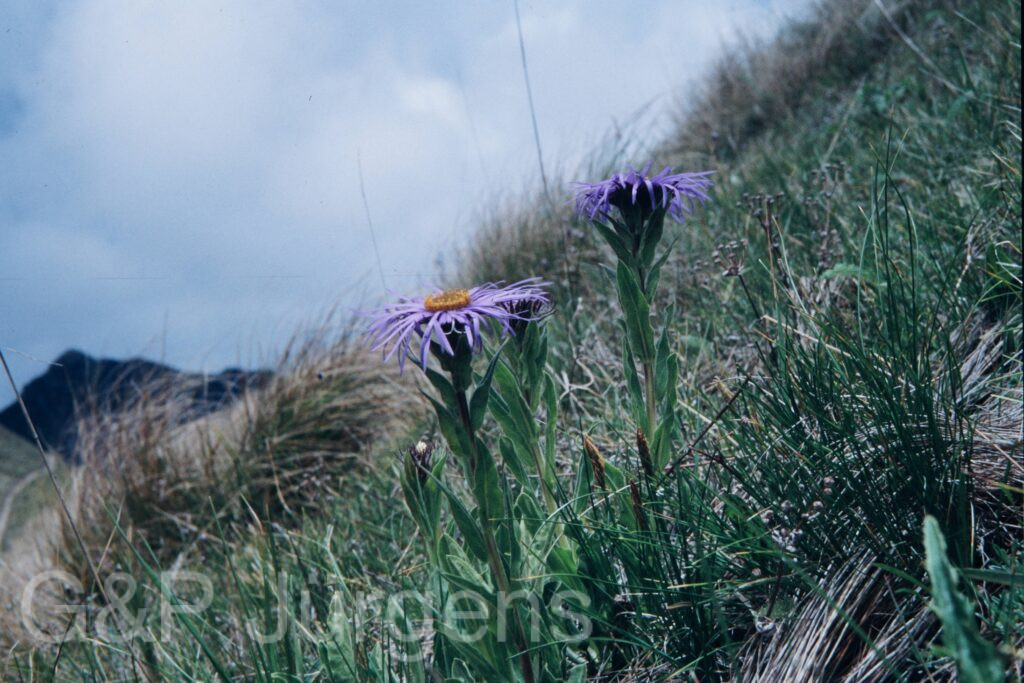
Nepal 99 93 ergebnis
West-Nepal Bhulbhule 3600m, June
Nepal 99 258 ergebnis
West-Nepal Loccu 3155m, June
Nepal 99 122 ergebnis
West-Nepal South of Rara-Lake 3500m, June

Description

Aster falconeri is a high-alpine herb of the north-western and western Himalaya, recorded from India, Pakistan and Nepal, with some 147 georeferenced collections documenting a relatively narrow but well-sampled range. It occupies open turf, moist alpine meadows, grazed grassland and the margins of seepages and snowmelt flushes, typically between about 3100 and 4000 m. The photographed populations from West Nepal—Bhulbhule at 3600 m, Loccu at 3155 m and the slopes south of Rara Lake at 3500 m, all flowering in June—are characteristic of its early-summer phenology, the plants emerging and blooming soon after the snowpack recedes.

It is a perennial forming low tufts from a short rootstock, the stems erect to ascending, simple, glandular-hairy and bearing reduced cauline leaves. Basal and lower leaves are oblanceolate to spathulate, narrowed to a winged petiole, entire or obscurely toothed and somewhat hairy. The solitary terminal capitula are radiate, subtended by an involucre of subequal, herbaceous, often purple-tinged phyllaries; the ray florets are ligulate and blue to violet, surrounding a disc of yellow tubular florets. The fruit is a compressed, hairy cypsela crowned by a pappus of barbellate bristles aiding wind dispersal.

First described as a member of Erigeron by C. B. Clarke and transferred by Hutchinson, the taxon is treated under the name Aster falconeri, regarded as the accepted name notwithstanding its synonym status in the source dataset. As with many Sino-Himalayan asters, generic limits between Aster and Erigeron have shifted repeatedly with morphological and molecular reappraisal. Though not formally assessed for conservation, its restriction to montane pastures exposes it to heavy grazing pressure across the western ranges.

Author: (C.B.Clarke) Hutch. · Sources: POWO (Kew), GBIF, Flora of Pakistan, Annotated Checklist of the Flowering Plants of Nepal, Grierson & Long Flora of Bhutan, Grierson's revision of Himalayan Aster (Asteraceae)

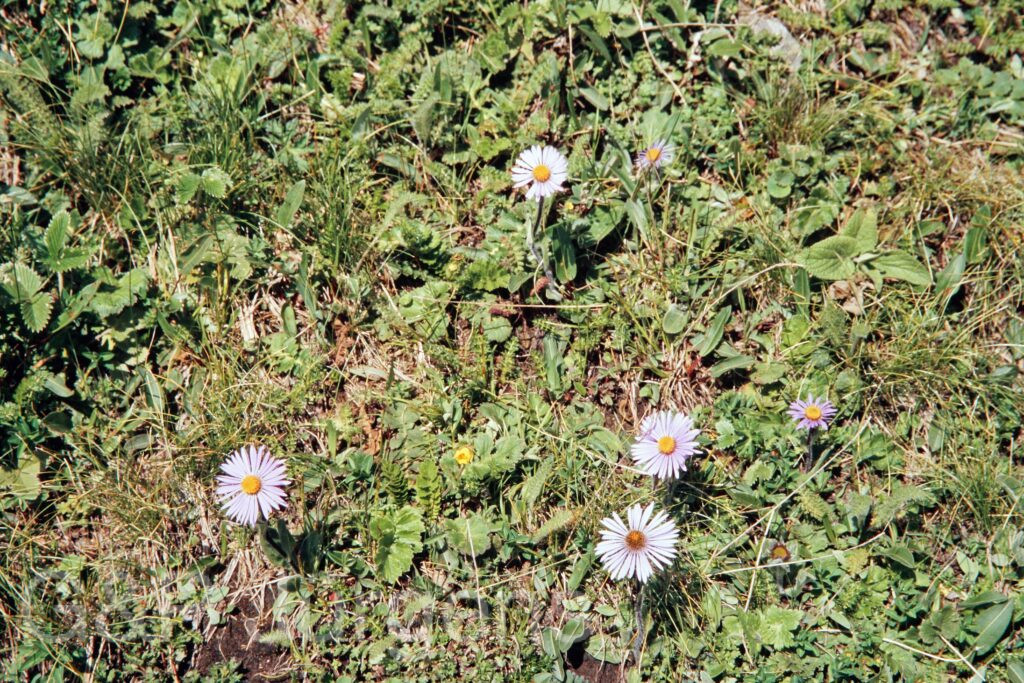
Bunge

Description

Aster flaccidus is a widespread alpine daisy of the high mountains of Asia, with extensive GBIF records (over 1600 occurrences) from China, India, Pakistan, Russia, Nepal, Afghanistan, Tajikistan, Mongolia, Bhutan, Uzbekistan, Kazakhstan, Myanmar, Kyrgyzstan and Turkey. It is a true alpine of stony meadows, scree, gravelly slopes, moraines and short turf, mostly above the treeline but descending where open ground occurs. The record from Belak Khal in Garhwal, India, at about 2900 m in June is a lower, early-season occurrence; across its range the species ascends well above 4000 m, flowering through the brief alpine summer. Here gbif_status is SYNONYM, with the name Aster flaccidus treated as the accepted taxon.

It is a low, tufted perennial herb arising from a short rhizome, the stems solitary or few, simple, erect and conspicuously clothed in long, soft, white or purplish, often glandular hairs. The basal leaves are spathulate to oblanceolate, entire and narrowed to a petiole, the cauline leaves few, sessile and reduced. Each stem terminates in a single large capitulum; the numerous ray florets are violet, blue-purple to lilac and spread around a central disc of yellow tubular florets. The involucre is hemispherical with herbaceous, hairy, purple-margined phyllaries in two or three subequal series. Achenes are flattened and pubescent, surmounted by a pappus of reddish barbellate bristles.

A member of Aster section Alpigenia, A. flaccidus is morphologically variable and has accumulated numerous synonyms and infraspecific names reflecting its vast range and the influence of altitude on stature and indumentum. It is a hardy, cushion-tolerant pioneer of cold, exposed habitats and an important component of alpine sward. Being abundant and broadly distributed it is of least concern, although high-altitude populations may serve as sensitive indicators of climate-driven vegetation change.

Author: Bunge · Sources: POWO (Kew), GBIF, Flora of China, Flora of Pakistan, Polunin & Stainton Flowers of the Himalaya, Onno revision of Aster Alpigenia

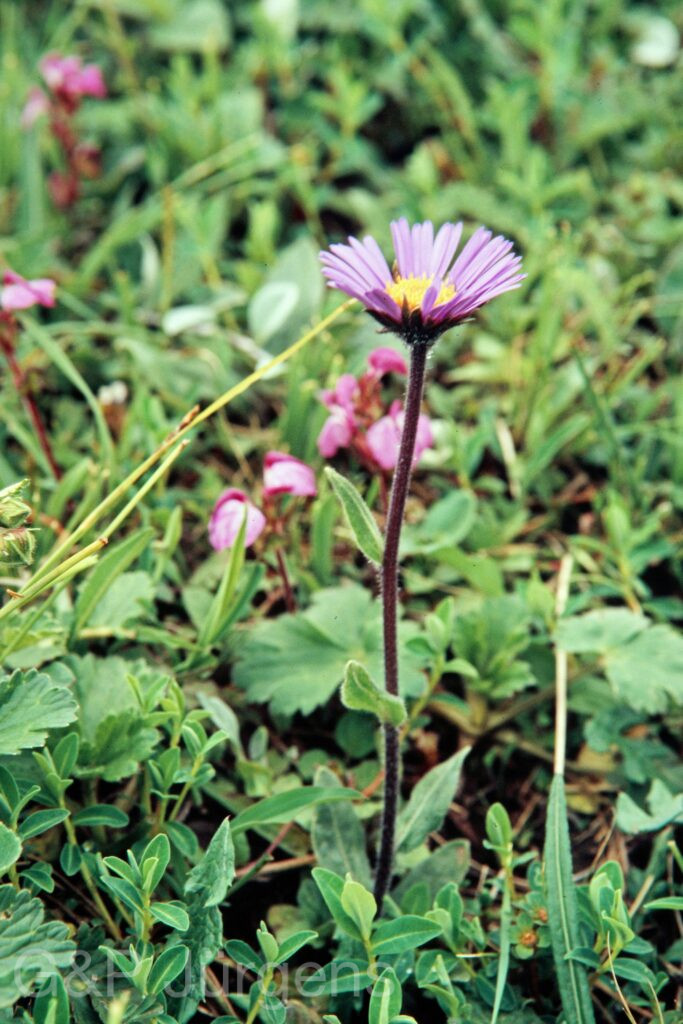
Wall.

Garw 2005 171 ergebnis
India Garhwal Shertoli 3200m, September

Description

Aster peduncularis is a western and central Himalayan daisy recorded from India, Nepal and Pakistan, with about 76 GBIF occurrences. It occupies the temperate to subalpine zone, growing in open forest, grassy slopes, meadows, clearings and shrubby banks, broadly between about 2500 and 3800 m. The collection from Shertoli in Garhwal, India, at 3200 m in September corresponds to its late-summer to autumn flowering, when such mid-montane meadows of the western Himalaya are bright with composites following the monsoon rains.

It is a perennial herb with erect or ascending stems arising from a rootstock, bearing alternate, ovate to lanceolate leaves that diminish upwards, the lower ones petiolate and the upper sessile and sometimes clasping. The capitula are radiate and borne on conspicuously long peduncles, the feature evoked by the epithet "peduncularis". Each head has an involucre of several rows of graded bracts; the ray florets are ligulate and bluish-purple to mauve, encircling a disc of yellow tubular florets. The achenes are compressed and crowned by a pappus of fine barbellate bristles aiding wind dispersal.

In GBIF this name is treated as a synonym, with the accepted taxon being the same epithet under current circumscription; placement of Himalayan asters has shifted considerably as the broad genus Aster has been split into segregate genera, several Sino-Himalayan species moving to allied groups within tribe Astereae. Pollination is by a range of generalist insects, and the plumose pappus disperses the seed on wind. The species is widespread and not regarded as threatened.

Author: Wall. · Sources: POWO (Kew), GBIF, Flora of China, Flora of Pakistan, Asteraceae of the Himalaya (Grierson / Nesom)

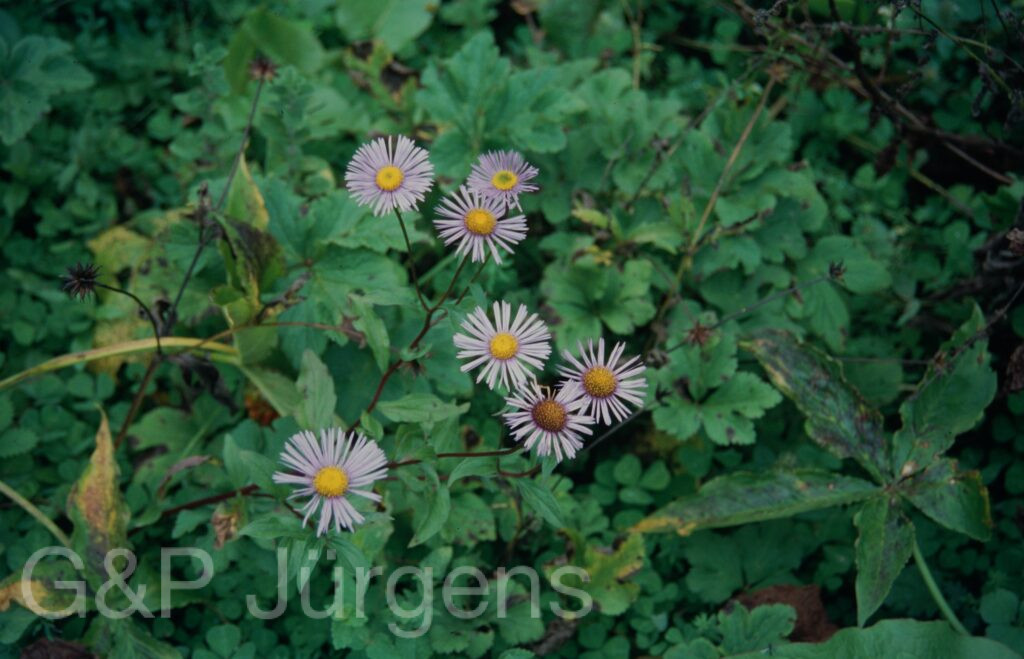
C.B.Clarke

Garw 2005 40 ergebnis ergebnis
India Garhwal Valley of flowers 2900m, September
Garw 2005 25 ergebnis ergebnis
India Garhwal Valley of flowers 2900m, September

Description

Aster thomsonii is a western and central Himalayan daisy ranging through India, Pakistan and Nepal, with roughly 223 GBIF records. It inhabits open slopes, forest clearings, meadows and shrubby banks in the temperate and subalpine zone. The material from the Valley of Flowers in Garhwal at about 2900 m, flowering in September, is characteristic of its preference for moist, well-lit montane sites where it blooms late in the growing season as the monsoon recedes, often forming scattered colonies among grasses and other tall herbs.

The plant is a perennial herb with erect, often branched stems bearing alternate, simple leaves that are ovate to lanceolate, the lower ones petiolate and the upper sessile and somewhat clasping, with toothed margins and a thinly hairy surface. The flower heads are radiate and solitary or few at the branch tips, with an involucre of imbricate, herbaceous phyllaries. The ray florets are female and ligulate, lilac to pale blue-violet, surrounding a central disc of numerous yellow, tubular, bisexual florets. The fruit is a flattened, hairy achene crowned by a pappus of fine barbellate bristles that aids wind dispersal.

Though catalogued here under the name Aster thomsonii C.B. Clarke, this name is treated as a synonym in current taxonomic databases, with Aster thomsonii cited as the accepted name following the ongoing recircumscription of Aster and its segregate genera in the eastern Old World. Such reassignments reflect molecular evidence that the traditional broad Aster is polyphyletic. The species remains a widespread and unthreatened component of Himalayan herbaceous vegetation.

Author: C.B.Clarke · Sources: POWO (Kew), GBIF, Flora of Pakistan, Flora Simlensis, Grierson's revision of Himalayan Aster

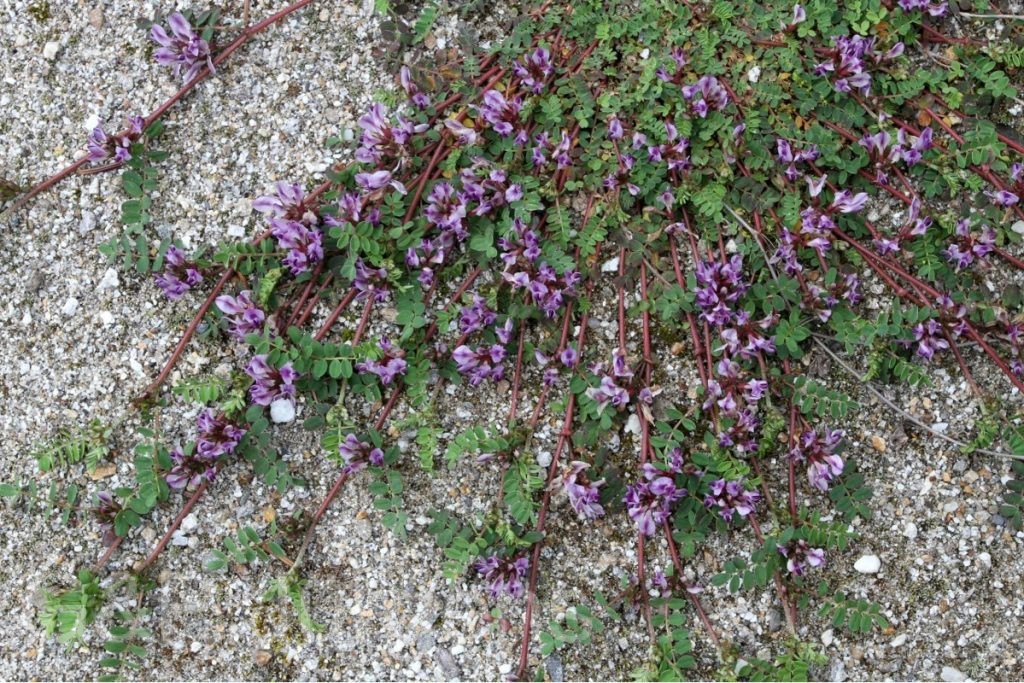
Benth. ex. Bunge

9F417E3DE29B4FE4ABBB6A304481347F
Bhutan Tsochenchen, 3550m June

Description

Astragalus sikkimensis is a Himalayan milkvetch recorded from India, Nepal, Bhutan and China, with about 68 GBIF occurrences distributed across the central and eastern range. It is a plant of open alpine and subalpine slopes, stony pastures and grassy meadows, typically growing between roughly 3000 and 4500 m. The photographed plant at Tsochenchen in Bhutan at 3550 m, flowering in June, reflects its early-summer anthesis at the onset of the growing season, when it occupies well-drained, often gravelly turf in the cool, exposed conditions of the high meadows above the forest line.

The species is a perennial herb arising from a woody rootstock, with stems that are decumbent to shortly ascending and an indumentum of fine appressed hairs. The leaves are imparipinnate, composed of several pairs of small elliptic to oblong leaflets, with persistent stipules at the base of the petioles. The flowers are borne in short axillary racemes or head-like clusters and are typically pink-purple to violet, with the standard, wing and keel petals of the papilionaceous corolla and a tubular, hairy calyx with triangular teeth. The fruit is a small legume (pod), often somewhat inflated and enclosed within or shortly exceeding the persistent calyx, splitting to release the seeds.

Astragalus is one of the largest of all plant genera, and its Himalayan alpine representatives such as A. sikkimensis form symbiotic root nodules with nitrogen-fixing rhizobia, an asset in nutrient-poor high-altitude soils. The papilionaceous flowers are bee-pollinated. The species is reasonably widespread within its montane band and is not regarded as threatened, though its alpine pastures are subject to grazing pressure across the inhabited Himalayan ranges.

Author: Benth. ex. Bunge · Sources: POWO (Kew), GBIF, Flora of Bhutan, Flora of China (Fabaceae), Podlech & Zarre Taxonomic Revision of Astragalus

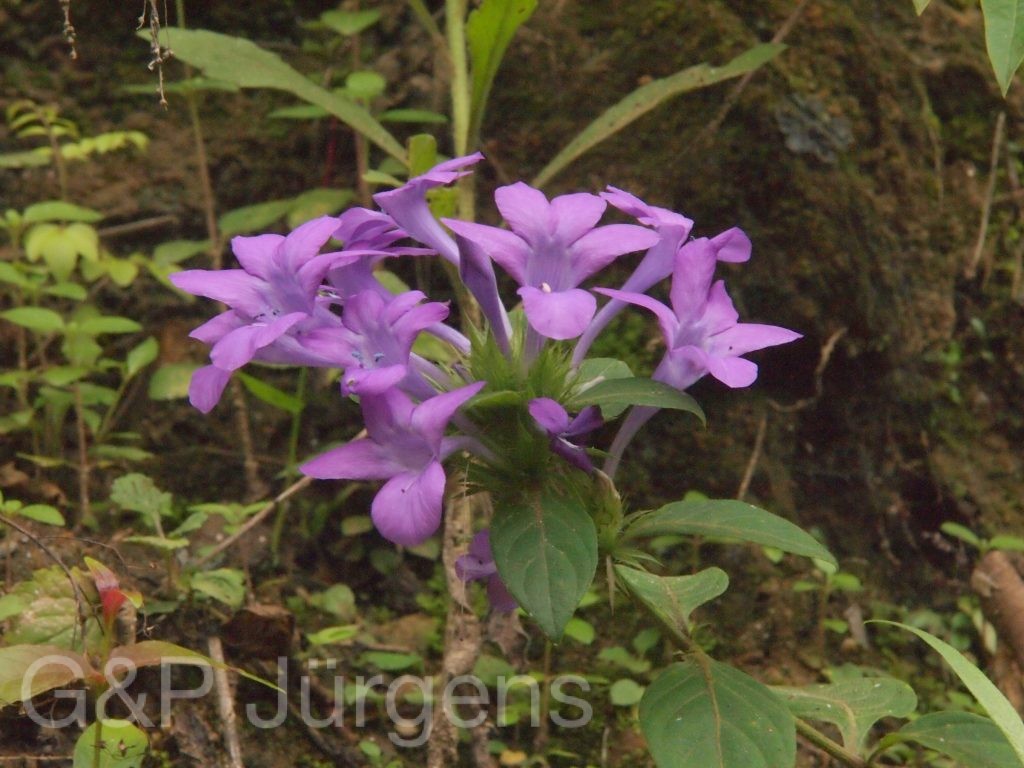
L.

Bhutan2012 1062
Bhutan Koma-Chu-Valley 800m, September
Bhutan2015 173 scaled
Bhutan Zhemgang 910m, October

Description

Barleria cristata is a widespread species distributed from the Indian subcontinent through Southeast Asia to southern China, occurring in India, Nepal, Bhutan, Pakistan, Myanmar, Thailand, and Laos. It has also become naturalized in parts of the tropics worldwide, including Australia, Brazil, and the Philippines. The species inhabits open and disturbed forests, rocky slopes, stream banks, and forest margins at elevations from near sea level to approximately 1,800 m. In Bhutan, it is found in the warm broadleaved forests of the southern foothills, as documented from the Koma-Chu Valley at 800 m and near Zhemgang at 910 m, where it flowers from September to October.
The plant is an erect to spreading shrub or subshrub, 0.5–1.5 m tall, with quadrangular stems that are pubescent when young. Leaves are opposite, ovate to elliptic, 5–12 cm long, with an acuminate apex and entire margins, bearing scattered hairs on both surfaces. The inflorescence is a dense, terminal or axillary spike, subtended by conspicuous, ovate, spinose-tipped bracts that give the species its epithet "cristata" (crested). Flowers are bilabiate, 3–4 cm long, typically violet to pale blue or occasionally white. The calyx is deeply four-lobed with two larger outer lobes and two smaller inner ones. The fruit is an oblong capsule containing two to four flattened, hygroscopic seeds that are explosively dehiscent when wetted.
Barleria is a large pantropical genus of approximately 300 species, with its centre of diversity in Africa and Asia. B. cristata is among the most commonly cultivated ornamental species in the genus and has escaped cultivation in numerous tropical regions, raising concerns about its invasive potential in some areas. Ecologically, it provides nectar resources for butterflies and long-tongued pollinators. The species exhibits considerable variation in flower colour across its range, which has led to the description of several infraspecific taxa, though most are not currently recognized.

Author: L. · Sources: POWO (Kew), GBIF, Flora of Bhutan Vol. 2, Flora of China Vol. 19

A.DC.

Bhutan2012 480 ergebnis
Bhutan, Wangdi 1800m, September
Bhutan2012 481
Bhutan, Wangdi 1800m, September

Description

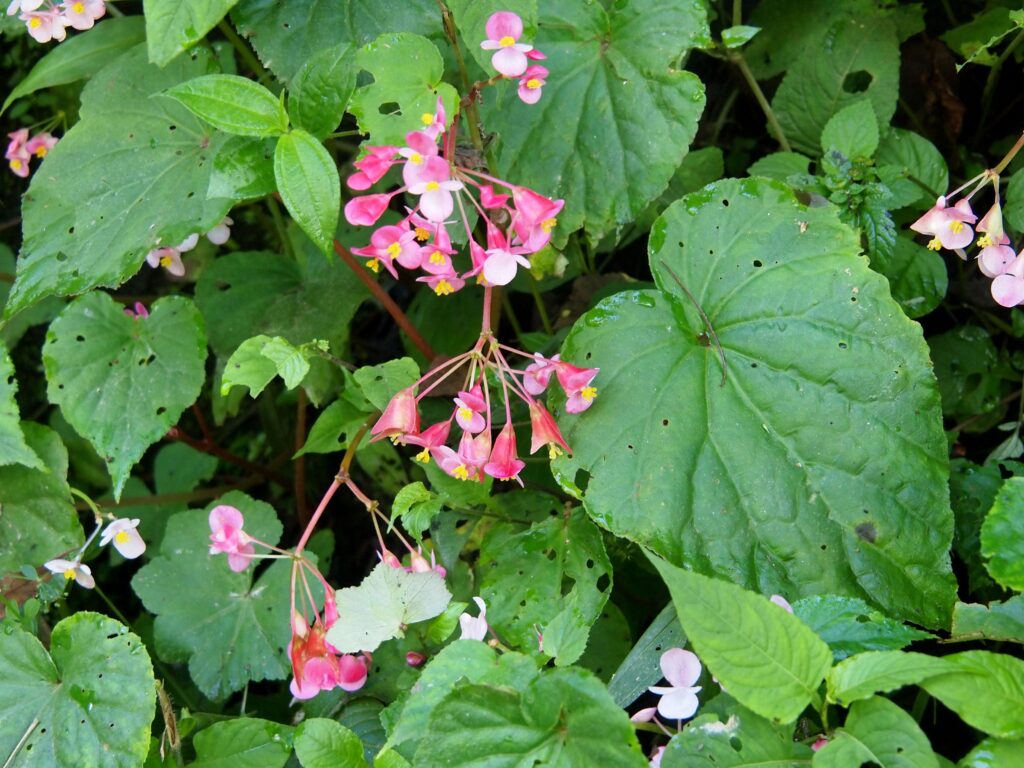
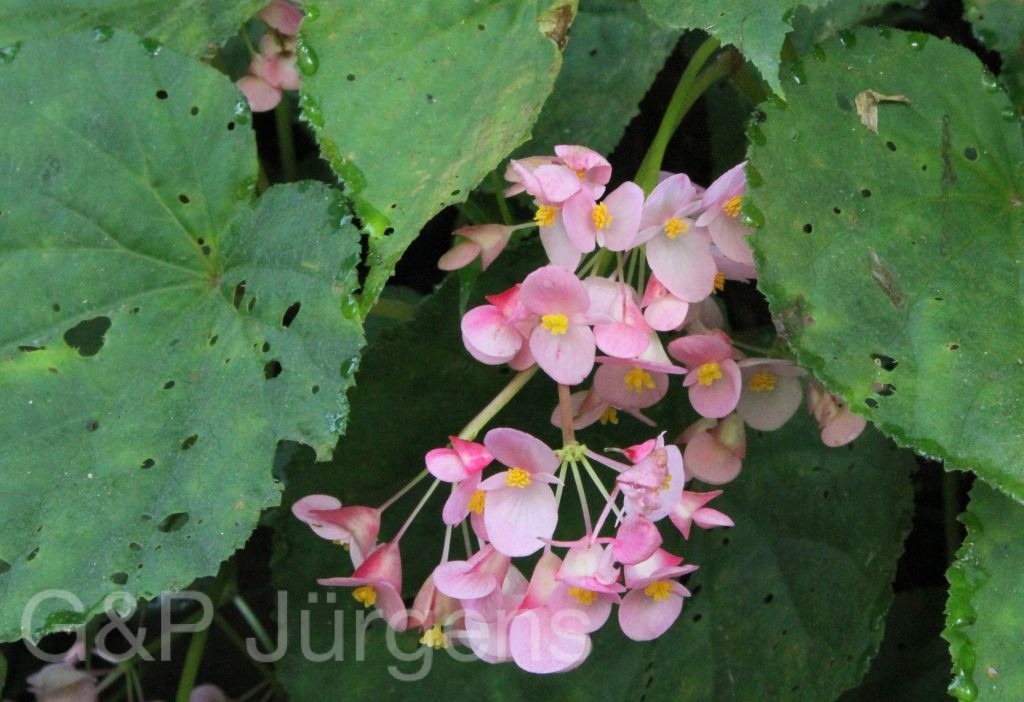
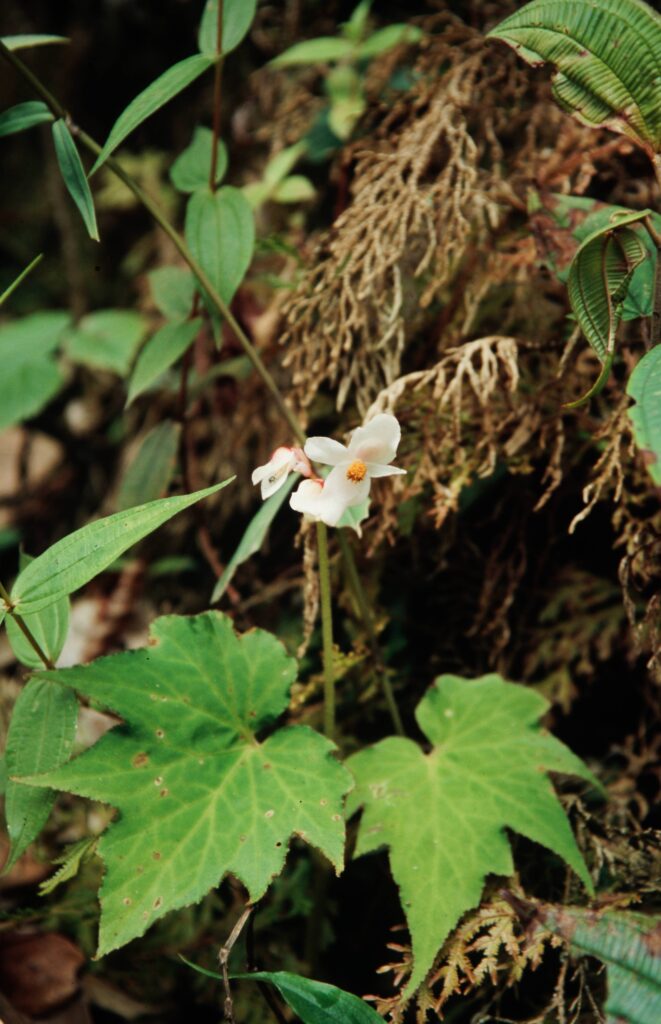
Begonia megaptera is a tuberous begonia native to the eastern Himalaya and adjacent regions, recorded from Nepal, northeast India (Sikkim, Darjeeling, Meghalaya), Bhutan, and Myanmar, with occasional records from Sri Lanka. It inhabits moist, shaded environments including rock crevices, mossy banks, stream margins, and damp earth walls in warm broadleaved and subtropical forests at elevations of 900–2,500 m. The species has been documented near Wangdi in Bhutan at 1,800 m, where it flowers during the monsoon and post-monsoon period in September.
The plant is a perennial herb arising from a globose tuber, with erect or ascending, succulent, sparsely branched stems 20–50 cm tall, tinged red and bearing scattered hairs. Leaves are alternate, broadly ovate to suborbicular, distinctly asymmetric, 8–20 cm long and nearly as wide, with a cordate base, irregularly serrate to dentate margins, and palmately veined undersurface often flushed reddish-purple. Stipules are large, ovate, and persistent. The inflorescence is a dichasial cyme bearing both male and female flowers; male flowers have two large, broadly ovate, white to pale pink tepals and numerous yellow stamens, while female flowers have five unequal tepals and a prominently three-winged inferior ovary — the epithet "megaptera" (large-winged) refers to the conspicuously enlarged wing on the fruit. The capsule is pendulous, with one wing much larger than the other two, up to 3 cm broad.
Begonia megaptera belongs to Begonia section Platycentrum and is distinguished by its notably large, unequal capsule wings and broad, nearly orbicular leaves. With only 63 occurrence records in GBIF, it remains a rather uncommon species. Begonia is one of the largest angiosperm genera, with over 2,000 species, and the eastern Himalayan region represents a secondary centre of diversity. B. megaptera contributes to the rich lithophytic and epipetric flora characteristic of humid gorge habitats in the region.

Author: A.DC. · Sources: POWO (Kew), GBIF, Flora of Bhutan Vol. 2, Doorenbos et al.: The Sections of Begonia (1998), Hughes et al.: Asian Begonia (2015)

D.Don

Description

Begonia palmata D.Don is a widespread and highly variable perennial herb of the Sino-Himalaya and Southeast Asia, recorded by GBIF from across China and Taiwan, the eastern Himalaya (Nepal, India, Bhutan), Myanmar, Thailand, Laos, Vietnam, Bangladesh and Malesia. It is a characteristic plant of shaded, humid evergreen and broad-leaved forest, growing on moist rocks, mossy banks, ravine sides and beside streams from the foothills to roughly 2,500 m. The May collection from Chaana in Darjeeling district of West Bengal at 1,600 m exemplifies its monsoon-forest habitat, where it thrives in deep shade and high atmospheric humidity.

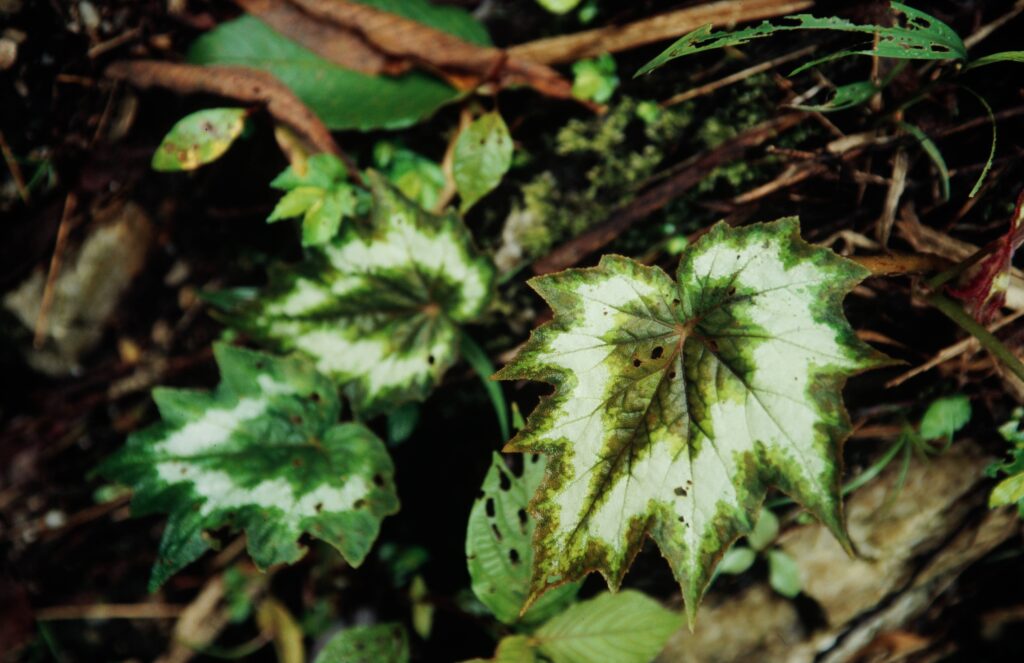
The plant is a succulent, rhizomatous to shortly caulescent herb with reddish, hispid stems. The asymmetric, palmately lobed leaves give the species its epithet: they are broadly ovate in outline, deeply incised into several acuminate, toothed lobes, often bristly-hairy and frequently marked with a paler or silvery zone above and reddish coloration beneath. As in all begonias the flowers are unisexual and monoecious, borne in axillary cymes; the pink to white male flowers bear two larger and two smaller tepals, while the female flowers have an inferior, three-winged ovary that develops into the characteristic unequally winged, dehiscent capsule containing very numerous minute seeds.

Begonia palmata is taxonomically a notoriously polymorphic species complex, with numerous varieties and segregate names reflecting wide variation in leaf division and indumentum across its range. Such variability has made it a focus of biogeographic and systematic study within the megadiverse genus Begonia. Many of its forms are cultivated as foliage ornamentals, and its broad distribution underlines the high endemism and diversification of begonias in the wet forests of tropical Asia.

Author: D.Don · Sources: POWO (Kew), GBIF, Flora of China Vol. 13, Flora of Bhutan Vol. 2, Tebbitt: Begonias — Cultivation, Identification, and Natural History

(Hook.f. & Thomson) Engl.

Description

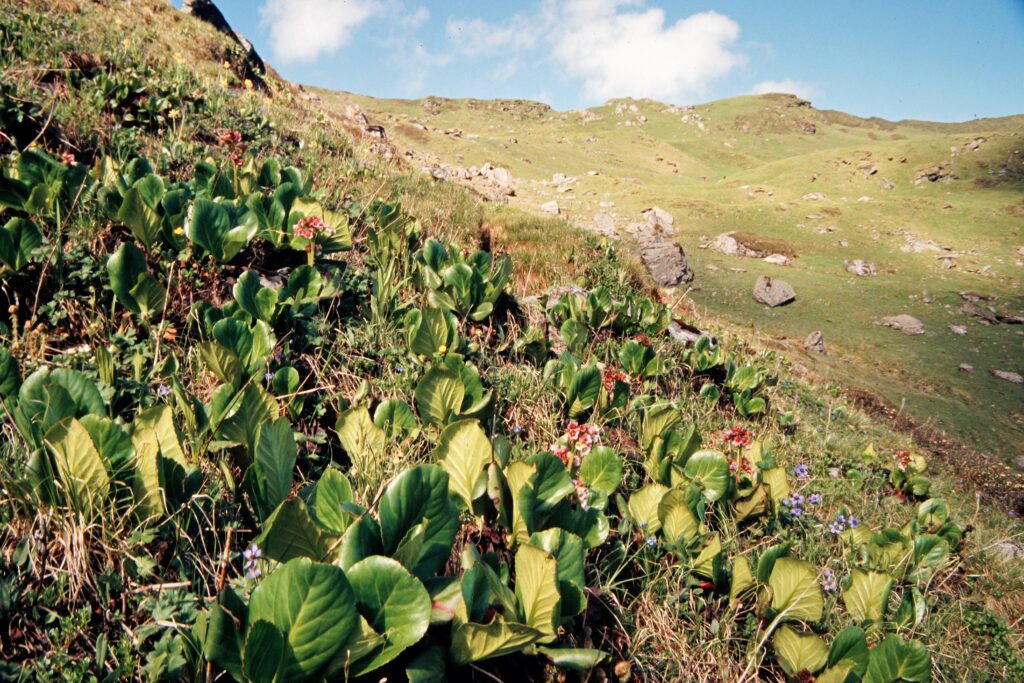
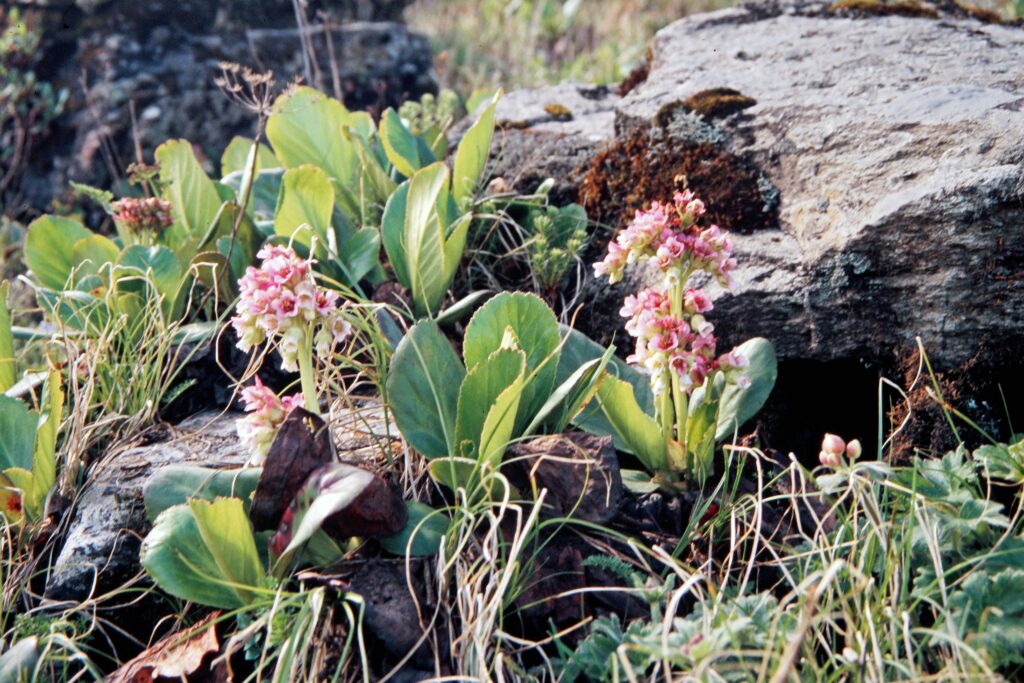
Bergenia stracheyi (Hook.f. & Thomson) Engl. is a perennial rock-dwelling herb of the higher Himalaya, native to Pakistan, north-west India, Afghanistan and adjacent China, with a GBIF record total (371 occurrences) inflated by its popularity in cultivation across Europe and North America. In its natural range it is a plant of moist alpine and subalpine ledges, screes, cliff crevices and stream banks, typically between about 3000 and 4500 m. The photographed individual, from Seema in Garhwal (Indian Himalaya) at 3700 m in June, exemplifies its habitat among shaded, humus-filled rock fissures where snowmelt provides reliable summer moisture.

The plant develops a stout, woody, creeping rhizome anchoring rosettes of thick, leathery, evergreen leaves. The leaf blades are obovate to broadly elliptic, glabrous, with crenate to entire ciliate margins and prominent reticulate venation, often flushing red in cold or exposed conditions. The inflorescence is a compact, nodding to erect cyme borne on a short fleshy scape, carrying campanulate flowers with five rose-pink to deep magenta petals, a persistent calyx, ten stamens and a bicarpellate, partly inferior ovary. The fruit is a capsule splitting to release numerous small seeds.

The genus Bergenia, often called elephant's-ears, comprises a small group of Asian saxifrages prized horticulturally for their bold foliage and early flowers; B. stracheyi is among the most cold-hardy and compact species and figures in the parentage of garden hybrids. In the wild its rhizomes have local medicinal use. Though not threatened owing to its broad montane distribution, populations are localised by their specialised cliff and scree microhabitats.

Author: (Hook.f. & Thomson) Engl. · Sources: POWO (Kew), GBIF, Flora of Pakistan, Flora Simlensis, Saxifragaceae of the Sino-Himalaya, Royal Horticultural Society monograph on Bergenia