Tag:

Autumn

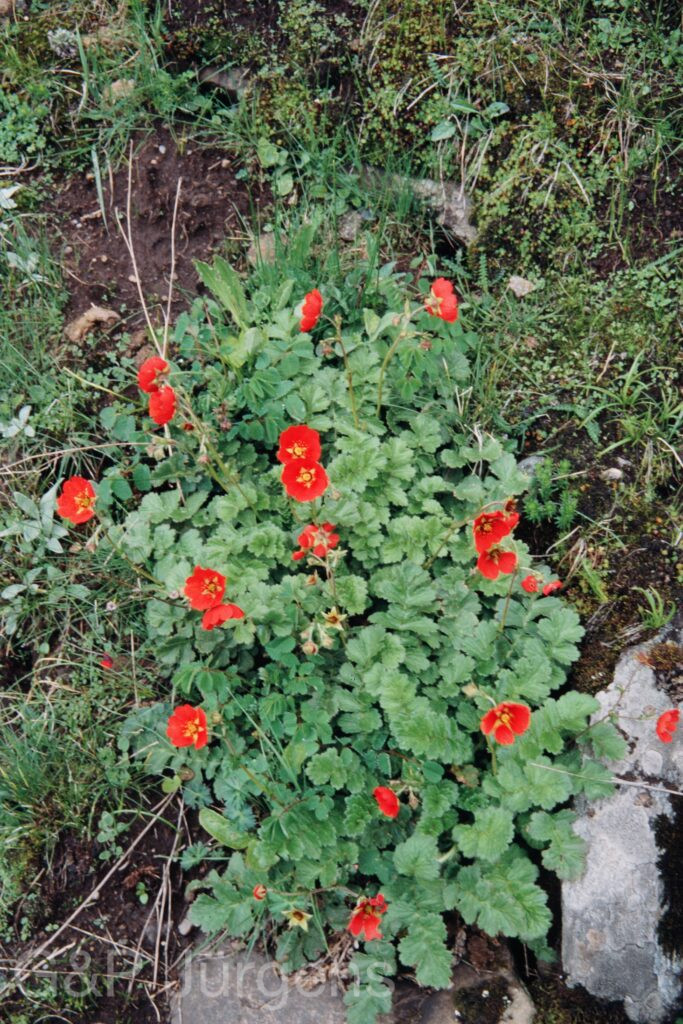
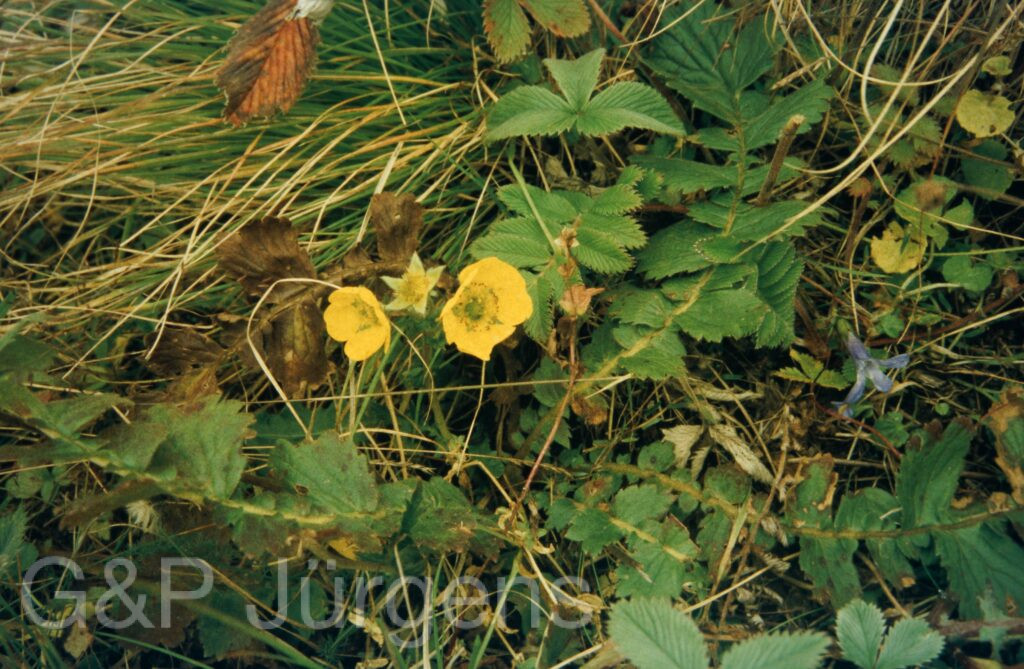
Geum elatum

by G & P Jürgens

Wall ex. G.Don.

Nepal 99 532 ergebnis
West-Nepal Churta-Khola 3600-3800m, June
Garw 2005 351 ergebnis
India Garhwal Patanathi 3800m, September

Description

Geum elatum is a perennial herb of the high Himalaya, distributed along the alpine and subalpine belt from Pakistan and Afghanistan eastward through India, Nepal, Bhutan and south-western China. GBIF aggregates some 366 occurrences, densest in Nepal and the Indian Himalaya. It grows in open alpine meadows, moist grassy slopes, rocky ledges and snow-melt flushes, typically between about 3000 and 4500 m. The populations imaged in West-Nepal at Churta-Khola (3600-3800 m, June) and in Indian Garhwal at Patanathi (3800 m, September) typify its preference for cool, humid turf near the upper limit of vegetation.

The plant arises from a stout, scaly rhizome bearing a basal rosette of pinnate to lyrate-pinnatifid leaves, the terminal leaflet conspicuously enlarged, reniform to orbicular and crenate-lobed. Flowering stems are erect to ascending, simple or sparingly branched, bearing one to several comparatively large, nodding to suberect golden-yellow flowers. These have five spreading obovate petals, five reflexed sepals alternating with small epicalyx segments, numerous stamens, and many free carpels on a hairy receptacle. In fruit the styles elongate into persistent, often plumose or hooked awns, forming a globose head of achenes adapted to epizoochorous dispersal.

Geum elatum belongs to a Himalayan complex sometimes segregated under Acomastylis or Sieversia, and varieties (notably var. leiocarpum) have been recognised on indumentum and style characters. Its nodding, large-flowered habit and montane ecology distinguish it from lowland Geum species. As a widespread, locally common alpine perennial it is of no immediate conservation concern, though potentially sensitive to grazing and climate-driven upward shifts of the alpine zone.

Author: Wall ex. G.Don. · Sources: POWO (Kew), GBIF, Flora of China, Flora of Pakistan, Flora of Bhutan, Annotated Checklist of the Flowering Plants of Nepal, monograph of the genus Geum (Gajewski)
King & Pantl.

Bhutan2012 347
Bhutan Dochu-La 3000m, September

Description

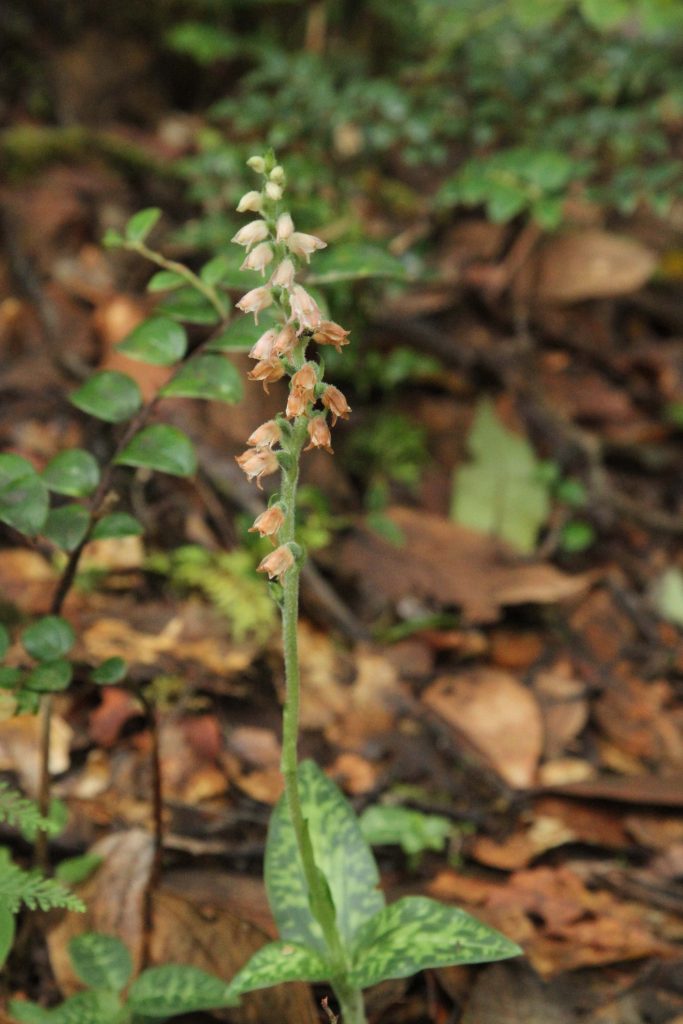
Goodyera hemsleyana is a terrestrial orchid of the cool, humid temperate forests of the eastern Himalaya and adjoining southwestern China. Documented occurrences (21 GBIF records) span India, Nepal, China, Bhutan and Myanmar, following the moist mid- to upper-montane belt of the Sino-Himalayan region. The species favours the deep, mossy humus and leaf litter of shaded broadleaved and mixed conifer forest, typically between about 2500 and 3500 m. The illustrated material was gathered at Dochu-La in western Bhutan at roughly 3000 m in September, a pass clothed in cloud forest where rhododendron and fir provide the shade and atmospheric moisture this orchid requires.

The plant is a small, creeping geophyte arising from a slender, fleshy, decumbent rhizome that roots at the lower nodes. The leaves are few, gathered toward the base, ovate to elliptic, and characteristically marked with a fine reticulate venation that distinguishes the 'jewel orchid' alliance. The erect inflorescence is a pubescent scape bearing a rather lax, secund raceme of small white to greenish-white flowers. Each flower shows the connivent dorsal sepal and petals forming a hood over the column, spreading lateral sepals, and a saccate, concave lip with an incurved, often shortly bifid apex; the ovary is glandular-hairy and twisted.

Goodyera is a large, near-cosmopolitan genus within tribe Cranichideae, subtribe Goodyerinae, and G. hemsleyana belongs to the assemblage of Himalayan species described from the King & Pantling collections. Like its congeners it is mycoheterotrophic in establishment, dependent on rhizoctonia-type fungal symbionts in the forest humus, which restricts it to undisturbed old-growth stands. Though not formally assessed as threatened, its reliance on intact mossy forest makes it sensitive to logging and grazing pressure across its range.

Author: King & Pantl. · Sources: POWO (Kew), GBIF, Flora of Bhutan, Flora of China, The Orchids of Bhutan (Pearce & Cribb)

L.

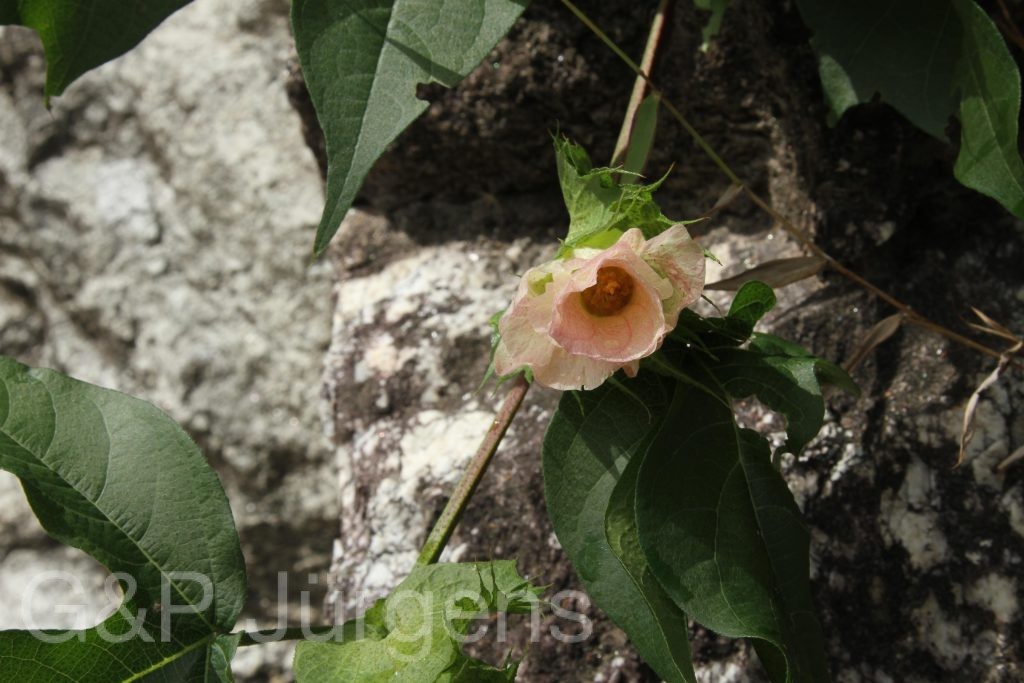
Bhutan2012 1230
Bhutan Trashigang 1150m, October
Bhutan2012 1231
Bhutan Trashigang 1150m, October

Description

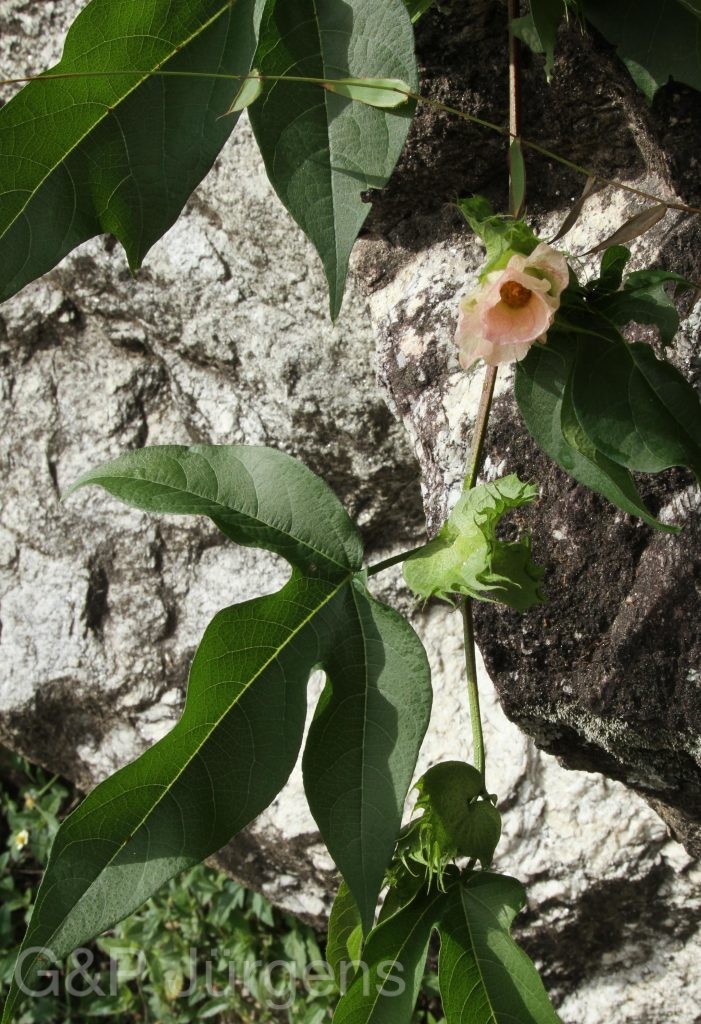
Gossypium hirsutum, Upland cotton, is native to Mesoamerica and the Caribbean but is now pantropical and warm-temperate in cultivation, accounting for the great majority of the world's cotton crop. Its 25,000-plus georeferenced records reflect this near-cosmopolitan distribution, with concentrations in the United States (US) and Mexico (MX) and naturalised or cultivated occurrences across Brazil, Uzbekistan, Australia, India, China and many other countries. In the Himalayan region it is a lowland cultigen and escape rather than a wild element; the plant photographed at Trashigang in eastern Bhutan at about 1150 m in October represents such warm subtropical valley cultivation, well below the montane flora. It thrives in hot, sunny, frost-free lowlands on deep, well-drained loams.

It is an erect, somewhat woody annual or short-lived perennial herb to shrub, with branching stems bearing scattered hairs and dark glandular dots. The leaves are alternate, broadly cordate and palmately three- to five-lobed, the lobes ovate-triangular and acuminate, with a basal nectary on the midrib beneath. The showy flowers are solitary and axillary, subtended by an epicalyx of three large, deeply incised, cordate bracts; the corolla is creamy white to pale yellow, often turning pink with age. The fruit is a three- to five-locular ovoid capsule (boll) that dehisces to reveal seeds embedded in copious white lint of elongated epidermal seed-hairs, the cotton fibre of commerce.

Gossypium (Malvaceae) is an economically pre-eminent genus whose allotetraploid New World cottons, including G. hirsutum, arose from hybridisation between Old and New World diploid lineages. The species is the foundation of global textile agriculture and a model for polyploid genomics. As a fully domesticated crop it has no conservation concern, though its wild and feral relatives are of interest for germplasm conservation and breeding.

Author: L. · Sources: POWO (Kew), GBIF, Flora of China, Flora of Pakistan, Fryxell monographic studies of Gossypium and the Malvaceae

(Roxb. ex Willd.) DC.

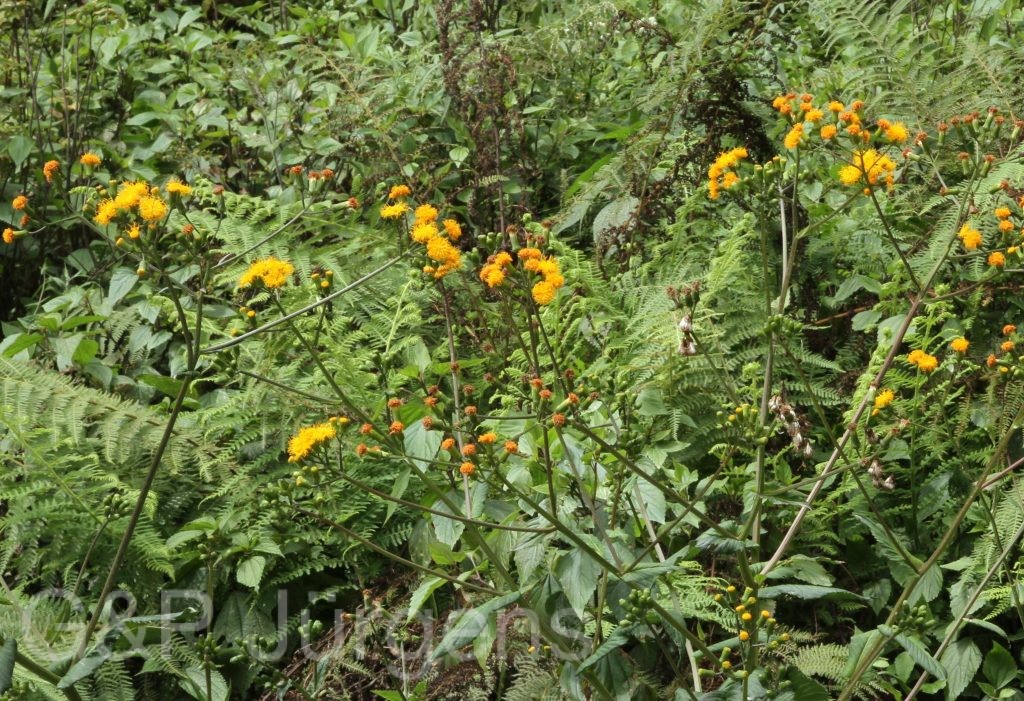
Bhutan2012 1313
Bhutan Pemagatse 1800m, October

Description

Gynura bicolor is a soft-stemmed composite of warm-temperate to subtropical Asia, native through China, Taiwan, Japan, India, Nepal, Thailand, Myanmar and Bhutan, and very widely cultivated and naturalised across the Pacific, Americas and elsewhere; GBIF lists over 600 occurrences reflecting both wild and grown plants. It occupies forest margins, moist shaded slopes, streamsides and disturbed ground, generally below about 2000 m. The photographed plant is from Pemagatse in Bhutan at 1800 m in October, growing in humid subtropical hill forest at the lower edge of the survey area.

The species is an erect to ascending perennial herb with fleshy, somewhat succulent, often purplish stems. The leaves are alternate, ovate to oblong-lanceolate, irregularly toothed to lyrately lobed, and strikingly bicolorous, green above and deep purple beneath, the source of the epithet. The capitula are discoid, lacking ray florets, and gathered in lax terminal corymbs; each head holds numerous orange to reddish tubular florets within a cylindrical involucre of narrow phyllaries, the long styles exserted with hairy, recurved branches. The fruit is a ribbed cypsela bearing a copious white pappus of fine bristles.

Gynura belongs to the tribe Senecioneae, and G. bicolor is well known as the edible "Okinawan spinach" or hong feng cai, grown as a leaf vegetable and used in traditional medicine, which accounts for its extensive cultivated distribution. It is of no conservation concern, being a vigorous, easily propagated plant tolerant of disturbance.

Author: (Roxb. ex Willd.) DC. · Sources: POWO (Kew), GBIF, Flora of China, Flora of Bhutan, Annotated Checklist of the Flowering Plants of Nepal, Revision of the Genus Gynura (Senecioneae)

Schltr.

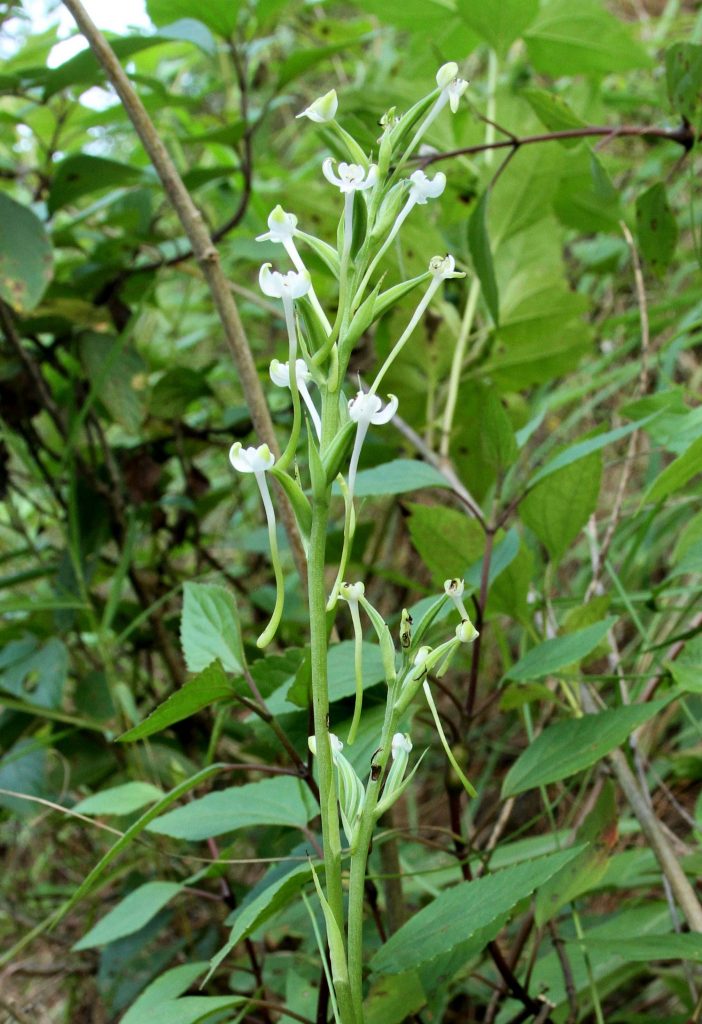
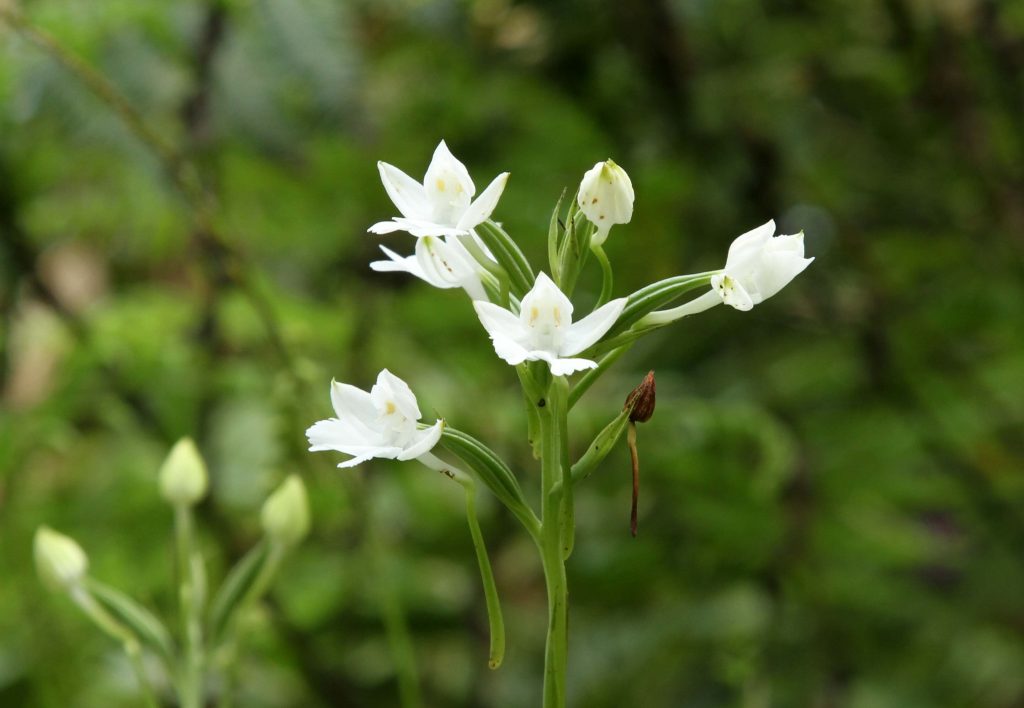
Bhutan2012 624
Bhutan Dochu-La 2800m, September
Bhutan2012 957
Bhutan Dochu-La 2800m, September

Description

Habenaria dentata is a wide-ranging terrestrial orchid of tropical and subtropical Asia, documented in GBIF across 933 occurrences from China, Thailand, Japan, Taiwan, India, Vietnam, Myanmar, Nepal, Bhutan and beyond. It grows in grassy slopes, open forest, scrub and forest-margin clearings from the lowlands to about 2800 m. The photographed plant was found at Dochu-La in Bhutan at about 2800 m in September, at the upper edge of its range, flowering at the close of the monsoon when soil moisture remains high in the cool mid-montane zone.

It is a tuberous terrestrial herb arising from underground ellipsoid tubers, with an erect leafy stem 30-60 cm tall bearing several oblong-lanceolate to elliptic, clasping cauline leaves. The inflorescence is a dense terminal raceme of showy white flowers; the dorsal sepal and petals converge to form a hood, while the conspicuous three-lobed labellum has the lateral lobes broadly dilated and fringed-dentate along the margins, giving the epithet dentata, and bears a long, slender, downcurved spur. The column is short with the rostellum and pollinaria typical of Habenaria, and pollination is effected by long-tongued, often nocturnal moths attracted to the white, spurred flowers.

Habenaria (Orchidaceae, subtribe Orchidinae) is a large, cosmopolitan genus of terrestrial orchids best diversified in the tropics, and like all orchids it is listed on CITES Appendix II. Seed germination depends on symbiosis with mycorrhizal fungi. Despite its broad distribution and relative frequency, populations are reduced locally by grassland conversion and collection, but the species is not globally threatened.

Author: Schltr. · Sources: POWO (Kew), GBIF, Flora of China, Flora of Bhutan, The Orchids of Bhutan, CITES Appendix II listing

D.Don

Bhutan2012 18
Bhutan Shele-La, 3600m September
Bhutan2012 52
Bhutan Shele-La, 3600m September

Description

Halenia elliptica is a widespread Asian gentian-relative ranging across the Himalaya and the mountains of central and eastern Asia, recorded from China, India, Nepal, Bhutan, Myanmar, Kazakhstan, Mongolia, Russia and Taiwan (CN, IN, NP, BT, MM, KZ, MN, RU, TW, with further records), and one of the most abundantly collected species treated here, with about 4437 occurrences. It grows in moist alpine and subalpine meadows, on grassy slopes, forest clearings, streamsides and open disturbed ground over a wide altitudinal span. The plant illustrated was found at Shele-La in Bhutan at 3600 m in September, an elevation and late-season flowering typical of its appearance in the autumn alpine turf and roadside banks of the high passes.

It is an erect, glabrous annual or biennial with a four-angled, often branched stem. The leaves are opposite, sessile or shortly petiolate, elliptic to ovate-lanceolate with three to five prominent longitudinal veins. The flowers are borne in terminal and axillary cymes; the most distinctive feature is the corolla, which is four-lobed and blue to purplish, each lobe bearing at its base a slender, backward-projecting nectar spur, so that the open flower carries four divergent spurs, the character that defines the genus. The four stamens alternate with the lobes, and the superior, bicarpellate ovary ripens into a many-seeded capsule.

Halenia (subfamily Gentianoideae, tribe Gentianeae of the Gentianaceae) is unusual within its family for the conspicuously spurred corolla, an adaptation offering nectar to long-tongued pollinating insects and a notable instance of nectar-spur evolution within the otherwise spurless gentians. The species is highly variable across its enormous range. As a common, weedy, broadly distributed colonist of disturbed montane habitats, H. elliptica is of no conservation concern, and it is also gathered for use in Tibetan and Chinese traditional medicine.

Author: D.Don · Sources: POWO (Kew), GBIF, Flora of Bhutan, Flora of China, Gentianaceae monograph (Halenia revision)

Buch.-Ham. ex Sm.

Bhutan2012 469
Bhutan Wangdi 2500m, September

Description

Hedychium ellipticum is a rhizomatous perennial of the family Zingiberaceae, one of the ornamental ginger lilies native to the eastern Himalaya and adjacent Southeast Asia. GBIF data document its occurrence across Bhutan, Nepal, northeast India, Myanmar, Thailand and southern China, with additional records reflecting cultivated material outside its native range. It grows in moist, shaded broad-leaved and evergreen forest, on humus-rich banks, ravine sides and rocky slopes, typically between about 1,000 and 2,400 m. The plant photographed near Wangdue Phodrang (Wangdi) in Bhutan at around 2,500 m in September represents the upper part of this altitudinal band, where flowering coincides with the late monsoon.

The species develops a stout, horizontally creeping rhizome from which arise erect, leafy pseudostems up to 1–1.5 m tall. The leaves are distichous, sessile or shortly petiolate, with elliptic to oblong-elliptic blades that are glabrous above and may be pubescent beneath, tapering to an acuminate apex, with a conspicuous ligule at the leaf sheath. The inflorescence is a dense terminal spike bearing imbricate green bracts, each subtending one or more flowers. The flowers are showy and fragrant, white with a long, slender corolla tube; the labellum is broad and bilobed and the filament conspicuously exserted, the whole flower built on the characteristic Hedychium plan with a single fertile stamen. The fruit is a globose capsule splitting to reveal seeds enveloped in a bright orange-red aril.

Hedychium is a horticulturally important genus, and several Himalayan species including H. ellipticum and the related H. spicatum are used in traditional medicine and as a source of aromatic rhizomes. The flowers are adapted to pollination by long-tongued insects and hawkmoths, attracted by scent and the slender nectar tube. Within the genus the elliptic leaf form and white, exserted-stamen flowers distinguish this species; care is needed in herbarium identification because it has frequently been confused with allied taxa of the H. spicatum complex.

Author: Buch.-Ham. ex Sm. · Sources: POWO (Kew), GBIF, Flora of Bhutan Vol. 3, Flora of China Vol. 24, Flora of Nepal, Wood: A Revision of Hedychium (Zingiberaceae)

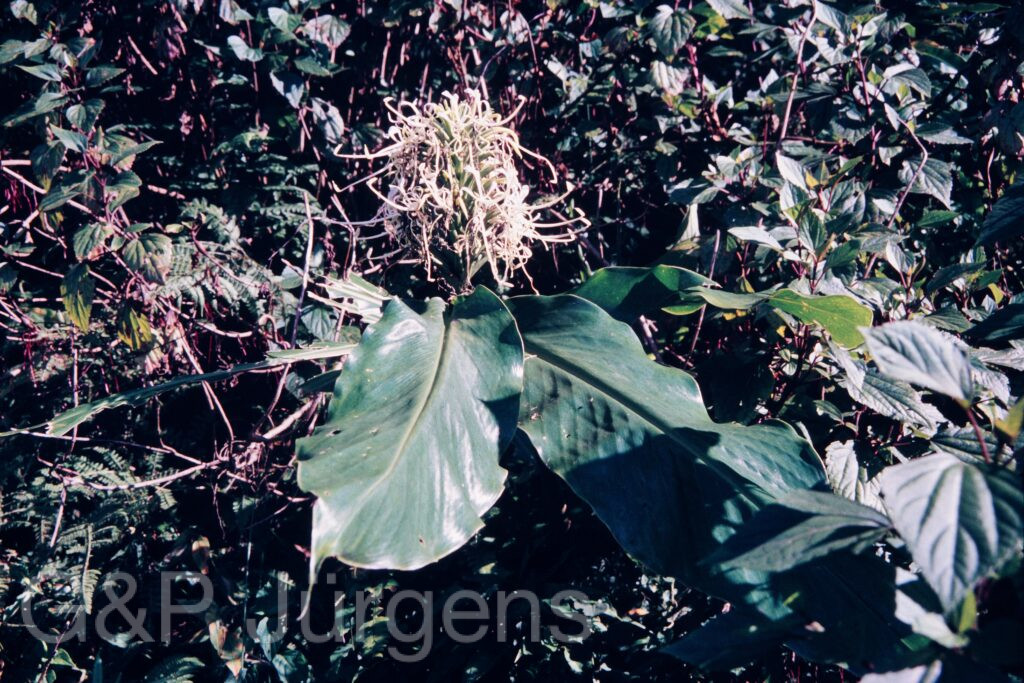
Sheph. ex Ker Gawl.

Bhutan2012 668
Bhutan Tserang 1100m, September
Sikkim2003 45 P60
Sikkim above Yoksam 200m 08.2003

Description

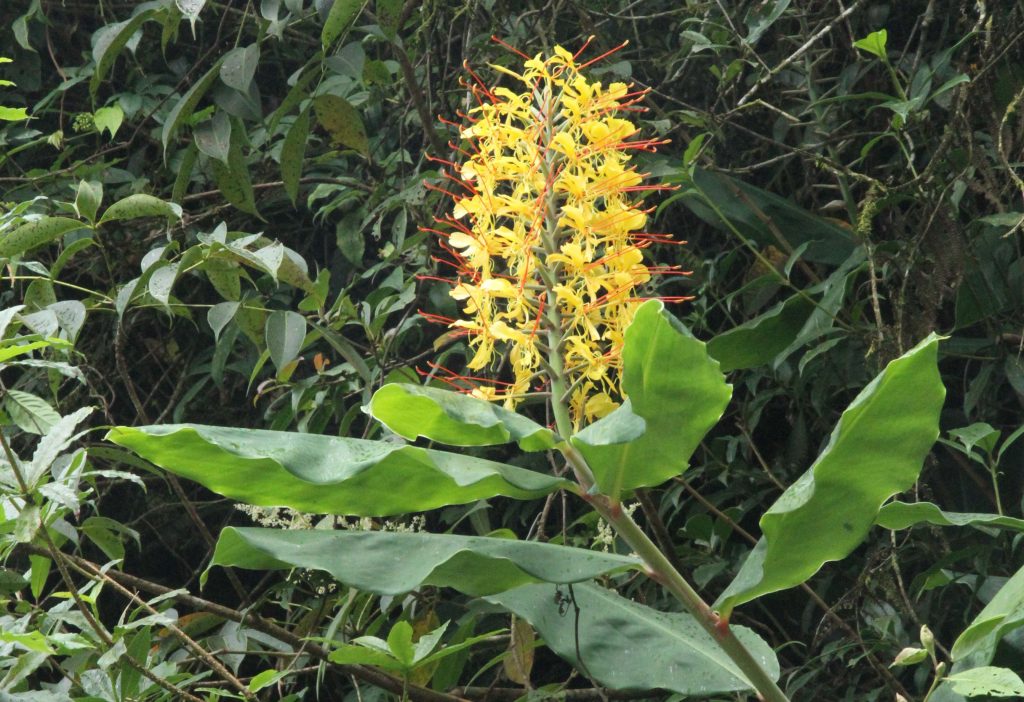
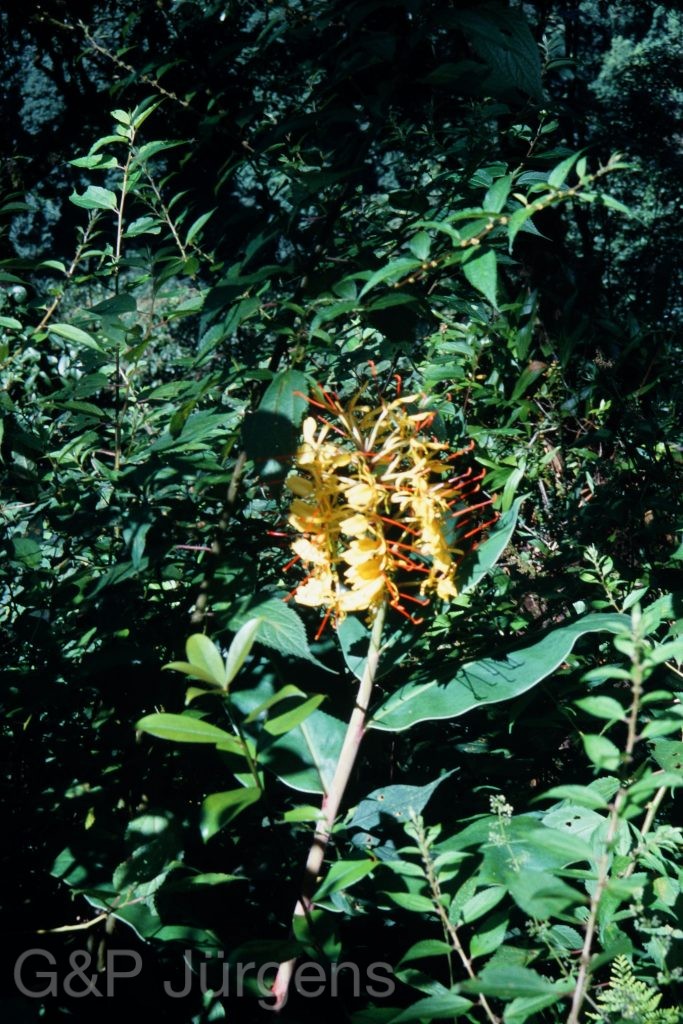
Hedychium gardnerianum, the Kahili ginger, is native to the eastern Himalaya of India, Nepal and Bhutan but has been very widely introduced and naturalised worldwide; GBIF records over 20,000 occurrences, the great majority from naturalised populations in Hawaii, New Zealand, the Azores, South Africa and Australia far outside its native range. In its homeland it grows in moist subtropical and lower temperate forest, on shaded banks, ravines and clearings. The images from Tserang in Bhutan at about 1100 m in September and above Yoksam in Sikkim show it flowering in late summer in its native warm, humid foothill forest belt.

It is a robust, clump-forming perennial herb arising from a stout, fleshy, branching rhizome and reaching two metres or more, with erect, leafy pseudostems formed by overlapping leaf sheaths. The leaves are large, oblong-lanceolate, glabrous above and shortly pubescent beneath, with a sheathing base and prominent midrib. The inflorescence is a dense, showy terminal cylindrical spike of many bracteate flowers; each is fragrant and lemon-yellow with a long-exserted bright red filament bearing the anther, the floral tube slender and the lip and lateral staminodes petaloid. The fruit is a fleshy capsule splitting to reveal numerous seeds enclosed in a bright orange-red aril.

Within Hedychium this species is notable for its conspicuous red stamens and is among the most ornamental gingers. The same vigour, rhizomatous spread and bird-dispersed arillate seeds make it a serious invasive in island and oceanic-climate floras, where it forms dense monocultures that suppress native regeneration, and it is listed among the world's worst invasive plants. Conservation concern thus relates not to its survival but to its impact where introduced.

Author: Sheph. ex Ker Gawl. · Sources: POWO (Kew), GBIF, Flora of Bhutan, Flora of China (Zingiberaceae), Branney Hardy Gingers including Hedychium, Roscoea and Zingiber

Sm.

Bhutan2012 706
Bhutan Galephu 850m, September
Nepal 95 11 P18 ergebnis
Nepal Gorkha 1200m, Octobre

Description

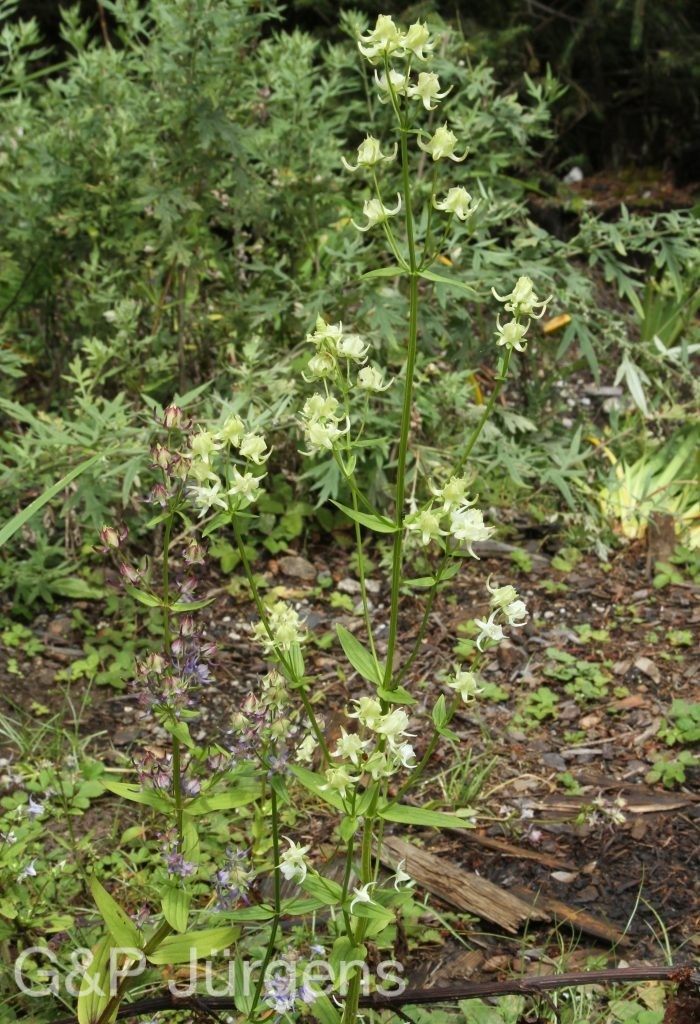
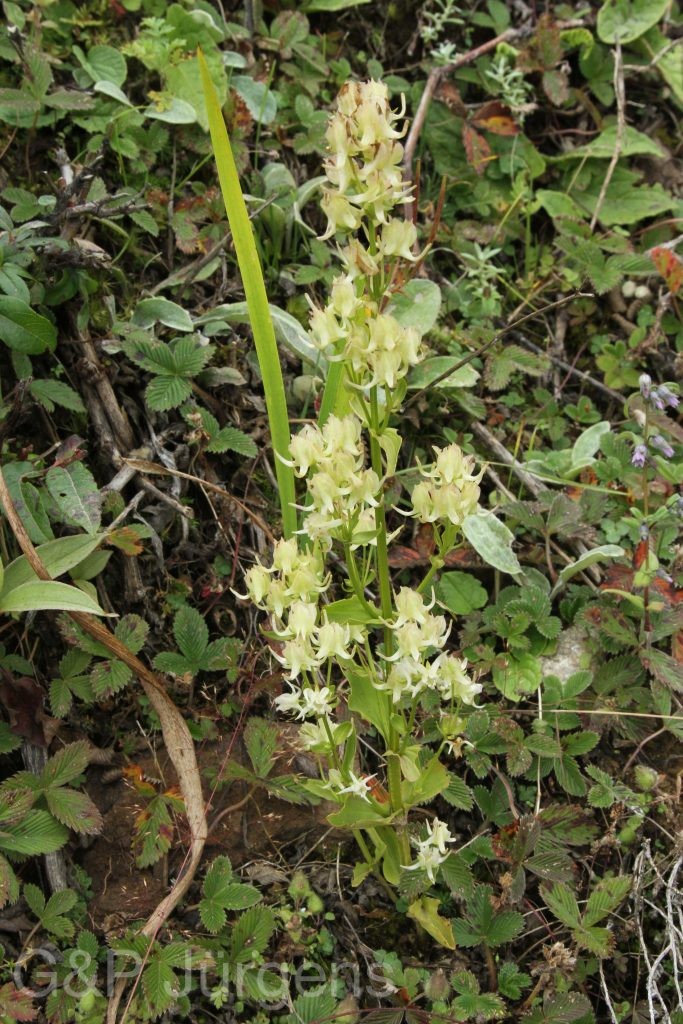
Hedychium thyrsiforme is a ginger lily native to the Himalayan foothills and northeastern India, ranging through Nepal, India, Bhutan and Bangladesh, with cultivated and naturalised records elsewhere (including Mauritius, Vanuatu, Brazil, the USA and Britain) reflected in its roughly 127 GBIF occurrences. It is a plant of warm, humid subtropical forest, favouring shaded banks, ravines and the margins of broadleaved woodland, and is frequently epiphytic or lithophytic on mossy trunks and rocks. The localities photographed, at Galephu in Bhutan at 850 m in September and at Gorkha in Nepal at 1200 m in October, lie within its typical low to mid-elevation belt where late-monsoon humidity sustains flowering.

It is a robust perennial herb growing from a fleshy, aromatic, creeping rhizome and producing leafy pseudostems formed by sheathing leaf bases. The leaves are distichous, oblong-lanceolate, glabrous above and shortly hairy beneath, with a conspicuous ligule. The inflorescence is a dense, cylindrical terminal thyrse from which the epithet derives, crowded with white flowers; each has a slender corolla tube, narrow reflexed segments, and the showy whitish labellum and greatly exserted long-filamented stamen that give the genus its butterfly-lily aspect. The fruit is a capsule splitting to reveal seeds with an orange-red aril.

Hedychium belongs to tribe Zingibereae of the Zingiberaceae and is centred on the Indo-Malayan region, where its long-tubed, fragrant flowers are adapted to hawkmoth pollination. Several species, this among them, are grown ornamentally and can naturalise in the tropics. The input family spelling "Zingiberacaea" is retained as given, though the accepted family is Zingiberaceae. The species is not regarded as threatened across its wide native range.

Author: Sm. · Sources: POWO (Kew), GBIF, Flora of Bhutan, Flora of British India, Hedychium revision (Wood / Sanoj & Sabu)

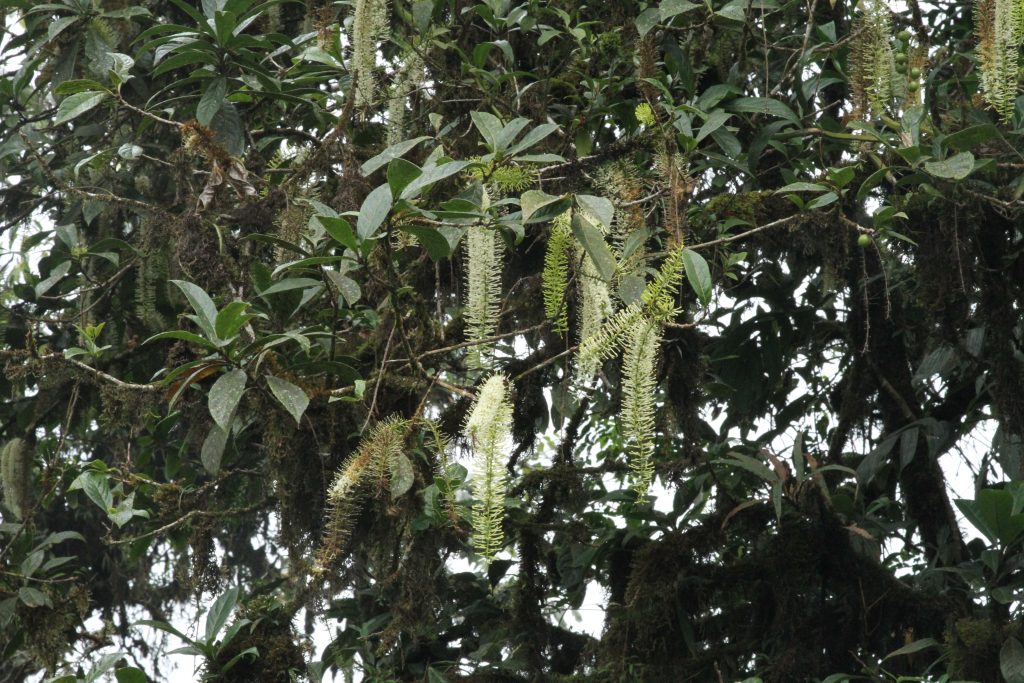
Bedd.

Bhutan2012 667
Bhutan Tserang 1100m, September

Description

Helicia nilagirica is an evergreen tree or large shrub of subtropical and tropical montane Asia, distributed from southern and northeastern India and the Nilgiri hills (whence the epithet) through Nepal, Bhutan, Myanmar, Thailand, southern China, Vietnam and Cambodia; GBIF lists some 944 occurrences, the species being relatively well collected. It grows in evergreen and semi-evergreen broadleaved forest, on hill slopes, ridges and along forest streams, chiefly between about 800 and 2000 m. The photographed individual was recorded in eastern Bhutan at Tserang around 1100 m in September, a humid forest setting typical of this warm-temperate to subtropical Proteaceae.

It is a tree with smooth to finely fissured bark and coriaceous foliage. The leaves are alternate, often clustered toward the branch tips, elliptic to oblong-lanceolate, leathery, entire or with a few coarse teeth toward the apex, glabrous and glossy above. The flowers are small and borne in slender, elongate, axillary racemes; as in the genus they are bisexual with four tepals that recurve at anthesis, the four stamens inserted on the tepals, and a hypogynous disk. The fruit is a hard, globose to ellipsoid, indehiscent drupe-like nut with a single large seed.

Helicia (Proteaceae) is the largest Old World genus of the family, centred on tropical Asia and reaching its northern limit in the eastern Himalaya. H. nilagirica is among the more widespread Asian species, and its racemose inflorescences and one-seeded indehiscent fruits typify the genus. Broadly distributed and locally common, it is not considered globally threatened, though populations depend on subtropical broadleaved forest affected by clearance.

Author: Bedd. · Sources: POWO (Kew), GBIF, Flora of China Vol. 5, Flora of Bhutan Vol. 1, Flora of Nepal, Flora of Pakistan, Sleumer revision of Asian Proteaceae