Tag:

Montane (1500-2500 m)

Müll.Arg.

Bh09 231 P387
Bhutan Wangdi, 1650m June
Bh09 380 G601
Bhutan Wangdi, 1650m June
Sikkim 2006 255 ergebnis
India West-Bengal, Lingza 1250m, May

Description

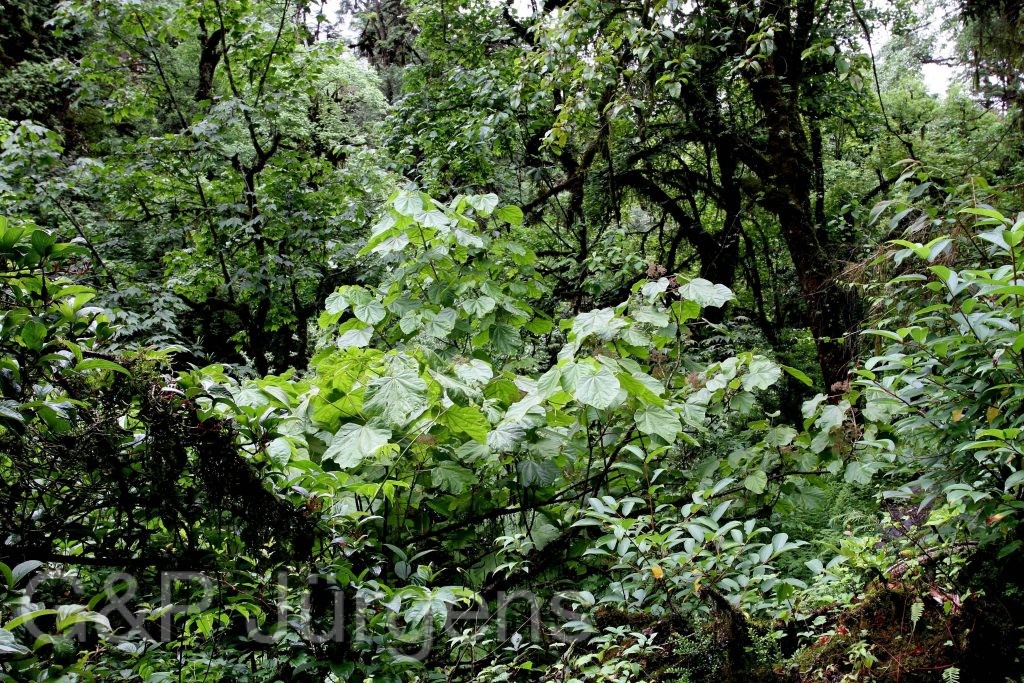
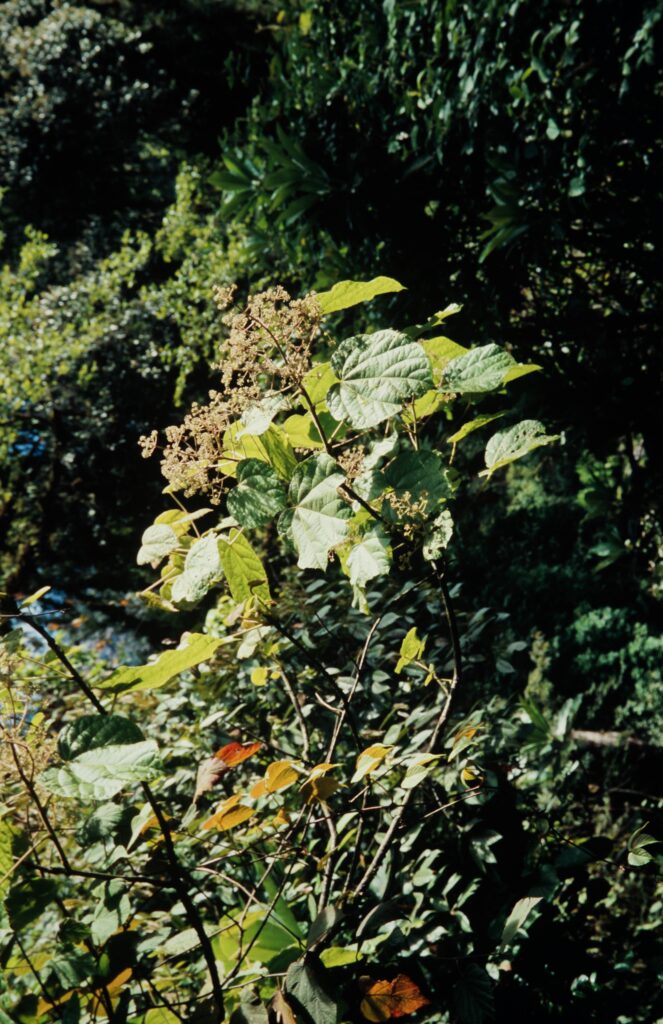
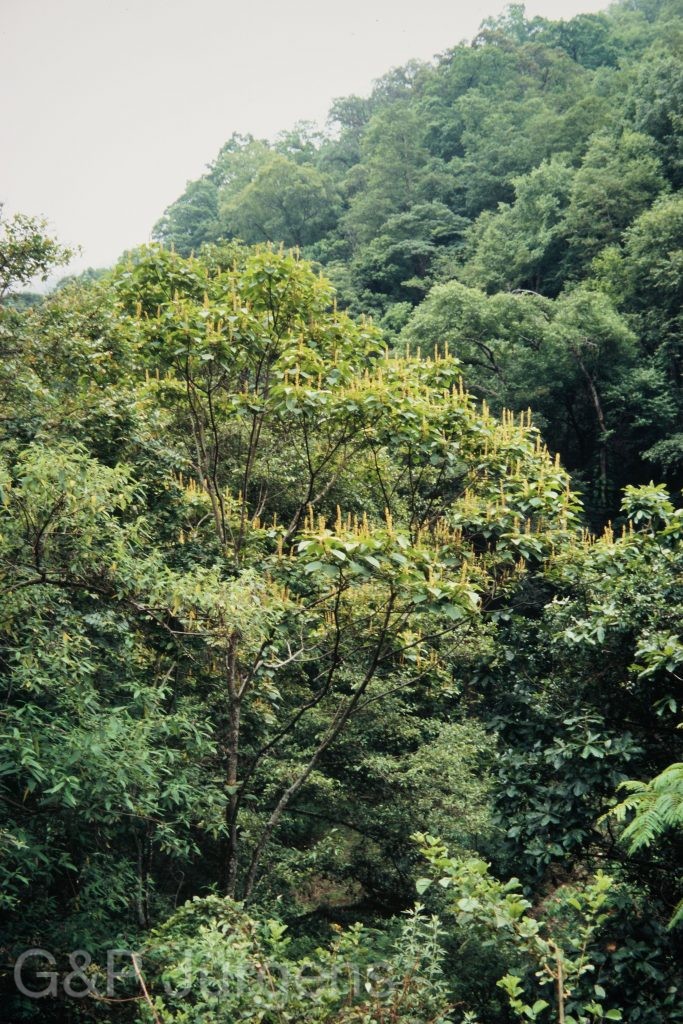
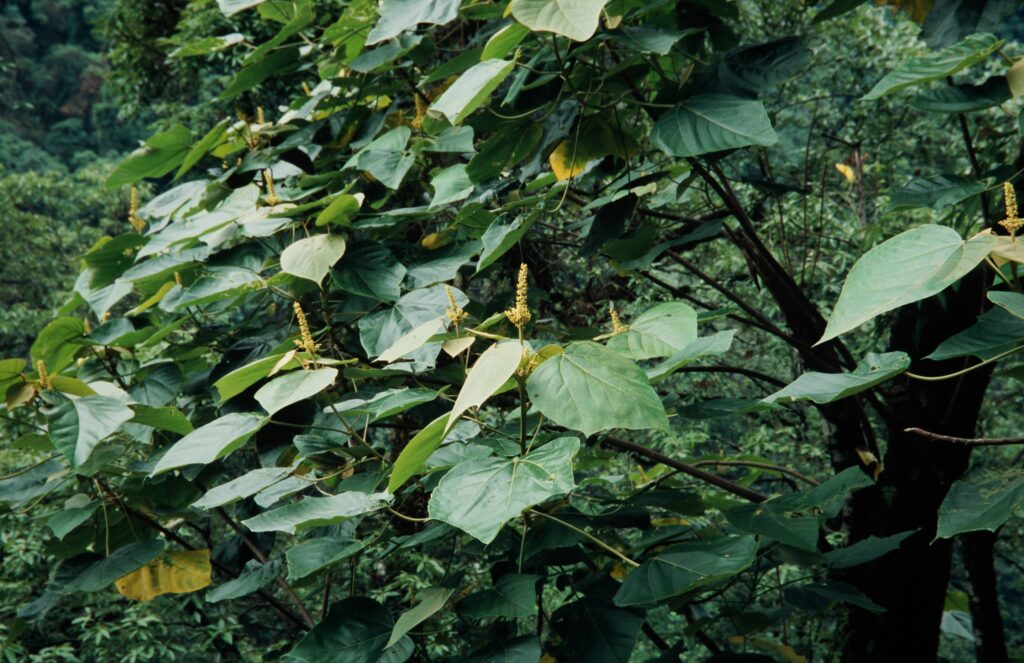
Mallotus nepalensis is a small tree or shrub of the subtropical to lower-temperate Himalaya and its eastern extensions, documented by GBIF (972 occurrences) across China, Nepal, India, Bhutan, Myanmar, Taiwan, Vietnam, Japan and Pakistan. It grows in secondary forest, scrub, forest edges and along streams and clearings, characteristically as a light-demanding component of disturbed and successional vegetation, mostly between about 800 and 2000 m. The collections from Wangdi in Bhutan at 1650 m in June and from Lingza in West Bengal at 1250 m in May illustrate its montane-subtropical distribution along the southern Himalayan front.

The plant is a deciduous shrub or small tree whose young branchlets, petioles and inflorescences are clothed in stellate hairs and reddish, granular peltate glands typical of the genus. The leaves are alternate, long-petiolate, broadly ovate to deltoid, often with two glands at the blade base and a pair of basal lateral nerves, the lower surface pale and gland-dotted. The plant is dioecious; minute apetalous flowers are borne in slender terminal and axillary racemes or panicles, the staminate with numerous stamens, the pistillate with a softly spiny ovary. The fruit is a globose, three-lobed capsule beset with soft processes and covered in red glandular powder.

Mallotus belongs to subfamily Acalyphoideae of the Euphorbiaceae and is characterised by its stellate indumentum and resinous peltate glands, the latter yielding the dye-like powder for which several species are known. Ecologically it behaves as a pioneer, regenerating freely in gaps and along disturbed margins, its capsular fruit and small seeds aiding rapid colonisation. The species is common and of no conservation concern.

Author: Müll.Arg. · Sources: POWO (Kew), GBIF, Flora of China Vol. 11, Flora of Bhutan Vol. 1, Flora of Nepal, Airy Shaw Euphorbiaceae of the Indian subcontinent
Malus baccata

by G & P Jürgens

(L.) Borkh.

Bhutan2014 407
Bhutan Jakar 2400m, May
Bhutan2014 408
Bhutan Jakar 2400m, May

Description

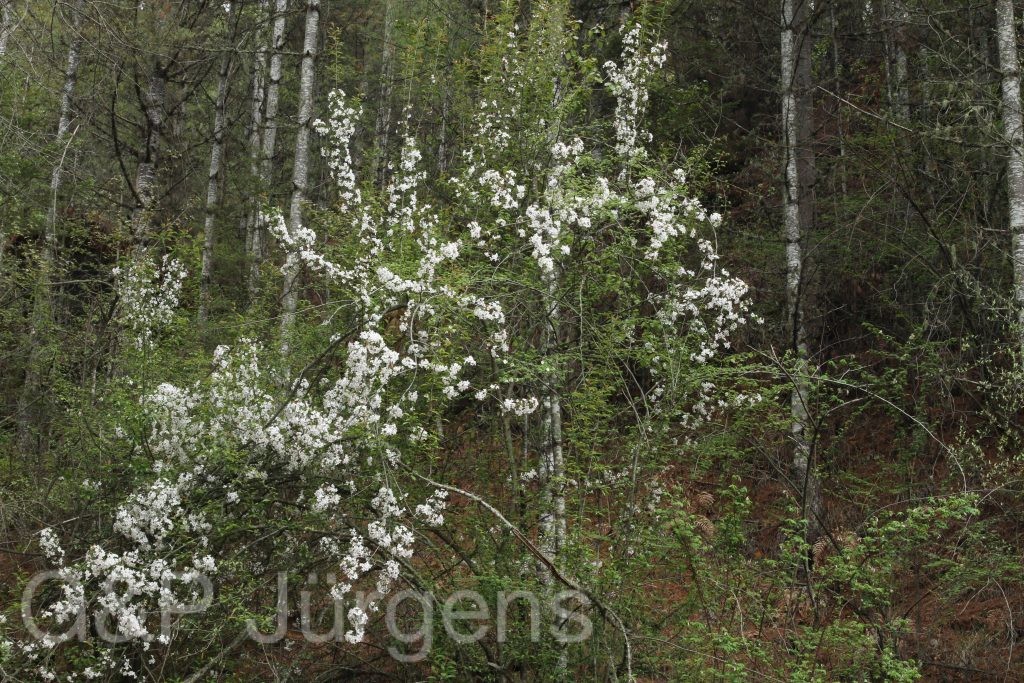
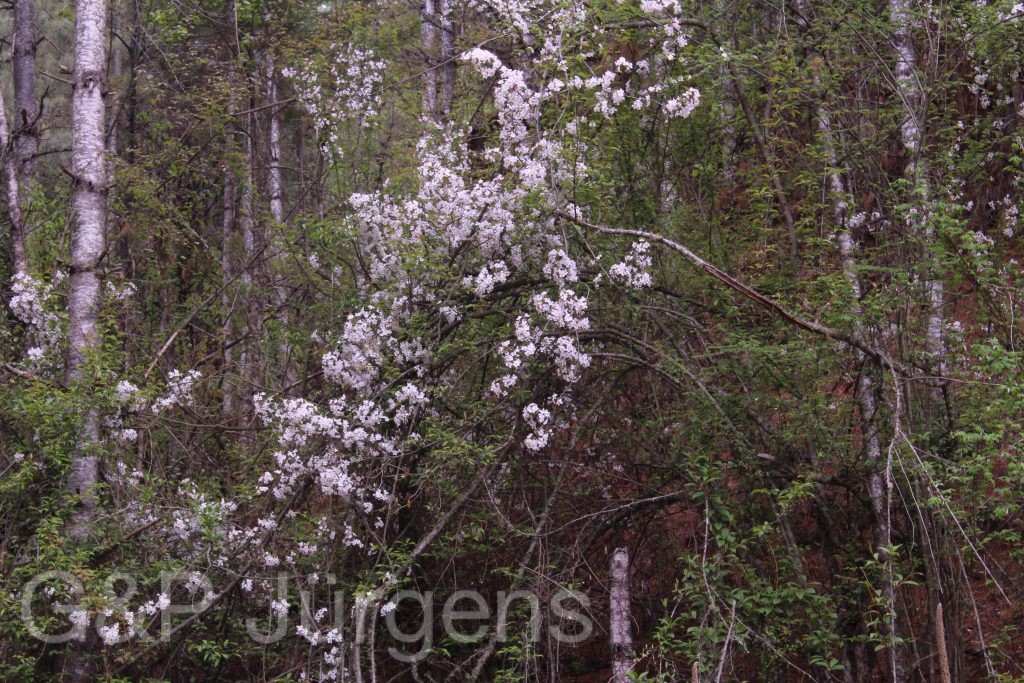
Malus baccata, the Siberian crab apple, is among the most broadly distributed wild apples, ranging across temperate and boreal East Asia from the Russian Far East and Siberia through Mongolia, northern China, the Korean Peninsula and Japan, and extending into the Himalaya in Nepal, India, Bhutan and Afghanistan; the species is widely cultivated and naturalised in Europe and North America, accounting for records from Great Britain, Germany, Sweden, Canada and the United States, with over 12,000 GBIF occurrences. In the eastern Himalaya it grows in temperate broad-leaved and mixed forest, margins, riverine thickets and open hillsides, as photographed near Jakar in central Bhutan at around 2400 m in May, when the trees are in full flower.

It is a deciduous tree reaching 10-14 m, with a rounded crown and reddish-brown, glabrous young shoots. The leaves are alternate, ovate to elliptic, 3-8 cm long, acuminate, finely serrate, glabrous or nearly so at maturity, on slender petioles. The flowers, borne in umbel-like corymbs of 4-6, are white, 3-3.5 cm across, with five rounded petals and styles connate and pubescent at the base. The fruit is a small globose pome 8-10 mm in diameter, red or yellow, lacking a persistent calyx, on a long slender pedicel, hanging conspicuously into autumn.

Malus baccata is the type of a polymorphic complex and is divided into several varieties and intergrading races across its range; Himalayan material has at times been segregated. As a cold-hardy, disease-resistant species it is of considerable importance in apple breeding and as a rootstock, and its abundant fruit is an autumn food resource for birds and mammals. It is of least concern conservation-wise, being common and widespread.

Author: (L.) Borkh. · Sources: POWO (Kew), GBIF, Flora of China, Flora of Bhutan, Flora of British India, A Monograph of the Genus Malus (Rehder)

Mazus dentatus

by GP Jürgens

Wall. ex Benth.

Sikkim2004 11 P17
Sikkim West-Bengal, Sambon 1800m April
Nepal 97 97 P160
Nepal Dongen 2360m April
Nepal1992 174 P255 ergebnis
Nepal Mamanke 1800m March 

Description

Mazus dentatus is a small herbaceous plant of the eastern Himalaya, recorded from northern India (Sikkim, Darjeeling), Nepal and Bhutan; GBIF holds only about 48 records, consistent with a restricted, narrow distribution. It grows in moist, shaded or semi-open habitats such as damp banks, grassy slopes, terraced field margins, ditches and stream sides at lower to middle elevations, broadly between about 1500 and 2500 m. The photographed material came from Sambon in the Sikkim/West Bengal hills at around 1800 m in April, from Dongen in Nepal near 2360 m in April and from Mamanke at about 1800 m in March, the early-spring flowering typical of this moisture-loving herb.

The plant is a low, soft, more or less hairy annual or short-lived perennial with slender ascending or decumbent stems. The leaves are mostly in a basal rosette and opposite below, obovate to spathulate, narrowed to a winged petiole, with a coarsely toothed (dentate) margin that gives the species its epithet. The flowers are borne in lax terminal racemes; the corolla is strongly two-lipped, pale violet to bluish, the short upper lip two-lobed and the larger lower lip three-lobed and marked with yellow and darker spots on a raised palate. The fruit is a small capsule enclosed in the persistent calyx.

Mazus, long placed in Scrophulariaceae and later in its own family Mazaceae, is treated here in Phrymaceae following the broad circumscription adopted in several recent floras. The genus is distinguished by its palate-bearing, bilabiate corolla and rosulate habit. M. dentatus is a localised eastern Himalayan plant of disturbed, moist ground; though not formally assessed, its limited range warrants attention.

Author: Wall. ex Benth. · Sources: POWO (Kew), GBIF, Flora of China Vol. 18, Flora of Bhutan Vol. 2, Flora of Nepal, Flora of Pakistan, Bonati revision of Asian Mazus

(C.B.Clarke) C.B.Shang

Sikkim2011 387
Sikkim Lachung 3200m, June
Sikkim2011 389
Sikkim Lachung 3200m, June
Sikkim 2006 327 ergebnis
India West-Bengal, Tolung 2400m, May

Description

Merrilliopanax alpinus is a small tree or shrub of the eastern Himalaya and south-western China, recorded from Nepal, northern India, Bhutan and Yunnan, a comparatively narrow range reflected in only some 59 occurrence records. It inhabits moist, evergreen broad-leaved and mixed montane forest and forest margins, generally between about 2000 and 3500 m, often in shaded, humid ravines. The images here derive from Sikkim at Lachung (3200 m, June) and from the Tolung area of West Bengal (2400 m, May), localities typical of the rich, mist-bathed mid-montane forests where the genus reaches its diversity.

The plant is an evergreen with stout, sparingly branched stems bearing simple, leathery leaves clustered toward the branch tips. The leaves are large, ovate to elliptic, entire or shallowly toothed, glabrous and shining above and frequently rusty-tomentose beneath, on long petioles. The inflorescence is a terminal panicle of small umbels; the flowers are small, polygamous and greenish, with a reduced calyx, several petals and stamens, and an inferior ovary. The fruit is a small, globose to ellipsoid drupe crowned by the persistent styles.

Merrilliopanax is a small genus of the Araliaceae segregated from the broadly defined Schefflera/Aralia complex and is restricted to the Sino-Himalayan region; M. alpinus was described by C.B.Clarke and transferred to the genus by C.B.Shang. Its simple (rather than compound) leaves distinguish it from many relatives. The drupes are bird-dispersed, and the species is a localised but characteristic element of eastern Himalayan cloud forest. Its restricted range makes it of biogeographic interest and potentially sensitive to forest loss, though no formal threat assessment is widely established.

Author: (C.B.Clarke) C.B.Shang · Sources: POWO (Kew), GBIF, Flora of China, Flora of Bhutan, Shang revision of Merrilliopanax, Frodin & Govaerts World Checklist of Araliaceae

Benth.

Bhutan2014 1027
Bhutan Paro 2320m, May
Bh2008 553 G837
Bhutan Paro 1900m April

Description

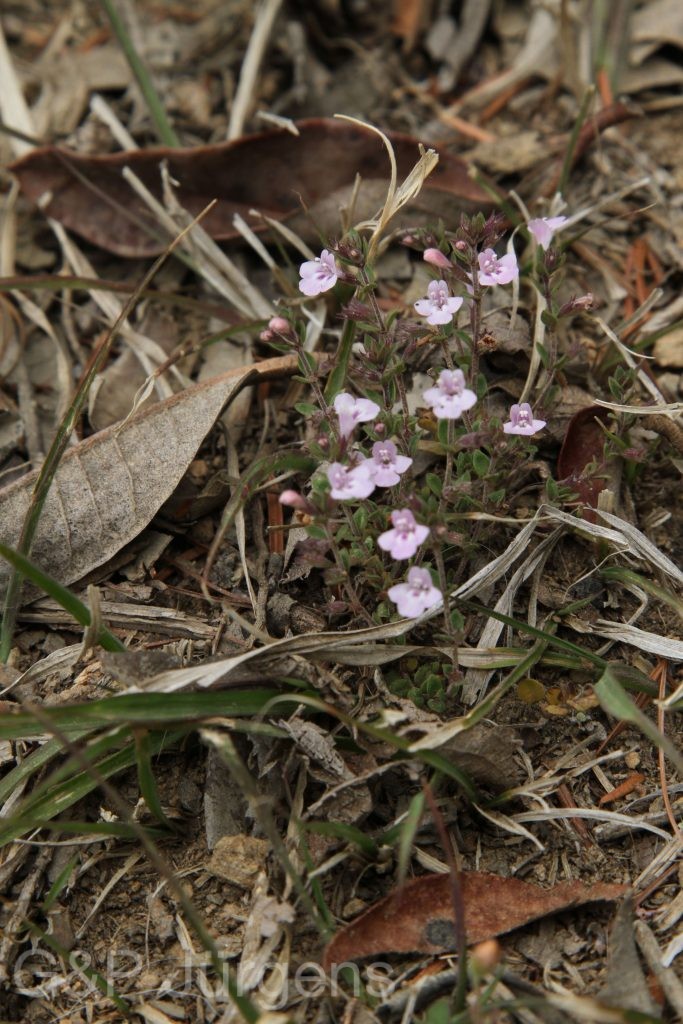
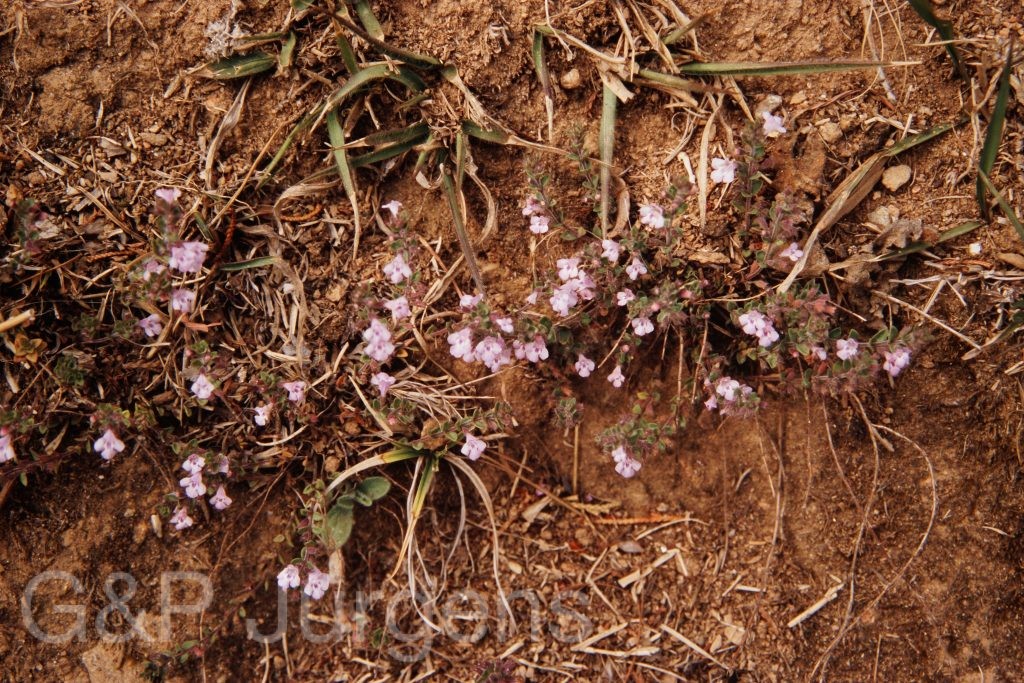
Micromeria biflora is an aromatic herb of remarkably wide Palaeotropical-to-Himalayan distribution, ranging from tropical and southern Africa (Ethiopia, Kenya, Tanzania, South Africa, Zimbabwe, Cameroon, Congo and others) through the Arabian Peninsula (Saudi Arabia, Yemen) and across to Afghanistan, Pakistan, India, Nepal, Bhutan, Myanmar and China; its nearly 1700 georeferenced occurrences underline this broad Old World range. It grows on dry, open, rocky and grassy slopes, banks and disturbed ground in the warm-temperate and montane belts, commonly between about 1500 and 2800 m. The plants documented around Paro in Bhutan at 1900-2320 m in April and May occupy exactly such sunny, well-drained hillsides.

It is a slender, much-branched perennial subshrub forming low, wiry tufts from a woody base, the quadrangular stems finely pubescent and clothed with a strong thyme-like aroma. The leaves are small, opposite, ovate to elliptic, entire and often revolute-margined, gland-dotted and short-petiolate. The pink to pale purple flowers are borne in axillary pairs or small few-flowered whorls, hence the epithet biflora; each has a tubular, ribbed, two-lipped calyx and a bilabiate corolla with the lower lip three-lobed, with four didynamous stamens. The fruit comprises four smooth, ovoid nutlets enclosed in the persistent calyx.

Micromeria belongs to tribe Mentheae of the Lamiaceae, allied to Clinopodium and Satureja, and the generic limits of this group have been much revised on molecular grounds. Rich in volatile monoterpene oils, M. biflora is widely used in folk medicine and as an aromatic herb. Its extensive range and tolerance of disturbed, arid habitats make it a successful and unthreatened species.

Author: Benth. · Sources: POWO (Kew), GBIF, Flora of China, Flora of Bhutan, Flora of Pakistan, Flora of Tropical East Africa, Harley's treatment of Labiatae

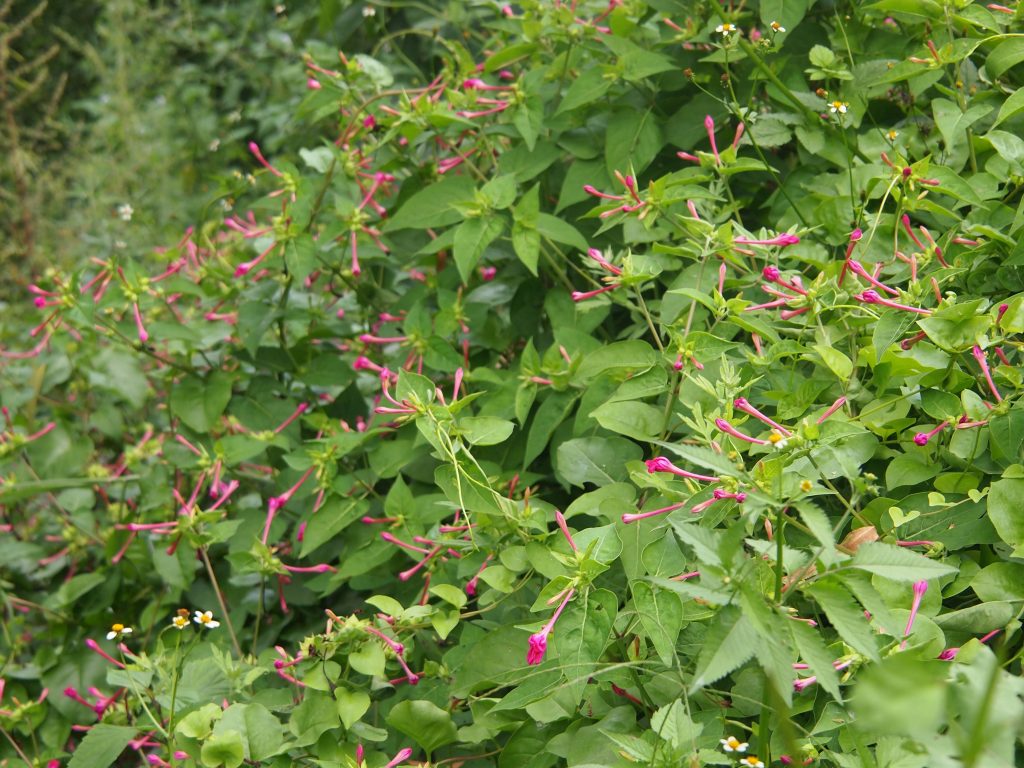
L.

Bhutan2012 425
Bhutan Wangdi 2300m, June

Description

Mirabilis jalapa, the four-o'clock flower or marvel-of-Peru, is native to tropical America but is now cultivated and naturalised across virtually the entire warm and temperate world; GBIF's very large total of around 48896 records spans France, Spain, the United States, Mexico, Italy, Germany, Brazil, China, Japan, South Africa, India and many other countries, reflecting its ubiquity as an ornamental and garden escape. It thrives in disturbed, sunny habitats, including gardens, roadsides, walls, waste ground and village margins, and readily persists around human settlements. The plant photographed at Wangdi (Wangdue) in Bhutan at about 2300 m in June represents one such cultivated and locally escaping occurrence in the Himalayan mid-hills, where it flowers freely through the warm months.

It is a bushy perennial herb arising from a thick, tuberous root, with erect, swollen-noded, dichotomously branched stems. The leaves are opposite, ovate, acuminate and entire, with a deep green blade. The flowers, which characteristically open in the late afternoon and remain open overnight (hence the vernacular name), are borne in terminal clusters; each consists of a brightly coloured, funnel-shaped, petaloid perianth (lacking true petals) subtended by a calyx-like involucre of bracts. The perianth ranges through magenta, red, yellow, white and variegated forms, often on the same plant. The fruit is a hard, ribbed, blackish achene (anthocarp) enclosed in the persistent perianth base.

As a member of the Nyctaginaceae, M. jalapa exhibits classic vespertine, often fragrant flowers adapted to pollination by long-tongued moths and hawkmoths, while it is also self-compatible. The genus is celebrated in genetics as the organism in which Carl Correns demonstrated cytoplasmic (extranuclear) inheritance through variegated leaf colour. Robust, self-seeding and tuberous, the species is highly persistent in cultivation and is not of conservation concern; rather, it is a minor weed of warm regions.

Author: L. · Sources: POWO (Kew), GBIF, Flora of China Vol. 5, Flora of Bhutan Vol. 1, Flora of Nepal, Bittrich & Kühn Nyctaginaceae (Families and Genera of Vascular Plants)

Morus indica

by GP Jürgens

L.

Nepal 97 362 P710
Nepal Arun-Valley 1700m May

Description

Morus indica L. is a deciduous tree or shrub of the mulberry family, widely distributed across temperate and subtropical Asia and extensively cultivated. GBIF documents over 14,000 records from China, India, Taiwan, Korea, Japan, Myanmar, the Philippines and Thailand, together with introductions in Europe and the Americas, reflecting its long history of cultivation for sericulture and fruit. In the Himalaya it occurs in subtropical and lower temperate forest, along valley sides, field margins and roadsides; the photographed plant is from Nepal, the Arun Valley, at 1,700 m in May, a typical mid-elevation montane setting.

The plant is a small to medium tree with grey, fissured bark and milky latex. The leaves are alternate, ovate, often unequally cordate at the base, with a serrate or dentate margin and an acuminate apex; juvenile and coppice leaves are frequently variously lobed, a common feature of the genus. The plant is dioecious or monoecious, the inconspicuous unisexual flowers borne in short, dense, pendent axillary catkins (spikes); staminate flowers have four tepals and four stamens, pistillate flowers a superior ovary with a bifid stigma. The fruit is a fleshy sorosis (multiple fruit) formed from the accrescent perianths, ripening from greenish through red to dark purple-black and edible.

The taxonomy of Asian Morus is unsettled, with M. indica often treated as part of the variable M. alba complex and subject to differing circumscriptions. The species is of major economic importance as the principal food plant of the silkworm and as a fruit and fodder tree, and is consequently both wild and widely naturalised; it is not of conservation concern.

Author: L. · Sources: POWO (Kew), GBIF, Flora of China Vol. 5, Flora of Nepal, Flora of Bhutan Vol. 1, Berg: Moraceae (Flora Malesiana)

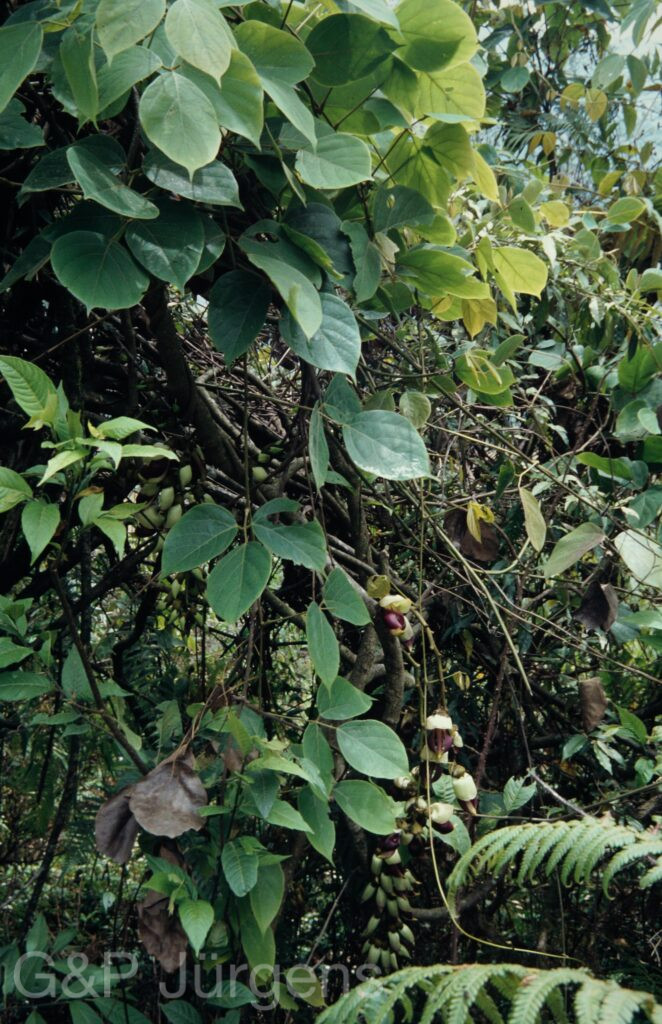
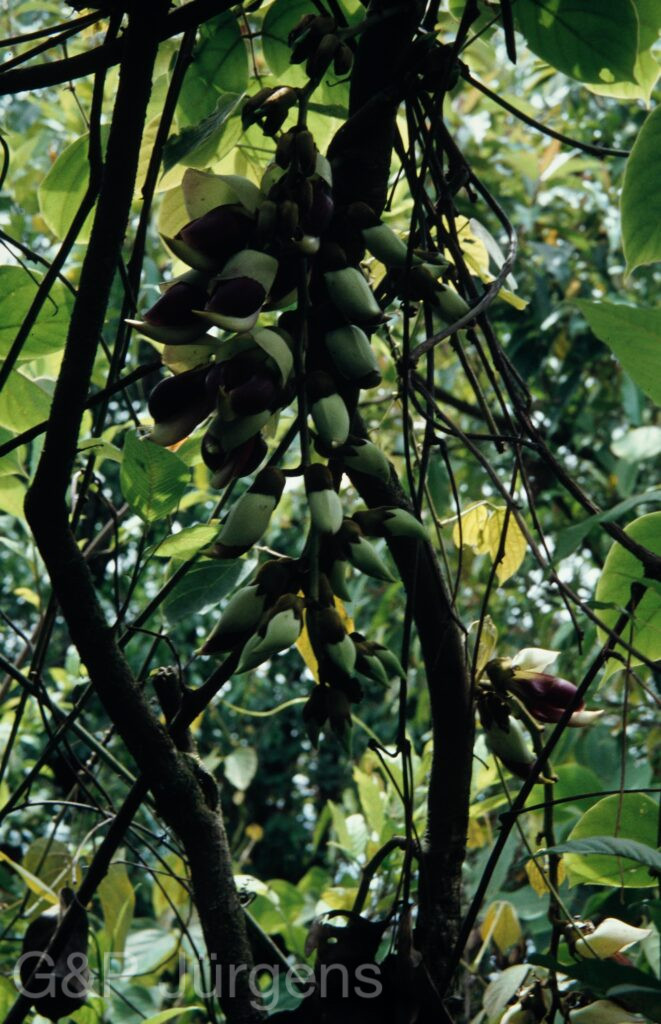
Mucuna macrocarpa

by GP Jürgens

Wall.

Nepal 1994 57 ergebnis
Ost-Nepal Bhalukhob 
1800m April
Nepal 1994 55 ergebnis
Ost-Nepal Bhalukhob 
1800m April

Description

Mucuna macrocarpa is a large woody climber of subtropical and tropical Asia, ranging from Taiwan, Japan and China through Thailand, Laos, Myanmar, India, Vietnam, Nepal, Malaysia and Bhutan; GBIF records some 2100 occurrences, making it by far the best-documented species in this set. It scrambles through warm broadleaved and evergreen forest, along forest edges and ravine slopes at lower montane elevations. The photographed plant grows at Bhalukhob in East Nepal at about 1800 m, flowering in April, in humid subtropical hill forest.

It is a robust, perennial liana with stout woody stems and trifoliolate leaves bearing large, broadly ovate to elliptic leaflets. The pendent, cauliflorous to ramiflorous inflorescences carry showy papilionaceous flowers with a dark, often deep purple to maroon or greenish keel and standard, the keel curved and enclosing the stamens and style. The fruit is a large, woody, oblong pod, broad and often flattened, conspicuously ribbed or winged and clothed in irritant hairs, enclosing several hard, disc-shaped seeds.

The species is accepted. Mucuna is noted for explosive, mechanically triggered flowers adapted to vertebrate pollination: in this and related species the keel snaps open under the manipulation of nectar-feeding bats and, locally, other mammals or large birds, a celebrated case of chiropterophily. The stinging pod hairs deter herbivores, while the buoyant seeds are reported to disperse by water. Its wide range and frequency indicate a secure conservation status across monsoon Asia.

Author: Wall. · Sources: POWO (Kew), GBIF, Flora of China, Flora of Bhutan, Wilmot-Dear's revisions of Asian Mucuna (Leguminosae)

(L.) Spreng.

Bhutan2014 150
Bhutan Trashigang 2000m, May
Bhutan2014 236
Bhutan Trashigang 2000m, May

Description

Murraya koenigii, the curry-leaf tree, is native to the Indian subcontinent and Indo-China and is now pantropically cultivated and naturalised, reflected in its very wide GBIF distribution spanning India, Sri Lanka, Nepal, Bhutan, China, Southeast Asia, Australia, Africa and the Americas. In its native range it grows in subtropical deciduous and semi-evergreen forest, scrub, forest margins and as an escape near settlements, from the plains up to about 1600 m, occasionally higher. The photographed plant from Trashigang in eastern Bhutan, at roughly 2000 m and flowering in May, sits near the upper limit of its altitudinal range in warm, sheltered hill forest.
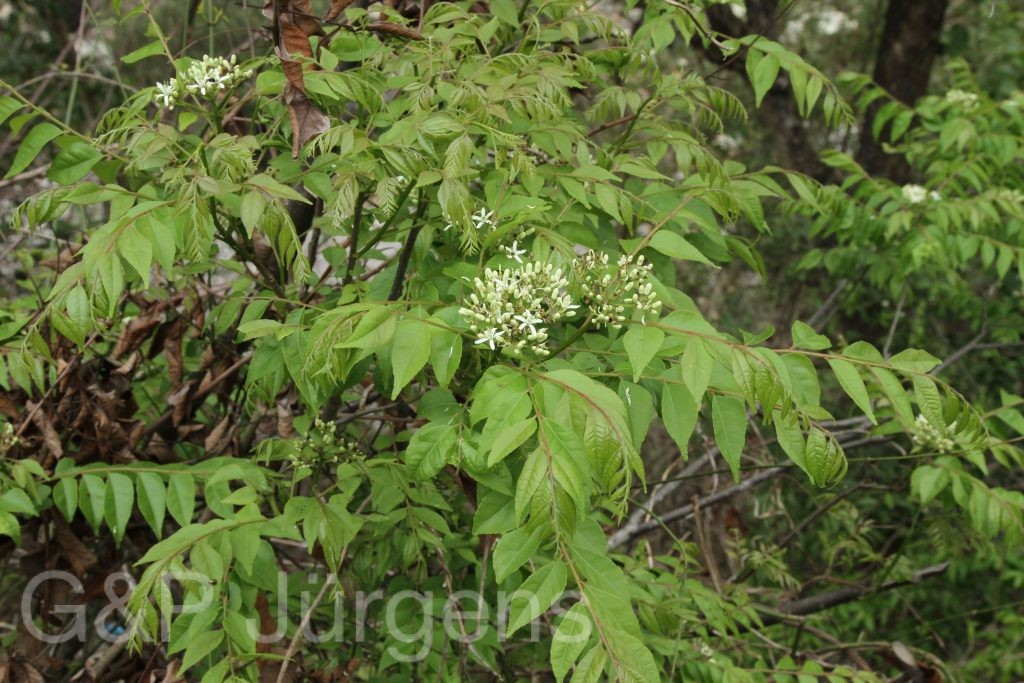
The species is a small, aromatic, much-branched shrub or tree with thin grey to brownish bark. The leaves are alternate, imparipinnate, with numerous ovate-lanceolate, oblique-based, crenulate leaflets that are strongly aromatic when crushed and gland-dotted, as throughout the Rutaceae. The flowers are borne in terminal corymbose panicles, small, white, fragrant and bisexual, with five petals, ten stamens and a superior ovary. The fruit is a small ellipsoid to ovoid berry ripening from green through red to glossy black, with thin sweetish pulp and usually one or two seeds; the seeds are notably recalcitrant.

The genus commemorates the Swedish physician J. A. Murray, and the species epithet honours Johann Gerhard König. The plant is of great economic and culinary importance, its leaves indispensable in South Asian cuisine, and it is widely valued in traditional medicine. Its gland-dotted, essential-oil-rich foliage typifies the Rutaceae, and bird-dispersed berries account for its frequent escape and naturalisation; it is abundant and of no conservation concern.

Author: (L.) Spreng. · Sources: POWO (Kew), GBIF, Flora of China Vol. 11, Flora of Bhutan Vol. 1, Flora of Nepal, A Monograph of the Genus Murraya (Rutaceae)

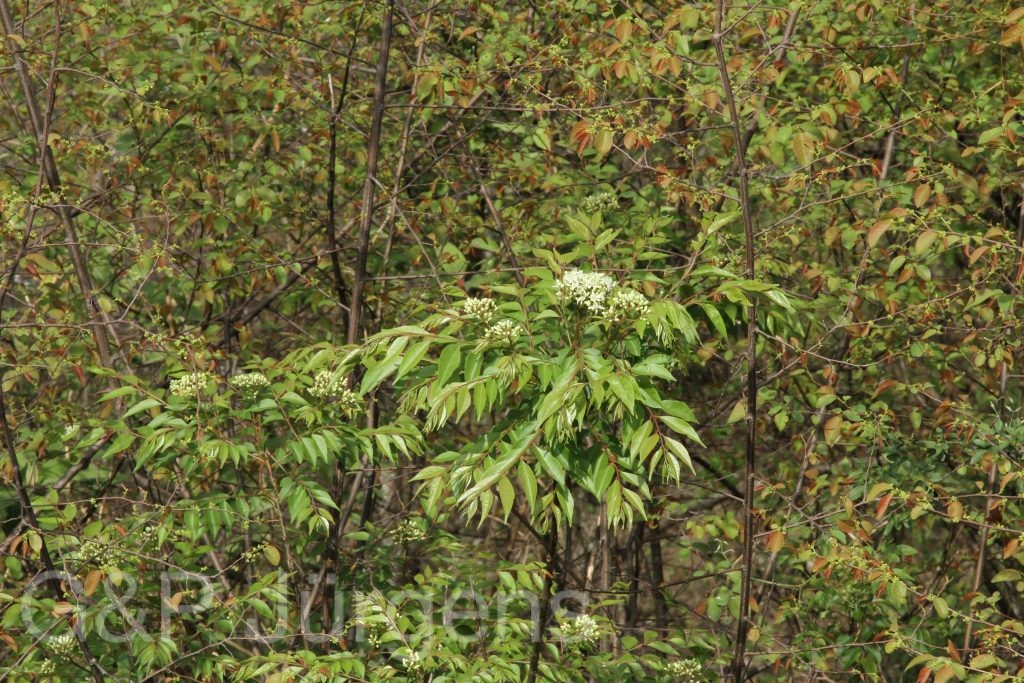
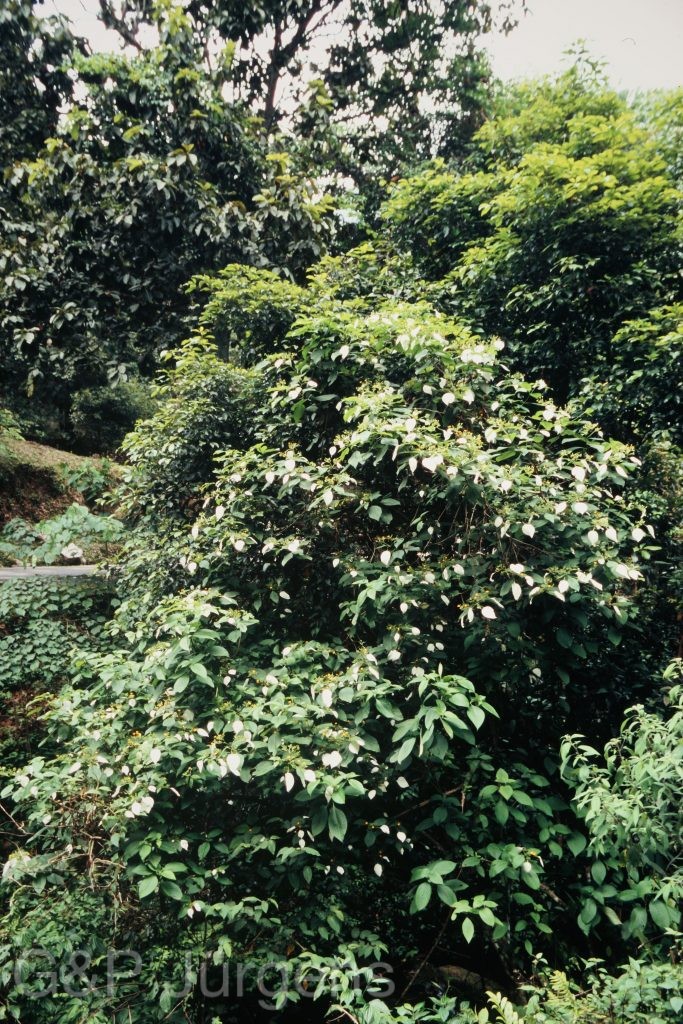
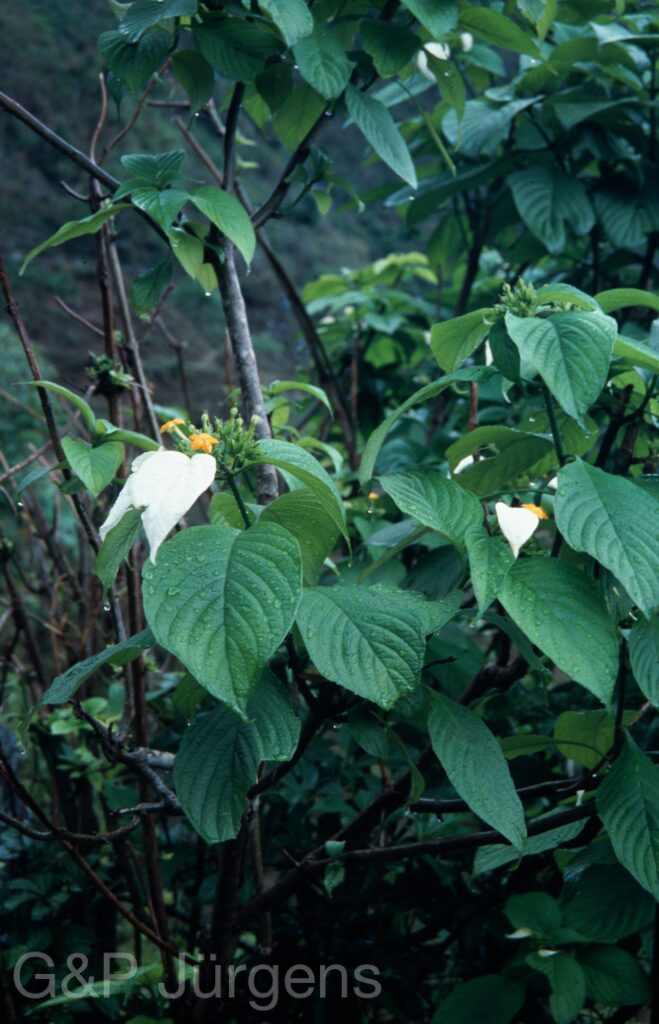
Vahl

Bh09 388 P615
Bhutan Punaka-Chju 1600m, June
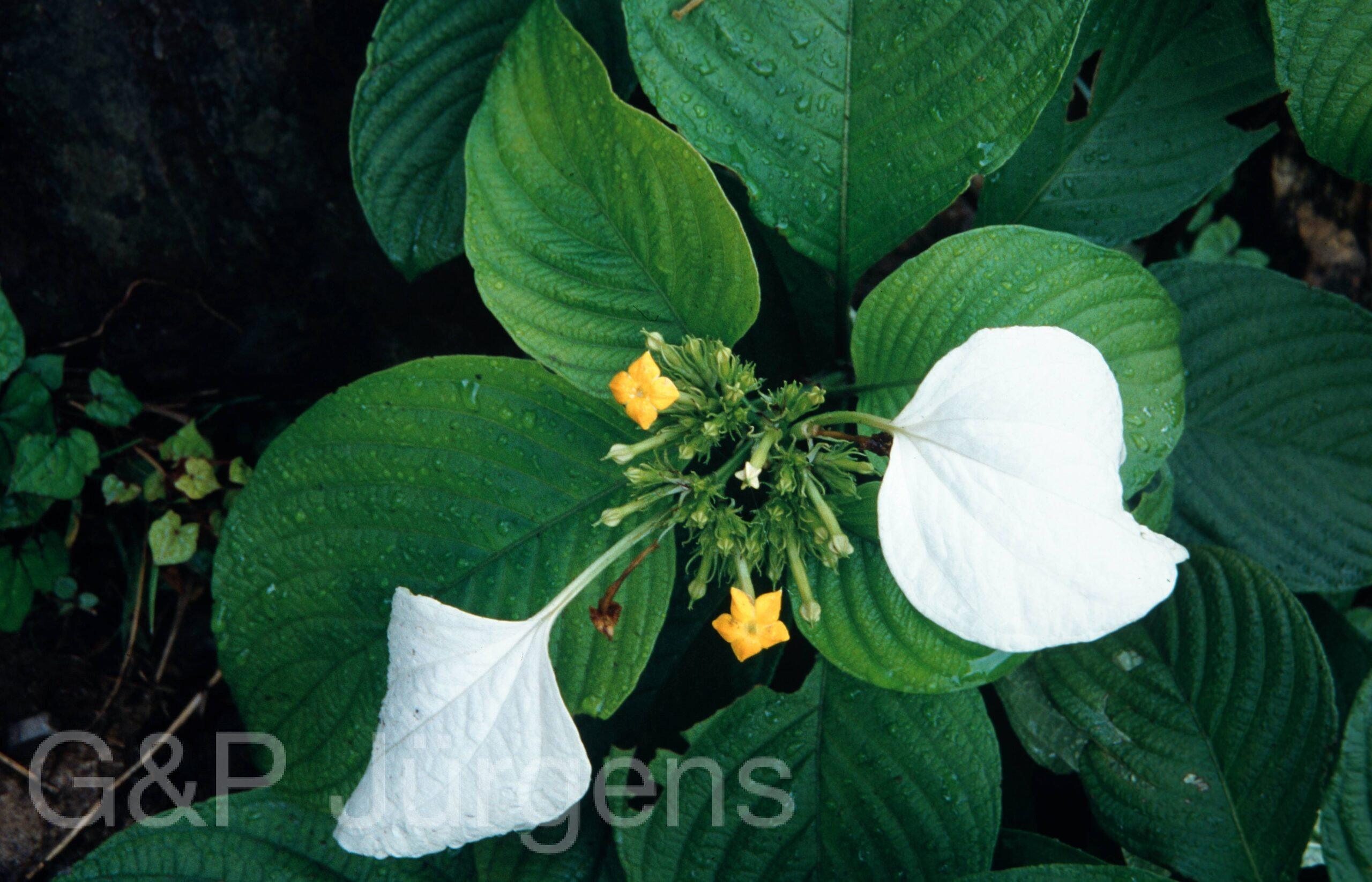
Nepal 2001 468 ergebnis ergebnis
Nepal (Gorkha) Gunda 1700m, May

Description

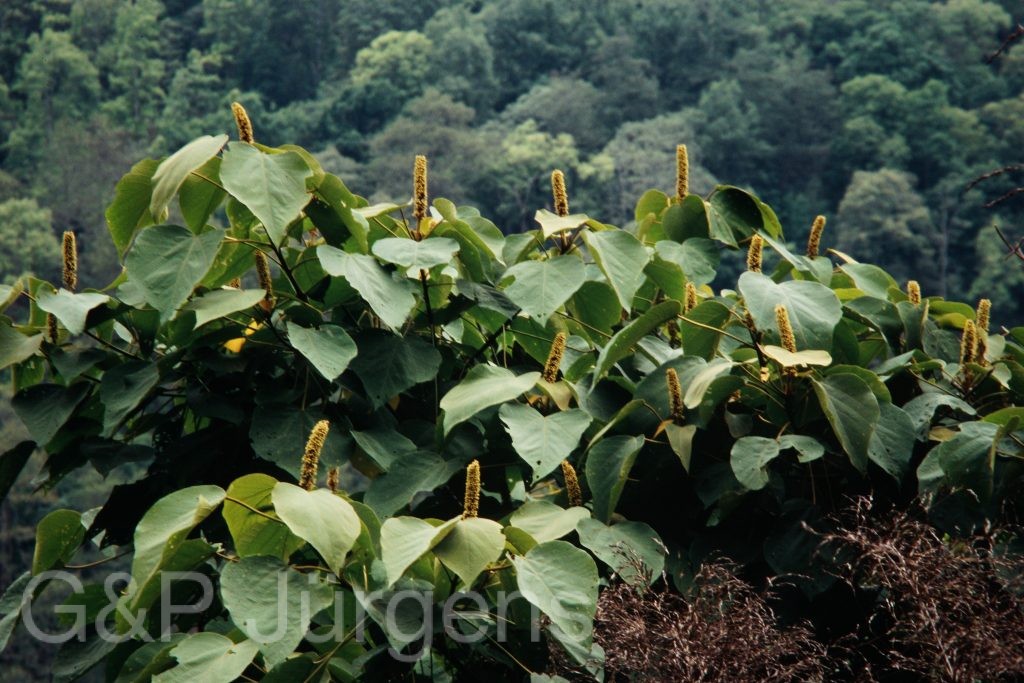
Mussaenda glabra is a widely distributed tropical to subtropical shrub or scrambling liana of Southeast Asia and the eastern Himalaya, documented from numerous countries including India, China, Myanmar, Thailand, Vietnam, Malaysia, Indonesia and Nepal across some 355 GBIF occurrences. The illustrated material was gathered at Punaka-Chu in Bhutan at 1600 m in June and at Gunda in Gorkha, Nepal at 1700 m in May. It grows in moist broad-leaved forest, along streamsides, thickets and forest margins from the lowlands up to about 1800 m, thriving in warm, humid, partly shaded situations.

It is an evergreen shrub or woody climber with terete, often pubescent young branches. The leaves are opposite, ovate to elliptic, entire, acuminate at the apex, with interpetiolar stipules characteristic of the Rubiaceae. The inflorescence is a terminal cyme bearing tubular flowers with a five-lobed orange-yellow corolla; the diagnostic feature is the enlargement of a single calyx lobe in some flowers into a large, conspicuous, white, leaf-like petaloid bract (semaphyll) that advertises the inflorescence to pollinators. The fruit is a fleshy berry containing numerous minute seeds.

The genus Mussaenda is renowned for these showy expanded calyx lobes, an adaptation enhancing pollinator attraction in the shaded understory and a feature widely exploited in horticulture. The fleshy berries are dispersed by birds. With its broad range spanning continental and insular Asia, the species is of least concern, being common across much of its distribution, though dependent on the persistence of intact lowland and submontane forest.

Author: Vahl · Sources: POWO (Kew), GBIF, Flora of China, Flora of Bhutan, Flora of Nepal, Jayaweera – The Genus Mussaenda (Rubiaceae) revision