
L.
Description
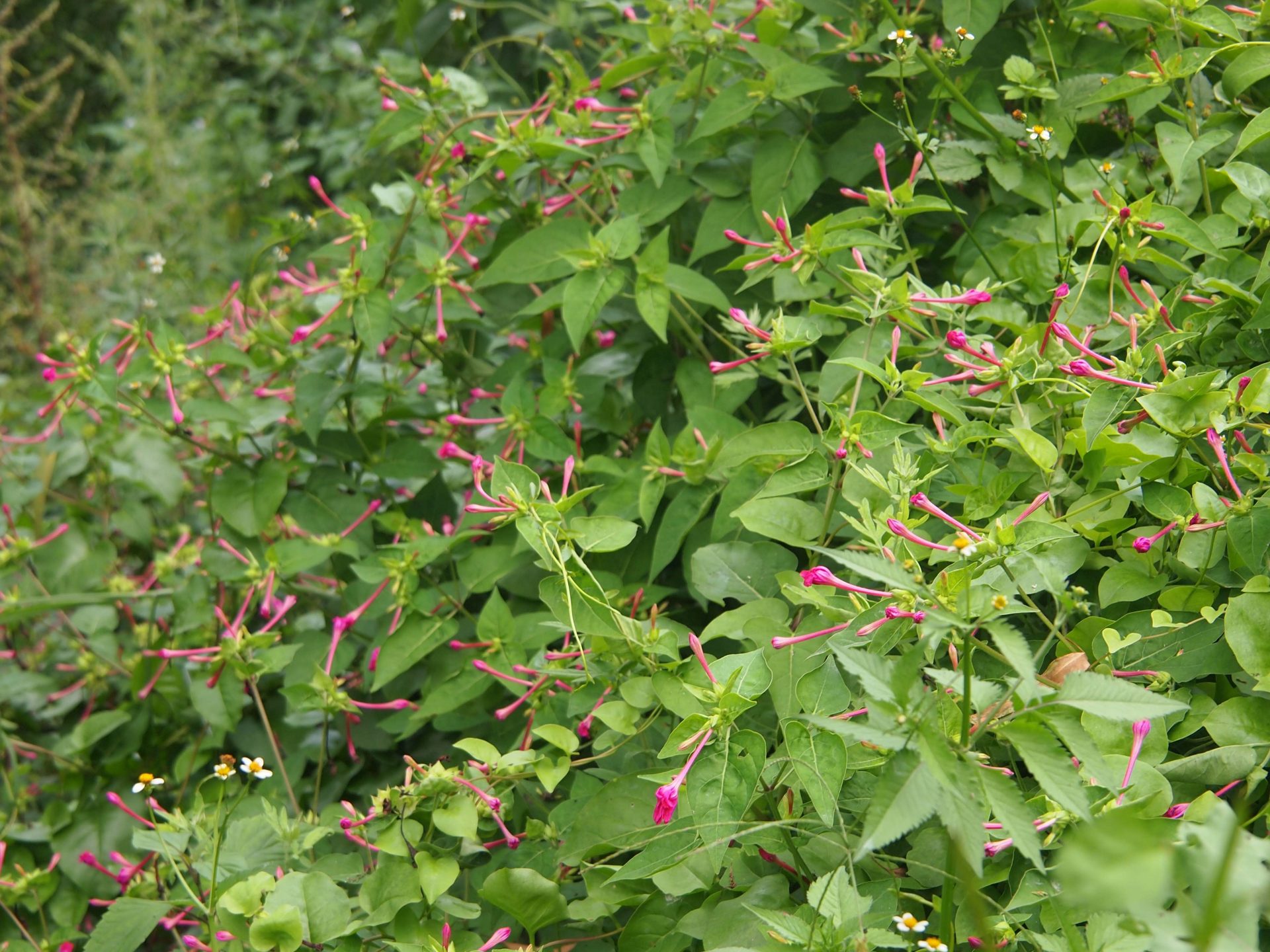
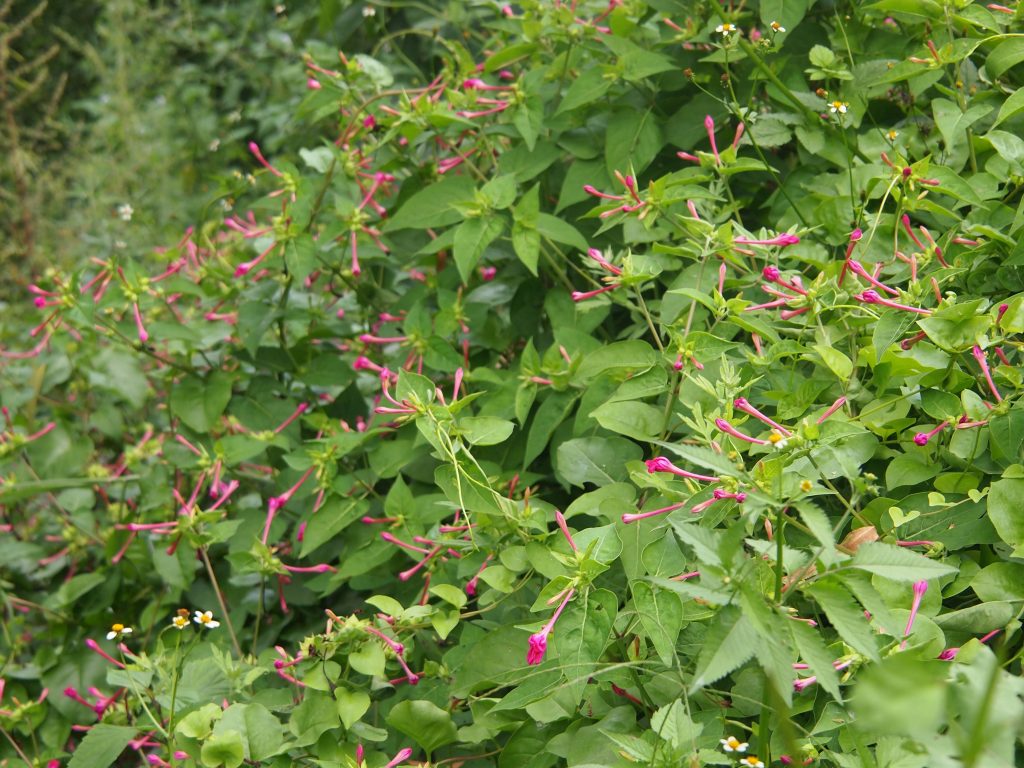
Mirabilis jalapa, the four-o'clock flower or marvel-of-Peru, is native to tropical America but is now cultivated and naturalised across virtually the entire warm and temperate world; GBIF's very large total of around 48896 records spans France, Spain, the United States, Mexico, Italy, Germany, Brazil, China, Japan, South Africa, India and many other countries, reflecting its ubiquity as an ornamental and garden escape. It thrives in disturbed, sunny habitats, including gardens, roadsides, walls, waste ground and village margins, and readily persists around human settlements. The plant photographed at Wangdi (Wangdue) in Bhutan at about 2300 m in June represents one such cultivated and locally escaping occurrence in the Himalayan mid-hills, where it flowers freely through the warm months.
It is a bushy perennial herb arising from a thick, tuberous root, with erect, swollen-noded, dichotomously branched stems. The leaves are opposite, ovate, acuminate and entire, with a deep green blade. The flowers, which characteristically open in the late afternoon and remain open overnight (hence the vernacular name), are borne in terminal clusters; each consists of a brightly coloured, funnel-shaped, petaloid perianth (lacking true petals) subtended by a calyx-like involucre of bracts. The perianth ranges through magenta, red, yellow, white and variegated forms, often on the same plant. The fruit is a hard, ribbed, blackish achene (anthocarp) enclosed in the persistent perianth base.
As a member of the Nyctaginaceae, M. jalapa exhibits classic vespertine, often fragrant flowers adapted to pollination by long-tongued moths and hawkmoths, while it is also self-compatible. The genus is celebrated in genetics as the organism in which Carl Correns demonstrated cytoplasmic (extranuclear) inheritance through variegated leaf colour. Robust, self-seeding and tuberous, the species is highly persistent in cultivation and is not of conservation concern; rather, it is a minor weed of warm regions.
Author: L. · Sources: POWO (Kew), GBIF, Flora of China Vol. 5, Flora of Bhutan Vol. 1, Flora of Nepal, Bittrich & Kühn Nyctaginaceae (Families and Genera of Vascular Plants)