Tag:

Montane (1500-2500 m)

Lindl.

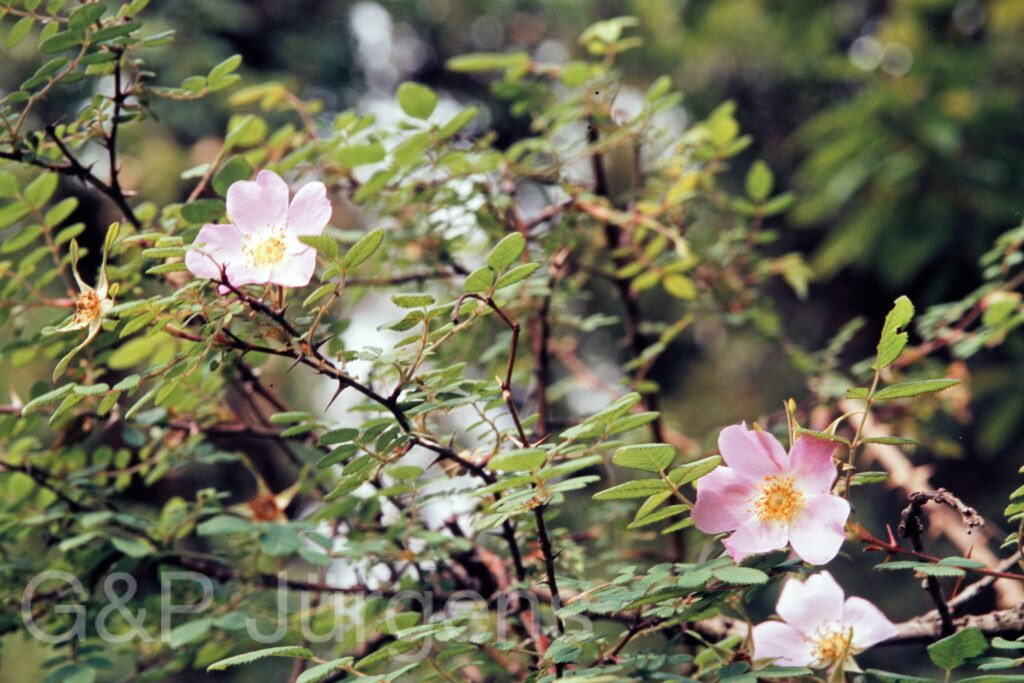
Garh 07 246 ergebnis
India Garhwal Barron Chatti 2450m, June
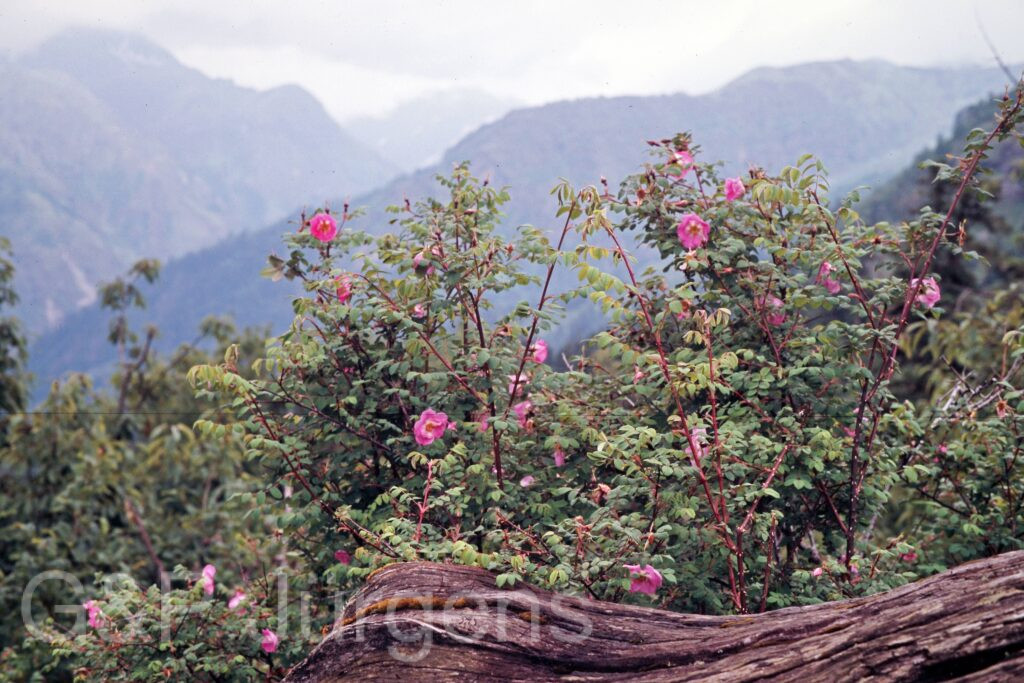
Garh 07 571 ergebnis
India Garhwal Barron Chatti 2450m, June

Description

Rosa macrophylla is a wild rose of the Himalaya and southwestern China, recorded from China, India, Nepal, Bhutan, Pakistan and Afghanistan, with numerous cultivated occurrences across Europe and North America; GBIF holds around 1506 georeferenced records. It grows in open temperate to subalpine habitats: forest margins, scrub, shrubberies, riverbanks and grassy slopes, typically between about 2400 and 3700 m. The photographed plant from Barron Chatti in Garhwal, India, at 2450 m in June is characteristic of these mid-montane Himalayan settings, where it flowers in early summer along trails and woodland edges.

It is a deciduous shrub 2–4 m tall with stout, erect to arching reddish-purple stems that are usually sparsely armed with straight or slightly curved prickles, sometimes nearly unarmed. The leaves are imparipinnate with usually 7–11 leaflets, these elliptic to oblong, serrate, glaucous or pubescent beneath. The flowers are large, solitary or in few-flowered corymbs, with five broad bright deep-pink to crimson petals, numerous stamens, and a glandular-setose pedicel and receptacle. The fruit is a large, conspicuous, flask-shaped to oblong-ellipsoid scarlet-red hip crowned by the persistent erect sepals, enclosing numerous bony achenes.

Described by Lindley, Rosa macrophylla belongs to section Cinnamomeae, the cinnamon roses, and is distinguished by its large flowers, large persistent-sepalled hips and big leaflets, having contributed to garden roses and several named cultivars and hybrids. The showy hips are dispersed by birds and mammals, while the flowers attract bees and other insects. Locally common across its Himalayan range and widely cultivated, it is of no conservation concern.

Author: Lindl. · Sources: POWO (Kew), GBIF, Flora of China Vol. 9, Flora of Bhutan Vol. 1, Flora of Nepal, The Genus Rosa (Phillips & Rix)
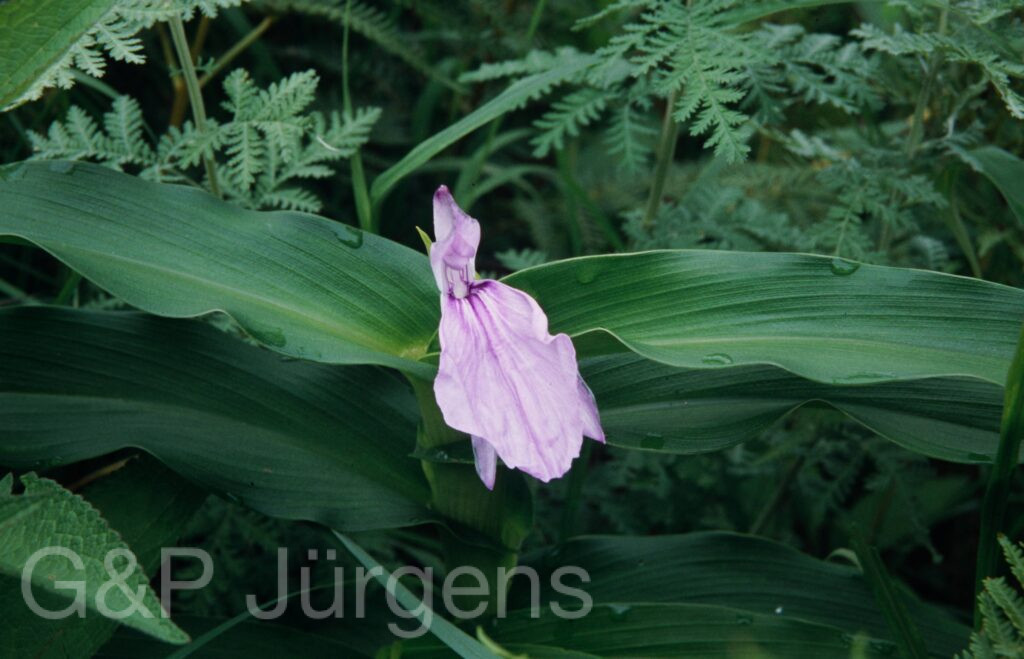
K.Schum.

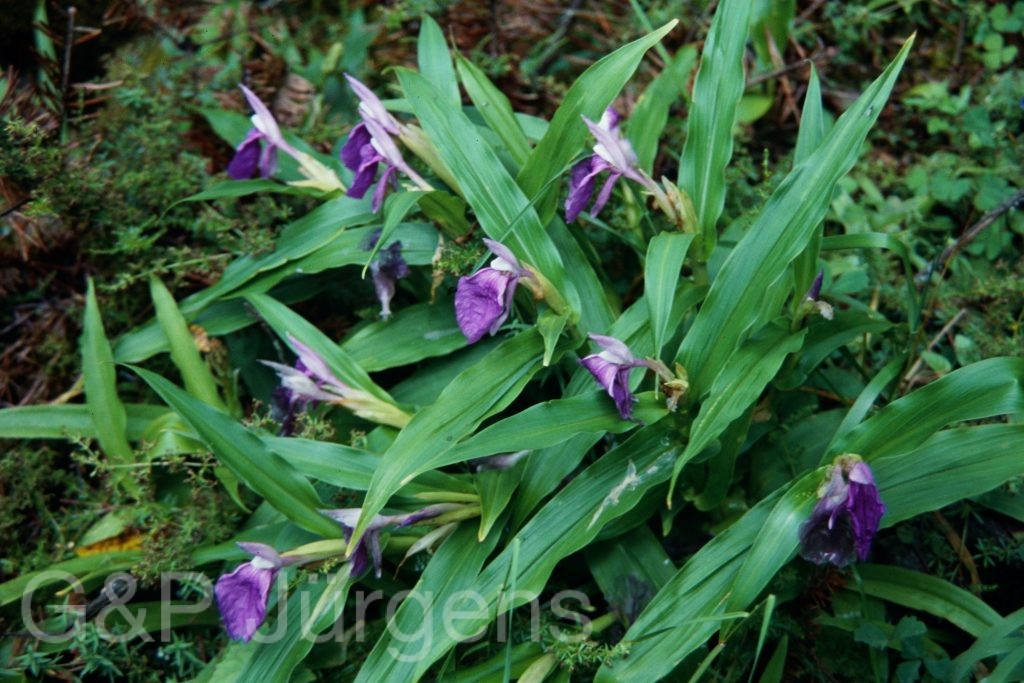
Sikkim2003 49 W68
Sikkim above Yoksam 2200m 08.2003
Nepal 99 909 ergebnis
West-Nepal Hanke 2700m, July

Description

Roscoea auriculata is an eastern Himalayan terrestrial ginger recorded from India, China, Nepal and Bhutan across some 126 GBIF occurrences. The photographed plants were found above Yoksam in Sikkim at 2200 m in August and at Hanke in West Nepal at 2700 m in July, locations typical of its range in moist temperate forest glades, grassy banks and open slopes between roughly 2000 and 3000 m. Unlike most members of the predominantly tropical Zingiberaceae, Roscoea is adapted to cool montane conditions, dying back to a tuberous rootstock to overwinter and emerging with the summer monsoon.

The plant is an erect perennial herb arising from clustered fleshy, tuberous roots. The leaves are few, lanceolate and arranged distichously, their sheaths forming a false stem (pseudostem); the diagnostic feature signalled by the epithet is the conspicuously auriculate leaf-sheath base. The flowers are large, showy and orchid-like, deep violet to purple, emerging successively from a terminal cluster; each has a hooded dorsal corolla lobe, two erect lateral staminode-like structures and a broad, often bilobed reflexed labellum, with a single fertile stamen.

Note that the input family is given as "Zingiberacaea", an evident misspelling of Zingiberaceae, in which Roscoea is correctly placed. The genus is celebrated for its convergence on an orchid-like floral form, an adaptation for pollination by long-tongued bees, and is much prized in cultivation for hardy temperate gardens. R. auriculata has a relatively restricted eastern Himalayan distribution; though not formally threatened, it is locally collected and sensitive to habitat disturbance.

Author: K.Schum. · Sources: POWO (Kew), GBIF, Flora of Bhutan, Flora of Nepal, Flora of China, Cowley – The Genus Roscoea (Royal Botanic Gardens Kew monograph)

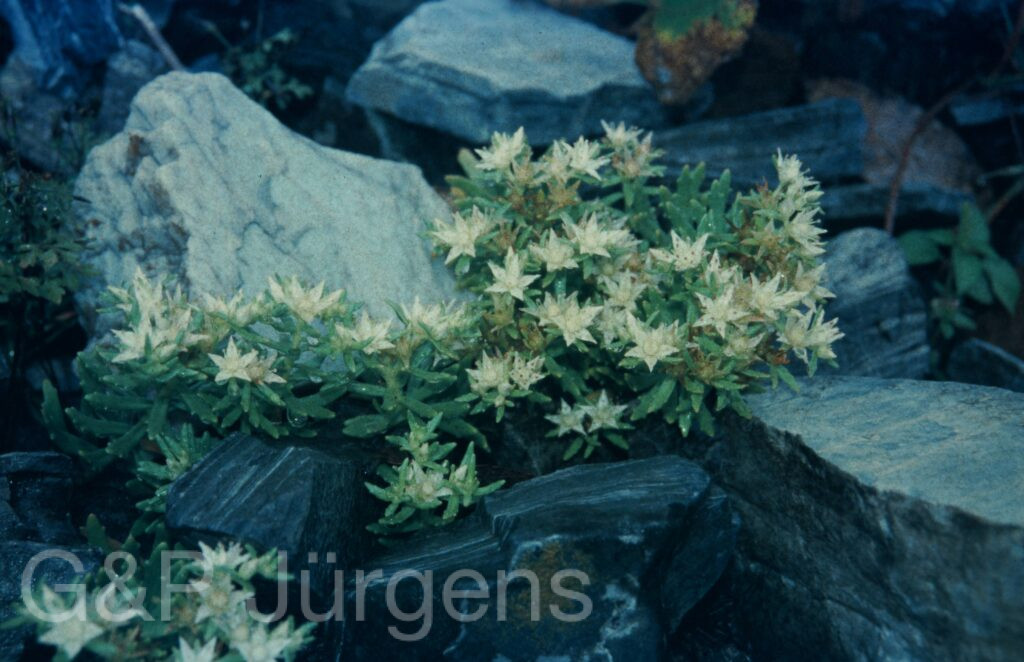
(Edgew.) H.Ohba

Garw 2005 234 ergebnis ergebnis
India Garhwal Guni 2400m, September

Description

Rosularia rosulata is a saxicolous succulent of the western and central Himalaya, recorded from northern India, Pakistan and Nepal, with around 106 georeferenced occurrences in the GBIF dataset. It is a plant of dry, sunny rock faces, cliff crevices, stony slopes and crumbling walls at montane to subalpine elevations, where it exploits thin pockets of mineral soil and tolerates strong insolation and seasonal drought. The collection illustrated from Guni in Garhwal, India, at 2400 m in September, exemplifies its occurrence on exposed rocky ground in the inner-Himalayan ranges where the monsoon is attenuated and conditions are markedly continental.

It is a perennial herb forming dense basal rosettes of fleshy, obovate to spathulate leaves that are glabrous or finely glandular-pubescent, often reddish-tinged at the margins and apex. From the rosette arises an erect or ascending leafy flowering stem bearing a cymose, somewhat secund inflorescence. The flowers are five-merous, with narrow sepals and a campanulate to shortly tubular corolla of pale yellowish-white to pinkish petals fused at the base, the lobes erect to spreading. Stamens are typically ten, the carpels free and erect, maturing into follicles that release small seeds. After flowering the monocarpic rosette commonly dies, the plant persisting through offsets.

The genus Rosularia, segregated from Sedum and Cotyledon, comprises Old World rosette-forming Crassulaceae distinguished by their tubular fused corollas and rosulate habit. Rosularia rosulata, treated by H. Ohba, occupies a biogeographically interesting niche in the drier inner valleys, sharing affinities with Central Asian congeners. CAM photosynthesis and water storage adapt it to arid rock habitats; it is not considered threatened but is locally restricted to suitable lithic microsites.

Author: (Edgew.) H.Ohba · Sources: POWO (Kew), GBIF, Flora of Pakistan, Flora of Nepal, Crassulaceae of the Himalaya (H. Ohba), A Revision of the Genus Rosularia

Rubus biflorus

by GP Jürgens

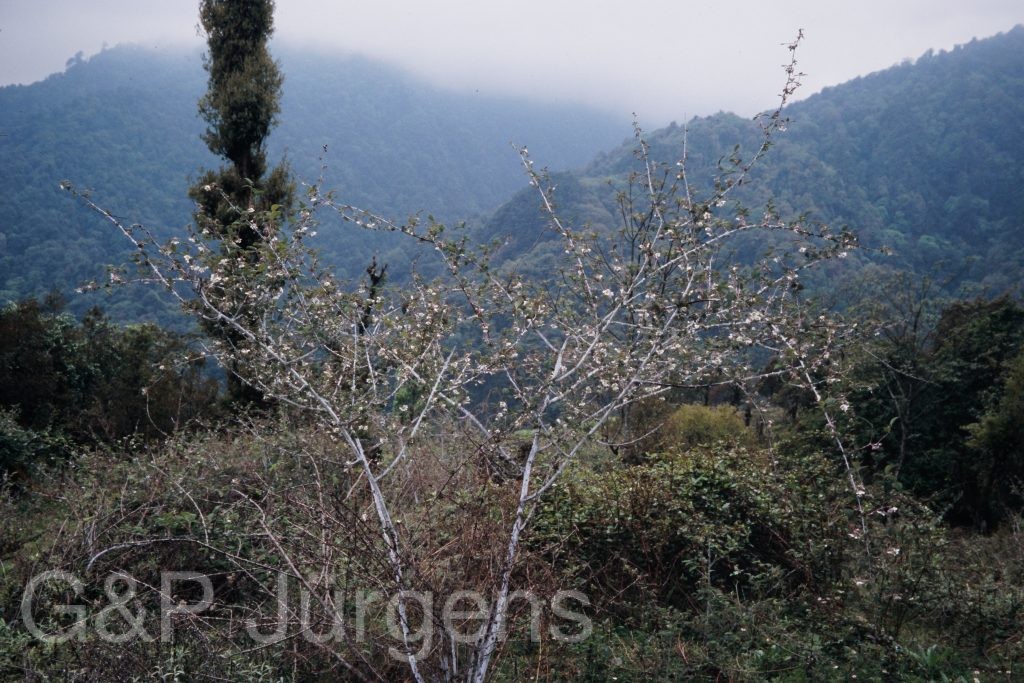
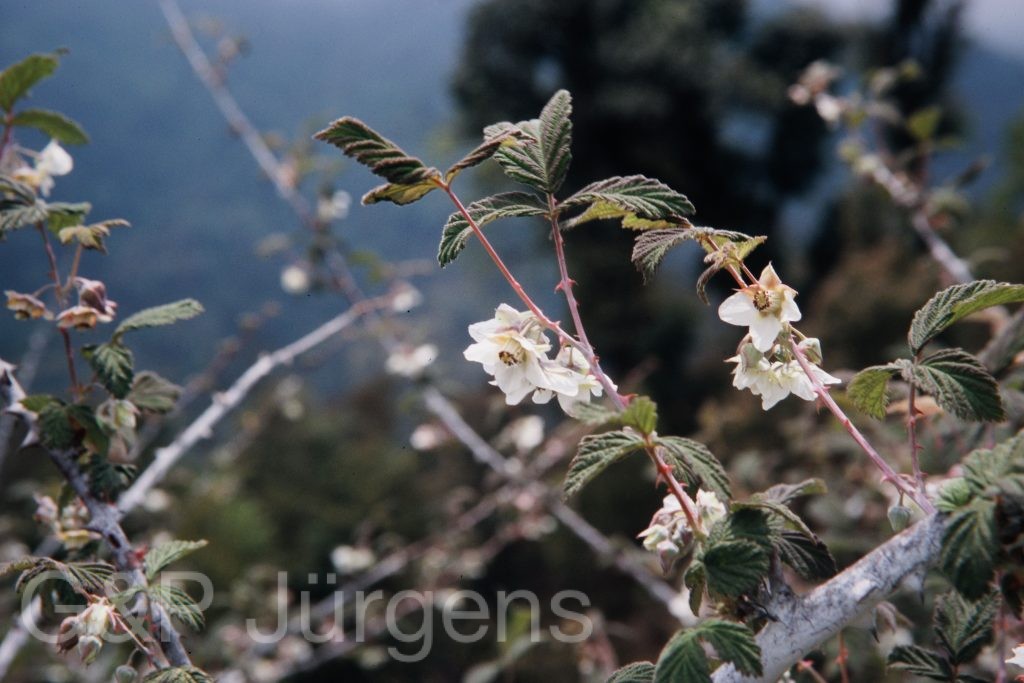
Buch.-Ham. ex Sm.

Bh2008 334 P515
Bhutan Chendebji, 2100m April
Bh2008 335 P516
Bhutan Chendebji, 2100m April

Description

Rubus biflorus Buch.-Ham. ex Sm. is a Himalayan bramble distributed from Pakistan and Afghanistan eastward through Nepal, India, Bhutan and into southern China and Myanmar, with around 651 GBIF records anchored in the temperate Himalaya. It is characteristic of forest margins, scrub, clearings and roadside thickets in the moist temperate zone, generally between about 1800 and 3500 m. The photographed material from Chendebji in central Bhutan at roughly 2100 m, flowering in April, typifies its occurrence in cool, humid mid-montane habitats where it forms dense tangled stands on disturbed and successional ground.

The species is a robust, arching to scrambling shrub whose biennial canes are conspicuously coated with a white, waxy bloom and armed with stout, hooked prickles. The leaves are imparipinnate with three to five ovate, doubly serrate leaflets that are green above and white-tomentose beneath. The flowers, often borne in twos or few-flowered clusters as the epithet suggests, have white petals subtended by a tomentose calyx. The aggregate fruit is a globose, yellow to orange edible drupelet cluster maturing in summer.

Rubus biflorus belongs to the taxonomically complex genus Rubus (Rosaceae, subfamily Rosoideae), where extensive hybridisation and apomixis complicate species delimitation; it is placed in the white-stemmed Himalayan brambles allied to R. niveus. Widespread, common and ecologically pioneering, it is of least conservation concern, and its fruit is gathered locally while the canes contribute to soil stabilisation on eroded slopes.

Author: Buch.-Ham. ex Sm. · Sources: POWO (Kew), GBIF, Flora of Bhutan, Flora of China, Flora of Pakistan, H. Hara Enumeration of the Flowering Plants of Nepal, Focke monograph Species Ruborum

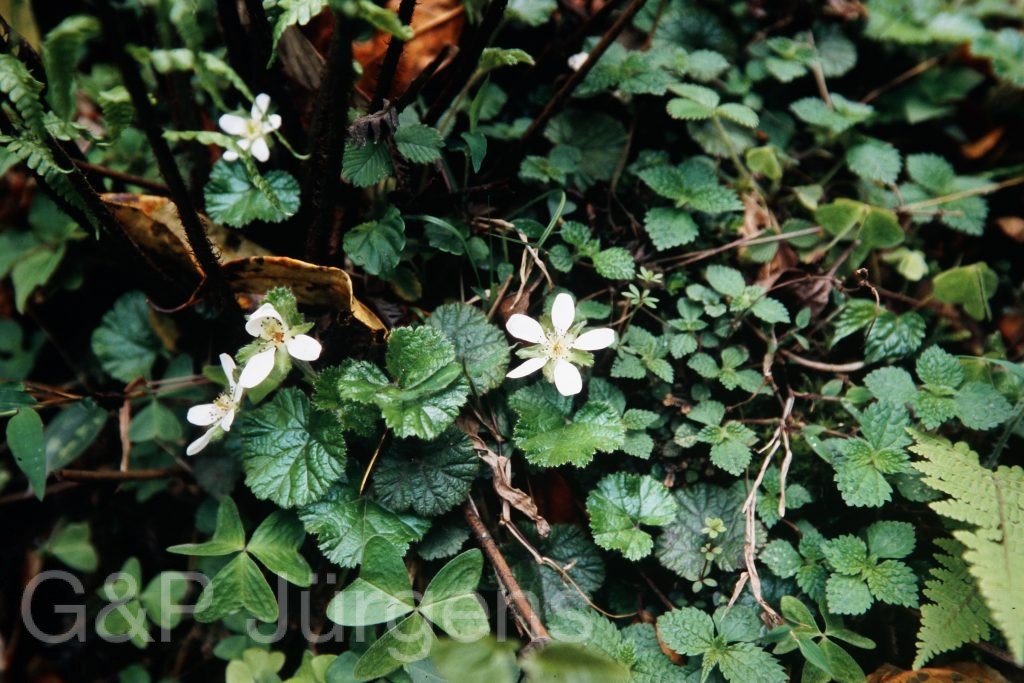
Wall. ex D.Don

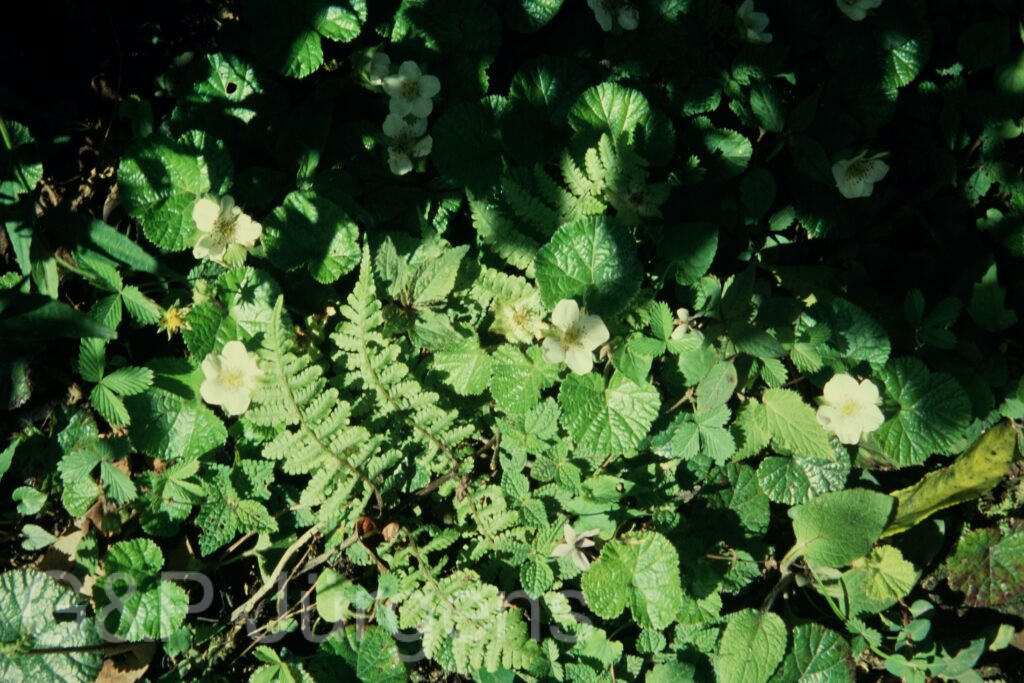
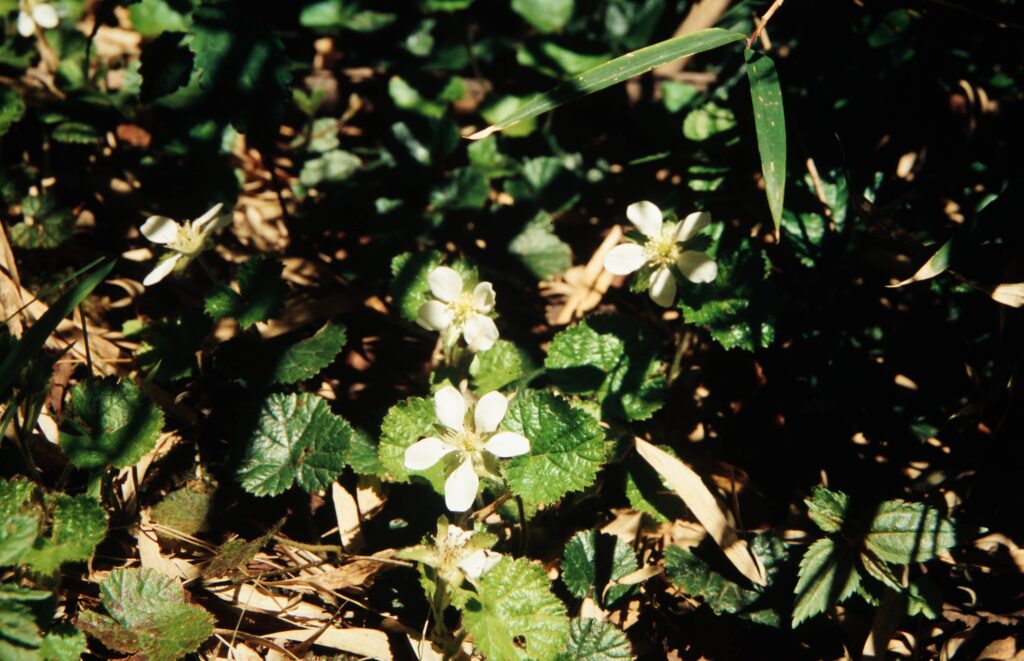
Bh2008 328 P506
Bhutan Chendebji, 2100m April
Sikkim2004 88 P155
Sikkim West-Bengal, Bersay 2600m April
Sikkim 2006 163 ergebnis
India West-Bengal, Molley 3000m, May

Description

Rubus calycinus is a creeping Himalayan bramble distributed across China, India, Nepal, Bhutan, Myanmar, Bangladesh, Afghanistan and into Southeast Asia, with some 255 GBIF occurrences. It is a plant of the floor of moist temperate and subalpine forest, growing on humus-rich banks, mossy slopes and shaded forest margins, generally between about 1800 and 3300 m. The documented populations span Chendebji in Bhutan at 2100 m, Bersay in Sikkim/West Bengal at 2600 m, and Molley at 3000 m, all flowering in April and May, illustrating its early-season anthesis as the forest understorey greens.

Unlike the familiar scrambling brambles, R. calycinus is a small, prostrate, herbaceous to weakly woody perennial with slender, creeping and rooting stems that form low mats, the stems sparsely armed or nearly unarmed and bearing scattered bristles. The leaves are simple, broadly cordate-orbicular and shallowly three- to five-lobed, crenate-serrate at the margin and pilose on both surfaces. The flowers are solitary, white, with a conspicuously enlarged, leafy, lobed calyx that exceeds the petals and gives the species its name. The aggregate fruit is a small reddish drupelet cluster of few segments.

The species belongs to Rubus subgenus Chamaebatus (the herbaceous, simple-leaved creeping brambles), a distinctive group within the genus. It is widespread and not of conservation concern, valued ecologically as ground cover that stabilises forest-floor soils and provides minor forage and fruit for wildlife.

Author: Wall. ex D.Don · Sources: POWO (Kew), GBIF, Flora of Bhutan, Flora of China, Focke monograph Species Ruborum

Rubus ellipticus

by GP Jürgens

Kupcsok

Nepal 1994 53 ergebnis
Ost-Nepal Bhalukhob 
1800m April

Description

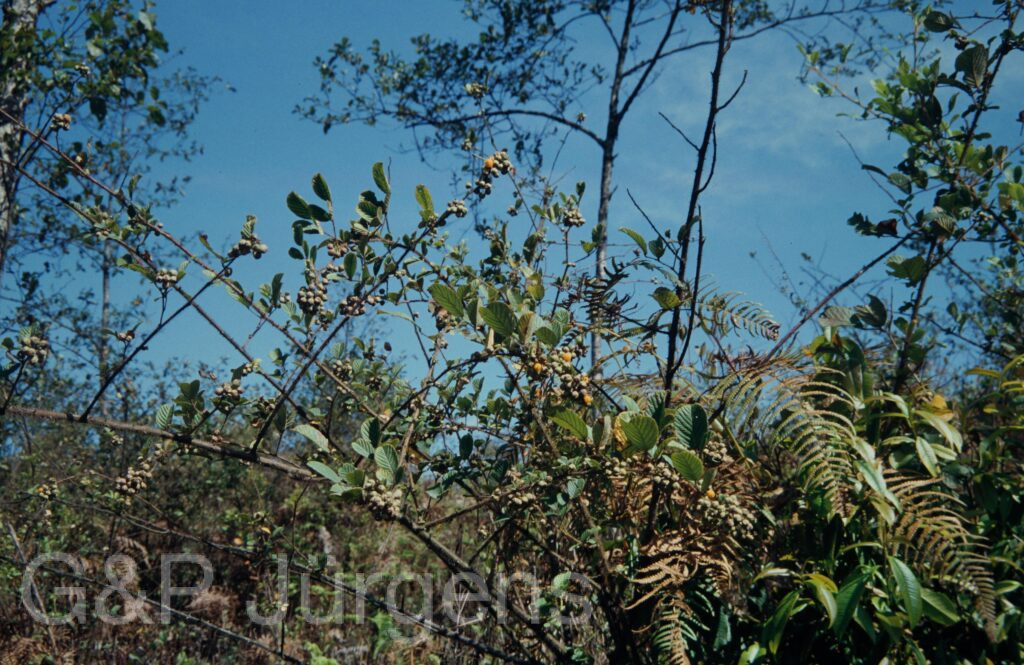
Rubus ellipticus, the yellow Himalayan raspberry, is native to South and East Asia and has become one of the most notoriously invasive of all brambles, with 3973 GBIF occurrences spanning its native range in China (CN), Taiwan (TW), India (IN), Nepal (NP), Bhutan (BT), Sri Lanka (LK), Thailand (TH), Vietnam (VN), Myanmar (MM), the Philippines (PH), Pakistan (PK) and Afghanistan (AF), together with extensive introduced populations in the United States (US, notably Hawaii), Australia (AU), New Zealand (NZ), Malawi (MW), Tanzania (TZ), Ecuador (EC), Costa Rica (CR) and Jamaica (JM). It forms dense thickets in forest margins, clearings, scrub, roadsides and disturbed ground from the lowlands to the lower montane zone. The figured plant was recorded at Bhalukhob in East-Nepal at about 1800 m in April.

It is a robust, scrambling, perennial shrub with biennial canes armed with stout recurved prickles and clothed in dense reddish bristly hairs. The leaves are pinnately trifoliolate, the leaflets elliptic to obovate, finely serrate, dark green and rugose above and densely greyish-tomentose beneath. The flowers are borne in dense terminal and axillary clusters, white, with five sepals and petals and numerous stamens. The aggregate fruit is a juicy, golden-yellow edible raspberry composed of numerous drupelets separating from the receptacle.

Rubus ellipticus belongs to the taxonomically complex subgenus Idaeobatus. Its palatable fruit and prolific seed production, aided by bird dispersal and vigorous vegetative spread, underpin its status as a serious invasive listed among the world's worst invasive species, displacing native vegetation in tropical island and montane ecosystems.

Author: Kupcsok · Sources: POWO (Kew), GBIF, Flora of China, Flora of Nepal, Flora of British India, IUCN Global Invasive Species Database, Monograph of the genus Rubus

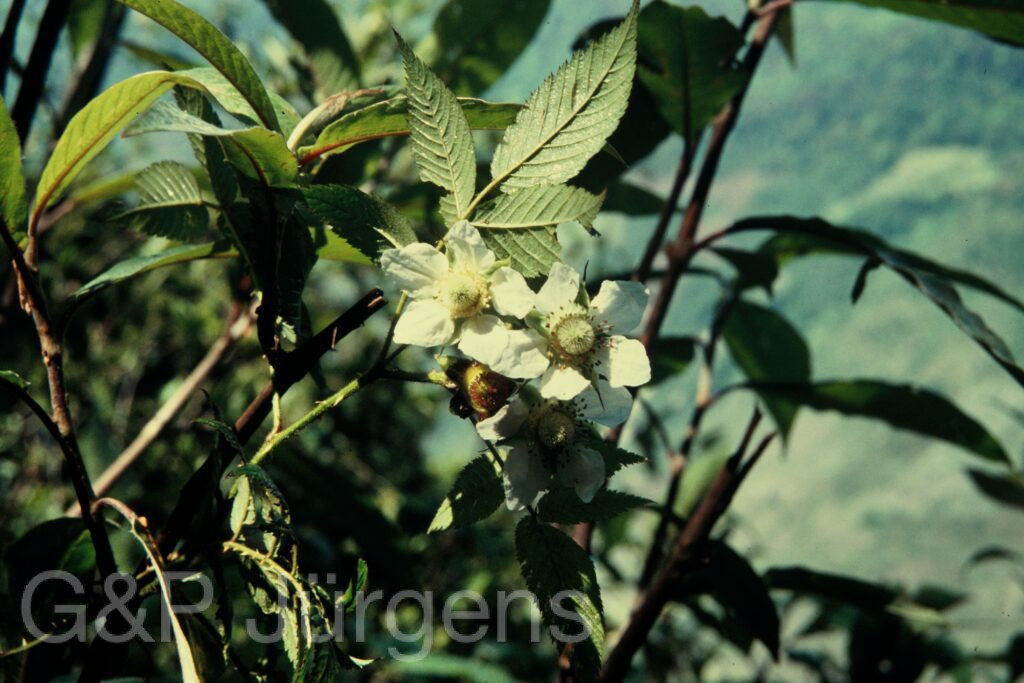
Rubus rosifolius

by GP Jürgens

Sm.

Nepal 97 334 G661
Nepal Arun-Valley 1800m May
Nepal 97 333 G660
Nepal Arun-Valley 1800m May

Description

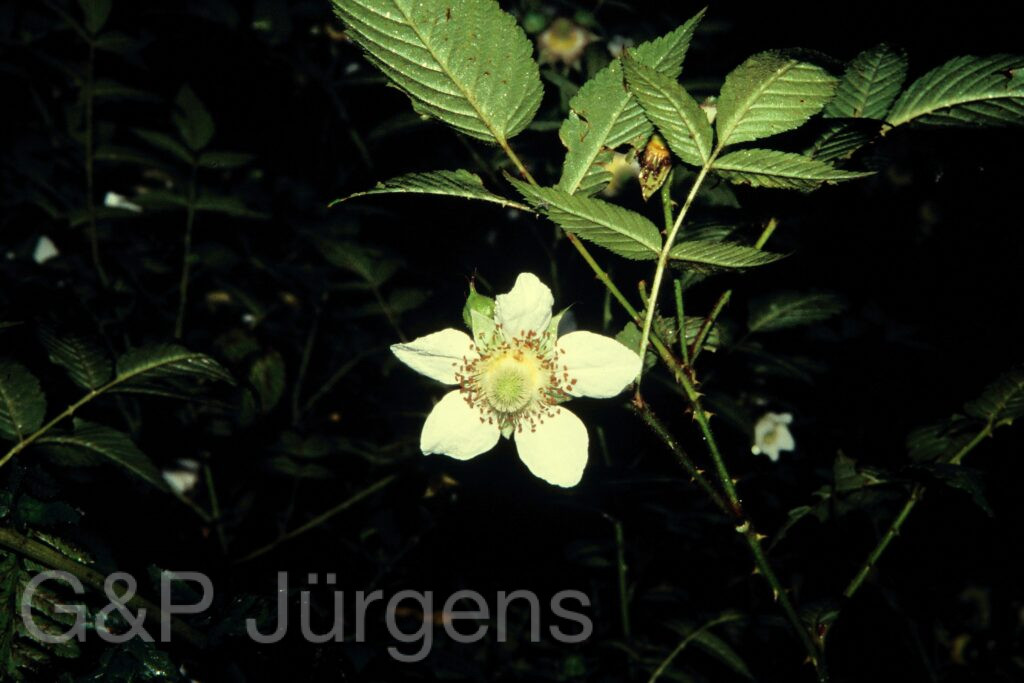
Rubus rosifolius is a widespread, semi-scandent bramble native to Asia and now pantropically naturalised, the very large GBIF dataset of nearly fifteen thousand records spanning Australia, Brazil, Taiwan, the United States, Réunion, China, Indonesia, Madagascar, South Africa and many other territories. Within its native Himalayan range it occupies forest margins, clearings, streamsides, hedgerows and disturbed slopes in the subtropical to warm-temperate belt. The illustrated plant from the Arun valley of eastern Nepal at about 1800 m, flowering in May, reflects its mid-elevation habitat preference; elsewhere its colonising vigour has made it an aggressive invader of disturbed and montane ground.

The species is a perennial shrub with erect to arching, slender stems armed with fine, often recurved prickles and bearing a sparse glandular-pubescent indumentum. The leaves are imparipinnate, the leaflets ovate-lanceolate, sharply doubly serrate and rugose, recalling those of a rose, whence the epithet rosifolius. The flowers are usually solitary or few, comparatively large, with five spreading white petals, numerous stamens and an enlarged conical receptacle. The fruit is an ellipsoid to ovoid aggregate of numerous small drupelets, ripening bright red, edible but rather insipid.

Rubus rosifolius is an accepted species within the vast genus Rubus (Rosaceae, subfamily Rosoideae), a complex group renowned for apomixis, polyploidy and hybridisation. Its prickly arching canes and prolific seed make it a notable transformer weed in many tropical highlands, and a double-flowered cultivar ('Coronarius') is grown ornamentally. In its native Himalaya it is common and of least concern, valued locally as a wild edible.

Author: Sm. · Sources: POWO (Kew), GBIF, Flora of China, Annotated Checklist of the Flowering Plants of Nepal, Focke Species Ruborum monograph

D.Don

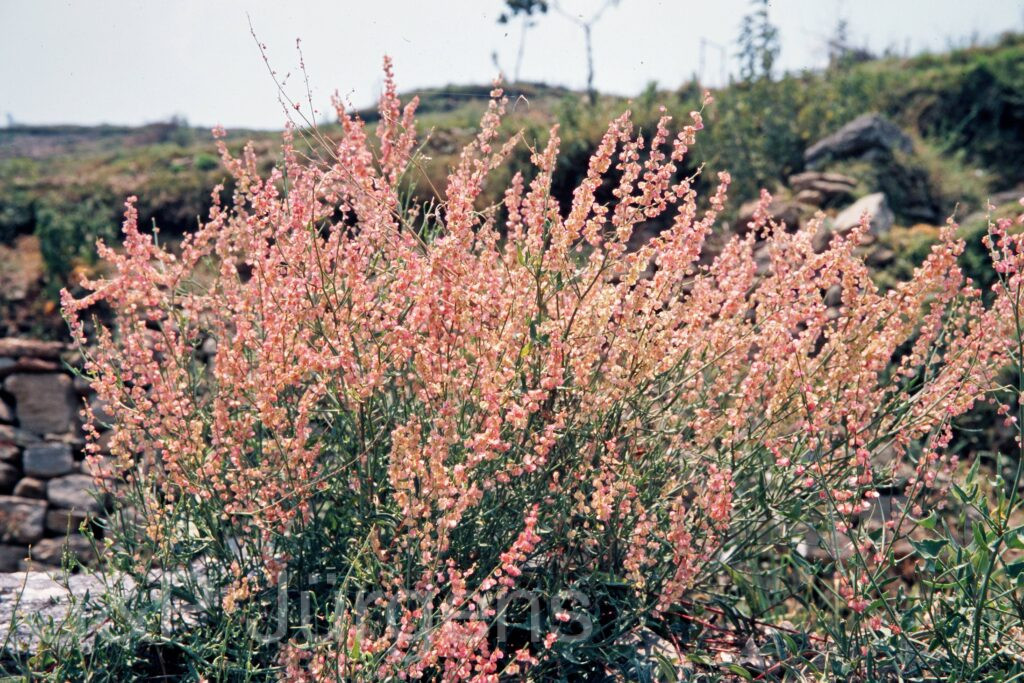
Garh 07 77 ergebnis
India Garhwal Sana at Mandakini 1750m, June

Description

Rumex hastatus is a widespread sub-shrubby dock distributed across the Himalaya and adjacent uplands, with GBIF documenting some 756 occurrences spanning China, India, Pakistan, Nepal, Afghanistan, Bhutan and Myanmar, alongside scattered introduced records in New Zealand and North America that mark it as a casual alien beyond its native range. It is a colonist of dry, sunny, often disturbed ground: rocky banks, terraced field margins, road cuttings, riverine gravels and open hillsides, ranging from around 700 m to over 3000 m. The plant photographed at Sana on the Mandakini in Garhwal, India, at about 1750 m in June, represents a typical warm-temperate montane locality where the species forms conspicuous reddish-tinged stands on stony slopes.

Morphologically it is a much-branched, woody-based perennial or subshrub reaching 30 to 100 cm, the slender intricate branches glabrous and often reddish. The leaves are characteristically hastate, the small narrow blade bearing a pair of spreading basal lobes, hence the epithet; lower leaves may be obovate, and the foliage is somewhat fleshy and grey-green. As in all Rumex the stem is sheathed at the nodes by membranous ochreae. The inflorescence is a large, lax, much-branched terminal panicle of small dioecious or polygamous flowers. The fruiting perianth develops three enlarged, rounded, membranous and often rose-tinted inner valves (wings) without conspicuous tubercles, enclosing a small trigonous brown nutlet and aiding wind dispersal.

The species sits within Rumex subgenus Acetosa, the sorrels, distinguished by their hastate or sagittate leaves, sour oxalate-rich sap and unisexual flowers. R. hastatus is valued locally as a pot-herb and in traditional medicine, the acidic foliage used as a refreshing condiment and astringent. Ecologically it is a hardy pioneer of degraded and eroding substrates, tolerant of drought and grazing, which underlies both its abundance throughout the Himalayan foothills and its capacity to naturalise elsewhere. It is of no conservation concern, being common and adaptable across a broad altitudinal and geographic span.

Author: D.Don · Sources: POWO (Kew), GBIF, Flora of China Vol. 5, Flora of Pakistan, Flora of Nepal, Rechinger Monograph of Rumex

Salvia nubicola

by GP Jürgens

Wall. ex Sweet

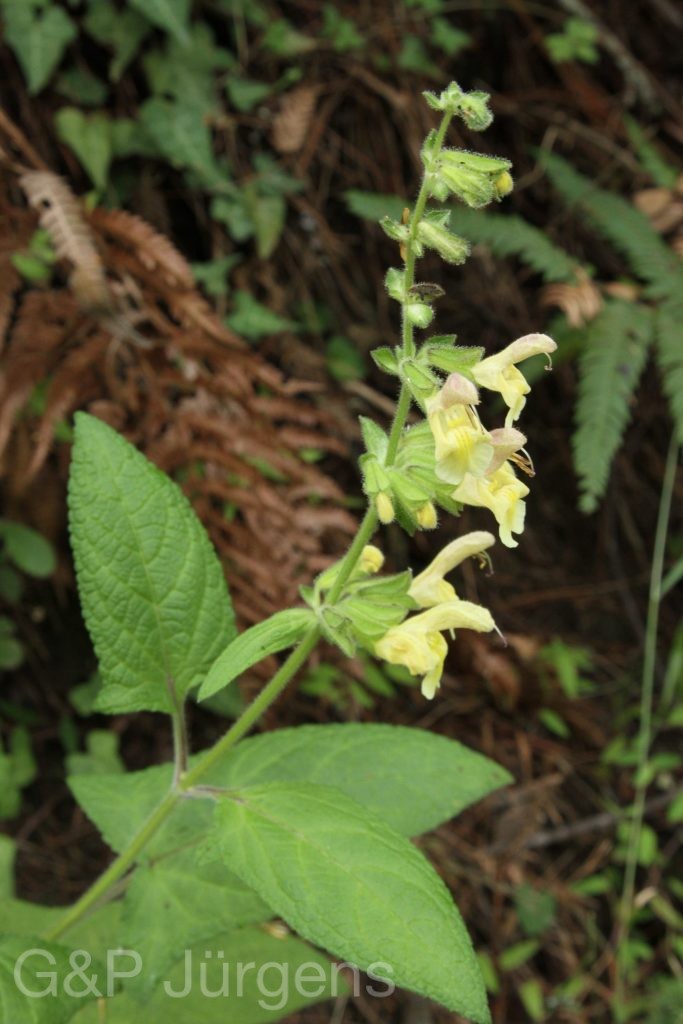
Bhutan2012 15 scaled
Bhutan Paro, 2300m September

Description

Salvia nubicola is a robust herbaceous sage of the Himalaya and adjacent mountains, distributed from Afghanistan and Pakistan through Nepal, northern India and Bhutan into south-western China, with 372 GBIF occurrences that include naturalised or cultivated material in Europe, North America, Iran and New Zealand. It favours open slopes, forest margins, clearings, roadsides and disturbed ground in the temperate montane zone, broadly between 1800 and 3600 m. The illustrated plant was photographed at Paro in Bhutan at 2300 m in September, in the late-summer to autumn flowering season characteristic of the species at mid-elevations.

It is a stout perennial herb up to 1-1.5 m tall with quadrangular, glandular-hairy stems and a strong aromatic scent. The leaves are large, ovate-triangular to hastate with a cordate or sagittate base and crenate margin, long-petiolate and rugose. The flowers are arranged in widely spaced verticillasters forming an elongate terminal inflorescence, subtended by conspicuous bracts. The corolla is pale yellow, often blotched or veined with purple or brown on the lower lip, strongly two-lipped with a hooded galea-like upper lip; the two fertile stamens bear the characteristic lever-like connective of Salvia. The fruit comprises four smooth nutlets enclosed in the persistent two-lipped calyx.

The staminal lever mechanism deposits pollen on visiting long-tongued bees and is a defining synapomorphy of Salvia; in S. nubicola the pale, dark-marked flowers attract bumblebees. The species belongs to a Himalayan group of large-leaved yellowish-flowered sages allied to S. glutinosa of Europe. Wide-ranging, weedy-tolerant and locally common, it is of least concern, and like many sages it has minor local use in traditional medicine and is grown as an ornamental in temperate gardens.

Author: Wall. ex Sweet · Sources: POWO (Kew), GBIF, Flora of China, Flora of Pakistan, Hedge: Labiatae of South-West Asia

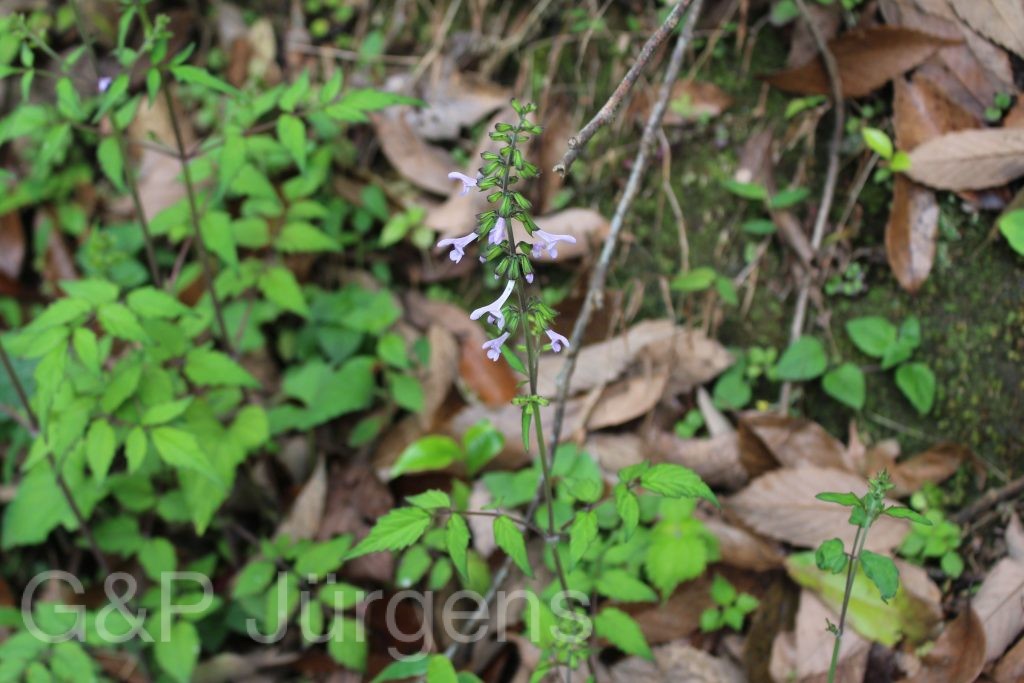
Griff.

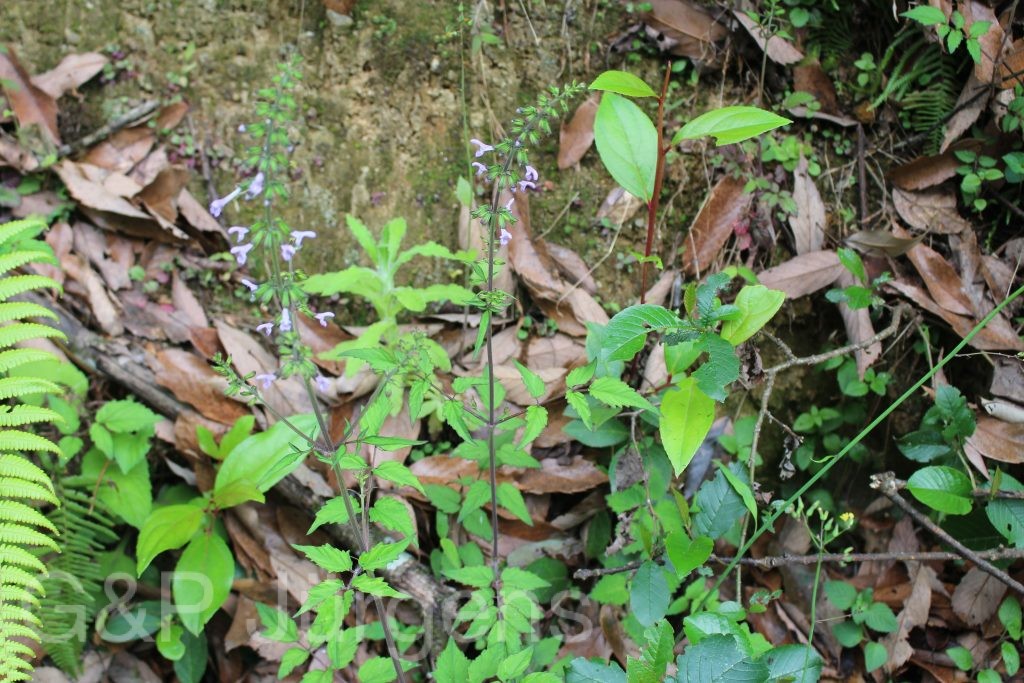
Bhutan2014 162
Bhutan Trashigang 2100m, May
Bhutan2014 163
Bhutan Trashigang 2100m, May

Description

Salvia plectranthoides Griff. is an Eastern Himalayan and Sino-Himalayan element distributed across southern China, Bhutan and northeastern India (gbif_countries: CN, BT, IN), with some 391 georeferenced occurrences recorded in GBIF. It occupies warm-temperate to subtropical montane habitats, favouring open forest margins, shrubby slopes, roadside banks and disturbed grassy ground between roughly 1500 and 2700 m. The photographed plant from Trashigang in eastern Bhutan at 2100 m, flowering in May, typifies its preference for the mid-elevation broad-leaved forest belt of the eastern monsoon ranges, where humid summers and mild winters prevail.

It is an erect perennial herb arising from a woody rootstock, with quadrangular, often purple-tinged and retrorsely pubescent stems. The leaves are opposite, petiolate, ovate to ovate-lanceolate with a cordate to truncate base, an acuminate apex and a crenate-serrate margin, the lamina rugose and pubescent on both surfaces. The inflorescence is a lax terminal panicle of verticillasters, each whorl 2–6-flowered. Flowers bear a campanulate, two-lipped calyx and a bilabiate corolla, pale violet to bluish-purple, the upper lip galeate and the lower lip three-lobed; the two fertile stamens display the characteristic Salvia lever mechanism. The fruit comprises four smooth ovoid nutlets enclosed in the persistent calyx.

Within the large genus Salvia (subfamily Nepetoideae), this species belongs to the East Asian assemblage and the specific epithet alludes to a superficial resemblance to Plectranthus. The staminal lever, a hallmark of the genus, facilitates precise pollen placement on visiting bees and contributes to floral isolation among congeners. It is not of conservation concern given its broad range and tolerance of disturbed habitats.

Author: Griff. · Sources: POWO (Kew), GBIF, Flora of China (Lamiaceae), Flora of Bhutan, A Revision of Salvia (Lamiaceae) and allied genera