Tag:

Montane (1500-2500 m)

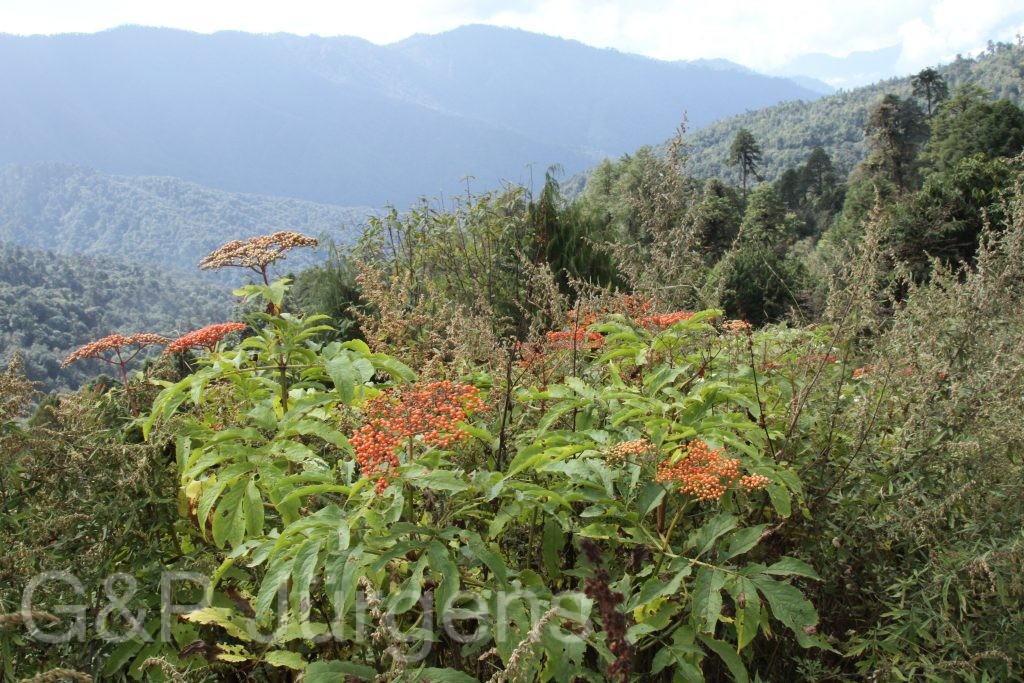
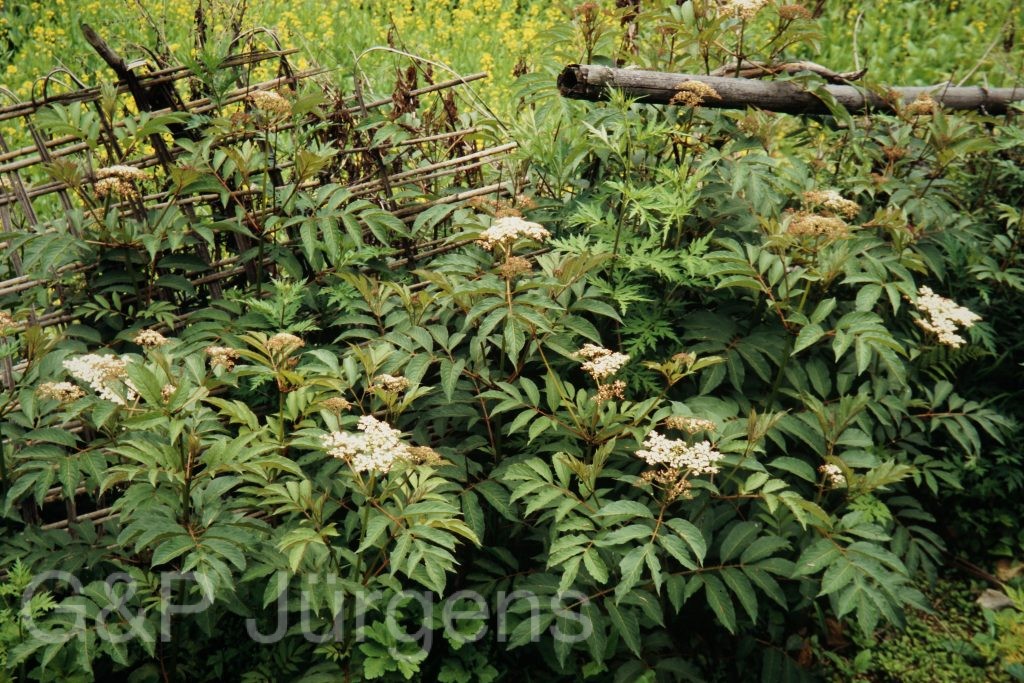
Sambucus adnata

by GP Jürgens

Wall. ex DC.

Bhutan2015 322
Bhutan Trongsa 2100m, October
Bh09 202 P341
Bhutan Thimphu, 2500m June

Description

Sambucus adnata is a herbaceous elder distributed across the Himalaya and western to central China, occurring in Nepal, Bhutan, northern India and widely in China, with its very numerous GBIF records (over 1700) concentrated in this region; records from Germany, the United States, Austria, Japan and elsewhere reflect cultivation and herbarium accessions. It grows in moist forest clearings, on shrubby slopes, along stream banks, roadsides and at forest margins, generally between about 1600 and 3600 m. The photographed plants from Trongsa (2100 m, October) and Thimphu (2500 m, June) in Bhutan illustrate its range through the cool, humid mid-montane belt of the eastern Himalaya.

Unlike its woody relatives, S. adnata is a tall, robust perennial herb dying back to a thick, fleshy, creeping rhizome. The stout, erect, ridged stems bear large, opposite, imparipinnate leaves with several pairs of lanceolate, serrate leaflets, the lowest leaflets often adnate to the rachis or with adnate stipule-like outgrowths, a feature reflected in the epithet. The inflorescence is a large, flat-topped to convex compound cyme of numerous small flowers with a rotate, whitish to pinkish corolla and conspicuous reddish anthers or nectaries. The fruit is a small, globose, red drupe containing a few seed-like stones.

Sambucus, formerly placed in the Caprifoliaceae, is now referred with the genus Adoxa and Viburnum to the Adoxaceae on molecular and morphological grounds. S. adnata is distinctive among elders for its fully herbaceous, rhizomatous habit. It is widespread, common and weedy in disturbed montane habitats, and is of no conservation concern; the plant has a record of local medicinal use for bruises and swellings.

Author: Wall. ex DC. · Sources: POWO (Kew), GBIF, Flora of China, Flora of Bhutan, Annotated Checklist of the Flowering Plants of Nepal, Sambucus (Adoxaceae) monograph
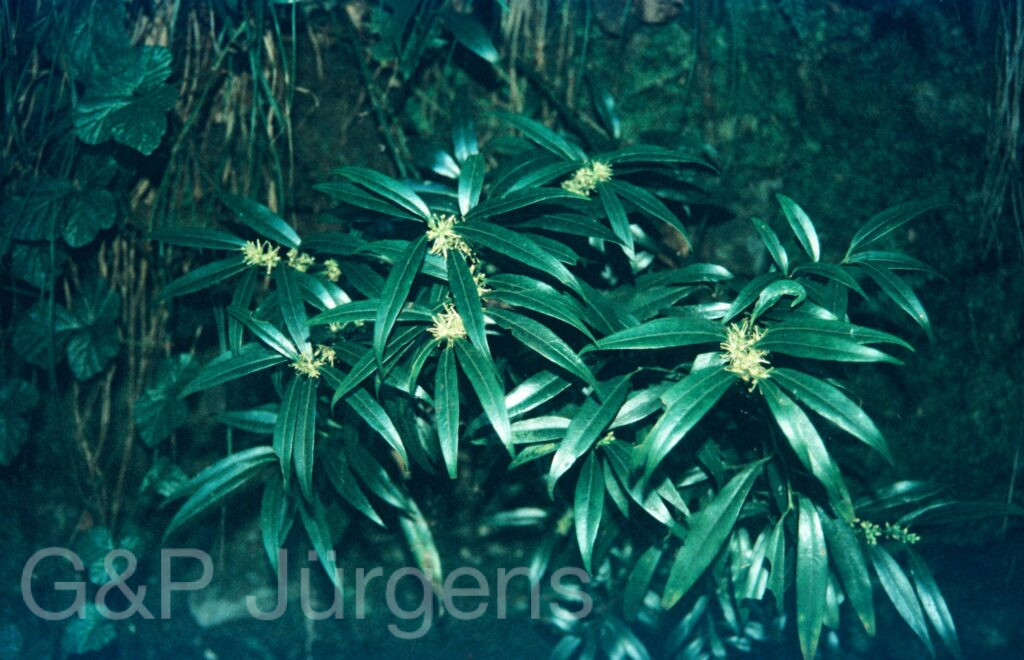
Müll.Arg.

Garw 2005 432 ergebnis
India Garhwal Barqargay 2100m, September

Description

Sarcococca saligna (Müll.Arg.), the willow-leaf sweet box, is an evergreen shrub of the family Buxaceae native to the Himalaya and adjacent uplands, ranging from Afghanistan and Pakistan through northern India and Nepal to China, with related records extending into Southeast Asia. The fewer than 400 GBIF occurrences point to a scattered montane distribution, supplemented by cultivated material in Europe and North America where the plant is grown as an ornamental. It inhabits shady, moist temperate forest, ravine slopes and the understorey of oak and conifer woodland, generally between 1,500 and 2,800 m, as shown by the Garhwal collection from Barqargay at 2,100 m in September.

The plant is a glabrous, much-branched shrub up to about 2 m tall, with slender green stems. The leaves are alternate, narrowly lanceolate to oblong-lanceolate, leathery, entire-margined, acuminate at the apex and tapering to a short petiole, the venation prominent beneath, distinguishing this species from its broader-leaved congeners. The small, fragrant, apetalous flowers are unisexual and borne in short axillary spikes or clusters, the plant being monoecious with the few female flowers placed below the more numerous male flowers; the male flowers display creamy-white stamens. The fruit is a small, globose, fleshy drupe ripening from red to purplish-black.

Sarcococca belongs to the same family as Buxus and Pachysandra, sharing the reduced, unisexual, perianth-simple flowers characteristic of the Buxaceae. The species is rich in steroidal alkaloids that have attracted pharmacological interest for their cholinesterase-inhibitory activity, and it is used in regional traditional medicine. Valued in gardens for its glossy foliage and intensely sweet winter fragrance, S. saligna is widely cultivated; in the wild it remains locally common and is not considered threatened.

Author: Müll.Arg. · Sources: POWO (Kew), Flora of Pakistan, GBIF, Flora of China Vol. 11, Köhler & Brückner: Buxaceae in The Families and Genera of Vascular Plants

D.Don

Sikkim2003 363 P512
Sikkim Lachen Tista Tal 3450m August
Sikkim2003 364 P511
Sikkim Lachen Tista Tal 3450m August
Nepal 95 100 P178 ergebnis
Nepal Barphak 2450m October
Nepal 95 135 P228 ergebnis
Nepal Barphak 2450m October

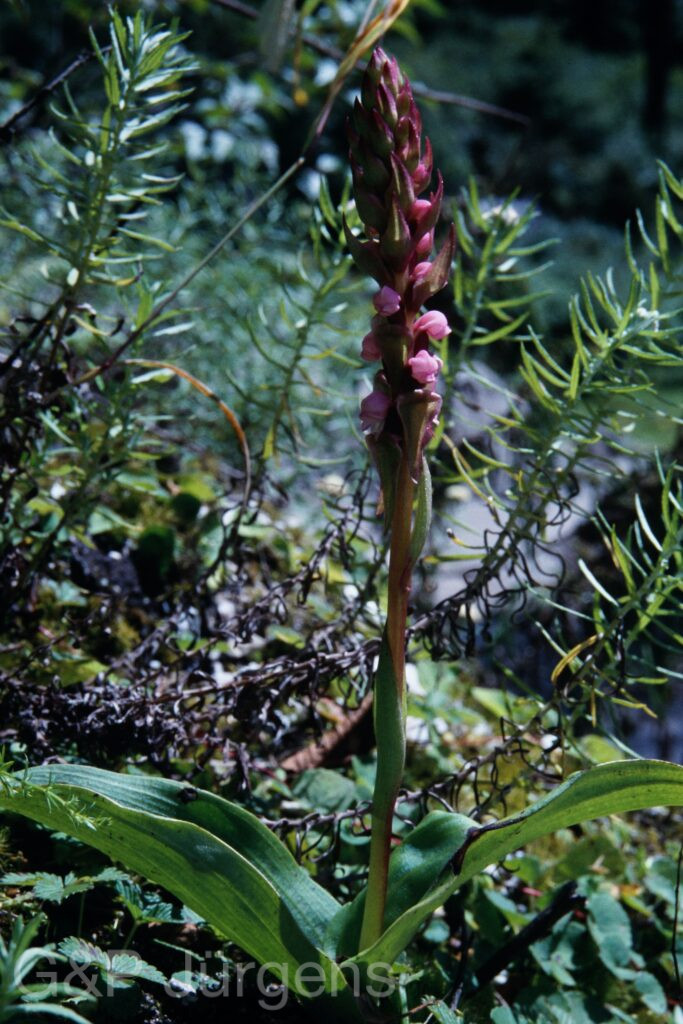
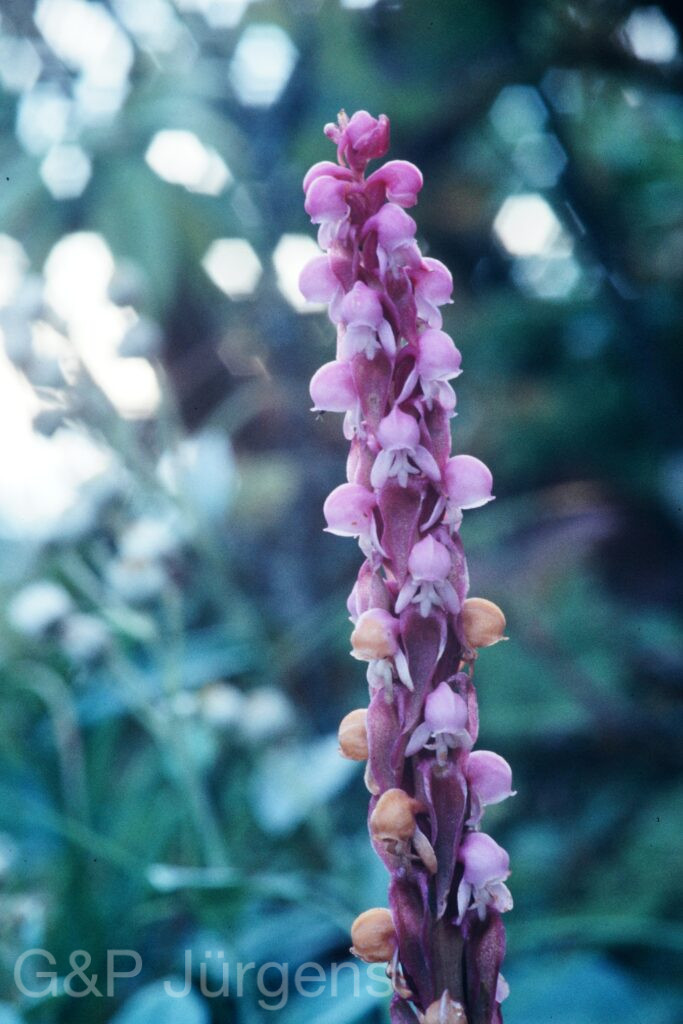
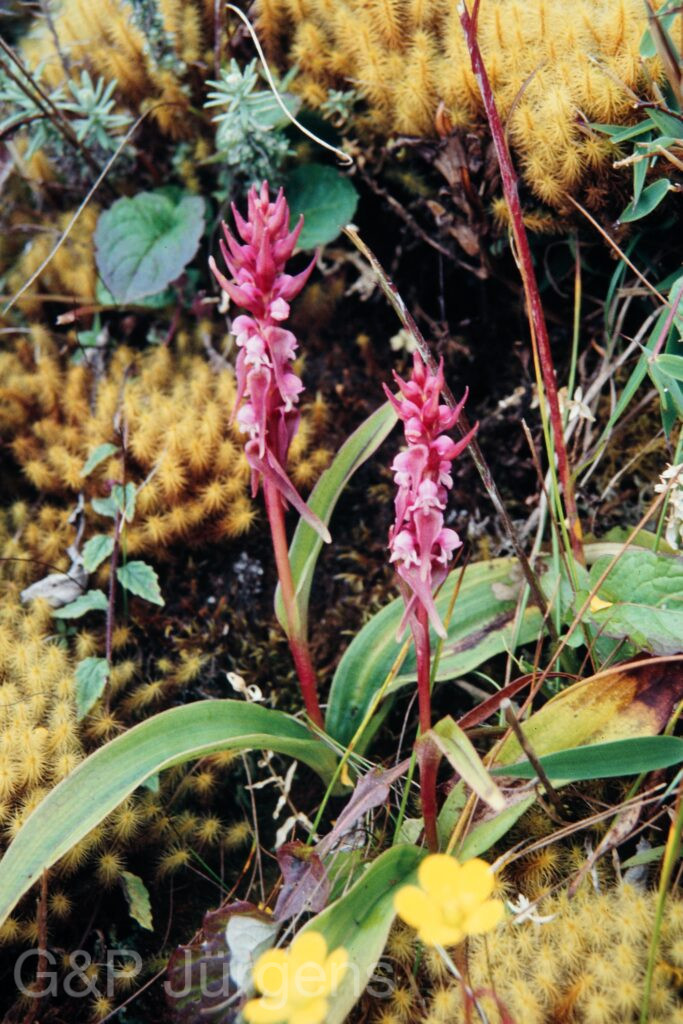
Description

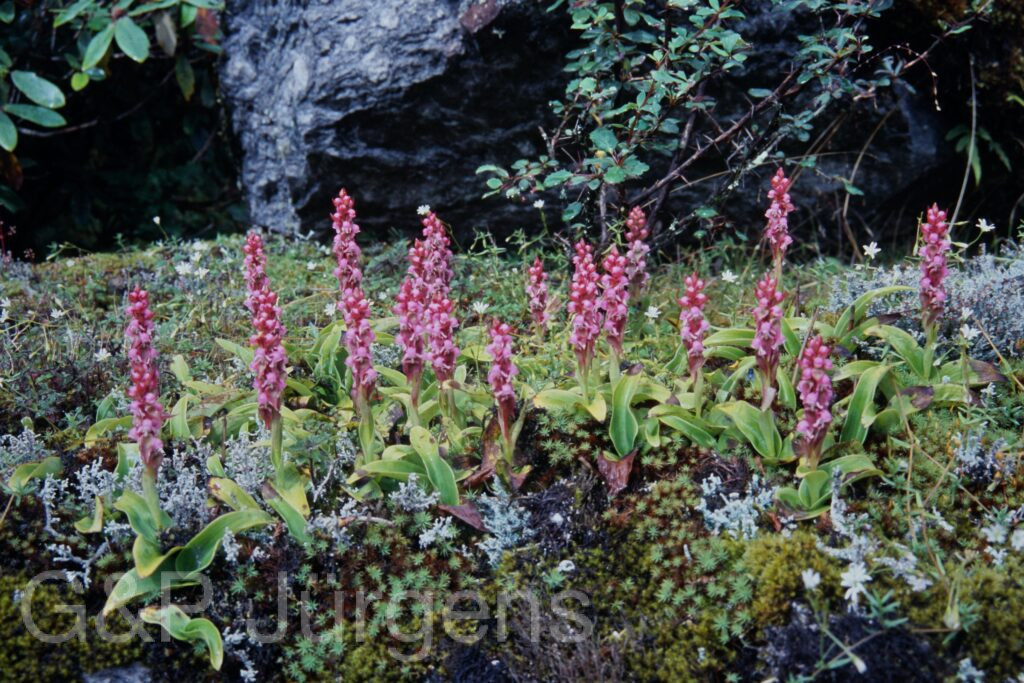
Satyrium nepalense D.Don is a terrestrial orchid of remarkably wide distribution, ranging across the Himalaya and southern Asia from Pakistan, India, Nepal, Bhutan, Sri Lanka and southern China to Myanmar, and extending through tropical and southern Africa; GBIF records nearly 1921 occurrences, reflecting its broad ecological tolerance. It grows in open grassy slopes, meadows, scrub and forest clearings from the submontane belt to high alpine pastures, broadly between about 1500 and 3700 m. The cited material from Lachen in Sikkim at 3450 m in August and Barphak in central Nepal at 2450 m in October illustrates its long flowering season across a wide altitudinal range.

The species is a terrestric herb arising from paired ovoid, tomentose tubers, with an erect leafy stem bearing a few ovate to lanceolate sheathing leaves. The inflorescence is a dense cylindrical raceme of many small, pink to rose-purple, fragrant flowers; each flower is non-resupinate, with the lip uppermost and produced into two slender, parallel spurs at its base, a diagnostic feature of the genus. The fruit is a small dehiscent capsule releasing abundant dust-like seeds.

Satyrium (Orchidaceae, subtribe Satyriinae) is a chiefly African genus with an outlying Asian representation, of which S. nepalense is the most widespread; its twin-spurred, non-resupinate flowers and moth pollination are characteristic. Valued in traditional medicine for its tubers, the species is locally collected, and although still common it warrants monitoring where harvesting pressure is intense.

Author: D.Don · Sources: POWO (Kew), GBIF, Flora of Bhutan, Flora of China, Orchids of Sikkim Himalaya, Pridgeon et al. Genera Orchidacearum

(Wall.) Hook.f. & Thomson

Sikkim2011 189
Sikkim Lachung 2800m, June
Bh09 249 G417
Bhutan Pele-La, 3100m June
Sikkim 2006 7 ergebnis
India West-Bengal Maneybhajang 2000m, May

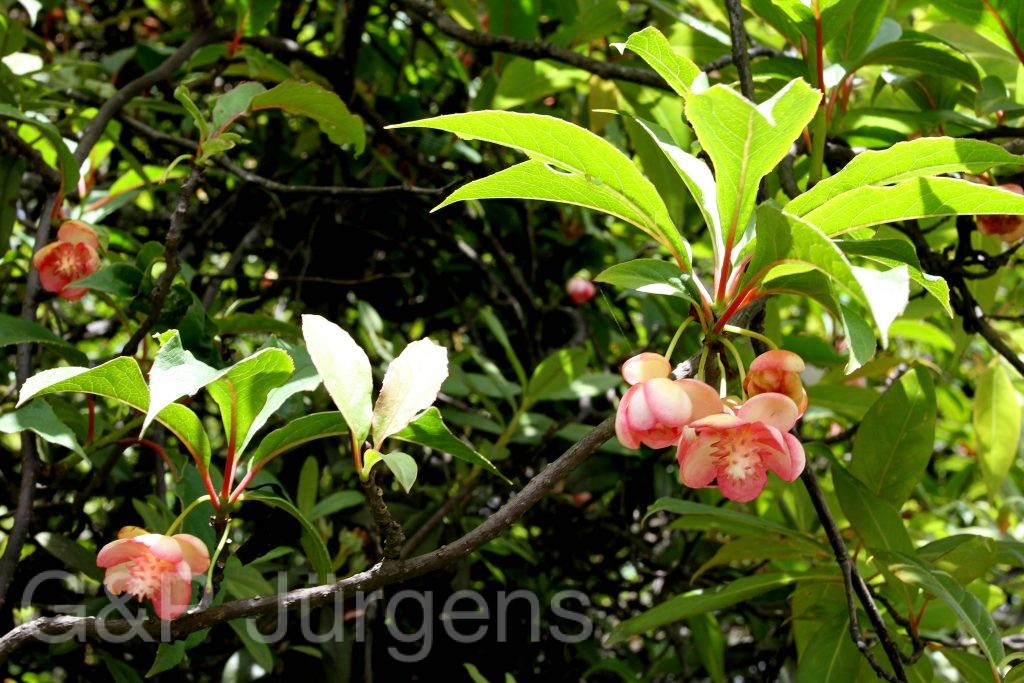
Description

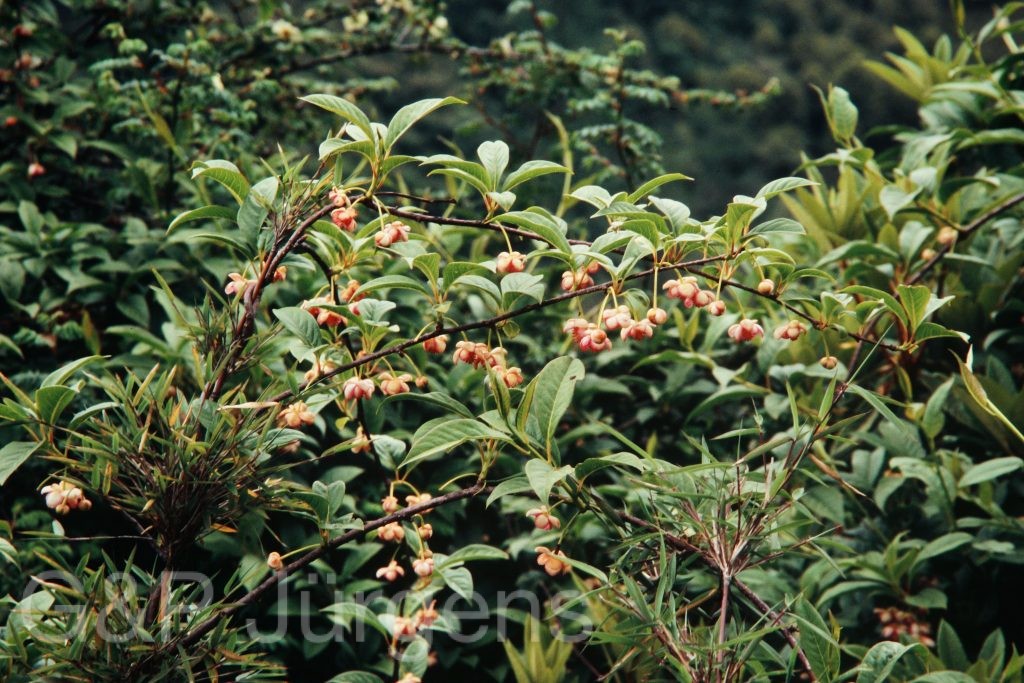
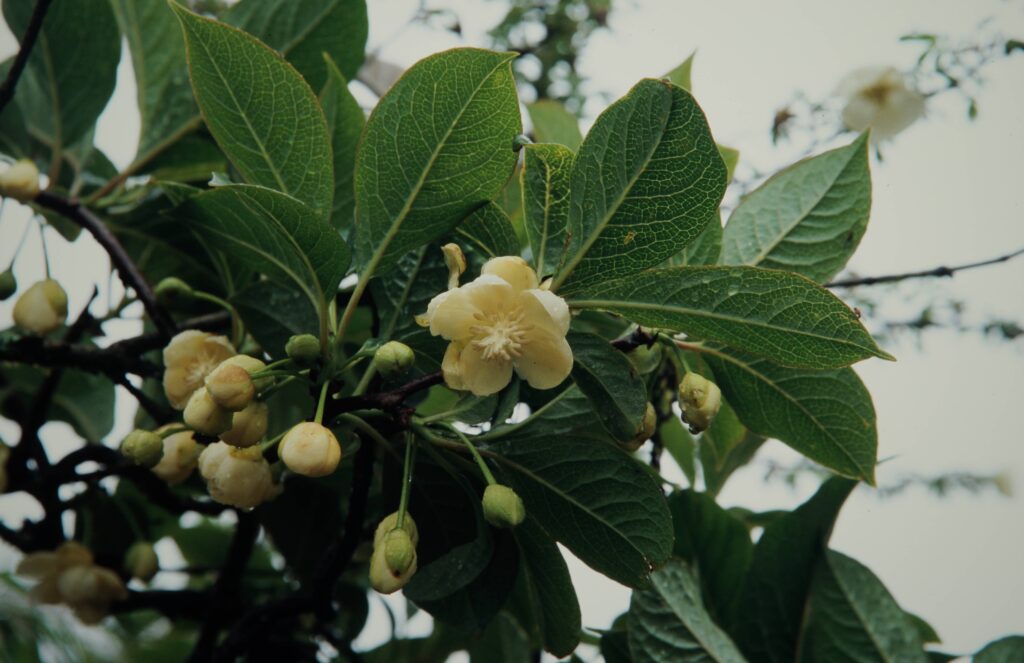
Schisandra grandiflora (Wall.) Hook.f. & Thomson is a deciduous, woody climber of the eastern Himalaya, recorded by GBIF from China, India, Nepal, Bhutan and Myanmar. It is a plant of cool, humid temperate forest, growing in mixed broad-leaved and conifer woodland, along forest margins and ravines, where it scrambles over shrubs and into the canopy, generally between about 2,000 and 3,500 m. The cited collections span Lachung in Sikkim at 2,800 m and Pele-La in Bhutan at 3,100 m in June, and Maneybhajang in West Bengal at 2,000 m in May, illustrating its broad occurrence across the moist temperate forest belt of the eastern Himalayan arc.

The plant is a glabrous, twining liana with slender woody stems and alternate, simple leaves that are elliptic to obovate, with serrulate margins and an acuminate apex, borne on reddish petioles. As in all Schisandraceae the flowers are unisexual, the species being dioecious or monoecious; they are solitary and pendulous on slender pedicels, comparatively large for the genus (hence grandiflora), with several white to creamy or pink-tinged perianth segments not differentiated into sepals and petals. The numerous free carpels of the female flower, borne on an elongating receptacle, ripen into a pendent, spike-like aggregate of red, fleshy berries.

Schisandraceae, together with the related Illiciaceae, occupy a basal position among the angiosperms in the order Austrobaileyales, making the family of major significance in studies of early flowering-plant evolution. Several Schisandra species, notably S. chinensis, are renowned medicinal plants, and the aromatic fruits of S. grandiflora are likewise used locally. Its disjunct Sino-Himalayan distribution reflects the ancient, relictual biogeography characteristic of this lineage.

Author: (Wall.) Hook.f. & Thomson · Sources: POWO (Kew), GBIF, Flora of China Vol. 7, Flora of Bhutan Vol. 1, Saunders: Monograph of Schisandra (Systematic Botany Monographs)

(L.) R.J.Wang

Sikkim 2006 280 ergebnis
India West-Bengal, Chaana 1650m, May

Description

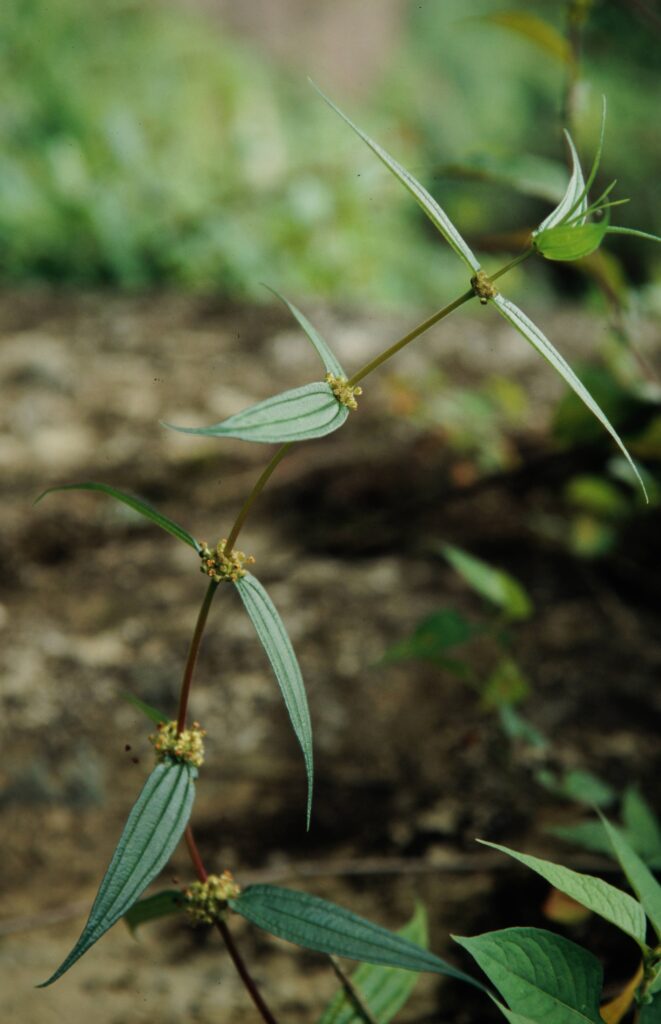
Scleromitrion verticillatum is a widespread herb of tropical and subtropical Asia, with 629 GBIF occurrences spanning India, Nepal, China, Taiwan, Japan and a broad swathe of Southeast Asia from Myanmar and Vietnam through Malaysia, Indonesia and the Philippines. It grows as a weedy annual or short-lived perennial of open, disturbed and seasonally moist ground, including roadsides, grassy banks and waste places from the lowlands into the lower hills. The plant recorded at Chaana in West Bengal at 1650 m in May reflects its presence in the eastern Himalayan foothills, where it flowers with the onset of the warm, pre-monsoon season.

The species is an erect to ascending herb with quadrangular, often scabrid stems that may be roughened on the angles. The leaves are opposite, sessile or nearly so, linear-lanceolate to lanceolate, with entire, frequently scabrid margins and interpetiolar stipules bearing setae characteristic of the tribe Spermacoceae. The small white flowers are borne in dense axillary clusters or verticillate glomerules, each with a four-lobed calyx, a tubular four-lobed corolla, four epipetalous stamens and a bifid style. The fruit is a small, subglobose to ellipsoid capsule that dehidces septicidally to release numerous minute, angular seeds.

Scleromitrion was segregated from the broadly circumscribed Hedyotis-Oldenlandia complex on the basis of molecular and capsular characters, and S. verticillatum was formerly placed in Hedyotis and Oldenlandia. The genus belongs to the tribe Spermacoceae within Rubioideae. As a ruderal coloniser of open habitats, the species is ecologically successful and locally common, posing no conservation concern across its extensive range.

Author: (L.) R.J.Wang · Sources: POWO (Kew), GBIF, Flora of China Vol. 19, Flora of Bhutan Vol. 2, Flora of Nepal, Flora of Pakistan, Wang's revision of Scleromitrion and Spermacoceae

Danser

Bhutan2012 994
Bhutan Trithangebe 1000m, October
Bhutan2012 995
Bhutan Trithangebe 1000m, October
Nepal 97 307 P610
Nepal Honggaon 2360m May
Nepal 97 308 P611
Nepal Honggaon 2360m May

Description

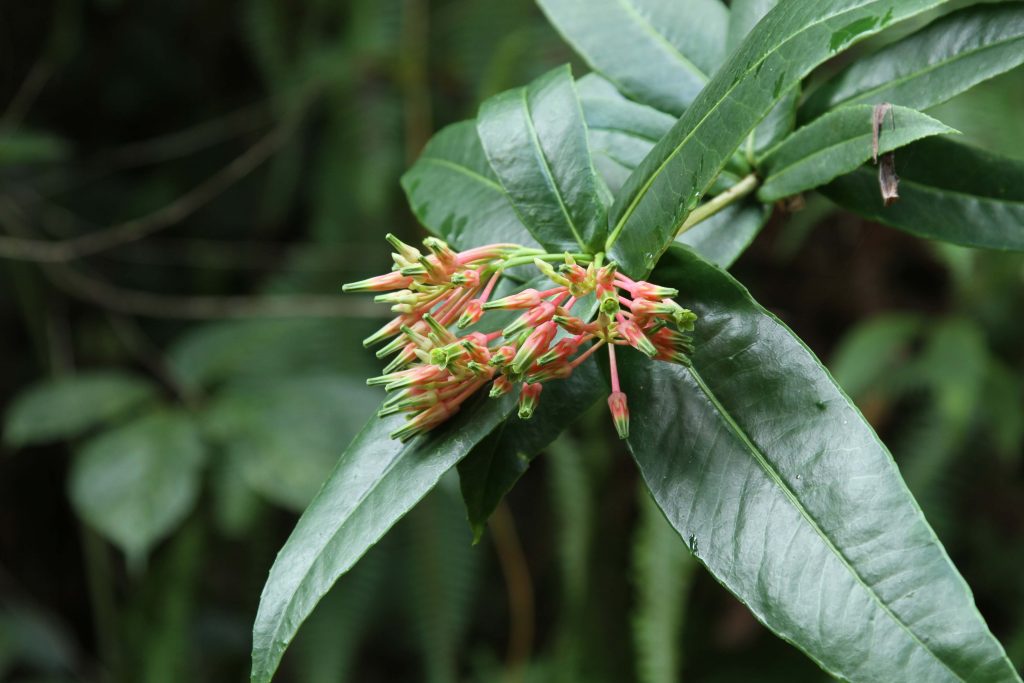
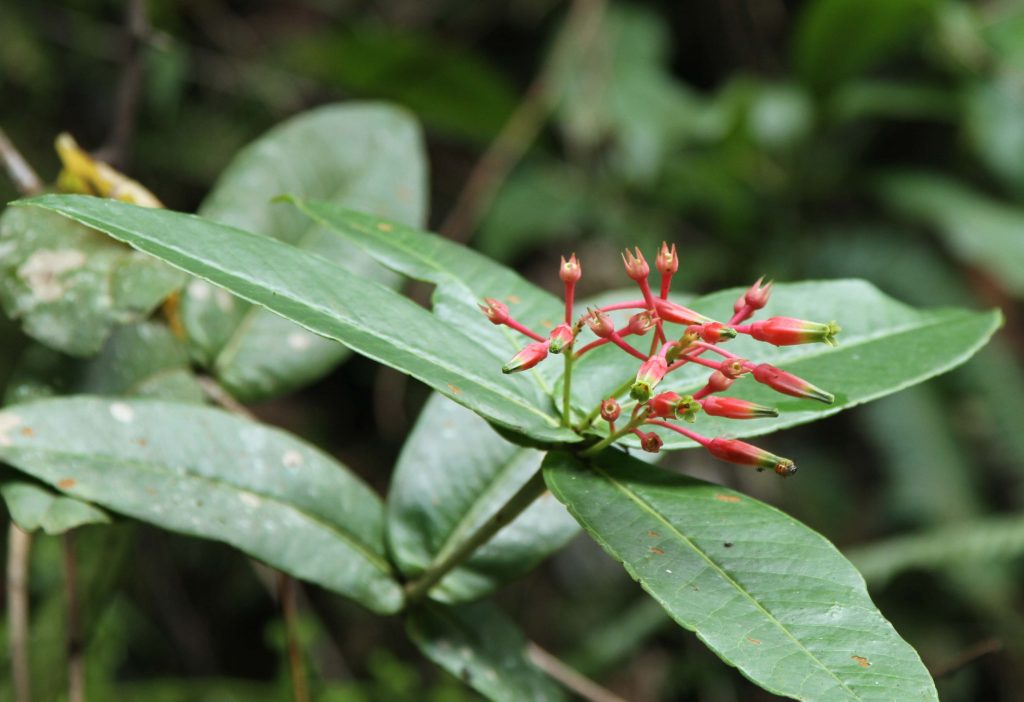
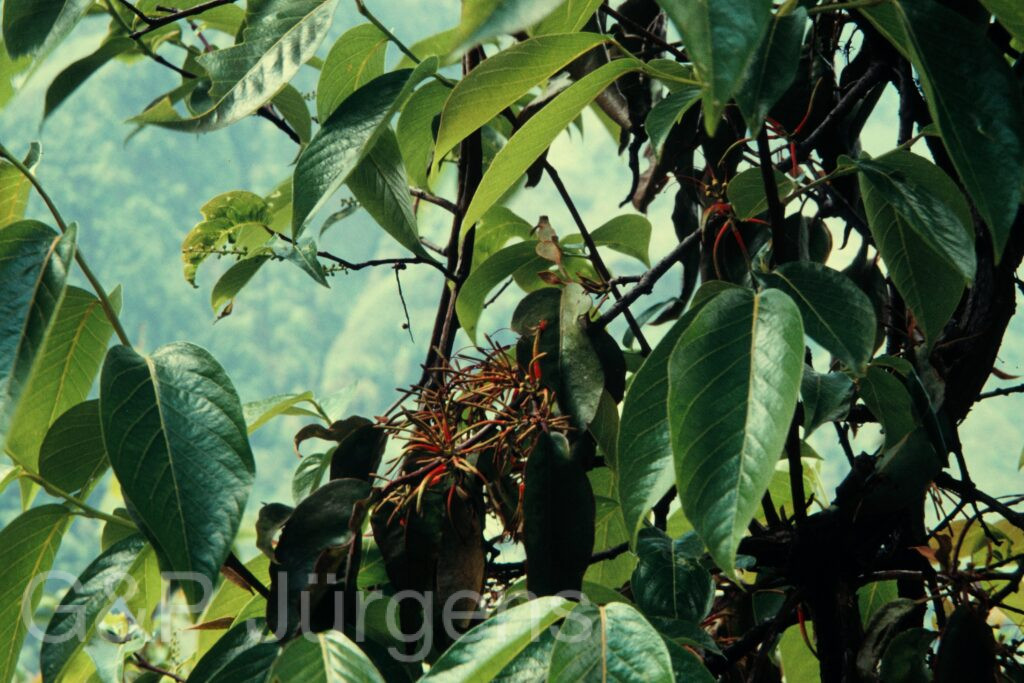
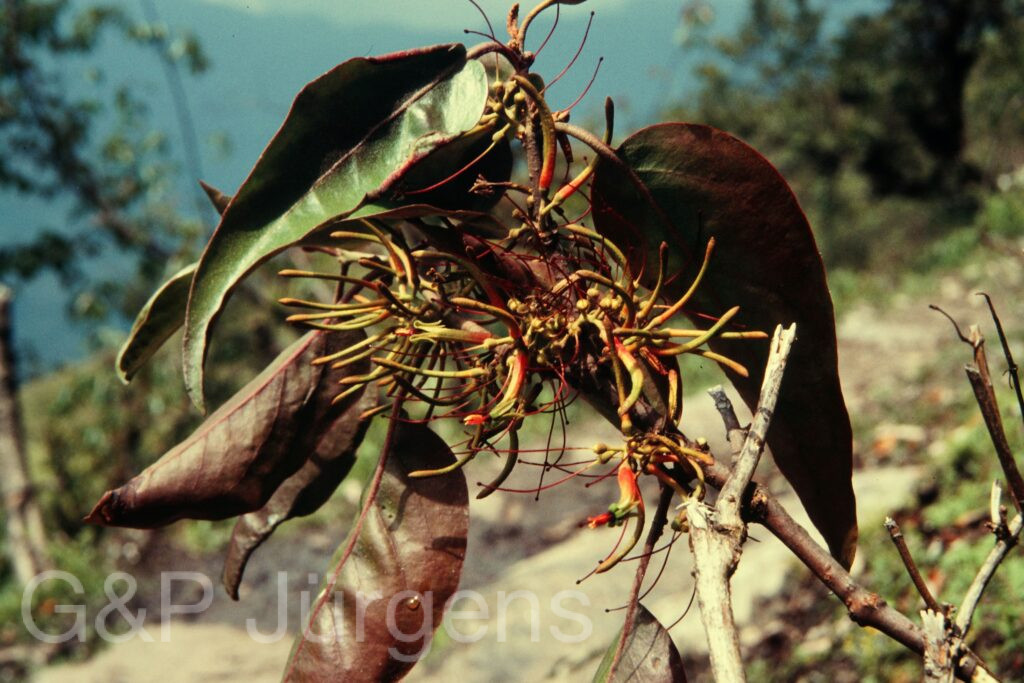
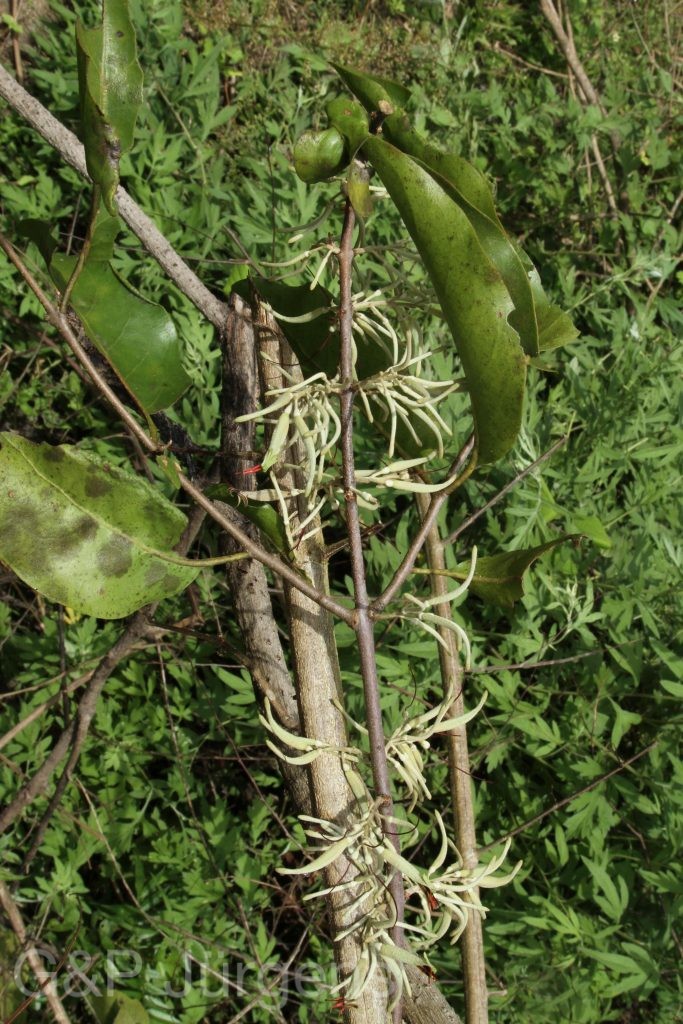
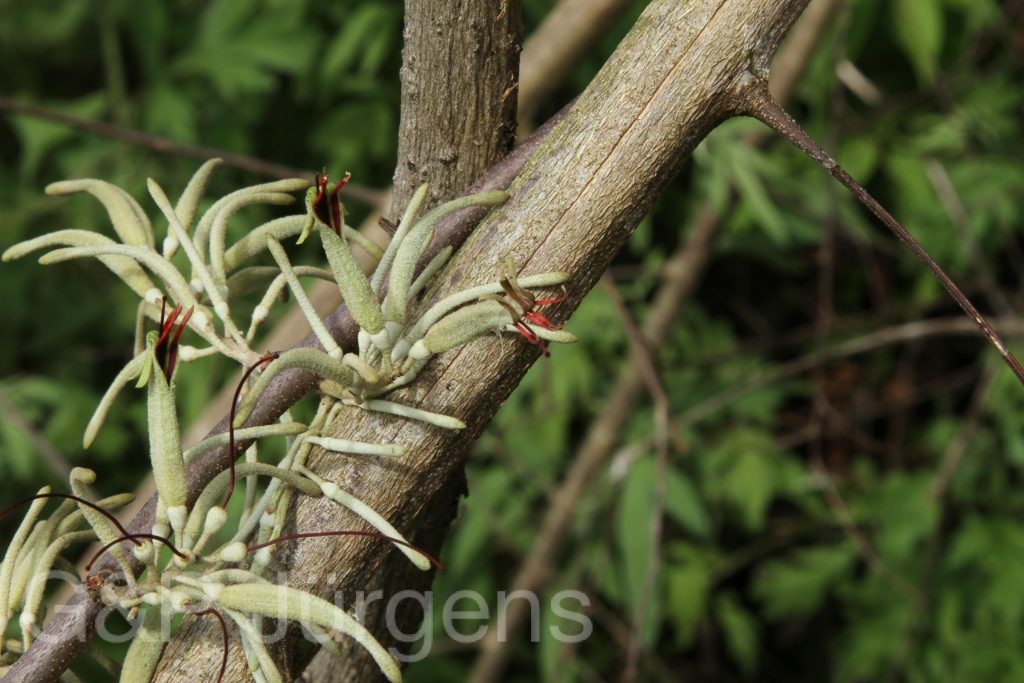
Scurrula elata is a hemiparasitic mistletoe of the eastern and central Himalaya, recorded from Nepal, China, Bhutan and India, with around 200 occurrences in GBIF. As an obligate stem parasite it occurs wherever suitable woody host trees grow in subtropical to warm temperate broad-leaved forest, hill forest and forest edges, drawing water and minerals from its host through a haustorial connection while photosynthesising in its own leaves. Its altitudinal spread is shown by the cited material from Trithangebe in Bhutan at 1000 m, in flower in October, and from Honggaon in Nepal at 2360 m in May, indicating a range across the lower and mid montane forest belt where host diversity is high.

The plant forms a pendent to spreading parasitic shrublet attached to host branches by a swollen haustorial union. The young stems and foliage are clothed in a brownish to rusty stellate or dendritic tomentum. The leaves are opposite or subopposite, ovate to elliptic, entire and shortly petiolate. The flowers are arranged in short axillary racemes and are characteristically zygomorphic, with a slender, curved, tubular corolla that splits along one side as it opens, ranging from greenish to reddish in colour; the calyx is borne on an elongate, club-shaped receptacle. The fruit is a small, club-shaped (turbinate) berry, narrowed below, containing a single viscin-coated seed adapted for bird dispersal and adhesion to new host branches.

Scurrula is a genus of the showy mistletoe family Loranthaceae, distinguished within the family by its pear- or club-shaped fruit and curved, one-sided corolla, and centred on tropical and subtropical Asia. As with other loranths, its flowers are typically pollinated by birds, and its seeds are spread by frugivorous birds such as flowerpeckers that wipe the sticky seeds onto branches. Heavy infestation can damage host trees, but the species is a natural component of Himalayan forest canopies, is widespread within its range and is not considered threatened.

Author: Danser · Sources: POWO (Kew), GBIF, Flora of China Vol. 5, Flora of Bhutan Vol. 1, Flora of Nepal, The Loranthaceae of the Indomalayan Region (Danser)

G. Don

Bhutan2012 1241
Bhutan Tashigang 1900m, October
Bhutan2012 1242
Bhutan Trashigang 1900m, October

Description

Scurrula pulverulenta G.Don is a hemiparasitic mistletoe of the Loranthaceae distributed through the eastern Himalaya and Indo-Burmese region. GBIF (about 126 occurrences) records it from India, Myanmar, Nepal, Bhutan, southern China, Thailand and Bangladesh, where it grows as a branch parasite on a range of woody hosts in broad-leaved and subtropical hill forest. It occurs chiefly in warm-temperate to subtropical montane zones; the collections from Tashigang (Trashigang) in eastern Bhutan at 1,900 m, flowering in October, illustrate its autumn anthesis in mid-elevation forest where it depends on suitable phorophytes for establishment.

The plant is a much-branched aerial shrublet attached to its host by a haustorial union, drawing water and minerals while photosynthesising in its own leaves. Young branches, leaves and inflorescences are densely covered with a rusty or greyish stellate-mealy indumentum, the source of the epithet "pulverulenta" (powdery). Leaves are opposite, ovate to elliptic, leathery and short-petiolate. The flowers are borne in short axillary racemes; the corolla is tubular and curved, four-lobed and typically reddish to orange, characteristic of bird-pollinated Loranthaceae. The fruit is the distinctive Scurrula "club-shaped" (pyriform, narrowed to the base) berry, with viscid pulp.

The genus Scurrula is defined within the Loranthaceae by its club-shaped fruit and the curved, often tetramerous corolla, and is closely allied to Taxillus and Dendrophthoe. Its sticky, viscin-coated seeds are dispersed by frugivorous birds (notably flowerpeckers), which wipe them onto host branches, completing an obligate host-parasite-disperser interaction. As a branch parasite, Scurrula pulverulenta is ecologically significant in Himalayan forest dynamics and is of interest in studies of mistletoe host specificity and pollination.

Author: G. Don · Sources: POWO (Kew), Flora of Bhutan Vol. 1, Flora of China Vol. 5, GBIF, Barlow: Loranthaceae of Asia and Malesia

A. Berger

Bhutan2012 328
Bhutan Dochu-La 3200m, September
Bhutan2014 35
Bhutan Trashigang 1570m, May

Description

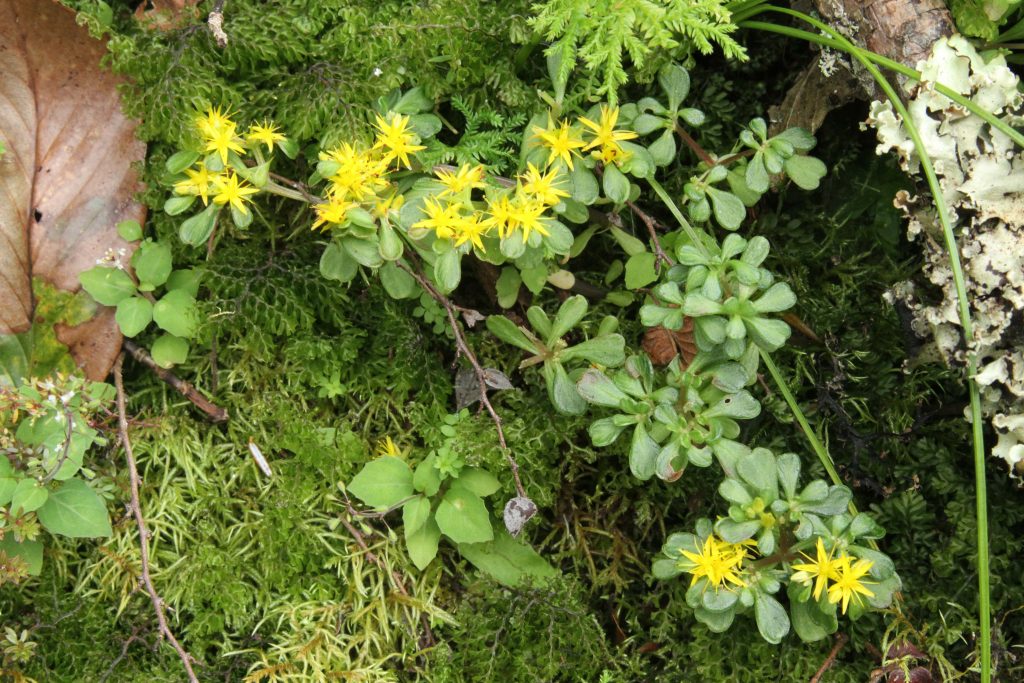
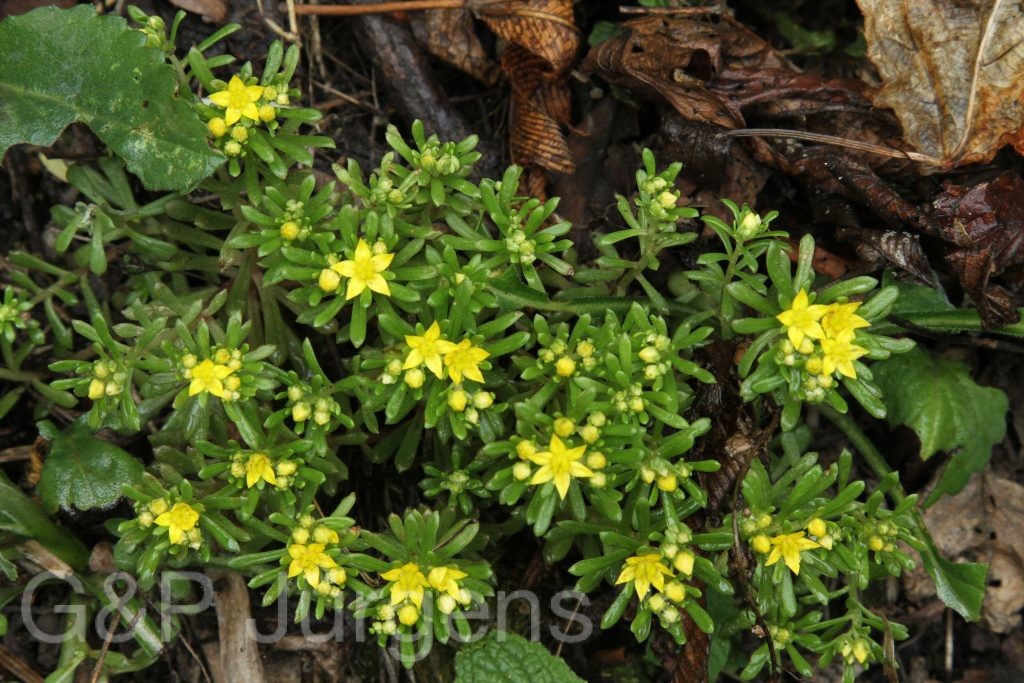
Sedum triactina is a succulent herb of the eastern Himalaya and Sino-Himalayan region, recorded from China, Nepal, India and Bhutan; its c. 329 georeferenced records span a wide temperate to subalpine altitudinal range. It grows on damp rocks, mossy banks, cliff ledges, stream margins and forest floor, generally between 1500 and 3500 m. The two Bhutanese localities documented in the image, Dochu-La at 3200 m in September and Trashigang at 1570 m in May, illustrate the species' broad ecological tolerance, occurring both in cool subalpine forest passes and warmer mid-elevation valleys.

It is a small, fleshy perennial herb with slender, often decumbent to ascending stems rising from a delicate creeping base, sometimes rooting at the nodes. The leaves are succulent, alternate, oblong to spathulate, entire and rather flat, glabrous and somewhat glaucous. The inflorescence is a lax, few-flowered terminal cyme. The flowers are typically pentamerous (the epithet "triactina" alluding to a three-rayed or three-parted character in some flowers), with narrow, spreading, pale yellow to greenish-yellow or whitish petals, ten stamens, and free or basally connate carpels. The fruit comprises several spreading, many-seeded follicles releasing minute seeds.

Described by A. Berger, S. triactina belongs to the large genus Sedum of the stonecrop family Crassulaceae, a group employing CAM photosynthesis as an adaptation to the desiccating conditions of rock and cliff microhabitats. Its small flowers are visited by generalist insects, and vegetative fragmentation supplements seed reproduction. The species is widespread and locally common across its montane range, with no recognised conservation concern, persisting readily on disturbed rocky and roadside substrates.

Author: A. Berger · Sources: POWO (Kew), GBIF, Flora of Bhutan, Flora of China, Flora of Nepal, 't Hart & Bleij's account of Sedum (Crassulaceae)

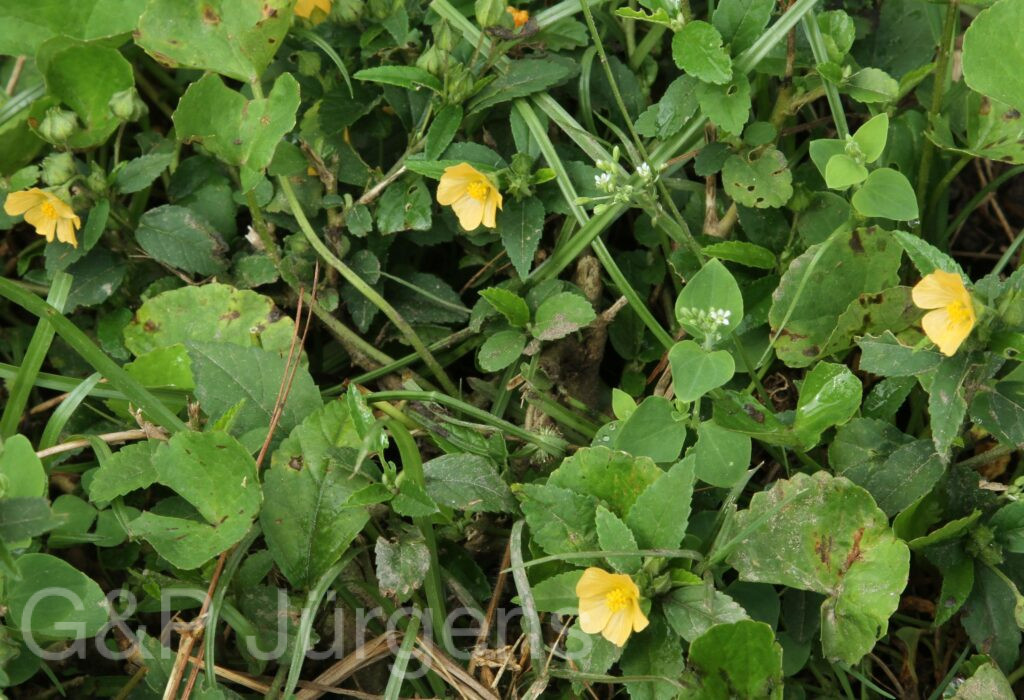
Sida acuta

by GP Jürgens

Burm.f.

Bhutan2015 66
Bhutan Wangdi Phodrang 1800m, October

Description

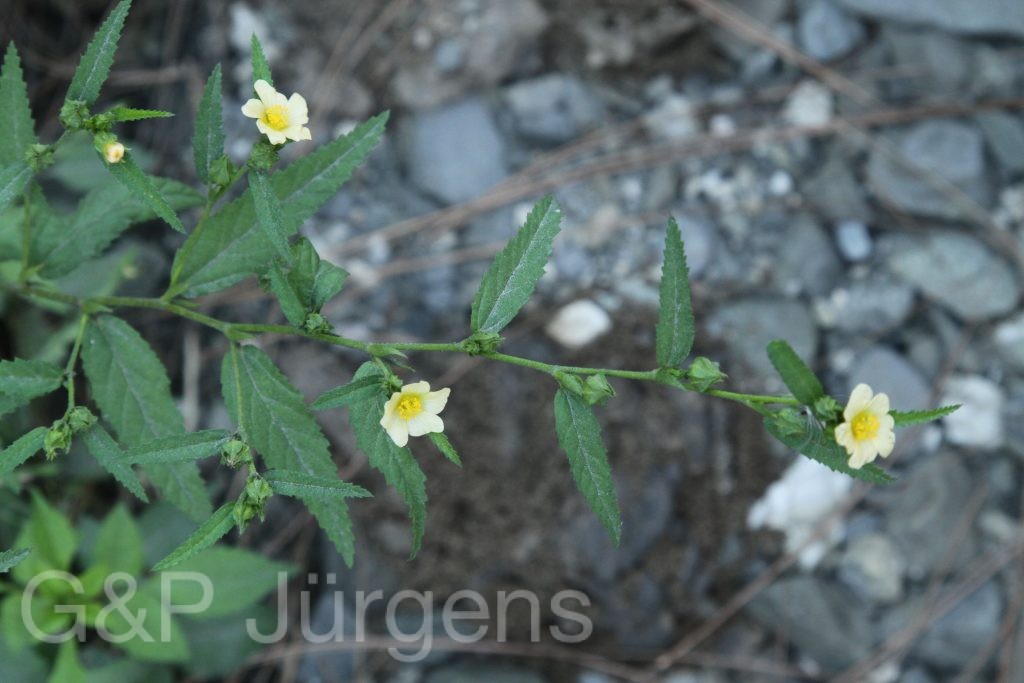
Sida acuta Burm.f. is a pantropical subshrub of the mallow family, one of the most widespread weeds in warm regions, documented by GBIF in over 23,000 occurrences spanning the Americas (Colombia, Mexico, Brazil, Argentina, Venezuela, El Salvador, USA), Africa (Ghana, Cameroon, Nigeria, Benin, Burkina Faso, DR Congo), Asia (India, China, Taiwan, Indonesia) and Australia. It thrives in disturbed ground, roadsides, pastures, fallow fields and waste places from sea level into the subtropical foothills, and was photographed in Bhutan at Wangdi Phodrang at 1800 m in October, near the upper margin of its altitudinal range.

The plant is an erect, much-branched perennial subshrub woody at the base, with tough fibrous stems. The leaves are alternate, narrowly lanceolate to oblong, with a sharply serrate margin and acute apex, and short stipules at the base of the petiole. The flowers are solitary or few in the leaf axils, with a five-lobed calyx and a corolla of five pale yellow to cream petals that open briefly in the morning; the stamens are united into a characteristic staminal column typical of Malvaceae. The schizocarpic fruit splits into several mericarps, each tipped with two short awns aiding epizoochorous dispersal.

Sida acuta is a notorious invasive and agricultural weed, forming dense stands that suppress pasture and crops, and is the target of biological control programmes in northern Australia. Despite its weedy status it yields a strong bast fibre and is used in traditional medicine across its range. Probably of neotropical origin, it has become naturalised throughout the tropics through human activity, and its tolerance of poor soils and disturbance ensures its continued spread.

Author: Burm.f. · Sources: POWO (Kew), GBIF, Flora of Bhutan, Flora of China, Sida revision (Fryxell, Malvaceae of the World)

L.

Bhutan2012 804
Bhutan Zemgang 1950m, October

Description

Sida rhombifolia L. is a near-cosmopolitan subshrub of tropical and warm-temperate regions, one of the most widely distributed weeds in the Malvaceae. GBIF documents over 50,000 records from every inhabited continent — Australia, the Americas (USA, Brazil, Mexico, Colombia, Argentina, Bolivia, Ecuador), Africa (South Africa, Cameroon, DR Congo), and Asia including China, India, Taiwan and Japan. In the Himalaya it occurs on roadsides, fallow fields, waste ground and open slopes; the photographed plant is from Bhutan, Zemgang, 1,950 m, in October. It thrives on disturbed, well-drained soils from sea level to around 2,000 m and is a pioneer of ruderal and pastoral habitats.

The plant is an erect, much-branched perennial subshrub 30–100 cm tall with tough, fibrous stems bearing stellate to simple appressed hairs. Leaves are alternate, shortly petiolate, rhombic to lanceolate (rhombifolia), 1.5–5 cm long, serrate in the upper half, entire toward the cuneate base, paler and pubescent beneath. Flowers are solitary in the leaf axils on slender, jointed pedicels, the corolla pale yellow to orange-yellow, 5–10 mm across, with five obovate petals; the staminal column is characteristic of the family. The schizocarpic fruit is a flattened ring of 8–12 mericarps, each with two short apical awns.

A polymorphic and taxonomically complex aggregate, S. rhombifolia has yielded numerous infraspecific taxa and segregates. The stem yields a strong bast fibre used for cordage and brooms, and the plant is widely employed in traditional medicine. Owing to its weedy vigour it is naturalised and sometimes invasive far beyond its presumed Old World tropical origin.

Author: L. · Sources: POWO (Kew), GBIF, Flora of China Vol. 12, Flora of Bhutan Vol. 2, Flora of Nepal, Borssum Waalkes: Malesian Malvaceae revised (Blumea)