Tag:

Myanmar

Flowers of the Myanmar Himalaya — 604 species recorded from northern Myanmar (Burma) and the eastern Himalayan borderlands, a biodiversity hotspot linking the Himalaya to the mountains of Yunnan and Southeast Asia. The region’s forests and alpine slopes hold a rich flora of rhododendrons, orchids, balsams and gentians. Every page gives a botanical description, distribution, habitat and flowering time with the original photograph.

Van Heurck & Müll. Arg.

Bhutan2015 170
Bhutan Zhemgang 950m, October
Bhutan2012 783
Bhutan Zemgang 1800m, October

Description

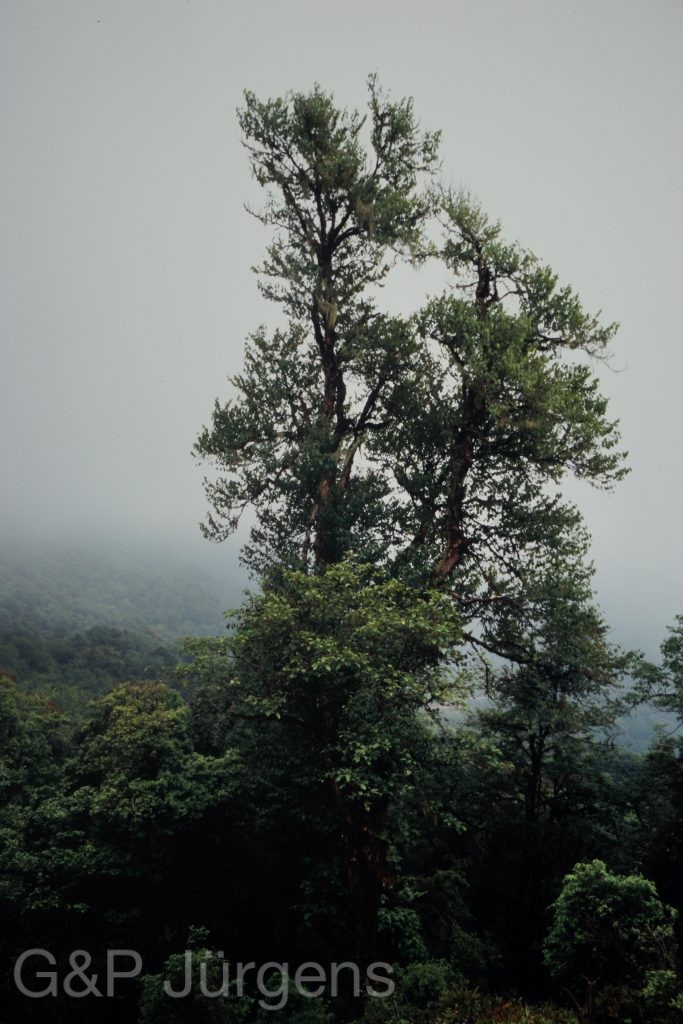
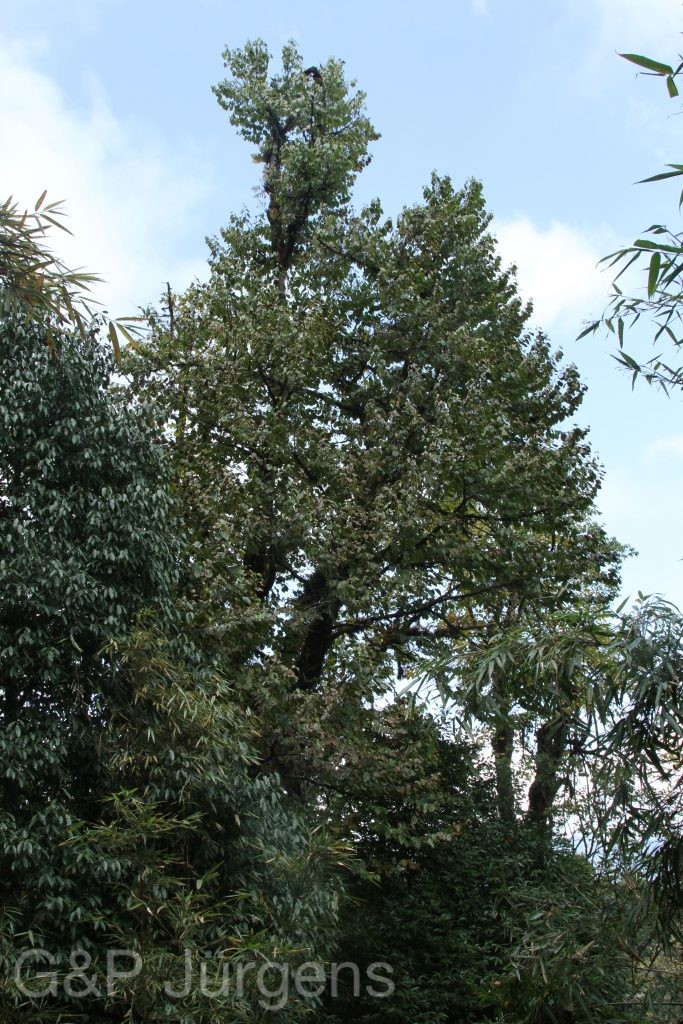
Terminalia myriocarpa Van Heurck & Mull.Arg. is a large evergreen tree of the Combretaceae, distributed across the eastern Himalaya and Indo-Burmese region, ranging from northeastern India, Nepal and Bhutan through Myanmar, Thailand, Laos and Vietnam to southwestern China (GBIF: c. 454 occurrences). It is a canopy tree of subtropical and tropical moist evergreen forests, favouring deep, moist soils along streams and in foothill valleys, generally below about 1,500 m though ascending higher locally. The photographed trees from Zhemgang in central Bhutan, recorded at about 950 m and 1,800 m in October, illustrate its presence in the warm, humid forests of the southern foothills.

The tree is tall, reaching 30 m or more, frequently developing prominent buttresses at the base. The leaves are opposite or subopposite, oblong-elliptic, with an acuminate apex and entire to crenulate margins, and often bear a pair of glands near the base of the petiole. The flowers are small, numerous and bisexual, borne in large, much-branched terminal and axillary panicles, giving rise to the species epithet "myriocarpa" ("many-fruited"). The fruit is a small, two-winged, samaroid nutlet that turns pink to crimson in dense masses, a striking feature that aids wind dispersal.

Terminalia belongs to the pantropical Combretaceae and includes many ecologically and economically important timber trees. Terminalia myriocarpa yields a useful general-purpose hardwood and is a significant component of lowland evergreen forest. Although locally common over a wide range and not globally threatened, its lowland forest habitat is under pressure from logging and land conversion across parts of its distribution.

Author: Van Heurck & Müll. Arg. · Sources: POWO (Kew), Flora of China Vol. 13, Flora of Bhutan Vol. 2, Flora of Nepal, GBIF, Exell: Combretaceae revisions
Oliv.

Bhutan2015 34
Bhutan Thimphu 2200m, October
Bh2008 43 G76
Bhutan Thimphu 2200m, April
Bh09 209 P350
Bhutan Thimphu 2200m, April

Description

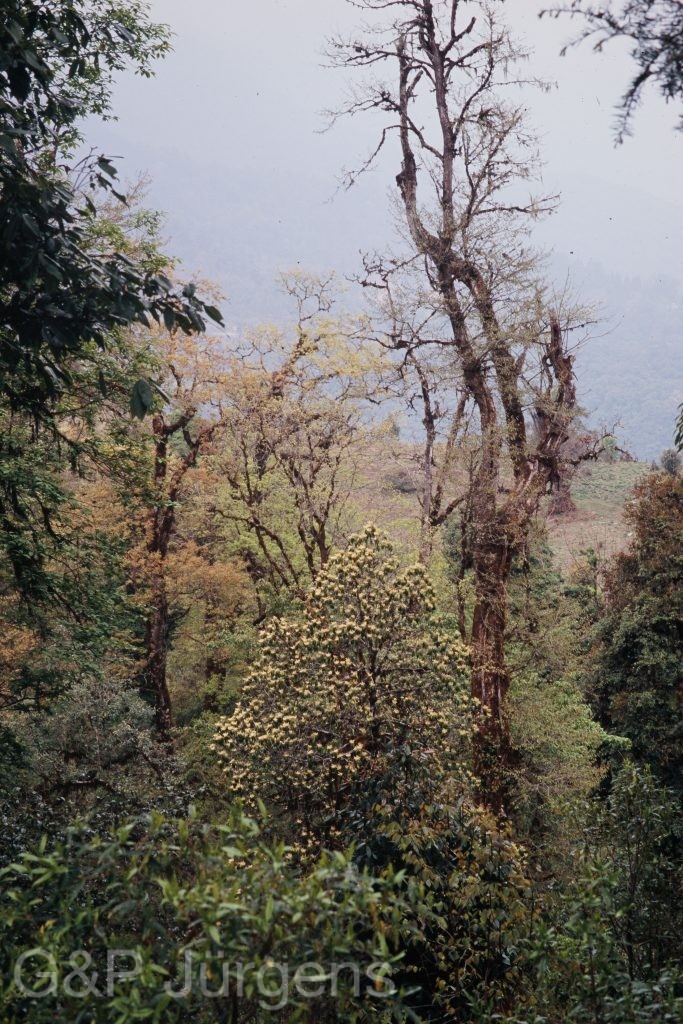
Tetracentron sinense is a deciduous tree of the eastern Himalaya and the mountains of central and southwestern China, recorded by GBIF from China, Nepal, Bhutan, India, Myanmar and Vietnam (with cultivated records in Europe and North America) across about 940 georeferenced occurrences. It is a tree of cool, moist temperate broadleaf and mixed forest, growing in valleys, on shaded slopes and along streamsides, generally between about 1,700 and 3,500 m. The cited records from Thimphu in western Bhutan at around 2,200 m, photographed in both April and October, span the leafing-out and the autumnal phases of its annual cycle and place it well within the temperate forest belt of the inner Himalaya, where it occurs scattered among other broadleaved trees.

The tree has a straight trunk and bears its leaves in two kinds of position: simple, alternate, long-petioled leaves on long shoots and solitary leaves terminating short spur shoots. The leaves are ovate to broadly ovate, cordate at the base, acuminate, finely serrate, and conspicuously palmately veined from the base. The minute, perfect flowers are densely crowded on slender, pendulous, catkin-like spikes; each tetramerous flower has four tepals, four stamens and a four-carpellate ovary. The fruit is a small four-locular capsule that splits to release tiny winged seeds. Anatomically the wood is remarkable for being vesselless, the water-conducting tissue consisting only of tracheids.

Tetracentron sinense is one of only two genera in the small, isolated family Trochodendraceae (the other being Trochodendron), an ancient and phylogenetically basal lineage of eudicots whose vesselless wood is regarded as a primitive or secondarily reduced condition of great interest to plant systematists and to studies of angiosperm wood evolution. As a relict species with a disjunct, fragmented distribution, it is of significant conservation concern: it is legally protected in China and assessed as near-threatened, its populations reduced by logging and habitat loss, making it an emblematic "living-fossil" tree of the East Asian temperate flora.

Author: Oliv. · Sources: POWO (Kew), GBIF, Flora of China Vol. 6, Flora of Bhutan Vol. 1, Flora of Nepal, Flora of Pakistan, Endress: systematics and floral morphology of Trochodendraceae

(D.Don) Manden.

Bh09 71 P123
Bhutan Jili-La 3600m, June

Description

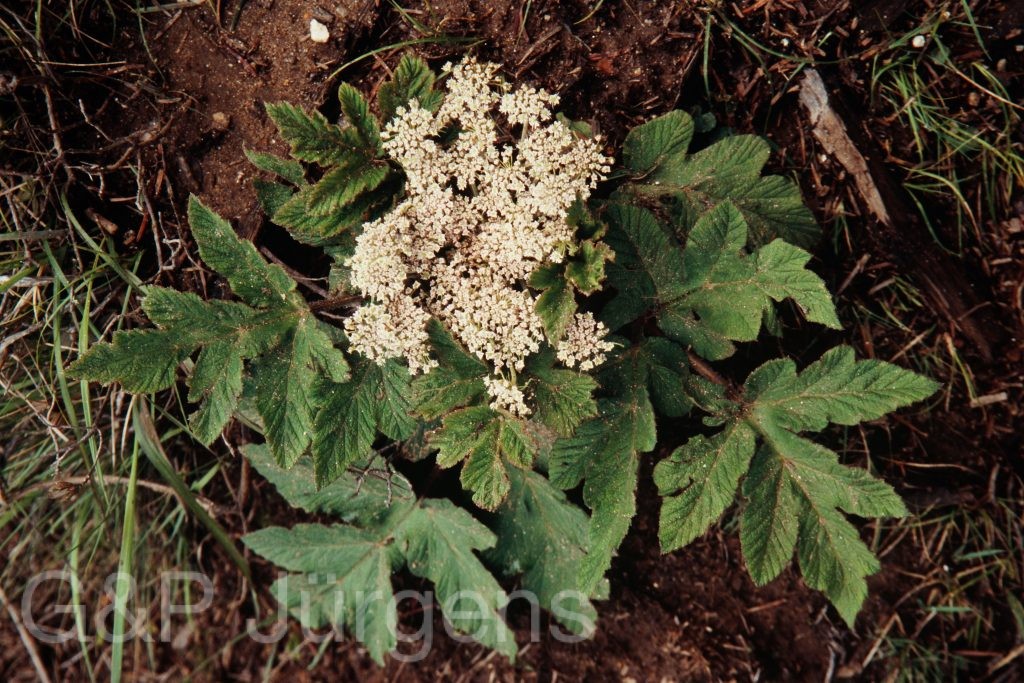
Tetrataenium nepalense is a tall Himalayan umbellifer distributed from Nepal and northern India through Bhutan into south-western China and Myanmar. Its 266 GBIF records lie within this native arc, indicating a widespread montane species of the Eastern and Central Himalaya. It occupies subalpine and alpine meadows, open slopes, forest margins and clearings, generally between about 3000 and 4000 m, where it is a characteristic robust herb of moist high-altitude grassland. The plant photographed at Jili-La in Bhutan at about 3600 m in June illustrates the species at its early-summer flowering on these damp, herb-rich montane slopes.

It is a stout, erect biennial or perennial herb arising from a thick taproot, with hollow, ridged, often pubescent stems. The large leaves are pinnate to ternately compound, the broad leaflets ovate, lobed and toothed, the lower leaves long-petiolate with conspicuous sheathing bases. The inflorescence is a large terminal compound umbel with numerous rays; the small white flowers are often radiant, the marginal petals of the outer flowers enlarged. The fruit is a flattened, broadly ovate to obovate, dorsally compressed schizocarp with conspicuous oil ducts (vittae) and narrowly winged lateral ribs.

Long known as Heracleum nepalense (a name preserved in its WordPress URL), the species was transferred to the segregate genus Tetrataenium, distinguished from Heracleum by features of the vittae and fruit. Its hogweed-like habit and large radiant umbels are typical of the group. Widespread and locally common across its range, T. nepalense is not considered threatened and is a prominent component of high Himalayan meadow vegetation.

Author: (D.Don) Manden. · Sources: POWO (Kew), GBIF, Flora of Bhutan, Flora of China, Pimenov & Kljuykov Umbelliferae revision

Blume

Bhutan2012 407
Bhutan Wangdi 2500m, June

Description

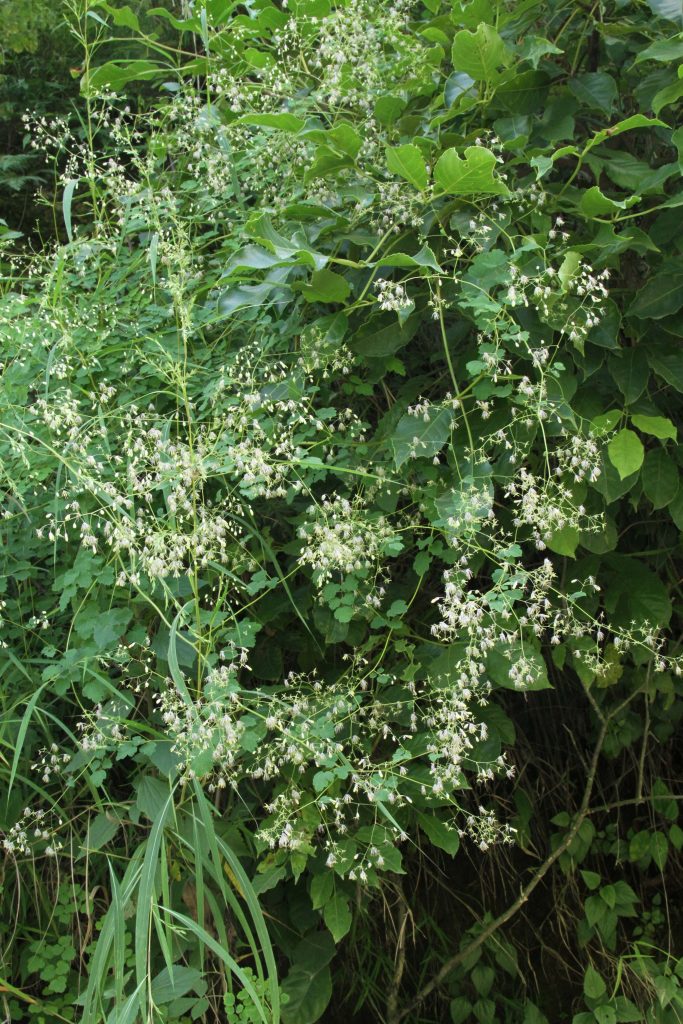
Thalictrum javanicum Blume is a widespread meadow-rue ranging across tropical and subtropical Asia. GBIF documents some 1366 occurrences from India, Sri Lanka, Nepal, Bhutan, Myanmar and southern China through Taiwan, Japan and into the Malesian uplands of Indonesia. It occupies moist, shaded habitats: streamsides, forest floors, damp ravines, clearings and grassy banks, mainly at middle elevations between roughly 1500 and 3000 m, descending lower in the tropics. The plant photographed near Wangdi in Bhutan at 2500 m in June, during the early monsoon, reflects its association with the cool, humid broad-leaved and conifer forest belt of the Himalaya.

It is a glabrous perennial herb forming erect stems 30-100 cm tall from a short rhizome. The leaves are two- to four-times ternately compound, the ultimate leaflets obovate to suborbicular, three-lobed and crenate at the apex, thin in texture, with conspicuous stipels at the divisions of the petiole. The inflorescence is a lax terminal panicle of small, apetalous flowers; the perianth consists of inconspicuous, caducous greenish sepals, the floral display provided instead by the numerous spreading stamens with slender filaments and oblong anthers. The fruit is a cluster of sessile to shortly stipitate, ribbed, ellipsoid achenes tipped by a short curved beak.

Thalictrum is a large, taxonomically intricate genus characterised by reduced, wind- and generalist-insect-pollinated flowers and considerable variation in stamen and achene morphology, generating a complex synonymy across its broad range. T. javanicum is among the most ecologically plastic species, tolerating a wide altitudinal and geographic span, which accounts for its abundant collection record. It is a common, unthreatened component of Asian montane forest understoreys, and several Thalictrum species, including this one, contain isoquinoline alkaloids used in regional ethnomedicine.

Author: Blume · Sources: POWO (Kew), GBIF, Flora of China, Flora of Bhutan, Flora of Java, Annotated Checklist of the Flowering Plants of Nepal

Hook.f. et Thomson

BhutanPG2011 73

Description

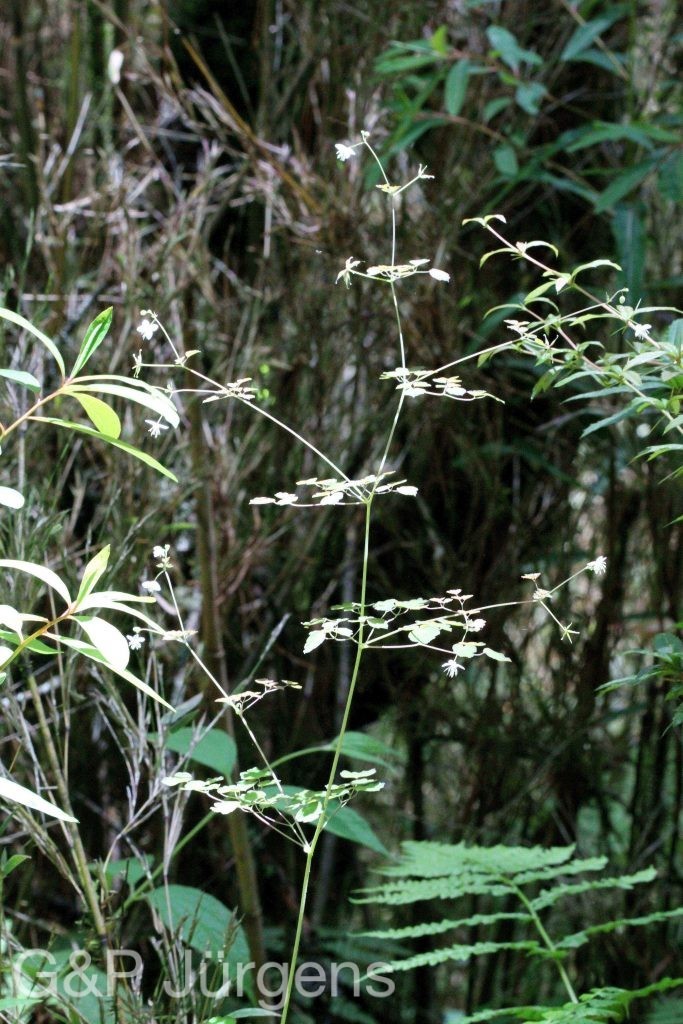
Thalictrum rostellatum is a meadow-rue of the temperate to subalpine Himalaya and adjacent China, recorded from China, Nepal, India, Bhutan and Myanmar, with some 258 occurrences aggregated in GBIF. It favours shaded, humus-rich slopes, the margins of forest, scrub and streamsides, and damp grassy banks within the broad-leaved and conifer forest belt of the Eastern Himalaya. Across its range it ascends through the montane and lower subalpine zones, where it grows in the dappled understorey alongside other moisture-loving herbs, flowering through the summer monsoon months.

It is a slender, glabrous perennial herb with a thin, creeping rhizome and erect, sparingly branched stems. The leaves are ternately decompound, the ultimate leaflets thin and membranous, obovate to broadly cuneate and shallowly lobed or toothed at the apex, often glaucous beneath. The inflorescence is a lax, few-flowered panicle of small, nodding flowers; as in the genus, the four pale sepals are caducous and petals are wanting, the floral display reduced to the pendulous stamens with filiform filaments and delicate anthers. The carpels are few and stipitate, ripening into small, stipitate achenes that bear a conspicuous slender beak, the rostellum from which the epithet derives.

The markedly beaked, stalked achenes are the principal character separating T. rostellatum from related Himalayan meadow-rues such as T. virgatum and T. reniforme. Like most Thalictrum it is anemophilous, the reduced, scentless flowers and exserted stamens reflecting wind pollination. Widespread and locally frequent through the Eastern Himalaya, it is of no particular conservation concern, though as a forest-understorey element its persistence depends on intact montane woodland.

Author: Hook.f. et Thomson · Sources: POWO (Kew), GBIF, Flora of China, Flora of Bhutan, Annotated Checklist of the Flowering Plants of Nepal, Boivin's revisionary studies of Thalictrum

(Wall. ex Kunth) Maxim.

Bh09 218 G366
Bhutan Wangdi 2250m, June
Nepal 99 897 ergebnis
West-Nepal Sepka 2760m, July
Sikkim 2006 453 ergebnis
India West-Bengal, Tolung 2200m, May

Description

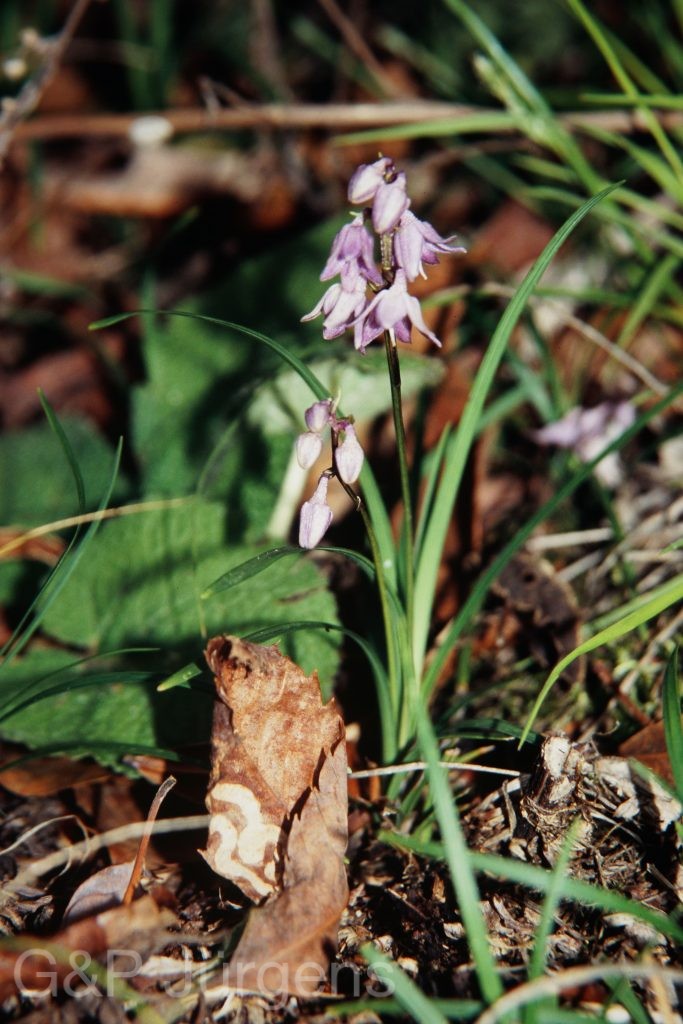
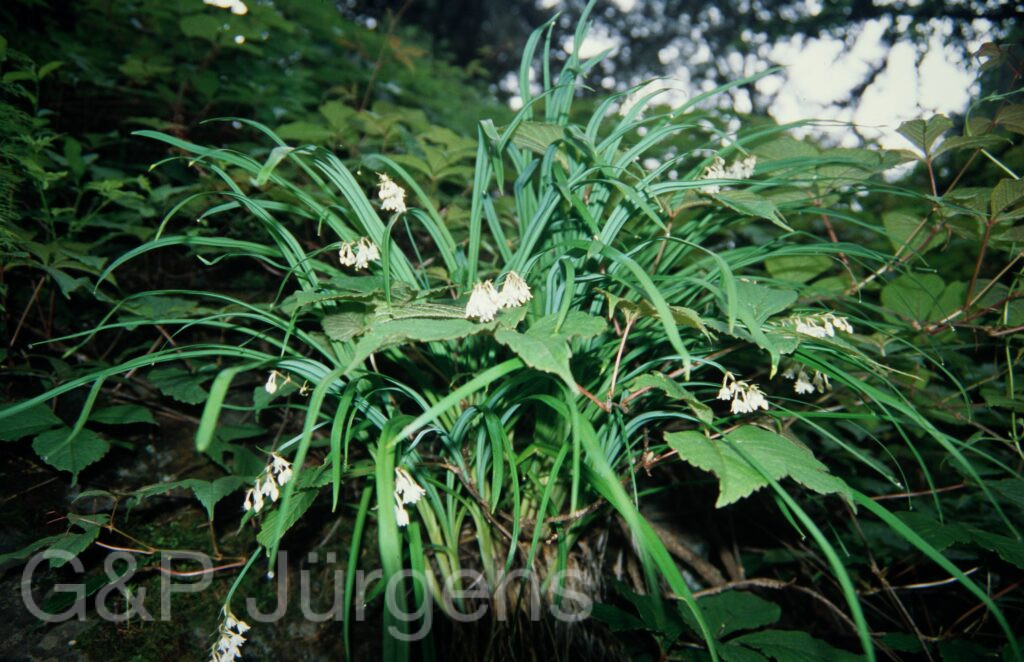
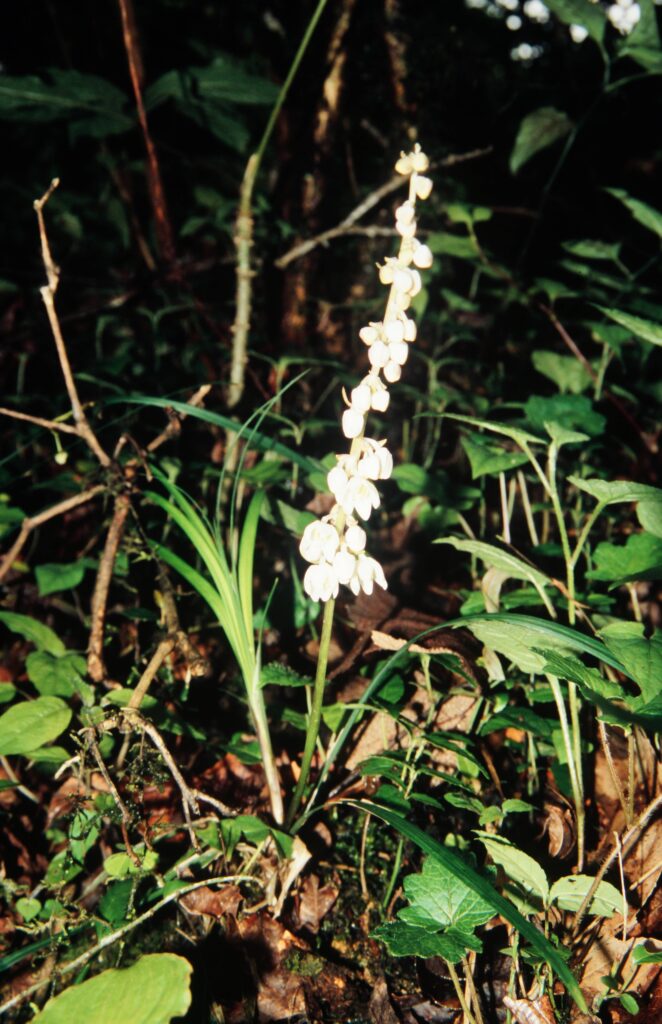
Theropogon pallidus is the sole species of its genus, a rhizomatous woodland herb distributed along the Himalaya from Nepal through northern India, Bhutan and south-western China into Myanmar and Thailand. GBIF lists some 264 occurrences concentrated in Nepal, China, India and Bhutan, with outliers in Myanmar and Thailand. It grows in shaded, humus-rich soils of temperate broad-leaved and mixed forest, on mossy banks, ravine sides and beneath shrubbery, broadly between about 1800 and 3000 m. The accompanying images span its range, from Bhutan at Wangdi (2250 m, June) and West Nepal at Sepka (2760 m, July) to West Bengal at Tolung (2200 m, May), illustrating its early-summer flowering across the mid-montane forest belt.

The plant arises from a short, creeping rhizome and forms tufts of narrowly linear, grass-like basal leaves that are channelled, arching and somewhat fleshy. The flowering scape is erect and leafless, bearing a lax, secund raceme of pendulous, bell-shaped flowers; each flower is subtended by a membranous bract and hangs on a slender, jointed pedicel. The perianth is white to pale pink, the six tepals fused below into a campanulate tube with recurved lobes, enclosing six stamens with short filaments. The ovary is superior and trilocular, maturing into a globose, fleshy berry that ripens red, containing few rounded seeds.

Theropogon is a monotypic genus of the Asparagaceae (formerly Convallariaceae or Liliaceae sensu lato), morphologically intermediate between Ophiopogon and Convallaria and allied to the lily-of-the-valley group by its nodding campanulate flowers and berry fruit. Its disjunct, narrowly montane distribution makes it of biogeographic interest as a relict of Sino-Himalayan forest flora. The species is locally frequent and faces no broad conservation concern, though it depends on intact shaded forest understorey.

Author: (Wall. ex Kunth) Maxim. · Sources: POWO (Kew), GBIF, Flora of China, Flora of Bhutan, An Annotated Checklist of the Flowering Plants of Nepal, Genera of Convallariaceae

(Blume) Cogn.

Bhutan2012 476
Bhutan Wangdi, 2500m September
Bhutan2015 63
Bhutan Wangdi, 2500m September
Bh09 229 P385
Bhutan Wangdi, 1600m June

Description

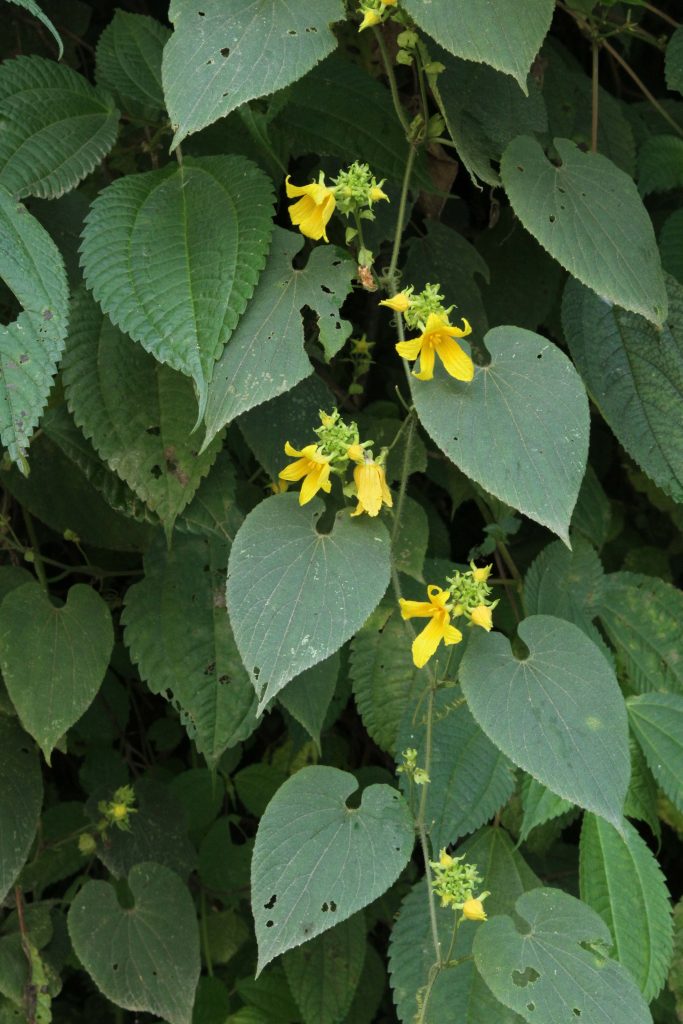
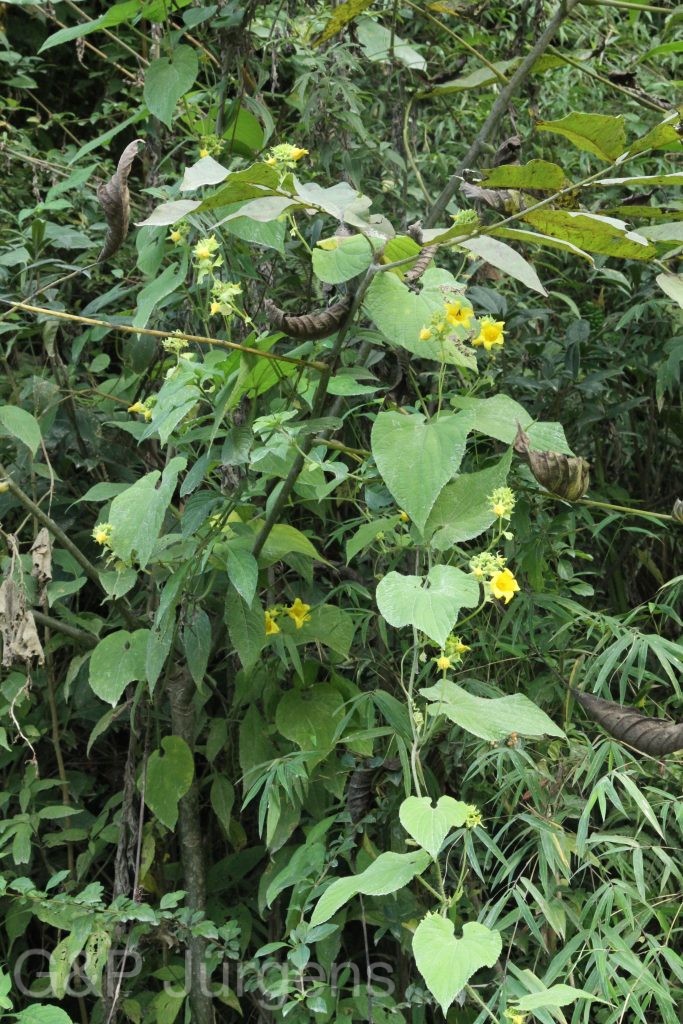
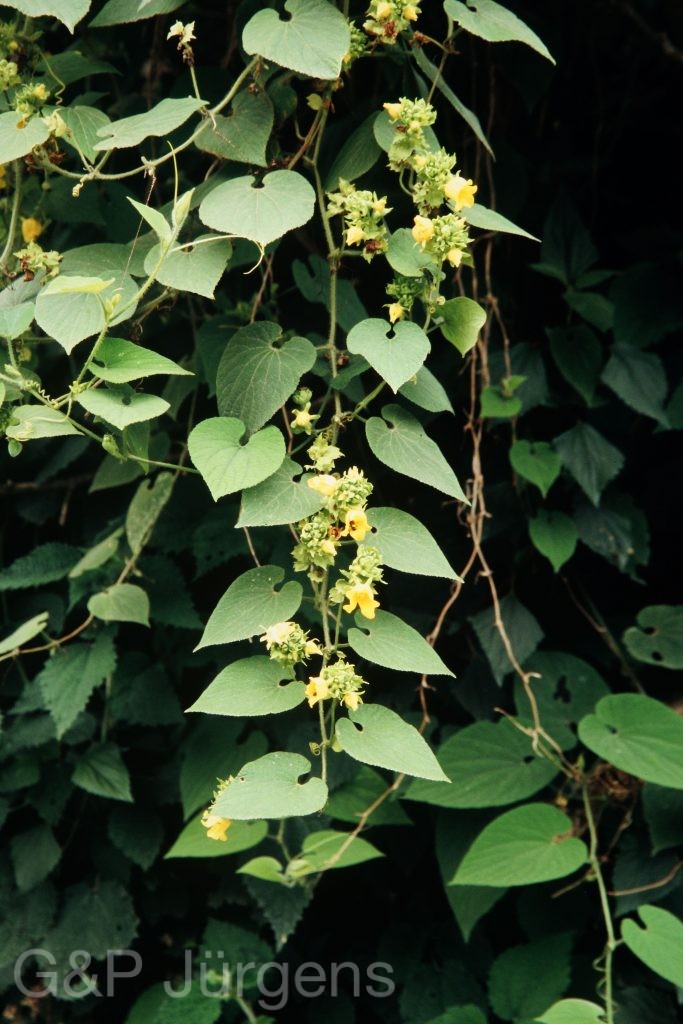
Thladiantha cordifolia is a climbing cucurbit distributed across the Sino-Himalayan and Indomalayan region, from Nepal, India, Bhutan and Bangladesh through Myanmar, Thailand, Vietnam, Laos and Malaysia into southern China, Indonesia and the Philippines; cultivated and casual records (ES, AU, JP, RO, DE, HU) inflate its GBIF country list, which rests on about 1,084 occurrences. The plants shown come from western Bhutan near Wangdue Phodrang, recorded at 1,600 m in June and 2,500 m in September, illustrating its altitudinal spread. It is a vine of forest margins, thickets, hedgerows and disturbed slopes in warm-temperate to subtropical country, typically between about 1,000 and 2,800 m, scrambling over shrubs and into the lower canopy.

It is a herbaceous to somewhat woody perennial climber arising from a tuberous rootstock, the stems angular and hispid and bearing simple or two-branched tendrils opposite the leaves. The leaves are cordate-ovate with a deeply cordate base, an acuminate apex and a denticulate margin, scabrid on both surfaces. The plant is dioecious; the male flowers are borne in axillary racemes and the females usually solitary, both yellow and campanulate with five-lobed corollas, the male flowers with the reduced stamen complement typical of the genus and the female with an inferior ovary. The fruit is an ovoid to oblong fleshy berry, often longitudinally ribbed and red at maturity, containing numerous flattened seeds.

Thladiantha is an Asian genus of the tribe Sicyoeae distinguished by its tuberous habit, dioecy and characteristic stamen arrangement. Its tubers and fruits have local food and medicinal uses. As a vigorous and widespread plant of secondary vegetation, T. cordifolia is not of conservation concern; indeed several Thladiantha species behave as garden escapes in temperate regions.

Author: (Blume) Cogn. · Sources: POWO (Kew), Flora of China Vol. 19, Flora of Bhutan Vol. 2, GBIF, Jeffrey: A review of the Cucurbitaceae

Wall. ex. D.Don.

Bhutan2012 363
Bhutan Wangdi 2500m, September

Description

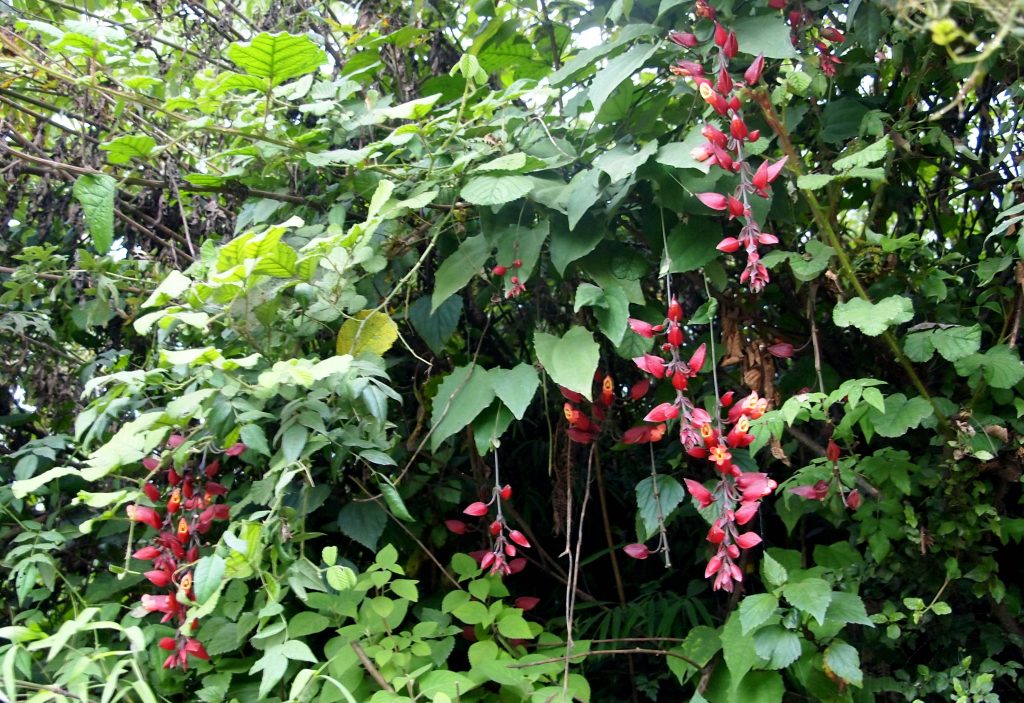
Thunbergia coccinea Wall. ex D.Don is a vigorous woody climber of the eastern Himalaya and Indo-Burmese region, with GBIF documenting nearly 692 occurrences across India, China, Nepal, Bhutan, Myanmar, Thailand, Laos, Sri Lanka and Bangladesh, alongside numerous cultivated records in tropical and subtropical gardens worldwide. In the wild it scrambles through the canopy of moist broadleaved and subtropical forest, along streamsides and forest margins, flowering in the post-monsoon months. The illustrated plant from Wangdi (Wangdue Phodrang) in western Bhutan at 2500 m in September captures it at the upper edge of its altitudinal range, twining over shrubs and trees in humid hill forest.

The species is a perennial liana with twining stems and opposite, petiolate leaves that are ovate to cordate, acuminate, with toothed to entire margins and palmate basal venation. The flowers hang in long, pendulous, many-flowered racemes; each scarlet to brick-red corolla is tubular and curved with a slightly oblique, shortly five-lobed limb, subtended by paired bracteoles, and contains four didynamous stamens. The fruit is the characteristic acanthaceous capsule, beaked and explosively dehiscent, ejecting a few flattened seeds borne on retinacula.

Thunbergia, sometimes segregated in Thunbergiaceae but generally placed in Acanthaceae, comprises Old World tropical climbers and shrubs, several grown ornamentally; T. coccinea is valued in horticulture for its dramatic drooping red flower chains. Its bird- and insect-visited blooms point to a mixed pollination syndrome. The species is widespread and not of conservation concern, though as a forest liana it depends on the persistence of intact moist montane and submontane woodland.

Author: Wall. ex. D.Don. · Sources: POWO (Kew), GBIF, Flora of Bhutan, Flora of China, Acanthaceae of the Indian Subcontinent, Bremekamp studies on Thunbergia

D. Don

Bhutan2014 588
Bhutan Phobjika 2810m, May
Nepal 97 128 G222
Nepal Mewa-Khole 2500m April
Nepal 1994 194 ergebnis
Ost-Nepal Mewa-Khola 2100m April
Nepal 2001 252 ergebnis ergebnis
Nepal (Gorkha) Niuli Kharka 2700m, May

Description

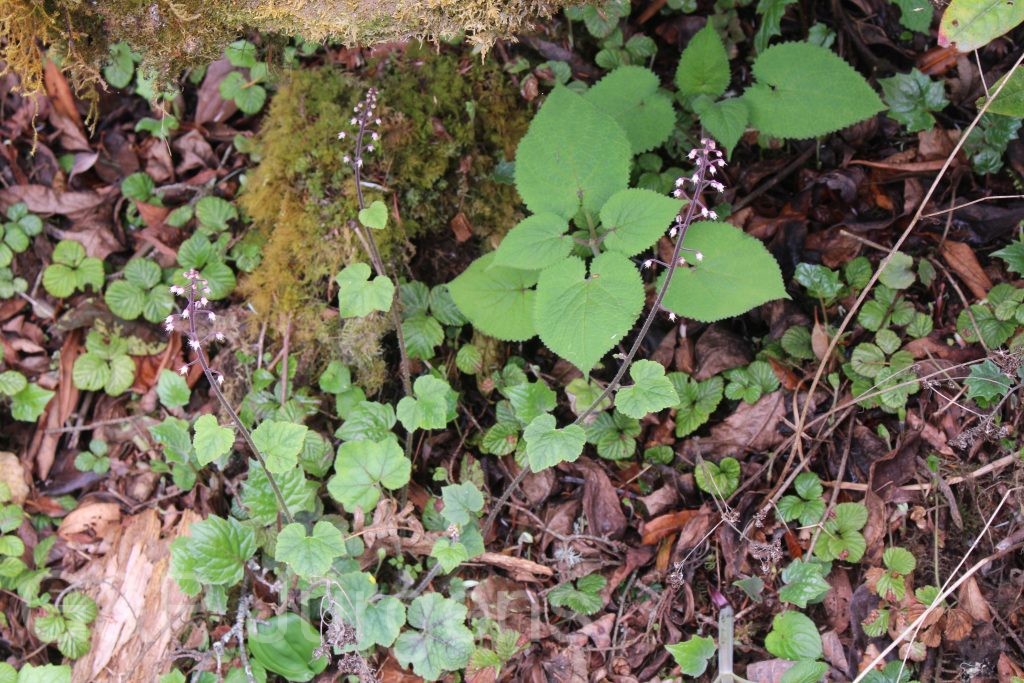
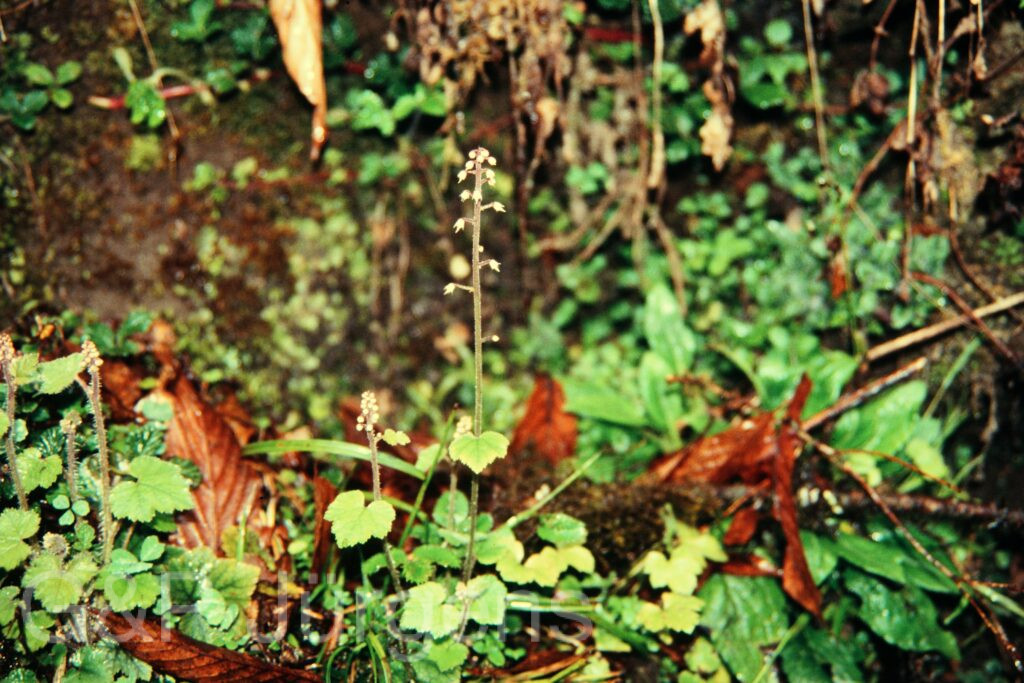
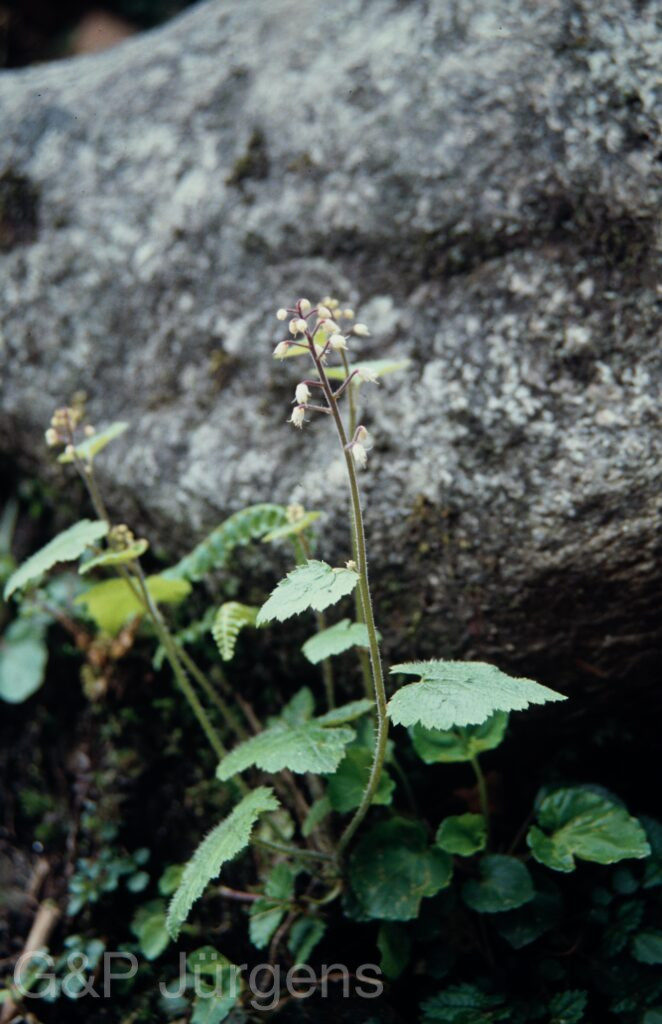
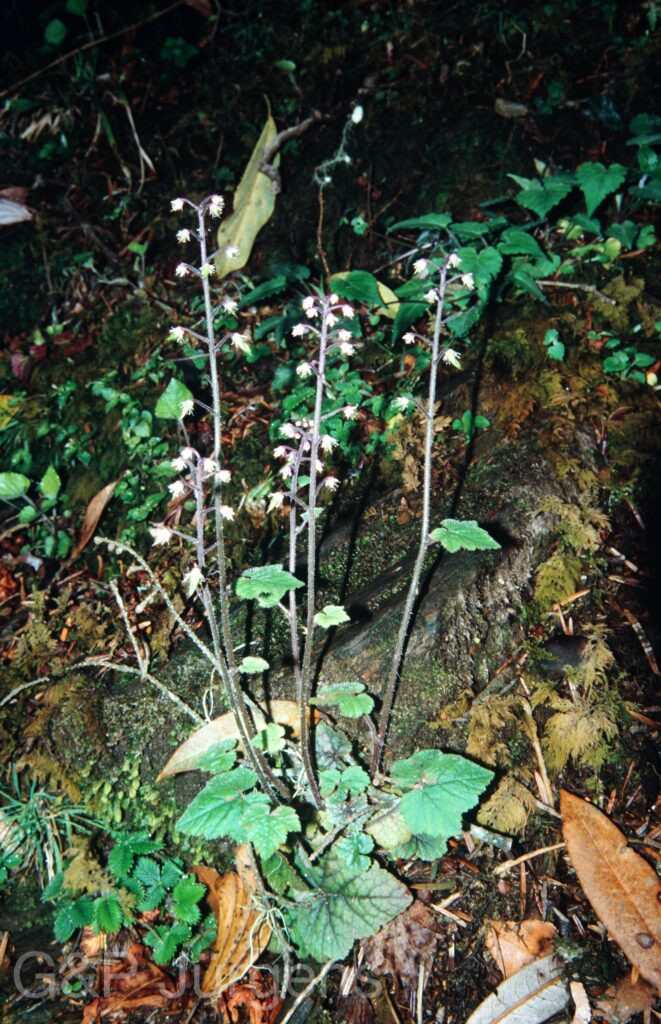
Tiarella polyphylla is a perennial herb with a wide East Asian and Himalayan distribution, recorded from China, Japan, Korea, Taiwan, Nepal, India, Bhutan and Myanmar, and reliably documented by over 4300 GBIF occurrences. It is a plant of cool, shaded, humid forests, growing in moist humus-rich soil along streamsides, on mossy banks and in the understorey of broadleaved and mixed forest, generally between about 1500 and 3500 m. The photographed populations span Bhutan (Phobjika, 2810 m, May) and eastern and central Nepal (Mewa Khola 2100-2500 m, and Gorkha at Niuli Kharka 2700 m), flowering through the spring months.

The plant grows from a short rhizome and produces a basal rosette of long-petioled leaves; the lamina is cordate-orbicular, shallowly three- to five-lobed, with toothed margins and scattered hairs. The slender, erect flowering stem bears a few reduced cauline leaves and terminates in a narrow, elongate raceme of small flowers. Each flower has five white to greenish, narrow petals and conspicuously exserted stamens, giving the inflorescence a delicate, foamy appearance. The fruit is a distinctive two-valved capsule with markedly unequal valves, splitting to release the small seeds.

Tiarella is a small genus of the Saxifragaceae, and T. polyphylla is the principal Asian representative, the remaining species being North American; this disjunction is a classic example of the eastern Asian-North American floristic link. The plant is shade-tolerant and clonal, often forming loose colonies on forest floors. Though not threatened across its broad range, it depends on intact moist forest and is locally sensitive to logging and disturbance of streamside habitats.

Author: D. Don · Sources: POWO (Kew), GBIF, Flora of China, Flora of Bhutan, Saxifragaceae monograph

(Azaola) Pennell

Bhutan2012 1338 ergebnis
Bhutan Pemagatsel 300m, October

Description

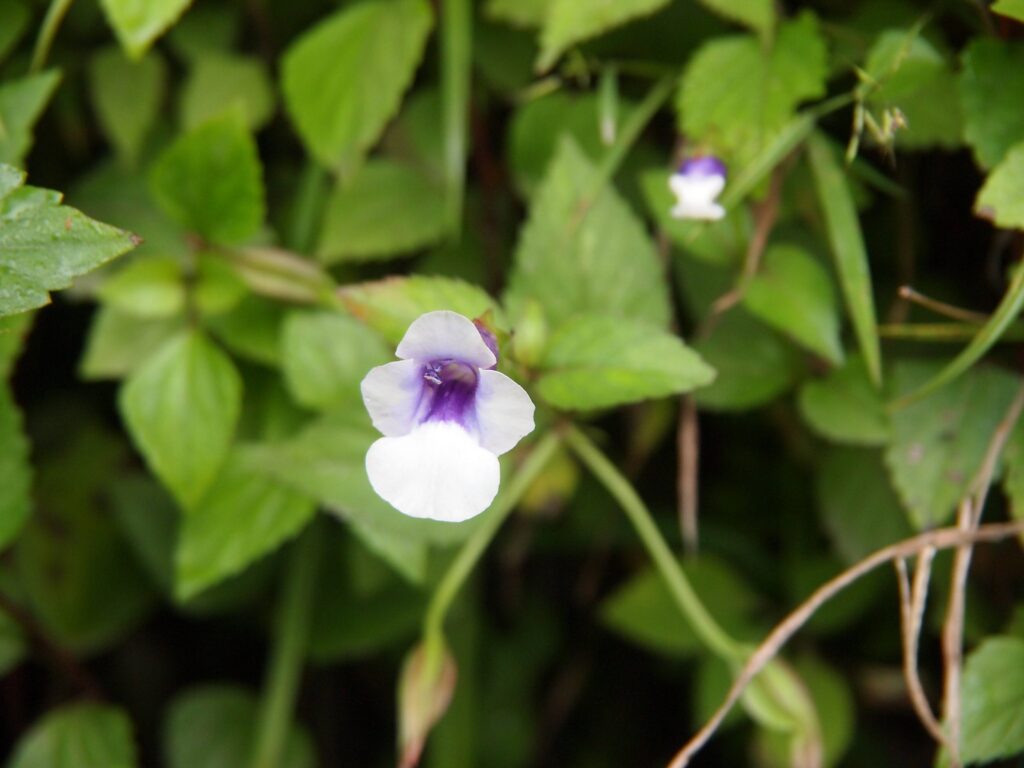
Torenia violacea is a small annual herb widely distributed across tropical and subtropical Asia, recorded by GBIF, with over a thousand occurrences, from India, Nepal, Bhutan and Bangladesh through China, Taiwan and Japan to Myanmar, Thailand, Laos, Cambodia, Vietnam, the Philippines, Malaysia, Singapore, Brunei, Indonesia and Papua New Guinea. It is a plant of warm, humid lowland and lower montane situations, growing on moist, shaded ground in rice-field margins, ditches, streamsides, damp roadside banks, forest paths and other disturbed wet places, mostly at low elevations. The photographed plant from Pemagatsel in southeastern Bhutan, at about 300 m and flowering in October, exemplifies this low-altitude, monsoon-influenced habitat, where the species flowers into the post-monsoon autumn in the warm foothill zone.

It is a slender, erect to ascending or somewhat decumbent annual with quadrangular, narrowly winged stems that branch from the base. The leaves are opposite, ovate to ovate-lanceolate, with a serrate margin, an acute apex and a rounded to broadly cuneate base, borne on short petioles. The flowers are axillary or in terminal racemes, each subtended by a tubular, five-winged (ridged) calyx. The corolla is two-lipped and violet to pale lilac, often with a yellow throat, the lower lip three-lobed and the tube curved; the four didynamous stamens are a diagnostic feature, the anterior filaments often bearing a slender appendage at the base. The fruit is a narrow, oblong, septicidal capsule enclosed by the persistent winged calyx and releasing numerous minute seeds.

Long placed in Scrophulariaceae and later in Veronicaceae or Plantaginaceae, Torenia is now assigned to the segregate family Linderniaceae, recognised on molecular grounds, alongside Lindernia and Vandellia, to which several species formerly called Torenia have been transferred. T. violacea, based on Azaola's name and recombined by Pennell, is distinguished within the genus by its five-winged calyx and violet corolla. The species is a self-compatible weedy annual of disturbed wet ground, abundant and adaptable across its very large range, and is of no conservation concern; ornamental relatives in the genus (the "wishbone flowers") are popular bedding plants.

Author: (Azaola) Pennell · Sources: POWO (Kew), GBIF, Flora of China Vol. 18, Flora of Bhutan Vol. 2, Flora of Nepal, Flora of Pakistan, Fischer's revision of Linderniaceae