Tag:

Nepal

Flowers of Nepal — 1313 wild plant species documented from the Nepalese Himalaya, from subtropical foothills to high alpine meadows above 4,000 m. Nepal’s dramatic elevation gradient makes it one of the richest botanical regions on Earth, home to rhododendrons, primulas, gentians and the famed blue poppies (Meconopsis). Every entry gives a botanical description, native distribution, habitat and flowering season, alongside the original field photograph and the location where it was taken.

L.

Garh 07 94 ergebnis
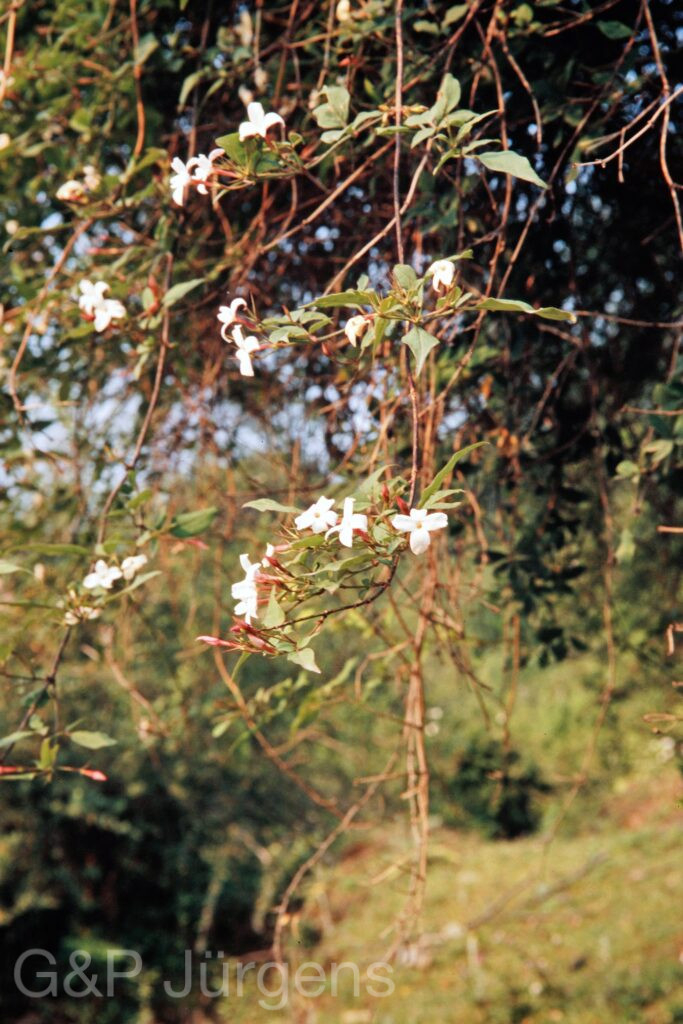
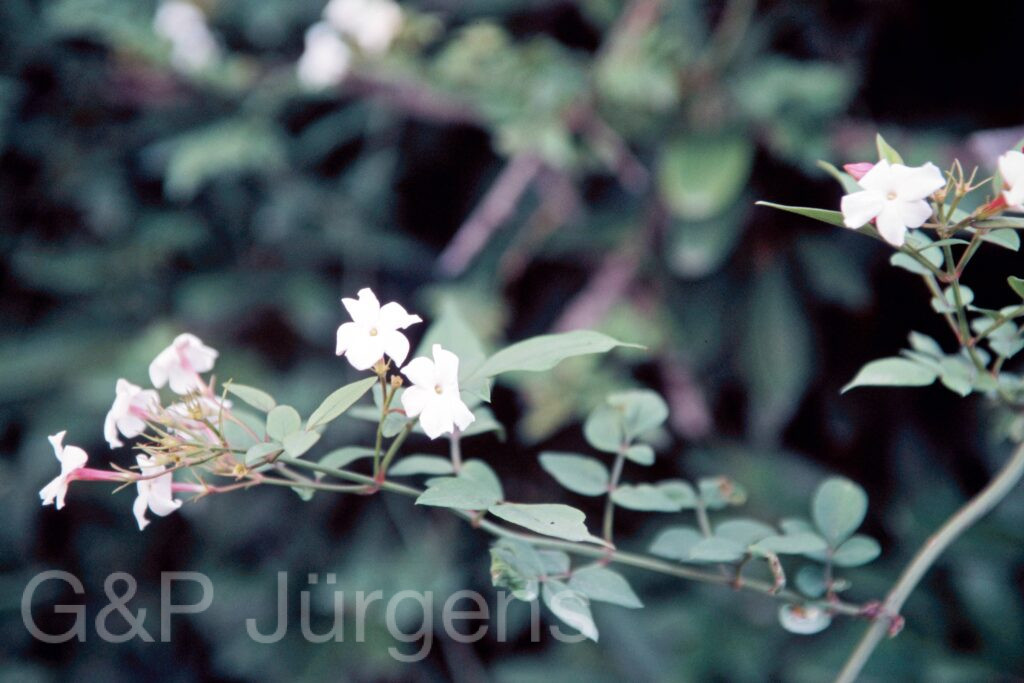
India Garhwal Meggu Kichatti 3100m, June
Garh 07 309 ergebnis
India Garhwal Bebra 2400m, June

Description

Jasminum officinale, the common or poet's jasmine, is native to the Caucasus, Central Asia and the Himalaya through Afghanistan, Pakistan, N India, Nepal and SW China, but is so widely cultivated that GBIF's 3,200-plus records span France, Britain, Spain, Italy, the United States, Australia and beyond, reflecting naturalisation far outside its native range. In its Himalayan homeland it is a plant of open forest, scrub, thickets and rocky slopes. The photographed material from Garhwal in the Indian Himalaya, at Meggu Kichatti (3,100 m) and Bebra (2,400 m) in June, illustrates its occurrence on warm temperate to subalpine slopes between roughly 1,500 and 3,100 m.

It is a deciduous or semi-evergreen scrambling shrub with slender, angular, twining green branches. The leaves are opposite and imparipinnate, with usually five to nine ovate-lanceolate, acuminate leaflets, the terminal leaflet longer and stalked. The fragrant flowers are borne in terminal and axillary cymes; each has a slender corolla tube expanding into four to five spreading white lobes, often flushed pink in bud. The fruit is a black, two-lobed berry, though fruiting is uncommon in cultivated clones.

The intense evening fragrance, produced by volatile esters and indole, attracts moths and other long-tongued nocturnal pollinators and underlies the long economic history of the species in the perfume and tea-scenting industries. Numerous cultivars and forms exist, including the hardy var. affine. As an extensively cultivated and locally naturalising species it is of no conservation concern, and indeed can behave as a garden escape in mild-climate regions worldwide.

Author: L. · Sources: POWO (Kew), Flora of Pakistan, GBIF, Flora of China Vol. 15, Green: A Revision of the Genus Jasminum (Kew Bulletin)

Sam.

Sikkim2011 378
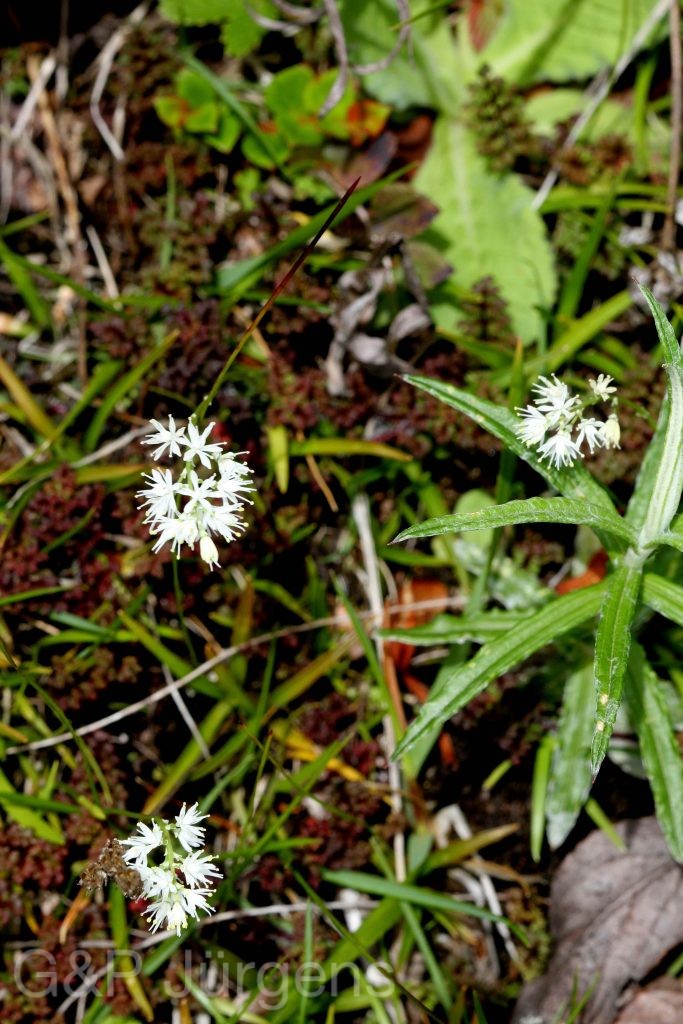
Sikkim Lada-La 3400, June

Description

Juncus cephalostigma is a Himalayan rush distributed from Nepal through Sikkim and adjacent India to Bhutan, northern Myanmar and south-western China, with about 139 GBIF records reflecting a restricted eastern Himalayan to Sino-Himalayan range. It is a plant of wet alpine and subalpine habitats: marshy meadows, streamsides, seepage slopes, springs and the margins of pools, generally between about 3,000 and 4,200 m. The plant photographed at Lada-La in Sikkim at 3,400 m, flowering in June, is typical of the cool, perennially moist high-montane grasslands and mires where rushes of this group thrive.

The plant is a tufted perennial herb growing from a short rhizome, with slender, erect, terete to compressed stems. The leaves are basal and cauline, grass-like, with the characteristic open or closed tubular sheaths of the genus. The inflorescence is a small terminal or pseudolateral cluster of few flowers, often condensed into a head (the epithet cephalostigma alluding to the head-like stigmatic arrangement); each flower has six small, scarious-margined, brownish to greenish tepals, six (or three) stamens, and a superior ovary crowned by a style with three stigmas. The fruit is a small loculicidal capsule containing numerous minute seeds.

Juncus is the largest genus of Juncaceae, a wind-pollinated family of cosmopolitan, mostly cool-climate and wetland graminoid herbs. The Himalayan rushes form a taxonomically demanding assemblage in which species are separated by fine characters of the inflorescence, capsule and seed. As an inhabitant of high-altitude wetlands, J. cephalostigma is sensitive to hydrological change and grazing, though it is not currently regarded as threatened.

Author: Sam. · Sources: POWO (Kew), Flora of China Vol. 24, Flora of Bhutan Vol. 3, GBIF, Kirschner: Juncaceae (Species Plantarum: Flora of the World)

D.Don

Sikkim2011 200
Sikkim Yumthang 3300m, June

Description

Juncus concinnus is a tufted, grass-like perennial rush of the Juncaceae, distributed through the Himalaya and the mountains of eastern Asia. GBIF data (nearly 1,000 occurrences) document a native range across China, Nepal, India, Bhutan, Pakistan, Japan, Myanmar and Thailand. The species is characteristic of moist alpine and subalpine habitats, including wet meadows, marshy ground, streamsides, seepage flushes and damp grassy slopes, generally between about 2,500 and 4,500 m. The collection from Yumthang in northern Sikkim at 3,300 m in June reflects its occurrence in the wet, snow-fed alpine meadows of the eastern Himalaya in early summer.

The plant forms dense tufts of slender, erect, terete to slightly compressed stems arising from a short rhizome, with narrow, channelled basal and cauline leaves. The inflorescence is a more or less compact, terminal cluster of several flower heads, each head comprising a few small, dark-coloured flowers. As in all Juncus, the perianth consists of six chaffy, lanceolate tepals (the inner and outer whorls similar), subtending three or six stamens and a superior ovary. The fruit is a small, three-valved loculicidal capsule containing numerous minute seeds, the chaffy perianth persisting around it.

Juncus is a large, cosmopolitan genus of the rush family, an assemblage of wind-pollinated, reduced-flowered monocots adapted predominantly to wet and seasonally inundated ground. As a component of alpine mire and wet-meadow vegetation, J. concinnus contributes to the structure of high-altitude wetland turf and stabilises moist soils. Widely distributed and secure across its range, it nonetheless depends on intact alpine hydrology, making it sensitive to wetland drainage and to changes in snowmelt regimes.

Author: D.Don · Sources: POWO (Kew), Flora of China Vol. 24, Flora of Bhutan Vol. 3, GBIF, Kirschner et al.: Juncaceae – Species Plantarum: Flora of the World

Fisch. & C.A.Mey.

Sikkim2011 92
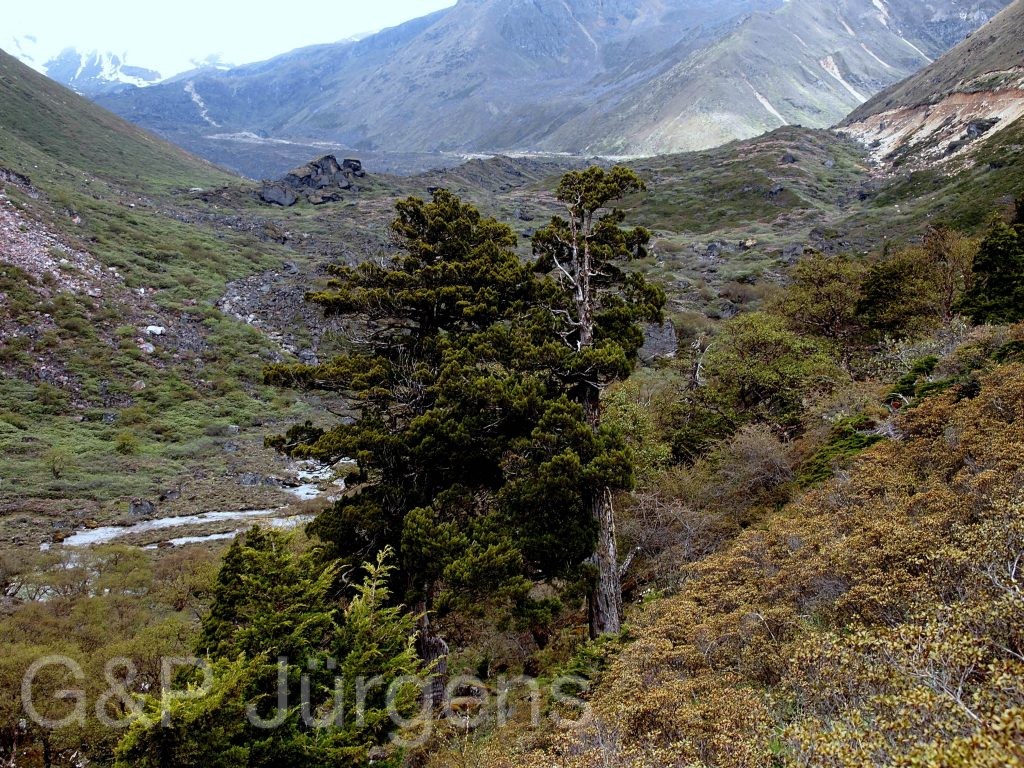
Sikkim Chopta-valley 4300m, June
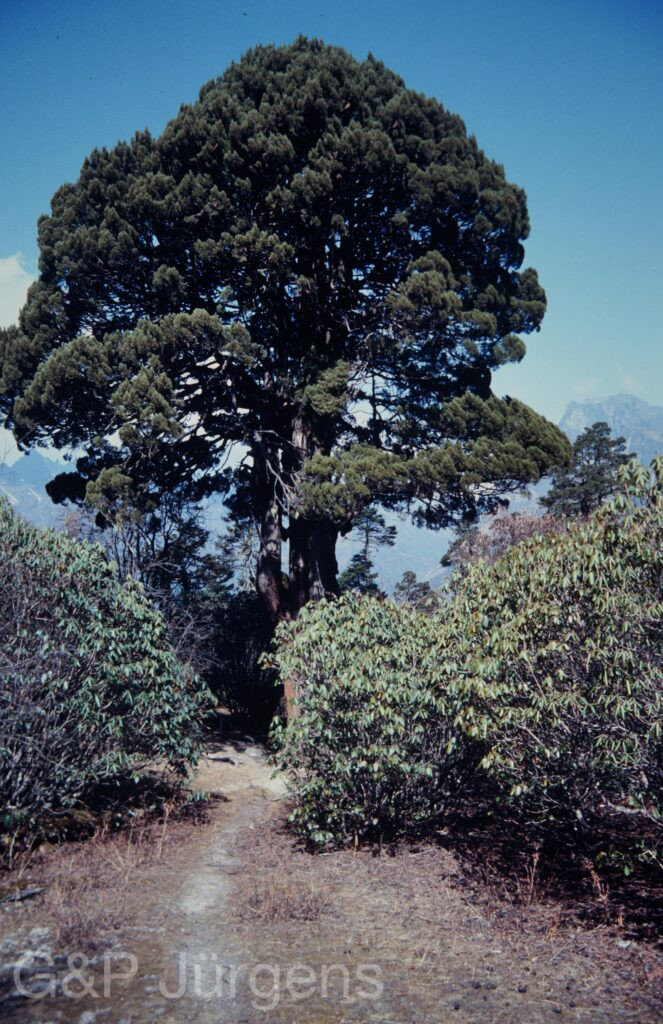
Nepal1992 120 P170 ergebnis
Nepal Ghunsa 3400m March

Description

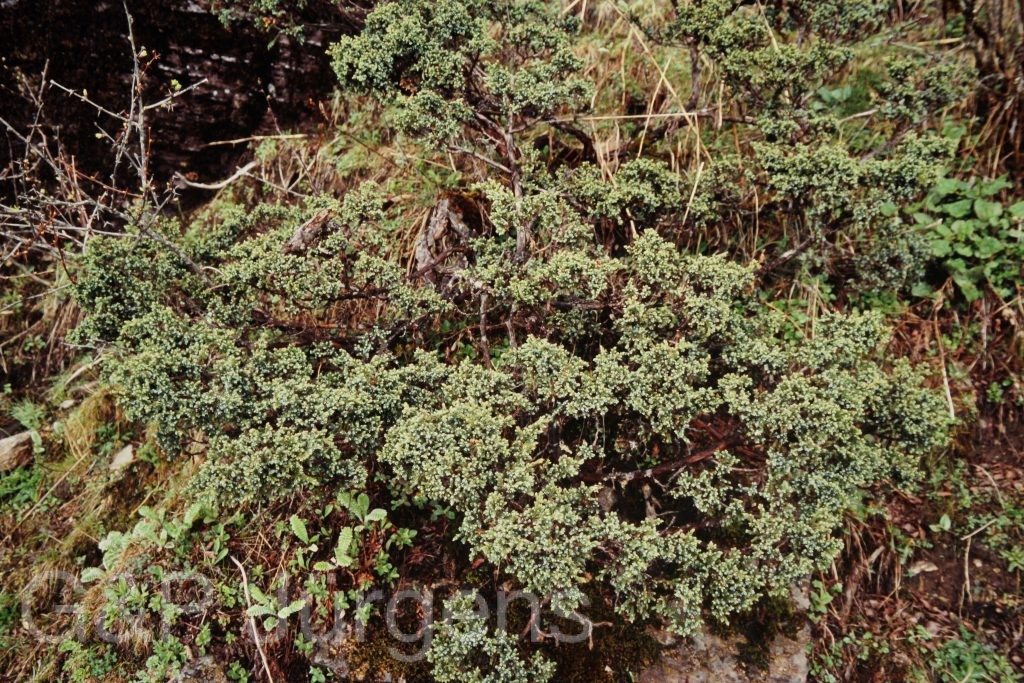
Juniperus pseudosabina is a coniferous shrub of the high mountains of Central Asia and the Himalaya, with GBIF documenting around 1678 occurrences across Russia, Kazakhstan, China, Uzbekistan, Mongolia, Kyrgyzstan, Pakistan, Tajikistan, India, Nepal, Afghanistan and Bhutan. It is a constituent of the upper subalpine and alpine zones, forming krummholz and prostrate thickets on stony slopes, rocky ridges, moraines and at the timberline. The photographed plants were recorded in Sikkim's Chopta valley at 4300 m in June and at Ghunsa in Nepal at 3400 m in March, illustrating its occupation of cold, exposed high-montane sites near and above the tree limit.

It is typically a low, spreading, mat-forming or procumbent shrub, occasionally a small tree, with reddish-brown shredding bark. The foliage is mostly squamiform (scale-like), with small, closely appressed, rhombic leaves bearing a conspicuous dorsal resin gland; needle-like juvenile leaves may persist on vigorous shoots. The species is usually dioecious; the pollen cones are small and terminal, while the seed cones are berry-like galbuli that ripen blue-black to purplish-black, are glaucous, and characteristically contain a single large seed.

GBIF accepts the name. Belonging to section Sabina, the multi-seeded and single-seeded savin junipers, J. pseudosabina is closely allied to several Himalayan and Central Asian junipers with which it has been taxonomically confused. Its galbuli are dispersed by birds, and the dwarfed, wind-pruned habit reflects adaptation to severe alpine exposure. Wide-ranging and locally abundant, it is assessed as of least concern.

Author: Fisch. & C.A.Mey. · Sources: POWO (Kew), GBIF, Flora of China, Flora of Nepal, Farjon monograph of Juniperus

Buch.-Ham. ex D.Don

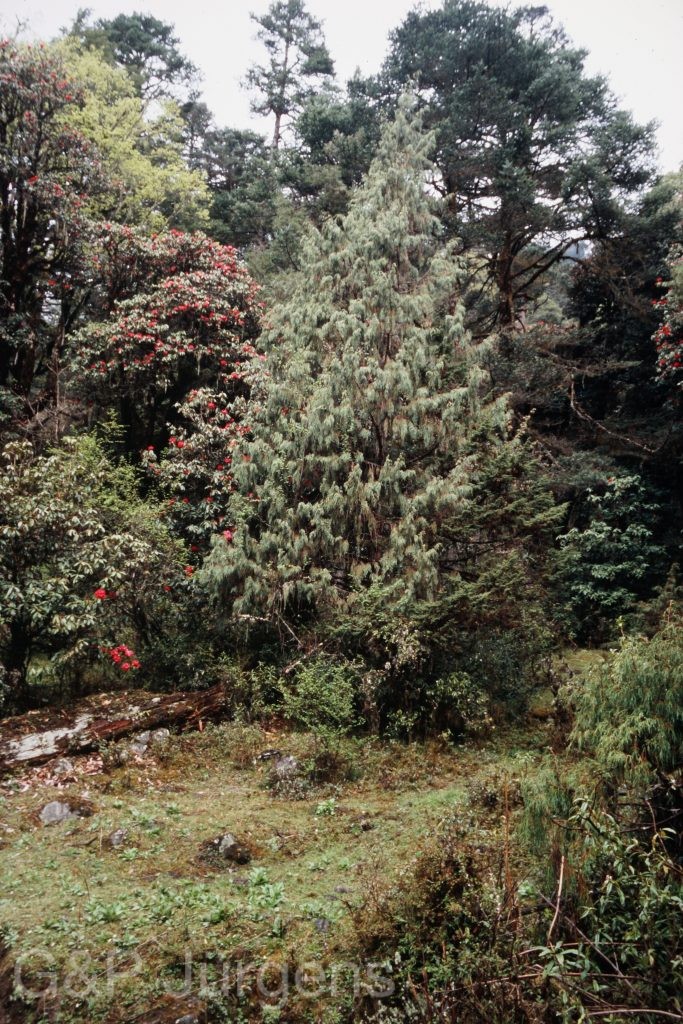
Bh2008 394 P610
Bhutan Gogona 3160m, May

Description

Juniperus recurva, the drooping or Himalayan weeping juniper, is a high-mountain conifer native across the Himalaya and adjacent China, with a core distribution in China, Nepal, India, Bhutan, Myanmar, Afghanistan and Pakistan; its very large GBIF tally of around 1185 records includes numerous cultivated occurrences in Great Britain, the United States, Spain, New Zealand, Japan and Germany, reflecting its long history in horticulture. In the wild it is a tree of the subalpine and alpine zones, forming open woodland, krummholz and scattered stands at and above the timberline on dry, rocky slopes. The tree photographed at Gogona in Bhutan at about 3160 m in May typifies its occurrence in the upper subalpine belt, where it often mingles with Abies, Rhododendron and Betula.

It is an evergreen tree or large shrub with characteristically pendulous, drooping branchlets and reddish-brown, fibrous bark that peels in long strips. The foliage consists of needle-like (acicular) juvenile-type leaves borne in whorls of three, incurved and sharply pointed, with a glaucous adaxial band; the leaves are retained as adults rather than reduced to scales. The species is typically dioecious, with small terminal pollen cones and ovulate cones that mature over two seasons into fleshy, berry-like galbuli that ripen blue-black to brownish and usually contain a single seed.

Juniperus recurva belongs to section Juniperus (the needle-leaved junipers) and includes the well-known coffin-juniper variant (var. coxii) with especially long pendulous shoots. Its fleshy cones are dispersed by birds and mammals, and the aromatic foliage is traditionally burned as incense across the Buddhist Himalaya. Although globally widespread and not classed as threatened, local populations near settlements are depleted by cutting for incense and fuel, and as a slow-growing timberline species it is potentially sensitive to warming-driven shifts in the upper forest limit.

Author: Buch.-Ham. ex D.Don · Sources: POWO (Kew), GBIF, Flora of China Vol. 4, Flora of Bhutan Vol. 1, Flora of Nepal, Adams Junipers of the World: The Genus Juniperus

Siebold & Zucc.

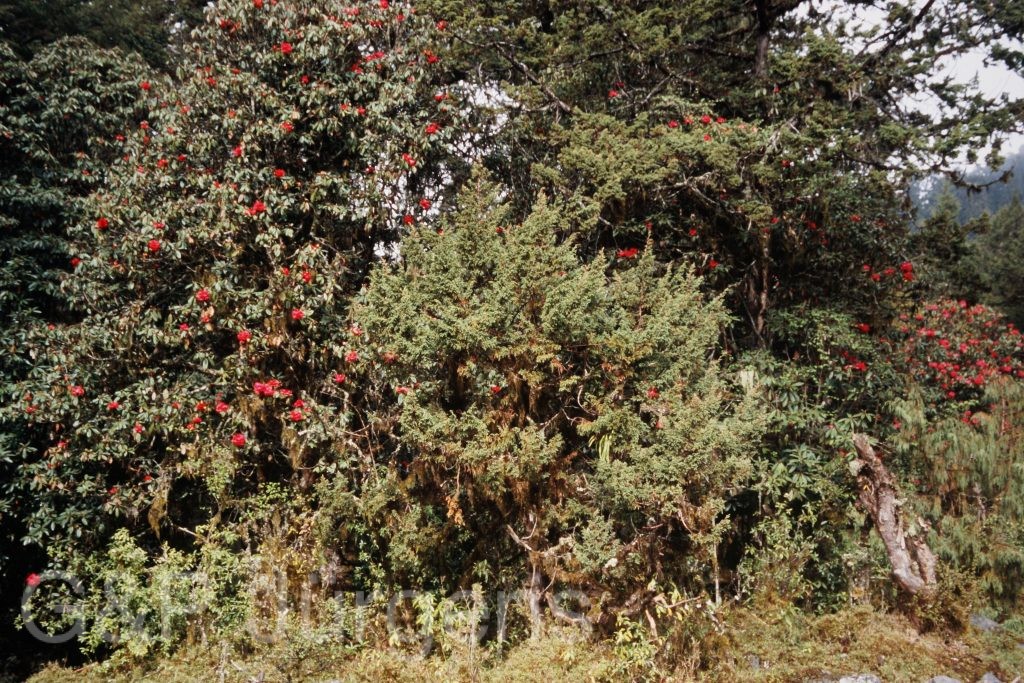
Bh2008 391 P606
Bhutan Gogona 3250m, May

Description

Juniperus rigida is a coniferous shrub or small tree of temperate East Asia, very well represented in GBIF with 6235 occurrences centred on Korea, Japan, China and the Russian Far East, alongside numerous cultivated records in Europe and North America. It grows on dry, rocky slopes, exposed ridges, sandy soils and open montane woodland, tolerating poor substrates and cold, often from the hills to the subalpine zone. The individual photographed at Gogona in Bhutan at 3250 m in May reflects its occurrence at higher Himalayan elevations, where it persists on stony, well-drained ground in cool montane conditions.

The plant is a dioecious, evergreen shrub or tree with spreading to pendulous branches and reddish-brown, fibrous bark that peels in strips. The leaves are all needle-like (acicular), borne in whorls of three, rigid, sharply pointed and deeply grooved adaxially with a single white stomatal band, a combination giving the foliage a harsh, prickly texture reflected in the epithet rigida. The male cones are small and axillary, shedding pollen in spring; the female structures develop into fleshy, berry-like seed cones (galbuli) that ripen blue-black with a glaucous bloom over about two years, each typically enclosing three seeds.

Juniperus rigida belongs to section Juniperus, the needle-leaved junipers, and is closely allied to J. communis, from which it differs in its longer, more rigid leaves and arching habit. It is widely cultivated as an ornamental and for bonsai, explaining many of its extralimital records. Ecologically it is a hardy pioneer of disturbed and stressful sites, and it remains common and of least concern across its broad native range.

Author: Siebold & Zucc. · Sources: POWO (Kew), GBIF, Flora of China Vol. 4, Flora of Bhutan Vol. 1, Flora of Nepal, Flora of Pakistan, Adams' Junipers of the World

Buch.-Ham. ex D.Don

Bh09 168 P297
Bhutan Labana 3600m May

Description

Juniperus squamata Buch.-Ham. ex D.Don is a variable, mostly prostrate to shrubby juniper of the Cupressaceae, native across the Himalaya and central and western China and recorded from Nepal, India, Bhutan, Pakistan, Afghanistan and Myanmar; with over 3,300 georeferenced records, many from cultivation in Europe, North America and Australasia, it is a widely grown ornamental as well as a wild montane species. In the wild it occupies high-altitude scrub, rocky alpine slopes, open conifer forest margins, ridges and exposed crests near and above the treeline. The photographed plant from Labana in Bhutan at about 3,600 m in May is typical of its subalpine to alpine station, where it often forms low spreading mats anchoring thin stony soils.

It is an evergreen shrub, frequently decumbent and mat-forming but sometimes erect and small-tree-like, with reddish-brown, flaking bark and ascending branchlet tips that are characteristically nodding. The foliage is entirely needle-like (acicular) and arranged in dense whorls of three, each leaf rigid, sharply pointed, concave and glaucous-white on the upper surface, giving the plant a frosted appearance. The species is usually dioecious; the seed cones are small, ovoid, ripening from green through reddish to glossy black, fleshy and berry-like, and contain a single seed.

Juniperus squamata belongs to section Juniperus, the needle-leaved junipers, and is morphologically variable across its range, having given rise to numerous horticultural cultivars selected for habit and foliage colour. As a slow-growing pioneer of harsh exposed sites it contributes to soil stabilisation at high elevation. The species is widespread and assessed as Least Concern, though local stands are affected by grazing and fuelwood collection.

Author: Buch.-Ham. ex D.Don · Sources: POWO (Kew), Flora of China Vol. 4, Flora of Bhutan Vol. 1, GBIF, Adams: Junipers of the World (2014)

L.

Nepal1992 15 P20 ergebnis
Nepal Tumlingtar 1200m March 
Nepal1992 16 P21 ergebnis
Nepal Tumlingtar 1200m March 

Description

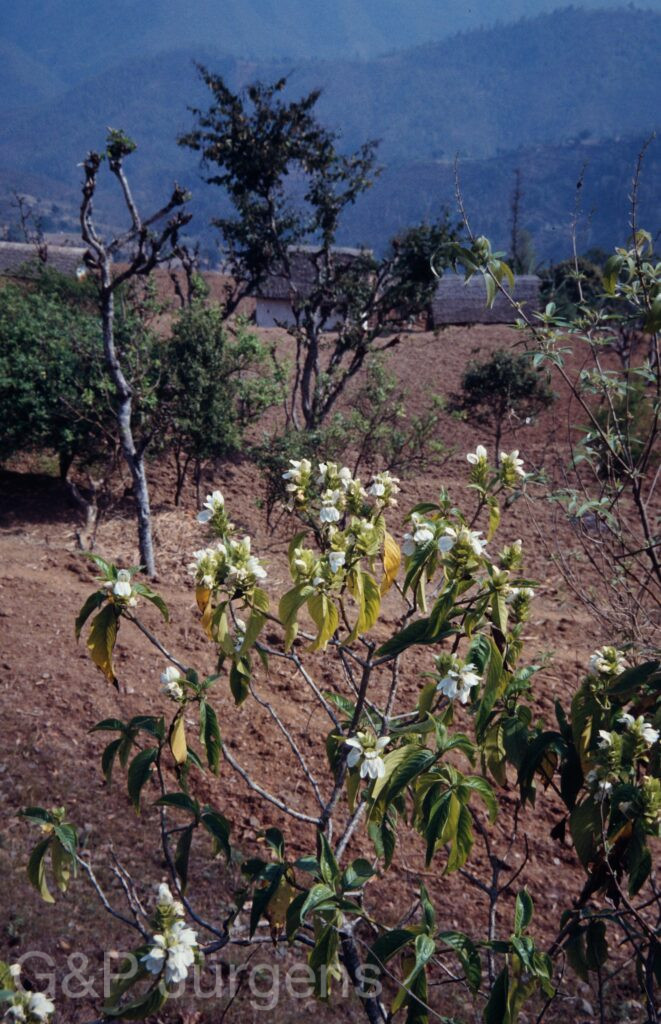
Justicia adhatoda, the Malabar nut or vasaka, is a widely distributed shrub native to the Indian subcontinent and now naturalised or cultivated across much of the tropics and subtropics; GBIF records (over 1500) span India, Nepal, Pakistan, Sri Lanka, China, Southeast Asia and many introduced regions in the Americas, Europe and beyond. In its Himalayan range it grows in the subtropical foothills and warm valleys, along streamsides, forest margins, fallow land and roadside scrub, generally below about 1300 m. The photographed plant from Tumlingtar in eastern Nepal (1200 m, flowering in March) sits squarely within this lower-elevation, dry-season-flowering habitat.

The plant is a robust, evergreen, much-branched shrub reaching 1–3 m, with opposite, lanceolate to elliptic-oblong, entire leaves that are pinnately veined and emit a strong odour when crushed. The flowers are borne in dense, axillary or terminal, bracteate spikes, the large ovate bracts conspicuous. Each flower is strongly two-lipped (bilabiate): the corolla is white to pale, the lower lip marked with purple to pinkish veining and a yellow throat. There are two stamens with bithecous anthers whose cells are unequally inserted. The fruit is a clavate, four-seeded capsule that dehisces explosively, the seeds projected from retinacula in the manner characteristic of Acanthaceae.

The species is of considerable economic and ethnobotanical importance, long used in Ayurvedic and Unani medicine for respiratory complaints; its leaves contain the quinazoline alkaloid vasicine (peganine) and related compounds with bronchodilatory and expectorant activity. Taxonomically it was formerly segregated in the monotypic genus Adhatoda but is now embedded within a broadly circumscribed Justicia. Being weedy and widely cultivated, it is of no conservation concern.

Author: L. · Sources: POWO (Kew), GBIF, Flora of Nepal, Flora of British India, Flora of China (Acanthaceae), A Revision of the genus Justicia (Acanthaceae)

L.

Nepal 97 410 P792
Nepal Tashigaon 3000m May
Nepal 2001 173 ergebnis ergebnis
East-Nepal Sabha-Khola 2100m, April

Description

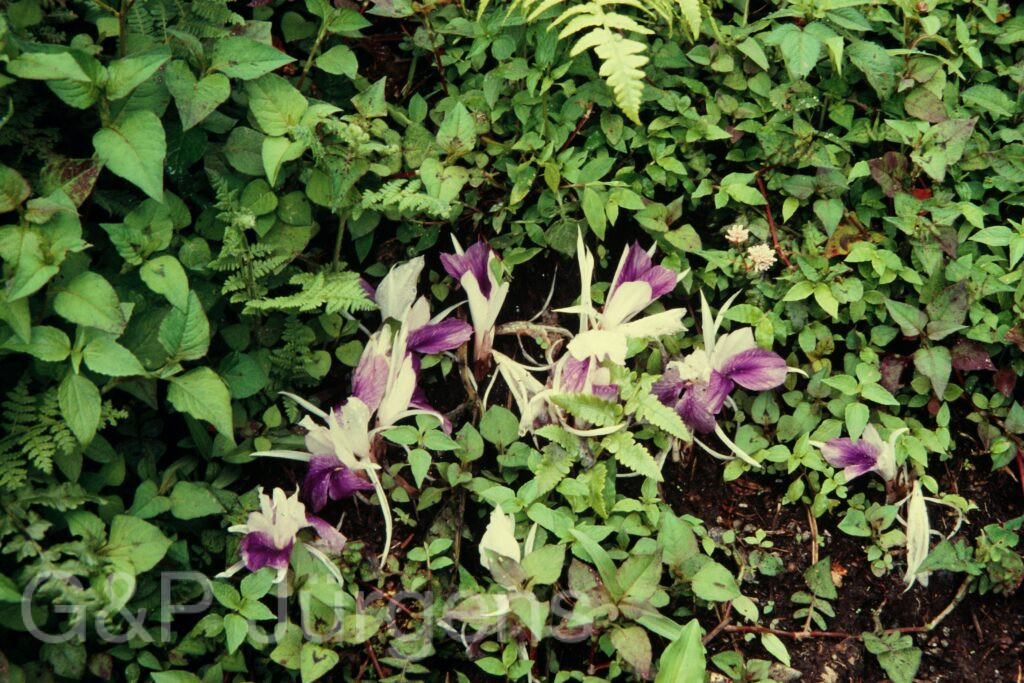
Kaempferia rotunda L. is a tuberous, rhizomatous herb of the ginger family native to tropical and subtropical Asia and very widely cultivated, so that its GBIF record (586 occurrences) spans India, Myanmar, China, Thailand, Bangladesh, Cambodia, Laos, Vietnam, Indonesia and the Philippines alongside many introduced localities in the Neotropics, North America and the Pacific. In the Himalayan foothills it grows in warm, shaded forest, scrub and disturbed ground; it was recorded in eastern Nepal at Sabha-Khola near 2100 m in April and at Tashigaon around 3000 m in May, the latter elevation being unusually high and probably reflecting sheltered, low-frost microsites or local cultivation.

The plant arises from a clustered, aromatic rhizome bearing fleshy tuberous roots. The leaves, two to four per shoot, are oblong-lanceolate, often handsomely variegated with dark and silvery-green zones above and purplish beneath, and appear after or with flowering. The inflorescence is hysteranthous, emerging directly from the rhizome at ground level before the leaves expand: a cluster of short-lived flowers with white, narrowly oblong corolla lobes, two petaloid white staminodes, and a conspicuous, deeply bilobed lilac to violet labellum. The fruit is a three-valved capsule, though propagation is largely vegetative.

Kaempferia rotunda is the type species of its genus and is grown ornamentally as 'peacock ginger' and used in traditional medicine across South and Southeast Asia, its rhizomes valued for fragrant essential oils. Its enormous naturalised range testifies to long human movement of the species. Pollination of the showy ephemeral flowers is by bees and other insects attracted to the labellar nectar guides, while persistence in cultivation buffers it against any wild conservation concern.

Author: L. · Sources: POWO (Kew), GBIF, Flora of China, Flora of Bhutan, Flora of British India, Zingiberaceae monograph (Larsen & Larsen; K. Schumann Zingiberaceae)

Kuntze

Bhutan2014 260
Bhutan Karu-Chu 1800m, May

Description

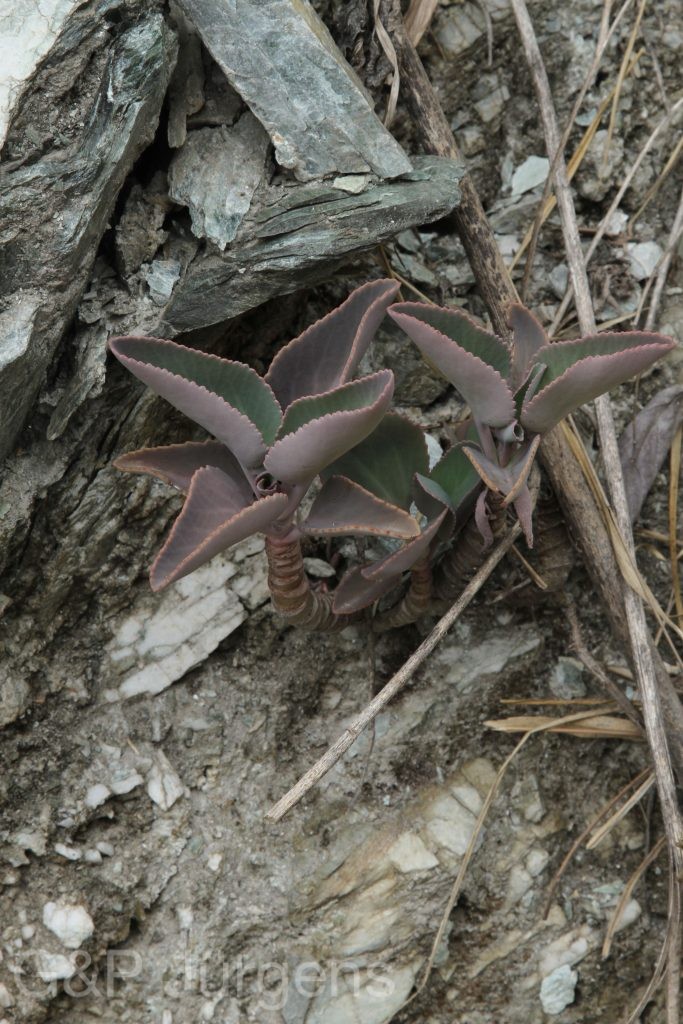
Kalanchoe integra is a succulent herb of broad palaeotropical and introduced distribution, recorded by GBIF (around 902 occurrences) across tropical and subtropical Asia and beyond, including Taiwan, Indonesia, the Philippines, India, Thailand, China, Japan, Nepal, Myanmar and Bhutan, as well as introduced or cultivated populations in the Americas and Europe. It grows on warm, dry, rocky slopes, open hillsides, walls, ledges and disturbed ground, favouring sunny, well-drained sites in the foothill and lower montane zones. The collection from Karu-Chu in Bhutan at about 1800 m in May marks a Himalayan foothill occurrence and reflects its preference for relatively low, warm elevations and its spring flowering at the onset of the growing season.

The plant is an erect, glabrous, fleshy perennial or biennial herb with a stout, often simple stem. The succulent leaves are opposite and decussate, the lower ones petiolate and obovate to oblong with a crenate or shallowly toothed margin, the upper leaves becoming sessile and sometimes pinnately lobed. The inflorescence is a large, terminal, much-branched corymbose cyme of numerous pendent, tubular flowers. Each flower has a fused, somewhat inflated tubular calyx and a longer tubular corolla in shades of yellow to orange or reddish, with four spreading lobes. There are eight stamens inserted on the corolla tube, and the four free carpels mature into many-seeded follicles.

Described under the combination by Kuntze, Kalanchoe integra belongs to a large Old World genus of the Crassulaceae noted for crassulacean acid metabolism (CAM), an adaptation enabling water conservation in seasonally dry habitats. The genus is taxonomically intricate, many names being confused within the K. integra-K. laciniata-K. spathulata complex. The species is used in traditional medicine in parts of its range and is sometimes cultivated. Being widespread, weedy and tolerant of disturbance, it is not of conservation concern.

Author: Kuntze · Sources: POWO (Kew), GBIF, Flora of China, Flora of Bhutan, Flora of British India, Raymond-Hamet revision of Kalanchoe